







Abstract
Several studies have found restrictions on minority faith-based communities to be related to the onset of violent religious hostilities. Absent from this work, though, is a consideration of the fact that minority religious discrimination can take different forms, and, consequently, may encourage violence in different ways. This paper seeks to fill this void by examining different forms of minority religious restrictions and their relationship to religious violence. Specifically, we analyze the comparative strength of three basic types of religious discrimination—restrictions on minority religious practices, restrictions on minority religious institutions, and restrictions on conversion and proselytizing—on violence carried out by both religious majority groups and religious minority groups. Interestingly, our analysis shows all three forms of restrictions encourage violence from religious majorities, but not from minorities. We supplement the statistical analysis with a case study of faith-based discrimination and violent religious hostilities in India.
Introduction
Since the end of the Cold War, accelerating levels of international migration coupled with the unprecedented spread of religious beliefs, both made possible through globalization processes, have resulted in increasing levels of religious diversity in countries around the world (Banchoff 2007; Hertzke 2012; Seiple and Hoover 2021). Political leaders, though, have struggled to design policies for effectively dealing with this new reality, especially with respect to assimilating and protecting minority communities (Kirkham 2013). The default position of many governments has been to restrict the activities of religious minorities, ostensibly for the sake of preserving national unity in the face of this increasing diversity, as political leaders often see their states as inextricably intertwined with historically dominant religious traditions (Fox 2016, 2020; Fox and Akbaba 2015a; Turner 2007).
The question of how to deal with religious minorities is not merely a question of morality, but one of national security to boot (Farr 2008; Grim and Finke 2010; Saiya 2018). Recent history provides many anecdotal examples of increasing violent hostilities between majority and minority religious groups throughout the world. In Sri Lanka, a resurgent Buddhist nationalism, abetted by Colombo’s laws and policies, has resulted in several deadly episodes of communal rioting between majority Buddhists and minority Muslims. In Sri Lanka’s neighbor to the north, India, political leaders acting on the basis of “Hindutva”—the ideology of the Hindu Right represented in political groups such as the Bharatiya Janata Party (BJP)—call for the amalgamation of Hinduism and the state and the restriction of minority groups such as Sikhs, Muslims, and Christians, who are believed to pose a threat to India’s identity as a Hindu nation—a situation that has directly fed inter-religious hostilities. The dynamic of minority discrimination leading to violence is particularly acute in Muslim-majority countries where state power is often used to promote a conservative form of Islam throughout all of society. In countries such as Pakistan, Sudan, and Afghanistan, codified forms of religious discrimination against non-Muslims and heterodox Muslims have resulted in cycles of attacks and reprisals. Similar dynamics can even be seen recently in the countries of the West where new forms of Christian nationalism have spawned clashes between different religious communities (Brubaker 2017).
Several studies have demonstrated empirically the causal relationship between faith-based discrimination against minorities and the outbreak of violence (Akbaba and Taydas 2011; Fox 2002, 2004; Grim and Finke 2010; Saiya 2014, 2015a, 2015b, 2017a, 2017b, 2018, 2019a, 2019b, 2020, 2021a, 2021b; Saiya and Fidler 2018; Saiya and Manchanda 2020a, 2020b; Saiya and Scime 2015; Saiya and Scime 2019; Toft, Philpott, and Shah 2011). Absent from this work, however, is an appreciation for the fact that religious discrimination against minorities can take different forms and that these different types of discrimination may promote different forms of religious conflict—a gap the present article hopes to fill. To simplify, minority religious discrimination comes in three general varieties: restrictions on minority religious practices; restrictions on minority religious institutions; and restrictions on missionary activity, conversion and proselytizing. In this study, we analyze the impact of minority discrimination on violent religious hostilities by examining each dimension of discrimination separately. Disaggregating minority discrimination in this manner thus provides a sharper grasp of the different avenues by which distinctive forms of discrimination against minority groups help generate violent religious hostilities. We also parse out violence committed by religious majorities from violence undertaken by religious minorities. Interestingly, our analysis shows all three forms of restrictions encourage violence from religious majorities, but not from minorities. We argue that this paradoxical finding may result from the fact that minority religious discrimination alters the “structure of opportunities” for both religious minorities and majorities in a way that deters violence from the former but encourages it from the latter. In fact, in several cases, restrictions on minorities are associated with a lower propensity for violence among minority groups experiencing discrimination.
This paper proceeds in seven parts. The first section discusses the literature on faith-based discrimination and violent religious conflict. It notes that discrimination can encourage violence via two pathways: minority backlash and majority radicalization. In the second section, we discuss three different types of minority religious discrimination and how each theoretically encourages violent hostilities between majority and minority faith communities. The third section covers the data and methods, while the fourth section presents the results. A fifth section offers a discussion of the statistical results, and proposes an explanation for our paradoxical finding. The sixth section presents a single-country case study, examining the link between faith-based discrimination and violent religious hostilities in India. The seventh section concludes, contextualizing how our analysis advances the study of religion and violence.
Literature Review
The argument that discrimination can foster grievances leading to rebellion has long been an established finding in the literature on contentious politics (Crenshaw 1981; Gurr 1968, 1993, 1968, 1970; Gurr and Moore 1997; Gurr 2000). In his classic treatment of the subject, Gurr (1970) argued that a sense of “relative deprivation”—the result of political, social, or economic exclusion—creates a perception of injustice among marginalized outgroups and produces grievances against the state and groups favored by the state. This perception of shared grievance also serves to solidify group identity, activating group-based discontent (Østby 2008; Tillly 1978). If widespread enough, these grievances can lead to mobilization and even armed rebellion against those believed to be responsible for the outgroup’s marginalization (Cramer 2003). In this view, the goal of violence is to redress an unfair status quo, and the level of violence varies according to the level of injustice people feel.
Much of the work on how grievances encourage violence has focused on ethnic conflicts, including civil wars, terrorism, and other episodes of mass violence (Cederman, Wimmer, and Min 2010; Crenshaw 1981; Denardo 1985; Fox 2000, 2004; Gurr 1996; Gurr and Moore 1997; Lichbach 1998; Laqueur 1999; Moore 2000; Regan and Norton 2005; Ross 1993; Wimmer, Cederman, and Min 2009; Wucherpfennig et al. 2012). Over the past decade, however, scholars, recognizing that religion occupies a central place in global conflicts, have attempted to extend this basic framework to religious conflict (Akbaba and Taydas 2011; Finke and Harris 2012; Finke and Martin 2012; Grim and Finke 2010; Muchlinski 2014; Toft, Philpott, and Shah 2011). Just as frustration with existing political, economic, and social realities can lead to ethnic rebellion, resentment over the unequal treatment of religious groups can likewise spur religious communities to take up the gun (Juergensmeyer 1993; Rapoport 1991).
Like more general forms of discrimination, faith-based discrimination divides people into insiders and outsiders, in this case on the basis of one’s religious tradition. Whereas the religious traditions and beliefs of majority traditions receive protection and often preferential treatment by the state, minority faith traditions are suppressed through official laws and policies (Fox 2016, 2020; Fox and Torpor 2021; Grim and Finke 2010). The experience of discrimination, in turn, generates and reinforces a sense of marginalization and creates grievances. Accordingly, the grievances held by minority religious communities as a result of discrimination produce a “minority backlash.” If severe enough, this backlash can turn violent as the presence of grievances enable the overcoming of the collective action problem (Gurr 1996). This “embittered minorities” framework has been used by scholars to explain some of the world’s most sanguinary religiously informed insurgencies, from the Sri Lankan civil war to India’s Sikh resistance movement to Northern Ireland’s Troubles. The logic linking discrimination to violence by minority communities is summarized nicely by Akbaba and Taydas (2011, 277): Members of the religious minority perceive discriminatory policies as fundamental threats to their moral framework and develop antagonistic feelings towards the perpetrators of such policies. Acts of discrimination are perceived by the victims as evidence of the government’s intolerance and lack of respect for other belief systems. Rebels who feel subordinate stop perceiving the state as a neutral entity but rather identify the state as an agent responsible for promoting the identity of the dominant group.
Minority backlash is not the only way that religious discrimination can encourage violence, however. In an important study, Basedau et al. (2017) found that while discrimination does indeed increase grievances held by minority religious communities, it does not invariably induce a violent backlash. In fact, most of the time, aggrieved minorities remain peaceful, even in the face of significant forms of discrimination. Still, this does not mean that states engaging in minority religious discrimination are free from violent religious hostilities.
In contrast to the grievance thesis that has dominated the study of political violence, a more recent school of thought argues that preferential treatment of majority groups coupled with discriminatory treatment of minority groups radicalizes members of dominant and favored groups to attack minorities. The politicizing of religion in countries practicing discrimination against minority religious communities often results in situations where those of dominant faith traditions believe that their privileged station entitles them to treat religious minorities as second class citizens (Finke, Martin, and Fox 2017). In some cases, religious militants belonging to the majority faith tradition might arrive at the conclusion that the state approves of discrimination, harassment, and even violence against non-privileged faiths. This position is laid out by Henne, Saiya, and Hand (2020) who argue that government support for a dominant religious expression in society encourages majority-on-minority terrorism by enabling the radicalization of majoritarian religions. Thus, they argue that terrorism, rather than being a “weapon of the weak,” as is argued by much of the seminal literature, is rather a “weapon of the strong” used to intimidate the weak—those who depart from the dominant understanding of the majority faith tradition. There is a powerful reciprocal relationship between religious favoritism from above and anti-minority extremism from below. Such a framework can be used to understand majority-on-minority religious violence in countries as diverse as India, Myanmar, Israel, and increasingly, those of the West.
In summary, the proposition that faith-based discrimination often produces grievances among minorities and results in violence finds support on balance in the empirical literature, albeit with a couple of dissenting studies (Basedau et al. 2017; Fox, Bader, and McClure 2019). The findings of the dissenting studies may owe to the fact that minority discrimination can also produce other pathways to violence beyond minorities taking up the gun. Some recent work has extended this line of research by arguing that minority religious discrimination can also embolden religious majorities to carry out attacks against minorities. The following section considers both pathways to violence in explaining three ways in which religious discrimination encourages violent religious conflict.
Three Ways Religious Discrimination Encourages Violence
Since Gurr’s original treatment of the subject, the theory of relative deprivation has been the most important framework used in cross-national studies to explain the outbreak of violent religious conflict. Absent from these studies, though, is an appreciation for the fact that religious discrimination comes in different forms and can thus have differential effects on violence. This section provides a brief overview of the three basic ways that states can discriminate against religious minorities and how this discrimination can foment violence, both by majorities and minorities.
The first and most obvious way states discriminate against minorities entails straightforward restrictions on the religious practices of minority communities. Such restrictions can include limitations on public religious observances, private religious observances, rites of passage, dietary laws, religious publications, access to holy sites, or the wearing of religious symbols or clothing in public (Fox 2020). Limitations on foundational faith-based practices such as these can result in minorities sensing a fundamental threat to their ways of life, developing hostile feelings towards the perpetrators of these policies, and solidifying in-group cohesion. As noted by Akbaba and Taydas (2011, 277), restrictions on religious practice serve as “glue that binds victims and inspires them to fight for religious freedom and equality.” If severe enough, these restrictions can prompt some within these communities to take up the gun in order to redress an unjust situation marked by intolerance, disrespect, fear, harassment, intimidation, or even physical violence. On the other hand, restrictions on minority religious practices may also embolden vigilantes from dominant religious communities to attack minorities. Violent religious actors associated with majoritarian religions may understand official discrimination against minorities as a green light given by the state to intimidate and coerce said minorities should they fail to comply with discriminatory laws and policies.
Consider the case of so-called burqa bans (Ferrari and Pastorelli 2016). Over the past decade, several European countries—Austria, Belgium, Bulgaria, Denmark, France, the Netherlands, and Switzerland—have enforced restrictions on the right of Muslim women to wear the full-face Islamic veil in public. Prohibitions on wearing the Islamic veil can stem from both religious and secular sources, as secular feminists and lawmakers make common cause with Christian civilizationalists to free Muslim women from the oppression of compulsory religious dress. While the specific restrictions on the Islamic veil vary from state to state—some bans being more extensive than others—they all stem from the common belief that banning symbols of Islam in public will allow Muslim minority communities to better integrate into mainstream culture. A strong case can be made, however, that restrictions on veiling are contributing to radicalization and extremism (Saiya and Manchanda 2020a). Burqa bans understandably generate resentment among European Muslims, and heighten the probability that some within Muslim communities will take up the gun against governments enacting discriminatory policies. Indeed, radical Islamist actors such as ISIS have seized on veil bans as a powerful recruitment tool, claiming that Muslims have a responsibility to resist such measures. Some who have turned to terrorism have cited limits on veiling as a key consideration in their decision to join militant organisations (Benmelech and Klor 2020). Laws and policies against the wearing of the veil might also empower non-Muslim vigilantes to attack Muslim women who refuse to comply with veil restrictions or Muslim communities in general. In Germany, Austria, and France, for example, Muslim women have been attacked for donning the burqa in public, following the passage of laws restricting the wearing of the veil. In short, bans or other restrictions on the veil foment grievances, help extremists overcome the collective action problem, and provoke violence by both Muslim minorities and religious majorities. The specific case of the burqa ban represents a much larger and more troubling dynamic of discrimination against Muslims in Western societies, (Cesari 2013; Fox 2019a; Fox and Akbaba 2015b; Fox, Finke, and Eisenstein 2019). We thus posit our first set of hypotheses:
States which engage in greater restrictions on the practices of minority religious communities will experience more violent attacks by religious minorities than states that either do not restrict minority religious practices or do so to a lesser extent.
States which engage in greater restrictions on the practices of minority religious communities will experience more violent attacks by religious majorities than states that either do not restrict minority religious practices or do so to a lesser extent.
A second way that states engage in discrimination against minorities is through restrictions on minority religious institutions (Bauman 2021; Fox and Finke 2021; Marshall 2013, 2021). Such restrictions curtail the ability of minority communities, bodies, and movements to control their internal affairs and external relations with the rest of society free from the interference of the state. A commonly overlooked form of discrimination, restrictions on religious institutions are nonetheless important, insofar as communal and institutional participation often lies at the heart of religion. Political leaders restrict minority institutions because they see them as a potential threat to their rule. Accordingly, the state may attempt to involve itself in the religious life of a faith community, including interfering in its beliefs, doctrines, rituals, and leadership structures. Where the self-organizing capacity of faith-based groups becomes compromised, however, the prospects of violent religious hostilities increase.
In various Middle Eastern and North African countries, for example, governments have restricted religious institutions, often viciously, that do not follow the state-sanctioned form of Islam in the belief that in doing so they will enhance their own stability, security, and wellbeing, at the same time that these regimes have attempted to co-opt a nonthreatening, moderate version of Islam. Of course, virtually all Muslim-majority states in the Middle East and North Africa impose the most serious institutional restrictions on non-Muslim minorities such as Christians, Jews, and Baháís. In Egypt, for example, construction of or repairs to Christian churches face a bevy of building and zoning regulations, and require the official permission of the governor. Few such permits are granted. Consequently, churches have been built illegally and clandestinely. Others that were built legally have sometimes collapsed after years of neglect. Scholars such as Kuran (2010) and Kuru (2019) argue that this state of affairs stems from the imposition of Islamic law beginning around the 10th century, which had the effect of hindering and preventing the emergence of free religious institutions. Religious pluralism and civil society suffered as a result, which, in turn, encouraged the growth of extremism (Farr 2008). Theoretically, restrictions on religious institutions can encourage violence by both minorities, whose institutions are the most heavily restricted, and also by extremists associated with the religious majority who feel empowered as a result of these restrictions. On the other hand, in countries with strong and independent religious institutions, extremist ideas must compete with non-extremist views in the free marketplace of ideas, thus dampening the impetus toward violence by making it more difficult for militants to win the battle of hearts and minds by default. Thus, we present our second set of hypotheses:
States which engage in greater restrictions on the institutions of minority religious communities will experience more violent attacks by religious minorities than states that either do not restrict minority religious institutions or do so to a lesser extent.
States which engage in greater restrictions on the institutions of minority religious communities will experience more violent attacks by religious majorities than states that either do not restrict minority religious institutions or do so to a lesser extent.
A third way that states discriminate against minority faith traditions is through restrictions on missionary activity, proselytization, and conversion (Grim and Finke 2010). Specific manifestations of this form of discrimination may include restrictions on conversion to minority faiths, forced conversions to the majority faith, forced renunciation of faith, limits or bans on proselytization, and restrictions on foreign missionaries. Here we are likely to see such restrictions on religious minorities resulting in majority-on-minority violence because conversions away from the majority faith tradition potentially pose the greatest direct threat to the hegemonic status of the majority religious community. Majority faith traditions will thus go to great lengths to prevent the loss of their members, including the use of force. Of course, those bearing the brunt of restrictions on conversion and proselytization may themselves lash out violently against the perpetrators and supporters of these policies.
Nowhere is the link between restrictions on conversion and religious violence more evident than in India. Twelve states in India have in place “anti-conversion laws”—statutes designed to stop religious conversions performed through “fraudulent” and “forcible” methods, including “allurement” and “inducement.” Through these measures, majoritarian Hindu groups seek to maintain India’s identity as a Hindu country by limiting conversions to minority faith traditions, especially the conversionary faiths of Islam and Christianity (Sahoo 2018). In an alarming trend, Hindu nationalists have also used these statutes as a justification for attacking religious minorities who are accused of attempting to convert Hindus away from Hinduism (Bauman 2020). In theory, such restrictions might also spawn a violent backlash from targeted minorities for whom proselytization and conversion is central to their faith. This leads us to our third set of hypotheses:
States which engage in greater restrictions on the ability of minority communities to undertake activities related to proselytizing and conversion will experience more violent attacks by religious minorities than states that either do not restrict conversion-related activities or do so to a lesser extent.
States which engage in greater restrictions on the ability of minority communities to undertake activities related to proselytizing and conversion will experience more violent attacks by religious minorities than states that either do not restrict conversion-related activities or do so to a lesser extent.
One possible challenge to our disaggregating of minority religious restrictions in this manner concerns the fact that governments tend not to restrict only one form of minority religious freedom. States restricting religious practices are likely to also restrict institutions, for example. Be that as it may, it is also the case that even if states are generally restrictive of minorities, they may elect to engage more heavily in a particular form of restriction, depending on the specific context. European states, for instance, tend to impose greater restrictions on the public rather than private expression of religion. While these governments are less likely to interfere in the right of minority groups to proselytize and convert people to their faiths, they are more likely to regulate minority religious institutions through restrictions on ritualistic animal slaughter and non-medical child circumcision and the public practice of religion through restrictions on the public wearing of religious dress and public worship (Fox 2020, 155-56). As a result, there are good reasons to believe that these three categories of restrictions represent discrete forms of discrimination against minorities. It therefore stands to reason that they might also generate violence in different ways and to different extents.
In summary, minority religious discrimination can take different forms: restrictions on the practices of minority religious communities; restrictions on the institutions of minorities; and restrictions on missionary activity, conversion, and proselytization. All three forms of discrimination carry the potential for violence. Importantly, this violence can stem not only from religious minorities but also from majorities. Of course, religious minorities can also suffer from other forms of discrimination—cultural, political, economic. We do not, however, consider these forms of discrimination to constitute religious discrimination in that these restrictions can be motivated by non-religious factors and can target other minorities in society. It might also be the case that there are some forms of minority restrictions that do not neatly fall into one of our three dimensions, but as discussed below, the fact that our categories are able to account for nearly 30 unique restrictions suggests that they are also able to account for almost all identifiable religious restrictions placed on minorities. The three categories of restrictions we examine here are discrete and contain no overlap between variables. They thus represent distinct ways by which governments restrict minority religious communities.
Data and Methods
The aim of this study is to assess the relative role of three different forms of minority religious discrimination—restrictions on religious practices, restrictions on religious institutions, and restrictions on conversions to minority faith traditions and proselytization to majority ones—on violent religious hostilities across countries. In order to test the hypotheses above, we employ a longitudinal dataset containing information on 172 countries from 1998 to 2018—a time period corresponding to data availability. The country-year is the unit of analysis. We employ the country-year instead of the group-year as the unit of analysis for four reasons. First, we are interested in how country-level minority policies effect general levels of religious violence. Second, a group-level approach would necessarily involve the mixing of group-and country-level variables in the same analysis. Third, using event counts of violence at the country level greatly increases the variation in the dependent variable, allowing for meaningful comparisons across cases. Finally, a country-level approach is consistent with previous quantitative work on the structural determinants of sub-national violence.
Dependent Variable
We employ two dependent variables: the number of attacks carried out by religious majorities (Majority Attacks) and the number of attacks carried out by religious minorities (Minority Attacks). We define majority attacks as the number of identifiable cases of physical violence perpetrated by those of the country’s religious majority. These cases can include attacks on individuals, holy sites, or state officials. We define minority attacks as the number of identifiable cases of physical violence perpetrated by the country’s religious minorities. These cases can include attacks on religious individuals, holy sites, or state officials. Data for these dependent variables are derived and coded from the U.S. Department of State’s International Religious Freedom Reports—an “Annual Report to Congress” that “describes the status of religious freedom, government policies violating religious belief and practices of groups, religious denominations and individuals, and U.S. policies promoting religious freedom in nearly every country throughout the world. Each report covers the period between January 1 and December 31 of the previous calendar year” (U.S. Department of State 2022). The reports contain information on communal hostilities between religious groups.
Independent Variables
In line with the hypotheses above, we examine the effect of three theoretically central independent variables of interest, all of which have been taken from the Religion and State Project (Fox 2008, 2015, 2016, 2019b, 2020). First is a measure of restrictions on minority religious practices (Restrict_Religious_Practices). These include restrictions on the public and private observance of religious festivals/holidays/services, laws and policies mandating the forced observance of laws of other religious groups, restrictions on the procuring of materials for religious ceremonies/customs/services, restrictions on circumcision/other rite of passage ceremonies, restrictions on the observing of dietary laws or requirements, restrictions on the ability to write/publish/disseminate religious publications, restrictions on importing religious publications, restrictions on observing religious laws on marriage and divorce, restrictions on observing religious laws of burial, and restrictions on religious clothing or symbols. The intensity of each of these restrictions is measured on a scale of 0–3, with higher scores indicating greater restrictions. These scores were then summed for each year to create the composite variable for restrictions on minority religious practices, which ranges from 0–26 in our sample.
The second theoretically central independent variable is a measure of institutional restrictions on minority religious groups (Restrict_Religious_Institutions). These include restrictions on building/repairing/leasing/maintaining sacred sites; on access to existing places of worship; on formal religious organizations; on the ordination of and/or access to clergy; on the ability of minority clergy to access jails, military bases, hospitals, and other public facilities; and special registration requirements for religious minorities. The intensity of each of these restrictions is measured on a scale of 0–3, with higher scores indicating greater restrictions. These scores were then summed for each year to create the composite variable for institutional restrictions on minority religious groups, which ranges from 0–20 in our sample.
The third theoretically central independent variable is a measure of restrictions on the ability to seek converts from and proselytize to majority faith traditions (Restrict_Religious_Conversions). These include restrictions on conversion to minority religions, laws or policies mandating forced renunciation of faith for converts to minority faith traditions, laws or policies mandating forced conversions to the majority faith tradition, efforts to convert members of minority faith traditions to majority ones, restrictions on proselytizing to members of the majority religion, and restrictions on proselytizing by foreign clergy or missionaries. The intensity of each of these restrictions is measured on a scale of 0–3, with higher scores indicating greater restrictions. These scores were then summed for each year to create the composite variable for restrictions on conversion and proselytization, which ranges from 0–19 in our sample.
Control Variables
Summary Statistics.
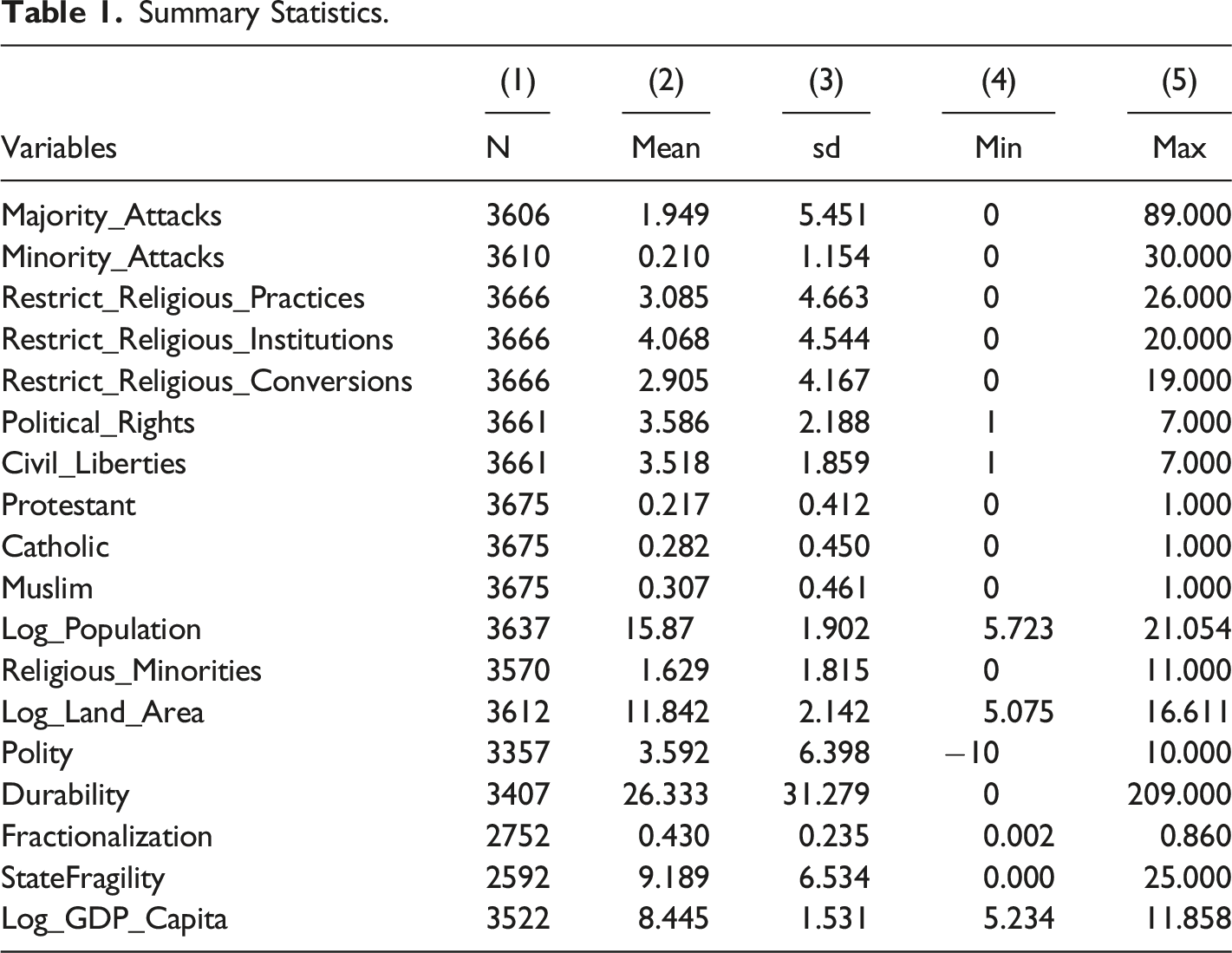
Given the non-negative count nature of the outcome variables—Majority_Attacks and Minority_Attacks—the dependent nature of values of other observations, and the uneven distribution across observations, we model the data using negative binomial regression. The models also include robust standard errors clustered on countries to account for correlation of observations within countries.
Results
Results Using Majority Attacks as the Dependent Variable.
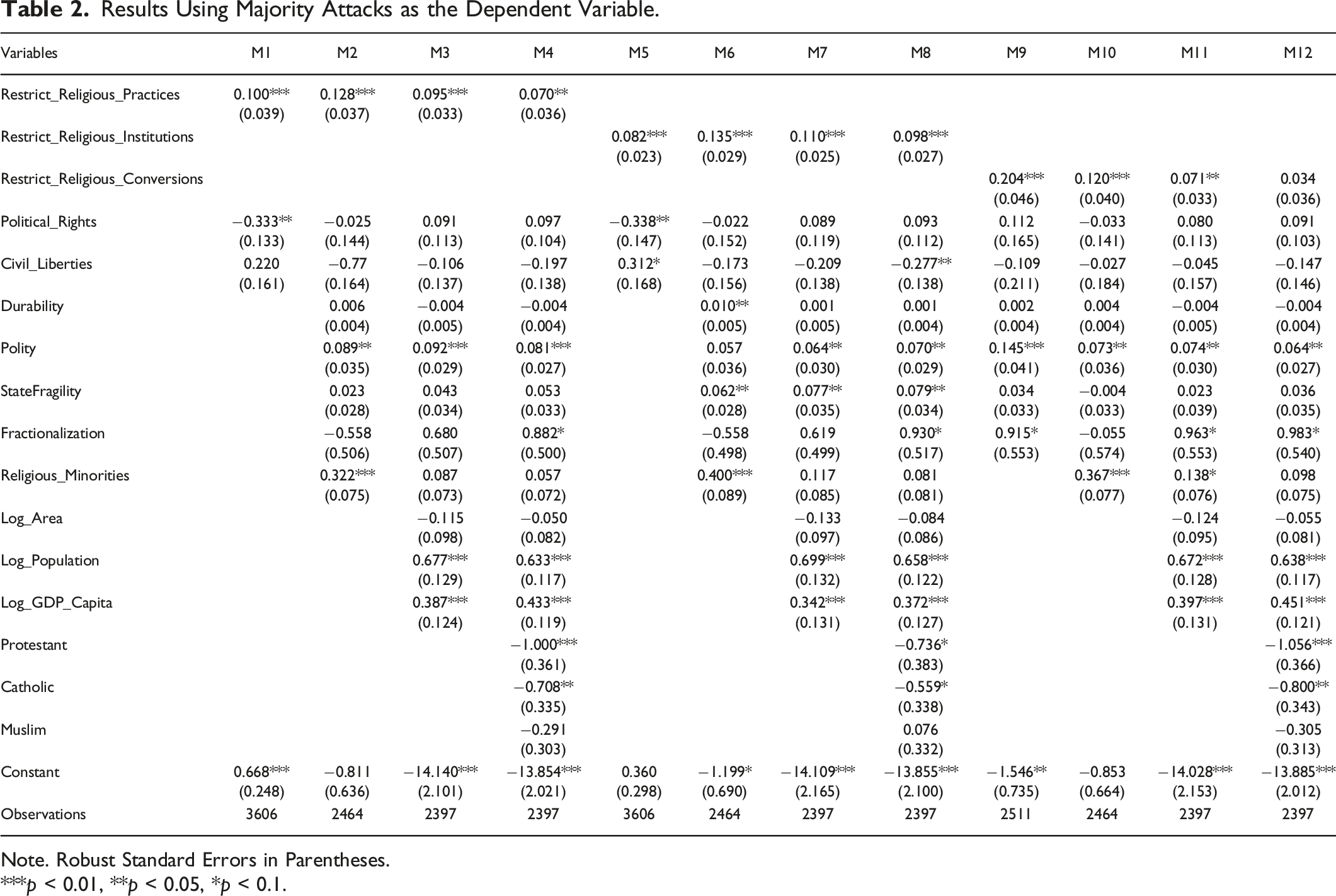
Note. Robust Standard Errors in Parentheses.
***p < 0.01, **p < 0.05, *p < 0.1.
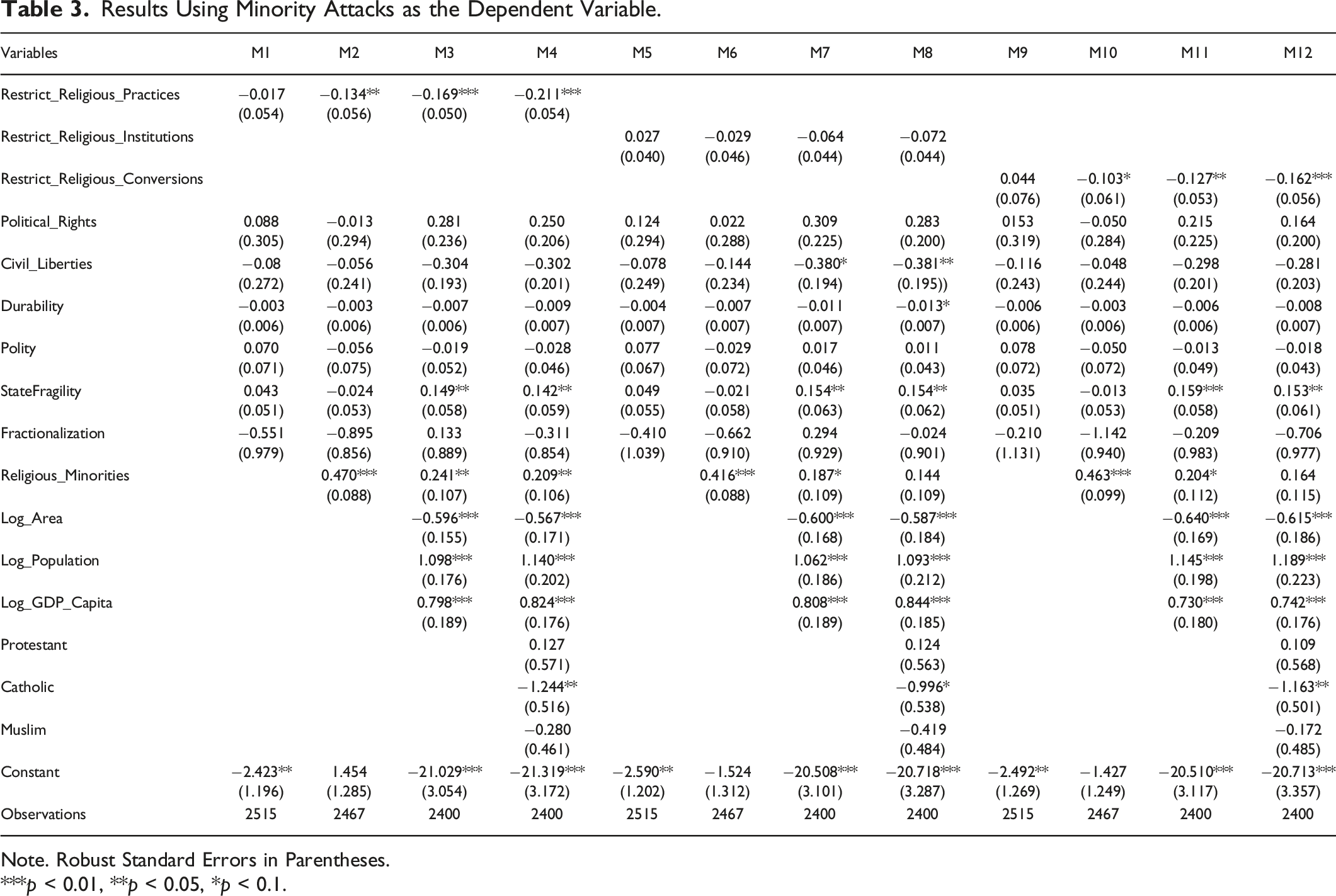
Results Using Minority Attacks as the Dependent Variable.
Note. Robust Standard Errors in Parentheses.
***p < 0.01, **p < 0.05, *p < 0.1.
Table 3 displays the results for Minority_Attacks as the dependent variable. Models 1 to 4 pertain to religious practices; Models 5 to 8 to religious institutions; and Models 9 to 12 to proselytizing and conversions. The results reveal that, contrary to intuition, restrictions on minorities do not increase violence by those who bear the brunt of these forms of religious restrictions. The statistically significant negative coefficients of Restrict_Religious_Practices across Models 2 to 4 rather indicate that these restrictions reduce violence by minority groups. Similarly, the negative sign of Restrict_Religious_Conversions indicates that restrictions on conversions reduce violence emanating from minority groups. The coefficients for Restrict_Religious_Institutions, while also negative, do not display any statistical significance. Among the covariates, Religious_Minorities and Log_GDP_Capita are statistically significant in most of the models in which they appear. The negative coefficients found in the case of minority attacks as opposed to majority attacks indicates that religious restrictions of different kinds work to limit associated violent attacks initiated by minority religious groups. On the other hand, they do not seem to be as effective in limiting such acts of violence that are perpetrated by majority religious groups. Thus, the results presented in Tables 2 and 3 suggest that restrictions on minorities do not increase violence by those bearing the brunt of the repression but rather by majoritarian vigilantes who are empowered to attack minorities.
IRR (Majority Attacks).
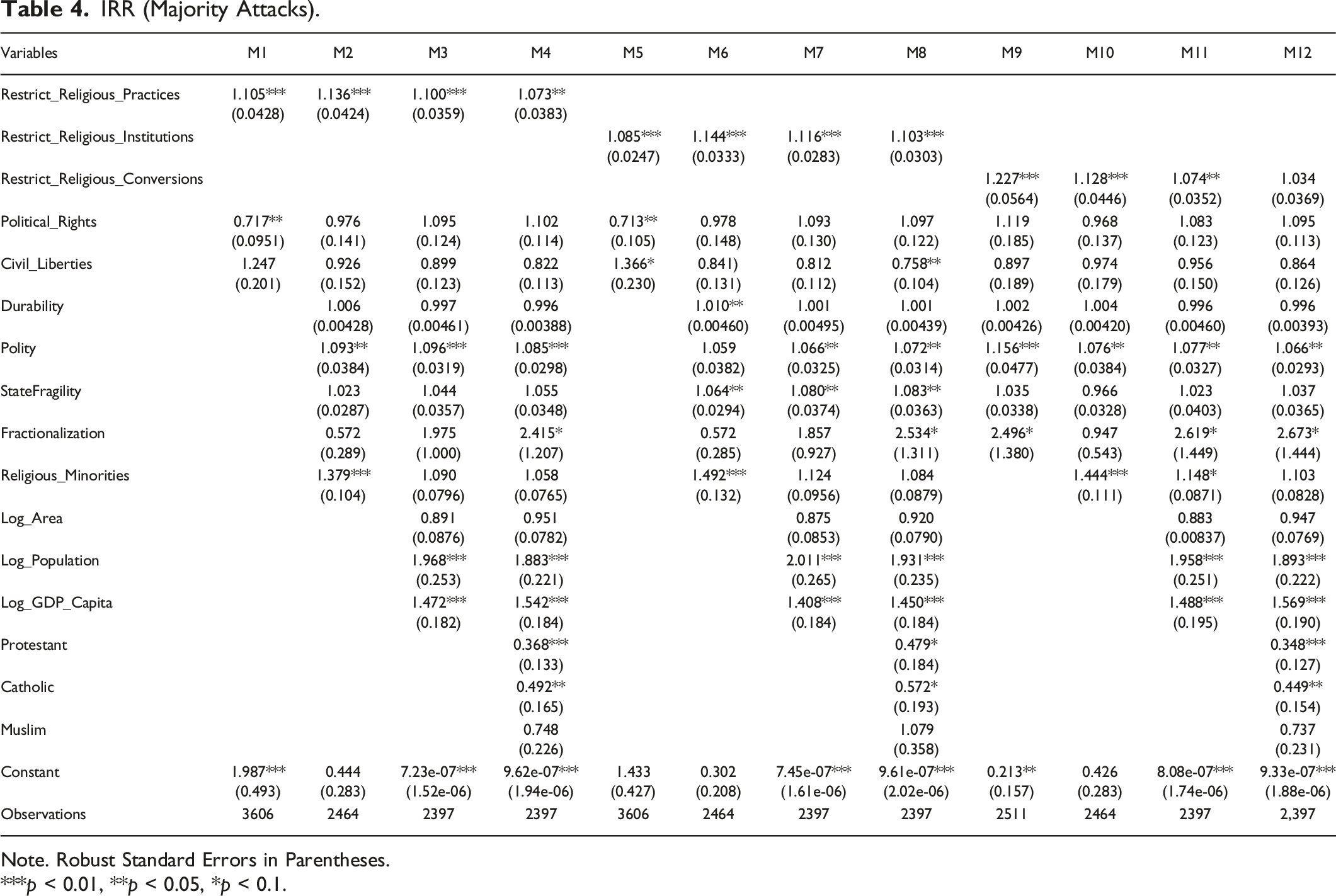
Note. Robust Standard Errors in Parentheses.
***p < 0.01, **p < 0.05, *p < 0.1.
IRR (Minority Attacks).
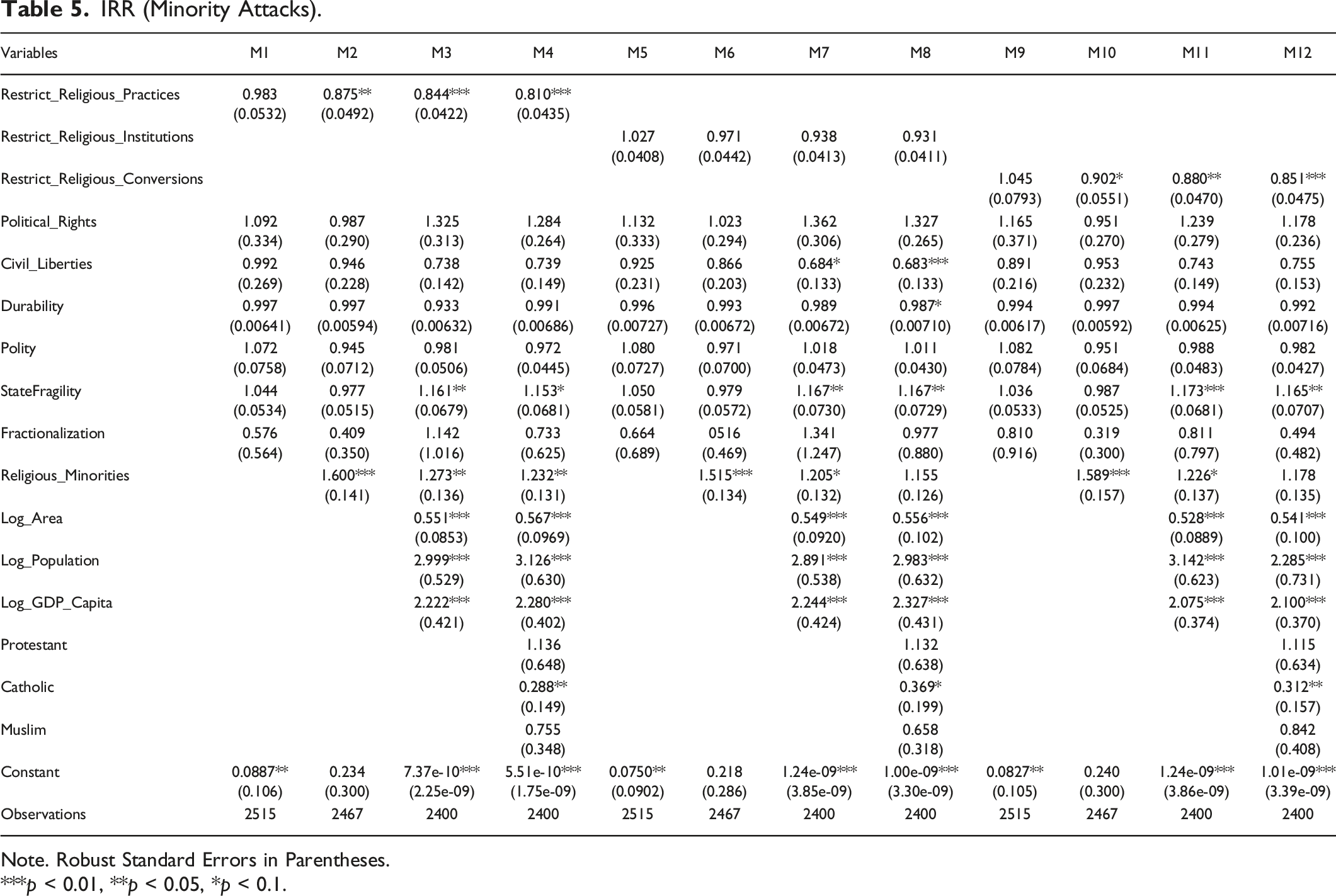
Note. Robust Standard Errors in Parentheses.
***p < 0.01, **p < 0.05, *p < 0.1.
We ran several robustness checks to establish the validity of our findings from the main models above. First, we used different outcome variables to test our models. First, we changed the dependent variables from the number of attacks by religious majorities and religious minorities to the number of victims from these attacks (Appendix A1(a) and A1(b)). It was found that restrictions on religious institutions and religious conversions were associated with higher numbers of victims of majority attacks, while the coefficients for restrictions on religious practices did not display statistical significance. All three forms of restrictions showed negative coefficients when using victims of minority attacks as the dependent variable, but only Restrict_Religious_Institutions displayed statistical significance. Second, given the panel nature of data, we ran fixed effects models that control for group characteristics that do not vary across time but may influence the outcome. Fixed effects models also help to establish causality. The results continued to support our main models, indicating that restrictions on religious practices, institutions, and conversions lead to more violence by majority groups (Appendix A2(a)). The fixed effects models do not show a statistically significant effect for minority attacks (Appendix A2(b)). Third, we also ran time fixed effects, which controls for variables that may be constant across countries but vary across time. The results support our main findings that any form of religious restrictions, whether on practices, institutions, or conversions, lead to more violence by majority groups (Appendix A3). However, for the case of minority attacks, the models lack any statistical significance. In order to check for causal heterogeneity and skewed observations, we conducted bootstrap regressions, a resampling technique that helps to reduce bias in estimators. The results continued to support our results that restrictions on religious practices, institutions, or conversions are associated with more cases of violence by majority groups (Appendix 4(a)) and generally lower levels of violence by religious minorities (Appendix 4(b)). Next, to account for any global trends (e.g., recession, rise of right-wing or left-wing politics, etc.) that may impact all countries, we added a time control and ran a negative binomial model instead of the fixed effects negative binomial already run in Appendix 3 (Appendix A5). The results indicated that restrictions on religious practices as well as institutions are associated with more attacks by majority groups, while the coefficients for restrictions on religious conversions, though positive, did not display statistical significance. Results for minority attacks revealed that restrictions on religious practices and religious conversions are associated with a decline in violence by minority groups, while the coefficients for restrictions on institutions, though negative, lacked statistical significance. Additionally, given the long-time span of the data set, to see that the results hold for both very early time periods as well as relatively recent time periods we accounted for four different time period controls: 1998, 1999, 2017, and 2018 (Appendix A6(a), A6(b), A6(c), A6(d)). While the models omitted the year dummies for 2017 and 2018, the results showed support similar to the results controlling for time effects above. Restrictions on religious practices and institutions were found to be associated with increased violence by majority groups, while on the other hand, restrictions on religious practices and conversions were found to be associated with lower violence by minority groups. Further, to check that the results are not swayed due to religious favouritism, we controlled for a measure of state support for religion, taken from RAS, and found the results upheld much as before (Appendix A7). Restrictions on religious practices and institutions were found to be positively and significantly associated with attacks by majority groups, while all three restrictions were negatively and significantly associated with minority attacks. Further, it might also be suspected that strength of the judiciary in a country, and especially its ability to operate independently, might affect the results. Hence, we controlled for a measure of judicial independence that combines a series of direct and indirect judicial indicators (Linzer and Staton 2015), and found that, as before, restrictions on religious practices and institutions further the violence of majority groups but all three restrictions lower the violence of by minority groups (Appendix A8). Next, we also controlled for lagged values of dependent variables—attacks in the previous year—to check for autocorrelation such that previous attacks may determine a current year’s attacks (Appendix A9). The results revealed that all three types of restrictions are positively and significantly associated with more majority attacks, while restrictions on religious practices and conversions are associated with lower violence by minority groups. Lastly, it might be the case that many such attacks may be fuelled by other political and economic factors. Hence, to further account for economic and political variables that may influence these attacks, we first controlled for a measure of overall capacity of the state to expend its duties and functions (Hanson and Sigman 2021) and then for the Gini coefficient, which captures economic inequality (Appendix A10 and A11). Results after controlling for state capacity revealed that restrictions of all three types are significantly and positively associated with higher violence by religious majorities. For minority attacks, it was found that restrictions on practices and conversions are likely to lower violence. The results from controlling for the Gini coefficient of inequality showed that restrictions on religious practices and institutions are associated with more attacks by majority groups, while restrictions on religious practices and conversions are associated with lower attacks by minority groups.
Discussion
What are we to make of the finding that faith-based discrimination against minorities, in its various manifestations, appears to motivate attacks from those of majority religions, but not from those from minority ones? Here, we briefly speculate on one potential explanation for this paradoxical discovery. Briefly put, we believe that religious discrimination potentially changes the structure of opportunities for religious minorities and majorities in a way that deters minority violence but encourages majority violence.
The contentious politics literature has long revealed that while grievances matter in explaining political violence, dispossessed citizens must also have the resources, organization, and opportunity to act on those grievances (McAdam, Mcarthy, and Zald 1996; Zald and McCarthy 1979). Faith-based discrimination may alter the opportunities available to both religious minorities and religious majorities for undertaking violence. Whereas discrimination empowers majoritarian vigilantes by opening up opportunities for violence, it simultaneously deters minorities from pursuing violence as a means to redress their grievances.
Discrimination against religious minorities means that the activities and institutions of minorities are regulated by the state. If this is true, then it stands to reason that the state also effectively blocks important avenues of collective action for minority extremists to organize around their cause. This is especially true regarding restrictions on minority institutions, as houses of worship have often been used to vent grievances, preach hatred, and radicalize believers. In these cases, discrimination prevents minority groups not only from carrying out practices central to their faith, but also undercuts pathways to violence. This happens because religious minorities, by definition, have small enough numbers that they can be effectively repressed into submission. The grievances are present, but the opportunities are foreclosed. Such an understanding might help explain why minority violence is less pervasive in countries that are more restrictive of minorities.
Anti-minority discrimination may have the opposite effect on religious majorities. Whereas discrimination against minorities works to prevent violence by minorities, it may also open up opportunities for majoritarian vigilantes by creating an environment of hostility towards religious minority communities and a climate of impunity for majoritarian extremists. The political “air cover” offered by the state appears to facilitate majoritarian violence by non-state actors, insofar as it effectively communicates that perpetrators of majority-on-minority attacks will not be held accountable for their actions. On the contrary, it often means they will enjoy protection by the state, thus sustaining a culture of anti-minority violence. We see this dynamic at work in countries enforcing so-called blasphemy laws, for example. Those who murder alleged blasphemers are often protected by the authorities and lauded by those in society. In this way, countries where governments partner with dominant religious traditions while repressing minority faith expressions often tolerate and sometimes encourage vigilante attacks on religious minorities. For their part, majoritarian vigilantes can exploit opportunities created by prejudiced legal systems to justify their violent actions on the grounds that they are upholding the law. In some cases, as in India and Pakistan, state officials may even participate in this violence. In short, anti-minority discrimination restricts violent opportunities for minorities but creates them for majorities.
Only recently have scholars of religious violence begun to realize the importance of religious privilege as a driver of majoritarian violence. Perhaps the most important work in this respect is a study by Henne, Saiya, and Hand (2020) that reveals religious terrorism to be a “weapon of the strong”—employed by relatively strong groups in society—rather than a “weapon of the weak” as the conventional wisdom in terrorism studies suggests. The present study corroborates and builds upon this work in three important ways. First, whereas Henne and his co-authors restricted their analysis to acts of terrorism, we expand the scope of analysis to consider different forms of violent religious hostilities. Our analysis shows that religious privilege in the form of anti-minority discrimination is associated with higher levels of general religious violence beyond simply terrorism. Second, whereas Henne and his co-authors focused only on Muslim-majority countries, we have undertaken a global analysis. This is an important advancement in that the analysis shows that majoritarian violence is a global phenomenon plaguing all of the world’s religious traditions and not one that can be reduced to countries in the Islamic world. Third, whereas Henne and his co-authors use an aggregated (and somewhat blunt) measure of discrimination, we have broken discrimination into its constituent parts. We have theorized the different ways each individual component of faith-based discrimination—restrictions on minority religious practices, restrictions on religious institutions, and restrictions on proselytizing and conversions—independently produce violent religious hostilities. Thus, the present work advances the study of religion and violence in important ways.
The Case of India
To further illustrate our findings, let us consider the case of India, a country whose large geographic size, massive population, and key geostrategic location make it an exceptionally important country to examine the relationship between faith-based discrimination and violent religious hostilities. India is also a country that suffers from comparatively high levels of violent religious hostilities. According to the Pew Research Center, India has one of the highest levels of social hostilities in the world, finding itself in the company of countries like Nigeria, Pakistan, and Egypt (Pew Research Center, 2022). India also engages in all three forms of minority religious discrimination discussed in this article. As in the statistical analysis, we see in this case study that all three forms of minority faith-based discrimination correspond to violent attacks by vigilantes from majority Hindu communities but not religious minority communities. Let us take a brief look at each of these in turn.
One important minority religious practice that India curtails is the ritual slaughter of animals. Because cows are considered sacred in Hinduism, Hindu nationalists have long sought bans on the production, sale, and consumption of beef through state-level statutes (Copeland 2014; De 2018; Valpev 2020). The export of beef is banned nationally. Such laws have been used by violent religious actors to target beef-consuming minorities, namely Christians, Muslims, Dalits, and Hindus who eat beef or otherwise participate in processing beef products (Adrock 2018). The passage of regulations restricting or banning the practice of cattle slaughter has emboldened various cow protection (gau raksha) Hindu vigilante groups within society who have attacked with impunity traders and consumers of beef with increasing frequency and lethality. Cow protection groups patrol highways and inspect trucks, often with the support of law enforcement, to ensure that cattle are not being transported to slaughterhouses or animal fairs. Those accused of trafficking cattle are frequently beaten or even killed (Human Rights Watch 2019). For example, in June 2021, cow vigilantes lynched three Muslim men suspected of smuggling cattle. In Madhya Pradesh, a vigilante beat to death a man believed to be illegally transporting cattle. Cow vigilantes have been emboldened by official laws in 24 of India’s 29 states that enforce restrictions on the slaughter of cattle (U.S. Department of State 2016). Importantly, laws against the slaughter, sale, or consumption of cattle appear not to have provoked a violent backlash on the part of minorities.
A similar outcome can be seen with respect to religious institutions. The clearest and most dramatic example involves the Hindu takeover of an historic mosque known as the Babri Masjid in the ancient city of Ayodhya. In 1986, a district judge ruled that the mosque should be opened to the Hindu public, essentially giving the Hindu majority control over it. From then on, Hindu nationalists worked to have the mosque demolished, staging a number of demonstrative processions throughout the country. Emboldened by their positions of power, Hindu fundamentalists became more brazen in their demands that the mosque be destroyed and replaced with a Hindu temple. Ultimately, militant Hindus prevailed at destroying the mosque during a rally in 1992 when a mob of 300,000, incited by Hindu nationalist organizations and politicians, demolished the Muslim place of worship and proceeded to build a shrine dedicated to a Hindu deity, Ram, doing so as the local authorities stood by idly. These events would help pave the way for the anti-Muslim pogrom that took place in the state of Gujarat 10 years later. Again, it appears that the violence was mostly one-sided with majority Hindus attacking with impunity minority Muslims.
Finally, laws regulating proselytizing and conversion have been a growing problem in India. Colloquially known as “anti-conversion laws,” these bills, which ostensibly prohibit conversion of Hindus to minority faiths performed through coercion or enticement, have been exploited by Hindu nationalists to target alleged proselytizers. Statutes regulating conversion have been rapidly spreading throughout India, as has attendant conversion-related violence directed at those belonging to conversionary faiths accused of engaging in “forcible conversions.” The violent vigilantes, however, claim they are simply upholding the law. In states enforcing anti-conversion laws, Hindu vigilantes have often attacked with impunity individuals, homes, places of worship, and businesses of those believed to be proselytizing and converting Hindus to other faith traditions, using the very laws passed by the state to justify their violence. These episodes can range from relatively minor isolated incidents to large-scale communal riots. In turn, the state commonly turns a blind eye to violence carried out by majority Hindus, on whose behalf it inhibits conversion in order to retain its good standing with that religious group. In some cases, the police and government officials actively incited conversion-related attacks. Saiya and Manchanda (2020b) find that Indian states that have in place and enforce anti-conversion laws experience more than seven times more Christian victims of Hindu violence than states where these laws either do not exist or are not enforced. There is no evidence to suggest, however, that anti-conversion laws have had a similar effect on minorities most affected by them.
In summary, a brief examination of the case of India bears out the insights of the statistical analysis. The three forms of faith-based discrimination appear to foment violence on the part of radicalized Hindus, India’s largest religious group, but not from religious minorities. In two of the cases—restrictions on religious practices and restrictions on conversion and proselytizing—we see virtually no examples suggesting that grievances over these forms of discrimination have led minorities to turn to violence. In the third case—restrictions on religious institutions—we see that the Hindu takeover and eventual demolition of the Babri Masjid did spark violent intercommunal hostilities; however, even here violence tended to be one-sided, leading to mass killings of minority Muslims by majority Hindus.
Conclusion
Faith-based discrimination against religious minorities is dangerous because religion is arguably the most important aspect of one’s identity (Fox 2018). In this study, we have assessed the relative impact of three different kinds of discrimination against minorities—restrictions on minority religious practices, restrictions on minority religious institutions, and restrictions on conversions and proselytizing—on violent religious hostilities. Using cross-national data from more than 170 countries, we find that each form of discrimination does indeed increase violent religious hostilities, but not in the way one might expect. Our findings show that minority restrictions paradoxically encourage violence by majority rather than minority groups.
This is a potentially important discovery that upends much of the conventional wisdom on the causes of religious violence. For decades, the contentious politics literature on the structural causes of political violence, including religious violence, has been dominated by the grievance model of conflict. According to this school of thought, those who are most suppressed in society—particularly ethnic, political, or religious minorities—should be the most likely to engage in violence. Our results suggest otherwise. When states advance the ambitions of a particular religious tradition and discriminate against that tradition’s religious competitors, they apparently encourage violence from those of the favored religion. As we discuss, one possible reason why is that these particular restrictions provide a ready-made justification for extremists associated with a country’s religious majority to attack religious minorities. For example, in the cases of countries having restrictions on institutions and conversion, religious vigilantes can claim that their actions are intended to uphold the law. This provides a pretext for attacking illegal religious gatherings of minority faith communities and those suspected of illegally proselytizing or attempting to convert those of the majority faith tradition. At the same time, it appears that anti-minority discrimination does not encourage violence from minority groups. This finding is in line with some other recent work on religious violence (Basedau et al. 2017; Henne, Saiya, and Hand 2020). We suggest these paradoxical findings can be explained by the fact that faith-based discrimination alters the structure of opportunities for both minority and majority groups, deterring the former but encouraging the latter. We encourage future studies that can explore this important dynamic further.
Supplemental Material
Supplemental Material - Faith-Based Discrimination and Violent Religious Hostilities: A Global Analysis
Supplemental Material for Faith-Based Discrimination and Violent Religious Hostilities: A Global Analysis by Nilay Saiya, Stuti Manchanda, and Rahmat Wadidi in Journal of Conflict Resolution
Supplemental Material
Supplemental Material - Faith-Based Discrimination and Violent Religious Hostilities: A Global Analysis
Supplemental Material for Faith-Based Discrimination and Violent Religious Hostilities: A Global Analysis by Nilay Saiya, Stuti Manchanda, and Rahmat Wadidi in Journal of Conflict Resolution
Footnotes
Declaration of Conflicting Interests
The author(s) declared no potential conflicts of interest with respect to the research, authorship, and/or publication of this article.
Funding
The author(s) disclosed receipt of the following financial support for the research, authorship, and/or publication of this article: The authors received financial support from an AcRF Tier 1 Grant from the Singapore Ministry of Education.

Supplemental Material
Supplemental material for this article is available online
References
Supplementary Material
Please find the following supplemental material available below.
For Open Access articles published under a Creative Commons License, all supplemental material carries the same license as the article it is associated with.
For non-Open Access articles published, all supplemental material carries a non-exclusive license, and permission requests for re-use of supplemental material or any part of supplemental material shall be sent directly to the copyright owner as specified in the copyright notice associated with the article.
