







Abstract
The war in Ukraine has manifested the critical importance of the American alliance network and the swift and effective deployment of necessary military assets. But do citizens of the U.S. allies support the deployment of such advanced, thus controversial, military assets in their countries? To examine this question, we administered two conjoint experiments in Japan, a critical U.S. ally in Asia. The results show the Japanese citizens’ strong Not-In-My-Backyard (NIMBY) sentiment: They value the U.S.-Japan alliance per se but do not want those advanced arms (specifically, Osprey and F-35 fighter jets) to be deployed in their vicinity, particularly when the U.S. military operates them. Our study contributes to the literature on alliance politics and civil-military relations by emphasizing the importance of paying close attention to local public opposition as a potential source of instability in global military alliances.
Introduction
The 2022 Russian invasion of Ukraine ascertained the resolve and cohesiveness of the American military allies. The NATO countries and other allies, such as Japan, Australia, and South Korea, have united to support Ukraine in fighting against Russia. For such multinational efforts to be successful, smoothly deploying necessary military assets, including tanks, fighter jets, and advanced rocket systems, is critical. For instance, the German-made Leopard 2 tanks are located in crucial NATO countries and can be rapidly deployed to the front line in Ukraine. The American-made F-16 fighter jets will be offered to Ukraine after some extensive training of pilots in key allied bases in Europe. Deploying these advanced military assets in forward bases is essential for counter-force capabilities.
Despite its relevance to the current and future international conflicts, however, we do not fully understand what citizens of the U.S. allies think about deploying advanced, thus controversial, military assets in their countries. Compared to any plans of newly hosting a military base or substantially expanding an existing one, deploying specific military assets may be perceived as less controversial. But if citizens in the deployed countries strongly oppose these specific decisions, the alliance’s deterrence credibility could be harmed. Such “weakness” information spread beyond borders through mass and social media could even trigger an opportunity-seeking attack by the enemy.
We empirically examine such public opinion about the deployment of military assets based on the theory of NIMBY (Not-In-My-Backyard) attitudes. On the one hand, residents near the deployment locations may oppose the plans because of geographically specific negative consequences. On the other hand, given the growing security concern, they may know that the deployments will effectively deter the enemy’s attack. Thus, they may support the policies in general, although their preferred deployment location could be elsewhere in their country. In other words, we expect that people have NIMBY rather than NIABY (Not In Anybody’s Back Yard) attitudes.
To study the public’s complex sentiment, we focus on Japan. Cooperation with Japan is crucial for the U.S. in East Asia because Japan hosts the largest number of U.S. military personnel outside the U.S. (Allen et al. 2020) for possible conflicts with China, Russia, or North Korea. In particular, in the future Taiwan crisis, Japan is believed to be the most critical ally for the U.S. to defend the islands from mainland China. American military bases in Japan, as well as Japanese SDF (Self-Defense Forces) bases, will be the forward bases for the U.S. forces to counter possible attacks by China. 1 Therefore, a key question in military preparation for such a crisis is whether Japanese citizens can accept the deployment of advanced military equipment manufactured by the U.S. within Japan.
We fielded two conjoint experiments to examine Japanese citizens’ attitudes toward the controversial deployment of military equipment—the Osprey and F-35 fighter jets, which could negatively affect Japanese citizens’ quality of life depending on various deployment conditions (e.g., nighttime training, the location of a facility, economic compensation). We administered national and Okinawa surveys for each study. Collecting a sufficiently large number of responses from Okinawa is crucial to studying local public opinion about the issues related to the U.S. military. This targeted sampling is necessary because Okinawa hosts 70 percent of U.S. military facilities in Japan despite having only 0.6 percent of Japan’s surface land. In addition, Okinawans experienced the Battle of Okinawa (from April 1 to June 22, 1945), one of World War II’s last major and brutal military campaigns. Moreover, Okinawans possess a long-standing animosity toward the U.S. military and distrust in the Japanese government arising from policies in the aftermath of the war (Hikotani, Horiuchi and Tago 2022).
Our analysis suggests Japanese citizens’ strong NIMBY (Not-In-My-Backyard) attitudes toward deploying controversial American-made military equipment. Japanese citizens generally value the U.S.-Japan alliance per se. Yet, no matter where they live, either in Okinawa or the mainland, 2 they do not want those advanced arms to be deployed in their vicinity, particularly when the U.S. military operates them.
These results advance current scholarship about alliance politics and civil-military relations. Although Allen et al. (2020) emphasize the socio-economic merits of hosting the U.S. military, they do not sufficiently consider the NIMBY attitudes among citizens living near military facilities. To understand how the public feels about the U.S. military presence, looking at such geographically-specific negative consequences caused by NIMBY facilities is critical. More generally, scholars and policy-makers should pay close attention to local public opinion as a source of instability in global military alliances.
Our study also improves our understanding of attitudes toward the alliance with the U.S. among citizens of a key U.S. ally, Japan. While some scholars have begun accumulating scientific evidence concerning Japanese public attitudes toward the American military presence in general (Hikotani, Horiuchi and Tago 2022) and various possible military operations by the SDFs (Horiuchi and Tago 2022), the study on public reactions toward the American-made advanced military equipment, which can be a source of NIMBY attitudes, is largely ignored. Under the current arms race in the East Asian regions and the increasing importance of American-made arms to deter China, Russia, and North Korea, it is vital to understand how the general public of the U.S. allies in East Asia, like Japan, would see these advanced military assets. They could effectively promote their national security but also generate various negative impacts on local communities. A study uncovering the public perception of this dilemma is required.
U.S. Military Should Not Be in My Backyard
Given the overall U.S. military presence worldwide, a broad—and critical—question to understand U.S. security alliances is: What do people in the U.S. allies think about the presence of the American military in their countries? Based on a large-scale survey fielded in fourteen countries hosting American troops, Allen et al. (2020) examine this under-investigated question and find that a U.S. military presence within a hosting country is associated with favorable attitudes toward the U.S. among citizens of that country because they have positive social contact with the U.S. military personnel and receive economic benefits from hosting the bases.
In contrast, there are many social movements against the U.S. military bases (Willis 2019). The anti-base sentiment often arises from the inherent negative externalities that military bases and assets could incur. While the military presence advances the capability of deterring enemies in general, it could become a primary target for the enemies. Thus, local communities with military bases and powerful equipment could become highly vulnerable to enemy attacks. Furthermore, military facilities and activities bring other adverse socio-economic and environmental effects to the local communities. Numerous studies illustrate the detrimental consequences of hosting military bases and assets, including noise, environmental pollution, crimes, and the risk of accidents (Abe 2020; Calder 2008; Cooley, 2008; Bitar 2016; Holmes 2014; Kawato 2015; Kim, 2017; Vine 2019; Yeo 2011). Hikotani, Horiuchi and Tago (2022) re-assess Allen et al.’s (2020) arguments using their original data from Japan and show that Japanese citizens, particularly those in Okinawa, care about geographically specific negative externalities, such as crimes, noise, and pollution. 3
Our study contributes to the literature regarding public opinion about the presence of the U.S. military worldwide, focusing on Japan. However, it is different from the above debate for two reasons. First, as noted in the introduction, we study public opinion about deploying specific military assets. Second, while the discussions by Allen et al. (2020), Allen et al. (2022), and Hikotani, Horiuchi, and Tago (2022) are about the relative weights of selective benefits and costs, we examine people’s attitudes toward geographically specific (or concentrated) costs, which are associated with the particular deployment plans, and more general (diffused) benefits, which arise from the U.S.-Japan security alliance and hosting the military bases. To put it differently, unlike the previous literature, we examine the applicability of a theory of Not-In-My-Backyard or NIMBY (e.g., Aldrich 2008; Dear 1992; Hankinson 2018) in the context of hosting the American military in allied countries.
A Theory of Not-In-My-Backyard
The literature on protests against military bases is extensive. Recent studies (Della Porta, and Fabbri 2016; Kim, 2021) discuss some motivations among the leaders of the anti-base movements, such as increasing political influence and mobilization for their re-election and creating a self-identification as an activist. However, we focus more on motivations among citizens of a country hosting the bases and specific military assets. The general public may support hosting the U.S. military for national security reasons. However, they may not welcome any facilities related to the U.S. military to be located near their residence. In other words, they may have NIMBY attitudes.
There are two theoretically essential elements underlying the theory of NIMBY, or more generally, a theory of collective action (Olson, 1971)—concentrated costs and distributed benefits. Although people in particular geographical locations must bear the costs of having NIMBY facilities, such as military bases, in their neighborhoods, the benefits of having such facilities are shared by many others in different locations. From this theoretical angle, Yeo’s (2011) study on social, anti-military movements investigates the problems with U.S. military bases. Yeo focuses, in particular, on how opposition to the stationing of American forces in host countries grows from a local NIMBY emotion to a more widespread societal movement.
In public opinion research about the U.S. military presence, examining such negative externalities arising from the nature of NIMBY facilities is imperative. The main source of grievances at the local level should be linked to the concentrated costs and diffused benefits of military facilities. Allen et al. (2020) and some other existing studies (e.g., Calder 2008) may assume that the positive externalities of hosting the U.S. military are powerful enough to mitigate—and even surpass—its negative externalities. However, answering this question would require carefully examining both diffused benefits and concentrated costs and appreciating the geography associated with U.S. military bases and the deployment of specific military assets.
Diffused Benefits: Support for the Alliance with the U.S
Most Japanese citizens—both residents of Okinawa and other prefectures—support the U.S.-Japan security alliance. Japan’s national broadcaster, NHK (Nippon Hoso Kyokai), fielded surveys in April 2017 (Kono 2017). Their studies show that 64.5 percent of Okinawans (in a sample targeted at Okinawa) and 83.2 percent of Japanese (in a separate nationwide sample, including Okinawans) consider the U.S.–Japan alliance “Very important” or “Somewhat important.” According to another survey administered by the Okinawa prefectural government (Okinawa Prefectural Governor’s Office, Regional Security Policy Division 2016) from November to December 2015, 56.8 percent of Okinawans think that the U.S.–Japan Security Treaty is “Helpful” or “Somewhat helpful” for Japan’s security. The same question was asked in a survey administered by the Cabinet Office in January 2015 (Government of Japan, Cabinet Office 2016). 4 The results show that 82.9 percent of people consider it “helpful” or “somewhat helpful.”
In our study fielded in 2022 (specifically, Study 2, which we will explain in the next section), we added the questions used in these previous surveys. The purpose of this replication was twofold. First, it helps us understand whether Japanese public opinion about the U.S.-Japan alliance has changed recently. Second, more importantly, by asking these questions about the diffused benefits within the same survey aimed at measuring people’s perception of the concentrated cost, we can better understand NIMBY attitudes among survey respondents.
Specifically, the first question used in the above-noted NHK study asks, “How important do you think the Japan-U.S. Security Treaty, which Japan has with the U.S., is to the peace and security of Japan?” The answer options are “Very important,” “Somewhat important,” “Not very important,” “Not at all important,” and “I don’t know.” The second question used in the government surveys asks: “Japan currently has a security treaty with the U.S. Do you think this Japan-U.S. Security Treaty is helping or not helping Japan’s peace and security?” The answer options are “Helpful,” “Somewhat helpful,” “Somewhat not useful,” “Not useful,” and “I don’t know.”
The results are presented in Figure 1. The top panel shows that 67.4 percent of Okinawans (in a sample targeted at Okinawa) and 77.0 percent of Japanese (in a separate national sample, including Okinawans) consider the U.S.–Japan alliance “Very important” or “Somewhat important.” The high level of support is consistent with the previous finding (Kono 2017). Our study also shows similarity with the findings from the government surveys (Okinawa Prefectural Governor’s Office, Regional Security Policy Division 2016; Government of Japan, Cabinet Office 2016): 53.5 percent of Okinawans and 69.3 percent of Japanese think that the U.S.–Japan Security Treaty is “Helpful” or “Somewhat helpful” for Japan’s security. Support for the U.S.-Japan Security Alliance in 2022. Note: The question wordings for the top and bottom panels are the following. “Japan currently has a security treaty with the U.S. Do you think this Japan-U.S. Security Treaty is helping or not helping Japan’s peace and security?” “How important do you think the Japan-U.S. Security Treaty, which Japan has with the U.S., is to the peace and security of Japan?”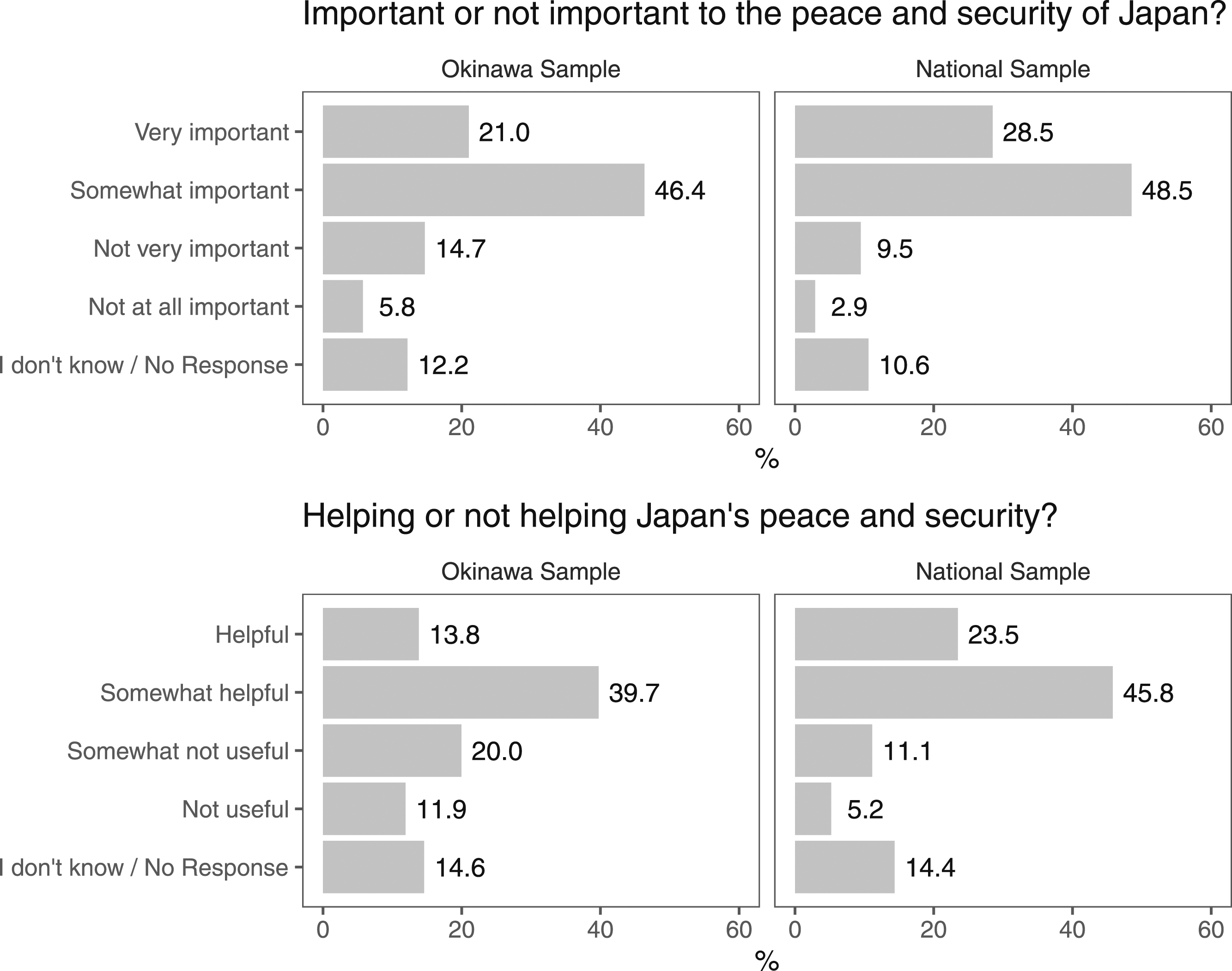
Compared to Japanese citizens on the mainland, residents of Okinawa have a lower level of general support for the security alliance with the U.S. This is not a surprise given the problematic historical backgrounds and the current situations. Nevertheless, despite their mixed feelings toward the presence of the U.S. military in their prefecture, a majority of them think of the necessity of the U.S.-Japan alliance for the peace and security of Japan. The general support for the partnership with the U.S. is a noteworthy fact that provides a foundation to examine the theory of NIMBY attitudes toward the U.S. military.
Concentrated Costs: Deployment of Military Equipment in Japan
Due to drastic changes in Japan’s national security environment, such as China’s rise and nuclear weapons development and numerous missile tests by North Korea, the Japanese government has been eager to fortify the U.S.-Japan alliance. In line with this strategy of strengthening the alliance ties, with the firm (but general) public support for the security alliance with the U.S., Japan has decided to buy various military equipment from the U.S. government. However, the geographical location of their deployments has always been highly contentious.
In 2011, the government decided to purchase F-35 fighters out of necessity for its deteriorating security environment and to replace F-4EJ fighter jets decommissioned in 2008. The Japanese government explained that it was “the only choice” (Tago and Vucetic 2013) for the country, which could not buy the F-22 Raptor due to U.S. Congressional opposition and needed to match with China’s J-20 and Russia’s Su-57 stealth fighters.
In 2016, before the F-35 fighters were delivered to Japan’s Self-Defense Forces (SDFs), the U.S. military introduced their F-35 fighters to the American bases in Japan. Iwakuni, a U.S. base city near Hiroshima, was expected to host F-35 fighters operated by the U.S. Marines. However, the deployment was a political challenge because the city council and the mayor of Iwakuni were seriously concerned about the allegedly high accident rate, noise pollution of the new fighters, and crimes by the American soldiers. 5
Among those negative factors accompanying the F-35 fighters, the noise problem continues to be the most critical concern for the locals. 6 Indeed, the protesters in Iwakuni announced in May 2022 that they were “set to assemble a group of plaintiffs to launch a lawsuit against the central government, demanding a ban on U.S. military and Japan Self-Defense Forces aircraft flights plus compensation for noise pollution.” 7 While the people would recognize the importance of the new fighter jets to protect Japan from various national security problems, the noise pollution of the fighters has been the core concern for the people near the bases hosting the aircraft.
The F-35 is not the only controversial military equipment that Japan had to introduce to strengthen its military capability to counter a rising threat from China and other neighboring countries. In 2014, after a heated controversy, 8 the Japanese government decided to buy 17 tilt-rotor V-22 (Osprey) for use by its SDFs over 6 years. With Osprey’s reputation for frequent accidents, another controversy occurred in Japan over where the American-made Ospreys should be deployed. Eventually, the government decided to deploy the Osprey permanently in Saga Prefecture in the Kyushu region. 9 The Governor of Saga then has implied to permit the SDF’s use of the Kyushu-Saga International Airport’s runway to operate the Osprey.
However, the local community in Saga, particularly among the local fisheries, is concerned about its environmental impacts, including polluted water running from the base to the nearby sea, noises, impact on the local fishing industry, and the risk of accidents. 10 Consequently, the first three Ospreys were temporarily deployed (for a maximum of 5 years) at the SDF’s Camp Kisarazu in Chiba Prefecture in July 2020. 11
A controversial case like the deployment of the F-35 fighters and Osprey could be used to study how citizens of the U.S. allies evaluate the proposals to locate advanced military assets and consider their negative externalities. While they may consider military presence essential for their country’s national security, they may not wish to welcome military equipment into their local communities. This sentiment, if found, would be a clear case of NIMBY-ism.
Up to this study, scholars tend to focus on the location of the military bases, which are considered various sources of negative externality. However, the level of the negative externality should be different depending on how the bases are used and, in particular, what would be deployed in the bases. Our study uncovers how the military assets deployment, which could be critical factors in effectively fighting a war and achieving successful deterrence of potential enemies, would cause the general public NIMBY-ism, and such a negative sentiment may be a problem for successful military preparedness and alliance management.
Research Design
Considering the debates over the F-35 and Osprey deployments in Japan, we fielded two experiments in August 2020 (Study 1 on Osprey) and January 2022 (Study 2 on F-35). 12 Each study includes two surveys. The first survey collects a large representative sample of the Japanese general public (national survey). The second survey focuses on gathering responses from Okinawa (Okinawa survey). In Study 1, we collected 994 valid responses for the national survey and 319 for the Okinawa survey. In Study 2, we aimed to increase the number of respondents to improve the accuracy of our measures, particularly among respondents in Okinawa. Therefore, we collected 3163 and 1042 respondents for the national and Okinawa surveys.
After obtaining consent to participate in each survey for each study, we asked a range of pre-treatment questions. 13 We then added the component of our conjoint analysis (Hainmueller, Hopkins, and Yamamoto 2013), which we describe in the following subsections. Conjoint analysis is a particularly well-suited tool to elicit honest public opinion about complex (i.e., multidimensional) and socially sensitive issues (Horiuchi, Markovich, and Yamamoto 2022). However, although it has recently gained popularity, no study has yet applied this experimental method to understanding nuanced foreign public opinion about the presence of the U.S. military.
In the component of conjoint analysis, we first provided respondents with essential information about the Osprey or F-35 deployment plans because we expected that they had insufficient prior knowledge (see: Sections E and F in the Supporting Information). We then asked respondents to compare seven pairs of hypothetical plans to deploy the Osprey or F-35 jets in Japan. The essential information did not clearly mention the involvement of the United States in decision-making for two reasons. First, in the context of the U.S.-Japanese security alliance, the deployment of advanced and, thus, controversial military assets normally means the deployment of U.S.-made assets, including F-35A fighter jets, the SM-3 Block IIA ship-based surface-to-air missile system, V-22 Osprey, and, most recently, BGM-109 Tomahawk. Furthermore, the Japanese (or the U.S.) government does not make unilateral decisions to deploy advanced military arms in Japan. For this reason, even though we only mentioned the Japanese government’s consideration for several deployment proposals, it is unlikely that respondents considered the hypothetical plans as the Japanese government’s unilateral decisions to deploy advanced arms made in Japan. Second, and more importantly, we did not want to emphasize U.S. roles in decision processes out of concern that such an emphasis could trigger a strong negative reaction among Japanese citizens, particularly those in Okinawa. To understand how the involvement of the U.S. might affect people’s attitudes, as we explain below, we decided to add the unit of operating these military assets—either Japan’s SDF or the U.S. military—as one of the key attributes in our experiments.
In Study 2, after the component for conjoint analysis, we added some additional questions about the security alliance with the United States. We have already presented the distributions of the responses to these questions, which suggest strong support for the U.S.-Japan security alliance. It is worth noting that we find strong support for the alliance even though we asked these questions after the tasks for conjoint analysis, which may motivate respondents to consider the negative externalities of hosting the military facilities. If asked earlier, the respondents could provide even stronger support. 14
Study 1: Osprey
The topic for the first experiment is the Osprey deployment in Japan. We asked respondents to compare seven pairs of hypothetical plans to deploy the Osprey in Japan. Each pair is in a tabular format with six rows corresponding to various attributes of deployment plans. Three columns correspond to the title of these attributes and two plans’ profiles. The question asked just above each table is the following: “Assuming that there are two plans, as presented below for a new deployment of the Osprey, which plan do you favor? Even if you are not sure, please choose one that you are relatively more supportive of.”
We added six attributes that we think are relevant when Japanese citizens consider and express their preferences for the Osprey deployment in Japan. They include (1) the location of a facility, (2) whether nighttime landing practice will take place, (3) the geographical scope of training, (4) regional economic incentives, (5) the size of troops to be stationed at the facility, and (6) the unit operating the Osprey. Each attribute has multiple levels (see Section E in the Supporting Information for details). These attributes’ order is randomized across respondents to avoid any order effect but is fixed for each respondent (across the seven tasks) to prevent the cognitive burden. Each attribute’s levels are randomly assigned so that respondents compare two randomly generated hypothetical plans in each table.
The attribute directly relevant to the theory of NIMBY is the facility’s location. It has four levels, one in Okinawa and three in other prefectures. Given the history of anti-base protests in Okinawa, we expect that respondents in Okinawa, compared with those in other prefectures, will have a stronger adverse reaction if a proposed location is in Okinawa. Since the geographically concentrated cost associated with a public facility is a source of local residents’ NIMBY attitudes, we expect that the schedule (i.e., nighttime or not) for allegedly noisy landing practice is also relevant to respondents’ preferences. When it comes to noise pollution and other risks (e.g., an aircraft crash), the geographical distance from a facility for training may also be relevant.
Although our conjoint analysis aims to understand NIMBY attitudes, we added some other relevant attributes. First, the amount of regional economic benefits associated with the Osprey deployment is an attribute relevant to the theory of compensation (e.g., Allen et al. 2020; Calder 2008; Cooley and Marten 2006). If this theory is correct, respondents are more likely to choose plans with larger amounts of economic compensation. Military force size may indirectly relate to the potential interpersonal contact between Japanese citizens and military personnel, which may have negative (Calder 2008) or positive (Allen et al. 2020) impacts on local communities.
In addition, we added a binary attribute about the unit operating the Osprey. The Japanese government purchased the U.S.-made Osprey for Japan’s SDF operation, specifically, the Japan Ground Self-Defense Force (JGSDF). But we are interested in how Japanese citizens’ attitudes change if they are informed counter-factually that the U.S. Marine Corps would operate the Osprey. 15 With this attribute, we can examine citizens’ attitudes toward the U.S. military in comparison to their attitude toward the military force of their own country.
We think this comparison is essential to understand the U.S. military presence in allied nations because citizens may support any military force as long as it can defend their own country. Conversely, the so-called “doves” or pacifists may oppose any military force on its soil. Indeed, whether to support or oppose the presence of military force, either the SDF or the U.S. military, has been one of the fundamental political cleavages in Japan. 16 To the best of our knowledge, no study has experimentally examined how citizens’ attitudes toward military presence in their localities could differ depending on whether the facilities are for their own country’s military force or their ally.
Study 2: F-35
We conducted the second conjoint study using another controversial military deployment case of F-35 fighters. In this study, we included the following five attributes; (1) the location of a facility, (2) whether nighttime landing practice will take place, (3) soundproofing measures (per household in the target area), (4) regional economic incentives, and (5) the unit operating the F-35. Each attribute has multiple levels (see Section F in the Supporting Information for details). As we did in Study 1, these attributes’ order is randomized across respondents. Each attribute’s levels are randomly assigned so that respondents compare two randomly generated hypothetical plans in each table.
The critical attribute relevant to NIMBY is, once again, the facility’s location. Yet, in Study 2, we use fine-grained levels to understand NIMBY attitudes among all respondents, regardless of whether they live in Okinawa or elsewhere. Specifically, we added the following levels (prefectures in parentheses): Chitose (Hokkaido), Misawa (Aomori), Hyakuri (Ibaraki), Komatsu (Ishikawa), Yao (Osaka), Iwakuni (Yamaguchi), Nyutabaru (Miyazaki), and Naha/Kadena (Okinawa). These levels are actual SDF facilities or the U.S. military base (specifically, Kadena). For our primary analysis, we use a binary attribute measuring whether a base is in a respondent’s prefecture. We also use the original eight levels and other ways to group these levels for further analysis.
Whether nighttime landing practice will take place is also relevant to NIMBY attitudes because the concern about the nighttime practice is about noise. We also keep the same levels for an attribute to measure the regional economic benefits. In Study 2, instead of using the size of troops stationed at the facility, we added soundproofing measures (per household in the near-base target area). Such measures are closely relevant to the deployment plans of fighter jets because noise pollution is a central problem regarding the deployment of F-35 fighters. Finally, similar to Study 1, we examine whether Japanese citizens’ attitudes differ depending on the unit of operation, namely, whether the United States Air Force or Japan Air Self-Defense Force (JASDF).
Statistical Analysis
Based on the above-mentioned conjoint experiments, we measure survey respondents’ preference for the deployment plans. Specifically, we calculate the marginal mean (Clayton, Ferwerda, and Horiuchi 2021; Leeper, Hobolt and Tilley 2020) for each attribute-level—the probability of choosing profiles that include a particular level for a given attribute (e.g., Chitose for the location of a facility), averaged over all the other attributes and all respondents. The unit of observation for this analysis is each profile. Thus, the total number of observations corresponds to the number of respondents times the number of conjoint tasks (=7) times the number of profiles in each task (=2). The observations are clustered by respondents to calculate standard errors. 17
We also examine whether the marginal means differ between respondents in Okinawa and other prefectures. For each subset of observations for a given attribute-level, we run OLS regression with whether a profile is chosen as the binary dependent variable and whether a respondent is in Okinawa as the binary independent variable. The standard errors are again clustered by respondents.
We take an additional step to delve further into respondents’ NIMBY attitudes. Although the most common way to measure preferences using conjoint analysis is to treat each profile (in a binary-forced choice setting) as an independent observation, for our analysis, it may make more sense to examine respondents’ head-to-head comparisons of profile pairs—a development plan which is closer to where they live versus a development plan which is farther away. For this profile-pair analysis, we identify each deployment location in latitude and longitude. Because we have a measure of each respondent’s place of residence (prefecture), we can also specify each prefecture’s population center of gravity. We then take the difference between them and measure which of the two deployment plans in each profile pair is closer for each respondent in each task. The profile pairs that include the same locations are excluded from the analysis. We then calculate the probability of respondents choosing the geographically closer deployment plan. Similar to our main analysis, we compare the results between respondents in Okinawa and those in other prefectures. 18
Correcting Measurement Error Bias
In a recent paper, Clayton et al. (2023) alert substantive measurement-error-induced bias in conjoint analysis. We follow their methodological recommendations and measure the error-corrected marginal means in the following way.
First, we calculate the average intra-respondent reliability (IRR). The results in Figure G.1 in Section G in the Supporting Information show that the predicted IRR is 71 percent in Study 1 and 74 percent in Study 2. These estimates are considerably similar to Clayton et al.’s (2023) estimates based on the replication of eight existing studies using their suggested method. 19 Considering all these estimated IRRs, to make conservative corrections, we use 75 percent, which “is about halfway between flipping coins (50 percent agreement) and perfect reliability (100 percent)” (Clayton et al. 2023, p. 2).
Second, using this IRR, we calculate the “swapping error,” a likelihood of respondents answering a binary (forced) question by mistake, thereby their answers not reflecting their true preferences. The formula in Clayton et al. (2023) suggests it is about 15 percent.
Finally, we correct the estimates based on their formula. The confidence intervals of these estimates are calculated by their proposed analytical method. All the figures are based on the bias-corrected estimates. The figures without the corrections are presented in Section H in the Supporting Information.
Results
We now present the results of our conjoint experiments. We first show the results of our analysis focusing on the deployment of Osprey aircraft, followed by another study focusing on the deployment of F-35 fighter jets. We then offer the results of head-to-head comparisons to measure NIMBY attitudes. The estimates without correcting measurement error bias are presented in Section H in the Supporting Information. Although the marginal means without the corrections are attenuated toward 0.5, the substantive conclusions of our analysis remain the same.
Study 1: Osprey
In Figure 2, the dots in the first two columns represent the marginal means of corresponding attribute-levels. The horizontal lines are their 95 percent confidence intervals. The first column is for respondents in Okinawa, whereas the second is for respondents in other prefectures. Since respondents compared pairs of hypothetical proposals and chose one for each pair, the overall mean probability of selecting a profile is 0.5. Given this benchmark, we highlight marginal means significantly different from 0.5 at the 0.05 level in black (otherwise, in gray). Significantly negative (positive) marginal means indicate respondents’ preference against (for) proposals that include corresponding attribute-levels. The third column shows the differences in marginal means between the two groups of respondents. Again, we highlight statistically significant differences in black. 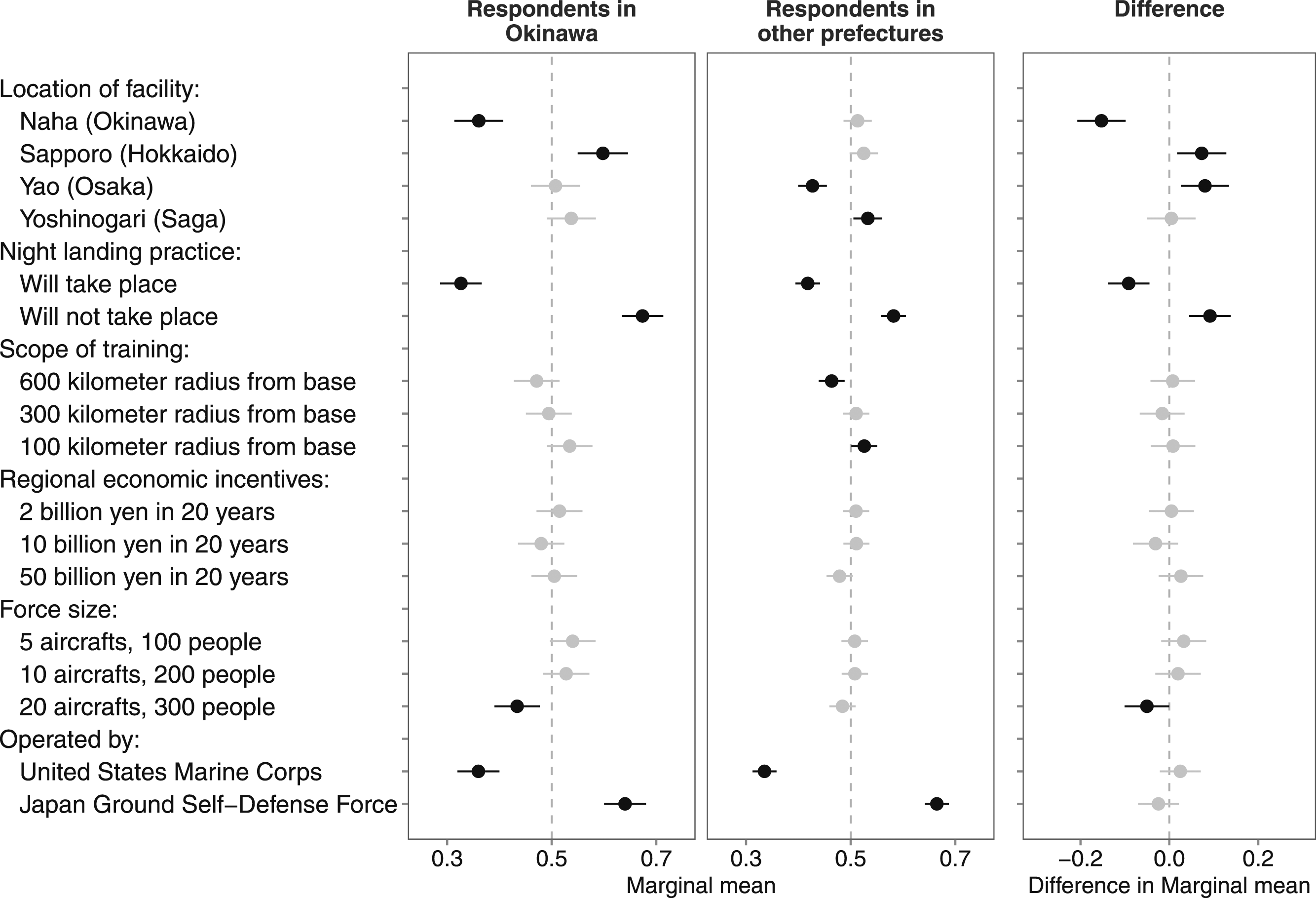
The figure shows evidence of NIMBY attitudes among Japanese citizens—most clearly among those in Okinawa, but also to some extent among those on the mainland. The top of the left column suggests a significantly negative preference among the respondents in Okinawa if a proposed deployment location is the City of Naha in Okinawa. The marginal mean is 0.361. Okinawans prefer the Osprey to be located in the City of Sapporo in Hokkaido, the north-most part of Japan, the geographically farthest option. Among respondents on the mainland, we find a weaker but similar NIMBY attitude in the middle column of Figure 2. The negative and statistically significant marginal mean is for the location to be in Osaka (0.427). This result makes sense from the NIMBY perspective because the percentage of respondents in Osaka (8.6 percent) is larger than the percentages of respondents in Hokkaido (4.7 percent) or Saga (0.3 percent) and because Osaka is closer to other large-population prefectures, including Kyoto and Hyogo. Most of the mainland respondents on Honshu island, including Tokyo, Osaka, Nagoya, and other major cities, seem to prefer the location to be farther away in the southwest (Saga). The third column shows that the differences are significant for three out of the four locations. Most importantly, compared with people on the mainland, people in Okinawa significantly prefer the Osprey deployment to be not in Okinawa—i.e., not in their backyard for Okinawans.
The second important finding is that respondents in both Okinawa and other prefectures dislike nighttime landing practices. The marginal means are negative for “Will take place” and positive for “Will not take place,” and both are highly significant. Japanese citizens may care about potential noise issues associated with nighttime practice operations. They may also consider the potential risk that the nighttime practice could be more dangerous than the daytime one. This finding provides another piece of evidence of NIMBY-ism among Japanese people. The right column of Figure 2 shows that the dispreference for nighttime practices is stronger among Okinawans. This significant difference is unsurprising because noise pollution and risks near military facilities are everyday issues for most people in Okinawa, which hosts 70 percent of U.S. military bases.
The training scope also shows some indication of NIMBY-ism. Respondents in both Okinawan and other prefectures prefer Osprey training to be within a small area as much as possible. They do not want to be bothered by noise and risk issues. The marginal mean becomes slightly smaller as the scope changes from the “100-km radius from base” to the “300-km radius from base,” and then the “600-km radius.” Some marginal means are significantly different from 0.5 only for respondents in other prefectures. But the differences in marginal means are all insignificant.
We now turn to other attributes included in this experiment. The proposed amounts of regional economic incentives are relevant to the compensation theory. We chose this attribute’s levels to have a large but realistic variation. 20 Indeed, we consider that “50 billion yen in 20 years” is substantially larger than “2 billion yen in 20 years.” 21 But we find that the marginal means are not significantly different from 0.5 among respondents in both Okinawa and other prefectures. In the context of military facilities in Japan, even a relatively large financial compensation for the local economy does not change people’s hearts and minds. This finding suggests that previous scholars may over-emphasize the importance of compensation and that we need further research to unpack people’s complex multi-dimensional preferences for public facilities (e.g., Hankinson 2018). 22
Concerning the force size for the operation of the Osprey, our analysis suggests that people in Okinawa want it to be small: the marginal mean for “20 aircraft, 300 people,” the largest force size, is significantly smaller than the benchmark of 0.5. The difference in marginal means between respondents in Okinawa and those in other prefectures is also statistically significant. These results suggest that Okinawans want to minimize the presence of military facilities.
Finally, we examine the subject of operating the Osprey. Interestingly, Japanese people strongly prefer the JGSDF over the U.S. Marine Corps. The difference in marginal means is very large: 0.280 (=0.640 − 0.360) for respondents in Okinawa and 0.330 (=0.665 − 0.335) for respondents on the mainland. The differences between respondents in Okinawa and those in other prefectures are insignificant. Their apparent preference for the JGSDF vis-à-vis the U.S. Marines is unexpected because noise pollution, risks, and other concerns associated with the Osprey deployment should not be different no matter which forces will be in charge. This finding could reflect generally higher trust in citizens’ armed forces than its ally’s forces in line with the psychological out-group and in-group biases (e.g., Tajfel et al. 1971).
In sum, the results of our conjoint analysis present a clear picture of NIMBY-ism. Japanese people—particularly Okinawans—do not want the Osprey to be deployed in their neighborhood. They are perhaps concerned about the issues of noise pollution and accidents. They do not seem to care much about economic compensation, but they want the Osprey to be operated by their national forces. They think the Osprey deployment should not be in their backyards.
Study 2: F-35
Shows the results of our second conjoint analysis. The first column is for respondents in Okinawa, and the second is for those in other prefectures. As in Study 1, the respondents in Study 2 compared seven pairs of hypothetical proposals and chose one for each pair; the overall mean probability of selecting a profile is 0.5. The third column shows the difference in marginal means for each attribute level. Since the number of observations is much larger in Study 2, some confidence intervals are very short. To make it clear, as in Figure 2, we highlight the estimates significantly different from 0.5 (the first and second columns) or 0 (the third column) at the 0.05 level in black (otherwise, in gray).
Study 1 shows a clear case of NIMBY attitudes among respondents in Okinawa. However, we acknowledge that the results indirectly suggest similar attitudes among respondents in other prefectures. To resolve this ambiguity, we added many possible locations from many regions in Japan. We then group these levels into two—whether a site is within the respondents’ prefecture. Figure 3 shows that both Okinawans and the people on the mainland disapprove of the deployment of fighter jets in a base within their prefecture. The marginal means for “Within Prefecture” are negative, and the marginal means for “Outside Prefecture” are positive. They are all significant at the 0.05 level. And there is no difference in the preferences between Okinawans and mainlanders.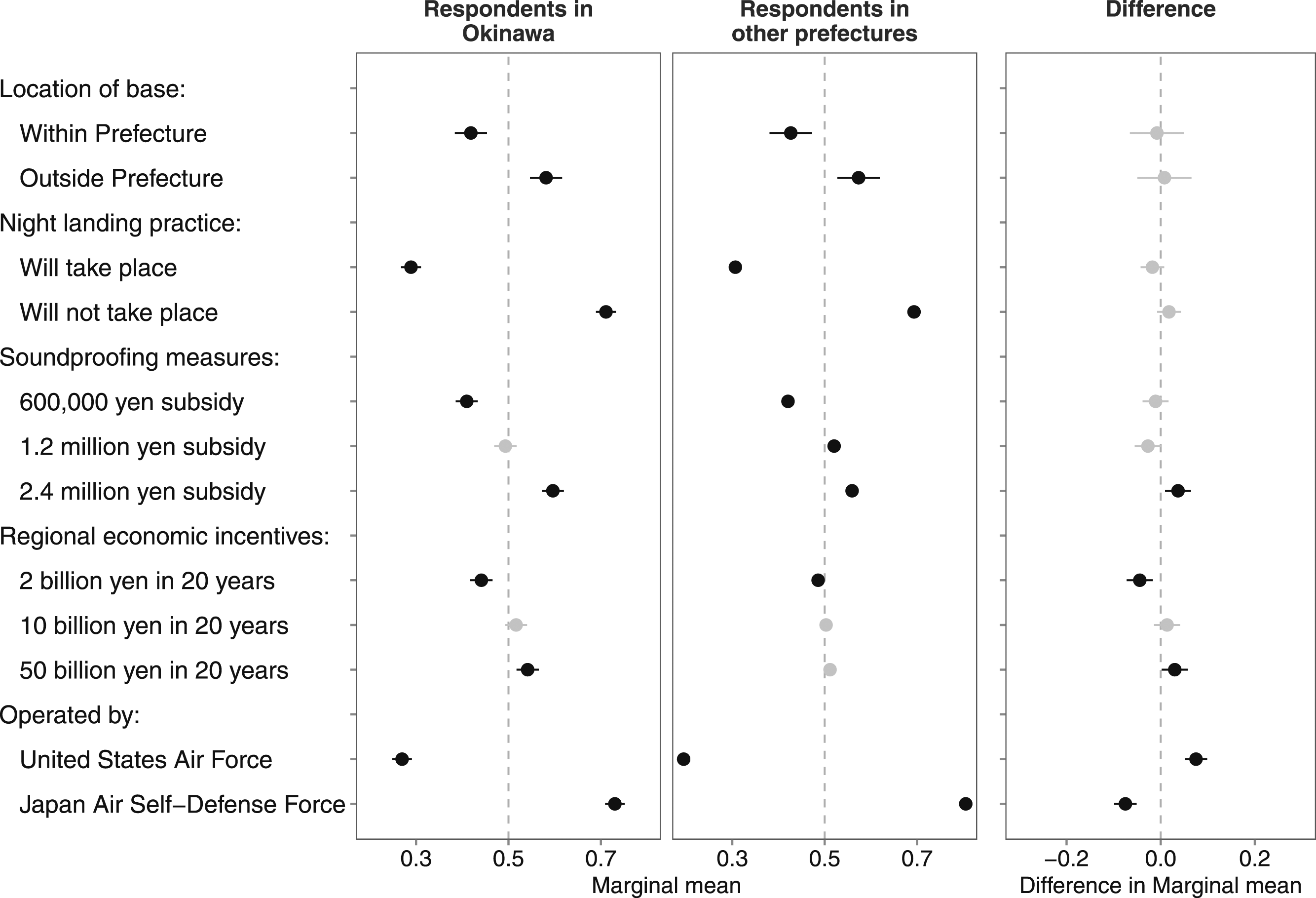
We made two additional sets of levels for this attribute to examine this possibility. The first set is to dichotomize the levels to “Within Area” and “Outside Area,” where the areas correspond to the commonly used eight geographical areas (Hokkaido, Tohoku, Kanto, Chubu, Kinki, Chugoku, Shikoku, Kyushu-Okinawa). The second set is to split “Outside Area” into the two sub-levels: “Within Area” (but not “Within Prefecture”) and “Outside Area.” The results of re-estimating the marginal means are presented in Figures I.2 and I.3 in Section I of the Supporting Information. These figures show that regardless of whether respondents reside in Okinawa or other prefectures, they prefer deploying F-35 fighter jets somewhere outside their areas. These results suggest that the closer the geographical proximity to the place of residence, the stronger the opposition to the deployment of military facilities.
The marginal means using the original eight levels are presented in Figure I.1 in Section I of the Supporting Information. It reveals an important cleavage in the perception between people in Okinawa and those in other prefectures. Okinawans are strongly against the bases in Naha and Kadena, both in central Okinawa. The marginal mean is 0.419, which is significant at the 0.05 level. By contrast, mainlanders prefer the base to be in Naha, Kadena. The marginal mean is 0.534, which is significant at the 0.05 level. 23 The difference (−0.115) is highly significant. These results raise a political concern about the Japanese government’s efforts to reduce Okinawa’s heavy burden of hosting military facilities and shifting some of these facilities to other prefectures (e.g., Shinoda 2014; Kawato 2015).
Figure 3 shows some other findings. Like in Study 1, respondents in Study 2 dislike nighttime flight training. The soundproofing measures are relevant: the more considerable the subsidy amount, the higher the level of support. This pattern is essentially similar between respondents in Okinawa and those in other prefectures. 24 In short, economic compensation matters. One crucial difference between Studies 1 and 2 is the marginal means for regional economic incentives. While the marginal means for the regional economic incentives are almost precisely zero in Study 1 on Osprey, the marginal means become larger as the amount becomes larger in Study 2 on F-35, at least in the Okinawa sample. The incentive does not work for the mainland respondents, consistent throughout the two studies. The differences between Okinawans and mainlanders are significant for the lowest amount (Okinawans having a weaker preference) and the largest amount (Okinawans having a stronger preference). The results for the attributes relevant to compensation in Study 1 and Study 2 may suggest that economic incentives work under certain conditions. This conditional effect of economic compensation is a fruitful area for future research.
Finally, similar to Study 1, in Study 2, respondents strongly prefer SDF operations over U.S. military operations. This overall pattern is commonly observed among respondents in Okinawa and other prefectures. However, the differences are significant at the 0.05 level in Study 2. Okinawans have weaker preference for the JASDF (and preference against the U.S. Air Forces) than Japanese citizens on the mainland, at least when it comes to deploying F-35 fighter jets. In Study 1, the differences are insignificant. With a larger number of respondents, as in Study 2, they could become statistically significant. In both Study 1 and Study 2, these marginal means and their difference suggest a stronger preference for (against) the U.S. military (Japan’s SDF) among Okinawans than people in the mainland of Japan.
There are two possible interpretations. One is substantive: Given the historical experience during the Second World War, those in Okinawa may instinctively dislike Japan’s military forces. Another interpretation is methodological: when there are highly salient attributes in conjoint analysis, the marginal means of other attributes are attenuated. This mechanical effect is large for Okinawans as they strongly dislike further military deployment in their prefecture, regardless of whether the unit of operations is the U.S. military or the SDF.
Comparison of Deployment Plans
Clayton et al. (2023) suggest alternative quantities of interest based on conjoint experiments: Specifically, they argue that researchers should pay more attention to the fact that respondents make binary choices instead of treating each profile as an independent observation. We follow their recommendation and compare which of the two deployment plans within each profile pair respondents choose. Given our interest in NIMBY attitudes, we measure the probability of respondents selecting a plan geographically proximate to their residence (prefecture).
Figure 4 shows the results of the head-to-head comparison of two deployment plans. Head-to-head Comparison of Deployment Plans. Note: The maps show the location of each deployment plan. The bottom panels show the marginal means of preferring a geographically closer deployment plan to a geographically farther-away plan. The vertical bars indicate the 95 percent confidence intervals. The estimates for respondents in Okinawa are in red, and those in other prefectures are in black.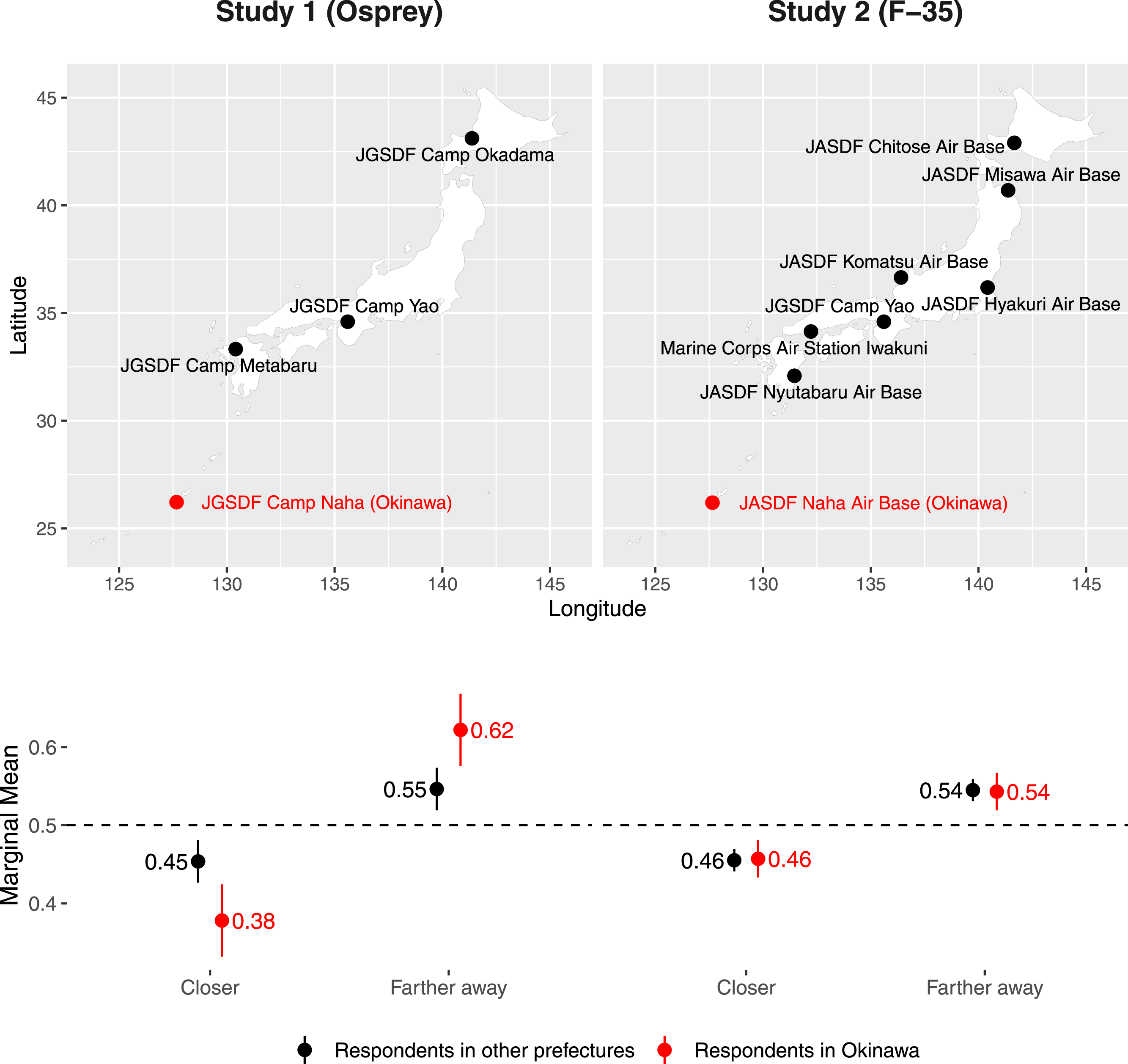
The maps show the location of each deployment plan. The location in Okinawa is highlighted in red. The bottom panel shows the marginal means of choosing geographically nearer development plans. 25 Given the binary choice, the sum of the mean for the “closer” plan and the mean for the “farther away” plan is 1.00. 26 The vertical bars show the 95 percent confidence intervals. The estimates for Okinawans are in red, and those for mainlanders are in black.
The figure shows some intriguing patterns. First and foremost, all the marginal means for the proximate plans are significantly smaller than 0.5 in both Study 1 (Osprey) and Study 2 (F-35). Furthermore, they are significant for respondents in both Okinawa and other prefectures. These results suggest the location of deployment plans matters, and Japanese people prefer the deployment of advanced military equipment to be “not-in-my-backyard.”
Second, for Okinawans, the absolute deviation from the benchmark (0.5) is larger in Study 1 (marginal mean = 0.38) than in Study 2 (marginal mean = 0.46). This is unsurprising. Since the number of options is smaller in Study 1 than in Study 2, respondents are more likely to compare the plan in Okinawa and one of the plans in other prefectures.
Finally, despite the difference in the number of randomly assigned plans between Study 1 and Study 2, the marginal means are almost the same for respondents in other prefectures. We interpret that respondents in prefectures other than Okinawa prefer deployment plans that are farther away and do not care so much about whether the plan is in Okinawa.
Trade-Offs
We delve further into the direct comparison of deployment plans. Given that the distance between the plan location and the operating unit are the salient attributes, it is worth examining whether Japanese citizens prefer one deployment plan, which is geographically closer (and thus not preferred) but operated by the SDF (and thus preferred), to another deployment plan, which is geographically not closer (and thus preferred) but operated by the U.S. military (and thus not preferred). The results are presented in Figure 5. Head-to-head Comparison of “Tradeoff” Deployment Plans. Note: The figure shows the marginal means of preferring a geographically closer deployment plan operated by the SDF to a geographically farther-away deployment plan operated by the U.S. military. The vertical bars indicate the 95 percent confidence intervals. The estimates for respondents in Okinawa are in red, and those in other prefectures are in black.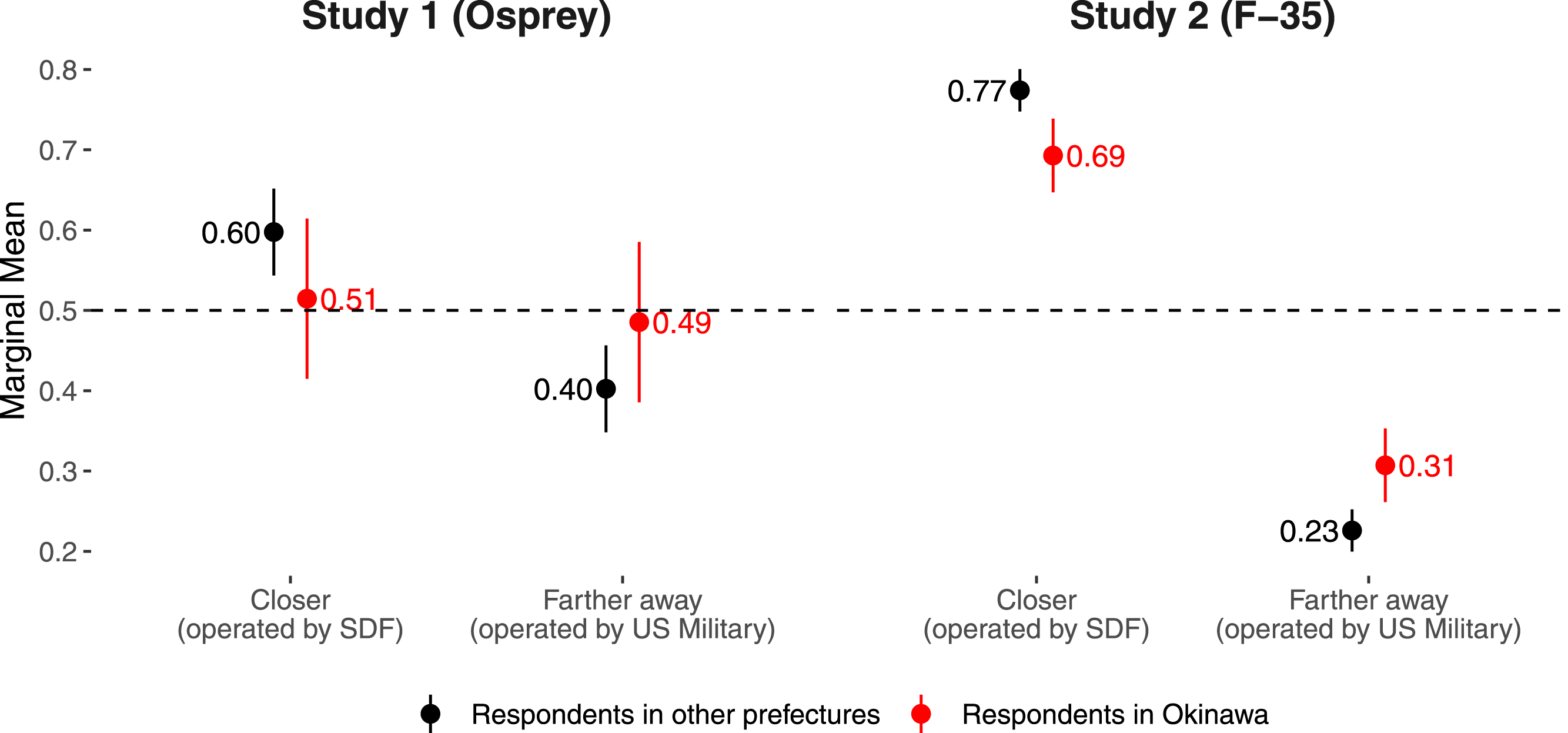
In Study 1, people in Okinawa do not have a clear preference between these two difficult options. But 60 percent of people in other prefectures prefer a plan operated by the SDF even if it is geographically closer. In Study 2, which has a wider variation in locations, both people in Okinawa and other prefectures, strongly prefer a deployment plan operated by the SDF even if it is geographically closer. These results may suggest that although Japanese people have geographically-relevant NIMBY attitudes, they have even stronger operator-relevant NIMBY attitudes. What matters could be not only NIMBY attitudes toward military assets but also, more generally, NIMBY attitudes toward U.S. military. This is an important topic for further research.
Conclusion
We conducted conjoint experiments to scrutinize Japanese citizens’ multidimensional preferences for the deployments of the Osprey and F-35 fighter jets, which are strategically important for Japan and the United States. On the one hand, we find strong support for the U.S.-Japan security alliance among Japanese citizens regardless of their place of residence. On the other hand, we find strong opposition to the military facilities being in proximity. A combination of perceived diffused benefits and perceived concentrated costs constitutes robust evidence of NIMBY attitudes toward deploying these advanced arms.
Importantly, we also find the preference for national (i.e., SDF) over the U.S. military in operating the Osprey and F-35. This pattern is also highly consistent among the Okinawans and the residents of other prefectures in Japan. Furthermore, the night landing practice was commonly disliked. These results suggest that Japanese people think, “U.S. military should not be in my backyard.”
Our research substantially contributes to the literature and offers several directions for further investigation. First, the study provides clear evidence that the military is the typical NIMBY item. People want security, and for that improvement, they know the military base of an alliance partner would benefit the country as a whole. While they appreciate the military alliance, the people would not welcome the controversial foreign troops’ deployment in their vicinity. The military equipment would cause noise and air pollution and could be a target for the first strike from the enemy countries. Future research on security policy and military strategy should explicitly consider citizens’ NIMBY attitudes toward the armed forces. We believe that such a study examining not only positive externalities (Allen et al. 2020) but also negative externalities (Hikotani, Horiuchi, and Tago 2022) of military presence can facilitate policy discussions about effective military deployment and robustness of the American alliance network. Without a good relationship with the local residents hosting American bases, the U.S. may not be able to continue its dominance in global security.
Second, we contribute to the current discussions in the literature on civil-military relations regarding public opinion and social movements. Our research on public perceptions regarding military bases complements Kim and Boas’s (2020) recent study, which suggests that practical and tangible framing works better than ideological or patriotic framing to garner local support. We should look further into the impact of various information environments to explain the origins of the NIMBY sentiment about locals and explore how NIMBY attitudes can be minimized. While Kim (2021) and Della Porta, and Fabbri (2016) are key interdisciplinary studies on social movements against the military base siting, our study suggests that the Japanese people care about the negative externalities of the military assets, and although they do not want military assets to be deployed in their vicinity, despite their diffused support for the U.S.-Japan alliance. Such NIMBY attitudes have not been much investigated in the existing literature on base politics.
Third, our survey data show a clear preference for the Japanese SDF over the U.S. military in the operation of the Osprey and F-35. This finding opens a new question in future research on the domestic foundation of support for alliances. Some studies have looked at public support for the military alliance and commitments (e.g., Kreps 2010; Mello 2020). However, there has not been much systematic research investigating whether there is a significant difference between confidence in one’s military and confidence in an ally’s forces (see Tomz and Weeks 2021, for an exception). Upon even closer examination, our finding may be more relevant to nationalism, other security concerns, or decision processes (domestic versus international). Examining how the unit of military operation (national, foreign, or joint forces) in different settings affects public opinion is a fruitful avenue for future research on public opinion about alliances.
This finding about the preference for the domestic, rather than foreign, military also has some policy implications. As long as the national troops can minimize the negative attitudes toward the military bases among the local people, the foreign military (i.e., U.S. military) could find ways to collaborate with the national forces (i.e., SDF). For instance, by transforming a foreign military base into a joint operation base with the national troops, it may be possible to reduce the visibility of foreign armed forces to the locals and, in turn, ease the anti-base feeling among the people living nearby.
Finally, our research points to the significance of local public opinion in studying foreign policy. There is an expanding body of literature on foreign public opinion, and one of the critical discussions is whether such opinion matters in international affairs (Goldsmith and Horiuchi 2012; Kreps 2010). To comprehend global problems, we call for further research on local public opinion among important stakeholders when examining the concerns unique to particular locations. The urgency for such research is growing with geographically specific security concerns in Central/Eastern Europe, East Asia, and many other parts of the world.
Supplemental Material
Supplemental Material - U.S. Military Should Not Be in My Backyard: Conjoint Experiments in Japan
Supplemental Material for U.S. Military Should Not Be in My Backyard: Conjoint Experiments in Japan by Yusaku Horiuchi and Atsushi Tago in Journal of Conflict Resolution
Supplemental Material
Supplemental Material - U.S. Military Should Not Be in My Backyard: Conjoint Experiments in Japan
Supplemental Material for U.S. Military Should Not Be in My Backyard: Conjoint Experiments in Japan by Yusaku Horiuchi and Atsushi Tago in Journal of Conflict Resolution
Footnotes
Acknowledgments
We thank the United States-Japan Foundation for a research grant (No. 2019-1-18-U).
Author’s Notes
We presented earlier versions of (part of) this paper at the 2020 Annual Meeting of the American Political Science Association (September 9, 2020), the Japanese Politics Online Seminar Series (December 3, 2020), the 2021 Winter Meeting of the Japanese Society for Quantitative Political Science (January 9/10, 2021), and the 2022 Annual Meeting of the American Political Science Association (Montreal, September 17, 2022); John Carey, Alexander Cooley, Takako Hikotani, Takeshi Iida, Koji Kagotani, Claudia Kim, Yoshiaki Kubo, Max Knight, Wendy Leutert, Max Margulies, Carla Martinez Machain, Ann Mezzell, Jay McCann, Nick Miller, Jonson Porteux, Sebastian Schmidt, Mike Tomz, Charmaine Wills, Bill Wohlforth, and other conference/seminar participants for useful comments; and Kathryn Weller for proof-reading.
Declaration of Conflicting Interests
The author(s) declared no potential conflicts of interest with respect to the research, authorship, and/or publication of this article.
Funding
The author(s) disclosed receipt of the following financial support for the research, authorship, and/or publication of this article: This work was supported by the United States-Japan Foundation for a research grant (No. 2019-1-18-U).
Data Availability Statement
A complete replication package is available for download from the author’s Dataverse,  .
.
Supplemental Material
Supplemental material for this article is available online.
Notes
References
Supplementary Material
Please find the following supplemental material available below.
For Open Access articles published under a Creative Commons License, all supplemental material carries the same license as the article it is associated with.
For non-Open Access articles published, all supplemental material carries a non-exclusive license, and permission requests for re-use of supplemental material or any part of supplemental material shall be sent directly to the copyright owner as specified in the copyright notice associated with the article.
