







Abstract
Following Russia’s full-scale invasion of Ukraine in 2022, the United Nations General Assembly adopted multiple resolutions condemning the aggression and calling for the withdrawal of Russian forces. While some Global South countries supported these measures, many refrained from taking a critical stance toward Moscow, despite clear violations of international law. What accounts for this divided response? Departing from existing explanations that focus on contemporary geopolitical or economic interests, this paper traces Global South countries’ positions to the Soviet Union’s extensive Cold War–era interventions in the developing world. We argue that states that received greater volumes of Soviet aid are significantly more likely to align with Russia today, driven by both material dependencies and ideational legacies. Empirically, we demonstrate that the observed association withstands extensive robustness tests and is substantiated by evidence for both material and ideational mechanisms. These findings underscore the importance of a historical-institutional approach to understanding international alignment in the Global South and call for moving beyond the Liberal International Order framework when analyzing global responses to contemporary conflicts.
Introduction
Russia’s full-scale invasion of Ukraine in 2022 represents one of the starkest violations of international law and the territorial sovereignty of a UN member state in recent history. While the Global North uniformly condemned the invasion and called for Russia’s immediate withdrawal, efforts to mobilize a united front in the Global South fell short. Many states in the Global South refrained from taking strong actions against Russia, with a notable number abstaining or voting against key UN General Assembly resolutions critical of Russia’s actions. The countries failing to chastise Russia in the UN numbered more than 40 and represented almost half of the world’s population. Nearly half of African countries chose to abstain or voted against condemning Russia. This fragmented response has bolstered Russia’s international standing, allowing it to claim support from a significant portion of the Global South and challenging the West’s narrative of Russia’s global isolation.
Understanding why many Global South countries have adopted pro-Russian or neutral stances is crucial to unpacking the international dynamics of this conflict. Existing scholarship offers several explanations. One view emphasizes economic and security ties, arguing that states with deeper material dependencies on Russia are less likely to criticize it. Another explanation highlights the Global South’s aspiration for a multipolar world, with many states seeing Russia as a counterweight to U.S. hegemony and Western imperialism. A third perspective suggests that states perceive the conflict as a regional European affair, avoiding costly political alignments that may not serve their national interests.
This article advances a historically grounded explanation for the Global South’s varied responses to the invasion. We argue that the legacy of Soviet intervention in the Third World during the Cold War plays a critical role in shaping contemporary voting patterns in the UN General Assembly. Specifically, countries that received significant Soviet military and economic aid during the Cold War are more likely to adopt pro-Russian positions today. This legacy operates through two pathways: material incentives and ideational factors.
First, we posit that Cold War-era Soviet aid laid the foundation for enduring material ties between recipient states and Russia. Economic and military assistance from the Union of Soviet Socialist Republics (USSR) created patterns of mutual trust, institutionalized relationships, and path dependence that persisted after the USSR’s dissolution. When Russia re-emerged as a global actor in the late 1990s, these states were more likely to establish robust trade and security partnerships with Moscow, reinforcing their alignment with Russian interests.
Second, we highlight the ideational dimension of Soviet assistance, which was framed during the Cold War as support for newly independent states seeking liberation from colonial and imperial domination. This ideological framing fostered goodwill and a sense of solidarity with Moscow, which has been inherited by Russia as the USSR’s successor state. Russia has strategically invoked the memory of Soviet aid to position itself as a champion of anti-colonialism and an ally of the Global South in resisting Western dominance. This historical narrative resonates particularly strongly in states that benefited from Soviet support, shaping their perceptions of the global order and their responses to the Ukraine conflict.
To empirically test these claims, we analyze voting patterns on six major UN General Assembly resolutions related to Russia’s invasion of Ukraine. These resolutions, adopted by the UNGA between Mach 2022 and February 2023, addressed critical issues such as condemning the invasion, suspending Russia from the UN Human Rights Council, rejecting Russia’s annexation of Ukrainian territories, and demanding reparations for Ukraine. Despite the clear and blatant nature of the invasion, a significant number of states abstained or voted against these resolutions, which we interpret as pro-Russian stances. Using regression analysis, we demonstrate that higher levels of Soviet military and economic aid during the Cold War are strongly associated with a greater likelihood of abstention or opposition to these resolutions. These results remain robust after accounting for contemporary military and economic ties and other potential confounding factors. Moreover, we supplement the baseline analysis with matching methods and process tracing of selected cases, showing that divergent historical ties have led to contrasting voting choices among countries with similar contemporary dependence on Russia.
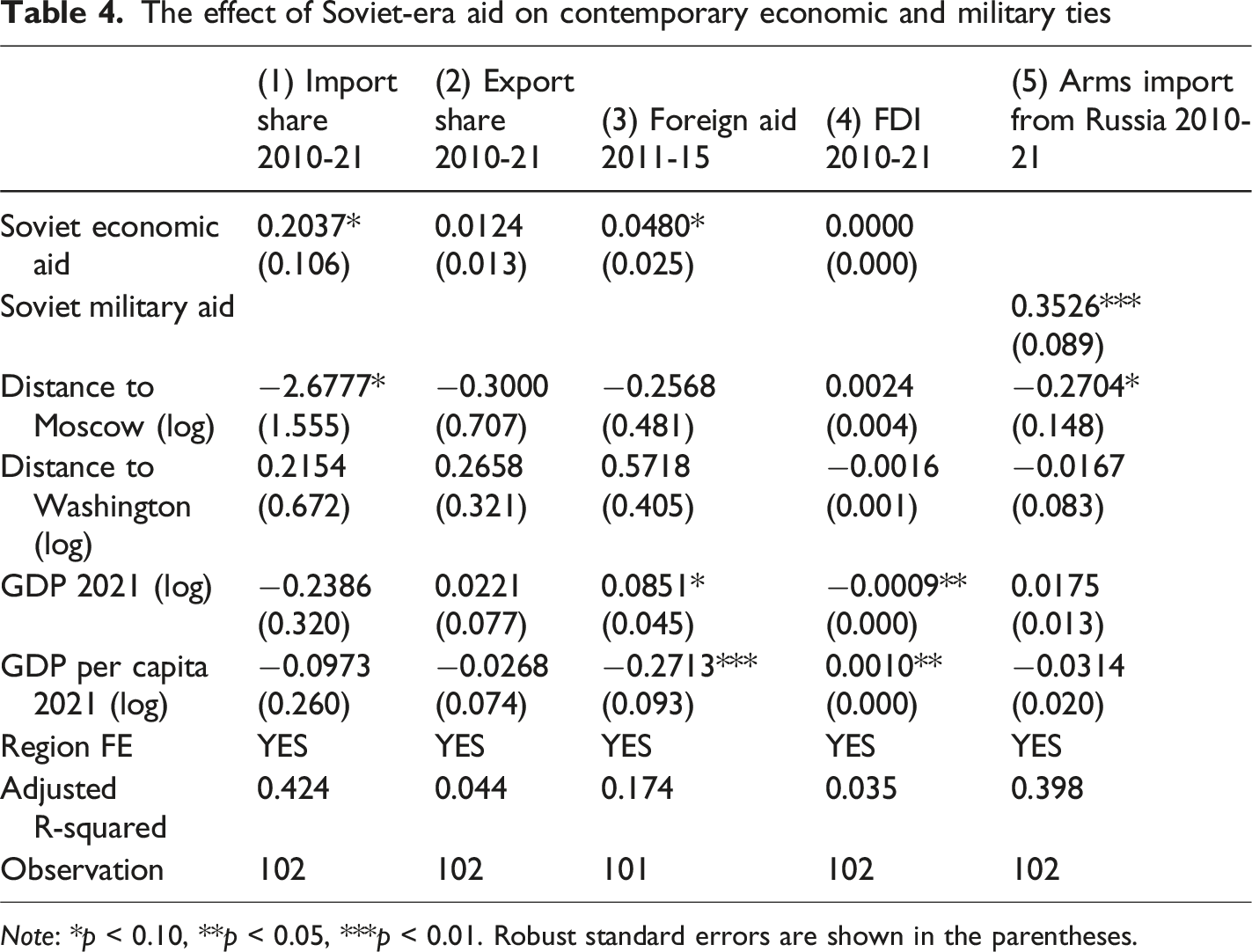
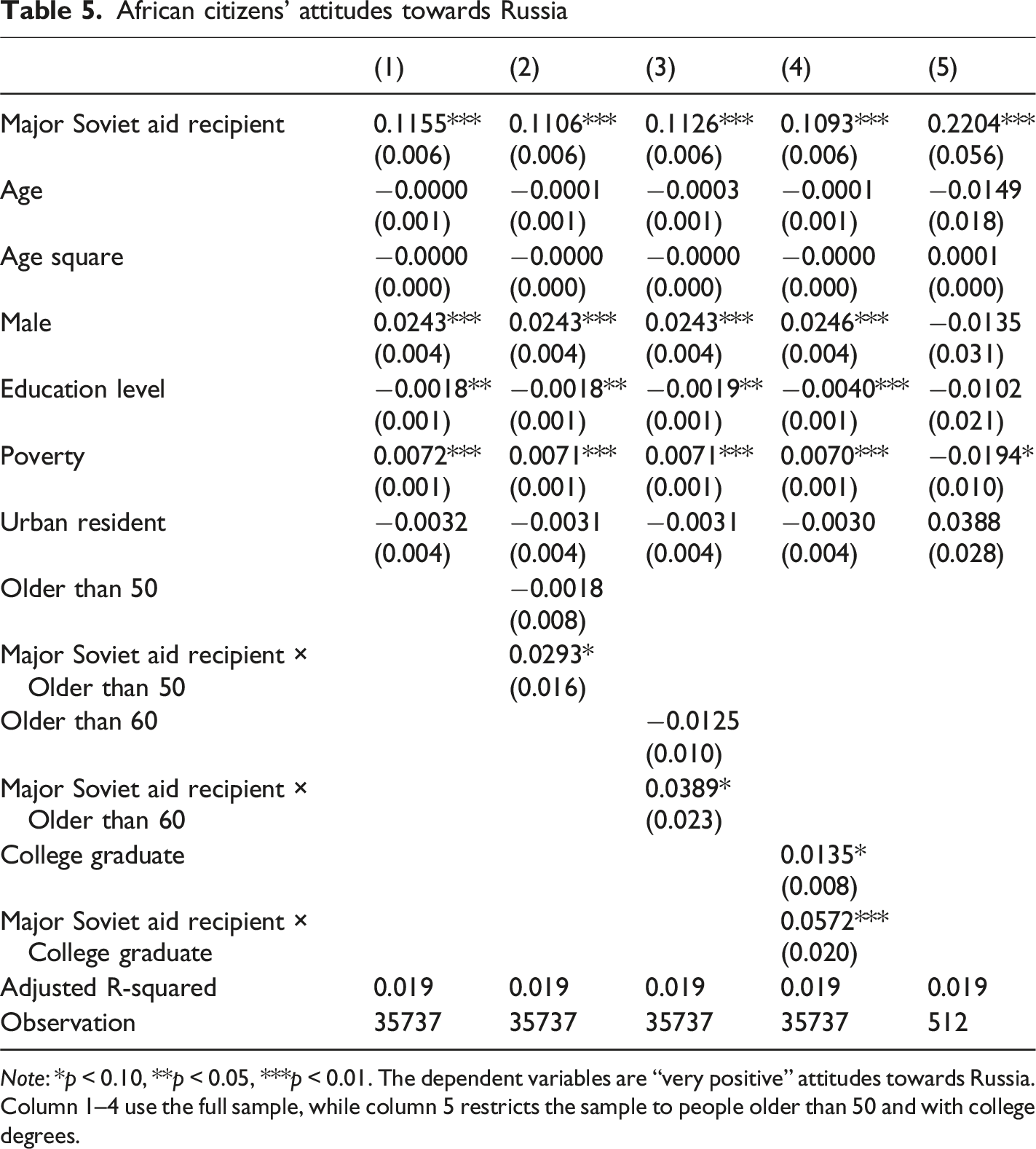
To further substantiate our theoretical mechanisms, we present evidence for both material and ideational pathways. For the material mechanism, we show that contemporary military and, to a less extent, economic relations with Russia are closely linked to past Soviet aid, underscoring the path-dependent nature of these ties. For the ideational mechanism, we leverage Afrobarometer survey data to reveal that individuals in countries that received substantial Soviet aid are more likely to hold pro-Russian attitudes prior to the Russia-Ukraine conflict. This effect is particularly pronounced among older respondents who were socialized during the Cold War and whose lives might have been directly impacted by Soviet aid during their formative years. More importantly, we find that the effect of historical aid on contemporary views towards Russia is even stronger among the subgroup whose demographic characteristics most resemble the countries’ ruling class, suggesting that Soviet-era assistance might have influenced the views of current rulers.
Our study contributes to several strands of existing scholarship. First, we speak to a growing body of work that has sought to explain the foreign policy behavior and alignment strategies of Global South countries (Braveboy-Wagner 2003; Brummer 2021; Cooper and Flemes 2013; Gray and Gills 2016). Much of this literature emphasizes economic interdependence, military cooperation, and aspirations for strategic autonomy as central drivers of Global South diplomacy. Scholars have highlighted how postcolonial states navigate great power competition by balancing material interests with normative commitments, often prioritizing non-alignment or multipolarity to preserve their sovereignty (Luckman 2025). Our study contributes to this literature by introducing a historical-institutionalist perspective, showing that foreign policy preferences of the Southern countries are not only shaped by contemporary interests, but also by deep-rooted historical relationships that originated during the Cold War.
Second, this article engages with the literature on the long-term impact of foreign aid and international engagement by great powers. Existing research has shown that economic and military aid can create durable alliances, norms, and networks that persist long after the original donor regime has changed (Engerman 2018; Morgan and Zheng 2019; Westad 2005). For example, traditional empires often provided long-term aid to satellite states to defend their sphere of influence or safeguard their borders (Markovits, Strange, and Tingley 2019). In addition, the literature extensively shows that donors provided considerably more foreign aid to their former colonies than to other countries (Chiba and Heinrich 2019; Ramachandran 2024). While scholars have explored how Western aid created institutional dependencies and normative alignments in the postwar world (Easterly 2008; Juselius, Møller, and Tarp, 2014; Moyo 2009), fewer studies have systematically examined how Soviet aid shaped recipient states’ long-term trajectories. Our study fills this gap by empirically linking Cold War-era Soviet assistance to present-day diplomatic behavior in the UN General Assembly, demonstrating how material and ideational legacies of Soviet engagement continue to shape alignment with Russia.
Finally, this article contributes to recent debates on the decline of liberal hegemony and the rise of multipolarity. The post-Cold War liberal international order, long dominated by the United States and its allies, faces growing challenges from states that reject its normative foundations and institutional structures (Ikenberry 2011; Lake, Martin, and Risse, 2021; Prantl 2014). Russia, in particular, has sought to mobilize historical narratives of anti-imperialism and South-South solidarity to position itself as a champion of multipolarity (Kanet 2018; Morozov 2023). Our findings suggest that this strategy resonates more strongly in states that received Soviet-era support, where Cold War-era ideological affinities and enduring memories of anti-colonial solidarity remain potent. By tracing how these historical experiences shape contemporary responses to global crises, we show that multipolarity is not only a geopolitical reality, but also a deeply embedded narrative sustained by memory, identity, and history.
Relevant Literature
The reaction of the Global South to Russia’s invasion of Ukraine in 2022 diverged sharply from that of Western democracies. While the United States and its allies quickly imposed sanctions and provided military support to Ukraine, many countries in Africa, Asia, and Latin America refrained from taking strong action against Russia. This literature review examines existing explanations for this behavior, categorizing them into three primary strands.
One key factor influencing the response of Global South nations is their economic and strategic relationships with Russia. Brosig and Verma (2024: 743) notes that states displaying dependency or vulnerability in energy and food trade have strong reasons to avoid antagonizing Moscow. For instance, India dramatically increased its imports of Russian oil following the invasion, taking advantage of discounted prices due to Western sanctions (Farzanegan and Gholipour 2023). Nigeria’s reliance on Russian oil, gas, and grain imports explains its pragmatic stance (Ayodele 2024: 769–70). Similarly, Brazil depends on Russian fertilizer exports to sustain its agricultural sector, which limits its willingness to confront Moscow (Stoner 2024).
Beyond economic ties, military cooperation with Russia has also played a role. Several countries maintain defense agreements with Moscow, a legacy of Cold War-era arms deals and training programs (Kinne 2018). Nations such as Algeria, Venezuela, and Myanmar have historically received Russian weaponry and continue to engage in military cooperation. Russian arms and mercenary support help regimes in Mali and Central African Republic stay in power (Gopaldas 2023: 5). These ties foster a degree of political alignment, as military dependence on Moscow discourages direct confrontation (Busari 2022).
Another explanation highlights the Global South’s aspiration for a multipolar world, with many states seeing Russia as a counterweight to U.S. hegemony and Western imperialism. Many developing countries view Western dominance as a relic of colonialism and support efforts to create a more balanced international order (Engerman and Bhardwaj 2024). India, for example, emphasizes strategic autonomy as a means of resisting Western influence, a perspective shaped by colonial-era grievances (Ollapally 2024: 470, Luckman 2025: 60). Russia’s advocacy for reforms in global institutions to better represent the Global South also aligns with these aspirations. Additionally, Russia’s ideological framing of the conflict as a struggle against Western liberal hegemony finds resonance in both democratic and authoritarian states (Chatterjee and Petrone 2024: 5).
The suspicion of a unipolar world led by the US is reinforced by the perception of Western hypocrisy and double standards in enforcing the international law. Several scholars highlight the frustration among developing nations regarding selective enforcement of sovereignty norms (Alden 2023). Western interventions in Iraq (2003), Libya (2011), and Syria (ongoing) are frequently cited as instances where international norms were violated without global repercussions (Brosig and Verma 2024: 759). This inconsistency weakens the legitimacy of Western-led condemnation of Russia’s actions. Leaders from countries such as South Africa and Brazil have openly criticized NATO’s role in provoking the crisis, arguing that the war is a symptom of broader geopolitical tensions rather than a clear-cut case of aggression (Chatterjee and Petrone 2024).
A third strand of the literature explains the Global South’s reaction through the lens of non-alignment. The Non-Aligned Movement (NAM), which emerged during the Cold War as an alternative to U.S. and Soviet bloc alliances, continues to shape foreign policy thinking in many developing countries. For instance, South Africa, India, and Indonesia have all framed their responses to the Ukraine crisis in terms of preserving strategic autonomy and avoiding entanglement in great-power conflicts (Alden 2023). Many Global South leaders question why their countries should bear economic hardships for what they view as an European conflict (Chatterjee and Petrone 2024: 4). Nigeria’s pragmatic approach, for instance, is influenced by its domestic security challenges, with leaders prioritizing internal stability over foreign entanglements (Ayodele 2024). Similarly, many states prefer to maintain the status quo rather than implementing drastic foreign policy shifts, as seen in the reluctance to impose sanctions on Russia (Brosig and Verma 2024: 743).
While these explanations capture important aspects of the Global South’s reaction, they do not provide a complete account of the support enjoyed by Russia after the invasion was launched. The explanation focusing on economic and security ties to Moscow stands out as a compelling and intuitive one, but several issues exist with this argument. First, facing Western sanctions, Russia has become highly dependent on customers in the developing world for its export goods. This suggests that a strong rebuke of the invasion from Global South countries is unlikely to imperil their trade and arms transactions with Russia (Ollapally 2024: 470). For example, Argentina voted against Russia in all six war-related UN resolutions, yet this position did not harm its trade relations with Moscow (Binetti 2024: 748). This case illustrates that countries can condemn the invasion without antagonizing Russia, as long as they do not join Western efforts to arm Ukraine or impose sanctions. Second, while many developing countries maintain trade ties with Russia, these ties pale in comparison to their economic connections with Western countries. Russia’s total trade with African states amounts to only $18 billion, significantly lower than the United States’ $64 billion and China’s $254 billion (Ferragamo 2023). South Africa, despite consistently refusing to vote against Russia, does not exhibit substantial economic dependence on Moscow (Brosig and Verma 2024: 760). These examples suggest that economic or military ties alone do not fully account for the variation in Global South responses.
The second and third explanations highlight the importance of ideational and normative factors ignored by the first. Suspicion of U.S. hegemony, resentment of Western double standards, and historical involvement in the Non-Aligned Movement have shaped the foreign policy perspectives of many Global South states. However, these explanations tend to treat Southern countries as a homogenous group and struggle to account for the variation in responses. Why do some states embrace Russia’s anti-Western narrative while others align with the West in condemning the invasion? Many key players in the Non-Aligned Movement, such as Kenya and Zambia, have consistently voted against Russia in UN resolutions. This raises the question of why some states internalize anti-Western norms more deeply than others.
Theoretical Argument
While existing studies have sought to understand the mixed reactions from the Global South from various angles, they tend to overlook a crucial historical factor—the legacy of Soviet interventions in the Third World during the Cold War. To be sure, scholars have mentioned historical ties to the USSR as a factor in explaining the response of individual countries, but none have elaborated on the theoretical mechanisms linking these ties to contemporary state behavior. Our argument is that states that benefited more from Soviet economic and military support are more likely to adopt pro-Russia positions in the present crisis.
During the Cold War, the USSR provided significant economic and military assistance to emerging countries in Asia, Africa, and Latin America, aiming to expand its global influence and disseminate its development models to recipient nations (Friedman 2015; Iandolo 2022). Soviet economic aid took the form of credits for purchasing Soviet machinery and equipment or covering the expenses of Soviet-led development projects (Heurlin 2020: 970). Between 1955 and 1991, the USSR delivered over $46 billion in economic aid to 39 less developed countries, with non-CMEA countries receiving 51 percent of this total (Bach 2003: 156). In 1990, a Soviet official announced that economic assistance amounted to 1.4 percent of Soviet GNP or 6.2 percent of the government’s budget expenditure (Bach 2003: 9).
Even more important than economic assistance as a foreign policy instrument towards the Third World was Soviet military assistance (Goodman 1991: 146), including the transfer of weapon systems and the provision of military training. Since 1960 the USSR had ranked second to the U.S. as the major world supplier of arms, accounting for 33.7 percent of total world exports. Between 1982 and 1986, the value of Soviet military deliveries reached 75 billion dollars or more than twice the value in comparable US deliveries (Central Intelligence Agency 1987). From the 1970s onward, Moscow expanded its arms trade to meet the growing demand of the Third World market. For the period of 1974–1978, it supplied approximately one third of all weapons shipped to the Third World (Kanet 1983: 39). Moreover, arms trade was almost always accompanied by the dispatch of Soviet military technicians to instruct the local military in its use and/or the sending of officers to the USSR for extended training (Ibid.: 52).
We argue that the close connections formed between the USSR and some Third World states exerted a significant impact on how these states reacted to Russia’s invasion of Ukraine. We propose two mechanisms – one material and one ideational – through which Soviet-era ties influence contemporary alignment with Russia.
The Material mechanism
Whether countries from the Global South decided to take a strong stance against Russia’s invasion of Ukraine was partially determined by their economic and security ties with Russia. However, states’ contemporary ties with Russia were themselves shaped by historical relationships in which the Soviet era played an important role. On average, states that developed stronger economic and military ties with the USSR were also more likely to rekindle such ties in the early 21st century.
After the collapse of the USSR, Russia experienced a rapid retrenchment in the Global South, with massive reduction of diplomatic and military presence. Post-Soviet Russia experienced a breakdown in economic ties, especially with Africa, leading to diminished trade and investment opportunities. This new era was marked by the closure of nine Russian embassies and three consulates on the African continent, the majority of trade missions, and 13 out of 20 cultural centers. Most of the aid projects initiated by the USSR were shut down (Mahamat 2024; Neethling 2020, 18–19). Arms sales to the developing countries plummeted (Ramani 2023; Trenin 2018), and Russia’s economic and military assistance to the Global South came to an abrupt halt. The decline was due to both the disappearance of the communist ideology and Russia’s own political and economic turmoil (Droin and Dolbaia 2023).
In the early 2000s, however, Russia began to reassert its global influence and rebuild links with countries in the Global South. President Vladimir Putin stepped up military and economic cooperation with the developing countries, focusing on arms trade and the extraction of natural resources (Ramani 2023; Bechev et al., 2021: 1–13, Matusevich 2019). As Moscow aimed to make a return to the global stage as a major power, it did not start from a clean slate. Its Soviet-era involvement in the Third World left a powerful legacy that conditioned which countries were more likely to form close ties with a resurgent Russia. The literature in economic sociology shows that actions such as trade and investment are deeply rooted in social networks and personal relationships. Individuals prefer to transact with those they know personally or who are recommended by trusted contacts (Granovetter 1985). Preexisting social capital in the form of information and mutual trust are partially constructed through historical aid projects and military support. Governments, firms, and aid workers can use the social capital to facilitate new commercial transactions in the future (Morgan and Zheng 2019).
The social capital that Russia inherited from the USSR takes a variety of forms. First, Moscow drew on the forgiveness of Soviet-era debts to renew commercial cooperation with developing countries. As early as 1996, Russian academics advocated for debt relief in exchange for preferential access to African markets and the creation of joint enterprises (Ramani 2023). Russia’s debt forgiveness in Africa during the June 1999 G8 meeting in Cologne and support for debt restructuring in Mozambique in 2000 achieved positive diplomatic impacts (Sredin 2001). Putin continued these policies at the start of his presidency. For example, in 2005, Russia and Algeria struck a debt-for-arms deal that allowed Algeria to return $1 billion of the $4.7 billion debt and the remaining debt would be repaid through the purchase of Russia weapons. In the same year, Russia agreed to write off 73 percent of Syria’s Soviet-era debts, estimated at $9.8 billion, in exchange for new arms contract and access to facility once used by the Soviet navy (Bechev et al., 2021: 3).
Second, Russia took advantage of a thick web of Soviet-era personal networks in the Third World to gain access. For example, many prominent African politicians and business leaders received training in the USSR, a connection that endured into the post-Soviet era (Matusevich 2019). In South Africa, many leaders of the ruling African National Congress party spent considerable amounts of time receiving training in the USSR (Loyd 2024). On the Russian side, many key players in the diplomatic community had ties to the Third World during the Soviet era. Former foreign minister Yevgeny Primakov had long personal links with Iraq, working as a Soviet correspondent in Baghdad from 1968 to 1970 (Ismael and Kreutz 2001: 98) Quite a few members of the new, post-Soviet Russia elite have backgrounds in foreign intelligence and the KGB. Igor Sechin, CEO of the oil company Rosneft, served under cover at Soviet missions in Angola and Mozambique in the 1980s (Matusevich 2019: 26).
Third, in the realm of military cooperation, the purchase of arms from the USSR creates powerful path dependence mechanisms that encouraged the continuation of Soviet-era ties. After the collapse of the USSR, Russia inherited an oversized defense industry. Converting this sector to civilian use proved prohibitively expensive, making it more feasible for the Kremlin to revive arms relationship with its former Soviet allies and partners such as India, Syria, and Vietnam (Sorokin 1993). These relationships extended beyond the sale of military equipment to include training, organizational support, and technological transfer that facilitated indigenous defense production. Over time, these states became deeply integrated into the Soviet military system. Switching to alternative suppliers would be highly costly due to the accumulated stock of Soviet-origins weapons, operator familiarity with existing platforms, and institutional adaptation to Soviet-era procurement and maintenance flows (Sameer Lalwani et al., 2021; Verma 2024). Without continued Russian support, including spare parts and servicing, the military effectiveness of the recipient states would likely diminish significantly.
The Ideational Mechanism
Soviet-era ties influence the positions adopted by the Global South not only through the path dependency of economic and military ties but also through an ideational mechanism. Constructivist scholars in international relations have long argued that states’ foreign policies are derived partly from national identities and cultural norms (Blyth 2010). Thus, states’ reactions to Russia’s aggression towards Ukraine were determined not only by realist calculations regarding the material consequences of their behavior. Instead, they were also influenced by self-understandings of how the world works, their role in the international community, the perception of Russia and the West’s global influence, and international norms of appropriate behavior. These normative understandings are profoundly shaped by the historical experience of nation-building since the end of the colonial era and their interaction with the USSR.
During the Cold War, Moscow positioned itself as the champion of anti-colonial struggles and national liberation—a policy that had its roots in Vladimir Lenin’s commitment to supporting oppressed peoples in their fight against capitalist exploitation. Lenin saw colonial oppression as integral to the capitalist system, as colonies provided raw materials and cheap labor that helped prevent economic crises in the capitalist core. Therefore, the international communist movement should support national liberation in the colonies as a way to weaken imperialist powers (Seth 1992). Soviet support for national liberation movements was seen as a continuation of this Leninist vision, linking the Soviet cause to the global struggle against capitalism (Bechev et al., 2021: 14). In practical terms, many Third World states turned to Soviet aid because they perceived the West not as genuine partners but as potential new colonial masters. The Soviet model of state-led modernization offered an alternative to Western free-market capitalism, which many saw as inherently neo-colonial (Chatterjee and Petrone 2024: 4). This choice was reinforced by the tangible benefits these countries received. In regions where Western economic and military support was either unavailable or came with strings attached, Soviet assistance provided not only immediate relief but also a sense of solidarity and respect. Furthermore, Soviet backing for Arab states battling US-supported Israel reinforced the notion that the USSR was a reliable partner in the pursuit of national independence and decolonization (Bechev et al., 2021: 3). The gratitude that followed created a foundation of goodwill that persisted even after the end of the Cold War.
After the dissolution of the USSR, the historical and cultural ties forged during the era of Soviet support did not simply vanish. Instead, these ties evolved into a form of Soviet nostalgia—a potent soft power resource that Russia has since tapped into. In the 2000s, as Russia sought to restore its status as a global power, it consciously evoked the legacy of its support for anti-colonial movements. Moscow’s diplomatic rhetoric emphasized its historical alliance with former liberation movements and its consistent opposition to Western unilateralism, appealing to a decolonial sentiment that remains strong among many Global South countries (Ramani 2023; Gopaldas 2023, 5). In Africa, more than anywhere else, Russia has skillfully appropriated the history of Soviet support for national independence movements to bolster its image, using public events, conferences, and media in countries from Algeria to Zimbabwe. Sergey Lavrov, the Russia Foreign Minister, toured several African countries after the outbreak of the Russian-Ukraine war to promote Moscow’s status as an anti-imperialist force, instrumentalizing positive memories of Soviet support in the shared struggle against Western colonialism. The Kremlin depicted the current war in Ukraine as a war of liberation to overcome the West’s political, cultural, and normative hegemony (McGlynn 2021, 2023).
The painful and enduring experience of imperialism led some African countries to embrace the Kremlin’s narrative. The president of Uganda, for example, asserted in a 2022 news conferences with Lavrov that “(w)e appreciated them (the Bolsheviks) because they supported us, they supported our anti-colonial struggle …… therefore, whenever issues come up and some people want us to take position against Russia, we say that these people have been with us for 100 years. How can we be automatically against them? …… How can we be against somebody who has never harmed us? (TASS 2022)”
This enduring affinity was further institutionalized by personal experiences. Many current leaders in the Global South were themselves beneficiaries of Soviet support—whether through educational opportunities, military training, or technical assistance. For example, many leaders of the African National Congress, the ruling party in South Africa, were forced into exile under apartheid and ended up in the USSR, where they received training in medicine, engineering, guerrilla warfare, and party building. For some of these black ANC leaders, life in the socialist bloc was “transformative”, as they “were experiencing for the first time in their lives, care and hospitality at the hands of white people” (Loyd 2024: 18). A very personal account of how historical experiences with the Soviets can sow the seed of long-standing pro-Russia sentiments is given by the Foreign Minister of India in a 2020 interview. When asked about India’s relationship with Russia, S. Jaishankar replied: You know, I like nostalgia. I started my career in Moscow …… Now if you kind of plot these relationships (between great powers), actually an extraordinary steady relationship has been one between India and Russia. It’s actually a standout relationship for its consistency and it has intrigued me why that is so …… it has also been sustained by strong sentiment. And I think sentiment should never be underestimated in international relations. You know, look, my mother today is pushing 90, she still remembers standing on the streets in Delhi and welcoming Khrushchev and Bulganin in 1955, the year I was born. You know it’s still is there in her mind (Ministry of External Affairs 2020).
These anecdotes illustrate how Soviet intervention in the Third World left a lasting imprint on the political imaginations of elites. These personal histories have fostered a sustained receptivity to Russian appeals for multipolarity and resistance against Western domination (Brosig and Verma 2024, 743). Russia has pursued a method of courting and capturing political elites with deep Soviet ties to deliver outsized returns (Gopaldas 2023: 14).
To sum up, the USSR’s engagement with the Third World was a multifaceted intervention that combined material aid with ideological resonance. It provided a blueprint for state-led modernization, affirmed a collective anti-imperialist identity, and forged enduring personal and political ties that continue to predispose these nations to support Russia on key international issues today. The cumulative effect of these strategies is evident in the persistent goodwill toward Russia in regions like Africa and parts of Asia, where historical memory and personal experience continue to shape geopolitical loyalties. This legacy is not merely historical—it is an active component of Russia’s contemporary foreign policy, where Soviet-era narratives and memories are mobilized to counterbalance Western influence and promote a vision of a multipolar world order that resonates deeply with former aid recipients.
The theoretical analysis leads to the following main hypothesis: Global South states that received higher levels of economic or military assistance from the USSR during the Cold War are more likely to take pro-Russian positions towards UN General Assembly Resolutions concerning the invasion of Ukraine.
Data and Method
Sample
Our sample includes all Global South states that came into existence prior to the collapse of the USSR and were therefore eligible to receive Soviet assistance. The term “Global South” broadly refers to countries in Latin America, Asia, Africa, and Oceania that have historically been marginalized in global political and economic systems (Dados and Connell 2012). Because no definitive list of Global South countries exists, we follow established practice by using the membership of the G77, a coalition of developing countries founded in the 1960s to promote their collective interests within the United Nations. The group currently includes 134 states (The Group of 77 2025). From this set, we exclude (1) former Soviet republics (e.g., Kazakhstan, Tajikistan), (2) states that gained independence only after the end of the Cold War (e.g., Namibia, Eritrea), and (3) states with populations under one million. This results in a sample of 105 UN member states.
Outcome Variable
UN general assembly resolutions on Russia’s invasion of Ukraine (March 2022 – February 2023)
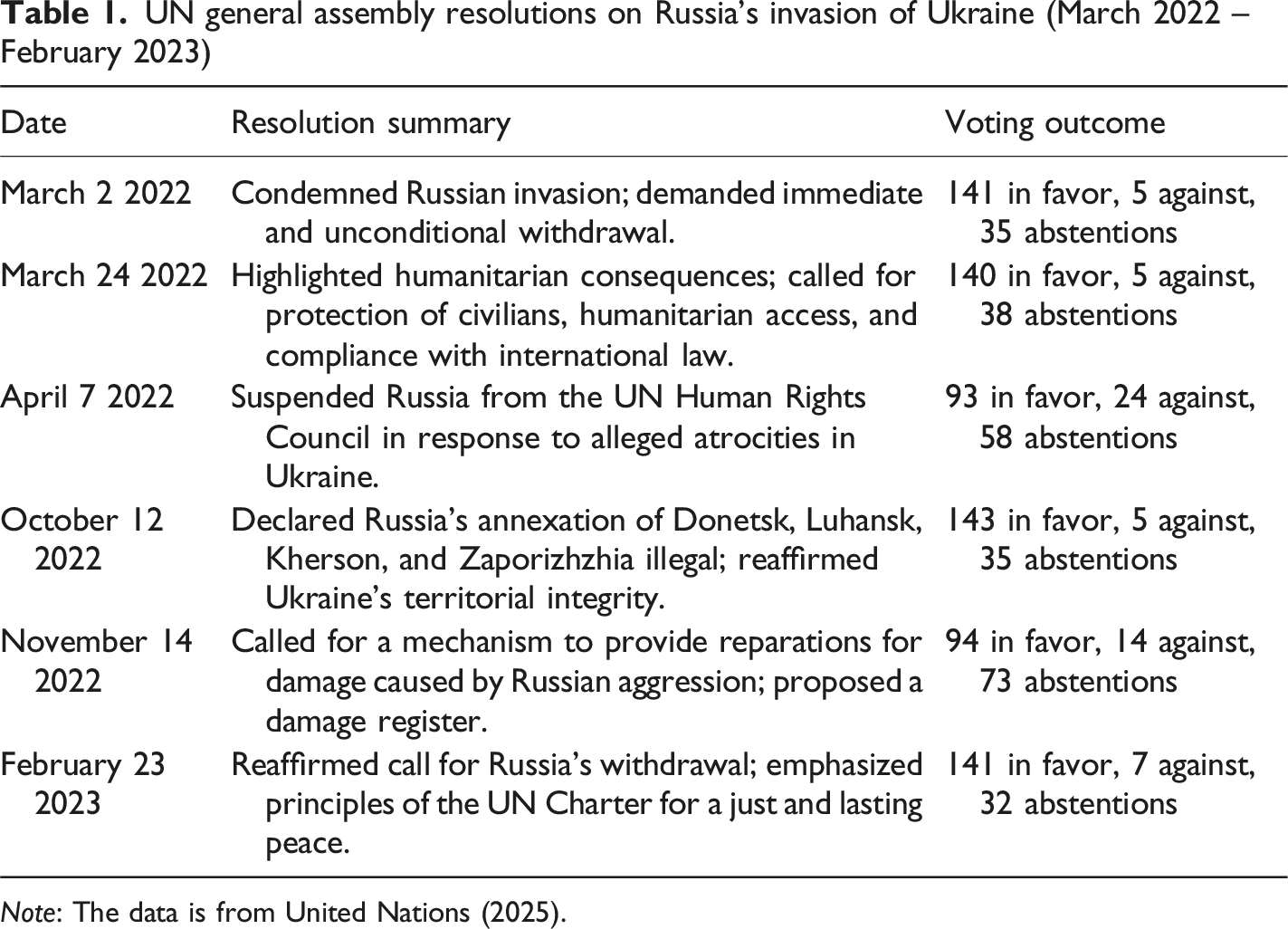
Note: The data is from United Nations (2025).
Explanatory Variables
We measure Soviet-era linkages through two variables: economic aid and military aid. For economic aid, the data is extracted from Bach’s “Soviet Aid to the Third World: The Facts and Figures,” covering the period from 1955 to 1991 (2003). Bach’s compilation primarily relied on the Soviet official publication, the Annual of Soviet International Trade Statistics, which included a section entitled “Deliveries under economic co-operation agreements.” These figures, reported in millions of US dollars, consist of materials, equipment, and technical assistance (i.e., the service cost of experts during project construction, local training, and documentation). One advantage of this data source is that Bach adheres to the international criteria of aid and includes only concessional aid with a grant element above 25 percent (Bach 2003: 16). There are a total of 39 recipient states in the dataset, most of which are Asian, Middle Eastern, and African countries. 1 Following standard practices for measuring foreign aid intensity, we constructed a variable representing Soviet aid on a per capita basis and log-transformed the measure to reduce skewness and mitigate the impact of outliers. For country-year observations with no aid, we assigned a value of $1 (or $0.00001 million) to avoid missing data due to log transformation (Heurlin 2020: 7). We then average the measure over the 1955–1991 period (or from independence until 1991 for countries that gained independence post-1955).
For military aid, the data is drawn from the SIPRI Arms Transfer Database (Stockholm International Peace Research Institute 2024). This database measures the volume of international transfers of major conventional weapons using a common unit called the trend-indicator value (TIV), which is based on the known unit production costs of a core set of weapons. The data source does not capture the extent to which arms were offered at a discount or transferred as grants, so it should be treated as a proxy of Soviet military assistance. As explained by the data’s authors, since the SIPRI TIV figures do not represent sales prices for arms transfers, it is not appropriate to normalize the variable by using GDP or population as the denominator. Rather, “they are best used as the raw data for calculating… global percentages for suppliers and recipients.” Following this advice, we measure a country’s military ties to the USSR by calculating the TIV of arms transfer from the USSR as a percentage of a country’s total arms imports. Again, the variable is averaged across the 1950–1991 period to reflect Cold War-era dependence on Moscow.
Control Variables
Our preferred specification includes several Cold War-era controls to address potential confounding factors. First, substantial evidence suggests that the USSR distributed aid on the basis of the ideological inclinations of countries’ leaders (Gu 1983: 72). Communist and other left-wing governments were more likely to receive Soviet aid due to their ideological affinities with Moscow. Meanwhile, countries that were governed by leftist leaders for longer periods could also be more likely to take positions against the US-led capitalist international order. Therefore, we draw on Herre (2023) to control for the percentage of years that each country was ruled by left-wing leaders from 1945 to 1991. Second, we control for geopolitical proximity by including the distances between each country’s capital and both Moscow and Washington, using data from the CEPII Gravity Database (Conte, Cotterlaz, and Mayer 2022). Third, the USSR is known to have extended aid to Third World states partly to exploit their natural resources. For example, it signed agreements regarding assistance to exploit gas and oil in Iraq, Iran, and Syria (Gu 1983: 76). To account for this, we include a measure of resource dependence, defined as fuel and metal revenues as a percentage of GDP, averaged from 1945 to 1991 (Haber and Menaldo 2011).
Finally, we account for a country’s role in the Non-Alignment Movement (NAM), which was founded to advance the interests of developing countries amid Cold War confrontation. Although the NAM officially pursued neutrality between the two superpowers, it developed closer ties with the USSR through shared anti-imperialist rhetoric and voting alignment on anti-colonial initiatives. From its inception, Soviet diplomacy regarded the NAM as a friendly international movement, maintaining high-level contacts with its founding leaders such as Egypt’s Nasser and Yugoslavia’s Tito (Kostiuk and Katkova 2021). Meanwhile, important members of the NAM may be more inclined to avoid taking explicit positions in the Russia-Ukrainian conflict. We therefore include a dummy variable indicating whether a Global South country participated as a full member in the founding NAM conference in 1961. There were 25 such countries in total.
In addition to these Cold War-era variables, there are also contemporary factors that might impact how countries reacted to the conflict. Because Soviet-era ties may influence these factors, controlling for them risks introducing post-treatment bias that distorts the estimated causal effect. Thus, while we present models that include contemporary controls, the results should be treated with some caution. Most importantly, these models account for a country’s economic and security ties to Russia in the decade immediately preceding the 2022 invasion, ensuring that all control variables are measured prior to the outcome period (2022–2023).
First, we retrieve bilateral trade data from the World Integrated Trade Solution of the World Bank and use two variables to capture each country’s trade relations with Moscow: Export Partner Share (%) defined as “the percentage of exports going to Russia to total exports of a country (dollar value)” and Import Partner Share (%) defined as “the percentage of imports from Russia to total imports of a country (dollar value)” (World Bank 2022). Second, we control for Russia’s foreign direct investment in each country as a percentage of the country’s GDP (Bank of Russia 2022).
Third, as another indicator of economic dependence, we include a measure of Russia’s foreign aid to the Global South states. Ideally, this would reflect the annual aid amount each country receives from Moscow. As part of the accession process to the OECD, Russia began reporting its Official Development Statistics to the economic organization in 2011. However, possibly due to increasing tensions with the West, such detailed information on Russia’s foreign aid programs is no longer available on OECD’s website. The best alternative is the share of total Russian aid each recipient country received between 2011 and 2015, compiled by Asmus, Fuchs, and Müller (2018). The source grouped countries into six categories: (0) no aid, (1) <0.5 percent, (2) 0.5%–1%, (3) 1%–5%, (4) 5%–10 percent, and (5) >10 percent of Russia’s total aid. Based on this, we construct an ordinal variable ranging from 0 to 5, with each value corresponding to a category and higher values indicating greater aid dependence on Russia.
Fourth, to capture contemporary military ties, we control for the share of a country’s arms imports that came from Russia, again using data from the SIPRI Arms Transfer Database. Finally, we include each country’s total GDP and GDP per capita as basic economic controls (World Bank 2023). With the exception of foreign aid (measured for 2011–2015), all contemporary variables are calculated as the mean values for the 2010–2021 period to reduce the influence of short term fluctuations. The descriptive statistics for the main variables are shown in Table A1 of the Online Appendix.
Model Specification
The baseline analysis estimates the following linear probability model:
Results
Soviet aid and support for Russia in UNGA votings
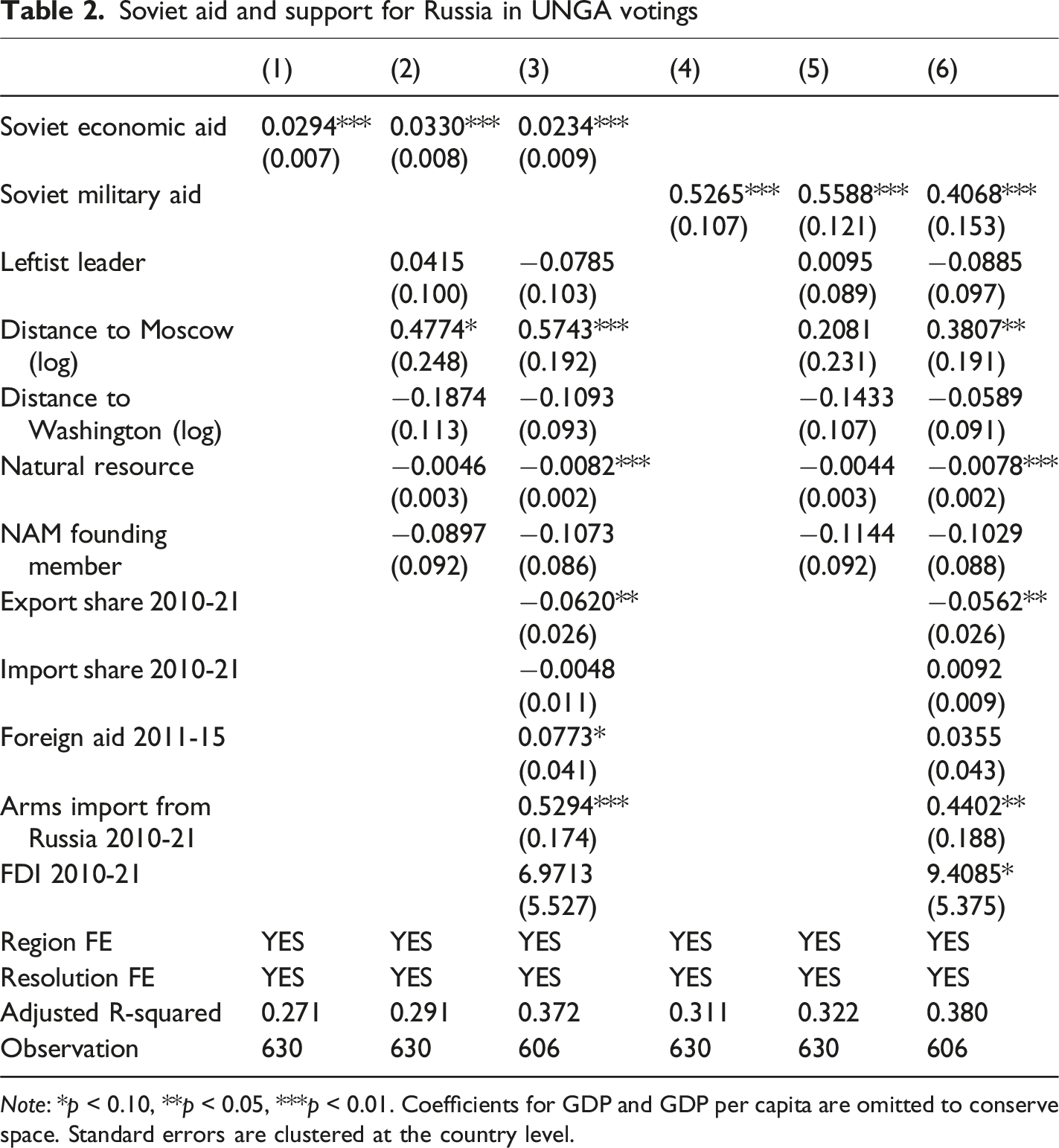
Note: *p < 0.10, **p < 0.05, ***p < 0.01. Coefficients for GDP and GDP per capita are omitted to conserve space. Standard errors are clustered at the country level.
Figure 1 illustrates the effects of Soviet-era aid on voting outcomes for each of the six UNGA resolutions. As shown, the positive effects of economic and military aid are statistically significant at least at p = 0.1 level across all six resolutions. However, these effects are weaker and estimated with less precision for votes on Resolution ES-11/3, which suspended Russia’s membership in the UN Human Rights Council, and Resolution ES-11/5, which called for the establishment of an international mechanism to compensate Ukraine for damages caused by Russia’s aggression. As shown in Table 1, these two resolutions received considerably less support from UN member states than the others. Approximately 70 percent of Global South countries in the sample declined to vote for either resolution, compared to an average of 36 percent that withheld support from the other four. Both resolutions have more tangible operational implications than the other four resolutions, leading to less support from Southern states (Luckman 2025: 61). Resolution ES-11/3 invokes the international human rights mechanism to penalize a state—an approach generally opposed by a broad coalition of like-minded states with problematic human rights records (Freedman 2015; Inboden 2022). Meanwhile, Resolution ES-11/5 has drawn opposition from some Global South states, which point to Western countries’ longstanding failure to deliver reparations for the damage and suffering caused by colonialism (Labuda 2024: 20). Thus, the resolution-specific analysis reveals that the effects of Soviet-era aid are more pronounced in contexts where Russia is more isolated—i.e., when it faced more broad-based condemnation of its military actions. The effect of Soviet aid on support for Russia in UNGA votings: by resolution. Note: This figure shows the effect of Soviet economic and military aid on Southern countries’ voting outcomes for each resolution. The horizontal spike indicates 95 percent confidence interval.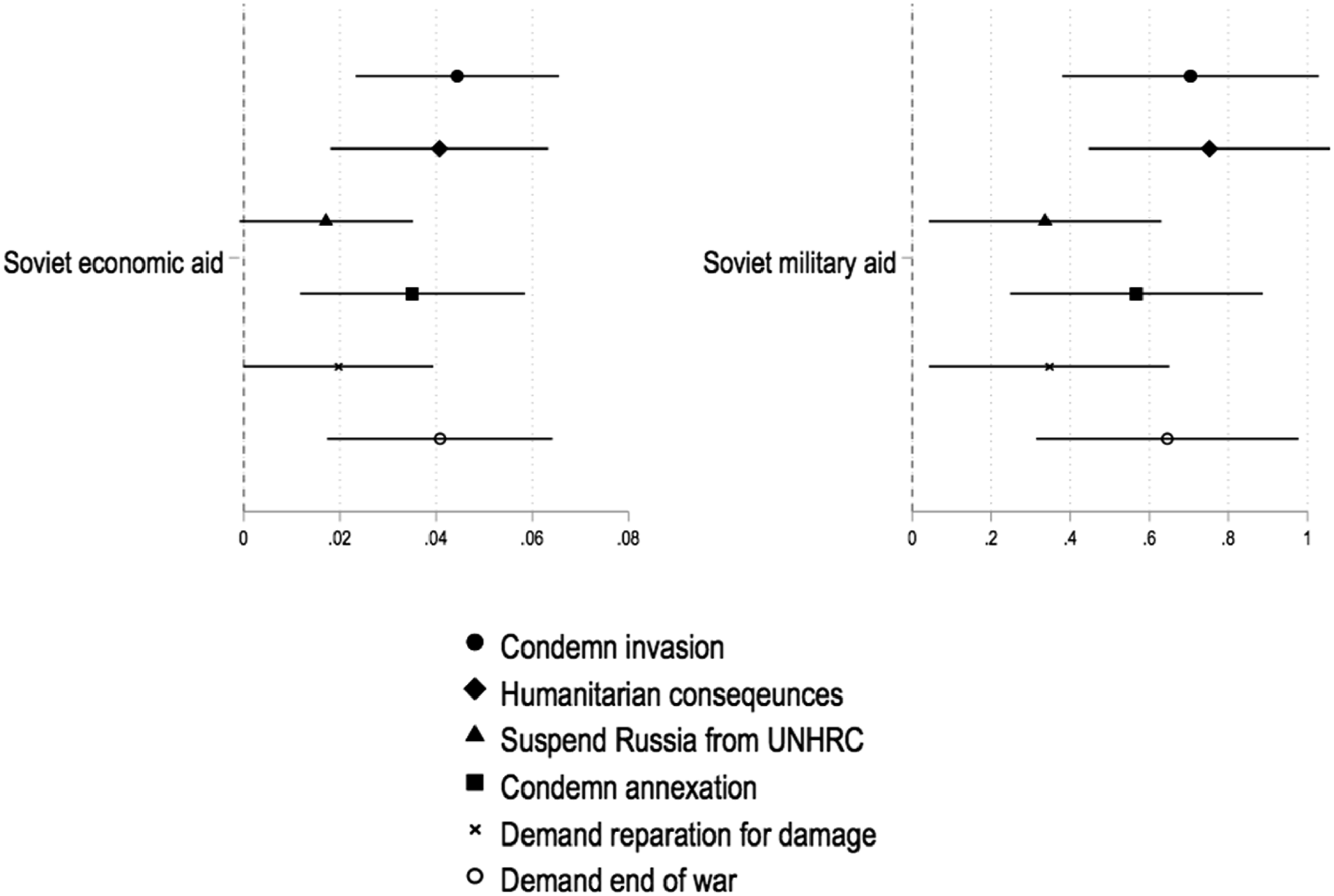
We conduct several robustness checks to ensure the validity of our findings. First, to address potential measurement errors in Soviet aid data—for example, the current measurement does not capture the dispatch of economic and military technicians, and data on military transfer ignored the extent to which arms were offered at a discount or transferred as grants—we use an alternative indicator of Soviet ties: the existence of bilateral friendship treaties. Before its dissolution, the USSR signed friendship and cooperation treaties with 16 countries in the Global South, with their relevant details shown in Table A2 of the Online Appendix. These agreements are a distinct type of treaties signed between Moscow and its partners that represented the strongest form of bilateral cooperation, with standardized format and durations typically ranging from 10 to 25 years. Although formally reciprocal, the treaties in practice imposed asymmetrical obligations on the USSR, primarily involving long-term economic assistance and arms transfers to its treaty partners (Imam 1983). We capture the existence of such treaties using a binary variable to indicate a “strong tie” with the USSR. As shown in Table A3, countries that signed these treaties with the USSR were significantly more likely to support Russia in the present day.
Second, in addition to the explicit UN voting options—“yea,” “nay,” or “abstain”—member states may also be absent. For the six resolutions analyzed here, an average of 7.9 percent of member states were absent during each vote. Our baseline analysis treats absence as equivalent to abstention, assuming both reflect a moderate level of support for Russia. However, scholars have argued that absence should be distinguished from abstention, as it is usually used by weaker and smaller states to avoid taking sides on controversial issues (Morse and Coggins 2024), or results from logistical factors such as a temporary lack of government (Bailey, Strezhnev, and Voeten, 2017). To address this concern, we re-estimate the models excluding observations in which the member states were absent. The results, reported in Table A4, remain substantively unchanged.
Third, to ensure that the results are not only driven by countries from a particular continent, we perform the analysis on subsamples from each of the three major continents of the Global South: Africa, Asia (including the Middle East), and South America (including Central America). It is worth noting that Bach (2003) reported aid data for only two Latin American countries – Cuba and Chile, so the results for economic aid in this region should be interpreted with caution. As shown in Table A5, the results remain robust when the sample is restricted to individual continents. Notably, Soviet aid exhibits particularly strong and significant effects among African countries, suggesting that this region experienced especially intense superpower competition during the Cold War.
Fourth, our main analysis categorizes both abstentions and “nay” votes as expressions of support for Russia, due to the relatively small number of countries voting “nay.” However, since a “nay” vote signals a stronger level of support than abstention, we also estimate ordered logit models to account for the ordinal nature of the dependent variable. As shown in Table A6, the positive and significant association between Soviet-era ties and support for Russia remains robust.
Finally, to ensure that the results are not driven by a handful of major Soviet client states, we replicate the baseline analysis after excluding countries that have the highest values for the economic and military aid variables. Table A7 shows that the results remain consistent even after dropping the top five (or there) recipients of economic (or military) aid. 2 This suggests that the findings are not driven by a few influential outliers.
Additional Evidence Supporting Our Argument
Admittedly, the preceding analysis demonstrates statistical association rather than causality, as unobserved confounders may remain. While endogeneity cannot be fully eliminated, this section mitigates such concerns through complementary quantitative and qualitative approaches. First, we employ a matching design that pairs countries with similar observable characteristics but differing exposure to Soviet aid. Unlike regression-based analyses that rely on functional form assumptions and use all observations regardless of comparability, matching enforces the common support condition—restricting the sample to treated countries with close counterparts among controls. This approach constructs more credible counterfactuals and compares countries that are genuinely similar on observable characteristics.
Specifically, we use propensity score matching to estimate the average treatment effect on the treated (ATT) for each of the six UNGA resolutions. The treatment group consists of the thirty countries that historically received the largest amounts of annual Soviet economic aid, while the control group includes countries that are otherwise similar but received little or no aid. Propensity scores are estimated using a probit model that includes the full set of historical and contemporary controls (as in columns 3 and 6 of Table 2).
Table A9 reports that ATT estimates are positive and statistically significant for most resolutions, except Resolutions 3 and 5—consistent with our earlier finding that Soviet aid mattered more when Russia faced broad-based condemnation of its invasion. The balance test (Table A10) indicates reasonably good balance across covariates, though treated countries still purchased more Russian arms during 2010–2021 (p = 0.073). Results remain robust when redefining treatment as the top thirty recipients of Soviet military aid (Table A11), using alternative matching estimators (radius and kernel; Table A12), and varying the number of treated units to twenty-five or thirty-five (Table A13). Although not eliminating all sources of bias, the matching analysis strengthens the claim that historical ties forged through Soviet aid continue to shape international alignment, even among states with similar contemporary relations with Russia.
To further bolster this argument, we also conduct brief process-tracing analyses of selected country cases. The case selection follows a paired-comparison logic. First, we examine countries with strong contemporary ties to Russia but differing historical relationships with the USSR. This contrast highlights that, where Cold War–era ties are absent, even close present-day connections may not translate into diplomatic support for Moscow. Second, we consider countries with weak current ties to Russia but divergent historical experiences with the USSR. Here, the goal is to show that enduring gratitude rooted in shared anti-imperialist struggles can shape pro-Russian behavior even in the absence of economic or military dependence today. Together, these cases help counter the alternative explanation that contemporary political, economic, or ideological proximity alone determines states’ positions in the UN.
Rwanda exemplifies a country with strong contemporary ties to Russia but no significant historical relationship with the USSR. Economic relations between Russia and Rwanda have expanded significantly since 2010, driven primarily by Rwandan imports of Russian cereals and fertilizers. President Paul Kagame underscored this potential at the 2019 Russia–Africa Summit in Sochi, noting that trade with Russia “has the potential for significant growth in the years ahead” (Ministry of Foreign Affairs and International Cooperation, South Africa 2025). Even more striking, however, is the deepening military cooperation between Moscow and Kigali. The two countries signed an agreement on military-technical cooperation in 2017, outlining plans for arms deliveries and training (Interfax 2017). By mid-2018, Rwanda and Russia were negotiating the supply of air-defense systems, and Rwandan security forces were already operating Russian helicopters, Ural trucks, and small arms (Army Recognit Group 2018). Moreover, both countries share a similar regime type—personalist autocracies centered on long-serving presidents in power since 2000.
Contemporary and historical ties to Moscow for selected countries
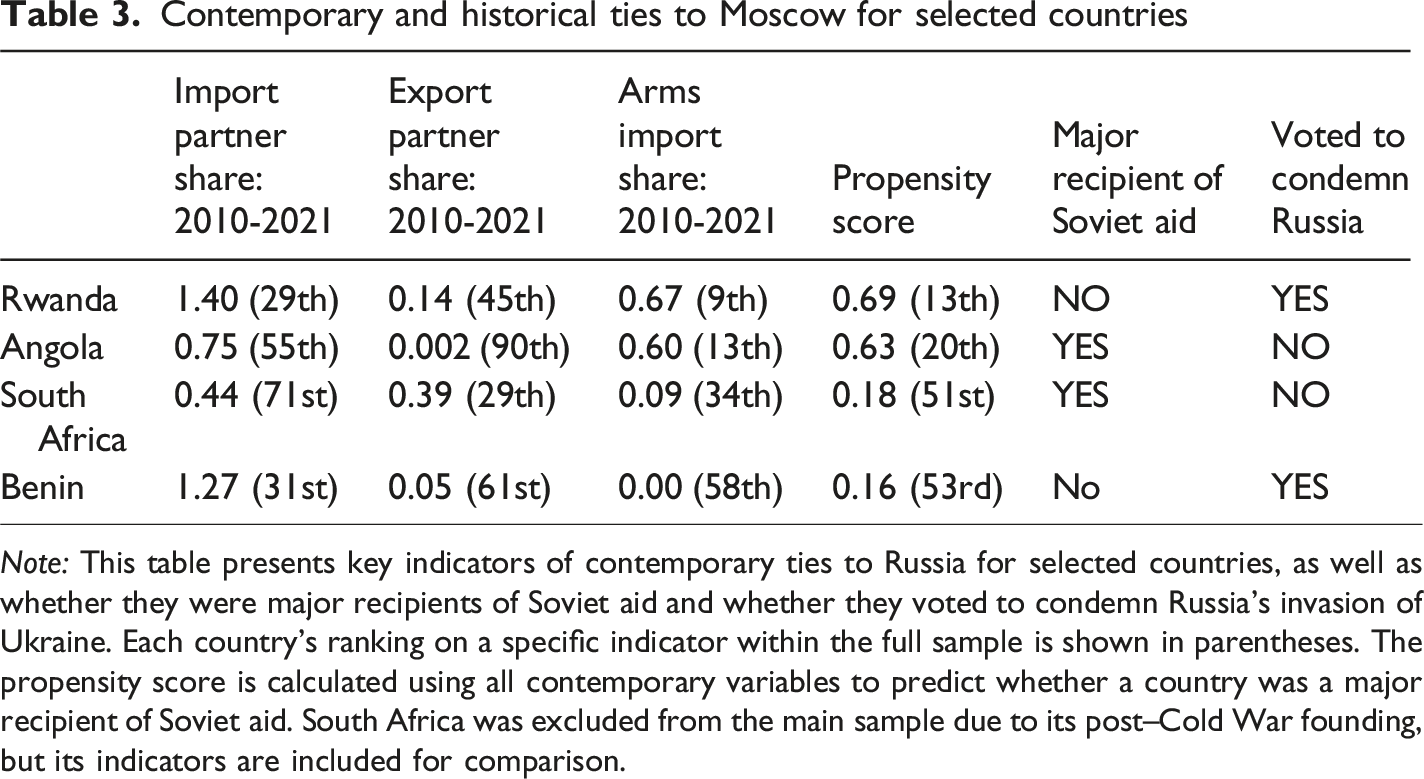
Note: This table presents key indicators of contemporary ties to Russia for selected countries, as well as whether they were major recipients of Soviet aid and whether they voted to condemn Russia’s invasion of Ukraine. Each country’s ranking on a specific indicator within the full sample is shown in parentheses. The propensity score is calculated using all contemporary variables to predict whether a country was a major recipient of Soviet aid. South Africa was excluded from the main sample due to its post–Cold War founding, but its indicators are included for comparison.
We next turn to countries with weak contemporary ties to Russia but divergent historical relationships with the USSR. South Africa is an illustrative case: despite its limited current connections with Moscow, it refused to condemn Russia’s invasion of Ukraine. As Table 3 shows, Russia accounts for less than half a percent of South Africa’s trade, and only a negligible share of its armaments originates from Moscow. Based on contemporary economic and military indicators, South Africa’s estimated propensity score is only 0.18—lower than that of fifty other states. Other African countries with similar scores, such as Somalia, Benin, and Chad, all voted to condemn Russia immediately after the invasion. Contemporary interdependence thus provides little leverage in explaining Pretoria’s decision to abstain from all six UNGA resolutions analyzed in this study (Brosig 2024).
The key to understanding South Africa’s stance lies in history. The ruling African National Congress (ANC) retains deep gratitude for Soviet support during the anti-apartheid struggle. Since the 1960s, the USSR had been a steadfast ally of the liberation movement, providing arms, equipment, and training valued at an estimated 61 million rubles between 1963 and 1990 (Shubin 1996, 15). Thousands of ANC cadres received military and political education in the USSR. As Lindiwe Zulu, a senior ANC leader and Minister of Social Development, declared in 2022 after the invasion, “Russia is our friend through and through. We are not about to denounce that relationship that we have always had. (Saudi Gazatte 2022)” Opposition parties recognized this sentiment: Freedom Front Plus leader Pieter Groenewald cautioned the ANC in Parliament that “if you think that just because of the support in your struggle days you have to look in favor of your friend, … you are failing the people of South Africa” (Groenewald 2022, 63). The radical left party Economic Freedom Fighters, on the other hand, defended the government’s position by stressing that “South Africa’s relationship with the Russia Federation is rooted in through bonds of liberatory brotherhood. At the core of the Soviet Union was the Russian Federation and anyone who argues otherwise is being dishonest” (Shivambu 2022, 55). The domestic press reached a similar conclusion—the Sunday Times editor Msomi noted that the gratitude many older South Africans feel for the historical assistance should not be underestimated (Sadie 2023, 258). In sum, South Africa exemplifies a group of countries whose stances toward Moscow remain deeply rooted in Cold War alignments, even as they have moved away from material dependence on the Kremlin.
Mechanisms
In this section, we provide empirical support for the mechanisms linking Moscow’s Cold War-era interventions in the Global South to how these countries positioned themselves in the Russia-Ukraine conflict. We begin by testing the material mechanism—specifically, whether a country’s contemporary economic and military ties with Russia are correlated with the historical aid it received from the USSR.
To assess the enduring effects of Soviet economic assistance, we regress four indicators of present-day economic dependence on Russia—export partner share, import partner share, Russian FDI, and Russian foreign aid—on the annual volume of Soviet economic aid. To evaluate the persistence of military ties, we regress the share of a country’s arms imports sourced from Russia on the annual volume of Soviet military aid. Both historical and contemporary variables are measured as in the previous analysis (see columns 3 and 6 of Table 2).
The effect of Soviet-era aid on contemporary economic and military ties
Note: *p < 0.10, **p < 0.05, ***p < 0.01. Robust standard errors are shown in the parentheses.
Next, we turn to the ideational mechanism, which posits that Soviet aid to developing countries fostered a sense of gratitude for and solidarity with Moscow. Leaders of Third World states—especially those socialized during the Cold War—may have adopted a worldview aligned with Soviet doctrines of national liberation, anti-colonialism, and anti-Americanism. Even among political elites who were brought up during the post-Cold War period, such pro-Russian sentiment may have been transmitted through family ties, public education, or state propaganda. Ideally, we would analyze elite-level survey data to determine whether political leaders from countries that received substantial Soviet aid are more positively inclined toward Russia. However, to our knowledge, no such survey currently exists.
Instead, we adopt an alternative approach using data from the Afrobarometer survey, a high-quality source of public opinion across numerous African countries. Africa provides an appropriate focus for three reasons: it was a major arena of Soviet influence during the Cold War; it received substantial Soviet assistance; and its geographic distance from Russia reduces the likelihood that contemporary geopolitical dynamics—such as border conflicts or direct military engagement—are driving public attitudes, thus allowing us to more cleanly isolate the long-term effects of Soviet aid. While mass attitudes do not perfectly reflect elite preferences, we proceed under the assumption that leaders are, on average, more likely to favor foreign countries viewed positively by their populations. We also examine whether demographic variation in pro-Russian sentiment aligns with the ideational mechanism, particularly among those whose profiles resemble political elites.
Our empirical strategy is to assess whether citizens of African countries that received significant Soviet economic aid are more likely to view Russia favorably today. We use data from Round 8 of Afrobarometer (conducted in 34 countries between 2019 and 2021), the final round completed prior to the Russia-Ukraine conflict (Afrobarometer Data 2022). Respondents were asked: “In general, do you think the economic and political influence of Russia on [your country] is mostly positive, mostly negative, or haven’t you heard enough to say?” We code a binary dependent variable equal to 1 if the respondent answered “very positive,” indicating strong pro-Russian sentiment. 3 The key independent variable is a binary indicator for whether the respondent resides in a major Soviet aid recipient, defined as a country that received at least $100 million in economic aid from the USSR between 1955 and 1991 (Bach 2003). These countries include Angola, Ethiopia, Guinea, Nigeria, and Mozambique. We control for individual-level characteristics including age, gender, education, wealth (proxied by the frequency of going without cash income in the past year), and urban/rural residence.
African citizens’ attitudes towards Russia
Note: *p < 0.10, **p < 0.05, ***p < 0.01. The dependent variables are “very positive” attitudes towards Russia. Column 1–4 use the full sample, while column 5 restricts the sample to people older than 50 and with college degrees.
We also examine whether education mediates the effects of historical aid. In former Soviet aid recipients, highly educated individuals may be more familiar with the historical ties between their countries and the USSR. Column 4 tests this by interacting the aid recipient indicator with a binary variable for college graduates. The interaction term is significantly positive, indicating that the legacy of Soviet aid is stronger among educated respondents.
Finally, we restrict the sample to a subgroup whose characteristics most closely resemble those of national elites—respondents over 50 and with a college degree. Of the 35,737 respondents in 27 countries, only 512 (1.43 percent) meet this criterion. Column 5 replicates the baseline analysis on this elite subgroup, revealing a larger and statistically significant coefficient for aid recipient status. Holding covariates at their means, the model predicts that 30 percent of elites in major aid recipients view Russia very positively, compared to just 8 percent in non-recipient countries. When further restricting the sample to urban, financially stable respondents, the pattern persists (N = 166). These results suggest that socialization under Soviet assistance may have cultivated durable pro-Russian attitudes among current ruling elites.
While we have emphasized the role of socialization in shaping favorable views of Russia, recent research highlights that individuals are influenced by multiple agents of socialization, including the state, civil society, and family (Neundorf and Pop-Eleches 2020). This raises the question of whether pro-Russian sentiment in former Soviet client states stems primarily from state propaganda or from narratives transmitted through non-state channels. To explore this, we leverage Afrobarometer questions on media consumption, which asked respondents how frequently they obtain news from various sources. We interact the aid-recipient country indicator with the respondent’s reported frequency of using each type of media. If state propaganda were the sole driver of pro-Russian sentiment, we would expect positive attitudes to be concentrated among individuals who frequently access state-controlled traditional media, with no similar effect among those relying on the Internet or social media., However, as shown in Table A7 in the Online Appendix, respondents in the five aid-recipient countries who consume more information are consistently more pro-Russian, regardless of the medium. This finding casts doubt on the notion that regime indoctrination alone accounts for these attitudes and suggests a broader legacy of Soviet-era influence that transcends media channels.
Conclusion
Our study is the first to investigate systematically how Soviet interventions in the Third World shaped the reactions of Global South countries to Russia’s full-scale invasion of Ukraine in 2022. Different from existing studies that emphasized the impact of countries’ contemporary ties to Moscow, we argue that a full understanding of these responses requires grappling with the deep and extensive legacy of Soviet engagement with the developing world. Two mechanisms were highlighted to explain the continuing relevance of the Soviet legacy. First, the USSR’s military and, to a less extent, economic assistance created path dependence that makes former aid recipients more dependent on Russia’s material support today. Second, because Soviet aid was framed as a contribution to national independence and decolonization, it fostered enduring sentiments of goodwill and gratitude toward the socialist bloc. These sentiments were inherited by Russia and have been strategically leveraged by Putin’s regime to mitigate international isolation.
Empirically, we demonstrate that the volume of aid a country received from the USSR is strongly correlated with its stance on the Russia-Ukraine conflict. This association holds after accounting for a range of contemporary controls, conducting split-sample analyses, and using alternative measures of key variables. The persistence of Soviet-era influence is particularly striking given that more than three decades have passed since the fall of the USSR, and that Russia’s current political system and official ideology differ sharply from those of the Soviet state.
Our findings underscore the need to move beyond the dominant frameworks rooted in the liberal international order (LIO) when analyzing the global response to the Russia-Ukraine war—and international conflict more broadly. Many Global South countries, shaped by histories of colonization and national liberation, view the LIO as an extension of Western imperial dominance. They often perceive the “rules-based order” as selectively enforced to maintain Western hegemony. These grievances are especially pronounced in countries that had deep relationships with the USSR. In a world where the Global South is becoming increasingly influential, acknowledging the continuing resonance of anti-colonial and national liberation narratives is essential. Understanding these historical legacies can offer more nuanced insights into the geopolitical alignments of today—and help explain why many countries have chosen not to fully condemn Russia’s actions, despite the norms emphasized by Western powers.
Supplemental Material
Supplemental Material - The Soviet Legacy and the Global South’s Reactions to Russian Invasion of Ukraine in the UN General Assembly
Supplemental Material for The Soviet Legacy and the Global South’s Reactions to Russian Invasion of Ukraine in the UN General Assembly by Qingjie Zeng in Journal of Conflict Resolution.
Supplemental Material
Supplemental Material - The Soviet Legacy and the Global South’s Reactions to Russian Invasion of Ukraine in the UN General Assembly
Supplemental Material for The Soviet Legacy and the Global South’s Reactions to Russian Invasion of Ukraine in the UN General Assembly by Qingjie Zeng in Journal of Conflict Resolution.
Footnotes
Acknowledgement
I thank my student Yanxi Li for provoiding invaluable research assistance. For helpful comments, I thank workshop partcipants from Zhejiang University including Zhengxu Wang, Shengyu He, Li Shao, and Tungamirai Eric Mupona. I also want to thank the managing editor (Leo Bauer) and two anonymous reviewers.

Ethical Considertions
There are no human participants in this study.
Funding
The authors received no financial support for the research, authorship, and/or publication of this article.
Declaration of Conflicting Interests
The authors declared no potential conflicts of interest with respect to the research, authorship, and/or publication of this article.
Data Availability Statement
The data that support the findings of this study are available in the online Supplementary Material and Havard Dataverse (view at https://dataverse.harvard.edu/dataset.xhtml?persistentId=doi:10.7910/DVN/LLORG6) (Qingjie, 2026).
Supplemental Material
Supplemental material for this article is available online.
Notes
References
Supplementary Material
Please find the following supplemental material available below.
For Open Access articles published under a Creative Commons License, all supplemental material carries the same license as the article it is associated with.
For non-Open Access articles published, all supplemental material carries a non-exclusive license, and permission requests for re-use of supplemental material or any part of supplemental material shall be sent directly to the copyright owner as specified in the copyright notice associated with the article.
