







Abstract
A significant part of economic coercion deployed by the US, EU and the UN targets authoritarian regimes’ ruling elites. We develop a formal model to study the effects of such measures. The ruler chooses how much power to delegate to elites, while bracing for a challenge from the latter or from the masses. The elite decides whether to fight for the ruler, walk away, or stage a coup. Depending on how much the ruler trusts the elite, the imposition of individual sanctions may lead to more power being delegated, thus inducing coups and repression, or it may lead to less power being delegated, which results in liberalization. We illustrate these predictions with two case studies.
Introduction
In response to Russia’s full-scale war against Ukraine, the West has imposed sanctions targeting a large number of Russian elites. Such measures enjoy growing popularity. Approximately one-third of all sanctions deployed by the major Western senders since 1990 have included blacklist-based measures targeting individuals (Weber and Schneider 2022), the majority of them involving non-democratic regimes (von Soest and Wahman 2015). The US list of Specially Designated Nationals is now over 2,000 pages long, spanning more than 20,000 individuals and companies. Likewise, the EU’s more than 40 sanctions regimes include restrictive measures imposed on thousands of individuals.
Yet, despite this tremendous rise in use, research on sanctions against individuals remains limited. While there is ample scholarship that examines the repercussion of sanctions for autocracies (Baliga and Sjöström 2023; Brooks 2002; Escriba-Folch and Wright 2010; Grauvogel and von Soest 2014; Grillo and Nicolò 2025; Idrobo 2024; Marinov 2005; Peksen 2019), few of these studies specifically focus on sanctions targeting regime insiders. Sanctions against authoritarian elites are designed to impose costs on those considered responsible for undesirable behavior (Eriksson 2016; Giumelli 2015), deemed preferable to imposing the burden of pain on the broader population (Marinov and Nili 2015). Moreover, there is a sense that imposing sanctions on the population as a whole is unlikely to change policies in authoritarian regimes (Allen 2008). Yet, targeted sanctions do not have a clear-cut reputation for success (Drezner 2011).
Individual sanctions consist of asset freezes and travel bans. These restrictions can carry significant costs for those targeted (Ahn and Ludema 2020; Wallensteen and Grusell 2012), which should make the job of working for the government less attractive, thereby potentially convincing some elites to defect or turn against the regime. For instance, some Russian oligarchs denounced the war against Ukraine—presumably in an effort to avoid Western sanctions. Yet, political processes in Russia—and other authoritarian regimes—are so opaque that researchers have struggled to “find evidence for such causalities” (Fischer 2015, 4). Adding to the difficulties of drawing causal inferences from observational data (Adam and Tsarsitalidou 2019) is the lack of more fully developed theories about the consequences of targeting autocratic elites. In this paper, we contribute a new theory to the topic of sanctioning authoritarian regime insiders. Our model produces a variety of testable implications, which further our understanding of why sanctions against individuals sometimes succeed and sometimes fail to deliver on expectations.
We assume that, in order to survive, the ruler needs to trust the ruling elite enough to give them sufficient power to be effective, whereas the ruling elite has to decide between deploying repression on behalf of the regime, defecting, or attempting a coup (Albrecht and Ohl 2016; Paine 2022a). We posit that the ruler suffers from an information deficit regarding the elite’s loyalty. Literature on authoritarian regimes has shown that despite dictators’ attempts to infer loyalty, for example from ethnic ties (Harkness 2016), they are generally unsure to what extent the elite is comprised of loyalists (who always serve) versus opportunists who may betray them (Hendrix and Salehyan 2017; Reuter and Szakony 2019; van der Maat 2020). The ruler stays in power if he avoids being ousted from below and does not lose power via a coup (Svolik 2012). Dealing with mass challenges while trying to survive a coup poses a dilemma for the ruler, as elites with greater power can deploy more repression and service, but empowered elites can also easily turn on the ruler. Targeted sanctions change the elites’ cost–benefit calculus of these actions and, as a consequence, the regime’s probability of survival.
We develop a formal model to explore how strategic decisions made by a ruler to counteract the expected effect of sanctions on the targeted elite change a regime’s trajectory. For one, the ruler can reduce the power enjoyed by the elite to forestall a coup, thus causing defections, reducing repression, and opening himself up to a mass challenge. For another, the ruler can increase the power of the elite. Key is the composition of the elite, meaning how many loyalists and how many opportunists there are in the regime’s inner circle. When the ruler does not trust the elite, he expects that the individual costs of sanctions will incentivize them to stage a coup, as these measures are individually costly and contingent on support for the regime, so those who stop supporting the ruler are likely to be removed from Western sanctions lists (Ahn and Ludema 2020; Park and Choi 2022). To prevent the ruling elite from challenging him to evade the costs of sanctions, the ruler reduces their power, which keeps the elite from staging a coup 1 but also weakens the regime and thus facilitates popular challenges.
However, when loyalists dominate, this strategy may not be optimal from the dictator’s point of view, as it undermines a loyal elite’s ability to suppress potential uprisings. Instead, the ruler is better off transferring more power to the elite. When sanctions are imposed on a regime whose inner circle consists mostly of loyal supporters, this causes only a relatively small increase in the probability of a coup, but a relatively large decrease in the probability of a successful popular challenge. Although sanctions destabilize the regime in the sense that they increase the chance of a coup in this case, they also lead to more repression against the masses.
Case studies are based on primary and secondary materials, including expert interviews 2 and (local) news sources, and serve to illustrate the theoretical predictions. We discuss how the Eritrean regime, whose elite is commonly characterized as highly loyal, engaged in power sharing and did not experience any large-scale uprising but rather a (failed) coup attempt supported by key regime members while being under sanctions. In contrast, sanctions against Venezuela, where the ruler was notoriously distrustful of the ruling elite, went hand in hand with reduced power sharing during certain periods. Consequently, the Latin American country experienced high-profile demotions, defections, and regular mass protests.
Our model helps to understand how targeted sanctions may achieve liberalization—ostensibly the goal of approximately half of all sanctions regimes (Attia and Grauvogel 2023). By studying how and when sanctions targeting authoritarian elites inflict actual damage on a regime, our model illuminates when such measures are an effective way to force the dictator into other types of policy change as well (Attia, Grauvogel, and von Soest 2020). In Online Appendix B, we consider a simple extension of our model in which the dictator can choose between sanctions or conceding to the international community’s demand. We show that the dictator is unlikely to concede when the regime is strong (less susceptible to mass challenge) and the elite is more loyal. In this case, the ruler’s deposition would be left in the hands of the elite and the masses, the interaction on which we focus.
Literature on Sanctions and Autocratic Regimes
There is ample literature on how sanctions affect the domestic politics of targeted authoritarian regimes. 3 Marinov (2005) shows that sanctions weaken rulers—especially democratic ones. They also undermine the persistence of some types of authoritarian regimes, which inter alia depends on the ruler’s ability to raise revenues (Escriba-Folch and Wright 2010). Sanctions can increase repression and human rights violations in target states (Peksen 2010; Wood 2009), but they can also undermine the coercive capacity of targeted regimes if they cut off access to arms, restrict military cooperation, or reduce the state budget through the suspension of aid payments (Escribá-Folch 2002). Moreover, sanctions (threats) can foster anti-government protest (Allen 2008; Grauvogel, Licht, and von Soest 2017; Kaempfer, Lowenberg, and Mertens 2004; Wood 2008). However, instead of destabilizing those in power, sanctions can also lead to a rally-round-the-flag effect (Grauvogel and von Soest 2014; Hellmeier 2021; Sejersen 2021), cause emigration waves of opposition supporters (Idrobo 2024), or allow rulers to strategically use economic shortages to weaken the opposition (Peksen and Drury 2010). Thus, while empirical studies suggest that sanctions can be successful in destabilizing dictators, they can also strengthen them in certain situations. Yet, these studies deal with all types of sanctions such as aid suspensions, trade restrictions or arms embargoes, and do not zoom in on the repercussions of measures targeting authoritarian elites. This is our focus.
Targeted sanctions “differ from comprehensive sanctions in that they are discriminating policy measures” (Biersteker, Eckert, and Tourinho 2016, 13). They can be targeted in a number of different ways, i.e. against individuals, corporate entities, specific sectors of the economy, or particular regions of a country (Biersteker et al. 2018). We focus on a subset of targeted sanctions, namely measures against selected regime insiders, commonly referred to as “individual sanctions” (Wallensteen and Grusell 2012). Moreover, we limit our attention to non-democratic states, which constitute the great majority of all targets (von Soest and Wahman 2015), as the mechanisms of exercising political power there differ from those in democratic states.
Sanctions against members of the ruling elite, including travel bans and asset freezes, impose costs on regime insiders (Ahn and Ludema 2020; Park and Choi 2022). In the case of Liberia, for example, ruling elites experienced financial hardship as a result of individual sanctions (Wallensteen and Grusell 2012). Travel bans hit crucial “elite resources” (Wallensteen and Grusell 2012, 214), because elites typically need to travel to personally benefit from exportable goods obtained via trade arrangements. Furthermore, asset freezes also have a significant impact on sanctioned individuals (Gordon 2011) as they limit their access to crucial resources. The growing use of individual sanctions (Attia and Grauvogel 2023; Weber and Schneider 2022) reflects the tendency to individualize accountability in foreign policy (von Soest 2019). However, despite this increase in popularity, there is a dearth of literature on how these measures—and the costs that they impose on regime insiders—affect dynamics in targeted authoritarian regimes. The few existing empirical studies explore how targeted elites feel stigmatized (Cosgrove 2005; Eriksson 2007, 2016). The only large-N study to date (Wallensteen and Grusell 2012) suggests that sanctioning regime insiders can change the course of the regime, but does not theorize how individual sanctions affect the relationship between rulers and elites.
Although recent theoretical studies on sanctions have expanded in scope to encompass a broader set of policy instruments beyond comprehensive sanctions, our understanding of individual sanctions directed at authoritarian elites remains limited. Baliga and Sjöström (2023) study the optimal mix of two types of sanctions: targeted sanctions, which hurt the leader of a country and comprehensive sanctions, which hurt citizens and create social turmoil. The key difference between targeted sanctions in their and our respective models is that we study measures imposed on elites under the leader rather than the leader per se. In only slightly more than 10 percent of the countries that faced sanctions as of 2021, the head of state or government was on EU or US blacklists (own calculation, based on Attia and Grauvogel (2023)), meaning that cases such as sanctions against Belarusian president Alexander Lukashenko, Cuban president Miguel Díaz-Canel Bermúdez or North Korea’s Kim Jong Un constitute the exception. Mei (2024) considers comprehensive sanctions but allows these punitive measures to be contingent on the identity of the leader. Grillo and Nicolò (2025) study the optimal intervention of a third country in a dispute between an attacker and a defender using comprehensive sanctions and military aid. In these works, the authoritarian elite is not modeled as a separate player. Consequently, they do not analyze the specific effects of individual sanctions on the configuration of power in the targeted country.
What sets our study apart, then, is that our departure point for understanding the effects of individual sanctions is the principal–agent relationship between rulers and elites (Albrecht and Ohl 2016; Dragu and Lupu 2018; McMahon and Slantchev 2015; Paine 2022a; Svolik 2009; Tyson 2018). In our model, similar to the ones developed by Dragu and Lupu (2018) and Paine (2022a), the dictator simultaneously faces threats from the masses and from the ruling elite, two challenges that “fundamentally shape authoritarian politics” (Svolik 2012). In line with Albrecht and Ohl (2016) and Paine (2022a), we model elite decision-making in this regard as a choice between engaging in repression on behalf of the regime, defecting, or staging a coup. This allows us to assess how targeted sanctions affect the relative attractiveness of serving the regime compared to the other two options. The model introduces a distinction between “loyal” and “strategic” types of elites to compare the effects of targeted sanctions in regimes with factionalized and consolidated elites (Hendrix and Salehyan 2017).
Theory of Targeted Sanctions
Model
Our model consists of two players, a dictator D (he) and an elite E (she).
4
The game begins with the dictator choosing a power level
After dictator D has chosen x, elite E observes the power-sharing choice and chooses one of the three options: staging a coup C, following the dictator F, and walking out W. Let
Dictator D’s sole objective is to survive. If dictator D is not ousted at the end of game, he gets a payoff of 1. Otherwise, he gets 0. Elite E gets α > 0 if she stages a successful coup, β > 0 if she chooses to serve under dictator D and the regime survives the mass challenge, and outside option γ > 0 if she chooses to walk out. In all other cases, i.e., when she is removed by dictator D or when she has chosen to follow dictator D but the regime does not survive the mass challenge, she gets 0.
We assume that if elite E chooses to follow the dictator, she incurs a cost of targeted sanctions s ∈ (0, β] at the end of the game. In this case, she receives a payoff of β − s instead of β if the regime survives at that point. Following Ahn and Ludema (2020) as well as Park and Choi (2022), we thus think of targeted sanctions against regime insiders as being individually costly. Moreover, sanctions are only imposed on elites as long as they serve the regime (Wallensteen and Grusell 2012). 9 Therefore, an individual will not be sanctioned if she attempts a coup or leaves the government. 10 Alternatively, we can think of the sanctions as already in place, and once elite E withdraws support for the regime, the foreign power involved lifts the targeted sanctions s. 11
Figure 1 below shows the game tree of the model. Game tree of the model.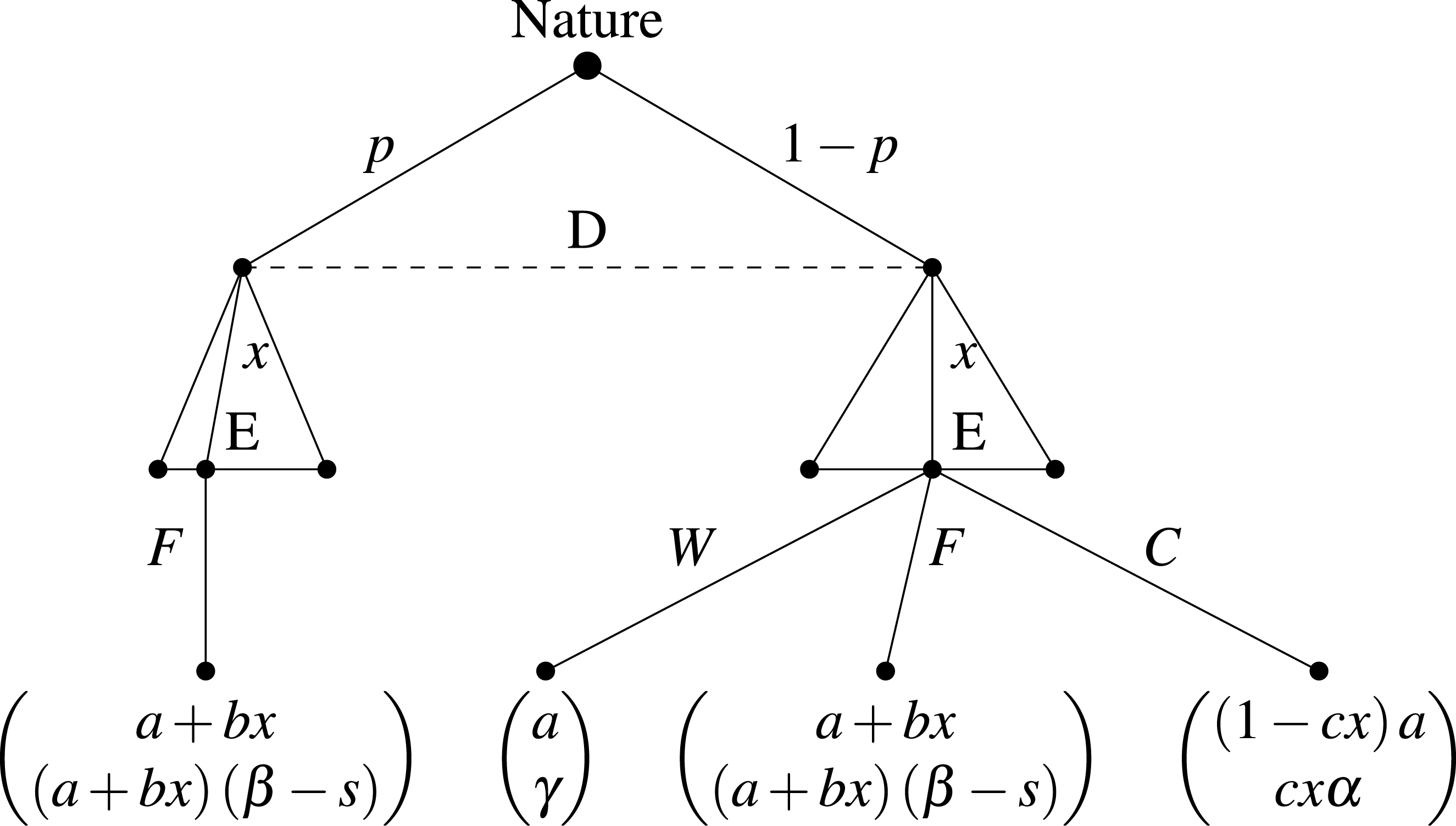
For simplicity, we also impose two parametric assumptions:
This assumption makes sure that staging a coup is not dominated by the other two options so that elite E will always stage a coup when given excessive power. 12
To understand this assumption, note that staging a coup and walking away give a strategic elite the same payoff when x = γ/cα. Assumption 2 imposes that at this power-sharing level, following the dictator gives a strategic elite a higher payoff in the absence of sanctions. This means that there is some power-sharing level x that dictator D can choose so that a strategic elite will follow him. When Assumption 2 is violated, a strategic elite would never follow the dictator, whether she is sanctioned or not. This means sanctions have no effect on the equilibrium at all.
Elite’s Problem
To solve the game, we work backward from the end and analyze the elite’s decision for any given power-sharing level x. Our first task is to derive the sanction level s* above which a strategic elite would never follow dictator D regardless of the power-sharing level. We call s* the breaking point of the strategic elite. To derive s*, note that for following the dictator to be dominated by the other two options, we need
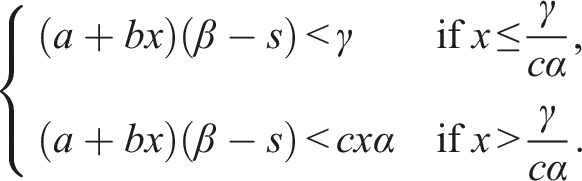

Since the R.H.S. of (1) is increasing in x, (1) is satisfied for all x ≤ γ/cα when it holds for x = γ/cα. Thus, we must have

Similarly, when x > γ/cα, the relevant condition

Since the R.H.S. of (3) is decreasing in x, (3) is satisfied for all x > γ/cα when it holds for x = γ/cα. Thus, we must have

Thus, it is never optimal for a strategic elite to follow the dictator when s > s* where

Conversely, when s ≤ s*, there is some power-sharing level
It is instructive to consider how the breaking point s* changes with the model’s parameters. From (4), we obtain.
A strategic elite’s breaking point s* is decreasing in α, γ and c and increasing in β, a and b.
All proofs can be found in Online Appendix A. Intuitively, it is easier to “break” an elite when the benefit from staying in office is low (low β), the regime is more vulnerable (low a), the elite is technically less competent (low b), and alternative options are more attractive (high α, γ and c).
Our next lemma characterizes a strategic elite’s optimal choice when s > s*, which follows immediately from our previous discussion for the breaking point s*.
If s > s*, then a strategic elite’s optimal choice Lemma 3 further illustrates a strategic elite’s optimal choice when s ≤ s*.


If s ≤ s*, then a strategic elite’s optimal choice Moreover, Intuitively, a strategic elite would stage a coup if dictator D shares too much power with her and walk away if dictator D shares too little power. A strategic elite would only follow dictator D when the power-sharing level falls into the intermediate region and the intermediate region shrinks as s increases and eventually disappears. Figures 2(A) and 2(B) illustrate elite E’s payoff as a function of x when s is higher than and lower than s*, respectively.



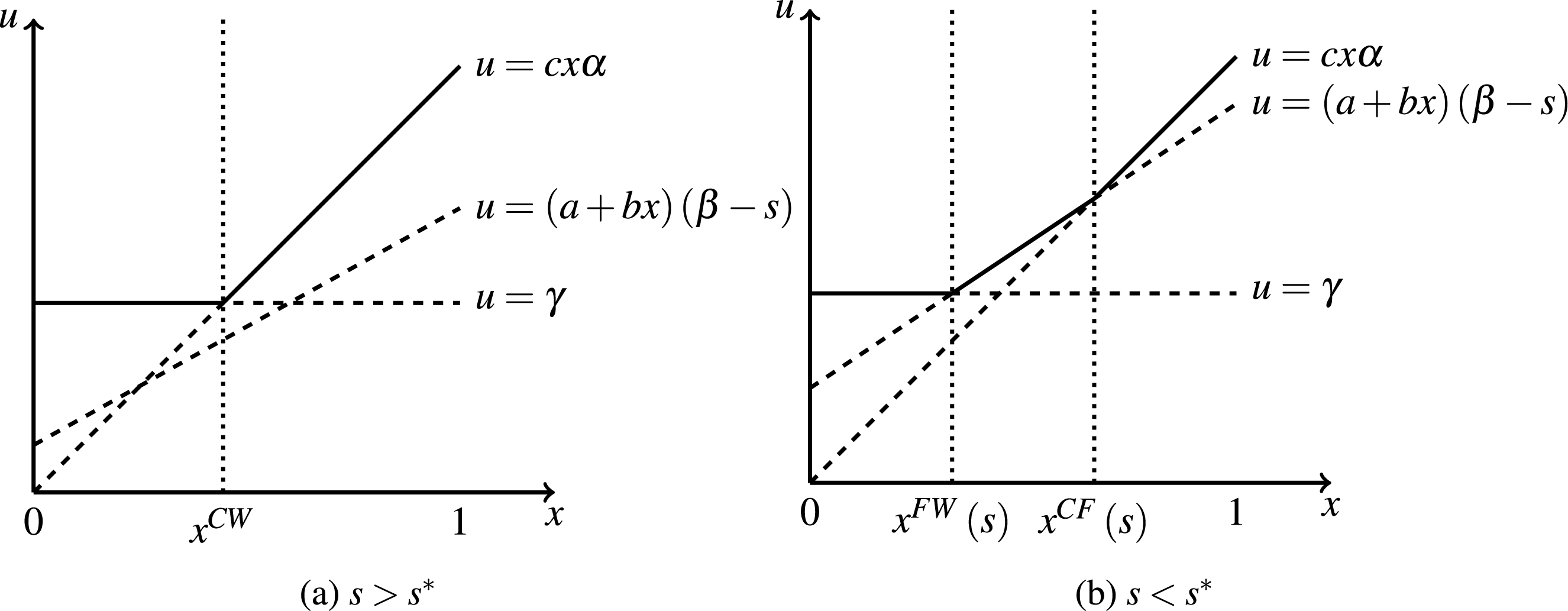
Illustrations of elite E’s payoff (A) s > s* (B) s < s*.
Dictator’s Problem
Next, we consider the dictator’s problem. For ease of exposition, we assume that the elite chooses the action the dictator prefers whenever she is indifferent to ensure that the dictator’s problem always has a solution. This assumption is inessential and does not affect our results.
First, consider the case in which the sanction level is high, that is, s > s*. By Lemma 2, the level of power sharing x can be divided into two regions. For all x ≤ x
CW
, a strategic elite would walk away, and dictator D’s payoff conditional on having a strategic elite is a, while his payoff conditional on having a loyal elite is a + bx. Therefore, choosing to share x* = x
CW
gives dictator D the highest payoff in this region. If dictator D chooses x > x
CW
, a strategic elite will stage a coup. If elite E is a strategic type, then dictator D gets a payoff of
Second, consider the case in which the sanction level is low, that is, s ≤ s*. By Lemma 3, the level of power sharing x can be divided into three regions. For all
Proposition 1 summarizes our observations.
Suppose s > s*. Dictator D’s equilibrium choice Suppose s ≤ s*. Dictator D’s equilibrium choice From Proposition 1, we can see that dictator D delegates less power to the elite for repressive purposes when p is small. This is consistent with Hendrix and Salehyan’s (2017) observation that African regimes with a history of divided loyalty within the security forces are less likely to use repression. From Proposition 1, we can also derive the following corollary:



When the prior probability that elite
E
is loyal is small enough, dictator
D
delegates more (less) power to elite
E
as elite
E’s technical (political) competence increases.
Corollary 1 derives Lee and Schuler’s (2020) argument about technical and political competence formally in our model when the elite is relatively likely to be strategic. 13 However, if we take into account the presence of the loyal type, the picture is more complicated and the effects of technical and political competence on elite power are in general non-monotonic.
By Proposition 1, how much power dictator D would share with elite E depends on the sanction level s as well as the prior probability that elite E is loyal p. Figure 3 illustrates this dependence. Dictator D’s equilibrium choice of power-sharing level 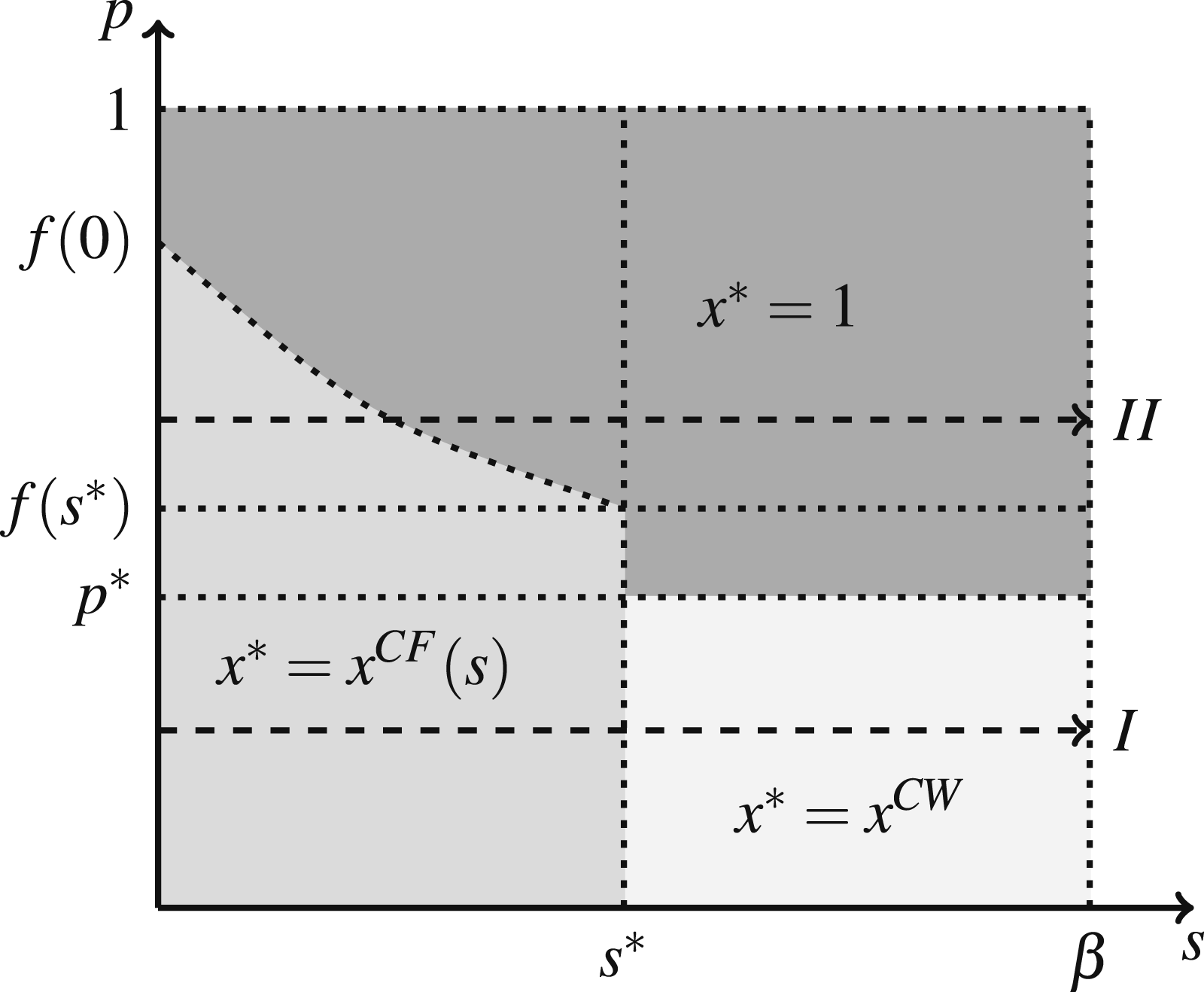
Figure 4 illustrates the effects of an increasing level of sanctions along paths I and II in Figure 3. In Figure 4(A) (path I), targeted sanctions have their “desired effect”. This occurs when p is small. In this case, increasing s does not increase the probability of a coup. Instead, dictator D would reduce elite E’s power, curbing her ability to crack down on the mass challenge. As a result, the probability of a successful mass challenge increases, until at the breaking point s* = 0.57 the disloyal elite walks away. At that point, the probability of a successful mass challenge increases discontinuously and the probability that dictator D survives reaches its lowest value. A further increase in the sanction level has no effect. The effect of targeted sanctions (α = 1.5, β = 1, γ = 0.2, a = 0.4, b = 0.5, c = 1) (A) p = 0.3 (B) p = 0.6.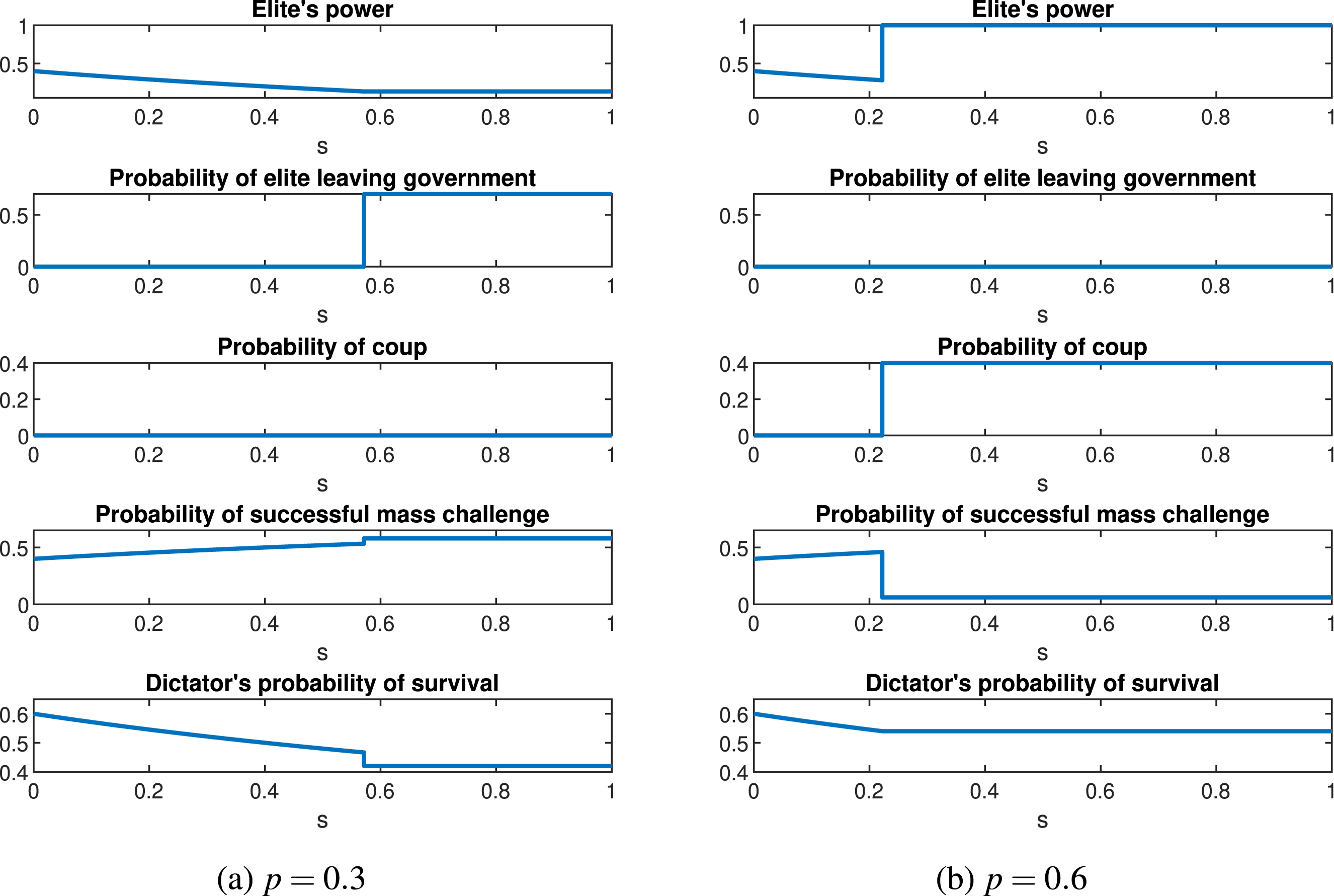
When p is large enough, things are different. In the first panel of Figure 4(B) (path II), we see that increasing s has a non-monotonic effect on elite E’s power. When the sanction level is low, dictator D reduces elite E’s power to reduce a strategic elite’s incentive to stage a coup. But when the sanction level gets “too high”, further reducing elite E’s power would risk a successful mass challenge. Dictator D would instead share all the power with elite E to increase her ability to suppress the mass challenge, albeit at the risk of a coup. This is optimal because p is large. In other words, elite E is likely to be loyal, so the relative risk of a coup is low comparing with that of a successful mass challenge. Even though the probability that dictator D survives decreases with s as before, the reduction in the survival probability is not due to a mass challenge, but a coup. Comparing the final panels of Figures 4(A) and 4(B), we also see that, overall, the regime is weakened less by sanctions when loyalty among elites is high.
Proposition 2 summarizes the effects of targeted sanctions in our model, which can be obtained by comparing the cases when s = 0 and s > 0.
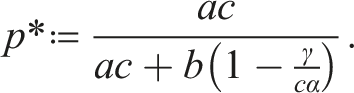
Imposing targeted sanctions s > 0 on elite E always decreases the dictator D’s probability of survival, but its effect is greater when elite E is less likely to be loyal. When p < p*, imposing targeted sanctions increases the probability that elite E leaves the government as well as the probability of a successful mass challenge. When p > p*, imposing targeted sanctions increases the probability of a coup.
Proposition 2 shows that targeted sanctions always decrease dictator D’s probability of survival. As a result, in the absence of a cost of sanction, if the sole objective of the foreign actor who chooses the level of sanctions s is to unseat the dictator, then it will be optimal to impose the maximum level of sanctions. However, note that the effect of sanctions imposition plateaus at the point where a strategic elite walks away or stages a coup. Further increasing the level of sanctions would have no effect on the equilibrium outcomes. This is because the elite has already taken the most drastic actions (either quit or rebel) against the regime. A further increase in s will not induce the elite to do anything different.
However, destabilizing country leaders may not always be a reasonable objective for the sanctioning state(s). For example, Koehler and Albrecht (2021) find that military coups following popular mass uprisings are “conservative rollback coups” that result in continued illiberal politics (see also, Elischer and Lawrance (2022)). Therefore, a foreign actor may prefer regime change via mass challenge to regime change via coup. In this case, the foreign actor has an incentive to limit the level of sanctions, as excessive sanctions will push the elite toward a coup when the elite is relatively loyal.
Suppose the level of sanctions s is chosen at the beginning of the game by a foreign actor whose aim is to maximize the probability of a successful mass challenge. When p < p*, it is optimal for the foreign actor to choose any s ∈ (s*, β].
14
When p ∈ [f(s*), f(0)], setting s = f−1(p) < s* is uniquely optimal for the foreign actor. When p > f(0), any s ∈ [0, β] is optimal.
Proposition 3 shows that when the foreign actor’s aim is to maximize the probability of a successful mass challenge, the optimal sanctioning strategy depends crucially on the elite’s level of loyalty.
On the one hand, when the elite is relatively disloyal, the dictator responds to an increase in sanctions by decreasing power sharing. This eventually leads to the exit of the elite and an upward jump in the probability of a successful mass challenge at s*. Therefore, any s > s* maximizes the probability of a successful mass challenge.
On the other hand, when the elite is relatively loyal, the dictator responds to an increase in sanctions first by a gradual decrease in the level of power sharing but eventually by an increase in power sharing to 1 at s = f−1(p). This leads to a coup when s > f−1(p) and a downward jump in the probability of a successful mass challenge (see Figure 4(B)). Therefore, setting s = f−1(p) uniquely minimizes power sharing and, as a result, uniquely maximizes the probability of a successful mass challenge.
Finally, when the level of loyalty is extremely high, the dictator will always delegate full power to the elite and sanctions have no effect. This means any level of sanctions will lead to the same equilibrium outcomes.
This dependency of the optimal sanctions on the perceived level of loyalty of the elites has important policy consequences. For example, a foreign actor who overestimates the elite’s loyalty may impose sanctions that are too weak to be effective, while a foreign actor who underestimates the elite’s loyalty may impose excessive sanctions, leading to the unintended consequence of coups. This contrasts sharply to the case where the foreign actor’s only objective is to destabilize the regime. In that case, imposing the maximum level of sanctions always causes maximum damage, regardless of the elite’s loyalty.
Mass Uprisings and Coup Attempts in Eritrea and Venezuela
We now turn to two country cases, Eritrea and Venezuela, to illustrate the mechanisms presented by the model. We draw on primary materials—including local news sources and expert interviews with scholars working on Latin American and African politics—alongside secondary literature to examine how targeted sanctions have contributed to shaping patterns of authoritarian power sharing and, in turn, affected the probability of mass uprisings and coups in both countries. They were selected because they epitomize cases in which the ruler is, respectively, highly trustful (Eritrea) and very distrustful (Venezuela) of the ruling elite according to key scholarship on the two regimes (Corrales 2020; Müller 2008).
Proposition 2 suggests that the impact of sanctions is not unidirectional. If the ruler does not trust the elite, demotions and defections occur against the backdrop of a greater chance of mass challenge being successful. If the ruler trusts the elite, conversely, he is better off increasing their power, averting a challenge from below—albeit at the cost of an increased probability of a coup attempt.
An example of an authoritarian regime with a loyal elite facing targeted sanctions is Eritrea. The country was subject to UN targeted sanctions (asset freezes, travel bans) between 2009 and 2018 and to EU targeted sanctions between 2010 and 2018. The regime has been described as one in which “most senior positions are held by individuals loyal to the political project of the ruling elite” (Müller 2008, 126), not least due to the shared liberation war. 15 Due to the regime’s opaque nature and closed-door policy (Aweke and Seid 2023; Hirt 2015), there is, however, limited information on the precise degree of power delegation. Available research hits at an institutionalization of power, which is often associated with authoritarian power sharing (Boix and Svolik 2013). The country’s ruling party, the Peoples’ Front for Democracy and Justice (PFDJ), has maintained its dominant position in the political and economic spheres (Bertelsmann Stiftung 2022); the regime relies on a strong nexus between the PFDJ and the military (Ogbazghi 2011). After sanctions were imposed, the incumbent was never confronted with any challenge from below, as military and political elite possess significant power to engage in widespread surveillance and repression, thereby preventing any meaningful mass uprising. 16 This lack of pressure from below is likely to have contributed to the failure of targeted sanctions, as coded by existing datasets (Weber and Schneider 2022). Yet, Eritrea experienced an abortive coup attempt in 2013 (Gettleman 2013), which was supported by high-ranking generals and initially even backed by the then Minister of Defense. 17 This is in line with the model’s prediction that in regimes where the probability of the elite being loyal is high, the dictator substitutes the risk of a popular uprising with that of a coup. Sanctions were clearly not the only determinant of authoritarian power sharing dynamics in this instance, as the relationship between the ruler and the elite is fundamentally shaped by the liberation war in Eritrea. Sanctions arguably had an impact, though: those on the blacklists “were allowed to smuggle to keep their loyalties,” with this clandestine trade also contributing to the supply of weapons. 18 In other words, political and military elites benefited from access to economic and military resources while power sharing also increased the coup risk, as outlined above.
By contrast, Venezuela constitutes an example of an authoritarian regime facing targeted sanctions whose ruler is less confident about elites’ degree of loyalty. The country has been under US targeted sanctions since 2014, while the EU imposed significant sanctions against regime insiders starting 2017. Moreover, there has been a US travel ban against certain individuals in place since 2007. As most measures are ongoing, the sanction’s final outcome cannot be assessed at present; the fact that Chavismo still shapes Venezuela’s government and elite politics, however, can be seen as an indication that the goal of bringing about democratization has not been achieved thus far.
Former president Nicolás Maduro has been described as paranoid in the literature (Corrales 2020; Lansberg-Rodríguez 2015). He allegedly became even more distrustful of his elite after surviving a drone strike (Lansberg-Rodríguez 2015). His lack of trust in the elite resulted in a strong concentration of power that led “to an insufficient delegation of competences” (Hoffmann 2015, 31). Venezuela experienced a weakening of executive constraints (Bull and Rosales 2020), as the regime “became dramatically less institutionalized” (Mainwaring 2018). In addition, the removal of key military leaders became more commonplace (Polga-Hecimovich 2025)—to the extent that key positions held by elites have been described as a “musical chair.” 19 Following threats from different factions within the government, Maduro reduced the level of power sharing with the military, which he “heavily distrust[ed].” 20
Since the onset of targeted sanctions, Venezuela has experienced several mass protests. In 2019, large-scale demonstrations following Maduro’s controversial second inauguration developed into a coordinated—albeit failed—effort from below to remove him from the presidency. Following the presidential elections of 28 July 2024, protesters took to the streets and demanded that Maduro acknowledge he had lost to the opposition. While the causes of these popular uprisings were clearly multidimensional and—inter alia—related to socio-economic discontent, humanitarian suffering, and election rigging (Hanson and Zubillaga 2024), 21 the security apparatus was unable to exert full control over the domestic population. 22 The elite was able to deploy repression to safeguard its grip on power, but it was not entrusted with sufficient resources to prevent mass uprisings. In particular, Venezuela has parallel security institutions, 23 which plausibly contributed to preventing a coherent response to mass dissent. The establishment of parallel security institutions represents a widely recognized coup-proofing strategy. Due to such coup proofing strategies, “it was really hard for the military to successfully stage a coup”, 24 which is in line with the model’s predictions. In addition, the regime experienced several high-profile defections in recent years. They included Víctor Vargas, one of the country’s most influential bankers (Ellner 2019), and Hugo Carvajal, the head of Venezuela’s military intelligence for 10 years (Radio France Internationale 2019; The Wall Street Journal 2019). In addition, there were also multiple coup attempts. Relations between Maduro and the elite were “heavily tied with foreign influence.” 25 Sanctions were clearly not the only game in town, but nevertheless contributed to the developments described above, as the regime “imposed a full check and surveillance of those people [on the sanctions lists].” 26 The regime also tended to reduce the roster of those benefiting from power sharing in times of economic downturns, 27 which were exacerbated by sanctions (Economic Observatory 2024). While sanctions did not lead to a popular uprising displacing the regime, large-scale protests are an indication that certain measures have contributed to disunity among Venezuela’s elite and greater popular challenges. Recent reports indicating some within Maduro’s political leadership may have betrayed him prior to his capture 28 further highlight the regime’s difficulties in securing the elite’s loyalty. Yet Venezuela has not witnessed sustained mass mobilization comparable to those of 2019 and 2024, not least because of heightened uncertainty and widespread fear in the immediate aftermath of Maduro’s ouster.
Conclusion
In this paper, we have introduced a formal model of sanctions targeting regime insiders and shown that while they undermine the dictator’s prospects for political survival, their destabilizing impact depends on the degree of loyalty of the ruling elite. When elite loyalty is low, such sanctions increase the probability that elites will defect and that a popular uprising succeeds. When loyalty is high, in contrast, targeted sanctions increase the risk of a coup from within the ruling coalition. We offer case study evidence on Eritrea and Venezuela in support of our arguments. Due to the highly opaque nature of these authoritarian regimes—particularly Eritrea—it remains difficult to fully uncover their internal regime dynamics. However, research on less closed regimes would make it possible to further unravel how power sharing arrangements are adjusted in response to external pressure.
Follow-up work could also examine the motives and cost-benefit analyses of the sanctioning states in greater depth. Based on our model, we show that if the foreign actor’s objective is to maximize the probability of regime change, it is optimal to impose the highest possible level of sanctions against regime insiders. In contrast, if the goal is to maximize the probability of a successful mass challenge, the foreign actor has an incentive to limit the severity of sanctions imposed on authoritarian elites to reduce the risk of a coup. Thus, a policy that is optimal per one objective may prove counterproductive regarding another.
This has implications for future research, not least regarding the interplay between sanctions targeting individuals and other measures such as sectoral sanctions in the financial, energy, and military domain or aid-related sanctions, which tend to have broader implications for the target state’s economy. While these different types of sanctions are employed simultaneously in cases such as Russia, Venezuela, and Zimbabwe, in other instances only blacklist-based measures apply. Existing research has addressed the effectiveness of targeted versus broader measures and found their success rate to be comparable (Biersteker, Eckert, and Tourinho 2016). Future research can help us gain an in-depth understanding of how these various types of sanctions formally relate to each other.
Supplemental Material
Supplemental Material - Targeted Sanctions Against Authoritarian Elites
Supplemental Material for Targeted Sanctions Against Authoritarian Elites by Tsz-Ning Wong, Julia Grauvogel, Nikolay Marinov in Journal of Conflict Resolution.
Footnotes
Acknowledgements
We thank Emilian Berutti, Shiladitya Kumar and Klara Panther for capable research assistance, Navin A. Bapat, Thomas Braeuninger, Nicolás Idrobo, Adam Scharpf and Christian von Soest for feedback on earlier drafts of this paper and participants of the Research Colloquium of the Centre for International Security at the Hertie School, the workshop “Smart Sanctions: Theory, Evidence, and Policy Implications” organized by Bård Harstad, the 4th UB Microeconomics Workshop, and seminars at the University of the Balearic Islands and National Taipei University as well as Constantinos Syropoulos and Yoto V. Yotov for valuable comments and suggestions.

Funding
The authors disclosed receipt of the following financial support for the research, authorship, and/or publication of this article: Tsz-Ning Wong gratefully acknowledges financial support from the Swiss National Science Foundation (SNF) through project grants 172680 and the Generalitat de Catalunya AGAUR through project grants 2021 BP 00137 and 2021 SGR 00862.
Declaration of Conflicting Interests
The authors declared no potential conflicts of interest with respect to the research, authorship, and/or publication of this article.
Data Availability Statement
Data sharing not applicable to this article as no datasets were generated or analyzed during the current study.
Supplemental Material
Supplemental material for this article is available online.