







Abstract
How does U.S. military education build influence among foreign officers? This study proposes two theoretical pathways from training to influence. The extrinsic pathway is based on material incentives for cooperation and acceptance of the U.S.-led hierarchy. In contrast, the intrinsic pathway relies on interpersonal networks based on trust and reciprocity expectations. The study argues for the latter: Cooperation by U.S.-trained officers occurs not out of subordination, but because they view themselves as part of a network with the U.S. The empirical analysis focuses on the case of Turkey: a NATO ally that nevertheless has a history of anti-American sentiment among the military ranks. Through both interviews and a survey experiment with Turkish officers, we provide individual-level evidence showing that U.S.-trained officers are more likely to both grant and make informal requests when dealing with U.S. counterparts, and that this effect is larger for those officers who participate in longer programs.
The U.S. government has significantly invested both capital and effort in training the military forces of other states as a primary foreign policy tool since World War II. While several powerful nations utilize foreign military training to extend their influence on the global stage, the United States stands as the foremost provider of such training. According to recent data spanning 1999 to 2016, the United States has trained 2,395,272 individuals from nearly every country worldwide, through its 34 distinct training programs (McLauchlin, Seymour, and Martel, 2022). 1
The United States’ motivation for providing this type of training is not a purely altruistic act, but rather an attempt to build influence among military elites in the recipient states. 2 To maintain the U.S.-led global order, the U.S. strategically allocates its military assistance across countries and over time (Joyce, McLauchlin, and Seymour 2024; Nieman et al. 2021; Sullivan, Alvarez, and Marx 2025). This, then, begs the question of whether foreign military training effectively achieves its goal of expanding U.S. influence worldwide. In this project, we aim to answer that question in the U.S.-Turkey setting.
The existing literature primarily delves into concepts such as norm diffusion, professionalism, transnational ties, and socialization to uncover potential multifaceted impacts of U.S. military training in recipient countries (Atkinson 2010, 2014; Dreher and Yu 2020; Gift and Krcmaric 2017; Grewal 2022; Joyce 2022; Kalin and Kirisci 2024; Martínez Machain 2021, 2024; Nye 2004; Ruby and Gibler 2010; Savage and Caverley 2017; Scharpf 2020; Scharpf and Savage 2025). Against this backdrop, in this project we explore the path from training to influence by investigating whether U.S.-trained officers show a willingness to favor their American counterparts or go the extra mile for them. We focus on military-to-military influence, a process that has been comparatively understudied in the soft power literature.
In our hypotheses and analysis, we aim to explain the impact of U.S. military training on those decisions that can be made by military officers. In addition, we build on previous research that has presented various causal pathways through which foreign military training can lead to influence, but does not empirically distinguish between them (Lemons 2023; Martínez Machain 2021). This study proposes two theoretical pathways from training to influence. The extrinsic pathway is based on material incentives for cooperation and acceptance of the U.S.-led hierarchy. In contrast, the intrinsic pathway relies on interpersonal networks based on trust and reciprocity expectations. The study argues for the latter, presenting a soft power theoretical argument for how U.S. military training builds trust and networks between foreign officers and their American peers. This trust thus facilitates reciprocal cooperation in future interactions with U.S. counterparts.
Beyond its academic contribution, this paper also answers policy-relevant questions about how it is that allies establish military cooperation. From the U.S. perspective, the provision of foreign military training is seen as having a pragmatic purpose. There is a belief among practitioners that U.S.-trained officers become part of a network that can be reached out to if needed (Cope 1995; Lemons 2023; Martínez Machain 2021). But what does “reaching out” actually accomplish? What policies will the alumni of U.S. military education institutions be able to alter if needed? Actions such as intervening on behalf of Americans arrested abroad, or rescuing kidnapped Americans, come to mind, but given its often extraofficial nature, there is little official and/or publicly available data on this type of activity. 3 We get around this constraint by applying a mixed method (qualitative interviews and a survey experiment) and focusing on the case of Turkey. Turkey represents both a hard case to test our theory in, given the country’s widespread anti-American sentiment, as well as a more typical or easy one, given its long-standing military partnership with NATO and the United States. This duality makes Turkey a compelling and rigorous setting for evaluating whether U.S. military training fosters trust and influence among allied militaries, even under conditions of political and societal skepticism.
Our empirical results provide individual-level evidence for the intrinsic pathway to create influence through foreign military training. They show how focusing on policy measures that foreign military officials can directly influence allows us to understand how U.S. foreign military training not only builds influence among foreign military officers, but also how it is that it builds expectations for reciprocity from the American side for them. Specifically, we find in our survey experiment that respondents who are trained and/or educated in the U.S. are more willing to state that they would be likely to grant or make an informal request to a U.S. counterpart than respondents without U.S. training. This effect does not hold when the hypothetical counterpart is framed simply as “foreign.” Our qualitative interviews provide further support for the intrinsic causal pathway through which this occurs, showing the importance of U.S.-trained officers establishing interpersonal relationships with American instructors and peers.
Foreign Military Training as a Foreign Policy Instrument
Previous research has explored the diverse roles U.S. military training can play for both the U.S. and host countries, yielding mixed conclusions (Atkinson 2010, 2014; Dreher and Yu 2020; Gift and Krcmaric 2017; Martínez Machain 2021, 2024; Nye 2004; Ruby and Gibler 2010; Savage and Caverley 2017; Scharpf 2020; Scharpf and Savage 2025). Broadly, scholars suggest that interactions with U.S. soldiers can foster pro-U.S. perspectives (Allen et al., 2020; Dreher and Yu 2020; Nye 2004). However, these interactions can also coincide with more critical views of the U.S. military (Allen et al., 2020, 2022). In the specific instance of U.S. foreign military training, the attitudinal shifts of U.S.-trained officers are often attributed to the diffusion of norms (Atkinson 2010, 2014; Ruby and Gibler 2010), socialization during training, and the formation of transnational bonds (Atkinson 2010; Gift and Krcmaric 2017; Martínez Machain 2021).
Building on norm diffusion, existing work initially proposed that U.S. military training could instill liberal norms, potentially fostering a stronger commitment to human rights within recipient countries (Atkinson 2010, 2014; Ruby and Gibler 2010). However, other research has shown that U.S. training can also increase the likelihood of coups by enhancing the military capacity and political influence of U.S.-trained officers (Savage and Caverley 2017). Growing more skeptical of norm diffusion, scholars have noted that U.S. training may impart unintended political norms (Fábián and Boutton 2024; Grewal 2022; Scharpf and Savage 2025) or conflicting norms that could undermine the intended positive effects (Joyce 2022). Additionally, some caution that the institutional and geopolitical context under which the training takes place can determine whether the military’s views on human rights actually improve after U.S. foreign military training (Martínez Machain 2024; Omelicheva, Carter, and Campbell, 2017).
Existing works also point out that foreign training military programs establish cooperative relationships between sending and host countries (Martínez Machain 2021; Scharpf 2020). For example, militaries with a substantial number of U.S.-trained officers are more likely to defect during nonviolent uprisings when those movements receive support from the United States and other Western powers (Kalin and Kirisci 2024). This suggests that U.S. military training programs go beyond establishing strategic alliances; they also influence the political orientation of foreign trainees, aligning them more closely with U.S. interests. The U.S. motivation to extend influence through training is further evidenced by the prestige that U.S.-trained officers often enjoy, making them more likely to hold influential positions within their respective militaries (Martínez Machain 2021; Savage and Caverley 2017; Scharpf 2020; Scharpf and Savage 2025). We add to this literature by focusing not only on preferences, but on decisions made by foreign officers and how these decisions may be influenced by training from the U.S. military. Importantly, we distinguish between different causal paths from training to influence and provide empirical support for the intrinsic pathway to influence.
Military-To-Military Influence: From Training to Influence
Military-To-Military Interactions
Military-to-military interactions are effective in fostering connections between individuals across nations, with a shared military identity serving as a key focal point for these relationships (Atkinson 2014, 2015; Cope 1995; Lemons 2023; Martínez Machain 2021). Though the military is a traditional hard power tool, recent work explores its potential uses as a soft power tool (Allen et al. 2020, 2022; Atkinson 2014; Fábián and Boutton 2024; Nye 2019; Simonyi and Trunkos 2014). As foreign military training becomes more common in an increasingly globalized world, these interactions are more likely to take place and often play a pivotal role in shaping diplomatic and strategic ties between countries (Kucera 2025).
Military-to-military interactions can be particularly effective at fostering cooperation on the type of policy issues that military officers themselves have discretion over (Kucera 2025). These decisions occupy the space below state-level policies that are determined or approved by the state’s executive and/or legislature. Of course, there is significant variation across states and institutions in the types of decisions that military officers can have discretion over, ranging from high-level ones such as the decision to participate in U.S.-led coalitions (see Lemons 2023) to lower-level ones such as a choice to share intelligence with a U.S. counterpart. Yet the common thread is that these are all decisions that are policy-related, but that are within the purview of military personnel and that would not require approval from civilian authorities.
Previous work has found that intermediary goals (“crucial steps that link fighting to the achievement of political objectives”) can make a key difference in achieving desired outcomes in conflict (Petersson 2024, 293). Following this line of thinking, we argue that it is at this intermediary level that military-to-military relations prove invaluable. This is true not only in conflict per se, but also during crises, where unofficial communication channels can offer more pragmatic and expeditious solutions. However, accessing these channels requires mutual trust and established relations between the parties involved.
Establishing a Causal Pathway From Training to Influence
We identify two distinct theoretical causal pathways, drawn from existing literature, through which U.S. foreign military training can create influence abroad for the U.S.: an extrinsic and an intrinsic motivation pathway. 4 While both pathways predict increased cooperation between U.S.-trained foreign officers and American counterparts, the underlying processes between the two are different and distinguishing between them is theoretically and practically crucial.
The extrinsic pathway conceptualizes foreign military training as a tool through which hegemonic powers socialize military officers from recipient states into accepting their position within the international hierarchy (Lemons 2023). This in turn leads to policy outcomes that are favorable to the hegemon. This mechanism operates through both material and ideational channels (Nieman 2016). It is a material transaction in the sense that foreign military training is considered a valuable form of bilateral aid (much of U.S. foreign military training is funded by U.S. agencies, such as the U.S. State Department or the U.S. Department of Defense) that the recipient state does not want to lose (Scharpf 2020). Though foreign military education and training is not a physical form of military aid, it is seen by recipients as increasing the competence of their military officers (Kucera 2025). Foreign military training from the U.S. is thus valuable as a source of human capital.
The foreign aid literature has long argued that valuable foreign aid is not given for purely “selfless” reasons, but rather to obtain policy concessions from the recipient, particularly in cases where the recipient’s foreign policy is salient to the donor (Heinrich 2013). This aid has certainly been found effective at “buying” policy concessions from the recipient, but it does not necessarily change their preferences or domestic institutions (Bueno de Mesquita and Smith 2010). In the case of U.S. foreign military training as a form of aid, it will act as an extrinsic motivator. In order to keep the training, the recipient state is more likely to enact foreign policies in line with U.S. preferences but will not necessarily change its preferences (or those of its service members) (Martínez Machain 2021).
The extrinsic pathway can also be thought of as an ideational channel through which the hegemon (in this case the United States) socializes the foreign trainees and students into accepting their state’s role in the established world order. In the hierarchical international system, subordinate states will carry out policies that fit the preferences of a dominant state. These policy concessions occur in part in exchange for material benefits provided to the subordinate state by the hegemon, but also through an acceptance by the subordinate state of the dominant state’s authority (Nieman 2016). At the individual level, a similar dynamic can occur. Whether they agree or disagree with the hegemon’s order, the trainees, after being socialized through the U.S. military education system, come to accept their place in the global hierarchy and thus carry out policy that is consistent with U.S. preferences (Lemons 2023).
In contrast, the intrinsic pathway conceptualizes foreign military training as creating interpersonal networks based on trust and reciprocity expectations. This mechanism operates through preference change and relationship-building rather than material incentives or hierarchical acceptance. This pathway draws from work in the political psychology tradition of contact theory, suggesting that meaningful intergroup contact fosters positive intergroup attitudes (Allport 1954; Kteily et al., 2019; Pettigrew and Tropp 2006). U.S. training programs place foreign officers in repeated, cooperative interactions with U.S. service members and peers. As a result of this deeper contact, foreign officers are socialized into more favorable views of the United States, making them more likely to pursue policies aligned with U.S. preferences (Lemons 2023; Martínez Machain 2021). In other words, socialization may also change the preferences of the foreign trainees so that they actually want to behave in ways that are in line with U.S. preferences (Lemons 2023).
The intrinsic pathway is thus a soft power one. Nye (2018, 3) defined soft power as “the ability to affect others to obtain the outcomes one wants through attraction and persuasion rather than coercion or payment.” In this setting soft power manifests itself as military officers changing their preferences to be more in line with those of a partner state.
Our argument in this piece follows the intrinsic casual path: We argue that military-to-military interactions build connections that make military officers more likely to trust their foreign counterparts. Military education institutions are particularly effective at creating trust-based networks among the graduates that enable future cooperation between members (Böhmelt et al., 2019). Many of the interactions that occur between foreign trainees and their U.S. counterparts are positive ones, which are likely to be effective at building trust (Boin et al. 2021; Cope 1995; Lemons 2023; Martínez Machain 2021).
The primary transfer effect from contact theory suggests that trust built between in-group and out-group members will also transfer to greater trust of other members of the outgroup and will foster cooperation with them (Boin et al., 2021). We thus expect that the trust that comes from network-building with American counterparts will in turn transfer to increased trust of other American military personnel who the trainees may encounter in the future, and in turn to willingness to engage in reciprocal cooperation with U.S. military counterparts (Cope 1995; Ferrin, Bligh, and Kohles, 2008).
The Role of Reciprocity
We propose that foreign military officers who have received training from the U.S. will be more trusting of U.S. counterparts, who they view as being part of a shared network. These views will in turn make them more receptive to cooperating with U.S. service members. Importantly, we argue that this willingness to cooperate does not follow the extrinsic pathway. In other words, it is not based on the foreign officers being subordinate to U.S. counterparts and accepting their country’s place in the hierarchy below the U.S. (Lemons 2023). Instead, we expect increased cooperation to occur intrinsically, because foreign military training and education builds networks and trust through military-to-military interactions.
We expect that U.S.-trained officers will be more willing to grant an informal request (that is within the purview of their position and does not require them to violate any laws) than those who have not received training from the U.S. If the hierarchy mechanism were at play, we should see foreign officers being willing to grant the U.S. favors because they are following the rules of the international system (Lemons 2023). Instead, we argue that a networks and trust mechanism is at play. Though it may not be part of the U.S.’s intention when training foreign officers, it is likely that foreign officers who build personal relationships with their U.S. counterparts will expect some degree of reciprocity when it comes to cooperation. The increased trust that comes with personal interactions and relationships with U.S. service members also means that foreign officers will feel more comfortable with the idea of making an informal request from an American peer than they otherwise would have been. They will equally be willing to ask favors of the Americans because they see themselves as more equals than subordinates.
We thus derive our first two hypotheses:
5
Further, we expect that the effect of contact and exposure to U.S. culture will be larger in cases of more extended exposure. Socialization does not occur through single interactions, but rather through iterative ones (Lemons 2023). Longer programs allow for more opportunities for deeper socialization and trust-building between foreign trainees and their U.S. peers (Kucera 2025). We thus derive the third, interactive, hypothesis:
Research Design
To test our hypotheses, we employed a mixed method approach consisting of 10 semi-structured interviews with retired Turkish officers who had participated in U.S. foreign military training and a pre-registered survey experiment with 196 military officers in Turkey. 6 This two-pronged research design uses complementary methodological approaches that offset each other’s weaknesses. This is an approach that has previously been effectively used to study the effects of foreign military training, such as in Grewal’s (2022) extensive study of the Tunisian military.
Case Background: The U.S.-Turkey Military Relationship
The Turkish military has been heavily influenced by U.S. and NATO training and missions, particularly since the end of World War II. Turkey began to receive substantial American support in 1947 as part of the Truman Doctrine, aimed at countering Soviet influence. The American Mission for Aid to Turkey (AMAT), later renamed the Joint American Military Mission for Aid to Turkey (JAMMAT), was pivotal in modernizing the Turkish military, focusing on rearming, training, and improving logistical capacities (Guvenc and Uyar 2022; Uyar and Guvenc, 2022).
Throughout the early Cold War, U.S. military assistance included training Turkish personnel, significantly enhancing their tactical skills and career prospects. With Turkey’s admission to NATO in 1952, both Turkey and the U.S. favored using multilateral cooperation channels through NATO rather than bilateral institutions such as JAMMAT (Uyar and Guvenc 2022). Starting in the 1950s, the U.S.-Turkey alliance was marked by strong military cooperation, with the Pentagon playing a key role in managing this relationship. This resulted in substantial military and economic aid, bolstering Turkey’s military capabilities and economic development, and establishing a legacy of U.S. influence that continues today. According to a report by the U.S. Department of Defense (2016), 28,587 Turkish military personnel were trained under the International Military Education and Training (IMET) program, one of several U.S.-sponsored military training initiatives, making Turkey one of the top recipients worldwide. This highlights a substantial contribution to human capital.
Turkey represents a particularly informative case because it combines features of both a difficult and a typical case for our theory. On the one hand, Turkey constitutes a relatively difficult environment for testing the influence of U.S. training. Despite being a long-standing NATO ally, Turkish public opinion not only exhibits strong anti-American sentiment (Birol 2024), but also negative views of the U.S. military (Allen et al. 2020, 2022). Moreover, debates over Turkey’s alignment with the West have historically divided Turkish political and military elites between those favoring continued Western alignment and those advocating more autonomous or alternative geopolitical orientations (Aktürk 2015). If interpersonal trust and cooperative tendencies emerge even under such conditions, this would provide strong evidence for the intrinsic mechanism of influence we propose.
On the other hand, Turkey is also a typical and theoretically relevant case for studying the effects of U.S. military training. It has been one of the largest and longest-standing recipients of U.S. training programs and has maintained extensive institutionalized military cooperation with the United States for decades. Thousands of Turkish officers have participated in U.S. professional military education programs, making the country an ideal setting to observe whether and how these experiences shape interpersonal cooperation among military elites.
Qualitative Interviews: Data Collection and Sample
This project investigates how it is that the contact that occurs in U.S. foreign military training leads foreign officers to develop increased trust for their U.S. counterparts. The expectation is that U.S.-trained officers will be more likely to both grant and make requests of a U.S. peer, with the effect being greater for those involved in longer training programs. Following the mixed-method approach, we first test our hypotheses using qualitative evidence.
Between October 26, 2024 and February 27, 2025, we conducted 10 semi-structured interviews with retired Turkish military officers who had received foreign military training/education in the United States. Five of the respondents had served in the Land Force (Army), four in the Air Force, and one in the Navy. The sample was recruited by initially contacting three of the authors’ personal connections and then using a snowball recruitment method. We contacted a total of 18 officers to obtain the 10 interviews used in this project. Out of those interviewed for the project, none had a personal connection to either one of the authors.
The interviews were conducted in Turkish, by teleconference, by one of the authors, and then translated to English by the same author aided by a research assistant. Informed consent forms were shared with participants ahead of time and consent was obtained verbally during the interview. The questions in the interview were general and broad ones that asked respondents about the type of training/education program they had participated in, the impact it had on their careers, the relationships they formed during it, and their views “about international relations, such as how [they] evaluate some countries, assess threats, or in the way [they] define Turkey’s role in world politics.”
Qualitative Interviews: Results
Overall, the interviews supported our expectations, not only the hypotheses, but also the theoretical mechanism that would lead to those conclusions. Showing support for the theoretical mechanism is important to support our argument that the pathway to influence follows the intrinsic mechanism of influence. A clear pattern of support emerged for contact and interaction decreasing bias towards U.S. actors, which in turn allowed for the forming of friendships within the military-to-military network. The majority of interview subjects specifically mentioned that participating in U.S. military training/education and engaging with American and international counterparts helped them overcome their initial skepticism toward Americans, a sentiment that they noted is common in Turkey. The interviewees also noted that U.S. military training helped them form close friendships with their American peers, fostering a sense of friendship that endured throughout their careers. These connections facilitated smoother collaboration and mutual support when they encountered each other in subsequent international missions.
Most of the respondents noted that there is a clear and common anti-U.S. bias among the Turkish military ranks. As noted by Interview Subject 3, “Unfortunately, there is a negative prejudice by default in Turkey.” Another subject phrased it as “Unfortunately, many of my colleagues in Turkey still tend to see the U.S. through a singular, often negative lens” (Interview Subject 7). Many of them also noted that there is a belief that the U.S. actively works to undermine Turkish aims in the international system. As noted by one subject, “I came to realize that Turkey overestimates its significance and those who have not been abroad cannot see this. During my years in the U.S., I observed that many people do not have much knowledge of Turkey. However, from Turkey’s perspective, it feels like everyone is talking about us” (Interview Subject 3).
Almost every officer we interviewed noted that their foreign military training/education led to them dropping some of these biases. One respondent noted that they “had the chance to know the U.S. better and develop more empathy, understanding that the other side is also simply trying to do their job” (Interview Subject 2). As we had theorized, the interview subjects noted that once they got back to Turkey, there was a difference between how they viewed the U.S. and how their peers who had not been trained/educated in the U.S. viewed Americans. In some cases they even noted that it caused friction between them and their Turkish peers, as noted by one subject who stated that “I was even labeled as ‘too pro-American’ back at the [Turkish] Military Academy, with others saying I was ‘thinking too much like an American’ ” (Interview Subject 3). Another subject noted that “when I returned to Turkey, I was seen as too pro-American”, even though in the U.S. they had been perceived as “anti-American because I was critical of certain foreign policy decisions” (Interview Subject 7).
Most of the officers noted that during their time in the U.S. they had developed friendships with their U.S. counterparts, though not all had kept in touch with them after returning to Turkey. Out of the ones who had not kept in touch, only one respondent noted that this was an intentional decision. They noted, “Given the nature of my job [intelligence officer specializing in electronic warfare], I felt it would be inappropriate for an intelligence officer to maintain contact with foreign military personnel, so I remained cautious about this.” Most others who did not keep in touch simply noted that they fell out of touch with their classmates. Interview Subject 1 noted that “Since this was in the early 2000s, there was no social media, so maintaining contact was more challenging,” yet they “encountered many of [their] former colleagues multiple times” at the Anatolian Eagle joint exercises, noting also that “I even went on duties with some of them later in my career. I feel very close to my colleagues I met at the flight school.” 7
Along with Interview Subject 1, many respondents mentioned that they did stay in touch with their American counterparts. Respondents kept in touch with both peers and instructors, as illustrated by one who said “I have remained in contact with a few of my American classmates and one of my professors. We occasionally exchange emails and updates” and another who also commented “I maintained contact with one American instructor and a close American friend. I encountered several classmates again in joint exercises” (Interview Subject 7; Interview Subject 10). They expressed going to great lengths to maintain friendships, such as a graduate of Laughlin Air Force base pilot training who noted that, “One particularly memorable moment was when my American friend was assigned to Incirlik Air Base in Adana, and I drove 6 hours from Ankara just to see him for a weekend. We stayed in touch later for many years” (Interview Subject 10). A retired Lieutenant Colonel noted that having the common Naval Postgraduate School experience led to affinity later on in life, stating, “In one NATO deployment years later, I worked directly with an American officer who had been in my seminar group. Although we were not that close during my time in the US, when we met again in an environment we didn’t know others; we clicked quickly” (Interview Subject 8).
While these findings showed support for the relationship between education, contact, and the formation of trust-based networks, we also wanted to specifically test Hypotheses 1 and 2, on influence and reciprocity. Thus, one of the questions we asked respondents was whether they “believe [they] have established contacts within the U.S. military with whom [they] can seek assistance or advice, and reciprocally, do [the U.S. contacts] feel comfortable reaching out to [them] for help?”. Though not all respondents had specific examples of making or receiving this type of request, several of them confirmed that these types of relationships were indeed fostered by foreign military training/education.
Regarding Hypothesis 1, which proposes that officers trained in the U.S. will be more likely to grant a favor to a U.S. counterpart, we found strong support. For example, a retired lieutenant colonel who had participated in pilot training for 1.5 years in the U.S., noted “I feel very close to my colleagues with whom I took the training together. If they asked me of any favors, personal or professional, I would do my best to help them” (Interview Subject 1). Another subject gave the example of how a former classmate “contacted me about Turkish operational procedures while preparing for a joint NATO exercise. He actually wanted to confirm the information he found online, and I helped him happily. He felt comfortable reaching out to me with this request as a friend because of our time in Monterey” (Interview Subject 8). A retired Colonel who attended the Signal Captains Career Course in Fort Eisenhower, Georgia recalled “helping an American classmate understand the Turkish military’s communication infrastructure during a joint project. A few months later, he reached out via email to clarify something similar for a project he was working on” and noted that “even brief interactions can create enough trust to reopen communication when needed” (Interview Subject 9).
Importantly, this influence was very much seen as a two-way street, with respondents making it clear that they had expectations of receiving help from American contacts if it were to be needed. As noted by a subject discussing contacts from his U.S. military education days: “I later encountered some of them during NATO joint exercises and conferences, and the previous connection helped ease communication and foster mutual trust” (Interview Subject 7, emphasis added). The responses thus provided support for Hypothesis 2, which states that U.S.-educated officers will also be more likely to make informal requests of their U.S. counterparts. For example, one subject noted that “there hasn’t been a need to ask for formal assistance, but if the need arose, I would feel comfortable reaching out without hesitation. For example, if I needed a document, I would feel comfortable asking if they could provide me with the document, if it is not a classified one” (Interview Subject 2). The subject whose friend from Monterey had reached out the confirm information about the Turkish military he had read online also said that “I also remember reaching out to him to pick his mind on things. I would not say anyone from the program would feel comfortable reaching out, as it also depends on how close you are” (Interview Subject 8).
This reciprocity was one that had been pre-established through reciprocal personal interactions. For example, that same interview subject noted that they and their American friends “lent each other money when needed” (Interview Subject 8). Turkish officers also saw themselves as helping American peers drop their biases about Turkey. As noted by one retired Naval officer who had gotten a Master’s degree at the Naval Postgraduate School in Monterey, CA, “I also believe that I have shaped my American friends’ perception about Turkish people in the same positive manner” (Interview Subject 7).
We also received support for Hypothesis 3, on the length of training. Importantly, while we did ask the respondents how long their training/education in the U.S. had been, we did not ask them to speculate about the relationship between the duration of training and the strength of their relationships built or their views on the U.S. These observations were provided without prompt. For example, the respondent who had participated in pilot training for 1.5 years noted that “going through 1.5 years of rigorous training together naturally builds strong friendships” and a subject who spent a total of 4 years in the U.S. in different programs noted that “the amount of time spent there also played a role” in changing their views about the U.S. and leading them to view the U.S. more favorably, as “it’s harder to experience a major shift in perspective in a short time” (Interview Subject 1; Interview Subject 2). Given the support for our hypotheses in the qualitative interviews, we now turn to the survey experiment.
Survey Experiment: Data Collection and Sample
The survey experiment separates the effect of U.S. training on willingness to engage in informal cooperation with the U.S. (influence) from a general predisposition to be friendly to foreigners. Our analysis focused on U.S. training as a moderator of the treatment (being presented with a vignette about Americans, versus one about generic foreigners).
Data were collected between August 26 and October 31, 2024. We began by sampling ten retired Turkish officers as initial contacts and then using a snowball sampling technique to gather further respondents. 8 At the conclusion of the survey, we had a sample of 196 Turkish officers and non-commissioned officers (NCOs). The survey was available in both Turkish and English, but all respondents chose to take it in Turkish. After excluding incomplete surveys, the final sample that we analyze in our models consists of 184 respondents.
Sample characteristics
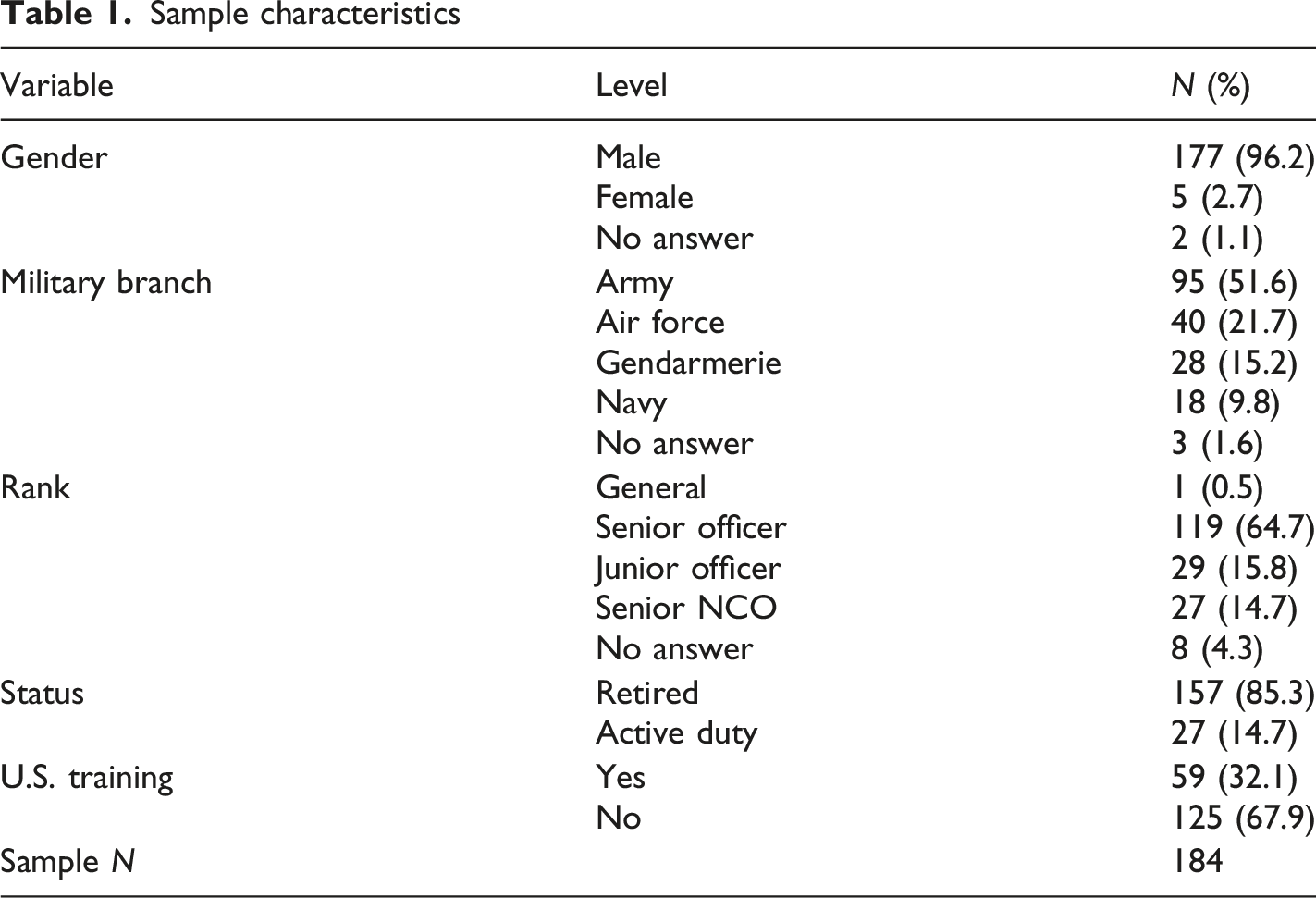
The sample departs from the broader Turkish military in three important ways. First, it overrepresents retired personnel (85.3 percent) relative to active-duty officers. Second, it is skewed toward senior officers, with nearly two-thirds holding senior officer ranks. Third, the prevalence of U.S. military training (32.1 percent) is likely higher than in the general Turkish military population, though precise comparison data are unavailable. These patterns reflect our snowball sampling strategy, which deliberately targeted retired officers with professional networks of senior colleagues due to sensitivity concerns and institutional constraints on surveying active-duty personnel.
These departures have implications for interpretation. Retired and senior officers were socialized during an earlier era of Turkish political culture and U.S.-Turkey relations, which may influence their baseline attitudes and potentially amplify observed training effects. Because the study relies on a convenience sample, the results should be interpreted cautiously when generalizing to the entire Turkish officer corps. The primary limitation therefore concerns external validity and generalizability. Our estimates capture behavioral tendencies among officers who were reachable through our snowball sampling strategy and willing to participate in the survey, rather than a random draw from the full population of Turkish military personnel.
These limitations do not threaten the internal validity of the experimental estimates, since treatment assignment was randomized within the sample (see Table A1, Appendix). The survey experiment allows us to identify whether exposure to U.S. military training systematically shapes officers’ responses to interpersonal cooperation scenarios, a causal relationship that random assignment allows us to estimate even when the sample itself is not representative (Mullinix et al., 2015). Such convenience and snowball sampling strategies are widely recognized as appropriate—often necessary—for research on military elites, where institutional gatekeeping, security concerns, and small population sizes make probability sampling infeasible (Kertzer and Renshon 2022).
The survey started with a series of demographic questions, including active-duty status, age, gender, foreign languages spoken, education level, military branches served in, length of military service, and maximum rank held. All questions included a “Do not know/Prefer not to say” option.
The next section in the survey asked respondents a series of questions about their military experience. The key question we asked in this section was whether they had “received any military training/academic education abroad” and where this education took place. We followed up with a question about the duration of this training/education. In our final sample (N = 184), 72 officers reported receiving training or education abroad, with 59 of them receiving US military training and 13 attending programs in other countries. 9
Finally, we introduced the last section of the survey, in which respondents were presented with a series of fictitious scenarios in which they were asked to imagine themselves in each situation and share what actions they would take. All respondents were first presented with a warm-up vignette. At this point respondents were then randomly assigned to either a control group, in which all references to foreigners in the vignettes simply use the word “foreign”, and a treatment group, in which all foreign officers are identified as “American.”
10
The first experimental vignette (Scenario 1), which tests Hypothesis 1 (on U.S. influence), asked them to imagine themselves as the commander of a unit stationed at the Syrian border. The vignette (shown in Figure 1) describes a situation where they receive an informal request from an officer, either described as “foreign” (control) or “American” (treatment). Following the vignette, they were asked about their willingness to grant this informal request. Scenario 1.
Scenario 2 asked them to imagine themselves as a unit commander in a UN Peacekeeping Operation who needs access to some classified information. In the scenario (shown in Figure 2), the chief commander of the PKO operation, who possesses the information, was described either as “a foreign” (control) or “an American” (treatment) Colonel whom they knew before from a social, professional setting. Following exposure to this vignette, they were asked about their willingness to make an informal request from the Colonel. This tests Hypothesis 2, capturing the possibility that the influence built through military training will not be a one-way street, but rather that foreign trainees will also expect to have a degree of influence with their U.S. counterparts. In other words, a willingness to make requests of American officers would be indicative of the intrinsic mechanism being at play. Scenario 2.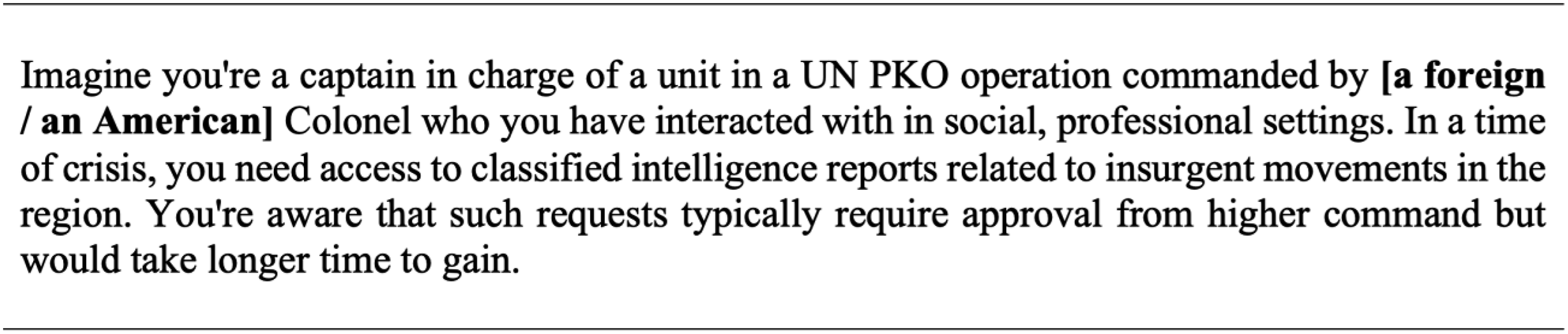
Importantly, because we believe that norms of reciprocity may influence the respondent’s willingness to grant/request a favor (e.g., a respondent who has just responded that they would grant a request to a foreign officer may then be more likely to say that they would ask for a favor from a foreigner than they would have otherwise), we randomized the order in which these two vignettes were presented to the respondents. 11 For the outcome questions regarding their willingness to grant (Scenario 1) or make (Scenario 2) an informal request, the response options were: Very likely (1), Somewhat likely (2), Somewhat unlikely (3), Very unlikely (4), Don’t know/prefer not to say (99).
Finally, we had a third vignette (Scenario 3) that dealt with the choice to follow an order from a superior officer in an international crisis. This vignette served as an attention check at the end of the survey to ensure that respondents were actively engaging with the scenarios and not answering randomly. 12
Survey Experiment: Results
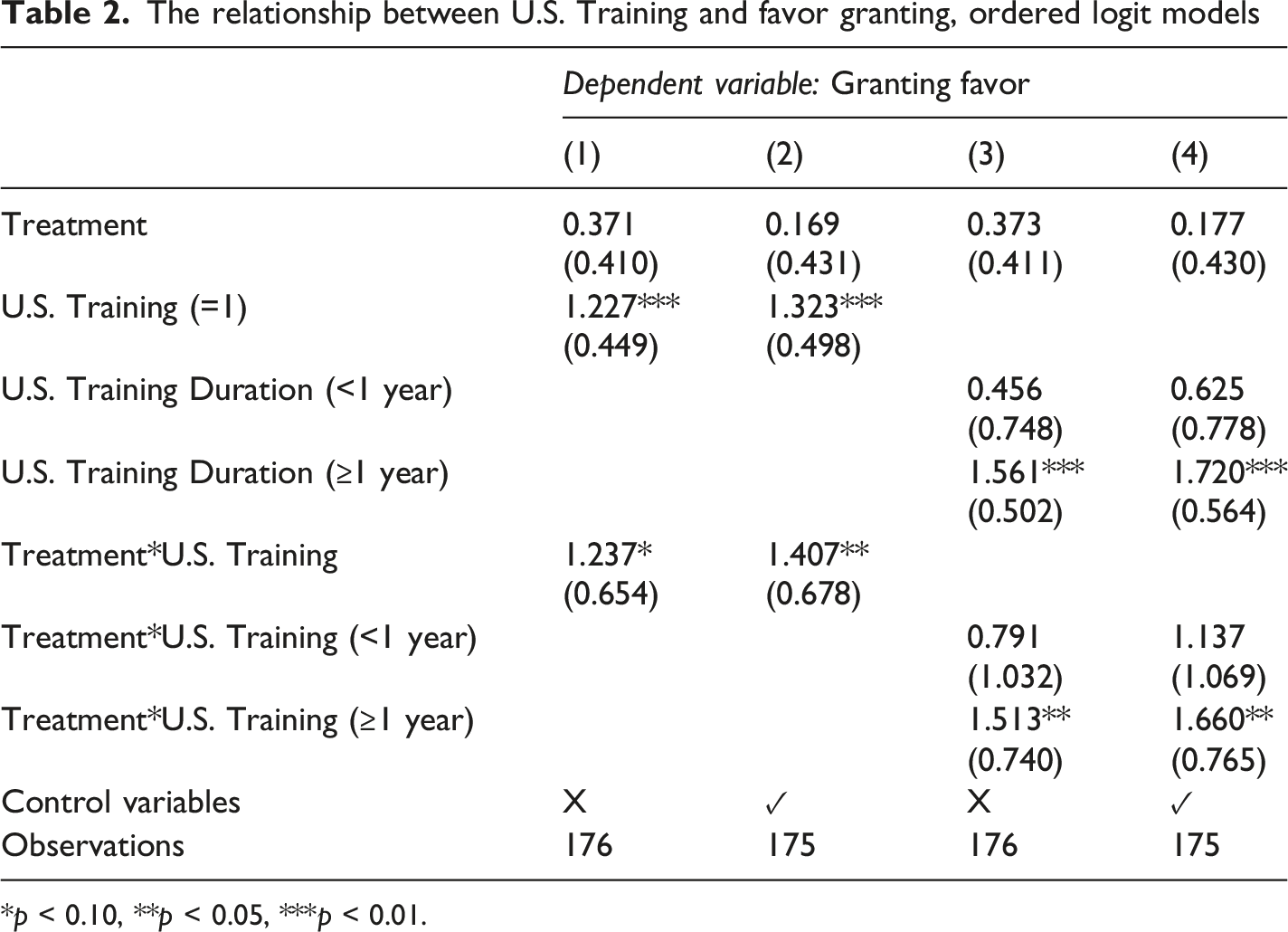
We estimate ordered logistic (logit) regression models utilizing the full range of response categories. To test hypotheses 1 and 2, we are mainly interested in the interaction between being exposed to the treatment vignette and whether an individual received military training or education in the U.S. To test hypothesis 3, we use the interactions between being exposed to the treatment vignette and a variable that measures the length of the training/education. We group training duration into two categories: more or less than 1 year (with no training as the reference category). We made this choice based on the qualitative interviews that identified 1 year as a focal point to indicate longer-term assignments, as well as on recent existing literature that highlights the 1-year mark as being associated with programs with greater opportunities for socialization (Kucera 2025). In our initial set of models, we dropped the very limited number of respondents that selected the “Don’t know/prefer not to say” option. In a robustness check (see Appendix Table A14) we included this option as a separate category, in case respondents chose this option systematically (Kleinberg and Fordham 2018).
To ensure the balance between the treatment and control groups, we conducted covariate comparisons using standardized mean differences (SMDs) and statistical tests, with the full results reported in Table A1 and Figure A1 in the Appendix. The treatment and control groups are largely comparable across key demographic and attitudinal covariates, including age, gender, education, U.S. training background, cosmopolitanism and obedience, and number of foreign languages spoken. 13 This balance supports the assumption of random assignment between treatment and control groups.
The relationship between U.S. Training and favor granting, ordered logit models
*p < 0.10, **p < 0.05, ***p < 0.01.
Given the caution against directly interpreting the significance level of interaction terms in regression models (Berry, DeMeritt, and Esarey, 2010), we present the marginal effects of the interaction term in Figures 3 and 4. The plot in Figure 1 (based on Model 2.1; see Appendix Figure A4 for models 2.2 and 2.4) shows how training amplifies the effect of the treatment condition. Officers without U.S. training show no significant difference in favor-granting behavior between the treatment and control groups; the marginal effect is near zero, with a confidence interval spanning positive and negative values, indicating no statistically significant effect. In contrast, officers with U.S. training exhibit a significant positive marginal effect, with the confidence interval not overlapping zero, except for the “somewhat unlikely” responses. This suggests that U.S.-trained officers are more likely to favorably respond to requests involving an American officer compared to a foreign officer. Also, they are less likely to respond “very unlikely” to a favor request from an American officer. These findings support the hypothesis that U.S. training enhances responsiveness toward favor requests from American officers. Based on Model 2.1. Based on Model 2.3.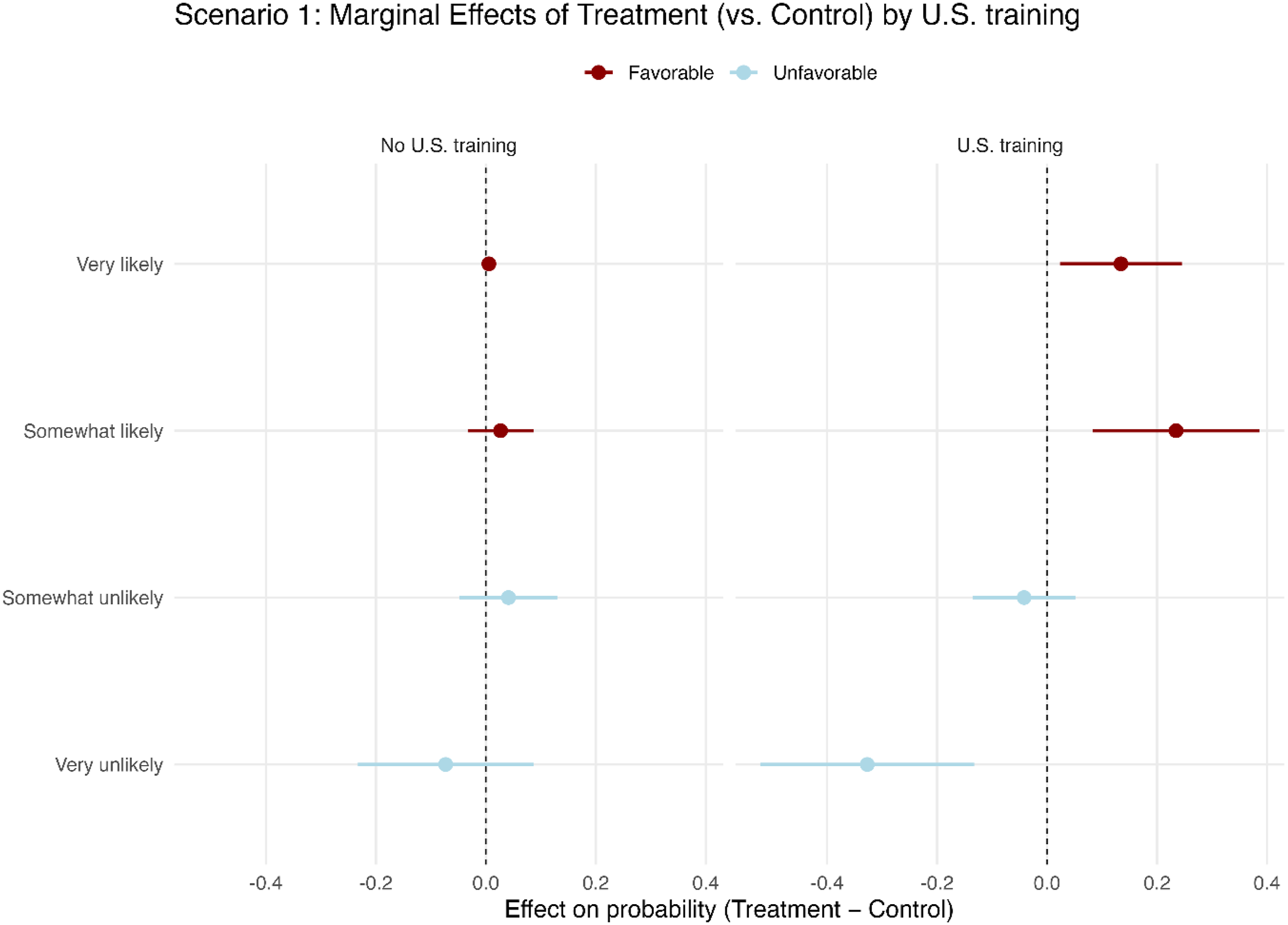
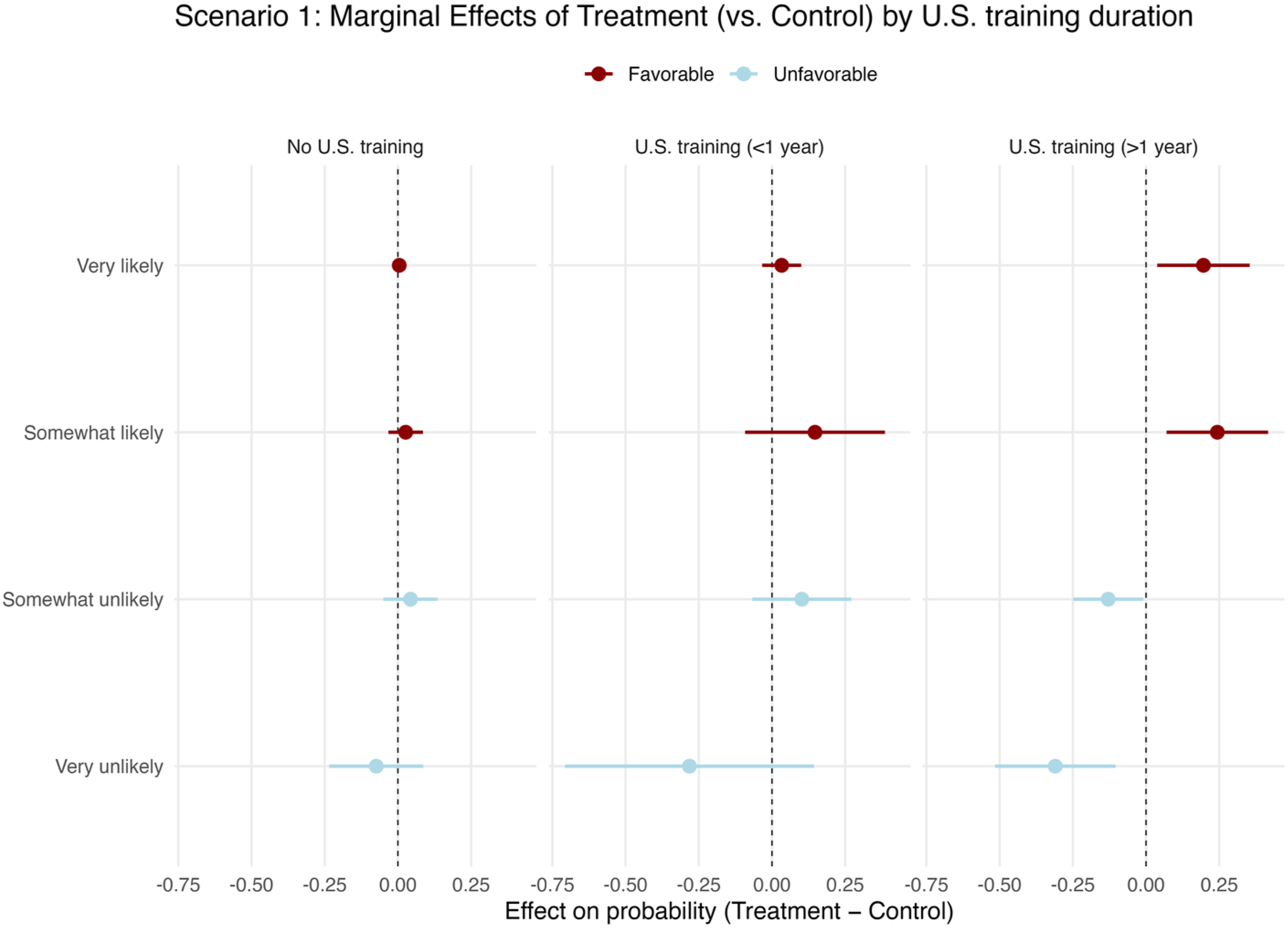
To provide a more intuitive understanding of the substantive effect sizes, we also examine the proportion of officers who reported being either “somewhat likely” or “very likely” to grant a favor in each condition. Among U.S.-trained officers, 61.3 percent (19 out of 31) expressed willingness to grant a favor to an American officer in the treatment condition, compared to just 21.4 percent (6 out of 28) in the control condition. In contrast, among officers without U.S. training, the proportion of favorable responses remained essentially unchanged across conditions, hovering around 7%–7.5 percent (4 out of 53) in the treatment and 6.9 percent (5 out of 72) in the control group.
Though U.S. trained officers were more likely to grant a favor to a U.S. counterpart (treatment) than a generic foreign one (control), overall U.S.-trained officers also showed higher rates of favorable responses in the control condition, when compared to non-U.S. trained officers in that same setting (see also Table A2 in the Appendix). This may suggest that, in addition to the reciprocity being built in training, U.S.-trained officers become more internationalized than their counterparts and more open to cooperating with international officers in general. We observed some evidence of this in the interviews as well. 14 This finding points to a broader possible outcome of training abroad—an increased willingness to engage cooperatively with international peers—which future research could explore further.
The plot in Figure 4 indicates that officers with shorter U.S. training (up to 1 year) display a slight positive effect, though it is not statistically significant, as the confidence interval includes zero. However, officers who received U.S. training for more than 1 year show a significant positive marginal effect. These officers are more likely to favorably respond to requests involving an American officer compared to a foreign officer. These results suggest that the duration of U.S. training matters: longer training periods are associated with a stronger positive response to the treatment condition. This supports the hypothesis that the length of U.S. training amplifies the positive effect on responsiveness to favor requests involving American officers.
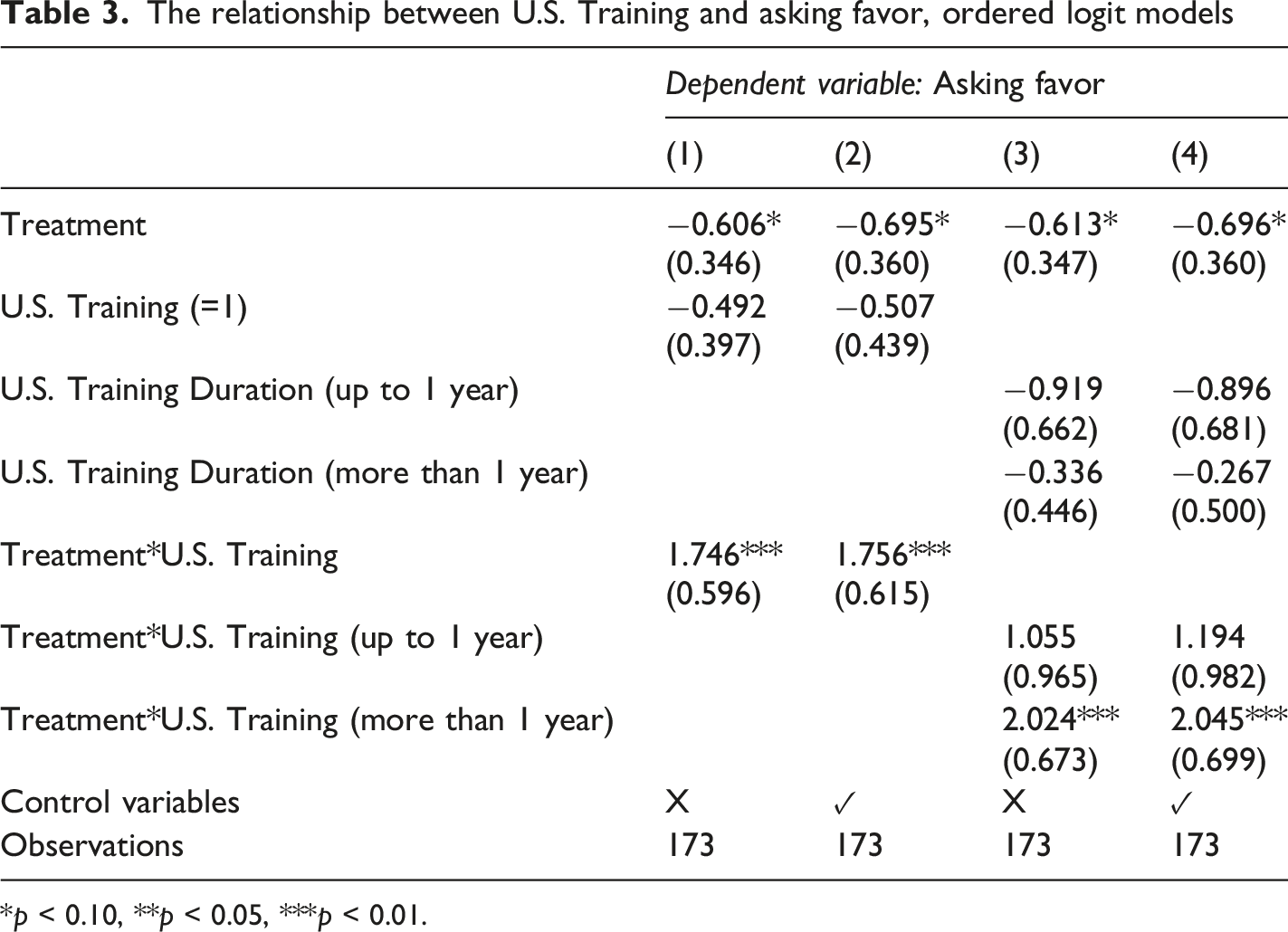
The relationship between U.S. Training and asking favor, ordered logit models
*p < 0.10, **p < 0.05, ***p < 0.01.
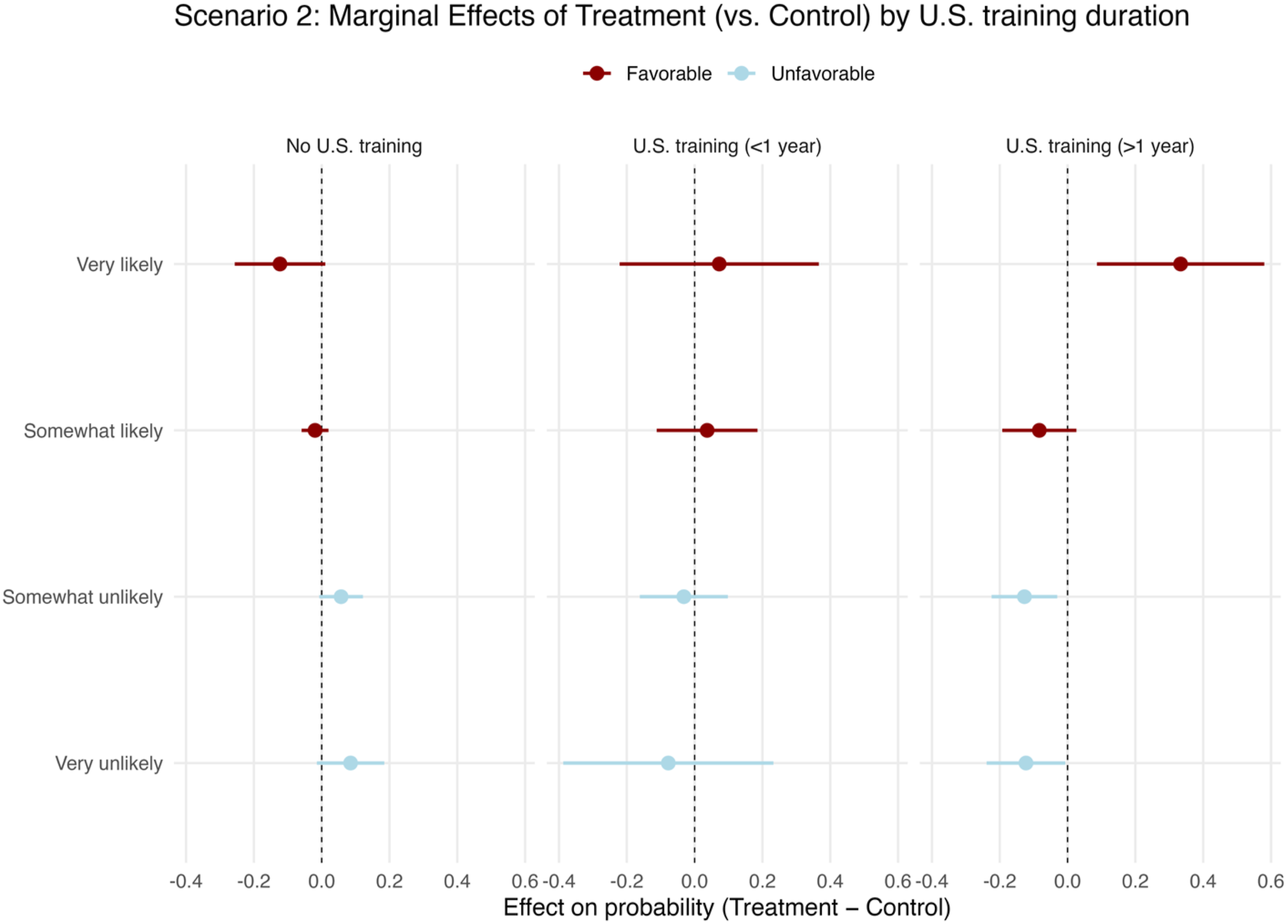
We present the marginal effects of the interaction term in Figures 5 and 6, with Models 3.1 and 3.3 presented in Table 2. The plot in Figure 5 suggests that U.S.-trained officers are more likely to respond positively (“Very Likely”) and less likely to answer negatively (“Very Unlikely” or “Somewhat Unlikely”) to the possibility of asking favors from American officers. For those who did not train in the U.S., there seems to be no significant effect. Based on Model 3.1. Based on Model 3.3.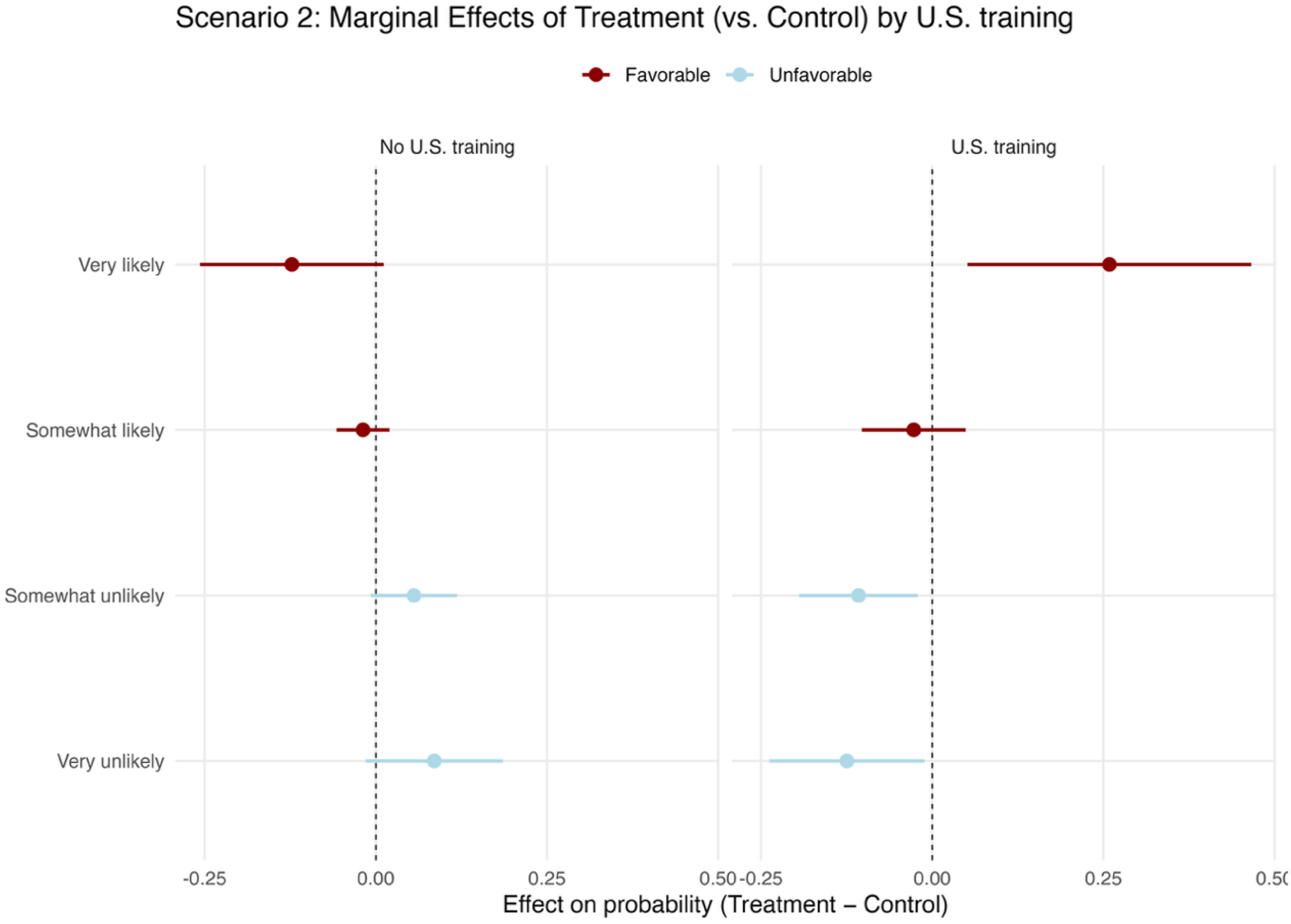
Among U.S.-trained officers, 80.6 percent (25 out of 31) expressed willingness to ask for a favor from an American officer in the treatment condition, compared to 60.7 percent (17 out of 28) from a foreign officer in the control condition. Among officers without U.S. training, the proportion of favorable responses was 49.1 percent (26 out of 53) in the treatment and 62.5 percent (45 out of 72) in the control group.
These results, especially when compared to Scenario 1, reveal two important patterns. First, Turkish officers appear generally more comfortable asking for a favor than granting one to foreign officers. Yet, U.S. training still matters: in Scenario 2, the treatment condition (featuring an American counterpart) elicits the highest rate of favorable responses from U.S.-trained officers. Second, among officers without U.S. training, the presence of an American counterpart in Scenario 2 actually reduces favorable responses compared to when the counterpart is described simply as “foreign.” In other words, Turkish officers without U.S. training are more likely to ask for a favor from a generically foreign officer than from an American one. As in Scenario 1, Figure 6 demonstrates that the treatment effect becomes significant only for officers who trained in the U.S. for more than 1 year, though the wider confidence intervals may temper the strength of these conclusions.
Additional Robustness Checks
To assess the reliability and consistency of our findings, we conducted several additional robustness checks, the results of which are reported in the Appendix. We tested the sensitivity of our results to alternative modeling choices. Specifically, we (a) replicated our main findings using OLS regression (Gomila 2021), presented in Tables A6 and A7 of the Appendix and binary logistic regression presented in Tables A8 and A9 of the Appendix, and (b) introduced additional control variables to account for potential confounding factors, including respondent rank and training from non-U.S. states, presented in Tables A10 and A11 of the Appendix. Across all specifications, the interaction effect between U.S. training and treatment condition remained substantively robust.
A potential concern with our findings is the possibility of selection bias—that officers who participated in U.S. training programs may have already held more favorable views toward the United States. However, our qualitative interviews show how officers overwhelmingly cited career advancement—not ideological alignment—as their primary motivation for attending U.S. programs. In fact, as noted earlier, many interviewees noted a general skepticism or ambivalence toward the United States prior to training. For instance, subjects stated: “Participating in this program is beneficial for one’s career” (Interview Subject 1); “My goal in participating in these programs was to advance my career, as they were considered important for career advancement” (Interview Subject 2); and “it was a good opportunity to improve my career prospect in the army” (Interview Subject 5). This suggests that career incentives, rather than pre-existing affinity for the U.S., primarily drive participation, thus mitigating concerns over selection bias.
Finally, to ensure robust interaction analyses, we also checked common support (King and Zeng 2006)—the extent to which random assignment successfully balanced U.S. training status across experimental groups. Table A16 in the Appendix shows the distribution of respondents across all combinations of experimental group and training status. The interaction of primary interest for H1 and H2 (treatment × U.S. training) has adequate sample sizes across all cells, with the minimum being 28, and U.S. training distributions being balanced between the control and treatment groups (χ2 = 1.28, df = 1, p = 0.26). As for the second interaction with the duration of U.S. training, the short-term duration (<1-year) category has 9 observations in each experimental condition, while the long-term duration (≥1-year) category has more observations, 19 and 22, in the control and treatment groups respectively. While we acknowledge this limitation regarding short duration programs and interpret the results with caution, we also note that this is one area where our qualitative results bolster the support for Hypothesis 3 and make up for the shortcomings of the quantitative approach. Further covariate balance checks also confirm that key demographic and professional characteristics are well-balanced across experimental groups within each training category (see Appendix Tables A17 and A18).
Conclusion
This study sheds light on the nuanced and underexplored pathways through which U.S. foreign military training shapes the attitudes and actions of recipient military officers. Theoretically, it presents two pathways, extrinsic and intrinsic, through which influence occurs. By providing individual-level evidence for the intrinsic, soft power pathway from training to influence, this paper fills an existing gap in a literature that has often left these questions untested.
Our theory is a general one that we expect to have implications far beyond the Turkey case. Future work should test these hypotheses in different settings. Most of our respondents are retired officers who served during relatively stable periods in U.S.-Turkey relations and when the Turkish military held more institutional autonomy. It is possible that currently active officers might respond differently, given the gradual transformation of civil-military relations in Turkey as well as worsening bilateral relations with the U.S. under the AKP rule (see, for example, Aydinli 2009; Hovsepyan 2022). Still, we believe our findings reflect latent potential for influence to emerge under more positive bilateral conditions. Future work that explored the effect of U.S. training in different states would be an effective way to probe the results further.
From a policy perspective, our findings reaffirm the strategic value of U.S. foreign military training programs but also underscore their fragility. The results show that there is indeed a relationship between U.S. training and a willingness to grant U.S. requests, something that could certainly facilitate U.S. foreign policy execution. Yet this influence through training is neither automatic nor one-directional. Officers who develop cooperative ties with U.S. counterparts often expect reciprocity, as shown by the finding of U.S.-trained officers also being more willing to make requests of American counterparts. If they perceive the relationship as extractive or unreciprocated, the willingness to offer informal cooperation may erode. Durable relationships require more than exposure; they require sustained engagement and mutual respect. Trust, once earned, can be lost, and relationships with allies cannot be taken for granted by any of the parties involved.
Supplemental Material
Supplemental Material - From Training to Influence: The Role of U.S. Military Training in Turkish Officers’ Decisions
Supplemental Material for From Training to Influence: The Role of U.S. Military Training in Turkish Officers’ Decisions by Ilker Kalin, Carla Martínez Machain in Journal of Conflict Resolution.
Footnotes
Funding
The author disclosed receipt of the following financial support for the research, authorship, and/or publication of this article: Ilker Kalin acknowledges the funding from the EU NextGenerationEU through the Recovery and Resilience Plan for Slovakia under the project No. 09I01-03-V04-00609.
Declaration of Conflicting Interests
The authors declared no potential conflicts of interest with respect to the research, authorship, and/or publication of this article.
Data Availability Statement
The data and replication materials are available in the Harvard Dataverse at https://doi.org/10.7910/DVN/YKLTNZ by  .
.
Supplemental Material
Supplemental material for this article is available online.
Notes
References
Supplementary Material
Please find the following supplemental material available below.
For Open Access articles published under a Creative Commons License, all supplemental material carries the same license as the article it is associated with.
For non-Open Access articles published, all supplemental material carries a non-exclusive license, and permission requests for re-use of supplemental material or any part of supplemental material shall be sent directly to the copyright owner as specified in the copyright notice associated with the article.
