







Abstract
Why does amnesty for mass atrocities persist despite the international justice regime’s efforts to end impunity? I address this puzzle by highlighting a new dynamic in contemporary civil wars: the growing risk of international prosecution in rebel groups’ foreign sanctuaries. I argue that the international justice regime—particularly the International Criminal Court (ICC) and universal jurisdiction—undermines the security of these sanctuaries, making return under amnesty more attractive for rebel groups. This logic explains why amnesty for serious crimes persists, if not increases, despite the global norm against impunity. Large-N analyses show, first, that rebel groups operating abroad and facing international legal risk are more likely to obtain amnesty, and second, that amnesty provisions increase as prosecution risks rise in host states. The findings reveal an irony of global justice: a system created to end impunity entrenches it through amnesties, while simultaneously constraining warlords’ operational space and narrowing their strategic options.
Introduction
In 2022, the Chadian government signed a peace agreement with 42 rebel groups that included a controversial amnesty provision for individuals accused of war crimes and crimes against humanity. The accord was praised for disarming insurgents and bolstering regional stability, yet this outcome appears inconsistent with decades of international efforts to eradicate impunity for serious crimes. Although the Nuremberg Trials laid the early legal groundwork, the global movement toward accountability gained full momentum only after the Cold War. Since the late 1990s, the international community has increasingly relied on judicial processes to hold perpetrators of grave violations accountable, a shift that directly challenges the legitimacy of domestic amnesties (Freeman 2009; Sadat 2005).
Contemporary peace processes—as in Chad and elsewhere—nonetheless demonstrate the persistence of amnesty practices. According to recent scholarship, the frequency of amnesties covering serious crimes has not declined but instead increased over the past several decades (Mallinder 2012; Olsen, Payne, and Reiter, 2010; Payne, Lessa, and Pereira, 2015). This paradox raises a central puzzle: Why do amnesties for the gravest crimes persist—and in some cases expand—even as the international legal regime aimed at eliminating impunity has strengthened? Does this trend imply that international law exerts only limited influence on peace negotiations? If not, what effects does it generate in shaping the dynamics of peace and justice?
This paper addresses the puzzle by analyzing conflict-related domestic amnesties (hereafter conflict amnesties), which are legal immunities governments grant to rebel groups during civil conflicts to facilitate negotiations or settlements (Dancy 2018; Daniels 2020). 1 I argue that developments in international law unintentionally contribute to the persistence of such amnesties by reshaping the strategic environment in which rebel groups operate. I contend that international accountability mechanisms, chiefly the International Criminal Court (ICC) and national courts exercising universal jurisdiction (UJ), have diminished the reliability of foreign sanctuaries that once provided safe haven to rebel actors. 2 When foreign sanctuaries become insecure, rebels face a narrowing path for survival, incentivizing them to seek amnesties as a strategic exit to return home. Home states, in turn, benefit from this shift: as international accountability mechanisms erode rebels’ external options, the balance of bargaining power tilts in the government’s favor, making amnesty an attractive strategic instrument to convert military and legal advantage into durable political settlements. This argument helps explain the enduring reliance on domestic amnesties for serious crimes and illustrates how the international justice regime inadvertently shapes the conditions for conflict settlement by stripping rebels of their strategic alternatives.
I substantiate this argument through two analyses of global patterns of conflict amnesties. First, I show that, in the wake of the global justice cascade, transborder rebel groups are more likely than localized groups to receive amnesty for serious crimes. Because transborder groups depend on foreign sanctuaries for cross-border operations, they are also the actors most directly affected when international accountability mechanisms diminish the reliability of those safe havens. Second, when the analysis is restricted to transborder groups, those exposed to higher levels of ICC scrutiny are more likely to obtain amnesties for serious crimes from their home governments. These results are consistent across model specifications and measurement strategies, providing strong empirical support for the claim that international legal pressures on foreign sanctuaries contribute to the persistence of domestic amnesty provisions.
This paper contributes to the study of civil conflict and international law by offering new theoretical insights and empirical evidence. First, it identifies a key dynamic in contemporary civil wars: the impact of international law on the viability of foreign sanctuaries for rebel groups. This mechanism has practical implications for peace processes, as international legal enforcement in foreign jurisdictions often constrains the mobility and operational capacity of rebel actors—particularly those accused of serious crimes. In turn, rebel groups are more likely to seek negotiated settlements with their home governments to obtain amnesty and secure repatriation, a paradoxical outcome that may ultimately facilitate peace.
Second, the paper extends the civil war bargaining literature beyond traditional dyadic models that emphasize state–rebel commitment problems. Instead, it shows how international legal developments alter the broader strategic environment in which rebels make decisions, reshaping the opportunity structure that underpins their bargaining with governments. This reframing—from debates over the validity of amnesty to assessments of its necessity—offers a novel perspective on the peace–justice debate.
The Puzzle of Amnesty in the Age of Accountability
Over recent decades, the international community has intensified efforts to curb impunity for grave crimes, most notably through the establishment of the ICC and the growing embrace of universal jurisdiction. The 1998 adoption of the Rome Statute establishing the ICC marked a watershed in international legal history by stipulating that no national measure—including an amnesty—can shield alleged perpetrators from the Court’s reach (Art. 27 (2)). That same year, the former Chilean dictator Augusto Pinochet, who had granted himself blanket amnesty, was arrested under a Spanish court’s exercise of universal jurisdiction, signaling that amnesty no longer guaranteed protection from legal accountability. 3 Regional and international bodies, including the United Nations, the Inter-American Court of Human Rights, and the African Union, have likewise condemned amnesties for the most heinous international crimes.
These developments were intended to curtail reliance on amnesty for serious crimes and fostered widespread expectations that such practices would decline, consistent with emerging international legal norms. 4 This expectation also shaped the so-called “peace versus justice” debate, in which scholars disagree over whether amnesty for serious crimes should remain a negotiable instrument in conflict resolution (Ginsburg 2009; Goldsmith and Krasner 2003; Kersten 2016; Kim and Sikkink 2010; Olsen, Payne, and Reiter 2010; Prorok 2017; Snyder and Vinjamuri 2003). While amnesties have historically facilitated transitions from civil war and authoritarian rule (Dancy 2018; Daniels 2020; Mason, Weingarten, and Fett 1999), critics contend that impunity for grave crimes undermines legal norms and erodes deterrence for future atrocities, whereas proponents argue that amnesty may be a necessary concession to halt violence. Much of this literature focuses on how international justice mechanisms, particularly the ICC, raise the legal costs of settlement and exacerbate commitment problems that render amnesty promises less credible (Bass 2000; Ginsburg 2009; Krcmaric 2020; Prorok 2017). 5
Contrary to these expectations, however, recent studies reveal an unintended persistence—and in some cases even expansion—in the use of amnesty provisions. Olsen, Payne, and Reiter find that the rate of amnesty laws has remained stable despite the so-called age of accountability (Olsen, Payne, and Reiter 2010). Mallinder, drawing on a global database of amnesties, shows that the frequency of amnesties covering serious crimes has not declined but instead increased since 1979 (Mallinder 2012, 91). Although human rights trials have proliferated globally (Sikkink 2012), these legal developments appear to have had little effect on the prevalence of amnesty laws (Payne, Lessa, and Pereira 2015, 732, 745). Some scholars even question whether the “age of accountability” has, in fact, materialized (Lessa and Payne 2012, 3).
The persistence of amnesty for serious crimes in this purported era of accountability presents a complex puzzle that demands deeper theoretical engagement and more rigorous empirical analysis. A lack of theorization about why and when states grant amnesty remains a notable gap in the literature (Dancy 2018, 406). Yet existing work offers important insights. Some suggest that the trend reflects a shift from informal impunity—marked by prosecutorial inaction—to more legalistic frameworks that formalize impunity through legislation (Mallinder 2012). Others argue that rising accountability pressures may paradoxically incentivize actors to seek amnesty as a safeguard against prosecution (Mallinder 2012; Sikkink 2012; Slye 2002). Still others emphasize the enduring political utility of amnesty—for ending violence (Jeffery 2014), shielding actors from retribution (Sikkink 2012, 8), or facilitating reconciliation during transitions from authoritarian rule or civil war (Snyder and Vinjamuri 2003). These insights, however, have rarely been systematically theorized or empirically tested. In the following section, I extend these insights by developing a framework that explains why amnesty still persists as a result of rebels’ shrinking strategic options.
International Justice, Rebel Targeting, and the Erosion of Foreign Sanctuaries
Between 35 and 55 percent of rebel organizations operate from extraterritorial bases that provide critical resources for recruitment, training, and arming, while allowing them to shelter in relatively safe havens beyond the reach of prosecution and counterinsurgent operations (Salehyan 2008, 2009; Salehyan, Gleditsch, and Cunningham 2011). Prior to the expansion of international criminal jurisdiction, such extraterritorial bases functioned as de facto safe havens. Criminal jurisdiction was traditionally vested in national governments, which prosecuted crimes only under three conditions: when the perpetrator or victim was a national (nationality or passive personality principles), when the offense occurred within their territory (territorial principle), or when the act directly threatened their national interests (protective principle). Beyond these grounds, governments generally lacked authority to prosecute foreign individuals for crimes committed abroad. Consequently, home states bore primary responsibility for enforcement, while rebel actors operating from foreign territories often enjoyed impunity, shielded both by the limited reach of their own governments and the jurisdictional constraints of host states.
Today, however, the landscape of international justice has shifted considerably. Individuals once beyond the reach of traditional jurisdictions now fall within the scope of international legal frameworks, most notably the International Criminal Court (ICC) and the expanding use of universal jurisdiction, particularly for those implicated in serious international crimes. These new avenues for accountability expose rebel actors to unprecedented risks of prosecution. Where rebel actors once needed only to avoid capture by national governments, they now face sustained scrutiny from international courts and domestic authorities exercising universal jurisdiction.
ICC cases involving rebel group leaders
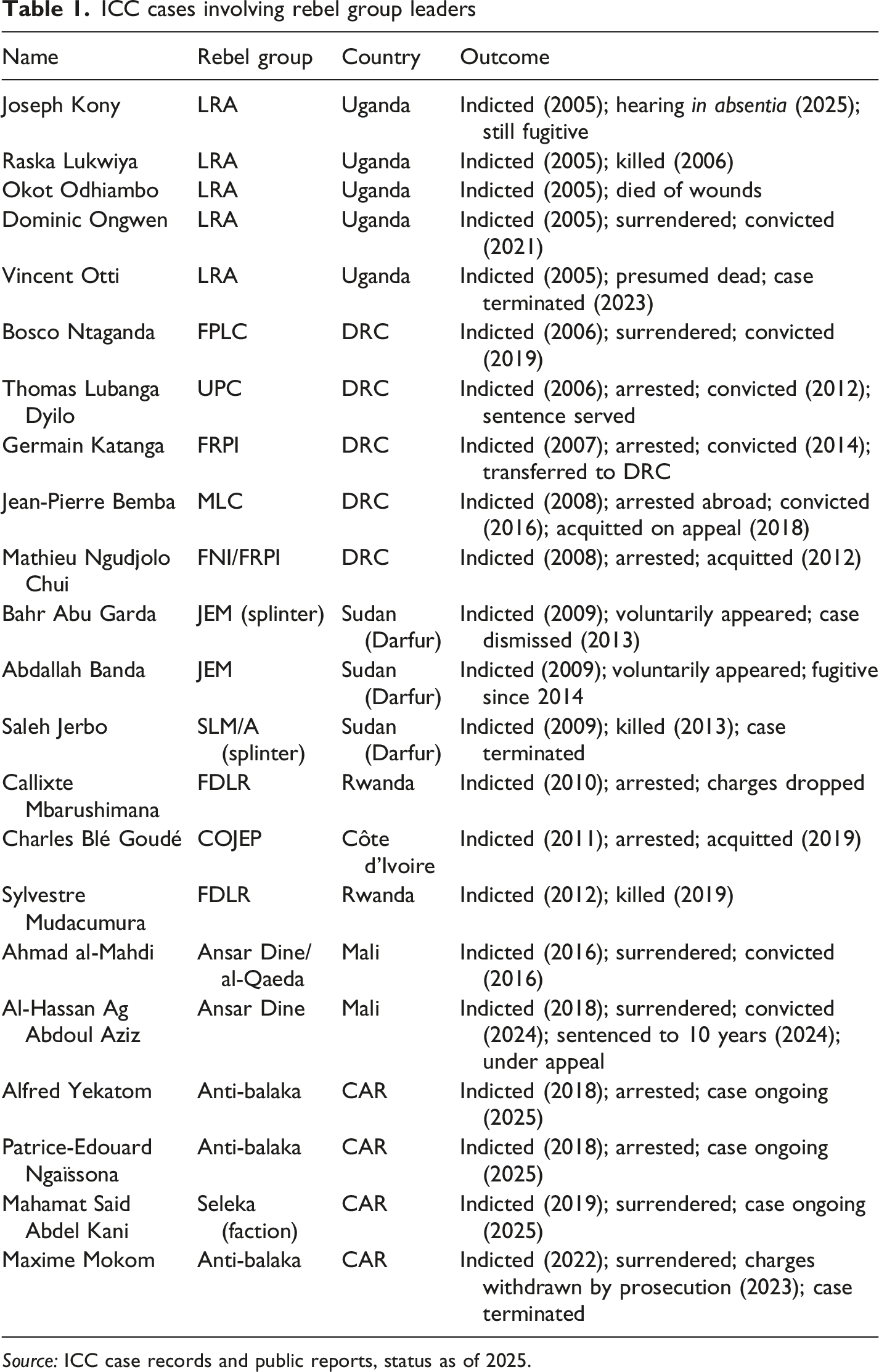
Source: ICC case records and public reports, status as of 2025.
Universal jurisdiction cases involving rebel group members
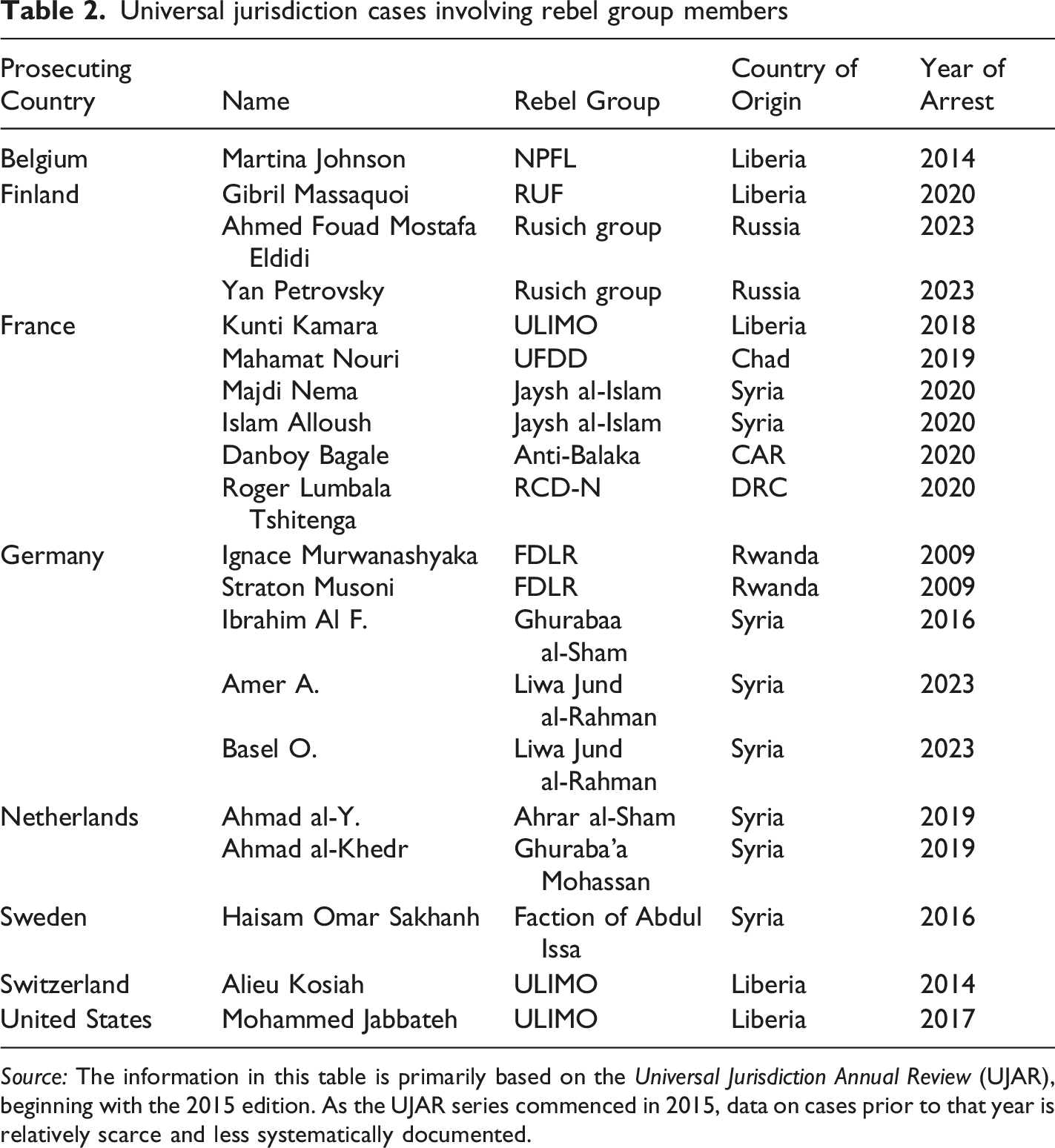
Source: The information in this table is primarily based on the Universal Jurisdiction Annual Review (UJAR), beginning with the 2015 edition. As the UJAR series commenced in 2015, data on cases prior to that year is relatively scarce and less systematically documented.
UJ further complements the ICC by filling accountability gaps when the Court lacks jurisdiction—whether because the state in question is not a member or because Security Council vetoes block referrals. In such contexts, national courts exercising universal jurisdiction have increasingly stepped in to ensure that rebel actors do not enjoy impunity. For example, UJ prosecutions in Europe have targeted Syrian rebel actors even though Security Council vetoes prevented ICC jurisdiction over Syria in 2014. In some instances, these cases have involved rebel leaders who remained active in coordinating their groups from exile abroad. This pattern indicates that international criminal accountability is not confined to post-conflict justice, but can also directly affect the strategic environment of ongoing rebel movements operating from abroad.
What do these developments imply for rebel groups operating from foreign sanctuaries? Across diverse sanctuary environments, international accountability makes external bases less reliable by increasing rebels’ exposure to prosecution abroad and raising host states’ legal, diplomatic, and political costs of tolerating them. Although host states may initially tolerate, invite, or be unable to remove foreign rebels, these insurgents rarely remain costless guests. External bases can generate violence, coercion, and cross-border spillovers that transform rebel groups from strategic assets—or manageable problems—into domestic liabilities (Moore 2019; Salehyan 2007; Stewart and Liou 2017). In this context, the expansion of international criminal accountability allows host governments to utilize, or be pressured by, legal mechanisms that facilitate arresting rebels, withdrawing protection, or cooperating with international prosecution.
Recent research shows that international criminal accountability has already altered the strategic calculus of state leaders by increasing the risks associated with losing power and seeking refuge abroad (Escribà-Folch and Wright 2015; Krcmaric 2018; Roht-Arriaza 2006). My argument extends this logic of extraterritorial legal pressure but shifts the focus from future exit options to present operating environments. Whereas Krcmaric emphasizes how accountability pressures constrain state leaders after they lose power, I argue that for rebel groups these pressures operate during conflict. For rebels, international justice does not primarily foreclose exile as a future option; it actively destabilizes the foreign sanctuaries they already rely on, undermining the cross-border bases that sustain rebel organization, financing, and military capacity.
This dynamic is especially pronounced for rebels because they typically lack the institutional protections that can shield sitting state leaders. Whereas heads of state may at times benefit from sovereign immunity, diplomatic leverage, or strategic non-cooperation, rebel leaders possess few such safeguards and are more frequently the direct targets of international justice mechanisms (Akande 2004; Ginsburg 2009; McAllister 2023). As a result, accountability pressures do not simply apply more strongly to rebels; they function differently by transforming the very feasibility of operating from foreign territory during war. These developments suggest that the sanctuaries on which rebels have long depended are no longer immune from external pressures.
To demonstrate how these accountability pressures transform the feasibility of foreign sanctuary during war, I trace the logic across several recurring settings in which rebels operate abroad: neighboring states with limited capacity, rebel-sponsoring states, and refugee or diaspora communities. These settings are not mutually exclusive: weak neighboring states may host refugee communities, sponsoring states may rely on camps or diaspora networks, and rebel organizations may draw on more than one sanctuary environment at the same time. Across these settings, the common logic is that international accountability mechanisms reduce the reliability of foreign sanctuary by raising the costs of tolerating or protecting rebel actors and making rebel mobility more legally precarious.
First, rebels often establish sanctuaries in neighboring states with limited capacity to prevent their presence. Such states typically lack robust judicial systems and sufficient military or police forces to prosecute international crimes or apprehend perpetrators. Yet residence in these territories does not guarantee impunity. Weak institutions may instead create openings for international intervention: ICC investigations, warrants, and cooperation requests can extend beyond the immediate sanctuary, limiting rebel leaders’ mobility and making once-protective spaces legally precarious. This risk is especially acute where international courts operate alongside UN peacekeeping operations (PKOs), which can help bridge the institutional deficits of weak host states by supporting arrest, transfer, and cooperation with international courts (Venigandla 2021). Although such cooperation has occasionally generated tensions over traditional peacekeeping principles (Buitelaar 2024), modern peacekeeping missions with protection-of-civilians mandates are increasingly positioned to support international accountability. In the Central African Republic, for example, UN peacekeepers (MINUSCA) played a decisive role in the surrender and transfer of Lord’s Resistance Army (LRA) commander Dominic Ongwen to the ICC in 2015. Such involvement can transform theoretically safe territories into high-risk zones, ensuring that even where state authority is weak, rebel leaders can no longer rely on the permanence of their sanctuary.
Second, some foreign sanctuaries are created deliberately by rival states that sponsor rebel groups as instruments of proxy warfare. These arrangements can provide rebels with territory, arms, logistics, and political protection, but they are not costless for host governments. When sponsored groups become associated with serious international crimes, accountability mechanisms can raise the diplomatic and political costs of maintaining protection, especially when support becomes visible to international courts, monitoring bodies, or other states. Stein (2022) finds that overt support for rebel groups implicated in atrocities heightens sponsor states’ exposure to reputational damage, sanctions, and operational constraints. ICC scrutiny can further reinforce these costs by publicizing non-cooperation, reporting defiance to the Assembly of States Parties or the UN Security Council, and turning rebel atrocities into internationally visible liabilities.
This does not mean that sponsor states will abandon useful proxies whenever legal pressure rises. States may continue to tolerate or assist rebels when the security benefits are substantial. The point is more limited: accountability pressures can make sponsorship less reliable by increasing the costs of open protection, encouraging sponsors to reduce support, deny association, restrict rebel mobility, or cooperate selectively when the benefits of protection no longer outweigh the diplomatic burden. This logic is especially relevant for rebel leaders, who lack the sovereign status and diplomatic leverage that sometimes make non-cooperation more attractive in cases involving sitting heads of state (Bosco 2014).
Sudan’s changing posture toward the LRA following Uganda’s ICC referral in 2003 illustrates this dynamic. Although Sudan had initially aided the group to undermine Uganda, it later permitted Ugandan forces to pursue the LRA inside Sudanese territory, reflecting a recalibration of support under growing international and regional pressure (Akhavan 2009; Brunner 2004; Lanz 2007). Rwanda’s arrest of Laurent Nkunda, leader of the Congolese rebel group CNDP, after ICC investigations and UN reporting on rebel abuses similarly suggests that accountability pressure can make continued protection more costly and less stable (Shepherd 2011). These cases show how accountability can weaken the reliability of sponsor-backed sanctuaries by making protection more politically costly, more conditional, and more vulnerable to reversal.
Third, foreign sanctuary may operate through refugee communities and diaspora settings. Traditional accounts emphasize refugee camps located in neighboring states near conflict borders, where rebels exploit displaced populations to recruit fighters, reorganize militarily, and access humanitarian resources such as food and medical care (Lischer 2005; Salehyan 2009). More recent research further shows that refugee camps may function as an extension of state sponsorship, suggesting that camp-based sanctuaries and proxy sponsorship are not mutually exclusive but can coexist within the same host-state strategy (Turkoglu 2021). Accordingly, the same host-state incentives that undermine sanctuaries in weak neighbors and sponsoring states can also operate in refugee camp environments.
Even apart from such cases, when armed groups infiltrate camps, divert humanitarian aid, recruit among displaced populations, or use camps as staging grounds, host governments face heightened incentives to contain and remove these actors—not only for national security reasons, but also to protect refugee populations and prevent the militarization of refugee camps. In this context, the availability of international criminal justice mechanisms provides host states with additional institutional channels to arrest or prosecute rebel actors. As a result, the expansion of international accountability increases the prosecutorial risk facing rebels who attempt to operate from refugee-based sanctuaries.
Beyond traditional border-region camps, contemporary displacement has also generated more geographically distant forms of sanctuary, including refugee and asylum communities in urban centers far from the conflict zone. These settings—particularly in Europe following the Syrian war—can function as durable sanctuaries by allowing rebel leadership to reside safely abroad while continuing to coordinate, finance, or politically represent their organizations.
Historically, many rebel leaders were able to reside abroad with little interference for extended periods, even while maintaining active roles within their organizations. However, as universal jurisdiction has become more actively exercised—particularly in Europe—and as investigative and prosecutorial infrastructures for international crimes have been consolidated, host states have increasingly screened refugee inflows for suspected perpetrators and initiated domestic prosecutions. As reflected in the growing number of cases brought under universal jurisdiction, rebel actors who once operated relatively securely from diaspora settings now face a substantially heightened risk of arrest and trial. 7
For example, Mahamat Nouri, leader of Chad’s Union of Forces for Democracy and Development (UFDD), resided in France while continuing to play a leadership role before being arrested under universal jurisdiction in 2019. Similarly, Kunti Kamara, a former commander of Liberia’s ULIMO, lived in France prior to his prosecution for war crimes in 2018, and Ignace Murwanashyaka, leader of the FDLR, coordinated rebel activities from Germany prior to his arrest and trial by German authorities exercising universal jurisdiction in 2009. These cases illustrate that urban asylum environments are not reliable sanctuaries for rebel organizations. Even when rebel leaders are able to reside abroad and coordinate activities from exile, the expanding use of universal jurisdiction—alongside the ICC—renders such arrangements highly vulnerable to exposure and disruption.
These dynamics demonstrate that foreign sanctuaries once thought to provide safe havens are increasingly compromised across diverse settings. The mechanisms vary in form, but the underlying logic is consistent: international accountability increases the risks of operating abroad and raises the costs of tolerating or protecting rebel actors. This destabilization narrows rebels’ strategic horizon, making negotiated return to the home state—and the contingent protection of amnesty—an increasingly rational, if imperfect, response.
Shrinking Rebel Options Under International Accountability
Rebel Perception and Legal Risk
How does the erosion of security in foreign sanctuaries affect rebel behavior? Before examining the strategic options available to rebels in this environment, it is essential to establish that rebel groups can perceive and respond to shifts in the international legal landscape.
Existing research shows that armed actors adjust to legal and institutional signals, including treaty ratifications, ICC investigations, arrest warrants, and other visible enforcement actions, often before final judgments are rendered (Jo 2015; Krcmaric 2018; Prorok 2017; Simmons and Danner 2010; Stanton 2016). These responses need not reflect sudden reactions to isolated legal shocks. Rather, as international accountability becomes more institutionalized and visible, rebels update their strategic calculations within the growing “shadow of the law.”
Rebels may also update their beliefs by observing enforcement actions against comparable actors, treating these events as informative signals about future risk (Jo et al., 2021; Jo and Simmons 2016). The Central African Republic (CAR) illustrates this logic. In late 2018, the ICC arrested and transferred senior Anti-balaka leaders Alfred Yekatom and Patrice-Edouard Ngaïssona to The Hague. Although these warrants did not initially target rival Seleka leaders, the arrests made international criminal accountability newly salient in the CAR conflict. Soon afterward, Seleka representatives contacted the government, AU-led peace talks convened in Khartoum in early 2019, and armed groups demanded general amnesty as a non-negotiable condition for agreement. 8 This sequence is consistent with the argument that rebel groups can learn from enforcement signals in the international legal environment and adjust their strategies as expectations about legal risk evolve.
Rebel Options Under Sanctuary Erosion
When rebels perceive foreign sanctuaries as increasingly precarious, they confront a limited set of strategic options: remaining in the host country, relocating to a third state, or shifting toward a negotiated settlement that enables safe return.
Remaining abroad or relocating elsewhere becomes less attractive as the costs and risks of evasion increase. Heightened border surveillance, expanded international cooperation, and growing reluctance among governments to grant asylum to individuals accused of international crimes have rendered long-term evasion difficult, even for those attempting to maintain low profiles or false identities. Recent cases of rebel leaders and conflict actors arrested or surrendering after prolonged periods in hiding underscore the limits of exile as a durable strategy. 9
Against this backdrop, voluntary repatriation—when facilitated by amnesties—emerges as a viable alternative to the looming threat of involuntary extradition. Amnesty is valuable precisely because it mitigates the legal risk that rebels would otherwise face. As Ginsburg (2009, 508) observes, “the possibility of an amnesty depends on some probability of prosecution.” Rebels facing credible risks of prosecution abroad therefore have strong incentives to pursue settlements that include amnesty, which offers a safer and more feasible path than continued conflict or indefinite exile.
Crucially, amnesty provides value beyond legal immunity by reducing the uncertainty inherent in cross-border vulnerability. For transborder rebels, life in a precarious sanctuary is shaped by the constant risk of host-state betrayal, sudden extradition, or assassination. By transforming an illicit transborder actor into a recognized domestic participant, a formal amnesty agreement can help resolve this fugitive’s dilemma. It reduces not only legal exposure but also the logistical and psychological vulnerabilities associated with indefinite exile. Amnesty thus offers a path to predictable survival, allowing leaders to trade the diminishing returns of a precarious insurgency for a stabilized position within the domestic political order. In many cases, amnesty also creates pathways for renewed political participation, allowing former rebel leaders to reenter formal political life (Matanock 2017). This logic mirrors findings in the literature on exiled state leaders, where amnesty and legal guarantees function not merely as protection from punishment but as a foundation for political comeback (Krcmaric and Escribà-Folch 2023).
One might object that rebels could instead attempt to resume fighting upon return, “gambling for resurrection” (Prorok 2018). While plausible in some contexts, this strategy is often constrained by structural factors. Most rebel groups are militarily weaker than the state, and for transborder groups in particular, the loss of foreign sanctuaries—their principal strategic asset—significantly diminishes prospects for renewed military success. Moreover, transnational operations often entail weak control over domestic territory (Stewart and Liou 2017), limiting rebels’ ability to convert presence into sustained military pressure. Collapsing cross-border advantages and limited territorial control therefore render renewed insurgency less attractive than negotiated return under the shield of amnesty.
The Value of Amnesty and the Commitment Problem
The viability of negotiated return as a strategic option hinges on a classic commitment problem (Walter 1997). Importantly, rebels’ turn toward the home state is not necessarily a reflection of trust—it is a response to the declining viability of alternatives. Amnesty becomes attractive not because it is fully credible, but because it offers a comparatively more predictable form of security than the growing uncertainty of foreign sanctuaries. For amnesty to function as a credible inducement for rebel repatriation, two conditions must hold. First, amnesty must meaningfully reduce rebels’ exposure to both domestic and international accountability. Second, governments must have strategic incentives to offer and uphold legal immunity for actors implicated in serious crimes in ways that rebels perceive as credible. The following subsections address each of these conditions in turn.
Amnesty as Legal Shield
Amnesty is a domestic legal measure that reduces rebels’ legal exposure upon return by creating an institutionalized shield against legal accountability. Through formal legislation, amnesties can suspend investigations and criminal proceedings, creating a binding legal barrier to accountability rather than a discretionary promise (Mallinder 2008). Legislative approval and public justification raise the costs of future revocation: reversing an amnesty would require substantial political capital and would signal unreliability to other potential peace partners. As Daniels (2020) emphasizes, these procedural constraints transform amnesty from a symbolic concession into a credible and durable legal safeguard.
Internationally, amnesty can operate as a practical shield so long as returning rebels remain within national territory. Although international criminal tribunals do not formally recognize domestic amnesties for international crimes, such amnesties can still insulate rebels in practice because international enforcement depends heavily on state cooperation (Hillebrecht and Straus 2017). When governments that have granted or upheld amnesty refuse to cooperate, arrest by foreign authorities, extradition, or transfer becomes substantially more difficult. Governments also retain some leverage over the enforcement of ICC jurisdiction through complementarity: domestic accountability arrangements can, in some cases, delay or forestall international intervention (Bates 2025; Ginsburg 2009; Labuda 2019; Shereshevsky 2020). 10 As a result, amnesties can provide rebels with both domestic legal security and de facto protection from international accountability, so long as governments are willing to uphold them.
Thus, under conditions of sanctuary erosion, rebels weigh the contingent protection offered by amnesty against increasingly unattractive alternatives: prolonged exile, relocation to a third state, or renewed fighting from a weakened position. Among these imperfect choices, negotiated amnesty may represent the least risky option available.
State Incentives for Amnesty Provision
Amnesty is not necessarily a concession born of weakness. For governments, it can function as a strategic instrument of consolidation. Existing research suggests that by lowering the exit costs of rebellion, amnesty can break bargaining deadlocks, induce elite defections, and facilitate organizational demobilization (Dancy 2018; Daniels 2020; Loyle and Binningsbø 2018). In this sense, amnesty enables governments to convert battlefield advantage into stable political arrangements.
Yet this logic raises a puzzle: if rebel groups are already militarily compromised and deprived of foreign sanctuary, why would a state grant amnesty rather than simply press for outright victory? Counterintuitively, existing research indicates that governments are often willing to offer amnesty when rebels are weak, not because the state lacks leverage, but because amnesty allows it to use that leverage more efficiently (Daniels 2021). Military force may degrade rebel capabilities, but it does not always secure organizational exit from armed activity. Legal immunity can therefore serve as an inducement for rebels to accept demobilization, negotiated withdrawal, or other organizational concessions that force alone may not achieve.
The erosion of foreign sanctuaries creates favorable conditions for this exchange. Once deprived of external safe havens, rebel groups may face growing strains on organizational cohesion. This vulnerability enhances the state’s bargaining leverage: by retaining control over the threat of prosecution, the government can offer legal immunity in exchange for organizational exit—often a more cost-effective strategy than continued military pressure. In this context, amnesty is not a sign of restraint but a mechanism for consolidating victory on terms largely set by the state.
Yet if international justice is already making foreign sanctuaries less secure, one might ask why governments would not simply delegate accountability to international tribunals instead. From a government’s perspective, international prosecution is an imperfect substitute for arrangements under state control, because governments may seek to use international criminal justice strategically while preserving leverage over domestic political outcomes (Ba 2020). While international tribunals can punish individuals, they offer limited leverage over the collective and organizational survival of the group. As a result, outsourcing accountability risks removing key perpetrators without resolving the structural factors that allow rebel organizations to endure. By rendering foreign sanctuaries insecure, the international justice regime inadvertently shifts the bargaining range in favor of the state, eroding rebel alternatives and strengthening the government’s leverage in shaping the terms of settlement.
Amnesty can therefore reduce rebels’ exposure to domestic and international accountability while simultaneously serving governments’ strategic interest in converting military leverage into durable political arrangements. As a plausibility check on this mechanism, I conduct a descriptive assessment of historical rebel leader returns. The evidence reveals a consistent pattern: returns facilitated by amnesty are systematically associated with the absence of subsequent punishment, whereas returns without such legal protections are not (see Table A6 in the Online Appendix). While the risk of state reneging is a significant theme in existing literature, this empirical regularity suggests that the associated commitment problems may be more manageable in practice than often assumed.
Empirical Implications and Hypotheses
The theory developed above posits that by undermining the security of foreign sanctuaries, the international justice regime reshapes rebel incentives to seek domestic amnesty for serious crimes—an effect that should be most pronounced among rebel groups whose operational survival depends on cross-border sanctuaries. To evaluate this implication, I adopt two complementary empirical strategies.
Empirical Strategy 1: Cross-Era Patterns (All Rebel Groups)
The first strategy evaluates whether the consolidation of the international justice regime generates a differential shift in amnesty provision for transborder rebel groups (TBRs) relative to local rebel groups. This comparison leverages the fact that both groups experienced the same temporal environment, while only transborder rebels faced the erosion of foreign sanctuaries as an outside option.
To identify the emergence of the accountability era, I compare amnesty patterns before and after 1998—a year widely recognized as marking the transition from an era of impunity to one of accountability (Dancy 2018; Daniels 2020; Krcmaric 2018). As Krcmaric (2018) notes, the rapid increase in the likelihood of punishment for international crimes during this period provides a unique opportunity to estimate the effects of international justice.
If the international justice regime is the driving force, we should observe a significant shift in amnesty provision for TBRs specifically after 1998, whereas local groups—who lack foreign sanctuaries—should not exhibit a comparable increase in amnesty provision and may even face reduced access to amnesty as anti-impunity norms raise the reputational costs of domestic amnesty provision.
To test this hypothesis, I employ two primary modeling strategies. The first involves dividing the dataset into pre- and post-1998 conflict subgroups — conflicts that concluded before 1998 (Pre-98 Conflict) and those ongoing during 1998 (Post-98 Conflict). 11 The subgroup approach allows more flexibility as the other covariates can vary across within each subgroup. The second strategy involves constructing a unified model that spans both the pre- and post-1998 periods, incorporating an interaction term between a TBR dummy variable and a Post-1998 dummy variable. This approach gives up flexibility, but it offers a higher degree of statistical efficiency. 12
A key conceptual challenge in evaluating Hypothesis 1 concerns whether transborder and local rebel groups constitute a valid basis for comparison. Existing research suggests that the baseline relationship between transborder operation and amnesty is theoretically ambiguous.
On one hand, external bases provide military advantages and enhance bargaining leverage (Salehyan 2009), which may increase a government’s willingness to grant amnesties to reach a settlement. On the other hand, sanctuary can substitute for formal legal guarantees by shielding rebels from domestic prosecution, thereby reducing their immediate demand for amnesty. Because these countervailing incentives offset one another, there is no clear theoretical expectation that transborder rebels are inherently more or less likely than local rebels to receive amnesty in the absence of international legal pressure. Nevertheless, transborder rebel groups may differ from local groups along a range of structural and strategic characteristics that are not directly observed. To adopt a more conservative identification strategy and avoid attributing such underlying differences to international justice, I therefore avoid simple comparisons between transborder and local rebels and instead examine whether the consolidation of the international justice regime altered the likelihood of amnesty for transborder rebels relative to local groups over time.
A related identification challenge concerns culpability—the likelihood that a rebel group commits serious international crimes that trigger international legal scrutiny. Prior research shows that transborder rebel groups are, on average, more likely to engage in civilian victimization and other serious abuses than purely domestic insurgents, suggesting that culpability and transborder status are often analytically intertwined (Blair, 2024; Salehyan et al., 2014; Stewart and Liou, 2017). This relationship further cautions against naïve cross-sectional comparisons, as differences in amnesty provision could reflect baseline levels of violence rather than the strategic effects of sanctuary erosion. More importantly, this interdependence explains why treating culpability as an independent conditioning variable—such as through a triple interaction—is conceptually problematic. Because higher culpability is frequently embedded in the structure of transborder rebellion, conditioning on it risks over-controlling for the very mechanism through which transborder groups become exposed to international justice.
For these reasons, the interaction between transborder status and the accountability era provides an appropriate test of the theory. By comparing changes in amnesty provision for transborder rebel groups relative to local groups across the 1998 threshold, this strategy captures the aggregate effect of international prosecutorial risk on the unique vulnerability of foreign sanctuaries without relying on problematic measures of latent culpability.
Empirical Strategy 2: Temporal Variation Among Transborder Rebel Groups
The second strategy focuses exclusively on transborder rebel groups and exploits temporal variation in international legal risk in the foreign states where these groups operate. While the 1998 cutoff provides a useful benchmark for assessing broad cross-era shifts in amnesty patterns, it may lack the precision required to attribute changes in rebel behavior to variation in international legal risk. I therefore examine whether transborder rebel groups are more likely to obtain amnesty when ICC involvement intensifies in their host states.
The theory suggests that escalated ICC engagement in a host state increases the perceived risk of prosecution for rebels using that territory as a sanctuary, thereby increasing their incentives to seek amnesty as a condition for safe return. This logic follows from the structure of ICC involvement. ICC investigations concern situations within a territory, not merely isolated individuals or factions, and ICC activity can progress from preliminary examination to investigation, arrest warrants, hearings, trials, and sentencing. As proceedings advance, the perceived likelihood and imminence of punishment should increase (Prorok 2017). Intensified ICC activity in a host country is therefore expected to heighten the perceived threat of prosecution and increase rebels’ incentives to pursue amnesty for serious crimes.
A parallel logic appears in cases involving universal jurisdiction. Chadian rebel leader Mahamat Nouri, who had operated in exile in France, faced heightened legal exposure after French authorities arrested him in 2019 on charges related to crimes against humanity. Following this episode, Nouri sought legal guarantees in negotiations with the Chadian government, culminating in amnesty-backed repatriation under the 2022 Doha Agreement. 13
While data limitations preclude a systematic large-N test of UJ, this case suggests that similar pressures may arise from other forms of international accountability. The large-N analysis therefore focuses on ICC involvement, which provides a more systematic measure of temporal variation in international legal risk across host states.
Based on these premises, I propose the following hypothesis, focusing on ICC involvement as a proxy for the intensity of international legal risk:
Analysis
Data
I test the hypotheses using data on state-rebel dyads experiencing civil conflict between 1946 and 2014, as determined by the Uppsala Conflict Data Program (UCDP). For Hypothesis 1, which examines amnesty provision across all rebel types, the unit of analysis is the state–rebel dyad. To avoid overfitting, I aggregate yearly observations into a single data point per dyad, as amnesties for serious crimes are typically one-time events. 14 For Hypothesis 2, which examines the impact of ICC involvement on the foreign sanctuaries of TBRs, the unit of analysis is the triad-year (home state, rebel group, and host country). This structure captures cross-national and temporal variation in ICC involvement across host states.
Dependent Variable: Conflict Amnesties for Serious Crimes
The dependent variable is a binary indicator denoting whether each rebel group receives an amnesty for serious violations of human rights (SV Amnesty). I utilize the conflict amnesty dataset from Dancy (2018), which effectively disaggregates conflict amnesties by identifying whether an amnesty prevents prosecutions for serious violations of international law and specifying the timing of the amnesty. 15 The variable SV Amnesty is coded as 1 when an amnesty forgives combatants for serious violations of human rights or humanitarian law during the conflict or as part of conflict termination efforts, including amnesties embedded in peace agreements (Dancy 2018, 394). 16
Distribution of SV amnesties (count)

Rebel Operational Scope
Hypothesis 1 examines whether the impact of international legal regimes varies between transborder rebel groups (TBRs) and local rebel groups. I distinguish between transborder and local rebel groups using the Non-State Actor (NSA) dataset (Cunningham, Gleditsch, and Salehyan, 2013). The binary variable TBR is coded as 1 when rebel groups are physically present in other states, indicating cases in which troops operate abroad and maintain extraterritorial bases, and 0 otherwise. This variable encompasses all cases of foreign sanctuaries, regardless of whether neighboring countries host rebel groups voluntarily or involuntarily. Figure 1 illustrates the distribution of rebel group types across two distinct time periods and shows a decline in the number of unique rebel groups—both local and transborder—after 1998. Distribution of rebel group types by time period.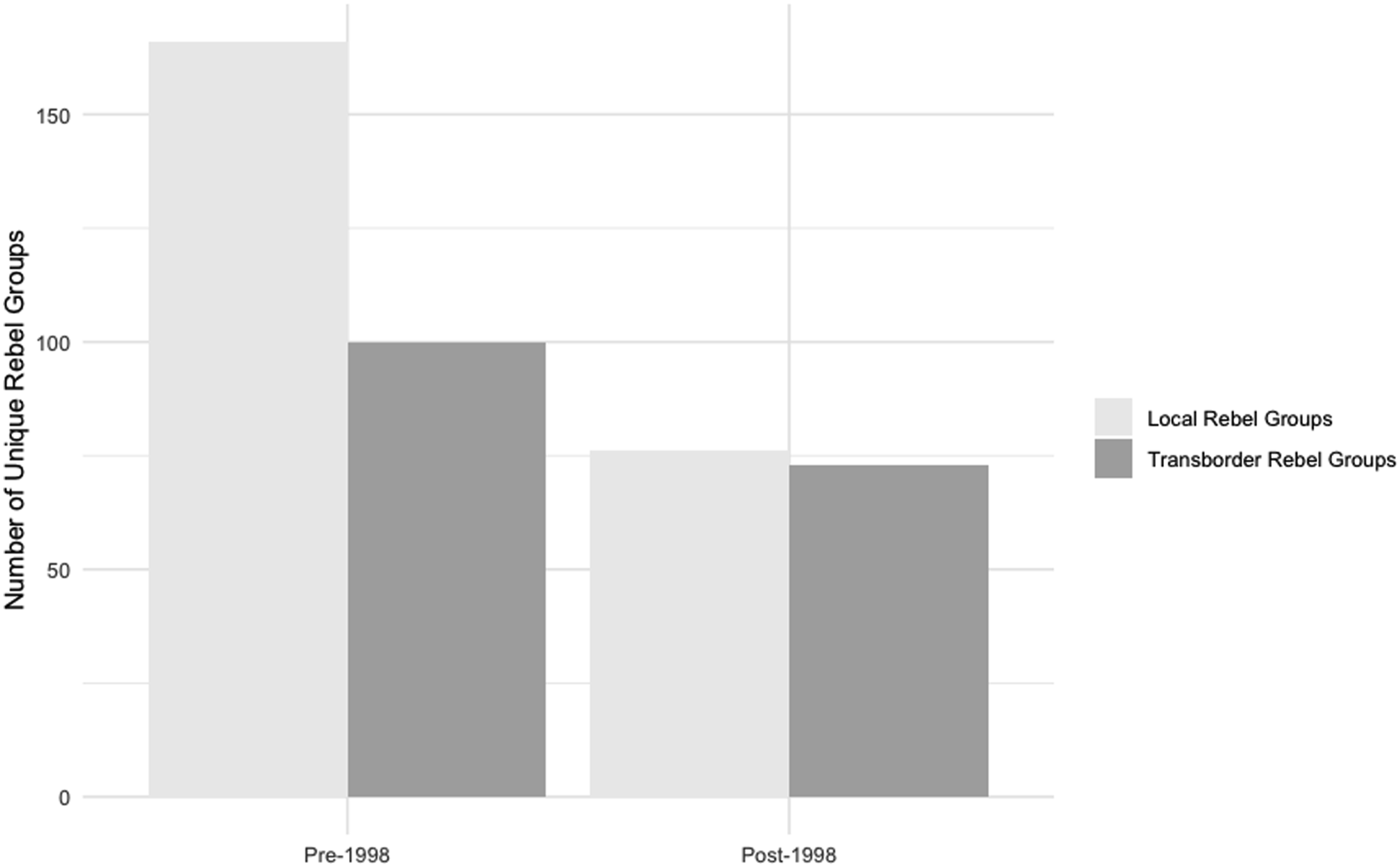
ICC Involvement in Host State
For Hypothesis 2, I employ the ICC involvement measure developed by Prorok (2017) to capture the extent of ICC engagement in host states where rebel groups maintain foreign sanctuaries (ICC Involvement in Host State). I identify rebel host countries using the NSA dataset. The ICC involvement measure, covering activities from 2002 to 2014, is a continuous measure reflecting the intensity of ICC engagement within a country, ranging from preliminary actions to more coercive proceedings with a higher likelihood of punishment. It is coded from 0 (no involvement) to a maximum of 14 (significant court actions), and due to data skewness, values are log-transformed to a scaled range from −2 to 2 (Prorok 2017). For rebels operating in multiple foreign sanctuaries, the mean value is used.
Control Variables
I adjust for confounders as suggested in prior studies on conflict amnesties (Dancy 2018; Daniels 2020). Control variables are grouped into three categories: political conditions, intractability, and bargaining environment. First, political conditions include the home government’s Rule of Law Index from V-Dem (Coppedge et al., 2021), which assesses government transparency, impartiality, and adherence to the law, normalized on a 0–1 scale. This variable captures rebels’ expectations about the credibility of domestic legal commitments, including both the likelihood that amnesty provisions will be upheld and the risk of prosecution by independent courts.
I also include the home state’s authority over the territory (Home State’s Territory Authority) from the V-Dem, which measures the percentage of national territory under effective state control (Coppedge et al., 2021). This variable is pivotal as my theory hinges on the concept of safe havens; low control by a government reduces the rebels’ need to seek amnesty since they can find sanctuary within the home state. Additionally, I control for the presence of a peacekeeping operation (PKO) in the rebels’ home country (PKO at Home), which may influence the perceived risk of arrest and prosecution. This, in turn, could affect rebels’ decisions to return home and their subsequent likelihood of seeking amnesty.
Second, I control for the intractability of a conflict with three variables, taken from the UCDP Armed Conflict Data Set (Gleditsch et al., 2002). They include log-transformed years the civil war lasts (Years at War (ln)), a binary measure of whether the conflict reached 1,000 battle deaths (Conflict Intensity), and a continuous indicator of how many other rebel groups are fighting in the conflict (Number of Dyads).
Third, I control the conditions that influence the bargaining environment between a rebel group and the government. These include an ordinal indicator (0–2) of rebel fighting capacity, capturing whether a group has low, moderate, or high ability to mobilize and strike state targets (Rebel Capacity) (Cunningham, Gleditsch, and Salehyan, 2013), and a binary indicator of mutual culpability, coded as 1 when both state and rebel forces committed atrocity-level violence during the conflict (Bloody Hands) (Davies, Pettersson, and Öberg, 2023).
Rebel capacity captures the relative bargaining strength of the armed group, which should increase its ability to extract concessions such as amnesty. The Bloody Hands variable captures a distinct mechanism: when governments themselves are implicated in atrocity-level crimes, they face heightened incentives to institutionalize impunity through amnesty in order to shield state agents from future legal exposure (Nalepa and Powell 2016; Prorok 2017).
To address concerns that the demand for amnesty may vary with rebels’ own violence, I include a measure of Rebel One-sided Violence (OSV) as an additional control. For the analysis of Hypothesis 1, I use a binary indicator of OSV capturing whether a rebel group ever engaged in the intentional targeting of civilians. For the time-varying analysis of Hypothesis 2, I employ a yearly binary indicator that takes a value of 1 starting from the year a group first engaged in OSV, capturing the onset of legal vulnerability as it emerges over time. Additionally, as a robustness check for Hypothesis 2, I also use a cumulative OSV measure to account for the total intensity of prior culpability.
For Hypothesis 2, utilizing a triad-year unit of analysis, I include two control variables pertaining to the host country’s territorial control. My theoretical framework posits that a state’s limited territorial control might diminish the perceived risk posed by the ICC as such states often lack the capacity to arrest and transfer suspects. To account for this, I control for the Host State’s Territory Authority, operationalized using the V-Dem dataset. Additionally, the theory suggests that the presence of peacekeeping operations (PKO) in the host country could mitigate this limitation by enhancing the feasibility of arrest and prosecution. Consequently, I also control for PKO in Host State, utilizing the Peacekeeping Mandates (PEMA) dataset (Di Salvatore et al., 2022).
For models related to Hypothesis 1, I aggregate yearly observations by calculating the mean values for all variables. For models addressing Hypothesis 2, where rebels operate in multiple foreign sanctuaries, I use the mean values of these sanctuaries for all variables.
Main Findings
Transborder status and amnesty for serious crimes: Pre- and Post-1998
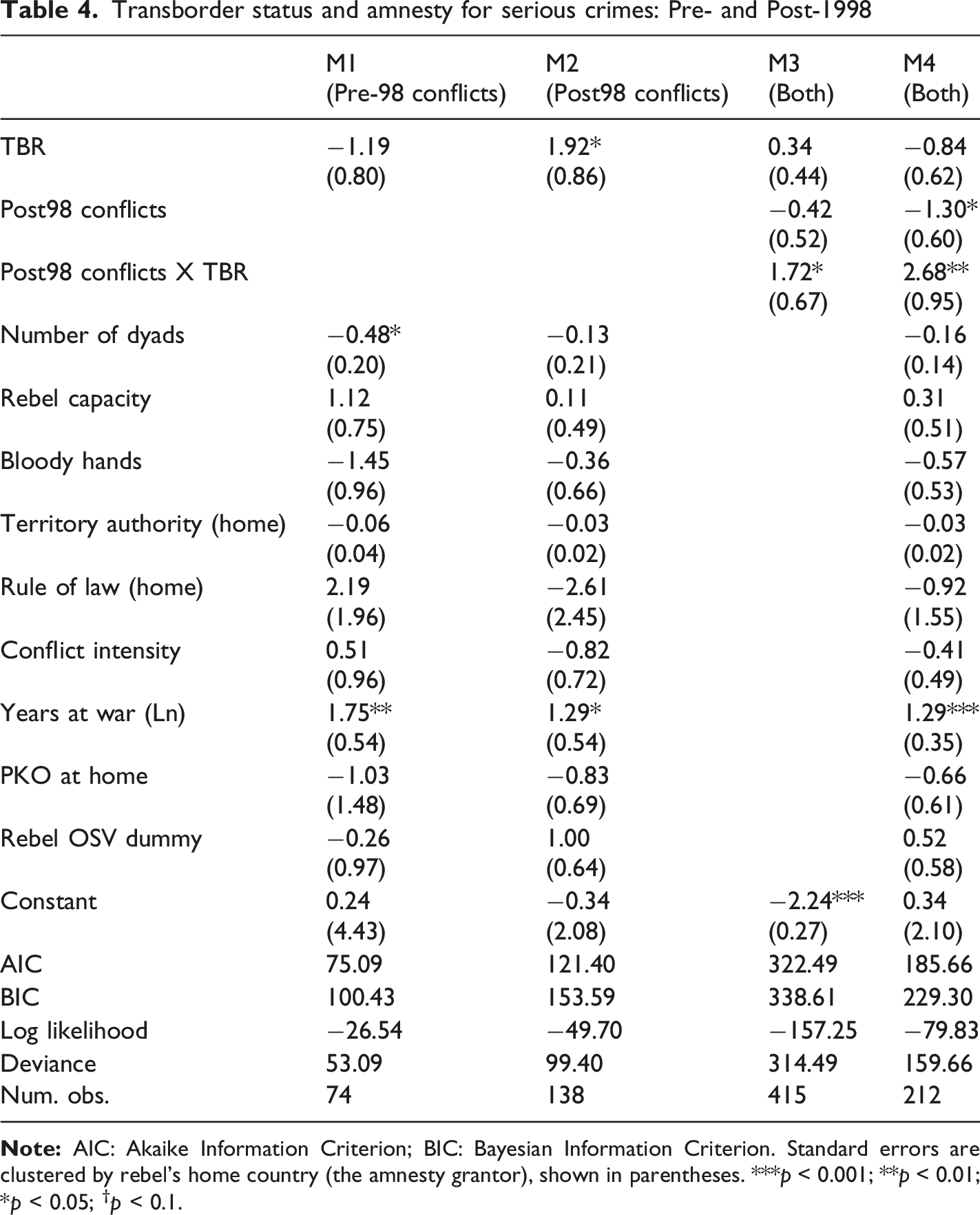
Hypothesis 1 examines whether the strategic value of amnesty changed for transborder rebel (TBR) groups after the 1998 threshold. Models 1 and 2 estimate this relationship separately for the pre-1998 and post-1998 periods. Consistent with the theoretical expectation, Model 1 shows that TBR status has no statistically significant effect in the pre-1998 era. This suggests that prior to the emergence of the international justice regime, transborder and local rebel groups faced similar strategic environments. In this period, foreign sanctuaries were relatively secure, and transborder groups did not exhibit a heightened tendency to bargain for domestic amnesty.
Conversely, Model 2 shows that TBR status becomes positive and statistically significant in the post-1998 period (1.92, p < 0.05). This shift suggests that in the age of accountability, rising international legal risks in once-secure foreign sanctuaries increased transborder rebels’ incentives to obtain amnesty.
Models 3 and 4 further test this logic by interacting TBR status with the post-1998 period. Model 4 presents the full specification with controls and serves as the primary model for substantive interpretation. The interaction term Post98 Conflicts × TBR is positive and statistically significant across both specifications, confirming that the impact of being a transborder group is contingent upon the international legal context. Model 4 is particularly illustrative of this conditional dynamic. As is typical in interaction models, the constituent terms capture baseline effects, whereas the interaction term reflects the conditional effect of transborder status in the post-1998 period. While the constituent terms for TBR status and the post-1998 period are individually negative, their interaction is positive and highly significant (2.68, p < 0.01). This pattern indicates that while neither factor alone increases the likelihood of amnesty, their combination substantially raises the probability that transborder rebels receive amnesty, consistent with Hypothesis 1.
To evaluate the substantive magnitude of this interaction, Figure 2 presents the marginal effect of crossing the 1998 threshold on the probability of receiving amnesty. For transborder rebel groups, the post-1998 shift is positive and statistically significant, corresponding to an average increase of approximately 21.6 percentage points in the likelihood of receiving amnesty for serious crimes. By contrast, local rebel groups experience a statistically significant decline of about 10.5 percentage points over the same period. These estimates indicate a clear divergence in amnesty outcomes following the institutionalization of international criminal accountability. Marginal effect of the 1998 threshold on amnesty probability.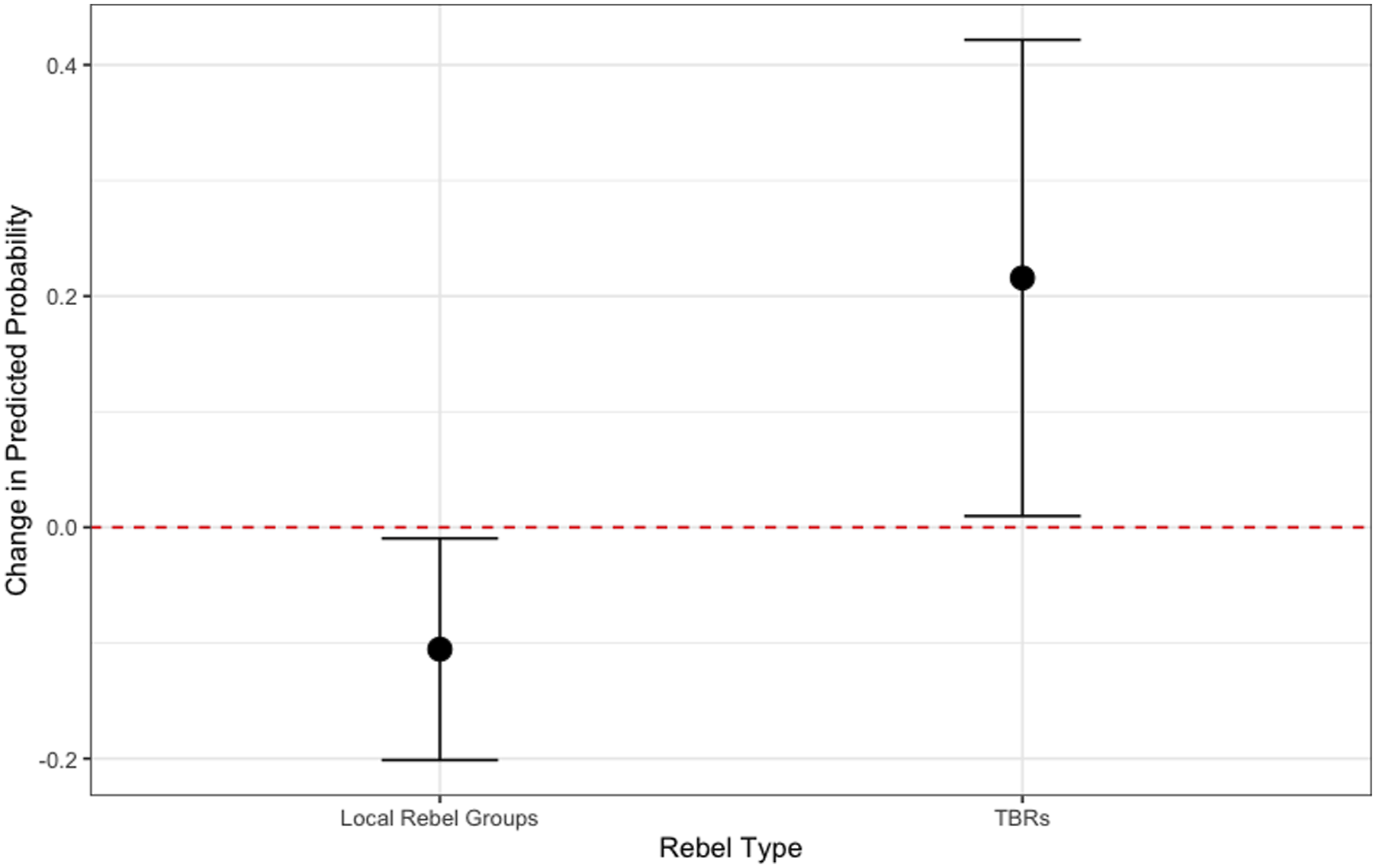
Figure 3 illustrates these results in terms of predicted probabilities derived from Model 4. Consistent with the marginal effects, the predicted probability of amnesty for local rebel groups declines from roughly 0.18 in the pre-1998 era to about 0.06 in the post-1998 era. In contrast, the predicted probability for transborder rebel groups rises from approximately 0.09 to 0.28 across the same periods. Predicted probability of amnesty by rebel type and time period.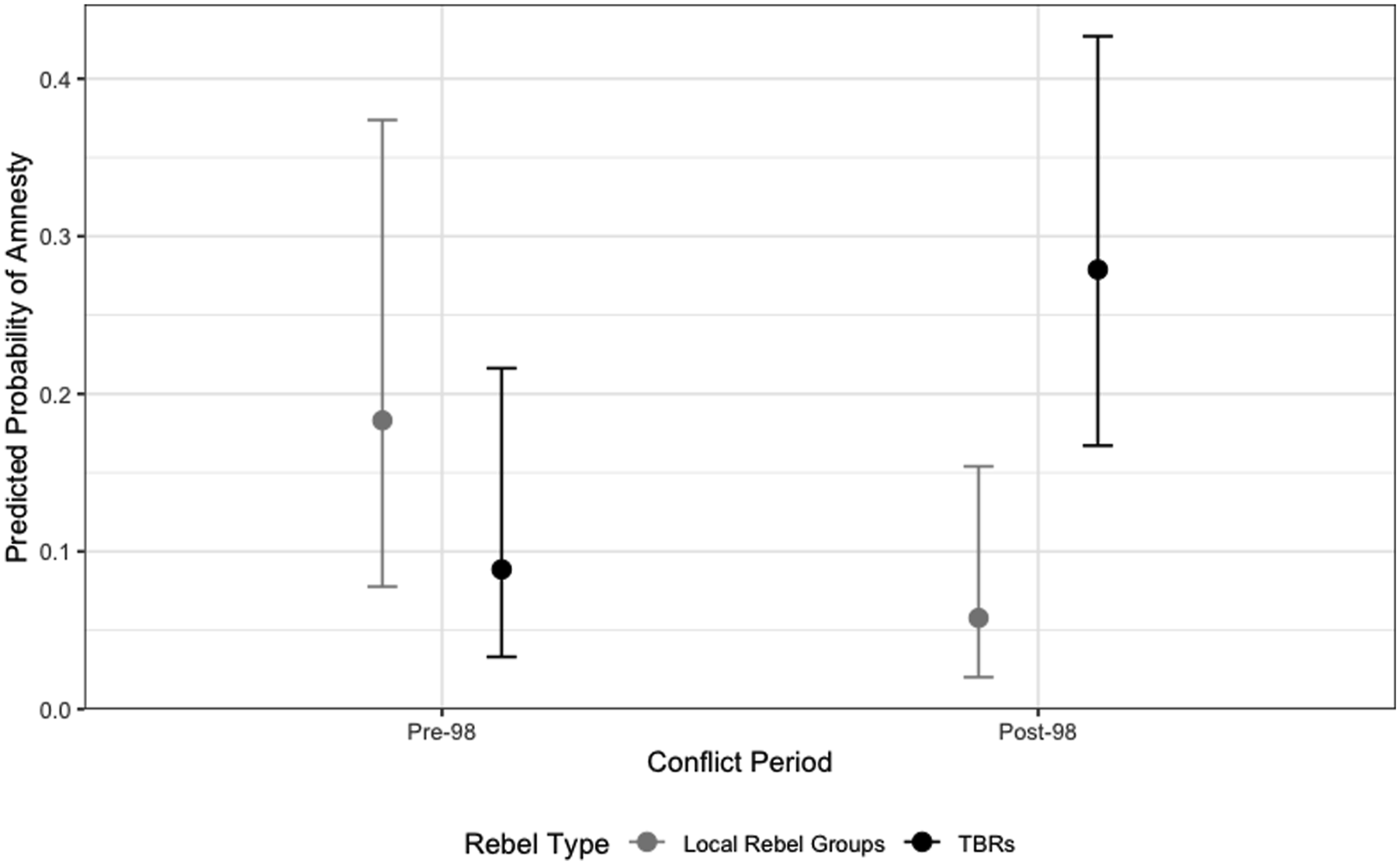
Although the theory centers on how the erosion of foreign sanctuaries increases amnesty demand among transborder rebels, the patterns observed among local rebel groups are also consistent with the underlying logic. Because local rebels do not rely on foreign sanctuaries, the international justice regime does not introduce an additional channel of prosecutorial risk for them. Unlike transborder rebels—whose exposure to ICC investigations or universal jurisdiction in host states can directly undermine the safety of external havens—local rebels do not experience a comparable increase in legal vulnerability abroad. As a result, heightened international prosecutorial activity does not generate a new or intensified incentive for local rebels to seek amnesty from their home governments.
In addition, stronger anti-impunity norms and reputational constraints may further limit governments’ willingness to extend amnesty to purely domestic rebel groups. As theorized above, these constraints are less binding in conflicts involving transborder rebels, which are typically more intractable and sustained by external sanctuaries. When international justice mechanisms erode these sanctuaries, governments face strong incentives to prioritize conflict termination over strict adherence to anti-impunity norms.
ICC involvement in rebel Group’s foreign sanctuaries and amnesty for serious crimes
Note: AIC: Akaike Information Criterion; BIC: Bayesian Information Criterion. Standard errors are clustered by rebel’s home country (the amnesty grantor), shown in parentheses. ***p < 0.001; **p < 0.01; *p < 0.05; †p < 0.1.
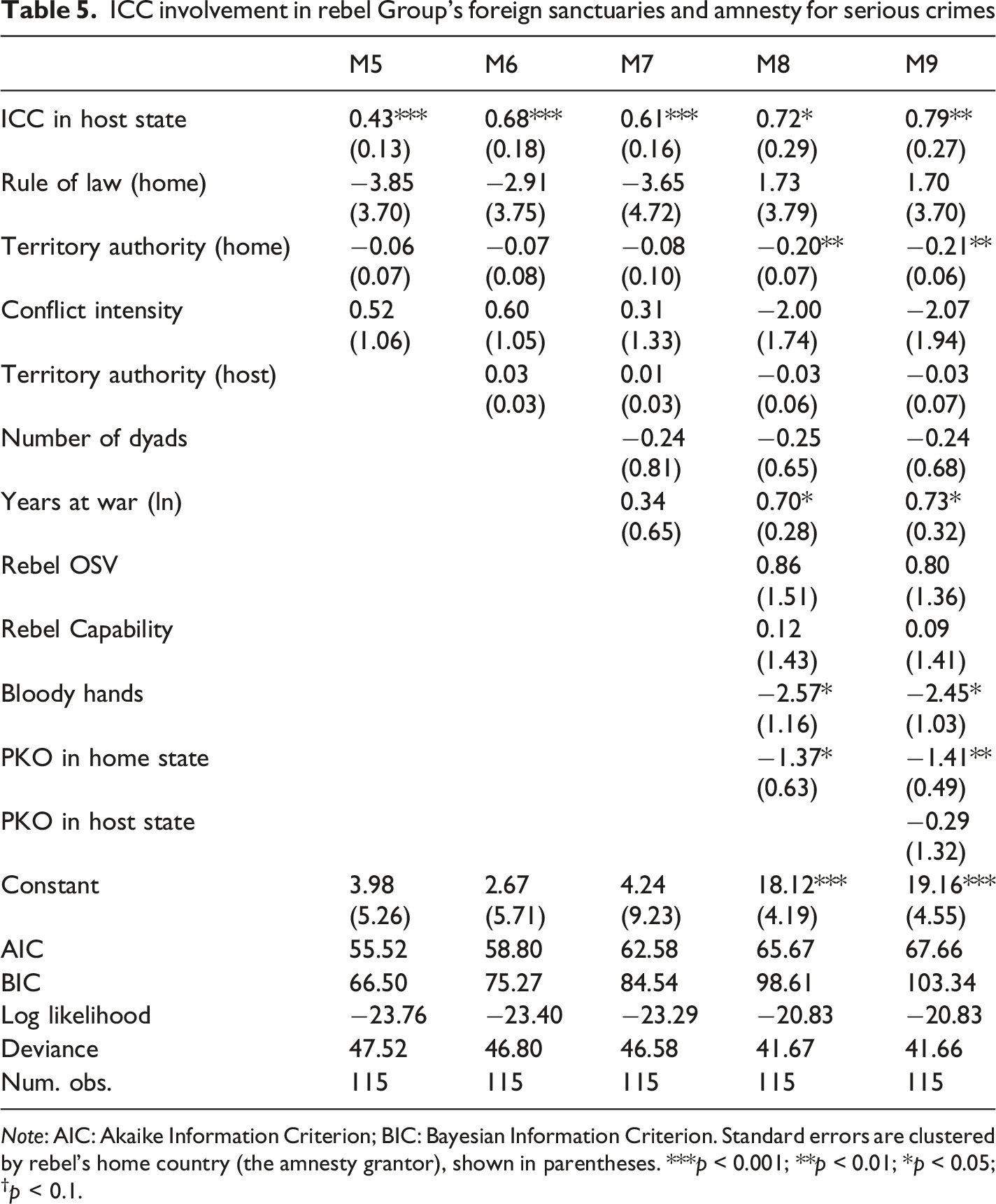
Models 5 through 9 incrementally introduce additional controls to assess the robustness of the relationship. Across all specifications, the key independent variable—ICC involvement in the host state (ICC in Host State)—exhibits a positive and statistically significant association with the likelihood of amnesty. The consistency of this effect across increasingly demanding specifications suggests that the relationship is not driven by omitted political, conflict, or bargaining-related factors.
In line with the theoretical expectation, the estimates imply that higher levels of ICC activity in foreign sanctuaries are associated with a substantially greater probability that transborder rebels secure amnesty for serious crimes from their home governments. In the absence of ICC involvement, the estimated probability of amnesty is very low—approximately 1 percent. As ICC involvement in host states increases, the implied probability of amnesty rises steadily. By the 90th percentile of the observed distribution of ICC involvement (approximately 0.74), the estimated probability increases to about 10 percent, and it rises further, exceeding 20 percent at the highest observed levels of ICC engagement. 17 Overall, these estimates provide robust support for the argument that intensified international legal exposure in foreign sanctuaries increases transborder rebels’ incentives to seek amnesty at home.
Robustness
A series of additional robustness checks reinforce the main findings. First, the results hold under alternative temporal specifications of the accountability era, including the use of 2002—when the Rome Statute entered into force—as a more conservative cutoff, and redefining the post-accountability sample to include only conflicts that terminated after 1998. Second, restricting the sample to conflicts beginning in 1989 or later—to address concerns that early amnesties may reflect default impunity rather than deliberate legal arrangements—produces consistent results. Third, the findings are robust to alternative clustering strategies, including clustering standard errors by dyad rather than by state.
I also assess whether the observed effects are contingent on the degree of rebel culpability. As discussed above, transborder status and rebel criminality are closely intertwined rather than independent dimensions. Consistent with this theoretical expectation, triple-interaction models incorporating rebel culpability (TBR × Post98 × Culpability) do not yield statistically significant higher-order interaction terms. Importantly, however, the core interaction between the accountability era and transborder status remains positive and statistically significant across all specifications. The evidence suggests that amnesty is not primarily a function of how culpable rebels are, but of whether their foreign sanctuaries become legally vulnerable under the international justice regime. Finally, replacing the baseline culpability measure with cumulative one-sided violence yields nearly identical results in the host-state ICC models. Taken together, these robustness checks confirm that the central findings are not driven by temporal coding choices, sample selection, or specific measures of rebel violence. Full results are reported in the Online Appendix (Tables A1–A5); additional diagnostics, including alternative clustering strategies, are available in the replication files.
Conclusions and Implications
In an era frequently characterized by the crisis of international institutions, the persistence of amnesty for serious crimes appears, at first glance, to signal the failure of the international justice regime. However, the findings of this study suggest a more complex, unintended dynamic: impunity persists not because the regime is failing to function, but because its operation reconfigures the strategic landscape for armed actors. By shifting the focus from overt institutional compliance to the structural constraints imposed on transborder actors, this paper demonstrates that international criminal accountability can reshape conflict dynamics even in the absence of direct enforcement.
Specifically, the international justice regime—through the International Criminal Court (ICC) and the decentralized exercise of universal jurisdiction—imposes new legal risks on rebel groups. As international legal scrutiny expands, the foreign sanctuaries that rebels historically relied upon to sustain protracted insurgencies are eroding. By narrowing the strategic options available across borders, the regime inadvertently renders domestic settlements, even those facilitated by amnesty, a more pragmatic path than remaining in increasingly precarious external bases. Consequently, while amnesty represents a normative setback for criminal accountability, it may also contribute to regional stability by localizing civil wars and curbing the cross-border spillover of violence.
These findings offer three implications for the study of international relations and conflict resolution. First, this research identifies a critical yet overlooked shift in the contemporary civil war landscape: the legal constriction of foreign sanctuaries. Given that external safe havens are systematically associated with prolonged conflicts, higher civilian casualties, and heightened interstate tensions (Salehyan 2009; Stewart and Liou 2017), understanding how international legal regimes modify the availability of these sanctuaries opens vital avenues for future conflict research.
Second, this study contributes to the justice versus peace debate. Theoretically, I illuminate a new dimension beyond the conventional commitment problem by demonstrating how the risk of extraterritorial prosecution shifts peace bargaining frontiers. Empirically, I provide novel evidence that the international justice regime can facilitate conflict resolution rather than hinder it. Crucially, this mechanism operates differently depending on the actor type: whereas international criminal accountability may prolong conflict by discouraging incumbent state leaders from seeking exile (Krcmaric 2018), the same legal pressures destabilize transborder rebels, making a negotiated domestic return comparatively more attractive.
Third, this framework provides actionable insights for policy. States confronting transborder insurgencies can strategically leverage the shadow of the ICC or Universal Jurisdiction to constrict rebel operational space and incentivize their return. Similarly, host states seeking to dislodge foreign rebel factions can utilize international justice mechanisms as a tool to raise the costs of hosting illicit actors, thereby discouraging cross-border mobilization without necessarily resorting to military escalation.
In conclusion, while skepticism toward international law remains prevalent, the international justice regime is far more consequential than its critics assume. Although amnesty as an outcome remains controversial, it reveals a regime that actively reshapes the incentives of violent actors. Ultimately, international justice may serve the broader interests of peace not by eliminating impunity, but by altering the conditions under which justice and settlement are bargained.
Supplemental Material
Supplemental Material - Crumbling Safe Havens? International Justice Regime and Conflict Amnesty for Serious Crimes
Supplemental Material for Crumbling Safe Havens? International Justice Regime and Conflict Amnesty for Serious Crimes by Myung Jung Kim in Journal of Conflict Resolution.
Supplemental Material
Supplemental Material - Crumbling Safe Havens? International Justice Regime and Conflict Amnesty for Serious Crimes
Supplemental Material for Crumbling Safe Havens? International Justice Regime and Conflict Amnesty for Serious Crimes by Myung Jung Kim in Journal of Conflict Resolution.
Footnotes
Acknowledgment
I am grateful to colleagues at the University of Illinois, where this project began, including Alyssa Prorok, Paul Diehl, Xinyuan Dai, Matthew Winters, James Kuklinski, Jake Bowers, Rob Carroll, Wendy Kam, Seongjoon Ahn, Shuyuan Shen, and participants in the IR Workshop, for valuable comments on earlier drafts. I also thank Tom Ginsburg, Lesley-Ann Daniels, two anonymous reviewers, and the editors of the Journal of Conflict Resolution for helpful feedback.

Funding
The author received no financial support for the research, authorship, and/or publication of this article.
Declaration of Conflicting Interests
The author declared no potential conflicts of interest with respect to the research, authorship, and/or publication of this article.
Data Availability Statement
Replication data for this paper are available at Replication Data for: “Crumbling Safe Havens? International Justice Regime and Conflict Amnesty for Serious Crimes”, Harvard Dataverse, V1. https://doi.org/10.7910/DVN/2HNJTJ (Kim, 2024).
Supplemental Material
Supplemental material for this article is available online.
Notes
References
Supplementary Material
Please find the following supplemental material available below.
For Open Access articles published under a Creative Commons License, all supplemental material carries the same license as the article it is associated with.
For non-Open Access articles published, all supplemental material carries a non-exclusive license, and permission requests for re-use of supplemental material or any part of supplemental material shall be sent directly to the copyright owner as specified in the copyright notice associated with the article.
