






Abstract
Civil war research has primarily studied ethnic nationalism in the form of emancipatory movements that seek to attain government representation or autonomy. In contrast, it has neglected nationalist movements whose ideology insists on a specific group’s political dominance. Addressing this gap, we argue that dominant nationalism increases the risk of civil war through three mechanisms: First, under the influence of dominant nationalist ideology, governing elites are more likely to politically exclude outgroups, even if doing so increases the risk of civil war. Second, if they control the government, dominant nationalists can also spark civil war by victimizing outgroup members. Finally, dominant nationalism fuels conflict-prone independence demands among outgroups. Using new data covering 90 countries since WWII, we find robust support for these expectations. Our results underline the need for cross-national conflict research to take more seriously the role of dominant nationalism and of ideology more broadly.
Introduction
Across a range of contemporary conflicts, civil war violence has been closely associated with nationalist movements that insist on the exclusive political dominance of a single ethnic group. In Israel and the occupied territories, rival Jewish and Islamic nationalists press incompatible claims to supremacy, fueling recurring civil conflict (Shelef 2010, 2023). In Myanmar, Bamar nationalists have obstructed negotiated settlements to decades-long ethnic insurgencies (Kipgen 2022). In India, Hindu hardliners promote a Hindu ethnocracy that curtails Muslim rights, provoking violent resistance, especially in Kashmir (Bhatt 2001; Leidig 2020). Taken together, these cases raise the possibility that nationalist projects centered on political dominance may be linked to civil war violence in a more systematic way, yet existing evidence remains largely anecdotal and case-specific.
Are these prominent cases symptomatic of a more general causal chain linking what we term dominant nationalism 1 —the ideology that a particular ethnic group should rule alone— and civil war violence? Existing research on ethnic civil war has largely answered related questions by taking key outcomes of dominant nationalism for granted. Most cross-national studies treat ethnic exclusion as an exogenous condition, without analyzing its frequent roots in dominant nationalist ideology. When nationalism itself enters the analysis, attention overwhelmingly centers on emancipatory movements seeking equitable representation, autonomy, or independent statehood. The contrasting role of dominant nationalists, whose ethnically hierarchical ideology may fuel conflict even in anticipation of realized exclusion, has received far less attention. Research on peace processes similarly overlooks how dominant nationalist ideology often blocks negotiated agreements. Although case-based work has traced these dynamics in a handful of prominent conflicts, it remains unclear whether dominant nationalism constitutes a broader and systematic driver of civil war violence.
This paper addresses these gaps. We argue that dominant nationalist movements, especially when in power rather than in opposition, heighten the risk of ethnic civil war through three mechanisms. First, they push governments toward political exclusion of minorities, either by exerting pressure from outside office or, when in power, by binding ruling elites to their exclusionary ideological commitments, even when exclusion is strategically suboptimal and raises the specter of imminent destabilizing conflict. Second, sometimes they even provoke violence directly by committing mass atrocities, forcing minorities into armed resistance. Third, they generate fears among ethnic outgroups over their future status and well-being, prompting unilateral steps toward secession despite the risk of war.
To test these arguments, we introduce the Dominant Nationalist Movements (DNM) dataset, which covers a representative sample of 90 multi-ethnic countries in North America, Eurasia, and Africa since 1946. In each country, we identify nationalist organizations that seek to maintain or expand the political dominance of a specific ethnic group, including both organizations that control the government and those that are in opposition. Our main explanatory variable, measured at the ethnic group-level, captures these organizations’ exclusionary demands against specific outgroups that do not form part of dominant nationalists’ conception of “the nation.” These demands range from calls to exclude outgroups from government or limit their citizenship rights to overt agitation for their physical removal through ethnic cleansing and targeted killings.
Analyzing within-country variation across groups and over time, we find that dominant nationalist agitation robustly predicts outgroup involvement in civil war. This relationship is strong, comparable to conventional predictors such as actually realized political exclusion, relative military strength, and geography favorable to secession. Moreover, dominant nationalism systematically interacts with these factors, amplifying their destabilizing potential.
Building on this robust association, we conduct further analyses to bolster confidence in its causal properties. Mediation analyses confirm that dominant nationalism increases civil war risk by driving exclusion, victimization, and separatist claims. Causal sensitivity analyses indicate that our results are unlikely due to unobserved third factors, such as preceding ethnic tensions. Difference-in-differences analyses that exclusively focus on group-level variation over time offer additional support for a causal interpretation of the connection between dominant nationalism and civil war.
By centering on dominant nationalism, we advance research on ethnic conflict in three key ways. Theoretically, we shift attention from emancipatory nationalism—which has dominated cross-national analyses—to the exclusionary ideologies of dominant nationalists, revealing how these movements can trigger conflict even before actualized exclusion occurs. Empirically, we introduce the first global dataset of dominant nationalist movements and their demands, enabling the systematic assessment of an underexplored driver of civil war. Conceptually, we bridge literatures on nationalism, ethnic exclusion, and conflict by showing that dominant nationalism reshapes the strategic environment in which governments and ethnic groups interact. Our broader theoretical and empirical lens also underscores a pressing policy implication: rising dominant nationalism constitutes a significant and underappreciated threat to building a durable peace in multiethnic states.
Concepts and Existing Research
We define dominant nationalism as a political ideology which aims to establish, maintain, or expand the political dominance of a single ethnic group over other groups within the territory of an existing multi-ethnic state, often through explicit political demands aimed at preserving or reinforcing this status hierarchy. As this definition makes clear, dominant nationalism is a subtype of ethnic nationalism, which we conceptualize as an ideology that claims state power and typically unity for an ethnic nation.
This conceptualization only partially overlaps with Gellner’s (1983) famous definition of nationalism as the principle that nation and state should be congruent. Some dominant nationalist projects may indeed retain congruence as a long-run aspiration. However, dominant nationalism more broadly also encompasses projects that justify enduring relations of ethnic hierarchy within a common state, rather than seeking to eliminate all incongruence between nation and state. In this respect, dominant nationalism extends beyond Gellner’s framework, especially given his own clarification that ethnic boundaries within a given state should not separate power-holders from the rest. It also differs sharply from the two better-studied, emancipatory variants of ethnic nationalism: monistic nationalists who seek to escape alien rule by establishing their own state through secession; and accommodationist nationalists aiming for inclusive governance based on regional autonomy or shared power as equal or junior members of government. By contrast, dominant nationalists insist that one ethnic nation should occupy a superior political position within the state.
This broad category contains two ideal-typical variants. Ethnocratic dominant nationalists explicitly accept the enduring presence of non-nationals, provided these groups remain politically subordinate—typically excluded from government or denied recognition as co-equal constituent nations. For example, this stance characterizes Russian nationalists’ views towards non-Russian minorities inhabiting territories claimed as integral parts of Russia (Kolstø 2019). Other dominant nationalists of this type are even willing to tolerate limited power-sharing, as long as their own group retains political dominance. Malay nationalism in Malaysia, where ethnic Chinese and Indian parties have long participated in government under Malay dominance, is an example for this.
Assimilationist variants of dominant nationalism, by contrast, reject the continued existence of outgroups as distinct political collectivities. In theory, they may still aspire to nation-state congruence, but they seek to achieve it through assimilationist policies or, in more extreme cases, expulsion or even targeted killings. Examples for this logic are the stance of Turkish nationalists toward the Kurds, pursuing assimilation and denying a Kurdish collective identity, and the extreme violence employed by the Rwandan Hutu power movement against the Tutsi minority. In practice, dominant nationalist movements often combine these logics, targeting some outgroups for assimilation or elimination while claiming ethnocratic dominance over others. A similar distinction is drawn by Kolstø (2019), who contrasts nation-building and ethnocratic variants of imperialist nationalism.
Although dominant nationalism is grounded in claims of a single group’s supremacy, this does not imply that all ethnic outgroups are viewed or treated identically. Instead, dominant nationalist projects are often structured around differentiated relationships between the group dominant nationalists claim to represent and particular outgroups. Because dominant nationalists pursue their group’s privileged position, they are likely to direct particularly extreme demands towards specific outgroups perceived as threatening that position—for example because they are demographic competitors, rival claimants to political authority, challengers to territorial integrity, or symbols of an alternative vision of the nation. By contrast, other groups may be seen as less consequential, more assimilable, or even acceptable partners as long as they remain in a politically subordinate position.
As a result, dominant nationalists often construct graduated hierarchies among outgroups, assigning distinct statuses to different groups. Some outgroups may be targeted for exclusion, assimilation, expulsion, or violence, while others are tolerated or incorporated under conditions of continued dominance. Consequently, dominant nationalist claims are often directed at specific groups rather than universally applied across all outgroups. This logic is exemplified by the selective targeting of Muslims by Hindu nationalists in India, of racial minorities by white supremacist movements in the United States, and of Muslim and North Caucasian groups by Russian nationalists within the Russian Federation.
In another contrast to most monistic and accommodationist nationalists, dominant nationalists typically represent demographic majorities, which is why they are often referred to as “majority nationalists” (Vogt 2025). However, our key definitional criterion is ideological rather than demographic, in the form of explicit and consistent demands for ethnic dominance. This allows us to include minority-based dominant nationalism, as in apartheid-South Africa, and to capture rival dominance projects within the same polity, as in Israel/Palestine.
Dominant nationalism often overlaps with state nationalism, which may also impose a particular vision of the national community that fails to accommodate national diversity or that marginalizes specific outgroups. These connections are particularly evident when dominant nationalists are in power, in which case their demands for the dominance of a specific ethnic group shape state nationalism. In these cases, dominant nationalism is tied to “state-building nationalism” (Hechter 2000), “nationalizing states” (Brubaker 1996), and concrete nation-building policies (Mylonas 2012; Wimmer 2018). Yet dominant and state nationalism are not identical. Most importantly, dominant nationalists may be opposed to state nationalism, even where their own ingroup is politically influential. For example this characterizes Hindu nationalists’ opposition to the ruling Congress Party’s inclusive form of nationalism that prevailed across much of India’s post-independence period.
Similarly, dominant nationalism is often associated with ethnic exclusion, which characterizes many exclusionary state- and nation-building projects. Yet the two phenomena remain conceptually distinct. Most importantly, ethnic groups may be excluded for strategic or material reasons that are unrelated to nationalist ideology (Beiser-McGrath and Metternich 2021; Cederman, Gleditsch and Buhaug, 2013). Conversely, as noted above, groups may share political power while still being subject to antagonistic claims of dominance. Indeed, dominant nationalists may even cooperate with minorities, as in Malaysia or North Macedonia, provided that their group’s political superiority is maintained.
In contrast to monistic and accommodationist forms of ethnic nationalism, dominant nationalism rarely figures in conventional explanations of ethnic civil war. For instance, a large literature shows that politically disadvantaged groups are more likely to engage in insurgency, sometimes seeking to overthrow the political systems, sometimes seeking an equitable share of government power within the existing system (Cederman, Gleditsch and Buhaug, 2013; Gurr 2002; Hartzell and Hoddie 2008; Juon 2023; Roessler and Ohls 2018; Wucherpfennig, Hunziker and Cederman, 2016). Other studies trace how the pursuit of self-rule—either in the form of autonomy or full-fledged independence—can motivate armed conflict (Cunningham 2011; Germann and Sambanis 2021; Walter 2009). Conversely, scholars have only recently noted the neglect of dominant or “majority” nationalism (Basta 2021; Coakley 2011; Lecours and Nootens 2009; Vogt 2025).
A related line of research traces ethnic conflict and salient divisions to exclusionary nation-building in the modern state system (e.g., Hechter 2000; Juon 2025; Wimmer 2013, 2018). Another examines the destabilizing effects of such programs (Brubaker 1996; Bulutgil 2016; Cederman, Wimmer and Min, 2010; Garrity and Mylonas 2024; Mylonas 2012). Yet this work largely addresses state nationalism and implemented policies, like realized exclusion, rather than the broader ideology of dominant nationalism, which may be pursued by non-state actors as well, and is not always implemented, even where dominant nationalists are in power. As we shall argue, state-sponsored nation-building is but one of the ways whereby dominant nationalists affect the risk of civil war.
Another strand highlights how inclusion of marginalized groups reduces conflict risk, especially via power-sharing (Cederman, Gleditsch and Buhaug, 2013; Germann and Sambanis 2021). Adopting a power-based logic, an emerging body of work illuminates how threats, external sponsors, and elite incentives shape the government’s ability to offer such concessions (Cunningham 2011; Roessler and Ohls 2018; Svolik 2009; Walter 2009; Wucherpfennig, Hunziker and Cederman, 2016). Though offering important insights, this literature under-theorizes the constraints on governments’ ability to share power. As we shall argue, ideological opposition to power-sharing concessions, often from dominant nationalists, can constrain even the most accommodative policy makers and prevent power-sharing.
In contrast to cross-national studies, case research frequently identifies dominant nationalism as a central driver of exclusion and violence, whether in India (Leidig 2020; Wilkinson 2000), Yugoslavia (Hislope 1997), Rwanda (Straus 2012), Sri Lanka (Hennayake 1992), South Africa (Clark and Worger 2011), or Israel/Palestine (Shelef 2010). Indeed, qualitative work has long recognized the roots of ethnic conflict in rival groups’ dominance aspirations, although often without connecting such aspirations to nationalism (Horowitz 1985). However, these studies disproportionately examine prominent, often extreme cases where dominant nationalism actually did lead to violent conflict. This underlines the need for systematic, cross-national analysis of dominant nationalism’s role in civil war, including non-conflict cases.
In sum, to the extent it considers nationalism at all, existing research overwhelmingly focuses on emancipatory nationalism, aiming for monistic rule in their own state or accommodationist governance, or on actually-implemented nation-building policies by the state, and primarily highlights strategic obstacles to conflict resolution. We shift the lens to dominant nationalism—in the form of antagonistic demands directed against specific outgroups—showing how it independently shapes both the likelihood of exclusion and the aspirations of ethnic outgroups, thereby altering civil war risks.
Argument
We argue that dominant nationalism increases the risk of civil war through three complementary pathways (see Figure 1). We anticipate that dominant nationalists’ insistence on dominance leads them to formulate antagonistic demands towards specific outgroups. In turn, these demands destabilize multiethnic states by (1) pushing governments toward political exclusion of these outgroups, (2) provoking violence against them through their systematic victimization, and (3) generating fear among them about their future treatment. Theoretical framework and mechanisms.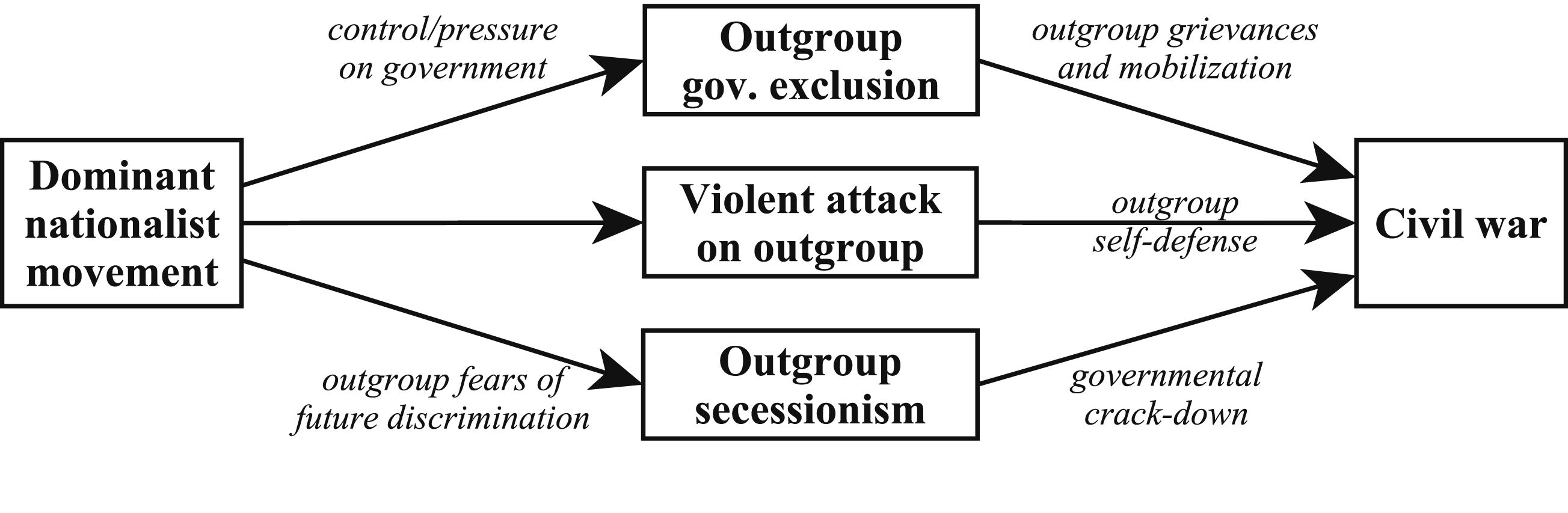
Offsetting Strategic Incentives: Dominant Nationalism and Ethnic Exclusion
First, we argue that dominant nationalism makes governing elites more likely to politically exclude ethnic outgroups subject to dominant nationalists’ antagonistic demands, even when strategic incentives favor concessions. 2 This exclusionary mechanism is most visible when parties espousing dominant nationalism participate in, or control, governing coalitions, as this allows them to translate ideology into policy, whether out of conviction or concern about alienating their core constituency. For example, successive dominant nationalist governments in Israel consistently excluded Arab Israelis—who were not conceived as part of the Jewish nation—from political power (Shelef 2023). Similarly, in pre-2005 Sudan, Southern Christians were systematically marginalized by Muslim nationalists (Sidahmed 1997). Such exclusion fuels group grievances and increases the risk of rebellion (Cederman, Gleditsch and Buhaug, 2013).
Facing the threat of large-scale violence from aggrieved outgroups, some governing dominant nationalists may be willing to offer concessions even to outgroups subject to highly exclusionary demands, for instance if faced with militarily capable challengers (Wucherpfennig, Hunziker and Cederman, 2016). Yet deviating from their hardline ideology incurs audience costs and can generate dissatisfaction among their support base. Moreover, concessions entail the risk of being outbid by extreme challengers, who can present themselves as the more valiant defenders of the nation (Vogt, Gleditsch and Cederman, 2021). Hence, dominant nationalism adds a domestic ideological constraint to power-sharing beyond the strategic calculations emphasized in prior research (Griffiths 2016; Walter 2009).
The South African transition from apartheid illustrates this dilemma. By the late 1970s, the ruling National Party acknowledged apartheid’s untenability and initiated constitutional reforms. Yet its moves toward limited inclusion were consistently undermined by extremist rivals insisting on the continued exclusion of black South Africans, including the Conservative Party, which won over 30 percent of the white vote in 1989 and branded the government as betraying white interests. This opposition prolonged negotiations with the ANC and delayed apartheid’s dismantling (Clark and Worger 2011).
A similar dynamic occurred in Sri Lanka in the 1950s and 1960s. Both the Sri Lanka Freedom Party and United National Party, after entering government, briefly reverted from their extreme Sinhala nationalist stances and floated the accommodation of Tamils, whether through language rights or decentralized councils. Yet in each case, rival nationalist parties mobilized mass protests that forced the ruling party to abandon concessions and revert to exclusionary positions towards the Tamil minority (Hennayake 1992).
In some cases, dominant nationalists can constrain governments even from the opposition. In pre-independence Myanmar, U Nu abandoned an inclusive coalition and instead centralized the state and promoted Buddhism as the state religion under pressure from Bamar nationalists (Kipgen 2022; Walton 2020). Decades later, during Myanmar’s democratization, Aung San Suu Kyi’s NLD similarly refused to nominate Muslim candidates or protect the Rohingya from genocide, fearing backlash from nationalist forces (Walton 2020).
In sum, dominant nationalists pressure governments to exclude ethnic outgroups even when strategic logics point toward accommodation. Outgroups subject to such persistent exclusion for reasons of nationalist ideology or outbidding are therefore more likely to rebel.
Initiating Violence: Dominant Nationalism and Mass Minority Victimization
Second, rather than seeking to avoid civil war, some dominant nationalists will purposefully seek to encourage large-scale violence against outgroups seen as threatening or incompatible with the nation. In this view, violence can be an opportunity to entrench ethnic hierarchies, implement their long-held exclusionary agendas, and rally their base. In turn, systematic atrocities, such as mass expulsions or killings, can in turn push targeted groups into violent self-defense, escalating into civil war.
This dynamic is most pronounced when dominant nationalists control the state, giving them the capacity to implement eliminationist policies (cf. Garrity and Mylonas 2024; Mylonas 2012; Wimmer 2018). For example, Hutu nationalists in Rwanda engaged in repeated anti-Tutsi campaigns from independence onward. Following the 1959 crisis of the Tutsi monarchy, the long-ruling Hutu nationalist Parmehutu and allied actors mobilized support through Hutu supremacist rhetoric, portraying Tutsis as a threatening elite, excluding them from government, and at times instigating killings against them. In the early 1990s, the cross-border invasion by the Tutsi-dominated RPF triggered a sharp escalation, with Hutu extremists associated with the governing party carrying out systematic killings that culminated in the 1994 genocide (Kakwenzire and Kamukama 1999; Straus 2012).
Yet even in opposition, dominant nationalist extremists can instigate atrocities to emphasize the ethnic cleavage and push governments to the brink of civil war. For example, in India, Hindu nationalist hardliners repeatedly encouraged Hindu–Muslim violence to mobilize supporters and displace Muslims, even under Congress rule (Wilkinson 2000). Organizations such as the Rashtriya Swayamsevak Sangh openly promoted Hindutva, a vision of India as a Hindu nation that excludes Muslims and minorities, using mass violence against religious minorities that fueled insurgencies in Kashmir and Punjab in the 1980s (Bhatt 2001; Leidig 2020).
In sum, dominant nationalists can be initiators of civil war, especially when they control the state or embrace eliminationist strategies.
Sowing Fear: Dominant Nationalism and Public Antagonist Rhetoric
Finally, dominant nationalist agitation can heighten outgroups’ fears about their future security and rights, pushing them to support risky strategies, including secession, that increase the likelihood of civil war.
In highlighting this final mechanism, we build on two established insights from the secessionist conflict literature: first, that real or anticipated repression raises separatist sentiment (Butt 2017; Walter 2009), and second, that commitment problems make negotiated settlements fragile (Jenne 2007; Roessler and Ohls 2018). Dominant nationalism intensifies both dynamics. Its openly exclusionary agenda makes the risk of future repression appear especially credible, amplifying fears even before repression occurs.
Outgroups with current representation may fear imminent exclusion; already excluded groups may anticipate even harsher discrimination. Faced with extreme demands, outgroups can plausibly expect policies such as citizenship restrictions, expulsion (cf. Brubaker 1996; Juon and Bochsler 2023), or even systematic killing (cf. Lake and Rothchild 1996; Posen 1993). Such anticipatory fears are particularly acute among large, border-proximate groups with kin support—“proto-nations” that are both most threatening to dominant nationalists and most capable of seceding (Cederman, Rüegger and Schvitz, 2022). Anticipating future persecution, members of these groups may conclude that secession offers greater security than continued participation in the common state, even at the cost of war. Governments influenced by dominant nationalism, however, are unlikely to accept such moves peacefully, making violent confrontation probable.
These dynamics are again most visible when dominant nationalists hold power, making threats of future discrimination highly credible. After Milošević’s 1987 rise, Serbian nationalists revoked Kosovo’s autonomy and openly proclaimed plans for Serb dominance across Yugoslavia. Their exclusionary agitation fostered secessionist reactions. For example, fearing future repression, Croatian voters rallied behind the Croatian Democratic Union (HDZ), which swiftly moved toward independence despite international warnings of war (Basta 2021; Hislope 1997).
Yet again, dominant nationalists’ threats can also generate security concerns among members of proto-nations, even where dominant nationalists do not control the government. For example, even during Myanmar’s independence negotiations, minority leaders feared that Bamar chauvinists would impose a unitary, exclusionary state. Even Aung San’s federalist assurances could not overcome widespread suspicion, stoked by nationalist rhetoric that depicted minorities as foreigners or threats (Kipgen 2011; Mutraw 2009). These fears laid the groundwork for enduring secessionist insurgencies.
In sum, we expect dominant nationalist agitation to generate fears among outgroups over their future status and well-being, especially if their demands are particularly extreme. In turn, among ethnic outgroup members, we expect support to grow for unilateral steps, including secession, which increase the risk of imminent civil war.
Hypotheses
To summarize, we have argued that, whether in government or opposition, the antagonistic demands of dominant nationalists increase the risk of civil war among targeted outgroups through the three mechanisms elaborated above. We capture the observable implication of these arguments in our first two, and main, testable hypotheses:
Our arguments also have broader implications for the strategic behavior of both governments and ethnic outgroups. First, dominant nationalist demands can override governments’ strategic incentives to accommodate challengers. Previous rationalist accounts emphasize how factors such as demographic size, international support, and proximity to the capital shape a group’s bargaining power and thus the likelihood of power-sharing (e.g., Beiser-McGrath and Metternich 2021; Jenne 2007; Roessler and Ohls 2018; Svolik 2009; Wucherpfennig, Hunziker and Cederman, 2016). We argue, by contrast, that outgroups that are subject to dominant nationalist demands will be more likely to be excluded or actively victimized by governments, even where these groups possess capabilities to rebel (mechanisms 1 and 2). This implies that even in contexts of balanced threat capabilities—where strategic models predict greater incentives to compromise—dominant nationalism can still prevent accommodation and raise the risk of civil war.
Second, where dominant nationalist agitation targets them, it reshapes the calculations of “proto-nations”—ethnic groups whose demographic weight and geographic concentration make independent statehood conceivable (Cederman, Rüegger and Schvitz, 2022; Germann and Sambanis 2021). By heightening fears of future discrimination, dominant nationalism provides a motive for such groups to attempt risky secession. Absent this motive, even proto-nations with favorable structural conditions—large size, compact settlement, border proximity—may refrain from rebellion.
We formalize these expectations in the following two hypotheses:
The Dominant Nationalist Movements (DNM) Dataset
To test these arguments, we assemble the Dominant Nationalist Movements (DNM) Dataset, a new global database that identifies dominant nationalist movements around the world, measures their demands vis-à-vis specific outgroups, and identifies whether dominant nationalists control the government or remain in opposition. This covers a representative sample of 90 multi-ethnic countries in North America, Eurasia, and Africa. 3 Mirroring our conceptualization, the Dominant Nationalist Movements Dataset identifies all nationalist movements that are constituted by one or more formal political organizations which (i) are connected to a specific ethnic, religious, linguistic, or racial group, through consistent public claims; (ii) demand political dominance for this identity group, at the expense of other identity groups in the same country; and (iii) satisfy minimal political relevance criteria.
Depending on the country-specific context, demands for political dominance—our key identification criterion—can take variegated forms: In India, Hindu nationalists have sought to constitutionally enshrine India as a “Hindu nation,” while explicitly demanding that Muslims be excluded from government (Bhatt 2001; Leidig 2020). In Iraq, Shia nationalists have demanded rule according to “Shia Islamic principles” and, specifically, by Shia clerics. In Spain, Castilian Nationalists equate Spain with “Greater Castile,” with its language and Catholic religion at the center, while seeking to suppress differences between Spain’s different ethno-regional groups (Basta 2021; Cetrà and Swenden 2021). In Malaysia, Malay nationalists have sought to retain the Malays’ political preeminence, which they define as Malaysia’s indigenous group, while casting Chinese and Indians as non-natives entitled to fewer rights (Mauzy 2006).
To identify dominant nationalist movements, we relied on a team of country experts who consulted historical dictionaries and qualitative studies by country experts (see appendix 1). Based on these sources, we code a dominant nationalist movement as active in all years during which our coders identify at least one organization that satisfies the above three criteria. Based on the same sources, we also collected information that allows us to distinguish dominant nationalist movements by the substantive content of their exclusionary demands toward specific outgroups. Drawing on O’Leary’s (2001) distinction between strategies of “control” and “right-peopling,” we code whether movements’ ideological platforms advocate excluding outgroups from government, restricting citizenship rights, reducing their demographic presence, expelling them from the state territory, or physically eliminating them. For example, country experts highlight that Russian supremacists associated with Pamyat in the late Soviet period explicitly demanded that “Russians should rule” and that political representation be limited to those “with Russian blood,” leading us to code as exclusionary demands directed at all non-Russians (Tolz 2001). Similarly, leading Sinhala nationalist parties in Sri Lanka campaigned to deny citizenship to Indian Tamils, leading us to code demands against that group (Hennayake 1992). Note that our demand measures thereby capture the existence of dominant nationalist organizations with articulated exclusionary ideologies, as documented in secondary literature, rather than the year-to-year intensity or public salience of specific antagonistic statements. While this approach does not capture short-term fluctuations in rhetoric, it is appropriate for our aim, which is assessing how sustained and politically mobilized dominant nationalist ideologies affect civil war risk over time.
Finally, for each year, we identify whether any organization belonging to the movement was included in the government as either a senior partner (the head of government is a member of the organization) or a junior partner (the organization is a coalition partner in government but does not field the head of government). For this purpose, we combined existing information from the V-Party Dataset (Lindberg et al. 2022) with additional, manual coding for organizations not covered by this dataset. For more details on these coding procedures and a detailed overview on all dominant nationalist movements identified in our data, we refer to appendix 1.
Figure 2 traces the proportion of the population in our 90 sampled countries living in states in which dominant nationalist movements were active (panel a) and part of the government (panel b), respectively. While the overall number of dominant nationalist movements has been increasing only slowly, their governmental influence has increased markedly, particularly since the 2010s, in line with observations of a nationalist resurgence around the globe. Dominant Nationalist Movements (DNM) dataset: percentage of the population living in states with active (panel a) and governing (panel b) dominant nationalist movements, 1946–2023.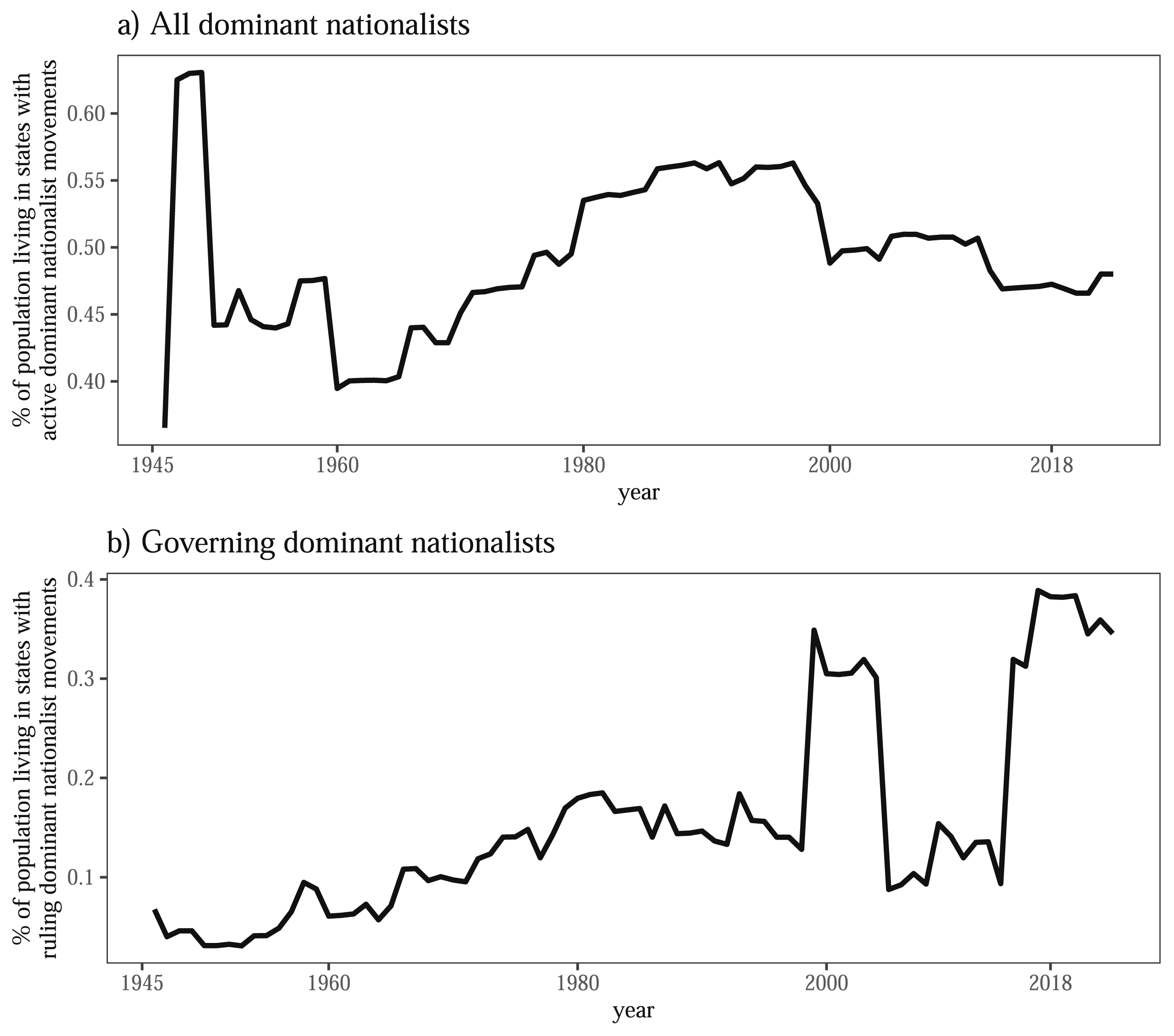
Methodological Approach and Operationalization
Unit of Analysis and Sample
We now quantitatively examine the impact of dominant nationalist demands towards specific outgroups on these groups’ involvement in civil war. Across our analyses, our unit of analysis is the ethnic group year, based on the group classification by the Ethnic Power Relations Dataset (EPR) (Vogt et al. 2015). Our sample includes all politically relevant groups in the 90 countries covered by the DNM dataset, for the time period between 1946 and 2023 (see appendix 2 for descriptive statistics).
Dependent Variable
Our dependent variable, civil war onset, takes the value 1 in any year in which a specific group is involved in civil war violence following 2 years of inaction, according to the UCDP Armed Conflict Dataset (Davies, Pettersson and Öberg, 2022; Gleditsch et al. 2002) and ACD2EPR (Vogt et al. 2015). In our main models, we consequently exclude all observations with an ongoing civil war in the previous 2 years, as these groups can by definition not see a new civil war onset.
Operationalizing Dominant Nationalist Demands
Our key independent variable is dominant nationalist demand. This binary group year-level variable identifies all groups that are subject to dominant nationalist demands for political exclusion, citizenship rights restrictions, reductions in demographic size, expulsion, or systematic killing; note that this list purposefully does not include demands for assimilation which may give rise to dynamics that are distinct from the exclusionary demands considered (Garrity and Mylonas 2024; Mylonas 2012). 4 In our robustness checks, we disaggregate this dichotomous variable further.
Operationalizing Existing Explanations for Civil war
In our analyses, we compare the substantive impact of dominant nationalism with some of the most prominent existing explanations for ethnic civil war. First, we capture prominent arguments that civil wars are fueled by grievances over a lack of political representation (e.g. Cederman, Gleditsch and Buhaug, 2013) with a dichotomous variable excluded, which takes the value 1 in each year where each given group is not represented in key executive offices, as coded by the Ethnic Power Relations (EPR) dataset (Vogt et al. 2015), and 0 otherwise.
Second, we account for strategic bargaining between each group and the government, which influences the government’s ethnic composition in the first place. For this purpose, we measure the balance of threat capabilities between each group and the country’s ruling group in the given year. We do so based on two of the factors most commonly highlighted in previous research on ethnic bargaining (Beiser-McGrath and Metternich 2021; Jenne 2007; Roessler and Ohls 2018; Wucherpfennig, Hunziker and Cederman, 2016), namely both sides’ relative demographic size and their minimum distance from the capital. We capture the main implications of the bargaining argument with a dichotomous variable: high-high threat capabilities. 5 This takes the value 1 if both sides’ threat capabilities are higher than the median threat capabilities in our sample. The intuition is that groups with mutually high capabilities will be able to commit to a self-enforcing power-sharing agreement, which reduces the risk of civil war between them. In our main analysis, we reverse this variable, to compare the conflict-inducing effect of dominant nationalism with the conflict-inducing effect of constellations where such self-enforcing power-sharing is not possible.
Finally, we identify “proto-nations”—groups whose ethnic demography and geographic location provides them with a reasonable path towards secession, should they so desire. As we aim to compare the explanatory power of dominant nationalism to (potential) separatist nationalism as captured by proto-nationhood, and explore interactions between them, we again do so with a simple, dichotomous variable. Our variable proto-nation identifies groups with a compact settlement pattern that are located close to the international border and that satisfy one of two conditions: they have a demographic size of at least 1 million (meaning they can conceivably hope to establish their own independent state) or there is an adjacent state controlled by their ethnic kin (meaning they can conceivably hope to join this state’s territory).
Control Variables
Throughout our analyses, we employ fixed effects at the country- and year-levels. These hold constant all potential confounders at these levels, such as colonial legacies, national founding narratives, or persistently deep ethnic divisions. In our main models, we employ fixed effects at the country-, as opposed to the ethnic group-level, as we aim to compare the explanatory power of dominant nationalism with conventional explanations for civil war. Two variables whereby we capture those existing explanations—high-high threat capabilities and proto-state—are largely time-invariant at the group level, which precludes the use of group-fixed effects in our main analysis. In our difference-in-differences analysis below we show that our main findings can be replicated when using fixed effects at the group-level which restrict our analysis to overtime variation in each group’s exposure to dominant nationalist demands.
Instead, in our main analyses, we control for the most important, time-variant factors that might simultaneously influence a given groups’ risk of becoming subject to dominant nationalist demands and becoming involved in civil war. First, we account for a pattern whereby groups that are demographically larger are not only more likely to attain representation in the government, but also to catch the attention of dominant nationalists. We do so by controlling for each group’s relative size (Vogt et al. 2015). Second, we control for the (logged) number of petroleum sites on each group’s territory (Lujala, Ketil Rod and Thieme 2007), which enable it to finance challenges against the center, and similarly enhance its bargaining power. Third, to account for time dependence, we incorporate a cubic term counting the years since independence or the last civil war involving a given group and a dichotomous variable that identifies groups that revolted before.
At the country year-level, we account for the governments’ coercive capabilities, which might simultaneously encourage extreme dominant nationalism but also deter outgroups from revolting, as measured by the Composite Index of National Capability (CINC) (Singer, Bremer and Stuckey 1972). We also account for a pattern whereby governments faced by a large number of potential challengers might be reluctant to offer concessions to outgroups and are more likely to crack down violently on dissent (Walter 2009). We capture this by controlling for the number of ethnic groups that EPR judges as “politically relevant” in each year (Vogt et al. 2015). In addition, we control for each country’s (logged) GDP per capita, 6 .
Analysis
Comparing the Impact of Dominant Nationalism With Conventional Explanations for Civil war
Comparing the impact of dominant nationalist demands with conventional explanations for ethnic civil war
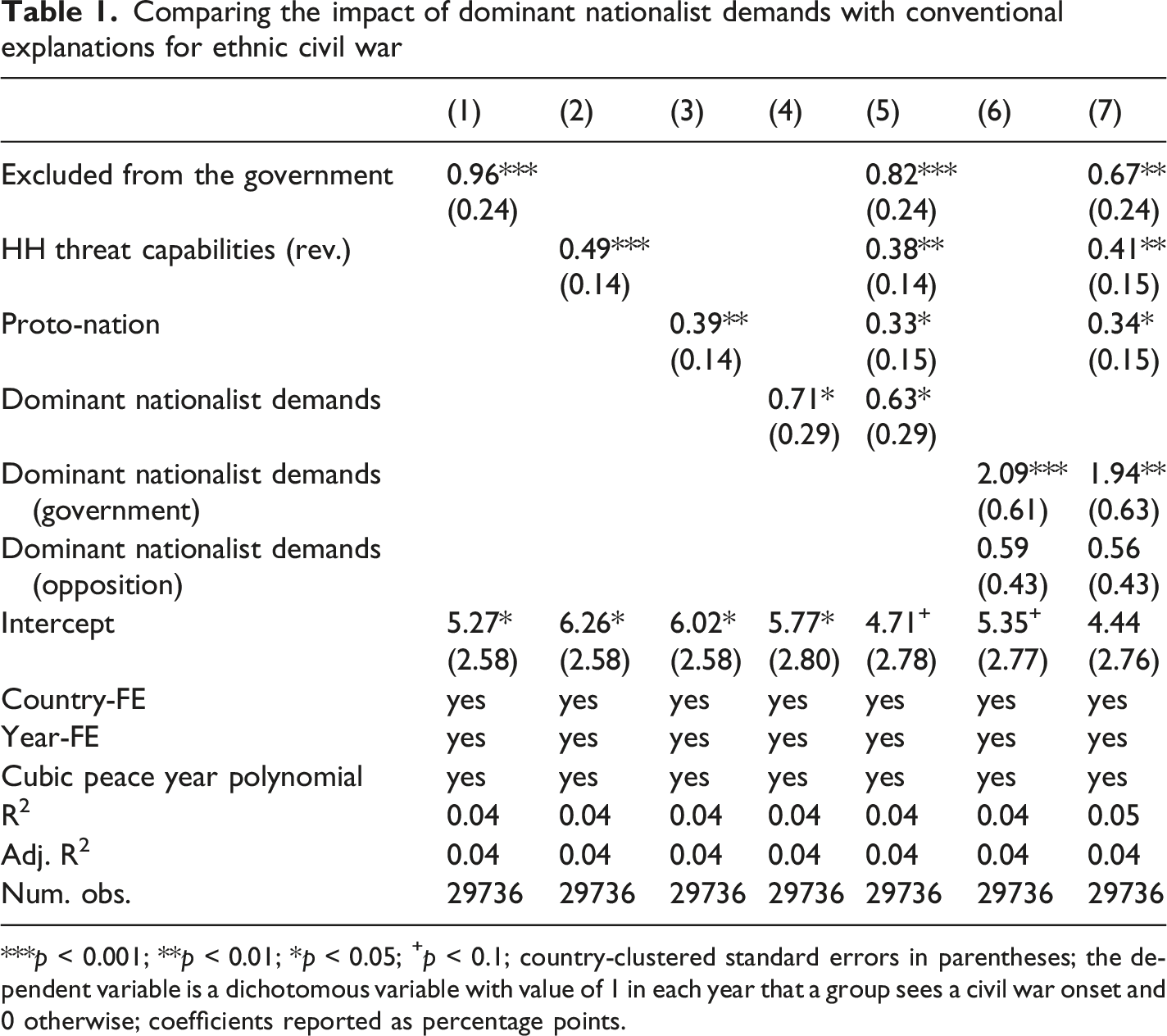
***p < 0.001; **p < 0.01; *p < 0.05; +p < 0.1; country-clustered standard errors in parentheses; the dependent variable is a dichotomous variable with value of 1 in each year that a group sees a civil war onset and 0 otherwise; coefficients reported as percentage points.
Overall, the results from these models offer support for our expectations. In line with hypothesis 1, we find that dominant nationalist demands are associated with a higher probability that outgroups subject to such demands experience a civil war onset (model 4). As shown in Figure 3 (line 4), this relationship is precisely identified and of substantial magnitude. Most notably, if a group is subject to antagonistic demands by dominant nationalists, it has a 0.6%–0.7 percent higher annual risk of civil war onset. This is a substantial association relative to the mean of our outcome across all group years in our sample (0.7 percent). Moreover, the magnitude of this association is comparable to factors highlighted in conventional explanations for civil war, which we examine in the remaining models: governmental exclusion (1 percent, model 1), threat capabilities that do not allow for self-enforcing power-sharing (0.5 percent, model 2), and factors favorable to minority nationalism, as captured by our proto-nationhood variable (0.4 percent, model 3). Further, the estimated association of dominant nationalism with civil war onset remains substantial and statistically significant even when controlling for these alternative explanations (model 5).
7
Partial effects and 90 percent confidence intervals: dominant nationalist demands, conventional explanations, and civil war onset (based on models 1–4 and 6 in Table 1).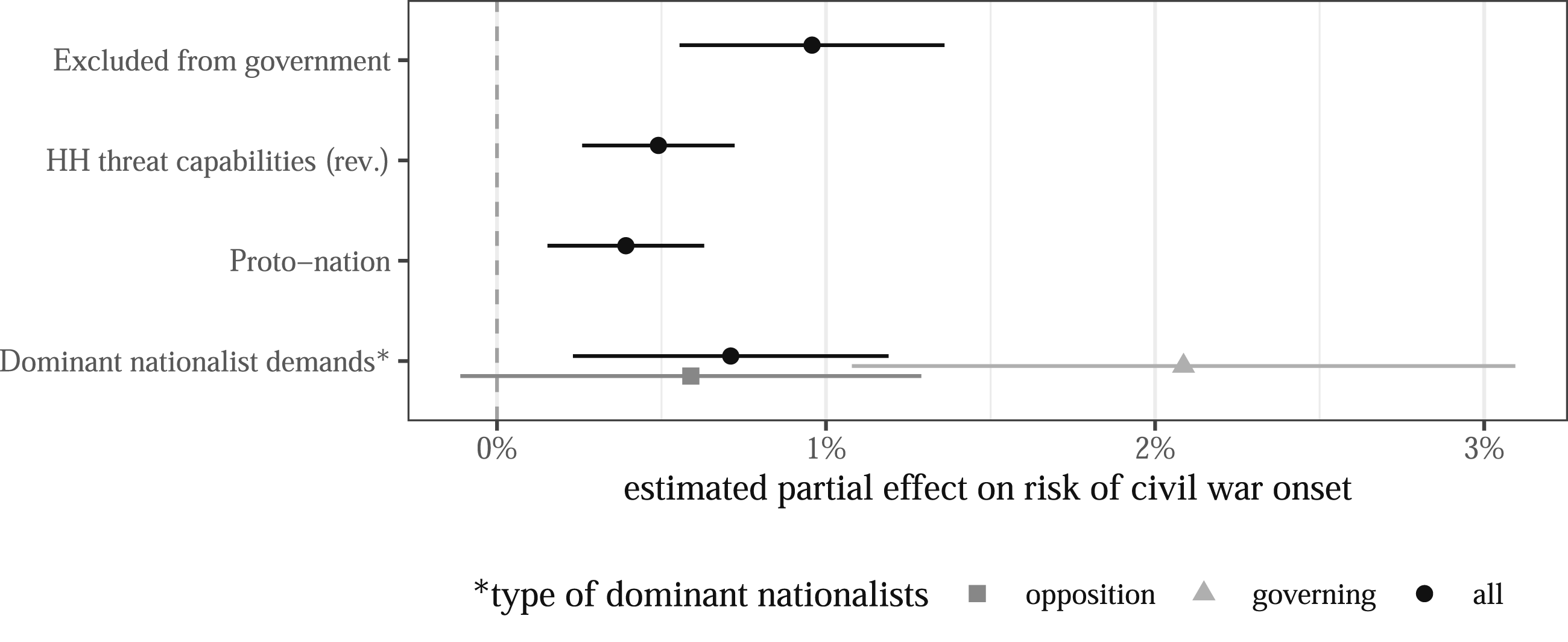
Finally, we find that the estimated effect of dominant nationalism on civil war risk is larger and statistically significant when dominant nationalists hold executive power (approximately 1.9%–2.1 percent; Models 6–7). The corresponding estimate for dominant nationalists in opposition is substantially smaller (around 0.6 percent) and not statistically significant. To assess whether these effects differ, we conduct a Wald test of coefficient equality. The test indicates that the difference falls just short of conventional levels of statistical significance (model 5, p = 0.056). Thus, while we cannot reject the null hypothesis that the government and opposition effects are equal at the 5 percent level, the results provide suggestive evidence that dominant nationalism likely has a stronger association with civil war risk when pursued from within government. At the same time, the positive, albeit imprecisely estimated, opposition coefficient remains consistent with the possibility that dominant nationalism outside government also contributes to conflict risk. We therefore interpret the findings as offering only qualified support for hypothesis 2, with considerably stronger evidence for dominant nationalism in power than in opposition.
Examining Interactions Between Dominant Nationalism and Strategic Considerations by the Government and Ethnic Outgroups
Testing interactions between dominant nationalism and strategic considerations by the government and ethnic outgroups
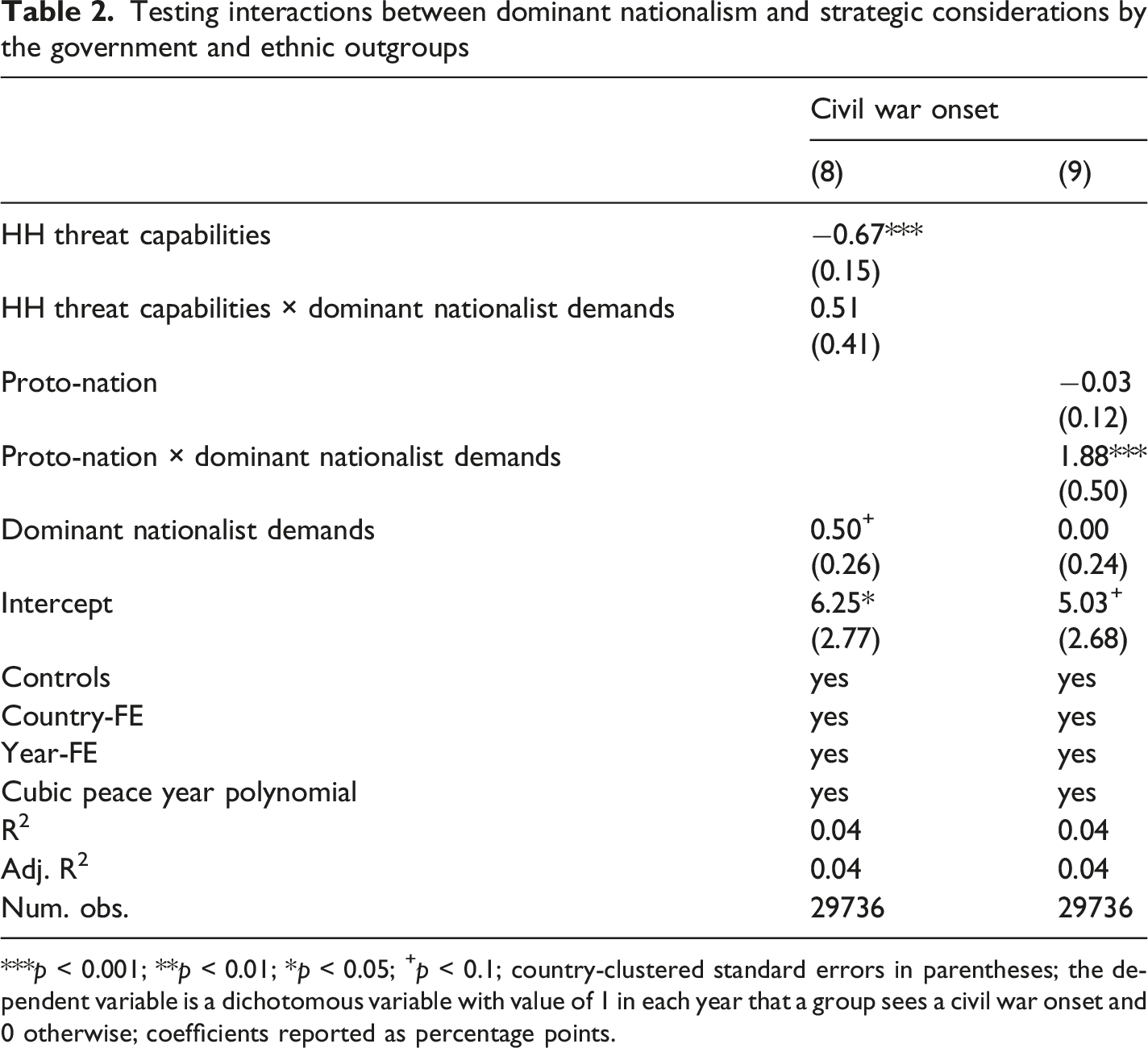
***p < 0.001; **p < 0.01; *p < 0.05; +p < 0.1; country-clustered standard errors in parentheses; the dependent variable is a dichotomous variable with value of 1 in each year that a group sees a civil war onset and 0 otherwise; coefficients reported as percentage points.
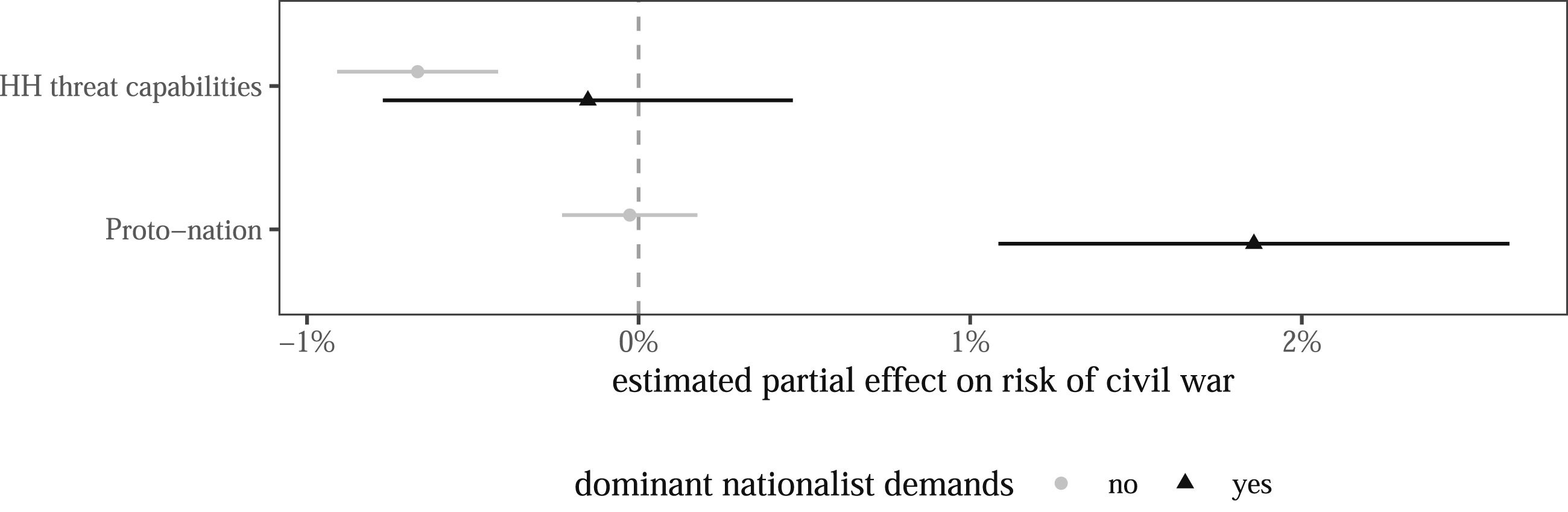
Partial effects and 90 percent confidence intervals: the interactions between dominant nationalist demands and strategic considerations by the government and ethnic outgroups (based on models 8–9 in Table 2).
We find evidence that dominant nationalism conditions the relationship between the strategic environment and civil war risk. Reinforcing (“high–high”) threat capabilities are associated with a lower probability of civil war onset, but this pacifying association is statistically distinguishable from zero only in the absence of dominant nationalist demands (Figure 4, line 1). For groups subject to such demands, the estimated association is smaller and statistically indistinguishable from zero (line 2). Although the interaction between high–high threat capabilities and dominant nationalist demands does not reach conventional significance (p = 0.21), the estimated pattern is consistent with the claim that dominant nationalism weakens the conflict-reducing effect of strategic incentives. In appendix 4.2, we show a similar pattern for power-sharing: dyads with reinforcing threat capabilities are more likely to share power, but this relationship does not hold for groups subject to dominant nationalist demands, with the difference statistically significant at the 95 percent level, indicating that dominant nationalism can override strategic incentives to share power. Taken together, these results provide partial but consistent evidence in support of hypothesis 3.
Second, and strikingly, we find that proto-nationhood is associated with a higher risk of civil war, but only for groups that are simultaneously targeted by dominant nationalist demands (Figure 4, line 4). In contrast, proto-nationhood is not associated with a higher civil war risk for groups that “are left alone” by dominant nationalists or that settle in states without a politically relevant dominant nationalist movement (line 3). Moreover, we note that the difference between these configurations, given by the interactive term (model 9 in Table 2), is statistically significant. In line with hypothesis 4, our results indicate that dominant nationalist agitation provides a powerful motive to take this risk. Again, we extend this analysis in appendix 4.2 and show that proto-nations only organize in self-determination movements that demand independence, as measured with data from the Self-Determination Movement (SDM) database (Sambanis, Germann and Schädel, 2018),8 if they are subject to dominant nationalist demands. These findings are in line with our argument that, while favorable structural conditions give minorities a conceivable chance of secession, an additional motive is required for them to take the substantial risks entailed by this decision.
Robustness Checks
In appendix 5, we provide numerous robustness checks. These replicate our main results, focusing on the association of dominant nationalist demands with civil war onset (as attained in model 4 in Table 1), for different samples (focusing on demographic and political minority groups and on regionally concentrated groups only), different operationalizations of our independent variables, while incorporating additional controls (including external support from kin states, irredentism, and interstate wars), and alternative specifications.
Mechanisms
Having established a robust association between dominant nationalist demands and ethnic civil war onset, we now examine the mechanisms underlying this relationship. We first show that dominant nationalism is associated with three intermediate outcomes central to our argument (appendix 6.1): increased political exclusion of outgroups (EPR; Vogt et al. 2015), higher risks of outgroup victimization through state-sponsored repression (Butcher et al. 2020; Garrity 2022), and a greater likelihood that outgroups mobilize for independence (SDM; Sambanis, Germann and Schädel, 2018).
We then assess whether these outcomes mediate the effect of dominant nationalism on civil war onset using a causal mediation analysis (Imai et al. 2011). As summarized in Figure 5 (appendix 6.2), approximately 14 percent of the effect is mediated by political exclusion, 5 percent by outgroup victimization, and 34 percent by independence demands. These results support our proposed mechanisms and indicate that secessionism is the most important pathway linking dominant nationalism to civil war. Mediation analyses: Total effect and 90 percent confidence intervals of dominant nationalist demands on civil war onset (based on model 1 in Table 1) and decomposition into components mediated by government exclusion, victimization, and independence demands (based on mediation analyses reported in appendix 6.2).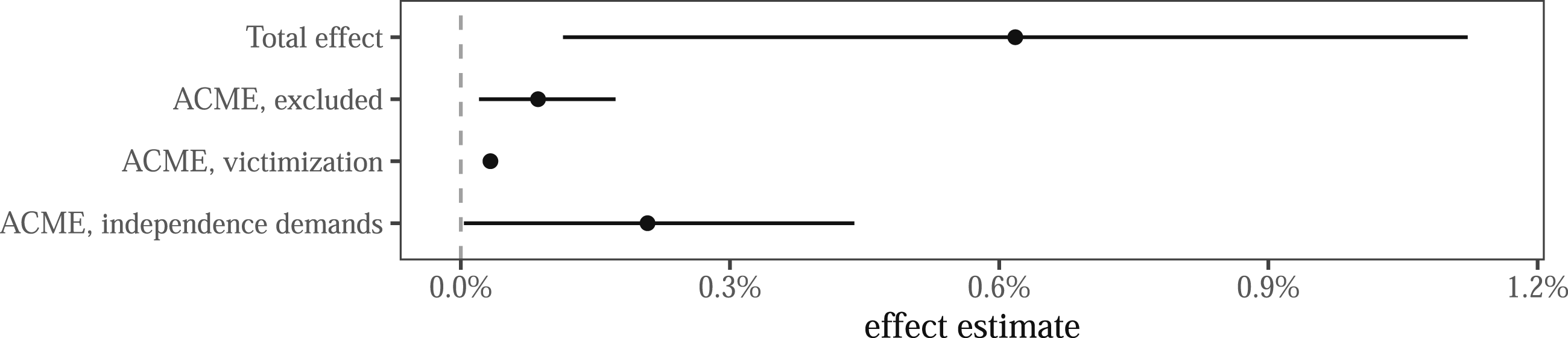
Finally, appendix 6.3 documents additional outcomes consistent with our argument, including changes in government composition, political discrimination, and the onset of secessionism.
Accounting for Reverse Causation and Endogeneity
While our findings align with expectations and are robust, we cannot yet infer that dominant nationalism causally affects civil war risk. Reverse causation is a concern: dominant nationalists might target vulnerable minorities to rally support (Basta 2021; Bustikova 2014), leading us to potentially underestimate their true effects; or, they might preemptively repress powerful outgroups, leading us to overestimate their effects. Endogeneity to third factors is also a potential concern. For instance, countries with persistent ethnic divisions (e.g., Israel, South Africa, Rwanda, Sri Lanka) may experience cycles of exclusionary governance and unrest. We control for past conflict and the number of politically relevant groups, but latent divisions remain partially unobserved.
To address these concerns, we proceed in three steps. First, we conduct a causal sensitivity analysis, following the approach proposed by Cinelli and Hazlett (2020) (appendix 7.1). This allows us to assess the susceptibility of our findings to unobserved confounders. Second, we refer to our robustness check that incorporates country year-fixed effects, which hold constant all unobserved factors that vary at this level, such as regime type or the level of societal repression (appendix 5.3). Third, we conduct a difference-in-differences analysis, using the fixed effects counteractual (FECT) estimator by Liu, Wang and Xu (2024). Employing group- and year-fixed effects, this approach exclusively focuses on over-time variation in the group-wise incidence of civil war and allows us to approximate the causal effect of dominant nationalist demands (see appendix 7.2 for details).
Reassuringly, our findings are supported by these analyses. Our causal sensitivity analysis shows that our findings are robust even to severe omitted variable bias (appendix 7.1). Moreover, our findings can be replicated when incorporating country year-fixed effects (appendix 5.3). Finally, in our FECT analysis, we find that the initiation of dominant nationalist demands against a given group subsequently makes this group more likely to become involved in civil war, in direct accordance to our main findings; in particular, the unit-averaged effect of dominant nationalist demands is estimated to be 2.7 percent (p = 0.03) in these analyses (see Table A5 in appendix 7.2.3, model 8 and Figure 6, panel a). Event plot: dominant nationalist movements and civil war incidence, fixed effects counterfactual analysis (based on models 10 and 11 in Table A5 in appendix 7.2.3).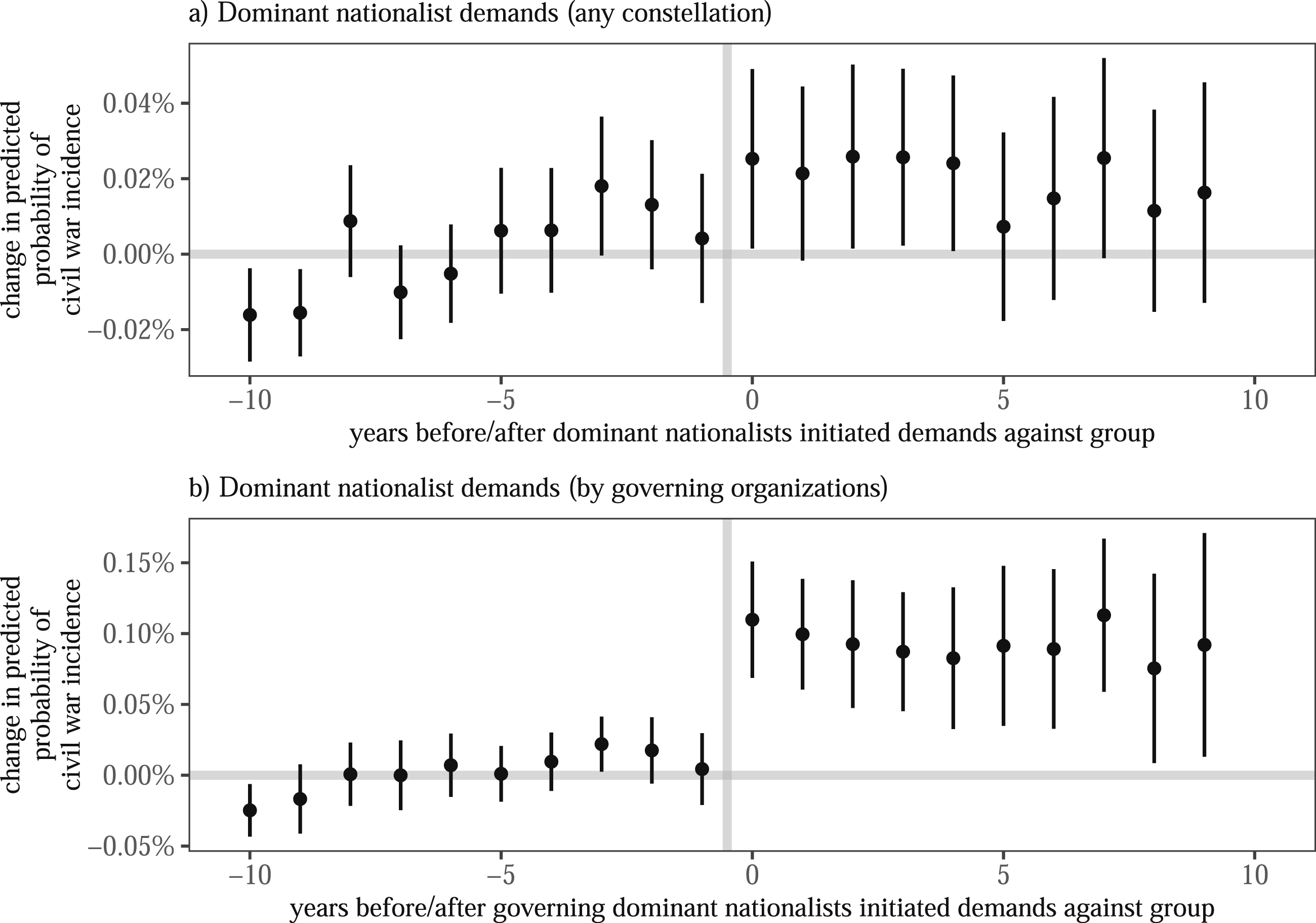
Like other difference-in-differences procedures, FECT is very sensitive to the measurement of treatment timing, which is used to estimate its causal effect. For our treatment variable, dominant nationalist demands, this poses challenges, as it is difficult to precisely identify the year that a dominant nationalist movement crosses the threshold of political relevance and that it started making demands against a specific group. We hence also provide a second FECT analysis that only considers demands by dominant nationalists that are in government. Importantly, the timing of this alternative treatment—the year that a dominant nationalist organization became newly included in government—is comparably easier to identify and measure precisely. 9 Reassuringly, we attain an even more pronounced effect of dominant nationalist demands on civil war incidence when employing this alternative treatment variable, with the estimated unit-averaged effect amounting to 5 percent (p = 0.07) (see Table A5 in appendix 7.2.3, model 9 and Figure 6, panel b).
Conclusion
How does dominant nationalism, on the rise across much of the world, affect the risk of ethnic civil war? Using a new global dataset of dominant nationalist movements, their exclusionary demands, and their control over government, we show that ethnic outgroups targeted by dominant nationalist ideologies are substantially more likely to engage in armed rebellion. Causal sensitivity and difference-in-differences analyses support a causal interpretation of this relationship.
Our results show that dominant nationalism elevates the risk of civil war through three complementary mechanisms. First, it pressures governing elites to politically exclude outgroups, fueling grievance-driven rebellion. Second, we provide some of the first cross-national evidence that dominant nationalism is a key predictor of mass atrocities, which we show can escalate to civil war. Finally, dominant nationalist agitation is a key catalyst of secessionist rebellions, as it raises widespread fears among minorities over future discriminatory policies.
These findings have important implications for future research and policy. Most fundamentally, they point to the importance of accounting for dominant nationalist ideology in cross-national studies on ethnic conflict. This literature has almost exclusively focused on nationalist movements with emancipatory aims, such as equitable government representation, increased autonomy, or independent statehood. Our results suggest the importance of widening the lens to the conflict-inducing role of dominant nationalist movements, which espouse a rigid ethnic hierarchy that prescribes the exclusion, assimilation, or forced displacement of ethnic outgroups.
Our results show that violent contestations over representation or autonomy—typically ascribed to emancipatory nationalist movements—have roots in the actions and rhetoric of dominant nationalist movements, which prevent governmental power-sharing and push outgroups towards secessionism in the first place. Thereby, our results underline assessments that widening the analytical focus to dominant nationalism will help advance research on civil war and ethnic mobilization (Vogt 2025) and can “form a useful antidote to the conventional understanding of the nature of ethnic conflict, in which it is minorities who are so often …seen as being at the root of ´the problem.”’ (Coakley 2011, 123).
More broadly, our results support mounting pleas for cross-national conflict research to take more seriously the role of ideology, including nationalism in particular (cf. Leader Maynard 2019; Sanín and Wood 2014). For instance, existing research on ethnic bargaining has predominantly focused on the strategic interactions between diverse groups and governing elites, which are typically conceived as unitary and rational actors. Our results challenge both assumptions. First, they indicate the need for further disaggregation as governing elites may be unable to offer concessions to ethnic outgroups, especially if they face stiff competition from dominant nationalist challengers. Moreover, they indicate that, in some cases, governing elites may not only be willing to take the risk of civil war, but see violence as a means to realize the aims of their long-held exclusionary ideology. Our results indicate that dominant nationalism can interact with and potentially supersede strategic incentives. Moreover, it can influence how both the government and ethnic outgroups perceive strategic incentives in the first place.
Our findings indicate that dominant nationalism, on average, strongly increases the risk of civil war. Future research might fruitfully extend the analysis of this relationship in several ways. First, our analysis has focused on movements whose nationalist platforms are explicitly to the disadvantage of specific ethnic or cultural outgroups. However, such dominant nationalist ideas are often present to varying degrees across the political spectrum in many states. Future research might go beyond the sharp criteria employed in our study and seek to identify more fine-grained variation in the intensity of dominant nationalist ideology. Second, mindful of the rarity civil war, it might further probe both countervailing mechanisms—that prevent the escalation of dominant nationalist agitation—and scope conditions thereof.
Beyond civil war, future research should also consider the consequences of dominant nationalism for other outcomes. While we have focused on civil war, our framework suggests that dominant nationalism is likely to increase the risks of other types of violent conflict as well, most notably one-sided violence, communal conflict, and interstate war. Given the return of violent conflict between states (Davies, Pettersson and Öberg, 2023) and the resurgence of ‘imperialist” nationalism (Kolstø 2019), investigating how dominant nationalism affects the risk of interstate disputes and of their violent escalation seems particularly urgent. In addition, future work should investigate the drivers of dominant nationalism, including the determinants of which outgroups they target with which type of demands. Given such demands’ exclusionary and violent consequences, such an analysis would be of particular policy relevance.
For now, we conclude that dominant nationalism substantially increases the risk of civil war. Given the mounting wave of dominant nationalism engulfing much of the world (Snyder 2019), these results are worrying. Most notably, they suggest that the recent surge of violent conflict around the world (Davies, Pettersson and Öberg, 2023) is likely to continue and intensify further in the coming years.
Supplemental Material
Supplemental Material - Dominant Nationalism and Civil War
Supplemental Material for Dominant Nationalism and Civil War by Andreas Juon, Lars-Erik Cederman in Journal of Conflict Resolution.
Supplemental Material
Supplemental Material - Dominant Nationalism and Civil War
Supplemental Material for Dominant Nationalism and Civil War by Andreas Juon, Lars-Erik Cederman in Journal of Conflict Resolution.
Footnotes
Acknowledgements
Earlier versions of this research were presented at Jan Tinbergen European Peace Science Conference, Bologna, June 2023; Annual Conference of the Swiss Political Science Association, St. Gallen, February 2024; Annual Meeting of the American Political Science Association, Philadelphia, September 2024. We are grateful to participants for their suggestions and feedback.
Funding
The authors disclosed receipt of the following financial support for the research, authorship, and/or publication of this article: This work was supported by Swiss National Science Foundation Project Funding (grant number: 207820).
Declaration of Conflicting Interests
The authors declared no potential conflicts of interest with respect to the research, authorship, and/or publication of this article.
Data Availability Statement
All data used in this article, along with the R and Stata scripts used to conduct the statistical analyses, is made publicly available under https://doi.org/10.7910/DVN/ELZ7ZX ( ).
).
Notes
References
Supplementary Material
Please find the following supplemental material available below.
For Open Access articles published under a Creative Commons License, all supplemental material carries the same license as the article it is associated with.
For non-Open Access articles published, all supplemental material carries a non-exclusive license, and permission requests for re-use of supplemental material or any part of supplemental material shall be sent directly to the copyright owner as specified in the copyright notice associated with the article.
