






Abstract
This paper critically examines the conceptual and practical challenges raised by forensic conclusions that assert categorical certainty about propositions of interest. Such conclusions rest on the examiner's judgment that it is ‘impossible' for the observations in question to arise under any alternative proposition – a stance now formalised in ISO 21043-4 (Forensic Sciences – Part 4: Interpretation). Our paper provides a concise overview of the necessity and role of expert witness testimony in contemporary legal systems. It outlines the legal framework governing scientific evidence and draws attention to key elements of ISO 21043-4. Thereupon we examine the reasoning patterns underpinning ISO 21043-4, with particular attention to the vast hypotheses-space involved in relating results to a specific proposition. It introduces a key distinction between the Set of Relevant Alternatives – propositions that must be explicitly ruled out – and the Set of Silently Obviated Alternatives, which are dismissed without formal consideration. The paper then analyses the ‘Trojan Horse' effect of invoking ‘impossibility' in forensic reporting, showing that categorical conclusions rest not solely on methodological validity but on normative choices that exceed empirical warrant. These issues are situated within epistemology to highlight both the limits of justified forensic claims and the asymmetry they impose on defendants. Thereupon we highlight the gap between the generality of scientific conclusions and the singularity of legal decisions regarding unique historical events. It argues that the ISO's ‘impossibility' clause fosters scientific imperialism, allowing experts to arbitrarily reshape both epistemic and normative limits. Drawing on jurisprudential concepts, our analysis shows how this practice cedes decision-making prerogatives from legally empowered fact-finders to scientists, undermining the justice system’s legitimacy.
Keywords
‘By what authority are you doing these things?’ they asked. ‘And who gave you this authority?’ Matthew 21: 23
Introduction
In forensic science, the phrase ‘to the exclusion of all others’ has long served as shorthand for a conclusion so certain that it brooks no rival proposition. It promises epistemic closure and finality: that the trace has a source, and that the source is the defendant or, more generally, some person of interest (hereafter: POI). This language, once and still routine, is under longstanding critique from scientific bodies, 1 commentators 2 and courts alike. 3 Scientifically, it is therefore obsolete; in practice, it endures. 4 The backlash is often framed as a rejection of inferentially unwarranted certainty and a call for probabilistic reasoning. And yet, curiously, a revitalised form of ‘certainty’ has crept back in – less excentric, perhaps, but no less insidious. It is embedded in a recent international benchmark, notably the ISO 21043-4:2025 (hereafter: ISO 21043-4), 5 which allows practitioners to issue categorical opinions under the condition that, in their judgment, ‘it would be impossible to obtain the observation if any alternative proposition were true’. This invocation of impossibility as a justification for classifications or source attribution determinations (hereafter: SADs) introduces a profound theoretical problem – one that only rarely receives sustained doctrinal or epistemological scrutiny.
Our paper confronts this problem head-on. Following a brief overview of the law in England and Wales governing expert evidence and the ISO 21043-4 in section ‘Expert witness testimony’, we contend in section ‘To the exclusion of all others?’ that the ISO 21043-4's ‘impossibility’ clause operates as a Trojan horse: it offers a route back into forensic reporting for the very kind of definitive statements that probabilistic accounts were designed to displace, but under the guise of judgment-based exception – on terms that evade empirical scrutiny and exceed the legitimate epistemic constraints of expert testimony. To illuminate the structure of this problem, the paper develops a formal model that distinguishes between two logically separate sets: the Set of Relevant Alternatives (SRA) which includes hypotheses that are actively considered and ruled out; and the Set of Silently Obviated Alternatives (SSOA), which encompasses the remainder of the logical space – the billions of possible donors or propositions that are not actively tested or ruled out, but are instead bypassed by a claim of ‘impossibility’.
Section ‘Decisional matters’ explains that ‘impossibility’ is not just a linguistic sleight of hand. It reflects a deeper category error – one that conflates (a) metaphysical uniqueness with evidentiary discernibility, and (b) the empirical limitations of forensic inference with normative permission to decide. ‘Certainty’ in law is not merely an epistemic status, but a procedural act, performed by those empowered to decide. The trier of fact – not the forensic scientist – is the locus of that authority. When a forensic practitioner crosses from statements of scientific knowledge, which are general and probabilistic in nature, to definitive attribution – particularly under the cover of impossibility – they perform a quasi-judicial function albeit without legal mandate.
In sum, this paper argues, in section ‘Conclusions’, that the ISO's inclusion of categorical conclusions based on examiners’ judgments of ‘impossibility’ is prone to replicate the very errors that probabilistic methods were intended to correct. It transforms subjective judgment into epistemic finality and threatens to erase the distinction between expert evaluation and legal decision. By tracing the conceptual, formal and jurisprudential implications of this shift, the paper contributes to a growing body of critical forensic scholarship that seeks to restore rational accountability to the use of expert witness testimony in criminal trials.
Expert witness testimony
The ‘good old way’
Rapid technological advancement and the growing compartmentalisation of knowledge serve as a reminder that legal systems are – and must be – complex, continuously adapting to their respective social environment. 6 But how can legal orders manage complexity, and ensure the very possibility of accurate fact-finding? A process in which professional judges, magistrates or jurors (hereafter referred to as ‘fact-finders’ 7 ) as decision-makers fail to grasp the nature (statistical or otherwise) or empirical content (e.g. what is an allele?) of the pertinent evidence would be arbitrary, undermining both the integrity of the legal system and, ultimately, public confidence. The very existence and effective functioning of the criminal justice system depend on the ability of fact-finders to make accurate decisions by identifying specific acts, events and circumstances as instances of abstract legal concepts. 8 It is accurate fact-finding that allows the criminal justice system to treat like cases alike and different cases differently, which is a fundamental principle of justice. 9
The solution to the problem identified above appears to be universal. Legal systems around the world have developed a solution known as expert witness testimony (hereafter: EWT), allowing factual determinations to be made with the assistance of specialised witnesses (hereafter: domain experts) called in to provide information, disinterested and dispassionate analysis. Despite a façade of modernity, expert witnesses have been present in criminal trials since at least the mid-16th century. In 1554, Saunders J. famously stated: If matters arise in our law which concern other sciences or faculties, we commonly apply for the aid of that science or faculty, which is an honourable and commendable thing in our law. For thereby it appears we do not despise all other sciences but our own; rather, we approve of them and encourage them as things worthy of commendation.
10
Following decades of a laissez-passer approach, the law in England and Wales now employs methodological standards to determine what counts as scientific and thus admissible evidence. The test for scientific evidence is the requirement of a sufficiently reliable scientific basis 16 – which is the E + W-version of the Daubert framework regarding scientific validity. 17 But legal tests or even common sense can only get us so far.
The crucial question thus is: How can fact-finders make accurate factual determinations when, as Damaska put it, the ‘creeping scientisation’ 18 of factual inquiries raises fundamental questions about comprehension – such as the practical meaning of a random match probability? How can the ‘good old way’ survive in the modern technological world? In other words, the challenge is to enable smooth, that is, methodologically (scientifically) valid and procedurally lawful communication between scientists and fact-finders.
Probabilism and the ISO 21043-4
A new development has recently emerged in the ongoing, multilayered debate over the role of forensic scientists in the criminal justice system: the forensic science standard ISO 21043-4 on ‘Interpretation’ which is the product of approximately eight years of international deliberation.
19
ISO 21043-4 aims to establish discipline-wide requirements and recommendations for forensic interpretation – whether based on human judgment or statistical models
20
– to ensure that opinions provided in investigations and legal proceedings are clearly documented, based on methods that are backed by suitable validation studies, relevant to the question posed and designed to reduce the potential of cognitive bias. Para. 1 of ISO 21043-4 (‘Scope’) states that this document specifies requirements and provides recommendations for the interpretation of observations in order to reach opinions that answer questions that are relevant for decision making in investigations or legal proceedings.
In a key provision of ISO 21043-4 (Section 6.2), it is stated that: (…) the examiner shall assess the ratio of the probabilities of the observations if the first proposition were true versus if the second proposition were true. If more propositions are considered, the examiner shall assess the probability of the observations under each pair of propositions and assign their ratios.
To the exclusion of all others?
Para. 6.3 of ISO 21043-4 and the function of categorical opinions
Para. 6.2 (‘Likelihood ratios’) of ISO 21043-4 – along with its underlying commitment to a scientific and thus probabilistic approach to evidence interpretation – should be read in conjunction with para. 6.3 (‘Categorical opinions’), which states: [c]ategorical opinions shall only be formed when, in the examiner's judgment, it would be impossible to obtain the observations if any alternative proposition were true.
A possible response to this could be to argue that the requirement defined in para. 6.3 of ISO 21043-4 is, in fact, a probabilistic criterion: that is, the requirement of judging that the denominator of the likelihood ratio is zero, and hence that the observations provide infinite support for the first over the alternative proposition. Insofar, the categorical conclusion would merely be a logical implication of an extreme probability assignment made under para. 6.2. So, while para. 6.3 of ISO 21043-4 defines the logically correct requirement for a categorical opinion, the overall message of ISO 21043-4 is confusing because it mixes up inferential targets (i.e. probability of observations given propositions and categorical statements about propositions) and suggests that it is suitable for forensic examiners to do so.
To examine these issues in further detail, let us consider a routinely encountered case example: Suppose an incident involving the discharge of a firearm. A bullet found on a crime scene is examined by a firearms expert. The microscopic markings present on the surface of the recovered bullet are compared with those present on bullets fired under controlled conditions by a seized firearm, belonging to a POI. The expert concludes that the striations on the bullet from the crime scene bullet correspond to those observed on the test-fired bullets.
If the examiner intends to perform an interpretation, 25 they will follow para. 6.2 of ISO 21043-4 and undertake an evaluative process grounded in a scientific, probabilistic framework. The output of that process is a likelihood ratio, that is, a statement reflecting the strength, assigned by the examiner, of the observations with respect to competing propositions.
However, para. 6.3 of ISO 21043-4 also permits the practitioner to go much further: whenever the examiner judges that it is impossible to observe the markings if any alternative proposition were true (i.e. the bullet had been fired from any other firearm), a categorical conclusion may be formed. In such cases, the expert's conclusion amounts to attributing the bullet to a specific weapon – to the exclusion of every other firearm in the world. This illustrates the threshold under which categorical conclusions are permitted within the ISO's interpretive architecture. Para. 6.3 of ISO 21043-4 thus raises several concerns.
First, what methodological framework underpins the practitioner's judgment of ‘impossibility’? Second, how does such a categorical conclusion sit with the procedural and normative architecture of the criminal process?
There are also pressing practical questions: who will be sufficiently qualified, or feel confident, to challenge a conclusion framed in terms of ‘impossibility’? And how many fact-finders will quietly welcome such statements as a way of reducing their own workload and evidentiary burden?
Opinion and fact
We used the term ‘categorical conclusion’ above, but it is crucial to note that ISO 21043-4 consistently frames such determinations as opinions, not facts. Para. 8.4.1 of ISO 21043-4 makes this explicit: ‘Categorical opinions shall not be expressed as if they were statements of fact’. 26 This choice of language signals an intention to preserve the distinction between expert opinion and factual determination, even in cases where para. 6.3 permits categorical formulations.
The conventional approach to expert evidence is structured as an exception to the opinion rule. 27 The law is generally cautious about permitting ordinary witnesses to draw inferences from, or express opinions on, facts they have not personally observed. 28 This reflects the basic distinction in law between facts and opinions: while witnesses are expected to testify only to what they have directly perceived, they are not generally permitted to offer inferences or opinions – precisely because the law treats such evaluative judgments as the domain of the fact-finder.
This distinction is, we submit, an unhelpful and potentially misleading representation, as it presupposes a clear – or more precisely, a categorical – separation between facts and opinions. In reality, there exists a continuum between subjective opinions and those that are sufficiently justified or methodologically validated to attain the status of what the legal system treats as facts. There is, in other words, no analytic criterion by which to arbitrate the institutionally constructed boundary between fact and opinion. Even courts in England and Wales recognise that the fact–opinion divide is ultimately untenable. Ordinary witnesses are unlikely to confine themselves to a purely observational or pseudo-factual vocabulary and are, in practice, permitted to offer testimony that encroaches upon the opinion end of the fact–opinion continuum. 29 As J.W. Thayer had observed, ‘[i]n a sense all testimony to matter of fact is opinion evidence, i.e., it is a conclusion formed from phenomena and mental impressions’. 30 As a result, a witness may state opinions to the extent that this is only a ‘compendious means of giving factual evidence’. 31
The correct distinction, we submit, is not between opinions and facts – such categorical separations have long been shown by analytic philosophy to be problematic, if not entirely unviable 32 – but between those who are procedurally empowered to offer opinions and those who are not. In other words, the distinction is between procedurally valid opinions on the one hand and procedurally invalid opinions on the other. It is a function of the procedural architecture that empowers certain categories of individuals to deliver opinions, including, most notably, those vested with decision-making authority. The more pertinent distinction is thus not simply between facts and opinions, but between claims regarding the constitutive elements of an offence or defence on the one hand, and facts that are procedurally validated on the other. What matters here are legal facts – not facts in general – since criminal adjudication is fundamentally a normatively structured decision-making process under uncertainty. Moreover, it remains unclear how a forensic practitioner's opinion can be both categorical – implying a ‘no alternative’ certainty – and yet simultaneously ‘shall not be expressed as if [it] were a statement of fact’ as ISO 21043-4 requires. This demand for categorical opinions, paired with the prohibition on presenting them as factual assertions, creates an inherent contradiction.
In short, claiming that an observation rules out all alternative propositions (‘impossibility’) while simultaneously denying that this claim constitutes a factual statement attempts to have it both ways – asserting the weight of fact without accepting the responsibilities that such an assertion demands.
‘Guess who?’
Let us now illuminate the activity of forensic examiners when they draw categorical conclusions and thereby rule out all alternative propositions (e.g. potential sources of the recovered forensic trace material) as ‘impossible’, based on the observations made during examination. Recall that such a conclusion rests on the judgment that it would be impossible to observe the forensic trace under any other version of the event of interest (proposition). This forensic version of ‘Guess Who?’ 33 mirrors a process of eliminative reasoning, whereby – given a set of hypotheses, H₁ through Hn – a particular hypothesis Hi is taken as validated, only if the available evidence is judged to rule out all competing alternatives. 34 We thus see that the initial, seemingly one-dimensional categorical conclusion is based on multifaceted, heterogeneous input: 35 the observation that, for example, the DNA profile of the POI corresponds to the profile of the biological trace found at the crime scene, as well as the assertion that the trace's profile does not correspond to anyone else. Note that the former is an empirically demonstrable assertion, while the latter is not. Indeed, it is an empirically unwarranted claim. Typically, examiners would present or accompany their claims using phrases such as ‘this pattern (profile, etc.) is so distinctive, and hence rare, that we would not expect to see it in items from any other source’ or ‘this pattern (profile, etc.) is so distinctive, and hence rare, that for practical purposes it can be considered to be impossible to observe it if it came from another source’. In combination, this multi-faceted input to the interpretation process is captured in the notorious six-word expression ‘to the exclusion of all others’.
For example, a forensic firearms examiner may individualise a bullet (i.e. attributing it to a specific weapon) – to the exclusion of every other firearm in the world. 36 Note, however, that in practice it may not be necessary to exclude all potential sources in the entire world as the relevant population may be limited by case-specific aspects (such as time, location, etc.). Notwithstanding, our point is that even if only a restricted population is considered, forensic examiners usually cannot, for practical reasons, examine it exhaustively. 37
Taken literally, eliminative induction would require the forensic practitioner to undertake the titanic task of systematically examining and ruling out every alternative hypothesis. As noted above, examiners often circumvent this formidable task by advancing all-encompassing assertions that the observations would be impossible under alternative propositions. Such claims, however, ignore the sheer breadth of the relevant logical space, which encompasses the set of all possible donors (sources) of the forensic trace – potentially numbering in the billions, with each representing a distinct hypothesis corresponding to a conceivable source (human, object or otherwise).
The problem of eliminative induction is therefore forbiddingly complex and practically unmanageable. The forensic practitioner can neither fully explore the logical space:

As outlined above, in both ‘Guess Who?’ and the kind of forensic reasoning permitted under para. 6.3 ISO 21043-4, the reasoning process hinges on systematically eliminating alternative propositions until only one remains. The final inference – i.e.: ⇒this⇐ is the source − is reached not only through direct observation (e.g. that the trace corresponds to the candidate source), but also by an assertion for which no direct or tangible evidence is provided: ‘none of the alternatives can account for what I see’. The key difference, of course, is that in ‘Guess Who?’, the complete set of alternatives is known, finite and can be investigated exhaustively. In forensic science, however, the pool of potential sources (e.g. all firearms, all individuals), although finite, is rarely, if ever, exhaustively known. Moreover, various sources of variation exist both within and between sources. Therefore, excluding all alternatives is not merely practically challenging; it is predicated on a conceptually untenable view of the problem.
Given the methodologically trivial yet functionally significant fact that the examiner cannot possibly traverse the entire logical space 38 – that is, s/he cannot compare the questioned item with every potential source in order to justify the claim ‘to the exclusion of all others’ – the initial set of hypotheses {H1, …, Hi, …, Hn} is, by necessity, partitioned. Starting from the full hypothesis space – that is, all possible donors (sources) – the ISO 21043-4 framework effectively reduces this space to a binary partition.
More precisely, there exists a subset of hypotheses (i.e. possible donors) that must be actively considered and, where appropriate, ruled out. These alternatives are epistemically relevant: ignoring them would compromise the integrity of the inquiry. We refer to this subset of the n propositions as the SRA

The remainder of the hypothesis space – the logically possible alternatives – is excluded without thorough scrutiny. Their dismissal is not epistemically earned but presumed, assumed or simply overlooked – whether because they are deemed implausible, inconvenient or escape notice altogether. We refer to this subset as the SSOA:

This reads: SSOA is the set difference [‘\’] between the full hypothesis space H and the actively considered subset SRA – and includes all those propositions that are excluded sub silentio. In other words, SSOA is the complement of SRA. At this juncture, a few clarifying comments are necessary.
First, it is worth noting that the cardinality of the two subsets – SRA and SSOA – is inversely related due to the constraints of eliminative reasoning. The more hypotheses the examiner actively considers – plausible, relevant or comparable alternatives – the smaller the SSOA becomes. Conversely, the lower the cardinality of actively considered hypotheses, the greater the cardinality of the SSOA, and the more hypotheses are excluded without epistemic justification.
Secondly, the process of elimination is marked by a fundamental asymmetry: only a narrow subset of possible hypotheses – those explicitly judged to be relevant and feasible – are actively considered, while the vast remainder are silently disregarded. A vast set of propositions – comprising the SSOA – are therefore excluded by omission rather than scrutiny. Their elimination occurs sub silentio, not through evidential engagement but through tacit disregard. This move reveals an epistemic sleight of hand inherent in categorical conclusions. The act of individualisation and the claim of exclusion (‘to the exclusion of all others’) suggest a narrowing to a single hypothesis, yet in reality only a tiny subset of the logical space (SRA) may have been given due consideration. What is more, in many cases, the properly investigated subset of the SRA contains only a single member, the candidate source. Meanwhile, the vast logical space of other possible donors – including the massive SSOA – is silently disregarded.
So, while the conclusion feels singular and decisive – individualisation is the claim of having reduced the set of potential donors of a forensic trace to a single source 39 – it is, de facto, built on a large-scale exclusion by omission. Most hypotheses are excluded not because they were shown to be incompatible with the findings, but because they were never actively considered. This creates the illusion of exhaustive reasoning where none exists. More troubling still, the asymmetry works to the detriment of the legitimate interests of individuals (POIs) – notably: of defendants. By suggesting that fact-finders could make categorical statements (‘this trace comes from this individual’), the framework of ISO 21043-4 gives the impression of exhaustive analysis while in fact narrowing the field of inquiry only to what the examiner – often tacitly – presumes to matter. The result is a categorical conclusion that conceals the fragility and hastiness of its inferential base, shifting the burden of justification away from the fact-finder and undermining the adversarial ideal of symmetry and equality of arms between prosecution and defence. What appears as certainty is in fact a mirage – a SAD masked as pseudo-probabilistic reasoning: the assertion of ‘impossibility’ by rounding a small probability to zero on the basis of allegedly perfect evidence.
Admittedly, the approach offers nothing fundamentally new; it merely formalises one of the oldest institutional forensic practices as a core element of an international standard. The inclusion in para. 6.3 of a logical criterion 40 for categorical opinions, though commendable in principle, is ultimately self-defeating because it cannot be empirically substantiated (other than in special closed-set cases).
Another way of reading para. 6.3 of ISO 21043-4 would be to consider it perfectly well suited because it poses a severe requirement so that, if properly applied, it should prevent forensic practitioners from reaching categorical conclusions, especially those relating to source attribution. However, this seems a rather idealistic viewpoint. As Morrison et al. 41 noted, the ‘impossibility’ criterion is defined in terms of a human judgement, making it vulnerable to bias. Therefore, what appears prima facie to be a hard criterion, implying a categorical conclusion as a logical necessity, will lead to an output that remains entirely dependent on the fallibility of the ‘impossibility’ judgement.
Relevant alternatives and contextualism
As outlined above, applying the ISO framework implicitly but inevitably leads to a partition of the logical space of all possible donors into two mutually exclusive and exhaustive subsets:
one set – the SRA – comprising relevant alternatives that must be actively considered and ruled out; the other – the SSOA – consisting of hypotheses that can be readily disregarded.
In forensic reporting – especially in case of categorical conclusions – the examiner is implicitly claiming: ‘I am a scientist, and I am sure that the forensic item originates from that candidate source because I have ruled out all relevant alternative sources’. The phrase ‘I am sure’ is an assertion, not a demonstration, of complete knowledge about an unobserved and unobservable event of the past. Any belief about the truth of this event must therefore be based on information and empirical data. While, under real-world circumstances, information (evidence) is incomplete or imperfect, asserting complete knowledge presupposes, from a formal point of view, sufficient evidence. However, regardless of whether the forensic findings in real-world cases can justifiably be regarded as such evidence – in our view they cannot – the feasibility of such a judgment inevitably depends on the set of propositions under consideration. This raises several concerns that merit closer examination.
First, which hypotheses count as ‘relevant’ alternatives to gain membership in the SRA? The relevance threshold in forensic practice remains undefined – resulting in scientifically unwarranted, if not arbitrary, choices. There is no established forensic protocol to specify the cardinality of the SRA: no agreed criteria for what renders one alternative relevant while another is disregarded. This determination is left to the examiner's judgment. To be clear, we are not suggesting that such choices or judgments should never be made – but rather that they are not scientific. As commentators have put it with characteristic verve in the context of theoretical frameworks for rational decision analysis, a theory ‘does not eliminate the need for you to make judgments and to express preferences; anyone who so claims is a charlatan’. 42
Secondly, who holds the authority to determine how high the stakes are? What counts as sufficient in one context may be wholly inadequate in another. For example, vast resources are routinely spent – entire investigative teams, extensive surveillance operations and multi-million-pound budgets – to try to solve a single homicide, while the theft of an elderly person's purse may receive no more than a brief incident report and cursory attention – even when both cases lack investigative leads. In other words, the cardinality of the SRA – that is, the strictness of our epistemic demands – depends not only on contextual epistemic standards but also on value judgments. 43 Limited resources and the need for finality necessitate trade-offs. The criminal process, after all, is neither a ritual nor an open-ended historical inquiry. Legal systems weigh costs and benefits and adjust the epistemic standards of proof accordingly. Crucially, however, these adjustments are not to be made by forensic practitioners. They are normative determinations made by the legal system itself, grounded in its values and procedural architecture.
Arbitrary or implicit decisions about the cardinality of the SRA or the SSOA are therefore not only methodologically questionable but also epistemologically superficial.
Thirdly, can forensic scientists legitimately claim to have ruled out all relevant alternatives when they rely on incomplete data sets and non-demonstrable assumptions (about potential sources that have not explicitly been examined) and even assumptions known to be incorrect, 44 rather than individually justified exclusions? For example, forensic examiners typically claim that ridge skin surfaces are ‘unique’ and that the selected candidate source was the only correspondence or, at least, the best correspondence (‘hit’ or ‘match’) found in a database. This, however, is flawed in several respects. The point is not uniqueness of human ridge skin surfaces, which is uncontested. The problem is that in casework, we find traces that are incomplete and distorted representations of their actual source but may resemble or even be confused with –as errors in real cases have demonstrated– traces from other sources. 45 Further, searching traces against collections of reference prints in a database does not primarily lead to a single association: instead, current computerised systems typically produce a list of candidates, ranked according to their degree of similarity with the trace of unknown source. It therefore requires the intervention of a human examiner to select a particular candidate from that list, to compare it with the trace and evaluate the similarities and differences before a definite conclusion can be drawn. Obviously, the fact that none of the database entries other than the selected candidate was retained does not imply that all relevant alternatives were ruled out, which would be the logical condition of source attribution. In other words: Absence of proof of (closely) corresponding candidates other than the selected candidate source in a finite database is not proof of the nonexistence of such candidates in general. The forensic examiner's move to SADs and individualisation under ‘no alternative explanation’ language mimics epistemic justification but lacks a mechanism to define the SRA and to effectively explore it in a demonstrable process. 46
More broadly, the mainstream forensic commitment to SADs—frequently presented as the hallmark of forensic science 47 and reflected in the criteria embodied in ISO 21043-4—can be critically examined through the lens of Epistemological Contextualism. 48 While ISO neither expressly recognises nor endorses SADs, its framework substantially mirrors the criteria traditionally associated with them. First developed in response to sceptical challenges, contextualists hold that knowledge does not require the elimination of all logically possible alternatives, but only of those alternatives that are relevant in the given context. 49 Relevance is thus context-sensitive. In essence, a person is entitled to believe that a proposition p is true only if they can rule out all relevant alternatives to p. This framework has strong explanatory power because our epistemic practices already adjust standards for justification – expanding or contracting the set of relevant propositions – through concepts like ‘(un-)reasonable doubt’. The model does not just capture epistemic practice but conceptualises aspects underlying that practice. It provides us with a – in T.S. Kuhn's terms – ‘metaphor’ which enables us to ‘see’ things more clearly. 50
ISO 21043-4 is agnostic on this aspect. It does not formally require, but tacitly forces practitioners to partition the set of alternative propositions into relevant (SRA) and irrelevant (SSOA) ones. However, ISO 21043-4 does not involve the conceptual sophistication provided by epistemological contextualism, which leads to an arbitrary process of elimination – one that treats only a subset of alternatives as actionable, while (often silently) 51 dismissing the rest. This core asymmetry – between relevant and obviated alternatives – is at the heart of contextualism and bears significance for the logic of forensic identification.
In summary, the term ‘impossible’ in ISO 21043-4 appears to function as a means to an end, that is, the exclusion of alternatives. However, it lacks the justificatory rigor articulated and provided by epistemological theories. In other words, the reference in ISO 21043-4 to ‘impossibility’ seemingly imports a version of contextualism and a factual conclusion under the guise of expert judgment – but does so without the conceptual coherence or methodological structure that rigorous epistemic practice requires. It acts as a black box, substituting authority for reasoned argument.
Decisional matters
Decisions and decisionists
We saw above how individualisation to the exclusion of all others can be better understood as a decision rather than a scientific statement (section ‘Opinion and Fact’). According to our account, individualisation is a decision because one would need to decide that all the relevant alternatives can be regarded as excluded in absence of any empirical demonstration of any or most of those exclusions. This is at odds with the rationale underpinning the law of expert evidence, which is an exception to the opinion rule. We remind that an expert's opinion is admissible to furnish the court with scientific information if and only if the fact-finder cannot form their own conclusions without help. The law simply does not care about anyone's opinion insofar as fact-finders can form their own. For example, in G v DPP 52 in answer to a charge of indecent assault on a child (in E + W) the defendant wanted to adduce an expert psychologist's report purporting to establish that the allegation against him were fabrications. Phillips LJ held nothing back in rejecting G's appeal and upholding his conviction. His Lordship explained in no unclear terms that ‘this exercise was misconceived, inappropriate and a complete waste of, no doubt, considerable money. The test of whether a child is capable of giving intelligible evidence does not require any input from an expert. It is a simple test within the capacity of a judge or magistrate’. 53 The expert therefore requires specialised skills and knowledge of a target system beyond the fact-finder's experience and understanding. 54 Now, the question is: Why would a fact-finder need expert help to make judgments under uncertainty – that is, to make decisions? For all the sophistication of formal frameworks, decision theory in particular, no separate realm of ‘decisionists’ exists: practical reason remains irreducibly plural, even among reasonable agents. 55 Put differently, there is no such institution as the ‘University of Life’ whose supposed graduates could claim to make decisions by scientific method. 56 Inferential reasoning alone does not dictate the answer to questions of justice in the same way that a medical diagnosis does not dictate – without taking into account personal values – the course of therapy.
Experts are well placed to interpret 57 and report data, helping fact-finders evaluate competing propositions. But they are not qualified to resolve factual disputes that require value-laden judgments under uncertainty – particularly when these concern, ultimately, questions of justice shaped by non-scientific parameters. The overall aim of criminal proceedings is to do justice; while epistemic considerations are essential – we aim to convict the guilty, and only the guilty, of the right offences – scientific input, including probabilistic reasoning, is not itself the proof of the pudding. 58 Expertise in a specific field does not entail special competence in setting the cut-off point for accepting a proposition or in determining the appropriate number of relevant alternatives (SRA) along with the level of their scrutiny. 59 As I.W. Evett observed, ‘[i]t is important to realise that this kind of opinion is a manifestation of a largely psychological process – it owes nothing to scientific proof and cannot be substantiated by logic. This does not make it bad, or unreliable, but it is not based in science’. 60
Generality
The point above touches on a foundational feature of science – its inherent commitment to generality. The defining feature of scientific inquiry is the pursuit of generalisable principles, not the construction of ad hoc explanations for singular events. Science seeks systematic, replicable knowledge – not context-sensitive conclusions. For example, Newton's laws of motion do not merely explain why a specific apple falls from a specific tree – they apply equally to all apples, planetary orbits, pendulums and projectiles.
While in the philosophy of science generality is considered a hallmark of robust theories, 61 forensic scientists, paradoxically, consistently claim the exact opposite. They consider that reaching conclusions in the individual case based on general knowledge to be, in fact, the distinctive feature of their science. That is, they view generalisation not as an end, but as a means to an end which is individualisation. Strictly speaking, however, this is not a typically (forensic) scientific enterprise because reaching a conclusion remains an inferential problem which relies on practical reasoning under uncertainty about past, current and future events. Therefore, forensic science holds no special status insofar as it represents a mere instance of a discipline that deals with the problem of reasoning under uncertainty. In forensic inference, for instance, the use of likelihood ratios is grounded in probability theory that applies across contexts – from fingermarks, mixed DNA traces to toolmarks. The strength of the likelihood ratio framework – endorsed by the forensic science community, including ISO 21043-4 – lies precisely in its generality: it provides a comprehensive formal structure for evidential reasoning, irrespective of the type of forensic data under consideration (see ISO 21043-4, para. 1).
It is important to recognise that generality comes at a cost: the broader a theory's scope, the less precisely it may fit individual cases. Inferential frameworks are subject to the same limitation. Likelihood ratios, for example, offer a general structure for evaluating observations with respect to competing hypotheses. However, their case-tailored development and application require particular models and specific numerical values that depend on various assumptions about the relevant population, laboratory conditions, performance characteristics of methods and examiners, as well as other case-specific variables. A model crafted for broad applicability will inevitably fall short of capturing the full complexity inherent in any individual case. Conversely, a highly tailored model may be suitable for approaching a given case but lack any broader applicability. Understanding this inverse relationship between generality and individual cases is essential when evaluating scientific claims in legal contexts, where both overgeneralisation and excessive specificity can distort reasoning. As the historian of science James Gleick points out: ‘The choice is always the same. You can make your model more complex and more faithful to reality, or you can make it simpler and easier to handle’. 62
The aforementioned trade-off is always constrained by the basic purpose of modelling itself. The aim of any model is to generalise – to reduce the complexity of target systems into theoretically meaningful propositions with real-world applications. A map as detailed as the terrain it represents would cease to function as a map; it would simply replicate the landscape. In this sense, all models, including forensic science models, necessarily involve abstraction and simplification. In other words, in inferential reasoning one never solves an actual problem but merely an abstraction thereof. To clarify, the function of any scientific model is threefold:
(i) to generate generalisable statements about the world, for example, conclusions based on the presumption that ‘events occur in consistent patterns that can be understood through careful comparison and systematic study’,
63
in direct opposition to ad hoc reasoning. (ii) to establish symmetry across members of a target system, that is, to treat those members as interchangeable regarding the predictions or explanations derived from the model. (iii) to eliminate, as much as possible, the need for a case-by-case treatment of individual instances.
The scientific validity of a general proposition rests on its derivability from a scientific model. Within this framework, the idea of an ‘ad hoc explanation’ is conceptually troubling: it signals a deviation from the generality that scientific inquiry aims to uphold. This raises a crucial question: can a forensic examiner properly offer an opinion about a specific case outcome – such as the source of a forensic item – rather than limiting their opinion to the evidential features themselves? In other words, are examiners entitled to make case-specific judgements, 64 or must they confine themselves to evaluating findings and to interpreting data within the boundaries of their scientific expertise? From Aristotle's observation that ‘it is foolish to accept probable reasoning from a mathematician and to demand from a rhetorician [i.e. lawyer] scientific proof,’ 65 to modern forensic scientists who caution against attaching aggregate case statistics to singular events, 66 there has been longstanding scepticism about the scientific credentials of (legal) decision-making. The concern is that such decisions, rooted in particular contexts and value-laden considerations, resist the kind of generality that science aspires to.
Just as, in H.L.A. Hart's memorable words, individual cases do not hold up a sign saying I am an instance of the general rule
67
Yet the phrase ‘to the exclusion of all others’ remains a staple rhetorical device in forensic reporting, notably endorsed in para. 6.3 of the ISO 21043-4, although not explicitly, but by logical implication. The claim, under ISO 21043-4, that the observations wouldn’t be obtained with any alternative source is not the product of an algorithmic or analytic process. Instead, it rests on discretionary judgment – specifically, ‘the examiner's judgement’ (ISO 21043-4, § 6.3), who is neither institutionally empowered nor methodologically equipped to make such determinations. Just as legal facts do not automatically yield their classification under law, SADs do not follow inexorably or inferentially from the data. What is routinely framed as a scientific conclusion is, in reality, semantically and conceptually, a judgment – a decision cloaked in the language of forensic analysis, made at the boundary where scientific reasoning gives way to evaluative choice.
To summarise, treating decisions as if they were equivalent to scientifically valid conclusions does not resolve real-world uncertainty – it compounds it. In legal proceedings, forensic and other experts cannot validly provide what is often unduly expected of them: algorithmic decisions. While experts assist fact-finders with diagnostic questions, they should remain silent on decisional issues – such as the (im)possibility under alternative explanations (as in para. 6.3 ISO 21043-4) – which lie beyond the legitimate scope of scientific inference. 74
A legal order does not operate as an empirical system governed by causal laws, but as a normative system governed by rules of ascription. A legal system is thus a nomodynamic order, not a nomological one. As such, the legitimacy of legal decisions derives not from their alignment with domain-expert opinion, but from their compatibility with constitutional values, procedural fairness and democratic accountability. Treating expert judgment as dispositive on normative questions risks turning a system of public reason into an exercise in scientific imperialism. 75 Simply put: scientific authority over statistical propositions does not confer authority over practical matters. An ethical or legal conclusion is not correct because most scientists endorse it; it is correct, if at all, because it is justifiable within the normative framework of law.
Scientific imperialism?
Our argument does not imply that domain experts should be a priori excluded from decision-making roles. Instead, if they are included, it cannot be in their capacity as domain experts. Expertise is not a general trait of people but a domain-specific credential: it refers to specialised knowledge of a well-defined empirical target system. 76 To assume otherwise would be to treat all of a scientist's views as authoritative simply by virtue of their scientific identity – as if anything they say or think is reliable because of the purported rationality of their discipline or mindset. Unsurprisingly, a legal system is not answerable to some imagined Tribunal of Rationality. It can make institutional choices – including who decides – as a matter of public policy. Expertise confers authority over data, methods and models – not over value-laden judgments. A particular ethical or political stance is not authoritative simply because it is held by most scientists. 77
After all, a legal order is not merely a static set of substantive rules dictating which primary behaviours warrant censure or punishment. It is a dynamic normative system that regulates itself by prescribing how evidence is generated and admitted, and – most critically – by conferring legal authority on designated decision-makers to assign criminal liability or make decisions on penultimate evidential issues – notably: the question of source. This self-regulated structure defines law as a nomodynamic system: one governed not by descriptive laws of nature, but by prescriptive norms that determine who is empowered to decide what. 78 In this context, only decisions rendered by the competent legal authority carry binding force. Expert opinions do not possess decisive authority on penultimate or ultimate issues, as experts lack the formal authority to make such decisions. To focus solely on epistemic considerations is to overlook the essential institutional architecture of law – namely, the procedural allocation of decision-making power – which grounds legitimacy and ensures orderly adjudication.
More specifically, the criminal process unfolds as a tightly regulated and intricately choreographed decision-making system operating under conditions of uncertainty. At its core lies a crucial structural question: Who decides?
We can now address two important questions:
– T1 – Who has the decision-making prerogative in modern legal orders? – T2 – Who should have the decision-making prerogative: laypeople or experts?
The first question (T1) admits a straightforward answer: modern legal systems, legitimised through democratic principles, consistently assign decision-making authority to fact-finders, that is, professional judges or laypeople. 79 While expert witnesses have the duty to provide technical information to assist fact-finders in reaching their own conclusions within the expert's domain, it is crucial to safeguard the prerogative of fact-finders to make final decisions. As Lord Kerr observed in a UK Privy Council judgment, expert witnesses must acknowledge ‘the need to avoid supplanting the court's role as the ultimate decision-maker on matters that are central to the outcome of the case’. 80
The second question (T2) is not one of law but of public policy. In principle, there is no compelling reason to privilege laypeople over subject specialists when it comes to practical decisions, including legal verdicts. Indeed, the distinction between ‘decision-making’ experts and laypeople is often not particularly meaningful, since claiming expertise about what should be done in response to unique historical events is essentially contradictory. Nevertheless, modern democratic legal orders favour this policy for important reasons. 81 Criminal justice systems, especially in the Anglosphere, decentralise decision-making to ensure that attributes typical of the general population – experiences, perspectives and even biases – are proportionally represented within decision-making bodies. 82 This selection mechanism is far from random. The use of aleatory methods and diversified decision-making as mechanisms for assigning public responsibilities has deep roots, stretching back to ancient political systems. 83 By enfranchising the general population – primarily laypeople as jurors or magistrates (or even lay magistrates in Continental jurisdictions) – criminal adjudication incorporates genuine diversity into its decision-making processes.
Any critique of current systems must rest on the assumption that a group of educated individuals – particularly forensic scientists – would consistently make better decisions. (Legal) decisions, however, are not based on forensic findings only, as forensic scientists often claim as a caveat, but those based on the entire case file. This condition alone undermines forensic expert exceptionalism in practical decision-making. To this add numerous further impediments, such as empirical research demonstrating that cognitive biases affect both novices and experts across all domains. As Bartels and Achen observe, ‘[t]he historical record leaves little doubt that the educated, including the highly educated, have gone wrong in their moral and political thinking as often as everyone else’. 84
We conclude that, even from a normative standpoint, the existing constitutional arrangements governing decision-making prerogatives – referred to by courts as the ‘primacy of the jury’ 85 or, in the German-speaking world, as ‘ureigene Aufgabe [des Tatrichters]’ 86 – are entirely legitimate within a democratic society. As the forensic scientists Fraser and Williams remind to persistent practitioners: ‘[t]he combination and weighting of different kinds of evidence to decide guilt or innocence […] is a question for the jury and is certainly outside the province of the scientist’. 87 Fundamentally, the allocation of decision-making authority is a policy choice rather than a scientific imperative. Legal systems retain full freedom to designate who is entrusted with the critical responsibility of making factual determinations, without infringing upon any logical or methodological principles intrinsic to scientific inquiry.
As outlined above, para. 6.3 of ISO 21043-4 permits, in principle, SADs, when an examiner judges it impossible for the observed features – for example, between a fingermark and a POI's reference print – to arise under any alternative proposition. This ‘impossibility’ is not a product of formal proof or probabilistic necessity, 88 but of subjective judgment, made by allocating hypotheses either to relevant alternatives or to silently eliminated ones. Given the vast logical space of possible donors and the fact that exhaustive exclusion cannot be scientifically or empirically guaranteed, such claims amount to an appeal to trust in the examiner rather than to a demonstrable fact. This constitutes an unauthorised, pseudo-normative intervention into the procedural framework, effectively claiming certainty and sufficient legal proof. In doing so, the examiner oversteps their role as a provider of specialised information and assumes the role of decision-maker. The epistemic leap (i.e. the claim that it is impossible to obtain the findings under any alternative proposition) bypasses procedural safeguards designed to leave ultimate and penultimate judgments to the fact-finder. ‘Certainty’ in law is not merely an epistemic status, but a procedural act, performed by those empowered to decide based on the case as a whole. The criminal court – not the forensic scientist – is the locus of that authority.
Categorical statements suggest that the examiner is doing more than offering evidence under a given hypothesis – this is the essence of (forensic) probabilism – but deciding between hypotheses. This amounts to delivering a verdict masqueraded as expertise.
From a legal theoretical point of view in criminal adjudication, authority is formally structured: the judge or jury alone make factual determinations or ascribe guilt, while expert witnesses are confined to providing evaluations within the scope authorised by law. Legal norms derive their binding force only through the formal grant of authority; any act outside this authorisation exceeds the respective person's competence. Smuggled in under the banner of scientific methodology, ‘impossibility’ carries within it an unauthorised transfer of adjudicative power from the judge or jury to the expert witness. When forensic examiners present conclusions that effectively pre-empt factual determinations closely tied to guilt, 89 rather than merely illuminate the evidence, they overstep their role and undermine the epistemic and normative foundations of the criminal process.
Discussion and conclusions
We showed that SADs are not merely expert opinions but quasi-judicial determinations usurping the fact-finder's authority. In law, ‘certainty’ is a procedural act reserved for those empowered to assess the evidence as a whole. When forensic practitioners move away from probabilistic assessment to categorical opinions – especially under the banner of ‘impossibility’ – they make an epistemic and normative leap that bypasses procedural safeguards designed to keep factual determinations and decisions with the court. Such unauthorised interventions short-circuit judicial reasoning, risk coercing fact-finders into deference and shift the burden of reasoning away from those with the legal mandate to decide. When fact-finders treat an expert's claimed certainty as a reason not to deliberate further, they cede their decision-making prerogative to the witness, turning expert confidence into a substitute for independent judicial reasoning and eroding the normative foundations of adjudication.
Overall, the message conveyed by the standard ISO 21043-4 is mixed. On one side, it endorses a probabilistic framework for forensic interpretation. It explicitly states that findings should be couched as evaluative conclusions reflecting varying degrees of evidential support expressed as likelihood ratios. This stance ostensibly aligns with best scientific practice, acknowledging the inherent uncertainty of inferential reasoning in forensic science, as shown in Table 1.
Examples of position statements regarding problematic language in forensic reporting.
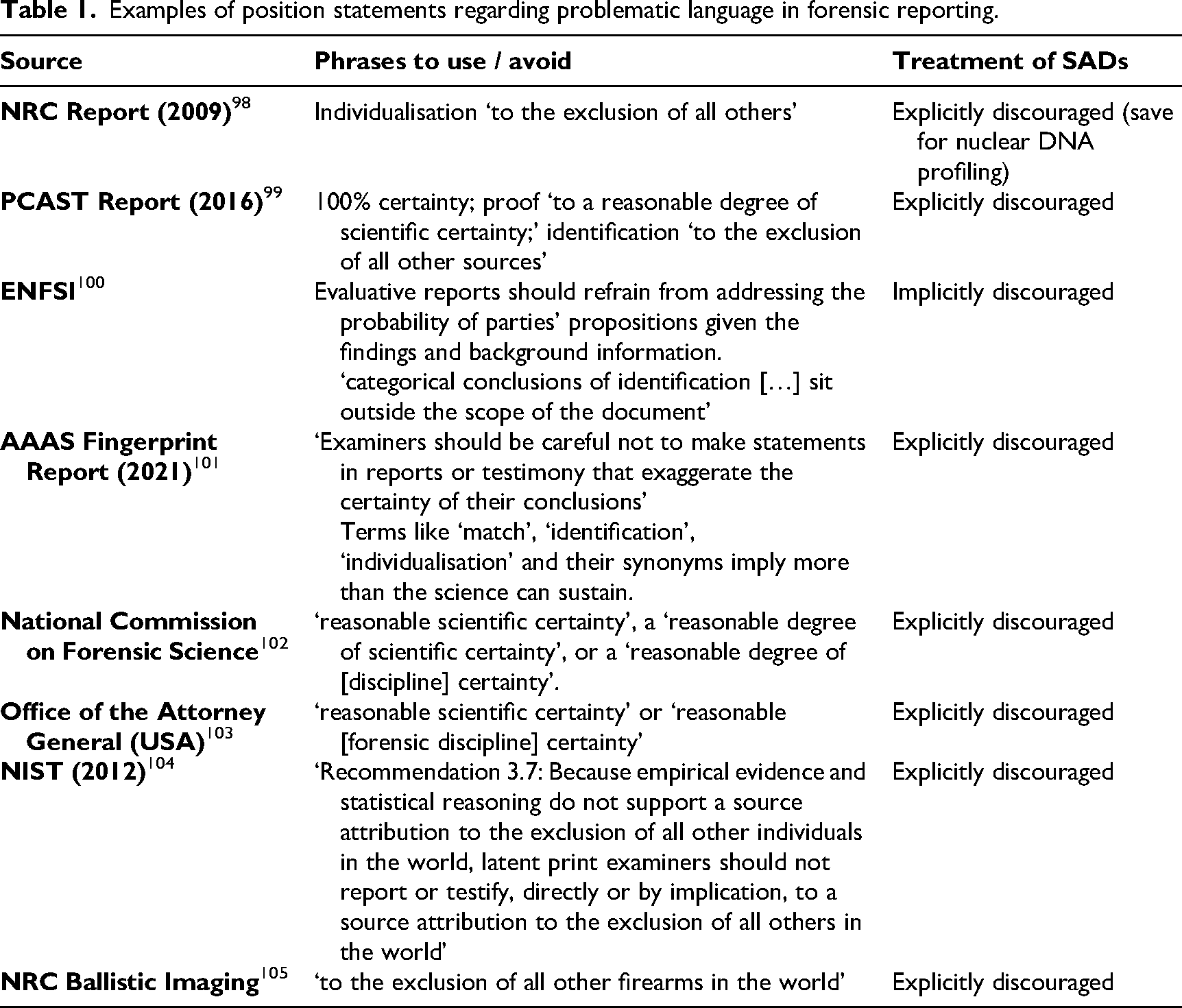
At the same time, however, embedded within this otherwise cautious framework arrived a subtle yet consequential exception – one that functions, conceptually, as a Trojan horse. The standard ISO 21043-4 permits the examiner to reach and convey a categorical opinion (such as a SAD) if, in their judgment, ‘it would be impossible to obtain the observations if any alternative proposition were true’ (ISO 21043-4, para 6.3). While this may seem to preserve scientific modesty by reserving categorical claims for only the most compelling observations and findings, it nevertheless imports, de facto, a form of epistemic overreach under the guise of (unauthorised) practitioner discretion.
The problem lies in the nature of the judgment required. Asserting that none of the alternative hypotheses could account for the findings is not a properly derived probabilistic assessment – it is a logical requirement conveyed as an inevitable conclusion. However, in the empirical world, and especially in forensic practice, such certainty cannot be achieved.
90
As the PCAST-Report put it: Troublingly, expert witnesses sometimes go beyond the empirical evidence about the frequency of features—even to the extent of claiming or implying that a sample came from a specific source with near-certainty or even absolute certainty, despite having no scientific basis for such opinions. From the standpoint of scientific validity, experts should never be permitted to state or imply in court that they can draw conclusions with certainty or near-certainty.
91
In this light, the said provision risks collapsing the distinction between probabilistic reasoning and decision-making – not by defying science openly, but by quietly reintroducing outdated and discredited forensic certainties under the rubric of individual judgment. The danger is not simply rhetorical; it is rather methodological in nature. While one interpretation of para. 6.3 of ISO 21043-4 is that it is a formal clause that sets a high bar and therefore should prevent extreme conclusions, it nevertheless opens the door for practitioners to exceed what the data can bear, 93 while formally appearing to comply with scientific standards. The prohibition against categorical expressions shaped ‘as statements of fact’ is directly undermined by the simultaneous allowance of categorical conclusions based on an examiner's personal judgment of ‘impossibility’. The result is a normative framework that outwardly endorses restraint while covertly permitting precisely what it claims to forbid.
The ISO 21043-4 thus contains this contradiction. It allows practitioners to adopt probabilistic reasoning but simultaneously permits categorical conclusions – provided they believe it would be ‘impossible’ for alternative propositions to account for the findings. This is like exhorting the examiner: It's unscientific to claim ‘certainty’, unless you feel sure.
But ‘certainty’ in this context is a fiction:
a) It cannot be empirically validated – there is no scientific method that can establish the impossibility of findings under all alternatives. b) It is a function of personal judgment – one can declare certainty at will. Certainty, then, is no longer the outcome of deliberation but imposed by fiat. But epistemic justification has to be earned by giving reasons, just as energy has to be produced.
This exposes a disturbing asymmetry. While the likelihood ratio framework responds to the requirements of robustness, transparency and logic, the appeal to ‘impossibility’ invites unbridled epistemic discretion: no scientific models, no assumptions, no need to articulate what alternatives have been considered, let alone empirically investigated – just a leap into categorical assertion. The result is a methodological loophole: forensic science claims the authority of probabilistic reasoning, then abandons it when convenient. ‘Impossibility’ thus becomes the gateway through which subjectivity (‘the examiner's judgement’, para. 6.3 ISO 21043-4) re-enters, shielded by the language of scientific certainty.
There is also a pragmatic risk embedded in the ISO framework: the allowance for categorical conclusions, even under the guise of examiner judgment, may be perceived by fact-finders as a delegation of responsibility. If forensic practitioners are allowed to present their conclusions as definitive – even with internal qualifiers – fact-finders may treat these opinions as conclusive, diminishing their own responsibility for independent assessment, especially when the ‘impossibility’ assessment relies on supposedly special knowledge that laymen lack and may therefore be discouraged from challenging. In this way, the ISO 21043-4's exception functions not only as a conceptual loophole but also as a practical outlet: it may inadvertently encourage judicial actors to rely on forensic certainty where, in truth, none can be guaranteed.
The ISO 21043-4 framework endorses categorical conclusions when it would be ‘impossible’ for any alternative to account for the findings – yet impossibility relative to what exactly?
Logical impossibility is unintelligible, as even implausible scenarios (e.g. a planet made of green cheese) remain logically possible and, formally, probability (theory) does not prevent us from placing belief in such fancy propositions. Claims of empirical impossibility overstate the case; from a probabilistic standpoint, it is unjustified to assert that no alternative explanation could account for the findings.
94
If ‘impossible’ means merely highly unlikely, then it is a matter of probabilities, not a categorical conclusion (and demonstrates that one reaches beyond the available evidence), returning us to the relevance of the likelihood ratio framework.
Over 30 years ago, D.A. Stoney expressed a moment of professional introspection when he asked, ‘What made us ever think we could individualise using statistics?’
95
That question marked a turning point in the field's understanding of the epistemic limits of forensic inference. Yet today, we face a different – and arguably more troubling – development: the institutional acceptance of categorical conclusions grounded in claims of ‘impossibility’. It would be unfortunate if, a generation from now, we were compelled to ask:
What made us ever think we could accept the Trojan horse of
‘impossibility’ as an international standard for expert witness testimony?
The notion that examiners can make statements about their findings given all alternative hypotheses represents not merely an epistemic overstatement, but a pseudo-normative sleight of hand. It effectively disposes of the structured, probabilistic reasoning associated with likelihood ratios and reintroduces categorical judgment under the guise of expert discretion. This shift deserves careful scrutiny – not just for what it claims to establish, but for what it allows to bypass unchallenged.
We submit that the standard ISO 21043-4, by permitting categorical conclusions based on untested, indeed untestable judgments of ‘impossibility’, poses a serious threat to the rationality and integrity of the criminal justice system. It blurs the line between empirical assessment and normative decision-making, allowing claims of subjective certainty to substitute objective evaluation. In doing so, it not only undermines the evidentiary standards designed to protect against arbitrary fact-finding and convictions but also distorts the role of expert testimony by encouraging epistemic overreach under the banner of professional judgment.
Arthur Conan Doyle once quipped: ‘When you have eliminated all which is impossible, then whatever remains, however improbable, must be the truth’ 96 – charming advice for a detective novel, but disastrous in a courtroom. Unlike Holmes's fictional world, the forensic context is not closed; 97 the hypothesis space is open-ended, defeaters abound, and the unknown unknowns are legion. Smuggling Doyle's logic into the courtroom is a Trojan horse: it imports the illusion of closure into a domain that is, by its very nature, open-ended and uncertain.
Footnotes
Acknowledgement
The research project has greatly benefitted from a generous scholarship awarded to the first author by the Max Planck Institute for the Study of Crime, Security and Law (Freiburg im Breisgau / Germany, May–July 2025). All URLs were valid in May 2026.
Funding
The authors received no financial support for the research, authorship, and/or publication of this article.
Declaration of Conflicting Interests
The authors declared no potential conflicts of interest with respect to the research, authorship, and/or publication of this article.