







Abstract
This study examined cultural and generational differences in views on intergroup dating relationships among members of younger and older generation South Asian and European Canadians and the role of mainstream and heritage cultural identities in shaping these views. In response to a scenario describing an intergroup dating conflict between a young adult and his or her parents, as well as on self-report measures of attitudes toward intergroup dating, South Asian Canadians and members of the older generation exhibited less favorable views on intergroup dating compared to European Canadians and members of the younger generation. Moreover, Canadian identity was consistently associated with more favorable views on intergroup dating, and this relationship was stronger for the South Asians. By comparing members of younger and older generation immigrants to their majority culture counterparts, the study adds a developmental layer to views on minority-majority group romantic relationships.
Keywords
Intimate interpersonal relationships have been identified as a potential locus for cultural conflict between second-generation immigrant children and their first-generation immigrant families, along with education and career matters (e.g., Chung, 2001; Kwak & Berry, 2001). Dating, and particularly dating a member of another cultural group, has the potential not only for intergenerational conflict but also for an internal cultural conflict for second-generation immigrants. Forging an intimate relationship with someone from another cultural group can be seen as jeopardizing heritage culture continuity. It is therefore of importance to understand how immigrant parents and children view dating a person of another cultural/ethnic/racial background and to identify the social psychological variables that are associated with these views. The current article aims to examine cultural and generational differences in views on intergroup relationships and to examine the role of mainstream and heritage cultural identities in these views.
In multicultural countries such as Canada, many members of ethnic minority groups show openness to being romantically involved with a member of another cultural group. The 2006 Canadian Census reports that among visible minorities groups, Japanese, Latin Americans, and Blacks were found to engage in the greatest number of intergroup/interethnic marriage, with more than 40% of their marriages being mixed unions (2006 Census Canada). Conversely, the visible minority having the least number of mixed unions were South Asian immigrants, with only 12.7% marrying outside of their cultural community. Berrington (1994) reports convergent findings in his study with South Asians in Britain, purporting that among a number of ethnic groups (e.g., Caribbean, Chinese, African) South Asians were significantly less likely to form intergroup romantic relationships with Whites. These findings suggest that although some South Asians in Western countries such as Canada and Britain are open to intergroup romantic relationships, the majority still endorse a preference for endogamous relationships (i.e., marrying or dating within one’s heritage ethnic group).
The present study was designed to understand attitudes toward intergroup romantic relationships of younger and older generation South Asian Canadian immigrants in comparison to the majority younger and older generation European Canadians and to explore the role of mainstream and heritage cultural identities in potentially shaping these attitudes. We examine these questions by means of a hypothetical intergenerational conflict regarding intergroup dating and questions measuring attitudes toward intergroup dating.
Cultural Differences in Views on Romantic Relationships
An important manifestation of difference in cultural value systems is evidenced in how romantic relationships are viewed and experienced. The primary Western perspective on intimate relationships has a focus on the importance of romantic love (Dion & Dion, 1993) and marriage is seen as the union of two individuals who have pursued their preferences and desires (S. R. Gupta, 1999). Although family approval might be desirable within this perspective, individuals are expected to follow their own decisions and to find their partners without parental assistance. A life partner, therefore, is not necessarily expected to be from the same cultural, ethnic, or religious group as love is generally believed possible between any two individuals regardless of their background.
The South Asian perspective on marriage is somewhat at odds with the Western perspective, as marriage is often seen as an alliance of families rather than two individuals (G. R. Gupta, 1976; Katti & Saroja, 1989). Arranged marriages are quite common in South Asian cultures, and they can be seen as fulfilling the needs of the family rather than the individual (Dion & Dion, 1993; Goodwin & Cramer, 2000; Naidoo & Davis, 1988). In such arrangements, future partners are introduced to each other after families are carefully screened for factors such as its reputation, its economic standing, and the education of the future husband/wife in order to ensure successful matching between the two families (Bhachu, 1985; Goodwin, 1999). Family approval of a future spouse is necessary, and children are not as encouraged to follow their own decisions as they would be in a Western culture. This view on relationships can serve an additional function within immigrant South Asian communities, namely to protect relationships from being formed between members of different cultural groups and thereby ensuring cultural continuity. One’s partner would not only be expected to have a similar social status but would also be expected to share a cultural and religious background. Thus, among South Asian immigrant communities in multicultural societies such as Canada, the norm of choosing a partner from one’s own cultural ingroup is likely to conflict with the norm of tolerance promoted by the mainstream culture when it comes to intergroup dating and marriage. The current study examined the dynamics of these norms by focusing on the intergroup dating views of South Asian and European Canadians.
Generational Differences in Views on Intergroup Romantic Relationships
Generational parent-child differences in views on dating have been reported to be common regardless of cultural background. For example, Sam and Virta (2003) found significant value discrepancies between adolescents and their parents regarding children’s rights, with adolescents endorsing more liberal views than their parents among both nonimmigrant and immigrant groups. Phinney, Ong, and Madden (2000) similarly found intergenerational discrepancies in a measure of family obligations for immigrant and nonimmigrant samples, with children expressing less support for family obligations than their parents. Moreover, Phinney and Vedder (2006) report that this intergenerational value discrepancy is larger within immigrant families than nonimmigrant families. Although generational differences in dating norms will be found in numerous cultures, these differences may play out differently within immigrant groups, since they often need to negotiate and reconcile different sets of norms regarding romantic relationships, thus adding a cultural layer to the phenomenon of intergenerational norm conflict.
In her analysis of South Asian Canadians, S. R. Gupta (1999) reports that first-generation South Asian immigrants value strong ties with members of their own community and work toward the promotion of the continuation of ethnic heritage, cultural, and religious practices in their children. Their children, however, may not share these ideals to the same extent, having been exposed to both heritage and mainstream cultural value systems more systematically than their parents. Empirically, although a growing number of studies pay attention to South Asian immigrants living in Canada (e.g., Talbani & Hasanali, 2000) and the United States (e.g., Dasgupta, 1998; Dugsin, 2001; Pettys & Balgopal, 1998) and the conflict they experience around issues of dating and marriage, research evidence on generational differences is limited. Recently, Goodwin and Cramer (2000) conducted interviews with 70 British-Indian couples from a younger (under 30 years of age) and older generation (50 years of age or above) and found that the younger generation were more likely to marry as a result of introducing themselves or dating (34%), compared to the older generation (3%). Younger participants reported placing more importance on their own personal desires of trust and friendship, whereas the older generation emphasized finding a partner who had a good relationship with the wider family. In the present study, we aim to extend the investigation of generational difference on romantic relationships to South Asians in Canada in comparison to European Canadians.
The Role of Mainstream and Heritage Identities in Views on Intergroup Dating
Immigrants are likely to be pulled and pushed by their heritage and mainstream identities when engaging in their close interpersonal relationships. Integration, the most popular acculturation strategy (e.g., Phinney, Berry, Vedder, & Liebkind, 2006), involves an identification with the heritage culture along with participation in the mainstream culture (Berry, 1997; Sommerlad & Berry, 1970). Thus, both heritage and mainstream identities are expected to matter in acculturative processes.
Immigrant groups, especially first-generation immigrants, may emphasize the continuation of heritage cultural identity and socialize their children accordingly. For example, in a study of parenting goals among South Asian Canadian mothers, Maiter and George (2003) found that identity formation appeared as one of the most important parenting goals in this group. Specifically, the mothers felt that not educating their children about South Asian culture would leave them without a sense of belongingness, while the transmittance of strong South Asian identity would result in greater family connectedness and a sense of community.
While heritage cultural identity may play an important role in the shaping of immigrants’ overall identity and ensure cultural continuity, first- and second-generation immigrants also acquire a mainstream cultural identity. What respective contributions will be made by the mainstream and heritage identities in shaping immigrants’ psychological adjustment and their interactions with both communities? Some evidence from multicultural contexts indicates that heritage and mainstream cultural identities tend to be relatively independent of each other in different Chinese immigrant samples in Canada (Ryder, Alden, & Paulhus, 2000) and the United States (Tsai, Ying, & Lee, 2000) in their influence on the acculturation process. Ryder et al. (2000) found that identification with the mainstream culture was a significant positive predictor of psychosocial adjustment for Chinese Canadians, while heritage culture identification was unrelated to adjustment. Moreover, Uskul, Lalonde, and Cheng (2007) showed that positive attitudes toward intergroup dating among Chinese Canadians was positively related to the endorsement of mainstream Canadian identity but not related to heritage identity. Finally, Lalonde, Hynie, Pannu, and Tatla (2004) found that preference for traditional attributes in a mate was positively related to South Asian Canadians’ heritage culture identity but unrelated to their mainstream cultural identity. With respect to views toward intergroup dating, both heritage and mainstream identities are expected to play a role in the shaping of these views, albeit in opposite directions: while ingroup identification would be expected to drive preferences for endogamy (i.e., marrying or dating within one’s heritage ethnic group), identification with the majority culture would drive greater openness to exogamy (dating or marrying outside one’s ethnic group) and to dating norms prescribed in that culture. Stronger endorsement of mainstream Canadian identity was therefore expected to be associated with more favorable attitudes toward intergroup dating and heritage cultural identity was expected to be associated with less favorable attitudes towards intergroup dating.
Method
Participants
One hundred and eighteen South Asian Canadians (58 men, 60 women) and 120 European Canadians (60 men, 60 women) participated in the study. In each cultural group, approximately half of the sample represented the older generation (60 European Canadians and 58 South Asian Canadians) and the other half represented the younger generation (60 participants in each cultural group). Younger participants were recruited on a university campus and through social networks. Older participants were recruited by the third author using convenience sampling in the Greater Toronto Area. Within the older generation, South Asian Canadians (M = 51.70, SD = 9.54) were somewhat older than European Canadians (M = 47.50, SD = 8.61; p = .001), while younger South Asian Canadian participants (M = 24.10, SD = 3.31) did not differ from younger European Canadian (M = 24.31, SD = 3.48) in age, as indicated by a significant interaction between cultural group and generation, F(1, 229) = 6.13, p = .014. As expected, the younger generation was younger than the older generation, F(1, 229) = 813.96, p < .001.
All participants were either Canadian citizens or had landed immigrant status/permanent residency. Most European Canadians (80%) were born in Canada. When asked to specify their “ethnic” background, 35% of older and 37% of younger European Canadians reported European ethnic groups (e.g., Irish, Italian, Croatian). All older South Asian Canadians were born outside of Canada; the mean age of arrival in Canada was 26.08 years (SD = 8.22). The majority of the younger generation were born in Canada (78%), and of those who were not, the mean age of arrival was 13.36 years (SD = 7.06). The majority of South Asian Canadian participants born outside of Canada came from India (80%), while the rest indicated countries such as Sri Lanka, Pakistan, Zambia, and Kenya as their birth place. 1 When asked to identify their “ethnic” background, the majority of South Asian Canadian participants (63%) identified themselves as having an Indian or Punjabi ethnic background.
The levels of educational attainment across generations and cultural groups were comparable. The only difference was in the percentage of individuals with university degrees in the older European Canadian (63%) and South Asian Canadian (89%) samples (χ2 = 9.95, p = .002), which mirrors Canadian census data (Canadian Census, 2006).
Procedure and Measures
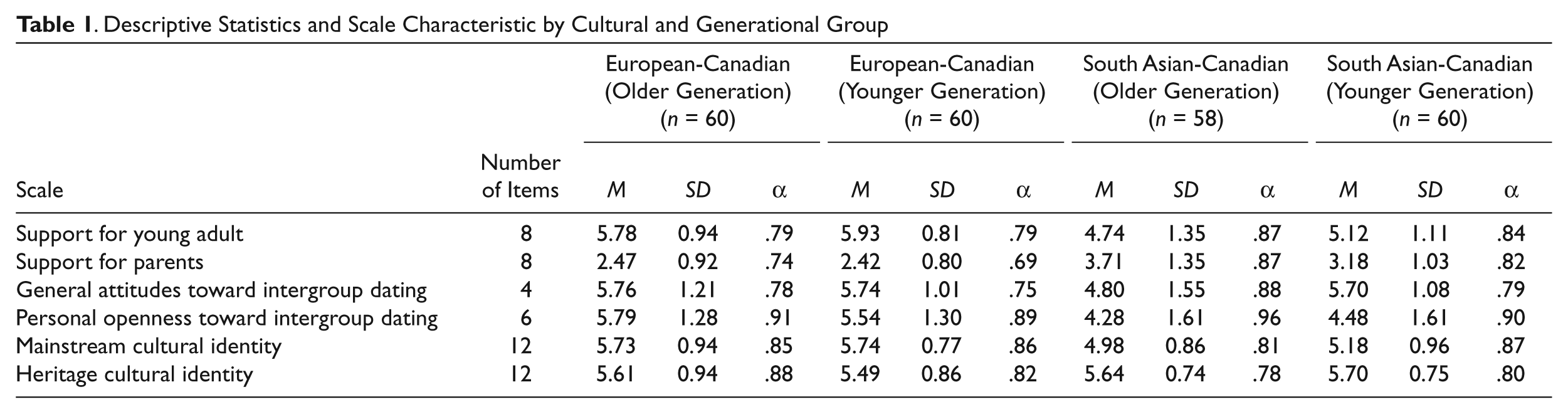
After providing informed consent and responding to a series of demographic questions, all participants read a scenario depicting a conflict between a young South Asian adult and his or her parents with regard to interethnic dating. Following this scenario, participants completed scales measuring support for the young adult and his or her parents in this conflict, as well as measures assessing cultural identification and intergroup dating attitudes. All scale items used 7-point Likert-type scales (1 = strongly disagree to 7 = strongly agree). All participants completed the questionnaire in English. Descriptive statistics and reliability coefficients for each study measure are presented in Table 1 for each cultural and generational group.
Descriptive Statistics and Scale Characteristic by Cultural and Generational Group
Conflict scenarios
The conflict scenarios were adapted from Uskul et al. (2007). A one-page scenario described a conflict between a South Asian Canadian university student, Priya or Raj, and his or her parents, who immigrated to Canada when Priya (Raj) was 3 years old. The conflict concerned Priya’s (Raj’s) involvement with an opposite sex Canadian of European descent, Tim (Joanne), despite her (his) parents’ disapproval. Priya (Raj) was described as enjoying both the Canadian culture and his (her) heritage culture. The parents were described as having strong ties to the South Asian community in Toronto, thus hoping that their children would marry a person of South Asian descent. Participants were randomly assigned to one of the two versions of the scenario (Priya dating Tim and Raj dating Joanne). The number of participants in each condition per cultural group and gender was balanced.
Measures of support for the young adult and parents
After reading the story, participants completed two eight-item scales (adapted from Uskul et al., 2007), measuring support for Priya (Raj) and for her (his) parents in the depicted conflict. The first set of eight items involved actions that the young adult should take and evaluations of his (her) position (e.g., “Raj is being reasonable about her relationship with Joanne”). The second set of eight parallel items addressed the actions and position of the parents (e.g., “Priya’s parents should put their daughter’s wishes before their own when it comes to her dating choices”). The mean of each set of items provided an index of support for the young adult and for the parents. We examined the cross-cultural structural equivalence of the support scales by calculating factorial agreement using the most stringent identity index. Results revealed an identity factor of .94 for support of young adult scale and .89 for the support for the parent scale. According to recommendations cited in Van de Vijver and Leung (1997), these values can be taken as evidence for factorial similarity.
Cultural identification
Cameron’s (2004) measure of social identity was used to measure the strength of both mainstream (Canadian) and heritage culture identifications. This 12-item scale is adaptable for the measurement of the strength of both identities (e.g., “In general, I’m glad to be Canadian” and “In general, I’m glad to be a member of my heritage culture”). Participants were asked to reiterate their ethnic identity before completing items relating to their heritage culture. We examined the factor structure of the two identity scales using the same method as described above. Results revealed an identity factor of .98 for Factor 1 (mainstream identity) and .89 for Factor 2 (heritage identity). These values again suggest factorial similarity.
Intergroup dating items
Ten items were used to examine attitudes toward intergroup dating (also see Lalonde, Giguère, Fontaine, & Smith, 2007; Uskul et al., 2007). They assess two distinct components: general attitudes toward and personal openness to intergroup dating. Four items tapped into general attitudes toward intergroup dating without specifying particular groups (e.g., “Persons of different races should not become seriously involved”), and six items tapped into personal openness toward intergroup dating where the younger generation European Canadians were asked about dating South Asians (e.g., “I would happily date a South Asian person”) and the younger generation South Asians were asked about dating European Canadians (e.g., “I am open to involvement in an intergroup relationship with a White person”). Older generation participants responded to the openness items by thinking of their child dating a member of the opposite cultural group (e.g., “I am open to my child’s involvement in an intergroup relationship with a South Asian person”)
Results
We first ran item bias analyses for all scale scores adopting the procedure recommended by Van de Vijver and Leung (1997) based on Cleary and Hilton’s (1968) use of analysis of variance, which entails the use of item scores as dependent variables and cultural groups and score levels as independent variables (see Van de Vijver & Leung, 1997, pp. 63-68). The inspection of main effects of cultural group and score levels and the interaction effect between cultural group and score levels on individual items in each scale revealed only a few significant effects with no systematic pattern. Thus, it is safe to conclude that no uniform and nonuniform bias was present in the current data and mean comparisons across cultural groups are justified.
Descriptive Statistics and Group Differences in the Endorsement of Identities
European Canadians scored higher on Canadian identity than did South Asian Canadians, t(236) = 5.70, p < .001. Heritage identity did not vary as a function of cultural group, t(234) = −1.13, p = .26.
Culture, Generation, and Intergroup Dating2
Multiple regression analyses were conducted with each dependent measure to examine the effects of cultural group, generation, and gender controlling for level of education, participants’ age, and age of arrival. In all regressions, we entered the control variables in Step 1, the main effects in Step 2 (cultural group, generation, and sex), the two-way interactions in Step 2, and the three-way interaction in Step 3. As shown in Table 2, Step 1 did not contribute significantly to the explanation of the variance in any of the regression models. In Step 2, cultural group emerged as significant predictors of all study variables: European Canadians gave greater support to the young adult, less support to the parents, had more positive general attitudes toward intergroup dating, and showed greater personal openness than did South Asian Canadians (see Table 1 for means and SDs). Generation emerged as a significant predictor of the three study variables: Younger participants gave greater support to the young adult, less support to parents, and had more positive general attitudes toward intergroup dating than did older participants. Participants’ sex emerged as a significant predictor for support for parents; male participants (M = 3.07, SD = 1.29) gave significantly more support to the parents in the conflict scenario than did female participants (M = 2.81, SD = 1.01).
Results of Regression Analyses for Four Criterion Variables With Generation, Cultural Group, and Sex as Predictors
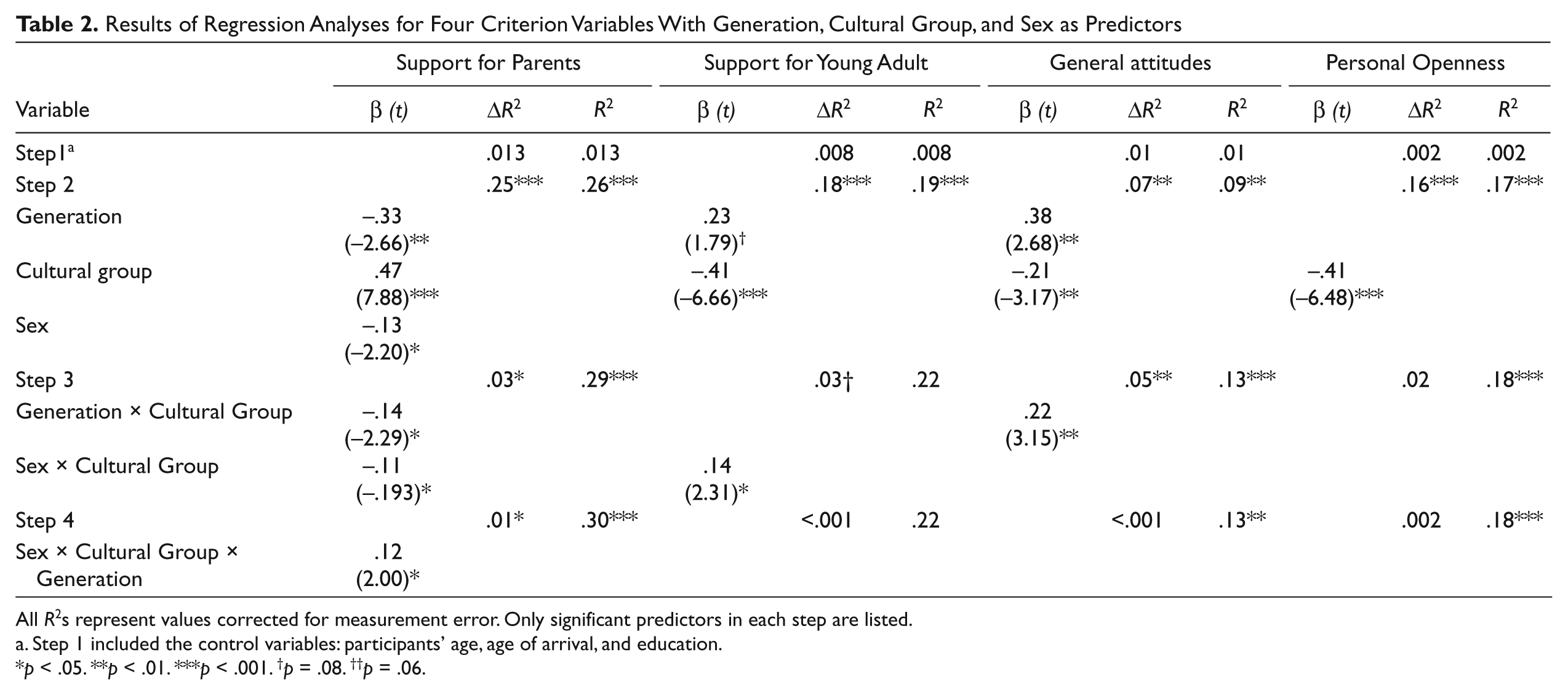
All R2s represent values corrected for measurement error. Only significant predictors in each step are listed.
Step 1 included the control variables: participants’ age, age of arrival, and education.
p < .05. **p < .01. ***p < .001. †p = .08. ††p = .06.
A significant Generation × Cultural Group interaction emerged for general attitudes toward interethnic dating and support for parents. For both measures, the interaction was driven by the generation difference in the South Asian Canadian group; the older generation had significantly less positive attitudes toward interethnic dating and gave greater support to parents compared to the younger generation (p < .001 and p < .01, respectively), whereas such difference was absent in the European Canadian group. A significant Sex × Cultural Group interaction emerged for the two support measures. For both measures, the interaction was driven by the sex difference in the South Asian Canadian group such that in this group men gave significantly greater support to parents and less support to the young adult in the conflict scenario compared to women (p < .01 and p < .05, respectively), whereas such difference was absent in the European Canadian group. A significant Sex × Cultural Group × Generation interaction qualified the Sex × Cultural Group interaction for support for parents. Unfolding this interaction we found that all groups gave similar levels of support to parents except in the older generation South-Asian Canadian group where men gave significantly greater support to parents in the scenario than did women (p < .01).
Cultural Identities and Intergroup Dating
To examine the role of mainstream and heritage cultural identities in views on intergroup dating, we conducted multiple regression analyses controlling for level of education, participants’ age, and age of arrival. Control variables were entered in Step 1 followed by main effects in Step 2 (heritage and mainstream identities, cultural group, generation), two-way interactions in Step 3, three-way interactions in Step 4, and the four-way interaction in Step 5. These latter two steps did not add to the prediction of the study variables and will not be reported. As shown in Table 3, Canadian identity was a systematically significant predictor of all study variables; greater endorsement of Canadian identity predicted stronger support for the young adult and weaker support for parents in the conflict scenario, more positive general attitudes toward and greater personal openness to interethnic dating. Heritage identity was a significant predictor of three of four study measures: greater endorsement of heritage identity predicted stronger support for parents and weaker support for the young adult and lower levels of personal openness toward interethnic dating.
Regression Analyses for Four Criterion Variables With Canadian/Heritage Identities and Cultural Group as Predictors
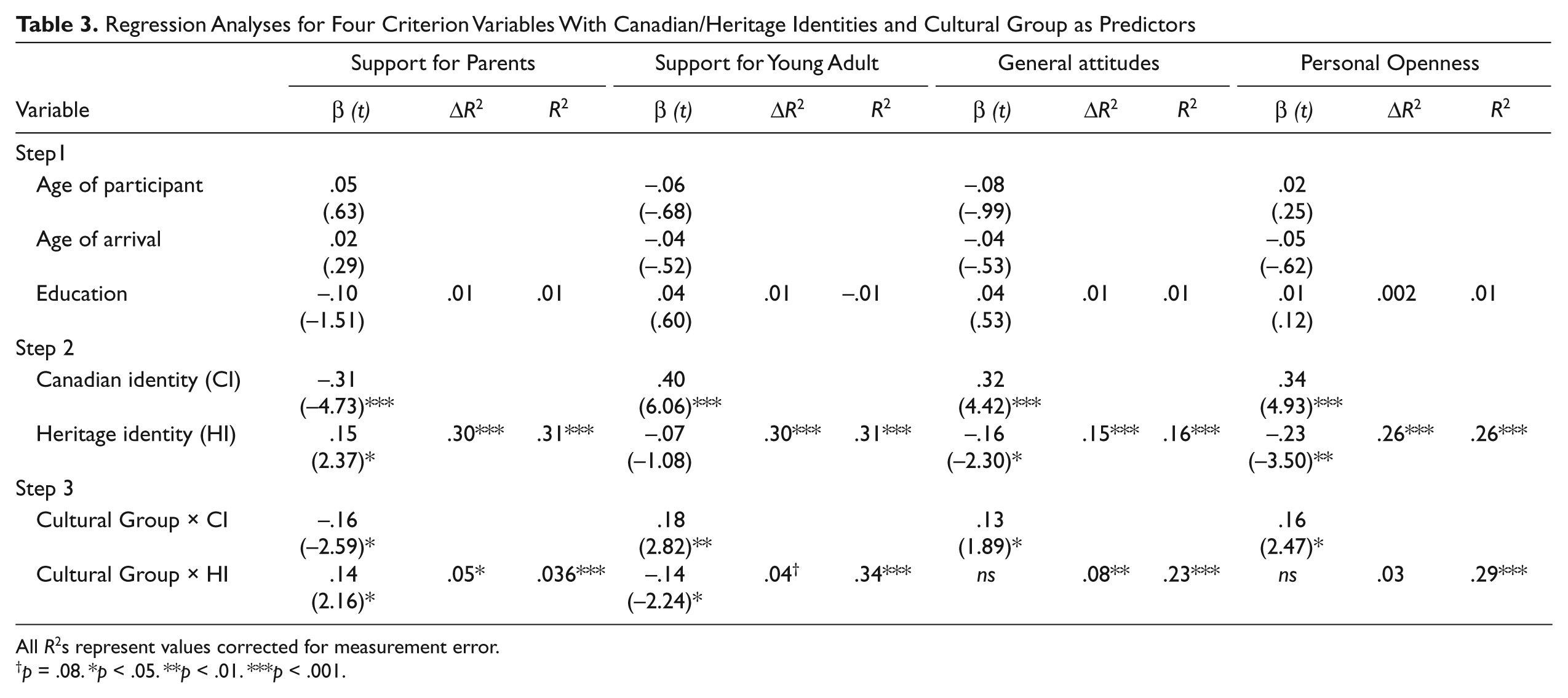
All R2s represent values corrected for measurement error.
p = .08. *p < .05. **p < .01. ***p < .001.
Importantly, a Canadian Identity × Cultural Group interaction emerged as a significant predictor of the two support measures and general attitudes toward interethnic dating. Unfolding these interactions following procedures suggested by Aiken and West (1991), we found that Canadian identity was consistently a stronger predictor of study variables in the South Asian Canadian group than in the European Canadian group. Specifically, in the South Asian Canadian group, the simple slope of the Canadian identity was steeper for support for the young adult (β = .52, p < .001), support for parents (β = –.41, p < .001), general attitudes (β = .38, p < .001), and personal openness (β = .47, p < .001) than in the European Canadian group (β = .27, p = .01, β = −.21, p = .04, β = .22, p = .04, β = .18, ns, respectively) (note, however, the nonsignificant ΔR2 for Step 3 for personal openness). The Heritage Identity × Cultural Group interaction was a significant predictor of support for the young adult and parents only. Unfolding these interactions, we found that heritage identity was a stronger predictor of support for parents and support for the young adult in the South Asian Canadian group (β = .27, p < .01 and β = –.30, p < .01, respectively) than in the European Canadian group (β = .10, ns, and β = −.19, p = .08, respectively).
Discussion
This study examined cultural and generational differences in views on intergroup dating among South Asian and European Canadians by means of a hypothetical intergenerational conflict regarding intergroup dating and questions measuring attitudes toward intergroup dating. Findings revealed cultural differences in all study variables with South Asian Canadians giving less support to the young adult and more support to the parents in the conflict scenario and showing more positive general attitudes toward intergroup dating and greater personal openness than did European Canadians. Thus, we observed stronger traditional normative expectations regarding intergroup dating among South Asian Canadians than among European Canadians. These findings suggest that South Asians are more likely to support endogamy and oppose intergroup romantic relationships which have the potential to jeopardize heritage cultural continuity. The findings are in line with previous studies pointing to South Asian immigrants’ family and ingroup-focused value-orientation with regard to romantic relationships (e.g., Dion & Dion, 1993; Goodwin & Cramer, 2000; Naidoo & Davis, 1988).
Findings also revealed generational differences for three study variables such that younger participants gave greater support to the young adult, less support to parents, and had more positive general attitudes toward interfaith dating than did older participants. These findings are in line with previous findings pointing to a discrepancy between the general views on dating of younger children and those of their parents (Kwak & Berry, 2001; Sam & Virta, 2003). This main effect, however, interacted with cultural group for two study variables revealing that generation differences were particularly strong in the South Asian Canadian group compared to the European Canadian group. Thus, stronger traditional normative expectations regarding intergroup dating were observed among South Asian Canadian members of the older generation compared to the members of the younger generation.
Gender differences also emerged in views on intergroup dating that were particularly strong in the South Asian Canadian group where men gave greater support to parents and less support to the young adult in the conflict scenario compared to women. For support for parents, this gender difference was stronger in the older generation than in the younger generation. These findings converge with previous literature suggesting weaker traditionalism (e.g., Talbani & Hasanali, 2000; Tang & Dion, 1999; Rosenthal, Ranieri, & Klimidis, 1996), particularly in the realm of close relationships (e.g., Chung, 2001; Levin, Taylor, & Caudle, 2007; Mok, 1999; Uskul et al., 2007) among Asian immigrant women in comparison to their male counterparts.
The Role of Mainstream and Heritage Identities in Views on Intergroup Dating
We predicted that both mainstream cultural identity and heritage identity would be associated with views on intergroup dating, albeit in opposite directions. As expected, greater endorsement of Canadian identity predicted more favorable views on intergroup dating and heritage cultural identity predicted less favorable views. Importantly, these associations showed different patterns across the two cultural groups. Specifically, Canadian identity was consistently a stronger predictor of more favorable views on intergroup dating in the South Asian Canadian group than in the European Canadian group. Similarly, heritage cultural identity was a stronger predictor of support for parents and the young adult in the South Asian Canadian. These correlational patterns were not found to vary by generation.
These findings demonstrate that both the mainstream and heritage identities play a role in shaping the views on intergroup dating, but particularly so for the South Asian Canadian group. Our contention is that, on one hand, mainstream (i.e., Canadian) cultural identity plays a contributing role in intergroup dating attitudes, because from a South Asian Canadian perspective, such views are more outgroup-focused than ingroup-focused. Identification with the mainstream culture facilitates interpersonal openness to members of that culture. A stronger Canadian identity, moreover, has been specifically associated with greater acceptance and encouragement of ethnic diversity (Lalonde, 2002). Thus, it is the mainstream identity that functions as a push-forward factor relating to an increase in positive attitudes toward intergroup dating. This finding is in keeping with Ryder et al. (2000), who found that most adjustment effects are carried by the mainstream identity aspect of integration rather than the heritage identity aspect. On the other hand, heritage identity functions as a pull-back factor relating to a decrease in positive attitudes toward intergroup dating, particularly so when it comes to the level of support shown for parents and the young adult in the conflict scenario—variables that might have made salient the ingroup-related consequences of dating outside of one’s cultural group.
Limitations
The current study compares Canadians of European and South Asian origin in terms of their attitudes toward intergroup dating. As revealed by the demographic characteristics of both groups, the immigration histories of European and South Asian Canadians are rather different. Moreover, whereas the data provide clear information on the heritage identity of South Asian Canadians, it is less clear what heritage identity constitutes for European Canadians in the current sample. Moreover, given that there is no information available on the degree of homogeneity and nature of the European heritage identities and South Asian identities, the comparability remains limited. Recruitment of samples of more homogenous heritage backgrounds and immigration histories in future research would increase the comparability of groups and strengthen the conclusions drawn.
Footnotes
The authors declared that they had no conflicts of interests with respect to their authorship or the publication of this article.
This research was supported by a standard research grant from the Social Sciences and Humanities Research Council of Canada that was awarded to the second author.
1.
Immigration of South Asian (particularly Indian) individuals to Canada occurred not only from the South Asian continent but also from East and South Africa and the Caribbean where South Asians settled and preserved their culture and traditions. Given this nature of South Asian immigration to Canada, participants who reported their birth place to be Kenya or Zambia were retained in the analyses.
2.
There were no main or interactions effects observed for the sex of the young adult (i.e., Priya vs. Raj) in the scenario. This variable is therefore excluded from the analyses.