







Abstract
This article represents one of the first cross-cultural explorations of ethical ideology among physicians. The study involved a total of 1,109 physicians from six countries (Canada, China, India, Ireland, Japan, and Thailand) who responded to the Ethics Position Questionnaire. A comprehensive Bayesian Confirmatory Factor Analysis demonstrated robustness of the ethical dimensions of idealism and relativism as fundamental across cultures, with noteworthy cross-cultural variation. In particular, a four-factor construct was revealed and suggested more complex ethical dimensions for Chinese physicians.
Of the many attempts to measure ethical orientation, the Ethics Position Questionnaire (EPQ) developed by Forsyth (1980) has been the most influential. The EPQ is based on two broad ontological concepts—idealism and relativism. Forsyth describes idealism as the degree to which an individual perceives the nature of the world as positive and having potential leading to goodness. Relativism is described as the extent to which one accepts absolutes or permanent/universal principles.
Studies featuring English-speaking participants have confirmed the two-factor structure of the EPQ using exploratory factor analytic techniques (e.g., Forsyth, Nye, & Kelley, 1988; Forsyth, O’Boyle, & McDaniel, 2008; Kenhove, Vermeir, & Verniers, 2001). A confirmatory factor analysis conducted by Davis, Anderson, and Curtis (2001), however, led to the conclusion that a three-factor solution best fits their data: The 10 “idealism” items were grouped together, but only eight remained together for “relativism.” Two items (EPQ19 and 20) grouped together to form a third factor they called “veracity.” More recently, Cui, Mitchell, Schlegelmilch, and Cornwell (2005) conducted a confirmatory factor analysis of the EPQ in Austria, Britain, Brunei, Hong Kong, and the United States. An acceptable two-factor idealism-relativism solution was confirmed by omitting seven low-loading items (EPQ 7, 9, 10, 11, 12, 19, 20) for Austria, Britain, Brunei, and the United States. Deletion of an additional two low-loading items (EQP 1, 12) also provided an acceptable two-factor solution for Hong Kong. Cross-cultural differences were also found by Redfern and Crawford (2004) in their exploration of ethical ideologies of business managers in China. Using exploratory factor analysis, these authors suggested a two-factor solution: The first factor corresponded closely to Forsyth’s idealism construct, retaining 7 of the original 10 idealism items. However, one item from the original relativism scale also loaded onto this first factor (EPQ 13). Only 4 of the original 10 relativism items were loaded onto the second factor (EPQ 15, 17, 19, 20).
We examine evidence for the similarity and variation of the factor structure of the EPQ in Thailand, China, India, Japan, Ireland, and Canada, countries that differ in culture and religious orientation (Hofstede, 1997). We chose these countries because, with the exception of Canada, each has a dominant religious orientation (e.g., Thailand/Buddhism, China/Confucianism, India/Hinduism, Japan/Buddhism and Confucianism, and Ireland/Catholicism) and the countries are culturally distinct (Hofstede, 1997). Moreover, we have established a strong research network with scholars in their respective health care systems.
Method
Participants and Procedures
Physicians 1 were participating in a larger investigation exploring the cross-cultural influences on ethical decision making. Their names were chosen at random from the national directory of physicians for five of the six countries. In China, physicians were selected from a convenience sample from three hospitals in Shandong Province. Eight hundred questionnaire packages were mailed out in each of the six countries. Out of a possible 4,800 responses, 1,109 surveys were returned for an overall response rate of 23.1%. Of the six countries, Thailand had the greatest response rate (39.9%) followed by China (25.5%), Canada (21%), Japan (19%), Ireland (17.8%), and India (16%).
Measures
EPQ (Forsyth, 1980)
The EPQ consists of 10 Likert-type style questions pertaining to idealism and 10 pertaining to relativism. Participants indicate their agreement or disagreement with each item (1 = strongly disagree; 9 = strongly agree). The EPQ has been shown to be reliable, valid, and not reflective of social desirability bias (e.g., Forsyth, 1980; Forsyth & Pope, 1984). For our study, Cronbach’s alpha values for the subscales, calculated for each country, ranged from 0.71 to 0.89.
Translation
The EPQ was administered in its original English form in Canada, Ireland, and India (the majority of Indian physicians spoke and read English). For Japan, Thailand, and China, the EPQ was translated into each local language. It was then back-translated into English in Canada by independent language experts. The back translations were reviewed by Canadian, Thai, Chinese, and Japanese collaborators to ensure accuracy. To ensure a diverse sampling of Canadian physicians representing both official languages, the EPQ was translated into French using the same procedure.
Bayesian Confirmatory Factor Analysis (BCFA)
A comprehensive BCFA was carried out to verify or falsify the Forsyth’s two-factor ethics position scale proposal (Forsyth, 1980). In addition, the three-factor construct presented in Davis et al. (2001) was also explored. In particular, Bayesian factor analytic modeling, which is asymptotically equivalent to the classical CFA (via covariance structure analysis), was implemented using the simulation-based Markov chain Monte Carlo (MCMC) method of Gibbs sampling using WinBUGs software (Spiegelhalter, Thomas, Best, & Lunn, 2003). The posterior estimates of the model parameters were derived from 30,000 samples derived from three chains of the Gibbs sampling, removing the initial 1,000 cycles. All factor models discussed herein exclude cross-loading.
The Bayesian CFA approach was taken as an alternative to the classical CFA and was shown to lead to consistent results and acceptable goodness-of-fit. The main analytic advantage of the Bayesian factor analysis over the commonly used classical/frequentist factor analysis is that the Bayesian method enables incorporation of prior information, which typically eliminates ambiguity of model constraints that are often found in classical EFA/CFA models (Press, 2003). For this specific BCFA, for example, information of “positive factor loadings” was used in the formulations of the prior distributions of the loading parameters. One novelty of the particular BCFA method is its formulation of multivariate Gaussian factor priors that facilitate assessment of interscale correlation/independence. For example, for a two-factor construct with idealism as
Results
Forsyth’s Two-Factor Structure
The BCFA confirmed the Forsyth two-factor structure for Thailand, Canada, and Ireland, respectively. 2 The resulting posterior estimates of the factor loadings were all statistically significant. The 20 items were modestly loaded onto their corresponding scales but comparably weak loadings were also observed: EPQ 10 has a small loading for each of the three countries; EPQ 7 has a low loading for Thailand. The total item variation explained by the two-factor construct was 32% for Thailand, 33% for Canada, and 35% for Ireland. Small and marginally significant interfactor correlations were observed in the Thai EPQ and Canadian EPQ models. These were (posterior mean) −0.21 (95% credible interval) (−0.35, −0.07) for Thailand and 0.20 (0.00, 0.37) for Canada. The BCFA model for Ireland indicated orthogonal “idealism” and “relativism” factors: 0.16 (−0.04, 0.37).
The fitted two-factor BCFA model for Japan resulted in only one small and statistically insignificant factor loading for item EPQ 11. The posterior estimates for the rest of the loading parameters were sizeable and suggested factor patterns that were similar to those for Thailand, Canada, and Ireland. The Japanese model explained 43% of the total item variability and suggested orthogonal “idealism” and “relativism” factors: −0.13 (−0.33, 0.05). The India model resulted in six items (EPQ 3, 4, 5, 6, 8, 10) being significantly loaded onto “idealism,” with the 10 relativism items having significant loading estimates. The BCFA also suggested a minor interfactor correlation: 0.25 (0.05, 0.46). As for the Chinese model, seven of the idealism items (EPQ 2-7 and 10) and six of the relativism items (EPQ 14-19) had statistically significant posterior loadings. More specifically, EPQ 2, 6, 12 had low loadings, but EPQ 3, 4, 5, 10, 14-18 were highly loaded onto the respective scales. The model explained 38% of the total item variation and indicated a high positive interfactor correlation: 0.62 (0.46, 0.80).
Four-Factor Alternative for the Chinese EPQ
A further Bayesian factor analysis of the Chinese data confirmed a much improved four-factor solution (Idealism A, Idealism B, Relativism A, and Relativism B), with significant (sizeable) item loading estimates except for item 7, which has a small and statistically nonsignificant item loading estimate. These results are presented in Table 1. The subscale Idealism A (EPQ 1, 2, 6, 8, and 9) was orthogonal to the subscale Idealism B (EPQ 3, 4, 5, 7, 10). The relativism subscales (Relativism A: EQP 11, 12, 13, 19, 20, and Relativism B: EPQ 14-18) were also orthogonal (0.06 (−0.10, 0.22)). The BCFA indicated a negative correlation between Idealism B and Relativism A (−0.53 (−0.72, −0.37)) and a positive correlation between Idealism B and Relativism B (0.65 (0.49, 0.83)). Moreover, a comparably smaller but statistically significant negative correlation was observed between Idealism A and Relativism B (−0.28 (−0.45, −0.13)).
BCFA Four-Factor Model 2 for China
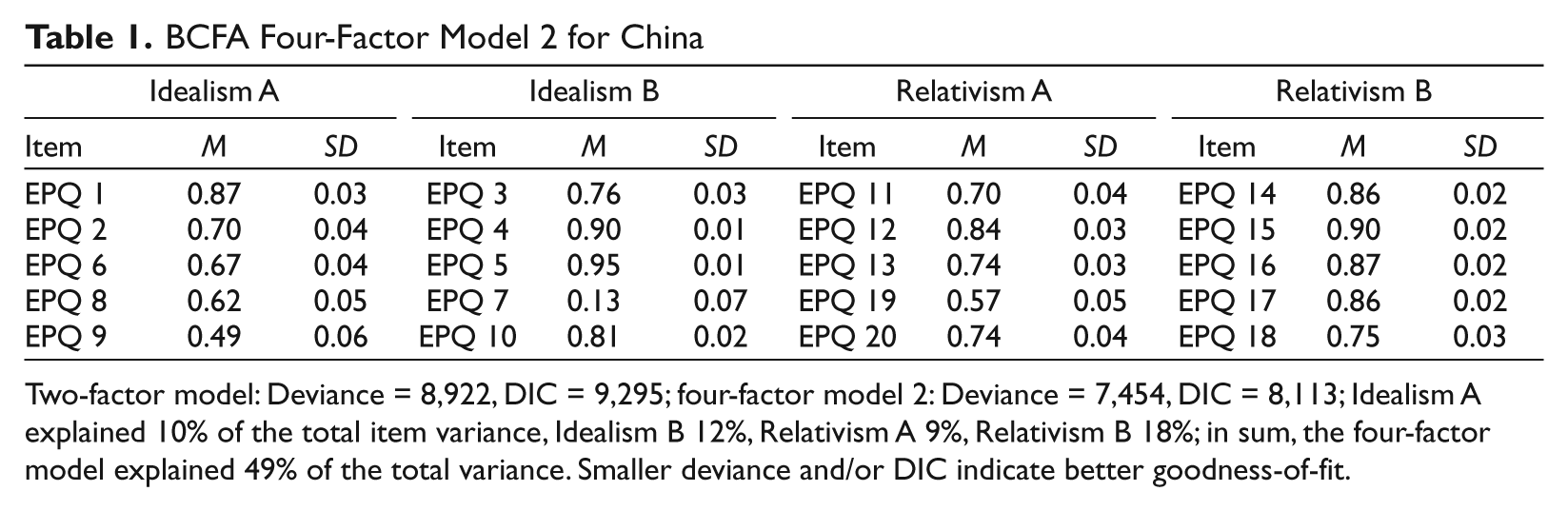
Two-factor model: Deviance = 8,922, DIC = 9,295; four-factor model 2: Deviance = 7,454, DIC = 8,113; Idealism A explained 10% of the total item variance, Idealism B 12%, Relativism A 9%, Relativism B 18%; in sum, the four-factor model explained 49% of the total variance. Smaller deviance and/or DIC indicate better goodness-of-fit.
It is worth mentioning that the five-item idealism and relativism subscales for China were motivated by our careful observations of the fitted two-factor Chinese model. Specifically, the EPQ 1, 2, 6, 8, and 9, having small loading parameters in the two-factor model, were grouped to form the subidealism factor named Idealism A, and the remaining five items formed Idealism B. The EPQ 11, 12, 13, and 20, also having small item loadings in the two-factor model, were gathered to form the subidealism scale named Relativism A; EPQ 19 was also grouped to Relativism A, because EPQ 19 and 20 were shown to be highly correlated. In addition, allocating EPQ 19 to Relativism A was also consistent with the Davis et al. (2001) finding, in which EPQ 19 and 20 were shown to form a common factor named “veracity.”
Discussion
The two major dimensions of relativism and idealism emerged across cultures that differ in religious orientation, providing support for the robustness of these dimensions. Nonetheless, some differences across countries emerged. Specifically, our BCFA results from three of the six countries suggested evidence of minor to modest idealism-relativism interfactor correlation. Minor idealism-relativism interfactor correlation was also observed by Redfern and Crawford (2004). At the same time, our BCFA results from Ireland and Japan also indicated evidence of orthogonality for these two dimensions. These observed differences in the interfactor correlation coefficients may reflect minor to modest heterogeneities observed from the country-specific item factor loading pattern—the BCFA models for Thailand, China, and India resulted in some low and statistically nonsignificant item-specific factor loadings, whereas the BCFA models for Ireland and Japan resulted in high factor loadings for most of the items (with only a few exceptions). In Japan, for example, EPQ 11 did not load onto the relativism factor. This item may be too broad to accurately reflect the relativism dimension. Three items from the original idealism scale (EPQ 2, 7, 9) did not (significantly) load onto this factor for India. For China, EPQ 1, 8, 9, 11, 13, 20 failed to (significantly) load onto the respective factors. It is important to note that these results are comparable to those observed in the two recent studies of Chinese data. Specifically, in the Cui et al. (2005) analysis, EPQ 1, 8, 9, 11, 20 were dropped (due to low loadings) from the two-factor EPQ construct, and in the Redfern and Crawford (2004) results, EPQ 8, 9, 11, 20 had low item loadings. Due to the limited information available, we are not able to offer evaluative comments on the results presented in Cui et al. (2005) and Redfern and Crawford (2004). Our in-depth analysis of the Chinese physician data, however, suggested a more complex four-factor solution. Even though such construct was not explored in Cui et al. (2005) and Redfern and Crawford (2005), it might be possible that the Chinese data used in the two previous studies also suggest evidence of a similar four-factor solution.
A closer look at the Chinese data and a further exploration of the more complex factor structure reveal findings that were unique to the Chinese physicians. For example, the Chinese physicians scored overwhelmingly high for EPQ 1, 2, 6, 8, and 9. Removing these items from the two-factor model led to nearly identical two-factor model estimation and nearly identical goodness-of-fit. It is important to note that the finding of the Chinese physicians scoring high on the five EPQ items may be indicative of valuable information on ethical orientation unique to the Chinese, and such information is retained in the four-factor construct. Perhaps more importantly, it should be noted that, on the one hand, the four-factor solution for China suggests evidence of two orthogonal subidealism factors and two orthogonal subrelativism factors, which also served as supporting evidence for the idealism and relativism dimensions. On the other hand, the observed interfactor correlations between “Idealism B” and the two relativism subscales suggests potentially more complex ethical dimensions for the country. More studies with independent data are needed before this idea can be fully supported. Interpretation of the four-factor Chinese model also requires additional research. It is possible that intricacies in the translation could have, to some extent, affected the results. However, given that the questionnaire underwent successful back-translation, it is most probable that other factors were at play. As such, our recommendation is for future research to determine whether our solution can be confirmed or refuted (preferably with data of larger sample size) and to investigate the variables that relate to the various factor scores in order to facilitate the emergence of this four-factor solution.
Limitations of our study include the extent to which our physician samples were representative and, as is typical with survey research in general, the inherent superficiality of items to reflect the shear complexity of one’s ethical ideology. Potential impact of gender, age, and specialty on variable correlations may be formally investigated within a BCFA with covariates. However, this was not implemented here due to small sample size.
Footnotes
The authors declared that they had no conflicts of interests with respect to their authorship or the publication of this article.
This research was supported through a Social Sciences and Humanities Research Council of Canada Grant to David Cruise Malloy and Thomas Hadjistavropoulos and a Natural Sciences and Engineering Research Council of Canada Grant to Ying C. MacNab.
1.
A table with detailed demographic information about the sample is available from the corresponding author upon request.
2.
Tables with Bayesian two-factor CFA loadings are available by request from the corresponding author.