







Abstract
Based on research with Bond’s Chinese Values Survey (CVS) across 23 countries, Hofstede added a fifth dimension, Long- versus Short-Term Orientation (LTO), to his earlier four IBM-based dimensions of national cultures. The authors attempted to replicate this dimension by analyzing World Values Survey (WVS) items that seemed to capture the concept of LTO. Their factor analysis of 10 such items across 38 countries resulted in two factors. One was strongly correlated with the original LTO, whereas the other resembled Hofstede’s individualism dimension. The first factor’s nomological network was identical to that of the CVS-based LTO: It predicted national economic growth and national school success in mathematics. These findings show that a dimension very similar to the original LTO can be derived from the WVS and that Chinese and Western research instruments can produce similar dimensions of culture.
Geert Hofstede’s (1980) first monograph presented a four-dimensional model of national cultures, which provided an extremely popular research paradigm in the field of comparative cross-cultural management studies. All of the four dimensions in that model were derived from Hofstede’s analysis of an existing IBM employee database. In a subsequent publication, Hofstede (1991) added a fifth dimension to his model. It was based on a study of students’ values in 23 countries around the world, using a Chinese Values Survey (CVS), initiated by Michael Harris Bond. The results of the CVS analysis were published by the Chinese Culture Connection (1987), a consortium of researchers for whom Bond acted as a spokesman.
The CVS questionnaire used items proposed by Chinese scholars. The analysis produced four national dimensions. Across 20 overlapping countries, three of these were each significantly correlated with one of Hofstede’s IBM dimensions. The fourth CVS dimension had no equivalent in the IBM quartet, but it correlated with past national economic growth, which Hofstede (1991) considered sufficient reason for adding it to his model as a fifth dimension.
The values that defined the new dimension are given below, together with the factor loadings of the corresponding items that the Chinese Culture Connection (1987) reported:
On the positive pole: Persistence (perseverance) .76 Ordering relationships by status and observing this order .64 Thrift .63 Having a sense of shame .61 On the negative pole: Personal steadiness and stability −.76 Protecting your “face” −.72 Respect for tradition −.62 Reciprocation of greetings, favors, and gifts −.58
Michael Bond named the new dimension “Confucian Work Dynamism” (Chinese Culture Connection, 1987), as it mainly contained items to be found in the teachings of Confucius. It contrasted dynamic, future-oriented items on its positive pole to static, past- and present-oriented ones on the negative pole. When Hofstede (1991) adopted this dimension, he renamed it “Long- versus Short-Term Orientation” (LTO). China and other East Asian countries tended to score high on the dimension, suggesting a long-term orientation. Continental European countries had average scores, whereas Anglo, African, and South Asian countries had low scores, suggestive of a short-term orientation.
In the 1990s, several external measures validated the LTO dimension, including savings rates (Read, 1993). LTO predicted national educational achievement, in particular in mathematics (Hofstede, 2001, using data from Mullis et al., 2000), as well as national economic growth from 1985 to 1995. An African Values Survey, modeled after the CVS approach but with questionnaire items proposed by Africans, administered to students in 14 countries around the world, produced a mirror image of the LTO dimension, opposing African countries on the short-term pole to East Asian countries on the long-term pole (Noorderhaven & Tidjani, 2001).
Despite the evidence that LTO is a valid and meaningful dimension of national culture, two widely read publications have expressed criticisms of it: Fang (2003) and Ashkanasy, Gupta, Mayfield, and Trevor-Roberts (2004). These publications warrant a detailed reply in a separate article. Here, we address them very briefly.
The main point in Fang’s criticism is that many of the items in the CVS are correlated and are therefore redundant. To support this claim, he simply relies on a semantic analysis of the corresponding Chinese words. He does not refer to any research that shows whether these values are really correlated across Chinese individuals as he suggests. But he also ignores the fact that the CVS was a cross-cultural study at the level of nations. For the purpose of that study, it does not matter whether the items are correlated across Chinese individuals but how they correlate across nations. The only evidence that we have for that is provided by the CVS.
It appears to us that the main criticisms in Ashkanasy et al. (2004) concerning LTO address the name of the dimension and its interpretation as time orientation. We believe that a debate on this issue will inevitably involve a lot of subjectivity. Naming dimensions is a form of art, not exactly science. As for the time orientation interpretation, we will return to this issue in the Discussion.
LTO and Other Dimensions of National Culture
For about two decades, there were no reports of dimensions that were reminiscent of LTO. A breakthrough occurred when Minkov (2007) published a new analysis of the WVS database, showing that an ecological dimension based on WVS items correlated highly with LTO and was conceptually somewhat similar to it. The dimension was defined by items that measured various types of pride, which Minkov interpreted as similar to a concern for face, and items that measured religiousness, which Minkov interpreted as similar to personal stability, since the Middle Eastern religious doctrines emphasize strong and immutable values, beliefs, and identities. This theoretical interpretation finds partial support in Bond et al. (2004), who studied “social axioms” and extracted a cultural dimension that they called “dynamic externality.” The items with the highest loadings on that factor measure religiousness. However, one of the items—“Behavior changes with the social context”—also loaded highly yet negatively. This demonstrates an ecological correlation between religiousness and self-stability or a reluctance to adapt to shifting circumstances.
Minkov (2007, 2008) called his new dimension “monumentalism versus flexumility” (also spelled “flexhumility”). He explained it as a contrast between societies with many selves that resemble a proud and stable monolithic monument versus societies with many selves that are humble and flexible.
Minkov has published two strongly correlated sets of scores for his monumentalism dimension. Those in Minkov (2007) correlate with LTO at −.68 (p < .001, n = 16), whereas the scores in Minkov (2008) correlate with LTO at −.75 (p < .001, n = 21). As in the case of LTO, monumentalism groups the East Asian countries at one pole (flexumility). African and Islamic countries are found closer to the opposite pole (monumentalism), and so is the United States.
Schimmack, Oishi, and Diener (2002) measured an aspect of personal dialecticism across 38 nations: the correlation between the frequencies of pleasant and unpleasant emotions (FPE versus FUE) in the same individuals within a month. They did not find high positive correlations (strong dialecticism) in any country. However, they found the opposite: high negative correlations in Egypt, the Anglo countries, and Latin America. In East and Southeast Asia, as well as Hungary, these correlations were positive (albeit weak) or close to zero, meaning that pleasant and unpleasant emotions were not dissociated but could occur independently. The results can be interpreted as a contrast between clear absence or avoidance of dialecticism (Egypt, Anglo world, and Latin America) versus weak dialecticism (East and Southeast Asia, some East European countries). A high negative FPE versus FUE correlation can be viewed as an indication of personal stability and self-consistency. Therefore, if LTO also reflects differences in personal stability and consistency, it should be positively correlated with the FPE versus FUE correlations. That is so indeed: r = .68 (p = .004, n = 16).
Goal and Hypotheses of the Present Study
Our goal was to replicate the LTO dimension. We believed we could do that using WVS items that are conceptually similar to those that define the original LTO, although full face validity would be impossible. To be convincing, our LTO replication should validate several hypotheses:
Hypothesis 1: The WVS items that we chose for the LTO replication will yield a single strong factor.
Hypothesis 2: Our LTO replication will be highly correlated with the original LTO-CVS index. The criterion that we chose is at least 50% of shared variance (r > ± .70). Considering the fact that the highest correlation between the national indices for any two supposedly identical Big-Five measures in McCrae (2002), McCrae and Terracciano (2005), and Schmitt, Allik, McCrae, and Benet-Martinez (2007) is only .58 (between extraversion in McCrae, 2002, and extraversion in McCrae & Terracciano, 2005), our criterion is quite conservative.
Hypothesis 3: In accordance with Hofstede and Bond (1988) and Hofstede (1991, 2001), our LTO replication will predict national differences in subsequent economic growth.
Hypothesis 4: In accordance with Hofstede (2001), our LTO replication will predict national differences in school success in mathematics.
Hypothesis 5: Because the original LTO-CVS is positively associated with the national dialecticism index in Schimmack, Oishi, and Diener (2002), our measure of LTO will also be associated with it in a similar way.
Method
We scoured the WVS database up to 2008, looking for items that are conceptually similar to the LTO items in the CVS. Unfortunately, the latest wave (2005-2008) has far fewer countries than the previous most recent waves (1994-2004). Therefore, we reluctantly decided to exclude the 2005-2008 WVS wave from our data collection. However, this choice has a clear advantage. If our LTO measure, based mostly on data from 1998 to 1999, predicts subsequent economic growth, it is less likely that it is the result of such growth than a reflection of something that is its determinant.
Using the latest available data for each country in the WVS in the 1994-2004 period (WVS, 2006), but mostly from 1998 to 1999, we decided to consider the following items as potential measures of LTO. The exact wording of the items is presented in the appendix, together with an explanation of their scoring.
for the concept of thrift
A038, thrift as a desirable trait for children
for the concept of perseverance
A039, determination/perseverance as a desirable trait for children
for the concepts of personal stability, consistency, and avoidance of duality
A040, religious faith as a desirable trait for children D055, respondent describes self as making efforts to live up to friends’ expectations A025, agreement that children must always love their parents, regardless of any parental deficiencies A026, agreement that parents must always do their best for their children rather than have a parallel life of their own F121, agreement that divorce is never justified
for the concept of concern for face (interpreted as similar to a sense of dignity and pride)
G006, national pride D054, agreement that making parents proud is a major goal in respondent’s life
for the concept of reciprocation of favors
A007, importance of service to others in respondent’s life.
None of the available WVS items in 1994-2004 directly addresses the concept of tradition, but many of those listed above do so indirectly. Religion, parental pride, and national pride can be seen as traditional values (Inglehart & Baker, 2000).
Some of our items lack full face validity with respect to the items in the Chinese Culture Connection. Still, Schwartz and Sagiv (1995) stated that ”the meaning of a value is reflected in its pattern of intercorrelations with other values” (p. 101), and we fully agree with this view. What an item measures is often revealed by its nomological network or the adjacent items in smallest space analysis, not necessarily by its wording.
Like the Chinese Culture Connection (1987), we performed an ecological factor analysis of the selected items. This means that the scores for each variable were national scores and the factor structure reflects correlations between items at the national level. Unlike the Chinese Culture Connection, we did not correct for response bias. Several key items in the WVS (importance of thrift, perseverance, and faith) are not scored on a Likert-type scale but involve a free choice from a list of items (item chosen or not chosen); therefore, traditional score standardization procedures are unnecessary and inapplicable. Some of the other WVS items are forced-choice items (the respondents must choose between two options or “neither”), whereas those that do use Likert-type scales do not have the same number of points: Scales vary between 4 and 10 points. This makes score standardization impossible.
The WVS provided scores for all of our 10 items (variables) for 38 countries (cases). We factor-analyzed this matrix with varimax rotation and examined the structure of the factors that we obtained.
Results
The factor analysis yielded two factors with eigenvalues over 1.00. Thus, Hypothesis 1 was not validated. However, the analysis of the factor structures revealed that we did succeed in obtaining an LTO replication.
The first factor had an eigenvalue of 5.07, explaining 50.7% of the variance. The second factor had an eigenvalue of 1.71, explaining 17.1% of the variance. After varimax rotation, the loadings of the items on the two factors were as follows:
Factor 1. service to others: .84; thrift: −.82; perseverance: −.77; national pride: .68; religious faith: .65; parental pride: .63; parents do their best: .62; live up to friends’ expectations: .57; divorce justifiable: −.04; always love parents: .10.
Factor 2. divorce justifiable: −.89; always love parents: .83; parental pride: .67; religious faith: .57; national pride: .42; live up to friends’ expectations: 41; thrift: .31; service to others: .22; perseverance: .07.
The items with the three highest loadings on Factor 1 (service to others, thrift, and perseverance) yield a Cronbach’s alpha of .76. After adding the next four items (national pride, religious faith, parents do their best, and parental pride), the alpha increases to .88.
The first factor is strongly reminiscent of LTO-CVS but with reversed poles. It is defined by a high importance of service (favors) to others, a low importance of thrift and perseverance, high pride, and high self-stability: religious faith and avoidance of duality (parents must only be parents and cannot have a parallel life of their own; one must live up to friends’ expectations). The high importance of faith can also be interpreted as a high importance of tradition, whereas the high importance of parental pride suggests a concern for face. The scores for this factor correlate strongly and negatively with LTO-CVS: r = −.81 (p ≤ .01, n = 13). This validates Hypothesis 2.
The items that define the second factor do not reflect personal stability, as we expected, but a focus on a cohesive family, which suggests collectivism as described by Hofstede (2001), as well as traditionalism. The relatively high loading of religious faith on this factor suggests that strong religion may function as a sort of glue that ensures family cohesiveness.
Country Scores
Table 1 presents the factor scores for our first factor, multiplied by −100. In this way, we avoided decimals and aligned the scores with the original LTO-CVS measure. Table 1 also shows the scores on a 0 to 100 scale.
Long-Term Orientation Index for 38 Countries and Provinces
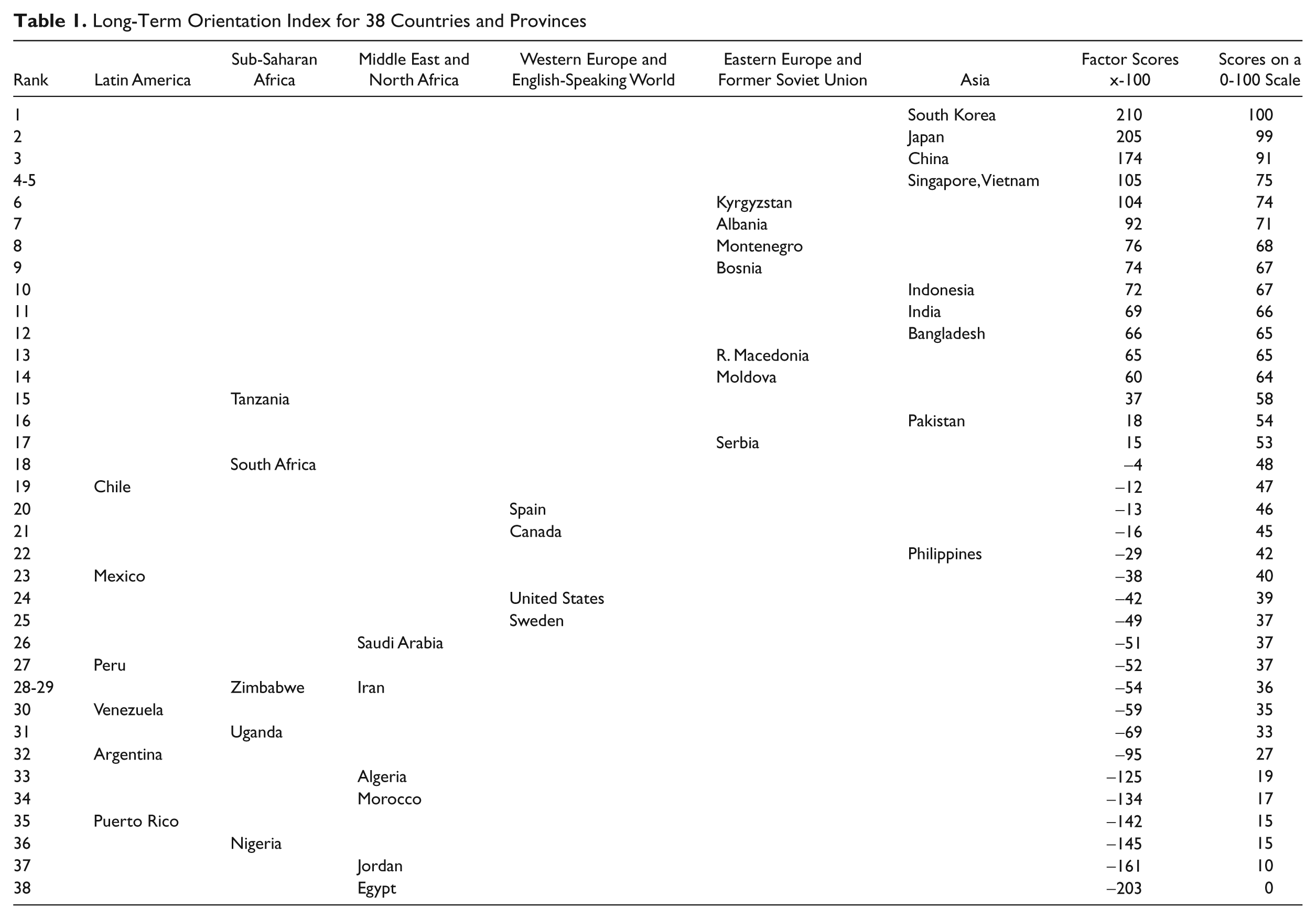
Since response bias is often viewed as an issue when Likert-type scales are used, we did a factor analysis of the items defining Factor 1 that are not scored on a Likert-type scale but involve a free choice from a list of concepts: A039 (perseverance), A038 (thrift), and A040 (faith). We also added A026 (parents do their best), which requires a categorical choice. These items yielded a single factor whose factor scores correlated with those in Table 1 at .91 (n = 37). Therefore, fears that our LTO scores might be distorted through response bias (reflecting something different from the construct of interest) would be unfounded. Our LTO measure clearly reflects a high importance of thrift and perseverance versus a low importance of personal stability and service (favors) to others, as well as low concern for pride (dignity), which are the key facets of LTO as described by the Chinese Culture Connection (1987) and Hofstede (2001).
A meaningful national index should create meaningful geographic patterns (McCrae, Terracciano, Realo, & Allik, 2007). Table 1 shows a very clear pattern: The national scores fall from East Asia and Eastern Europe to Western Europe and the Anglo world, and then to Latin America, Central/Western Africa, and the Middle East.
Validation of the LTO Factor
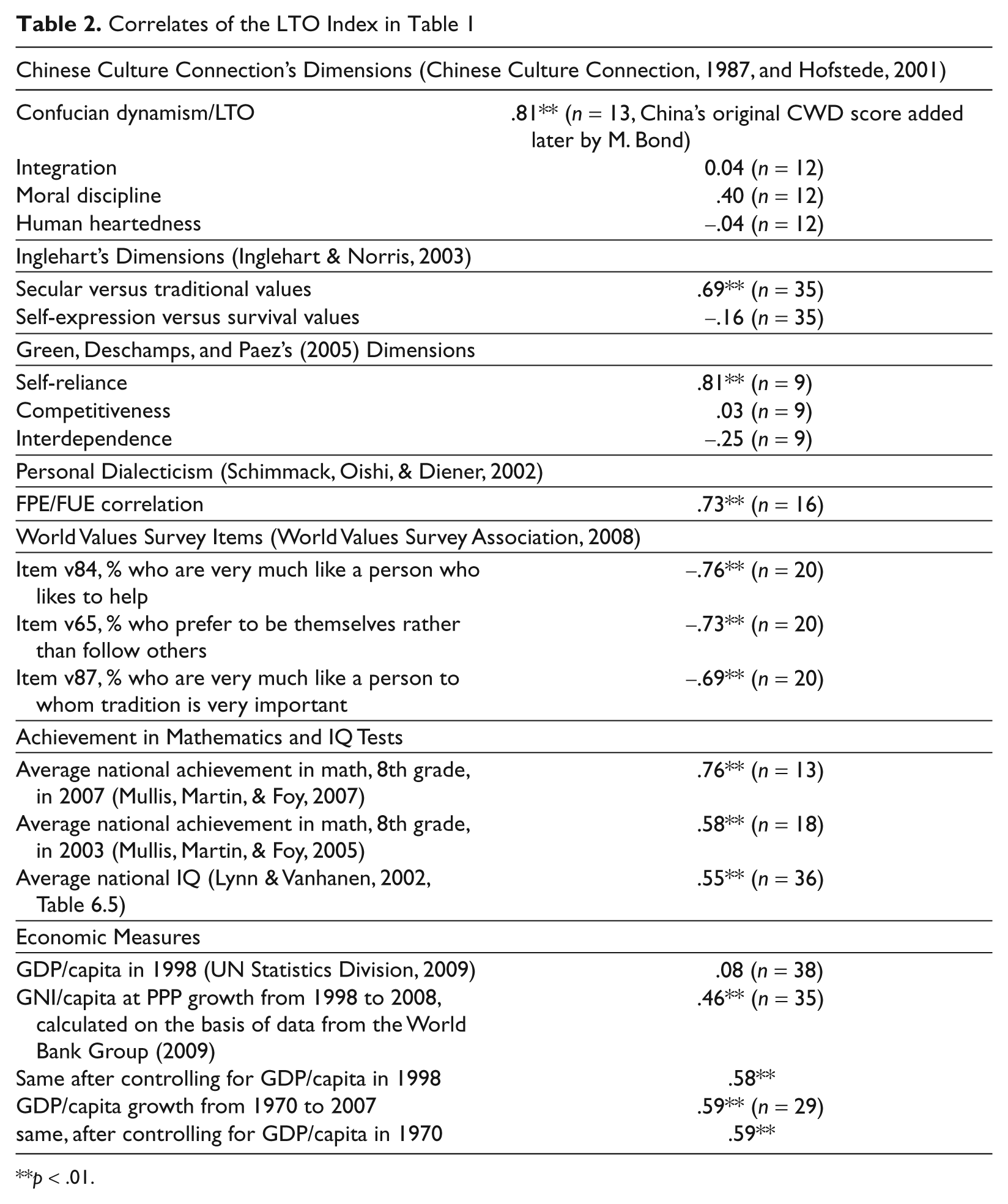
In Table 2, we provide correlations between the LTO scores in Table 1 and relevant external variables. We also found an unexpected strong correlation between LTO and a measure of self-reliance (Green, Deschamps, & Paez, 2005). This should not be surprising in view of the fact that long-term-oriented societies attach a low importance of service to others and reciprocation of favors.
Correlates of the LTO Index in Table 1
p < .01.
For the economics part, we used two measures: raw gross domestic product (GDP) per capita and gross national income (GNI) at purchasing power parity (PPP) per capita. The first one is usually preferable because PPP is a subjective construct. Nevertheless, the typical correlation between the two measures for one and the same year is about .90; therefore, it does not matter much which one is used. We preferred GDP for 1998 (the year from which we collected most WVS data for this study) but GNI at PPP for the subsequent period because of the turbulence in the exchange rate of the U.S. dollar, which is precisely what the PPP concept is supposed to eliminate statistically.
The correlations validate Hypotheses 3, 4, and 5. As hypothesized, our LTO index predicts national measures of school success in mathematics and IQ tests, and national differences in economic growth—both after the WVS data collection (mostly 1998-1999 in our case) and for the whole 1970-2005 period. Our LTO measure is also highly and positively correlated with Schimmack et al.’s (2002) national index of personal dialecticism. Our LTO scores also yield high significant correlations with WVS items that measure personal stability (Item v65, respondent prefers to be himself rather than follow others), importance of tradition (Item v87), and importance of helping others (Item v84).
Discussion
The goal of this study was to replicate an interesting and important dimension of national culture, originally called “Confucian Work Dynamism,” then renamed “Long-Term Orientation” by Geert Hofstede. We believe that we have achieved our goal. Although our replication is not perfect, we did obtain a version that is close to the original LTO.
We have confirmed or elucidated a number of important points concerning LTO:
LTO is a valid and extremely important dimension of national culture. Including this study, it has been extracted from databases that employed two very different types of questionnaires, Chinese and West European/North American, and two types of respondents, matched samples of students in the CVS and nationally representative samples in the WVS. Considering these very different circumstances, the correlation between the two LTO measures is strikingly high. It shows that LTO is neither a Chinese nor a Western research artifact but a universal dimension of national culture, underpinned by concepts that are meaningful across the whole world.
The conceptual similarity between our LTO measure and the original one is also clear, albeit not perfect. Two of the main facets—importance of thrift and perseverance—are fully identical. Reciprocation of favors resembles service to others. We believe that without being absolutely similar, the other WVS items that define our LTO factor are reasonably good proxies for the corresponding CVS concepts.
LTO is a valid predictor of national educational achievement in mathematics and of economic growth. This is one of the dimension’s most interesting properties.
Interestingly, LTO is also highly correlated with self-reliance: a construct that is supposed to be a facet of individualism versus collectivism (Green et al., 2005) but is not associated with it at the national level. Self-reliance is an interesting construct because, just like LTO, it predicts national differences in GNI per person growth from 1998 to 2008: r = .64, p < .001, n = 20. We believe that LTO reflects self-reliance through the low importance of service to others and the low agreement that parents should always do the best for their children rather than have a life of their own. This facet of LTO may be one of the important determinants of economic dynamism.
Because LTO is, among other things, a measure of self-stability, it is associated with importance of tradition as a single item and with Inglehart’s complex measure of traditional values. However, our results show that some aspects of tradition are also associated with the core of the collectivism dimension—importance of cohesive in-groups—which is orthogonal to our LTO measure.
Although LTO is strongest in East Asia, we found that the eastern parts of Eastern Europe and Kyrgyzstan also score high. This is consistent with the high levels of educational achievement in Eastern Europe and with its recent economic boom, prior to the 2008 international financial collapse that was created by the United States. Our LTO measure evidences a fairly clear contrast between Asia and Eastern Europe, on the one hand, and Africa, the Middle East, and Latin America, on the other hand. The historical origin of this split is an issue for further studies.
This study obviously does not elucidate all outstanding issues associated with the LTO dimension. Its theoretical interpretation may continue to generate controversies. The Chinese Culture Connection (1987) saw a contrast between two kinds of Confucian values in it. Hofstede (2001) preferred to interpret it as time orientation, whereas Minkov (2007, 2008) hypothesized a link with the theory of self-enhancement and self-stability in Heine (2001, 2003) and Heine and Hamamura (2007). None of these interpretations can explain fully and convincingly what holds together such seemingly diverse values as thrift and persistence and opposes them to personal stability, tradition, and a willingness to help others, yet our study confirms the existence of such a value contrast on the basis of nationally representative samples.
The dimension’s name may continue to generate controversies. The high scores of the Eastern European countries confirm that an association with Confucianism is not quite appropriate. A name associated with time orientation also has its detractors. However, it has been in use for 20 years now, reaching some maturity. A different name is possible, yet it would probably create unnecessary confusion.
Footnotes
Appendix
The authors declared that they had no conflicts of interests with respect to their authorship or the publication of this article.
The authors declared that they received no financial support for their research and/or authorship of this article.