







Abstract
The present research explores cultural understandings of what it means to be human. We used open-ended responses to examine whether the most culturally salient aspects of humanness are captured by two theoretical dimensions: human uniqueness (HU) and human nature (HN). Australians, Italians, and Chinese (N = 315) showed differences in the characteristics considered human and in the emphasis placed on HU and HN. These findings contribute to developing cross-cultural folk psychological models of humanness.
There has been a recent surge of interest in people’s beliefs about humanness. Although it was prompted by new developments in dehumanization research (Haslam, 2006; Haslam, Loughnan, Kashima, & Bain, 2008; Leyens et al., 2000), such beliefs have broad relevance across many areas of psychology, pointing to basic assumptions people hold about human values, strengths, and weaknesses (Wrightsman, 1992). However, research on humanness beliefs has typically been derived from researchers’ theories (e.g., Wrightsman, 1992), or limited to particular kinds of characteristics like traits and emotions (e.g., Bain, Park, Kwok, & Haslam, 2009; Haslam, Bain, Douge, Lee, & Bastian, 2005; Leyens et al., 2000). These approaches overlook a more fundamental question about the salient features of humanness in people’s minds, and whether beliefs about what makes us human varies across cultures. Therefore, we examined how people freely describe humans across cultures.
Our first research question addresses whether cultures differ in the types of features they use to understand humanness. Existing approaches have focused on intra-individual characteristics (e.g., traits, emotions, values), which may be applicable mainly in Western cultures (where they were developed). However, collectivist cultures may focus more on social/cultural characteristics, such as social obligations and group attributes (Oyserman, Coon, & Kemmelmeier, 2002). Hence, we selected three cultures (Australia, Italy, and China) based on contrasting Individualism (IND) and Collectivism (COL) profiles: Australians have a relatively high IND / low COL profile, Chinese a low IND / high COL profile, and Italians a high IND / high COL profile (Oyserman et al., 2002). We expected that humans will be described using more intra-individual terms by high IND Australians/Italians than by low IND Chinese, and using more social/cultural terms by high COL Chinese/Italians than by low COL Australians.
Our second research question relates to cultural differences in the emphasis placed on different construals of humanness. According to Haslam (2006), people construe humanness in two distinct ways: what humans possess that other animals lack (human uniqueness, HU, signified at least in Western cultures by features like morality and rationality), and what is core or fundamental to humans (human nature, HN; e.g., emotionality, vitality), which distinguishes humans from objects and machines. Some dehumanization research suggests that cultures differ in which sense of humanness they tend to emphasize. That is, Australians typically attribute their ingroup with greater HN, but not HU, whereas Chinese typically attribute their ingroup with greater HU, but not HN (Bain et al., 2009). Italians typically attribute high levels of both HU and HN to their ingroup (Vaes, 2010; Vaes & Paladino, 2010). Thus, we expected Australians to emphasize HN when describing humans, Chinese to emphasize HU, and Italians to describe humans using terms high in both HU and HN.
Method
Participants were 315 undergraduate students who were citizens of their country: 103 Australians (55% female; age, M = 19.5, SD = 3.4), who were predominantly Anglo/European (83%); 93 Italians (62% female; age, M = 21.9, SD = 4.8), who all identified as Italian; and 119 Chinese (62% female; age, M = 21.8, SD = 2.2), who identified predominantly as Han (92%). The gender distribution across countries did not differ, χ2(2) = 1.39, p = .500, but there was an age difference, F(2,312) = 15.66, p < .001, η2 = .09, with Australians younger than the other samples.
Participants completed a questionnaire including the focal measures as part of a larger survey. The English version of the questionnaire was translated into Italian and Chinese by bilingual researchers and back-translated by different bilingual speakers. The questionnaire instructed participants to list up to seven characteristics that came to mind when they thought about humans. They then rated each characteristic on either Human Uniqueness (HU) or Human Nature (HN), using 11-point scales labeled −5 (strongly disagree) to 5 (strongly agree). The HU item was “This characteristic is exclusively or uniquely human; it does not apply to other species.” The HN item was “This characteristic is an aspect of human nature.”
Australians completed the questionnaire in groups of 1-10, Italians completed the questionnaire in groups after lectures, and Chinese completed questionnaires in groups of 10-15. Surveys took 15 to 20 minutes to complete.
Results
The average number of spontaneous descriptions per participant differed across cultures, F(2, 312) = 8.30, p < .001, η2 = .05, with Tukey’s HSD post hoc tests showing Australians (M = 5.5, SD = 1.4) and Chinese (M = 5.2, SD = 1.6) reported more characteristics per person than Italians (M = 4.6, SD = 1.6). Descriptions were coded thematically in their original language for Australian and Italian data, and using English translations for the Chinese data, in consultation with the Chinese researcher. To test for expected IND/COL differences, categories were classified into Intra-Individual (traits, mental states, emotions, and values), Social/Cultural (society/culture, language/communication, labor), and Other. As some values and positive traits overlap (e.g., loyalty), responses were categorized as values when they were contained in the Schwartz Value Survey (Schwartz, 1992). Emotions were divided into primary (basic) and secondary (complex), based on research showing that secondary emotions are seen as uniquely human (Leyens et al., 2000). Traits were categorized according to valence, and values were treated as a single category. Inter-rater reliability was excellent overall (Krippendorff’s alpha = .86, Hayes & Krippendorff, 2007). Alphas for subcategories are shown in Table 1 and were generally excellent (> .8), although in the good range for “Personality” and “Other” subcategories. Disagreements were resolved through discussion.
Categories and Frequencies of Participant-Generated Human Characteristics
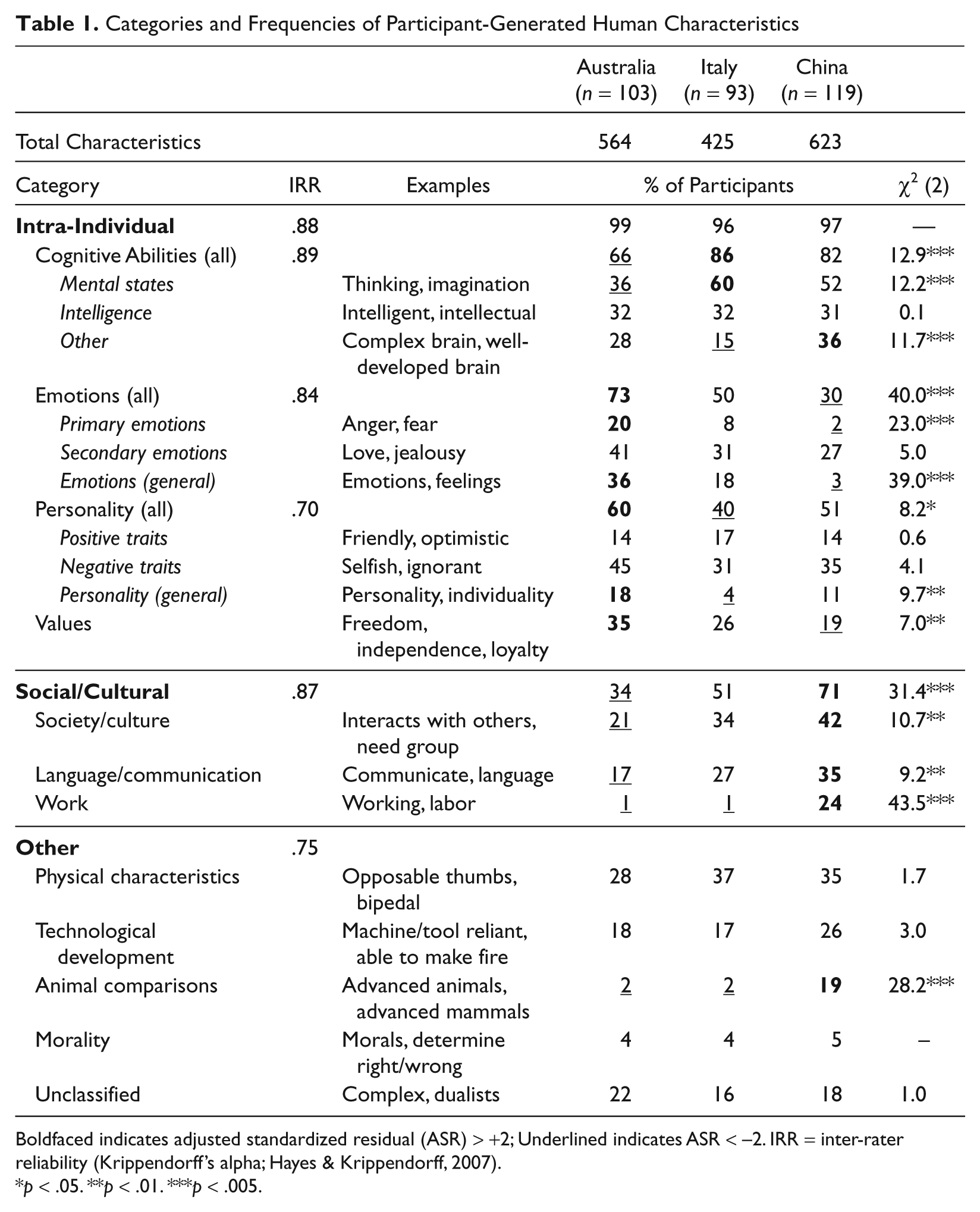
Boldfaced indicates adjusted standardized residual (ASR) > +2; Underlined indicates ASR < −2. IRR = inter-rater reliability (Krippendorff’s alpha; Hayes & Krippendorff, 2007).
p < .05. **p < .01. ***p < .005.
The percentage of people who reported each type of characteristic is shown in Table 1. Chi-square analyses revealed cultural differences, which were interpreted using adjusted standardized residuals of 2 or greater (equivalent to α = .05). The expected broad-level cultural differences for intra-individual characteristics were not identified, with almost all participants citing at least one intra-individual characteristic. However cultural differences emerged for the type of intra-individual characteristic cited. Australians perceived humans more in terms of emotions (especially “Emotions [general]”) and values than Chinese and referred to personality more than Italians. Italians more frequently cited cognitive abilities (especially “Mental States”) than Australians, and Chinese used general descriptions of cognitive abilities (“Cognitive Abilities [other]”) more than Italians. Cultures were similar in their use of specific positive and negative traits, secondary emotions, and intelligence.
As expected from their COL profiles, Chinese were more likely than Australians to refer to societal and cultural attributes. However, high COL Italians mentioned social/cultural features more frequently than Australians, but not significantly so, suggesting that COL cannot wholly account for observed differences. Chinese were also more likely to describe humans in terms of work and labor than both Western cultures, possibly reflecting Marxist influences on Chinese culture, which would point to labor as a central human endeavor. For the “Other” categories, all cultures referred to physical characteristics and technological development to similar degrees, and all mentioned morality infrequently. The only significant difference was that Chinese made more direct comparisons between humans and animals than Australians and Italians.
Emphasis was assessed by examining whether participants rated the characteristics they generated higher on HU or HN. To adjust for cultural response biases, within-culture standardization using the grand mean and standard deviation of all HU and HN ratings was used. Humanness ratings were analyzed using a 3 Country (Australia, Italy, China) × 2 Humanness Type (HU, HN) analysis of variance. There was a significant main effect for humanness type, with characteristics overall rated higher on HN than HU, F(1, 308) = 62.97, p < .001, partial η2 = .17, but this was qualified by the expected interaction, F(2, 308) = 9.40, p < .001, partial η2 = .06.
Simple effects analyses first compared countries for each type of humanness using univariate analyses of variance with Bonferroni post hoc tests. For HU, the difference between cultures was significant, F(2, 157) = 3.23, p = .042, η2 = .04. Australians emphasized HU (M = −.42, SD = .74) less than Chinese did (M = −.06, SD = .69), and Italians’ ratings (M = −.32, SD = .87) were not significantly different from either group. For HN, the difference between cultures was also significant, F(2, 151) = 8.67, p < .001, η2 = .10, with post hoc tests showing that Australians (M = .45, SD = .36) and Italians (M = .39, SD = .41) emphasized HN more than Chinese did (M = .09, SD = .60). Comparisons within each country showed that both Australians and Italians rated characteristics relatively higher on HN than HU (both ts > 4.91, both ps < .001, both Cohen’s d > 1.0), but there was no difference between HU and HN ratings for Chinese, t(117) = 1.33, p = .187, Cohen’s d = .2.
Discussion
Although humanness is a category encompassing all cultures, there was significant cultural variability in the types of features seen to make us human, and in whether cultures emphasize essential, core features (HN), or those distinguishing us from animals (HU). Our finding that humans are described primarily using intra-individual characteristics in all cultures is encouraging for existing theoretical approaches to humanness, as it suggests that the characteristics typically used in research capture the main ways in which humanness is understood across cultures. However, the results indicate that greater attention should be paid to which type of intra-individual characteristic is studied in different cultures, as there were significant cultural differences for each type of characteristic.
If comparability across cultures is important, it is recommended that personality traits are used, as these were reasonably frequently cited, and their frequency differed least across cultures. In contrast, models of humanness that focus on other characteristics, such as emotions, may not capture the most salient aspects of humanness in cultures like China. To develop comprehensive, cross-culturally valid models of humanness, however, the Chinese responses demonstrate the need to move beyond the existing intra-individual focus. Specifically, theories of humanness should incorporate more social and cultural features, such as our interactions and relationships with others and our embeddedness within groups.
As expected, cultures differed in the sense of humanness they emphasized. Chinese placed more emphasis on HU than Italians and Australians, but Australians and Italians nominated human characteristics that were higher on HN than Chinese. It is worth speculating on why cultures would emphasize each dimension. A HU emphasis may reflect an internalization of a history of achievement on markers of HU such as education, philosophy, high culture, and art, including exporting these to other parts of the world (e.g., China, Italy). Younger countries, especially those with a colonial history such as Australia, lack comparable achievements on HU and may instead emphasize HN as this relies less on cultural achievements and more on symbolic youth (emotionality, vitality). The findings may also help explain why Chinese tend to deny HU to outgroups, whereas Australians deny HN (Bain et al., 2009), indicating that cultures use the sense of humanness that is most salient to them when making intergroup comparisons.
While conceptions of humanness may have some overlap with IND/COL, our results suggest they are not reducible to these dimensions. Most notably, low IND Chinese described humans using intra-individual characteristics like cognitive abilities and personality as frequently as high IND cultures. Findings were partly consistent on the COL dimension, with (high COL) Chinese referring to society and culture more than (low COL) Australians. However, high COL Italians did not mention society and culture significantly more frequently than Australians.
Humanness beliefs may be related to different philosophical traditions, helping explain cultural differences. Notably, the influence of Confucianism in China has promoted a conception of humanness that prioritizes HU aspects like education and wisdom (“zhi”) and etiquette (“li”), helping to explain why Chinese emphasized HU most strongly. Humanness beliefs may also overlap with differing conceptions of the self, notably independent-interdependent self-construal (related to cultural IND/COL; Markus & Kitayama, 1991), although the failure to fully support expectations from IND/COL research warrants further investigation. Further research should determine how HU and HN correspond to other dimensions in Hofstede’s (1980) cultural model to better understand links between humanness and cultural values, and to further determine how distinct humanness beliefs are from other dimensions of culture.
Humanness beliefs point to basic assumptions people make about human strengths and frailties. When shared across cultures, they may help promote inter-cultural understanding, but when they diverge, they may perpetuate inter-cultural misunderstanding and conflict. For instance, in cultures emphasizing HU (e.g., China), it may be especially difficult to understand and accept people from cultures who do not highly esteem maturity and civility, or for people from high HN cultures (e.g., Australia) to understand why people from other cultures would constrain emotions. Thus, by identifying the underlying assumptions about humanness held in different cultures, we hope to advance the process of intercultural understanding.
Footnotes
The author(s) declared no potential conflicts of interest with respect to the research, authorship, and/or publication of this article.
This research was supported by an Australian Research Council Discovery Project grant (DP0771200) to the first and fourth authors.