







Abstract
Over the past three decades, considerable research effort has been expended charting how and when children develop an understanding of others’ minds. Multicultural studies allow us to determine what features of this important cognitive developmental achievement might be universal and what aspects are culturally specific. However, the body of literature in this area is slim and unsystematic. The current study therefore aimed to contrast and compare the sequence through which Western and non-Western children develop a theory of mind (ToM). One hundred sixty-four 3- to 9-year-old children from Australia and Iran were assessed using an expanded ToM Scale. Although children from both cultures had equivalent overall ToM scores, more Australian children showed an understanding of diversity of beliefs and desires whereas more Iranian children understood knowledge access and sarcasm. This study is the first to compare Western and non-Western children’s ToM development with a battery of ToM Scale tasks extended to include sarcasm. The cross-cultural similarities and differences revealed allow a deeper understanding of universal and culturally specific aspects of social-cognitive development.
To understand others’ behavior, children need to discover that human actions are rooted in subjective, internal mental states such as desires, beliefs, and emotions. Achieving this understanding, referred to as theory of mind (ToM), is a critical developmental milestone (Flavell & Miller, 1998). Researchers have used a variety of tasks to investigate different aspects of this multifaceted phenomenon (for reviews, see Wellman, 2012; Wellman & Liu, 2004). These include the False Belief Test, as well as tasks assessing children’s understanding of other’s desires, emotions, and intentions. Research shows that in Western cultures the vast majority of typically developing children acquire a ToM sometime during early childhood. At the same time, there is a general consensus that acquiring a ToM is a universal developmental milestone that all typically developing children pass (Avis & Harris, 1991; Scholl & Leslie, 2001). However, the extent to which the developmental unfolding of ToM understanding is universal is a topic of ongoing debate.
A primary reason for continued debate over the universal nature of ToM development is that cross-cultural studies have returned contradictory findings. For instance, despite their distinct cultural backgrounds, children from Peru, Canada, India, Samoa, and Thailand acquire the concept of false belief at similar ages (Callaghan et al., 2005). Similarly, unschooled children in remote Cameroon pass the False Belief task at a similar age to Western children (Avis & Harris, 1991). However, other research has indicated that Junin Quenchua children in Peru acquire the false belief concept later than Western children (Vinden, 1996). Furthermore, recent studies comparing cultures more similar in terms of education, cultural practices, and economic circumstances such as Britain and Italy (Lecce & Hughes, 2010), and mainland versus Hong Kong China (Liu, Wellman, Tardif, & Sabbagh, 2008), have shown different developmental timetables for ToM understanding. There is hence evidence for significant cross-cultural differences in the pace (Oh & Lewis, 2008) and pattern of ToM development (Shahaeian, Peterson, Slaughter, & Wellman, 2011; Wellman, Fang, Liu, Zhu, & Liu, 2006).
Individual differences research also shows that although children gain an understanding of mind during early childhood, the developmental timetable for ToM depends on several environmental factors related to family and sibling interactions. For example, parenting strategies (Ruffman, Perner, & Parkin, 1999; Vinden, 2001), conversations referring to feeling and emotions in the family (Dunn, Brown, & Beardsall, 1991), parents’ use of mental state language (Peterson & Slaughter, 2003; Ruffman, Slade, Devitt, & Crowe, 2006) and the presence of siblings (Lewis, Freeman, Kyriakidou, Maridaki-Kassotaki, & Berridge, 2008; McAlister & Peterson, 2013) have all been shown to affect how ToM understanding matures. These findings highlight the importance of everyday interactions in developing a ToM.
A number of studies have shown that having siblings is associated with more rapid development of false belief understanding (Perner, Ruffman, & Leekam, 1994; Ruffman, Perner, Naito, Parkin, & Clements, 1998; Ruffman et al., 1999). This is however controversial as some others have failed to find similar association (Cole & Mitchell, 2000; Henning, Spinath, & Aschersleben, 2011). Therefore, some researchers qualify this by suggesting that older siblings yield more benefit than younger siblings (Ruffman et al., 1998), that children do not benefit from having siblings younger than 3 years (Perner et al., 1994), or that the main effect is for children with language delays (Jenkins & Astington, 1996). However, Peterson (2000) showed that having either a younger or older sibling leads to better false belief understanding compared with children without siblings, provided the sibling is aged 1 to 12 years (no longer an infant and not yet a teenager). She explained this through the “sibling variety hypothesis,” which suggests that to benefit each other’s ToM development siblings must be capable of distinctive kinds of playful and conversational interaction with one another, and when this is true the more varied the siblings’ cognitive perspectives the better. Thus, children without siblings fail to benefit and those with older and younger siblings gain most. Peterson further suggested that siblings sharing of varied perspectives through pretend play or via sibling conflict (Randell & Peterson, 2009), when children argue their independent perspectives, supplies a rich insight into the mind and others’ true and false beliefs. Recent studies of families with twins provide support to this argument (Cassidy, Fineberg, Brown, & Perkins, 2005; Deneault et al., 2008).
In a previous attempt to evaluate the role of siblings in ToM development for children from Western versus non-Western cultures, Shahaeian et al. (2011) compared preschool children in Iran and Australia. The Australian children developed ToM understanding (as assessed via False Belief Tests and developmental ToM Scale) more rapidly when they had a child-aged sibling (i.e., 1-12 years of age) than if they were only children. However, no evidence of a beneficial effect from having a sibling emerged for the Iranian children. A possible explanation for this is that in Iranian families, siblings are less often granted opportunities to exchange their varied points of view than in Australian households. In Iran, harmony and agreeable family interactions are emphasized and children are not encouraged to speak their minds. Having a sibling might therefore not bring a rich conversational environment for Iranian children. More research is now needed if we are to better understand how siblings specifically and children’s cultural heritage, more generally, might interact with family structure to influence ToM development.
Furthermore, issues of assessment have been the cause of much controversy: What is the best task that assesses ToM development? The most widely used test to assess ToM understanding is the False Belief task. In a classic version (Baron-Cohen, Leslie, & Frith, 1985), known as a change-of-location False Belief Test, children are shown a doll who has hidden her marble in a box. When she leaves the room and is not present, another doll enters and hides the marble in the basket. Then children are asked where the doll will look first for the marble when she comes back. Younger children struggle to separate what they know now from what they used to know and from what others should know, stating the doll will look in the basket (the true current location). In contrast, from around 4 years, children typically begin to show an understanding that because the doll originally put the bread inside the box, and had no subsequent chance to look inside, she will think that the bread is still in the box. Although false belief understanding captures children’s transition toward having a mature understanding of others’ minds, such understanding does not emerge without developmental preparation. That is, children do not suddenly go from having no ToM understanding to having a fully fledged understanding, as is sometimes implied in suggestion that children go from failing to passing ToM Tests (Astington, 2001). Research in the last decade (e.g., Shahaeian et al., 2011; Wellman & Liu, 2004) has shown that the development toward gaining an understanding of mind progresses through a series of distinct preliminary stages leading up to false belief and continuing beyond it.
Based on a meta-analysis, Wellman and Liu (2004) developed a scale to assess the sequential progression of ToM. This research indicates that Western children begin by understanding that people can like or dislike similar things (known as Diverse Desires) and then to appreciating that people can have different opinions and beliefs about the same situation (Diverse Beliefs). After this, children can understand that others might not have access to the right information (Knowledge Access) before recognizing how people’s behavior is based on what they think they know even if their supposed knowledge is wrong (False Belief), and that they can deliberately hide how they feel (Hidden Emotions). This hypothetical sequence was then supported in experimental research with American, Australian, and German children (Kristen, Thoermer, Hofer, Aschersleben, & Sodian, 2006; Peterson, Wellman, & Liu, 2005; Peterson & Wellman, 2009).
This sequence allows us to evaluate patterns of ToM progression and to more systematically probe this understanding among different groups of children. Using the ToM Scale with Iranian and Chinese children (Shahaeian et al., 2011; Wellman et al., 2006) has shown that although children in these two very different cultures generally progress through the ToM sequence proposed by Wellman and Liu (2004) in similar ways to Western children (Diverse Desires before Diverse Beliefs, Knowledge Access before False Belief, and Hidden Emotions after False Belief) intriguing differences are also evident. In contrast to their Western peers, children in Iran and China develop understanding of knowledge access earlier and diversity of beliefs later. This suggests that aspects of the proposed ToM sequence are culturally specific. However, before firm conclusions can be drawn on the cultural specificity of ToM development, more direct cross-cultural comparisons with different age groups and alternative tasks are required.
Furthermore, understanding of sarcasm has been identified as an additional, later step in the development of ToM concepts (Peterson, Wellman, & Slaughter, 2012). This work built on previous studies of school-age children (Banerjee, 2000; Filippova & Astington, 2008), finding that only approximately half of a group of 10- to 11-year-old children passed a Sarcasm task. To the best of our knowledge, no published study has yet investigated sarcasm cross-culturally as an aspect of ToM. As per Peterson et al. (2012), in the current study, we used an expanded ToM Scale that included sarcasm. Our aim was to identify where sarcasm fits in the development of ToM among Iranian children and to compare this with children from a typical Western culture (Australia). Iran, as a nation, overall conforms to Triandis (1993) definition of a collectivist culture, placing more emphasis on interpersonal relationships and group harmony than Western individualistic cultures. Compared with Western parents, Iranian parents are more prone to teach children to respect their elders, avoid direct expression of their disagreement with family members, and grow as members dependent on family values, ways of doing things and a global lifestyle (Frank, Plunkett, & Otten, 2010; Ghorbani, Bing, Watson, Kristl Davison, & LeBreton, 2003; Rudy & Grusec, 2001; Sharifzadeh, 2004). Iranian children may thus be more sensitive to distinctions between what others say and what they mean than Western children. This cultural emphasis on interpersonal sensitivity and avoidance of outright disagreement might result in Iranians using more subtle ways of expressing their divergent points of view, such as sarcasm. Thus, greater everyday exposure might enable Iranian children to acquire a relative sophisticated understanding of sarcasm at an early age. Based on this reasoning, we hypothesized that Iranian children would be more able to pass a ToM Test based on sarcasm than their Australian peers.
In addition to exploring cross-cultural differences in preschool- and school-aged children’s understanding of ToM concepts, up to and including sarcasm, the current study had two further aims. Also, previous research has shown that Iranian children lag behind their Western peers in understanding diverse beliefs while being comparatively advanced in their understanding of knowledge access (Shahaeian et al., 2011). Our second aim was to confirm these findings in a new sample of children from a wider age range. Finally, as already noted, the role of siblings in ToM development has been extensively documented in research with Western children, mostly from English-speaking countries. However, there has been much less research on siblings and ToM in non-Western cultures. Our third aim was therefore to continue evaluating the extent to which having siblings facilitates development of ToM for Iranian children.
Method
Participants
A sample of one hundred sixty-four 3- to 9-year-old children participated in this study. Eighty children (47 girls, 33 boys; M age = 74.8 months, SD = 21.3) were from the city of Shiraz in Iran and 84 children (43 girls, 41 boys, M age = 73.5, SD = 21.9) were from Brisbane, Australia. All Iranian children were born in Iran and the only language they spoke was Farsi. All Australian children were born in Australia and English was the sole language they spoke.
Shiraz is the capital of Fars province with a population of 1.2 million (Statistical Centre of Iran, 2006) and is the sixth largest city in Iran. Brisbane, with a population of 1.7 million (Australian Bureau of Statistics, 2008), is the third largest city in Australia and is the capital of the state Queensland. Both cities offer a range of high-quality education to preschool children. In Australia and Iran, compulsory education starts 1 year before primary school and all children have to attend 1 year of preschool education, although most middle class families send their children to preschool 2 or 3 years before primary school.
In both countries, children were recruited by sending invitation letters to parents through a range of different sources. All families were targeted from middle to upper class regions of both cities. Some letters were sent through children’s preschools and schools, others through informal access to parents such as email lists. All parents provided consent for their children to participate in the study. Parents’ education as well as sibling information for the sample is presented in Table 1. Education is reported for either parent who has completed the questionnaire (mostly mothers except one father for Iranian sample and four fathers for Australian children). Following Peterson (2000), siblings older than 12 years or younger than 1 year were not included in the analyses. For the Iranian sample, four children had one sibling over the age of 12 and two children had one sibling younger than 1. In Australia, three children had one and one child had two siblings older than 12, and three children had an infant sibling younger than 1. The mean age of siblings for Iranian children was 6.6 years and for Australian children 6.2 years.
Number of Child Age Siblings (i.e., 1-12 Years Old) and Parents’ Education for Both Countries.
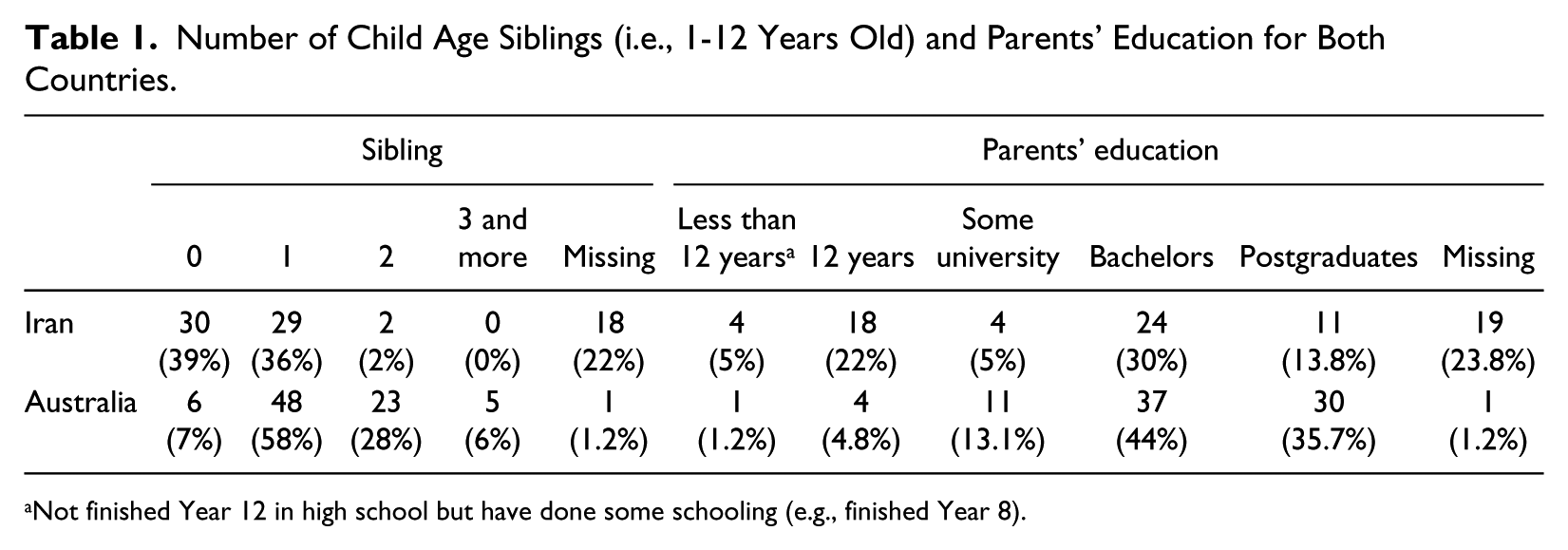
Not finished Year 12 in high school but have done some schooling (e.g., finished Year 8).
Procedure, Tasks, and Scoring
In Iran, children were tested individually in a quiet room of their preschool in the presence of their teacher or someone from the preschool familiar with the child. In Australia, all children were tested in dedicated child development test rooms of a large university in the presence of one parent. The first author tested all children. All tasks were from Shahaeian et al. (2011) with the exception of the False Belief task. Shahaeian et al. assessed false belief understanding using a Surprise Contents Task where children were shown a box of chocolate and asked what was inside—only to discover that the box actually contained a toy bear. However, in Iran, chocolate does not commonly come in boxes and it is possible that for this task no belief was established upon presentation of the box. Children were nevertheless encouraged to guess the box’s contents and hence upon opening it had established some belief about what might be inside, so the basic premise of the task was not compromised. With a view to avoiding added complication in interpreting children’s responses, and also to bolster confidence in the robustness of our findings with regard to the positioning of false belief in the ToM Scale, we decided here to use a Change of Location False Belief Test instead of a Surprise Contents Task. We also added an advanced ToM Test, the sarcasm understanding task (Sarcasm) from Peterson et al. (2012). The task was translated to Farsi by the first author, and then back translated by an official Farsi translator to ensure the comparability with the English version. The back translation matched the English version with minor differences in tenses of the verbs used. Disagreements were solved by discussion. The order of the tasks presented to children in each country was based on the order of difficulty previously reported for their country, with the Sarcasm task appearing last for both groups.
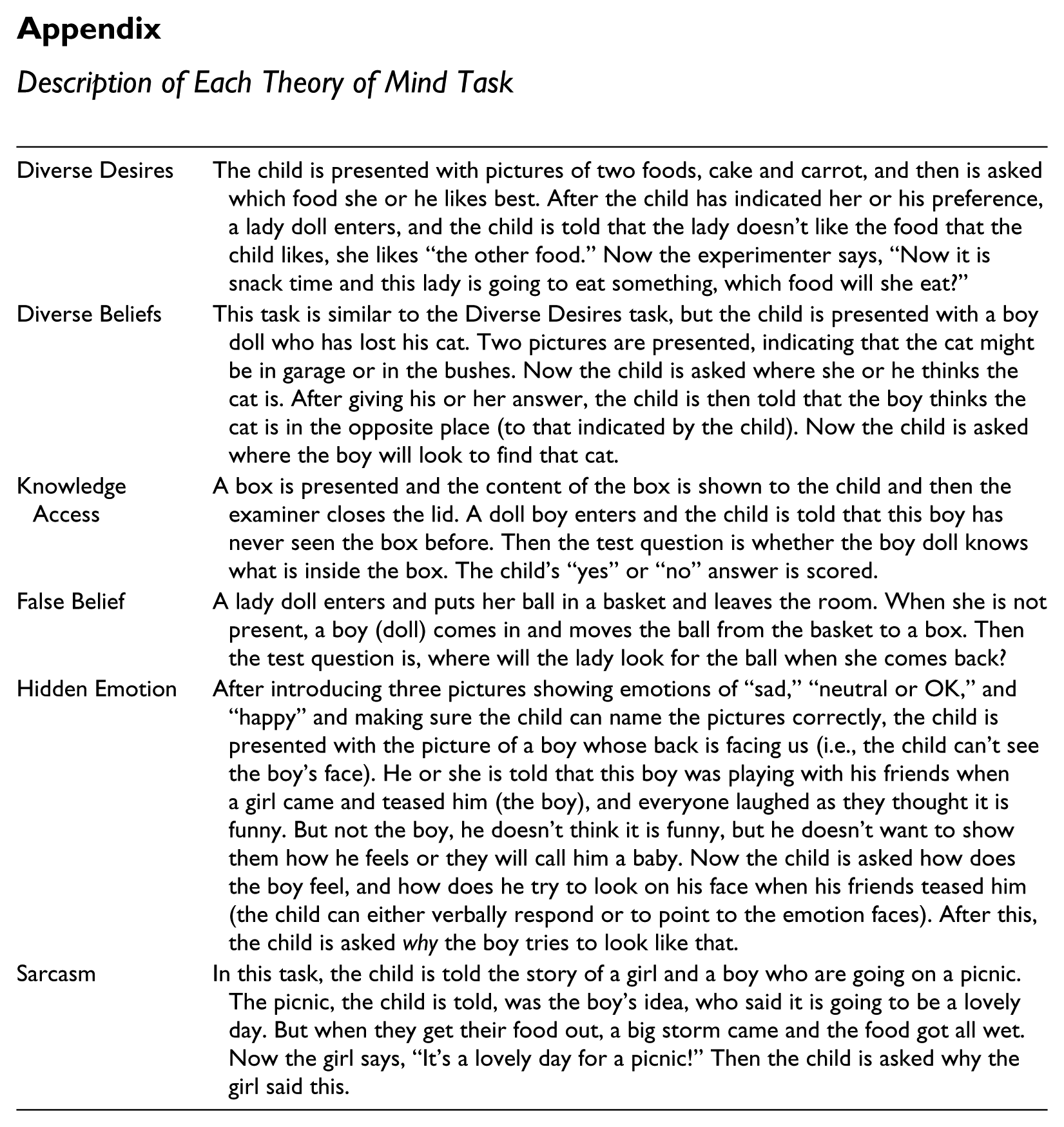
Notably, the original version of the Diverse Beliefs task involved a boy who had lost his cat. However, having a pet cat is not something most Iranian children are familiar with. We thus ran a pilot study to see if more culturally familiar versions of this task would yield different responses. In one version, we used a story of a man who came home and his wife was absent (she could have been at the neighbors or in the shops). In the second version, a boy lost his shoes and they could be in a wardrobe or chest of drawers. Results from forty-two 4- to 5-year-old children showed no difference between the three versions (51% of children provided correct answers in wife version, 55% in cat version, and 58% in shoes version; Cochran’s Q Test, p = .102). Thus, the original version of the Diverse Beliefs task (the boy and the lost cat) from Wellman and Liu (2004) was used for both cultural groups. To summarize, the Diverse Desires, Diverse Beliefs, and Knowledge Access tasks are identical to Wellman and Liu (2004), the Hidden Emotion task is also similar with the addition of a “why” question followed by the test question, as used in both Peterson et al. (2012) and (2005). False Belief is assessed by a Change of Location False Belief task and Sarcasm is derived from Peterson et al. (2012). The appendix includes the description of all six ToM tasks. All tasks were similarly administered in both countries. Testing took around 15 to 20 min for each child.
Coding
For each task, children were given a score of 1 for providing a correct response and 0 for an incorrect response. They could therefore gain an overall ToM score ranging between 0 (none correct) and 6 (all correct). For the Hidden Emotion task, we also asked the question of “why” (previously used by Peterson et al., 2005) to ensure children who passed had really understood the question. This question is initially added because some children do not clearly distinguish between the “neutral” and “sad” faces; hence, it is unclear whether when pointing to the neutral face they mean “happy” or “OK.” As Peterson et al. (2012) have reported, “the work with a separate sample of children and adults showed that the supposedly neutral (middle) picture was often spontaneously labelled as ‘angry,’ so pointing at this face could (incorrectly) indicate negative rather than neutral emotion” (see Peterson et al., 2005, p. 517). The additional question of “why” disambiguates this. Also after asking this additional question, it was apparent that some children chose the correct picture (happy face) but their justification showed their misunderstanding (e.g., responding “because it was a joke and it was funny”). Therefore, we also adopted a coding scheme to avoid this error. For an answer to be considered correct, the child needed to either clearly mention the discrepancy between how he really felt and tried to look, with answers like “he doesn’t want them to call him baby” or “he doesn’t want them to see he is sad,” or some other comprehensive response showing the same meaning. In the Sarcasm task, the following two answers were accepted: (a) if the child directly mentioned that “she was being sarcastic” or (b) if the child mentioned that she meant the boy was wrong and she was saying the opposite (e.g., “she means look this is a very bad day, but you said it will be sunny” or “she meant he is wrong”). The first author coded all answers and to ensure reliability, a second coder familiar with both languages coded all children’s answers to the “why” questions separately. Cohen’s Kappa was found to be .89 for responses to Hidden Emotion “why” questions and .97 for responses to Sarcasm “why” questions, showing high inter-rater agreement.
Results
Cross-Cultural Comparisons by Task
Table 2 shows the number and percentages of children who passed each test. There was no difference in overall ToM scores between the Iranian (M = 3.63, SD = 1.5) and Australian (M = 3.83, SD = 1.3) children, t(161) = 0.38, p = .38. However, at the single task level more Australian children passed the Diverse Desires, χ2(1, N = 164) = 7.25, p = .007, Cramer’s V = .21, and Diverse Beliefs tasks, χ2(1, N = 164) = 32.28, p < .001, Cramer’s V = .44. In contrast, on the Knowledge Access task significantly more Iranian children passed, χ2(1, N = 164) = 5.15, p = .02, Cramer’s V = .17. On the False Belief and Hidden Emotion tasks, children in both cultures passed at similar rates, χ2(1, N = 163) = .113, p = .74, and χ2(1, N = 164) = 1.13, p = .182, respectively. Thus, consistent with previous research, more Iranian children tested here passed the task of Knowledge Access whereas less of them passed Diverse Desires and Diverse Beliefs tasks. As predicted, Iranian children were also more likely to pass the Sarcasm task, χ2(1, N = 164) = 7.87, p < .005, Cramer’s V = .22. There were no gender differences in task performance and total ToM scores for either cultural group.
Number and Percentages of Children Who Passed Each Task in Both Countries.
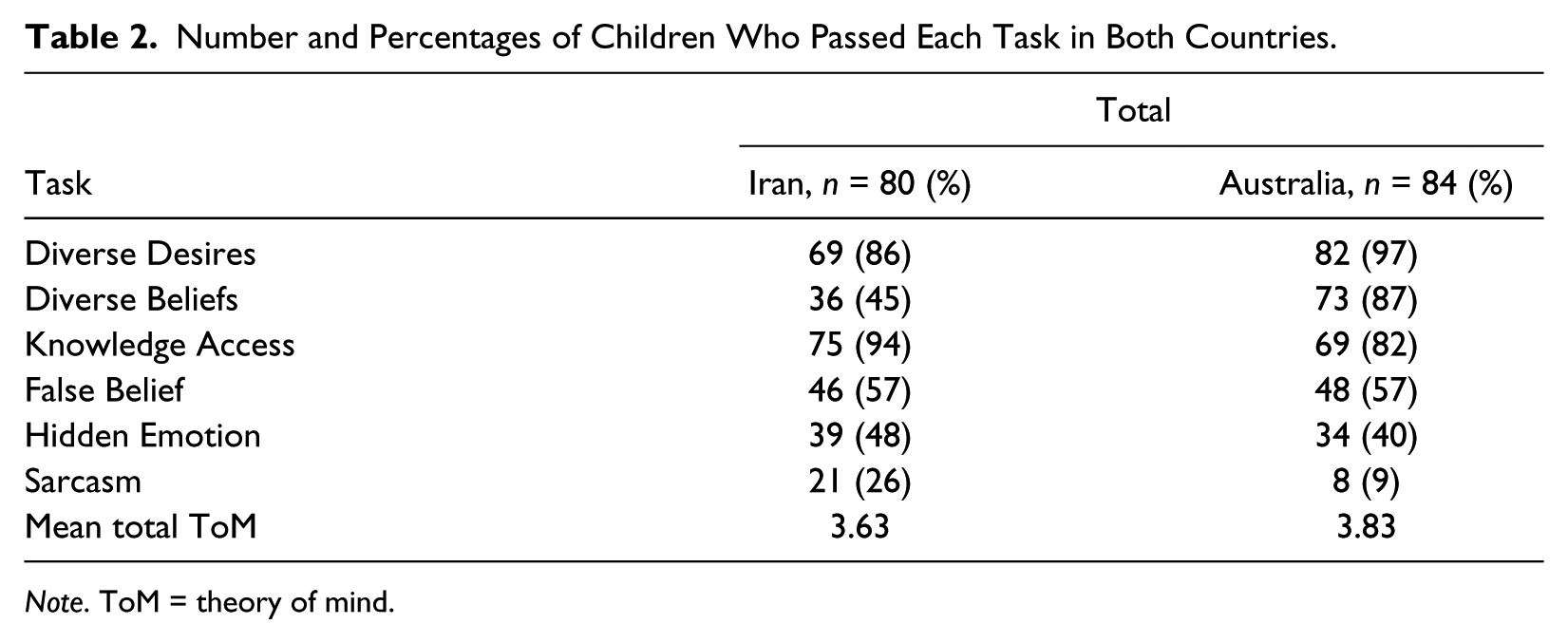
Note. ToM = theory of mind.
Because the age range of the sample is broad, to provide a more detailed assessment of age-related patterns of difference between the two cultures, we divided the sample into three age groups: 3 to 5 years, 5 to 7 years, and 7 to 9 years. Table 3 presents the percentages of children who passed each task based on age group. This age split divided the sample based on transition-to-school milestones (e.g., 3-5 years most children are in preschool, 5-7 years equates to early school age, and at 7-9 years children are settled in school). This three-way split provides a relatively fine-grained picture of development while keeping group sizes even. As is evident here, for the youngest group (3-5 years), more Australian children than Iranians passed Diverse Beliefs, χ2(1, N = 47) = 13.16, p < .001, Cramer’s V = .52, and more Iranian children than Australians passed Knowledge Access, χ2(1, N = 47) = 7.67, p = .006, Cramer’s V = .40. For this age group, none of the other tasks differed significantly across cultural group.
Number and Percentages of Children Who Passed Each Task in Both Countries Based on Age Groups.
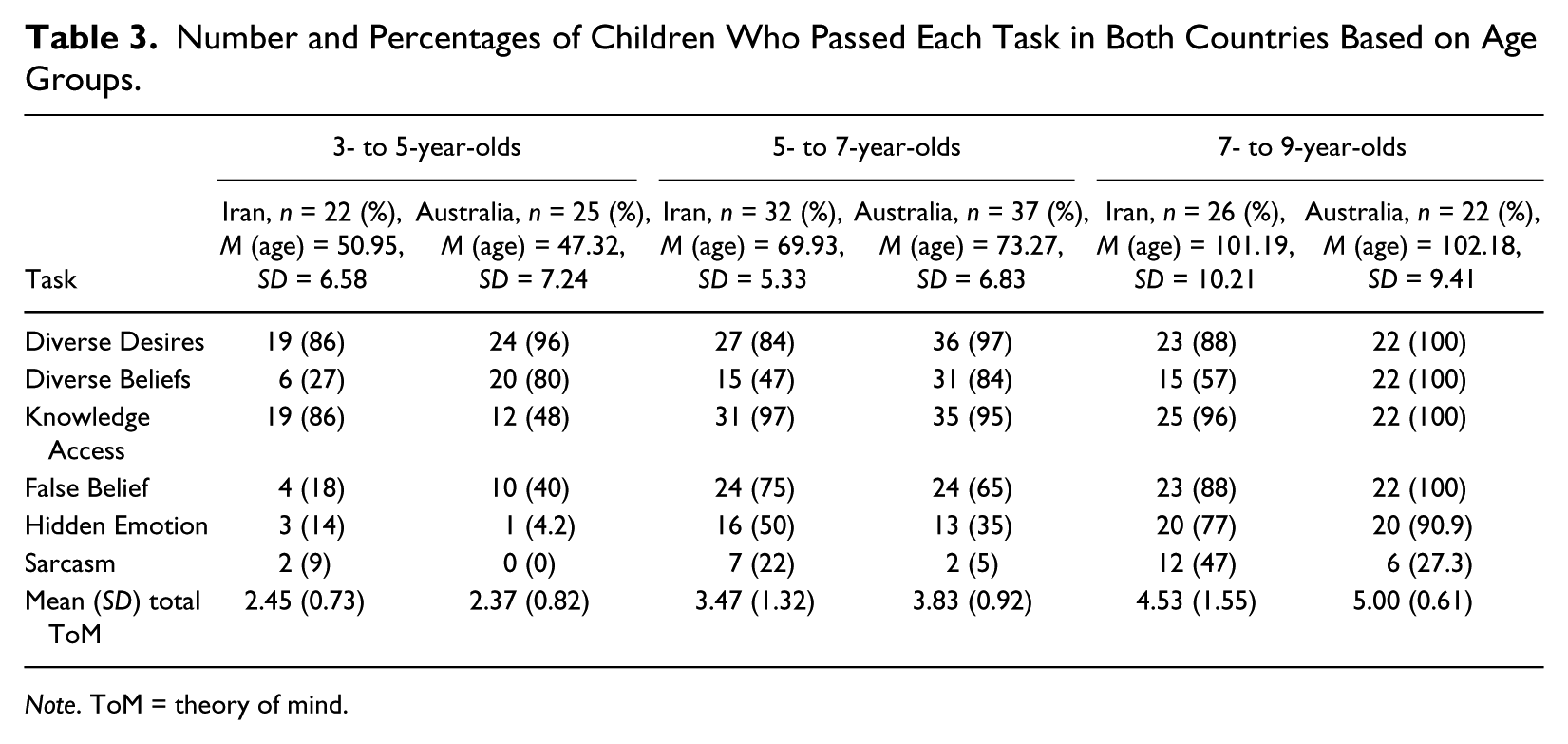
Note. ToM = theory of mind.
At ages 5 to 7 years, the Australian children continued to outperform their Iranian counterparts on the Diverse Beliefs task, χ2(1, N = 69) = 10.52, p < .001, Cramer’s V = .39, whereas significantly more Iranian children than Australians passed the Sarcasm task, χ2(1, N = 69) = 4.10, p = .047, Cramer’s V = .24. Cross-cultural differences on all other tasks were not significant for this age group.
For the oldest group of children, the culture difference in understanding Diverse Beliefs remained significant (all Australian children passed the task while just above half of Iranians passed, χ2(1, N = 48) = 12.07, p < .001, Cramer’s V = .50, while performance in all other tasks is similar.
As seen in the complete samples for each culture, there were no gender differences at any age groups across the two countries. And performance in ToM score was similar for both cultures at all age groups.
ToM Task Scaling in Iran and Australia
Next, we investigated the extent to which the developmental progressions of ToM suggested by overall task pass rates were scalable for children in both countries. For this purpose, Guttman’s coefficient (Green, 1956) was calculated using the Matlab program. Guttman’s scaling is a strict analysis that looks at the pattern of passing the items from easiest to hardest for each child in the sample. The index requires an exact match between the patterns of pass and fail, and a perfect hypothetical pattern from easiest to hardest whereby no child should pass a harder task if he or she has failed the easier ones.
Before conducting statistical analyses, simple inspection of individual children’s patterns of passing or failing in each task was examined. Consistent with previous work, in the present study, 83% (70) of the Australian children matched the sequence of their country, Diverse Desires > Diverse Beliefs > Knowledge Access > False Belief > Hidden Emotion > Sarcasm (steps from easiest to hardest). Among Iranian children, the sequence of the first five steps was the same as what was found by Shahaeian et al. (2011) and different from the Australian sequence, Diverse Desires > Knowledge Access > Diverse Beliefs > False Belief > Hidden Emotion > Sarcasm. We found that 62% (50) of the Iranian children matched this sequence of steps (with Knowledge Access before Diverse Beliefs). Only one of the Iranian children passed the Diverse Beliefs task while failing Knowledge Access, and eight Australian children passed Knowledge Access while failing Diverse Beliefs (opposite to the proposed sequence of their country). Using Green’s (1956) statistical formulae, we found that coefficient of reproducibility (Rep) for the Iranian children was .92 and for the Australian sample was .97 (scores higher than .90 are considered to be statistically significant). Rep of .91 for Iranian children and .94 for Australians are obtained, only looking at the five-steps scale for both countries.
As a further step, Green’s Index of Consistency (or I index) was calculated. This is a more conservative indicator of an observed pattern’s conformity to a Guttman Scale and I scores higher than .50 are considered to be statistically significant. For the full six-step ToM Scale (Peterson et al., 2012), we found I = .42 for Iranian children and I = .56 for Australian children. If Green’s Index of Consistency is calculated with sarcasm excluded, I = .32 for Iranian and I = .48 for Australian children are observed (for a comparison, I = .25 for Iranian and Chinese children and I = .45 for Australians were reported in Shahaeian et al. (2011) and Wellman et al. (2006), both using shorter five-step ToM Scale not including sarcasm). Thus, the present scaling results suggest that an understanding of sarcasm is a reliable sixth step in ToM development among children of both cultures, in line with Peterson et al.’s (2012) earlier findings. All children found sarcasm understanding the most difficult step in gaining an understanding of others’ minds. Shahaeian et al.’s (2011) previous findings of scale divergence between Iran and Australia were also supported for this new sample. Similarly, Iranian children reached Knowledge Access sooner and Diverse Beliefs later than Australian children.
Correlates of ToM Understanding, by Culture
To investigate possible sources of the differences identified above, we looked at the effects of age, parents’ education, and presence of child age siblings on the total ToM scores for each group. Samples were carefully matched for age and socioeconomic status (SES) but the range number of siblings varied between cultures. This limits the conclusions that can be drawn regarding the influence of siblings on Iranian children’s ToM. Nonetheless, we started by looking at correlations between age, number of siblings, parents’ education, and total ToM scores. Spearman correlations showed a significant effect of age for both groups (r = .59, p < .001 for Iranian and r = .85, p < .001 for Australian). However, parents’ education was not significantly correlated for either of the groups (r = .05, p = .67 for Iranian and r = .14, p = .18 for Australian). The number of child age siblings (i.e., 1-12 years old) was associated with ToM development for Australian (r = .25, p < .01) but not Iranian children (r = .11, p = .35). Furthermore, a linear multiple regression analysis, using forced entry (i.e., entering all variables at the same time) was conducted with child’s age and the number of child age siblings as predictors and total ToM score as the dependent variable. There was a significant effect of age, with older children achieving higher scores, β = .37, t(3) = 4.79, p < .001, Part correlation = .53 for Iranian children and β = .48, t(3) = 12.4, p < .001 for Australian children, Part correlation = .78. Having a child age sibling significantly influenced the performance of the Australian children, β = .42, t(3) = 2.3, p < .05, Part correlation = .147, but not the Iranian children, β = .11, t(3) = .36, p = .72, Part correlation = .04. However, as already alluded to, the latter may be due to the restricted range characteristic of our sample.
Discussion
The current study found clear differences among Iranian and Australian children in their development of ToM concepts. As hypothesized, Iranian children showed a greater understanding of sarcasm than their Australian peers, with Iranian children passing this task at almost 3 times the rate of Australian children. This might be a reflection of the importance of interpersonal relationships in a collective culture. It has been argued that Western cultures emphasize individuality and independence, whereas Asian cultures emphasize interdependence and sharing group values (Nisbett, 2003; Nisbett & Masuda, 2003). We refer to Iran as a culture with overall interdependent collectivist–shared values (e.g., Ghorbani et al., 2003; Greenfield, Keller, Fuligni, & Maynard, 2003). Maintaining group harmony and emphasis for considering group and family needs and preferences in such a culture is of significant importance (Rudy & Grusec, 2001), and children learn from early in life to be sensitive about how others feel. In Iran, there is a great concern about maintaining relationships and sacrificing individual needs for group purposes. Thus to maintain relationships, one needs to be highly sensitive to others’ communicative intentions, as well as their language (Harb & Smith, 2008). Understanding sarcasm is about understanding the hidden meaning in communication. Iranian culture’s emphasis on interpersonal harmony and cooperation may socialize children to a high level of sensitivity to such subtleties (Behzadi, 1994). However, it is important to keep in mind that our interpretation of culture is based on two different countries, and we did not assess the degree to which our participants conform to their broader cultural practices. Therefore, while we refer to group differences as cultural ones, caution needs to be exercised in drawing conclusions. As we have previously argued, “Any country encompass multiple communities and varied practices, making global cultural distinctions problematic” (Shahaeian et al., 2011, p. 1240). Nonetheless, there is a place for generalizations that can present the first step toward greater understanding of cultural differences and how such differences may affect children’s development.
The complexity of cultural norms is evident in the finding that Iranian children passed the tests of Diverse Desires and Diverse Beliefs at lower rates than their Australian counterparts. It is notable that at the oldest age (7-9 years), only a little more than half of the Iranian children passed the Diverse Beliefs task, whereas all Australian children did so at this age. At first glance, this seems to contradict the claim that Iranian children are socialized to be sensitive to others’ communication. However, the interpretation we favor is that for these tasks collectivist motivations, which bring more attention to “what is best to do” are given priority over sensitivity to personal choices. That is, Iranian children respond in ways that reflect their collectivist concern with everyone acting in accordance with one another. Also exposure to daily life experiences in which children are invited to express their own personal choices (reflecting diversity of desires and beliefs) would seem to be a feature of Australian families more so than Iranian ones. Iranian families, for example, may be more concerned about what is “healthier” for the child to eat than what the child “wants” to eat, and therefore the question of “what do you want?” may be asked of children less frequently in Iran than Australia. Of course, more research is required to assess this hypothesis, but this could explain why Iranian children are more likely than their Australian counterparts to fail tasks that ask about people’s diverse desires and diverse beliefs. However, in Australia, speaking one’s mind is encouraged and people, including children, are expected to express what they want. Conversely, in Iran, it often happens that utterances and actions are not in line with what one person wants or feels. This may lead to Iranian children being more sensitive to the concept of sarcasm. Targeted research is now needed to (a) empirically explore these hypotheses about sociocultural foundations for the cultural differences evident in this study and (b) extend this research to other collectivist cultures with a view to identifying the cultural specificity of these developmental patterns.
We also observed a cultural difference in the extent to which having a sibling relates to the child’s developing ToM. Specifically, the total number of child-aged siblings was related to ToM understanding in Australian but not Iranian children. This is in line with Shahaeian et al. (2011) who also failed to find any sibling effect on ToM with a sample of younger Iranian children (3-6 years old). Western parents often encourage their children to assert themselves by stating and debating their opposing points of view. They may also tolerate or even encourage sibling conflict, provided it is engaged in amicably and within reason. Therefore, under such socialization conditions, having child-aged siblings at home is likely to result in children gaining regular exposure to others’ opinions and points of view, that is, to others’ minds. Unfortunately, we were unable to obtain a sample of Iranian children that had wider range of siblings, which limits the conclusions we can draw about their influence in Iranian families. However, if it is the case that the presence of siblings has little effect on ToM development for Iranian children, this would be consistent with observations about Iranian socialization processes and family expectations. Iranian families value similarity, conformity, and harmony more than challenging beliefs, and this leads siblings to be encouraged to play peacefully with each other without arguing (Behzadi, 1994). The role of an older sibling is to “teach” the young ones how to do things and younger children are encouraged to look at their older siblings and “learn” from them. Thus, compared with their Western counterparts, these children may have more experience of didactic sibling interactions than of ones characterized by conflict. Additional research is required to clarify the effect of siblings on ToM development in Iranian children, and also to evaluate cross-cultural differences in sibling interaction across Australia and Iran. There of course exist individual differences among families in each culture and identifying differences in daily interactions is to be investigated in future research.
It is worth mentioning that in Iran, a parental questionnaire, including demographic information, was sent to the family home with the child’s consent form. Unfortunately, some of the parents did not return the parental questionnaire when providing consent. In Australia, the questionnaire was given to parents during the test session, thereby allowing them opportunity during the warm up phase to complete it. Demographic information was therefore provided by more Australian families than Iranian ones. Regardless, considering the large sample size and the lack of significant effect for parental education in both samples, we are confident that the lack of demographic information from the remaining Iranian families does not overly compromise our findings.
Overall, this study showed clear differences in the pace and order in which Iranian and Australian children acquire ToM concepts. Children predominantly gain a comprehensive ToM understanding in a pattern suitable to their own country’s epistemology and cultural preferences. This draws attention to recent calls for psychology to incorporate data collection from participants who are not of Western origin (Arnett, 2008; Henrich, Heine, & Norenzayan, 2010) and how failure to do so can result in cultural norms of development being interpreted as universal norms. For instance, while past studies have shown that understanding of knowledge access happens later than diversity of beliefs, if such research had only ever been carried out in an Iranian context the developmental story would be viewed very differently. Without ongoing cross-cultural data collection, our understanding of universal patterns of ToM development will be incomplete.
Footnotes
Appendix
Description of Each Theory of Mind Task
| Diverse Desires | The child is presented with pictures of two foods, cake and carrot, and then is asked which food she or he likes best. After the child has indicated her or his preference, a lady doll enters, and the child is told that the lady doesn’t like the food that the child likes, she likes “the other food.” Now the experimenter says, “Now it is snack time and this lady is going to eat something, which food will she eat?” |
| Diverse Beliefs | This task is similar to the Diverse Desires task, but the child is presented with a boy doll who has lost his cat. Two pictures are presented, indicating that the cat might be in garage or in the bushes. Now the child is asked where she or he thinks the cat is. After giving his or her answer, the child is then told that the boy thinks the cat is in the opposite place (to that indicated by the child). Now the child is asked where the boy will look to find that cat. |
| Knowledge Access | A box is presented and the content of the box is shown to the child and then the examiner closes the lid. A doll boy enters and the child is told that this boy has never seen the box before. Then the test question is whether the boy doll knows what is inside the box. The child’s “yes” or “no” answer is scored. |
| False Belief | A lady doll enters and puts her ball in a basket and leaves the room. When she is not present, a boy (doll) comes in and moves the ball from the basket to a box. Then the test question is, where will the lady look for the ball when she comes back? |
| Hidden Emotion | After introducing three pictures showing emotions of “sad,” “neutral or OK,” and “happy” and making sure the child can name the pictures correctly, the child is presented with the picture of a boy whose back is facing us (i.e., the child can’t see the boy’s face). He or she is told that this boy was playing with his friends when a girl came and teased him (the boy), and everyone laughed as they thought it is funny. But not the boy, he doesn’t think it is funny, but he doesn’t want to show them how he feels or they will call him a baby. Now the child is asked how does the boy feel, and how does he try to look on his face when his friends teased him (the child can either verbally respond or to point to the emotion faces). After this, the child is asked why the boy tries to look like that. |
| Sarcasm | In this task, the child is told the story of a girl and a boy who are going on a picnic. The picnic, the child is told, was the boy’s idea, who said it is going to be a lovely day. But when they get their food out, a big storm came and the food got all wet. Now the girl says, “It’s a lovely day for a picnic!” Then the child is asked why the girl said this. |
Declaration of Conflicting Interests
The author(s) declared no potential conflicts of interest with respect to the research, authorship, and/or publication of this article.
Funding
The author(s) received no financial support for the research, authorship, and/or publication of this article.