







Abstract
Developing an understanding of others’ minds (called theory of mind) has been a topic of considerable research effort. Literature on theory of mind and family influences within Western cultures has documented that children’s understanding of mind is related to parental and family factors such as the number of siblings, discussion about emotions inside the family, and parenting styles. However, research in non-Western cultures is scarce, despite culture playing an important role in shaping parenting practices and family atmosphere. The current study therefore investigated links between mothers’ disciplinary strategies and children’s theory of mind understanding in Iran. Mothers of forty 4- to 6-year-old children responded to six parenting disciplinary situations derived from a study by Ruffman, Perner, and Parkin. In each situation, mothers were presented with a challenging scenario which may occur in daily interactions and were asked what they would do if that the situation happens. Mothers’ answers were coded based on a variety of disciplinary strategies. Children were tested with a battery of theory of mind tasks, including false belief, diverse beliefs, and a Theory of Mind Scale. Results showed that the disciplinary strategy of Silence or avoiding direct encounter with the child was negatively correlated with children’s total theory of mind scores as well as false belief and diverse beliefs understanding. In contrast, the disciplinary strategy focused on Discussion was positively correlated to all theory of mind measures. This study presents important findings to better understand theory of mind development and factors associated with it in a culture different from previously studied samples.
Understanding that people have internal mental states that drive their behavior, or a “theory of mind,” is an extensively studied developmental phenomenon. While it is widely accepted that by ages 4 or 5 children develop an understanding of mind, individual and cultural differences exist in the timing of development in this domain (see Wellman, 2012, for a review). The foundation for these differences includes the presence or absence of siblings (McAlister & Peterson, 2007; Peterson, 2000), parents’ use of mental state language (Peterson & Slaughter, 2003; Ruffman, Slade, & Crowe, 2002), parenting style (Hughes, Deater-Deckard, & Cutting, 2001; Ruffman, Perner, & Parkin, 1999; Vinden, 2001), and specifically parents’ disciplinary strategies (Ruffman et al., 1999). That is, literature on the development of theory of mind suggests that individual differences in children’s understanding of mind are associated with family factors.
Several studies have identified early measures of parenting such as maternal sensitivity and attachment during infancy as predictors of children’s theory of mind (McElwain & Volling, 2004; Meins, Fernyhough, Fradley, & Tuckey, 2003). A consistent finding has been that mothers’ sensitivity, defined as the ability of mothers to perceive their infants’ signals and to respond to them promptly and properly (Ainsworth, Bell, & Stayton, 1974), is related to an earlier acquisition of theory of mind in the preschool period. It can be said that more sensitive mothers are more responsive to their children and in particular, their children’s unique mental and emotional experiences. Sensitive mothers thus provide a rich context of communication about the mind that helps children understand their own and others’ minds. More responsive mothers listen to their children and refer to their internal motives and mental states (Symons, Fossum, & Collins, 2006), which may help children gain a better understanding of mental states in general.
Other evidence suggests that parental mental talk and the nature of discussions inside the family facilitate children’s understanding of mind. Dunn, Brown, Slomkowski, Tesla, and Youngblade (1991) observed the interaction of 3-year-old children with their parents and siblings at home. They found that the quality of family discussions, such as talk about feelings, was associated with children’s theory of mind understanding as reflected in false belief task scores 7 months later. Other longitudinal research also supports claims that discourse about mental states predicts children’s false belief understanding (Hughes & Dunn, 1998; Ruffman et al., 2002). However, some studies have shown that only certain types of mental state language is associated with children’s developing false belief understanding. For instance, Bartsch and Wellman (1995) found that parents’ use of desire-related terms is a stronger predictor of false belief understanding in children than belief- and knowledge-related language. Other studies indicate that parental and more specifically mother’s conversation which includes elaborated and explanatory mental state talk is associated with children’s theory of mind, whereas parental talk that touches on mental concepts without explaining or elaborating them is not related to children’s understanding (Adrian, Clemente, Villanueva, & Rieffe, 2005; Slaughter, Peterson, & Mackintosh, 2007; Taumoepeau & Ruffman, 2006).
Parenting style, in particular disciplinary style, is also associated with children’s false belief and theory of mind understanding. Parental control and power assertion, for instance, are negatively linked to children’s theory of mind development. Vinden (2001) developed a Parental Attitude Inventory assessing three parenting dimensions of conformity, freedom, and autonomy among mothers. She found that a parenting attitude of high control was negatively correlated with false belief understanding among American mothers. Similarly, Pears and Moses (2003) assessed parental strategies using a daily report of child positive and negative behaviors. Parents were asked to report how they responded to those behaviors. This study found that mothers’ use of power assertion was negatively correlated with their children’s false belief understanding; however, mothers’ references to victims’ feelings were not associated with children’s performance in false belief tasks. This is contrary to findings of Ruffman et al. (1999) who asked parents to describe how they would respond to their child’s transgressions. Ruffman et al. found that after controlling for several key variables (such as number of older and younger siblings, time spent with mothers, and child’s mental age), mothers’ references to a victim’s feelings uniquely predicted false belief understanding. However, their study failed to find a significant correlation between mothers’ general discussion responses and reprimand strategies and children’s false belief scores. Ruffman et al. suggested that their coding of general discussion responses might be too broad and thus may have failed to capture the mothers’ relevant discussion patterns related to false belief understanding.
While there are numerous studies on how parenting relates to theory of mind in Western cultures, research with samples from other cultures is scarce. Vinden (2001) tested a sample of Korean-American mothers with her Parenting Attitude Inventory and, contrary to her findings with the American sample, found no correlation between mothers’ disciplinary style and children’s false belief understanding for the Korean mothers. She argued that use of an authoritarian parenting style has a different effect on children growing up in an Asian as opposed to Western cultural context. Indeed, many studies suggest that Asian parents use more authoritarian parenting strategies; however, their children still regard them as warm and supportive (E. Kim, 2005; K. Kim & Rohner, 2002; Rohner & Pettengill, 1985). Even though authoritarian parenting in Western cultures predicts lower school performance, Asian children who report their parents higher in authoritarian and controlling parenting strategies still perform well at school (Steinberg, Lamborn, Dornbusch, & Darling, 1992). However, it should be noted that Vinden’s Parenting Attitude Inventory was used in only one study and no further published research has tested the reliability or validity of the questionnaire with different samples. In three unpublished studies, we administered Vinden’s attitude inventory to more than 350 Iranian parents (from middle class, low socioeconomic status [SES], and suburban regions) and found not only that the inventory had extremely low internal consistency (alphas change from .25 to .51 across three different studies and different subscales) but also that there was no correlation between parents’ attitudes as measured by the inventory and their children’s theory of mind (for 200 children tested). Among Iranian parents, the mean across all inventory questions for the whole sample was 4.6 of 5. Most parents “extremely agreed” with all of the items in the questionnaire (i.e., “I let my child ask me why I want him/her to do something”). This highlights the difficulties involved in directly translating measures in cross-cultural research.
In another previous attempt to look at parental strategies of Chinese parents and their association with children’s theory of mind (Lewis, Huang, & Rooksby, 2006), researchers used a procedure similar to that of Ruffman et al. (1999). Results of this study showed that ambiguous responses (in which a parent’s response is not clear or cannot be included in any other category of responses) were used often by Chinese parents. Also this was shown as the only category of responses which was correlated with children’s false belief understanding. This also suggests that the coding category needs to be adapted to the specific responses by parents in each culture. Therefore, it may be said that the Chinese parents’ responses could be rather shown in a different coding scheme, to be able to capture the appropriate mind-related references.
As such, in the current study, we adopted the same open-ended parental disciplinary strategies from Ruffman et al. with appropriate changes in coding, to investigate links between parenting and children’s theory of mind in Iranian families. The focus on Iran is particularly important for two reasons. Foremost, with regard to parenting practices, Iranian culture is distinct from the typical Western cultures that have predominantly featured in previous studies. Broadly speaking, Iran is a culture with collectivist orientations, which are different from Western individualistic cultures (Ghorbani, Bing, Watson, Kristl Davison, & LeBreton, 2003; Greenfield, Keller, Fuligni, & Maynard, 2003; Tavakoli, 2012). In these cultures, family values are more important than individuals’ personal goals, and parents expect their children to endorse parental decisions and subordinate their individual needs and preferences to them (Behzadi, 1994; Rudy & Grusec, 2001). In this context, it is reasonable to assume that parental practices and disciplinary strategies are likely to contrast with those from Western cultures, in at least some respects (Sharifzadeh, 2004). More specifically, certain aspects of Iranian culture make it an interesting environment for the study of parenting and theory of mind understanding. For example, in Iranian culture expressing one’s mind is usually avoided. In Iran, people prefer to keep their opinion to themselves and generally do not readily voice their opinions, needs, or desires to others (Tavakoli, 2012). Moreover, politeness and respect are two important concepts that are intertwined with interactions inside families and in interpersonal relationships (Behzadi, 1994). The notion of respect often refers to accepting the authority and wisdom of an older person, while being polite means agreeing with others and not showing a strong point of view that might be seen to contradict others (Shokoohi-Yekta, Shahaeian, & Parand, 2012). It is therefore reasonable to assume that parents would not encourage their children to express their minds, and instead emphasize reaching agreement with others.
In addition, previous research comparing Iranian and Australian children has shown cross-cultural differences in patterns of theory of mind development. Shahaeian, Peterson, Slaughter, and Wellman (2011) found that Iranian children, compared with age-matched Australian children, were more likely to pass a knowledge access task (where children are asked if a puppet who has not looked in a box knows about the contents of the box) and to fail a diverse beliefs task (in which child’s own opinion about the location of a cat which is hiding will be contradicted to the belief of the boy who has lost the cat. The child is then asked whether she thinks the boy will act based on his own opinion or the child’s guess). These differences were confirmed in a second study using a similar methodology (Shahaeian, Nielsen, Peterson, & Slaughter, 2014). Both these studies also failed to find any association between Iranian children’s theory of mind understanding and having siblings, a pattern that contrasts with results from similar studies conducted in England, Canada, and Australia (for example, see Cassidy, Fineberg, Brown, & Perkins, 2005; Hughes & Leekam, 2004; Jenkins & Astington, 1996; Lewis, Freeman, Kyriakidou, Maridaki-Kassotaki, & Berridge, 2008; Pears & Moses, 2003; Perner, Ruffman, & Leekam, 1994; Peterson, 2000; Ruffman, Perner, Naito, Parkin, & Clements, 1998). This can be explained by collectivistic and individualistic cultural differences that exist between typical Iranian and Australian families; that is, Iranian culture values interpersonal similarities more than individual differences and children are encouraged to be obedient, respectful, and accepting, rather than challenging adults and other family members by asserting their individual opinions (Frank, Plunkett, & Otten, 2010; Ghorbani et al., 2003; Shahaeian et al., 2011). This in turn may lead to less explicit disagreement and challenging of ideas between siblings, which could account for the failure to find a sibling effect when looking at theory of mind development in Iranian samples. It may also be that Iranian parents have less tolerance for sibling disagreement and argument, being more concerned with maintaining a level of harmony inside the family (Shahaeian et al., 2011). While such claims can explain differences in children’s performance, no empirical evidence has yet been provided to support these hypotheses. Therefore in the current study, we explored parenting strategies and theory of mind performance in an Iranian sample of parents and children. If we can find links between parental strategies and children’s theory of mind understanding, this will be a valuable addition to the existing literature and may help explain cultural differences in Iranian versus Western children’s theory of mind development.
Method
Participants
Forty 4- and 5-year-old children (Mage = 60.5 months, SD = 5.6 months; 20 girls) and their mothers participated in this study. Roughly half of the children were 4 (n = 19) and half were 5 years old. All families were chosen from two preschools located in a middle class region in the city of Shiraz. Shiraz is the capital of Fars province with a population of 1.2 million (Statistical Centre of Iran, 2006) and is the sixth largest city in Iran. Researchers first contacted the preschools and by agreement of the principal, parents’ questionnaires and child participation consent forms were sent to their homes. If the completed questionnaire and consent form were returned, then the child was tested. All children were tested one-on-one in a quiet room in the preschool by a native Farsi-speaker who was trained for testing children on the scale, in the presence of the child’s teacher or someone familiar to the child.
All questionnaires were completed by mothers whose ages ranged from 26 to 41 years (Mage = 32 years). Even though the questionnaire was not specified for mothers, all respondents were mothers. Usually when children are given forms or letters to be taken home, the child gives it to the mother (who is more likely to be at home for longer hours or is present when the child comes home). Also, it is often the mother who deals with children’s schoolwork, so it is not surprising that only mothers responded to the forms. Five percent of mothers had less than 12 years education, 20% had a high school diploma equivalent to year 12, 35% had completed some university study beneath an undergraduate degree level, 30% had completed an undergraduate degree, and 10% had higher degrees.
Materials
Theory of Mind Scale
A Farsi version of the Theory of Mind (ToM) Scale from Wellman and Liu (2004) as adapted by Peterson, Wellman, and Liu (2005) was used. The scale has five ToM tasks assessing understanding of Diverse Desires, Diverse Beliefs, Knowledge Access, False Belief, and Hidden Emotions. In the Diverse Desires task, children are shown pictures of two foods (cake and carrot) and are asked which one is their favorite. Then, a doll enters and children are told that the doll does not like the food that the child has chosen and likes the opposite food, followed by the test question, “What will she eat when it is snack time?” In the Diverse Beliefs task, children are shown pictures of a boy and two places: bushes and a garage, and are told that the boy has lost his cat, followed by asking where the child think the cat is hidden. Then children are told that the boy thinks the cat is hiding in the opposite location, followed by the test question which is “where will he look to find the cat?” In the Knowledge Access task, children are asked whether a girl knows about the contents of a closed box that she has not looked in. A version of the Surprise Content False Belief task was used in which a box of colored pens is shown to the child when she or he makes a guess about the contents of the box that is subsequently opened to reveal it actually contains a toy car. Then, a boy doll enters and the child is asked what the boy would think is inside the box before opening it up. The child received a passing score of 1 for answering “color pens.” Finally, in the Hidden Emotions task children are shown a picture of a boy from behind and told a story that the boy was playing with his friends when a girl came and teased him. Now the boy does not want his friends to know how he feels so as not to be called a baby. Children are then asked the following test questions: “How does he really feel?” and “how does he look on his face?” All tasks were identical to those previously used with Iranian children (Shahaeian et al., 2011), with the exception of the Surprise Content False Belief task, where we used a box for colored markers instead of a candy box owing to the fact that candy rarely comes in boxes in Iran. All tasks followed a similar format to one another with one test and one control question each. Both questions had to be correct to pass. Each task was scored on a pass–fail basis and summed, so that children received a ToM Scale total score of 0 to 5.
Additional diverse beliefs tasks
We also included a more extended diverse beliefs measure. Two additional versions of diverse beliefs were used because our previous research indicated that Iranian children pass this task in lower rates compared with Australian children (Shahaeian et al., 2011). Therefore, in addition to Wellman and Liu’s (2004) scale version of the Diverse Beliefs task about a boy who lost his cat, two other culturally familiar versions of the task were administered. In one, a man comes home and finds that his wife is not there: She may be at the shops or visiting neighbors. In the other, a boy has lost his shoes and they might be in a drawer or under a bed. For each task, children received a score of 1 for each correct response and hence could receive a total score out of 3 for diverse beliefs understanding.
False Belief tasks
Three tests were used to assess false belief understanding. In addition to the Surprise Content False Belief task included in the measure, a Change of Location and an Emotion False Belief (Wellman & Liu, 2004) tasks were added. In the Location task, a lady doll is presented who puts her keys in a box and leaves the room, and the keys are moved to a bag in her absence. The child is then asked where she will look for the keys when she comes back (test question), along with two memory questions asking where she put them first and where they are “now.” Children received a passing score for answering all three questions correctly. In the Emotion task, children are shown a candy box which contains stones. Then, a doll who loves candies enters, and the child is told that this girl has never seen the box before. Children are then asked test questions of how the doll will feel when she sees the box first (happy) and how does she feel when she opens it up (sad). Children were given a score of 1 for answering both questions correct. In addition to the individual false belief task scores, each child received a score out of 3 for total false belief understanding.
Parenting Questionnaire
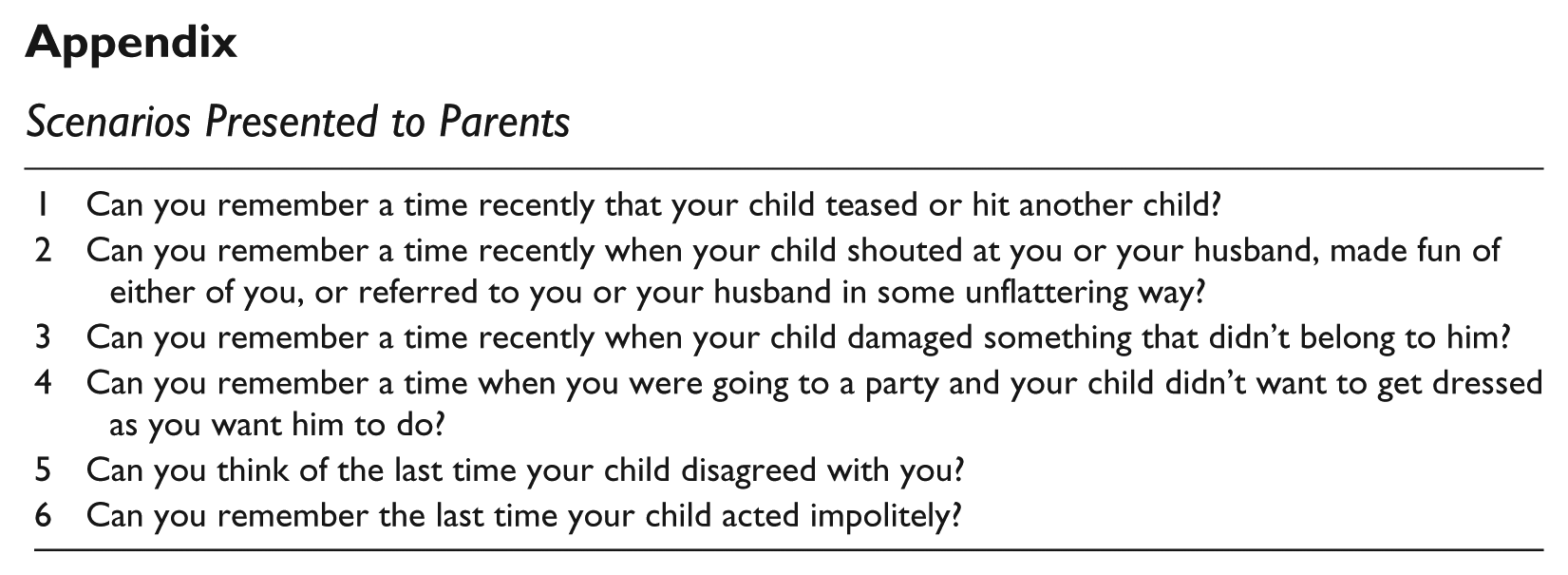
We created a questionnaire describing six disciplinary scenarios derived from Ruffman et al. (1999). The six scenarios are presented in the appendix. Each scenario describes a child’s challenging behavior and parents are asked to write answers describing (a) “What happened in the situation?”, (b) “How did you feel?” and (c) “What did you do or say?” Responses to the latter question were coded for this study. Parents were told if the situation had never happened, to imagine what they would do if it were to happen.
Coding was derived from Ruffman et al. (1999) with adaptations based on the variety and frequency of answers we received from Iranian parents. Ruffman et al. used three categories of answers: General Discussion, that is, when parents reported that they explained to the child or discussed the situation with her or him; Reprimand, that is when parents used punishment as a strategy or ignored the child; and How Feel, in which the parent made reference to a victim’s feeling.
We noticed that Iranian parents reported using reference to Social Norms (e.g., “this is not polite” or “you should respect your older brother”) in ways that do not directly translate into any of the aforementioned categories. Also, we believe parents’ use of emotional displays such as “I got mad” or “I became very upset” differs from reference to how a victim might feel in terms of the level of insight into mental state understanding that can be gained. We thus also coded Parent Emotions responses into a separate category. Furthermore, we also noticed that some mothers have reported that, in response to the child, they do not talk to him or her or try to ignore the situation. Ignoring a child’s misbehavior or avoiding the conflict may also have different consequences for his or her development and is different from disciplining the child with power assertive strategies, so we elaborated on Ruffman’s Reprimand strategy and added another category (Silence) to cover instances where mothers do not challenge the child’s misbehavior and ignore the situation. Finally, some parents reported that they let their child decide, and these were also coded separately. This is particularly important as in our previous unpublished studies we found that the majority of Iranian parents responded to the single item (from Vinden, 2001) of “I let my child decide for herself or himself” with strong agreement; it is therefore of interest to see how often they claim to act this way in real-life situations. Listed below are detailed descriptions and examples of each disciplinary strategy coding category.
Coding
Discuss, explain, describe consequences (dubbed “Discuss”)
This is when mothers tried to discuss the situation with their child, explaining why a behavior is not appropriate or telling them about the consequences of certain behavior. Any responses in which the mother treats the child as a mindful agent who can think and make decisions are included in this category. This category also includes situations where the mother gives the child opportunity to make up his or her mind or to explain to the mother what she or he has done. For example, “I explained to him that he shouldn’t touch other people’s belonging without them knowing.” This example is included as the mother is explaining to the child that touching another’s belonging without permission is not appropriate. If this example was something like “I told him he shouldn’t touch other people’s belongings,” it would be coded into the Boss category. Conversely, a statement like “I told him people will think you are a bad boy if you touch their belongings” would be coded under Social Norms. Another example is, “I tried to talk to them and see why they have started fighting,” in which the mother is giving her children a chance to explain to her the reason of their behavior. And, “I told her she can wear this shirt but then she might catch a cold” which is an example of consequence.
Let Child Decide
This code was used when parents said that in response to the situation in the question they let the child decide or left it to the child to choose. This category is used if the parent added no further explanation to make the response appropriate to appear as a Discuss answer, for example: “I try to let him choose what he wants.”
How Feel
This category includes responses that refer to the feelings of someone involved in the scenario. This is when a mother is referring to the feelings of the victim; for instance, “what would you feel if it were you instead of her/him.”
Avoidance, silence, or passivity (dubbed “Silence”)
This category is for responses that show a passive approach where the parent is not directly involved or does not challenge the child’s behavior. This is when mothers said that they do not talk to the child, they ignored the child’s misbehavior, or they asked someone else to talk to the child. Sometimes they responded, “I didn’t tell him anything,” “I try to control my anger and don’t mention it,” or “I told his older sister to talk to him about it.” Any response that does not actively involve the parent in the situation is included in this category. It should be noted that this category is different from neglecting the child when the child needs the parent (such as silent treatment). In these responses, the mother is avoiding telling the child he has done something wrong. If the mother uses silence as a punishment (e.g., one mother said, “I get angry at them and then ignore them when they come and ask for something, this way they know they should behave themselves”) this would be coded as a Boss strategy.
Deciding for the child, punishing or controlling (Boss)
This category of responses refers to situations when parents do not discuss things with the child. This situation is a “parent to child” decision-making situation, when parents try to control the child’s behavior and do not give the child a chance to respond, defend, or make decisions, without any further explanation or discussion. Examples are as follows: “I told him what to do,” “She should do what I ask her to,” “I told him he can’t watch TV tonight,” “I told her she is a bad girl.”
Social Norms
This is when parents refer to the importance of other people’s judgments of behavior, such as appropriate behavior in public or in front of others. Also included in this category are sole responses relating something socially accepted without further explanation, by referring to respect for adults and politeness. Examples are as follows: “I told him people will laugh at him if he wears that,” “So what would others think if you talk to your dad like this?” or “You should respect your older sister.”
Parent Emotions
This category includes responses referring to any sort of negative feelings that mothers expressed to the child, for instance, “I would be very unhappy and told her I am very upset with what you did.”
Coding Procedure
Mothers’ responses were not mutually exclusive. If a mother gave just one response, her answer was coded for that response, but if a mother said she uses different strategies (e.g., “I talk to him first and try to explain him why I ask him to wear jacket, but if he doesn’t accept, I tell him he can’t come to the party with us”), her answers were coded for each relevant strategy. At the end, in line with Ruffman et al. (1999), each parent received a score based on the proportion of her responses in each category of coding. For instance, if a mother had a total of four responses for all six situations including one How Feel response and three Boss responses, she got a score of ¼ for How Feel and ¾ for Boss.
The first author scored all answers and a second coder, blind to the study’s aims and hypotheses, scored half. Coders agreed on 122 cases, Cohen’s kappa = .84. Disagreements were resolved by discussion.
Results
Parenting Strategies
First, we started by looking at the frequency of particular parenting strategies used by the mothers. Most mothers (87%) responded to all six disciplinary situations, 9% did not answer one and the rest left two situations blank or said that it has never happened. A total of 306 responses were recorded for 40 mothers across all six situations. Descriptive data relate to percentages of mothers who have used any specific strategy at least one time, and means and standard deviations for each disciplinary strategy by situation are presented in Table 1. Here, it can be seen that the most frequently reported strategy is Boss, which is used by almost all mothers (92%). However, 75% also reported using the Discuss strategy at least once. The least used strategy was How Feel. It is also evident that more than half of the mothers used the Silence approach as a disciplinary strategy and one third referred to Social Norms in disciplining their children.
Percentages of Parents Who Have Used Each Strategy at Least One Time and Mean and Standard Deviation of Total Strategies Used by Parents in All Six Situations.
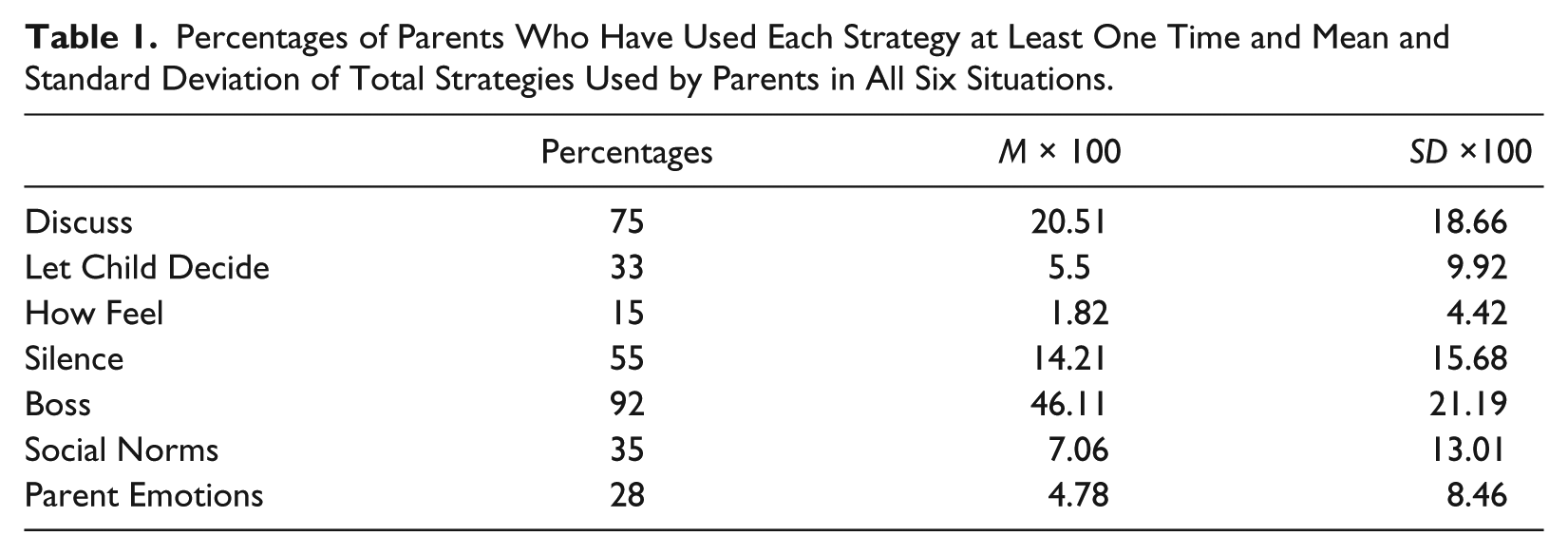
Table 2 shows the associations between the different parental disciplinary approaches. Frequencies of Discuss, Let Child Decide, and Social Norms were negatively correlated with frequencies of Boss and Silence, while other correlations do not appear significant.
Correlations Between Different Parental Disciplinary Strategies.
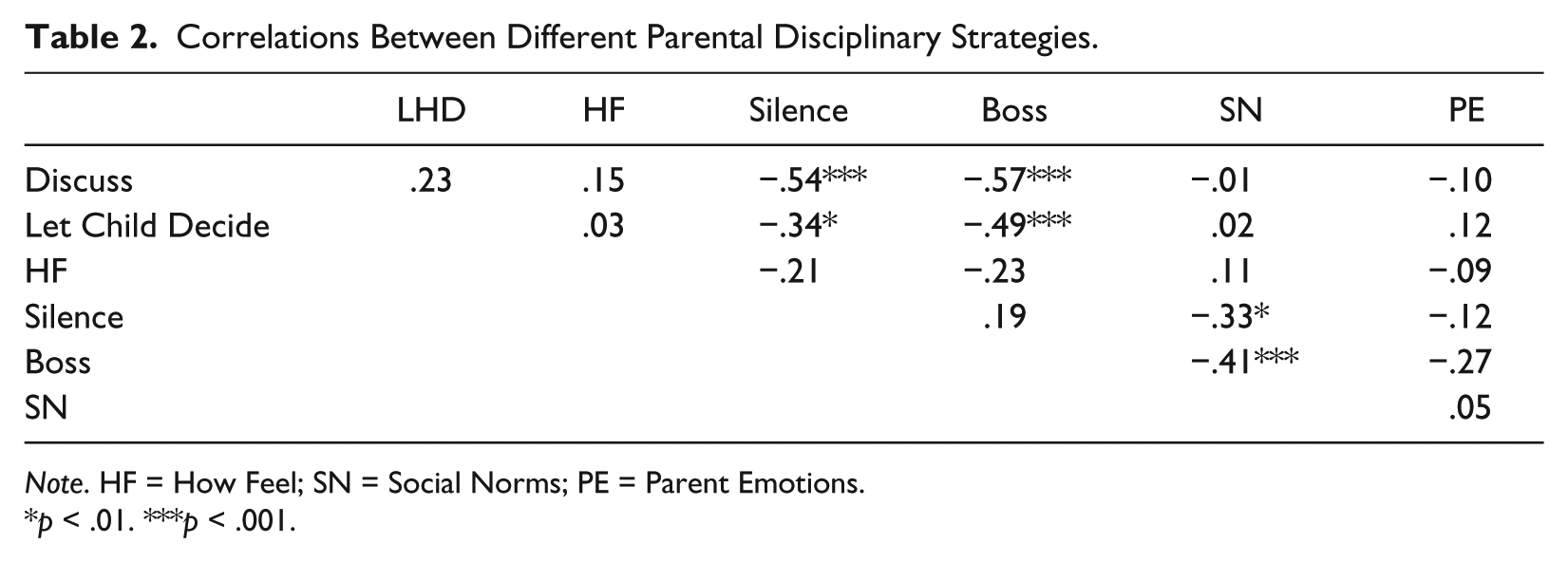
Note. HF = How Feel; SN = Social Norms; PE = Parent Emotions.
p < .01. ***p < .001.
Associations Between Parenting Strategies and Children’s Theory of Mind Scores
We calculated Pearson’s correlations between individual parents’ reported frequencies of using the different disciplinary approaches (Discuss, Let Child Decide, How Feel, Silence, Boss, Social Norms, and Parent Emotions) and their children’s theory of mind scores. Results show that the Discuss strategy is a significant positive correlate of children’s total theory of mind (r = .54, p < .001), total False Belief (r = .48, p < .001), and total Diverse Beliefs (r = .46, p < .001). Also Silence is a significant negative correlate of all three theory of mind measures (r = −.46, p < .001 for total ToM Scale; r = −.31, p < .01, for total False Belief, and r = −.48, p < .001 for total Diverse Beliefs). Reported frequencies of using How Feel and Boss strategies are correlated with children’s false belief scores in a positive (r = .37, p < .01) and negative direction (r = −.43, p < .001), respectively (Table 3 presents the full set of zero-order correlations).
Correlation of Parental Disciplinary Strategies and Children’s Theory of Mind Scores.
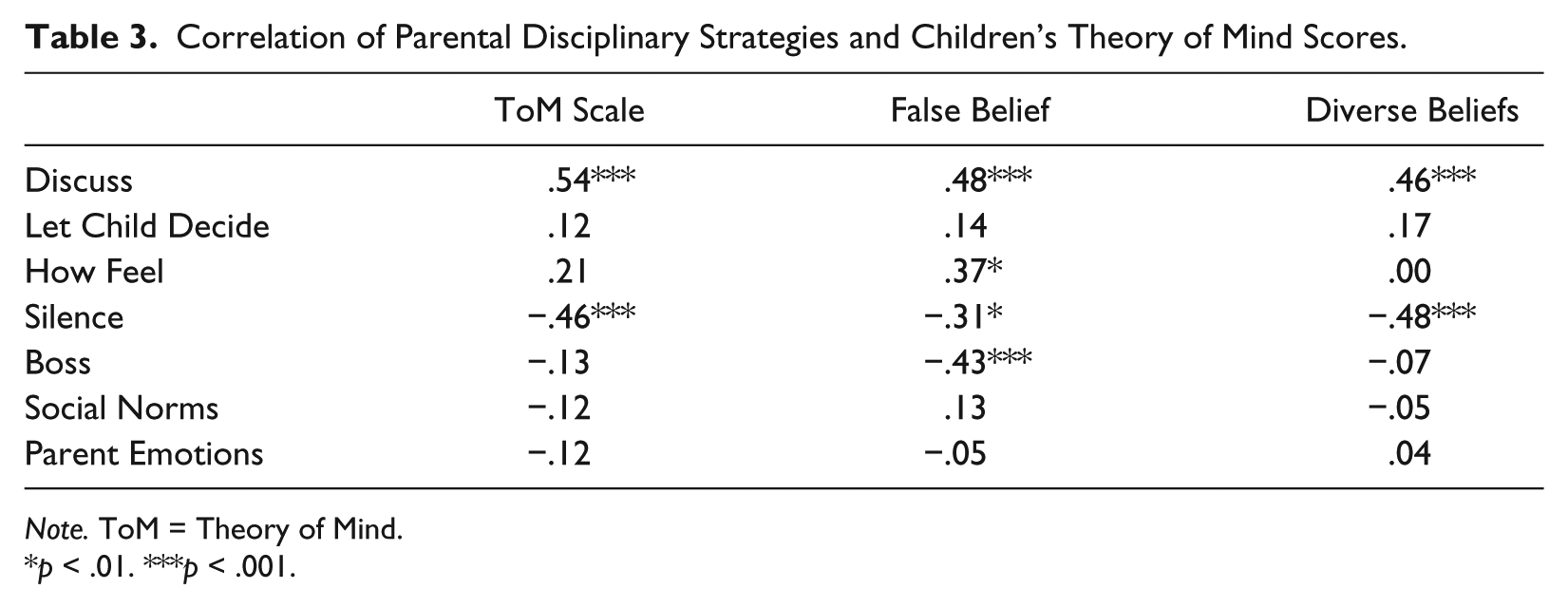
Note. ToM = Theory of Mind.
p < .01. ***p < .001.
To evaluate whether or not these effects were influenced by a child’s age or parental education, we controlled for these variables in a further analysis. Partial correlations were calculated between the frequency of each disciplinary strategy and each scored aspect of children’s theory of mind, controlling for the child’s age and maternal education (see Table 4). The previously noted correlations remained significant save for the negative correlations between children’s false belief scores and parents’ Silence and Boss strategies, which were no longer significant.
Partial Correlations of Parental Disciplinary Strategies and Children’s Theory of Mind Scores Controlling for Child’s Age and Mother’s Education.

Note. ToM = Theory of Mind.
p < .01. **p < .005. ***p < .001.
Discussion
This study has brought insight into parenting approaches in a sample of parents rarely studied before. Results showed that Iranian mothers use Silence and reference to Social Norms in disciplining their children, both of which are strategies not previously identified in the literature on Western parents’ disciplinary styles. However, results confirmed that in line with previous findings with Western parents (e.g., Hughes et al., 2001; Ruffman et al., 1999; Ruffman, Slade, Devitt, & Crowe, 2006), Iranian mothers’ disciplinary strategies are predictors of children’s theory of mind understanding. While mothers’ positive approaches, such as discussing issues with their children and talking about a victim’s feelings, are positively associated with children’s theory of mind, opposite strategies such as ordering (Boss) and not talking to the child (Silence) are negatively associated (though it should be noted that the pattern slightly changes when child’s age and mother’s education are taken into account).
We found that of the seven disciplinary strategies coded, the Boss strategy, in which parents described using an authoritarian approach, was most common, whereas How Feel, in which children were encouraged to consider another’s emotions, was least common. In terms of one approach dominating, this pattern reflects but is distinct from Ruffman et al. (1999) whose sample of British parents reported using a Reprimand strategy most frequently, followed by How Feel and General Discussion. However, there are some procedural differences across the two studies that preclude direct comparison. The six scenarios we used were adapted from, and therefore slightly different to, the five scenarios used by Ruffman and colleagues. Also, our disciplinary strategy coding scheme included seven categories, based on the content of responses from our Iranian parents, whereas Ruffman et al. coded their parents’ responses into four categories. In addition, compared with Ruffman et al., we found a new strategy, Silence, which was not previously mentioned in the literature with Western parents, used often by Iranian mothers. We call this “silence” because it is different from ignoring and neglecting the child. This is an interesting finding as previous research has elaborated on the use of silence in Iranian culture as a communication style (Behzadi, 1994). Behzadi (1994) argued that not talking about your negative feelings and avoiding disagreement are common in Iranian culture. People often avoid talking about what they think, feel, or want. This silence has two functions in interpersonal relationships and among families. In one way, people use silence to punish the other person, cut them out from communications, and show their dissatisfaction. However, not expressing your disagreement or negative feeling also can be seen as controlling your emotions and avoiding further conflicts (Shokoohi-Yekta et al., 2012). This is in line with the findings of our study. In line with these claims, we have found that Iranian parents use Silence to deal with their children’s misbehavior, which means avoiding the situation and not becoming involved. This could be because they are concerned with additional conflicts inside the family and prefer to keep a peaceful atmosphere, rather than challenge their children. However, it should be noted that this strategy may also be used by Western mothers, and the degree to which Western and Iranian parents differ is something our data cannot directly address.
There were significant inter-correlations among the different disciplinary strategies mothers reported using, suggesting that individual mothers tended to be consistent in their approach across diverse disciplinary scenarios. The use of Boss and Silence strategies was significantly negatively associated with Discuss and Let Child Decide strategies. This suggests that parents who tend to discuss things with their children tend to do so, no matter what the nature of the child’s transgression, and they generally avoid reprimand or silence approaches. This may reflect parents’ underlying beliefs about effective parenting behaviors, as the two strategies of Silence and Discuss are opposite in nature. Similarly, the parental strategy of using Boss behavior is conceptually opposite to letting the child decide, again suggesting individual consistency in mothers’ choice and use of disciplinary strategies.
Our results showed that mothers’ use of a Discuss strategy is the strongest correlate of their children’s theory of mind understanding, correlating significantly with total ToM Scale and also total scores for false belief and diverse beliefs. When mothers use this strategy with their children, they are more likely to consider the child’s perspective, in turn preparing children to better understand others’ perspectives. Discussion inside the family also gives the child the opportunity to be familiar with mental terms, which can lead to earlier development of an understanding of other’s minds. This finding is also in line with previous findings showing that mothers’ reference to mental talk and discussion inside a family will facilitate children’s ToM understanding (Ruffman et al., 2002; Slaughter et al., 2007; Taumoepeau & Ruffman, 2008). Similarly, mothers who reported that they refer to the victim’s feelings if their child misbehaves (How Feel) encourage their children to explicitly consider another’s perspective. Interestingly, the use of this strategy was related specifically to children’s false belief task performance, but not to performance on the full ToM Scale. This finding is in line with Ruffman et al. who found a positive association between British parents’ references to other people’s feelings and their children’s false belief understanding. Notably, the use of authoritarian parenting (Boss) was negatively correlated with false belief understanding in the Iranian sample, although this did not remain significant after parent education and child age were partialled out. Silence, in this context, appears to be a more robustly correlated strategy than Boss. This can be explained by saying that the Boss strategy was used by almost all parents (92%), indicating that most parents use this approach in their day-to-day communication with their children. In contrast, Silence was used by only half of the parents. Therefore, Silence may show as a pattern in communication for some parents and not others, and this makes it a more robust predictor of children’s ToM understanding.
The pattern of full and partial correlations suggests a robust association between Iranian mothers’ disciplinary strategies and their child’s ToM. In particular, positive associations between mothers’ self-reported use of the Discuss strategy and their children’s ToM as measured by each indicator of ToM: the total ToM scale, total False Belief, and total Diverse Beliefs scores independently. These correlations all remained significant when maternal education and child age were controlled. This is important, as one would think more educated mothers have children with better theory of mind understanding, and also older children get higher scores in theory of mind tasks. These results show that the association found here cannot be explained by these alternative explanations. Also the positive correlation between the How Feel strategy and children’s False Belief task performance still remained significant when the control variables were included in the analysis. This finding is consistent with Ruffman et al. who also reported a zero-order correlation of .28 (p < .05) between parent’s use of How Feel discipline and their children’s False Belief scores.
Consistent with Ruffman et al., we found a negative association between use of the Boss strategy (similar to “Reprimand” by Ruffman et al.) and children’s False Belief score, although this correlation did not survive inclusion of the control variables. This suggests that more educated mothers may use less of authoritarian strategies and instead tend to discuss things with their children. Similarly as children get older, mothers tend to use less of Boss and Silence strategies and discuss more, as they may think that their older children are better able to understand the discussion while younger children need to be approached differently. More convincingly, we found a robust negative association between Iranian mothers’ use of the Silence strategy and their children’s ToM; when control variables were entered in the partial correlation, this association remained significant for children’s total ToM scores and the diverse beliefs scores, which again confirms a strong effect of Silence strategy above and beyond parents’ education or child’s age. This suggests that theory of mind understanding develops more slowly among Iranian children whose mothers avoid or withhold communication in disciplinary situations.
Furthermore, our results suggest that Iranian parents’ use of Silence strategies may be related to cross-cultural differences previously observed between Iranian and Australian children’s understanding of diverse beliefs. Argument and speaking one’s mind in Iranian culture is not highly valued and this may lead to the avoidance of challenges inside a family. Previous research also failed to find a sibling effect on theory of mind for Iranian children, with speculation being offered this is an outcome of parents being less tolerant for siblings’ arguments and encouraging family harmony (Shahaeian et al., 2014; Shahaeian et al., 2011). The current study provides support for these claims by showing that Iranian parents’ use of the Silence strategy is negatively correlated with children’s diverse beliefs understanding.
The findings of this study add to the body of research demonstrating links between family factors and children’s developing theory of mind. We found that Iranian mothers reported using disciplinary strategies that echoed strategies reported by Ruffman et al.’s British parents (Discuss, How Feel, Boss/Reprimand) and that use of those strategies was related, as predicted, to their child’s theory of mind development. Iranian mothers also reported using strategies not previously identified (Silence, Social Norms), which may reflect aspects of the Iranian collectivist cultural context and which were also correlated with their children’s theory of mind development. These results bring new insights into aspects of family experiences, as influenced by cultural context, which shape children’s understanding of others’ minds. This suggests that research into child development needs more data from various cultures to bring a better and more comprehensive picture of development and child and family interaction.
Footnotes
Appendix
Scenarios Presented to Parents
| 1 | Can you remember a time recently that your child teased or hit another child? |
| 2 | Can you remember a time recently when your child shouted at you or your husband, made fun of either of you, or referred to you or your husband in some unflattering way? |
| 3 | Can you remember a time recently when your child damaged something that didn’t belong to him? |
| 4 | Can you remember a time when you were going to a party and your child didn’t want to get dressed as you want him to do? |
| 5 | Can you think of the last time your child disagreed with you? |
| 6 | Can you remember the last time your child acted impolitely? |
Declaration of Conflicting Interests
The author(s) declared no potential conflicts of interest with respect to the research, authorship, and/or publication of this article.
Funding
The author(s) received no financial support for the research, authorship, and/or publication of this article.