







Abstract
This research examines how technology usage can instigate social change in a developing country. We expected that technology usage leads to changes in modern cultural values and attitudes toward gender equality while traditional values persist. This was tested in an information and communication technology (ICT) for Development Aid project among Ethiopian children who had received a laptop. A longitudinal field experiment compared children who received a laptop (n = 573) with a matched control group without a laptop (n = 485). Measures were taken before laptop introduction and 6 months later. Laptops had medium to strong effects on value and attitude change, particularly in rural areas. Children with laptops endorsed modern values more strongly, but traditional values were bolstered as well. Modern value change mediated the effect of laptop usage on the endorsement of gender equality. Theoretical and practical implications for cultural changes related to gender equality are discussed.
Keywords
Introduction
Scholars from different disciplines have argued that industrialization produces pervasive social change (for an overview, see Inglehart & Baker, 2000). According to this perspective, modernization instigates cultural changes that are associated with rising educational levels and changing gender roles. Although the impact of modernization has been extensively studied, we know very little about how gender roles might change. Cross-national research has suggested that economic development is associated with adoption of values that are increasingly tolerant, rational, trusting, and participatory while distinctive cultural traditions are persistent (e.g., Inglehart & Baker, 2000; Inglehart & Oyserman, 2004). Further research has shown that values are the key drivers for changes in gender attitudes toward equality (Inglehart, 1997; Inglehart & Norris, 2003). In the current research, we aim to broaden our insight in the drivers and process of social change by studying the particular impact of information and communication technology (ICT) as one facet of modernization on cultural values and attitudes toward gender equality. More precisely, we focus on the impact of technology and within-culture differences among girls and boys within one culture over time to gain insight in how social change occurs.
Modernization and Technology
Modernization is a form of social change in which the activities of a more traditional culture are aligned with the activities, institutions, and tools of industrialized nations (Inkeles & Smith, 1974). According to historical and sociological analyses, the introduction of technology can be a powerful driver of social change, implying that technology plays a major role in the shaping of culture. Based on prehistoric archaeological records, Anthony (2007) advanced the thesis that the domestication of horses and use of the wheel played an important part in the spread of language and the transformation of civilization in the Eurasian steppes. Looking at more modern technology, it has been argued that the introduction of the automobile fostered class and race segregation in American cities (McShane, 1995) and that communication technologies such as the telephone (Fischer, 1992) and ICTs have fueled particular social changes of their own (Hiltz & Turoff, 1993; Katz & Rice, 2002; Zuboff, 1988). But although plenty of studies have documented that technology can stimulate social change, we know preciously little about the social-psychological processes involved. One objective of the present research is to address this.
An important factor to consider here is that research on modern ICTs suggests that the technology itself produces only limited social change. Computing activities by themselves tend to be individual activities, and these are unlikely to produce enduring social change. Rather, it is the use of computer technology as a social medium, for activities that include communication and interaction with others, that is responsible for social change effects (Kraut et al., 2002). In line with this research, we expect that ICT could instigate cultural change because of the changing social relations they produce (cf. Bardi & Goodwin, 2011, who consider cultural value change to be possible through priming, adaptation, and identification, all three of which harbor elements of changes in relations).
Modernization and Cultural Values
Although research has documented many consequences of modernization (Inglehart & Baker, 2000), the specific influence of technology adoption has (to our knowledge) not been empirically isolated in this research. But more generally, we do know a lot about the particular values that are affected most strongly by modernization. A three-wave study including cohorts from 65 nations from the World Values Survey found evidence that strong cultural change on certain beliefs and norms may co-exist with simultaneous persistence of distinctively traditional beliefs and norms (Inglehart & Baker, 2000; Inglehart & Oyserman, 2004). Across these nations, “modern” beliefs and norms of increasing rationality, tolerance, trust, and participation emerged while other “traditional” beliefs and norms persisted and continued to reflect a society’s cultural heritage. The authors argue that the fact that a society has historically been shaped by religion leaves a cultural heritage with enduring impact on subsequent development. For example, although increasingly few people might attend church services, the norms anchored in this religion tend to persist in society.
Another relevant literature to consider in the context of this research is a body of recent research examining value change as a function of life-changing events. Studies have examined cultural-value-consequences of migration (Goodwin, Polek, & Bardi, 2012; Lönnqvist, Jasinskaja-Lahti, & Verkasalo, 2011), transition to college (Study 2; Bardi, Lee, Hofmann-Towfigh, & Soutar, 2009), life-changing events in adulthood (Study 4; Bardi et al., 2009), and adulthood and parenthood (Ferriman, Lubinski, & Benbow, 2009). Only one of these studies (Lönnqvist et al., 2011) adopted a pre–post design with a comparison control group.
More recently, Bardi and Goodwin (2011) have speculated about what “facilitators” may stimulate value change. They suggest, among others, that value change may be more observable among children: Adults have strongly crystallized value systems which are more stable and less prone to change (Bardi & Schwartz, 1996). However, their review also reveals that to date, there is very little research on value change among children (see also Bardi & Goodwin, 2011; Daniel et al., 2012) and hardly any in developing countries. In that sense, there is no firm basis in the cultural value literature upon which the present research could make predictions. The present study therefore offers an opportunity to extend our knowledge of value change, linking it with modernization theory. To the best of our knowledge, no other study has yet assessed value change before and after the introduction of technology compared with a control group to test how one specific aspect of modernization may stimulate value change among children in a developing country.
ICT for Development Aid
Laptop programs for students in developing countries are in some respects ideally suited to test some of these hypotheses. During the last 5 years, laptop programs for students such as the One Laptop per Child (OLPC) initiative or Intel’s Classmate PC are proliferating in developing countries. Low-cost laptops were especially designed for children and schools in the developing world. These laptops are now being donated to children in developing countries on a huge scale. 1 Ethiopia was the first African country to receive 4,375 laptops donated by the OLPC initiative in 2008. OLPC is an American-based non-profit organization whose mission is to provide educational opportunities for the world’s poorest children by giving them a laptop with software designed for self-empowered learning. In this spirit, people in Western countries could buy one laptop for themselves and donate one for the developing world which in this case was given to the Ethiopian government. 2
To date, empirical evidence of the effectiveness of these programs is inconsistent, scarce in developed countries and rarer in the developing countries (for overviews, see Penuel, 2006; Zucker & Light, 2009). Some changes associated with this technology might be progressive and beneficial, such as potential educational outcomes in the form of a heightened motivation to go to school (Penuel, 2006; Zucker & Light, 2009), improved computer skills (Penuel, 2006; Zucker & Light, 2009), or improved abstract reasoning abilities (Hansen, Koudenburg, et al., 2012). But there are a host of other potential outcomes such as cultural values which this line of research tends to ignore.
Value Change Stimulated by Technology Usage
What Value Changes to Expect?
Although there is relatively little prior research that examines the specific relations we are interested in, we attempted to form some educated guesses of the expected value change, based on prior knowledge of the culture, the effects technology, and the cultural impact of modernization. This field experiment was conducted in one of the least developed countries in the world, with a low level of modernization in a very collectivist and traditional culture (e.g., Becker et al., 2012; Owe et al., 2013). Whereas computers are a thoroughly integrated part of everyday life in Western societies, in Ethiopia technology is exceedingly rare. Around the time of the study, ownership of a PC was at 80.5% in the United States and 0.7% in Ethiopia and rates of Internet access were 73.5% and 0.4%, respectively (World Bank, 2009). Important is that in Ethiopia, family structure is highly important and that children (in particular girls) are the lowest status household members. It is not customary for children to be seen to be acting or thinking independently, nor to own any valuable goods. Thus, pieces of sophisticated and unknown technology were given to the lowest status household members. Within this context, we expect that there are three underlying processes that are likely to instigate value change among children.
First, the activities provided by this laptop require a set of complicated actions that children had to learn and undertake completely independently of their elders (Hansen, Koudenburg, et al., 2012). The activities provided by the laptop broaden children’s range of experiences: They can carry out concrete tasks such as writing, doing mathematics, or drawing pictures, as well as consume various kinds of information (e.g., mainly schoolbooks, off-line picture gallery, and Wikipedia). 3 It is important to note that at the time of the study, the laptops were not connected to the Internet. A separate field experiment conducted among a subset of these children showed evidence that students who used laptops performed better on abstract reasoning test compared with a control group 6 months after deployment (Hansen, Koudenburg, et al., 2012). Interestingly, this effect was strongest among older children who used a range of more complicated programs for painting, memorizing, and chatting (whereas younger children mainly read their schoolbooks). We believe that the reason why these cognitive effects occurred was that the laptop offered novel learning experiences for children, in which they could follow their own interest (e.g., by exploring programs or searching for information) independently of their teachers and elders. In this perspective, improvements in abstract reasoning are an indicator of independent reflection. In the present research, we therefore hypothesize that these independent modes of thought might extend to cultural worldviews and this should result in stronger endorsement of modern values.
Second, a related point is that only active laptop usage is likely to stimulate these changes. In another field experiment, we compared cultural expressions in self-construal and values among students who were actively using their laptop with a control group of students whose laptop was broken (i.e., mere ownership) and a second control group of students without a laptop in the same school (Hansen, Postmes, van der Vinne, & van Thiel, 2012). This study documented some first evidence that active laptop use was instrumental in the development of an independent self-construal and in the adoption of more individualist values, while mere laptop ownership did not have a very large impact. At the same time, these data suggested that collectivist cultural expressions (i.e., interdependent self-construal and collectivist values) did not go down much. The present study provides several additional pointers that laptop usage stimulates the development of an independent self-concept which might be associated with an increased sense of agency. The new independent and agentic sense of self should similarly be reflected in a stronger endorsement of modern values in the present longitudinal study.
Third, a laptop of this kind is an immensely valuable property by local standards. Providing such a laptop to these children constitutes a major upheaval of social relations in itself. Ownership of this object distinguishes a child from others, from their parents, teachers, and friends and thereby makes children visibly different and independent from others.
The current study set out to examine value change as a function of technology usage by (a) adopting a longitudinal design with matched control groups, (b) comparing girls and boys, (c) comparing urban and rural regions within one country, and (d) using a large enough sample to be able to detect both small and large changes.
Operationalizing Value Change
Previous macro-level research on value change has mapped a wide range of political, social, and religious norms and beliefs on two dimensions: traditional versus secular-rational orientations toward authority and survival versus self-expression values (e.g., Inglehart & Baker, 2000). This research showed that modernization led to considerable changes in the direction of secular-rational orientation and self-expression, while specific traditional orientations toward authority (i.e., obedience toward religion, family, and norms) and survival values (i.e., maintaining order) were relatively static. To be able to investigate the impact of one piece of technology, a laptop, on value change at a micro level, we used a value taxonomy which has been widely used in psychological research on value change (Schwartz, 1992) and linked these two theories. According to Schwartz’ taxonomy, 10 basic values can be mapped on two dimensions: One dimension contrasts openness to change and conservation values and the second dimension contrasts self-enhancement and self-transcendence values. These dimensions encompass the conflict between values that emphasize concern for welfare and interests of others (e.g., universalism, benevolence) and values that emphasize the pursuit of one’s own interests and relative success over others (e.g., achievement). In this taxonomy, the values openness to change, self-enhancement, and self-transcendence assess modern values of secular-rational orientation and self-expression in line with Inglehart and Baker (2000). These values encompass more dynamic values, which are related to change. In contrast, the Schwartz’ conservation values (i.e., security, conformity, tradition) encompass the values of the traditional and survival dimension assessing obedience toward family, religion, and norms in Inglehart and Baker’s research. These values are more static. In line with considerations above, we expected that laptop usage will lead to an increase of modern values of openness to change, self-enhancement, and self-transcendence representing the secular-rational orientation and self-expression (Hypothesis 1a). Furthermore, we expected that laptop usages will have no impact on traditional values of conservation values representing the traditional and survival dimensions (Hypothesis 1b).
Gender Differences
Traditional countries tend to exhibit greater gender inequality (Bergh, 2007; Inglehart & Norris, 2003), also among children. Children are commonly involved in daily chores which replicate traditional gender roles. Boys often herd the cattle or have to work in the field and girls stand in for their mothers in various household chores (e.g., Woldehanna, Tefera, Jones, & Bayrau, 2005). There is also evidence that girls are less invested in than boys: In many developing countries, fewer girls attend school than do boys (United Nations Educational, Scientific and Cultural Organization [UNESCO], 2011). The manner in which ICT was offered to girls and boys, in contrast, was on the basis of equality. Thus, technology use should change both females’ and males’ values to the same extent. In addition, we had no reason to expect that, among these young children, there would be strong gender differences in value endorsement (Daniel et al., 2012). Thus, we expect girls and boys to endorse modern values equally strongly after having used technology (Hypothesis 2).
Within-Culture Differences
Within developing countries, there are often very strong differences between rural regions and urban regions (Sassen, 1998). A discrepancy in the pace of modernization is often the source of these rural/urban differences. To date, relatively few studies have paid attention to regional variation in cultural values within one culture (e.g., Freeman, 1997; Georgas, 1989; Hofstede, de Hilal, Malvezzi, Tanure, & Vinken, 2010; for an overview, see Cohen, 2009). This research has shown that individualistic values are more strongly endorsed in urban areas compared with rural areas. In a similar vein, research has also shown that people differ in their self-conceptions depending on their area of residence (Kashima et al., 2004): Japanese and Australians living in the city de-emphasized their collective self compared with residents in rural areas. Thus, different research lines suggest that more modern values (i.e., more individualistic values) are more strongly endorsed in urban areas compared with rural areas.
Based on this research, we expect stronger endorsement of modern values and gender equality in the urban compared with the rural areas. As people living in urban areas are already more used to signs of modernization (Sassen, 1998), we expected to see greater changes in children living in rural areas than in urban areas (Hypothesis 3).
Values and Attitude Change Toward Gender Equality
Values are more general and enduring in nature, whereas intergroup attitudes are related to a specific referent groups (e.g., Allport, 1961). Values can thus serve as foundations upon which more specific attitudes are built. Value changes in turn have been related to changes in socio-structural arrangements and gender roles (e.g., Bergh, 2007; Inglehart & Norris, 2003; Inglehart & Welzel, 2005; Ogburn & Nimkoff, 1955). Analyses of data from 19 advanced industrial countries from 1990 to 1996 showed that adults’ gender attitudes were mediated by more general cultural values (Bergh, 2007). Moreover, research by Inglehart and Welzel (2005) shows that cultural value change precedes changes in actual gender relations. Whether these macro-level changes over very long periods of time can be related to micro-level changes initiated by the usage of a particular piece of technology is ultimately an empirical question. In other words, having both girls and boys use laptops may decrease gender inequality in a society where there are entrenched sex roles from childhood onward. Thus, we predict that shifts toward modern cultural values are the drivers of changes in attitudes related to gender equality (Hypothesis 4).
The Present Research
We conducted a longitudinal field experiment to systematically study how technology usage affects cultural values and attitudes toward gender equality among Ethiopian children who received a laptop compared with a matched control group. In line with the theoretical considerations outlined above, we examine four questions. First, we investigate whether laptop usage increases the endorsement of modern cultural values and attitudes toward gender equality while traditional values persist. Second, we examine gender differences. Third, we investigate within-culture differences between the urban area and the rural area and compare the magnitude of the value and attitude changes between the areas. Fourth, we test whether modern values mediate the relation between laptop usage and endorsement of gender equality.
Method
Participants and Design
Participants were 1,058 Ethiopian children (640 girls, 408 boys, 10 unknown; M age = 12.66, SD = 1.78) recruited via their schools. The study had a 2 (Laptop: laptop vs. control) × 2 (Region: urban vs. rural) between-subjects design with two measurement points (baseline vs. 6 months after laptop deployment). In total, 4,375 OLPC laptops were deployed in Ethiopia. Three experimental schools were selected in different regions across the country, based on four criteria: Social status of the students had to be about average for the region, school/classroom size had to be equivalent to an average Ethiopian school, school equipment had to be of a suitably high standard (e.g., with electric power and desks for the laptops), and accessibility of the school for support and research had to be good. Finally, staff had to be willing to participate in the scheme (Kocsev, Hansen, Hollow, & Pischetola, 2010). Within these schools all children had received a laptop. In addition, three control schools were selected within the same regions to match the experimental schools in terms of the same criteria as well as ethnicity, religion, and language. Within these schools, none of the children received a laptop. Within all schools, children in Grades 5 and 6 participated in the study (573 in the laptop condition, 485 in the control condition). Four schools were situated in the main capital and two schools in a rural area. Children were approached shortly before the laptop deployment and 6 months later.
Prior to deployment, teachers in the participating schools received professional development training to be familiarized with the software and digital schools books (for more details, see Hansen, Koudenburg, et al., 2012). All children had received a short training on how to use the laptop at school (for more information, see Kocsev et al., 2010). They quickly became familiar with the activities and explored them further independently of their teachers. Because of the lacking infrastructure, laptops could not be connected to the Internet.
Procedure and Measures
The instructions and questionnaires were given in the native language of the children, Amharic or Oromifa. All questions were back-translated from English to Amharic and Oromifa and pre-tested for their suitability for this sample. Bilingual indigenous assistants administered the questionnaires, after familiarizing the children with the questionnaire format and introducing some example items. They were asked, among others, to indicate their agreement with a series of value statements by circling one of the five “smileys” with emotional expressions ranging from a very unhappy face with downturned mouth to a “smiley” with strongly upturned mouth. Unless otherwise indicated, the faces were accompanied by anchors: very unimportant ( = 1), unimportant (
 = 2), OK (
 = 3), important (
 = 4), and most important (
 = 5). This scale has previously been used when studying children’s social norms (e.g., Rutland, Cameron, Milne, & McGeorge, 2005) and self-construal and values (Hansen, Postmes, et al., 2012). On average, children filled in the questionnaire within 1 hr.
Cultural values
Cultural values were measured with an adapted version of the Portrait Values Questionnaire (PVQ; Schwartz et al., 2001). This variation on the Schwartz Value Questionnaire (SVS; Schwartz, 1992) was developed and tested in multiple cultures to measure the basic values in samples of children from age 11. In the present article, we focus on six values in the PVQ which, in prior research, have been associated with traditional and modern values in line with Inglehart and Baker (2000). 4 Traditional values were measured with the subscales Tradition (two items; to be satisfied with what I have; to do what my religion requires; αt1 = .68, αt2 = .63) and Conformity (three items; to do what I am told; to behave properly; to show respect to my parents and to older people; αt1 = .81, αt2 = .76). Modern values were measured with one value of the dimension self-enhancement (Achievement: two items; to be successful; to be ambitious; αt1 = .71, αt2 = .60), the dimension openness to change (Self-direction: four items; to think up new ideas and be creative; when I am grown up, to be independent; when I am grown up, to make my own decisions about what I can and cannot do; to be curious and to try to understand all sorts of things; αt1 = .76, αt2 = .74), and two values of the dimension self-transcendence (Universalism: two items; to treat everyone equally, to listen to people who have ideas that are different to my own; αt1 = .70, αt2 = .67; Benevolence: two items; when I am grown up, to help people around me; to respond to the needs of others; αt1 = .65, αt2 = .60). 5
Gender equality
Participants were asked to respond to the statement “it is important to treat boys and girls equally” on the above 5-point scale.
Laptop usage
To gain more insight in how students used the laptops in this specific context, we first asked students how often they used their laptop in school, at home, and for learning purposes on 4-point scales with 1 = never, 2 = a few times per month, 3 = multiple times per week, and 4 = every day. The three items were collapsed into a scale of frequency of usage, α = .63. Moreover, we asked students for the place where they most frequently used their laptop. They had to make a choice between in class, during breaks at school, inside their parental home, or outside their parental home. Next, we asked students to indicate their favorite activity on the laptop. Based on a pre-test, eight categories easy to understand for students were provided: write, record, paint, games, calculator, browse, memory, and chat activity (for an overview, see Hansen, Koudenburg, et al., 2012). 6
Results
Laptop Usage
We first examined frequency of use: Students indicated that they used their laptop on average multiple times per week (M = 2.86, SD = 0.75). Interestingly, laptops were used most frequently during school breaks (64.7%), less often inside the parental home (15%) or outside the home (14%), and hardly ever inside the classroom (2.8%). Similar observations have been made by others monitoring the implementation in Ethiopia; laptops were hardly ever used in class for teaching purposes (Hollow, 2009). It is important to note that in Ethiopia the majority of students can only recharge their laptop at school. Moreover, students indicated that their favorite activity on the laptop was the writing activity (38.6%), followed by the record activity including taking pictures, viewing slideshows, and recording video and audio (14.7%), the painting activity (13.2%), gaming activities (11.6%), browsing schoolbooks and off-line Wikipedia pages (7.2%), calculator (5.8%), memorize activities (5%), and finally the chat activity that was only usable within the radius of a few meters of another laptop (3.88%).
Overview of Hypotheses Tests
To test the hypotheses of greater value and attitude change among children using a laptop, we conducted 2 (Laptop: laptop vs. control) × 2 (Region: urban area vs. rural area) × 2 (baseline vs. 6 months after laptop deployment) ANOVA with gender as covariate. In all analyses, gender had no significant effect, all Fs < 2.26, ps > .13, indicating that girls and boys do not differ in the change of endorsement of values and gender attitude. This is in line with our expectations (Hypothesis 2) that gender does not have an impact on cultural changes. It is hence not reported below.
Results are summarized in Table 1. Overall, the analyses of the four modern value dimensions as well as attitudes toward gender equality showed roughly the same pattern of results. Traditional values persisted and even slightly increased through laptop usage. We shall discuss each dependent variable in turn.
Summary of Means and Standard Deviations (in Parentheses) for Scores on All Variables by Condition, Region, and Time.
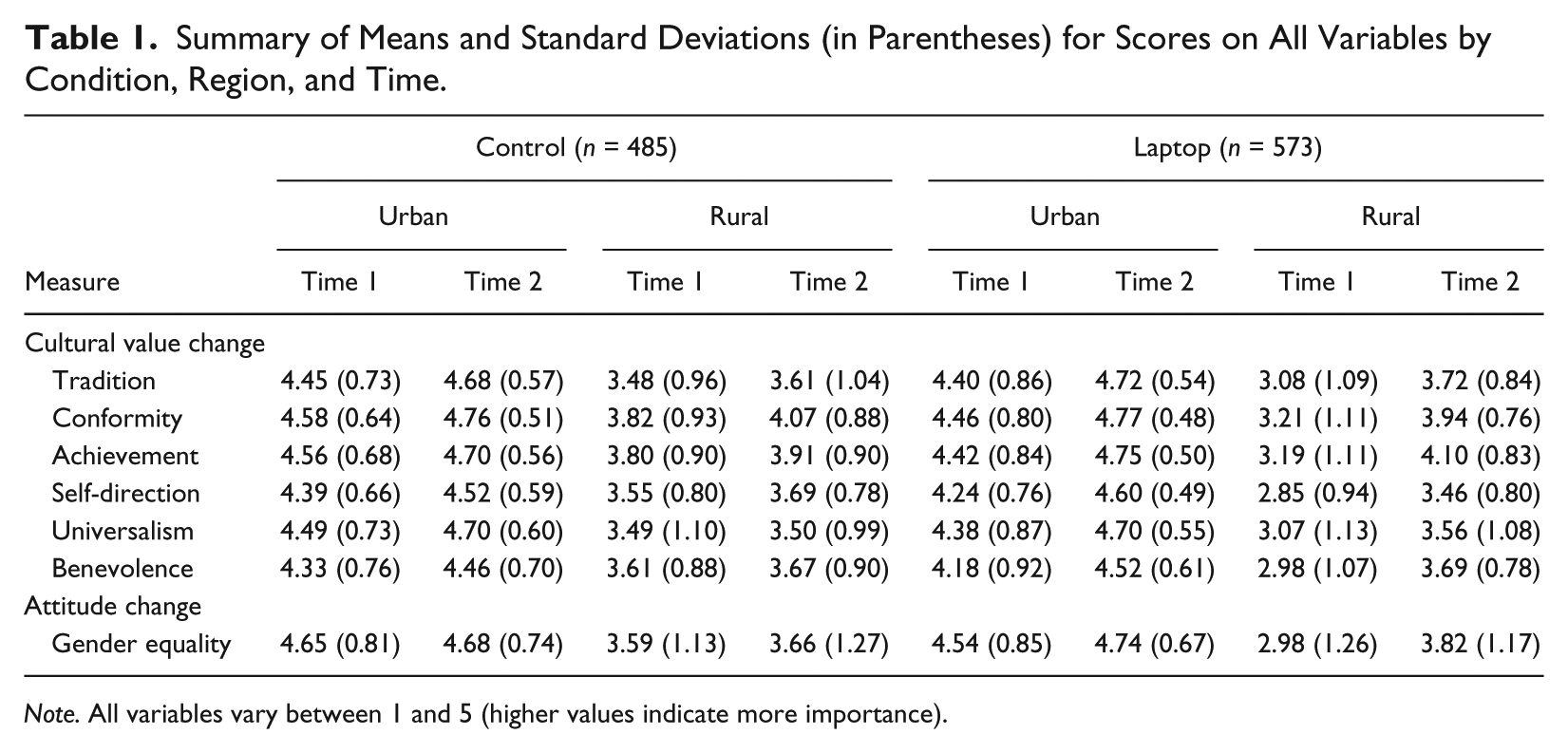
Note. All variables vary between 1 and 5 (higher values indicate more importance).
Valuing achievement
A main effect of region emerged, F(1, 1008) = 373.02, p < .001,
Valuing self-direction
As before, there was a significant main effect of region, F(1, 1015) = 596.17, p < .001,
Valuing universalism
Again a significant effect of region emerged, F(1, 1001) = 438.84, p < .001,
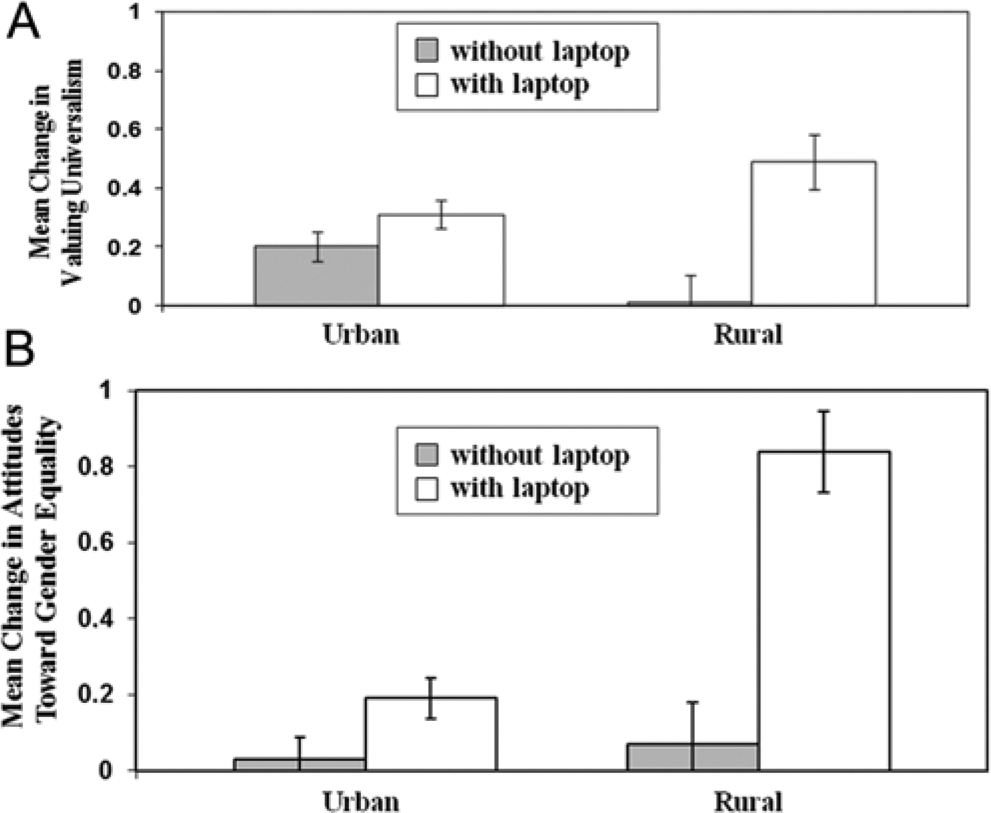
Mean difference values representing cultural value change in universalism (A) and attitude change in gender equality (B) by condition and area.
Valuing benevolence
The main effect of region was again significant, F(1, 1009) = 336.29, p < .001,
Attitude Change Toward Gender Equality
With respect to attitudes toward gender equality, the main effect of region was significant, F(1, 927) = 414.05, p < .001,
Valuing tradition
A main effect of region emerged, F(1, 1011) = 403.71, p < .001,
Valuing conformity
The results for conformity replicated those of traditional values (cf. Hypothesis 1b). A main effect of region emerged, F(1, 1013) = 259.32, p < .001,
In sum, we found strong evidence that laptops produced significant and substantial changes in modern values and in attitudes toward gender equality as predicted by Hypothesis 1a. Overall, laptops had medium- to large-sized effects on change (.05 <
Mediation
To test Hypothesis 4 that change in modern values would mediate the effects of laptops on changing gender attitudes, we tested a series of structural equation models using the package Lavaan in R (version 0.4-14, Rosseel, 2012). The model tested whether values mediated the effects of laptops on gender attitudes (see Table 2 and Figure 2 for an overview). In the model, effects of values and attitudes at Time 1 were included as covariates (although not included in Figure 2), and gender was controlled for. Thus, the model assesses effects of laptops on attitude change over time. Overall, there was clear evidence for mediation. Fit indices indicated excellent fit: χ2(1) = 2.25, p > .13; comparative fit index (CFI) = 1.00; Tucker–Lewis index (TLI) = .98; root mean square error of approximation (RMSEA) = .037; standardized root mean square residual (SRMR) = .003. Model fit of this model was not significantly poorer than the alternative (fully saturated) model with the direct effect from laptops to attitude change. This path was not statistically reliable, at p = .14. Inspection of the paths showed that laptops induced change in all values except for conformity. Gender attitudes in turn changed as a result of some influence of all values, except for traditionalism. Putting these two together, the effects of laptops on attitude change were mediated most strongly by value changes on the modern values of universalism, self-direction, achievement, and benevolence. There was less evidence of mediation for traditional values of traditionalism and conformity.
Summary of Intercorrelations, Means, and Standard Deviations for Scores on All Variables Among Children With a Laptop (n = 573).
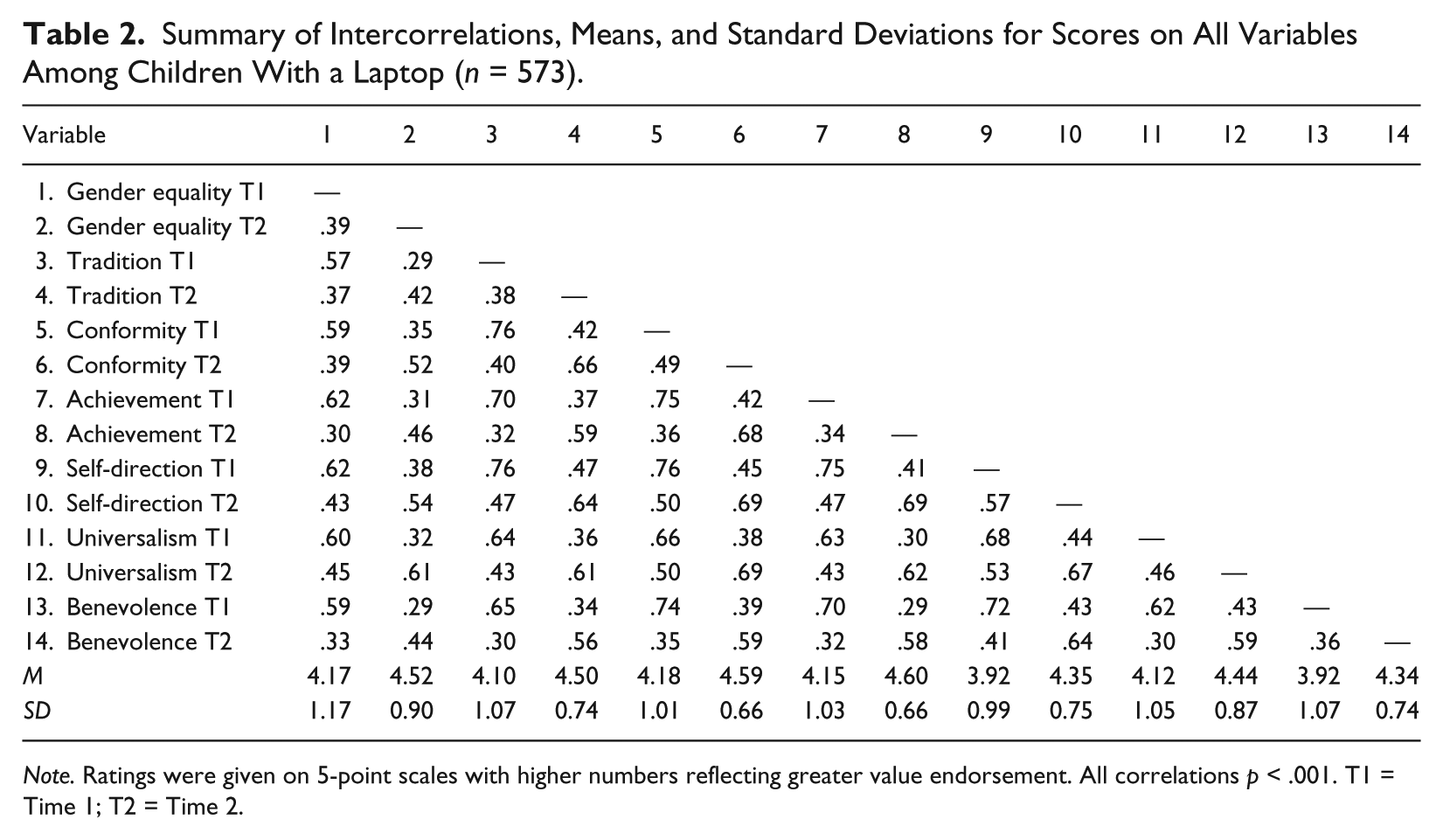
Note. Ratings were given on 5-point scales with higher numbers reflecting greater value endorsement. All correlations p < .001. T1 = Time 1; T2 = Time 2.
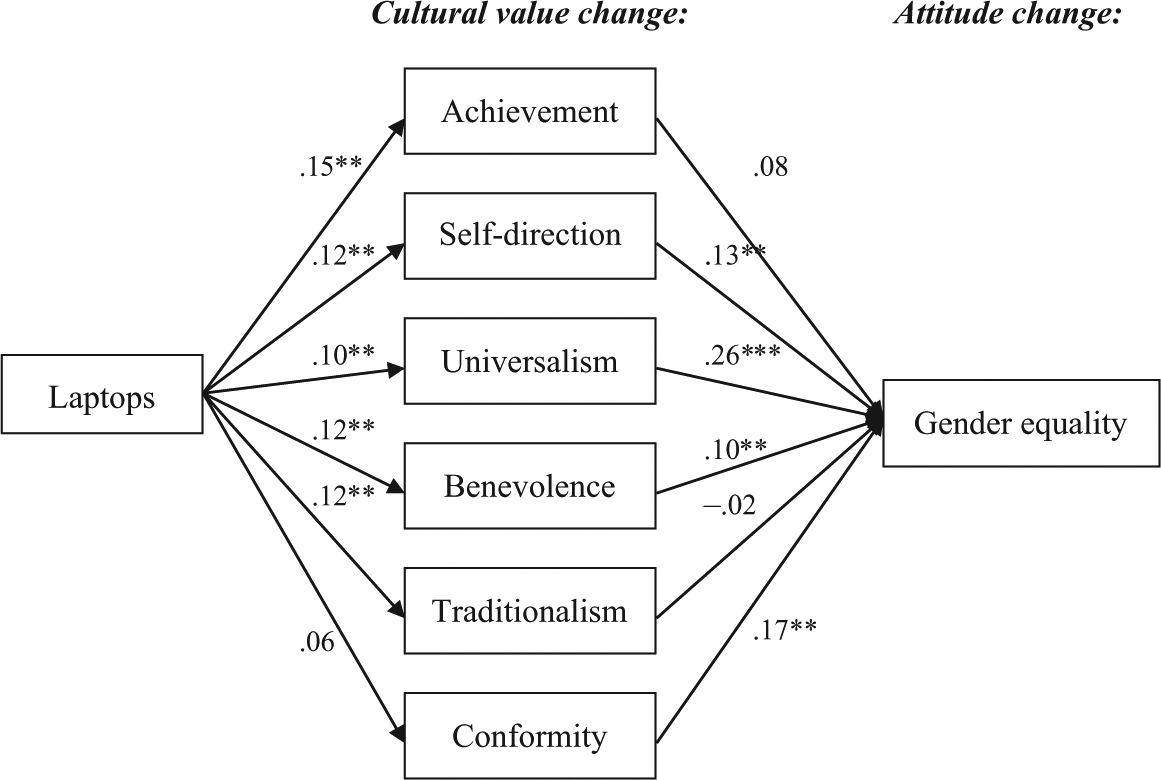
Cultural value change mediates effects of laptops on gender attitude change: Summary of four separate structural equation models.
Following up on the significant urban/rural differences, a multigroup analysis compared the two habitats. The chi-square from a model with all parameters allowed to be unequal across groups was compared with a model in which the paths (but not covariances and intercepts) were constrained to be equal across groups. The model with all parameters freely estimated in the two groups, fit the data reasonably well: χ2(2) = 5.44, p = .07; CFI = 1.00; TLI = .90; RMSEA = .061; SRMR = .003. The partial invariance model with all paths constrained to be equal across groups had somewhat poorer fit according to the chi-square difference test: χ2(68) = 93.28, p = .02. Overall, fit indices for this model were acceptable: χ2(70) = 98.72, p = .01; CFI = 0.99; TLI = .98; RMSEA = .030; SRMR = .023. This suggests that the differences between the two models were small. Modification indices were inspected to determine which loadings differed most across groups. The main difference was in the effect of laptops on achievement: When this path was freed up, and all other parameters constrained, the fit of the model was equivalent to a model in which all parameters were free; difference χ2(67) = 87.67, p = .10, ns. Effects of laptops on achievement were somewhat stronger in the countryside (B = .40, SE = .09, Z = 4.56, p < .001) than in the city (B = .10, SE = .035, Z = 2.73, p = .006). Otherwise, the models of countryside and city children were quite similar. Thus, the mediational models for countryside and city children were virtually identical.
Discussion and Conclusion
This study set out to investigate to what extent ICT usage would cause cultural value change and social change related to gender equality. This was tested in the field, while studying the cultural impact of an ICT for Development Aid project among Ethiopian children who had received a laptop. There was consistent and strong evidence of change. In terms of cultural change, children with laptops came to endorse more modern cultural values of achievement, self-direction, universalism, and benevolence (Hypothesis 1a). These cultural values are related to individual enhancement (achievement, self-direction) as well as the care of others (universalism, benevolence) in line with Inglehart and Baker (2000). In terms of social change in gender equality, gender attitudes became considerably more egalitarian (in particular among rural children); a finding that is in line with oft-noted changes due to modernization (Inglehart & Welzel, 2005). All these changes occurred equally among girls and boys (Hypothesis 2) and were stronger among children living in rural areas compared with urban areas (Hypothesis 3).
Moreover, there was consistent evidence that change in modern cultural values statistically mediated the effects that laptop usage had on attitudes toward gender equality (Hypothesis 4). It should be noted here that the use of an extraneous variable in the model (laptops) as well as evidence of change over time considerably strengthen the causal inferences implied.
We had predicted that traditional and conformity values which reflect a culture’s heritage would persist (Hypothesis 1b), but unexpectedly these values were also somewhat strengthened by the introduction of laptops (although effect sizes tended to be smaller than for modern values). We can only speculate about how to explain this. The increase of traditional and conformity values is not inconsistent with previous research: Inhabitants of countries that faced economic difficulties also showed increased endorsement of traditionalism (Inglehart & Baker, 2000). This suggests that these values may serve some protective function.
For these Ethiopian children, using and owning a laptop clearly changed their life in multiple respects. To endorse modern cultural values means they developed a sense of independence and autonomy. In their community and family, however, these modern values would have been inconsistent with their traditional place: They risk social exclusion. The importance of religion (assessed with the subscale traditionalism) and the importance of family (assessed with the subscale conformity) are major themes in traditional societies such as Ethiopia (Inglehart & Baker, 2000). In traditional societies, a major goal is to make one’s parents proud; to love and respect them. Similarly, religion is a central aspect of Ethiopian family and public life. It is possible that through the stronger endorsement of traditional and conformity values, these children sought to secure their own position in this otherwise traditional social structure. Interestingly, the higher mean levels of traditional values in the city compared with the rural area lend themselves to a similar explanation. Overall, these results demonstrate that ICT usage can be a driver of cultural value change and gender equality, but that this modernization needs not erode traditional values.
One could argue that these findings somehow challenge the Schwartz circumplex. To the extent that different values are at opposite ends of a single continuum, one could predict that if values such as openness to change increase, then conservation values should accordingly decrease (for experimental evidence of this hypothesis, see Maio, Pakizeh, Cheung, & Rees, 2009). In the current study, these two conflicting values increased in importance. We point out that this is not an isolated finding: They were also observed in another longitudinal study of the impact of migration on value change (Lönnqvist et al., 2011). Lönnqvist et al. suggested that value change might not have occurred evenly across all participants: For some, there may have been an increase in openness to change, whereas for other participants, there may have been an increase in conservation values. Of course, an alternative explanation is that even though these values are at opposite ends of the circumplex (implying some degree of negative correlation), it is still possible for one to increase a lot over time and for the other to increase less. But overall, all of these explanations strike us as far-fetched for the simple reason that the correlations between modern values and traditional values are positive and quite strong (see Table 2). Although this is, to some extent, unexpected from a circumplex perspective, we point out that many other studies have pointed out that perceptions of independence are positively related to conformity and adherence to collective norms across many different groups in Western societies, too (e.g., Jans, Postmes, & Van der Zee, 2011). All measured values were increased in importance after laptop use, so an alternative explanation to the results could also be that laptop use simply increased the importance of values overall. But although this is clearly a possibility, we have no theoretical rationale for why this might be the case. We also point out that only modern values were related to gender attitudes (as predicted), whereas traditional values were not.
It is also important to consider regional variations in the magnitude of these effects. To the best of our knowledge, this is the first study which investigates cultural change driven by ICT usage and regional variation compared with a control group. In line with earlier research (e.g., Hofstede et al., 2010), we also provide evidence for stronger endorsement of modern values and endorsement of gender equality in the rural compared with the urban area (Hypothesis 3). Although there were some differences between rural and urban children, it is important to take the magnitude of these effects into account. The effect sizes of the full Laptop × Area × Time interaction were small, with
Interestingly, our study also shows that students frequently use their laptops mainly during school breaks. During this time, they can independently explore the different activities provided by the laptop. Within this very collectivistic culture, this is a very unique moment in which students can follow their own interests without being observed by their teachers or parents.
Gender Differences
We did not find any gender effects. Girls and boys who used a laptop both became similarly more modern and endorsed gender equality more strongly over time. They used similar activities provided by the laptop and received the same input. Changes in attitudes toward gender equality are a logical consequence of this changing perspective on self and others: The relative position of boys and girls in the close-knit network is freed up first, to the extent that the agency of both genders increases and second, to the extent that cognitive alternatives to the present situation can become imagined (e.g., Hansen, Koudenburg, et al., 2012). The absence of gender effects in these results underlines that cultural value change may be underlying these changes in gender relations. In this case, ICT usage is the driver of change, and cultural values related to self and others are the engine.
Cultural Values Related to the Individual and Others
These results clearly show that Ethiopian children are not only getting more “individualistic” but also care for others. At the individual level, the values of self-direction and achievement serve individual interest, whereas the values of universalism and benevolence reflect collective interests. Both individualist and collectivist cultural expressions co-exist within cultures (Knafo, Roccas, & Sagiv, 2011; Oyserman, Coon, & Kemmelmeier, 2002). Likewise, in line with Markus and Kitayama’s (1991) distinction between self-construal as independent and interdependent, the current data show that children develop a more autonomous and independent self-construal (e.g., evident in the endorsement of self-direction) as well as a more interdependent self-construal which is embedded in relationships (e.g., evident in the endorsement of benevolence). In sum, there is clear evidence for growth of a modern sense of self with independent and interdependent aspects of a self-construal in youngsters who were given laptops, over a 6-month period.
The Development of an Agentic Sense of Self
The change was evident on modern values which in turn affected attitudes toward gender equality which dovetails with our reasoning based on modernization theory. Previous research showed that students who were using their laptop showed better abstract reasoning abilities (Hansen, Koudenburg, et al., 2012), a first sign for independent reasoning, compared with comparison group. Moreover, the active usage and not the mere ownership (Hansen, Postmes, et al., 2012) stimulated change with respect to individualist values and an independent self-construal. In sum, these results suggest that youngsters acquire a growing sense of agency and individuality—an awareness of being able to initiate a variety of actions upon their environment, coupled with a growing ability to imagine a range of possible futures (for a definition see, Hansen & Postmes, 2013; Kitayama & Uchida, 2004). This changing perspective on self and self-initiated actions can be witnessed in the increased value placed on self-direction and achievement. In addition, the discovery of agency and individuality seems not to be restricted to individual goals but also transfers to the awareness of being able to care for others as evidenced in changes in self-transcendence values, in particular the values of universalism and benevolence.
Theoretical Implications
The current research differs in two respects from the previous research: (a) Research by Inglehart and Welzel (2005) has focused on the impact of broader economic development on value change, whereas the current research focuses on the impact of one concrete technological tool on value change, and (b) Inglehart and Welzel have studied longer time horizons. Importantly, the current results show that introducing ICT in a developing country stimulated cultural value change in individuals already 6 months after the introduction of a new technology. Although this finding is in line with research on modernization theory (e.g., Inglehart, 1997; Inglehart & Baker, 2000), the relationships uncovered in this research are nonetheless quite unique, because of the quasi-experimental design of this study, the realistic setting, and the concrete outcomes. As a result, we can relate the consequences of the introduction of one very specific (and in the Ethiopian context in which it was introduced, quite revolutionary) technological tool, to subsequent changes in some very general modern values which, in turn, were the key driver for attitude change related to gender equality. At the same time, traditional values increased as well (see discussion of Hypothesis 1b) but were not related to the attitude change. This is not that surprising because, in contrast to modern values, traditional values of following religious requirements and obedience are unlikely to make much difference to the lives of boys and girls (and they are more static). In sum, we uncovered direct and strong evidence to support predictions derived from modernization theory.
With respect to the social psychological literature, the article explores alternative pathways to social change that tend to be neglected (Hansen & Postmes, 2013). There was no evidence here that an intergroup dynamic played any role in producing changes in gender relations. Instead, the changes in gender attitudes were the consequence of a shift in values that equally affected girls and boys. That technology made such changes possible should not surprise us: Technology that enhances capabilities for communication, exchange, and mobility has often been associated with pervasive social change (e.g., Fischer, 1992; McShane, 1995; Zuboff, 1988). The present research suggests that changing social relations can be based on changing cultural values. Also, it is noteworthy that in the present research substantial social and cultural change happened without conflict and without apparent resistance to this change. With respect to potential theoretical innovations in the psychology of social change, we would like to advance the hypothesis that technology usage can be a major driver of social and cultural change.
Practical Implications
Although the primary goal of laptop programs for students is to affect educational and learning outcomes, this article focuses on the unintended secondary effects (Sproull & Kiesler, 1991) and shows that they can be substantial. Even if the effects of laptops on gender equality are not necessarily the primary goal of OLPC, they are nonetheless evidence of a change that many would welcome. Although these changes are considerable, we should caution that it may be premature to infer from these results that laptop programs are a cost-effective instrument to bring about social change. Stakeholders often underestimate the magnitude of the initial investment required. There is also a tendency to neglect the significant oncost (e.g., Camfield, 2006) for providing energy and technical support such as new software or repairs of broken laptops. These additional investments are highly important for a sustainable success of these programs. Only with accompanying support can these programs have a lasting impact on students’ development.
Limitations and Future Research
The present data do not allow us to ascertain what are the precise mechanisms by which technology affects values. In line with other research, we argue that the actual laptop usage and the development of a stronger independent self-construal and a sense of agency (Hansen, Postmes, et al., 2012) change social relations of the individual who begins using this technology to her or his immediate environment. The present data offer no direct evidence to support this assertion, however.
Future research should more carefully investigate the benefits and risks of the cultural changes instigated by ICT for development projects in the long run. As mentioned above, these changes in cultural values and gender equality might also trigger conflicts with peers who were not given a laptop, or parents.
Conclusion
The current research demonstrates that technology can promote cultural value change and gender equality, without undermining traditional values. Ethiopian children who were given small laptops showed evidence of strong cultural change related to the endorsement of modern values, both when comparing baseline values to changes 6 months later, comparing children in the urban area and the rural area, and in comparison with a control group. They also became more egalitarian with respect to gender. The goal of these initiatives is to enhance educational prospects of children in the developing world. But as shown here, there are considerable unanticipated side effects. The results might be a first sign that technology is the harbinger of change, albeit not necessarily that which was originally intended.
Footnotes
Acknowledgements
We thank Thomas Rolf, Márton Kocsev, Eskender Endualem, and the rest of the on.e | eCapacity Development team from the Engineering Capacity Building Program (ECPB), Ethiopia, for helping with the study. We particularly thank the children and teachers in Ethiopia with whom we worked and who gave their time freely.
Declaration of Conflicting Interests
The author(s) declared no potential conflicts of interest with respect to the research, authorship, and/or publication of this article.
Funding
The author(s) disclosed receipt of the following financial support for the research, authorship, and/or publication of this article: This study was financially supported by the Engineering Capacity Building Program, Ethiopia, and by a grant from the Economic and Social Research Council (RES-062-23-0135).