







Abstract
Is East Asian religious tolerance, as opposed to Western monotheistic prejudice, a stereotype or a reality? Based on theoretical and empirical evidence, we hypothesized low prejudice as a function of East Asian religiosity. We examined whether this holds true for interreligious, anti-atheist, ethnic, and anti-gay prejudice. In Study 1, analysis of the International Social Survey Program (ISSP) 2008 data from Eastern religious and Christian samples in Japan, South Korea, and Taiwan (total N = 3,555) showed, contrarily to Christians, high interreligious tolerance and weaker if no anti-gay prejudice as a function of Eastern religiosity. In Study 2, Eastern religiosity among Taiwanese (n = 222) was negatively related to prejudice against various religious outgroups (except atheists), especially among those low in authoritarianism. In Study 3, Eastern religiosity among Taiwanese (n = 102) was negatively related to implicit interreligious (Muslims) and ethnic (Africans) prejudice; prosociality partially mediated the former association. Eastern religious tolerance seems to be true, but not unlimited.
Religiosity and Prejudice Across Religions
Systematic research over the last 30 years has established that religiousness—certainly religious fundamentalism, but often even mere personal and intrinsic religiosity—predicts prejudice toward outgroups and people who are perceived to threaten one’s religious values. This is the case with people of other race, ethnicity, and religion, as well as atheists, homosexuals, single mothers, and feminists (see for reviews Hall, Matz, & Wood, 2010; Hunsberger & Jackson, 2005; Whitley, 2009). The effects are clearer when the prejudice is not socially proscribed and when one examines the role of coalitional, rather than devotional, aspects of religion. They are mediated by religious persons’ and, even more so, by fundamentalists’ authoritarian social attitudes (Rowatt, Johnson, LaBouff, & Gonzalez, 2013) and the epistemic needs for consistency (Hill, Cohen, Terrell, & Nagoshi, 2010), and closure, that is, the desire for high cognitive order and structure and clear answers as opposed to ambiguity (Brandt & Reyna, 2010).
However, the above knowledge is based on many dozens of studies carried out essentially among Christians from North America and Europe. Few additional studies having been conducted with Muslims and Jews—and, exceptionally, Hindus—have provided similar results (e.g., Ginges, Hansen, & Norenzayan, 2009; Hunsberger, 1996). In sum, the existing knowledge on religiosity and prejudice clearly applies to the three monotheistic religions, and possibly extends to Hinduism.
Surprisingly enough, it is unknown whether the above knowledge generalizes to people belonging to major East Asian religions and cultures, that is, Eastern Buddhists, Taoists, and folk believers living in Asian countries. More generally, systematic empirical research on the psychological aspects of East Asian religions and religiousness is extremely rare (see Saroglou & Cohen, 2013, for a review). The aim of the present work was to investigate the role of religiousness in prejudice in the context of East Asian religions. We hypothesized that Eastern religiousness relates to low prejudice, contrary to what is the case (high prejudice) in West-originated Christianity. Below, we develop the rationale for the hypothesis.
East Asia–West Religious and Cultural Differences
Philosophers, religious scholars, and cultural psychologists have argued that Eastern religions, especially Buddhism and Taoism, may escape the temptation of the monotheistic religions, in particular Christianity, to tend toward dogmatism, rigidity, and the subsequent intolerance and prejudice (e.g., Harvey, 1990; Ji, Lee, & Guo, 2010; Nisbett, Peng, Choi, & Norenzayan, 2001). These religious/convictional systems are less marked by doctrinal purity and the need for a systematic integration of all beliefs into a coherent whole of theological ideas, as is the case with Christianity. Thus, historically, East Asian religions have also been much more open to reciprocal interpenetration and subsequent blending, compared with certain exclusiveness within each monotheistic religion. Buddhism and Taoism favor a more holistic and dialectical way of thinking about the world, humans, and transcendence than Catholicism and Protestantism. The yin–yang symbol in Taoism emphasizes interdependence and complementarity, and in Buddhism, two seemingly incompatible phenomena can both be true at the same time. Several East Asian religions also seem less concerned with obedience to religious authorities: These religions dispose of many temples but few priests (Yang, 1961).
Moreover, these religions emphasize, presumably in a stronger way than in the so-called Abrahamic religions, ideals of harmony, compassion, and non-violence (Davidson & Harrington, 2002; Ji et al., 2010). The concern for harmony is particularly present in East Asian religions at different levels: between individuals, between groups, and between humans and nature. In this context, universal compassion and tolerance are strongly emphasized especially in Buddhism, possibly in a clearer way than in the three monotheisms. The latter suffer from an accentuated distinction between the ingroup and outgroups, thus limiting prosociality mainly to the ingroup (Galen, 2012; Saroglou, 2013).
There is indirect evidence from psychological research in favor of the above differences between East Asian religions/religiosity and West-originated monotheisms, in particular Christianity and Christian religiosity. For instance, whereas religion is a means to maintain control among Christians (European Americans), which contributes to their well-being, this does not seem to be relevant in the context of Eastern religion among Asian Americans and East Asians (Sasaki & Kim, 2011). Moreover, the belief in a personal moral God is strongly related to morality in Western monotheistic societies, but it is unrelated to morality among Easterners (China, India, and Japan; Stark, 2001). Finally, among Western (Belgian) Catholics converted to Buddhism, high scores on Buddhist beliefs and practice are unrelated to the epistemic need for closure (Saroglou & Dupuis, 2006), whereas the opposite is true for religiosity among Catholics in the same country (Duriez, 2003; Saroglou, 2002) and Christians in the United States (Brandt & Reyna, 2010).
Thus, East Asian religiosity can be expected to lead to weaker prejudice compared with Christian religiosity. Moreover, East Asian religiosity may even be negatively associated with prejudice regarding various targets. This may be due to the underlying psychological pattern of a lower need for cognitive closure, a lower need for control, and a lower motivation to integrate all beliefs and norms into a coherent whole, as well as lower theological exclusivism and a higher emphasis on compassion, non-violence, and harmony.
Note that religions can legitimately be seen as cultural systems themselves, or at least as subcultures within broader cultures (Cohen, 2009). When there is correspondence (probably bi-directional influences) between religious characteristics and other ethnic cultural characteristics (e.g., Jews living in Israel), such “isomorphism” may consolidate psychological differences between religious groups (e.g., Israeli Jews vs. Muslim Turks; Saroglou & Cohen, 2013). On the contrary, when there is “non-isomorphism” between religious and other ethnic cultural characteristics (e.g., Muslims living in France), it is unclear whether it is the religious elements or the ethnic cultural elements that become preponderant.
In the present case, it is historically evident that East Asian versus Christian (and monotheistic in general) religion and religiosity have been embedded in different geographies and corresponding cultures (East Asia vs. the West). These religions are even considered as having contributed to the respective East Asian versus Western cultural psychological differences (e.g., Nisbett, 2003). A brief inspection of key cultural differences between the East and the West consolidates our hypothesis.
East Asians differ from Westerners in that they are more interdependent versus independent, respectively (Henrich, Heine, & Norenzayan, 2010; Kitayama & Cohen, 2007). Westerners exaggerate their positive self-views and are more egocentric, whereas East Asians may demonstrate a self-effacing bias (Yamagishi et al., 2012). Whereas Westerners tend to use analytic reasoning and focus on categorical rules and attributes when perceiving objects, East Asians use more holistic, context-based thinking and similarity relations when classifying objects (Nisbett, 2003; Nisbett et al., 2001) and show weaker motivation for consistency (Kanagawa, Cross, & Markus, 2001; Suh, 2002). Interestingly, Chinese people show less ingroup favoritism than European Americans (Ma-Kellams, Spencer-Rodgers, & Peng, 2011), which is very likely due to the dialectical vision of self, allowing thus for the integration of contradictory elements and changes (Peng & Nisbett, 1999; Spencer-Rodgers, Williams, & Peng, 2010). Moreover, dialectical thinkers are supposed to be less vulnerable to essentialist thinking about social groups and more open to stereotype change (Spencer-Rodgers, Williams, & Peng, 2012).
To the extent that cultural elements (other than religion) affect religion and between-religion differences, we can suspect that, within the context of East Asian religions, compared with West-originated Christian religions, holistic thinking, interdependence, low egocentrism, emphasis on similarity relations in categorizations, and a low need for consistency should result in a weakened perception of others as being totally different, and thus attenuate prejudice, if not favor tolerance.
The Present Studies
To fully investigate the question of low prejudice as a function of East Asian religiousness across the present studies, we measured prejudice toward a variety of outgroups that are known to be relevant in terms of previous research on religion and prejudice, that is, religious, convictional (atheists), ethnic, and moral (homosexuals). Although there exists a common global tendency for high versus low prejudice across a variety of targets (e.g., Akrami, Ekehammar, & Bergh, 2011), distinct psychological processes may be involved in different kinds of prejudice toward specific targets (Asbrock, Sibley, & Duckitt, 2010; Duckitt & Sibley, 2010). Previous research on religion and prejudice suggests, for instance, some “hierarchy” between various kinds of targets, with atheists and homosexuals, or moral outgroups in general, being the typical targets of prejudice as a function not only of Christian fundamentalism, but also of mere Christian religiosity (Leak & Finken, 2011; Mavor & Gallois, 2008; Rowatt, LaBouff, Johnson, Froese, & Tsang, 2009). Nevertheless, on the basis of the many arguments in favor of our main hypothesis, we expected East Asian religious tolerance to apply to all of the above-mentioned types of targets.
To clearly focus on culture-based East Asian religiousness and its social outcomes, that is, attitudes toward outgroups, three studies were carried out specifically in East Asian societies (adults from Japan, South Korea, and Taiwan in Study 1; young adults from Taiwan in Studies 2 and 3). Across the studies, Buddhists, Taoists, and folk believers, but also, for comparative reasons, non-believers (atheists), were included. In interpreting the results, comparisons were made to previous knowledge from research on monotheistic, especially Christian, religions, and, in Study 1, with Christian (Catholic and Protestant) Asians living in the same Eastern countries. Across the studies, ethnic, religious, convictional (anti-atheist), and moral (anti-gay) prejudice was investigated; both explicit and implicit measures of prejudice were adopted; and various measures of religiousness (affiliation, global religiosity, religious practice, and fundamentalism) were used. In addition, we investigated authoritarianism as a possible moderator of the religiousness–prejudice link (Studies 2 and 3), and prosociality as a mediator of the religiousness–(low) prejudice link (Study 3).
Study 1
In Study 1, the hypothesis of weaker prejudice as a function of Eastern religiousness compared with Christian religiousness was tested in a set of three East Asian countries (Japan, South Korea, and Taiwan). To show cross-religious differences while keeping the ethnic cultural background constant, we compared East Asian religious groups (Buddhists and Taoists) with Catholic and Protestant Christians from the same countries. The study focused on interreligious prejudice toward people from other religions or with different religious convictions and moral, that is, anti-gay, prejudice.
We expected low prejudice among East Asian religious samples as a function of high religiousness. Of particular interest was anti-gay prejudice, as all world religions are suspected to explicitly support anti-gay prejudice (Siker, 2007) and all religions imply an overall conservatism and traditionalism in values and a low consideration of hedonistic values (Norris & Inglehart, 2004; Saroglou, 2014; Saroglou & Dupuis, 2006).
Method
Participants
Data for this study were retrieved from the International Social Survey Program (ISSP) 2008 module on religion. The ISSP is a program of yearly international surveys covering a large variety of topics (http://www.issp.org), with an additional module each year addressing specific questions on a given topic (e.g., in 2008, religion). We used the pooled data set from the three East Asian countries that are included in the ISSP 2008: South Korea (n = 1,482), Taiwan (n = 1,800), and Japan (n = 1,131). All three countries have been marked by the presence and influence of East Asian religions, and South Korea presents the advantage of a strong presence of Christians. On the basis of the ISSP item asking for participants’ religious affiliation, we retained those belonging to any one of the five major convictional groups present in these countries: Buddhists (n = 1,081), Catholics (n = 163), Protestants (n = 469), Taoists (n = 260), and atheists (n = 1,582). The few remaining respondents belonged to very small and marginal religious groups. The study thus included 3,555 participants in total (48% male, 52% female) ranging in age from 16 to 94 (M = 46.5, SD = 17.3). Buddhists were numerous in each of the three countries (24% in South Korea, 18% in Taiwan, and 35% in Japan); the large majority of Christians hailed from South Korea (83%) and all Taoists came from Taiwan.
Measures
Prejudice
Anti-gay prejudice was measured through the single ISSP item assessing perceived immorality of homosexuality: “Are sexual relations between two adults of the same sex wrong or not?” (Likert-type scale ranging from 1 = always wrong to 4 = not wrong at all). For the analyses, scores were reversed. Interreligious prejudice was measured through two ISSP items: “Would you accept a person from a different religion or with a very different religious view from yours . . . (1) marrying a relative of yours and (2) being a candidate of the political party you prefer?” (4-point scales ranging from 1 = definitely accept to 4 = definitely not accept). The two items were importantly interrelated (r = .61, p < .01) and thus were averaged to form an index of interreligious prejudice (rs across samples: .49-.68).
Religiousness
General religiosity was measured through the ISSP 2008 item: “Would you describe yourself as. . . . ?” (responses ranged from 1 = extremely religious to 7 = extremely non-religious). For the analyses, scores were reversed. Religious practice was measured through three ISSP 2008 items assessing frequency of prayer, religious attendance, and visitation to holy places (responses ranged from 1 = never to 11 = once a day; α = .61; αs across samples: .43-.64). 1
Results
Bivariate correlations between religious measures (general religiosity and religious practice) and the two types of prejudice (i.e., interreligious and anti-gay) were conducted distinctly for each of the four religious groups (see Table 1). Interreligious prejudice was positively associated with both measures of religiousness among Christians (both Catholics and Protestants); however, the same associations were negative (for religiosity) or nonexistent (for religious practice) among Buddhists and Taoists. Anti-gay prejudice was positively associated with religiosity among all religious groups (but not significantly among Taoists).
Coefficients of Correlations Between Indicators of Religiousness and Interreligious and Antigay Prejudice, Distinctly by Religious Group (Study 1).
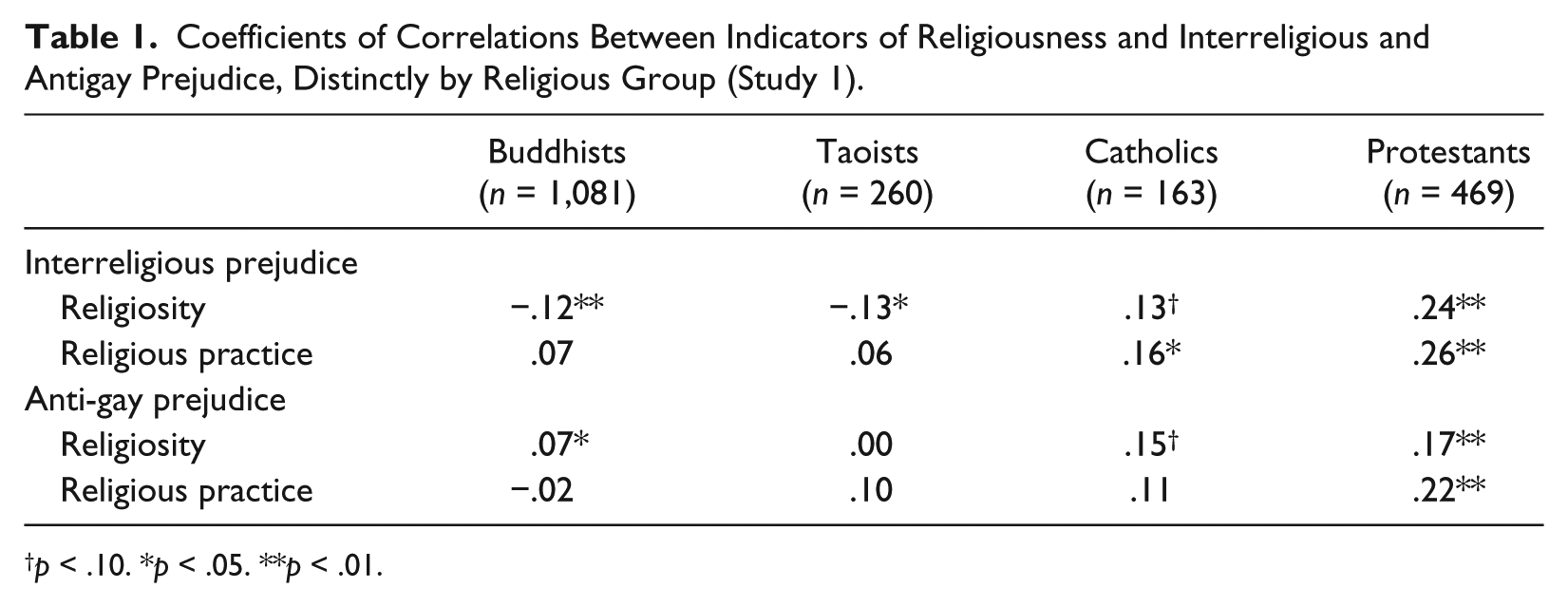
p < .10. *p < .05. **p < .01.
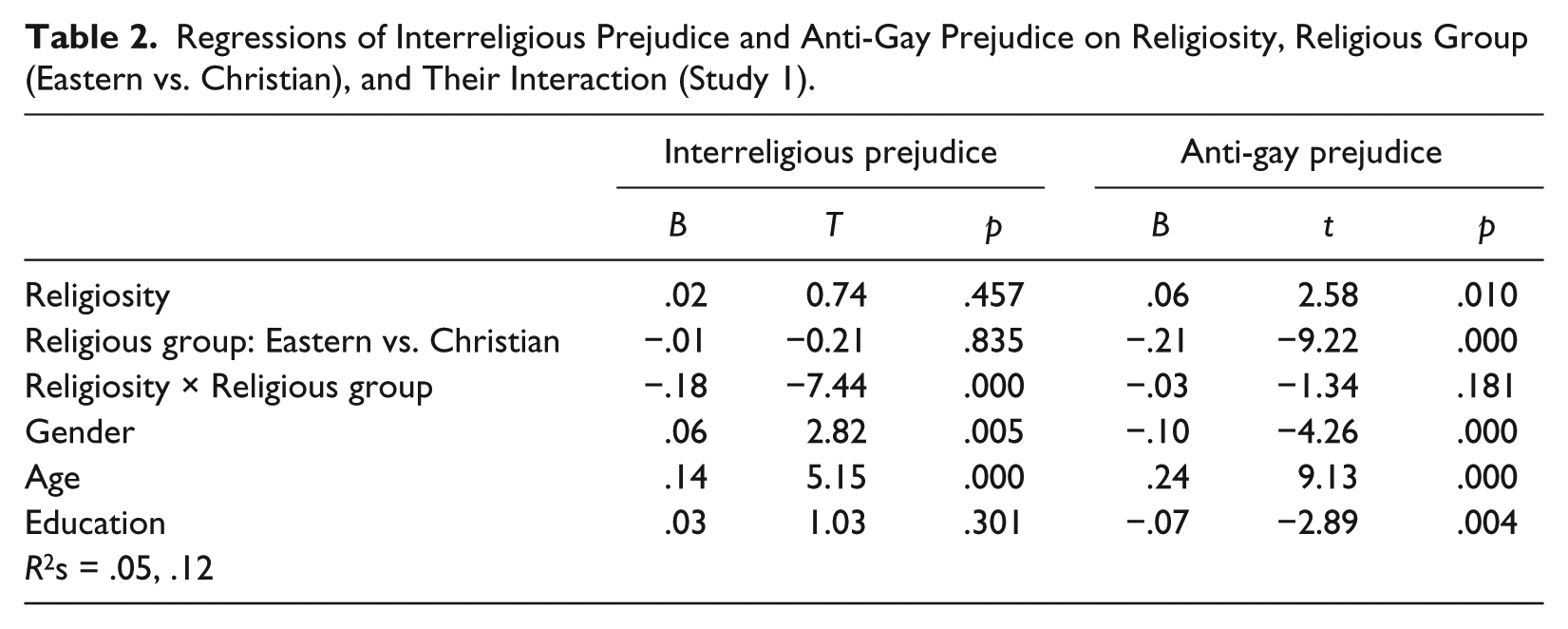
To test the significance of differences in the associations between the religious groups, the two kinds of prejudice were regressed on religiosity (centered), the contrast (centered) between the two East Asian religious groups (coded 1) and the two Christian groups (coded −1), and the interaction between the two. To control for possible between-group socio-demographic differences, age, gender, and education were also entered as predictors. As shown in Table 2, an interaction was found between religiosity and being of East Asian versus Christian religion for interreligious prejudice but not for anti-gay prejudice. Simple slope analyses showed that religiosity among Christians predicted both interreligious and anti-gay prejudice (βs = .25, .14; p < .01) as opposed to East Asian religiosity that implied low interreligious prejudice (β = −.17, p < .01) and no anti-gay prejudice (β = .03, p = .32).
Regressions of Interreligious Prejudice and Anti-Gay Prejudice on Religiosity, Religious Group (Eastern vs. Christian), and Their Interaction (Study 1).
Discussion
Study 1 provided partial confirmation of the main hypothesis. Using ISSP 2008 data from three East Asian countries, we found that as a function of high religiousness, Buddhist and Taoist samples exhibit high interreligious tolerance and weaker or no anti-gay prejudice. The present findings are not due to a general religion–low prejudice effect in these societies as a contrasting pattern, that is, low interreligious tolerance and stronger anti-gay prejudice, was found among highly religious Catholics and Protestants living in the same countries. The present findings clearly indicate cross-religious differences, as the ethnic cultural context was held constant.
It seems important to distinguish between different targets of (religious) prejudice. Interreligious prejudice may be different in nature from moral prejudice against targets perceived to threaten values. Although to a much lesser extent than among Christians, Buddhists’ religiosity was still positively related to anti-gay prejudice—though this relation seemed to be mainly due to socio-demographic variables. However, Taoist religiosity was totally unrelated to anti-gay prejudice, Taoism having historically shown more tolerance toward homosexuality (Siker, 2007). Nevertheless, both Buddhists and Taoists showed higher anti-gay prejudice compared with atheists.
Study 2
In Study 2, we further investigated the link between East Asian religiousness and interreligious prejudice and addressed additional questions. An important limitation of Study 1 was that no specific religion was mentioned in the measure of interreligious prejudice. This may have facilitated an overall positive evaluation of tolerance of “people from a different religion” in general rather than providing specific information on prejudice against distinct, well-identified religious outgroups. Thus, in Study 2, we investigated whether East Asian religiousness relates to low interreligious prejudice, again measured explicitly, but this time in reference to specific religious outgroups, possibly varying on familiarity and valence: Christians, Jews, Muslims, and even an unknown fictitious religious group we called “Yxto.”
Moreover, in Study 2, alternative measures of religiousness were introduced, that is, a more extended scale of religiosity and a measure of religious fundamentalism. On the basis of previous studies of other religions (Rowatt et al., 2013) as well as on the theory and conceptualization of fundamentalism as implying rigidity, conservatism, and an emphasis on ingroup/outgroup distinctions (Brandt & Reyna, 2010; Hunsberger & Jackson, 2005; Rowatt et al., 2013), one could expect fundamentalism to not show low prejudice, and to even reflect high prejudice, especially interreligious prejudice.
Finally, a measure of right-wing authoritarianism was included. Authoritarianism is the major explanatory factor of the religion–prejudice link in studies in Western monotheistic religions (Hall et al., 2010; Rowatt et al., 2013; Whitley, 2009). Low prejudice as a function of East Asian religiosity may be due to an independence of Eastern religiosity from authoritarianism, the latter being thus unable to contribute to religious prejudice. Nevertheless, its presence might weaken, if not oppose, the tolerant role of Eastern religiosity. In other words, authoritarianism should moderate the religiousness–prejudice link.
Method
Participants and procedure
Participants were 222 Taiwanese students (64% female) from Fu Jen Catholic University and National Taiwan University. The average age was 21 years (SD = 5. 67). Participants self-identified as Buddhists (24%), folk believers 2 (22%), agnostics (13%), and atheists (25%), whereas 16% reported “Other.” They took part in this study in exchange for course credits and completed the questionnaire in the classroom within 30 min.
Measures
Interreligious prejudice was measured distinctly in reference to five specific targets: Christians, Jews, Muslims, Yxto (a fictive religious group), and atheists. For each of the five targets, participants answered three questions commonly used in international surveys: “Would you like to have this person as a (a) neighbor, (b) political representative, (c) husband/wife?” (Likert-type scales ranging from 1 = totally dislike to 7 = totally like). Cronbach’s alphas were satisfactory, ranging from .76 through .86. The scores on the three items were averaged, after being reversed, to provide a unique score of prejudice for each target.
Participants were also administered a religiosity scale (12-item Four Basic Dimensions of Religiosity scale; see Saroglou et al., 2012) and a religious fundamentalism scale (12-item short version; Altemeyer & Hunsberger, 2004). The former measures religiosity as a composite of four basic dimensions (emotions-experience, affiliation-identity, meaning-beliefs, and values-morality) and has been validated in 14 countries of various religious traditions. The latter has been extensively used in many studies with participants from the major religious traditions. Finally, participants were administered the 12-item Right Wing Authoritarianism Scale (Funke’s [2005] version of Altemeyer’s [1996] scale, adapted to the international context by Van Pachterbeke, Freyer, & Saroglou, 2011). All three measures of religiosity, fundamentalism, and authoritarianism used scales on a 7-point Likert-type format ranging from totally disagree to totally agree (αs: .88, .74, and .65). 3
Results
Bivariate correlations were computed between (a) the distinct indicators of prejudice against the various convictional targets and (b) religiosity, fundamentalism, and authoritarianism (see Table 3). Negative associations were found between the two religious measures and prejudice toward Christians, Jews, and Muslims, and also the fictitious religious group (Yxtos). However, this effect did not extend to atheists; the association between religiosity and anti-atheist prejudice actually turned out to be positive.
Coefficients of Correlations of Religiosity, Fundamentalism, and Authoritarianism With Explicit (Study 2) and Implicit Prejudice and Prosociality (Study 3).
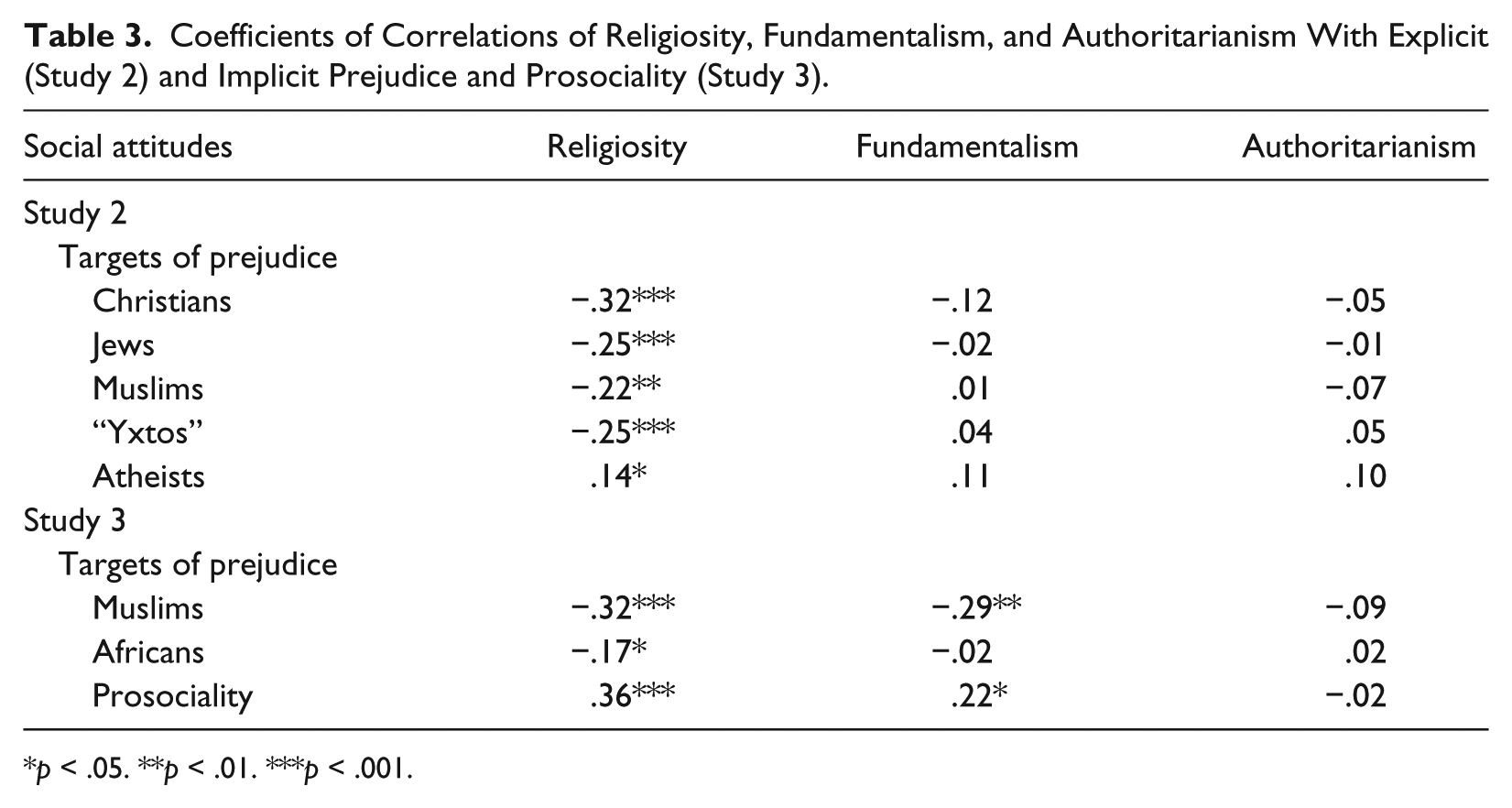
p < .05. **p < .01. ***p < .001.
Right-wing authoritarianism, although related to fundamentalism (r = .25, p < .01), was unrelated to interreligious prejudice (see Table 3) and religiosity (r = .10, not significant [n.s.]). However, we explored the possible moderating role of authoritarianism on the religiosity–low prejudice link by conducting a moderated multiple regression. The predicted variable was interreligious prejudice as an aggregate measure of prejudice toward the four religious targets (Christians, Jews, Muslims, and Yxtos, α = .83; an exploratory factor analysis with varimax rotation also indicated the existence of one factor). Religiosity (centered), authoritarianism (centered), and the product of their interaction were entered as predicting variables. There was a main effect of religiosity, β = −.29, t(3,199) = −4.48, p < .01, but not of authoritarianism, β = .06, t(3,199) = 0.99, n.s., on interreligious prejudice, and the interaction of authoritarianism and religiosity turned out to be significant, β = −.13, t(3,199) = −1.99, p < .05. The regression explained 11% of the total variance, F(1, 199) = 9.15, p < .01. A simple slope analysis revealed that the negative link between religiosity and interreligious prejudice was much stronger among those low (1 SD below the mean; β = −.41, p < .01) than among those high (1 SD above the mean) on authoritarianism (β = −.17, p = .07). 4
Discussion
Study 2 replicated and extended the findings of Study 1 relative to interreligious prejudice. Compared with Study 1, it included a more homogeneous sample (Taiwanese students) rather than adults of various ages from different Asian countries, as well as more extended and specific measures of religiosity and prejudice. It turned out that the more religious the participants were (in beliefs, emotions, values, and belonging to East Asian religions), the less they showed explicit indirect prejudice, measured as an unwillingness to have people from other specific religions as neighbors, political representatives, or marriage partners. This interreligious tolerance applied to all different religious groups regardless of their possible different status (e.g., valence and familiarity) among Taiwanese. However, such tolerance was not extended to atheists, people who possibly constitute believers’ typical outgroup (see Gervais, Shariff, & Norenzayan, 2011).
As suspected, religious fundamentalism, a religious tendency characterized by rigidity, conservatism, and an emphasis on the ingroup/outgroup distinction, was unable to show the same tolerant tendency of general, personal religiosity. Nevertheless, it was not related to high interreligious prejudice. Finally, authoritarianism was only modestly related to fundamentalism and was unrelated to religiosity. These findings suggest that, contrary to the case of prejudice in monotheistic religions, authoritarianism may be unable to support religious prejudice in Eastern religions. However, authoritarianism moderated the religiosity–low prejudice link in a meaningful way: the tolerant “role” of religiosity toward religious outgroups was weakened among participants high in authoritarianism. Thus, the findings of Study 2 suggest that, whereas authoritarianism nourishes and strengthens religious prejudice in monotheistic contexts, in Eastern religious contexts it inhibits religious tolerance. 5
Study 3
The main aim of Study 3 was to further extend and consolidate the findings of Studies 1 and 2 by testing whether East Asian religiousness implies low prejudice also at the implicit level. Self-reported measures of attitudes toward outgroups are subject to social desirability bias (Fazio & Olson, 2003). Similarly, religious people of Christian tradition tend to overestimate the quality of their social attitudes and may be wrong when they perceive themselves as low in prejudice, high in altruism, and universalistic in their prosociality (Batson, Schoenrade, & Ventis, 1993; Blogowska & Saroglou, 2011). It thus became critical to our main hypothesis to test whether Eastern religiousness predicts low prejudice not only at the explicit level but also at the implicit level. This is particularly important if one assumes that tolerance of outgroups is highly valued in East Asian religions. The more tolerance is socially and explicitly valued, the greater the discrepancy between explicit and implicit attitudes may be if, for instance, tolerance is not internalized as a value.
Three additional questions were investigated. First, Studies 1 and 2 tested the religion–low prejudice hypothesis by focusing on interreligious and moral prejudice. In Study 3, we also studied interreligious prejudice—against Muslims, a key target for the Taiwanese—but we also included for the first time ethnic/racial prejudice against a typical Taiwanese outgroup, that is, African people. Second, one could counter-argue that religious explicit outgroup tolerance found in Studies 1 and 2 simply reflects politeness, social conformity, or a need to inhibit hostility, rather than real proactive compassionate concerns for others. The latter are however considered to be strongly valued in the context of East Asian religions. We thus included in Study 3 a measure of prosocial behavioral intentions (previously found to be sensitive to Buddhist primes among Westerners; Clobert & Saroglou, 2013) as a possible mediator of the religiousness–low prejudice link.
Finally, as in Study 2, we included measures of fundamentalism and authoritarianism here to again test whether these two constructs function differently from religiosity regarding prejudice. We also investigated an additional question. Previous research has shown that fundamentalism can be conceived as a blend of religiosity with authoritarianism (Hunsberger & Jackson, 2005), the former implying prosocial tendencies such as ingroup helping, and the latter implying anti-social tendencies such as outgroup prejudice (e.g., Blogowska & Saroglou, 2011). In case fundamentalism proved, as in Study 2, to be unrelated to prejudice, we would investigate the unique outcomes of its underlying components, that is, religiosity and authoritarianism.
Method
Participants
Undergraduate students (n = 102; 53.9% female) from Fu Jen Catholic University and National Taiwan University took part in this study voluntarily or in exchange of course credit. The mean age was 21.1 years (SD = 1.54). Participants self-identified as follows: folk believers (45.1%), Buddhists (19.6 %), Taoists (1%), atheists (26.5%), and “Other” (7.8%). The researcher contacted students directly in classrooms and invited them to take part in the study. Participants entered the lab in small groups (3-10 people) and completed the task on a computer. The study was presented as a recognition and categorization task.
Material and procedure
Implicit prejudice
On entering the lab, participants were asked to complete a computer task. This included two Implicit Association Tests (IATs) intended to measure implicit prejudice toward Muslims and African people. Each of the two IATs consisted of five blocks (total: 10 blocks). For the IAT measuring prejudice against Muslims, the target categories were Buddhist and Muslim (10 words each), whereas the attribute categories were positive and negative words (10 and 10, respectively). The Buddhism-related words were as follows: Nirvana (涅槃), Buddha (佛陀), monk (僧), Sutra (佛經), Bodhisattva (菩薩), Sangha (僧尼), reincarnation (生死輪迴), awakening (覺悟者), Buddhist temple (佛寺), and Dharma (佛法).The Islam-related words were as follows: Koran (古蘭經), Mahomet (穆罕默德), imam (阿訇), mosque (清真寺), Sharia (伊斯蘭法), Allah (真主), Islam (伊斯蘭教), Ramadan (齋戒), Mecca (麥加), and Muslims (穆斯林). These words were selected based on a pre-test conducted in another group of 27 Taiwanese undergraduate students who rated 15 Buddhist and 15 Muslim words on their relevance to Buddhism and Islam, respectively, and their valence (7-point scales). The 20 selected words were all very religious (scores ≥ 6) and neutral in valence (scores between 3 and 5). All stimuli were presented in traditional Chinese.
For prejudice against Africans, the target categories used were Asian and African, and the attribute categories were positive and negative words. The associated stimuli for targets were 10 Asian and 10 African male faces and the attribute stimuli were 10 positive and 10 negative words. African and Asian male faces were generated for this experiment using FaceGen Modeller 3.5 that also allowed us to control for facial expressions of emotions. We chose to generate neutral faces to avoid emotional priming.
Each of the discrimination tasks (Blocks 1, 2, 4, 6, 7, and 9) consisted of a total of 20 trials. Each of the combined tasks (Blocks 3, 5, 8, and 10) comprised 40 trials, with targets and attributes presented in a random order. For each trial, the participant had to focus on a blank screen for 395 ms, at which point a target or an attribute appeared on the screen for 10,000 ms, during which participants had to press the key corresponding to the correct category. Feedback followed the response, indicating the participants’ accuracy and response times. The order of presentation between the two IATs was selected randomly.
The critical comparisons between the prejudice-congruent sorting task (Block 3: Buddhist words + positive words / Muslim words + negative words; Block 8: Asian faces + positive words / African faces + negative words) and the prejudice-incongruent sorting task (Block 5: Buddhist words + negative words / Muslim words + positive words; Block 10: Asian faces + negative words / African faces + positive words) provided a measure of prejudice against Muslims and African people. As a measure of prejudice, we used the incompatible task response time minus the compatible task response time divided by its associated pooled-trial standard deviation. Each block started with short instructions that described the assignment of the two response keys (i.e., “s” and “l”) for the stimulus categories. Participants were asked to respond as quickly and as accurately as possible.
Prosocial behavior
After completing the IAT, participants were asked to write down what they would do if they won 100,000 euros, specifying the percentage of money they would allocate to each expenditure. The percentage of money participants spontaneously allocated to others (e.g., family, friends, charities) and not to themselves was coded as a measure of prosociality (see also Clobert & Saroglou, 2013).
Individual differences
Authoritarianism and fundamentalism were measured as in Study 2 (αs = .61 and .69). Participants also filled in a three-item index of religiosity (Saroglou & Muñoz-García, 2008) assessing the frequency of prayer and the importance of God and religion in life (α = .72; 7-point Likert-type scale).
Results
Preliminary analyses
For the IAT results, we followed the typical data reduction procedure (Greenwald, Nosek, & Banaji, 2003). After checking for subjects with more than 10% of trial latencies below 300 ms (0 subjects), we replaced the inaccurate trials (6%) with the respective block mean plus 600 ms. Means (and standard deviations) for the (a) Muslims IAT-compatible task, (b) Muslims IAT-incompatible task, (c) Africans IAT-compatible task, and (d) Africans IAT-incompatible task were 624 ms (129), 697 (189), 648 (48), and 762 (65), respectively. Repeated-measures analysis of variance (ANOVA) analyses confirmed the classic discrimination effect of the IAT for the implicit prejudice against Muslims, F(1, 101) = 45.54, p < .01, partial h2 = .31, and for the implicit prejudice against Africans, F(1, 101) = 271.21, p < .01, partial h2 = .73. Indeed, participants needed more time to classify religious words and faces in a prejudice inconsistent manner (non-compatible task) than in a prejudice consistent manner (compatible task).
Means and standard deviations of prosociality were 24.67 and 24.07. Comparisons between convictional groups revealed less prosociality among atheists, M = 11.48, SD = 14.35, compared with the religious groups, F(3, 96) = 3.98, p = .01, that is, Buddhists, folk believers, and other religious believers, Ms = 29.84, 25.66, 37.32, SDs = 28.61, 22.81, 33.59, respectively.
Religious measures, authoritarianism, and implicit prejudice
We first computed bivariate correlations between the three “predictors” (religiosity, fundamentalism, and authoritarianism) and the three “outcome” variables (prejudice against Muslims, prejudice against Africans, and prosociality; see Table 3). Religiosity correlated negatively with both kinds of implicit prejudice, and even fundamentalism was found to correlate negatively with prejudice against Muslims. Moreover, both religious measures were positively correlated with prosocial behavior (sharing of hypothetical gains). Authoritarianism, which was modestly although non-significantly related to religiosity and fundamentalism (rs = .13, .15, p = .18, .12), was unrelated to either prosociality or prejudice. 6
Second, to disentangle the effects of authoritarianism and religiosity as underlying components of fundamentalism, we carried out a hierarchical multiple regression on prejudice against Muslims. In Step 1, only fundamentalism was entered as a predictor, F(1, 99) = 6.36, p = .01, R2 = .06. In Step 2, we added religiosity and authoritarianism as predictors, F(3, 97) = 3.89, p = .01, R2 = .11. In this step, fundamentalism was no longer a significant predictor (the regression coefficient dropped from β = −.25, p = .01, to β = −.08, n.s.); only religiosity (β = −.26, p = .03) but not authoritarianism (β = −.04, n.s.) predicted low prejudice against Muslims.
Finally, given that prosociality was related to both religiosity (r = .36, p < .001) and prejudice against Muslims (r = −.29, p < .05), but not Africans (r = −.05), we investigated whether prosociality mediates the link between religiosity and low prejudice toward Muslims. We carried out a simple mediation analysis following Preacher and Hayes (2008). The results (see Figure 1) confirmed the hypothesized mediation, with prosocial behavioral intentions partially mediating the religiosity–low prejudice link.
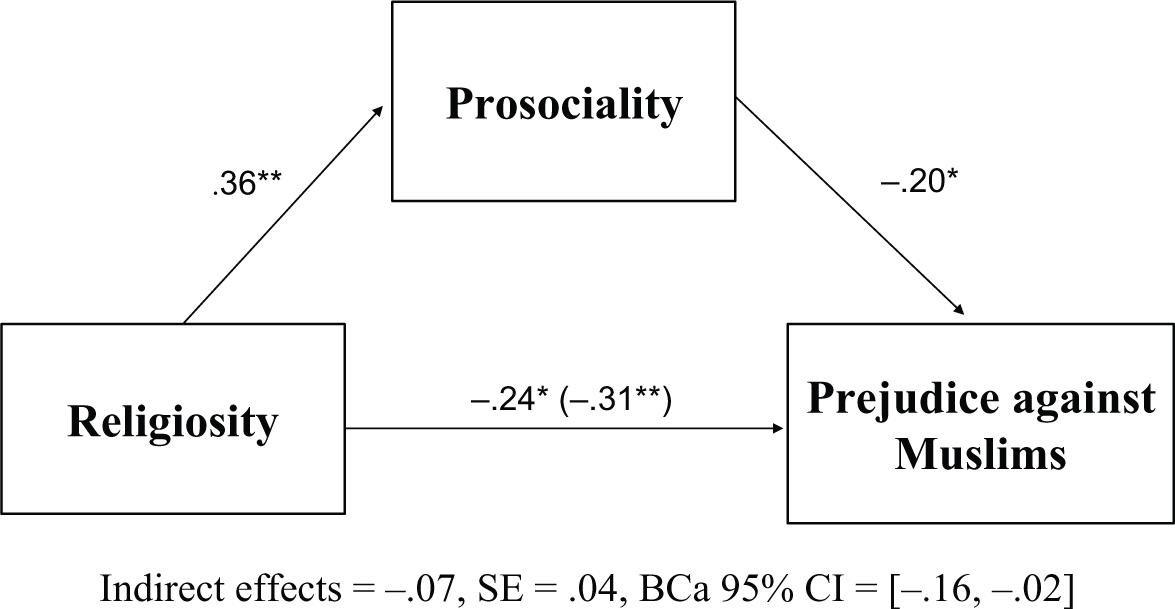
Prosociality as a mediator of the relationship between East Asian religiosity and low interreligious implicit prejudice (Study 3).
Discussion
Study 3 consolidated and extended the findings of Studies 1 and 2 through implicit measures of both interreligious and ethnic prejudice toward key outgroups, that is, Muslims and Africans, respectively. Religious tolerance toward these outgroups seems rather solid in the context of East Asian religions (in the present sample: mostly folk believing and Buddhism). Taking also into account the fact that prosociality mediated the religiosity–low interreligious prejudice link, one can suspect Eastern religious tolerance to result from some internalization of prosocial values and not to be an artifact of impression management or social conformity concerns. Nevertheless, this religious tolerance seemed to be somehow weaker (in correlation coefficients) when the outgroup was racial/ethnic (Africans) compared with when the outgroup was religious (Muslims). Similarly, the mean level of implicit prejudice was higher for the former target (note also the failure of prosociality to mediate the religiosity–ethnic tolerance link).
Religious fundamentalism was unrelated to ethnic prejudice and even negatively related to interreligious prejudice. As shown by a multiple regression that added fundamentalism’s two major components (religiosity and authoritarianism) as predictors, this was due to the underlying component of religiosity. Thus, in line with Study 2, fundamentalism, although including some authoritarian tendencies, did not reflect, unlike many studies in Western Christian contexts, high prejudice. The tolerant nature of the underlying Eastern religiosity seems to be responsible for low prejudice.
Finally, it appears that East Asian religiosity, at least in the country of the study, clearly functions differently from social attitudes typical of closed-mindedness (authoritarianism). Religiosity reflects general prosocial orientation and tolerance toward religious and ethnic outgroups. Authoritarianism may share with religiosity some traditionalism and respect for authority, but it does not share religiosity’s tolerant attitudes toward outgroups. Nevertheless, in both Studies 2 and 3 that used explicit and implicit measures of prejudice, respectively, authoritarianism failed to show the opposite tendencies, that is, high interreligious and ethnic prejudice. These findings may suggest that the high tolerance of East Asian religiosity is already based on (or goes a step further than) a secular East Asian authoritarianism that does not necessarily fuel religious and ethnic prejudice.
General Discussion
Across three studies, all carried out in East Asian countries (Taiwan in all three studies; Japan and South Korea in Study 1), among samples of Buddhists, Taoists, and/or folk believers, as well as non-believers, evidence was provided in favor of the idea that low prejudice is present in the context of East Asian religions; this is an empirical reality, although with certain limitations, mostly depending on the nature of prejudice.
East Asian religiosity was, consistently across the studies, related to low prejudice against people from other religions, whether this was measured as a global attitude (Study 1), willingness to have as neighbors, political representatives, or marriage partners believers from specific other religions (Christians, Jews, Muslims, and even an unknown, fictitious religious group; Study 2), or low implicit discrimination (IAT) of Muslims compared with Buddhists (Study 3). Study 1 provided additional, comparative information in favor of the East Asia–West contrast: Among Catholics and Protestants (i.e., those endorsing a West-originated religion), coming from the same Asian countries, religiosity was indicative of the opposite tendency, that is, high interreligious prejudice toward people from other religions.
Taken as a whole, these findings confirm the main hypothesis. Religiousness in the context of major East Asian religions, contrary to what research has shown for Western monotheistic religions, and in particular Christianity, implies tolerance of people holding other religious beliefs and affiliations. This is likely due to the comparatively (to the West) lower levels of dogmatism, rigidity, and need for consistency, and the greater emphasis on interdependence and holistic thinking that are typical of both East Asian religions and cultures. An additional explanation is the strong emphasis on compassion and prosocial values within East Asian religions, especially Buddhism. Study 3 provided initial evidence for this point, with prosociality mediating the relationship between religiosity and low implicit interreligious prejudice. A similar tendency for tolerance was observed when the target was an ethnic (racial) outgroup in Study 3, although prosociality failed to mediate this link in that study.
Nevertheless, East Asian religious tolerance was not unlimited. East Asian religiosity was, modestly but positively, related to prejudice against atheists (Study 2) and homosexuals (the latter among Buddhists, but not Taoists; Study 1). Interestingly, atheists and homosexuals are known to constitute the strongest targets of prejudice in studies with Christian participants in the West (Gervais et al., 2011; Leak & Finken, 2011; Rowatt et al., 2009). Atheists may be seen by believers of apparently all religions, including those of East Asia, as the outgroup per excellence. They not only differ from believers in some or many beliefs and convictions but, in principle, they preach exactly the opposite. Homosexuals are known to be the target of homonegativity, in various degrees and forms, across all religions (Siker, 2007), and previous initial evidence suggests the influence of Buddhist religion and religiosity on homonegativity (Detenber et al., 2007; Ramsay, Pang, Johnson Shen, & Rowatt, 2014). Nevertheless, in line with the weaker, if not low, prejudice hypothesis, anti-gay prejudice was overall absent among the two East Asian religious groups when compared with the two Christian ones and when controlling for socio-demographic factors.
The present work was to some extent exploratory—the main goal was to identify specifics of East Asian religions in the link between religiousness and prejudice against various targets. However, the inclusion of one mediator (prosociality in Study 3) and two additional variables (fundamentalism and authoritarianism) in Studies 2 and 3 provided some initial information about the underlying psychological processes that may be different when one compares Western and Eastern religions. First, fundamentalism, contrary to what is most often the case in studies on Western Christian religiosity, did not lead to high prejudice. Due to underlying religiosity, it was even related to implicit tolerance of a religious outgroup (Muslims) in Study 3. Second, East Asian religiosity seems to escape the authoritarian tendencies of Western Christian religions (especially in fundamentalism) that typically lead to religious prejudice; authoritarianism only moderated, by decreasing, the East Asian religiosity–low prejudice link (Study 2). Third, ethnic and interreligious prejudices seem not to apply to believers belonging to Eastern religions. These religions even tend to imply ethnic and interreligious tolerance, the latter being explained by internalized prosocial values. Nevertheless, Western and Eastern believers seem to have a common, clear outgroup, that is, atheists. It cannot be excluded that, for some believers, ethnic and religious outgroups may be perceived to be part of a larger ingroup if qualified as members of a common super-ordinate category (“believers of all religions”), but this is much more difficult to do with non-believers and atheists.
The present work has several limitations. The studies concerned three East Asian countries (Japan, South Korea, and Taiwan) and three main East Asian religious denominations (Buddhism, Taoism, and folk religion). It is thus premature to make generalizations to all Eastern religions or cultures from the present findings. However, the consistencies across the studies were remarkable. Moreover, it is important, with respect to previous research on religious prejudice (Batson et al., 1993; Hunsberger & Jackson, 2005), to focus on the specific role of distinct religious dimensions.
Finally, both theoretically and empirically, it is extremely difficult to identify whether, beyond the observed cross-religious differences, the causal factors are relative to religions themselves (theology, history, contemporary religious teachings) or to other, non-religious, cultural factors (socio-economic or socio-cultural; see for a discussion, Saroglou & Cohen, 2013). The differences found in Study 1 between participants belonging to East Asian religions and those belonging to Christian denominations, all coming from the same East Asian countries, do not necessarily suggest that the differences are strictly religious and not ethnic cultural. They may rather suggest that among participants of East Asian religions, the isomorphism between religious specifics (in this case, characteristics of Buddhism and Taoism as depicted in the East Asia-West religious and cultural differences section) and other non-religious cultural specifics (in this case, cultural characteristics of East Asians regarding self-views, cognition, moral reasoning; see the introduction) makes the effects (tolerance or weaker prejudice) clearer in comparison with the Christian East Asian participants who are characterized by non-isomorphism. The East Asian Christians are in fact in a position of cultural mixing, with the religious-cultural elements from the West-originated Christian culture countering those of their ethnic culture.
Future research should identify the cognitive moral and social mechanisms (in addition to prosociality and the lack of authoritarian influences) explaining tolerance toward religious and ethnic outgroups among East Asian believers. Indirect evidence reviewed in the introduction suggests several possible explanatory factors related to (social) cognition and self-perception: a low need for closure and consistency, high interdependence, low egocentrism, similarity perception, holistic thinking, and tolerance of contradictions. These factors may attenuate in- versus outgroup distinction among East Asian believers and increase the perceived similarity between various beliefs and value systems.
An additional set of mechanisms worth investigating in future research that possibly explain religious differences in prejudice concern the role of underlying emotions as a function of religion and culture. Existing research suggests promising pathways for future investigation. In fact, collectivists (like East Asians) feel especially good when their emotional experience leads them to connect with others, whereas individualists (like Americans) feel especially good when dwelling on emotional experiences that distinguish them from others (Kitayama, Mesquita, & Karasawa, 2006). Also, the ideal positive affect valued in East Asian and Buddhist contexts, compared with the ideal positive affect valued in European American and Christian Protestant contexts, is characterized by low arousal (e.g., calm) rather than high arousal (e.g., excitement; Tsai, Knutson, & Fung 2006; Tsai, Miao, & Seppala, 2007). Therefore, if we take into consideration the fact that prejudice is often fueled by emotions such as fear or anger (Cottrell & Neuberg, 2005), that imply high arousal and disturbance in interpersonal relations, it is reasonable to hypothesize that East Asian religiosity, compared with the religiosity in Western monotheism, is less favorable of these kinds of emotions. This in turn may lead to greater tolerance and/or weaker prejudice.
To conclude, it is our impression that this work has the merit to provide consistent and replicated evidence in favor of the idea that some East Asian religions, embodied in East Asian cultures, may, at least in part and under certain conditions, escape, or at least attenuate, anti-social tendencies that have been evidenced in the context of Western monotheism. The observed differences between East Asian Buddhists, Taoists, and folk believers, on the one hand, and East Asian Christians, on the other hand, suggest that “local” religious cultures may intensify broad cultural characteristics (e.g., interdependence and holistic thinking), whereas “foreign” religious cultures seem to counter the same broad cultural influences.
Footnotes
Declaration of Conflicting Interests
The author(s) declared no potential conflicts of interest with respect to the research, authorship, and/or publication of this article.
Funding
The author(s) disclosed receipt of the following financial support for the research, authorship, and/or publication of this article: This research was supported by a doctoral fellowship offered by the Belgian National Fund for Scientific Research (FNRS) FC86456 to the first author under the supervision of the second author. Data of Study 3 were collected during a scientific stay of the first author at the National Taiwan University and Fu Jen Catholic University, made possible through a travel grant from the Belgian National Fund for Scientific Research. Data collected for Study 2 benefited from Grant ARC08/13-013 from the Communauté française de Belgique to the second author.