







Abstract
Previous research on culture and emotion questioned whether emotions are universal or culture-specific. However, as it has become clear that emotions have both universal and culture-specific features, recent research has focused on distinguishing the aspects of emotions that are more universal from those that are more culture-specific. We tested the extent to which the three emotion domains in the cascading model of emotional intelligence (emotion perception, emotion understanding, and emotion regulation) are universal versus culture-specific. In the first study, data from China, the United States, Japan, India, and Argentina provided support for our hypotheses that emotion perception is the more universal domain of emotional intelligence, and emotion understanding and emotion regulation are more culture-specific domains. In the second study, the findings were replicated using a larger sample from China and the United States, and we explored specific cultural differences in emotion understanding and emotion regulation. Implications for theory and practice are discussed.
Keywords
Early research on culture and emotions focused on whether emotions are universal or culture-specific (Averill, 1980; Ekman, 1973, 1984, 1992; Mead, 1975; Scherer & Wallbott, 1994). Given the growing evidence that emotions have both universal and culture-specific aspects (Mesquita & Frijda, 1992), research has now turned to examining which aspects of emotion are more universal versus more culture-specific (Matsumoto & Hwang, 2012). Based on a review of extant research, Matsumoto and Hwang (2012) proposed that cultural differences are larger for certain types of emotions and emotion domains, due to increased requirements for language and higher order cognition.
Many studies have examined the extent of universality versus cultural specificity for individual emotion domains (e.g., Elfenbein & Ambady, 2002; Kuppens, Ceulemans, Timmerman, Diener, & Kim-Prieto, 2006; Matsumoto & Kupperbusch, 2001; Miyamoto & Ma, 2011; Scherer, 1997a). However, few studies that we know of have systematically compared the extent of universality versus cultural specificity across different emotion domains. In the current study, we take an initial step in this direction and examine the universality and cultural specificity across three emotion domains—the three branches of emotional intelligence: emotion perception, emotion understanding, and emotion regulation (Joseph & Newman, 2010; Mayer & Salovey, 1997).
The cascading model of emotional intelligence (Joseph & Newman, 2010) provides a powerful opportunity for comparing universality versus cultural specificity across important emotion domains. According to this model, there are three domains of emotional intelligence—emotion perception, emotion understanding, and emotion regulation—which exhibit a progressive pattern, whereby emotion perception causally precedes emotion understanding, which in turn, causally precedes emotion regulation. By examining the universality and cultural specificity of the three domains of the cascading model of emotional intelligence, we attempt to provide evidence that the criterion against which emotional intelligence is measured might be different across cultures, and that those who have high emotional intelligence in one culture might not be considered to be high in emotional intelligence in another culture, particularly regarding branches that are heavily affected by culture.
Universality and Cultural Differences of Emotions
According to the evolutionary perspective, emotions are universally elicited by certain situations and accompanied by specific and universal patterns of bodily changes and subjective feelings (Ekman, 1973, 1984; Mead, 1975). By contrast, the culture-specific or social constructivist perspective of emotions embraces cultural relativism, contending that “emotions are not just remnants of our phylogenetic past, nor can they be explained in strictly physiological terms. Rather, they are social constructions, and they can be fully understood only on a social level of analysis” (Averill, 1980, p. 309).
Numerous empirical studies have found both universal and cultural differences in different emotion domains. For example, in emotion perception domain, Ekman et al. (1987) found evidence of cross-cultural agreement in the judgment of facial expressions, and at the same time, cultural differences in judgments of the absolute level of emotional intensity. In a meta-analysis of 168 studies of emotion recognition, Elfenbein and Ambady (2002) found evidence for both universality and cultural variations in accuracy of emotion perception. Regarding emotion experience, Scherer and Wallbott (1994) used data from cross-cultural questionnaire studies in 37 countries and found evidence for both universal and culture-specific aspects of subjective feelings. Concerning emotional regulation, although research found general regulation patterns as well as their associated consequences (Gross, 1998; Gross & John, 2003), quite a few studies provided empirical evidence for the cultural differences in emotional regulation. For example, Matsumoto et al. (2008) reported differences across 23 countries on emotion suppression and emotion reappraisal, revealing that cultures that emphasized social order and hierarchy tended to have higher scores on suppression, and that suppression and reappraisal tended to be positively correlated for those cultures, whereas cultures that valued affective autonomy and egalitarianism tended to have lower scores on suppression, and reappraisal and suppression tended to be negatively correlated in those cultures. Taken together, these studies indicate that both the evolutionary perspective and the social constructivist perspective of emotions have some validity.
Recently, Matsumoto and Hwang (2012) proposed an overarching biocultural model of emotion in an attempt to theoretically integrate the growing body of empirical research on culture and emotion. According to this model, emotions can be classified into three domains—priming reactions, subjective experience, and emotion meaning. Priming reactions refer to instantaneous, emotional reactions to stimuli, including immediate physiological changes and expressive behavior such as facial expression. For example, observers tend to automatically smile or laugh when hearing a baby’s laughter (Provine, 1992). An observer’s reaction of smiling or laughing is an instantaneous response to the stimuli or prime of the baby’s laughter, which does not rely on conscious deliberation or language ability. Subjective experience of emotion requires language and some higher order cognition. For example, when it snows, people who have to go to work would feel annoyed as the snow is an inconvenience, while those who do not have to go to work may not feel annoyed, because their goals are not blocked by the weather. These different subjective experiences result from people’s primary appraisal of “goal relevance” that requires awareness and judgments above and beyond the instantaneous priming reaction (Lazarus, 1991). Emotion meaning refers to preferences, beliefs, concepts, and lay theories of emotions, such as preferences regarding which emotion is ideal to have (Tsai, Knutson, & Fung, 2006), or beliefs in whether emotion can be changed or not (Tamir, John, Srivastava, & Gross, 2007). For example, in Western cultures, high-arousal positive emotions are generally highly desirable, yet in Asian cultures, they are more likely to be perceived as potentially disruptive to social harmony, and hence undesirable (Markus & Kitayama, 1991). Assigning meaning to emotion requires language and high-order thinking.
According to Matsumoto and Hwang (2012), all three emotion domains have biological and cultural influences. However, culture has the strongest influence on emotion domains that require language and higher order thinking. Hence, culture is expected to have the strongest impact on emotion meanings and the weakest influence on priming reactions. By contrast, biological influences should be stronger on priming reactions and weaker on emotion meaning and subjective experiences. Prior research has provided initial evidence to support this model. Researchers found that culture has a stronger influence on the emotions that individuals prefer to experience (ideal affect), which belongs to emotion meaning domain, in comparison with the emotions that individuals actually experience (actual affect), which belongs to subjective experience domain (Tsai et al., 2006).
Although Matsumoto and Hwang’s (2012) model offers clear direction for integrating the research into culture and emotion, very little research has systematically examined the culture-specific aspects of emotion across multiple domains to date. Comparing the effects of culture across the multiple domains included in emotional intelligence provides such an opportunity.
Emotional Intelligence
Emotional intelligence has gained increasing attention over the past decades (Côté & Miners, 2006; Daus & Ashkanasy, 2005; Joseph & Newman, 2010; Lopes et al., 2004; Mayer & Salovey, 1997; Mayer, Salovey, & Caruso, 2004; Van Rooy & Viswesvaran, 2004). It has been found to contribute to meaningful and important outcomes (see Mayer, Roberts, & Barsade, 2008, for a review). Emotional intelligence has been conceptualized in several ways, and this has resulted in a body of research that offers conflicting and confusing accounts. For example, Mayer et al. (2008) made distinctions among three approaches: specific ability approach (e.g., Nowicki & Carton, 1993), integrative ability approach (e.g., Izard et al., 2001; Mayer et al., 2004), and a mixed approach (Bar-On, 1997). Petrides and Furnham (2000, 2001) proposed a conceptual distinction between an ability model and a trait model. While mixed-model emotional intelligence or trait emotional intelligence is measured through self-report measures (Petrides, Frederickson, & Furnham, 2004), the ability model of emotional intelligence is measured using maximum-performance tests with scoring criteria generated from a majority of people in the sample or emotions experts (Mayer, Salovey, & Caruso, 2002).
In this study, we adopt the (integrative) ability model (e.g., Joseph & Newman, 2010; Mayer, Salovey, & Caruso, 2008), as this model provides us with a good opportunity to examine the universality and cultural specificity across multiple domains. The original ability model of emotional intelligence was defined as the “ability to carry out accurate reasoning about emotions and the ability to use emotions and emotional knowledge to enhance thought” (Mayer et al., 2008, p. 507), including the ability to (a) perceive emotions in oneself and others accurately; (b) use emotions to facilitate thinking; (c) understand emotions, emotional language, and the signals conveyed by emotions; and (d) manage emotions so as to attain specific goals (Mayer & Salovey, 1997). 1 Despite earlier criticisms regarding this four-branch ability model (cf. Davies, Stankov, & Roberts, 1998), a recent meta-analysis provides strong support for the validity of a revised three-branch cascading model (Joseph & Newman, 2010), based on the original four-branch model (Mayer & Salovey, 1997).
According to this model, emotional intelligence consists of three cascading branches: emotion perception, emotion understanding, and emotion regulation (Joseph & Newman, 2010). 2 Emotion perception is defined as “the ability to identify emotions in oneself and others, as well as in other stimuli, including voices, stories, music and works of art” (Brackett, Rivers, Shiffman, Lerner, & Salovey, 2006, p. 781). Emotion understanding refers to the ability to understand emotions, including the ability to label emotions, to interpret the meanings of emotions (including likely causes of emotions), to understand complex emotions, and to recognize emotion patterns over time (Mayer & Salovey, 1997). According to the cascading model of emotional intelligence, emotion perception causally precedes emotion understanding. An awareness of emotions in the self and others enables an individual to learn how emotions function. By accurately noticing emotions as they occur, individuals accumulate knowledge regarding the causes and consequences of emotions and how emotions evolve over time. Hence, emotion perception facilitates the development of emotion understanding. Emotion regulation refers to the ability to regulate emotions in oneself and others to act effectively and appropriately (Mayer et al., 2002). Emotion understanding enables the development of emotion regulation (Joseph & Newman, 2010) in that if an individual has access to high quality knowledge structures regarding the causes, consequences, and meanings of emotions, the individual can use this knowledge as a base for building a broad repertoire of strategies for selecting and inducing appropriate emotions in a given situation. In this research, we do not examine the second branch of the Mayer and Salovey (1997) ability model—using emotions to facilitate thought, because this branch has received mixed empirical support and may be conceptually redundant with other branches of emotional intelligence (Joseph & Newman, 2010).
Despite the growing body of research on emotional intelligence, questions remain about the construct. One important question is to what extent is the criterion of emotional intelligence universal versus culture-specific (Wong & Peng, 2012)? An ability emotional intelligence measurement (Mayer–Salovey–Caruso Emotional Intelligence Test [MSCEIT]) has been used across different countries in both practice and academic research with the same sets of answer keys generated from an American standardization sample (or from emotions experts), indicating an assumption that the general population in different cultures have the same sets of knowledge about emotion as people in America (or as emotions experts). However, research has identified both universal and culture-specific aspects of individual emotion domains related to emotional intelligence—emotion perception (Matsumoto, 1989, 1992; Matsumoto, Olide, Schug, Willingham, & Callan, 2009), emotion understanding (Innes-Ker & Niedenthal, 2002), and emotion regulation (Arens, Balkir, & Barnow, 2013; Gross, 1998; Gross & Thompson, 2007). Therefore, the assumption of measuring ability emotional intelligence using the same criteria should be challenged (also see Wong & Law, 2002; Wong, Wong, & Law, 2007). Furthermore, culture may play a more important role in certain branches of emotional intelligence than others (Tsai et al., 2006). However, little research has examined the relative impact of culture across the branches of emotional intelligence. Drawing on Matsumoto and Hwang’s (2012) model of the influence of culture across emotion domains, we propose that understanding universality and cultural specificity across emotional intelligence domains will contribute to our understanding of the role that culture plays in emotion and emotional intelligence.
Universality and Cultural Specificity Across the Three Branches of Emotional Intelligence
Although emotion and emotional intelligence are distinct concepts, we leverage the rationale from previous research on emotion in examining the relative influence of culture across the three domains in the cascading model of emotional intelligence. Researchers have identified the importance of display rules (Ekman, 1972), decoding rules (Buck, 1984), culture-specific affect programs (Elfenbein & Ambady, 2003), and requirements for language and higher order cognition (Matsumoto & Hwang, 2012) in understanding cultural differences in emotions. We examine these factors for the branches of emotional intelligence.
The universality versus cultural specificity of emotion perception has been well researched over the past decades (Elfenbein & Ambady, 2002). Researchers have argued that emotion perception is largely universal due to our hard-wired “core emotion system” (Levenson, 1999), which prepares us to produce and recognize potential signals of danger from other faces or the environment (Darwin, 1872/1998). However, small cultural differences in emotion perception may be due to differences in display rules, decoding rules, or culture-specific affect programs. Empirical evidence points to emotion perception being predominately universal, with a small amount of cultural specificity (Ekman et al., 1987; Elfenbein & Ambady, 2002; Elfenbein, Mandal, Ambady, Harizuka, & Kumar, 2002). Thus, we expect the emotion perception domain in emotional intelligence to be mostly universal, with some small cultural specificity.
Emotion understanding requires a rich and nuanced emotion vocabulary—particularly for labeling emotions. Cultures vary in terms of the extensiveness (Matsumoto & Assar, 1992) and the content of their emotion vocabularies (Matsumoto & Hwang, 2012). Some cultures may hypercognize emotions, in which they produce an extensive emotion vocabulary, whereas other cultures may hypocognize emotions, in which they produce a very limited emotion vocabulary (Levy, 1973). For example, researchers have identified 113 Chinese shame-related concepts (Li, Wang, & Fischer, 2004), but only 4 English shame-related concepts (Brandt & Boucher, 1986; Fessler, 1999, 2004; Shaver, Schwartz, Kirson, & O’Connor, 1987) and 1 Indonesian concept (Fessler, 1999, 2004). Although shame occurs in all cultures, it appears to be noticed more often, in more detail, and can be spoken about with greater nuance in China than in other cultures. Hence, emotion understanding should be heavily influenced by emotion vocabulary, which, in turn, should be influenced by culture.
Emotion understanding also includes complex blends of emotions. Emotion blends refer to complex emotions that are derived from a combination of more basic emotions (Mayer et al., 2002). Yet, emotion combinations may be somewhat culture-specific. For East Asian cultures, positive and negative emotions are more likely to co-occur than for Western cultures (Bagozzi, Wong, & Yi, 1999; Schimmack, Oishi, & Diener, 2002). Hence, East Asian knowledge about complex blends of positive and negative emotions should be more extensive than Western knowledge of these blends. For example, the English language does not have a term that matches the Ifaluk term fago, which refers to a blend of compassion, love, and sadness (Lutz, 1988).
Cultural influences on emotion vocabularies and emotion blends largely stem from the frequency and importance of certain emotions within the cultural system (Mesquita & Frijda, 1992). The importance of certain emotion can derive from fundamental attitudes that are culture-specific (Matsumoto & Hwang, 2012). For example, European American and Asian American individuals prefer to experience high-arousal positive affect more than Hong Kong Chinese, while Hong Kong Chinese and Asian American individuals prefer to experience low-arousal positive affect more than Europeans (Tsai et al., 2006). High-arousal positive emotions can cause jealousy in observers, thereby disrupting the harmonious relationships that are highly valued in Asian cultures (Mesquita & Albert, 2007). Hence, cultural attitudes toward emotions can be influenced by beliefs regarding the consequences of emotions as well as the importance of such consequences within the cultural system. These attitudes, in turn, influence the content and complexity of the knowledge structures regarding these emotions.
Emotion understanding includes an awareness of the causes of emotions, which is also subject to social construction within a culture. Although underlying the causes of an emotion may be universal (e.g., perceived loss causes sadness), specific interpretations of universal causes may vary tremendously. Matsumoto and Hwang (2012) referred to this as the front-end calibration of eliciting events. For example, death may be perceived as a loss, triggering sadness in some cultures. Yet, in other cultures, death may be framed as positive event and a cause for celebration (Mead, 1943). Hence, the interpretation of specific events can vary widely, triggering widely different emotional reactions. For example, when experiencing a snowstorm, Canadians might joyfully welcome the upcoming ski season, whereas Tahitians might fear the end of the world. Empirical evidence suggests important differences across cultures in event–emotion relationships, based on the availability and/or meaning of certain events (Scherer, 1997a, 1997b).
In sum, emotion understanding is influenced by culture through emotion vocabulary, emotion concepts, emotion preferences, and interpretation of emotion triggers that are socially constructed to reflect the frequency and importance of events and emotions within the cultural system. These social constructions involve more complex, higher order conceptualizations than those associated with emotion perception, and hence involve higher order cognition. In fact, evidence shows that emotion understanding is associated with cognitive ability whereas emotion perception is not (Joseph & Newman, 2010). These higher order cognitions associated with emotion understanding are more likely to be subject to cultural influence than the lower order cognitions associated with emotion perception (Matsumoto & Hwang, 2012). Hence, we expect emotion understanding to be more culture-specific and less universal than emotion perception.
Finally, emotion regulation can be seen as the master ability of emotional intelligence, in that it depends on other branches of emotional intelligence—most notably emotion understanding. To regulate emotion, individuals must understand the triggers or causes of emotions as these serve as the levers for emotion regulation (Mesquita & Albert, 2007). Furthermore, the ability to accurately perceive emotions enables individuals to recognize the need for, and the effectiveness of, emotion regulation strategies. Empirical evidence shows that emotion regulation is directly influenced by emotion understanding and indirectly influenced by emotion perception (Joseph & Newman, 2010).
Theoretically, as emotion regulation is influenced by emotion understanding, it should be influenced by the same cultural forces described previously—such as emotion vocabulary, emotion concepts, emotion preferences, and, especially, the interpretation of emotion triggers. For example, if an individual wishes to make a typical Canadian happy, he or she might share the news of an upcoming snowstorm. The same intervention would not likely be as effective with a typical Tahitian.
Emotion regulation also involves acting effectively and appropriately (Mayer et al., 2002). Yet, appropriateness is strongly dictated by cultural values and scripts (Cooper, Doucet, & Pratt, 2007). Culture influences norms for emotions, and hence dictates the ultimate goal of emotion regulation behaviors. Happiness is a highly desired outcome of emotion regulation activities in American culture, but not in others (Mesquita & Albert, 2007).
Emotions are regulated toward preferred endpoints through a variety of tactics, including reappraisal, suppression, and situation selection (Gross, 1998). Individuals selectively experience situations that are more likely to lead to culturally endorsed emotional endpoints. For example, North Americans experience more situations that create opportunities for self-enhancement and happiness, whereas Japanese experience more situations that create opportunities for self-criticism and shame (Kitayama, Markus, Matsumoto, & Norasakkunkit, 1997).
Cultural models also vary to the extent to which people frame emotion regulation as an independent, individual task or as a social task—mirroring the cultural model of the relationship between the individual and others (Mesquita & Albert, 2007). For example, people with an independent view of the self are more likely to believe that individually oriented emotion regulation tactics are more effective, whereas people with an interdependent view of the self perceive that socially oriented emotion regulation tactics are more effective (Markus & Kitayama, 1991).
Display rules dictate which emotion expressions are considered appropriate, and vary across cultures (Friesen, 1972; Matsumoto & Kupperbusch, 2001). Cultures that are highly concerned about maintaining social order are more likely to have rules that emotions should generally be suppressed so that they do not threaten the social order. In a study of 23 countries, Matsumoto et al. (2008) found that emotion suppression was associated with cultural differences in power distance, hierarchy, and collectivism.
In sum, emotion regulation is a master ability of emotional intelligence, relying on emotion perception, emotion understanding, tactics, and emotional endpoints that are deemed appropriate. As emotion understanding and appropriateness are strongly influenced by culture, we expect emotion regulation to be most highly influenced by culture, more so than emotion perception and emotion understanding.
Based on the arguments above, we expect the three emotion domains based on the cascading model of emotional intelligence are both universal and culture-specific. More importantly, we predict emotion perception to be the most universal of the three domains, with minimal influence from culture. We expect emotion understanding to be more strongly influenced by culture, thus more culture-specific than emotion perception, and emotion regulation to be most strongly influenced by culture, and thus the most culture-specific and the least universal (see Figure 1).
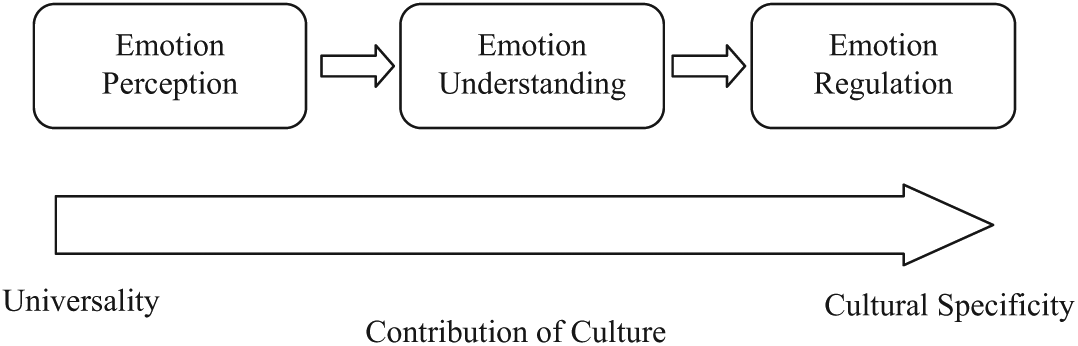
The increasing contribution of culture on emotional intelligence branches.
The Present Studies
In our studies, we examine the extent to which the three emotion domains of the cascading model of emotional intelligence are universal versus culture-specific. More specifically, we test whether emotion perception is the most universal of the three branches and whether emotion regulation is the most culture-specific of the three branches. In Study 1, we examined our hypotheses using data from five countries (China, the United States, Japan, India, and Argentina). These countries belong to important and different cultural traditions (House, Hanges, Javidan, Dorfman, & Gupta, 2004). For example, China and Japan belong to Confucian Asia, India belongs to Southern Asia, the United States represents Anglo culture, and Argentina belongs to Latin America whose culture has also been heavily influenced by Europe. In Study 2, we examined our hypotheses using a larger sample from China and the United States, independent of the samples used in Study 1. We chose these two countries because they are commonly used as proxies for East Asian culture and North American culture in cross-cultural research (e.g., Brockner & Chen, 1996; Markus & Kitayama, 1991; Zhang & Tsui, 2013).
Study 1
Method
Participants
Our sample includes 580 individuals from 5 countries: 120 people (28 females, M age = 40) from China who are executive MBA students in a business school located in Shanghai, 120 (60 females, M age = 42.3) from the United States, most of whom are managers from a single consumer company, 103 (49 females, M age = 35.6) from Japan who are working adults, 120 (28 females, M age = 33.4) from India who are managers in a single information technology consulting company, and 117 (51 females, M age = 35.5) from Argentina who are managerial candidates from a recruitment company. 3 Participants were either from executive MBA classes, or from training workshops. They were debriefed on their emotional intelligence test results, but did not receive any monetary compensation for participation.
Measures
We used the Mayer–Salovey–Caruso Emotional Intelligence Test V2.0 (MSCEIT V2.0; Mayer et al., 2002) to measure the domains of emotional intelligence. The original measure includes eight tasks, two for each of four emotional intelligence branches: perceiving emotion, facilitating thought, understanding emotion, and managing emotion (Mayer et al., 2002). It has been widely validated (Brackett & Mayer, 2001, 2003; Mayer, Salovey, Caruso, & Sitarenios, 2003) and is now widely used to measure emotional intelligence in many countries.
With MSCEIT, emotional intelligence is scored using two methods. One is the “general consensus” method by which the correct answer is the one that is considered correct by the majority of people in the research or standardization sample. A second approach is “expert consensus,” where the agreed-on responses by emotions experts are the correct ones. These methods followed the consensus agreement studies, where the identification of a target’s feeling is scored as correct when it is consensually agreed on by a number of judges who view similar information about the target (Mayer & Geher, 1996).
As we followed Joseph and Newman’s (2010) cascading model of emotional intelligence, which involves three domains, we used three parts from the test: perceiving emotion, understanding emotion, and managing emotion (emotion regulation). 4 In perceiving emotion, respondents were asked to rate the emotions expressed in photographs of faces, abstract designs, and landscapes. Each stimulus was rated for multiple emotions using a 5-point scale. In understanding emotion, participants answered multiple-choice questions on how emotions combine to form more complex emotions and how emotions change over time. For managing emotion, participants were presented with a series of scenarios and asked to rate the effectiveness of several emotion regulation strategies using a 5-point scale. The measures cover a wide range of emotions, such as happiness, fear, surprise, disgust, excitement, anger, sadness, shame, and contentment.
The Chinese participants completed the MSCEIT in Chinese (Mandarin), whereas the U.S., Japanese, and Indian respondents completed the English version (all were fluent in English). The Argentinian participants completed the MSCEIT in Spanish.
To test the reliability of the measures, we followed the “general consensus” scoring method of MSCEIT (see Mayer et al., 2002, p. 67) and calculated emotional intelligence scores for each individual using our research sample. Each MSCEIT response was assigned a score based on the proportion of sample that selected that response. For example, if the response of “a” was selected for an item and 70% (proportion = .70) of the sample selected “a,” then a score of .70 would be assigned to that response. Using these scores, we calculated reliabilities of each measure for each country. Results are presented in Table 1.
Reliabilities of Measures.
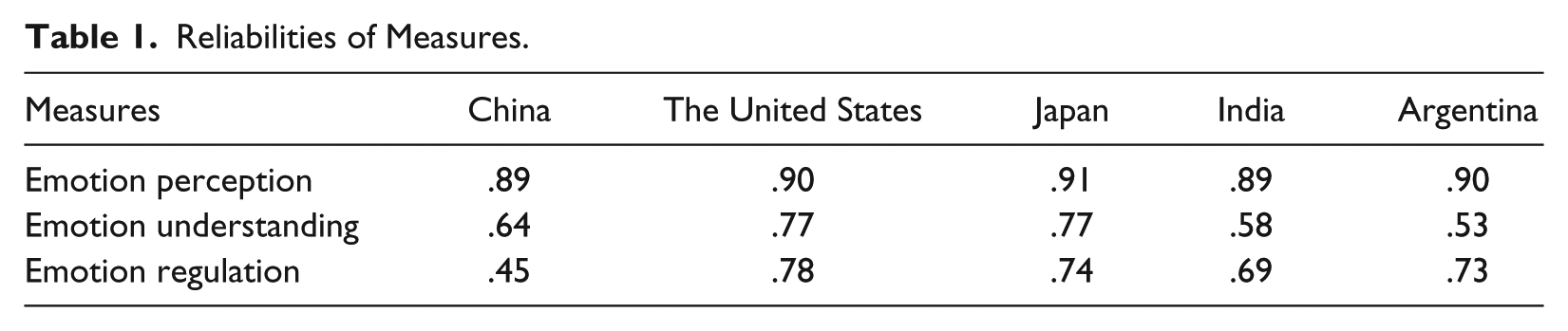
Out of all the reliabilities, 10 out of 15 are above .7, 4 between .5 and .7, and 1 below .5. That some of the reliabilities were lower could be due to the complexity of the coding method (as compared with Likert-type scales, which assign numerical integer numbers to each anchor) and the relatively small samples (see improved reliabilities with large samples in Study 2).
Method of analysis
Before we made comparisons across countries, we conducted an ANOVA and checked the intraclass correlation (ICC(1)) to make sure that there was enough between-group variance and within-group agreement for using country as the unit of analysis (James, 1982). Results showed significant between-group variance and good within-group agreements for all three branches across the five countries: for emotion perception, F(4, 575) = 28.8, p < .01, ICC(1) = .19; for emotion understanding, F(4, 575) = 44.6, p < .01, ICC(1) = .29; and for emotion regulation, F(4, 575) = 74.5, p < .01, ICC(1) = .40. The ICC scores indicate that there were about 19% variance in the branch score explained by country-level influence for emotion perception, 29% for emotion understanding, and 40% for emotion regulation, revealing medium to large country-level effects (Bliese, 2000; James, 1982; LeBreton & Senter, 2008). This provided support for meaningful comparisons across national groups.
We generated unique answer keys for each of the five countries as well as common answer keys (referred to as global answer keys) for the total sample. Each answer key identifies the most common answer for one item in the test. For example, a test item may be multiple-choice question with five possible answers (a), (b), (c), (d), or (e). If the most frequently selected response is (b), then (b) is the answer key for that item. The answer key represents the “best” or most widely endorsed answer for the item.
To assess cultural influences on branches of emotional intelligence, we assessed the extent to which answer keys for the emotional intelligence test items are shared across cultures. Similar to Ekman et al.’s (1987) facial expression judgment study and Scherer and Wallbott’s (1994) differential emotion response patterning study, we used proportions of shared answer keys as an indicator of universality or cultural specificity. We used two methods to assess the extent to which answer keys are universal. First, we compared the answer keys across countries to find the proportion of answer keys that are shared across all cultures. Second, we compared the answer keys for each country with the global answer keys to determine the proportion of answer keys that are universal (i.e., individual country answer keys match the global answer keys) versus culture-specific (i.e., individual country answer keys differ from global answer keys). Proportions of universal versus culture-specific answer keys were calculated for each of the three branches of emotional intelligence—emotion perception, emotion understanding, and emotion regulation.
Results
Figure 2 depicts the results of comparing answer keys across all five countries. All three branches of emotional intelligence had shared and specific answer keys across the five countries, indicating that they are both universal and culture-specific. The proportion of shared answer keys was highest for emotion perception (71.4%), second highest for emotion understanding (53.1%), and lowest for emotion regulation (33.3%). Consequently, the proportion of culture-specific answer keys was lowest for emotion perception (28.6%), followed by emotion understanding (46.9%), and highest for emotion regulation (66.7%). A chi-square test showed that the proportion of shared answer keys (and thereby, culture-specific answer keys) differs among three branches, χ2(2, N = 98) = 9.17, p < .01. Additional tests revealed that emotion perception had a higher proportion of shared answer keys (and thereby, a lower proportion of culture-specific answer keys) than emotion understanding and emotion regulation combined, χ2(1, N = 98) = 6.99, p < .01, and emotion regulation had a higher proportion of culture-specific answer keys (and thereby, a lower proportion of shared answer keys) than emotion perception and emotion understanding combined, χ2(1, N = 98) = 6.70, p < .01. Pairwise chi-square tests indicated that the proportion of shared (or culture-specific) answer keys differed significantly between emotion perception and emotion regulation, χ2(1, N = 66) = 9.07, p < .01. The proportion of shared (or culture-specific) answer keys did not differ significantly between emotion perception and emotion understanding, χ2(1, N = 74) = 2.63, p = .11, or between emotion understanding and emotion regulation, χ2(1, N = 56) = 2.17, p = .14, although the differences were in the expected direction. The overall results indicated decreasing proportions of shared answer keys (and thereby increasing proportions of culture-specific answer keys) from emotion perception to emotion understanding and emotion regulation, providing evidence that emotion perception is the relatively more universal and less culture-specific branch of emotional intelligence, while emotion understanding and emotion regulation are the relatively more culture-specific and less universal branches. The results provided partial support for our hypotheses.
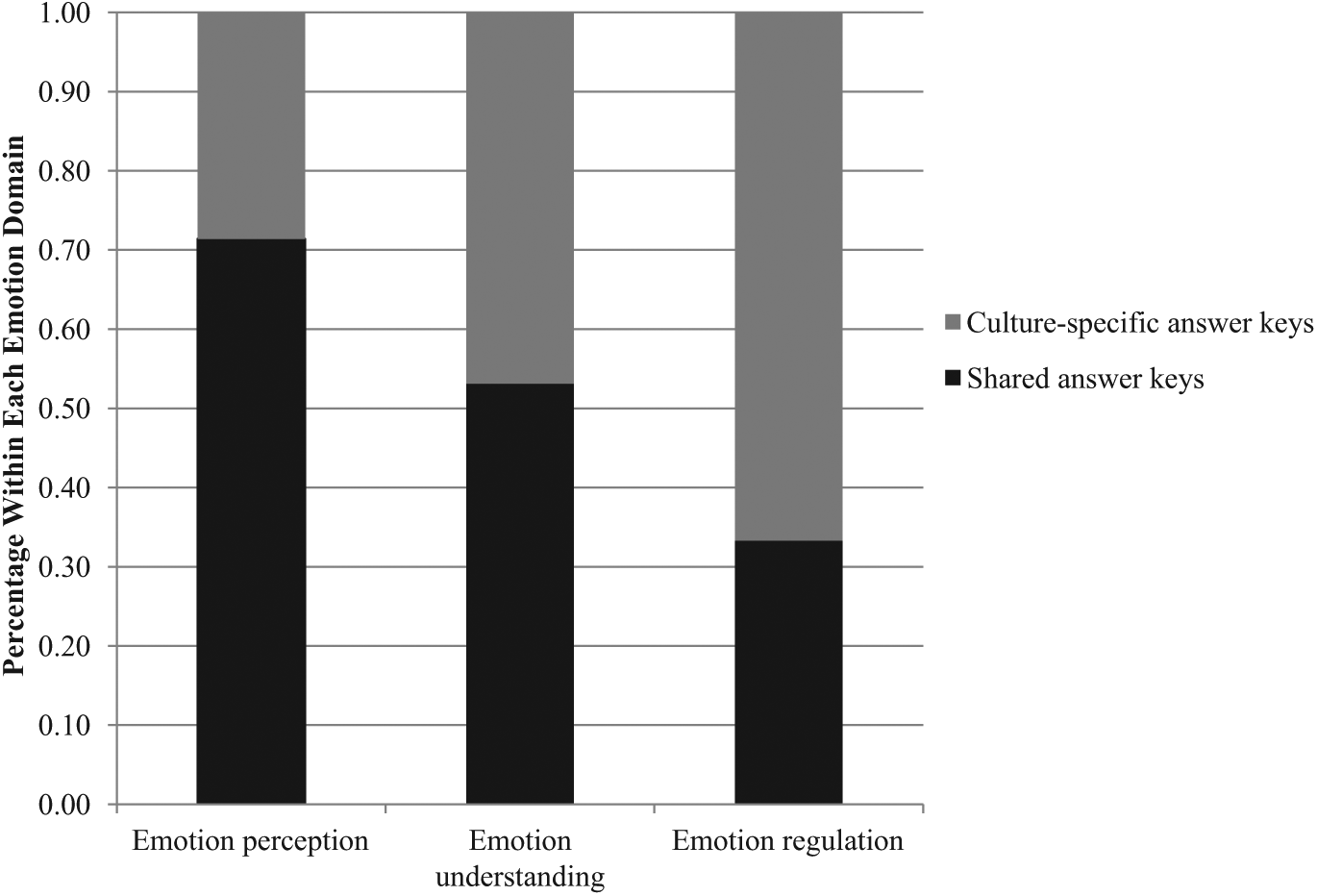
Percentages of shared and culture-specific answer keys across five countries in the three emotion domains.
Comparing among all five countries has limitations, as it may over-estimate the differences and under-estimate the sharedness. This is because sharedness was only counted when all five countries had the same answer key. For example, if only one country has a different answer key from the other four countries, the comparison is still counted the same as if all five countries had different answer keys. To overcome this limitation, we also generated the answer keys for the total sample (i.e., global answer keys), and then made comparisons between each individual country answer keys and the global answer keys.
Figure 3 depicts the results from the comparison of country-specific answer keys with the global answer keys. The results were generally consistent with findings in Figure 2. There were both shared and specific answer keys for all three branches. The proportion of shared answer keys was highest for emotion perception (average = 91.0%), second highest for emotion understanding (average = 85.0%), and lowest for emotion regulation (average = 76.7%). Consequently, the proportion of culture-specific answer keys was lowest for emotion perception (average = 9.0%), followed by emotion understanding (average = 15.0%), and highest for emotion regulation (average = 23.3%). This evidence provided additional and consistent support for our predictions.
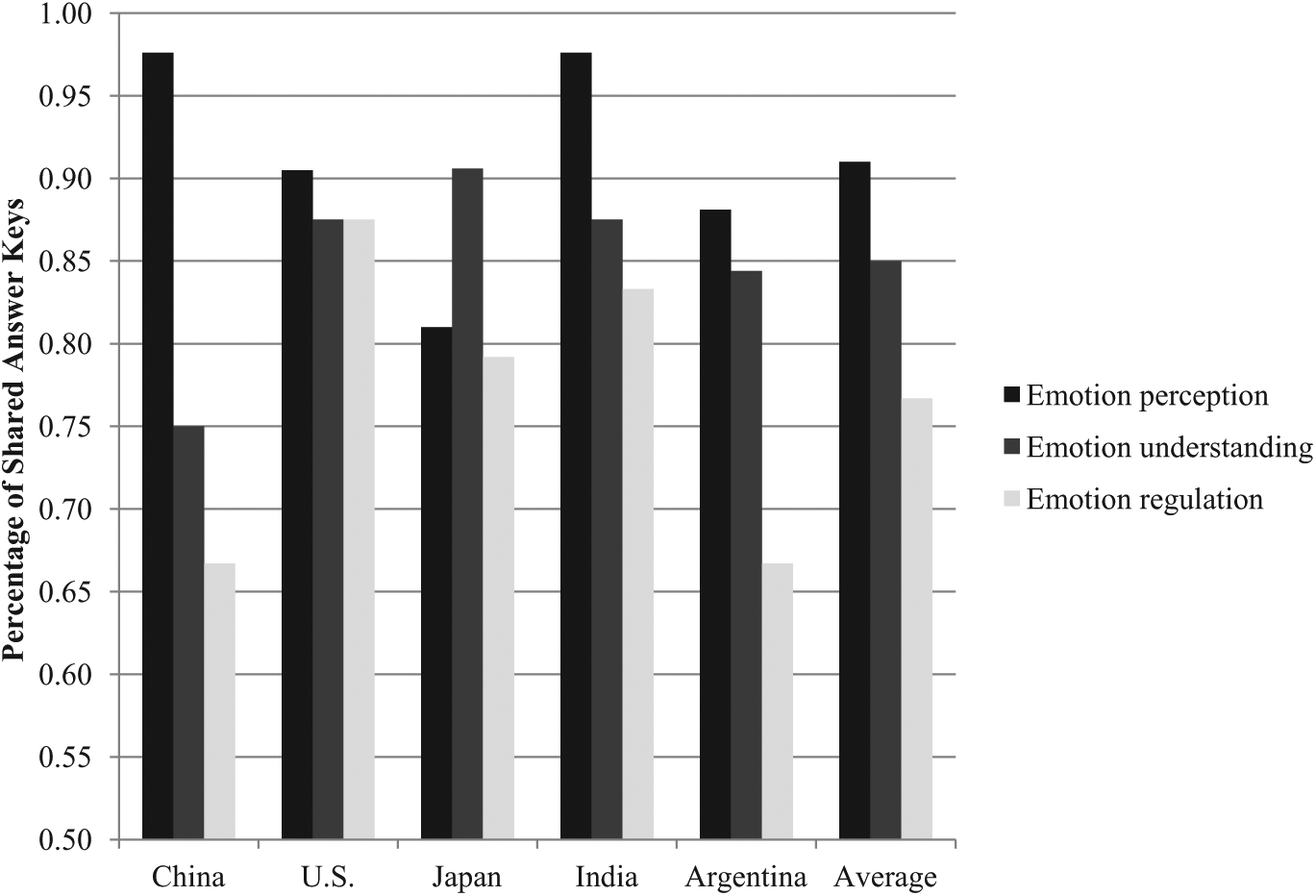
Percentages of shared answer keys between individual countries and the five-country sample.
Upon closer examination, Figure 3 yields some interesting discrepancies in the findings for individual countries. For example, for the U.S. sample, emotion regulation was not the most culture-specific branch as the percentages of shared answer keys for emotion understanding and emotion regulation were the same (87.5%). Also, for the Japanese sample, emotion perception was not the most universal branch, as the percentage of shared answer keys for emotion perception (81%) was lower than for emotion understanding (90.6%). These discrepancies will be addressed in the later section.
Study 2
Method
Although Study 1 was based on a diverse sample from five countries, the relatively small sample size for each country may raise doubts about the representativeness of each sample. Furthermore, due to the small sample size, we were unable to test the measurement equivalence using confirmatory factor analysis (Bandalos & Finney, 2001). To overcome these limitations, as well as to check the robustness and replicability of our findings, we replicated Study 1 using independent, larger samples from two countries—China and the United States. We selected China and the United States as they are the most common proxies for East Asian culture and North American culture, and the cultural differences of these two countries have been widely studied (Brockner & Chen, 1996; Markus & Kitayama, 1991; Zhang & Tsui, 2013). In addition to replicating our findings from Study 1, we also intended to illustrate specific cultural differences in answer keys that may be explained by prior research.
Participants
The sample in Study 2 includes 310 Chinese people (72 females, M age = 40) who participated in several executive MBA programs in an international business school in China, and 363 American participants (187 females, M age = 44.1) who are executives involved in several coaching programs. None of these participants were involved in the samples in Study 1. Participants from the executive MBA programs in China are part-time students who are executives in their companies, and they have similar management levels with the American participants in their respective companies. Thus, it is appropriate to make comparisons between these two groups. All participants completed MSCEIT as part of a course, or a training workshop. They were debriefed on their results on the emotional intelligence test, but did not receive any financial compensation for their involvement in the study.
Measures and method of analysis
As in Study 1, we also used the MSCEIT V2.0 to measure the three branches of emotional intelligence, and compared answer keys for the Chinese respondents with the answer keys for the U.S. respondents. The measures exhibited acceptable reliabilities in this study as well (for Chinese sample, the reliabilities were .91, .69, and .58 for emotion perception, emotion understanding, and emotion regulation, respectively; for the U.S. sample, the reliabilities were .89, .63, and .61 for emotion perception, emotion understanding, and emotion regulation, respectively).
Similar to Study 1, we tested within-group agreement and between-group variance. Results from ANOVA showed that the between-group variance was significant for each of the three branches (all ps < .00). ICC(1)s (.24, .64, and .73 for emotion perception, emotion understanding, and emotion regulation, respectively) indicated medium to large country-level effects, and justified our comparisons on group levels (Bliese, 2000; James, 1982; LeBreton & Senter, 2008). Because in our studies we took emotional intelligence as a construct that comprises three interconnected branches, it is necessary to ensure that this three-factor model applies in both countries so as to make the comparison meaningful. Therefore, before we compared the answer keys, we tested the configural equivalence to ensure that emotional intelligence had the same factor structure between the two countries. 5 We set up a three-factor model in which factor loadings were estimated freely in both countries (Vandenberg & Lance, 2000). 6 Results showed good support for the model—χ2(372) = 481.65, root mean square error of approximation [RMSEA] = 0.03, non-normed fit index [NNFI] = 0.95, comparative fit index [CFI] = 0.96. Therefore, according to Vandenberg and Lance (2000), this evidence provided support for the same three-factor structure of emotional intelligence in the United States and China.
Results
Figure 4 shows the results of comparing the Chinese answer keys with the U.S. answer keys. Consistent with the patterns of our findings in Study 1, we found both shared and specific answer keys in all three branches of emotional intelligence between the two countries. The proportion of shared answer keys was highest for emotion perception (90.5%), second highest for emotion understanding (71.9%), and lowest for emotion regulation (54.2%). Consequently, the proportion of culture-specific answer keys was lowest for emotion perception (9.5%), followed by emotion understanding (28.1%), and highest for emotion regulation (45.8%). A chi-square test also showed significant difference among the proportions, χ2(2, N = 98) = 11.22, p < .01. Additional tests revealed that emotion perception had a higher proportion of shared answer keys (and thereby, a lower proportion of culture-specific answer keys) than emotion understanding and emotion regulation combined, χ2(1, N = 98) = 8.90, p < .01, and emotion regulation had a higher proportion of culture-specific answer keys (and thereby, a lower proportion of shared answer keys) than emotion perception and emotion understanding combined, χ2(1, N = 98) = 7.83, p < .01. Pairwise chi-square tests indicated that emotion perception had a higher proportion of shared answer keys than emotion understanding, χ2(1, N = 74) = 4.34, p < .05, and emotion regulation, χ2(1, N = 66) = 11.47, p < .01, but emotion understanding and emotion regulation did not differ significantly from each other, χ2(1, N = 56) = 1.87, p = .17. In general, the results provided additional support for our prediction that both universality and cultural specificity exist, and they are different across different branches of emotional intelligence, with emotion perception relatively more universal, while emotion understanding and emotion regulation relatively more culture-specific. 7
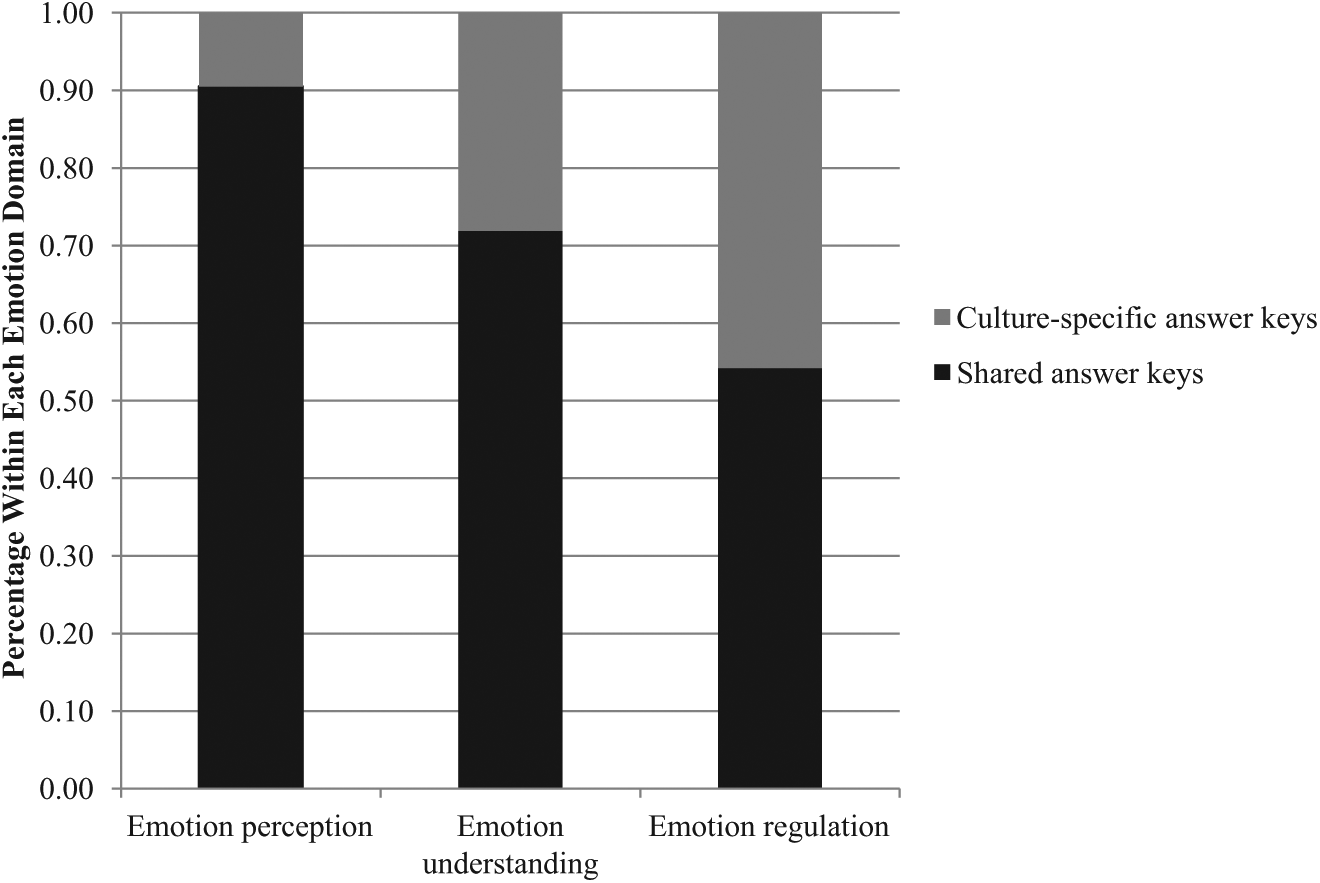
Percentages of shared and culture-specific answer keys between China and the United States in the three emotion domains.
Different from Study 1, we did not generate the global answer keys for the total sample, as on one hand, the limitation of over-estimating differences would not appear in two-country comparison, and on the other hand, when there are only two countries, the global answer keys for the total sample are usually biased toward the country with higher consensus, leading to over-estimation of sharedness.
To further explore the cultural differences in answer keys, we present one example from both emotion understanding and emotion regulation—the branches that show higher cultural variability. For example, one test item measuring emotion understanding presents a scenario in which a man discovered someone cheating on exams and thought it was morally wrong, and then reported to the teacher. However, the teacher told him that there was nothing he could do. The man plans to pursue the matter with a school administrator. Respondents are asked to choose an emotion that the man in the scenario felt. Chinese respondents most frequently picked the option of enraged (66%), whereas U.S respondents most frequently chose disgust (68%). In the emotion regulation measure, a test item presents a scenario about a woman for whom everything is going well. Details of her life are offered, indicating that her work and family life are pleasant. The woman starts to feel self-important and finds herself tempted to show off to her friends. Respondents are asked to rate the effectiveness of specific strategies if the woman wants to maintain her relationships. One strategy was that the woman could start to think of all the things that could possibly go wrong in the future so as to gain perspective on her life. The most common Chinese rating for this strategy was somewhat effective (43%), and then very effective (32%), while the most common American rating for this strategy was very ineffective (31%), and then somewhat ineffective (29%). The above specific differences in emotion understanding and emotion regulation between China and the United States likely reflect the impact of culture. We will discuss how these differences can be linked with prior research findings in the “Discussion” section.
Discussion
To what extent are the three domains of the cascading model of emotional intelligence (emotion perception, emotion understanding, and emotion regulation) universal versus culture-specific? Results from two studies provided support for our hypotheses that emotion perception, emotion understanding, and emotion regulation are both universal and culture-specific. More importantly, we found emotion perception to be the most universal domain of emotional intelligence, and emotion understanding and emotion regulation to be more culture-specific.
Our study makes several contributions to the current literature. First, it provides empirical support for Matsumoto and Hwang’s (2012) theory regarding the influence of culture on different emotion domains. Matsumoto and Hwang proposed that culture makes differing contributions to different emotion domains, depending on requirements for language and higher order cognition. Using Joseph and Newman’s (2010) three-branch cascading model of emotional intelligence, the current research tested Matsumoto and Hwang’s theory across three emotion domains—emotion perception, emotion understanding, and emotion regulation, and provides empirical support for the differing impacts of culture across multiple emotion domains. Specifically, our findings that emotion understanding and emotion regulation in particular were the more culture-specific emotion domains than emotion perception provide support for the proposal that culture has a stronger influence on emotion domains that require more extensive language and higher order cognition (Matsumoto & Hwang, 2012).
Our findings also contribute to emotional intelligence literature. On one hand, we provide support for the three-branch cascading model of emotional intelligence (Joseph & Newman, 2010). Our findings that culture had an increasing impact on the three branches from emotion perception to emotion understanding and emotion regulation are consistent with Joseph and Newman’s (2010) emotional intelligence model where the three domains exhibit a progressive pattern with emotion perception causally preceding emotion understanding, which in turn, precedes emotion regulation. On the other hand, our findings indicate that, in practice, testing emotional intelligence across cultures using ability model with the same sets of criteria should be treated with caution—especially with respect to emotion understanding and emotion regulation. Although we found the majority of the best answers to emotional intelligence test items in the MSCEIT were shared across countries, there were notable differences, particularly for emotion regulation domain, which poses a challenge to the assumption that people across different cultures may have the same sets of knowledge about emotions. This suggests that people who have high emotional intelligence in one culture may not be necessarily considered to be emotionally intelligent in another culture, or people from different cultures may have different sets of knowledge about emotions. Therefore, future research may need to think about developing different sets of answer keys for the same measures (i.e., MSCEIT), particularly for emotion understanding and emotion regulation when using an ability-based approach to the assessment of emotional intelligence, or develop new culture-tailored measures (cf. Wong et al., 2007). These insights should also be applied to training and development efforts geared toward improving emotional intelligence.
Third, our findings extend earlier research on cultural differences in emotion understanding. Previous research has found that for the same emotion-eliciting event, people from different cultures may have different interpretations (Scherer, 1997a, 1997b). Our findings provide additional insights into this area. For example, in one test item of emotion understanding we presented above regarding someone cheating on an exam, Chinese respondents selected rage as the likely emotional response, whereas U.S. respondents selected disgust. Although rage (i.e., extreme anger) and disgust are related moral emotions, anger is typically triggered by individual rights violations whereas disgust is triggered by violations of purity–sanctity (Rozin, Lowery, Imada, & Haidt, 1999). Hence, Chinese respondents may be more attuned to the individual rights violation associated with cheating on exams than Americans. Prior research has shown that Asian individuals tend to have a more interconnected construal than Americans, seeing oneself as embedded in interpersonal relationships (Markus & Kitayama, 1991). Thus, it is possible that Chinese respondents perceive more of a connection between the behavior of cheaters and important outcomes for themselves or others. In particular, exam scores have an incredible impact on educational opportunities and life success of individuals in Chinese society. U.S. participants, by contrast, tend to view themselves independently (Markus & Kitayama, 1991). Hence, they may be less likely to see others’ cheating as relevant to their own individual goals or rights. Compared with anger, disgust is associated with divinity–purity violations (Rozin et al., 1999) as opposed to the individual rights violations. This finding contributes to the growing body of research that shows for a given emotion-eliciting event, people from different cultures may have different interpretations and hence different emotional reactions (Scherer, 1997a, 1997b).
Finally, our findings extend earlier research on cultural differences in emotion regulation (Butler, Lee, & Gross, 2007). In one test item we presented earlier, Chinese respondents considered the down-regulation of positive emotion to be a somewhat effective strategy for maintaining a relationship, whereas U.S. respondents considered that strategy to be ineffective. Prior research shows that emotion regulation is influenced by cultural differences in dialectical beliefs about positive emotions (Miyamoto & Ma, 2011). East Asians, who are generally higher in dialectical thinking, tend to take both positive and negative sides into consideration, especially in positive situations (Hui, Fok, & Bond, 2009), so as to regulate their emotions to avoid making others jealous and hence maintain harmonious relationships (Mesquita & Albert, 2007). Therefore, this particular finding provides additional evidence regarding the cultural impact of dialectical thinking on emotion regulation.
Limitations and Future Research
Despite the strengths of our present studies, including a diverse sample and the use of a well-established measure of emotional intelligence, some limitations still remain. One potential limitation of our study is the limited range of emotions examined in our study. By using the MSCEIT, we largely examined emotional intelligence regarding basic emotions such as anger, disgust, fear, joy, sadness, and surprise (Ekman, Friesen, & Ellsworth, 1982; Matsumoto & Hwang, 2012) and not regarding more culture-specific emotions such as shame, embarrassment, or pride (Matsumoto & Hwang, 2012). Hence, our results likely over-estimate the universality of all the branches of emotional intelligence. However, because our primary purpose was to compare the degree of universality across different emotion domains, our findings are still informative. Furthermore, given that we identified notable cultural differences across emotion domains for basic emotions, we consider this to be especially strong evidence for our claims. For example, in Study 2, emotion recognition of anger was completely shared for Chinese and U.S. respondents, yet understanding and managing anger were mostly unshared. Additional research should be conducted to examine this research question for more culture-specific emotions.
Our findings may also be influenced by the varying amounts of contextual information included in our measures of the different emotion domains. Emotion perception test items in the MSCEIT contain no contextual information, whereas emotion regulation test items include extensive contextual information. Context has been argued to play an important role in cultural differences in emotions (Carroll & Russell, 1996; Ito, Masuda, & Hioki, 2012; Masuda et al., 2008; Matsumoto, Hwang, & Yamada, 2012). However, we argue that the variation in the amount of contextual information in the MSCEIT test items is consistent with differences in the constructs being measured. Emotion perception is, by definition, a decontextualized ability. For example, emotions are expressed and perceived through the movement of facial muscles (Ekman & Friesen, 1975), which is independent of the context. Emotion perception refers to one’s ability to read such emotions from the facial cues presented. Emotion perception does not refer to the ability to infer emotion from contextual information. The ability to infer emotion from contextual information requires emotion understanding, a separate branch of emotional intelligence. Hence, the decontextualized emotion perception items are a fair representation of the construct. By contrast, the MSCEIT items for emotion regulation are highly contextualized, which fits the conceptualization of emotion regulation because it draws on the ability to understand and intervene in the broader emotion processes, including contextual factors that trigger emotions. Therefore, the variation of contextual information provided for each branch may indeed influence our findings, but the variation maps to the theoretical constructs, and thus is not a methodological artifact.
We contend that our study provides evidence to support Matsumoto and Hwang’s (2012) model of the influence of culture on emotion domains. However, Matsumoto and Hwang’s model explicitly contrasts biological versus cultural influences on emotion domains, while we contrast the universality versus cultural specificity of responses to the test items for emotional intelligence. We did not test biological influences on the three domains of emotional intelligence. Universality cannot be unequivocally equated with the influence of biological factors discussed in the model. Although sharedness of responses for the emotional intelligence test may be due to innate basic human psychological tendencies (such as language acquisition, Pinker & Bloom, 1990, or personality structure, Allik, Realo, & McCrae, 2013), it may also be due to social learning from cross-cultural contact, from shared mass media input, or other factors (Ekman, 1992; Matsumoto & Hwang, 2012; Norenzayan & Heine, 2005). Future studies should incorporate more direct tests of the biological influence on emotion domains, such as genetic testing (Judge, Ilies, & Zhang, 2012).
We did not find significant differences regarding the universality and cultural specificity in the pairwise comparison between emotion understanding and emotion regulation. This may indicate a possibility that emotion understanding and emotion regulation might be affected by culture equally due to their shared higher requirements for languages and high-order cognition (Matsumoto & Hwang, 2012). Future research should further test whether emotion understanding and emotion regulation differ in their universality and cultural specificity. In addition, two countries in Study 1 did not exhibit a consistent pattern of decreasing universality and increasing cultural specificity from emotion perception to emotion regulation as the rest of the countries and the average pattern. For example, for the U.S. sample, universality on emotion regulation was higher compared with other countries and the average pattern, and was not different from emotion understanding. That is, the U.S. answer keys for emotion regulation are quite similar (87.5%) to the answer keys generated for the combined five countries. This implies that U.S. emotion regulation norms may be widely understood and accepted by other cultures. This may be due, in part, to the influence of U.S. culture on global culture, particularly in the business domain. For the Japanese sample, emotion perception was not the most universal branch, and it was less universal than other countries and the average pattern. Such country-specific patterns are beyond the scope of this article, but deserve more attention in future research.
Another possible limitation of our study is that we examine one model and one test for assessing emotional intelligence. As the conceptualization and measurement of emotional intelligence continue to develop in the future, the current study should be revisited. More specifically, as the MSCEIT was developed in the United States, it is likely to contain scenario and response options that are biased toward U.S. culture. Future research should take a more inductive approach, generating scenarios and response options from a wider range of cultures to create a truly global test for examining the relative universality and cultural specificity of emotion domains in emotional intelligence (see the Global Leadership and Organizational Behavior Effectiveness study for an example of this approach, House et al., 2004).
Other limitations of our study include the languages of the measures versus the native languages of participants. Participants in the United States, India, and Japan took MSCEIT in English, while Chinese in Mandarin and Argentines in Spanish. Although the measurement reliability and validity for the Chinese version of MSCEIT were established in our current study and for the Spanish version in previous research (Extremera, Fernández-Berrocal, & Salovey, 2006), the findings should still be interpreted with caution as emotion can be eliciting different meanings when translated (Elfenbein & Ambady, 2002).
Our sample covered five countries, but did not include any African or European countries, which may lead to an under-estimation of the degree of cultural specificity. However, we did include a wide range of nations, which are quite different in their cultures (House et al., 2004), and therefore, our findings are still informative. Future studies should include a broader range of countries to thoroughly test the generalizability of the findings. Our sample included more males than females. Hence, our results may be more representative of men, and may not generalize to women. Future studies should draw on gender-balanced samples and should explicitly examine the effect of gender on our findings.
Finally, we used nation as an imperfect indicator of culture. Future studies should measure culture directly and examine whether these findings are indeed linked with specific cultural dimensions identified in prior research (Hofstede, 1980; Markus & Kitayama, 1991; Minkov & Hofstede, 2012; Triandis et al., 1986).
Conclusion
Research on culture and emotion has been shifting from the question of whether emotions are universal or culture-specific (e.g., Averill, 1980; Ekman, 1973, 1984, 1992; Mead, 1975; Scherer & Wallbott, 1994) to distinguishing the aspects of emotions that are more universal from those that are more culture-specific (e.g., Matsumoto & Hwang, 2012). We extended this research by examining the universality and cultural specificity of the three emotion domains in the cascading model of intelligence—emotion perception, emotion understanding, and emotion regulation. Consistent with predictions based on Matsumoto and Hwang’s (2012) model of culture and emotion, we found that emotion perception was the most universal branch of emotional intelligence, while emotion understanding and emotion regulation were less universal and more culture-specific. To date, little research has been dedicated to examining the relative universality and cultural specificity across different emotion domains. Our studies contribute to this area and provide directions for future research.
Footnotes
Declaration of Conflicting Interests
The author(s) disclosed receipt of the following financial support for the research, authorship, and/or publication of this article: David R. Caruso receives royalties from the sale of the MSCEIT.
Funding
The author(s) disclosed receipt of the following financial support for the research, authorship, and/or publication of this article: This research was supported in part by the China Europe International Business School Research Committee Grant.