






Abstract
We investigated associations among social class, parents’ work experiences, and their child-rearing values in a sample of mothers and fathers drawn from southern Brazil, testing Kohn’s hypothesis that parents who experience greater decision-making autonomy at work and who perceive their jobs to be more complex will be more likely to value self-direction and less likely to value conformity in their children. We also tested the hypothesis that the relation between social class and values would be mediated by workplace experiences. Participants included 68 parents (38 mothers, 30 fathers; 46 working class, 22 middle class) of 36-month-old children who were part of a longitudinal study. Correlation analyses revealed few associations among social class, workplace experiences, and child-rearing values among the mothers, but among the fathers these variables associated in the expected direction. The results also indicated that workplace experience mediates the relation between social class and values, although only for fathers. Our findings supported Kohn’s hypothesis regarding differences between social-class groups and highlighted that the relation between work experience and parental values varied by parents’ gender. Social and cultural issues regarding work context and parental values between women and men in southern Brazil are discussed.
Many scholars have argued that there is a link between parents’ social-class background and their child-rearing values, with the majority of the relevant research conducted in the United States (Curtner-Smith, Bennett, & O’Rear, 1995; Gerris, Deković, & Janssens, 1997; Grusec, 1997; Holden, 1995; Lareau, 2000, 2002; Luster, Rhoades, & Haas, 1989; Spade, 1991; Weininger & Lareau, 2009). In this article, we will broaden the discussion, framing it in cultural terms, given that parents’ child-rearing values are influenced by their membership in one or other cultural group. By “cultural group” we mean the following:
A group of people who share a set of values, beliefs, and practices; who have access to the same institutions, resources, and technologies; who have a sense of identity of themselves as constituting a group; and who attempt to communicate those values, beliefs, and practices to the following generation. (Tudge, 2008, pp. 3-4)
This definition can be applied to an entire society. Comparing, for example, the United States and Brazil, one would need to show that there was greater between-group variability than within-group variability in values, beliefs, practices, institutions, resources, identities, etc. to make the claim that these two societies constituted different cultural groups. However, within any society the same claim can be made for two or more groups that vary in the same way. Differences of region, ethnicity, and social class are among the most important factors that can distinguish groups in terms of their values, beliefs, practices, and so on.
Although research on individualism and collectivism has made a major contribution to the field, we think that it is problematic to treat societies as though they can be placed on a single continuum of these two dimensions (see, for example, Hofstede, 1991; Hofstede, Hofstede, & Minkov, 2010; Kim, Triandis, Kağitçibaşi, Choi, & Yoon, 1994; Triandis, 1995) or by interdependence and independence (e.g., Markus & Kitayama, 1991). Each of these scholars acknowledges that societies are far from homogeneous, but nonetheless describes the United States as being prototypically individualistic whereas other societies, part of the “developing” world, can be described as having collectivist values or as valuing interdependence. Brazil is widely portrayed as a collectivist culture as demonstrated by Hofstede’s Individualism–Collectivism scale (Hofstede, 1991; Minkov, 2011). Nevertheless, the diversity of Brazilian culture and values is increasingly recognized, including the presence of individualistic subcultures (Hofstede, Garibaldi de Hilal, Malvezzi, Tanure, & Vinken, 2010; Torres & Dessen, 2008).
Recognizing this within-society variability, Kağitçibaşi (2005, 2007, 2012) and Keller (2007, 2012; Keller & Kärtner, 2013) proposed more subtle accounts of cultural influences on child-rearing values. Kağitçibaşi argued that rather than the single dimension on which to place cultural groups there are two orthogonal dimensions, one having to do with agency and the other with interpersonal distance. Along the agency dimension, parents vary in the extent to which they value and encourage autonomy or heteronomy (conformity) in their children, and along the dimension of interpersonal distance they vary in the extent to which they value relatedness (connectedness with others) and separation from others. Being orthogonal, these two dimensions are not in competition.
Kağitçibaşi (2007) noted that families valuing heteronomy and relatedness are mostly found in the “majority world,” that is, where the majority of the world’s children live, but where almost no research is conducted (Arnett, 2009; Henrich, Heine, & Norenzayan, 2010; Tomlinson & Swartz, 2003; Tudge & Freitas, 2012). However, Kağitçibaşi argued, significant changes in values occur after people move from rural areas to urban centers in societies where parents not only have greater access to education but also can gain higher education, and thus be employed in the professional sphere. Using data from the Turkish Values of Children project, Kağitçibaşi (2007; Kağitçibaşi & Ataca, 2005) showed that urban and well-educated parents were likely to value both autonomy and relatedness in their children. Similar findings come from Brazil; Seidl-de-Moura and her colleagues (Seidl-de-Moura, Carvalho, & Vieira, 2013; Vieira, Seidl-de-Moura, Mafioletti, et al., 2010) have shown that educated city dwellers in Brazil can best be categorized as having autonomous-related values.
Following Cole (2005), we agree that education is likely to have profound effects on many aspects of development, and Kağitçibaşi’s (2007; Kağitçibaşi & Ataca, 2005) data are compelling. However, it almost certainly is not only in majority-world societies that parental child-rearing values change once parents attain higher education and have professional occupations. In the industrialized world, too, as we noted in the opening paragraph, differences in parents’ social class have been clearly linked to differences in child-rearing values. What is it, though, about education and one’s type of occupation that might influence child-rearing values?
Kohn’s research in industrialized societies (e.g., Kohn, 1969/1977, 1995; Kohn & Slomczynski, 1990; Kohn et al., 2001) has been particularly important in explaining the links between education and occupation on the one hand and parental values on the other. He argued that parents’ prior educational experiences and their current workplace experiences greatly influence their child-rearing values. For example, some parents’ formal education ended while they were still relatively young. In this case, their educational experiences were such that their models for success consisted of classmates who did what their teachers wanted and responded to questions with the same information that the teachers or the texts had provided. Limited education typically leads to jobs in which workers are rarely required, or rewarded, for thinking for themselves. In other words, their workplace experiences, like their previous school experiences, are such that doing well requires following rules that others have established and diligently doing what has been required. The work itself may well be difficult (particularly physically difficult) but often is repetitious, involving little complexity. Assuming that parents want their children to be successful, parents with this type of educational background and current workplace experiences are likely, Kohn argued, to see their children’s eventual success in terms of learning to follow rules and doing well and carefully what they have been asked to do.
By contrast, other parents’ educational experiences were perhaps similar during their adolescent years but, because they went on to higher education, a part of those experiences involved seeing success not simply in terms of following the rules, but thinking for oneself and providing a reasoned argument for one’s opinions. People with a college degree (or more) have the potential for taking jobs that require more than simply following someone else’s rules, but also involve thinking for oneself and making one’s own decisions. Such jobs often are more complex, and involve making collaborative decisions with others. Not surprisingly, Kohn argued, parents with educational backgrounds and occupational experiences such as these view eventual success for their own children as requiring more in terms of autonomy and self-direction and less in terms of conformity to the demands of others.
Kohn’s argument is not that working-class parents only want their children to conform, or that middle-class parents are only interested in fostering autonomy in their children. All children need to learn when to conform to what parents and teachers want, and all children must develop some autonomy if they are not to be dependent on others for their entire lives (Deci & Ryan, 2000). Kohn’s point is simply that middle-class parents are more likely to see the value of encouraging self-direction in their children to help them become successful in later life, whereas working-class parents are more likely to see the value of conformity.
Kohn and his colleagues have provided clear support for his position with research conducted in various parts of the industrialized world—the United States, Italy, Japan, Poland, and Ukraine (Kohn, Slomczynski, & Schoenbach, 1986; Kohn et al., 2001). Other researchers, too, have found support for Kohn’s arguments in the United States and Russia (Alwin, 1989, 1995; Curtner-Smith et al., 1995; Luster et al., 1989; Spade, 1991; Tudge, Hogan, Snezhkova, Kulakova, & Etz, 2000). A number of scholars have also found a connection between social class and parents’ child-rearing values in Brazil (Moinhos, Lordelo, & Seidl-de-Moura, 2007; Piccinini, Tudge, Marin, Frizzo, & Lopes, 2010; Ribas, Seidl-de-Moura, & Bornstein, 2003; Seidl-de-Moura et al., 2004; Tudge et al., 2013; Vieira, Seidl-de-Moura, Lordelo, et al., 2010), although no research in Brazil has been conducted on the factor (i.e., parents’ workplace experiences) proposed to connect social class to parents’ child-rearing values.
Some researchers, however, have reported inconsistent findings with regard to Kohn’s argument regarding parental occupation (though not parents’ education). For example, Xiao (2000), drawing on a representative sample from the United States, Ma and Smith (1990, 1993), using data from Taiwan, and Ribas and colleagues (2003), with data from Brazil, found that education was more related to parental values than was the type of occupation parents had. One possible explanation for these results is that occupational status is less important to Kohn’s argument than is the ways in which parents experience or perceive their past education or current employment (e.g., its complexity or the opportunities for exercising autonomy that it affords; Kohn, 1969/1977, 1995). As Kohn and colleagues (1986) concluded, “The experience of self-direction, in paid employment or in schoolwork, is important for valuing self-direction” (p. 96).
Although much of Kohn’s research was conducted solely with fathers, his work in the United States and Poland found that the experience of workplace self-direction had an equally important role for mothers (Kohn et al., 1986). Although Ribas and his colleagues (2003) noted in their Brazilian sample that mothers’ education was more related to their child-rearing values than was their occupation (fathers’ education and occupation were equally related to their values), Ribas et al. only had data on occupational type, not on workplace experiences. By contrast, Etz (1997) found that, among North American mothers, greater opportunities for self-direction at work were associated with less restrictive child rearing, although this was not true for fathers. Xiao (2000) also reported gender differences in the same direction, arguing that “women’s parental values are influenced more by their class locations or occupational experiences than are men’s parental values” (p. 796) and that women were, across all social-class strata but the lowest, more likely to positively value autonomy for their children than were men in the corresponding strata.
In part, these differences might be explained by the fact that women and men experience their work differently, even when occupying the same positions. Xiao (2000) suggested that women still experience worse work opportunities and conditions than do men, and thus tend to place more value on autonomy as a way to overcome these differences and attain a status similar to that of men. However it is not clear why in some studies mothers’ child-rearing values are more influenced by their occupation and social class than are fathers’ whereas in other research the opposite occurs.
The cultural and historical context is likely to play a large role, of course (Tulviste & Ahtonen, 2007); different societies provide different models of gender-related division of labor, and those models change over historical time. Traditionally in the United States, for example, the mother’s role has been primarily associated with child care whereas fathers have viewed their role more to present the outside world to their children (Paquette, 2004). In this context, one should expect that maternal values might be more influenced by their own contact with their children than by more distal variables such as education and occupation. Supporting this view, Gerris et al. (1997) found that, especially among mothers, the concept of “parental perspective taking” was a better mediator of the relation between social class and parental behavior than were child-rearing values. They argued that whereas values are often more general and not consciously parents’ in their daily routines with their children, mothers are more attuned to their children’s immediate needs and perspectives and these influence her behaviors far more directly than do values. Recent evidence from seven different societies reveals that even in the 21st century, mothers are far more likely to be engaged in activities with their young children than are fathers, even when taking into account the fact that fathers spend more time working outside the home than do mothers (Tudge, 2008).
Tudge and colleagues’ (2013) study of Brazilian parents’ child-rearing values also suggests that daily contact with a child can influence not only the parents’ behavior but also their specific child-rearing values, particularly when their children are young. Young children are developing abilities and wishes to be autonomous that may run counter to their parents’ attempts to have them follow the family’s norms and rules. Thus, as in Tudge and colleagues’ study, even when middle-class parents valued the development of autonomy when their children were infants and who again valued it when their children were 6 years of age, they were more likely to value obedience when their children were aged 3. This study, however, did not examine the parents’ different workplace experiences as a possible mediating link between social class and child-rearing values.
Brazil is a useful majority-world society in which to assess these links in a context in which one might expect to find families valuing both autonomy and relatedness because it is similar, economically and in terms of access to education, to the society where Kağitçibaşi has conducted most of her research. The World Bank (2014) described Brazil as an “upper-middle income” country, with a ranking in per capita Gross National Income of 82 and an 85 ranking on the Human Development Index (HDI: a composite of longevity, education, and health, HDI of .73; United Nations Development Programme [UNDP], 2014). The World Bank (2012) rated Brazil as being highly unequal (2009 GINI coefficient of 54.7, Inequality-Related HDI scores of .53; UNDP, 2014). In terms of the number of years of schooling, the average in Brazil is 7.2 years, and the percentage of the adult population with higher education 10.6%, a position well below the Organization for Economic Co-Operation and Development (OECD) average of 31% (OECD, 2013).
Brazil is a society with many differences between the relatively impoverished north and northeast and the much wealthier southeast and south of the country, including the state of Rio Grande do Sul where the present research was conducted (Hofstede, Garibaldi de Hillal et al., 2010; Tudge et al., in press). This state has a higher life expectancy, less extreme poverty, and a smaller rate of illiteracy than most other states (Instituto Brasileiro de Geografia e Estatística [IBGE], 2010). Approximately 16% of individuals aged 25 and above have completed some or all college, compared with 10.7% in the north of the country and 8.7% in the northeast, and a greater percentage of females (12.9%) than males (10.5%) have completed college (IBGE, 2010). Nonetheless, despite women being more likely to have higher education than do men (IBGE, 2010), their average pay is only about 70% that of men (Fundação de Economia e Estatística Siegfried Emanuel Heuser [FEE], 2012).
Objectives and Hypotheses
In the present study, we aimed to investigate associations among social class, parents’ work experiences, and their child-rearing values in a sample of mothers and fathers drawn from southern Brazil. Our first objectives were to test Kohn’s hypotheses that (a) middle- and working-class parents differ in terms of their work experiences and child-rearing values, (b) parents who experience greater decision-making autonomy at work and who perceive their job activities to be more complex are more likely to value self-direction and less likely to value conformity in their children, and (c) the relation between social class and values is mediated by workplace experiences.
However, some studies pointed out that the relation between work experiences and child-rearing values may be different for fathers and mothers. Considering that, we hypothesized that the positive link between self-direction values and the experiences of complexity and decision-making work autonomy would be stronger for fathers than for mothers. Mothers are often the parents who spend most of their time with their young children, and therefore may be more likely than fathers to take the children’s individual characteristics into account when reporting on their child-rearing values. Moreover, mothers are still more likely than fathers to take time away from work following childbirth and to be in charge of their children during their first years, thereby limiting their opportunities for gaining workplace experience in comparison with fathers. Particularly in societies with large gender inequalities, as in Brazil, women are thus less likely to be considered for occupations involving greater complexity or requiring greater autonomy.
Method
Participants
The sample consisted of 68 parents (38 mothers, 30 fathers) who participated in data collection of a longitudinal study conducted in a large city in the south of Brazil, which included healthy primiparous women and their families who were in the study from the third trimester of pregnancy until their children were aged 8 (Piccinini, Tudge, Lopes, & Sperb, 1998). For the present study, we are using data from parents who participated during the seventh wave of data collection, when their children were 36 months old, and who fully completed all of the relevant instruments.
Mothers were significantly younger (M = 26.5 years, SD = 5.86 years) than were fathers (M = 31.4 years, SD = 8.29 years), t(66) = 2.87, p < .01. Parents reported on a total of 22 boys (58%) and 16 girls (42%). Mothers and fathers had, on average, similar years of schooling (mothers: M = 11.1, SD = 2.7; fathers: M = 12.0, SD = 3.5). Most of the fathers (96.6%) were employed, whereas more than one third (36.8%) of the mothers were unemployed or homemakers. Among employed fathers, 41.4% were minor administrators or executive professionals, whereas among employed mothers 29.2% (18.4% of all mothers) occupied the same positions. The study was approved by the local Ethics Committee and written informed consent was provided by each participant.
Measures
Sociodemographic interview
Participants took part in a structured interview in which they provided demographic data, including parents’ age, educational level, occupation, and the child’s sex and age. Parents’ social class was calculated by a combination of their educational background and their occupation, with at least some college education and a professional or semi-professional occupation being required for an individual to be coded as middle class. Working-class individuals were those who had no higher education and whose occupation was non-professional. In cases of women who did not work outside the home, we simply used their educational background.
Parental values Q-sort
Kohn’s Q-sort methodology (Kohn & Schooler, 1969) was used to assess parents’ child-rearing values. Parents were asked to rank the three most and three least important qualities for a 7-year-old from a list of 13 items. Of these six items selected, the parent was asked to choose the most valued and least valued. Five items are related to self-direction (e.g., “has self-control” and “has good sense and sound judgment”), four to conformity (e.g., “has good manners” and “obey their parents well”), and four are filler items that are not related to either (e.g., “gets along well with other children”). All filler items were scored 3. Among selected items, the most-liked value was scored 5, the other two liked values scored 4, the two not liked values scored 2, and the least-liked value scored 1. Three scores were computed based on each parent’s responses to the measure. A self-direction score was computed by adding each participant’s rankings for the five self-direction items (whether selected or not, with any item not selected scored 3) and a conformity score was computed by adding the rankings for the four conformity items (whether selected or not), non-selected items being scored 3. An overall autonomy score was computed by summing across all six selected items (with all conformity items reverse-scored); this autonomy score is thus more responsive to the participants’ selection of items. The means for self-direction (wanting children to develop “internal standards for behavior”; Kohn & Slomczynski, 1990, p. 61) and for conformity (wanting children to conform “to externally imposed rules”; Kohn & Slomczynski, 1990, p. 61) were multiplied by six to ensure a similar range across the three measures. The scores for self-direction and conformity ranged from 13 to 23 and 12 to 24, respectively. The overall autonomy score ranged from 10 to 26, with higher scores indicating a greater preference for children to decide things for themselves and lower scores signifying that children should learn to obey their parents.
Work-Experience Survey
The Work-Experience Survey was used to assess the latent construct of opportunities for self-direction at work through its components: complexity, routinization, and the level of supervision at work. The original version of the scale was constructed by Etz (1997), based on Kohn’s theoretical and empirical work (Kohn, 1969/1977; Kohn & Slomczynski, 1990). The instrument has 50 items rated on a 6-point Likert-type scale, in which the parents were asked to rate how much they agreed or disagreed that the items reflected their experiences on a regular day at work. These 50 items were submitted to a factor analysis by Etz (1997), using responses from North American parents. Her analysis indicated two factors, decision-making autonomy (26 items, α = .89) and work complexity (18 items, α = .88).
Although the Brazilian participants responded to all 50 items, only those that belonged to the factors identified by Etz (1997) were used in the analyses, and had similar alphas (.92 and .85 respectively for “autonomy in decision making” and “complexity at work”). Autonomy in decision-making items included statements such as “My boss keeps a close watch on most things I do” and “My work hours are kept on a time clock” (both reverse-scored). Complexity was measured by items such as “My job consists of doing the same thing daily” (also reverse-scored). A mean score was obtained for each subscale. A higher score on each of the subscales reflects greater opportunities for self-direction, characterized by more complexity and more autonomy in decision making at work.
Both the Parental Values Q-sort and the Work-Experience Survey were originally developed in English. They were translated into Portuguese and back-translated by a bilingual expert to assure similarity of meaning between both. Minimal adjustments were made to the final Portuguese version.
Data Analysis
Analyses were conducted using SPSS version 20 and were undertaken to test these hypotheses. First, some exploratory analyses were conducted with the variables of interest, such as measures of central distribution and dispersion of data and bivariate correlations among all variables. We decided to conduct all subsequent analyses separately for mothers and fathers given the dependent nature of our data. Specifically, although our total sample consisted of 68 cases (38 mothers and 30 fathers), in 30 cases the mothers and fathers were responding to their child-rearing values with regard to the same child.
For each group (mothers and fathers), we ran bivariate correlations between the variables of interest (social class, child-rearing values, and work-experience variables) and compared the correlation coefficients of mothers and fathers using z tests. Subsequently, partial correlations were conducted to test the hypothesis about a mediator effect of work-experience variables (workplace autonomy and complexity) on the relation between social class and child-rearing values. In all analyses involving work-experience variables, we dropped all parents who were not employed.
Results
To test our first and second hypotheses, that social class would be related both to child-rearing values and workplace experience and that these two last variables would be also related, we ran bivariate correlations separately for mothers and fathers. As can be seen in Table 1, the results revealed that, for mothers, there was only one significant correlation between social class and parental values. Middle-class mothers were more likely that those from the working class to value self-direction (r = .33, p = .043). For fathers, however, social class significantly correlated with all child-rearing values. Middle-class fathers were more likely to value overall autonomy (r = .55, p = .002) and self-direction (r = .41, p = .023) than did their working-class counterparts. By contrast, the latter were more likely to value conformity in their children (r = −.51, p = .004). Besides these differences between mothers and fathers, z tests revealed only one significant difference between their correlation coefficients—the correlation between social class and conformity (z = 2.08, p = .037). This means that fathers’ social class membership was more influential than that of mothers in terms of valuing the child’s conformity.
Bivariate Correlations Among Social Class, Work-Experience, and Child-Rearing Variables for Mothers and Fathers.
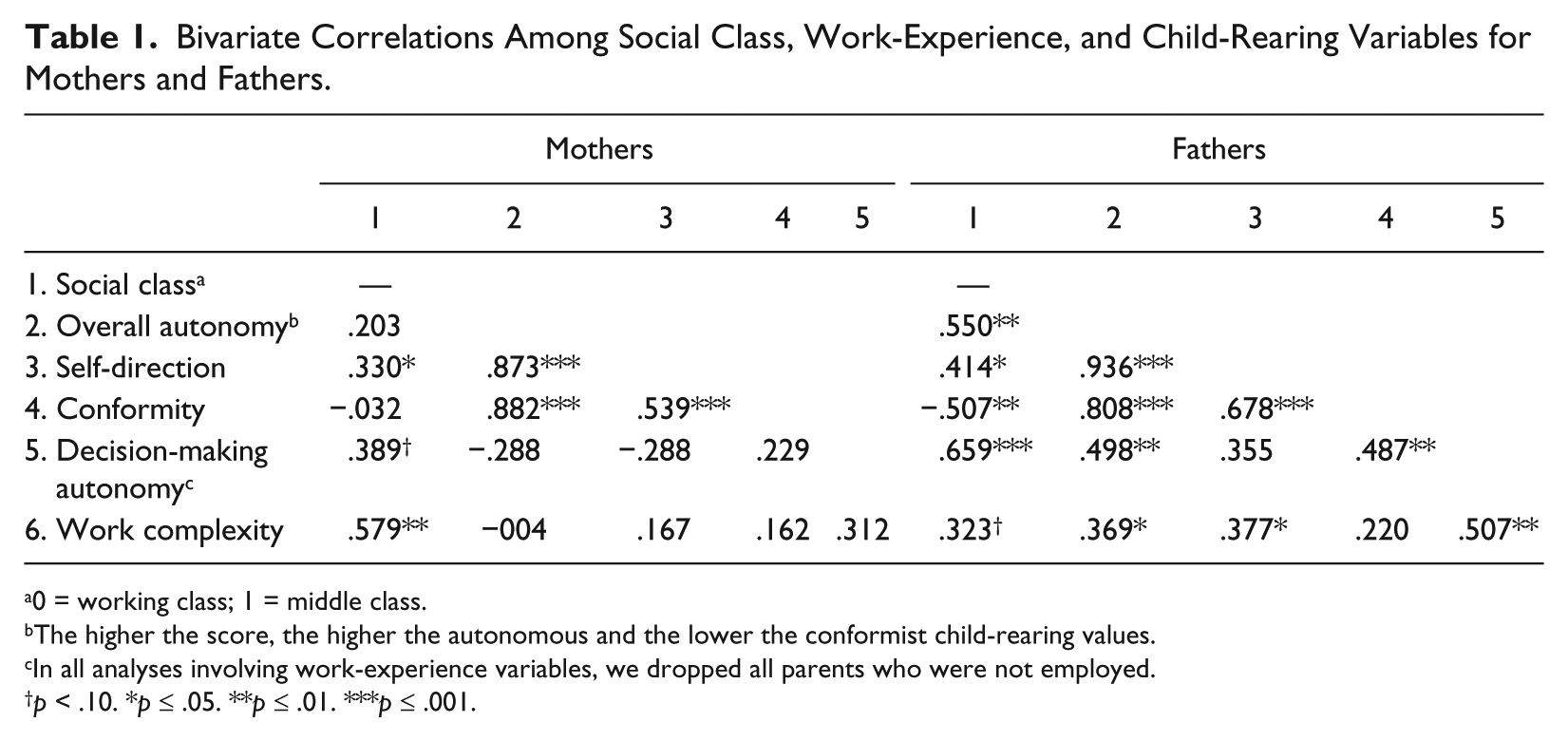
0 = working class; 1 = middle class.
The higher the score, the higher the autonomous and the lower the conformist child-rearing values.
In all analyses involving work-experience variables, we dropped all parents who were not employed.
p < .10. *p ≤ .05. **p ≤ .01. ***p ≤ .001.
Among working mothers, we found a significant correlation between social class and workplace complexity (r = .58, p = .003); the middle-class mothers perceived their work as being more complex than did their working-class counterparts. The former also tended to perceive their work as giving them more autonomy than did the working-class working mothers (r = .39, p = .061). By contrast, middle-class fathers only tended to view their work as more complex than did working-class fathers (r = .32, p = .087), but perceived themselves as having greater autonomy than did their working-class counterparts (r = .66, p < .001); z tests showed no significant differences between correlation coefficients of mothers and fathers in these cases.
As predicted, work-experience and child-rearing variables did not correlate significantly for mothers, but fathers who reported the greatest decision-making autonomy were also more likely to value their children’s overall autonomy (r = .50, p = .006), and less likely to value their conformity (r = −.49, p = .007). We also found that those fathers who reported the greatest complexity at work were also more likely to value their children’s overall autonomy (r = .37, p = .049) and self-direction (r = .38, p = .044). The coefficients of all correlations involving decision-making autonomy were significantly higher for fathers than for mothers, in overall autonomy (z = −2.88, p = .003), self-direction (z = −2.26, p = .023), and conformity (z = 2.62, p = .008). The correlation coefficients for complexity at work were not significantly different for mothers and fathers.
Finally, to test the hypothesis about the mediating effect of workplace-experience variables on the relation between social class and child-rearing values, we ran partial correlations for mothers and fathers. Table 2 summarizes these results, comparing correlation coefficients for direct and mediated effects. As can be seen, although among mothers the partial correlation coefficients were higher than the direct correlations, the opposite was found for fathers. This indicates that, among the mothers, the workplace-experience variables had a suppressor effect instead of mediating the relations between social class and child-rearing values. This was particularly clear in the case of values for self-direction. Among fathers, on the other hand, the partial correlations supported the hypothesis that workplace experience mediates the relation between social class and values.
Correlation Coefficients for Direct and Mediated Effects for Mothers and Fathers.

Partial correlations considering workplace experience variables as mediators.
p ≤ .05. **p ≤ .01.
Discussion
The main objective of this study was to investigate associations among social class, parents’ workplace experiences, and child-rearing values in a sample drawn from southern Brazil. We also aimed to ascertain whether these associations would be different for fathers and mothers. Following Kohn (1969/1977, 1995), we expected that parents who reported greater decision-making autonomy and workplace complexity would be more likely to positively value autonomy and self-direction in their children and less likely to value their children’s conformity. Moreover, we expected that parents from working- and middle-class families would differ in terms of their work experience and child-rearing values. In general, our findings supported Kohn’s hypothesis regarding differences between social class groups. Brazilian middle-class parents reported that they were less supervised at work and that their work involved more complexity than that of working-class parents, and whereas the former positively valued their children’s autonomy, the latter more highly valued their children’s conformity.
However, our results also showed that the relation between work experience and parental values varied by parents’ gender. Among fathers, those who viewed their work as allowing greater autonomy and being more complex were also more likely to value autonomy (and devalue conformity) in their children. In addition, also as hypothesized, these experiences were related to the fathers’ social class, as measured by their type of schooling and occupational status: Those with higher education and higher status occupations (i.e., middle-class fathers) viewed their jobs as requiring greater autonomy and being more complex. For mothers, by contrast, although the relations between social class and workplace experience and child-rearing variables were in the same direction as those for men, in all cases but one they were weaker and non-significant. More strikingly, there were no significant correlations between the mothers’ workplace experiences and their child-rearing values. These results fit with Ribas and colleagues’ (2003) finding that Brazilian mothers’ occupational level was not related to their child-rearing values.
What may account for these differences between men and women? One reason might have to do with the specificities of men’s and women’s workplace experiences. Perhaps in Brazil, as in other parts of the world, fewer women than men have positions at work that allow much autonomy, despite having similar levels of education. In this sample, only 29% of the employed mothers (18% of all mothers) had professional occupations (scores of 7, 8, or 9 in Hollingshead’s [1975] system) compared with 41% of the employed fathers (40% of all fathers). It is possible, however, that because the women were significantly younger than were the men they may attain equally challenging occupations as the men by the time they have reached the same age. Another explanation for these differences could be that the more traditional division of labor among working-class families is related to less father involvement in child rearing, leading mothers to more actively seek informational and experts’ support to deal with their children’s development. For instance, mothers may be advised that it is important to facilitate the child’s autonomy rather than foster strict conformity to parents’ rules.
It could also be the case that the gender differences we found are related to variations in parents’ child-rearing experiences itself. Many studies have shown that, despite changes in models of parenting, it is still the case that mothers (including those from southern Brazil) are more involved in the care and development of their children than are fathers, even when assessing caregiving as a proportion of time available (Tudge, 2008). It therefore is possible that mothers’ greater contact with their children means that their child-rearing values are more influenced than are fathers’ values by the specific nature of their children. Research by Gerris et al. (1997) supports this interpretation; in their study, the effects of social class on behavior in relation to children were mediated by mothers’ willingness to make decisions taking into account their child’s perspective. Similarly, Tudge and colleagues (2013), in a longitudinal study following children from 3 months of age to 7 years, provided evidence that even parents who valued autonomy when their children were 3 months and 7 years were more likely to value obedience when their children began to exhibit more autonomous behavior at 3 years of age. Parents’ values, in other words, were modified by changes in their children’s abilities and wishes.
If, on the one hand, the mothers appear more influenced by their daily contact with their children, our results related to the fathers indicate that their child-rearing values seem to be in line with their experiences outside the family context. This shows the special role that fathers have in child-rearing, in a form that may be complementary to the maternal role, given that mothers may be more sensitive to the specific needs and characteristics of their children. The literature traditionally notes that one of the paternal roles is to present the world at large to the child (Paquette, 2004). This study supports this idea and demonstrates that the experiences of fathers in the world of work can be important for the socialization of their children.
It is interesting to note that fathers’ workplace experiences (but not those of mothers) mediated the relation between social class and child-rearing values. The mere fact of having higher education and occupational status did not guarantee greater autonomy or job complexity at work, just as having limited education and lower occupational status did not necessarily mean a job that lacked autonomy and complexity. In other words, it is workplace experiences, rather than the simple fact of class membership, that seems to relate to child-rearing values, at least for men.
Conclusion
Our aim in this study was to evaluate Kohn’s theoretical model about the relation between social class and parents’ child-rearing values in a Brazilian context. It is important to recognize that Kohn defined social class on the basis both of parents’ educational level and occupational status. However, for Kohn, class membership was far less important than the experiences gained during education and at work, particularly in terms of influencing parents’ child-rearing values. We used the same operationalization of social class in this study and our Brazilian data support, in general, Kohn’s ideas. However, examining the correlations between the parents’ workplace experience and their child-rearing values reveals differing patterns.
Our data support Kohn’s position that individuals’ occupational level, treated only as an objective variable (e.g., the position they hold), is no guarantee of the same experience of workplace autonomy or complexity. On the one hand, that experience depends on other characteristics associated with the workplace environment, such as the quality of the relationship with immediate superiors, the organizational structure and climate, and the nature of the institution (e.g., public or private), among others. Furthermore, the experience of workplace autonomy and complexity is also associated with individual differences in the extent to which these characteristics are appreciated, time in the position, and so on. For example, someone who wants more autonomy and views the job as too easy (perhaps he/she has been doing it for some time) will evaluate the job as requiring little autonomy and not being complex. Another person with the same job who would like (or needs) more instruction is likely to evaluate the job as requiring too much autonomy and being highly complex. In other words, autonomy and complexity are not simply aspects of the job, but reflect individual variability in sensibility.
Another possible explanation for the specific relations found between parental child-rearing values and workplace experience among the parents in this study may have to do with the Brazilian socioeconomic context, particularly in the state of Rio Grande do Sul, where we collected our data. In this state, 16% of the population above age 25 has completed higher education (IBGE, 2010) compared with 31% in the OECD (2013) countries (and 11% in Brazil as a whole). Nevertheless, given the scale of Brazil’s economy, it is reasonable to suppose that there are similar numbers of jobs requiring autonomy and being complex as in the OECD countries. However, in Rio Grande do Sul there are fewer well-educated people to do those jobs than would be found in OECD countries. Therefore, these jobs are taken by some people who have less education. In this sense, given that educational level has an important influence on parents’ child-rearing values, according to Kohn, it is possible that although some people without higher education occupy professional positions that are complex and require the exercise of autonomy, this does not necessarily mean that they share the child-rearing values (their children’s greater autonomy and less conformity) of those who not only hold the same positions but also have higher education. Our findings, in fact, provide some indirect support to those scholars who have argued that education may be more relevant to child-rearing values than are a person’s occupational experiences (Ma & Smith, 1990, 1993; Ribas et al., 2003; Xiao, 2000).
Our results also provide some support for the positions of Kağitçibaşi (2007) and Keller (2007), who argue that in majority-world societies education plays a crucial role in encouraging parents to foster self-direction and psychological autonomy in their children. Just as Kağitçibaşi and Ataca (2005) showed that urban and educated Turks valued autonomy as well as relatedness, our data reveal that middle-class parents, by virtue both of their occupational experiences and their educational background, value autonomy in their children more than do working-class parents.
There are clearly some limitations of this study. Our findings are based on the responses of a total of 68 participants, thereby limiting power. Moreover, it is impossible to generalize our findings to Brazil. As we pointed out earlier, Rio Grande do Sul, the southernmost state in the country, is different in many ways from the rest of the country, and it is necessary to replicate our findings both with a larger sample from this state and using a representative sample from the country as a whole. It is also important to mention that the research instruments were translated into Portuguese and back-translated by a bilingual expert, demanding only minimal adjustments, but they have not been validated for the Brazilian population. Nonetheless, our findings are largely supportive of Kohn’s overall thesis. The findings have also raised new hypotheses that need to be explored in greater depth both in Brazil and in other parts of the developing world.
Footnotes
Declaration of Conflicting Interests
The author(s) declared no potential conflicts of interest with respect to the research, authorship, and/or publication of this article.
Funding
The author(s) disclosed receipt of the following financial support for the research, authorship, and/or publication of this article: We are grateful for the financial support courtesy of Fundação Capes (Brazil), BEX18344/12/7; UNC–Greensboro, for a year-long Research Assignment; the John Templeton Foundation, Grant No. 43510 (awards to the sixth author); and Conselho Nacional de Desenvolvimento Científico e Tecnológico–CNPq (Brazil; awards to the first and fourth authors).