






Abstract
Giving effective negative feedback is not only important but also challenging. Often people struggle as to how; and perhaps even more so when the feedback receiver comes from a different culture . Building on the regulatory fit theory, the current research examined how negative feedback framing (gain- vs. loss framed) would affect feedback receivers’ motivation as a function of their regulatory focus. We found that European Americans were in general more promotion-focused than Chinese (Study 1) and Indians (Study 2), such that promotion-focused (vs. prevention-focused) participants showed higher motivation after receiving gain-framed (vs. loss-framed) negative feedback. Across two studies, with student and work samples, our findings answered the question of how to give more effective negative feedback and suggested that regulatory fit can be a universal strategy for increasing motivation across the East and West.
We all have experienced failures. The ability to manage people who have experienced failure and to motivate them can be very crucial (Goleman, 2015; Liden et al., 1999). For example, managers often need to communicate dissatisfactory performance to followers, such as through giving verbal feedback or taking disciplinary actions. But this is not an easy task, because giving ineffective negative feedback could consequently incur a cost, for instance, harboring resentment, revenge, and ironically, reduced motivation (e.g., Arvey & Jones, 1985; Avolio, 2007; Baron, 1988). Similarly, ineffective negative feedback from teachers can lower students’ academic motivation and relationship quality with the teacher (e.g., Burnett, 2002; Rattan, Good, & Dweck, 2012). No wonder many are reluctant to give negative feedback in response to poor performance (Green, 2014). To this end, a pressing and recurring question awaiting answers is how can we give effective negative feedback (Kark & Van Dijk, 2007; Kluger & DeNisi, 1996)?
The question of how to give effective negative feedback becomes even more complicated as the internationalization of society has led to the question of how to communicate feedback effectively across cultures. On one side, individuals across cultures differ in the way they make sense of the world (Chiu & Hong, 2007). One major difference lies in the way they feel motivated to pursue a goal: Some are more focused on changes in growth, whereas others are focused on maintaining security. These orientations are called promotion and prevention (regulatory) focus, respectively (Higgins, 1997). Recently, it has been suggested that regulatory focus also explains cross-cultural differences in motivation responses, particularly so in performance settings (Higgins, 2008; Kurman, Liem, Ivancovsky, Morio, & Lee, 2015). On the other side, regulatory fit theory and message framing research suggest that people should be more motivated when the goal-pursuing strategy and regulatory focus are fit across cultures (Higgins, 2000, 2005, 2008)—promotion-focused people should be more motivated toward messages framed as pursing gains or avoiding nongains, whereas prevention-focused people should be more motivated toward messages framed as pursing nonlosses or avoiding losses (see Cesario, Corker, & Jelinek, 2013; Idson, Liberman, & Higgins, 2004). Integrating these two ideas, the dominant regulatory focus varies across cultures, but at the same time the motivational function of regulatory fit is universal (i.e., functionally universal; see Norenzayan & Heine, 2005). If this is true, we can rely on regulatory fit to increase negative feedback effectiveness by framing feedback accordingly across people and cultures; but this theory awaits more empirical evidence to support.
The current research therefore examined regulatory fit in feedback across two cultures. The feedback frame was manipulated to test how regulatory fit influenced the receiver’s motivational responses. We expected that people across cultures differed in the extent to which they were promotion-focused (vs. prevention-focused), and regulatory fit functioned universally which would lead to an increase in motivation as long as the feedback and regulatory focus were fit.
Culture and Regulatory Focus
Higgins (1997) proposed the self-regulatory theory to explain distinct self-regulatory strategies for different types of desired end states. With a promotion focus, one is more concerned with growth and aspirations, striving for accomplishments and gains. Those with a prevention focus, however, are more concerned with security and safety, fulfilling one’s obligations while ensuring minimal losses. Although these regulatory foci can be momentarily activated and shifted by contextual cues, priming for example (e.g. Förster & Higgins, 2005; Maddox & Markman, 2010), one crucial factor is suggested to shape one’s dominant regulatory focus and that is the influence of culture (e.g., Heine & Ruby, 2010; Higgins, 2008).
North American cultures, compared with Asian cultures, tend to be more individualistic; social relations are more mobile, and people tend to see themselves as individual entities who are eager to be unique and actualize their personal goals (Heine, Lehman, Markus, & Kitayama, 1999; Markus & Kitayama, 1991). These tendencies of pursuing uniqueness and personal aspirations lead people to be more promotion-focused (e.g., Lee, Aaker, & Gardner, 2000). On the contrary, Asian cultures tend to be more collectivistic; people are more embedded within a community, and people tend to construe themselves as interdependent members within the group who are vigilant about behaving properly to fit in (e.g., Chinese and Indians; Lee et al., 2000; Savani, Morris, & Naidu, 2012). These tendencies of fulfilling social obligations and avoiding social rejections (Hashimoto & Yamagishi, 2013) lead people to be more prevention-focused (Lee et al., 2000; Li & Masuda, 2015). For instance, research has shown that North Americans attended to and remembered more promotion-related information, whereas Japanese attended to and remembered more prevention-related information (Hamamura, Meijer, Heine, Kamaya, & Hori, 2009).
In line with past research, we expect to replicate a general cross-cultural difference in individuals’ dominant regulatory focus:
The Fit Between Regulatory Focus and Gain/Loss Framing
In the course of goal striving, promotion-focused individuals are eager to know whether or not they can successfully attain positive outcomes; as such, when an outcome is framed in terms of the presence and absence of gains (i.e., gain and nongain), it sustains the eagerness in which promotion-focused individuals pursue their goals (regulatory fit). On the contrary, prevention-focused individuals are vigilant about whether or not they can successfully avoid negative outcomes; as such, when an outcome is framed in terms of presence and absence of losses (i.e., loss and nonloss), it sustains the vigilant way prevention-focused individuals strive for their goals (regulatory fit; Higgins, 2000, 2006). When there is fit, individuals “feel right” about the message and are therefore engaged more strongly in the action (see Higgins, 2005). For example, Förster, Higgins, and Idson (1998) found that participants who had a chronic promotion focus were more persistent in an anagram task after receiving a gain-framed instruction (i.e., “If you scored at or above the 70th percentile, you will gain a dollar, but if you failed to score at or above the 70th percentile, you will not gain a dollar”), whereas participants who had a chronic prevention focus were more persistent in the task after receiving a loss-framed instruction (i.e., “If you scored at or above the 70th percentile, you will not lose a dollar, but if you failed to score at or above the 70th percentile, you will lose a dollar”).
Similar regulatory fit experiences were found to be universal across domains, including attaching greater monetary value to an object (e.g., Förster & Higgins, 2005), rating a health message as more persuasive (e.g., Cesario, Higgins, & Scholer, 2008), and perceiving the task as more important (e.g., Avnet & Higgins, 2006; Freitas & Higgins, 2002). As suggested by Higgins (2008), such regulatory fit experiences are fundamental motivational mechanisms related to human survival; hence, they should also be universal across cultures. Accordingly, our research will empirically test the claim in the context of negative feedback communication.
Regulatory Fit in Negative Feedback
Some past research has addressed how to frame effective negative feedback depending on the receiver’s regulatory focus, but it was limited to the fit between the feedback valence and receiver’s regulatory focus. Studies have shown that people with a promotion and prevention focus are generally more motivated by positive and negative feedback, respectively, across achievement settings (e.g., Lanaj, Chang, & Johnson, 2012; Van Dijk & Kluger, 2004, 2011). And the general advice would be to give positive feedback to those who are more promotion-focused and negative feedback to those who are more prevention-focused. However, in most cases, giving negative feedback is inevitable and the valence of the feedback is naturally contingent upon the receiver’s performance. In this regard, altering valence may have limited implications in, for instance, organizational and educational settings where performance appraisals are to be accurate. As a result, the question of how we should frame negative feedback that fits the receiver awaits an answer in practice.
We propose that framing negative feedback as gains versus losses can determine the regulatory fit experience and add value to the motivation of the feedback receiver. We adopt the strategies of manipulating messages in gain- versus loss framing. Specifically, promotion-focused receivers will experience regulatory fit when they receive gain-framed negative feedback (i.e., gain/nongain); in contrast, prevention-focused receivers will experience regulatory fit when they receive loss-framed negative feedback (i.e., loss/nonloss). This regulatory fit experience will be transferred to an increased motivation:
A Moderated Mediation Model
Combining the two hypotheses discussed above, we propose that cultures affect feedback receivers’ motivation indirectly through one’s regulatory focus (mediation), and this indirect effect is contingent on the framing of the feedback (moderated; see Figure 1). When the framing fits the regulatory focus, feedback receivers will experience higher motivation. The nature of such effects is labeled as either conditional indirect effects or a moderated mediation (Edwards & Lambert, 2007; Preacher, Rucker, & Hayes, 2007). In a moderated mediation model, the indirect effects of culture on motivation via regulatory focus will be examined in both conditions when feedback is gain- and loss framed, so as to understand how the strength (and the direction) of indirect effects differs across the conditions. Note that neither the test of the conditional indirect effect nor the theories require a direct effect of culture on motivation. An indirect effect can exist independently when the predictor has only distal impact on the outcome in a complex process, for example, when the presence of indirect effects is contingent upon third variables (see Hayes, 2009). It is exactly the case in the current study because a direct effect of culture or regulatory focus on motivation was not expected. The theories do not explain general cultural differences in motivation, but rather the how—how different framings of feedback fit people’s different levels of dominant regulatory focus. In sum, we hypothesize the following:
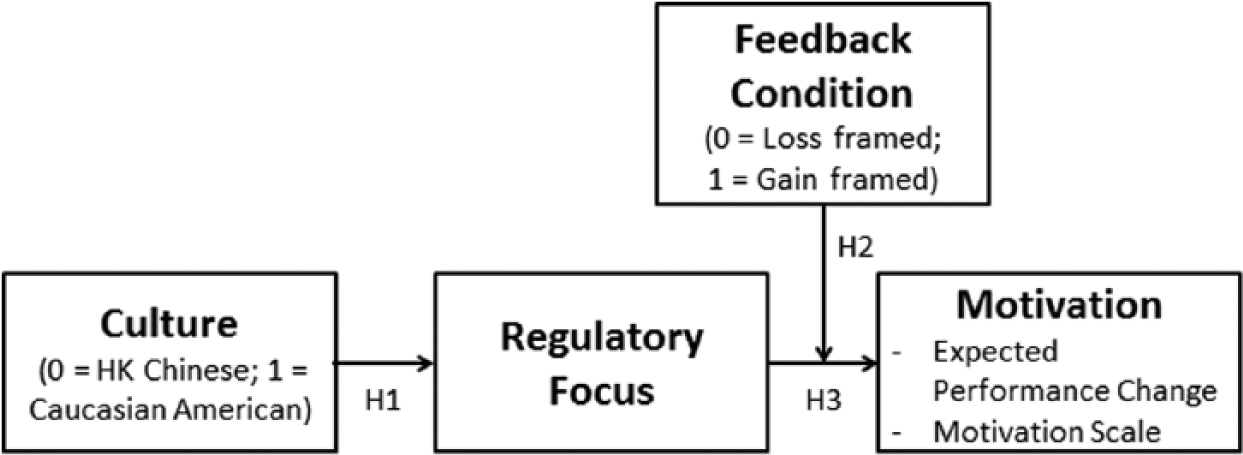
The moderated mediation model of culture via regulatory focus moderated by feedback framing on motivation.
To test the above hypotheses, two studies were designed to manipulate feedback framing and measure post-feedback motivation. To increase the generalizability of the findings, Study 1 recruited European American and Chinese university students, and Study 2 recruited European Americans and Indians who were full-time employees at the time of the survey. Together, the studies aim to extend the literature of feedback communication and regulatory focus across cultures. The study will enable us to expand our knowledge regarding the universal nature of regulatory fit experiences as well as how to give more effective feedback.
Study 1
Method
Participants
Two hundred twenty-seven undergraduate students were recruited from the University of Illinois and the Chinese University of Hong Kong through participation in an online study for either a course credit or entrance in a draw. Expecting a small to medium effect size, we aimed to recruit at least 100 participants from each culture. We conducted the study in parallel in the two schools in one academic term. At the end of the term, the number of participants had exceeded 100 in both samples, and hence we stopped the data collection.
For both samples, all materials were created in English to match the language more often used in feedback at schools and workplaces in Hong Kong. To empirically check if Chinese participants understood the materials, one additional item was included at the end of the survey for the Chinese participants—“How much did you understand the materials in the survey?” (1 = not at all to 7 = fully understand). Chinese participants reported a very high understanding of the experiment materials (M = 5.94, SD = 1.00). No report of difficulty in understanding was documented, but five Chinese participants (2%) were excluded who self-reported misunderstanding the scenario in the study. Therefore, the data of 212 participants were included for analysis—110 European Americans (42 males and 68 females; Mage = 19.1, SDage = 1.05) and 102 Chinese in Hong Kong including Chinese born in Hong Kong and mainland China (37 males and 61 females, four participants did not report gender; Mage = 20.7, SDage = 2.98).
Most of the participants reported that they had at least part-time work experience (Hong Kong = 66%, the United States = 74%), and no significant main effects of age, gender, or past work experience were found in preliminary analyses, Fs < 1.00, ns.
Procedure
The study was described to participants as an online study about organizational behaviors. The procedures across cultures were identical. Participants first completed a consent form, and then they read the scenario, in which they were told to assume the role of a project team member who has made a mistake. Afterward, they were randomly assigned to read either the gain- or loss-framed feedback letter. They completed measures of regulatory focus, work motivation, and demographics. Subsequently, they received an online debriefing form and were thanked at the end of the survey. Although regulatory focus was measured after the manipulation, there was no effect of condition on regulatory focus scores across the two cultures (Fs < 1).
Measures
Performance scenario
The teamwork scenario with a team member who made a mistake was adopted from Liden and colleagues (1999) for use in the study. In their collection of scenarios, they manipulated individual-based reward versus group-based reward structures, as well as internal versus external attributions of mistakes. Past research has shown that various factors affect the perception of the seriousness of the mistake (DeNisi, Randolph, & Blencoe, 1983). In general, people consider the mistake to be serious and in need of correction when the team is under a group-based reward structure and the cause of the mistake was internal, meaning that it is due to the poor performer (vs. the situation). In this study, the scenario with a group-based reward structure and an internal attribution of the mistake was used to minimize individual differences in interpretations of the context (Liden et al., 1999).
Manger-feedback framing manipulation
Two versions of the “letter from manager” were created with either gain- and loss-framed wording as the manipulation of the feedback frame conditions. There were five gain- or loss-framed sentences embedded in the letter. Sentences were parallel across the letters: Content was identical across conditions, but wording was framed differently, either as gain or loss. In the gain-framed feedback condition, the consequences of the mistake and disciplinary actions were described as gain and nongain:
. . . the company was able to gain $100,000 as profit this month; however, owing to your mistake, we earned $80,000 only, because the client of your group’s project retreated some of his investment . . . Considering the damage you have created, though initially you were able to earn $1,000 as the project bonus, you can now only get $500 due to your mistake . . . Keep in mind that every team member’s performance impacts whether the team can successfully achieve better group performance, so from now on, we have put you under observation for two weeks. It would be the company’s pleasure to have you retained, if you perform well during the observation period.
In the loss-framed feedback condition, the consequences of the mistake and disciplinary actions were described as loss and nonloss:
. . . the company made $100,000 as profit this month; however, owing to your mistake, we have lost $20,000, because the client of your group’s project retreated some of his investment . . . Considering the damage you have created, though initially you received $1,000 as the project bonus, you have lost $500 from deduction due to your mistake . . . Keep in mind that every team member’s performance impacts whether the team can successfully prevent poor group performance, so from now on, we have put you under observation for two weeks. It would be the company’s pleasure to have you retained, if you do not perform poorly during the observation period.
Regulatory focus
Regulatory focus was measured by the commonly used Regulatory Focus Questionnaire (RFQ; Higgins et al., 2001), as it has been tested to be the most valid and reliable measure for assessing chronic regulatory focus of the self (Haws, Dholakia, & Bearden, 2010; Summerville & Roese, 2008) and has been applied across cultures in recent work (e.g., Chung, Kim, & Sohn, 2014; Kurman & Hui, 2012). It was composed of a Promotion Focus subscale (six items; United States: α = .69; Hong Kong: α = .63) and a Prevention Focus subscale (five items; United States: α = .78; Hong Kong: α = .63) 1 where participants indicated the frequency and agreement of life events related to aspirations or obligations. For example, in the Promotion Focus subscale, participants were asked, “How often have you accomplished things that got you “psyched” to work even harder?” (1 = never or seldom to 5 = very often) and “Do you often do well at different things that you try?” (1 = never or seldom to 5 = very often). In the Prevention Focus subscale, for example, participants were asked, “How often did you obey rules and regulations that were established by your parents?” (1 = never or seldom to 5 = very often) and “Not being careful enough has gotten me into trouble at times” (1 = never or seldom to 5 = very often). For the sake of parsimony, we followed the convention to subtract prevention focus scores from promotion focus scores to attain the dominant regulatory focus scores in all analyses (Haws et al., 2010; Higgins et al., 2001; Scholer, Ozaki, & Higgins, 2013).
Motivation
We operationalized participants’ general motivation in two different ways. First, we measured motivation as individual’s expectation of subsequent work productivity and quality, in which higher expectation was found to reflect stronger motivation and was predictive of actual performance across academic and occupation contexts (e.g., Bandura, Barbaranelli, Caprara, & Pastorelli, 2001). Based on the scenario, four items were created to ask participants how they would expect their performance to change in quantity and quality. The first two items were “How does the incident result in your expected productivity of work next month?” and “How does the incident result in your expected quality of work next month?” (1 = substantially decrease and 7 = substantially increase). In the subsequent two questions, participants were asked to indicate in a percentage their expected change in work productivity and quality: “After receiving the letter, how would you expect your speed of completing assigned tasks change next month? (from −100% to 100%; for example, −10 as 10% slower, 0 as no effect, 10 as 10% faster),” and “After receiving the letter, how would you expect the quality of your work change next month? (from −100% to 100%; for example, −10 as 10% worse, 0 as no effect, 10 as 10% better)” (United States: α = .76; Hong Kong: α = .81).
Second, we operationalized motivation as an intention to engage in means that increase productivity, which usually requires spending extra effort and time (Higgins, 2006; Lockwood, Jordan, & Kunda, 2002). Similar behavioral intention questions for positive change have been shown to have valid prediction of actual behaviors, especially so for college samples (Wood et al., 2015). Five items were adapted to the scenario from a Motivation scale, which was tested reliable and was sensitive enough to measure task effort after scenario manipulations (Lockwood et al., 2002), for example, “I plan to put more time into my work,” “I plan to spend extra effort in my duties,” and “I plan to work harder for the coming project” (1 = not at all true and 7 = very true; United States: α = .92; Hong Kong: α = .90).
Results and Discussion
Prior to data analysis, data were examined for any missing or out-of-range values, violations of the assumptions of normality, and univariate outliers. No data on the model were missing or out of range. The tests of normality were not violated, with skewness and kurtosis below 3 and 10, respectively, as recommended by Kline (2011).
Culture and regulatory focus
A marginally significant cultural effect was found on regulatory focus scores. Consistent with H1, European Americans were on average more promotion-focused versus prevention-focused (regulatory focus scores; M = 0.20, SD = 0.93) compared with Chinese (M = −0.01, SD = 0.73), 2 t(210) = 1.87, p = .06.
Testing of moderated mediation
We used the bootstrapping macro provided by Hayes (2014). There are several advantages of this method, such as not forcing an assumption of a normally distributed indirect effect (Edwards & Lambert, 2007). The macro tested and computed both the moderation effect of feedback framing on the relationship between regulatory focus and motivation, and the conditional indirect effects of culture via regulatory focus on motivation, in which the indirect effect (mediation) is conditional on what feedback frame people receive (Model 14 in the PROCESS; see Hayes, 2014). Regulatory focus scores were also grand mean centered. All models used bias-corrected coefficients and 5,000 iterations. The confidence intervals (CIs) are reported in Table 1.
Study 1 PROCESS Results for Conditional Indirect Effects (n = 212).
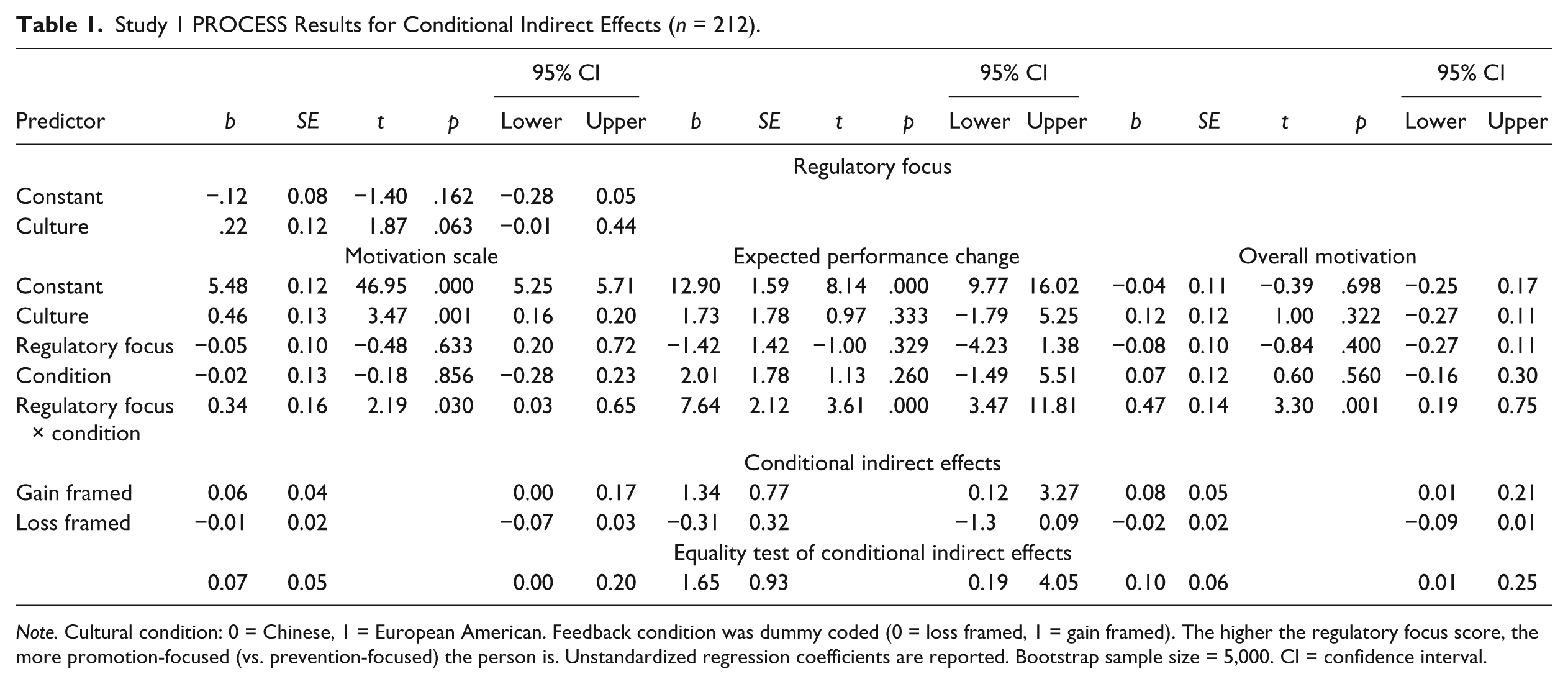
Note. Cultural condition: 0 = Chinese, 1 = European American. Feedback condition was dummy coded (0 = loss framed, 1 = gain framed). The higher the regulatory focus score, the more promotion-focused (vs. prevention-focused) the person is. Unstandardized regression coefficients are reported. Bootstrap sample size = 5,000. CI = confidence interval.
Conditional indirect effects on motivation
The two motivation measures were found to be strongly correlated, r(212) = .58, p < .001. Therefore, we collapsed the two measures by standardizing and combining two motivation measures as the dependent variables (α = .89). 3
The two-way interaction between condition and regulatory focus was significant, b = 0.46, SE = 0.14, t(207) = 3.30, p ≤ .001. To understand the nature of the interaction effect, we examined the simple main effect of gain- versus loss-framed feedback for those who scored higher in regulatory focus (promotion-focused participants: those who are 1 standard deviation above the mean) and those who scored lower in regulatory focus (prevention-focused participants: those who are 1 standard deviation below the mean). Among promotion-focused people, there was a significant effect indicating that receiving gain-framed feedback led to higher overall motivation compared with loss-framed feedback, b = 0.47, SE = 0.17, t(208) = 2.74, p = .007; while among prevention-focused people, there was an opposite and significant effect that receiving gain-framed feedback led to lower overall motivation compared with loss-framed feedback, b = −0.33, SE = 0.17, t(208) = −1.95, p = .05. Results support a moderation effect of feedback framing on the relationship between regulatory focus and motivation (H2).
To assess the conditional indirect effects model depicted in Figure 1 (H3), we used the moderated mediation macro, and the results have shown that the full moderated mediation model was significant, F(4, 207) = 4.00, p < .01. To unpack the model, we looked at the conditional indirect effects of culture on motivation across the two feedback conditions computed and plotted their simple slopes (see Figure 2). As the scores were standardized, the zero line in the graph represents the mean overall motivation score of the sample. As indicated in the figure, the more promotion-focused people were, the higher their overall motivation was after receiving gain-framed feedback, b = 0.08, SE = 0.05, 95% CI = [0.01, 0.21]; however, there was a marginal slope indicating that the more prevention-focused people were, the higher their motivation was after receiving loss-framed feedback, b = −0.02, SE = 0.02, 95% CI = [−0.09, 0.01]. These two conditional indirect effects were significantly different from each other, b = 0.07, SE = 0.05, 95% CI = [0.00, 0.22], supporting the hypothesis that motivation was higher when regulatory focus and the framing were fit. 4
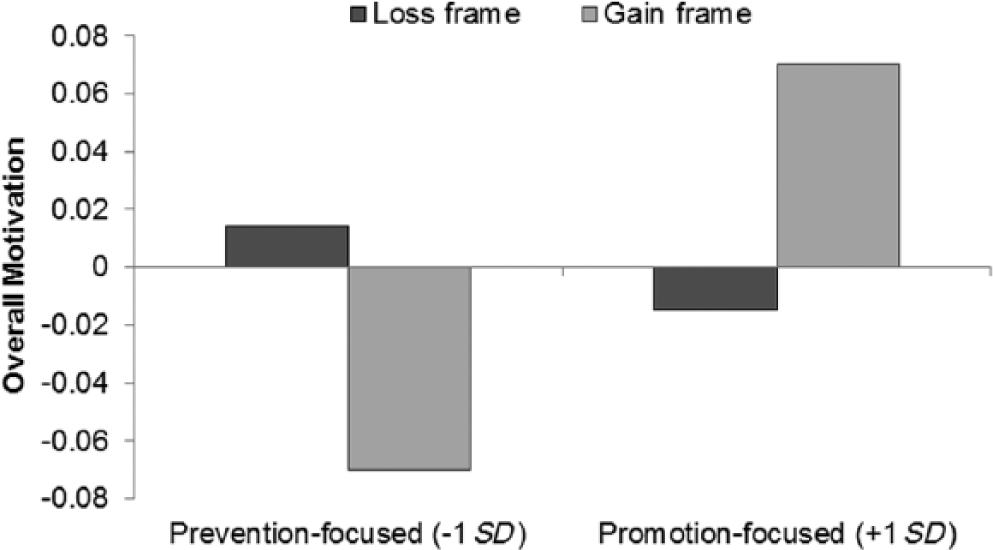
The conditional indirect estimates of culture on overall motivation via regulatory focus across feedback conditions.
Study 1 results provided some initial support for all three hypotheses in the model. Results overall suggested that even though people across cultures differed in their dominant regulatory focus, the regulatory fit response in motivation seemed to be universal.
Study 2
Study 2 aims to replicate the findings in two directions. First, to increase external validity of the findings, instead of university samples we recruited full-time employees who have more work experience and diverse demographic backgrounds. Second, to strengthen the claim that the regulatory fit effect between regulatory focus and feedback framing on motivation could be universal, we recruited participants from another collectivistic Asian culture—India (e.g., Ramesh & Gelfand, 2010). Similarly, we expect that European American workers would be relatively more promotion-focused (vs. prevention-focused) compared with Indian workers, but the regulatory fit effect on motivation should be consistent across the cultures.
Method
Participants and design
European American or Indian full-time employees were recruited through Amazon.com’s crowdsourcing website, Mechanical Turk© (Buhrmester, Kwang, & Gosling, 2011). They completed a short online survey with a payment of US$1. We set the location such that only people living in the United States or India can participate. Similar to Study 1, we aimed to recruit at least 100 participants from each culture. However, because we were also expecting that a nontrivial amount of participants might have missing data or might not complete the survey carefully, we continued the data collection until there were at least 200 participants from each culture.
After screening out participants who had missing data and/or failed the attention check questions, it resulted in a total of 317 participants in the analysis, of whom 114 were Indians living in India (79 males and 34 females; Mage = 32.60, SDage = 9.05; work experience: M = 14.93 years, SD = 10.26) and 203 were European Americans living in the United States (97 males and 104 females; Mage = 36.15, SDage = 10.43; work experience: M = 11.16 years, SD = 11.93). 5 There was a significant main effect of age such that older participants reported having stronger motivation in general, t = 3.40, p = .001. No significant main effects of gender or past work experience were found, Fs < 1.69, ps < .20. Because these demographic variables did not alter the pattern of the major findings, they were not included in the subsequent analyses.
Study 2 had the same design and materials as Study 1, except regulatory focus was measured before the scenarios to eliminate an unlikely but potential alternative hypothesis that the scenarios and feedback influenced participants’ regulatory focus. Both surveys were conducted in English. Similar to Study 1, we checked whether Indian participants understood the materials, and they reported a very high understanding of the experiment materials (M = 6.67, SD = 0.61).
The same measure of regulatory focus was used as Study 1 (promotion focus: United States: α = .71; India: α = .53; prevention focus: United States: α = .83; India: α = .78). 6 Participants’ motivation was measured with an adapted version of the five-item Motivation scale from Study 1 (United States: α = .71; India: α = .62).
Results
Similar to Study 1, data abnormality was checked before analysis. Regulatory focus scores were grand mean centered prior to analysis.
Culture and regulatory focus
As expected, a significant cultural effect was found on regulatory focus scores. Consistent with H1, European Americans were on average more promotion-focused versus prevention-focused (M = 0.17, SD = 0.98) compared with Indians (M = −0.33, SD = 0.81). 7
Test of moderated mediation model
We tested the moderated mediation model in the same way as Study 1, to examine the conditional indirect effects of culture via regulatory focus on motivation. The CIs are reported in Table 2. The two-way interaction between condition and regulatory focus was significant, b = 0.21, SE = 0.10, t(312) = 2.01, p = .045, supporting a moderation effect of feedback framing on the relationship between regulatory focus and motivation (H2). To understand the direction of effects in the interaction, we examined the simple main effect of gain- versus loss-framed feedback for those who were 1 standard deviation above and below the mean. Among promotion-focused people (+1 SD), there was a trend in the expected direction that receiving gain-framed feedback led to higher motivation compared with loss-framed feedback, b = 0.19, SE = 0.14, t(312) = 1.39, p = .17; while among prevention-focused people (−1 SD), there was an opposite trend that receiving gain-framed feedback led to lower motivation compared with loss-framed feedback, b = −0.21, SE = 0.14, t(312) = −1.46, p = .14. Although the simple effects were weaker than expected, they were trending in the predicted directions that were consistent with Study 1.
Study 2 PROCESS Results for Conditional Indirect Effects (n = 317).

Note. Cultural condition: 0 = Indian, 1 = European American. Feedback condition was dummy coded (0 = loss framed, 1 = gain framed). The higher the regulatory focus score, the more promotion-focused (vs. prevention-focused) the person is. Unstandardized regression coefficients are reported. Bootstrap sample size = 5,000. CI = confidence interval.
To assess and replicate the full conditional indirect effects model depicted in Figure 1 (H3), we used the moderated mediation macro, and the results have shown that the full moderated mediation model was significant, F(4, 312) = 57.25, p < .0001. To unpack the model, we looked at the conditional indirect effects of culture on motivation across the two feedback conditions computed and plotted their simple slopes (see Figure 3). As indicated in the figure, the more promotion-focused people were, the higher their overall motivation was after receiving gain-framed feedback, b = 0.08, SE = 0.04, 95% CI = [0.02, 0.17]; however, there was a marginal slope indicating that the more prevention-focused people were, the higher their motivation was after receiving loss-framed feedback, b = −0.02, SE = 0.03, 95% CI = [−0.10, 0.04]. These two conditional indirect effects were significantly different from each other, b = 0.10, SE = 0.05, 95% CI = [0.01, 0.23], supporting the hypothesis that motivation was higher when regulatory focus and the framing were fit. 8
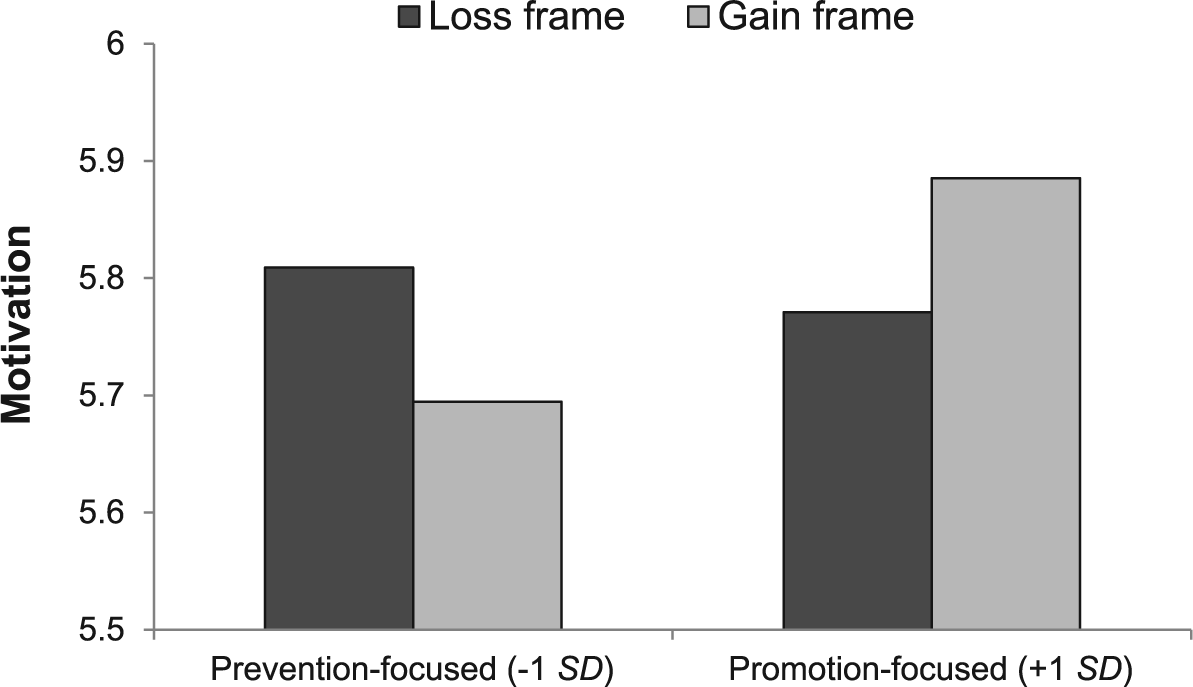
The conditional indirect estimates of culture on motivation scale scores via regulatory focus across feedback conditions.
General Discussion
As predicted, we found support for the three hypotheses. People differ in their dominant regulatory focus across cultures (H1). Culture predicted motivation indirectly through shaping one’s regulatory focus and such indirect effect was conditional on the framing of the feedback (moderated mediation; H2 and H3). Culture did not moderate the regulatory fit effect on motivation (i.e., the three-way interactions were not significant), which supported that regulatory fit effect was universal across cultures (Higgins, 2008).
Consistent with regulatory fit theory, promotion-focused participants showed higher motivation after receiving gain-framed (vs. loss-framed) feedback, while prevention-focused participants showed higher motivation after receiving loss-framed (vs. gain-framed) feedback. The moderated mediation model supported that people across cultures vary in their level of regulatory focus; regulatory focus interacted with the feedback framing resulting in higher motivation when they fit. Across North American, Chinese, and Indian cultures, the studies together provided empirical support to the inquiry that regulatory focus can explain cross-cultural differences (Kurman et al., 2015) and that regulatory fit is a universal phenomenon (Higgins, 2008).
Our studies also provide new insights to leadership and feedback communication (e.g., Ilies & Judge, 2005; Tolli & Schmidt, 2008). The current research demonstrates that regulatory fit is likely a universal strategy determining feedback effectiveness. While past research suggested whom to avoid giving positive or negative feedback to for maximizing post-feedback motivation (e.g., Van Dijk & Kluger, 2004), leaders in some situations simply cannot avoid giving negative feedback. The current regulatory fit approach gets around the problem and suggests that, by only a small modification in framing, people can increase feedback receivers’ motivation. The manipulations in the experiment have provided some examples. Furthermore, the results provide new evidence that understanding followers well may yield leadership advantages. Leaders who understand follower’s motivational strategies (e.g., regulatory focus) may capitalize more on this information to give the “right” feedback to the “right” follower. This kind of insight is particularly important in a growingly diverse multicultural workplace and is deemed a highly valued skill (Economist Intelligence Unit, 2012).
One interesting observation across the two studies was that the difference in motivation across promotion-focused and prevention-focused people receiving loss-framed feedback was weaker than that in the gain-framed feedback condition. In other words, the difference in motivation was primarily driven by gain-framed negative feedback. Although we did not specifically hypothesize such an effect, this was not surprising if we consider the congruency between feedback valence and framing. The words of losses and gains carry negative and positive information, respectively. In the context of negative feedback, there may be a congruency of using words of losses (vs. gains). Because individuals tend to process congruent information more quickly and less deeply (e.g., Maheswaran & Chaiken, 1991), that may account for the weaker effect of regulatory focus within the loss-framed condition. No research that we know of has directly tested this congruency and processing account in feedback and motivation, which could be an interesting direction for future research.
The studies conducted were not without limitations, however. The manipulations in the studies were hypothetical, so the study may have been more convincing had participants known the follower personally. Participants may not have felt the stakes and contingencies, therefore adding to a similar point that the external validity of descriptive manipulations and self-report measures may be of concern. However, our findings can still contribute to understanding social behaviors. As regulatory focus theory argues a fundamental human motivation mechanism (e.g., Aaker & Lee, 2006; Higgins, 1997), we expect that the regulatory fit effect would be amplified in high-stake situations where the feedback outcome can translate to huge cost and benefits, resembling many education and work settings.
Future studies should also aim to replicate the findings in other contexts, for example, in other performance settings, relationships, and cultures. Researchers should consider manipulating negative feedback framing in real relationships. The current findings may also spark future research to consider moderators to understand the boundary conditions of the effects. For example, considering its potential implications to organizational behaviors and educational outcomes, researchers may investigate how climates of performance would influence regulatory fit relationships in organizations (Wallace & Chen, 2006) and attempt to discover effective ways to help leaders understand the goal-striving strategies of followers. Future research could also employ more advanced interpersonal paradigms to understand the dynamic influence between the feedback giver and receiver, for example, by using a dyadic design to capture the interaction between the leaders’ feedback framing and the followers’ characteristics over time and examining a potential mutual adjustment effect.
Conclusion
Giving negative feedback can be a crucial, but it is hardly an easy task. Across two studies, the current research has demonstrated how a subtle adjustment in framing negative feedback can lead to significant difference in the receiver’s subsequent motivation. Overall, our findings extend our theoretical understanding of feedback communication and the universal nature of the regulatory fit; practically, they also offer insights for leadership training, education, and management in terms of how to frame negative feedback accordingly that fits and motivates people across cultures.
Footnotes
Acknowledgements
The authors thank Abigail Scholer, Igor Grossmann, and Takeshi Hamamura for their helpful comments on earlier drafts.
Declaration of Conflicting Interests
The author(s) declared no potential conflicts of interest with respect to the research, authorship, and/or publication of this article.
Funding
The author(s) disclosed receipt of the following financial support for the research, authorship, and/or publication of this article: This work was supported by Social Sciences and Humanities Research Council of Canada (Vanier Scholar—CGV-SSHRC-00379) to Franki Kung, as well as the National Research Foundation of Korea (NRF) grant funded by the Korean government (MSIP; No. 2012S1A5A8023903) to Young-Hoon Kim.