







Abstract
We attempt to develop an integrative model of the factors that give rise to the overestimation of their abilities among the incompetent and underestimation of the competent by decomposing the specific conditions of the cognitive and motivational components underlying the self-assessment phenomenon from a statistical point of view. Hong Kong (Study 1) and European American participants (Study 2) took an ability test and assessed their performance. By plotting estimated relative ability against actual ability and fitting a regression line, we found that a comparative bias (intercept), reflecting participants’ self-enhancement motivation, and a less-than-perfect estimation accuracy (slope), reflecting participants’ cognitive bias, jointly contributed to the ability estimation line wherein low-performance participants overestimate and high performance participants underestimate their performance. In testing and validating the model, the relationship between participants’ estimated relative ability and actual performance was examined as a function of participants’ self-esteem (motivational factor) and perceived difficulty level (cognitive factor). Regarding the extent of self-enhancement, we found that participants with higher self-esteem rated their ability more favorably independent of their actual performance. Moreover, participants who perceived the task to be more difficult made more unfavorable self-assessments. Regarding the relationship between estimated and actual performance, we found that when the task was seen as more difficult, and, hence, less diagnostic of ability, participants were less likely to base their ability assessment on their actual performance, resulting in less accurate self-assessments.
Keywords
Most theories on self-regulation assume that individuals assess the discrepancy between their current performance and goals or standard and take corrective actions to reduce this difference (Baumeister, Schmeichel, & Vohs, 2007). Thus, self-regulation requires insights to one’s inadequacies. However, recent findings suggest that such insights are difficult to obtain; according to Kruger and Dunning (1999), incompetence is accompanied by ignorance of one’s incompetence. When participants were asked to judge how funny/logical they were, those who performed poorly on an objective test of humor/logical thinking overestimated their abilities, whereas those who performed well underestimated their abilities (Kruger & Dunning, 1999).
To explain incompetent individuals’ tendency to overestimate abilities, Kruger and Dunning (1999) contended that competence begets calibration; those who are unskilled in a particular trade also lack the metacognitive ability to judge their ability in that trade. That is, the skills that engender competent performance in a particular domain are often the same skills that are necessary for accurate self-assessment in that domain. Thus, incompetent individuals make overly positive judgments because they fail to gain insight into their incompetence by attending only to their relative performance on an ability test. Furthermore, Kruger and Dunning suggested that competent individuals may erroneously believe that their peers are well skilled, and, thus, underestimate their own competence. In short, Kruger and Dunning postulate two different psychological processes to explain incompetent and competent individuals’ biases in self-assessment, “the miscalibration of the incompetent stems from an error about the self, whereas the miscalibration of the highly competent stems from an error about others” (p. 1127).
Several explanations to account for this phenomenon have some empirical support, yet a comprehensive model that explains both incompetent individuals’ overestimation and competent individuals’ underestimation has not been developed.
Overview
In the present study, we attempted to show from a statistical perspective that incompetent individuals’ overestimation and competent individuals’ underestimation result from the same psychological processes. Kruger and Dunning (1999) explained the phenomenon of the incompetent individuals showing overestimation and the competent individuals showing underestimation using two separate reasons, wherein the incompetent fail to gain insight into their incompetence by attending only to their relative performance, whereas the competent fail to gain insight of the incompetence of others. Although we do not disagree with the underlying psychological processes suggested by Kruger and Dunning, we believe our study demonstrates the reason underlying the self-assessment bias from a different perspective. More specifically, Kruger and Dunning’s reasoning tapped into the theoretical accounts behind the self-assessment bias, whereas our study tackles the self-assessment bias from a statistical stance. In other words, our aim is to explain the appearance of the general self-assessment bias pattern by decomposing the factors that contribute to it and combining these into a single model. In particular, we show how the general pattern of self-assessment results from both cognitive bias and motivational bias, and that without either of these factors, our observed pattern would not appear. Using Krueger and Mueller’s (2002) methodology, we developed and tested a model valid across cultures; it highlights the two components of self-assessment bias: cognition and motivation. Motivational bias is an overall motivational tendency to rate one’s comparative ability favorably or unfavorably in a particular domain, independent of one’s own actual performance in that domain; and cognitive bias involves the degree to which people use their actual performance in an ability domain to calibrate judgments about their relative ability in that domain. Thus, by plotting perceived ability against actual ability and fitting a regression line, we have demonstrated that comparative bias (a positive intercept of the graph), which reflects self-enhancement motivation, and a less-than-perfect accuracy estimate (a slope greater than 0 but less than 1), which reflects cognitive bias, jointly contribute to self-assessment bias wherein poorly performing individuals overestimate their performance and highly performing individuals underestimate their performance.
The Interplay of Two Components in Self-Assessment Bias
Krueger and Mueller (2002) rejected the hypothesis that unskilled individuals do not have metacognitive knowledge of their abilities, and posited that no individual—irrespective of their skill level—has perfect knowledge of his or her abilities, but all individuals are motivated to perceive themselves more positively for self-enhancement (Sedikides, Gaertner, & Toguchi, 2003; Taylor & Brown, 1988). This latter hypothesis suggests that both incompetent individuals’ overestimation and competent individuals’ underestimation may result from the same psychological processes.
To support their argument, Krueger and Mueller (2002) used an alternative, informative method to represent data. They plotted perceived ability percentile ranks against actual performance percentile ranks and fitted a regression line. The unit line in the plot (see Figure 1) illustrates the ideal situation wherein participants’ perceived ability and actual performance percentile ranks are identical, implying that they would have assessed their ability as accurately as possible, based on actual performance. Thus, no self-assessment biases would be operating. On the other hand, the regression line in Figure 1 represents the empirically observed relationship between actual and estimated performance. In this data set, the regression line has an intercept of 40 and a slope of .40. These two statistical parameters are jointly responsible for the overestimation of incompetent individuals and the underestimation of competent individuals, as explained by the positive intercept and slope between 0 and 1 (Figure 1).
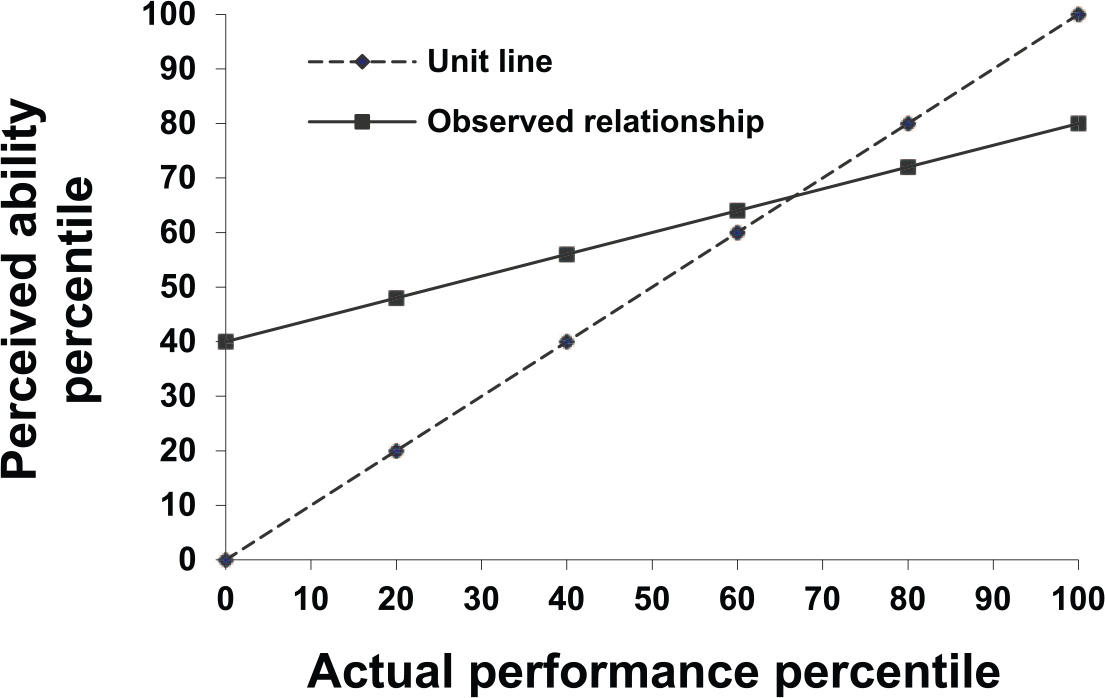
Characteristic data pattern of self-assessments of relative performance.
Several explanations for what these two statistical parameters represent have been provided. The intercept has been interpreted as a comparative bias (Krueger & Mueller, 2002) such that the participants evaluated themselves that they would be in the 40th percentile rank, even when their actual performance was in the 0 percentile rank (Figure 1). The comparative bias is reflective of self-enhancement (Sedikides et al., 2003; Taylor & Brown, 1988). According to the better than average effect—the self-enhancing tendency to believe that one is better than the average person in any given ability domain—the intercept would be positive (Krueger & Mueller, 2002).
The non-zero, significant slope indicates that participants have based their self-assessment on actual relative performance, albeit imperfectly. Regardless of the skill level, people do not have perfect knowledge of their performance, leading to differences between assessments and actual skill. Thus, the slope could be almost parallel to the unit line or almost flat. This collectively suggests that calibration accuracy is reflected in the slope of the regression line. Prior research has shown that the representativeness of task performance affects the degree of correspondence between self-assessment and actual task performance (Burson, Larrick, & Klayman, 2006). Specifically, when performance is perceived to be representative of one’s ability, one bases ability judgments exclusively on the task performance, resulting in a steep regression line, whereas a relatively flat regression line is expected when one perceives task performance to be uncharacteristic.
We have plotted two separate series of the ability estimation (self-assessment) line to illustrate that without either comparative bias or calibration accuracy, the overestimation of the incompetent and underestimation of the competent cannot both be observed simultaneously as well as to show the conditions these factors should fulfill. Through these series, we demonstrate that it is impossible to observe both the overestimation of the incompetent and underestimation of the competent without either calibration accuracy or comparative bias. More specifically, to observe both the overestimation of the incompetent and underestimation of the competent, not only are these two factors necessary but they should also meet specific criteria, namely, a reliable level of comparative bias and imperfect calibration accuracy. From a mathematical perspective, the two factors represent the intercept and the slope of the linear equation of self-assessment. Therefore, to fulfill the criteria of a reliable level of comparative bias and imperfect calibration accuracy, the intercept should be positive and the slope should be less than 1. We show how the ability estimation line changes when these criteria are not met.
The first additional figure (Figure 2) demonstrates how the ability estimation line changes with different levels of calibration accuracy when there is no comparative bias. The intercept is, therefore, fixed at the 0 point, and the estimation line becomes flatter or steeper according to the calibration accuracy level. When the calibration accuracy is low, the estimation line is far from the unit line. In this case, it could be possible for everyone to underestimate (Figure 2a) or everyone to overestimate (Figure 2c) their ability. When the calibration accuracy is high, the estimation line approaches the unit line (Figure 2b); if the calibration accuracy is perfect, there would be neither overestimation nor underestimation. From this series of graphs, it can be seen that although the slope of the equation changes according to the calibration accuracy level, without a reliable comparative bias (which would give a positive intercept), there cannot both be some participants underestimating their ability and others overestimating their ability, as shown by Kruger and Dunning (1999).
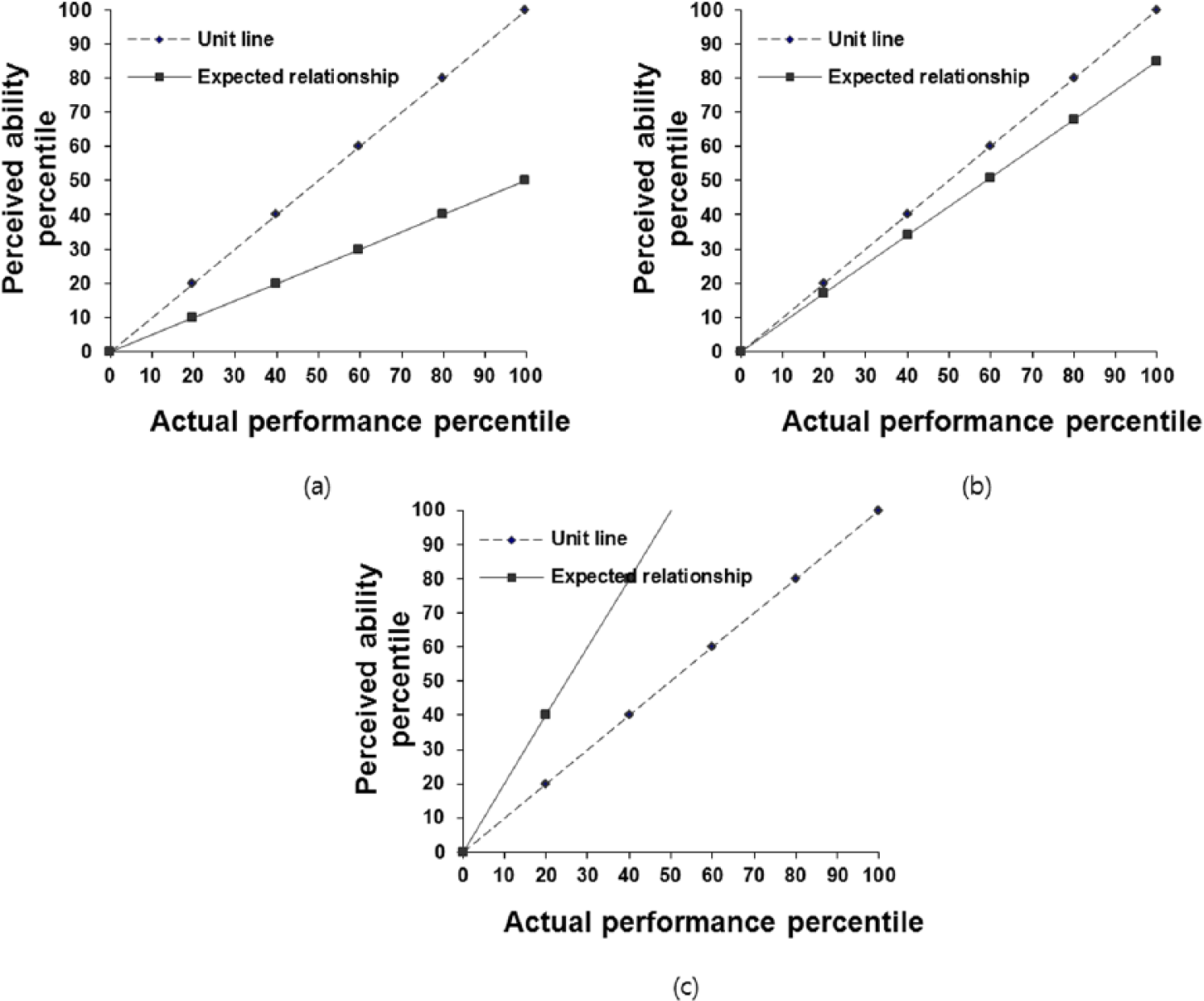
Expected ability estimation line change pattern with different levels of calibration accuracy when the comparative bias (self-enhancement) level is held constant.
The second additional figure (Figure 3) shows how the pattern shifts as the level of comparative bias changes when the calibration accuracy is perfect. The slope is, therefore, fixed at 1, which is parallel to the unit line, and the estimation line shifts upward or downward depending on the intercept set by the comparative bias level. As can be seen in the graphs, all participants will show overestimation with a reliable comparative bias and accurate calibration (Figure 3a, Figure 3b, and Figure 3c). Even with a comparative bias where everyone underestimates their ability, it would not be possible to observe overestimation. In other words, it would be impossible to see overestimation among the incompetent simultaneously with underestimation among the competent without an inaccurate calibration level.
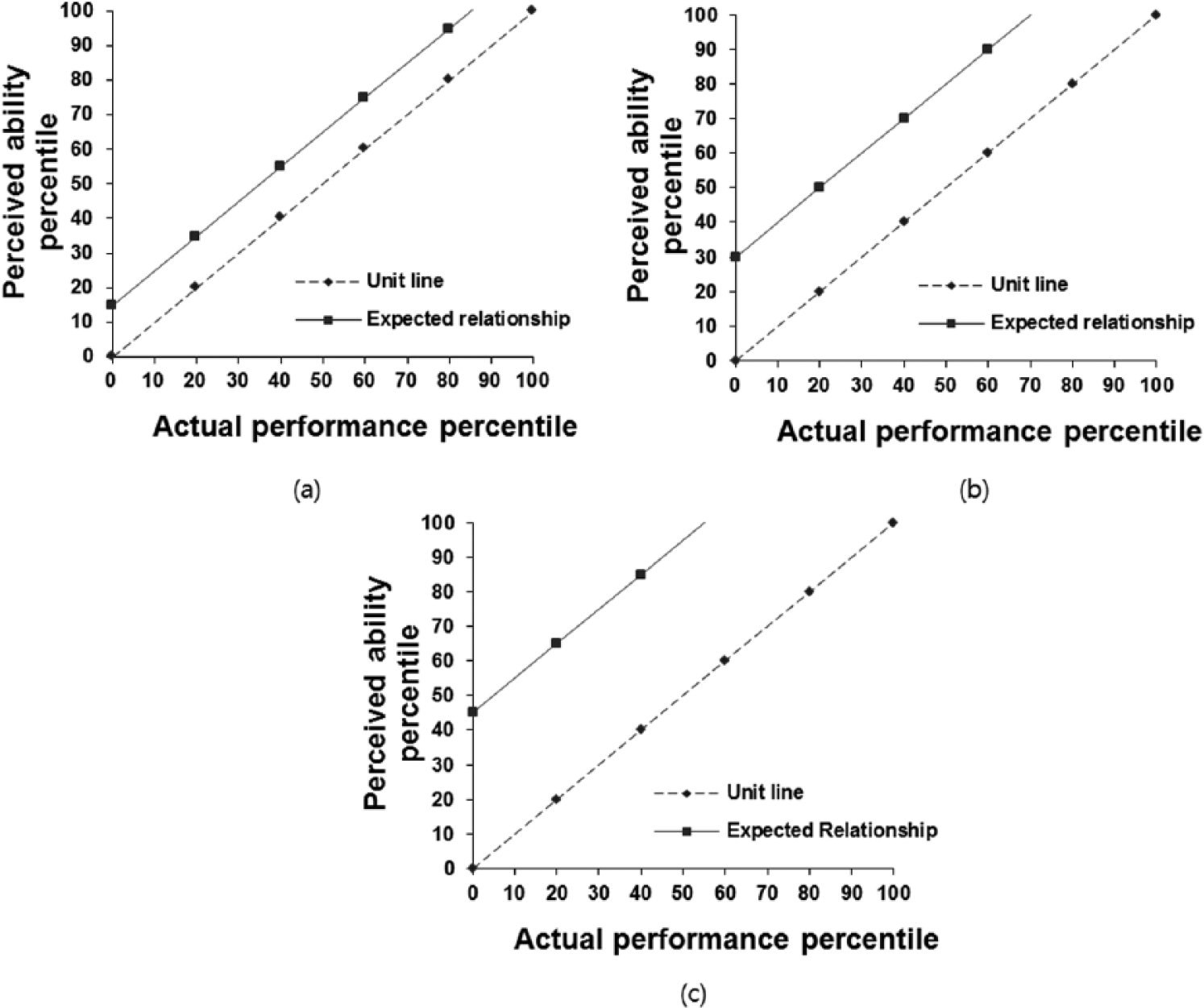
Expected ability estimation line change pattern with different levels of comparative bias (self-enhancement) when the calibration accuracy level is held constant.
In conclusion, calibration accuracy and comparative bias are both necessary in drawing the self-assessment bias equation and, more important, an inaccurate calibration level and a reliable comparative bias level are essential. This can easily be seen in Figure 4, which is a graph with the slope of Figure 2a, reflecting an inaccurate calibration level, and comparative bias level of Figure 3b, reflecting a reliable comparative bias level.
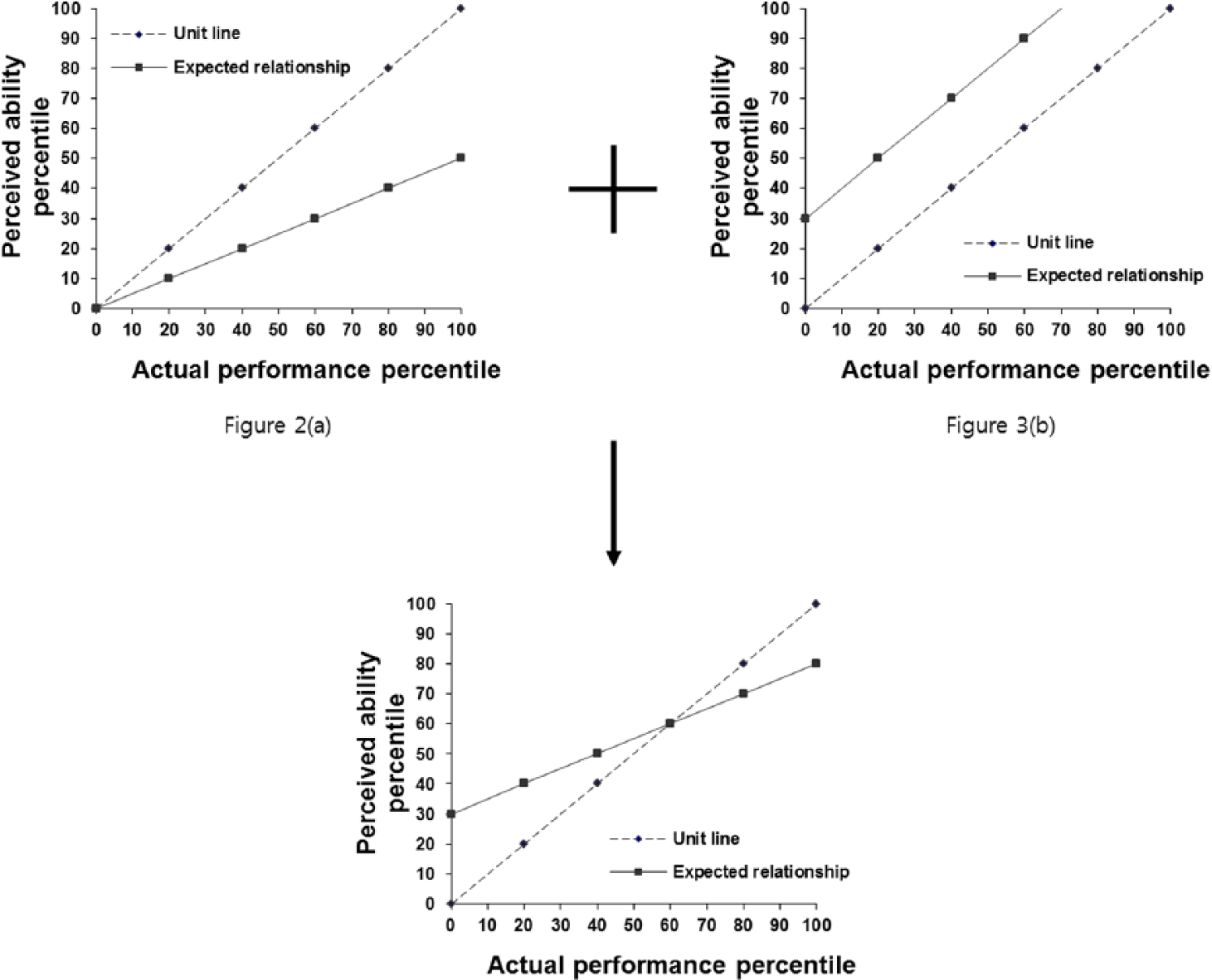
Role of Self-Esteem and Task Difficulty
To test a two-component model, we specified two psychological factors—self-esteem and perception of task difficulty—that would predict motivational and cognitive components, respectively, based on prior research on correlates of self-assessment bias. We posit that comparative bias reflects the motivational component of the model and calibration accuracy reflects the cognitive component of the model.
Self-esteem affects individuals’ motivation to make positive self-evaluations. Numerous studies have found that people with high self-esteem are overconfident and tend to set unattainable goals (e.g., Baumeister, Heatherton, & Tice, 1993; Roth, Snyder, & Pace, 1986). They are also more likely to evaluate themselves as better than average, overestimate the likelihood of positive outcomes (Brown, Collins, & Schmidt, 1988; Taylor & Brown, 1988), and engage in self-deceptive compensatory self-enhancing strategies to maintain their unrealistically positive self-perceptions (e.g., Baumeister, 1982; Baumeister & Tice, 1985; McFarlin, Baumeister, & Blascovich, 1984). Thus, we expected that self-esteem would predict comparative bias.
Regarding perceived difficulty and comparative bias, previous research shows that individuals report lower relative ability when they perceive the task to be more difficult, independent of their actual ability (Burson et al., 2006; College Board, 1976-1977; Kruger, 1999). This is explained by their failure to realize that others are also likely to find the task difficult and perform poorly. Thus, we hypothesized that individuals who view the task as more difficult will have lower estimates of their relative ability, independent of actual performance.
Task difficulty also affects calibration accuracy. Research shows a weak but significant correlation between actual performance and estimated performance; this weak correlation is mainly determined by competent individuals’ more accurate estimates (vs. those of incompetent individuals) on easy tasks (Burson et al., 2006); furthermore, on difficult tasks, competent individuals’ self-assessments are as inaccurate as those of incompetent individuals. Thus, the degree of correspondence between self-assessment and actual task performance decreases. These findings suggest that calibration accuracy would be low on difficult tasks, because performance on such tasks may not be perceived as diagnostic of relative ability. To elaborate, because it is hard for an individual to obtain accurate feedback on their relative performance standing in difficult tasks, the correspondence between actual and perceived ability would be unreliable. We have, thus, predicted that perceived task difficulty would influence calibration accuracy as the perceived task diagnosticity would be lower in more difficult tasks. Accordingly, we hypothesized that participants who perceive the task to be more difficult would be less able to use their performance to calibrate their judgment of their ability.
In sum, we propose that while the magnitude of comparative bias would vary systematically with positive (vs. negative) self-image and task difficulty, accuracy in self-assessment would vary according to perceived task difficulty. In testing this two-component model of self-assessment bias, we were also interested in testing its cross-cultural validity with East Asians in Study 1 and European Americans in Study 2. Given that the psychological processes underlying cross-cultural differences in self-assessment bias have been a controversial cross-cultural issue (Heine, Lehman, Markus, & Kitayama, 1999; Kim, Chiu, Peng, Cai, & Tov, 2010; Kim, Peng, & Chiu, 2008; Kurman, 2003; Sedikides et al., 2003), we expected that validating the two-component model with East Asians and European Americans would provide valuable insights into the culturally different manifestations of self-assessment bias.
Study 1
Study 1 was designed to test the hypotheses with participants from Hong Kong. To examine the cognitive and motivational components of self-assessment bias, we measured participants’ estimated relative ability and actual performance on a riddle-solving task. The relationship between participants’ estimated relative ability and actual performance was examined as a function of participants’ self-esteem and perceived task difficulty level. In line with Kruger and Dunning’s (1999) theorization, we hypothesized that low-performing participants would overestimate their ability while high-performing participants would underestimate their ability. Regarding comparative bias, we hypothesized that self-esteem would predict the magnitude of comparative bias: participants with higher self-esteem would estimate higher relative ability, independent of actual performance. We also hypothesized that participants who perceived the task as more difficult would have lower self-assessments, independent of actual performance. Regarding calibration accuracy, we hypothesized that participants would make less calibrated assessments of their ability when the task is perceived to be more difficult, resulting in lower correspondence between actual and perceived ability.
Method
Participants
Participants were 4,034 high school students (2,035 girls and 1,999 boys) in Hong Kong. Among them, 729 (350 girls) were seventh graders, 720 (333 girls) were eighth graders, 656 (322 girls) were ninth graders, 716 (347 females) were 10th graders, and 1,213 (647 girls) were 11th or 12th graders.
Procedure
The study was conducted during regular class. Participants were told that the researchers were interested in their ability to solve Chinese riddles, and in how participants perceived their ability to solve Chinese riddles. Chinese riddles were used because of their novelty to participants. There was no reason to expect participants to have strong, preconceived beliefs about relative performance. After signing the consent form, participants started working on a set of 10 Chinese riddles, each with four possible solutions. After identifying the correct solution for all items, participants rated their ability to solve Chinese riddles on a percentile scale based on Kruger and Dunning’s (1999) method; they were instructed to write down a percentile from 0 (I’m at the very bottom) to 100 (I’m at the very top) with 50 being I’m exactly average to indicate their perceived ability compared with other students in the same grade. They then rated how difficult the task was on a 5-point Likert-type scale, from 1 (very easy) to 5 (very difficult). Mean perceived difficulty was 2.99 (SD = 0.87). Finally, participants completed the 10-item Rosenberg Self-Esteem Scale (Rosenberg, 1965) that measures global perceptions of self-worth, confidence, and self-approval. The scale includes five positive items (e.g., “I am able to do things as well as most people”) and five reverse scored negative items (e.g., “I feel that I do not have much to be proud of”). In the present study, internal consistency was .82 while the mean self-esteem score was 2.77 (SD = 0.47), which was measured on a 5-point Likert-type scale.
Results and Discussion
Self-Assessment Bias
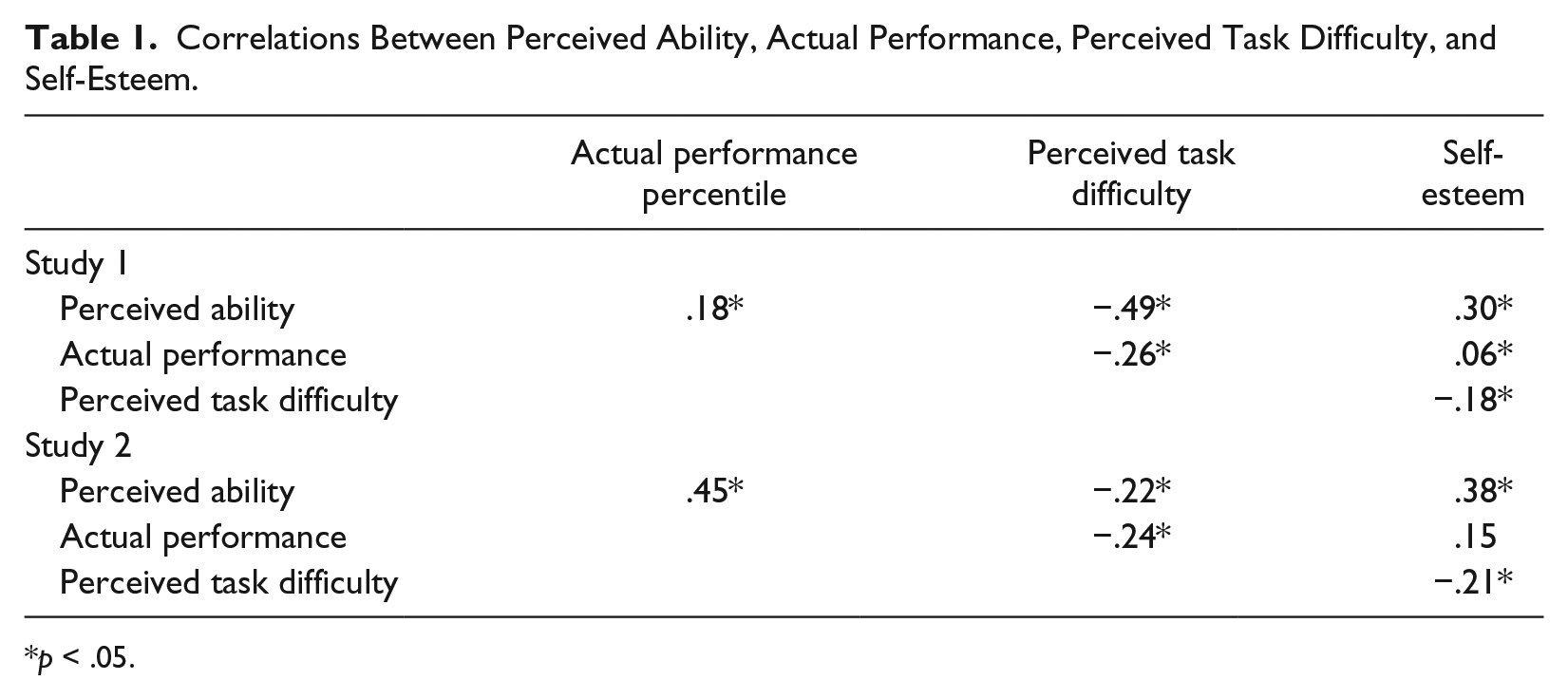
Table 1 shows the correlations between actual performance, perceived ability, perceived task difficulty, and self-esteem. Perceived ability was positively related to actual performance, but the correlation was weak (r = .18). Students who perceived the task to be more difficult tended to have poorer performance (r = –.26) and rated their riddle-solving ability less favorably (r = –.49). Self-esteem was weakly related to task performance (r = .06). Furthermore, participants with higher self-esteem found the task to be less difficult (r = –.18) and perceived their ability more favorably (r = .30).
Correlations Between Perceived Ability, Actual Performance, Perceived Task Difficulty, and Self-Esteem.
p < .05.
On average, we found that participants from Hong Kong perceived their performance to be worse (M = 53.35, SD = 27.39) than their actual performance (M = 59.83, SD = 27.40), t(3819) = −11.45, p < .01. Following Kruger and Dunning (1999), we assigned a percentile rank to each participant based on the participant’s actual performance relative to the performance of other participants in the same grade. As shown in Figure 5a, when participants’ actual performance was in the bottom quartile, their mean actual percentile rank was 13.21. However, these participants estimated their ability at the 46.38th percentile. In other words, they overestimated their ability by 33.17 percentile points, a large significant overestimation, t(716) = −32.95, p < .001. A smaller but still significant overestimation was observed for participants whose performance was in the second quartile (mean overestimation = 9.26 percentile points), t(813) = −9.87, p < .01. In contrast, participants in the third and top quartiles significantly underestimated their ability: participants whose actual performance was in the third and top quartile underestimated their ability by 15.57 percentile points, t(1106) = 19.95, p < .001, and 33.79 percentile points, t(1181) = 41.07, p < .001, respectively. Thus, consistent with Kruger and Dunning, there was a strong tendency for low-performing participants to overestimate their ability and for high-performing participants to underestimate it. 1
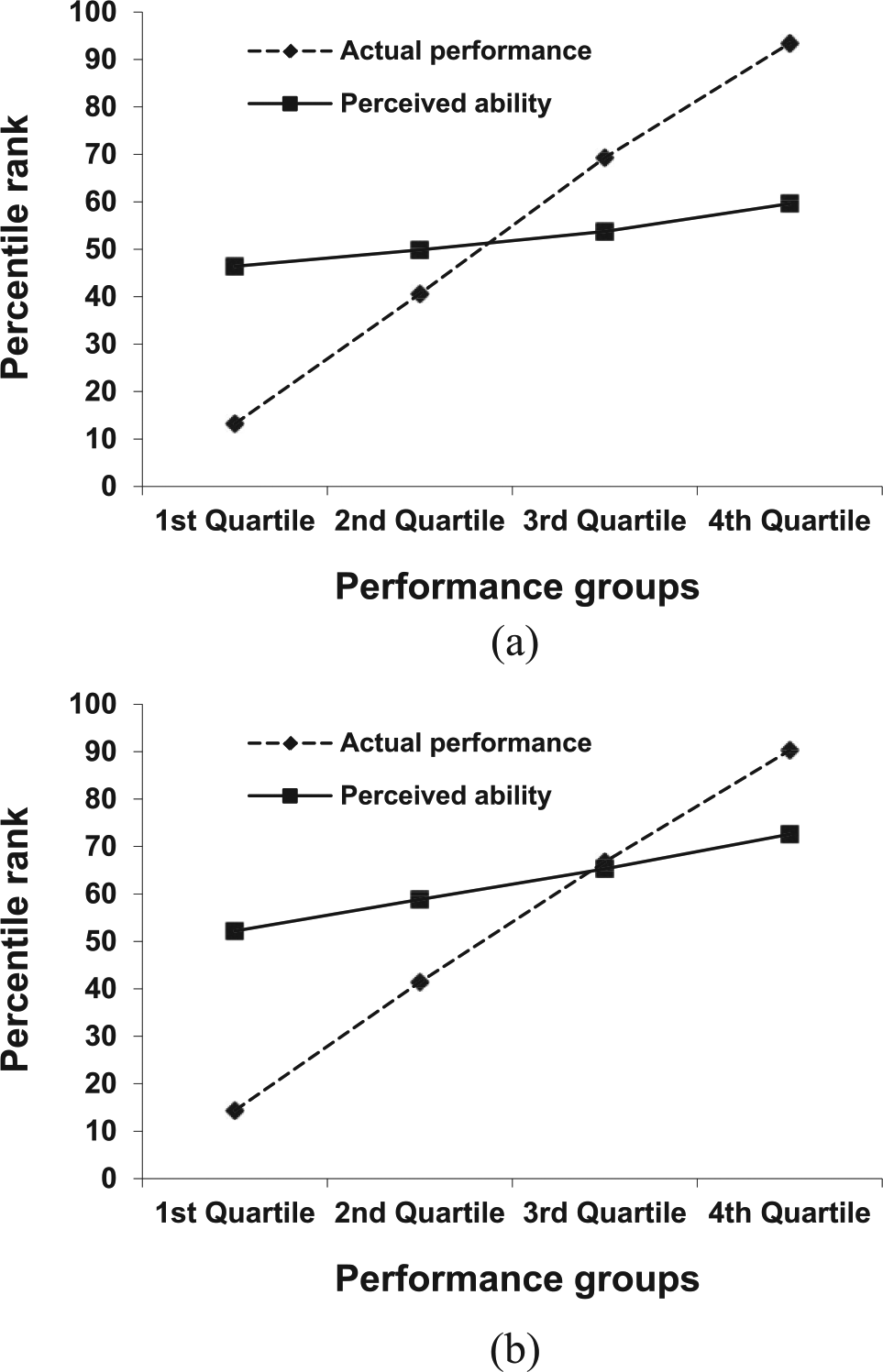
Perceived and actual performance in Study 1 (a) and Study 2 (b).
Self-Assessment Bias Components
We hypothesized that the comparative bias would be positively associated with self-esteem and negatively associated with perceived task difficulty. In addition, we hypothesized that calibration of self-assessment would decrease with higher task difficulty and thus resulting in low task diagnosticity. We tested these hypotheses by regressing estimated ability on the actual percentile ranks, perceived difficulty rating, self-esteem, and their interaction.
The intercept was significant (a = 52.71), F(1, 3719) = 18209.34, p < .001. Participants whose actual performance was at the 0 percentile estimated their ability to be at the 53rd percentile. The main effect of actual performance was significant (B = 0.06), F(1, 3719) = 20.85, p < .001,
In addition, Actual performance × Task difficulty was significant, F(1, 3719) = 26.33, p < .001,
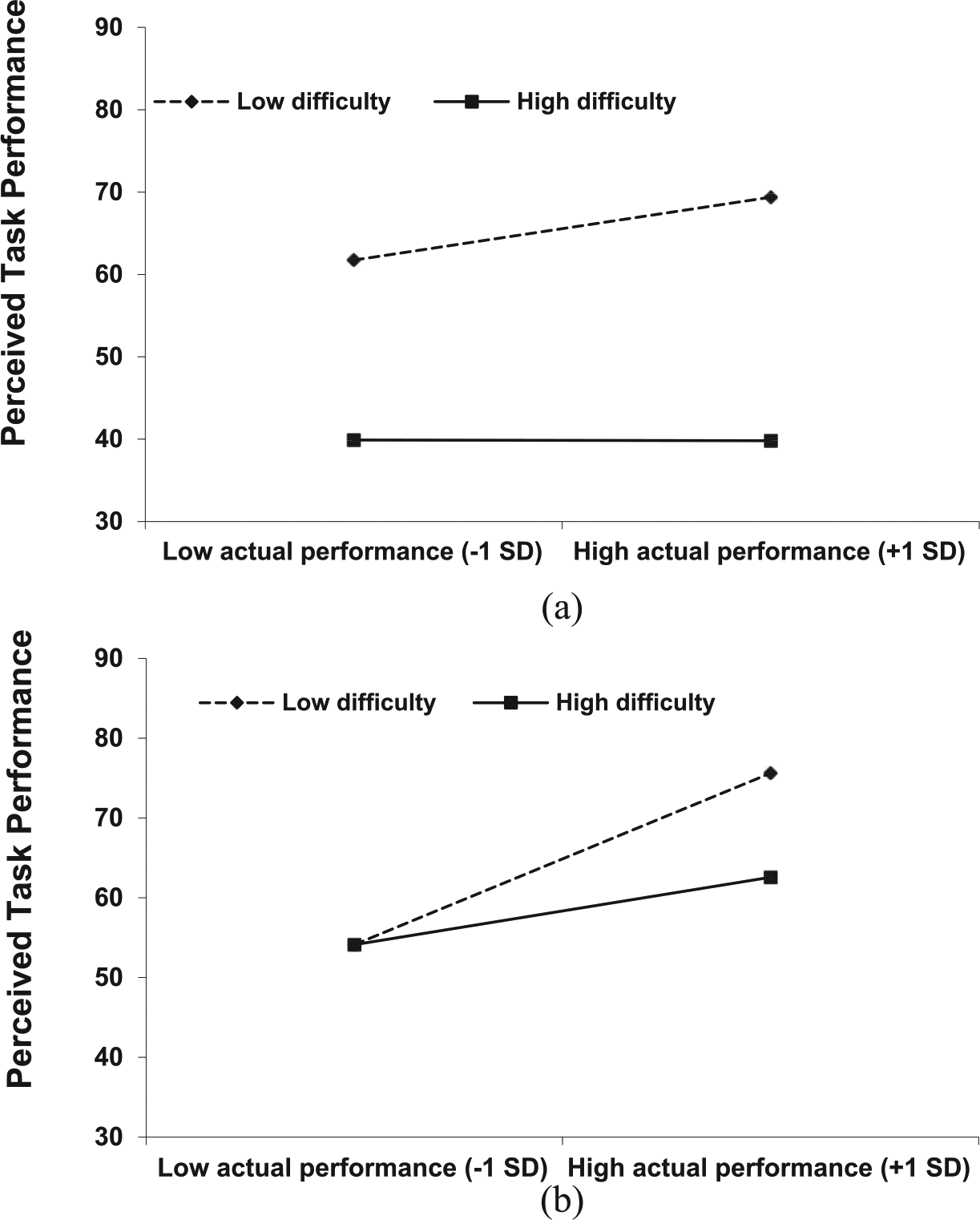
Calibration accuracy between actual performance and perceived performance as a function of perceived difficulty in Study 1 (a) and Study 2 (b).
In summary, the results of Study 1 show that self-assessments of ability have two components: (a) a comparative bias that is independent of actual performance, and (b) the tendency to use performance information to calibrate ability judgment. The comparative bias—reflected in the intercept of the regression line that represents the relationship between actual performance and self-perception of relative ability—and the calibration effect, reflected in the slope of the regression line, jointly contribute to incompetent individuals’ overestimation of their ability and competent individuals’ underestimation. Furthermore, whereas comparative bias is related to both self-esteem and perceived task difficulty, calibration of ability judgment is related only to perceived task difficulty, implying that the former is affected by both motivational and cognitive factors, whereas the latter appears to be affected only by cognitive factors.
Study 2
Method
Study 2 was designed to replicate Study 1 in a European American sample, using a different experimental task. Participants were 95 undergraduates (38 women) aged 19 to 23 years (M = 20.77, SD = 0.80) who self-identified as Caucasian or White from a public university in the United States. They received extra course credit in psychology for their participation.
A 15-item anagram test with a time limit of 10 min was used as the performance task. For each item, participants were asked to rearrange a stimulus word (e.g., tied) to form other meaningful words (diet, edit, tide). All stimulus words could be rearranged to form three different words. After completing the task, participants were asked to rate their anagram-solving ability, relative to other students at their university on a percentile scale from 0 (I’m at the very bottom) to 100 (I’m at the top) with 50 being I’m better than half and worse than half of other students. Participants were then asked to indicate how difficult the test was on a 7-point Likert-type scale; mean difficulty score was 4.30 (SD = 1.37). They were also asked to fill out Rosenberg’s (1965) Self-Esteem Scale (α = .86) on a 7-point Likert-type scale; mean self-esteem score was 5.97 (SD = 0.87). At end of the procedure, participants were debriefed and thanked for their participation.
Results and Discussion
We assigned a percentile rank to each participant based on their actual performance on the test relative to other participants’ performance. Gender did not predict any of the four measured variables (actual performance, perceived ability, perceived difficulty, and self-esteem), and was not included in subsequent analyses.
As shown in Table 1, the pattern of correlations among actual performance percentile, perceived ability percentile, perceived task difficulty, and self-esteem was similar to that in Study 1. Participants with higher actual performance percentiles estimated their relative ability to be higher (r = .45). Participants who perceived the task to be more difficult performed more poorly on the task (r = –.24) and perceived their ability to be lower (r = –.22). Participants with higher self-esteem rated the task as less difficult (r = –.21) and their relative ability as higher (r = .38). However, self-esteem was not significantly related to actual performance percentile (r = .15, ns).
We found that on average, European American participants perceived their performance more favorably (M = 62.38, SD = 17.85) than their actual performance (M = 53.76, SD = 29.05), t(93) = 3.17, p < .01. Thus, our studies provide confirmation that people from European American cultures have a strong self-enhancement tendency. Following Kruger and Dunning (1999), we assigned a percentile rank to each participant based on the participant’s actual performance relative to the performance of other participants in the same grade. Consistent with previous findings (Kruger & Dunning, 1999) and Study 1, incompetent participants overestimated their performance, and skilled participants underestimated performance. Figure 5b shows that participants whose actual performance was in the first quartile overestimated their ability by 37.85 percentile points, t(21) = −8.82, p < .01, and participants in the second quartile overestimated their ability by 17.43 points, t(25) = −4.62, p < .01. However, participants in the fourth quartile underestimated their performance by 17.70 points, t(24) = 6.36, p < .01, and those in the third quartile were fairly accurate in their self-assessment, t(20) = 0.61, ns.
We performed the same regression analysis as in Study 1, regressing percentile ranks of estimated ability on actual performance percentile ranks (mean-centered), perceived difficulty (mean-centered), global self-esteem (mean-centered), and their interactions. As expected, the main effect of global self-esteem was significant: Individuals with higher self-esteem had higher relative ability ratings, F(1, 86) = 8.04, p < .01,
The main effect of actual performance, F(1, 86) = 17.55, p < .001,
In summary, Study 2 successfully replicated the results in Study 1, supporting the hypothesis that inaccurate self-assessments of ability involve a positive comparative bias associated with self-esteem and perceived task difficulty, and the tendency to use actual performance information to calibrate self-assessment, which is related to perceived task difficulty or diagnosticity.
General Discussion
Replicating previous studies (Kruger & Dunning, 1999), Studies 1 and 2 show that incompetent individuals tend to overstate their abilities and competent individuals underestimate themselves. One account of this phenomenon suggests that incompetent individuals lack cognitive awareness of their abilities, while competent individuals lack cognitive awareness of the abilities of others (Kruger & Dunning, 1999), implying that each involves distinct processes. However, Krueger and Mueller (2002) suggested that both competent and incompetent individuals are unaware of their relative performance, but are motivated to elevate their self-perception, implying that they involve the same underlying processes.
The present studies draw out a statistically overarching model that integrates these two accounts, demonstrating incompetent individuals show overestimation and competent individuals show underestimation of their abilities because they both have inaccurate calibration and a comparative bias. The results of the studies suggest that it is useful to deconstruct self-assessment of ability into two components: the overall comparative bias, which is the tendency to judge one’s ability more favorably independent of one’s actual performance, and calibration, which involves using actual test performance data to adjust one’s ability inference. As predicted, overall comparative bias was linked to self-enhancement motivation and perceived task difficulty; individuals with higher self-esteem and those who perceived the task to be less difficult displayed a more pronounced positive response bias. In addition, calibration was related to perceived task difficulty; when the task was perceived as difficult, task performance was not used to calibrate ability judgment. Thus, the present study shows that comparative bias (a motivational bias) and calibration accuracy (a cognitive bias) jointly contribute to incompetent individuals’ overestimation of their ability and competent individuals’ underestimation.
These findings contribute to existing literature, particularly on self-evaluation processes. First, our results incorporate the findings of Krueger and Mueller (2002) that individuals are unaware of their relative performance but at the same time, show that people are at least partially aware of their relative performance and are able to use it for self-assessment, particularly when (a) task performance is perceived to be relatively easy and perhaps more diagnostic of ability, and (b) they are motivated to accurately assess their relative ability. The correlation between actual task performance and perceived ability ranged from .05 to .56, depending on task difficulty in the present and previous studies. Kim, Chiu, and Bregant (2015) found that when participants were induced to perceive a task as less relevant, lowering the motivation for self-enhancement, they exhibited a weaker comparative bias and higher calibration accuracy.
Second, although Kruger and Dunning (1999) suggested two different, theoretical psychological processes, our results indicate a more widely applicable model that shows how overestimation by incompetent individuals and underestimation by competent individuals appear from a statistical point of view. In this model, both incompetent and competent individuals (a) do not have a perfect knowledge of their ability, which results in inaccurate self-assessments; and (b) are motivated to evaluate themselves more favorably. These two factors—reflected in the slope and the positive intercept of the regression line for self-assessments plotted against actual performance—jointly contribute to the phenomenon. We believe that a more elaborative model with fully demonstrated contributing factors will provide a strong statistical supplement to Kruger and Dunning’s theorization.
Third, our results give insight into the debate on whether the need for self-enhancement is universal or culturally specific. Given that the debate exclusively focuses on supporting the presence or absence of self-enhancement motivation among East Asians, many studies have primarily examined cross-cultural mean differences in the extent of self-enhancement. This, however, in our view, is an incomplete understanding of the psychological processes underlying biases in self-assessment. Instead, the present studies show that cognitive and motivational factors jointly contribute to biases in self-assessment in both European American and East Asian cultures. Although European Americans are more likely to engage in self-enhancement than East Asians, East Asians have a need for self-enhancement. Instead, the extent of self-enhancement may depend on culturally different cognitive and motivational factors embedded in a specific cultural context (Kim et al., 2008; Kim et al., 2010).
Nonetheless, the present studies have some limitations. First, we posited that as calibration accuracy is low on difficult tasks, a nonsignificant correlation would result between actual and estimated ability because performance on such tasks may not be perceived as diagnostic of relative ability. However, this assumption of the mediating role of perceived task diagnosticity was not tested, and should be explored in future studies. Second, to show that a cognitive bias contributes to self-assessment bias, we examined the relationship between actual ability and perceived ability as a function of perceived task difficulty by using a relatively difficult task in each study. In Study 1, the mean performance was 6.68 out of 10; in Study 2, the mean performance was 18.53 out of 45. These results confirm our hypothesis. However, because a relatively difficult task was used in each study, this result does not imply that calibration accuracy was high for very easy tasks. Based on the proposed mediating role of perceived task diagnosticity, we also expect that on very easy tasks, people would estimate their relative ability less accurately because performance on such tasks may not be seen as diagnostic of relative ability. To have a complete understanding of the role of perceived task diagnosticity in self-assessment bias, a follow-up study should either use different tasks, varying in difficulty level (e.g., very easy, easy, moderately difficult, difficult, very difficult), and/or manipulate the difficulty level of a task to show how perceived task difficulty in each task affects calibration accuracy.
In sum, our studies suggest that the same psychological processes underlie self-assessment bias in both cultures; motivational and cognitive psychological factors affect response bias and calibration accuracy, and jointly explain self-assessment bias in individuals from Hong Kong and European Americans.
Footnotes
Declaration of Conflicting Interests
The author(s) declared no potential conflicts of interest with respect to the research, authorship, and/or publication of this article.
Funding
The author(s) received no financial support for the research, authorship, and/or publication of this article.