






Abstract
Intercultural competence (ICC) can be defined as a complex of abilities that are needed to interact with people from other cultures adequately and effectively. The goal of the present study was to investigate the development of ICC during international experiences. We conducted a quasi-experimental longitudinal study with a sample of N = 273 individuals. Whereas 199 participants went abroad for at least 3 months, the remaining 74 participants stayed in Germany during the same period. ICC was operationalized with the short version of the Test to Measure Intercultural Competence, which measures six facets of ICC multi-methodically with a self-appraisal test and a situational judgment test. We calculated regression analyses within the framework of change score models, thereby yielding significant increases in global ICC after 3 months abroad. Analyzing the six facets of ICC, we found the greatest increase for Cultural Identity Reflection, which is defined as intensively and constantly reflecting upon one’s own cultural character. We discuss our results with regard to the conceptualization of ICC and the relevance of stays abroad.
Keywords
Intercultural competence (ICC) is in vogue (Bolten, 2007). Phenomena like globalization, intercultural collaboration, and transcontinental migration highlight its increasing relevance in modern societies. At the same time, there is a growing interest to foster ICC development by educational stays abroad. According to Weichbrodt (2014), educational stays abroad can be defined as prolonged, but temporary sojourns in other countries than the country of origin, which are usually undertaken as independent travels during adolescence or early adulthood, and which have a direct or indirect educational purpose, at least partly. They are especially characterized by student exchanges, internships abroad, au pair stays, voluntary services, and work-and-travel turns. The present study aims to test whether educational stays abroad of 3-month duration have a positive impact on the development of ICC. To investigate this issue, we make use of the newly developed Test to Measure Intercultural Competence (TMIC; Schnabel, Kelava, Seifert, & Kuhlbrodt, 2014; Schnabel, Kelava, Van de Vijver, & Seifert, 2015), which is based on the onion model of ICC (Schnabel et al., 2014) and measures ICC multi-methodically with a self-appraisal test as well as a situational judgment test.
The theoretical section of this article is structured as follows: First, we will give an overview on the conceptualization and the measurement of ICC in general. Second, we will describe the onion model of ICC (Schnabel et al., 2014) as well as the TMIC (Schnabel et al., 2014; Schnabel et al., 2015) in particular. Finally, we will present theoretical approaches and empirical findings concerning the impact of international experiences on the development of ICC.
Conceptualization and Measurement of ICC
As yet, researchers on ICC have found no consensus how ICC is to define. Over the past 60 years, researchers in various disciplines have developed plenty of ICC definitions (Arasaratnam & Doerfel, 2005). Already in 1989, Ruben stressed “the need for conceptual clarity” (p. 234). Likewise, more recent publications (e.g., Chiu, Lonner, Matsumoto, & Ward, 2013; Deardorff, 2006; Rathje, 2007) point out the lack of specificity in ICC definitions. There seems to be wide agreement that ICC, in its broadest sense, is a heterogeneous construct involving multiple dimensions, which are necessary to interact with people from other cultures adequately and effectively (e.g., Earley & Ang, 2003; Fantini & Tirmizi, 2006; Schnabel et al., 2015). However, it is not clear which dimensions (in which proportions) describe ICC most appropriately. For example, Spitzberg and Changnon (2009) identified 325 facets of ICC, albeit largely overlapping.
Furthermore, there are different points of view in the literature about culture-general versus culture-specific aspects of ICC. Broadly speaking, culture-specific approaches, which define ICC with respect to people from specific cultures or regions, stand in contrast to culture-general approaches, which define ICC independently from specific cultures or regions (Arasaratnam & Doerfel, 2005; Matsumoto & Hwang, 2013; Rathje, 2007). However, a Delphi study by Deardorff (2004) showed that intercultural experts evaluated definitions and components of ICC as rather independent from specific cultures (see also Deardorff, 2006).
The conceptualization of ICC is even more confusing due to the variety of terminology, which has emerged in the field. While some terms, such as intercultural communicative competence or cross-cultural competence, are used rather synonymously to ICC (e.g., Chiu et al., 2013; Deardorff, 2006; Schnabel et al., 2015), other concepts are related to, but differ from, ICC, at least in nuances. For example, Hammer, Bennett, and Wiseman (2003) introduced the concept of intercultural sensitivity as “the ability to discriminate and experience relevant cultural differences” (p. 422). Because greater intercultural sensitivity is assumed to be associated with greater potential for exercising ICC, it can be seen as a prerequisite to develop ICC (Hammer et al., 2003; see also Bhawuk & Brislin, 1992; Chen & Starosta, 1997). In contrast, the concept of intercultural adaptation refers to the process of altering one’s behavior in response to a culturally different environment. Since successful intercultural adaptation requires the adoption of behaviors that accomplish goals and achieve tasks, it describes an outcome of ICC rather than the abilities to adequately and effectively interact with people from other cultures per se (Matsumoto & Hwang, 2013; Wilson, Ward, & Fischer, 2013). More related to ICC is the concept of cultural intelligence, which is defined as “an individual’s capability to function and manage effectively in culturally diverse settings” (Ang & Van Dyne, 2008, p. 3). Yet, in contrast to ICC, cultural intelligence is construed as a certain form of intelligence and accordingly dependent on certain genetic, dispositional, and personality-related components of intelligence (Schnabel et al., 2014).
It is hardly surprising that the different conceptualizations of ICC and ICC-related constructs yielded to a variety of instruments that aim to measure ICC (e.g., Gabrenya, Griffith, Moukarzel, Pomerance, & Reid, 2013). Investigating the reliability and validity of 10 tests to measure culture-general ICC, Matsumoto and Hwang (2013) found three tests to be most promising: The Cultural Intelligence Scale (Van Dyne, Ang, & Koh, 2008), the Intercultural Adjustment Potential Scale (Matsumoto et al., 2001), and the Multicultural Personality Questionnaire (Van der Zee & Van Oudenhoven, 2001). In two other reviews, Leung, Ang, and Tan (2014) and Schnabel (2015), classified these and other instruments measuring ICC as trait-based, attitude-based, or capability-based. Interestingly, while several instruments were described to cover traits, attitudes, or a mixture of the categories, only the Cultural Intelligence Scale was identified to exclusively focus on malleable abilities. According to Schnabel et al. (2015), this finding implies a gap between the conceptualization and measurement of ICC, taking into account that ICC is in theory often defined as an ability or a skill (see also Spitzberg & Changnon, 2009). Also keeping in mind that all instruments included in Matsumoto and Hwang’s (2013) review exclusively used Likert-type scale based items to assess ICC, while many authors call for multi-method approaches (e.g., Deardorff, 2006; Leung et al., 2014; Rathje, 2007; Sinicrope, Norris, & Watanabe, 2007), Schnabel et al. (2014) developed the TMIC.
TMIC
The TMIC (Schnabel et al., 2014) aims to measure culture-general ICC in the sense of malleable abilities, multi-methodically with a self-appraisal test (TMIC-SA), and a situational judgment test (TMIC-SJT). Theoretically, it is based on different features of previously existing theories: ICC is understood as a certain form of competence that can be acquired (e.g., Erpenbeck, 2012), that helps individuals to master intercultural situations (e.g., Earley & Ang, 2003; Fantini & Tirmizi, 2006), that involves multiple facets (e.g., Spitzberg & Changnon, 2009), and that triggers an individual’s global behavioral orientation (Schuler & Prochaska, 2000). In particular, the construction of the TMIC went along with the development of the onion model of ICC (Schnabel et al., 2014), which consists of three layers of a figurative onion. Overall, 17 facets of ICC (e.g., Sensitivity in Communication, Willingness to Use a Foreign Language) are placed at the core of the onion. They can be subsumed to six competence domains (Communication, Learning, Social Interaction, Self-Management, Creating Synergies, and Self-Knowledge), which constitute the next layer. Finally, personality traits, knowledge, attitudes, intercultural sensitivity, and cultural intelligence are positioned at the outside layer. They are understood as antecedents influencing the nature of ICC, without representing ICC per se (Schnabel, 2015; Schnabel et al., 2015).
The TMIC-SA and the TMIC-SJT measure the 17 facets of ICC in the core of the onion model. While the TMIC-SA assesses each facet with three to seven Likert-type-scaled self-report items, the TMIC-SJT represents each facet of ICC by a critical incident scenario from the intercultural context (cf. McDaniel, Hartman, Whetzel, & Grubb, 2007). For each scenario, test-takers have to select one of four (more or less desirable) behavioral alternatives describing the behavior they would most likely show in the given situation. So far, the TMIC is the only multi-method ability-based behavior-related instrument to measure ICC (Schnabel et al., 2015). Whereas the TMIC-SA refers to a person’s self-concept, the TMIC-SJT tries to uncover behavioral preferences (Bledow & Frese, 2009). The location of malleable abilities at the heart of ICC makes the TMIC particularly promising for training situations (Schnabel, Kelava, & Van de Vijver, 2016). In line with this, a possible effect of stays abroad on ICC development should manifest itself in the TMIC facets rather than in the facets of questionnaires measuring trait-based ICC, like the Multicultural Personality Questionnaire (Van der Zee & Van Oudenhoven, 2001).
Facet selection in the onion model of ICC (Schnabel et al., 2014) was done by a phenomenological expert-based strategy in combination with an extensive literature review (Schnabel et al., 2014). However, with 75 self-report and 17 situational judgment items operationalizing the 17 facets of ICC, the TMIC is quite time-consuming. Considering economical requirements, Schnabel et al. (2015) introduced the TMIC-S as a short form of the TMIC. The TMIC-S consists of only six ICC facets, namely, (a) Sensitivity in Communication, (b) Information Seeking, (c) Socializing, (d) Goal Setting, (e) Mediation of Interests, and (f) Cultural Identity Reflection, each representing one competence domain of the second layer of the onion model (for a description of the facets, see Table 1). Schnabel et al.’s (2015) validation study with a German and a Brazilian sample showed a high construct validity of the TMIC-S, a satisfactory model fit, and measurement invariance in Germany and Brazil. An investigation of the criterion validity revealed, among others, an association between higher latent means of ICC facets and previous experience abroad of more than 3 months in both samples for Socializing and Cultural Identity Reflection and at least in one of the two samples for Information Seeking (German sample), Sensitivity in Communication, and Mediation of Interests (Brazilian sample). Yet no prior empirical study has examined the development of ICC facets of the TMIC-S during international experiences longitudinally.
Competence Facets in the TMIC-S.
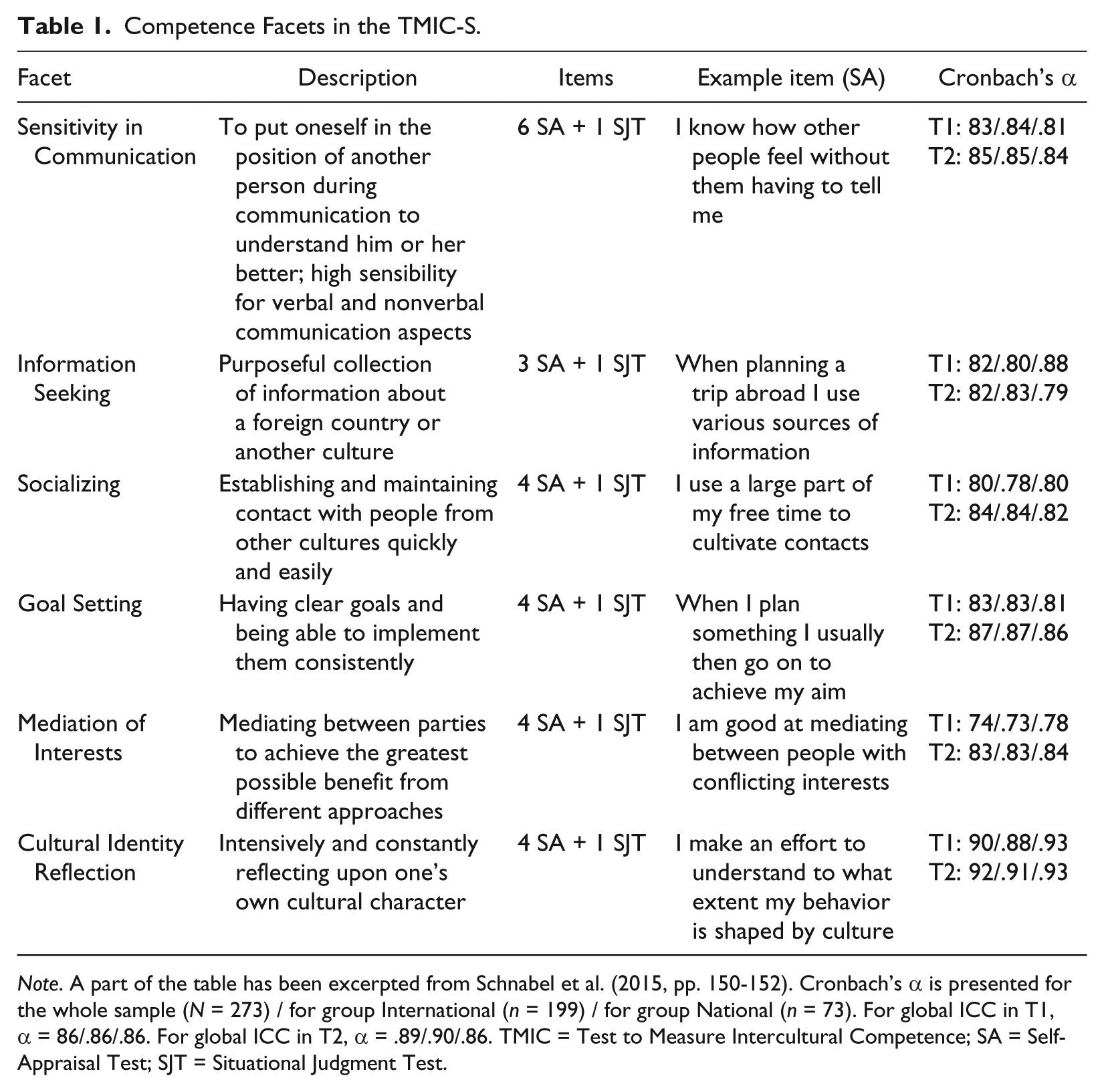
Note. A part of the table has been excerpted from Schnabel et al. (2015, pp. 150-152). Cronbach’s α is presented for the whole sample (N = 273) / for group International (n = 199) / for group National (n = 73). For global ICC in T1, α = 86/.86/.86. For global ICC in T2, α = .89/.90/.86. TMIC = Test to Measure Intercultural Competence; SA = Self-Appraisal Test; SJT = Situational Judgment Test.
ICC and International Experience
The onion model of ICC (Schnabel et al., 2014) describes a variety of ICC facets, which are intended to reflect malleable abilities and should hence be flexible for development, for example, as a result from intercultural contact. However, as the onion model identifies components assumed to be constitutive of competent intercultural interaction rather than emphasizing the process of ICC progression and maturity over time, it is a compositional model rather than a developmental model of ICC (Spitzberg & Changnon, 2009). To explain ICC development during international experience, research on ICC has yielded other theoretical approaches. In the following, we draw on the developmental model of intercultural sensitivity (Bennett, 1986, 1993, 2004), the culture learning theory (Ward, 1996; Ward, Bochner, & Furnham, 2001; Wilson et al., 2013), and the experiential learning theory (Kolb, 1984; Kolb, Boyatzis, & Mainemelis, 2001) to explain why stays abroad should lead to an increase in ICC. Subsequently, we will summarize and comment on previous empirical findings investigating the effect of international experiences on ICC development.
Developmental Model of Intercultural Sensitivity
One of the most prominent models of ICC development is Bennett’s (1986, 1993, 2004) developmental model of intercultural sensitivity. Strictly speaking, the developmental model of intercultural sensitivity does not deal with ICC, but with intercultural sensitivity. However, as intercultural sensitivity is seen as a kind of precondition to develop ICC (Hammer et al., 2003), the developmental model of intercultural sensitivity can also be applied to explain ICC development. According to the developmental model of intercultural sensitivity, individuals move through a continuum from ethnocentrism to ethnorelativism in their acquisition of ICC, which is shown by the change their cultural worldview from the perception of their own culture to be central to reality to the perception of their own beliefs and behaviors to be just one among plenty of possibilities to organize the world. While proceeding the six steps of the intercultural development continuum, their experiences of cultural differences become more complex and sophisticated. Following a constructivist view (Kelly, 1963), experience is considered as a function of how one construes events (i.e., cultural differences). The more perceptual and conceptual discriminations an individual can bring to bear on the event, the more complex the construction of the event and the richer the experience will be.
The developmental model of intercultural sensitivity assumes that contact with cultural differences can initiate ICC development. An ethnocentric worldview is regarded sufficient for managing relations within one’s own culture. However, the development and maintenance of social relations across cultural boundaries requires the ability to construe alternative experiences. If there is a need for intercultural relations, as it is usually the case during long-term stays abroad, there is pressure to modify one’s worldview to subsequently reach greater ICC. Accordingly, the developmental model of intercultural sensitivity can explain how international experiences may lead to advancement on the intercultural development continuum. Empirical support for a continuum of intercultural development could be found in several studies (e.g., Hammer, 2005, 2011).
ABC Model and Culture Learning Theory
While the developmental model of intercultural sensitivity (Bennett, 1986, 1993, 2004) refers to the development of intercultural sensitivity, another line of research addresses the effect of intercultural experiences on intercultural adaptation and adjustment. Meanwhile, several theories have been proposed dealing with topics such as culture shock, acculturation, and uncertainty management (e.g., Savicki, Adams, Wilde, & Binder, 2008; Zhou, Jindal-Snape, Topping, & Todman, 2008, for an overview). With her ABC model, Ward (2001) provided a comprehensive theoretical framework to accommodate the different approaches focusing on the affective, behavioral, and cognitive (ABC) processes. In particular, the ABC model embraces the three salient concepts stress and coping (Affect), cultural learning (Behavior), and social identification (Cognition). Taking into account that the TMIC (Schnabel et al., 2014) measures ICC in the behavioral domain, we want to outline the concept of cultural learning, which is also known as culture learning theory (Ward, 1996; Ward et al., 2001; Wilson et al., 2013).
The culture learning theory has its early roots in social and experimental psychology and largely arose from Argyle’s (1969) work on social skills and interpersonal behavior. It was strongly advocated by Furnham and Bochner (1986) as a reformulation of “culture shock” and later incorporated in Searle and Ward’s (1990) work on sojourner adaptation. The core assumption is that cultural novices have difficulties in managing everyday social encounters, because they lack the social skills required in the new society. Yet they can acquire the culture-specific skills that are needed to negotiate the new cultural milieu through learning processes within the host culture.
As learning proceeds, sojourners’ skills increase and their competences in the host culture grow. With an enhanced repertoire of skills and competences, sojourners place themselves into an increasing number of new intercultural situations, which enable further cultural learning. However, cultural learning does not proceed continually, but rather steeply increases in the early stages within a new culture and then levels off and remains relatively stable over time. In line with this, Ward, Okura, Kennedy, and Kojima (1998) showed that the pattern of intercultural adaptation resembles a learning curve.
Regarding the development of culture-general ICC by international experience, it may be somewhat problematic that the culture learning theory emphasizes the importance of culture-specific knowledge and skills (e.g., language proficiency). Yet there is some evidence that culture-specific learning can be generalized to other contexts (e.g., Parker & McEvoy, 1993; Wilson et al., 2013). In their meta-analysis, Wilson et al. (2013) found both culture-specific and culture-general variables to be associated with better intercultural adaptation. In line with the culture learning theory, there were small to moderate correlations between intercultural adaptation and cultural knowledge, length of residence in the host culture, contact with host nationals, cultural distance, language proficiency, and previous cross-cultural experience.
Experiential Learning Theory
Both the developmental model of intercultural sensitivity (Bennett, 1986, 1993, 2004) and the culture learning theory (Ward, 1996; Ward et al., 2001; Wilson et al., 2013) assume, at least indirectly, that intercultural experience has a positive impact on ICC development. However, none of the two theories describes the process of ICC acquisition through intercultural experiences on a micro level. To explain the psychological mechanisms that are involved in ICC development through intercultural experiences, some researchers have applied Kolb’s (Kolb, 1984; Kolb et al., 2001) experiential learning theory to the process of ICC acquisition (e.g., M. Li, Mobley, & Kelly, 2013; Ng, Van Dyne, & Ang, 2009).
The experiential learning theory is a comprehensive learning theory, which originally does not explicitly refer to ICC. It defines learning as “the process whereby knowledge is created through the transformation of experience [and] knowledge results from the combination of grasping and transforming experience” (Kolb, 1984, p. 41). For both grasping and transforming experience, Kolb (1984) describes two dialectically related learning modes. Whereas the grasp of experience happens through Concrete Experience (CE) and Abstract Conceptualization (AC), Reflective Observation (RO) and Active Experimentation (AE) express the transformation of experience.
The four learning modes are portrayed in the experimental learning circle. In terms of ICC development, an intercultural experience (CE) serves as the basis of observation and reflection (RO). For example, a culturally less adept European visiting a Buddhist temple in Thailand might notice that the local inhabitants dart malignant glances on her. This experience is then assimilated into an AC. After having realized that anybody else in the temple is unshod, the European concludes that Buddhists might differ from Christians in their concept of wearing shoes in sanctuaries. Validating her assumption (AE), she enters the next temple of her journey shoeless, this time having a much better experience (CE) since everyone seems to be well disposed toward her (RO). On a meta-level, the European realizes that it might be advisable considering dress codes to interact with people from other cultures adequately.
Altogether, the experiential learning theory demonstrates that both grasping and transformation of experience are essential for learning, because having an experience without doing anything for it is not sufficient and transformation is impossible without an experience that can be acted upon. Stays abroad afford plenty of opportunities to experience a foreign culture in the field and directly test the effectiveness of different ways of behavior. As an actor in an intercultural situation, an individual receives impressions that go beyond the pure theoretical studying of interculturally competent behavior, including emotions, dynamics, and expressions of values. Although empirical support for the experiential learning theory in the context of intercultural learning has especially been found in evaluations of trainings imparting ICC by experiential learning (e.g., Erez et al., 2013; MacNab, 2012; Pless, Maak, & Stahl, 2011; Rosenblatt, Worthley, & MacNab, 2013), some evidence could also be found for the relevance of CE and RO regarding the development of ICC during international experiences (M. Li et al., 2013).
Empirical Findings
The relation between international experience and ICC has been investigated in a couple of empirical studies (for a review, see Wolff, 2016). Altogether, the empirical findings provide evidence for a positive impact of international experiences on ICC, which could have been found for different types of international experiences, such as working abroad (e.g., M. Li et al., 2013), student exchange (e.g., Black & Duhon, 2006), or volunteering (e.g., Fantini & Tirmizi, 2006). Furthermore, previous research has examined international experiences of divergent periods (e.g., Engle & Engle, 2004; Stewart, Wilson, & Miles, 2014), in various countries (e.g., Kitsantas, 2004; Paige, Cohen, & Shively, 2004), and with student samples (e.g., Tarique & Takeuchi, 2008; Williams, 2005) as well as with non-student samples (e.g., Hammer, 2005; Zahed, 2012).
Although previous studies are indicative of a positive impact of international experiences on ICC development, some aspects limit their validity in their entirety. First, there are many studies investigating the relation between international experience and ICC only cross-sectionally, thus allowing no conclusion about the causality of the effects (e.g., Shannon & Begley, 2008; Tarique & Takeuchi, 2008; Westrick & Yuen, 2007). Second, studies using a longitudinal design are often restricted to small sample sizes (e.g., Anderson, Lawton, Rexeisen, & Hubbard, 2006; Kitsantas & Meyers, 2001; Medina-López-Portillo, 2004), partially ignore the inclusion of a control group (e.g., Kitsantas, 2004; Stewart et al., 2014; Zahed, 2012), and are in many cases conducted with the goal to evaluate a special program (e.g., Engle & Engle, 2004; Fantini & Tirmizi, 2006; Hammer, 2005). Third, a large part of studies examines college students, especially from the United States (e.g., Paige et al., 2004; Williams, 2005), hence constraining the generalizability of their results. Forth, most studies assess ICC exclusively with self-appraisal tests. In comparison with more direct measures, self-appraisal tests are prone to response biases, such as social desirability or acquiescence (Barker, Pistrang, & Elliott, 2005). Notably, to our knowledge, no longitudinal study has investigated ICC development during international experiences including a validated situational judgment test yet.
The Present Study
The goal of the present study was to investigate the impact of international experiences on ICC development, thereby avoiding the limitations we pointed out regarding previous studies as much as possible. That entails (a) conducting a longitudinal design including (b) a control group and (c) an adequate sample size, (d) looking for participants not only in the university context, (e) combining a self-appraisal test and a situational judgment test to measure ICC, and (f) realizing our study independently from any program evaluation. Considering international experiences, we confined ourselves to the investigation of educational stays abroad, as defined in the Introduction according to Weichbrodt (2014). Since educational stays abroad are generally carried out individually and with an educational purpose, we assumed them to bring particularly intensive intercultural contact with them. Regarding the developmental model of intercultural sensitivity (Bennett, 1986, 1993, 2004), the culture learning theory (Ward, 1996; Ward et al., 2001; Wilson et al., 2013), and the experiential learning theory (Kolb, 1984; Kolb et al., 2001), we subsequently hypothesized educational stays abroad to lead to an increase in ICC after three months (Hypothesis 1).
Referring to global ICC, our first hypothesis can properly be described as an “omnibus hypothesis.” Investigating the influence of international experiences on ICC more exactly, our following six hypotheses concerned the six ICC facets of the onion model of ICC (Schnabel et al., 2014), which are operationalized in the TMIC-S (Schnabel et al., 2015). We hypothesized that after 3 months, educational stays abroad led to an increase in each facet of ICC: in Sensitivity in Communication (Hypothesis 2.1), Information Seeking (Hypothesis 2.2), Socializing (Hypothesis 2.3), Goal Setting (Hypothesis 2.4), Mediation of Interests (Hypothesis 2.5), and Cultural Identity Reflection (Hypothesis 2.6). We expected changes in the ICC facets of the onion model (Schnabel et al., 2014) in particular because of their construction as explicitly malleable abilities.
Method
Our study took place during a larger project investigating the impact of educational stays abroad. In the following, we will only outline those aspects of the investigation, which are relevant for the present study. A comprehensive description of the full project can be found in Wolff (2016).
Design
We conducted a quasi-experimental design with two points of measurement (T1 and T2; within-subjects design) and with one independent variable (Location; between-subjects design). The variable Location was introduced to differentiate between the two quasi-experimental groups International and National. Whereas the participants in group International went abroad for at least 3 months within the next 20 days after T1, the participants in group National stayed in Germany between T1 and T2.
Measures
Independent variable
In T1, the participants indicated if they intended to go abroad for at least 3 months within the next 20 days or if they planned to stay in Germany for the next 3 months. In T2, they stated if they had spent their last 3 months abroad or in Germany. Only participants with consistent statements in both points of measurement were considered in the analyses. According to their statements, they were assigned either to group International or to group National.
Dependent variables
ICC was measured with the TMIC-S (Schnabel et al., 2015). The TMIC-S assesses six facets of the onion model of ICC (Schnabel et al., 2014) with 25 self-report items (TMIC-SA; 6-point Likert-type scale from [1] does not apply at all to [6] fully applies) and six situational judgment items (TMIC-SJT; four response categories, ordinally scaled from [1] to [4] with higher values indicating higher ICC). The items within each questionnaire as well as the behavioral alternatives in the TMIC-SJT were presented in randomized order. Table 1 describes the six competence facets including one example item of the TMIC-SA. Table 1 also presents the internal consistencies of the TMIC-SA. As depicted, Cronbach’s α differed between α = .73 and α = .93, which was in line with Schnabel et al. (2014) and Schnabel et al. (2015). The items of the TMIC-SJT can be found in the Schnabel et al. (2015, pp. 150-152). By way of example, the TMIC-SJT item measuring Cultural Identity Reflection reads as follows:
You begin a new position with a company based abroad. You find your new job very interesting and on the whole are satisfied. The only thing which bothers you are the new working hours which are much different to what you are used to in your working life. Your colleagues don’t seem to be bothered. How are you most likely to behave?
[1] I simply accept the new working hours so that I am not viewed negatively.
[2] I look for a way to get as near as possible to the working hours I would like.
[3] I consider why the working hours are so different.
[4] I think about why the working hours bother me and how I can deal with this in the future.
The test-takers have to choose one of the four given behavioral alternatives. The scores going along with the different behavioral alternatives are not visible. Following Schnabel et al. (2014), we analyzed the TMIC-SA and the TMIC-SJT separately.
Control variables
The participants provided their age, gender, educational achievement, and citizenship in T1. Moreover, they answered some questions about their international and intercultural experiences both before the start of the study and between T1 and T2. Participants who reported to go abroad also indicated some information about their stay abroad, such as the date their stay abroad began, the country where they resided most of the time, and the main reason for their stay abroad.
Procedure
The data collection took place between June 2015 and January 2016. We used two online questionnaires, which were created with LimeSurvey in the Version 2.05 (LimeSurvey Project Team & Schmitz, 2012). The questionnaires were coded with ID numbers to ensure complete anonymity. For the study, the participants registered with their email addresses. Shortly after, they received a link via email to the questionnaire in T1. About 3 months after the participants had submitted the first questionnaire, they got a second email with a link to the questionnaire in T2. Both questionnaires were largely identical. First, the participants were asked about their residence between T1 and T2. Second, they worked on the TMIC-SA, then on the TMIC-SJT, and subsequently on several psychological scales, which are not relevant for the present study. Finally, the control variables were assessed. After the successful completion of the questionnaire in T2, the participants were extensively debriefed. Working on each questionnaire lasted about 15 min. Recruitment was also done via Internet (i.e., social media, mailing lists). As an incentive, we offered the participants a personal feedback about their ICC after their participation in T2. Moreover, we randomly distributed six monetary vouchers of a total value of €100 (approximately $112).
Sample
Initially, N = 440 participants, who indicated to usually live in Germany, took part in our study in T1 (International: n = 291; National: n = 149). However, only data of N = 273 participants were considered in the analyses (International: n = 199; National: n = 74). The remaining N = 167 participants were excluded because of one or more of the following reasons: (a) Participants did not complete the questionnaire in T2 (International: n = 33; National: n = 16). (b) Participants could not be clearly assigned either to group International or to group National, because of contradictory statements in T1 and T2 (n = 11). (c) Participants in group International completed the questionnaire in T1 more than 20 days before their stay abroad (n = 11) or not from Germany (n = 23). (d) Participants in group International completed the questionnaire in T2 more than 105 days after their stay abroad had begun (n = 14) or participants in group National completed the questionnaire in T2 more than 114 days before they had completed the questionnaire in T1 (n = 5). (e) Participants in group International answered the questionnaire in T2 from Germany (n = 24, with n = 15 participants indicating that they had terminated their stay abroad prematurely) or participants in group National spent some time abroad between T1 and T2 (n = 59). (f) Participants’ stays abroad could not be classified as educational (n = 9, with n = 7 participants going abroad to work) or should take place in Germany (n = 3). (g) Participants used on average less than 1 s to answer one item of the TMIC-SA or less than 4 s to answer one item of the TMIC-SJT, indicating a lack of care (International: n = 3; National: n = 0). To test whether the exclusion of participants was systematically, we compared the participants who were included in the analyses with the participants who were not included in the analyses regarding their ICC in T1. We found no significant differences between these two groups regarding any facet of the TMIC-SA or TMIC-SJT, all t(438) ≤ 1.73, all p = ns, implying that our results should not have been biased by the selection of the participants.
Table 2 provides a detailed description of the sample, which was considered in the analyses. As depicted, the participants in group International and group National differed in their demographics. In particular, participants in group National were significantly older than participants in group International. However, participants’ age showed no significant correlation with global ICC or with any ICC facet in T1 whether measured with the TMIC-SA or with the TMIC-SJT (all |r| < .09, all p = ns), except for a small negative correlation with Socializing when measured with the TMIC-SA (r = −.13, p = .04). Furthermore, as also depicted in Table 2, the participants of group International and group National did not differ with respect to their international and intercultural experiences. Regarding their ICC in T1, the only significant difference between the participants of the two groups concerned the facet Socializing when measured with the TMIC-SA, t(271) = 3.06, p < .01, d = 0.42: Participants in group International (M = 4.55, standard deviation [SD] = 0.82) scored higher than participants in group National (M = 4.20, SD = 0.89). However, no significant differences emerged between the two groups regarding global ICC or any other facet, whether measured with the TMIC-SA or with the TMIC-SJT, all t(271) ≤ 1.52, all p = ns.
Sample Description Divided in Sub-Groups.
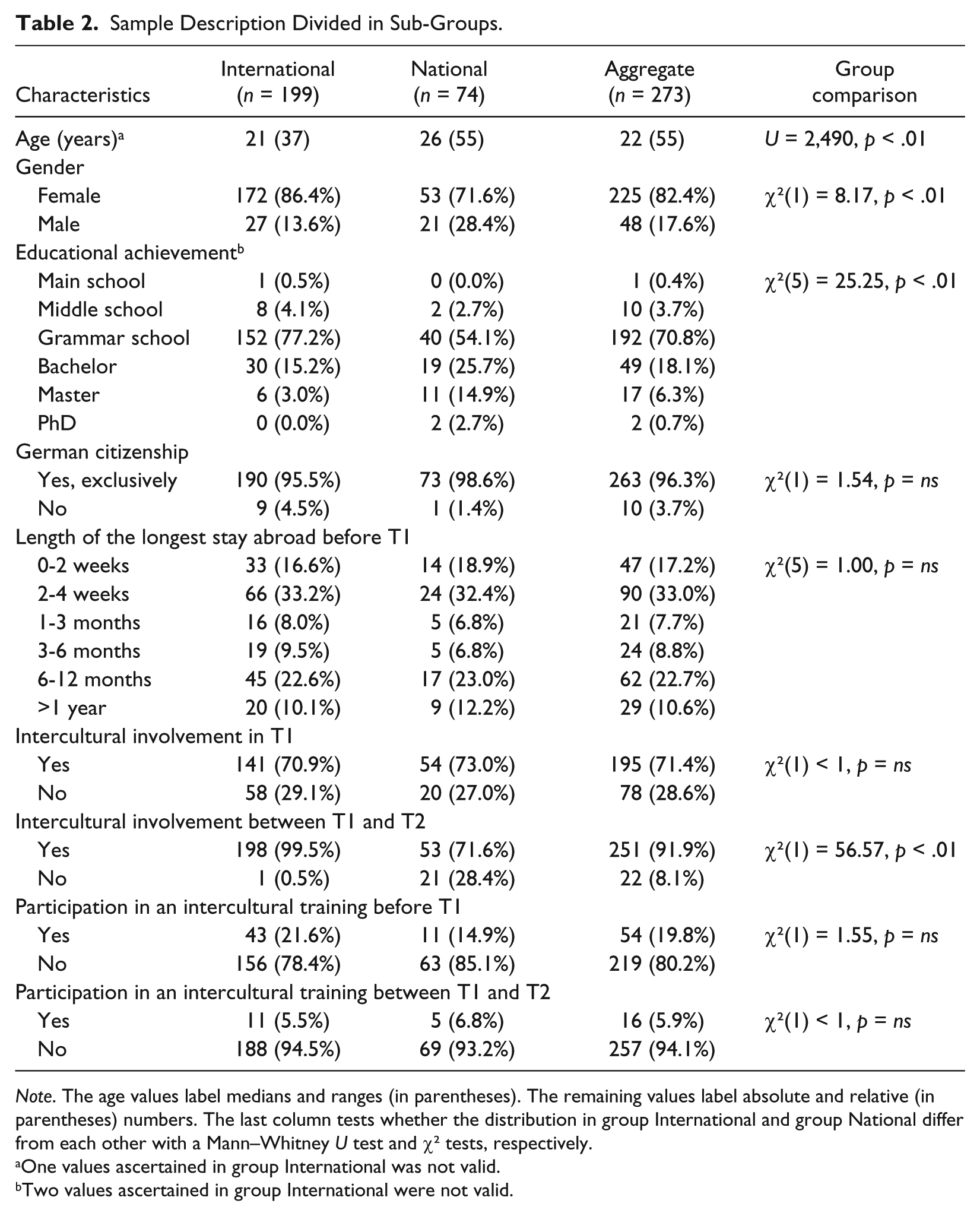
Note. The age values label medians and ranges (in parentheses). The remaining values label absolute and relative (in parentheses) numbers. The last column tests whether the distribution in group International and group National differ from each other with a Mann–Whitney U test and χ² tests, respectively.
One values ascertained in group International was not valid.
Two values ascertained in group International were not valid.
The interval between T1 and T2 for participants in group International (M = 98.64 days, SD = 7.34) and group National (M = 98.45 days, SD = 4.87) was also almost the same, t(197.82) < 1, p = ns. On average, participants in group International spent M = 89.82 days (SD = 5.92) abroad. Among these 199 participants, 75 participants (37.7%) completed a student exchange, 12 participants (6.0%) an internship abroad, 46 participants (23.1%) an au pair stay, 17 participants (8.5%) a voluntary service, and 49 participants (24.6%) a work-and-travel turn. The educational stays abroad took place in 44 different countries from seven continents (Europe: n = 74, 37.2%; Asia: n = 16, 8.0%; Africa: n = 5, 2.5%; North America: n = 42, 21.1%; South America: n = 11, 5.5%; Australia: n = 51, 25.6%). The most visited countries were the United States (n = 34, 17.1%), Australia (n = 31, 15.6%), and New Zealand (n = 20, 10.1%), followed by Great Britain, Spain (each n = 11, 5.5%), Canada (n = 8, 4.0 %), France, Sweden (each n = 7, 3.5%), Turkey (n = 6, 3.0%), Latvia, Norway, and the Netherlands (each n = 5, 2.5%).
Statistical Analyses
We used IBM SPSS Statistics 21.0 (IBM, 2012) to analyze descriptive statistics and Mplus 7.0 (Muthén & Muthén, 1998-2012) to calculate confirmatory factor analyses and latent change score models. With the confirmatory factor analyses, we tested whether our data fit the structure of the onion model of ICC (Schnabel et al., 2014), both in T1 and in T2. Each item of the TMIC-SA and of the TMIC-SJT loaded on the factor it should represent according to the onion model. Taking into account that the TMIC-SA contains continuous variables, while the variables of the TMIC-SJT are ordinal, we used the weighted least squares means and variance adjusted (WLSMV) estimator, which is a robust weighted least square estimator and computes factor loadings, structural coefficients, and robust standard errors more accurately than other estimators such as the maximum likelihood (ML) and the robust maximum likelihood (MLR) estimator (C.-H. Li, 2014; Schnabel et al., 2015).
We conducted the latent change score models with two points of measurement to test our hypotheses. In contrast to auto-regressive models, where change is measured “indirectly” through the residual variables in auto-regressions, change score models measure change directly through a latent difference variable representing interindividual differences in true intraindividual change over time. Accordingly, change scores are corrected for random measurement error. The crucial idea of change score models is that the manifest indicator in T2 is a function of the manifest indicator in T1 plus latent change between T1 and T2, that is the latent difference variable Diff = T2 – T1 (Geiser, 2013; McArdle, 2009). We used this latent difference variable as the criterion in linear regression analyses with our independent variable Location as the predictor (0 = National, 1 = International). Thus, we expected the resulting regression weights to be positive, indicating greater ICC increase in group International than in group National.
Results
Preliminary Analyses
Before testing our hypotheses, we conducted some preliminary analyses to investigate the quality of our data measured with the TMIC-S (Schnabel et al., 2015). To test whether the data fit the structure of the onion model of ICC (Schnabel et al., 2014), we calculated confirmatory factor analyses separately with the data from T1 and T2. For both points of measurement, we could find evidence for the assumed factor structure. The model fit was satisfactory, T1: χ2(419) = 525.60, p < .01, comparative fit index (CFI) = .92, Tucker–Lewis index (TLI) = .91, root mean square error of approximation (RMSEA) = .03, weighted root mean square residual (WRMR) = .85; T2: χ2(419) = 536.77, p < .01, CFI = .93, TLI = .93, RMSEA = .03, WRMR = .82, and all items, except for the TMIC-SJT item measuring Sensitivity in Communication in T1, showed significant loadings on the factors they should represent (see Table 3). Lower loadings of the items of the TMIC-SJT in contrast to the items of the TMIC-SA were in accordance with Schnabel et al. (2014) and Schnabel et al. (2015).
Standardized Factor Loadings (and Standard Errors) in the Confirmatory Factor Analysis.
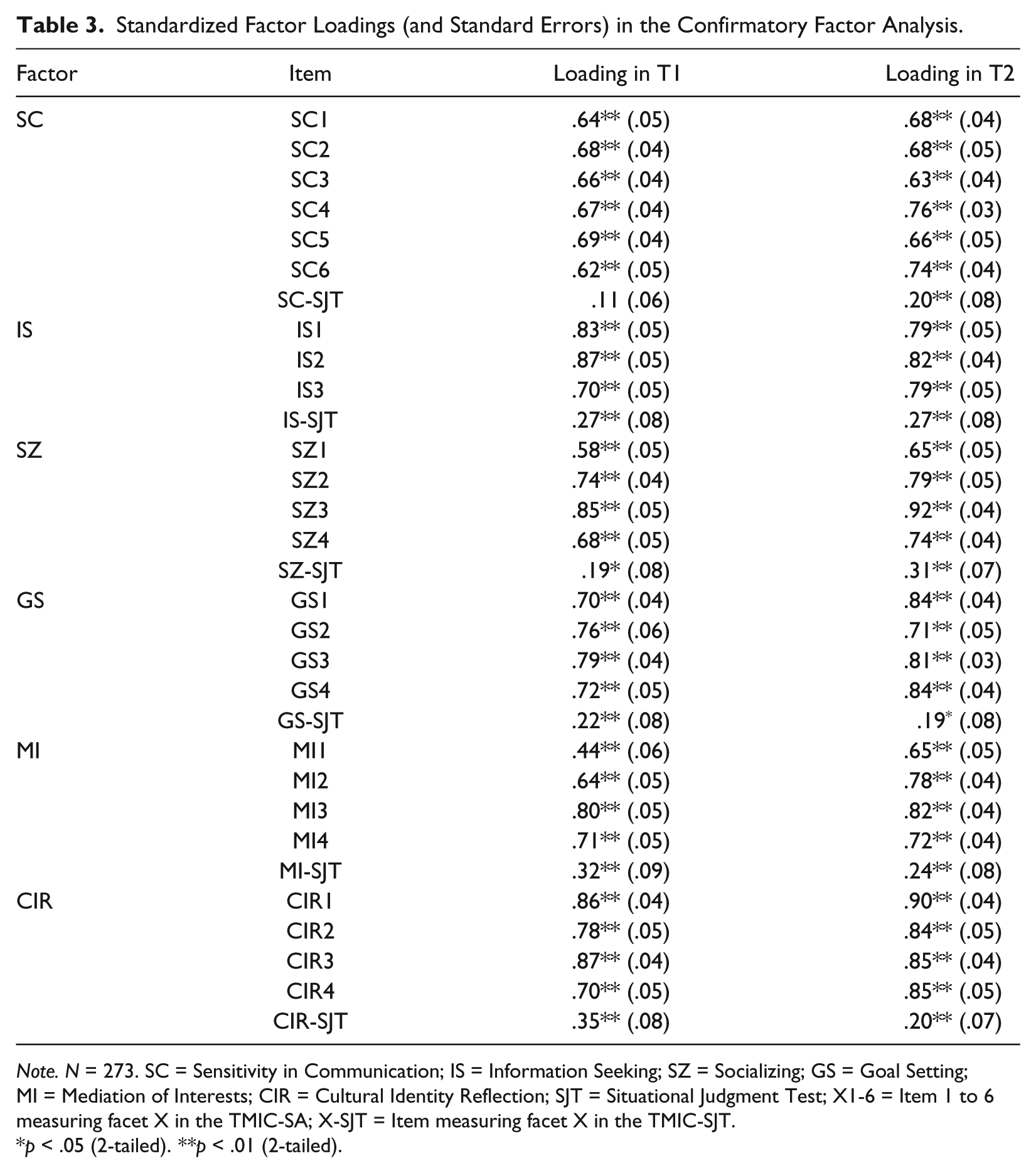
Note. N = 273. SC = Sensitivity in Communication; IS = Information Seeking; SZ = Socializing; GS = Goal Setting; MI = Mediation of Interests; CIR = Cultural Identity Reflection; SJT = Situational Judgment Test; X1-6 = Item 1 to 6 measuring facet X in the TMIC-SA; X-SJT = Item measuring facet X in the TMIC-SJT.
p
To test the relations between the facets of ICC, we calculated manifest correlations regarding global ICC and the ICC facets scores. Table 4 displays the correlations between the TMIC-SA and the TMIC-SJT in both points of measurement. Table 5 presents the manifest correlations of the TMIC-SA and the TMIC-SJT between T1 and T2. As depicted, corresponding ICC scores showed positive correlations with each other when measured with different questionnaires, again except for Sensitivity in Communication in T1 (r = .15 to r = .36, all p < .05), and at different points of measurement (r = .25 to r = .75, all p < .01). Also bearing the results from the confirmatory factor analyses in mind, these results indicate the TMIC-SA and the TMIC-SJT to have measured the same constructs (i.e., self-concept and behavioral perspectives, respectively) and to be reliable in terms of retest reliability.
Manifest Correlations of the TMIC-S Scores in Global ICC and in the ICC Facets Between the TMIC-SA and the TMIC-SJT.
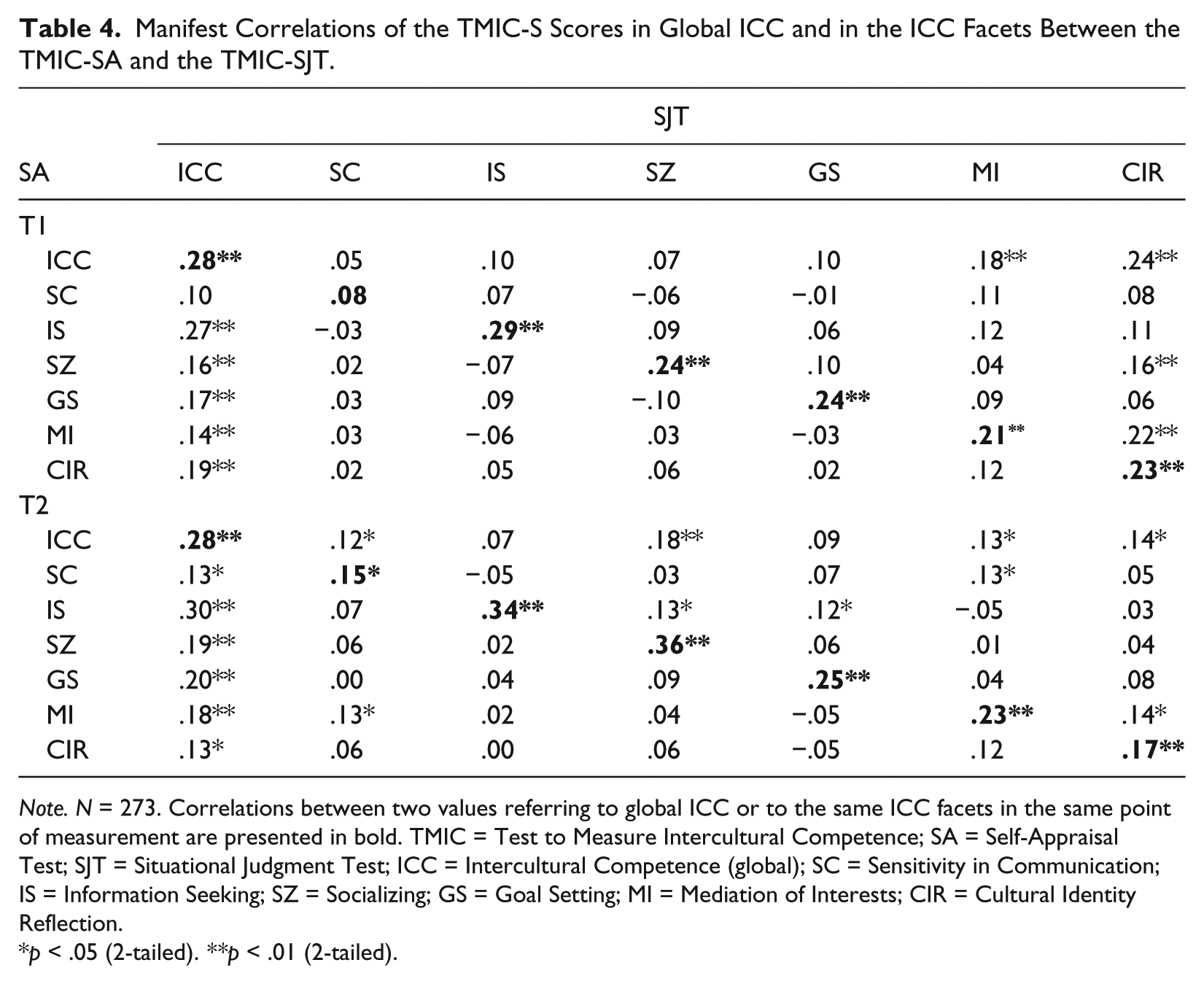
Note. N = 273. Correlations between two values referring to global ICC or to the same ICC facets in the same point of measurement are presented in bold. TMIC = Test to Measure Intercultural Competence; SA = Self-Appraisal Test; SJT = Situational Judgment Test; ICC = Intercultural Competence (global); SC = Sensitivity in Communication; IS = Information Seeking; SZ = Socializing; GS = Goal Setting; MI = Mediation of Interests; CIR = Cultural Identity Reflection.
p
Manifest Correlations of the TMIC-S Scores in Global ICC and in the ICC Facets Between T1 and T2.
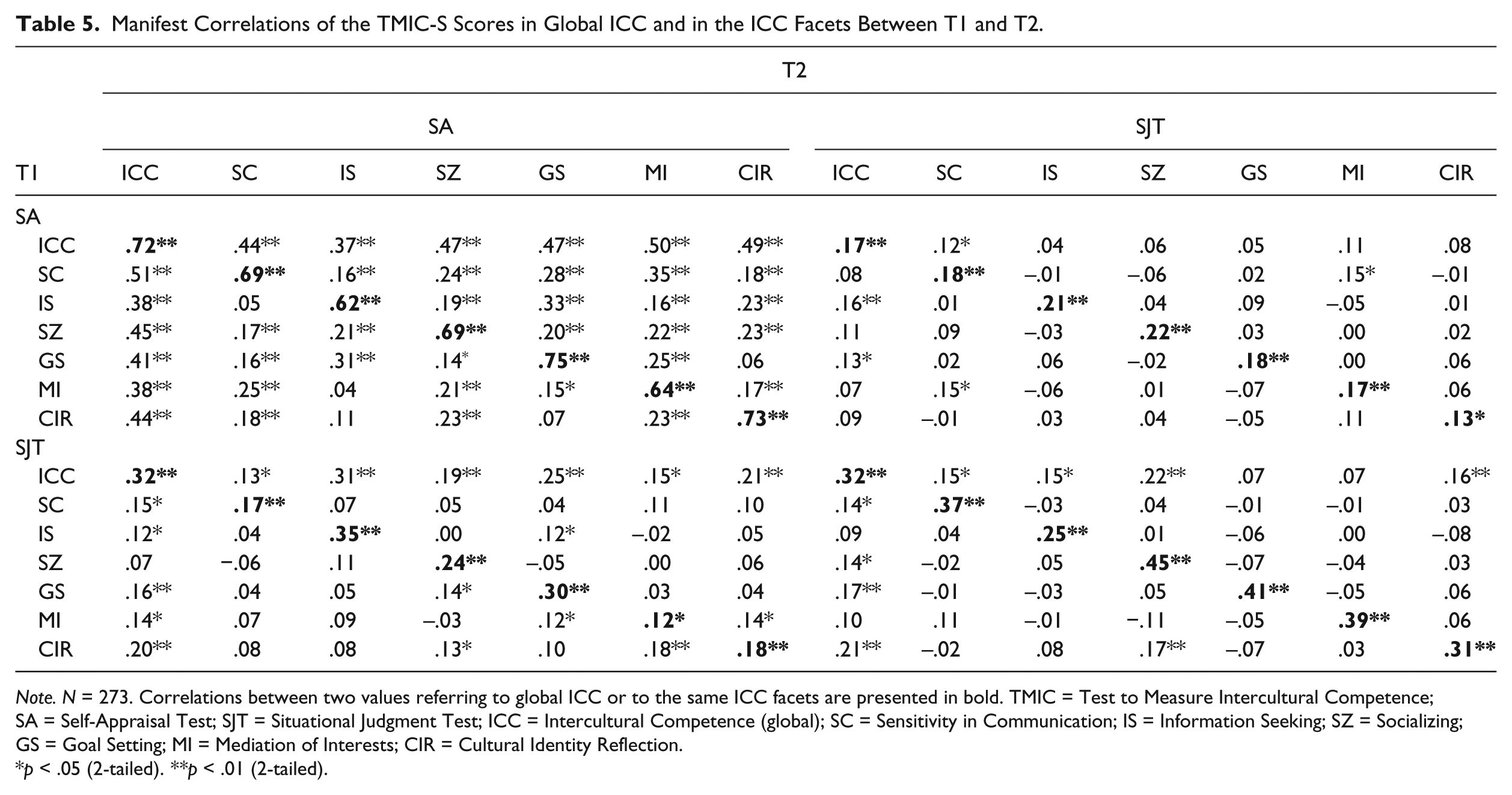
Note. N = 273. Correlations between two values referring to global ICC or to the same ICC facets are presented in bold. TMIC = Test to Measure Intercultural Competence; SA = Self-Appraisal Test; SJT = Situational Judgment Test; ICC = Intercultural Competence (global); SC = Sensitivity in Communication; IS = Information Seeking; SZ = Socializing; GS = Goal Setting; MI = Mediation of Interests; CIR = Cultural Identity Reflection.
p < .05 (2-tailed). **p
To investigate ICC changes between T1 and T2 separately for the two quasi-experimental groups as well as for the whole sample, we calculated paired sample t tests. Table 6 shows the manifest means and standard deviations as well as the effect sizes regarding the changes in the global ICC scores and in the ICC facets scores between the two points of measurement. Whereas the global ICC score measured with the TMIC-SA increased from MT1 = 4.51 (SDT1 = 0.50) to MT2 = 4.64 (SDT2 = 0.53) in group International, t(198) = 4.79, p < .01, d = 0.25, it did not significantly change between MT1 = 4.41 (SDT1 = 0.49) and MT2 = 4.38 (SDT2 = 0.47) in group National, t(73) < 1, p = ns. Similarly, the global ICC score measured with the TMIC-SJT increased from MT1 = 3.09 (SDT1 = 0.42) to MT2 = 3.17 (SDT2 = 0.35) in group International, t(198) = 2.26, p = .03, d = 0.20, but did not significantly change between MT1 = 3.14 (SDT1 = 0.43) and MT2 = 3.09 (SDT2 = 0.44) in group National, t(73) < 1, p = ns. We found analogous patterns for a number of ICC facets, with the highest effect size for Cultural Identity Reflection in group International. When measured with the TMIC-SA, the Cultural Identity Reflection score increased from MT1 = 4.16 (SDT1 = 1.07) to MT2 = 4.57 (SDT2 = 1.02) in group International, t(198) = 7.48, p < .01, d = 0.40, but did not significantly change between MT1 = 4.01 (SDT1 = 1.21) and MT2 = 3.96 (SDT2 = 1.12) in group National, t(73) < 1, p = ns. Using the TMIC-SJT, the Cultural Identity Reflection score increased from MT1 = 2.92 (SDT1 = 1.21) to MT2 = 3.22 (SDT2 = 0.99) in group International, t(198) = 3.16, p < .01, d = 0.27, but did not significantly change between MT1 = 2.97 (SDT1 = 1.11) and MT2 = 2.91 (SDT2 = 1.18) in group National, t(73) < 1, p = ns.
Means and Standard Deviations in Global ICC and in the ICC Facets.
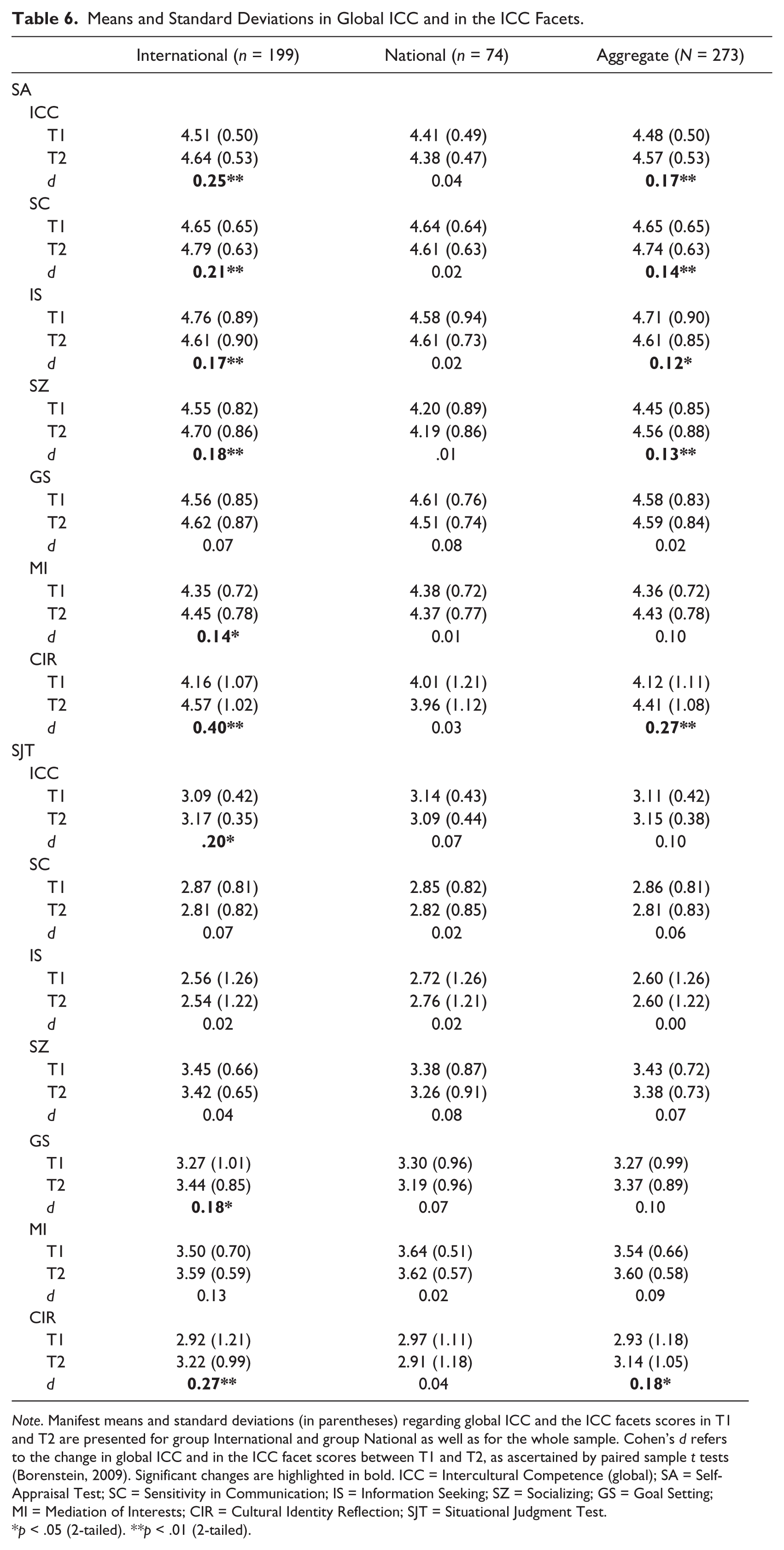
Note. Manifest means and standard deviations (in parentheses) regarding global ICC and the ICC facets scores in T1 and T2 are presented for group International and group National as well as for the whole sample. Cohen’s d refers to the change in global ICC and in the ICC facet scores between T1 and T2, as ascertained by paired sample t tests (Borenstein, 2009). Significant changes are highlighted in bold. ICC = Intercultural Competence (global); SA = Self-Appraisal Test; SC = Sensitivity in Communication; IS = Information Seeking; SZ = Socializing; GS = Goal Setting; MI = Mediation of Interests; CIR = Cultural Identity Reflection; SJT = Situational Judgment Test.
p < .05 (2-tailed). **p < .01 (2-tailed).
Testing the Hypotheses
To test our hypotheses, we calculated regression analyses within the framework of change score models, which allowed us to considerer changes in global ICC and ICC facets scores in the two quasi-experimental groups simultaneously. The results are provided in Table 7. As expected, our analyses with the TMIC-SA revealed positive regression weights for global ICC (β = 0.16, p < .01, 95% confidence interval [CI] [0.05, 0.27]), Sensitivity in Communication (β = 0.19, p < .01, 95% CI [0.08, 0.29]), Socializing (β = 0.17, p < .01, 95% CI [0.07, 0.28]), and Cultural Identity Reflection (β = 0.23, p < .01, 95% CI [0.13, 0.34]). That is, participants in group International (coded as 1) showed greater increase between T1 and T2 in global ICC as well as in the facets Sensitivity in Communication, Socializing, and Cultural Identity Reflection than participants in group National (coded as 0). In contrast to our hypotheses, we found no positive regression weights for Information Seeking, Goal Setting, and Mediation of Interests, implying that participants in group International and in group National did not differ regarding their change in these facets between T1 and T2. For the TMIC-SJT, we found a slightly different pattern: In line with our predictions, we found positive regression weights for global ICC (β = 0.15, p < .01, 95% CI [0.06, 0.24]), Socializing (β = 0.10, p = .05, 95% CI [0.00, 0.20]), Goal Setting (β = 0.13, p < .01, 95% CI [0.04, 0.22]), and Cultural Identity Reflection (β = 0.12, p < .01, 95% CI [0.04, 0.21]). However, the regression weights regarding Sensitivity in Communication, Information Seeking, and Mediation of Interests were non-significant. Thus, as we had expected, the increase in global ICC, Socializing, Goal Setting, and Cultural Identity Reflection between T1 and T2 was greater for participants in group International than for participants in group National, but in contrast to our predictions, participants in both groups did not differ in respect to their change in Sensitivity in Communication, Information Seeking, and Mediation of Interests. In summary, we found empirical evidence for our first hypothesis (i.e., increase in global ICC), whereas our hypotheses referring to the six different ICC facets could only be confirmed partially.
Standardized Model Results.
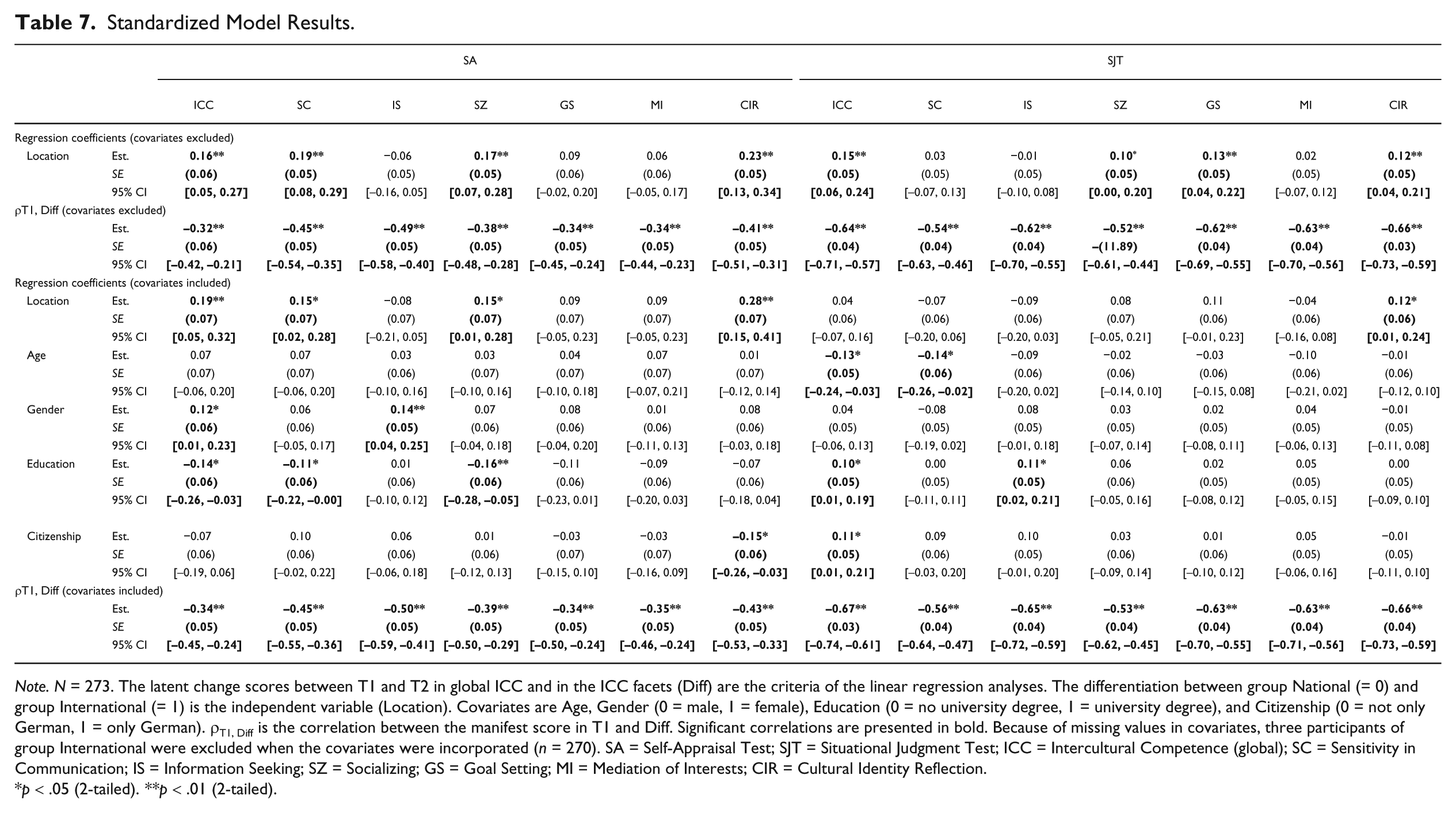
Note. N = 273. The latent change scores between T1 and T2 in global ICC and in the ICC facets (Diff) are the criteria of the linear regression analyses. The differentiation between group National (= 0) and group International (= 1) is the independent variable (Location). Covariates are Age, Gender (0 = male, 1 = female), Education (0 = no university degree, 1 = university degree), and Citizenship (0 = not only German, 1 = only German). ρT1, Diff is the correlation between the manifest score in T1 and Diff. Significant correlations are presented in bold. Because of missing values in covariates, three participants of group International were excluded when the covariates were incorporated (n = 270). SA = Self-Appraisal Test; SJT = Situational Judgment Test; ICC = Intercultural Competence (global); SC = Sensitivity in Communication; IS = Information Seeking; SZ = Socializing; GS = Goal Setting; MI = Mediation of Interests; CIR = Cultural Identity Reflection.
p < .05 (2-tailed). **p < .01 (2-tailed).
To investigate ICC change in more detail, we examined the correlations between the Diff scores and the manifest scores in T1. As depicted in the second column of Table 7, all correlations were negative for both the TMIC-SA (r = −.49 to r = −.32, all p < .01.) and the TMIC-SJT (r = −.66 to r = −.52, all p < .01). These negative correlations can be interpreted as a successful gain of ICC: The increase in ICC was greater for participants with smaller ICC scores than for participants with higher ICC scores in T1.
Because the two quasi-experimental groups differed regarding their demographics, it might be possible that our findings were due to these variables rather than due to the participants’ residence between T1 and T2. We therefore repeated our analyses adding Age, Gender (0 = male, 1 = female), Education (0 = no university degree, 1 = university degree), and Citizenship (0 = not only German, 1 = only German) as additional predictors in the regression analyses. Thus, we controlled for their effects on ICC development. As depicted in Table 7, positive regression weights for global ICC (β = 0.19, p < .01, 95% CI [0.05, 0.32]), Sensitivity in Communication (β = 0.15, p = .03, 95% CI [0.02, 0.28]), Socializing (β = 0.15, p = .04, 95% CI [0.01, 0.28]), and Cultural Identity Reflection (β = 0.28, p < .01, 95% CI [0.15, 0.41]) could still be found with the TMIC-SA when the covariates were included in the analyses. In addition, we found an effect of Gender on global ICC (β = 0.12, p = .04, 95% CI [0.01, 0.23]) and Information Seeking (β = 0.14, p = .01, 95% CI [0.04, 0.25]), of Education on global ICC (β = −0.14, p = .02, 95% CI [−0.26, −0.03]), Sensitivity in Communication (β = −0.11, p = .05, 95% CI [−0.22, −0.00]), and Socializing (β = −0.16, p < .01, 95% CI [−0.28, −0.05]), and of Citizenship on Cultural Identity Reflection (β = −0.15, p = .02, 95% CI [−0.26, −0.03]). After including the covariates in our analyses with the TMIC-SJT, only the regression weight for Cultural Identity Reflection (β = 0.12, p = .04, 95% CI [0.01, 0.24]) remained significant. Instead, we found significant effects of Age on global ICC (β = −0.13, p = .02, 95% CI [−0.24, −0.03]) and Sensitivity in Communication (β = −0.14, p = .02, 95% CI [−0.26, −0.02]), of Education on global ICC (β = 0.10, p = .04, 95% CI [0.01, 0.19]) and Information Seeking (β = 0.11, p = .02, 95% CI [0.02, 0.21]), and of Citizenship on global ICC (β = 0.11, p = .04, 95% CI [0.01, 0.21]). The negative correlations between the latent Diff scores and the manifest scores in T1 could be replicated for global ICC and for all ICC facets with both the TMIC-SA (r = −.50 to r = −.34, all p < .01) and the TMIC-SJT (r = −.67 to r = −.53, all p < .01) even after including the covariates.
Discussion
The objective of the present study was to investigate the effect of international experiences on ICC development with a quasi-experimental longitudinal design. By including a relatively large sample consisting of students and non-students, by contrasting individuals going abroad with a comparison group of individuals staying in Germany, and by disregarding any program evaluation, we tried to avoid the methodological weaknesses we had pointed out for previous investigations. In addition, the integration of the TMIC-SA and the TMIC-SJT allowed us to examine ICC development multi-methodically and to identify differences in ICC development when ICC is measured with a self-appraisal test and with a situational judgment test, respectively.
Change in Global ICC
As we had predicted in Hypothesis 1, we could provide empirical evidence that educational stays abroad lead to an increase in global ICC after 3 months. This finding is in line with previous studies that found an increase in ICC in different cultural contexts, for example, regarding students from the United States who spent one semester in France (Engle & Engle, 2004) or in different French- or Spanish-speaking countries (Paige et al., 2004), regarding volunteers from Great Britain and Switzerland who took part in a voluntary project in Ecuador (Fantini & Tirmizi, 2006), or regarding high school students from nine different countries who spent one school year abroad, particularly in the United States (Hammer, 2005). Also, our results provide longitudinal support for Schnabel et al.’s (2015) correlational finding that Germans (and Brazilians) with international experience of more than 3 months had higher scores in different facets of the TMIC-S.
The finding of an increase in ICC after only 3 months is particularly remarkable, bearing in mind that prior empirical studies, which investigated ICC development during relatively short periods of only a few months, revealed ambiguous results. For example, Kitsantas (2004) found an increase in ICC for students from the United States who spent 3 to 6 weeks in different European countries. Similarly, Black and Duhon (2006) found students from the United States to show higher ICC after a 1-month study stay in England. Yet Anderson et al. (2006) found only marginally significant gains in ICC for students from the United States who spent 4 weeks in England and Ireland. Stewart et al. (2014) also reported only marginally significant increases in ICC for volunteers who spent 3 to 6 weeks in China and Zimbabwe. In a study by Leong (2007), students from Singapore showed no gain in ICC after an exchange program of 3 to 4 months. A similar result emerged in a study by Savicki, Downing-Burnette, Heller, Binder, and Suntinger (2004) regarding students from the United States who spent 3 months abroad.
Maybe, the increase in ICC after only 3 months in our study might have been promoted by the fact that the majority of our participants spent their time abroad in Anglo-American countries, which are culturally similar rather than dissimilar to Germany. As predicted in the culture learning theory (Ward, 1996; Ward et al., 2001; Wilson et al., 2013), the transfer of skill-based ICC is more effective in culturally similar than in culturally dissimilar settings. In line with this, Wilson et al. (2013) showed cultural distance to be negative correlated to intercultural adaptation. Notably, even though the participants of our study demonstrated a global ICC increase after only 3 months, a further increase in global ICC can be expected in the case of a longer time spent abroad. As shown in various studies (e.g., Behrnd & Porzelt, 2012; Engle & Engle, 2004; Wilson et al., 2013), a longer time abroad is associated with higher ICC.
Whereas the increase in global ICC measured with the TMIC-SA even occurred over and above age, gender, educational achievement, and citizenship, we could not replicate the increase in global ICC when ICC was measured with the TMIC-SJT and the covariates were included. Beside the possibility that our results could have been biased by the inclusion of the covariates, it might be possible that individuals abroad need more time to change their behavioral preferences in precisely specified intercultural situations as opposed to their self-concept of ICC. Compared with the self-concept of ICC, behavioral preferences in intercultural situations might be more related to the construct of intercultural adaptation. Importantly, research in the context of the culture learning theory (Ward, 1996; Ward et al., 2001; Wilson et al., 2013) has found intercultural adaptation difficulties to be greatest on arrival to a new culture and to predictably decrease over time (e.g., Ward et al., 1998; Wilson et al., 2013). Moreover, the TMIC-SA assesses the self-concept of ICC rather independently from concrete situations. While the self-concept of ICC can refer to quantitative changes of the same behavior (e.g., using a larger part of one’s free time to cultivate contacts deeper than before), a change of behavioral preferences, as measured with the TMIC-SJT, requires the selection of a completely different behavior (i.e., choosing another behavioral alternative). Therefore, the TMIC-SA might detect slight changes in ICC development rather than the TMIC-SJT. Also, the fact that the TMIC-SJT consists of only six items with four response categories, whereas the TMIC-SA entails 25 items with six response categories and might therefore be the more reliable instrument, could be an explanation for why the significant increase in global ICC during international experience could be found when covariates were included only with the TMIC-SA.
Change in the Facets of ICC
In addition to the investigation of global ICC development, we considered the six facets of the onion model of ICC (Schnabel et al., 2014) separately. Using the TMIC-SA, we could replicate our finding concerning global ICC for the three facets Sensitivity in Communication, Socializing, and Cultural Identity Reflection. Regarding the TMIC-SJT, only Cultural Identity Reflection showed a significant increase during international experiences when the covariates were included. Altogether, the increase in global ICC for the participants abroad showed to result from an increase in the facets Sensitivity in Communication, Socializing, and Cultural Identity Reflection. Thus, Hypothesis 2.1, Hypothesis 2.3, and Hypothesis 2.6 could be supported.
It remains an open question why the facets Information Seeking (Hypothesis 2.2), Goal Setting (Hypothesis 2.4), and Mediation of Interests (Hypothesis 2.5) did not seem to play a decisive role in the development of ICC in the context of stays abroad. Taking a closer look at the items measuring Information Seeking (cf. Table 1), it is remarkable that the items do not only refer to the purposeful collection of information about a foreign country or another culture, but—more exactly—to the purposeful collection of information about a foreign country or another culture before a stay abroad has started. Hence, it seems plausible that the participants who went abroad noted during their stay that they had prepared their stay abroad well enough from home. Rather than concluding that they should have prepared themselves more intensively before their departure, they could have learnt that it can be another appropriate way to get information about another culture on the spot. Regarding Goal Setting and Mediation of Interests, one might suppose that it takes longer than 3 months until one develops clear goals and starts to mediate between parties during an educational stay abroad. If sojourners arrive in a new cultural setting, one of their first objectives may be to orientate themselves and to make friends as soon as possible. As they might therefore talk a lot to local persons and try to establish contact with them quickly and easily, it is reasonable that they improve their skills in Sensitivity in Communication and Socializing in only 3 months. In contrast, one might speculate that sojourners would start to set and implement personal goals as well as to mediate between different interests in a new cultural environment only after they feel fairly settled and have somewhat socialized.
Even though these deliberations are rather hypothetical, they are largely in accordance with Schnabel et al. (2015), who found their German participants with international experience of at least 3 months not to differ in the facets Goal Setting and Mediation of Interests as opposed to their participants without international experience of at least 3 months. Also in line with the results of our study, the German participants in Schnabel et al.’s (2015) study with 3-month international experience scored higher in the facets Socializing and Cultural Identity Reflection. As opposed to our study, they also scored slightly higher in Information Seeking, but not in Sensitivity in Communication. However, this pattern was different in the Brazilian sample, where participants with 3-month international experience scored higher in Sensitivity in Communication, but not in Information Seeking. Notably, Goal Setting was the only facet for which Schnabel et al. (2015) found no positive relation with 3-month international experience, with involvement in intercultural matters, or with previous participation in an intercultural training, neither in the German sample nor in the Brazilian sample. Taking together these findings and the findings of our study, it seems questionable in how far the facet Goal Setting actually describes a malleable ability, as proposed by Schnabel et al. (2014) and Schnabel et al. (2015).
Comparing the change between the six ICC facets, Cultural Identity Reflection showed to benefit most from educational stays abroad. Regarding the TMIC-SA, we found the greatest increase for Cultural Identity Reflection. Regarding the TMIC-SJT, Cultural Identity Reflection was even the only facet for which we found an increase when the covariates were included. These results are in line with Schnabel et al. (2015), who found their German participants with 3-month intercultural experience as opposed to their German participants without 3-month intercultural experience to differ most in the Cultural Identity Reflection facet. Maybe, international experience has a greater impact on the development in Cultural Identity Reflection than on the development in the other facets measured with the TMIC-S, because Cultural Identity Reflection is the only facet which is specific to intercultural matters. Skills such as Sensitivity in Communication and Socializing seem to be helpful to succeed not only in intercultural situations but also in other life domains (e.g., work life, friendship, partnership) and should be promoted not only by intercultural situations but also by non-intercultural situations. In contrast, Cultural Identity Reflection has an apparent relatedness to interculturality. Hence, it would be plausible that this facet is particularly promoted in situations with people from other cultures.
Limitations
The implementation of our research as a quasi-experimental longitudinal field study with two online questionnaires had certain limitations regarding the internal validity. Because of the realization as an online study, we could not ensure homogeneous testing conditions. Because the participation in our study was completely anonymous, we could verify neither the correctness of the demographics nor the sincerity with which our participants completed the questionnaires. Yet we assumed that most of our participants had sought an appropriate place to complete the questionnaires and had responded truthfully, because the main motivation for taking part in our study might have been to receive a (correct) feedback of ICC afterward (92.7% of the participants made use of this opportunity, whereas only 82.8% took part in the voucher lottery). For the same reason, we saw no essential problem in the possibility of a social desirability bias.
Due to the quasi-experimental approach, we could not randomly distribute our participants to one of the two experimental conditions. Instead, the two groups in our study were not fully comparable. Differences between group International and group National concerned their demographics. In particular, the participants in group International were around five years younger than the participants in group National. However, regarding their intercultural experiences as well as their ICC in the first point of measurement, the participants in both groups were largely similar. Moreover, participants’ initial level of ICC did largely not depend on their age. Due to the differences between the two quasi-experimental groups regarding their demographics, we considered the demographics as covariates in the analyses to test our hypotheses. Because the differences between group International and group National could in this sense be “controlled,” we believe that group National represented an adequate comparison group to investigate the development of ICC in group International. Maturity, testing effects, and influences of history could be excluded as alternative explanations for the change of ICC in group International by the non-equivalent control group design.
Whereas threats of internal validity should have been reduced as much as possible, it has to be reminded that our sample is highly self-selected and not at all representative of the German population. Instead, the high ratio of young, educated, and female people seems to be typical for the population undertaking educational stays abroad. The fact that our study included the wide spectrum of educational stays abroad according to Weichbrodt (2014) in a variety of countries accounts for the generalization of our findings on the different types of educational stays abroad. Nevertheless, one should bear in mind that international experiences such as school exchange, working abroad, or emigration were not the object of our investigation.
Implications
The results of our study support the assumption that educational stays abroad lead to an increase in ICC. Thus, providers of educational stays abroad are rightly allowed to advertise the positive effects of their programs concerning ICC development. Personnel managers can use educational stays abroad as an indicator for their applicants’ ICC. Public investments in programs such as Erasmus+ can be justified because of yielding interculturally competent citizens, who may contribute both to the competitiveness of their own country in a global market economy and to a peaceful coexistence together within their own borders.
Regarding the current tensions due to the increase in cultural heterogeneity in Europe, an important question arising from this study is whether the results can be applied to other populations and other forms of stays abroad. Theoretically, it could be assumed that not only individuals from Germany going abroad but also migrants and refugees coming to Europe improve their ICC over time through intercultural experience, which might lead to a better integration of this group of people into the local societies. Because of its cross-cultural applicability (Schnabel et al., 2015), the TMIC-S could be used to investigate refugees’ ICC development empirically.
However, returning to ICC development during educational stays abroad, some questions remain still unanswered. For example, the design of our study does not allow to draw conclusions about the mechanisms which facilitate the development of ICC during international experiences. According to the developmental model of intercultural sensitivity (Bennett, 1986, 1993, 2004), the culture learning theory (Ward, 1996; Ward et al., 2001; Wilson et al., 2013), and the experimental learning theory (Kolb, 1984; Kolb et al., 2001), intercultural contact and cognitive processing during a stay abroad might be crucial. To investigate intercultural contact during stays abroad in more detail, researchers in follow-up studies could make use of the name generator technique (Burt, 1984; Campbell & Lee, 1991), where sojourners are asked to designate those persons with whom they have relevant supportive relationships during a certain period of time (e.g., Zimmermann & Neyer, 2013). To detect cognitive processes during intercultural experiences, qualitative methods could be integrated (e.g., Fantini & Tirmizi, 2006; Moghaddami-Talemi, 2014).
Perhaps, study designs with longer periods and more points of measurement could reveal increases in all ICC facets. Building on our speculations above, an increase could for example be expected in Goal Setting and Mediation of Interests when individuals spent a longer time than only 3 months abroad. Another question concerns the sustainability of ICC increase after educational stays abroad. Following the developmental model of intercultural sensitivity (Bennett, 1986, 1993, 2004), regression on the intercultural development continuum seems to be unlikely. Furthermore, it seems possible that ICC development might continue even after the end of a stay abroad when returnees experience their own culture under the impression they received from the foreign culture (cf. Thomas, 1999). Future research has to test these assumptions empirically.
Coming back to the different facets of ICC, it would be interesting to contrast international experiences with intercultural trainings. International experiences afford the opportunity to test interculturally competent behavior “in its entirety” in a real-life context. In comparison, intercultural trainings should rather enable one to focus on separate facets of ICC, but usually under artificial conditions (cf. Schnabel et al., 2016). Thus, it seems plausible that international experience and intercultural trainings might have differential effects on the development of specific ICC facets. It is possible that international experience and intercultural trainings are rather complementary than competitive ways to develop ICC.
Finally, the present study demonstrates the additional value of not only assessing ICC globally, but of also considering the individual facets of the construct. As we showed, the effect of educational stays abroad on the development of ICC was highly different regarding the particular facets. In other fields of psychology, a differentiated view on global constructs such as ICC is rather common than exceptional. For example, in research on intelligence, we are often more interested in specific abilities, such as verbal comprehension, perceptual reasoning, and so on, than in global IQ values (e.g., Petermann, 2012). Similarly, it might be worth investigating a person’s ICC not only in the sense of a global ICC score but also regarding the individual ICC facets. Thus, we encourage researchers in the future to take the different facets of ICC into account. Perhaps, a more detailed knowledge about facets that (are assumed to) constitute ICC could also help to reach greater consensus concerning the question how ICC is to define.
Footnotes
Acknowledgements
We are indebted to Jens Möller, Deborah Schnabel, and Salome Becker for their helpful comments.
Declaration of Conflicting Interests
The author(s) declared no potential conflicts of interest with respect to the research, authorship, and/or publication of this article.
Funding
The author(s) received no financial support for the research, authorship, and/or publication of this article.