






Abstract
Cross-cultural research on personality has often led to surprising and countertheoretical findings, which have led to concerns over the validity of country-level estimates of personality (e.g., Heine, Buchtel, & Norenzayan, 2008). The present study explores how cross-cultural differences can be indexed via revealed trait estimates, which index the personality traits of individuals or groups indirectly through their likelihood of responding in particular ways to particular situations. In two studies, we measure self-reports of personality, revealed traits, and revealed preferences for different expected effects (e.g., experiencing excitement) of two cultural groups (U.S. and Singaporean participants). We found typical East–West differences in personality using self-report scales, such as lower levels of Conscientiousness- and Extraversion-related characteristics among Singaporean participants relative to U.S. participants. We found evidence of scale use extremity differences in self-report personality scales but not in revealed trait estimates. Using revealed traits, we found evidence of strikingly high levels of similarity in terms of overall action endorsement, revealed trait estimates, and revealed preferences. However, this was qualified by consistent differences in revealed trait estimates of Extraversion-related characteristics and less consistent differences in revealed trait estimates of Conscientiousness-related characteristics. We also found consistent differences in preferences for different expected effects; for example, Singaporean participants reported lower likelihood of performing actions expected to result in experiencing stimulation or excitement than U.S. participants. Results suggest that similarities in action endorsements and revealed traits may be driven by common preferences for social inclusion and benevolence, and differences may be driven by differing preferences for expending effort, experiencing stimulation, and social attention.
How do we estimate personality differences between cultural groups? One way is to collect self- or other-reports of the personality construct from people in each culture (e.g., the United States and Singapore), and then compare their mean levels (e.g., cultural difference in Conscientiousness between the United States and Singapore = MUS − MSG). Many studies have followed this procedure (Benet-Martínez & Karakitapoglu-Aygün, 2003; Gosling, Rentfrow, & Swann, 2003; McCrae, Terracciano, & Personality Profiles of Cultures Project, 2005; McCrae, Yik, Trapnell, Bond, & Paulhus, 1998; Mõttus, Allik, & Realo, 2010; Mõttus, Allik, Realo, Pullmann, et al., 2012; Mõttus, Allik, Realo, Rossier, et al., 2012; Schmitt, Allik, McCrae, & Benet-Martínez, 2007). However, this approach raises several methodological concerns, such as reference group effects (Heine et al., 2008; Heine, Lehman, Peng, & Greenholtz, 2002; Mõttus, Allik, Realo, Rossier, et al., 2012; Wood & Rogers, 2011), differences in response style (Hamamura, Heine, & Paulhus, 2008; Mõttus, Allik, Realo, Pullmann, et al., 2012), and the activation of cultural mind-sets (Chen, Lam, Buchtel, & Bond, 2013). These concerns are bolstered by negative correlations between mean-level traits and people’s perceptions of their own culture (McCrae & Terracciano, 2006), as well as other criterion validity issues (e.g., Conscientiousness and Gross Domestic Product; Heine et al., 2008; Oishi & Roth, 2009).
In the current study, we introduce a new methodology for assessing the personality traits of individuals or groups. Specifically, we adapt revealed preference methodology (Eastwick & Finkel, 2008; Fisman, Iyengar, Kamenica, & Simonson, 2008; Samuelson, 1948; Wood & Brumbaugh, 2009) to estimate traits indirectly through the endorsement of trait-relevant actions. In this revealed traits technique, the trait tendencies of individuals or groups are manifested through their performance or nonperformance of actions characterized as trait relevant by a consensus of judges. This technique can be used either by observing the individual’s actual responses in a large number of situations or by surveying how the individual would be likely to respond to hypothetical situations. For instance, “telling a stern professor that their answer is wrong in a large lecture class” might be characterized as a fairly assertive action. Then, rather than directly asking participants to rate how assertive they are, the revealed traits technique indirectly measures assertiveness by correlating one’s likelihood of performing a wide range of actions such as these with the extent to which those actions have been judged by others to be assertive. Following from a functionalist understanding that “things are what they do” (Tomasello, 2002), an individual’s trait level can be operationalized as that individual’s likelihood of doing trait-identifying actions (e.g., Buss & Craik, 1983; Wood, Tov, & Costello, 2015). Similarly, the trait tendencies of a cultural group can be defined as the mean likelihood of performing trait-identifying actions across members of that group. This method provides ecological meaning to abstract trait terms like Extraversion and Conscientiousness by showing how such tendencies are revealed in actions that people are likely to perform within a particular environment.
Given the continued controversy over cross-cultural differences in personality trait levels in general (e.g., Oishi & Roth, 2009), and East–West differences in Conscientiousness in particular (e.g., Heine et al., 2008), we employ this method to examine differences between two cultural samples (the United States and Singapore) in Conscientiousness and other Big-Five-related traits. We explore several questions. First, we examine the extent to which action tendencies are similar across cultures. As we detail below, a unique advantage of revealed preference methodologies is that they permit a deeper understanding of cross-cultural similarities than is typically possible with nonsignificant mean differences. Second, we examine whether previously estimated East–West differences in Conscientiousness and other Big Five traits replicate using this revealed trait methodology. Third, we examine how the expected effects of an action (e.g., fulfilling commitments to others; Wood, Tov, & Costello, 2015) are related to action likelihoods across cultures, which may help provide functional or contingency-based explanations for cultural similarities and differences. Such explanations elucidate why action likelihoods and revealed traits differ across cultures. For instance, it may be that different levels of Conscientiousness are explained by differences in the preference for fulfilling commitments to others. In all, these studies shed light on cross-cultural similarities and differences in personality.
We continue by reviewing previous research on personality trait differences between people from Eastern and Western cultures. Then, we describe the current state of understanding of cross-cultural similarities in psychological variables. Finally, we elaborate on the particulars of the revealed trait methodology, and how this method may inform understanding on these topics.
East–West Differences in Personality: Real or Illusory?
Cross-cultural differences in personality are typically investigated by comparing aggregated self-reports. For example, of 10 cultural groups studied, East Asians scored among the lowest on all of the Big Five traits (Schmitt et al., 2007). With regard to Conscientiousness in particular, Schmitt and colleagues (2007) remarked that “it is equally surprising to see Chinese, Korean, and Japanese people at the very bottom” (p. 206). The tendency for East Asian individuals to rate their own (individual) Conscientiousness lower than members of other cultural groups has been observed cross-culturally (Heine et al., 2008; McCrae et al., 2005; Mõttus et al., 2010, Mõttus, Allik, Realo, Pullmann, et al., 2012; Mõttus, Allik, Realo, Rossier, et al., 2012; Oishi & Roth, 2009) and intraculturally between Asian and European Americans (Benet-Martínez & Karakitapoglu-Aygün, 2003; Gosling, Rentfrow, & Swann, 2003; McCrae et al., 1998).
This finding has been criticized despite its regular recurrence, with critiques focusing on two primary concerns. First, Asian individuals and others typically describe Asian groups as being higher on Conscientiousness-related traits (No et al., 2008; Terracciano et al., 2005). In and of itself, this finding does not undermine the reality of cultural differences as it could simply reflect inaccurate cultural stereotypes (McCrae & Terraciano, 2006; McCrae et al., 2010). A more troubling observation is that between-nation variation in these cultural stereotypes—and not aggregate levels of self-reported Conscientiousness—relates to relevant criteria such as life expectancy, GDP, and country-level corruption in a more theoretically consistent manner (Heine et al., 2008; Mõttus et al., 2010; Oishi & Roth, 2009). For instance, life expectancy correlates positively with cultural stereotypes of Conscientiousness and negatively with aggregated self-reports of Conscientiousness. As others have argued (e.g., Heine et al., 2008), aggregated self-reports of personality may be poor indicators of real cultural differences in personality—how individuals in these cultures actually behave rather than just how they see themselves. Aggregated self-reports of personality could be biased due to a range of response artifacts. Because the range of national differences in trait levels should be much smaller than individual differences, rating biases need not be large at the individual level to obscure national differences.
One possible factor obscuring cultural differences is the reference group effect (Heine et al., 2008, 2002; Mõttus, Allik, Realo, Rossier, et al., 2012; Wood & Rogers, 2011); that is, the tendency for individuals to evaluate themselves relative to a specific group. Because the members of different cultures are likely to have different reference groups, cultural comparisons of abstract self-ratings may be invalid (Heine et al., 2002). If there is a stereotype (true or not) that the culture has high levels of a trait, and an individual’s own trait rating is influenced by this referent standard, the rank ordering of nations could be seriously disrupted. Heine and colleagues (2002) found that differences in independence and interdependence between European Canadians, Japanese Canadians, and Japanese individuals matched theoretical predictions once they controlled for possible reference group effects. However, controlling for reference group effects in cross-cultural comparisons of Conscientiousness had a negligible impact (Mõttus, Allik, Realo, Rossier, et al., 2012).
Differences in response styles may further complicate cross-cultural comparisons. Response styles are systematic tendencies to respond to items in a certain way, irrespective of the content of the scale. For example, extreme responding is the tendency to use the extreme points of the scale (e.g., 1’s and 5’s on a 1-5 scale) versus more moderate scale points (see Paulhus, 1991, for a review of common response styles). Previous research has found a greater tendency for moderate responding among Asian Americans than European Americans (Hamamura et al., 2008), potentially obscuring real cultural differences in aggregated self-reports. However, it seems that correcting for response styles, much like correcting for reference group effects, does not fully ameliorate the issue (Mõttus, Allik, Realo, Pullmann, et al., 2012).
Cross-cultural comparisons of personality are thus complicated by potential artifacts that are not completely resolved by attempts to statistically control for them (Mõttus, Allik, Realo, Pullmann, et al., 2012; Mõttus, Allik, Realo, Rossier, et al., 2012). Notably, cross-cultural research on Conscientiousness has almost exclusively relied on abstract items such as adjectives or decontextualized behavioral descriptions (e.g., the Big Five Inventory or Revised NEO Personality Inventory; Schmitt et al., 2007). As reference group effects are stronger when items are more abstract (Biernat, 2003; Biernat, Manis, & Nelson, 1991), more contextualized stimuli (e.g., scenarios; Peng, Nisbett, & Wong, 1997) may enhance the validity of cross-cultural comparisons.
Cross-Cultural Similarities
Cross-cultural research has tended to focus greater attention on differences rather than similarities among cultures. Although cross-cultural differences enhance our understanding of behavior, cross-cultural similarities are informative as these provide evidence consistent with a characteristic being deeply biologically based or shaped by situational influences that are prevalent across a wide range of cultures (Brown, 1991; Pinker, 2002; Schmitt & Pilcher, 2004; Schwartz & Bardi, 2001). For example, similarity across cultures in the mean endorsement of certain values and character strengths (Park, Peterson, & Seligman, 2006; Schwartz & Bardi, 2001) has been interpreted as evidence that certain values or valued characteristics are adaptations that have been selected for by the demands of social living faced by all cultures. Personality research can contribute to this growing body of knowledge on cross-cultural similarities and potential universals by devoting attention to similarities in major personality traits (e.g., the Big Five, Six, or HEXACO structures; Ashton & Lee, 2007; Saucier & Srivastava, 2015). However, focusing on similarities in personality traits may require a different methodological tool, as personality trait measures are often on scales which are difficult or inappropriate to interpret absolutely (Blanton & Jaccard, 2006; Costa & McCrae, 2008).
“Revealing Traits” Indirectly Through Action Likelihoods
Several approaches to personality conceptualize traits as observed or expected levels of trait-relevant actions (Buss & Craik, 1983; Fleeson, 2001; Fleeson & Gallagher, 2009; Srivastava, 2010; Fleeson, Zirkel, & Smith, 1995; Wood, Tov, & Costello, 2015). For instance, one’s level of dependability should correspond to the expected frequency of one performing dependable actions. This conceptualization suggests that personality trait levels can be estimated by the self-reported likelihood of performing relevant actions in response to actual or hypothetical situations. Trait levels can thus be indirectly inferred through the correspondence between the likelihood of an action and its relevance to a trait (i.e., action characterization).
We employed revealed preference methodology to indirectly assess trait levels. This approach generally begins by sampling a representative set of stimuli from the population of interest. The stimuli are (a) coded for key features and (b) presented to participants to elicit their responses. Individual preferences for these features are operationalized as the association (e.g., correlation) between each feature and individuals’ responses across the set of stimuli. For instance, Wood and Brumbaugh (2009) collected a large number of photographs of particular males and females. Each photo was (a) coded for features such as the level of confidence, traditionalism, or muscular tone displayed by the target person and (b) presented to participants who rated how attractive they found the target. An individual’s preference for confidence in mates was then revealed by estimating the correlation between the targets’ confidence level (assessed by coders) and how attractive the target was rated by the individual. A strong association linking particular features of the stimuli to the individual’s ratings of the stimuli (e.g., a correlation of .40 between targets’ confidence and individual’s attraction to targets) can usually be interpreted as revealing a preference for the feature by the individual.
Although this methodology has been used as a means to reveal preferences (Eastwick & Finkel, 2008; Hitsch, Hortaçsu, & Ariely, 2010; Wood & Brumbaugh, 2009), we propose that personality traits can be indexed in a similar manner. To do so, we coded a wide variety of actions for the extent to which they should be characterized by trait-relevant terms (i.e., action characterizations). Unlike past approaches relying on abstract behavioral descriptions (e.g., “I readily did the dishes after dinner” from Buss & Craik, 1983), our approach contextualizes each action within a specific scenario. Participants then rate how likely they are to perform the action in the given context (i.e., action likelihood). Analogous to revealed preference research, an individual’s (or group’s) trait levels are revealed by the magnitude and direction of the correlation between self-reported action likelihoods and the independently coded action characterizations.
Revealed trait analyses assume that a more dependable person reveals herself by indicating a higher likelihood of performing specific actions which are independently characterized as dependable given the context. Revealed dependability is thus operationalized as a positive correlation between self-reported action likelihoods and the extent to which those actions were characterized as dependable by other judges. Indexing revealed traits in this way is analogous to suggesting that a person with a preference for mates with blond hair should rate individuals with blond hair as more attractive mates. The fact that the actions are more concrete than the abstract trait terms often found in personality items, and the fact that the meaning of these actions is characterized by a standard group of raters rather than by participants themselves, should reduce the extent to which associations are driven by response styles.
The revealed trait approach is conceptually similar to the use of a particular form of situational judgment tasks (SJTs), termed implicit trait policies, which have been increasingly used within industrial psychology and personnel selection to provide estimates of traits through responses to ecologically valid situations (e.g., Motowidlo, Ghosh, Mendoza, Buchanan, & Lerma, 2016; Whetzel & McDaniel, 2009), and which have been recently prescribed as a valuable paradigm for personality assessments more generally (Lievens, 2017). SJTs present job applicants with job-relevant situations which are relevant to a particular trait (e.g., Agreeableness, Honesty, Integrity). Applicants then indicate which of several behaviors they would likely enact in response to the situation. When used for personnel selection, SJTs are often scored by experts for the most appropriate behavior, and scores on such measures generally predict job performance above and beyond personality measures or general cognitive ability (Lievens, Peeters, & Schollaert, 2008). Research has also shown that SJTs can be used to measure standard personality characteristics indirectly. For instance, Motowidlo, Hooper, and Jackson (2006) provided participants with different behavioral responses for how to respond to situations that may be encountered at work which were a priori categorized as reflecting high or low levels of Agreeableness and Extraversion. Participants then provided their ratings of the perceived effectiveness of different response options (e.g., telling a coworker to keep their rude comments to themselves). For each participant, the correlation between their rated effectiveness and the action’s consensually rated level of the personality trait was computed. In turn, these estimates were found to sometimes outperform standard self-report personality measures in the prediction of trait-relevant behavior in lab tasks. This advantage may stem from the fact that the scenarios used in SJTs more closely resembled the situations and behaviors that researchers may be interested in predicting, and thus increase the ecological validity of personality assessments, while helping to eliminate problems that may involve how participants idiosyncratically interpret the abstract trait descriptions often found in personality questionnaires.
The revealed traits approach is highly similar to current methods used to estimate personality traits indirectly via SJTs, with one notable difference. Unlike implicit trait policies assessed via SJTs, our approach does not assume that each behavior reflects a single trait but instead recognizes that in reality, any one action will tend to simultaneously reflect multiple personality characteristics (Wood, Gardner, & Harms, 2015; Wood, Tov, & Costello, 2015). For instance, the single act of “standing up for a friend who has been insulted by peers” simultaneously helps to establish a person as assertive, courageous, and kind, among other traits. By sampling situations that are expected to evoke multiple characteristics, our approach is consistent with the fact that traits naturally covary in part due to their affordance by similar situations in everyday life (Westfall, Judd, & Kenny, 2015).
Revealed Traits for Cross-Cultural Research
Revealed trait analyses may be especially useful for cross-cultural comparisons. First, we elaborate upon some of the steps specific to assessing groups (rather than individuals), as is done in cross-cultural research. Second, we elaborate upon some of the potential benefits of this methodology in the context of cross-cultural research.
To instantiate the revealed trait approach, a set of situation–action scenarios is first generated. Participants imagine that they are in a particular situation, and rate how likely they are to perform a given action in response (e.g., “You are in Situation X; how likely are you to do Action Y?”). A separate group of participants codes each action for its relevance to several personality characteristics (e.g., assertiveness). The reliability of these action characterization ratings can be assessed by calculating Cronbach’s alpha, treating each rater as an item (i.e., a column) and each action as an observation (i.e., a row). The resulting coefficient alpha value can be interpreted as the lower bound of the extent to which the observed ordering of action characterizations within the sample would be expected to correlate with the mean ratings obtained from a new sample of n raters from the same population (i.e.,
Potential Benefits
Below, we elaborate upon potential benefits of revealed trait methodology for studying cross-cultural variation in personality.
Robustness
Revealed trait estimates may be more robust than traditional trait assessments in the face of reference group effects. Revealed trait estimates are derived from action characterizations and action-likelihood ratings, and each of these should be less affected by reference group effects than abstract trait ratings. Action characterizations are performed by members of each group and, if sufficiently correlated, the average across groups is used in analyses, which should limit the extent to which reference group effects affect revealed traits via action characterization (i.e., differences in action characterization due to reference group effects should be washed out by averaging). Reference group effects should also have a small impact on the action-likelihood ratings, as such effects tend to be diminished when ratings are more concrete (vs. abstract; Biernat et al., 1991). For example, cultural differences in values were more in line with theory when assessed via scenario-based measures than decontextualized value endorsements (Peng et al., 1997); the former being similar to the structure of action-likelihood stimuli used by revealed trait methods.
Revealing cross-cultural similarities
The revealed trait method could advance research on cross-cultural similarities in personality. By calculating the extent to which the profile of action likelihoods appears similarly across two groups, this method provides a more direct index of similarity (i.e., a high correlation between group responses) than a comparison of mean differences (e.g., a small Cohen’s d). As noted earlier, similarities in trait levels across cultures may suggest characteristics that are uniquely adapted to human social life. That is, universality is one criterion for evaluating the possibility that a particular characteristic is an evolutionary adaptation (Schmitt & Pilcher, 2004). As trait levels are shaped by their functionality, identifying a common tendency to perform kind actions may indicate that kindness benefits an individual’s fitness (e.g., Bowles & Gintis, 2011). Thus, identifying cross-cultural similarities may illuminate potential psychosocial adaptations in personality and action tendencies.
Functional analysis of differences and similarities
The revealed trait method can be used to investigate other features beyond action characterizations. One could code actions for their relevance to goals, values, or situational demands. In the present study, we additionally coded actions for their expected effects—the consequences made more or less likely by performing a given action. Such effects may be central to the characterization of an action—indeed, they may be the features which most directly make certain actions trait relevant (Wiggins, 1997)—and are conceptually similar to the specific goals or “ends” the actor is trying to maximize or minimize when selecting an action (McCabe & Fleeson, 2012, 2016; Wood, Gardner, & Harms, 2015; Wood, Tov, & Costello, 2015). This connection between expected effects and desired end-states enables us to understand how cultural variation in action likelihoods reflects variation in the perceived functionality of those actions. Indeed, this is why the methodology has been referred to by economists as indexing revealed preferences (e.g., Samuelson, 1948; Hitsch et al., 2010). If the tendency to elicit particular environmental states through one’s actions is central to establishing the reality of one’s trait level—for example, a person is dependable because he or she tends to perform actions that increase the likelihood of completing responsibilities—(Wiggins, 1997; Wood, Tov, & Costello, 2015)—then cultural differences in trait levels should correspond with those actions and expected effects that are desired in each culture. We refer to correlations between action likelihoods and more specific expected effect dimensions (e.g., being rejected) by the more classical term revealed preferences because of the conceptual connection between expected effects and desired end-states.
The Present Study
The two studies presented here include data from 14 samples, with a combined n totaling 1,318 participants (combined final N = 1,172). Some of the data were utilized in a report by Wood, Tov, and Costello (2015). The last column in Table 1 indicates whether or not a data source was included in the previous publication. The present studies contain new data and explore questions that are conceptually distinct from the earlier article. Wood, Tov, and Costello (2015) focused on the extent to which action characterizations could generally be predicted from expected effect dimensions. In contrast, the present analysis explores cultural variation in the predictors of action likelihoods between U.S. and Singaporean participants. These analyses are previously unpublished.
Description of Samples.

Note. The table depicts all of the samples used in both studies reported here. The source refers to where the sample was drawn from. WFU indicates that the sample came from WFU subject pool. SMU indicates that the subjects were drawn from SMU subject pool. Data provided denote which parts of the study participants completed. The final column indicates whether or not the sample provided data that were used in studies presented in Wood, Tov, and Costello (2015). WFU = Wake Forest University; SMU = Singapore Management University.
Demographics were not collected from participants who completed this portion of the survey. These numbers come from the broader survey that contained these questions.
We utilize revealed trait methodology to better understand cultural variation in personality traits. We begin by focusing on the controversial East–West difference in Conscientiousness. We hope to clarify the nature of these differences by using a procedure designed to be more robust to method artifacts that affect abstract trait ratings and by assessing multimethod convergence. As described above, this method also affords a unique ability to document similarities in personality traits, and permits a functionalist analysis by linking cultural variation in action likelihoods to variation in expected effects.
Study 1
Differences in Conscientiousness-Related Acts
We estimated cultural differences and similarities in personality via two methods. First, we replicate previously reported East–West differences in self-reported personality using more typical abstract trait ratings (Benet-Martínez & Karakitapoglu-Aygün, 2003; Gosling et al., 2003; McCrae et al., 1998; Schmitt et al., 2007). We then attempt to replicate these cultural differences using what we have referred to as revealed trait estimates. Because cultural variation in Conscientiousness has spurred much discussion (e.g., Heine et al., 2008; Oishi & Roth, 2009), we focused on action tendencies specifically relevant to Conscientiousness-related traits.
Method
Participants
Data from eight different samples were utilized. Table 1 presents sample sizes and demographics, and identifies those samples previously analyzed by Wood, Tov, and Costello (2015).
Materials
Following the general framework of revealed preferences methodologies, we describe (a) the development of relevant stimuli (i.e., action scenarios), (b) the coding of the action scenarios on key features (action characterizations and expected effects), and (c) the collection of participants’ responses to the action scenarios and abstract trait items.
Development of action scenarios
To collect a broad range of stimuli, we asked participants at both Wake Forest University (WFU) and Singapore Management University (SMU; Samples 1 and 2) to describe situations in which they or someone else performed an action that exemplified a target personality trait. These actions were then adapted into two sets of action scenarios: actions specifically relevant to Conscientiousness and actions relevant to other traits from the HEXACO dimensions (Ashton & Lee, 2007). The Conscientiousness and “HEXAO” sets are used in Studies 1 and 2 of this article, respectively.
We briefly describe the development of these action scenarios below (see Wood, Tov, & Costello, 2015, for more details). Research assistants at both WFU and SMU adapted the free-response descriptions into action scenarios that could be rated more consistently across participants. An example of an organized action nominated by one participant was as follows: “My roommate is not very neat and places things everywhere around the room. If his things or trash are in my space [I] place them on his desk or clean up the mess upon sight.” This example was adapted into the following item: You have a roommate that frequently leaves trash all over the room. Today you get home to find a mess he/she left. You could wait for him/her to clean up the trash, but he/she may not get around to it for a while. How likely would you be to clean up his/her mess yourself? (Scenario #144 in Supplemental Table S1)
The nominated actions were ultimately adapted to shorter items that had (a) less than 350 characters in length, (b) an explicit or strongly implied alternative action, (c) enough information to understand the implications of performing the action, and (d) retention of important aspects of the original scenario. Finally, actions were reviewed by research assistants from WFU and SMU to ensure their cultural appropriateness.
Study 1 focuses on actions that were originally nominated for three antonymous pairs of Conscientiousness-related traits: (a) dependable/reliable and undependable/unreliable, (b) organized/neat and disorganized/messy, and (c) careful/cautious and impulsive/spontaneous. This resulted in the 150 action scenarios. The full list of action scenarios used in Studies 1 and 2 is provided in Supplemental Table S1.
Action feature coding
The target action in each scenario was coded on two key features: action characterizations and expected effects.
Action characterizations
Samples 3, 4, 5, and 6 read the items generated above, in the general format of “You are in [situation X], You [perform action Y].” Samples 3 and 4 then indicated the extent to which the target action should be characterized along 10 dimensions selected to span traits central to the Big Five and HEXACO frameworks. Samples 5 and 6 rated these same 150 action scenarios along 13 additional dimensions central to the Big Five and HEXACO frameworks. For each dimension, participants rated whether the action was best described by one characteristic or its antonym (e.g., bold/assertive vs. submissive/unassertive) on a scale ranging from 1 = very [Characteristic A], to 4 = neither [Characteristic A] nor [Characteristic B], to 7 = very [Characteristic B]. Subsequently, 4 was subtracted from all scores resulting in a scale from −3 to +3, with 0 indicating that the target action was not characterized by either term.
The 150 action scenarios were randomly divided into three subsets of 50. Each participant only rated one subset to minimize fatigue. To ensure data quality, ratings were eliminated from subsequent analyses if they had corrected item-total correlations lower than .35, which indicated that participants were responding randomly. For Sample 3, this rule resulted in eliminating two participants for a total of 27, or nine for each subset. For Sample 4, this rule resulted in the elimination of three participants for a total of 34, or 12 for the first subset and 11 for the second and third. For Sample 5, this rule resulted in eliminating 16 participants for a final sample of 55 WFU participants for the 13 additional ratings: 16 for the first subset, 15 for the second subset, and 24 for the final subset. For Sample 6, one participant was eliminated from the first subset for a final sample of 35 SMU participants for the 13 additional ratings: 12 for the first subset, 12 from the second subset, and 11 from the third subset.
Reliability coefficients were obtained by calculating Cronbach’s alpha on a restructured dataset treating individual raters as items, and actions as the unit of analysis; when data are structured this way, alpha is equivalent to the Intraclass Correlation Coefficient (ICC) from a two-way random-effects model (MacLennan, 1993). These alpha values can be regarded as providing the correlation that would be expected if these averages were correlated with a new group of raters of equal size. Action characterizations were highly reliable, with average reliability coefficients ranging from a high of .95 for careful to a low of .52 for creative, M(α) = .83, and so we took the average rating within each sample. Supplemental Table S2 contains the reliability coefficients for the characterization ratings and the average reliability for each characterization.
Supplemental Table S3 shows how characterizations made by the Singaporean and U.S. samples correlated with each other. For Study 1, the raw correlations were quite high, ranging from a low of .60 for creative to a high of .95 for dependable, M(r) = 0.84. Supplemental Table S3 also shows the estimated correlations adjusted for unreliability by dividing by the square root of the reliabilities reported above (e.g., J. Cohen, Cohen, West, & Aiken, 2003). These adjusted correlations indicate the expected correlations between rater groups if both groups had used a very large (conceptually infinite) number of raters. The cross-sample estimates of the correlations adjusted for unreliability were all very close to 1.0 (rs from 0.81 to 1.26); M(r) = 1.01. These high adjusted correlations suggest that there are at best relatively small differences in how actions were characterized along the 23 dimensions examined across the two samples. In other words, the rank order of the actions described as revealing different traits (e.g., assertive vs. unassertive) was extremely similar across the American and Singaporean samples, indicating that the traits examined did not appear to manifest themselves in different ways across the scenarios assessed in the two cultures. Therefore, we took the average of each sample’s mean characterization ratings, weighting the mean from each sample equally despite their different sample size. Supplemental Table S4 shows the revealed trait analyses using characterizations from each sample separately.
Expected effects
Eleven research assistants read the action scenario items and coded them along 21 expected effect dimensions (Wood, Tov, & Costello, 2015). Specifically, raters read the scenario and action descriptions and the prompt “How much would doing this (vs. the alternative) alter the potential/possibility of the following outcomes?” using a 5-point scale ranging from 1 = “Greatly Increase” to 3 = “No expected change” to 5 = “Greatly Decrease.” We subtracted 3 from all scores resulting in a scale from −2 to +2, and were then reversed such that higher scores were associated with greater expected effects on the indicated dimension.
Self-report measures
Samples 7 and 8 completed two self-report measures enabling us to compare cross-cultural variation in personality traits as assessed by traditional versus revealed trait methods.
Abstract personality ratings
To assess differences in self-rated personality trait terms, Samples 7 and 8 completed the Inventory of Individual Differences in the Lexicon (IIDL; Wood, Nye, & Saucier, 2010), an inventory designed to measure a broad range of traits regularly reflected by terms in the English lexicon. Participants rated the extent to which 61 synonymous adjective pairs (e.g., “dependable, reliable”) accurately describe them from 1 (very uncharacteristic) to 5 (very characteristic), with a midpoint of 3 (neither characteristic nor uncharacteristic). Two additional adjective pairs were included: “hard-working, productive” and “cheap, stingy” (see Table 2 for the full list of adjective pairs).
Average Endorsement of Abstract Self-Ratings for Each Sample.

Note. The above table depicts the average self-rating of 63 trait adjectives for each sample and the effect size of the difference between our samples (Cohen’s d). Cohen’s d values which are significant at p < .05 are underlined. Cohen’s d values which are significant at p < .01 are additionally shown in bold. WFU = Wake Forest University; SMU = Singapore Management University; HEXAO = Honesty-Humility, Emotionality, eXtraversion, Agreeableness, Openness.
Action-likelihood ratings
Samples 7 and 8 read the 150 action scenarios, and rated how likely they were to perform each action. For instance, in the messy roommate example, participants were asked, “How likely would you be to clean up his or her mess yourself?” with likelihood ratings of 1 = “Less than 10% chance,” 2 = “About 25% chance,” 3 = “50% chance,” 4 = “About 75% chance,” and 5 = “More than a 90% chance.” We calculated reliability for these ratings by treating individuals as items and actions as the unit of analysis. Action-likelihood ratings were highly reliable (both αs = .97), so we created group means by taking the sample average for each action. Group means were transformed to a 0 to 100 “percentage of maximum possible” (POMP) metric (P. Cohen, Cohen, Aiken, & West, 1999).
Prior to conducting substantive analyses, several participants were removed based on indications that they completed some or all of the survey randomly, which reduces statistical power (Maniaci & Rogge, 2014). Given evidence that response time serves as a strong indicator of careless responding (DeSimone, Harms, & DeSimone, 2015), participants were removed if they completed the survey in less than 30 min, and additionally showed low agreement with the normative profile of responses to either the action scenarios or IIDL (rs < .30; for more details, see Wood, Tov, & Costello, 2015). This process resulted in a final sample of 176 participants (WFU n = 86; SMU n = 90; see Samples 7 and 8 in Table 1).
Data analytic strategy
Analyses were conducted in a similar manner as described in the introduction. We first averaged action likelihoods separately for the WFU and SMU samples. We then averaged action characterizations obtained from separate WFU and SMU samples, and ratings of the expected effect dimensions obtained by research assistants. Action scenarios (rather than individuals) served as the unit of analysis. Consequently, the final dataset had a row for each of the 150 action scenarios, and columns for mean likelihoods from the WFU and SMU samples, the 23 action characterizations, and the 21 expected effects ratings.
Analyses were conducted in R version 3.4.1 (R Core Team, 2017), and additionally utilized the following packages: psych (v 1.7.8; Revelle, 2017), dplyr (v 0.7.2; Wickham, Francois, Henry, & Müller, 2017), ggplot2 (v 2.2.1; Wickham, 2009), effsize (v 0.7.1; Torchiano, 2017), haven (v 1.1.0; Wickham & Miller, 2017), and corrr (v 0.2.1; S. Jackson, 2016).
Open data and analyses
All data files and R scripts associated with this manuscript have been posted on the Open Science Framework (OSF), and are available for download at the following URL: osf.io/wrpnk
Results and Discussion
Cross-cultural differences in endorsements of abstract trait items
Table 2 contains the mean endorsement of trait adjectives for each sample and an effect size for each comparison. As shown in Table 2, the self-reported trait adjectives largely replicate previously reported East–West differences in Conscientiousness and Extraversion (Benet-Martínez & Karakitapoglu-Aygün, 2003; Gosling et al., 2003; McCrae et al., 1998; Schmitt et al., 2007). The Singaporean participants described themselves as lower on most Conscientiousness-related (rows 1-6) and Extraversion-related traits (rows 7-15) than U.S. participants.
Interestingly, the Singaporean sample’s mean levels were closer to the scale’s midpoint of 3 than the U.S. sample’s mean levels on 55 of the 63 items. Moreover, this was the case for all but two of the 36 total adjectives that differed significantly across cultures (“wealthy, well-to-do” and “ordinary, average”; rows 52 and 54, respectively). There are at least two potential reasons for this pattern. One possibility is that the Singaporean participants were using a more moderate response style than the U.S. participants, which is consistent with previous research on East–West differences in response style (Hamamura et al., 2008). Moreover, the U.S. sample showed considerably more variability than the Singaporean sample across the mean ratings of the 63 IIDL items (SDWFU = 0.85, SDSMU = 0.62). Indeed, Levene’s test for homogeneity of variances revealed that the difference in variance was significant, F(1, 124) = 8.04, p = .005, which is consistent with Singaporeans using a more moderate response style. 1 Another possibility is that the U.S. sample was self-enhancing more than the Singaporean sample (Heine & Lehman, 1999; Kurman, 2001). This also seems likely, as the U.S. sample’s mean typically deviated further than the Singaporean sample’s mean in the direction of greater desirability across items.
Cultural similarities and differences in revealed traits and revealed preferences
We first discuss the overall similarity in action-likelihood profiles across the Singaporean and U.S. samples. We then examine how action likelihoods relate to action characterizations (revealed traits) and expected effects (revealed preferences) in both cultures.
Similarity in overall response profiles
As seen in Figure 1, there was an extremely high degree of similarity in the actions that the U.S. and Singaporean participants reported they were likely to perform (r = .90). Thus, this broad analysis suggests that our samples are much more similar than different with regard to how they report they will act across a wide array of hypothetical situations. For instance, in both samples, people reported being highly unlikely to throw a ping pong paddle at the wall when losing a game of ping pong (Action 129 in Supplemental Table S1, MWFU = 19.5, MSMU = 18.9), and highly likely to double check their class schedule before the first day of classes (Action 68, MWFU = 93.3, MSMU = 88.6).

Overall similarity in endorsement of actions in Studies 1 and 2.
There were nonetheless actions with moderate discrepancies in endorsement across cultures. For instance, the Singaporean sample reported that they were considerably more likely to bring only one notebook to school to use for multiple classes (Action 121, MWFU = 31.4, MSMU = 59.7), whereas the U.S. sample reported that they were considerably more likely to clean their messy room before going on a trip (Action 97, MWFU = 81.0, MSMU = 58.1).
Interestingly, in contrast to abstract trait ratings, there was little evidence of differences in scale use for the action-likelihood ratings. Whereas the U.S. sample showed significantly more variability than the Singaporean sample across the mean ratings of the 63 IIDL items as noted above (SDWFU = 0.84, SDSMU = 0.62), no difference was observed in the variability across the mean ratings of the 150 actions (SDWFU = 0.76, SDSMU = 0.71 in original scale units 2 ), Levene’s test F(1, 298) = 0.79, p = .375. This suggests that action-likelihood ratings may be less susceptible to scale use extremity differences than abstract trait ratings. 3
Revealed trait analyses
Individuals in both cultures were fairly similar in how they report they are likely to act across a diverse set of situations. We can use the revealed trait analyses to investigate what sorts of actions both groups indicate they are likely to perform.
Cross-cultural similarities
Table 3 shows the correlation between the action characterization ratings and mean action-likelihood ratings for each sample. We discuss correlations that are particularly large in magnitude (|rs| ≥ .40). This effect size threshold was chosen because it is between the bounds of what is traditionally considered a medium and large effect size (J. Cohen, 1992). The following can thus be interpreted as some of the most commonly expressed traits in both cultures. In descending magnitude, participants in both samples report being more likely to perform actions that are characterized as normal (row #15 in Table 3), dependable (#4), intelligent (#5), courteous (#11), traditional (#19), modest (#12), likable (#13), competent (#16), careful (#3), kind hearted (#6), giving (#14), trusting (#17), industrious (#1), and truthful (#7). In Big Five or HEXACO terms, participants from both cultures report being more likely to perform actions that reflect Conscientiousness, Agreeableness, and Honesty/Humility-related characteristics.
Correlation Between Action Characterization and Mean Endorsement of Performing Action.
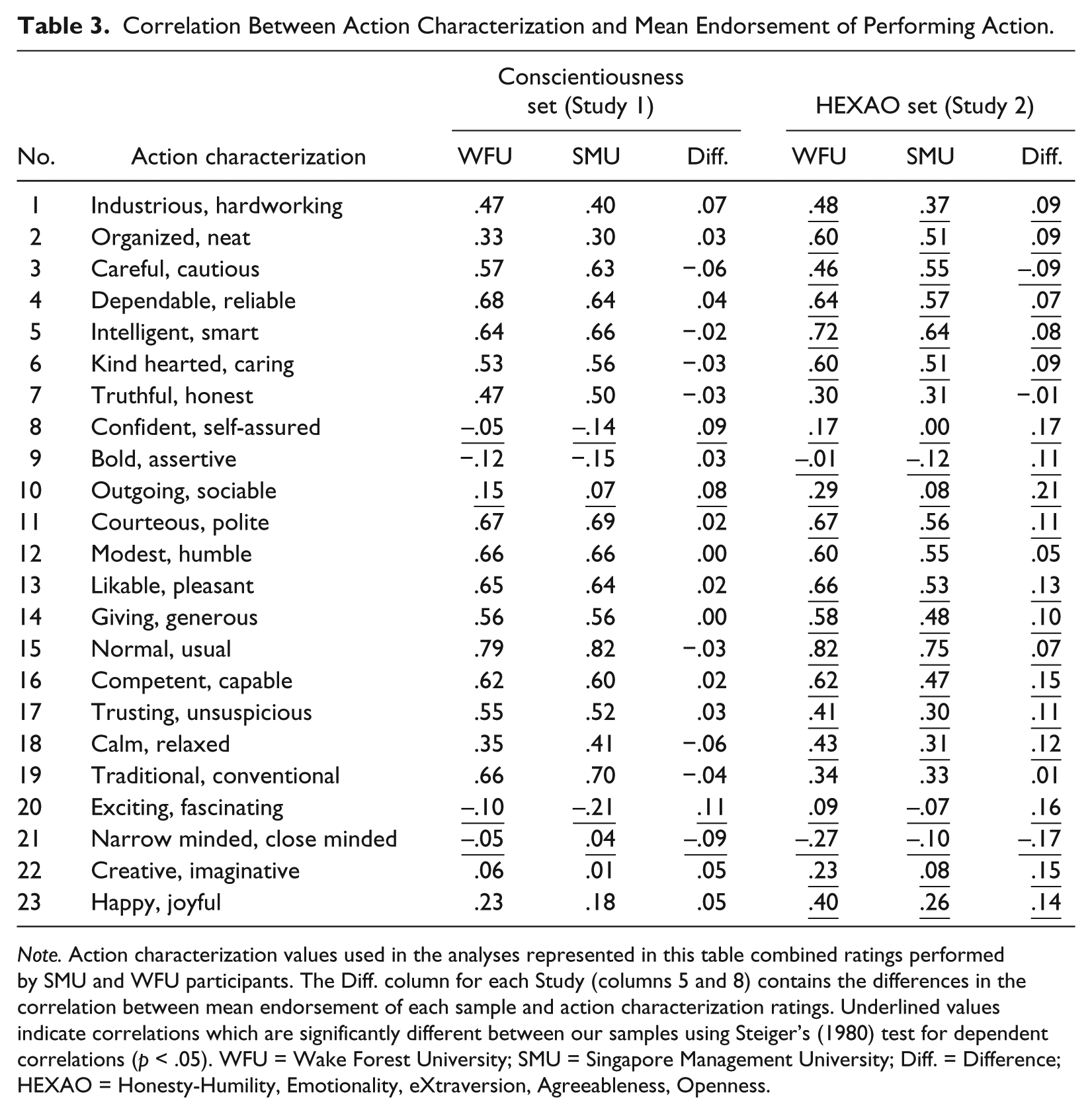
Note. Action characterization values used in the analyses represented in this table combined ratings performed by SMU and WFU participants. The Diff. column for each Study (columns 5 and 8) contains the differences in the correlation between mean endorsement of each sample and action characterization ratings. Underlined values indicate correlations which are significantly different between our samples using Steiger’s (1980) test for dependent correlations (p < .05). WFU = Wake Forest University; SMU = Singapore Management University; Diff. = Difference; HEXAO = Honesty-Humility, Emotionality, eXtraversion, Agreeableness, Openness.
Cross-cultural differences
To test for differences in revealed traits across the two samples, we applied Steiger’s (1980) test of dependent correlations. As seen in Table 3, analyses revealed a stronger tendency among U.S. participants to endorse actions as a function of how much they were characterized as outgoing (row #10 in Table 3) and confident (#8). Singaporean participants showed a stronger tendency to endorse actions as a function of how much they were characterized as narrow minded (#21), and a stronger tendency to endorse actions less as a function of how much they were characterized as exciting (#20).
Revealed preferences
We can use revealed preferences analyses to indirectly estimate the weight of specific expected effects on reported action likelihoods across cultures. The revealed preferences can help explain why we observe similarities and differences in revealed traits, as they have been previously demonstrated to be important in characterizing actions with particular trait concepts and are closer to features central to processing accounts of personality variation (Wood, Tov, & Costello, 2015). As with the revealed trait analyses, we first discuss those expected effects which had a large impact on action likelihoods in each of the two samples (|r| ≥ .40), and then discuss expected effects which had relationships with action likelihoods that differed significantly across the two samples.
Cross-cultural similarities
Table 4 shows the results from the revealed preferences analyses. Participants in both samples reported being more likely to perform actions that were expected to fulfill commitments (row #2), match others’ preferences (#1), and gain social status (#11). Both samples reported being less likely to perform actions that were expected to result in social rejection for the self (#3) or others (#4). The shared preference for the three former expected effects and aversion to the latter two may underlie the revealed similarity in kindness and dependability reported above as these five expected effects have previously been found to be related to characterizing actions as kind and dependable (Wood, Tov, & Costello, 2015). There was also a common preference for actions expected to enhance predictability (#15) and a common aversion to actions expected to surprise others (#5). Both of these expected effect dimensions were found by Wood and colleagues to be important in characterizing actions as careful, which may underlie the similarity in revealed carefulness reported above. Finally, both samples showed a preference for actions expected to meet achievement goals (#18), which was previously found to be central to characterizing actions as industrious; the similarity in revealed industriousness may thus reflect a common desire to meet achievement goals. Taken together, people in both cultures seem to preferentially perform actions expected to have prosocial effects (e.g., fulfill commitments), or that further their own more agentic concerns (e.g., gain social status), and these preferences may manifest themselves in the high degree of similarity in revealed traits.
Correlation Between Expected Effects Dimensions and Mean Endorsement of Performing Actions.
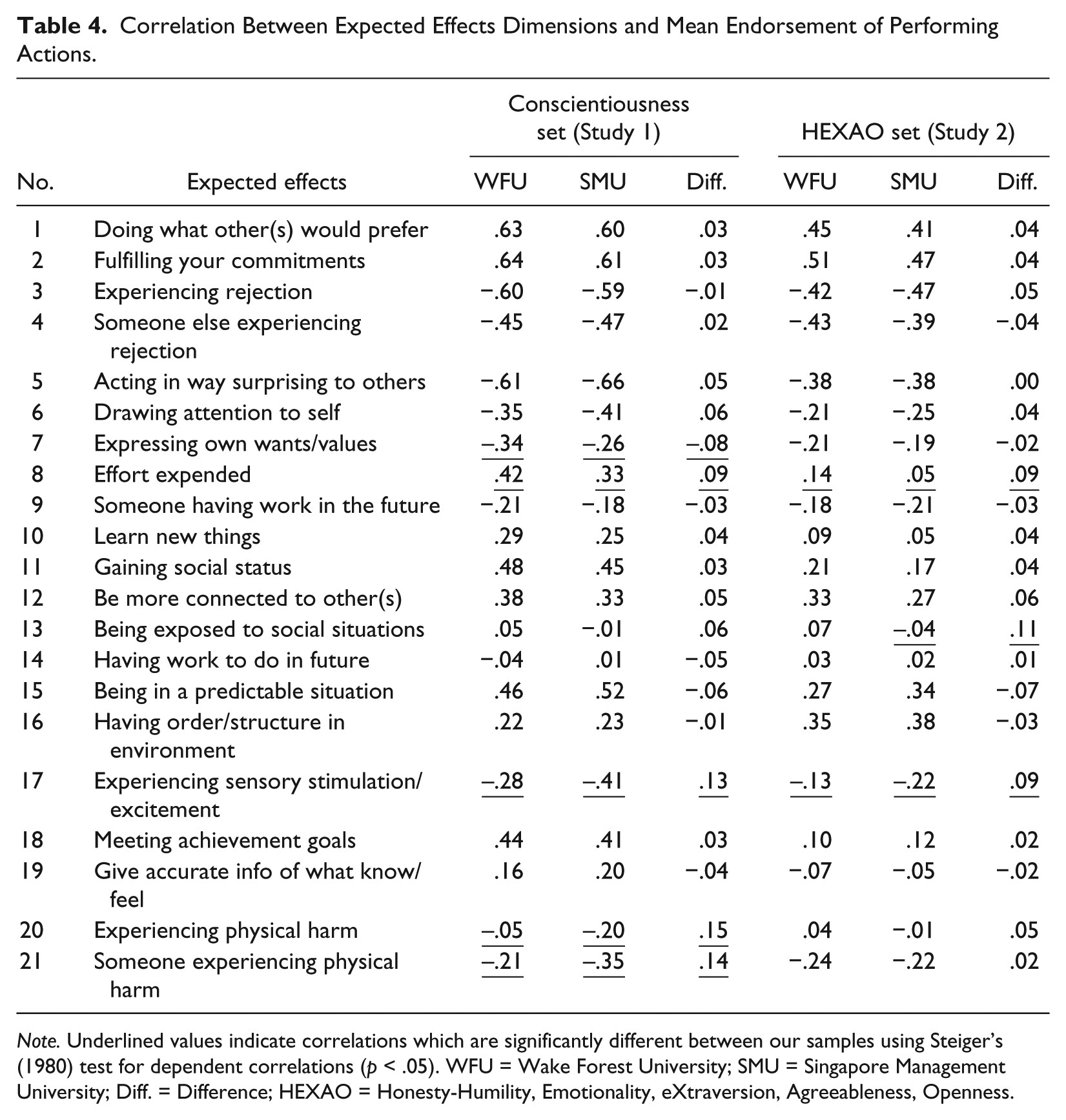
Note. Underlined values indicate correlations which are significantly different between our samples using Steiger’s (1980) test for dependent correlations (p < .05). WFU = Wake Forest University; SMU = Singapore Management University; Diff. = Difference; HEXAO = Honesty-Humility, Emotionality, eXtraversion, Agreeableness, Openness.
Cross-cultural differences
Even though the associations between expected effects and action likelihoods were highly similar across our samples, there were still some notable differences. As seen in Table 4, the Singaporean participants reported being less likely to perform actions that were expected to result in physical stimulation or excitement (#17), and expending effort (#8) than U.S. participants; these action effects were previously found by Wood and colleagues to be highly related to outgoing and confident actions. Thus, revealed differences in outgoingness and confidence may be driven by differences in preferences for experiencing excitement and conserving effort. Singaporean participants also showed a larger avoidance of actions expected to increase risk of physical harm or pain to the self (row #20) or others (row #21) than U.S. participants. Somewhat surprisingly, U.S. participants reported being less likely to perform actions that were expected to express one’s own wants or values (#7), which was previously found by Wood and colleagues to be principally related to boldness. The difference in preferences for expressing wants and values does not appear to be manifested in revealed trait differences, as none of the traits that showed revealed differences were found by Wood and colleagues to relate strongly to this expected effect.
Study 2
Revealed Traits With a More Diverse Set of Actions
Study 1 demonstrated a great deal of similarity in how U.S. and Singaporean participants report being likely to act in specific situations. This similarity extends to the traits those actions express as well as the expected effects of those actions. However, we also observed subtle differences such as lower revealed trait estimates of outgoing and confident and related expected effects among Singaporean participants, relative to U.S. participants.
One notable limitation of Study 1 is its emphasis on Conscientiousness-related action scenarios. It is unclear whether the similarities and differences identified are robust across a more diverse set of actions. Study 2 attempts to replicate Study 1 using a broader set of action scenarios targeting the other five factors of the HEXACO structure (i.e., Honesty–Humility, Emotionality, extraversion, Agreeableness, and Openness; “HEXAO”). Outside of this difference in stimuli, the second study was a direct replication of Study 1.
Method
Participants
This study used data from Samples 1, 2, 9, 10, 11, 12, 13, and 14 as listed in Table 1.
Materials
Development of action scenarios
Participants from Samples 1 and 2 described actions targeting 15 bipolar trait pairs (three for each of the “HEXAO” traits). Participants generated actions for each pole of a given pair (e.g., “outgoing/sociable” and “bashful/shy”). Following the procedure in Study 1, these descriptions were adapted into 150 action scenarios (five for each pole of the 15 trait pairs). Members of the two research teams (SMU and WFU) then reviewed the stimuli for cultural appropriateness. However, two action scenarios were not included in analyses. The first was unintentionally omitted from the survey due to a programming error (Scenario # 266 in Supplemental Table S1). The second referred to “mooning” a teacher to impress a friend. Members of the third author’s lab indicated that the meaning of this action may not be widely understood by Singaporean students (see Scenario #292 in Supplemental Table S1), as supported by a radically different average rating of this item from the U.S. sample which was near the scale midpoint (MWFU = 11.5, MSMU = 44.7 in POMP units). Excluding two scenarios resulted in a total of 148 action scenarios in Study 2.
Action feature coding
Action characterization
Samples 9 through 12 (see Table 1) rated the new set of 148 actions on 23 trait terms. Samples 9 and 10 rated the actions on 10 bipolar trait dimensions. Samples 11 and 12 rated these same actions along 13 other dimensions central to the Big Five and HEXACO frameworks. To minimize fatigue, the 148 action scenarios were divided into three subsets. Data were screened using the same procedure in Study 1. Sample 9 ultimately consisted of 58 WFU students (n = 20, 20, and 18 for the first, second, and third subsets, respectively). Sample 10 ultimately consisted of 35 SMU participants (ns = 12, 11, and 12). Sample 11 ultimately consisted of 44 WFU students (n = 15, 14, and 15). Sample 12 ultimately consisted of 33 SMU students (n = 9, 12, and 12).
Supplemental Table S2 again shows the reliabilities for each block and each characteristic of the action characterization ratings, as well as the average reliability for each characteristic. Reliabilities were generally better in Study 2 than in Study 1, ranging from a low of .71 for creative and a high of .94 for kind hearted and courteous; the adequate reliability allowed us to average action characterizations within each sample. Supplemental Table S3 shows the correlations in the average action characterizations made by the two rater groups; M(r) = 0.81 for zero-order correlations and M(r) = 0.94 for estimated correlations adjusted for rater unreliability. As in the first study, the evidence suggested that scenarios were understood as extremely similar in meaning across cultures, allowing us to average action characterizations across the two cultural groups. We averaged each sample’s mean rating, so that the larger sample would not be weighted more heavily in the average characterization rating. Supplemental Table S4 again shows the revealed trait analyses using characterizations from each sample separately.
Expected effects
Ten research assistants coded the new set of 150 action scenarios along the same 21 expected effect dimensions in the same manner as Study 1.
Self-report measures
Participants from Samples 13 and 14 completed the IIDL (Wood et al., 2010) to assess personality via abstract trait items. As in Study 1, they also rated the likelihood of performing the target action in each of the 148 action scenarios. Using the same rules as Study 1, we eliminated 41 WFU participants and five SMU participants, resulting in a final sample of 264 (WFU = 217; SMU = 47; see Samples 13 and 14 in Table 1). Action-likelihood ratings were again highly reliable (αs = .99 and .97 for WFU and SMU, respectively).
Results and Discussion
Similarities and differences using abstract trait adjectives
The means for each sample on all 63 IIDL items can be found in Table 2. Our results generally replicated Study 1. For example, Singaporeans generally showed less endorsement of characteristics related to Conscientiousness (rows 1-6) and Extraversion (rows 7-15) than U.S. participants. There were some discrepancies across studies in which differences reached significance. For instance, Singaporeans did not show significantly differing endorsement of being disorganized (#4), happy (#10), or excited (#8) in Study 2 despite earlier significant differences in Study 1, although the differences were in the same direction.
We again found that the Singaporean sample’s mean levels were generally closer to the scale’s midpoint than the U.S. sample’s mean levels on the majority of items (57 out of 63), which is consistent with a tendency to respond more moderately among the Singaporean sample, and/or higher levels of self-enhancement or general response positivity among the U.S. sample (Hamamura et al., 2008; Heine & Lehman, 1999; Kurman, 2001). We found that the variance in IIDL means was significantly different across samples (SDWFU = 0.90, SDSMU = 0.66); F(1, 124) = 7.47, p = .007, further suggesting the presence of more moderate responding among Singaporeans. 4
Cultural similarities and differences in revealed traits and revealed preferences
The primary purpose of this study was to test whether the indirect estimates obtained in the first study replicated using a new set of actions drawn from a broader range of traits (i.e., non-Conscientiousness-related actions). We first discuss the overall similarity in action likelihoods between our groups before comparing the results of revealed traits and revealed preferences analyses.
Similarity in overall response profiles
As in the first study, we again found an extremely high degree of similarity between the U.S. and Singaporean participants in the actions they said they were likely to perform (r = .89). This is graphed in Figure 1, and the actions corresponding to the numbers are listed in Supplemental Table S1. For instance, participants in both samples reported being highly unlikely to make fun of a peer’s religion (Action 280 in Supplemental Table S1, MWFU = 8.0, MSMU = 8.0) and being highly likely to attempt to make friends with fellow students on a trip abroad (Action 228, MWFU = 85.4, MSMU = 85.1).
There were again some notable discrepancies in reported action likelihoods across samples, which are indicated by distance from the diagonal of Figure 1. For instance, Singaporean participants reported being much more likely to tell a dieting friend not to eat a roll at lunch than U.S. participants (Action 175, MWFU = 50.5, MSMU = 74.5), but reported being much less likely to start a casual conversation with a cashier while waiting in line than U.S. participants (Action 181, MWFU = 55.2, MSMU = 16.5).
Replicating the results from Study 1, we found that variance in mean action likelihoods was not different across samples (SDWFU = 0.80, SDSMU = 0.86 5 ); F(1, 294) = 0.69, p = .406, which further suggests that action-likelihood ratings may not be influenced by response style differences in the same manner as abstract trait ratings. 6
Revealed trait analyses
Again, we see that people in both cultural groups reported highly similar action likelihoods across a diverse set of situations. As with Study 1, we use revealed trait analyses to investigate the kinds of actions both samples were likely to perform.
Cross-cultural similarities
Table 3 depicts the correlations between each of the 23 action characterizations and mean action likelihoods in each sample. In keeping with the previous study, we only discuss associations that are relatively high in magnitude (|rs| ≥ .40). As can be seen in Table 3, these results are highly similar to the pattern of results found in Study 1. Both U.S. and Singaporean participants reported being more likely to perform actions that were characterized as normal (row #15 in Table 3), intelligent (#5), courteous (#11), likable (#13), dependable (#4), competent (#16), kind hearted (#6), modest (#12), careful (#3), and giving (#14). Four characteristics that passed our effect size threshold in Study 1 did not cross this threshold in Study 2: traditional (#19), trusting (#17), industrious (#1), and truthful (#7). However, it is worth noting that these correlations were still quite high in both cultures (all rs ≥ .29). In addition, U.S. and Singaporean participants reported being more likely to perform actions that were characterized as organized (#2) in this study, whereas this revealed trait estimate was slightly below our effect size threshold in Study 1 (rs ≥ .30). As in Study 1, these analyses can be interpreted as revealing that participants in both Singapore and the United States report being more likely to perform actions characterized as normal and competent, and by several characteristics from the broader domains of Conscientiousness, Agreeableness, and Honesty–Humility.
Cross-cultural differences
We compared the correlation between each sample’s mean likelihood ratings and the 23 action characterization ratings, which can be seen in Table 3. These analyses revealed far more differences (20 of 23 differences were significant) than the first study (five out of 23 differences were significant). All four of the significant differences found in Study 1 replicated using the new set of action scenarios. Specifically, in both studies U.S. participants were more likely than Singaporean participants to endorse actions that were characterized as outgoing (#10), confident (#8), and exciting (#20), and less likely to endorse actions that were characterized as narrow minded (#21).
As stated previously, several more cross-cultural differences in revealed traits were found in Study 2 than in Study 1. As can be seen in Table 3, the U.S. participants indicated that they were more likely to perform actions characterized as competent (#16), creative (#22), happy (#23), industrious (#1), dependable (#4), calm (#18), likable (#13), bold (#9), courteous (#11), trusting (#17), organized (#2), kind hearted (#6), giving (#14), intelligent (#5), and normal (#15) than the Singaporean participants. The Singaporean participants indicated that they were more likely to perform careful actions (#3) than the U.S. sample.
Revealed preferences
As in Study 1, the revealed preferences were estimated by computing the correlation between an action’s likelihood and its expected effects. Before delving into cross-cultural differences in revealed preferences, we first discuss those expected effects which had a large impact on action likelihoods across our two samples (|r| > .40).
Cross-cultural similarities
As seen in Table 4, three of the eight expected effects which passed our effect size threshold (|r| ≥ .40) in both samples in Study 1 passed this same threshold in Study 2. More specifically, we again found that participants in both samples reported being more likely to perform actions that were expected to match others’ preferences (row #1), fulfill commitments (#2), and less likely to perform actions that were expected to lead to experiencing rejection themselves (#3) Someone else experiencing rejection (#4) and surprising others (#5) did not pass the effect size threshold for both groups but were very close to this threshold (rs > .35) as was being in a predictable situation (#15; both rs > .25). Gaining social status (#11) and meeting achievement goals (#18) were relatively far from the .40 threshold in Study 2. As with Study 1, these similarities in revealed preferences possibly underlie revealed trait similarities in tendencies toward kindness, dependability, carefulness, and industriousness.
Cross-cultural differences
Unlike the revealed trait analyses, the revealed preferences analyses revealed less cultural differences in Study 2 (three of 21 dimensions) than in Study 1 (five of 21). As shown in Table 4, two of the five differences found in Study 1 were replicated in Study 2; in both studies, U.S. participants reported being more likely to perform actions that were expected to result in expending effort (#8) and experiencing excitement (#17). Unlike Study 1, we did not find significant differences in the extent to which either sample endorsed actions that were expected to result in someone else experiencing harm (#21), expressing wants or desires (#7), and experiencing physical harm themselves (#20). In addition, we found one new significant difference in revealed preferences: The U.S. participants reported being more likely to perform actions expected to increase their exposure to social situations (#13). However, neither sample showed much of a preference nor aversion to this expected effect (both |rs| < .10).
Interestingly, the expected effects that differed across Singaporean and U.S. samples consistently across both studies relate to characterizing actions as confident and outgoing (Wood, Tov, & Costello, 2015), which both show revealed trait differences in both studies. This suggests that people in the United States consistently show a greater preference toward actions which involve expending effort and experiencing excitement, and these preferences may manifest as differences in the expression of actions consensually understood as confident and outgoing.
General Discussion
The present investigation had two complementary aims. First, we introduced revealed traits—a complement and cousin to revealed preference methodologies found within economic and decision-making research (e.g., Hitsch et al., 2010; Samuelson, 1948)—as a means of estimating personality characteristics indirectly through differential endorsement of trait-indicative actions. Second, we applied this methodology to explore the nature of East–West personality differences—a topic which has produced counterintuitive findings that some have argued may be driven by artifacts associated with group comparisons of self-report personality scales (e.g., Heine et al., 2008). Here, we attempt to integrate the findings of the two studies to better illuminate the nature of revealed trait estimates, how this method can be used to assess similarities across cultures, how this method may shift our understanding of East–West differences in personality traits specifically, and cultural comparisons of personality traits more generally.
Much More Similar Than Different
Although we did find some cross-cultural differences in action likelihoods across samples from the two populations, these differences were qualified by very strong similarities. The magnitude of similarity (both rs = .89), as shown clearly in Figure 1, was much closer to being indistinguishable (r = 1) than to being independent (r = 0), and far surpass traditional benchmarks for strong correlations in the social sciences (J. Cohen, 1992). These results suggest that cross-cultural similarity is high not only at the broader level of values (Schwartz & Bardi, 2001) but also at the level of action tendencies.
The revealed trait analyses shed further light on the nature of these similarities. In both studies, 10 traits (i.e., action characterizations) were highly related (|rs| ≥ .40) to action likelihoods for participants in Singapore and the United States. Both groups were considerably more likely to perform actions characterized as normal, intelligent, courteous, likable, dependable, competent, kind-hearted, modest, giving, and careful. In terms of the Big Five or HEXACO trait structure, this suggests that people in both cultures reported being more likely to perform actions that express Conscientiousness, Honesty–Humility, and Agreeableness.
Turning to the revealed preferences analyses, three expected effects were highly related (|rs| ≥ .40) to action likelihoods for Singaporean and U.S. participants across both studies. Participants from both groups reported being more likely to act in ways that increase the likelihood of matching others’ preferences and fulfilling commitments; and decrease the likelihood of experiencing rejection. People from both groups also reported being more likely to act in ways that decrease the likelihood of someone else being rejected and surprising others, though each of these fell just short of the effect size threshold in Study 2.
The observed similarities in revealed preferences are consistent with theories that propose certain characteristics to be valued across cultures (Baumeister & Leary, 1995; Ryan & Deci, 2000; Schwartz & Bardi, 2001). The need to belong has been postulated as a universal need; and the strong, negative correlation between the possibility of eliciting rejection and action likelihood across both groups in this study further supports that view. In addition, the observed role of matching others’ preferences, limiting others’ experience of interpersonal rejection, and fulfilling commitments in shaping action likelihoods is consistent with the high ranking accorded to benevolence values in cross-national studies of self-reported values (Schwartz & Bardi, 2001).
By identifying commonalities in how members of different groups calibrate their actions on the basis of expected effects, revealed preference analyses may suggest possible links between universal needs and values, and similarities in personality trait levels across cultures. Likewise, given that expected effects are likely closer to the ends that people pursue with their actions and are central to characterizing actions by a particular trait concept (Wiggins, 1997; Wood, Tov, & Costello, 2015), they provide a connection between structural and processing accounts of personality (McCabe & Fleeson, 2012, 2016; Wood, Gardner, & Harms, 2015). Indeed, the three expected effects dimensions that showed strong preferences across cultures in both studies have been found to correlate strongly with characterizing actions as kind and dependable (Wood, Tov, & Costello, 2015)—characteristics within the domains of Conscientiousness and Agreeableness. Our results suggest that the theorized universal values of belongingness and benevolence may manifest themselves in the cross-cultural tendency to behave in ways that are Conscientious and Agreeable.
Revealing Cultural Differences
A major purpose of this project was to test whether or not East–West differences in Conscientiousness-related traits found in previous research (Benet-Martínez & Karakitapoglu-Aygün, 2003; Gosling et al., 2003; McCrae et al., 1998; Schmitt et al., 2007) replicate using a novel method. That is, do we see multimethod convergence for this finding? The answer to this question differs across our two studies. There were no significant differences between the Singaporean and U.S. samples with regard to revealed Conscientiousness-related trait levels in Study 1. However, differences were observed in Study 2, which estimated revealed traits using a broader set of actions. Three of the four Conscientiousness-related revealed traits were higher for U.S. participants (industrious, organized, and dependable) and one was higher for Singaporeans (careful). It is worth noting that our self-report measures did find the typical East–West differences in Conscientiousness in both studies, and so the lack of consistent Conscientiousness differences using revealed trait methodology does not appear to be due to an idiosyncratic lack of Conscientiousness differences within our samples.
On the contrary, cultural differences in revealed Extraversion were more consistent with past findings. U.S. participants were more likely than Singaporean participants in both studies to perform actions characterized as Extraverted (e.g., confident, outgoing, exciting). This replicates past cultural differences using standard self-report personality scales (e.g., Benet-Martínez & Karakitapoglu-Aygün, 2003; Schmitt et al., 2007). Moreover, unlike Conscientiousness, nation-level Extraversion has demonstrated straightforward criterion validity (negative correlation with suicide rate; Oishi & Roth, 2009), suggesting that differences in Extraversion are generally less suspect than Conscientiousness.
As demonstrated, one strength of the revealed trait method is that it provides an opportunity to assess multimethod convergence. How can we make sense of divergences between revealed and direct estimates of personality, such as those observed in these studies? Divergences between these methods may point to novel, more nuanced interpretations of cross-cultural differences. For example, perhaps U.S. individuals encounter more situations in which they can demonstrate their dependability than Singaporean individuals, even if the latter would choose the dependable acts as often if they were in the same situations. Importantly, the revealed trait methods used a standard set of situation–action pairs, which should remove differences driven by rates of encountering trait-relevant situations (see Lievens, 2017, for a similar argument for the related SJT method). This is in contrast to typical act frequency approaches, which confound action enactment with the level of exposure to situations (e.g., reported frequencies of J. J. Jackson et al.’s, 2010, item “Miss a meeting” will be higher on average for people who have relatively more meetings independent of relative levels of Conscientiousness; Buss & Craik, 1983, take a similar approach to J. J. Jackson and colleagues). More generally, rates of encountering trait-relevant situations should be unlikely to affect revealed traits differences, whereas they are likely to affect both traditional act frequency approaches and self-reported personality using abstract trait items or short sentences. Future research could tease apart these possibilities by asking participants how often they encounter the situations in the action scenarios.
The results also illustrate how the nature of revealed trait differences can be further clarified by inspecting revealed preferences for expected effects. As mentioned previously, expected effects can help bridge the gap between values, structural models of personality, and processing accounts of personality. In both studies, U.S. participants reported being more likely to perform actions that required effort and that were stimulating. These differences in expected effects may explain revealed differences in Extraversion-related characteristics such as outgoing, confident, and exciting: Expending effort and experiencing stimulation are important to characterizing actions with such terms (Wood, Tov, & Costello, 2015), and may reflect key processing features of Extraversion (i.e., reward sensitivity; Denissen & Penke, 2008). The same expected effects may explain the revealed trait differences in Conscientiousness: Expending effort is central to trait tendencies that were stronger for U.S. participants (i.e., industrious and organized), and seeking stimulation correlates negatively with the trait tendency that was stronger for Singaporean participants (i.e., careful; Wood, Tov, & Costello, 2015). Thus, it may be that U.S. participants choose less careful actions due to a greater preference for stimulation, and Singaporeans choose less industrious and organized actions to conserve effort. These analyses provide evidence that East–West differences in Extraversion, and Conscientiousness to a lesser extent, may be due to differential preference for expending effort and experiencing excitement. These differences are also consistent with research showing a greater preference among European Americans for experiencing high-arousal positive affect and influencing the social environment relative to people of Chinese descent (Tsai, Knutson, & Fung, 2006).
Limitations and Future Directions
The clearest limitation of the revealed trait methodology presented here is that it does not index how people actually behave in these situations, but how they report they will behave. These indexes will certainly differ to some extent, and socially desirable responding can bias self-reports of hypothetical actions in much the same manner as abstract trait ratings (Fleeson, 2009; Peeters & Lievens, 2005). Socially desirable responding is a distinct possibility in our data, given that the cross-cultural similarities were in large desirable characteristics (kindness, dependability, etc.). To the extent that this is true, it is possible that the data do not suggest that people actually behave similarly across cultures, but instead that behaviors are similarly desirable across cultures. While this would go against the interpretations presented here, this would in itself be an interesting finding. It would further support the universality of values that other researchers have found or theorized (Baumeister & Leary, 1995; Ryan & Deci, 2000; Schwartz & Bardi, 2001), if not the actualization of these values in behavior. Notwithstanding these issues, the cross-cultural differences in revealed trait estimates of Extraversion-related characteristics are unlikely to be due to differences in socially desirable responding, as characteristics within the domain of Extraversion tend to be less evaluative or desirable (indeed, the lowest of the Big Five; John & Robins, 1993).
Outside of socially desirable responding, there are other reasons to question whether the results presented here reflect real differences in behavior. Indeed, it may be that action-likelihood responses reflect what people want or intend to do, rather than what they would actually do. Even so, intentions to act a certain way do predict how people actually act, though this prediction is not perfect (Ajzen, 1991). Moreover, methodologies similar to revealed traits, such as the SJTs, appear to predict real behaviors over and above typical self-reported personality inventories (Lievens, 2017; Motowidlo et al., 2006). Thus, responses to hypothetical scenarios may be valid for the prediction of behavior in similar, real-life situations. A clear avenue for future research is to explore how estimates of revealed traits predict actions taken in real situations. A key moderator may be the resemblance of the scenarios to everyday situations. According to Robinson and Clore (2002), people typically respond to hypothetical scenarios by considering how they have acted in similar situations. When scenarios are completely unfamiliar, however, responses are more likely to be based on general beliefs about oneself or possibly interpersonal comparisons.
Drawing on past theoretical approaches (Buss & Craik, 1983), the revealed traits approach assumes that personality traits are “revealed” by enacting trait-related behaviors in relevant situations. However, traits can be revealed additionally through cognitive and affective reactions to particular situations (e.g., Funder, 2013; Wilt & Revelle, 2015). We did include actions nominated for (and characterized by) trait terms which are often considered less behavioral (e.g., calm/relaxed). Nevertheless, it is possible that this approach is less suited to assessing traits that largely reflect cognitive or emotional tendencies. The generalizability of this approach for studying a range of traits deserves further attention.
Another concern is whether the scenarios themselves are representative of the cultures tested and understood in the same manner. The clearest example of an action that was not equally applicable across cultures in the present study was the aforementioned scenario involving “mooning” a friend in class, which was endorsed much more highly by Singaporean students than by American students, almost certainly due to Singaporean students not understanding the meaning of this slang term. It is likely that there were more subtle differences in the understood meaning of other scenarios presented to participants. Nonetheless, most scenarios appeared to be familiar or relatable to students in both cultures. First, the cross-cultural differences observed here were generally replicated regardless of whether actions were characterized by American or Singaporean students (see Supplemental Table S4). Second, the latent correlation between action characterizations made by the two cultures was near unity (i.e., correlations averaged approximately 1.0 after adjusting for rater unreliability), implying that the trait-relevant implications of each action understood similarly across cultures (e.g., the actions seen as indicating assertiveness or impulsivity by students in an American university were understood in largely the same manner by students in a Singaporean university, and vice versa).
We also took measures to address representativeness in the design phase of the study. Participants from both groups nominated the actions that ultimately became the action scenarios used in this study. In addition, research assistants from both the United States (the WFU research team) and Singapore (the SMU research team) reviewed the stimuli. These procedures ensured that the bulk of scenarios were generally familiar to participants from both cultures. Of course, the nature of different cultural groups is that they are often exposed to different social contexts, some of which are thought to be responsible for cultural or geographical variation in personality and behavior (e.g., Rentfrow, Gosling, & Potter, 2008). Thus, future development of revealed traits stimuli could include additional ratings by participants indicating how often they have encountered each situation described in the action scenarios to more formally assess the familiarity, meaningfulness, and cultural appropriateness of each item.
Although we have taken steps to maximize and ensure cross-cultural comparability of the scenarios, other methods could have been employed to evaluate the measurement invariance of the items. Current approaches to invariance testing (e.g., multigroup confirmatory factor analysis [CFA]) assume that several items are indicators of a target latent construct (e.g., the Extraversion subscale of the Revised NEO-Personality Inventory; Costa & McCrae, 2008). One difficulty of applying these analytical methods to revealed trait items is that the actions presented in a given scenario are not conceptualized as pure indicators of a single trait. Instead, a single action can be characterized in several different ways, and thus express multiple traits and expected effects. We believe that such an approach offers a unique perspective on trait covariation. Nevertheless, future researchers could apply multigroup CFA to revealed trait items. In particular, strict factorial invariance across groups may be required for comparisons between observed variances and covariances that are of interest in revealed trait analyses (Gregorich, 2006). However, two caveats are in order. First, it is likely that items will load onto more than one latent construct (e.g., dependable and organized). Second, the complexity of such models is likely to require sample sizes that are much larger than obtained in the present research. For example, Marsh et al. (2010) employed a sample of 1,570 respondents to test the gender invariance of a 60-item measure of Big Five personality traits. In their model, all items were allowed to load onto all five latent constructs.
An important step for future research is to investigate the utility of this method in cultural groups beyond the groups studied here. As we only examined a single group within each culture (i.e., students from a single university), it is possible that the extent of similarity found in these studies is limited to university students, or even to the specific universities from which the samples were drawn. To make more general conclusions regarding the reality and generality of cultural similarities and differences, it is certainly preferable to obtain multiple samples from each culture, as estimates will regularly fluctuate as a function of where the sample is drawn (e.g., college student vs. nonstudent adults in the United States; Peterson, 2001). Relatedly, this method may prove useful in comparing subgroups within a single culture. For instance, using this method alongside more typical self-report methods to investigate geographical variation in personality within the United States could be useful, as comparisons of self-reported trait levels across regions of the country have produced counterintuitive results that may reflect similar methodological artifacts as ones that affect cross-cultural comparisons (see Wood & Rogers, 2011). It may also be worth exploring how this methodology can be used to compare groups in very different cultures or contexts, where extremely different types of actions may be performed to manifest a particular type of trait such as industriousness or assertiveness (e.g., ballerinas, soldiers in the Israeli Defense Forces, preschoolers, Maasai women, astronauts). In addition to identifying the actions that reveal one’s trait level in different groups, the ability to correlate action likelihoods with abstract action characterizations in principle should allow the actions and trait levels of people from very different cultures to be more meaningfully compared.
Different samples of actions
It is worth noting that the two different sets of actions used in Study 1 versus Study 2 led to varying indications of revealed trait differences across cultures. Whereas Study 1 found fewer differences in revealed traits when using a set of actions specifically related to Conscientiousness, Study 2 found more differences when using a broader set. Although some differences were consistent across the two studies (e.g., Extraversion-related characteristics), others were not. Interestingly, U.S. participants showed higher levels of revealed Conscientiousness in Study 2 (where scenarios targeted a broad range of traits) but did not differ from Singaporean participants in Study 1 (where scenarios specifically targeted conscientious behavior).
The fact that findings varied across the two action sets is not entirely surprising, given that different strategies for sampling stimuli can profoundly influence correlations (Brunswik, 1955; Westfall et al., 2015), but the differences across studies merit further investigation. For example, scenarios in Study 1 likely involved more prototypical examples of conscientious behavior than Study 2. Although many actions were characterized as industrious and organized in Study 2, the context in which these actions were embedded may have contained other situational features that reduced their likelihood among Singaporean participants. Indeed, a previous analysis of the same set of actions (Wood, Tov, & Costello, 2015) found that actions characterized as industrious and organized were less likely to result in rejection of the self, and more likely to create order and predictability in Study 1 but not in Study 2. Thus, one possible explanation for cultural differences in self-reported Conscientiousness is that the likelihood of performing conscientious actions is more constrained by situational factors in Singapore relative to the United States. This may also explain why such cultural differences are regarded with suspicion. The intuition that East Asians are as conscientious (if not more so) than Westerners may stem from stereotypes and perceptions of how the former group behaves in prototypical settings (e.g., academic performance) and not in other, less obvious situations in which this trait might be expressed. Future research might expand on this line of inquiry by investigating the situational features that limit the expression of conscientious behavior in Eastern versus Western cultures.
Moreover, although there were certainly differences across the two samples of actions, both samples were developed based on nominations made by students. It is thus possible that the actions used in this study are less applicable to nonstudent groups. Future research on nonstudent groups could likely adapt many of the scenarios from a school to a work context (e.g., Scenario #4 in Supplemental Table S1 references a group project at school; this could easily be adapted to a team project at work). Indeed, adapting them from school to work contexts and comparing the resulting action characterizations could provide valuable information about the similarities and differences in the expression of personality in those two contexts. Other actions may be less applicable to nonstudent populations. Developing actions nominated by nonstudent groups would be a useful direction for future research.
Practical considerations for future research
The present studies were labor-intensive; they required collecting actions nominated by participants, adapting those actions to a consistent format, having those actions rated on trait and action effect dimensions, and finally having participants indicate their likelihood of performing these actions. This in combination with an atypical analytic framework is likely to present a perceived barrier to researchers interested in using this method. In an attempt to reduce this barrier, we have taken the following steps: We have included all 300 scenarios adapted for these studies in Supplemental Table S1, and have posted all of the data and R scripts for these analyses on OSF (osf.io/wrpnk).
Conclusion
The present study was initiated to assess the usefulness of the revealed trait methodology for the study of cross-cultural variation in personality traits. Specifically, this methodology was utilized to explore counterintuitive findings in East–West comparisons of personality traits (Benet-Martínez & Karakitapoglu-Aygün, 2003; Gosling et al., 2003; Heine et al., 2008; McCrae et al.,2005, 1998 Mõttus et al., 2010, Mõttus, Allik, Realo, Pullmann, et al., 2012; Mõttus, Allik, Realo, Rossier, et al., 2012; Oishi & Roth, 2009 Schmitt et al., 2007). The revealed trait methodology provided bolstering evidence of the reality of East–West differences in Extraversion-related traits, and less consistent (but somewhat suggestive) evidence of differences in Conscientiousness-related traits. Moreover, evidence was suggestive of these differences relating to differences in preferences for expending effort and experiencing sensory stimulation or excitement. Despite these differences, the results suggested a great deal of similarities in terms of how these groups report they would act, and the personality traits and preferences those actions reveal.
More broadly, this method has several benefits that extend beyond cross-cultural research. The method offers evidence of being able to alleviate some of the problems with cross-cultural comparisons associated with scale use and may help to circumvent other problems such as reference group effects (Heine et al., 2008; Peng et al., 1997). It is highly flexible; researchers can easily include a variety of features at different levels of abstraction (e.g., trait concepts or expected effects), allowing one to study connections between different psychologically meaningful features. We focused our efforts on expected effects and trait concepts, but one could code action scenarios for a different set of features (e.g., goals, values, situational features, etc.). This method is also uniquely well suited for investigating cross-cultural similarities in how people respond to particular situations in different cultures—an important and often neglected topic (Brown, 1991; Pinker, 2002; Schwartz & Bardi, 2001). Finally, this method can be easily administered alongside traditional self-report measures; analyses can be conducted across both revealed traits and traditional self-reported personality to assess the robustness of findings. Thus, revealed traits can be considered a valuable method for cross-cultural research on personality.
Supplemental Material
Supplementary_Table_S1 – Supplemental material for Revealed Traits: A Novel Method for Estimating Cross-Cultural Similarities and Differences in Personality
Supplemental material, Supplementary_Table_S1 for Revealed Traits: A Novel Method for Estimating Cross-Cultural Similarities and Differences in Personality by Cory K. Costello, Dustin Wood, and William Tov in Journal of Cross-Cultural Psychology
Supplemental Material
Supplementary_Table_S2 – Supplemental material for Revealed Traits: A Novel Method for Estimating Cross-Cultural Similarities and Differences in Personality
Supplemental material, Supplementary_Table_S2 for Revealed Traits: A Novel Method for Estimating Cross-Cultural Similarities and Differences in Personality by Cory K. Costello, Dustin Wood, and William Tov in Journal of Cross-Cultural Psychology
Supplemental Material
Supplementary_Table_S3 – Supplemental material for Revealed Traits: A Novel Method for Estimating Cross-Cultural Similarities and Differences in Personality
Supplemental material, Supplementary_Table_S3 for Revealed Traits: A Novel Method for Estimating Cross-Cultural Similarities and Differences in Personality by Cory K. Costello, Dustin Wood, and William Tov in Journal of Cross-Cultural Psychology
Supplemental Material
Supplementary_Table_S4 – Supplemental material for Revealed Traits: A Novel Method for Estimating Cross-Cultural Similarities and Differences in Personality
Supplemental material, Supplementary_Table_S4 for Revealed Traits: A Novel Method for Estimating Cross-Cultural Similarities and Differences in Personality by v in Journal of Cross-Cultural Psychology
Footnotes
Acknowledgements
We are indebted to great teams of research assistants at both Wake Forest University and Singapore Management University for their assistance with reviewing materials, data collection, and coding. We are also thankful to the handling editor and two anonymous reviewers for feedback in greatly improving this article.
Declaration of Conflicting Interests
The author(s) declared no potential conflicts of interest with respect to the research, authorship, and/or publication of this article.
Funding
The author(s) received no financial support for the research, authorship, and/or publication of this article.
Supplemental Material
Supplementary material for this article is available online.
Notes
Author Biographies
References
Supplementary Material
Please find the following supplemental material available below.
For Open Access articles published under a Creative Commons License, all supplemental material carries the same license as the article it is associated with.
For non-Open Access articles published, all supplemental material carries a non-exclusive license, and permission requests for re-use of supplemental material or any part of supplemental material shall be sent directly to the copyright owner as specified in the copyright notice associated with the article.
