







Abstract
Do social roles affect injunctive norms for behavior and more so in Chinese than American cultural contexts? We use mixed methods to analyze open-ended data describing appropriate behavior within social roles that differ in interpersonal closeness and relative status. American (N = 401) and Chinese (N = 392) participants provided descriptions of ideal behavior of two actors in one of 16 role dyads. The 2,219 (American) and 1,466 (Chinese) behavior descriptions were coded into 71 content categories, forming profiles of appropriate behavior for six social roles (Close/Distant × Low/Equal/High status). First, we adapt a method for assessing profile similarity in personality psychology to quantitatively evaluate how closeness and status affect similarity between the six social roles. By separating profiles into normative (average behavior) and distinctive (behavior specific to a particular social role) components, we find that distinctive behavioral profiles for specific social roles vary systematically by closeness/status in both American and Chinese data; we also find a larger effect of closeness in Chinese data. Second, we qualitatively analyze the content of the distinctive behavioral profiles through the lens of the rapport management model, showing how rights and obligations associated with each role vary, and finding cultural differences in which behaviors appropriately manage these expectations. Quantitative findings emphasize the cross-cultural importance of interpersonal situations for determining appropriate behavior, with some evidence for a greater effect in Chinese culture; qualitative results reveal the culturally specific ways in which relational situations direct expectations for behavior.
Keywords
Despite the prima facie importance of the effect of situations on behavior, psychology research on behavioral norms associated with specific situations is rare and in need of development (Funder, 2016; Pettigrew, 2018; Takano & Osaka, 2018). Psychologists have only recently made advances in how to define situations so as to create tractable research questions about their effects (Guillaume et al., 2016; McAuley, Bond, & Kashima, 2002; Rauthmann & Sherman, 2016). In particular, the effects of social role—one’s relationship vis-à-vis others in the situation—should be an important factor in determining behavior. This may be especially so in Confucian heritage cultures, influenced by a Confucian Role Ethics emphasis on the moral relevance of acting appropriately for one’s role (Buchtel et al., 2015; Buchtel et al., 2018; Rosemont & Ames, 2016). Yet, whereas cultural psychologists have classically argued that relationship-specific expectations are more differentiated and powerful guides for behavior in collectivistic cultures (e.g., Markus & Kitayama, 1991), large-scale cross-cultural personality research has found only ambiguous evidence for effects of culture or even social roles (e.g., Church, Alvarez, et al., 2012; Locke et al., 2017).
Do different social roles imply different norms for behavior, and how can we measure such dissimilarity? Cross-culturally, is there greater differentiation between social roles in Confucian heritage cultures than others? These questions frame our analyses of open-ended data, from China and the United States, describing the unique “injunctive behavioral profiles” of social roles: How one ought to act in roles varying in status and closeness.
To measure differences between social roles, we adapt the paradigm of normative versus distinctive aspects of personality profile similarity (Biesanz, 2010; Furr, 2008; Rogers, Wood, & Furr, 2018) and apply it to similarity between appropriate behavior profiles for different social roles. This framework can help to draw out role-specific effects on injunctive norms for behavior and uncover both cultural differences and similarities (Fischer & Poortinga, 2018) in how, and to what degree, social roles change these expectations. Finally, we qualitatively analyze the behavioral content of the role-distinctive profiles, using the framework of the rapport management model (Spencer-Oatey, 2000), to shed light on how different requirements for social interactivity, equity, and face are reflected in the distinctive behavioral profiles of different roles.
Effects of Social Role on Behavior
While it is a truism that behavior changes according to different situations, psychological research on the effects of specific situations has been slowed by the empirical difficulty of defining “situation” (Funder, 2009; McAuley et al., 2002; Rauthmann, 2015). Lacking an overarching theory of situations to guide hypotheses (Church, Katigbak, & del Prado, 2010; Rauthmann, 2015), the study of person–situation interactions has mainly focused on personality rather than features of situations.
What aspects of situations are most important for directing behavior? In the sociolinguistics area of pragmatics, the effects of situation on effective communication is a classic research question, with many researchers focusing on effects of relational closeness and relative status (as proposed in Brown & Levinson’s, 1987, politeness theory). Numerous studies of spoken and written communication have confirmed the important effects of closeness and status on behaviors such as speech forms, forms of address, and conflict management (e.g., see Spencer-Oatey, 2008). The two dimensions of closeness and status also appear in psychologists’ studies of situations: For example, in a study of Hong Kong and Australian students’ perceptions of 56 role dyads (McAuley et al., 2002), the first two factors reflected closeness (degree of affection and association) and equality (whether the dyads were equal or not). In the Riverside Situational Q-sort (Rauthmann, 2016), an empirically based set of dimensions that describe psychologically salient aspects of situations (Rauthmann et al., 2014), two underlying clusters reflect agency- (akin to status) and communion-relevance. Indeed, agency and communion are argued to be fundamental organizing dimensions of social cognition content in general (Abele & Wojciszke, 2014).
We thus suggest that across cultures, one’s social role—in particular, one’s relational status and closeness—should be a salient and important director of behavior. In this study, we ask how the closeness and status of social roles change expectations of behavior, that is, injunctive norms about how one ought to act. We first hypothesize that
Cultural Differences in Cross-Role Consistency of Injunctive Norms?
Cultural psychologists have classically argued that due to the importance of social roles in collectivistic cultures, self-concept (and related behavior) should be less consistent across relational situations than among members of individualistic cultures (Heine & Buchtel, 2009). For example, Japanese self-descriptions varied more depending on who was sitting nearby than did Americans’ (Kanagawa, Cross, & Markus, 2001); Koreans’ personality descriptions, both self-rated and informant-rated, varied more across relational contexts than did Americans’ (Suh, 2002); and East Asian Americans rated their personality and other traits less consistently across two relationships (friend vs. mother) than did European Americans (English & Chen, 2007). However, large-scale cross-cultural personality research has only sometimes found more personality variability among participants from East Asian cultures (e.g., Church, Willmore, et al., 2012; Malloy, Albright, Diaz-Loving, Dong, & Lee, 2004), or mixed evidence (e.g., Ching et al., 2013; Church, Alvarez, et al., 2012). Injunctive norms are rarely specifically assessed and, when assessed, as in Locke et al. (2017), find puzzling results such as a lack of differences between social roles and Japanese participants rating their personality as particularly dissimilar from injunctive norms. More research on cultural differences in injunctive norms for situations is needed.
In particular, the relational situation should be an especially important predictor of injunctive norms for behavior in Confucian heritage cultures due to the moral emphasis on both appropriateness and relational roles (Buchtel et al., 2015; Buchtel et al., 2018; Rosemont & Ames, 2016). In Confucianism, closeness and status are identified as the basic dimensions that define one’s moral duties and responsibilities vis-à-vis others (Hwang, 2012). These dimensions were found to explain Taiwanese participants’ similarity judgments of social roles (Chuang, 1998) and to be salient influences on Japanese communication choices (e.g., Moriizumi, 2016). Closeness versus distance of relationships may be particularly important in collectivistic cultures as low relational mobility leads to more salient ingroup–outgroup boundaries and differentiated responsibilities (Li, Li, & Li, 2018).
Thus, comparisons of Chinese and American open-ended descriptions of injunctive norms for behavior in different social roles should yield larger differences in Chinese descriptions of the ideal behavior of actors of different closeness or status. We hypothesize that
Managing Rapport With Appropriate Behavior
What do appropriate behaviors communicate about the rights and obligations of actors of different social roles? What behavior is appropriate for some roles and cultures, but not others? In the discipline of pragmatics, rapport management theory (e.g., Spencer-Oatey, 2000, 2002) extended Brown and Levinson’s (1987) language-focused politeness theory to provide an analytical framework for examining the appropriateness of interpersonal behaviors. Appropriate interpersonal interaction is expected to fulfill expectations for face (e.g., positive regard), equity (e.g., noncoercion), and (dis)association rights (e.g., social interaction at the expected level of intensity and intimacy). Cultural differences in the behaviors that express their appropriate management could lead to problematic cross-cultural interactions (Spencer-Oatey & Xing, 2004). Qualitative analysis of the behaviors through this framework will allow us to generalize from specific behaviors to see how actors appropriately manage such expectations and how this varies by role and culture. We thus expect that
Distinctive Versus Normative Similarity
Methodologically, how should we evaluate similarity between the expected behavior of social roles? In personality psychology, methods for assessing similarity between the personalities of individuals are well developed (Rogers et al., 2018) but have rarely been applied to assessing similarity of situations (see Rauthmann & Sherman, 2017, for an exception).
A well-established problem in personality psychology is that similarity between any two personality profiles is affected by both person-specific and person-general components (see Rogers et al., 2018, for a review). Raw similarity is composed of two aspects (Biesanz, 2010; Furr, 2008): first, the similarity that arises because of how similar both profiles are to any “average” profile (called the normative profile), and second, similarity between the two profiles’ distinctive features, that is, their profiles after subtracting or controlling for the normative profile. For example, marital couples’ personality trait profiles are, on average, positively correlated, but examining their distinctive personality profiles is necessary to determine whether married couples are any more similar than an average pair of strangers (Furr, 2008).
Supplemental Appendix 2 illustrates the application of this paradigm to the current data. Here, we are not analyzing similarity between individuals, but rather between social roles. Our parallel question is whether the profile of injunctive norms for one social role is similar to that of another social role and whether similarity decreases for roles of more different closeness/status. Raw similarity between the profile of acceptable behaviors of different social roles could be high, but to what extent is that because of common, normative behavior that is generally acceptable (e.g., anyone sitting with someone else in a restaurant is quite likely to discuss the weather and somewhat likely to discuss work/school)? Are there some behaviors that are distinctively appropriate for certain social roles more than others (e.g., relative to the average, a close and higher status grandmother may be much more likely to ask her granddaughter about school life rather than the weather, whereas strangers would do the opposite)? Differences and similarities between roles (H1 and H3) should become clearer if we disentangle role-distinctive from normative (average) behavior, enabling us to see which behaviors are distinctively appropriate for roles differing in closeness and status. Conversely, the similarity of the normative profile to that of role-specific profiles can also help test whether behavior in specific roles is more different from role-independent/average behavior in Chinese compared with American cultural contexts (H2).
The Current Study
To assess whether having a close or distant relationship, and being high, low, or equal in status, affects injunctive norms for behavior, we elicit descriptions of appropriate behavior between dyads from participants in the United States and China. Content analysis of these open-ended descriptions allows us to determine the profile of expected behavior for actors of six social roles (Close/Distant crossed with High/Equal/Low status). We then adapt the distinctive versus normative framework to assess similarity and qualitative content of social role–specific profiles of injunctive norms.
We find that distinguishing between normative and distinctive profiles helps highlight both cultural and role effects. In particular, the distinctive profiles highlight how injunctive norms change in both cultures depending on relational closeness and status. These distinctive profiles of injunctive norms for each social role can then be analyzed qualitatively to show how the management of rights and obligations (Spencer-Oatey, 2000, 2002) within relationships changes depending on dyad closeness and status differences.
Procedure
Scenarios and questions were presented in Chinese to the Chinese participants and in English to the American participants. Translations between English and Chinese were carried out through discussion and repeated back translation by the authors, who are fluent or conversant in both languages.
Scenario design
Drawing on role dyads that have been shown in previous research to vary on interpersonal distance and status equality (Chuang, 1998; McAuley et al., 2002), we designed 16 scenarios in which two people were interacting in a neutral setting (eating lunch at the same table in a restaurant; see Supplemental Appendix 1 for all scenarios). Role pairs were chosen to differ maximally in closeness (from strangers to close friends/family members) and equality (from equal to unequal relational status). Each of the 16 scenarios described a dyad of either a higher status and lower status person (unequal dyads), or two equal-status persons (equal dyads), crossed with closeness, resulting in four close-unequal dyads (e.g., grandfather and grandson), four distant-unequal dyads (e.g., boss and secretary from a different department), four close-equal dyads (e.g., old high school classmates), and four distant-equal dyads (e.g., shop workers from different shops). These 16 role pairs were primarily drawn from the 56 dyads rated in McAuley et al. (2002), selecting dyads that had been viewed as similarly equal (or unequal) by both Hong Kong and Australian participants. For assessment of closeness, we also drew on Chuang (1998), where Taiwanese adults and university students rated 28 role pairs’ similarity on closeness-distance and dominance-submission. As we made some adjustments to dyads (e.g., changing children to be adults) to prevent obvious ability differences from affecting behavior descriptions, we also retested closeness and status in our study.
Each specific actor in a dyad was thus categorized as one of six social roles: three status levels (high, equal, and low) crossed with two closeness levels (close and distant). Role pairs were always same-sex, adult, and nonhostile, with two male pairs and two female pairs representing each closeness/equality quadrant. The 16 short scenarios (see Supplemental Appendix 1) gave minimal but sufficient information about the relationship and situation; e.g., “Imagine a GRANDFATHER and his GRANDSON together in a casual restaurant, eating lunch together. The grandson is 25 years old and has a job.”
Participants
Adult participants from the United States and the People’s Republic of China (PRC) completed online surveys in English and Chinese, respectively. Participants were recruited from similar national online platforms (MTurk in the United States and SoJump in the PRC) for payment (PRC: 9RMB [US$1.30], United States: US$2).
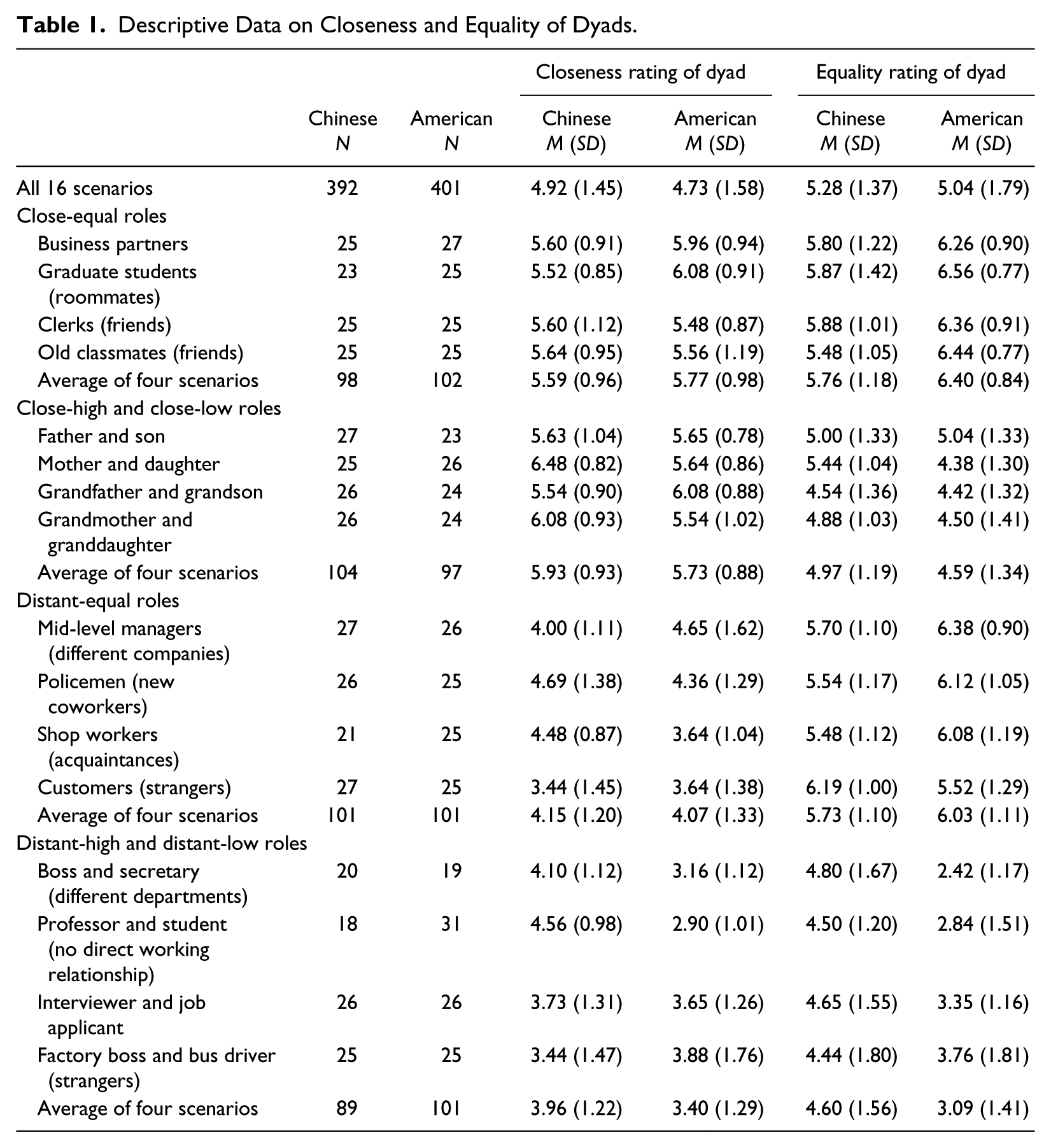
Data were sought from 20 to 30 American and Chinese participants, respectively, for each of the 16 role-pair scenarios 1 ; each participant was randomly assigned to only one role dyad. As shown in Table 1, an average of about 25 participants rated each role-pair in the American and Chinese data, respectively, resulting in data from approximately 100 participants per culture for each Closeness/Equality quadrant (401 U.S. and 392 Chinese participants in total). The American and Chinese participants were comparable on several demographic variables: Participants were 54% (United States)/48% (PRC) male, U.S. Mage = 34.77 years (range = 19-72)/PRC Mage = 32.52 (range = 20-68), and 67% (United States)/69% (PRC) participants were bachelor’s degree holders or currently attending university or college. An additional five American participants’ data were excluded as they had lived in the United States for less than 7 years, and 14 participants’ data (one United States, 13 PRC) were excluded for nonsensical open-ended responses. For the open-ended data analysis, an additional 20 Chinese participants’ data were excluded as their open-ended data indicated misunderstanding of the questions, but as inclusion or exclusion of these participants did not affect closed-ended data analysis, they were retained in those analyses.
Descriptive Data on Closeness and Equality of Dyads.
Measures
Open-ended appropriate behavior
Immediately after reading the description of a given situation, participants were asked to describe appropriate behavior of each actor in the dyad, for example, “How should the grandfather [grandson] act towards his grandson [his grandfather] in this situation? Please list 2-4 things that the grandfather [grandson] should do that would be appropriate. It could be body language, something he says, or something he does.” 2
Closeness and equality of role dyads
To confirm the applicability of dyads to their expected quadrants, participants rated how close and equal the dyad were on two questions, for example, “In your opinion, rate how close the grandfather and grandson are,” on a 7-point Likert-type scale labeled from very distant to very close; and “In your opinion, rate how equal in status the grandfather and grandson are” (in Chinese: “. . . rate how equal the relationship is between . . .”) on a 7-point Likert-type scale labeled from very unequal to completely equal.
Data Preparation (Open-Ended Data)
Coding
After separating participants’ descriptions into specific behaviors, 2,219 (American sample) and 1,466 (Chinese sample) behaviors were available for coding. On average, each participant provided about two to three behaviors per character (i.e., ~1% of the behaviors describing a given social role). A coding scheme was developed by two bilingual coders (including the second author), blind to hypotheses, 3 through an iterative, atheoretical process aimed to provide an accurate description of the behaviors in the data set. Behaviors that were mentioned more than 5 times in the whole data set were given their own code (see Online Table 1 for entire coding scheme with examples). The final coding scheme of 71 categories (as well as “uncodable”) was applied to all behaviors by the second author and a new bilingual coder blind to hypotheses, with 94.5% agreement. Final disagreements were resolved in discussion with the first author.
Calculation of raw, normative, and distinctive profiles
The frequency of each behavioral code for each of the six roles (Close/Distant crossed by High/Equal/Low status) was assessed by calculating the percentage of behaviors within that role 4 that were assigned to a given behavior code, resulting in a (a) raw injunctive norm profile (across the codes) of the frequency with which each behavioral code was mentioned for each social role (e.g., see Supplemental Appendix 2).
To analyze main effects of closeness/status, we (b) calculated separate “normative” profiles for Close, Distant, High-status, Equal-status, and Low-status roles; for example, the Close Normative profile is the average of three Close raw profiles across status (Close-High status, Close-Equal status, and Close-Low status) from the given culture.
The (c) overall normative profile was calculated per culture by calculating the average percentage for each code across the six roles’ raw profiles, thus reflecting the culture’s average profile of injunctive behavioral norms regardless of the role of the actor.
Finally, to create (d) distinctive profiles for each social role (as in Biesanz, 2010; Furr, 2008), for each culture separately, we subtracted the overall normative profile from the raw profile of each role, creating six role-specific distinctive profiles for each culture. 5
Results
Closeness and equality ratings of role dyads
Participants’ ratings of the dyads’ relational closeness and equality were examined to confirm that in both cultures dyads were perceived to differ on status equality and closeness as planned. As shown in Table 1, average ratings of Closeness and Equality for each of the 16 scenarios indicated that for both Chinese and American participants each role dyad scenario fell within its predicted quadrant (i.e., above or below the relevant overall average closeness or equality rating), with the exception of the Chinese participants’ Equality rating of the mother and daughter dyad (rated 5.44, falling above the average of 5.28). The average closeness rating of the eight distant and eight close dyads were significantly different in both cultures: Americans: Mdiff = 2.02 (SE = .12), t(398) = 16.67, p < .001, d = 1.67 [1.52, 1.82]; Chinese: Mdiff = 1.74 (SE = .12), t(390) = 14.91, p < .001, d = 1.50 [1.36, 1.64]. The average equality rating of the eight unequal and eight equal pairs was also significantly different in both cultures, Americans, Mdiff = 2.38 (SE = .13), t(399) = 17.81, p < .001, d = 1.77 [1.62, 1.93]; Chinese, Mdiff = .96 (SE = .13), t(390) = 7.39, p < .001, d = 0.75 [0.63, 0.86], although the difference was unexpectedly larger for Americans than Chinese. 6 In this context, and as the mother–daughter dyad had been rated by Hong Kong participants (McAuley et al., 2002) to be highly differentiated on equality, we retained our original categorization of the mother and daughter roles as being high and low status, respectively.
Correlational analysis of coded open-ended data
To eliminate behaviors that were not applicable for a given culture, only codes for behaviors that were observed more than 3 times in that culture were retained. This resulted in social role profiles across 56 codes for within-China analyses, and 61 codes for within-U.S. analyses. 7 As the frequency of behavior codes across the profiles were nonnormally distributed, Spearman’s rho correlations were used, which analyze the rank order of behavior-code frequencies. When averaging across correlations, correlations were first subjected to Fisher’s z transformations.
Plan for correlational analysis
Similarity between the six social roles was then assessed by correlations between behavioral profiles, addressing H1 and H2. (a) First, raw profile correlations show us the general pattern of closeness and status effects on similarity. (b) Second, similarity between the average profiles of close versus distant roles, and then roles of different status (high/equal/low), is compared with test for cultural and main effects of closeness and status on profile similarity. (c) Third, the similarity between the overall normative profile and raw role profiles is examined to test whether there are cultural differences in how “average” the role-specific behavior is. (d) Fourth, the distinctive role profiles are compared to test whether there are similar and systematic effects of closeness and status in both cultures (see Supplemental Appendix 2 for illustration).
Raw profile similarity
Before breaking down the raw frequency profiles into normative and distinctive profiles, we examine the raw frequency profiles for comparison. In Table 2, within-culture Spearman’s correlations between the raw frequency profiles show some evidence of both cultural differences and also effects of closeness versus status.
Similarity of Raw Role Profiles, Within Culture (Chinese: Upper Right, American: Lower Left).
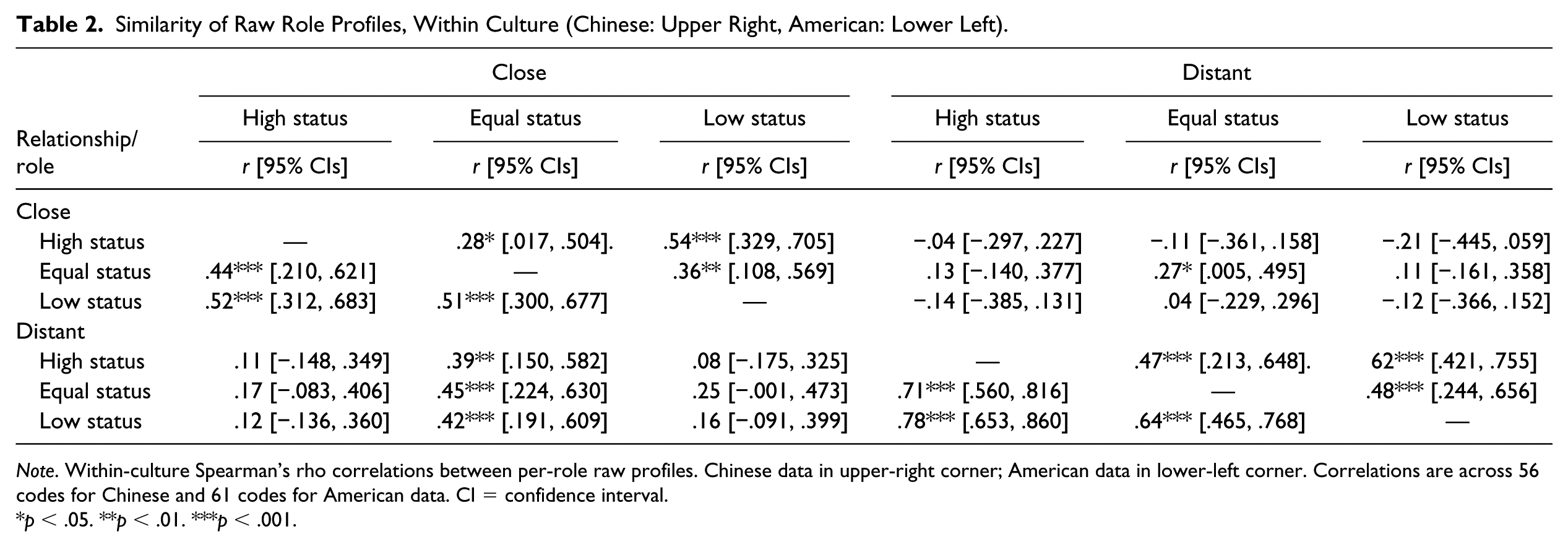
Note. Within-culture Spearman’s rho correlations between per-role raw profiles. Chinese data in upper-right corner; American data in lower-left corner. Correlations are across 56 codes for Chinese and 61 codes for American data. CI = confidence interval.
p < .05. **p < .01. ***p < .001.
Some general observations can be made but specific cultural and role comparisons are not statistically significant. Role profiles within culture were often positively correlated, perhaps due to common normative similarity of acceptable behavior across roles. There was a general pattern of greater profile similarity in the American than in the Chinese data; in the U.S. data, nine out of 15 comparisons were significantly positively correlated, an average of r̅s(61) = .41 [.178, .600], p = .001 across all comparisons (ranging from a low of .08 to a high of .78), while seven were significantly positively correlated in the Chinese data, an average of r̅s(56) = .19 [−.072, .434], ns (ranging from –.21 to .62), nonsignificantly smaller than the average correlation within the American data (z = 1.28, q = .24, ns). In both cultures, the distant roles’ raw profiles were all significantly positively correlated with one another, and close roles’ raw profiles were all significantly positively correlated with one another, suggesting that in both cultures, behavior between people of similar closeness but different status is similar. Moreover, in both cultures, the correlations between close and distant roles’ raw profiles appeared generally weaker, suggesting that close and distant roles were dissimilar on average. The pattern for status was less clear, suggesting that there was not a strong effect of status that generalized across close and distant roles.
Profile similarity of close versus distant normative; low versus high versus equal normative
Is there a different “role profile template” for roles that differ in closeness or status, that is more different in Chinese compared with American data (H2)? We find evidence for a main close versus distant role effect that is stronger for Chinese than Americans, but no evidence for a main effect of status (disregarding closeness). A correlation between the profile average of three close roles (Close Normative) and the profile average of three distant roles (Distant Normative) was nonsignificant for Chinese, rs(56) = –.17 [−.411, .100], ns, whereas it was significantly positive for Americans, rs(61) = .30 [.054, .513], p = .018, indicating that close and distant roles were less similar for Chinese than Americans, z = 2.53, q = .48, p = .012. The profile averages of the two High-status, Equal-status, and Low-status roles, respectively, however, were all positively correlated and not significantly weaker in Chinese, r̅s(56) = .37 [.117, .575], p = .005, than in American data, r̅s(61) = .62 [.440, .755], p < .001; cultural comparison z = 1.04, q = .34, ns.
But what are the injunctive norms that are unique to a given social role? Next, we turn to a separate analysis of the overall normative and distinctive profiles.
Overall normative profile
The overall normative profile for each culture indicates what behaviors were common across all roles (see Supplemental Appendix 2 for illustration). As a second assessment of whether there are cultural differences in the degree to which roles affect behavior (H2), we also examined whether role-specific profiles are similar to the “average” behavior profile, by calculating the correlation of each role’s raw behavioral profile with the culture’s overall normative profile. The average correlation of the six raw role profiles with overall normative was significantly positive in both cultures and not significantly larger in the American data, average r̅s(61) = .67 [.500, .786], p < .001, than in the Chinese data, average r̅s(56) = .49 [.262, .667], p < .001) z = 1.41, q = .28, ns. Similarly, the absolute value of the raw profiles’ percentage difference from the normative profile was only marginally larger in the Chinese data, M = 1.38% (SD = 1.77) across the 56 codes, versus M = 0.94% (SD = .87) across the 61 codes of the American data, t(115) = 1.76, d = .32, p = .08. This suggests that in both cultures, a large proportion of variance in behavioral frequency in different roles could be attributed to what people ought to do “on average”; there was not strong evidence of a more common core of “average” behavior across roles in the American data than in the Chinese data.
Distinctive profiles
The Distinctive profiles for each role describe the injunctive norms unique to a role, relative to the average (see Supplemental Appendix 2). Do they differ systematically depending on closeness and status (H1)? In Table 3, we show correlations, within culture, of each Distinctive profile with the Distinctive profiles of other roles. These distinctive profiles show more clearly that, in both cultures, social roles change what kind of behavior is appropriate, in a pattern that sensibly reflects both closeness and (to a lesser extent) status differences. As detailed below, the distinctive profile correlations show large effects of Distance versus Closeness in both cultures, and effects of status within the Close roles but less among the Distant roles.
Similarity of Distinctive Role Profiles, Within Culture (Chinese: Upper-Right, American: Lower-Left).
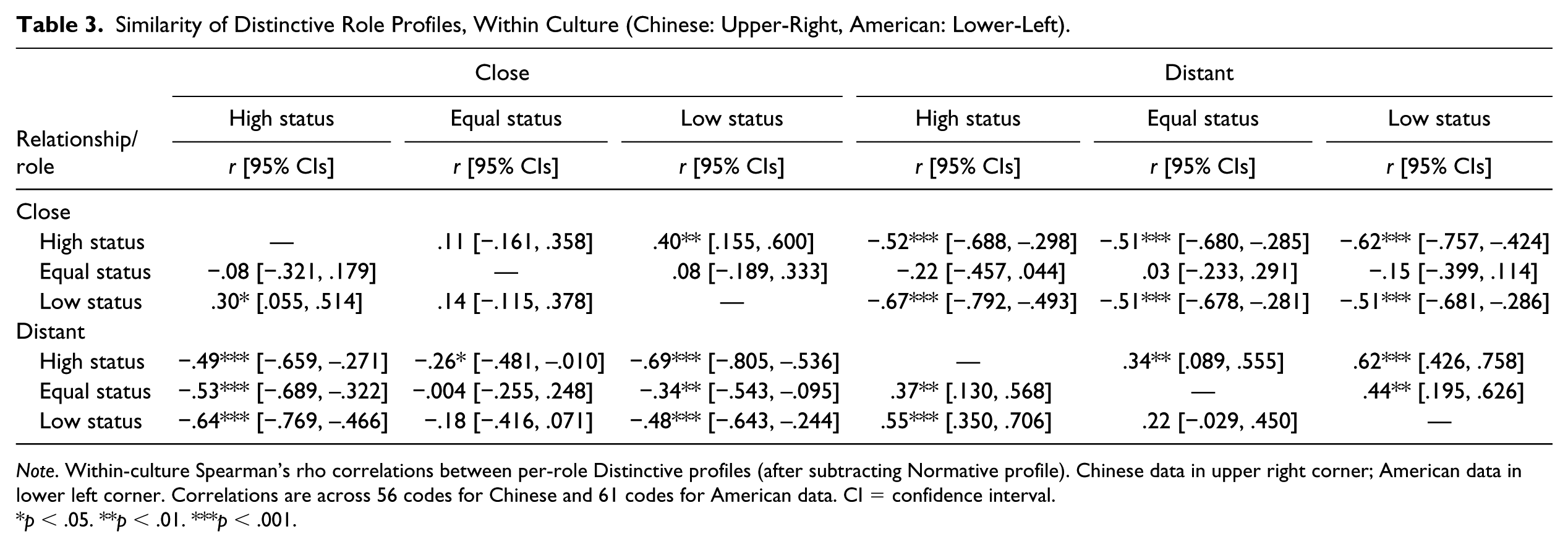
Note. Within-culture Spearman’s rho correlations between per-role Distinctive profiles (after subtracting Normative profile). Chinese data in upper right corner; American data in lower left corner. Correlations are across 56 codes for Chinese and 61 codes for American data. CI = confidence interval.
p < .05. **p < .01. ***p < .001.
Most noticeably, distant and close roles’ distinctive profiles were significantly negatively related to one another in both cultures; for Chinese data, the average across nine distant/close role correlations was r̅s(56) = –.43 [−.622, –.189], p < .001, similar to the U.S. average of r̅s(61) = –.42 [−.609, –.192], p < .001.
We find suggestive evidence for an interaction between closeness and status as different-status close roles were not similar to one another, whereas different-status distant roles were relatively similar to one another. The three close roles’ distinctive profiles were on average not significantly correlated across status; average among three Close role correlations: PRC r̅s(56) = .20 [−.066, .439], ns; United States r̅s(56) = .12 [−.131, .365], ns. Conversely, the three distant roles’ distinctive profiles were on average positively correlated across status; average among three Distant role correlations: PRC r̅s(56) = .47 [.242, .655], p < .001; United States r̅s(61) = .39 [.155, .584], p = .002. However, the difference was not significant in either culture (PRC: z = 1.58, q = .31, p = .11; United States: z = 1.57, q = .29, p = .12).
Finally, examining the effects of status within the close roles, correlations suggested that the Close, Equal roles (close friends) had a unique profile compared with other close roles. In both cultures, Close-High and Close-Low distinctive profiles were significantly positively correlated, and in turn were both significantly negatively correlated with all Distant roles; average of six correlations: PRC r̅s(56) = –.56 [−.72, –.35], p < .001; United States r̅s(61) = –.54 [−.69, –.33], p < .001. On the contrary, in both cultures, the Close-Equal role profile was not very similar to either the Close-Low or Close-High roles: average of two correlations: PRC r̅s(56) = .09 [−.175, .346], ns; United States r̅s(61) = .03 [−.221, .281], ns, nor dissimilar to the three Distant roles: average of three correlations: PRC r̅s(56) = –.12 [−.367, .152], ns; United States r̅s(61) = –.15 [−.388, .104], ns. This suggests that among the Close roles, it was the unequal, family dyad roles whose appropriate behavior was most different from that of Distant roles, whereas the equal friend relationships are not as strongly similar to either other Close roles or Distant roles, seemingly a category unto themselves.
Summary of correlational analyses
The correlational analyses of the distinctive profiles shows clearly that in both cultures, uniquely role-specific distinctive behavior exists (H1); that is, we can see that both cultures have role-specific rules for how to behave, which vary systematically according to closeness and (to a lesser extent) status. We found weaker evidence for cultural differences in the strength of role effects (H2). The average behavior of Chinese Close roles was more different from Distant roles than they were in the American data, a large effect (q = .48), but other comparisons of cultural differences in role effects were not statistically significant. There were only trends toward greater overall raw profile similarity in the American than in the Chinese data (q = .24 for the comparison), a trend toward a larger status main effect in the Chinese than in the American data (q = .34), and a trend toward higher similarity of raw profiles to Normative profile in the American than in the Chinese data (q = .28 and d = .32, for cultural differences in correlations and percentage difference, respectively). Notably, after removing the normative profile, the social role effects on distinctive profiles were very similar in the Chinese and American data.
Qualitative analysis of open-ended distinctive profiles
Beyond the specific behaviors of a restaurant lunch, what does the content of these injunctive norms imply about relational obligations and appropriate interaction? To address H3, we qualitatively analyze the distinctive behaviors for each role (Table 4). Spencer-Oatey (2000, 2002) proposed that, across cultures, interpersonal rapport depends on fulfilling expectations of appropriately showing respect for others (called face) and fulfilling expectations for sociality rights, such as the right to not be inappropriately imposed upon or coerced (equity rights), right to appropriate involvement in social interaction (interactive association or disassociation rights), and rights to appropriately implied intimacy (affective association rights). To the extent that cultural differences exist in the rights and obligations that are afforded by different social roles, greater potential for cross-cultural misunderstandings exist. Below, we briefly apply this analysis to Chinese, American, and then comparison data, showing how roles’ distinctive injunctions reflect the rights and obligations of each social role.
Top 10 Most Normative and Most Role-Distinctive behaviors, per Culture.
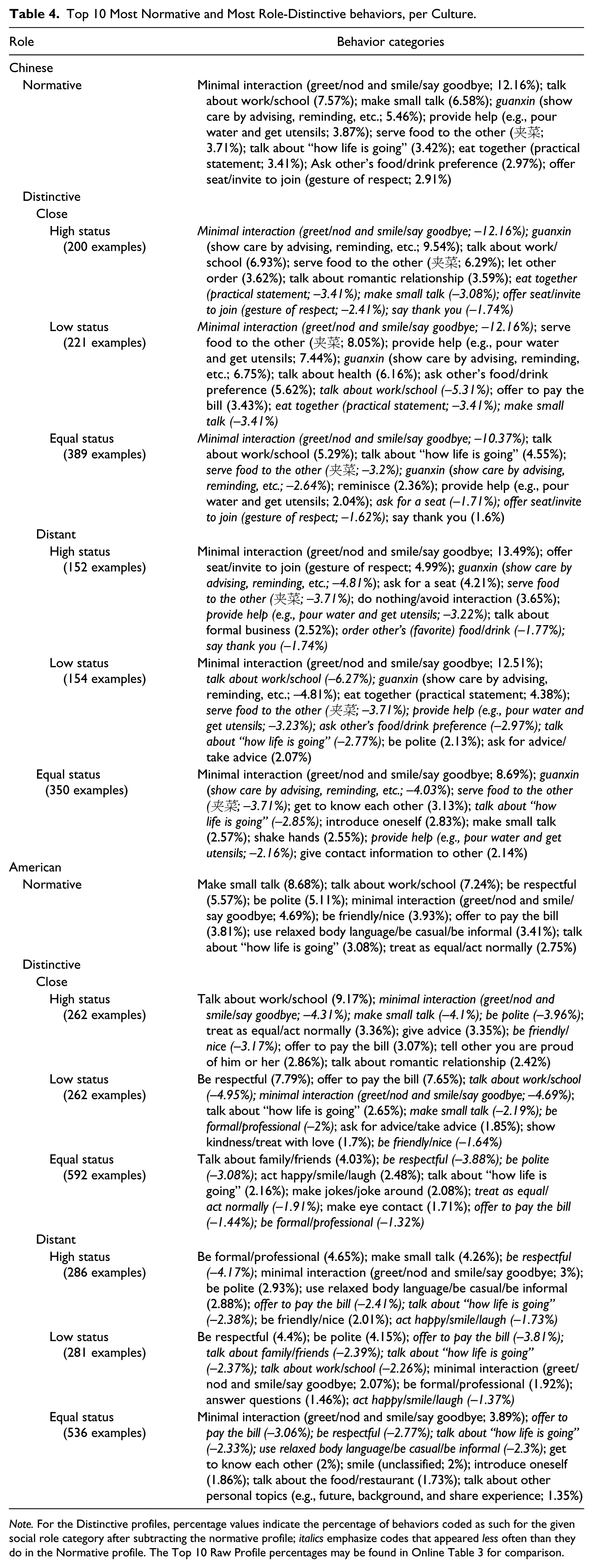
Note. For the Distinctive profiles, percentage values indicate the percentage of behaviors coded as such for the given social role category after subtracting the normative profile; italics emphasize codes that appeared less often than they do in the Normative profile. The Top 10 Raw Profile percentages may be found in Online Table 3 for comparison.
Chinese distinctive injunctive norms
Table 4 shows that in comparison with normative profile behavior, the expected distinctive behavior of Chinese in the high-/low-status close dyads (all family relationships) is characterized by caring gestures such as putting food on the other’s plate (“serve food to the other”) or guanxin-ing the other (reminders to dress warmly, etc.); these are not a feature of equal dyad (friend) interactions, who, on the other hand, do provide small acts of help for one another (pouring water, etc.). These behaviors could be interpreted as impositions on personal agency, and yet are apparently highly appropriate within close, high-/low-status family roles, suggesting that equity rights (the right to not be imposed upon or coerced) may be purposefully deemphasized; in fact, the very invasiveness of the behavior may be interpreted as indicating a high level of responsibility for and caring for the other. On the contrary, all close dyads are encouraged to converse and are not (i.e., much less likely than average) expected to interact minimally, showing the distinct difference in expectations of interactional association versus dissociation rights for, respectively, close versus distant relationship behavior. It is interesting to note that each actor should introduce conversation topics that seem more relevant to the other person: Older adults are particularly enjoined to ask about work, school, or romantic relationships; youngsters to ask about health; while equal dyads are more likely than the normative profile to converse about work, school, life in general, and reminisce about the past. The fact that specific topics are assigned to specific roles may also reflect the degree of intimacy and self-disclosure expected from different roles (affective association), as well as appropriate attentiveness to the interests of one’s interlocutor.
For Chinese distant roles, on the contrary, the most common distinctive behavior is to interact minimally, reflecting the interactional disassociation rights as described above, although distant-equal status roles are sometimes allowed to begin to build up a future relationship (e.g., introduce oneself and make small talk). Among distant roles, there is also a distinctive lack of injunction to serve food, guanxin, or pour water for the other, which might be interpreted as assuming too much intimacy (implying the right of affective disassociation). In unequal dyads, giving face to the other seems to be a concern, expressed differently by high- and low-status roles: High-status strangers should politely offer (or ask for) a seat, whereas the low-status stranger could ask for advice.
American distinctive injunctive norms
Close roles in the American data, like that of Chinese close roles, reflect high expectations for interactional association. American Close actors are expected to converse and again assigned to introduce conversation topics of interest to the other member of the role dyad: Older family members should introduce conversation about work or school, younger family members should talk about “how life is going,” and equal-status friends should talk about family and friends. In high/low dyads, face and equity seem to be a concern, with older family members expected to treat the other as an equal, and say they are proud of him or her; younger family members should “be respectful” and take advice. Older family members are also expected to give advice, and younger roles to offer to pay the bill, which, echoing the Chinese high/low close roles, suggest an expectation of being vulnerable to threats to equity. Equal-status, close friends are expected to provide affective interaction as indicated by making eye contact, thus communicating interest and intimacy. Differently from the high-/low-status roles, friends are less likely to be expected to be respectful or polite, instead being expected to laugh and joke around; this suggests an expectation of enhancing mood through cheerfulness rather than directly praising face.
Across the American Distant roles, disassociation rights are most emphasized, similar to that of the Chinese Distant roles, with minimal interaction or only making small talk highly advised, although distant-equal pairs are also allowed to get to know each other (indicating the possibility of increased intimacy in the future). Distant roles were expected to converse casually while also avoiding getting “too personal,” suggesting a difficult balance between some rights to interactional association while also rights to avoid affective (intimate) interaction. In all distant relationships, there is a distinctive expectation to not offer to pay the bill, indicating that this would be a role violation.
For the Distant, high-status roles, Americans seem to give curiously contradictory advice. High-status strangers should not only act professionally but also be relaxed, interact minimally but be polite, and be friendly and nice but not laugh. This may reflect anxiety about potential threats to a low-status strangers’ face, solved by communicating concern for both the equity rights (e.g., by acting relaxed and polite, and indicating no intention to coerce) and disassociation rights of low-status strangers. Low-status strangers are expected to respect the others’ face (by being respectful and polite) and affective/interactional disassociation rights, by interacting minimally, being formal, and not conversing about relationships, life, or work/school.
Chinese versus American injunctive norms
From the above analysis, we see that in both cultures, distant and close roles are expected to protect association/disassociation rights, respectively, and unequal dyads’ appropriate behavior shows or introduces concerns about equity and face. But across cultures, the kind of behavior that communicates appropriate management of these concerns may be quite different.
In family situations, for example, in both cultures, the younger family member is expected to show care and respect to the elder; but while in Chinese data this is indicated by serving food, providing help, and caringly nagging the other (e.g., about her health), in American data, younger family members are expected to offer to pay the bill and generally “be respectful.” Similarly, both Chinese and American older family members show care for the other’s face; Chinese older family members by letting the younger choose the communal meal, while American older family members “treat the other as an equal” and explicitly praise him or her.
Similarly, injunctive norms of how to treat friends in both cultures include conversation about personal life, but whereas American friends are additionally expected to act happy and joke around, Chinese friends are likely to reminisce about the past. Friends may play a special role in both cultures, expressed in restaurant behavior as being active conversation partners but not obliged to take care of others in the way that family relationships may require; for example, less need to offer food (Chinese) or be polite and respectful (American).
Finally, strangers in both Chinese and American data are in the awkward position of sitting intimately with a stranger. In the Chinese context, this conflict is solved with a very salient expectation of disassociation; indeed, across Chinese distant roles, in the raw data, 21% to 25% of the injunctions were simply “minimal interaction.” Among American strangers in the same situation, however, there seems to be a difficult expectation of engaging in some interaction, while balancing opposing concerns for face, equity, and affective disassociation (not appearing unfriendly or contemptuous, but also not too chummy).
General Discussion
Using mixed methods to study expected behaviors for different social roles, we found effects of both culture and social role on injunctive norms for behavior. The findings illustrate how the personality psychology paradigm of normative versus distinctive profiles can help define unique aspects of social roles, and also how focusing on two main relational aspects of the situation—specifically, interpersonal closeness and status—helps us observe important effects of situations on behavior across cultures.
First, we hypothesized that closeness and status would affect similarity of profiles in both cultures (H1). H1 was supported by the quantitative analysis of distinctive role profiles—behavior that is unique (relative to the normative profile) for each role—where both Americans and Chinese data displayed strikingly similar effects of social role: Distant and Close roles’ profiles were highly dissimilar, and status changed behavior within Close roles. These distinctive profiles suggested that relational closeness and distance strongly affected interaction norms in both cultures, while the effects of status were more dependent on whether the dyads were close or not. We also hypothesized that closeness and status effects would be larger in the Chinese than in the American data (H2). While there were only non-significant trends towards greater status effects and more general dissimilarity across roles in the Chinese data, support for H2 was found in the larger effect of Close vs. Distant roles in the Chinese compared to American data.
In addition to the correlational analyses, we applied the qualitative framework of the rapport management model (Spencer-Oatey, 2000) to the open-ended descriptions. This allowed us to interpret the social meaning of the distinctive behaviors, finding that dyads’ management of face and sociality rights (e.g., expressing the correct level of intimacy, respect, and level of concern for equity) depends on the closeness and relative status of dyads (H3). These descriptions provided generalizable insights, such as the finding that equity rights may be of less concern in intimate family relationships. Yet, the specific behaviors that communicate the appropriate management of such concerns are often different in the American and Chinese data, emphasizing the importance of being culturally aware of behavioral meanings. Behaviors that are especially distinctive to certain roles may serve a symbolic function; for example, in the Chinese data, placing food in another’s bowl is specific to relationships that are close and unequal in status, and thus may be employed in other situations as a gesture implying both intimacy and respect.
Normative and Distinctive Profiles as Applied to Social Roles
The distinctive profiles provided more specific insights into role effects than did the raw profiles and suggest that this is a promising route for analysis of similarity of behavior across social roles. But as we adapt the Normative versus Distinctive paradigm—commonly used to analyze personality data—to analyses of coded, open-ended data of six social roles with some large role-based differences in appropriate behavior, it is important (and interesting) to note how the meaning of “normative” changes. In personality psychology research, a normative profile of traits is also usually “normal”: Constructed as the average ratings on traits of hundreds of participants, the normative profile will be a pattern of traits that is representative of an average (and, generally, good) person (Rogers & Biesanz, 2015). In this study, with large differences in the appropriateness of some behaviors for specific social roles, the normative behavioral profile—the average across the social roles—may not represent a “normal” person at all. This is most apparent in the Chinese data, where the normative behavioral profile (Table 4) includes behaviors that would be unlikely to be carried out by the same person (e.g., minimal interaction, but also serving food and guanxin-ing the other). This abnormal normative profile reflects the cultural difference we hypothesized: that Chinese social roles are more markedly different, with relatively role-differentiated and stereotyped behaviors. Among American data, however, the normative profile seems to indicate a common set of behaviors, one that you might follow without much fear of causing offense regardless of your social role.
In both cultures, the methodological advantage of subtracting the “normative” profile is that it accentuates the differences among the different social roles. These distinctive profiles, similar to distinctive personality profiles, could serve as informative variables for further study. For example, would more socially adept people be more accurate at identifying the distinctive profile of a given social role within their own culture? Cross-culturally, could the ability to accurately detect or enact distinctive behavioral profiles of social roles be an indicator of cultural competence?
Limitations and Future Directions
Issues of response style complicate cross-cultural comparisons of Likert-type-rated items (Costello, Wood, & Tov, 2018; Fischer & Poortinga, 2018; Heine, Lehman, Peng, & Greenholtz, 2002), making coding and qualitative analysis of open-ended responses an important source of data. However, it would be helpful to replicate these findings with complementary methods such as situation sampling (Buchtel & Guan, 2019; Morling, Uchida, & Frentrup, 2015).
By focusing on the relational features of closeness and status, we unexpectedly found stronger effects of closeness than status in both cultures, despite the emphasis in Confucianism on role hierarchy (Hwang, 2012; Rosemont & Ames, 2016). This opens up interesting questions of whether relational distance places a boundary condition on the effects of status on behavior, or whether, in general, ingroup/outgroup differences have a larger effect on behavior than status differences. Further studies that focus on these features of social relationship (closeness or relative status) are needed to accumulate research evidence.
Conclusion
By uniquely combining methodological frameworks from both personality psychology and pragmatics to analyze open-ended data, we find rich and revealing patterns of how social roles are expected to affect behavior across American and Chinese participants. The data suggest that reliable and sensible differences will emerge as interpersonal roles change along two dimensions of closeness and relative status, which should stimulate further study and theoretical explanation. Especially in contrast to the communications literature, there is a dearth of research in personality and social psychology on the effects of specific aspects of contextual situations (Guillaume, Stauner, & Funder, 2017; Pettigrew, 2018). More research is needed to further develop methods in psychology that focus on revealing specific injunctive norms associated with specific situations and their effects on behavior.
The behavior of an individual is influenced by a combination of dispositional and contextual effects (Chiu, Gelfand, Yamagishi, Shteynberg, & Wan, 2010; Wood, 2007). Based on the evidence described here, it is likely that over and above individual and dyadic differences, on average, more role-differentiated behavior would be observed in Chinese than American contexts. But, to emphasize the universal aspects, it is evident that dyadic closeness and relative status are salient, behavior-influencing contextual features in both of these cultures. Knowledge of how injunctive norms for behavior are influenced by both culture and relational aspects of the situation is not only important for understanding how humans interact within our social worlds, but also for enhancing interpersonal interaction in our rapidly globalizing world (Kim, 2010).
Supplemental Material
Buchtel_Supplemental_Appendix_1_and_2 – Supplemental material for Assessing the Similarity of Injunctive Norm Profiles Across Different Social Roles: The Effect of Closeness and Status in the United States and China
Supplemental material, Buchtel_Supplemental_Appendix_1_and_2 for Assessing the Similarity of Injunctive Norm Profiles Across Different Social Roles: The Effect of Closeness and Status in the United States and China by Emma E. Buchtel, Paolo P. L. Ma and Yanjun Guan in Journal of Cross-Cultural Psychology
Footnotes
Acknowledgements
Gratitude for help with translations, coding, and article preparation is given to Ann Yicun XIE, Viky Shuk Yee LAM, Vicky Hiu Kei TO, Aimee Zhuofan SUN, Frank Tian-fang YE, Vienne Man Ying WONG, and Michelle Yan Jun CHEN.
Declaration of Conflicting Interests
The authors declared no potential conflicts of interest with respect to the research, authorship, and/or publication of this article.
Funding
The authors disclosed receipt of the following financial support for the research, authorship, and/or publication of this article: The work described in this article was supported by a grant from the Research Grants Council of the Hong Kong Special Administrative Region, China (Project No. EdUHK 18608315).

Supplemental Material
Supplemental material for this article is available online.
Notes
References
Supplementary Material
Please find the following supplemental material available below.
For Open Access articles published under a Creative Commons License, all supplemental material carries the same license as the article it is associated with.
For non-Open Access articles published, all supplemental material carries a non-exclusive license, and permission requests for re-use of supplemental material or any part of supplemental material shall be sent directly to the copyright owner as specified in the copyright notice associated with the article.
