







Abstract
Sexual double standards are associated with adverse consequences for women, including violence. However, little research examines sexual double standards across cultures that vary in tight or loose sexuality norms. Therefore, using social dominance theory, this study examined sexual double standards and violence against women in the United States of America (U.S., a loose culture) and Pakistan (a tight culture). We hypothesized that social dominance orientation is associated with violence against women via endorsement of sexual double standards for both the U.S. and Pakistan. We recruited 315 people in total from the U.S. (N = 169; women = 56.3%; Mage = 29 ± 5.6 years) and Pakistan (N = 138; women = 73%; Mage = 26 ± 5.3 years). After establishing measurement invariance for our measures, we used structural equation modeling to analyze our theoretical model in two cultural settings. Multigroup path models found support for social dominance theory’s proposition that people higher on social dominance orientation justify violence against women through their endorsement of sexual double standards in both countries, above and beyond more general attitudes toward women (i.e., ambivalent sexism). We also found that the processes (i.e., social dominance and sexual double standards) supporting violence against women are similar in the two countries. A sexual double standard is found to be strong predictor of justification of violence even after controlling for gender, ambivalent sexism, and cultural tightness/looseness for both countries. Discussion focusses on a sexual double standard may be a risk factor for violence against women in different parts of the world.
Social dominance theory (SDT) posits that human societies tend to be organized as group-based social hierarchies (Sidanius & Pratto, 2001), including hierarchies based on gender, age, and other arbitrary group distinctions (e.g., race and religion). In hierarchical societies, violent and non-violent discrimination against less powerful groups contributes to intergroup inequality (Sidanius & Pratto, 2001). SDT argues that different cultural ideologies, stereotypes, and myths function to either increase inequality (i.e., hierarchy enhancing ideologies) or decrease inequality (i.e., hierarchy attenuating ideologies; Pratto, 1999), and normalizing ideological discourses that prescribe intergroup violence may maintain dominant groups’ power and control in societies. SDT’s analysis of legitimizing myths and intergroup discrimination has been supported in cross-cultural research in Canada, China, Israel, and Taiwan (Pratto et al., 2000).
Sexual double standards may be one such legitimizing myth that is used to justify gender inequality, especially violence against women (Sanchez et al., 2012; Sidanius & Pratto, 2001). SDS are patterns of gendered expectations in which men are expected to be sexually active, assertive, and dominant in sexual activity while women are expected to be sexually submissive, passive, and shy (Sanchez et al., 2012). Endorsement of sexual double standards is associated with slut shaming (Hill & Kearl, 2011), sexual coercion (Shen et al., 2012), and sexism and gender inequality (Zaikman & Marks, 2014; Zaikman et al., 2016). To date, research shows endorsement of sexual double standards by men is associated with negative attitudes toward women and contributes to several adverse consequences for women such as poor mental and physical health (Kiefer & Sanchez, 2007; Sanchez et al., 2012). Although there is evidence that sexual double standards are linked to these outcomes, there is limited research on where similarities and differences exist cross-culturally in the relationship between sexual double standards and justifications for violence against women, particularly in cultures with tight and loose norms around sexuality. Most past studies on sexual double standards have only focused on differences in endorsement of SDS among men and women (Emmerink et al., 2016; Jamshed & Kamal, 2021; Lai & Hynie, 2011; Sakaluk & Milhausen, 2012; Thompson et al., 2020) showing greater endorsement of SDS by men than women. Very few studies have explored the consequences of sexual double standards beyond sexual cognitions, emotions (Emmerink et al., 2016), sexual desires, sexual behaviors (Fugère et al., 2008) gender attitudes (Kreager et al., 2016). Most of these studies were based on the context of the United States and other western countries. Thus, there is a gap in literature examining relationship between sexual double standards and justifications for violence against women cross culturally. Additionally to our knowledge no study has yet empirically explored the relation of social dominance orientation to sexual double standards and violence against women, in cross-national perspective. Thus, the present study examines sexual double standards, social dominance orientation, and justifications for violence against women in the context of the United States and Pakistan. Moreover, we also examined robustness of sexual double standards above and beyond more general attitudes toward women (e.g., ambivalent sexism; Glick et al., 2000) and the tightness/looseness of sexuality norms.
Sexuality Norms, Sexual Double Standards, and Cultural Context: The U.S and Pakistan
In many patriarchal cultures, the media, familial socialization, religious principles, and cultural norms in society propagate gender and sexuality norms consisting of different expectations or standards for sexual behaviors among men and women (Vanwesenbeeck, 2009). These different set of expectations or standards for engaging men and women in romantic and sexual behaviors are known as sexual double standards (SDS; Sanchez et al., 2012). Theories of sexual double standards posit cultural, contextual, and individual differences (Bordini & Sperb, 2013; Crawford & Popp, 2003; Sanchez et al., 2012). For example, endorsement of sexual double standards may vary among different countries, and even within cultures, depending on whether norms surrounding sexual double standards are clearly defined, pervasive, and reliably imposed (i.e., tight cultures) or are not clearly defined and reliably imposed (i.e., loose cultures; Gelfand et al., 2011) across macro, micro, and meso levels and for whom these norms are strongly prescribed (Prentice & Carranza, 2002).
The tight/loose cultural dimension is a part of an interconnected, multilevel system operating at macro, micro, and meso levels that stems from different social institutions and social norms (Gelfand et al., 2011). In this study, we are particularly focusing on tight/loose cultural dimension related to sexuality norms such as, but not limited to, surveillance in production and dissemination of information related to sexuality and specific criteria for regulation of sexual behaviors of women (Gelfand et al., 2011) informing how they are regulated in society. Gelfand et al. (2011) identified Pakistan as a tight culture overall and the United States as a loose culture. Tight cultures may have clearly defined social norms and rules for sexuality, which, in Pakistan, may derive from religious values in Pakistan. Some of the strict norms relating to sexuality in Pakistan for women include: (1) specific criteria for women’s dressing, (2) requirement to cover their heads in public and sometimes in private spaces too, (3) proscription on multiple sexual partners, (4) limited freedom to choose their romantic partners, (5) restrictions on mobility, (6) lack of control of their reproduction and sexuality (i.e., women cannot decide the number of children they want to have), (7) restrictions on women’s socialization and friendships, (8) restrictions on meeting their potential partners before marriage, and (9) lack of acceptance of different sexual orientations and gender identities (LGBTQ++) other than typical gender binary (Ali et al., 2011). Those social norms linked to sexuality in tight cultures (e.g., Pakistan) are clearly defined, pervasive, and reliably imposed across different levels (macro, micro, and meso).
On the other hand, loose cultures (e.g., U.S.) do not have clearly defined social norms related to sexuality; sexual norms are pervasive, but not reliably imposed, across macro, micro, and meso levels. Loose sexual norms in U.S. include the freedom to identify as different sexual orientations and gender identities, freedom to have multiple sexual partners, lack of strict or specific criteria for women’s clothing and physical appearance, few restrictions on sex before marriage for women, and lack of restrictions on women’s mobility (Lefkowitz et al., 2014). However, although narratives of sexual freedom are prevalent, these sexual norms relating to sexuality can differ for various groups in the United States.
Social Dominance Theory and Sexual Double Standards
Social dominance theory (Sidanius & Pratto, 2001) provides a theoretical explanation for how sexual double standards may contribute to supporting violence against women who violate sexuality norms across cultures. Social dominance theory posits that most human societies tend to be organized as varying degrees of group-based social hierarchies (Sidanius & Pratto, 2001; but for an exception see Spielmann, 1991), where ideologically justified discrimination disproportionately allocates resources across different groups. These inequalities are maintained when different cultural ideologies, stereotypes, and myths (e.g., sexual double standards) prescribe discrimination (Pratto, 1999). Sexual double standards can be considered as legitimizing myths because they prescribe norms around sexuality differently for men/boys and women/girls (Sanchez et al., 2012).
Generally, men hold more traditional SDS than women in the U.S. and sexual double standards might be more hegemonic among men of non-U.S. samples (Fugère et al., 2008; see Jamshed & Kamal, 2021—SDS in Pakistan). The findings of this study in the context of Pakistan revealed the strong endorsement of sexual double standards among men than women. Another line of research on SDS has shown that cultures reward men for having multiple sexual partners and casual sex while women are stigmatized for having multiple sexual partners and casual sex in general (Petersen & Hyde, 2010). Sexual double standards ensure that women are condemned and blamed more for violating sexuality norms while men are treated less harshly (Zaikman, & Marks, 2014). Sexual double standards are part of a patriarchal system that was developed by and for men and are used to suppress women. Moreover, SDS may serve to legitimize and justify sexual coercion against women (Krahé et al., 2000; Warner, 2000). It shows that adherence to sexual double standards leads to negative attitudes and violence against women. As such, societal hierarchies and inequalities promote discrimination and negative attitudes toward subordinate groups in form of sexual double standards and sexism resulting in violence against women (Pratto, 1996). Sexual double standards in both the U.S. and Pakistan may legitimize violence against women who violate sexuality norms (Kim et al., 2007) and shares strong relationship with ambivalent sexism (Rudman et al., 2013; Sakalh-Uğurlu & Glick, 2003).
Ambivalent sexism (i.e., hostile and benevolent) has been observed cross-culturally (e.g., Pakistan, Turkey, and United States) in past studies (Grubbs et al., 2014; Malatyalı et al., 2017; Nisar, 2021) contributing to sexual double standards. Several studies have suggested that men and women with sexist attitudes particularly hostile sexism are likely to negatively evaluate sexually active individuals. There is more possibility that individuals with sexist attitudes will show more negative reactions toward sexually active women as compared to sexually active men (Rudman et al., 2013; Zaikman & Marks, 2014). Furthermore, such sexist attitudes contributing to sexual double standards are likely to lead toward violence against women.
Sexual Double Standards and Violence Against Women
In both tight and loose cultures, sexual double standards may legitimize gender inequality and contribute to violence against women (Sanchez et al., 2012). In tight cultures like Pakistan, norm violators especially women are punished by society as well as by their family in harsh ways such as physical abuse and violence, lack of individual freedom or self-determination, and looked down by others if their behaviors are found to be deviant (Jamshed & Kamal, 2021). However, in loose cultures (e.g., U.S.) women are punished in different ways (e.g., isolation and limited contact with family and friends) for violating gender stereotypical expectations. It is important to consider that consequences or punishments for violating sexuality norms can also vary for different groups of women (e.g., women of color, Black and African American women) within U.S. As past literature has shown, women of color, Black and African American women are likely to experience harsher punishments and consequences for violating sexuality norms as compared to White women (Crenshaw, 1989; May, 2015). However, research has yet to examine whether the difference in sexuality norms has implications for justification of violence against women in different cultural contexts.
Different patriarchal and male favoring policies and laws are practiced both in the U.S. and Pakistan at structural or macro levels. Despite laws in the United States, such as the Violence against Women Act, structural interventions tend to discredit and dismiss many victims of domestic violence such as police using their judgment and not making arrests in cases, they do not deem high risk (Myhill, 2019), racial biases prevent reporting (Decker et al., 2019), and police less likely to arrest in cases of same gender violence (Franklin et al., 2019). Such policies and laws also impact micro level interactions such as men being bearers of authority and power making major decisions in households, ownership of financial resources thus having more status and value and holding more leadership positions as compared to women. Broadly at community (meso) level, such patriarchal norms exist in both countries (U.S. and Pakistan) allowing men to exercise their control, authority, and power over women’s life and sexuality.
Although there may be less clearly defined and not reliably imposed sexuality norms in the U.S. relative to Pakistan, it is important to note that violence against women in the U.S. is also prevalent, with the most common types being domestic violence and sexual assault (Human Rights on Domestic Violence & Sexual Assault in the U.S., 2014). Therefore, we can say, although norm violators may face greater violence in tight (vs. loose) cultures on average, the processes involved in supporting violence against women who violate sexuality norms may be similar across cultures (see Leach et al., 2000 for a similar discussion around the endorsement of racism versus its explanatory power). To the best of our knowledge, the empirical relationship of justification of violence with sexual double standards is understudied in literature particularly cross culturally, beyond some studies that explore justification of violence against African American women (Gillum, 2002).
Therefore, to address this gap in literature, the current study examines the role of social dominance orientation in predicting justification of violence against women via endorsement of sexual double standards cross culturally that is across U.S. and Pakistan. Although, sexual norms and consequences for violating the normative sexual norms can vary in both cultures (tight and loose), it is possible that the ideological processes, such as social dominance orientation and sexual double standards supporting justification of violence against women may function similarly in both countries. We test this hypothesis in the current research.
Overview
The present study tests a theoretical model based on social dominance theory that social dominance orientation predicts justification of violence against women who violate normative expectations for women to be submissive to men in sexual encounters via sexual double standards. We hypothesize that people who endorse group-based dominance hierarchies will support violence against women who violate gendered norms in relations because they have different expectations for women and men’s sexual behavior. We aim to test the social dominance orientation predicting justification of violence via endorsement of sexual double standards among the U.S. and Pakistan. We also test the robustness of sexual double standards above and beyond more general attitudes toward women (i.e., hostile and benevolent sexism) and role of gender in predicting justification of violence among U.S. and Pakistani individuals. Conducting this research with the U.S. and Pakistani sample will allow a comparative picture of endorsement of sexual double standards in two very different normative contexts (i.e., the tight culture relating to sexuality in Pakistan vs. the loose culture in the U.S.). As SDS might be more traditional and hegemonic in non-US samples as compared to U.S samples (Fugère et al., 2008; Jamshed & Kamal, 2021), we hypothesize that there will be clearly defined sexual norms and support for social dominance, sexual double standards, and violence against women in Pakistan as compared to U.S. Thus, we predict that Pakistani individuals will endorse sexual double standards more (on an average level) due to tight culture relating to sexuality norms relative to individuals in the U.S., though the processes explaining/supporting violence against women and outcomes will be same in both contexts. In all, the present study examines the importance of sexual double standards for understanding justification of violence against women in the U.S. and Pakistan.
Method
Participants
We ran an a priori power analysis to estimate the sample size required for estimating our theoretical model using structural equation modeling in R. A Monte Carlo simulation (Kane et al., 2017), was used and specified a population model with small path estimates (i.e., standardized b = 0.20) between variables. We then drew 500 samples from the population model of sample sizes ranging from 150 to 450 by units of 50 (i.e., 3,500 total samples). The largest sample size needed to detect the effects in the population model with 80% power was N = 261 participants. Participants included 315 people from the U.S. (N = 174) and Pakistan (N = 141). In U.S. sample, the percentage of female participants was 56.3% while 40.8% were males, 46% reported being from middle class while 20.1% from upper middle class. The age range was 20 to 40 years while average age for U.S. sample was 29 years (SD = 5.58). Participants reported their ethnicity as 69% White/European Americans, 10.3% Asian Americans, 8.6% Black/African Americans, 8% Latino/Hispanic American, 1.1% Native Americans, and 1.7% as others. 69.5% participants identified themselves as straight while 21.8% as bisexuals. In Pakistani sample, 73% participants were females and 24.8% were males. The percentage of participants from middle class was 47.5% while 42.6% from upper middle class. The age range was 20 to 40 years while average age in this sample was 26 years (SD = 5.27). There were no ethnicity categories for Pakistani individuals as all of them are South Asians. The percentage of participants who identified themselves as straight was 81.6% while 7% as homosexuals.
Procedure
Data from participants from both countries (U.S. and Pakistan) were collected through electronic survey. Data were collected from Prolific (an online participant recruitment platform) for U.S. participants and participants were paid US$2 for their participation in the study. For Pakistani individuals, the consent form and survey link were posted on social media (Facebook and Instagram), and those individuals who agreed to participate in this study were sent the consent form and link of the survey via email and no monetary compensation was paid. The survey was used in English language for both samples. The individuals from Pakistan who have access and can use internet for educational and work purposes are usually fluent in English language (The Language Blog, 2017). So, the Pakistani sample who have filled the online, internet-based survey had good command over English (comprehension and writing). Snowball and purposive sampling were used for Pakistani individuals. The survey was circulated among family, friends, and social media (Facebook and Instagram) and were requested by main researcher to forward the survey link to their acquaintances. One of the main measures of this study was sexual double standards that have several questions relating to physical (sexual) relationships. So, the requested age range for both U.S. and Pakistani sample were 20 to 40 years because it was assumed that individuals in this age range in both countries are involved in physical relationships either through dating or marriage. This specific age range was chosen because individuals often start forging intimate relationships in their early adulthood (Masarik et al., 2013). However, individuals can also have physical relationships in later stages of adulthood depending upon individual characteristics and context, but literature has shown physical relationships to be usually maintained until 40 years of age (Impett et al., 2008). Another reason for choosing this age range was to avoid any harmful consequences as there is stigma attached with any discussion related to sexuality in Pakistan (Chandra et al., 2018). It does not allow asking any sexuality related questions from elders because it is considered extremely disrespectful and rude. All the detailed information regarding the study was provided in the informed consent sheet that helped participants in decision making for their participation in this study.
Measures
Social dominance orientation
SDO was measured using the sixteen items from the SDO-7 scale (overall α = .76; U.S. α = .79; Pakistan α = .74; Ho et al., 2015). Example items include “Some groups of people must be kept in their place” and “It’s probably a good thing that certain groups are at the top and other groups are at the bottom”. Items were rated on a seven-point Likert scale ranging from 1 (strongly oppose) to 7 (strongly favor). All items were scored so that higher scores indicated greater preference for inequality.
Sexual double standards (SDS)
The Assessment of Sexual Standards among youth scale was used to measure endorsement of sexual double standards (Emmerink et al., 2016). Although, the scale name has “youth” in it, but it can be used with both young and adults. It measures the degree to which an individual’s attitude reflects a divergent set of expectations for men and women, in that men are expected to be relatively more sexually active, assertive, and knowledgeable and women are expected to be relatively more sexually reserved, passive, and inexperienced. It consists of 19 items about men and women, about which participants indicated their degree of agreement on a 6-point scale ranging from 1(completely disagree) to 6 (completely agree). Example items include “Once a boy is sexually aroused, a girl cannot really refuse sex anymore” and “I think the girl who takes initiative in sex is pushy” (α = .91; U.S. (α = .94); Pakistan (α = .89).
Tightness/looseness scale
This 6-item scale was developed to measure the degree to which social norms are pervasive, clearly defined and reliably imposed within nations (Gelfand et al., 2011), and because we were specifically interested in norms concerning sexuality, we adapted the items to refer to “sexual norms” instead of “social norms”. We also noted poor reliability of this scale using all six items (α = .59), but upon inspection of the inter-item correlations, the fourth item (i.e., “People in this country have great deal of sexual freedom in deciding how they want to sexually behave in different situations”) did not correlate highly with any of the other items for both the U.S. and Pakistan. We therefore removed this item, and the scale had acceptable reliability with the remaining five items (α = .75; U.S. (α = .74); Pakistan (α = .74). Participants rated their responses on a 6-point Likert scale 1 (strongly disagree) to 6 (strongly agree). Low scores indicate looseness while high scores indicate tightness of culture. This scale was used to verify past research’s characterization that the U.S. is a loose culture and Pakistan is a tight culture. Example items include “People agree upon what sexual behaviors are appropriate versus inappropriate in most situations in this country” and “There are many sexual norms that people are supposed to abide by in this country”.
Justification of violence scale
The justification of a violence scale was used to measure how justified participants think a man is to hit his woman if she performs 24 specific behaviors (overall α = .98; U.S. α = .99; Pakistan α = .94; Gillum, 2002). This instrument was designed to assess the degree to which African American men believe that violence against African American women is justified in certain situations (e.g., wears revealing clothes against his wishes, tries to dominate the relationship, etc.). Participants rated their responses on a 6-point Likert scale ranging from 1 (very justified) to 6 (very unjustified). The alpha reliability of this scale in Gillum (2002) study was α = .98. The low score on this scale shows more or high justifications of violence.
The original scale had three subscales (Jezebel, Matriarch, and violent acts), but in present study we excluded four items speaking to violent acts for ethical reasons. Instead, we added four new items corresponding to aspects of financial control (α = .92; e.g., pays the entire bill on a first date, makes more money than him) applicable to both U.S. and Pakistan and treated it as a third subscale. The variable of justification of violence includes behaviors related to these themes and examines the extent of endorsement of these stereotypical images of women by men to justify violence against women. The matriarch stereotype (α = .91) describes a woman who is aggressive, masculine, verbally abusive, and controlling of men (Collins, 1991; West, 1995). Some of the items for this subscale are insults him, constantly reminds him of his weaknesses, and puts down his manhood. The Jezebel stereotype (α = .93) describes a woman who is sexually aggressive, dirty, and a sexual exploiter of men’s weaknesses (Collins, 1991). Although this scale was developed and conceptualized considering context of African American women, these stereotypic justifications for violence (e.g., sexually unfaithful, domineering, and controlling) are also relevant in Pakistan. In Pakistan, men largely endorse violence against women by supporting such stereotypical images of women and declaring them as aggressive, unfaithful, and promiscuous (Saeed, 2012; Zakar et al., 2013).
Ambivalent Sexism Inventory
Ambivalent sexism was measured using the 22 items of the Ambivalent Sexism Inventory (Glick & Fiske, 1999), that is, comprised of two subscales: hostile (overall α = .84; U.S. α = .88; Pakistan α = .76) and benevolent sexism (overall α = .78; U.S. α = .84; Pakistan α = .62). Example items include “No matter how accomplished he is, a man is not truly complete as a person unless he has the love of a woman” and “In a disaster, women ought not necessarily be rescued before men,” etc. Participants rated their responses on a 5-point Likert scale ranging from 0 (strongly disagree) to 5 (strongly agree).
Results
Analytic Strategy
We estimated several structural equation models to test our hypotheses. Our theoretical model argues that social dominance orientation predicts justification of violence via people’s endorsement of sexual double standards (see Figure 1). To evaluate the importance of sexual double standards to understand justification of violence, we also tested an alternative model that include both hostile and benevolent sexism as mediators from SDO to justification of violence. In evaluating these models, we specified and estimated a fully saturated model, then our theoretically proposed model, and ultimately a final respecified model (as recommended by Kline, 2010). In addition to evaluating these structural models, we also evaluated the measurement of constructs, using latent variable modeling. These measurement models were estimated to evaluate measurement invariance between the U.S. and Pakistan so that we can proceed with cross-cultural comparisons. In evaluating measurement invariance, we evaluated (a) a configural model where all latent variables were specified the same in both countries, (b) a metric model where all loadings for latent variables were constrained to be equal between the two countries, and (c) a scalar model where all item intercepts were constrained to be equal between the two countries. If we establish metric invariance, we can compare path estimates between both countries, and if we establish scalar invariance, we can compare means between the two countries (Chen et al., 2008).

Theoretical model used in current study.
Several model fit indices such as chi square statistics, root mean square error of approximation (RMSEA), the comparative fit index (CFI), and the standardized root mean square residual (SRMR) are used to examine model fit (Kline, 2010). A non-significant chi square, a RMSEA lower than 0.08, a CFI larger than 0.90, and SRMR lower than 0.05 are indicative of good model fit (Kline, 2010). Full information maximum likelihood (FML) is also utilized as it accounts for missing data and then calculate parameter estimates (Enders, & Bandalos, 2001).
Measurement Invariance
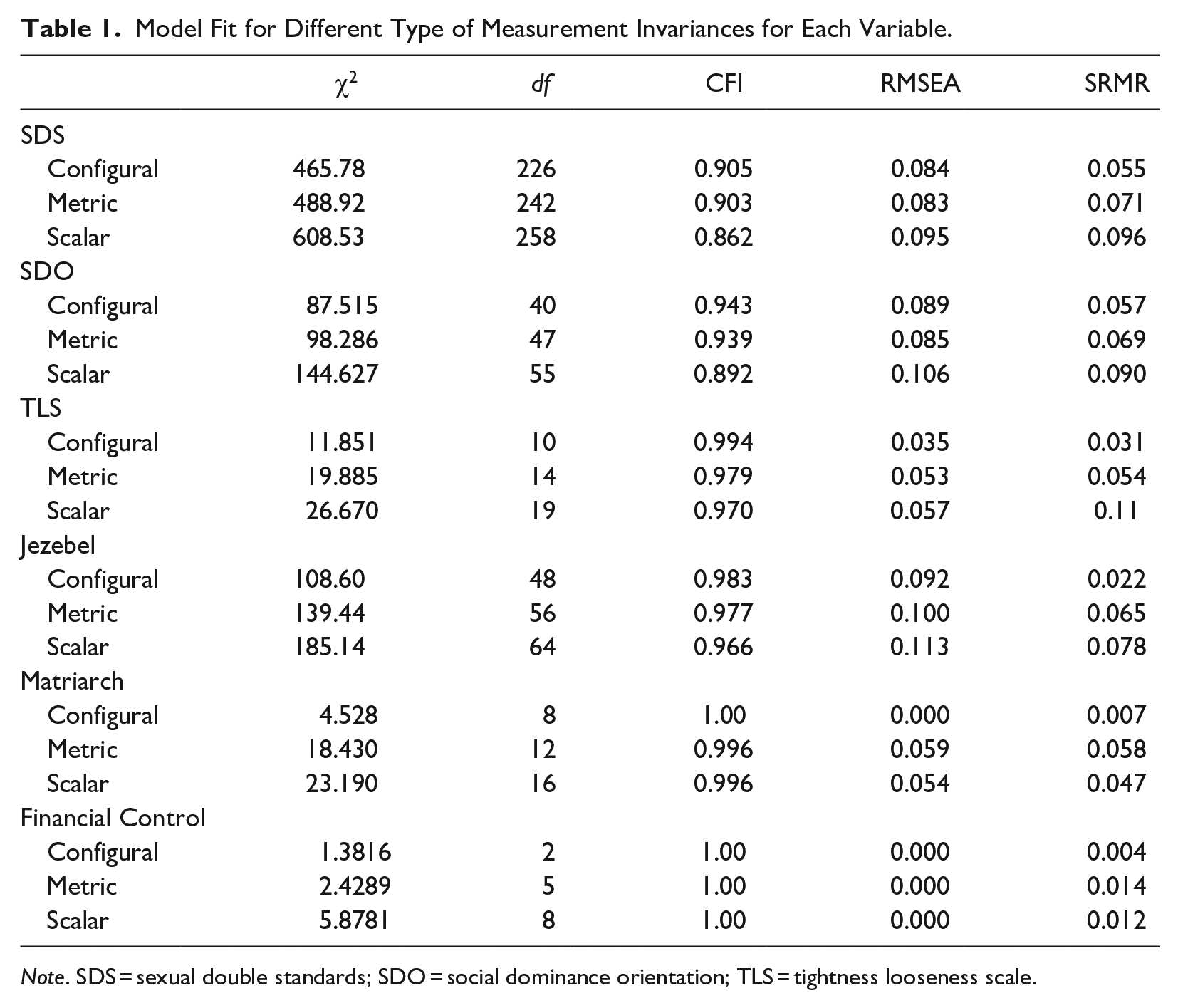
Measurement invariance between Pakistan and U.S. samples for each construct was examined using multigroup CFA, with country as the grouping factor. Each construct was specified as a latent variable with items as their indicators (see Measures section). For each construct separately, we estimated three models, (1) a fully unconstrained model where all intercept and factor loadings are set to vary freely across nations, (2) a constrained model where factor loadings are set to be equal to assess metric invariance, and (3) a model constraining where intercepts are set to be equal across nations to assess scalar invariance. When metric invariance is established, it is possible to compare relations among constructs across groups (Chen et al., 2008). Establishing scalar invariance allows us to compare means across groups (Chen et al., 2008). For each construct, we compared the unconstrained and constrained models (see Table 1). To compare models, we have reported the difference in CFI instead of chi square difference tests because of high degrees of freedom (Chen et al., 2008). The difference in CFI should be around or below 0.01 to establish that invariance exists.
Model Fit for Different Type of Measurement Invariances for Each Variable.
Note. SDS = sexual double standards; SDO = social dominance orientation; TLS = tightness looseness scale.
Model fits for all models to evaluate measurement invariance are displayed in Table 1. For sexual double standards, the unconstrained model was an adequate fit. We found support for metric invariance (ΔCFI = 0.003) but not scalar invariance (ΔCFI = 0.041). For social dominance orientation, the unconstrained model was an adequate fit with support for metric invariance (ΔCFI = 0.004) but not scalar invariance (ΔCFI = 0.047). The unconstrained model for the tightness and looseness scale showed a good fit with support for metric invariance (ΔCFI = 0.014) but not for scalar invariance (ΔCFI = 0.057). For the Jezebel subscale of justification of violence, the unconstrained model demonstrated a good fit with support for metric invariance (ΔCFI = 0.006) and for scalar invariance (ΔCFI = 0.011). For the matriarch subscale of justification of violence, the unconstrained model demonstrated a good fit with support for metric invariance (ΔCFI = 0.004) and for scalar invariance (ΔCFI = 0.022). For the financial control subscale of justification of violence, the unconstrained model demonstrated a good fit with support for metric invariance (ΔCFI = 0.00) and for scalar invariance (ΔCFI = 0.02). Because of high error correlations for two items on the Jezebel subscale and two items on the matriarch subscale, those items were removed to retain configural invariance.
In sum, metric variance was established for all variables. Scalar variance was only established for justification of violence while for all other variables such as sexual double standards, tightness/looseness, and social dominance orientation it was not established. Our primary hypotheses involve comparisons of the path estimates between the two countries, which we can proceed to do because we have established metric invariance, but because we have not established scalar invariance, we do not compare means for these variables across countries.
Descriptive Results for Variables
Means, standard deviations, and correlations for all variables are presented in Table 2.
Descriptive Statistics and Covariances for the Latent Variables in the United States and Pakistan.
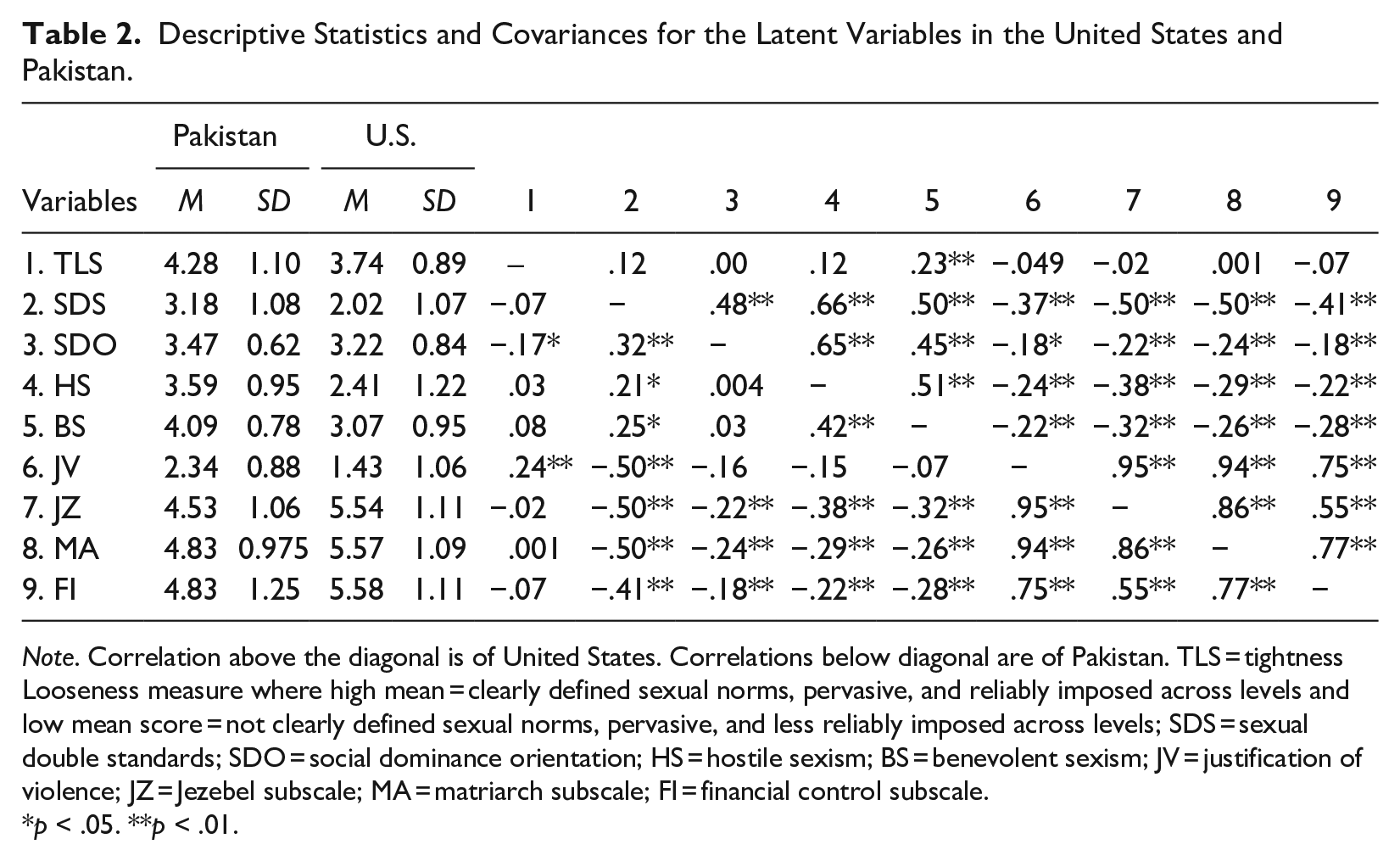
Note. Correlation above the diagonal is of United States. Correlations below diagonal are of Pakistan. TLS = tightness Looseness measure where high mean = clearly defined sexual norms, pervasive, and reliably imposed across levels and low mean score = not clearly defined sexual norms, pervasive, and less reliably imposed across levels; SDS = sexual double standards; SDO = social dominance orientation; HS = hostile sexism; BS = benevolent sexism; JV = justification of violence; JZ = Jezebel subscale; MA = matriarch subscale; FI = financial control subscale.
Multiple Group Path Analysis
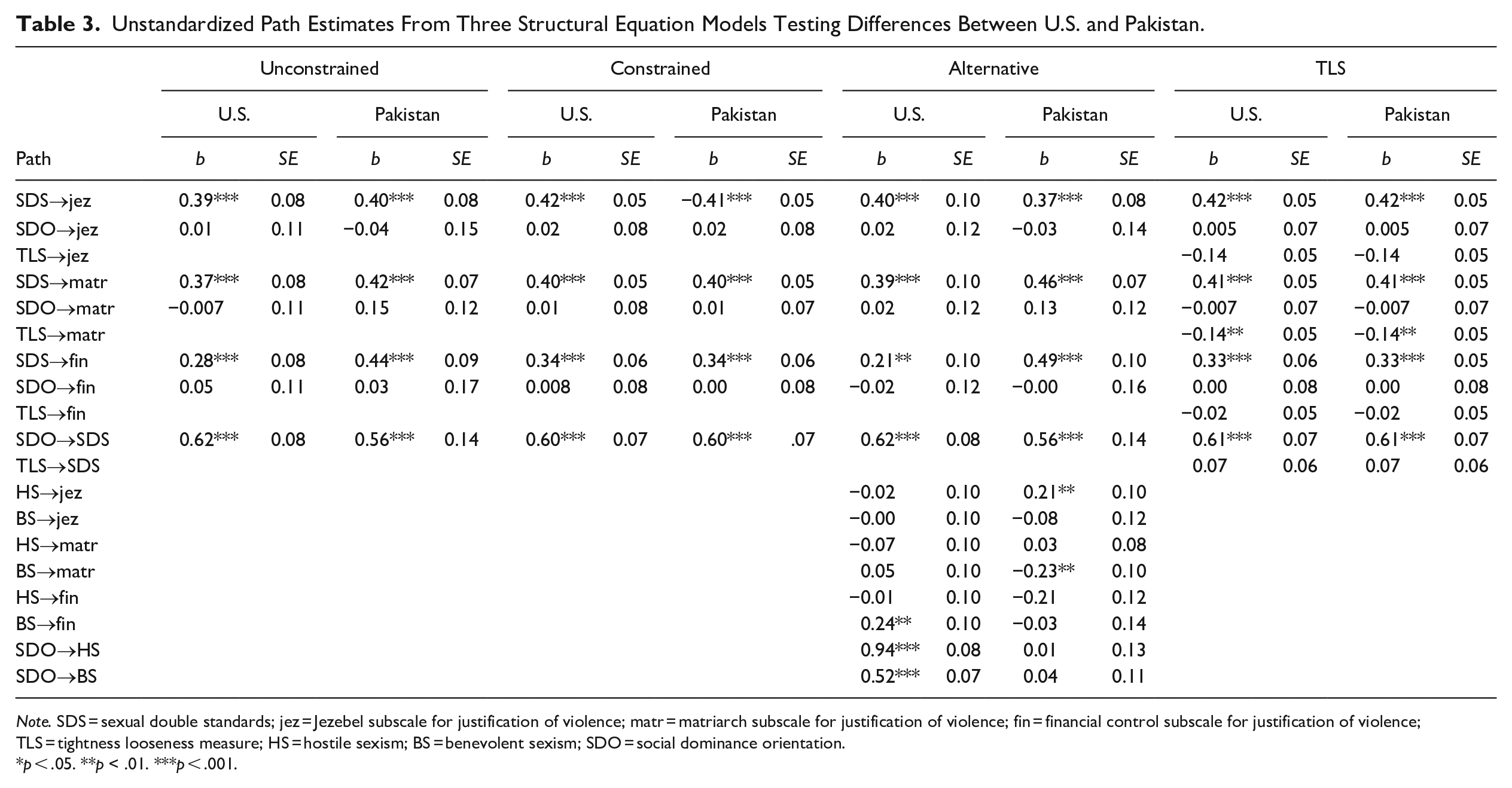
We estimated our theoretical model in which social dominance orientation predicted sexual double standards, and both predicted justification for violence against women. To examine whether there were differences in the structural paths between the two countries, we first estimated an unconstrained model where all paths were allowed to vary between the U.S. and Pakistan (see Table 3). We then constrained all paths between the two countries and examined model fit statistics to test whether there was a statistically significant detriment in model fit. If the model fit worsened after constraining the model to be equal across countries, then we would conclude that there are significant differences between the U.S. and Pakistan on the constrained paths. The unconstrained model had perfect fit because the model is fully saturated (Kline, 2010). The constrained model had excellent model fit and was not statistically different from the unconstrained model (CFI = 1.0; RMSEA = 0.00; SRMR = 0.02). Because the constrained model was statistically equal to the unconstrained model and because it is more parsimonious, we interpret the constrained model.
Unstandardized Path Estimates From Three Structural Equation Models Testing Differences Between U.S. and Pakistan.
Note. SDS = sexual double standards; jez = Jezebel subscale for justification of violence; matr = matriarch subscale for justification of violence; fin = financial control subscale for justification of violence; TLS = tightness looseness measure; HS = hostile sexism; BS = benevolent sexism; SDO = social dominance orientation.
p < .05. **p < .01. ***p < .001.
The path estimates from sexual double standards to justification of violence were statistically significant for both United States and Pakistan (see Table 3). In both the U.S. and Pakistan, social dominance orientation significantly predicted sexual double standards and direction of this relationship was positive. Social dominance orientation was not a significant predictor of justification for violence against women in this model for either country (U.S or Pakistan). Sexual double standards were a statistically significant predictor of justification for violence for both countries. The sign of relationship was negative because less score on justification of violence indicates more justification of violence.
Alternative Models
We also tested the robustness of sexual double standards in predicting justification for violence against women in an alternative model that also included hostile and benevolent sexism. Interpreting the alternative model of sexism (see Figure 2), the path estimates from sexual double standards to justification of violence for U.S. and for Pakistan were statistically significant. Sexual double standards predicted justification of violence for both U.S. and Pakistan. The path estimates for social dominance orientation to justification of violence for U.S. and Pakistan are not statistically significant. The path estimates for social dominance orientation to sexual double standards for U.S. and for Pakistan are statistically significant. In both nations, social dominance orientation predicted sexual double standards. The path estimates for hostile sexism to justification of violence for U.S. and Pakistan were not statistically significant. The path estimates for benevolent sexism to justification of violence for U.S. and for Pakistan were not statistically significant either. The path estimates for social dominance orientation to hostile sexism were statistically significant for the U.S. sample but not for the Pakistani sample. For the U.S., social dominance orientation predicted hostile sexism while for Pakistan it has not. The path estimates for social dominance orientation to benevolent sexism for U.S. were statistically significant but not for Pakistan. Again, social dominance orientation predicted benevolent sexism for U.S. but not for Pakistan. So, for both U.S. and Pakistan, sexual double standards predicted the justification of violence. Furthermore, social dominance orientation predicted sexual double standards in individuals of both nations. Social dominance orientation predicted hostile and benevolent sexism only for U.S. but not for Pakistan.
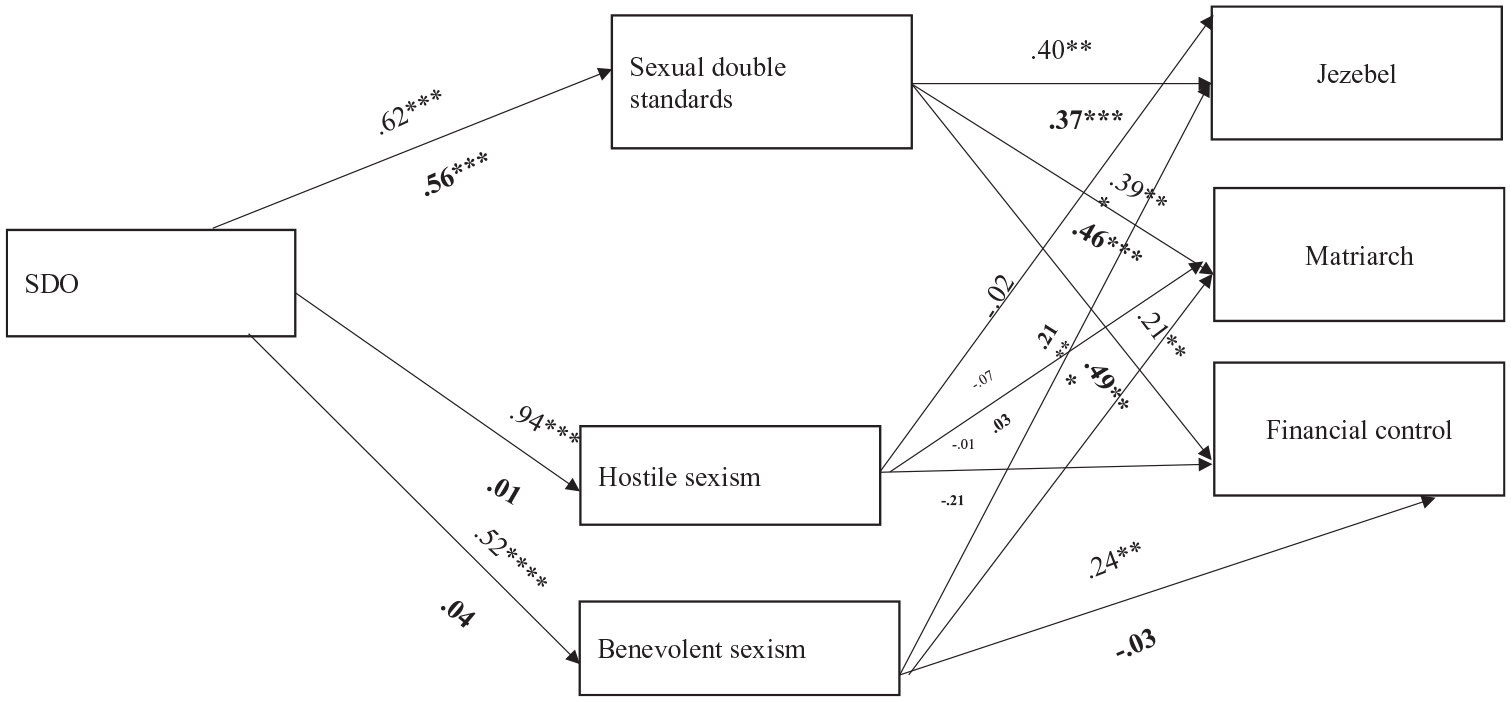
Alternative structural model showing social dominance orientation as predictor of sexual double standards, hostile, and benevolent sexism.
Furthermore, we also tested the robustness of sexual double standards in another alternative model by including tightness/looseness relating to sexuality norms. Interpreting the alternative model of tightness/looseness (see Table 3), the path estimates for sexual double standards to Jezebel, matriarch, and financial control (justification of violence) were statistically significant for both U.S. and Pakistan. For both U.S. and Pakistan, the path estimates for social dominance orientation to Jezebel, matriarch, and financial control (justification of violence) were not statistically significant. Furthermore, the path estimates for tightness/looseness were only statistically significant for matriarch for both contexts but not for Jezebel and financial control. Moreover, the path estimates for social dominance orientation to sexual double standards was statistically significant for both U.S. and Pakistan. The path estimates for tightness/looseness to sexual double standard was not statistically significant for both U.S. and Pakistan.
Moreover, we also tested the robustness of sexual double standards in another alternative model by including gender. Interpreting the alternative model of gender (see Table 4), the path estimates for sexual double standards to Jezebel, matriarch, and financial control (justification of violence) were statistically significant for both U.S. and Pakistan. For both U.S. and Pakistan, the path estimates for social dominance orientation to Jezebel, matriarch, and financial control (justification of violence) were not statistically significant. Similarly, the path estimates for gender were not statistically significant for matriarch, Jezebel, or financial control in either national context. The path estimate for social dominance orientation to sexual double standards was statistically significant for both U.S. and Pakistan. The path estimate for gender to sexual double standard was not statistically significant for both U.S. and Pakistan. The three separate path models (one with ambivalent sexism and without gender and tightness/looseness, second with tightness/looseness, and third with gender) were tested and all three alternative models proved the robustness of sexual double standards in predicting justification of violence.
Unstandardized Path Estimates From Structural Equation Model Controlling Gender Testing Differences Between U.S. and Pakistan.
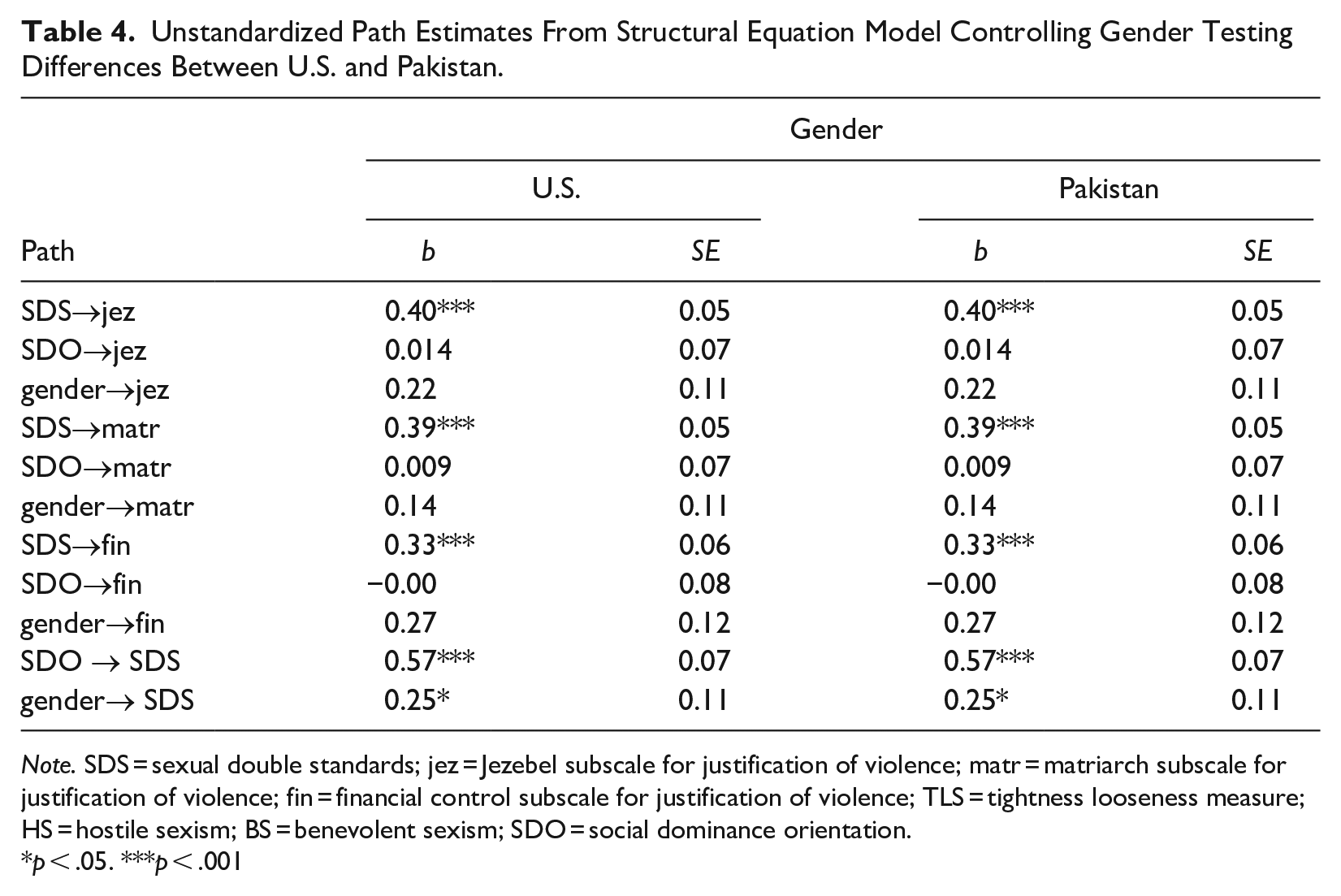
Note. SDS = sexual double standards; jez = Jezebel subscale for justification of violence; matr = matriarch subscale for justification of violence; fin = financial control subscale for justification of violence; TLS = tightness looseness measure; HS = hostile sexism; BS = benevolent sexism; SDO = social dominance orientation.
p < .05. ***p < .001
Discussion
The present study examined whether social dominance predicts justification of violence via sexual double standards in both the U.S. and Pakistan. Our results showed that social dominance predicts the justifications of violence via endorsement of sexual double standards in both countries. Furthermore, our findings have shown the robustness of sexual double standards despite the presence of gender, sexism (i.e., hostile and benevolent), and tightness/looseness of sexuality norms in predicting justification of violence among U.S. and Pakistani individuals. Justifications of violence (based on Jezebel beliefs, matriarch beliefs, and financial control) were similarly predicted by sexual double standards both with and without sexism variables and tightness/looseness in an alternative model. Findings suggest that despite differences in these cultures regarding sexual norms, the effects are fairly similar and having loose sexual norms does not necessarily guarantee women protection from abuse.
Our research findings have shown that social dominance orientation predicts the endorsement of sexual double standards across both countries (U.S. and Pakistan). As SDO is about endorsing hierarchies and inequalities in societies, we can speculate from our findings that individuals in both countries are likely to endorse gender inequality in different domains such as financial, social resources, and sexual freedom (Cooke, 2006; Hadi, 2017). Despite the differences in looseness/tightness of sexuality norms in both countries (U.S. and Pakistan), both societies are characterized as patriarchal societies (Sidanius & Pratto, 2001) privileging heterosexual men, who disproportionately receive financial, social, political, and private advantages (Chaudhry, 2013; Corradi, 2017). According to a PEW Research Center’s survey, heterosexual men in the U.S. occupy more leadership positions than women, so gender inequality is present in cultures with loose sexuality norms (Pew Research Survey, 2017; gender gap ranking for U.S = 30th out of 156 countries; Gender Gap Index, 2021) as well as in cultures with tight norms related to sexuality (e.g., gender gap ranking for Pakistan = 153/156; Gender Gap Index, 2021)
Despite cultural stereotypes that western countries like the United States are more gender egalitarian, our findings indicate that women in U.S. also experience violence that is socially excused (Frazier, 2021). In both contexts, gender inequality is maintained through unequal distribution of resources, power, and social value. Powerful groups (e.g., heterosexual men) have easy access to important material resources while less powerful groups (like women) are dependent on powerful individuals to gain access to these resources (Pratto, 1996; Sidanius & Pratto, 2001). Our findings, were consisted across gender, replicating past work that members of subordinate groups, like women, can also accept these notions that encourage gender inequality (Glick & Fiske, 2001), further reinforcing men’s dominance over women. These cross-cultural findings are in line with principles of social dominance theory stating that the processes supporting justification of violence against women are similar everywhere, where there are advantaged/powerful and disadvantaged/less powerful groups. Our findings extend this, demonstrating that these ideologies exist irrespective of differences in tightness/looseness of sexuality norms in countries and cultures.
Similarly, sexual double standards predicted justification of violence (matriarch, Jezebel, and financial control) for individuals of both U.S. and Pakistan. Endorsement of sexual double standards leads to justification of violence irrespective of differences in sexuality norms among both contexts. While there is a narrative that looser sexual norms are better for women’s liberation and preventing violence, but current findings suggest that similar oppression against women is found in both spaces. Individuals endorsing sexual double standards have a firm belief in the right of a heterosexual man to have multiple sexual partners, a more active role and freedom in sexual activities without any consequences and the right to engage in sexual conversations while women must remain restricted, shy, and passive in sexual matters and experience harsh judgment and punishment for being sexually active, particularly unmarried sexually active women in Pakistan. Our findings demonstrate that support for sexual double standards is indicative of support toward justification of violence against women.
Moreover, our alternative model of sexism (benevolent & hostile sexism) demonstrated the robustness of sexual double standards as a predictor of justification of violence against women when controlling for sexism in both countries (hostile and benevolent; see Figure 2). This finding shows that sexual double standards are an important component in predicting justification of violence against women irrespective of hostile and benevolent sexism. Our alternative model also showed that social dominance orientation is a predictor of hostile sexism and benevolent sexism for U.S. but not in Pakistan. This suggests since loose cultures with respect to sexuality norms, like the U.S. does not has clearly defined and reliably imposed sexual norms across levels (Gelfand et al., 2011) so individuals have an opportunity to utilize hostile and benevolent sexism to perpetuate and justify violence against women. While in tight cultures relating to sexuality norms like Pakistan has clearly defined and reliably imposed sexual norms across all levels (macro, micro, and meso) so individuals do not specifically require sexism to justify violence against women because they are already using pervasive ideologies justifying violence against women such as sexual double standards and social dominance orientation. In another alternative model, sexual double standards are again found to be a predictor for justification of violence against women despite controlling the variable of tightness/looseness relating to sexuality norms (see Figure 3) and gender (see Table 4). These findings speak for the robustness of sexual double standards as a strong predictor of justification of violence against women irrespective of sexism, gender, and differences in sexuality norms between contexts (U.S. and Pakistan). It is consistent with past literature within the field of violence studies (Endendijk et al., 2020; Hill & Kearl, 2011; Zaikman & Marks, 2014; Zaikman et al., 2016). In conclusion, we can say that tightness/looseness relating to sexuality norms as a cultural dimension does not affect the relationship between sexual double standards, social dominance orientation, and justification of violence against women. Thus, the findings of our study provide strong support for the robustness of sexual double standards and social dominance in predicting justification of violence across cultural contexts.
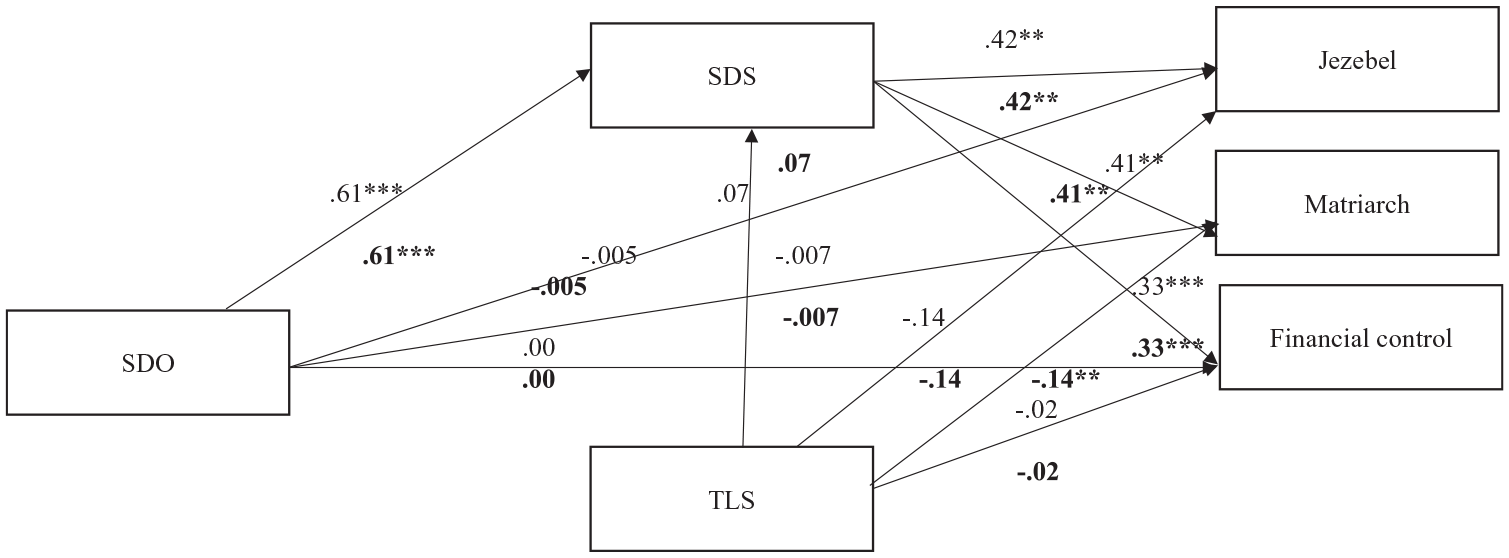
Alternative structural model with tightness/looseness.
Limitations and Future Research
The present study, while strong in its cross-cultural application of existing social psychological literature, was not without limitations. Firstly, it relies on correlational and cross-sectional data, so establishing causality is not possible. However, the social dominance theory model tested has empirical support from field studies supporting the causal prediction (Pratto et al., 1994, 2013; Sidanius & Pratto, 2001). Future research, however, should explore the relationships among social dominance, sexual double standards and justification of violence against women as argued by social dominance theory experimentally as they have been least developed. Secondly, the understanding of some variables like social dominance orientation and sexual double standards can vary among individuals so for future studies, it is better to first explore their understanding and then proceed with model testing. Furthermore, in future studies, other variables like negative attitudes toward women, peer’s influence, attitudes toward casual sex, etc. can be used to explore their relationship with sexual double standards and social dominance orientation. As past literature has demonstrated that these variables could have a strong influence on sexual double standards (Emmerink et al., 2016; Ferguson et al., 2008). In current study, we have not found any relationship between social dominance orientation and sexism variables (hostile and benevolent) in the context of the Pakistan and that might be due to a greater number of female participants in Pakistani sample. For future work, it is suggested to incorporate more variety in sample in terms of gender.
Another limitation of this study was use of two different recruitment methods—prolific for U.S. participants and social media has been used for recruiting participants from Pakistan so for future studies it is suggested to utilize similar recruitments in different contexts to get more accurate results. We are mindful that our study has not looked at variation in experiences of violence among different groups of women in the U.S so it is important to consider that the consequences for violence can vary for different groups of women within United States, for example, women of color, Black and African American women, and women from other marginalized groups (Cho, 2012; Mena, 2018). It is suggested for future research to consider how the relationships examined in the current work may vary for different groups of women in the U.S. Also, in future studies, the same variables and relationships can be unpacked by incorporating an intersectionality framework to observe sameness/differences in patterns for justifications of violence against women. Future research could also look at specific social and political environments in different contexts and how it influences endorsement of sexual double standards, social dominance, and justification of violence against women among individuals.
Another limitation could be the nature of instrument for sexual double standards that may have produced socially desirable responses. However, because the questionnaire was completed online from respondent’s own home, we believe that this risk was reduced (Spijkerman et al., 2009). In Pakistani sample, the ratio of responses from women were more than men that could be one of the limitations of present study as well. The reason is probably the nature of questionnaires that were used in this study. Also, women might find it as a good opportunity to report their views on justification of violence against women in an anonymous survey because usually such things are not encouraged to be discussed and anything relating to sex is considered as stigma or taboo in Pakistan. So, that is also one of the reasons that researchers have difficulty in obtaining responses from Pakistani men in general (Gul, 2017; Jamshed & Kamal, 2021). Furthermore, we did not measure the behavior of justification of violence against women but just justification or endorsement of violence against women, so it is suggested for future works to integrate behavior of justification of violence in order to get more nuanced understanding of violence against women.
Implications
The findings of this study add to the existing literature in the field of psychology on areas of violence against women, social dominance (Sidanius & Pratto, 2001) and sexual double standards (Emmerink et al., 2016; Sanchez et al., 2012) by demonstrating the relationship among social dominance orientation, justification of violence against women, and sexual double standards. One of the strengths of present study is its cross-cultural nature, that is, examining the proposed model in both U.S and Pakistan. Thus, the obtained findings elucidated the study of these variables across these contexts, contributing to both local and global literature on violence against women. The findings also helped in debunking some myths (e.g., violence against women is only prevalent in Pakistan and other countries with tight sexuality norms) by showing that the processes supporting violence against women are similar in both countries. Furthermore, our findings have clearly shown the similarity of the processes supporting violence against women as well as support for hierarchies in general and endorsement of sexual double standards in both U.S. and Pakistan. Hence our model based on social dominance theory stands true cross culturally which is again one of the most significant strength of our study. Finally, sexual double standards are found to be strong predictor of justifications of violence against women suggesting the need of addressing social dominance and sexual double standards in interventions aiming to reduce violence against women. The findings suggest the need of creating awareness and educating individuals in the U.S and Pakistan about negative impacts of sexual double standards in general and particularly contributing to violence against women. Our findings also have potential of informing policies addressing gender inequality and violence against women by suggesting working on reducing legitimizing myths (e.g., sexual double standards) and attitudes of social dominance held by individuals to decrease violence against women in both countries.
Conclusion
Support for social dominance theory was obtained in this research. It showed that social dominance orientation predicts justifications of violence via endorsement of sexual double standards for both countries (U.S and Pakistan). This cross-cultural study is effective in showing that the processes supporting violence against women are similar in both tight (Pakistan) and loose cultures (U.S) relating to sexuality norms despite cultural differences. The findings of this study also highlighted the robustness of sexual double standards in contribution to justification of violence against women in both contexts. Furthermore, findings have potential to inform interventions and policies focusing on violence against women in both countries. Our results suggest the need of creating awareness and educating individuals in both countries about harmful impacts of social dominance and sexual double standards in relation to justification of violence against women. Overall, our proposed model based on social dominance theory for examining violence against women held in two disparate countries (U.S and Pakistan).
Footnotes
Declaration of Conflicting Interests
The author(s) declared no potential conflicts of interest with respect to the research, authorship, and/or publication of this article.
Funding
The author(s) received no financial support for the research, authorship, and/or publication of this article.
