







Abstract
People care about their own well-being and about the well-being of their families. It is currently, however, unknown how much people tend to value their own versus their family’s well-being. A recent study documented that people value family happiness over personal happiness across four cultures. In this study, we sought to replicate this finding across a larger sample size (N = 12,819) and a greater number of countries (N = 49). We found that the strength of the idealization of family over personal happiness preference was small (average Cohen’s ds = .20, range −.02 to.48), but present in 98% of the studied countries, with statistical significance in 73% to 75%, and variance across countries <2%. We also found that the size of this effect did vary somewhat across cultural contexts. In Latin American cultures highest on relational mobility, the idealization of family over personal happiness was very small (average Cohen’s ds for Latin America = .15 and .18), while in Confucian Asia cultures lowest on relational mobility, this effect was closer to medium (ds > .40 and .30). Importantly, we did not find strong support for traditional theories in cross-cultural psychology that associate collectivism with greater prioritization of the family versus the individual; country-level individualism–collectivism was not associated with variation in the idealization of family versus individual happiness. Our findings indicate that no matter how much various populists abuse the argument of “protecting family life” to disrupt emancipation, family happiness seems to be a pan-culturally phenomenon. Family well-being is a key ingredient of social fabric across the world, and should be acknowledged by psychology and well-being researchers and by progressive movements too.
Keywords
Happiness may be the “ultimate dependent variable” in psychological science (Lu & Gilmour, 2004). Although a great deal of research has sought to measure and understand personal happiness, some recent evidence shows that many people tend to value family happiness over personal happiness (Krys et al., 2021). The purpose of this article is to investigate the relative idealization of family over personal happiness across a broad array of cultural contexts and to explore how cultures may vary in the extent of happiness idealization.
Ideal Level of Happiness Varies Across Cultures
A belief that people should explicitly and actively pursue happiness is a pervasive assumption within psychological science. Indeed, some view happiness as the ultimate value in life and strongly endorse its pursuit (e.g., Lu & Gilmour, 2004). Many intergovernmental organizations such as the United Nations consider the pursuit of happiness a fundamental human goal and advocate that levels of happiness should guide policy-making. Such positive conceptualizations of happiness are particularly common within Western and individualistic contexts (Bond, 2013; Steel et al., 2018). However, recent studies demonstrate considerable cultural variation in the way happiness is construed and valued (Hornsey et al., 2018; Krys et al., 2021).
Considerable variation exists in how happiness tends to be idealized. For example, Japanese, Koreans, and Chinese students score relatively low on ideal happiness (Diener et al., 2000). More recently, Hornsey and collaborators (2018) documented that people in holistic cultures (i.e., societies where holistic rather than analytic cognitive style is more prevalent; Nisbett et al., 2001) did not aspire to maximize their happiness. Furthermore, there also appears to be evidence for a fear of feeling too happy (Joshanloo & Weijers, 2014) and tendencies to refrain from expressing positive emotions (van Osch et al., 2016). These findings indicate that personal happiness may not necessarily be the “ultimate dependent variable.” It may be the case that other forms of happiness tend to be valued more than personal happiness. In particular, people across the world may aspire to preserve or enhance their family’s happiness more than one’s personal happiness.
Family Happiness: From Self-Ratings to Us-Ratings
The majority of psychological studies focus on individuals. Contemporary academic traditions originate mainly from individualistic societies (Sampson, 1981), in which the “basic unit of survival” is an individual person (Hui & Triandis, 1986). However, individualistic cultures emerged relatively recently; throughout most of human history, it was extremely difficult to survive without strong ties to a collective. Even nowadays, for many people across many different cultures (including those individualistic), people have a strong need to belong and “we” may be at least equally important as “I” (Sampson, 1981). Thus, to make psychological science more culturally sensitive, in addition to self-ratings, it is also important to study us-ratings.
Evolutionary psychologists recognize that family (i.e., kinship) is highly salient and important with respect to many other types of interconnectedness. Humans foster higher prosociality toward kin than toward other in-groups, and complex norms regulating kinship have evolved across all human cultures (McNamara & Henrich, 2017). Caring for family is one of the most important universal human motives (Ko et al., 2020). Data from the World Values Survey confirm that among six aspects of life—family, friends, leisure time, politics, work, and religion—family is rated as the most important domain of living in each of over 60 analyzed countries (Krys et al., 2021). Moreover, family is considered the most important contextual component of lay conceptions of happiness across many different cultural contexts (Delle Fave et al., 2016).
Ideal Type of Happiness Varies Across Cultures
Across cultures, people define personal happiness in a variety of ways (Krys et al., 2019; Uchida & Oishi, 2016). One type of happiness is broadly construed as life satisfaction (Diener et al., 1985). Life satisfaction tends to be individual person-oriented and frames personal happiness in accordance with several aspects of European American cultural contexts (Diener et al., 1985; Krys et al., 2019). Another type of happiness is termed interdependent happiness (Hitokoto & Uchida, 2015). Interdependent happiness represents the degree to which one is interpersonally harmonized and connected to the collective way of well-being. Interdependent happiness is more socially-oriented and frames personal happiness in accordance with several aspects of several East Asian cultural contexts such as Japan. Although life satisfaction and interdependent happiness represent separable as well as complementary forms of happiness both consider the individual as the primary unit, as opposed to the family.
Cultural Differences in the Idealization of Family Happiness
It may be the case that cultures differ in terms of how much family happiness is idealized over personal happiness. One broad construct shown to be associated with country-level measures is individualism. When happiness is measured with “I” as the focus, there exists a positive association between individualism and life satisfaction (Cheng et al., 2016; Diener et al., 1995; Jasielska et al., 2018; Krys et al., 2019; Kuppens et al., 2008; Steel et al., 2018). Individualism—collectivism represents a broad array of psychological constructs and thus it remains difficult to ascertain what aspects of individualism or collectivism may relate to happiness and what aspects do not. Here, we focus on another cultural variable that may be particularly important in terms of the idealization of family over personal happiness, namely relational mobility (Krys et al., 2021; Thomson et al., 2018).
Relational mobility is a cultural construct that differentiates societies on how fluid and open interpersonal relationships are (Thomson et al., 2018). Relational mobility is defined as “a socioecological variable that represents how much freedom and opportunity a society affords individuals to choose and dispose of interpersonal relationships based on personal preference” (Thomson et al., 2018, p. 7521). In low relational mobility societies, relationships are relatively stable: Members engage in few long-lasting relationships and tend to be unwilling to abandon them. Constituting a friendship or a family is a relatively long-lasting process. In contrast, in high relational mobility societies, relationship options are more flexible: Members more easily seek out new partners, leave old friends behind, and set up new families. Relationship options are abundant and new relationships can be formed in a short time (Thomson et al., 2018).
Because relationships are more fixed in societies of low relational mobility, options of quitting or changing a family are much smaller. This greater interdependence within in-groups may make family happiness more important for its individual members as they would personally be affected by unhappiness of the larger unit. Family happiness may, thus, be valued over personal happiness to a higher extent than in societies, where patchwork families, single parents, divorces, and frequent change of romantic partners are more common. It, thus, seems plausible that in low, compared with high, relational mobility cultures happiness of one’s family may be valued more than personal happiness. We are aware of one investigation tapping into both relational mobility and life satisfaction. However, this study focused on the moderating effect of relational mobility on the relationship between self-esteem and personal life satisfaction (Yuki et al., 2013). Our research question differs from these findings in that we are interested in the idealization of happiness, not actual happiness, and that we focus on the relationship between ideal happiness and relational mobility.
The theoretical content of relational mobility may relate to some aspects of individualism. Freedom to choose and dispose of interpersonal relationships based on personal preference seems inherently individualistic. However, a large cross-cultural empirical quantification of relational mobility (Thomson et al., 2018) showed that relational mobility is only moderately correlated with measures typically labeled as individualism-collectivism 1 (Hofstede, 2001; Minkov et al., 2017) or with measures recognized as individualism-like phenomena: autonomy (Schwartz, 2008), open society (Krys et al., 2019), or self-expression (Inglehart, 1997). Some may interpret relational mobility as a component or facet of individualism, and others interpret them as separate phenomena—the proper discussion of this issue reaches beyond the scope of this article. To situate the results of our study within the scope of prior research on the link between individualism and happiness (Cheng et al., 2016; Diener et al., 1995; Jasielska et al., 2018; Krys et al., 2019; Kuppens et al., 2008; Steel et al., 2018), we tested for associations between relational mobility and the type of happiness idealization, as well as between various measures of individualism and individualism-like phenomena and the type of happiness idealization.
Present Study
A recent study demonstrated that family happiness was idealized more than individual happiness across four different countries (Krys et al., 2021). In this study, we sought to replicate these findings across a larger array of countries/cultural contexts. We measured ideal levels of personal and family happiness, and sourced country-level data on relational mobility and individualism-collectivism. We investigated the relative idealization of family versus personal happiness across cultures and tested for associations between relational mobility and the type of happiness idealization, as well as between various measures of individualism (or related constructs) and the type of happiness idealization.
Method
Our primary data set consisted of self-reports from a total of 12,819 participants (Mage = 25.18, SD = 9.51) residing in 49 different countries collected from 2017 to 2019. As a rule of thumb, we sought to collect approximately 200 post-secondary sample and received in average 256 valid responses from each country. On average, 83.1% of the entire data set was based on student samples, while the remainder was based on community samples (Table 1; see also Supplementary Online Material [SOM] for detailed information).
Descriptive Statistics of Demographics and Focal Variables.
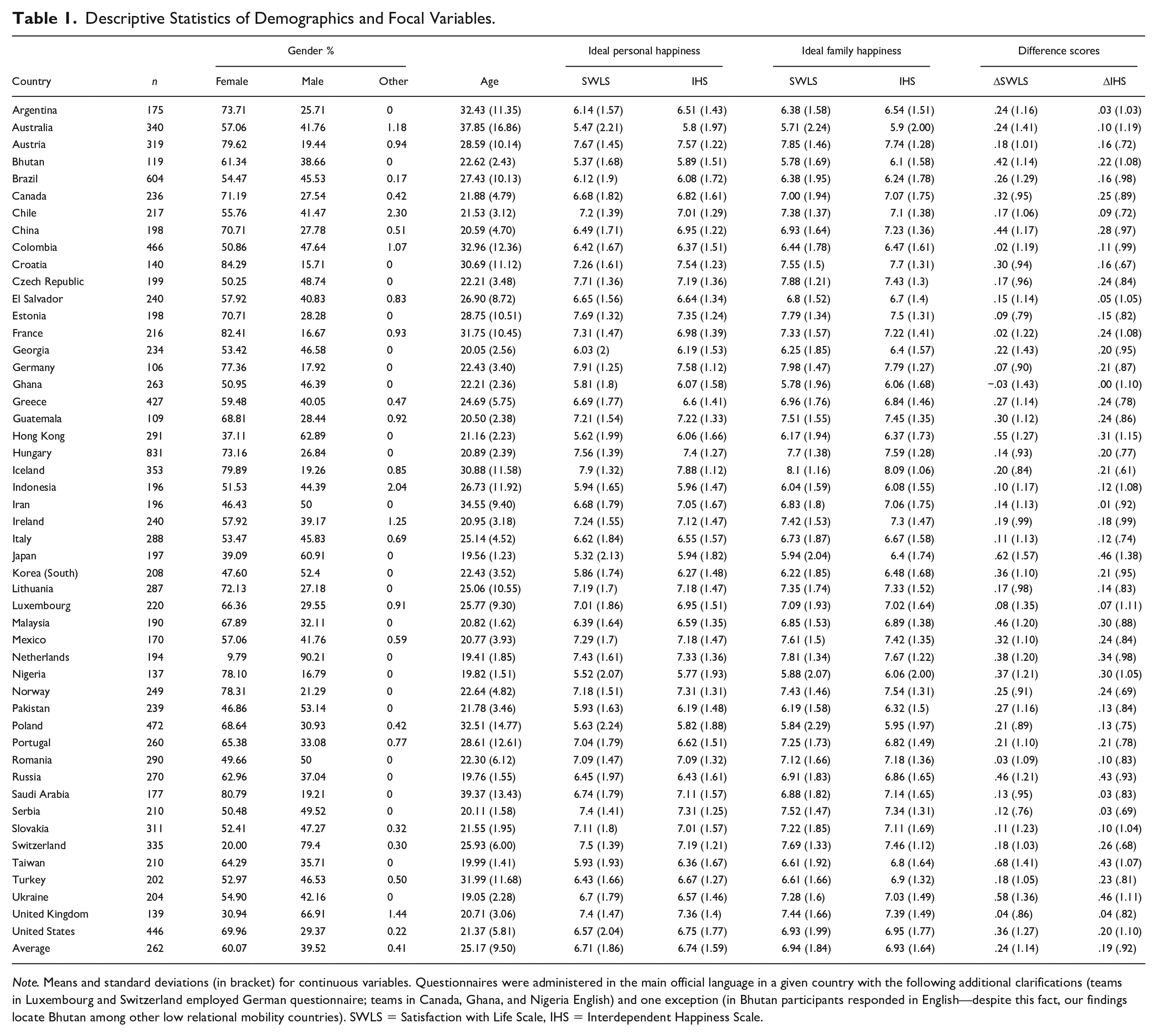
Note. Means and standard deviations (in bracket) for continuous variables. Questionnaires were administered in the main official language in a given country with the following additional clarifications (teams in Luxembourg and Switzerland employed German questionnaire; teams in Canada, Ghana, and Nigeria English) and one exception (in Bhutan participants responded in English—despite this fact, our findings locate Bhutan among other low relational mobility countries). SWLS = Satisfaction with Life Scale, IHS = Interdependent Happiness Scale.
A primary goal of this study was to characterize cultural norms of happiness. We, therefore, decided to frame items in terms of idealization of happiness types. Idealization was used based on prior research demonstrating the efficacy of this term when measuring cultural norms of happiness across 41 different societies (Diener et al., 2000). We used instructions for ideal levels of happiness from Diener and collaborators (2000): [. . .] instead of answering how much you agree with the statements, we would like you to indicate how much you think the ideal or perfect person would agree with each statement (identical approach to Krys et al., 2021). We used the Satisfaction with Life Scale (personal SWLS; five items; Diener et al., 1985; e.g., You are satisfied with your life) to measure ideal life satisfaction of individuals. The Interdependent Happiness Scale (personal IHS; 9 items; Hitokoto & Uchida, 2015; e.g., You believe that you and those around you are happy) was used to measure the ideal interdependent happiness of individuals. To move from self- to us-ratings, we additionally asked participants about ideal levels of their family happiness by changing the subject of the personal SWLS and personal IHS measures from the individual to their family. To establish linguistic equivalence of the instructions and demographic items, team leaders were instructed to follow the back-translation procedure (Brislin, 1973). A full list of the original and modified items, as well as reliability coefficients, is provided as Supplemental Material (pages S3 & S5).
To eliminate between cultural variance in scale-use and response bias, we subtracted the idealization of personal happiness from the idealization of family happiness for both the SWLS and IHS scales resulting in two difference scores (ΔSWLS and ΔIHS, skewnessΔSWLS = 0.56, skewnessΔIHS = 0.57; kurtosisΔSWLS = 5.89, kurtosisΔIHS = 7.62), such that a positive values corresponds to family happiness being idealized more than personal happiness.
Country-level relational mobility scores were obtained from Thomson et al. (2018), with higher scores indicating higher relational mobility. These scores tap into perceptions of both the opportunities and choices people have in their relationships in these countries. Relational mobility values were available for 22 out of the 49 included in this sample. Please see Supplementary Materials for a complete list of countries that were included within models testing for effects of relational mobility.
For markers of country-level individualism, we obtained scores of individualism (Hofstede, 2001; Minkov et al., 2017), open society (Krys et al., 2019), affective and intellectual autonomy and embeddedness (Schwartz, 2008); following the formula for aggregating various cross-cultural scores of similar phenomenona (Krys et al., 2018). We also calculated a meta-factor score of individualism which is the mean of standardized values of the above markers of individualism. We also employed markers of additional country and culture level markers. For Westernization, apart from individualism, we used traditional-secular values and survival-self-expression values (Inglehart, 1997). For Education, we used expected and mean years of schooling from the Human Development Index data (United Nations Development Programme, 2015). For Industrialization, we used technological advancement from Welzel (2013). For Richness, we used log-transformed GDP per capita in 2015 (World Bank, 2017). For Democracy, we used the democracy index by Economist Intelligence Unit (2020).
To ensure the data quality, we additionally excluded (beyond original exclusion of data as reported in material [Krys, Yeung et al., 2022]) 253 participants (about 2% of the overall sample) for lack of responses on variables of interest in this particular paper. A more comprehensive method section is provided in the SOM.
Results
Pancultural Idealization of Family Versus Personal Happiness
We found that across the majority of countries in our sample, family happiness was rated as more important than personal happiness (98% in direction; 73-75% with statistical significance). We found this pattern to occur for both SWLS (Figure 1) and the IHS (Figure 2) forms of happiness. This finding supports the idea that family happiness is almost universally idealized over personal happiness.
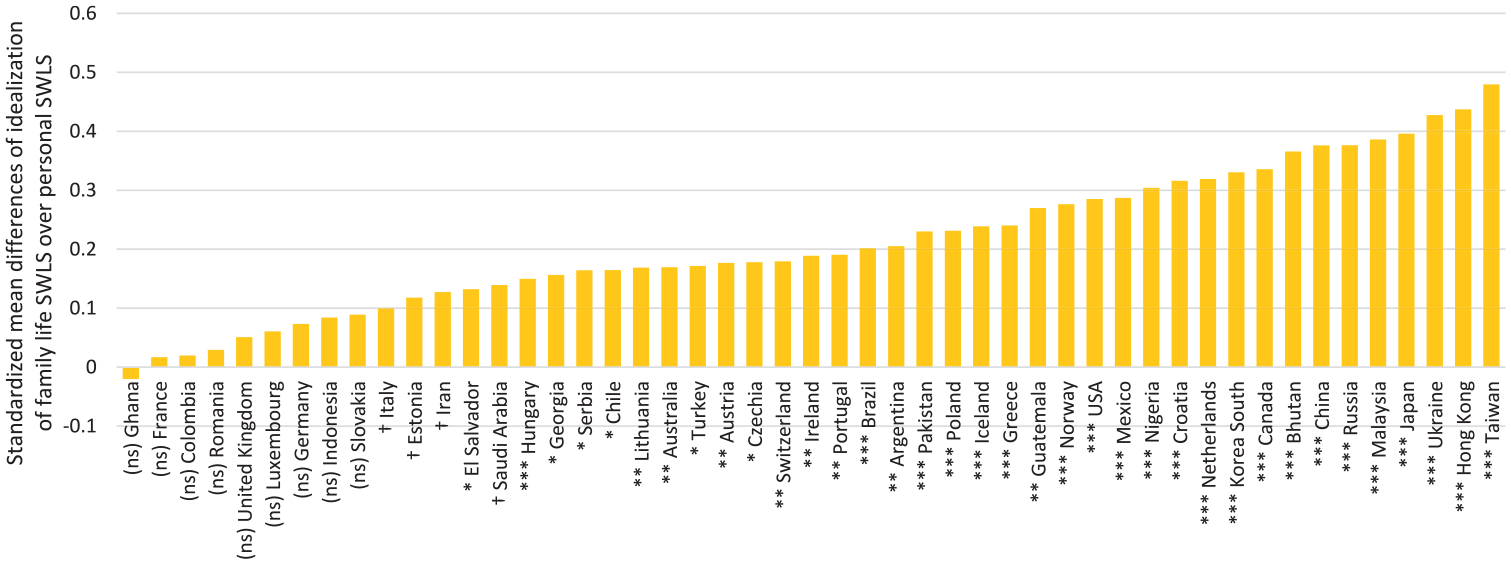
Family Happiness is Idealized Over Personal Happiness in the Majority of Countries Using SWLS as the Outcome Variable (With the Difference Reaching the Level of Statistical Significance in Countries Marked With One or More Asterisks).
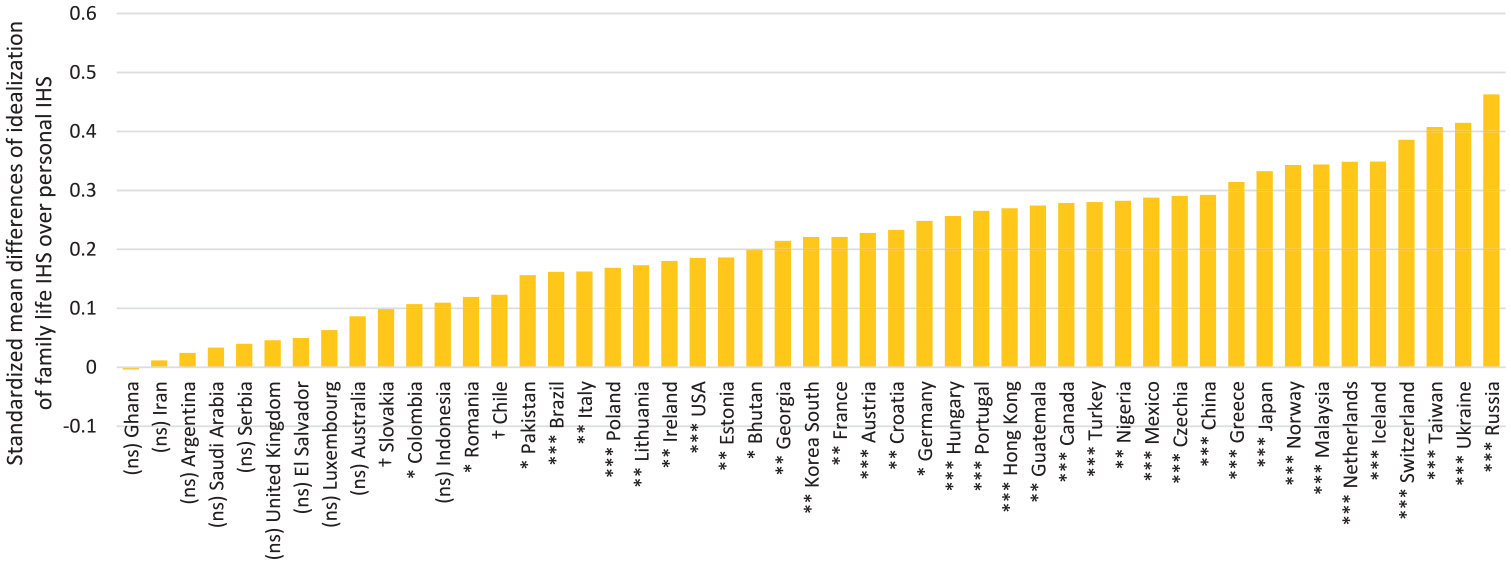
Family Happiness is Idealized Over Personal Happiness in the Majority of Countries Using IHS as the Outcome Variable (With the Difference Reaching the Level of Statistical Significance in Countries Marked With One or More Asterisks).
Cultural Variation in the Idealization of Family Versus Personal Happiness
A MANOVA with country and gender as between-subjects factors and ΔSWLS and ΔIHS as dependent variables, only revealed a significant multivariate effect of country, Wilks’ λ = .98, F(96, 25,182) = 3.12, p < .001, ηp2 = .01. Neither effects of gender and the culture × gender interaction were significant, all ps > .403. This finding indicates that there is cultural variability in the extent to which people value family happiness over personal happiness, and was observed for both operationalizations of happiness, FSWLS(48, 12,595) = 4.56, p < .001, ηp2 = .02, and FIHS(48, 12,595) = 3.41, p < .001, ηp2 = .01. The sizes of these effects were small, with a range from no effect to medium effect (SWLS: d = .20; dmin = −.02 [Ghana]; dmax = .48 [Taiwan]; IHS: d = .20; dmin = .00 [Ghana]; dmax = .46 [Russia]), but ubiquitous. That is, we found it in 98% of the studied countries; 73% and 75% exhibited statistical significance, for SWLS and IHS, respectively. Next we correlated the difference scores (ΔSWLS and ΔIHS) with relational mobility. We found that lower relational mobility scores were related to higher relative idealization of family happiness over personal happiness, rSWLS(20) = −.45, p = .036 and rIHS(20) = −.43, p = .048. In other words, the more “mobile” relations in a given country, the smaller the idealization of family happiness over personal happiness.
Next, we tested if ΔSWLS and ΔIHS correlate with several aspects of individualism–collectivism. Among the zero-order correlations (Table 2), the relationships between ΔSWLS and ΔIHS and relational mobility comprised two out of three significant correlations from 30 analyses run, ΔSWLS: r(20) = −.45, p = .034; ΔIHS, r(20) = −.44, p = .04. The third significant correlation we found was for ΔIHS and traditional-secular values: r[36] = .33, p = .04; correlation for ΔSWLS and traditional-secular values was far from significant: r(36) = .07, p =.65. Importantly, the relationship between ΔSWLS and ΔIHS and relational mobility remained the strongest among all variables of our interest after partialing out the potential confound of wealth level (manifested by log-transformed GDP per capita), ΔSWLS: rpartial(20) = −.45, p = .039; ΔIHS, rpartial(20) = −.45, p = .042. These correlation analyses indicate that relational mobility was uniquely and consistently associated with greater idealization of personal rather than family happiness. The full correlation matrix among variables of interests can be found in Supplemental Table S3 (zero-order correlation) and Supplemental Tables S4 (partial correlation). The general pattern of these results does not support the idea that aspects of individualism–collectivism explain a significant proportion of country-level variation in idealization of family versus personal happiness.
Zero-Order and Partial Correlations Between the Difference Scores of Idealizations and Cultural Variables of Interest.
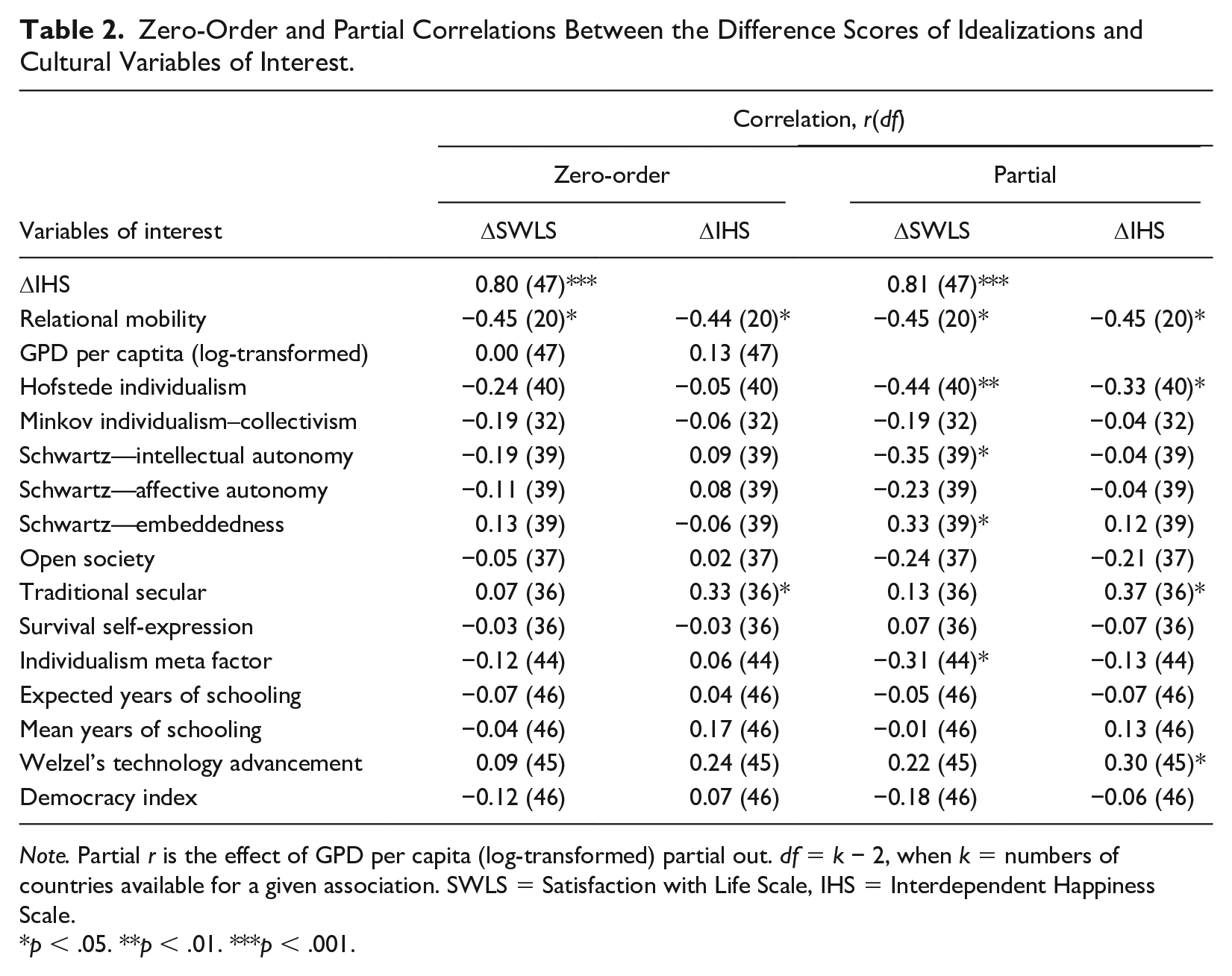
Note. Partial r is the effect of GPD per capita (log-transformed) partial out. df = k − 2, when k = numbers of countries available for a given association. SWLS = Satisfaction with Life Scale, IHS = Interdependent Happiness Scale.
p < .05. **p < .01. ***p < .001.
Two sets of multilevel modeling were conducted to examine whether the country-level relational mobility predicts individual ΔSWLS and ΔIHS (see Tables 3 and 4, respectively), after controlling for individual demographics, including age, gender, nature of samples, and social capital (measured by parents’ education level). We obtained intra-class correlation (ICCs = .02) by defining a null model (Model 1) with only fixed and random intercepts. The ICCs indicated that the cross-country differences accounted for about 2% of the variability of ΔSWLS and ΔIHS, which aligns with our main “take home message” that family happiness is generally idealized more than individual happiness across cultures. Then, in both lines of modeling, we defined two models, demographic model (Model 2) and relation mobility model (Model 3) using the subset of data where relational mobility was available (N = 6,318, k = 22), with a random intercept and fixed slope. Model 2 contains only individual-level demographic variables while Model 3 contains demographics plus country-level relation mobility. In Models 2 and 3, only social capital significantly predicted ΔSWLS and ΔIHS (ΔSWLS model: estimate = 0.05, SE = 0.02, p = .01; ΔIHS model: estimate = 0.05, SE = 0.02, p = .002); no other individual demographic variables significantly predicted ΔSWLS and ΔIHS, ps > .44. And more importantly, in both Models 2 and 3, country-level relational mobility significantly predicted ΔSWLS and ΔIHS (ΔSWLS model: estimates: −0.40, SE = 0.16, p = .02; ΔIHS model: estimate = −0.20, SE = 0.09, p = .04). The −2 log-likelihood different tests were significant as well, ΔSWLS model: Δχ2(1) = 5.66, p = .02; ΔIHS model: Δχ2(1) = 4.55, p = .03, indicating that country-level relational mobility had a significantly increased incremental value in explaining ΔSWLS and ΔIHS after individual-level demographics were controlled. For the full description of analyses, please see SOM.
Multilevel Model Predicting ΔSWLS from Demographics at Individual Level and Relational Mobility at Country Level.
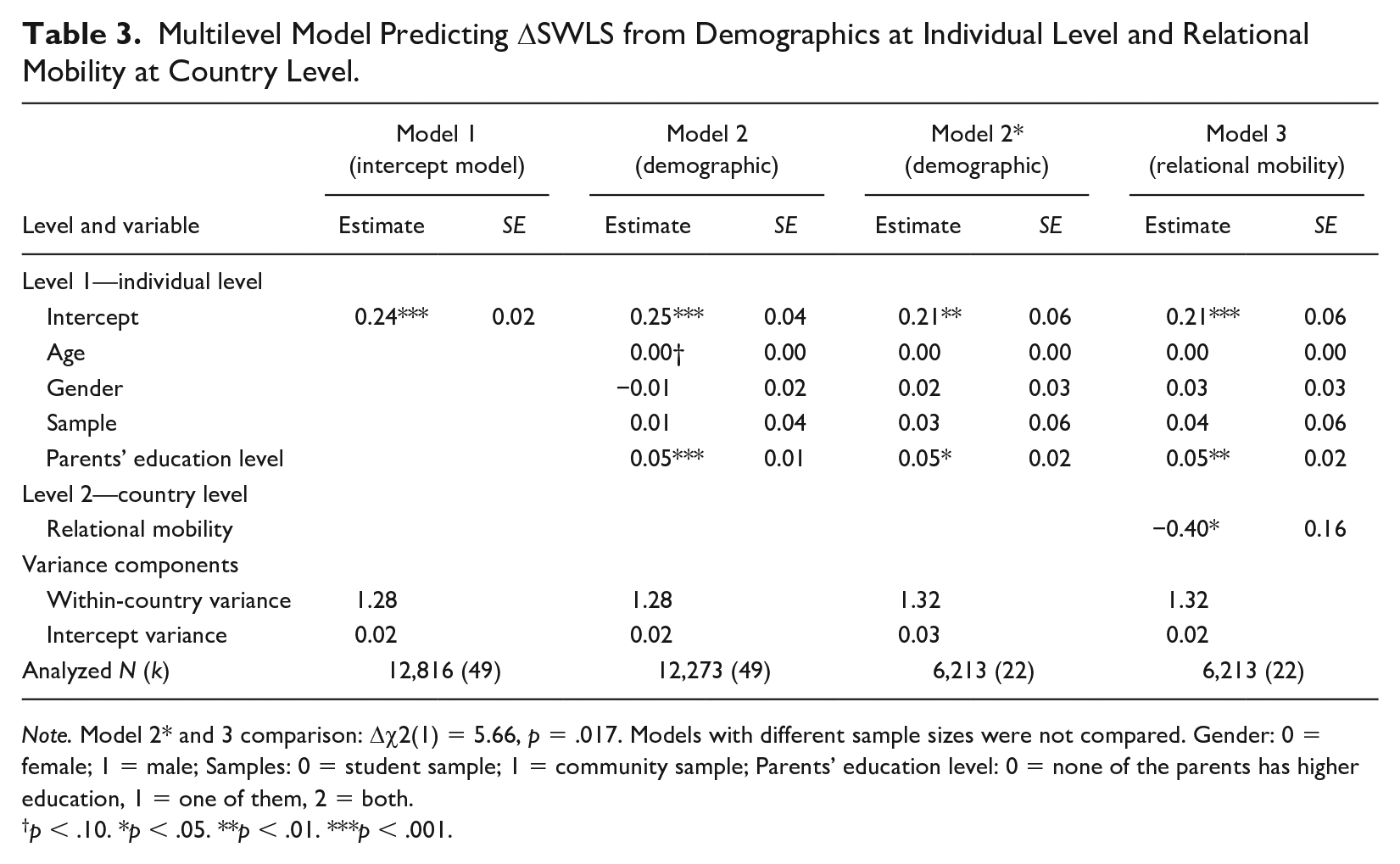
Note. Model 2* and 3 comparison: Δχ2(1) = 5.66, p = .017. Models with different sample sizes were not compared. Gender: 0 = female; 1 = male; Samples: 0 = student sample; 1 = community sample; Parents’ education level: 0 = none of the parents has higher education, 1 = one of them, 2 = both.
p < .10. *p < .05. **p < .01. ***p < .001.
Multilevel Model Predicting ΔIHS From Demographics at Individual Level and Relational Mobility at Country Level.
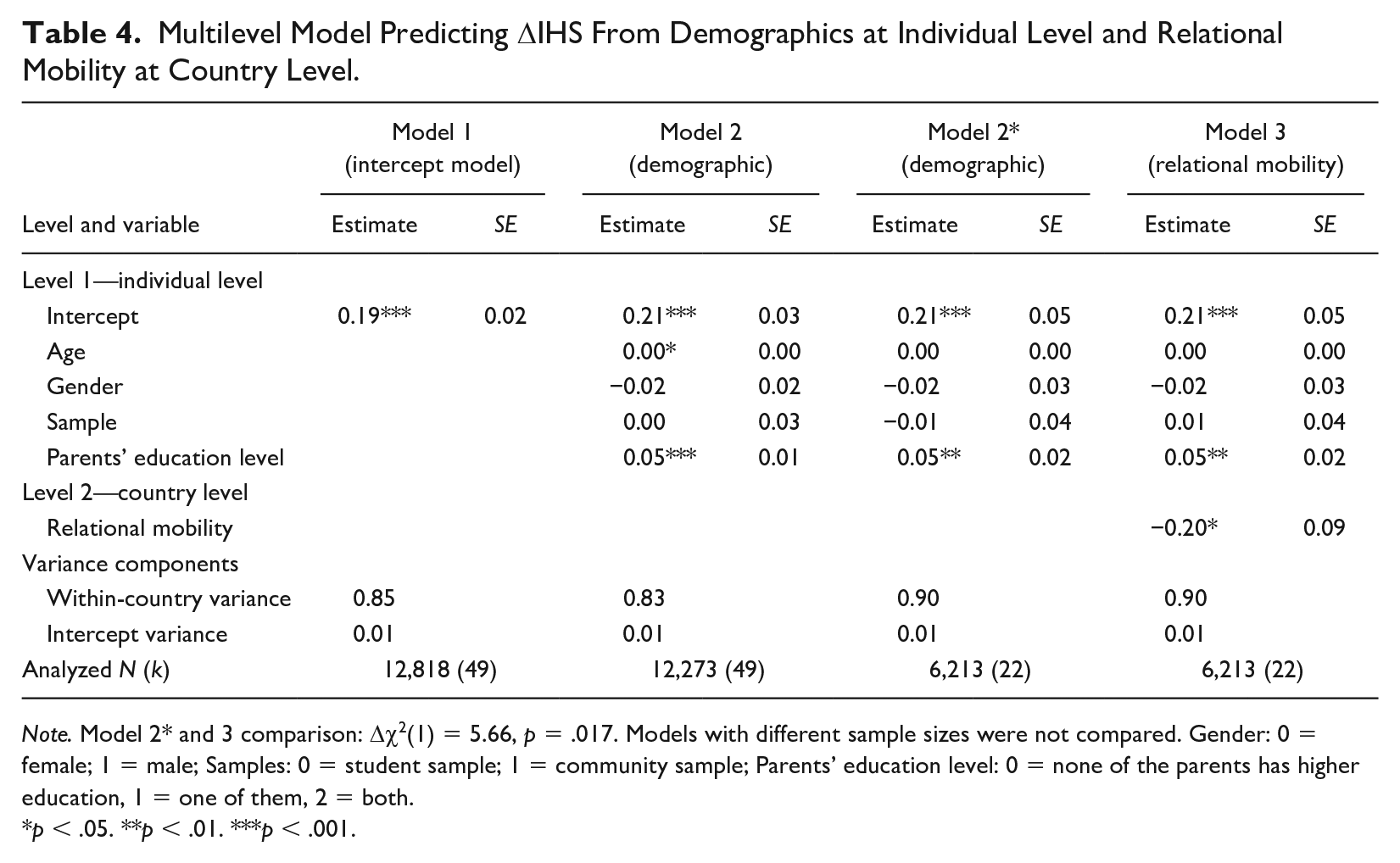
Note. Model 2* and 3 comparison: Δχ2(1) = 5.66, p = .017. Models with different sample sizes were not compared. Gender: 0 = female; 1 = male; Samples: 0 = student sample; 1 = community sample; Parents’ education level: 0 = none of the parents has higher education, 1 = one of them, 2 = both.
p < .05. **p < .01. ***p < .001.
Discussion
We found that across most countries people idealize family happiness above personal happiness. Importantly, our findings suggest pancultural generality of this effect around the world. People idealize family happiness over personal happiness in 48 out of 49 studied countries (in the 49th, the negative effect was close to zero), and the cross-cultural variation in our variable of interest was only 2%.
The (almost) pancultural idealization of family happiness over personal happiness is the most important finding of our study. Although personal happiness is commonly treated as the “ultimate” dependent variable for psychological science (Bond, 2002), our findings suggest that family happiness is often idealized more than personal happiness. Future research on psychological well-being may need to acknowledge this fact and account for its variation. We hope our findings will motivate future research on family happiness; the subject of well-being that at present seems largely understudied.
Although the variability across cultures in how much family versus personal happiness is idealized is small, we did find a theoretically plausible cultural-level factor to explain it. We found a significant association between relational mobility and the relative valuation of family over personal happiness (Thomson et al., 2018). Cultures characterized by low relational mobility idealize family over personal happiness to a larger extent than do members of societies high in relational mobility. We did not, however, find much support for the idea that what is currently labeled as individualism–collectivism was important in terms of explaining cultural differences in the relative valuation of family over personal happiness. Therefore, we suggest that relational mobility (and not currently used measures of individualism-like phenomena) is particularly important in explaining the cultural variation in idealization of family over personal happiness.
What is it about relational mobility that may be so important in terms of the type of happiness being idealized? Societies differ in how fluid and open interpersonal relationships are (Thomson et al., 2018). In low relational mobility societies, constituting a friendship or a family is a relatively long-lasting process, and people engage in few long-lasting relationships and tend to be unwilling to abandon them. We found that in such societies, family happiness is idealized over personal happiness relatively more. In contrast, in high relational mobility societies, relationships can be formed in a short time, relationship options are abundant and more flexible, thus, people are able to easily leave old friends behind to seek out new partners (Thomson et al., 2018). If a social context delivers cues that there may be an “expiration date” for a family, as it frequently happens in high relational mobility cultures, idealization of family happiness over personal happiness may be attenuated.
Interestingly, in our two-level analyses, we also found that the individual-level social capital (i.e., education of parents) was associated with idealization of family happiness over personal happiness. This finding highlights the potential importance of studying family happiness. The enormous body of research on personal happiness has elucidated some antecedents, features, and consequences. Yet, our findings highlight the need to broaden the scope of well-being studies—self-ratings on happiness may need to be accompanied by us-ratings of happiness. Future research is necessary to uncover the antecedents and consequences of both personal and family happiness. It may be the case that family happiness may be governed by somewhat different mechanisms and dynamics than personal happiness.
Limitations
These advances notwithstanding, we must acknowledge our study’s shortcomings in terms of measurements and sampling limitations. The fact that the majority of this sample was comprised of students is an important limitation of this work (for a detailed discussion see SOM). This study is also limited in terms of the number of countries included in the analysis with scores on relational mobility (n = 22), thus, conclusions drawn from this study should be considered with caution. It will be important for future studies to investigate this effect using a larger array of countries. Moreover, we only focused on individual and family happiness. It may be the case that some people may prioritize other ingroup members other than one’s family such as friends, work groups or religious community members. Future studies are required to replicate our findings and extend explore these mechanisms in greater detail. Another limitation is the understanding of family which may have been subjectively construed by participants. We assumed that because families differ across cultures, providing one definition of family may be culturally insensitive (Szarota et al., 2021). Finally, the instruction we employed limits the broad generalizations of our findings. Following Diener et al. (2000), we asked participants to employ the perspective of an “ideal person” when answering questions about happiness. It remains unclear, however, whether these instructions activated ideal self or ought self (Higgins, 1987). It also remains a possibility that real desires (as compared with ideals) are relatively more selfish than family-oriented.
Implications
Our findings indicate that for the majority of people, the most important individuals are those whom they consider family. Many studies have sought to elucidate what factors contribute to improve family life. However, the majority of family studies focus on relationships between spouses and parent–child relations. Here, we treated the family as a whole and found that the majority of people in a vast number of countries value their family’s happiness above their own personal happiness. Our findings support the idea that family happiness is important across a diverse array of cultural contexts.
Several aspects of traditional conceptualizations of collectivism lend support to the idea that highly collective cultures should be where family happiness is valued the most. This, however, is not what we found. We found that several countries low in collectivism (i.e., highly individualistic) such as the United States and Canada, tended to value family happiness more than individual happiness. This finding contributes to ongoing efforts to conceptualize the constructs of individualism and collectivism with greater detail (Brewer & Venaik, 2011; Krys, Vignoles, et al. 2022; Takano & Osaka, 2018). Our finding also supports the idea that relational mobility may have considerable importance in terms of explaining many other psychological constructs that differ across cultures. The topic of how best to define individualism and collectivism reaches beyond the scope of this article. However, we anticipate that our findings will contribute to ongoing constructive and empirical revisions of traditional models of individualism–collectivism.
Our findings also inform some topics related to political psychology and policymakers. Krys, Capaldi et al. (2022) recently signaled: “no matter how much various populists abuse the argument of “protecting family life” to disrupt emancipation, family life may be and is an important ingredient of social capital” (p. 14). Our findings seem to align with this perspective. Although concern with family is often associated with political conservativism (e.g., McAdams et al., 2008), our findings suggest that across the cultural spectrum, family happiness is highly valued everywhere.
This study suggests that family may be the basic collective unit of survival across cultures. We are unaware of any traditional or modern society that neglects the importance of family life. Cherishing life of families seems to be perceived universally across cultures as a foundation or a precondition for sound modernization (Krys, Capaldi et al., 2022). The modern welfare state and a variety of global policies are guided by securing family welfare (to mention a few: paid maternal and paternal leave, safe housing, basic income directed to support kids). Thus, explicitly centering policies around family happiness may help address the increasing polarization within and across societies and may help rebuild the shared story of humanity. Employing family happiness as a compass for policy-making may serve as a universal compass across societies more so than personal happiness.
Supplemental Material
sj-pdf-1-jcc-10.1177_00220221221134711 – Supplemental material for Family First: Evidence of Consistency and Variation in the Value of Family Versus Personal Happiness Across 49 Different Cultures
Supplemental material, sj-pdf-1-jcc-10.1177_00220221221134711 for Family First: Evidence of Consistency and Variation in the Value of Family Versus Personal Happiness Across 49 Different Cultures by Kuba Krys, June Chun Yeung, Brian W. Haas, Yvette van Osch, Aleksandra Kosiarczyk, Agata Kocimska-Zych, Claudio Torres, Heyla A. Selim, John M. Zelenski, Michael Harris Bond, Joonha Park, Vivian Miu-Chi Lun, Fridanna Maricchiolo, Christin-Melanie Vauclair, Iva Poláčková Šolcová, David Sirlopú, Cai Xing, Vivian L. Vignoles, Wijnand A. P. van Tilburg, Julien Teyssier, Chien-Ru Sun, Ursula Serdarevich, Beate Schwarz, Ruta Sargautyte, Espen Røysamb, Vladyslav Romashov, Muhammad Rizwan, Zoran Pavlović, Vassilis Pavlopoulos, Ayu Okvitawanli, Azar Nadi, Martin Nader, Nur Fariza Mustaffa, Elke Murdock, Oriana Mosca, Tamara Mohorić, Pablo Eduardo Barrientos Marroquin, Arina Malyonova, Xinhui Liu, J. Hannah Lee, Anna Kwiatkowska, Nicole Kronberger, Lucie Klůzová Kráčmarová, Natalia Kascakova, İdil Işık, Eric R. Igou, David O. Igbokwe, Diana Hanke-Boer, Alin Gavreliuc, Ragna B. Garðarsdóttir, Márta Fülöp, Vladimer Gamsakhurdia, Carla Sofia Esteves, Alejandra Domínguez-Espinosa, Patrick Denoux, Salome Charkviani, Arno Baltin, Douglas Arevalo, Lily Appoh, Charity Akotia, Mladen Adamovic and Yukiko Uchida in Journal of Cross-Cultural Psychology
Footnotes
Declaration of Conflicting Interests
The authors declared no potential conflicts of interest with respect to the research, authorship, and/or publication of this article.
Funding
The authors disclosed receipt of the following financial support for the research, authorship, and/or publication of this article: This work was supported by the Polish National Science Centre under grant 2020/38/E/ HS6/00357; the Hungarian OTKA under grant K-135963; the Brazilian National Council for Scientific and Technological Development –CNPq under grant 301298/2018-1; the Czech Science Foundation CSF under grant 20-08583S, by the NPO, Systemic Risk Institute, LX22NPO510, EU - Next Generation EU and the Ministry of Higher Education and Science RF FZEW-2020-0005.
ORCID iDs

Notes
References
Supplementary Material
Please find the following supplemental material available below.
For Open Access articles published under a Creative Commons License, all supplemental material carries the same license as the article it is associated with.
For non-Open Access articles published, all supplemental material carries a non-exclusive license, and permission requests for re-use of supplemental material or any part of supplemental material shall be sent directly to the copyright owner as specified in the copyright notice associated with the article.
