







Abstract
We addressed in a cross-sectional study the role of nostalgia in refugee psychological acculturation orientation toward both home and host cultures, as well as the intervening role of social connectedness. We defined home orientation as efforts to maintain one’s original culture and identity, whereas we defined host orientation as efforts to engage with and adopt features of the host culture. We tested 915 Syrian refugees (56.2% women), aged 17 to 78 years (M = 35.94, SD = 10.64), who were settled in Western countries. Participants’ nostalgia for life in their home country was directly associated with higher home orientation and host orientation. Furthermore, nostalgia was indirectly positively associated with home orientation through stronger social connectedness with their Syrian community, and it was indirectly negatively associated with host orientation through weaker social connectedness with the host community. We consider theoretical implications.
Keywords
Psychological acculturation refers to changes experienced by refugees, immigrants, sojourners, or members of ethnocultural groups following intercultural contact (Sam & Berry, 2016). As they adapt to a new cultural environment, individuals face the challenge of how to relate to or identify with their home culture, host culture, or both. These challenges influence how well they psychologically (feeling well) and socio-culturally (doing well) adapt to the acculturation process (Sam & Berry, 2016).
Acculturation orientation may entail two non-mutually exclusive forms: home orientation and host orientation (Demes & Geeraert, 2014). Home orientation refers to individuals’ efforts to maintain their original culture and identity, whereas host orientation refers to their efforts to engage with and adopt features of the host culture (Sam & Berry, 2016). Refugees, in particular, often occupy a liminal space—dislocated from their country of origin yet not fully incorporated into the host society. Consequently, they are likely to experience a heightened tension between home orientation and host orientation, as increased commitment to one may impede engagement with the other.
Nostalgia is a sentimental longing for one’s past, characterized by fond and tender reflections on personally meaningful experiences accompanied by a yearning for them (Hepper et al., 2012; Sedikides et al., 2015). Although nostalgia entails a bittersweet affective tone—combining contentment and happiness with sadness—it is predominantly a positive emotion, generating more positive than negative affect (Leunissen et al., 2021). It also exhibits a distinct appraisal profile, triggered by temporally distant, unique, and pleasant yet irrevocable life events (Van Tilburg et al., 2019). Nostalgia is a common and universal experience, occurring frequently (several times per week) across individuals of all ages and cultural backgrounds (Hepper et al., 2021; Juhl et al., 2020; Sedikides & Wildschut, 2022). The nostalgic past is deeply personal and social, often centering on momentous life events such as birthday celebrations, weddings, childbirth or culturally significant rituals (e.g., folkloric festivals; Wildschut et al., 2006; Yin et al., 2025).
Given its strong emotional and cultural resonance, nostalgia may play a pivotal role in the acculturation experiences of refugees, that is, the extent to which they relate to or identify with their home culture or engage with the host culture (Petkanopoulou et al., 2021; Sedikides et al., 2009). Importantly, however, nostalgia contributes to social connectedness selectively: It primarily strengthens bonds with familiar others associated with the nostalgized past (Wildschut et al., 2006), reinforcing ingroup identities (Smeekes, 2015) rather than promoting universal sociality. Thus, in refugee contexts, nostalgia for the home country may deepen ties with co-ethnics while potentially weakening engagement with host-society members, thereby intensifying the tension between home and host orientations.
We asked in the article whether and how nostalgia is associated with refugees’ home and host orientations. We examined, in particular, the role that “nostalgia for life in Syria” plays in the home and host orientations of Syrian refugees, with a specific focus on social connectedness as a key mechanism in this process.
As mentioned above, nostalgia is a social emotion: Nostalgizers feel socially connected (i.e., supported, trusting of others; Sedikides & Wildschut, 2024). But connected with whom, exactly? In Hypothesis 1 (H1) (Figure 1), we propose that nostalgizing about life in Syria contributes to social connectedness with members of the Syrian refugee community in the host country (Syrian-community connectedness). In turn, Syrian-community connectedness is associated with stronger home orientation, implying that refugees remain embedded in the attitudes, values, and customs of their home country. Yet, refugees who nostalgize about Syria might show weaker connectedness with community members of the host country (host-community connectedness), struggling to adjust and integrate in the new country. Host-community connectedness may be related to weaker home orientation, as refugees become conversant with the values and practices of the host country. H1 thus specifies two positive indirect pathways: Syria nostalgia is associated with higher home orientation via stronger Syrian-community connectedness (H1a) and via weaker host-community connectedness (H1b).
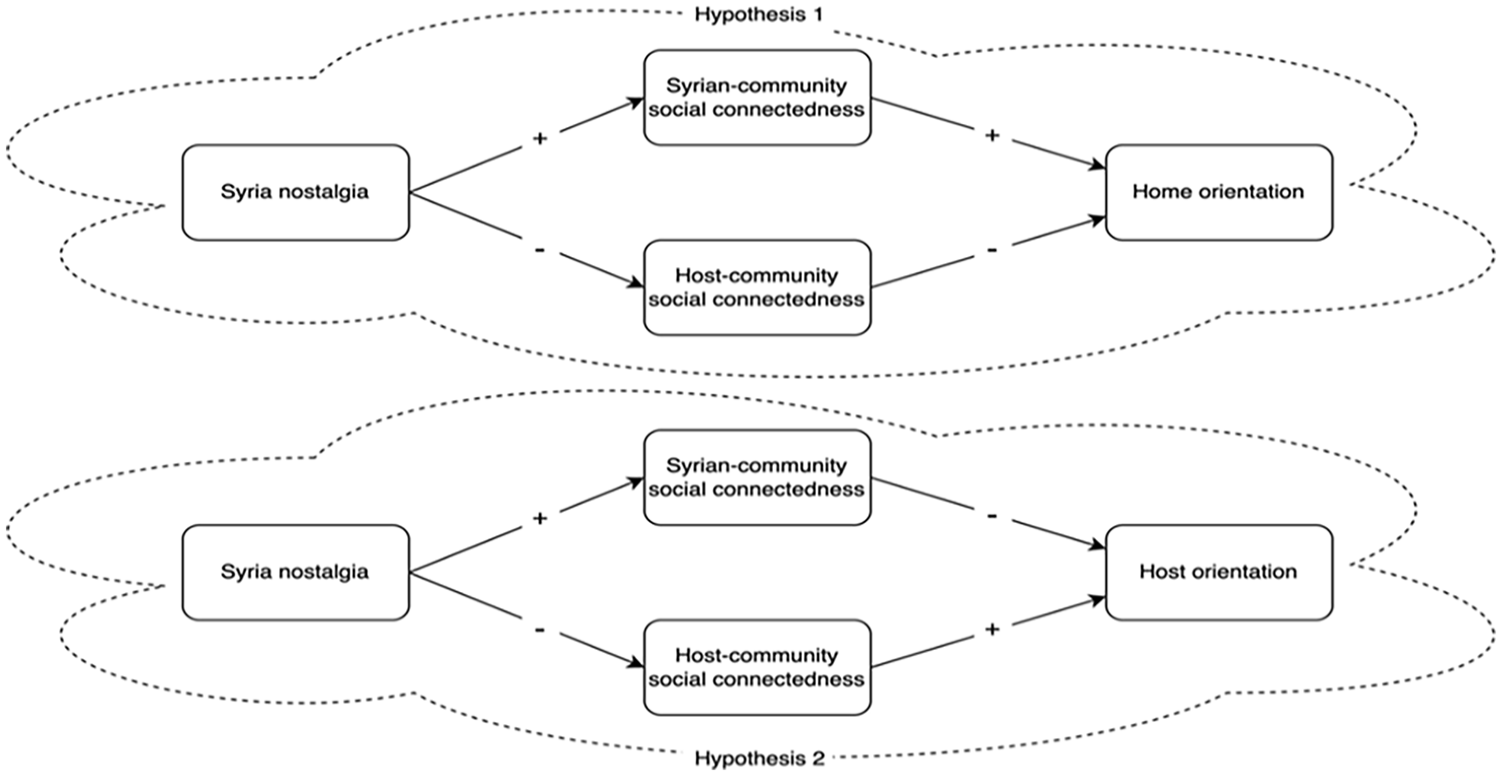
Research Hypotheses.
In Hypothesis 2 (H2) (Figure 1), we consider the outcome of host orientation, mirroring H1. Just as host-community connectedness contributes to weaker Syria acculturation, so will Syrian-community connectedness contribute to weaker host orientation. Furthermore, just as Syrian-community connectedness contributes to stronger home orientation, so will host-community connectedness contribute to stronger host orientation. H2, then, specifies two negative indirect pathways: Syria nostalgia is associated with lower host orientation via stronger Syrian-community connectedness (H2a) and via weaker host-community connectedness (H2b).
Method
We obtained ethical approval from the Doha Institute for Graduate Studies and collected the data from October 2022 to February 2023. We administered the questionnaire in participants’ native language, Arabic. The second and third authors, proficient in both English and Arabic, carried out the translation from English to Arabic. A bilingual outsider reviewed and edited it. Finally, the last author, also a bilingual, checked and verified its accuracy.
Participants
We placed an advertisement on online platforms (i.e., Syrian refugee forums, blogs, chat rooms, LinkedIn, Facebook), encouraging participants to share it with their social networks (snowball sampling), and distributing it via our social networks. We recruited 1,126 Syrian refugees. We concluded recruitment when responses became increasingly rare. We excluded 74 participants for completing the survey in less than one-third of the median time (Vishkin et al., 2021) and 137 for providing incomplete responses on one or more of the main study variables. Our final sample consisted of 915 participants (514 women, 392 men, 9 unreported), aged 17 to 78 years (M = 35.94, SD = 10.64). All resided in Western countries, with an average length of stay in the host country of 6.51 years (SD = 4.21). For additional demographic information and all scales, see Supplementary Materials.
Measures
We assessed nostalgia about life in Syria. Participants read a definition of nostalgia (“feeling sentimental for a fond and valued event from one’s personal past”) and rated how nostalgic they felt (1 = not at all nostalgic, 5 = very nostalgic) for 14 objects from their life in Syria (e.g., “music,” “friends”; α = .87).
We modified Hepper et al.’s (2012) four-item connectedness measure of social to assess Syrian-community connectedness and host-community connectedness. Participants stated how socially connected they felt to their Syrian community in the host country (seven items; α = .82) and how connected they felt to the host (non-Syrian) community (seven items; α = .71). Items were preceded by the stem “When nostalgic for my life in Syria, I feel” (e.g., “connected to people in my Syrian community/the host community”). We used this stem not only to ensure measurement precision but also to provide theoretical clarity: it directed participants to the questions within the context of their nostalgia for Syria.
We adapted the 8-item Brief Acculturation Orientation Scale (Demes & Geeraert, 2014; 1 = strongly disagree, 5 = strongly agree). Four items gauged home orientation (e.g., “it is important for me to do things the way Syrian people do”; α = .79) and four gauged host orientation (e.g., “it is important for me to do things the way [host country] people do”; α = .77).
Results
We present descriptive statistics and correlations in Table 1. All correlations were significant and in the expected direction, with the exception of a null correlation between nostalgia and host orientation (i.e., total effect). However, a significant total effect is not a prerequisite for testing indirect effects (Kenny & Judd, 2014). We tested our hypotheses with the PROCESS macro (Model 4; Hayes, 2022), with Syrian-community connectedness and host-community connectedness as parallel mediators. We report standardized indirect effects (ab). Figure 2 presents standardized regression coefficients. In Supplementary Materials, we present standard errors, 95% confidence intervals (CI), t-values, and p-values for standardized and unstandardized coefficients (Tables S1–S2).
Descriptive Statistics and Zero-Order Correlations Among Study Variables.
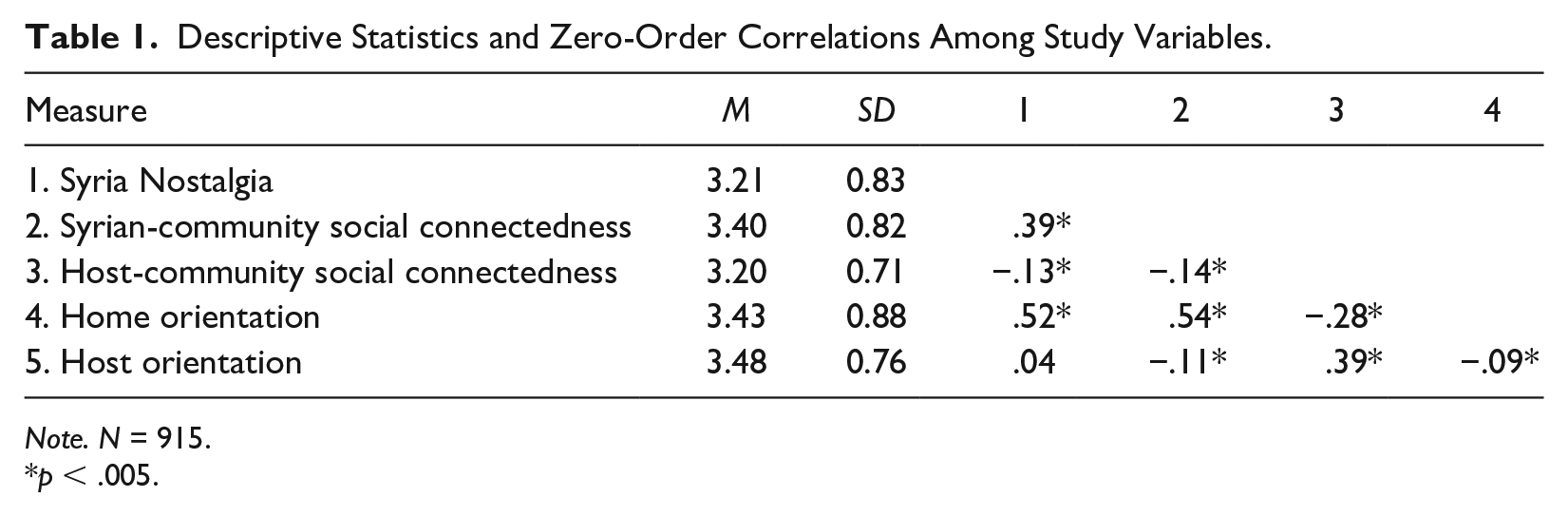
Note. N = 915.
p < .005.
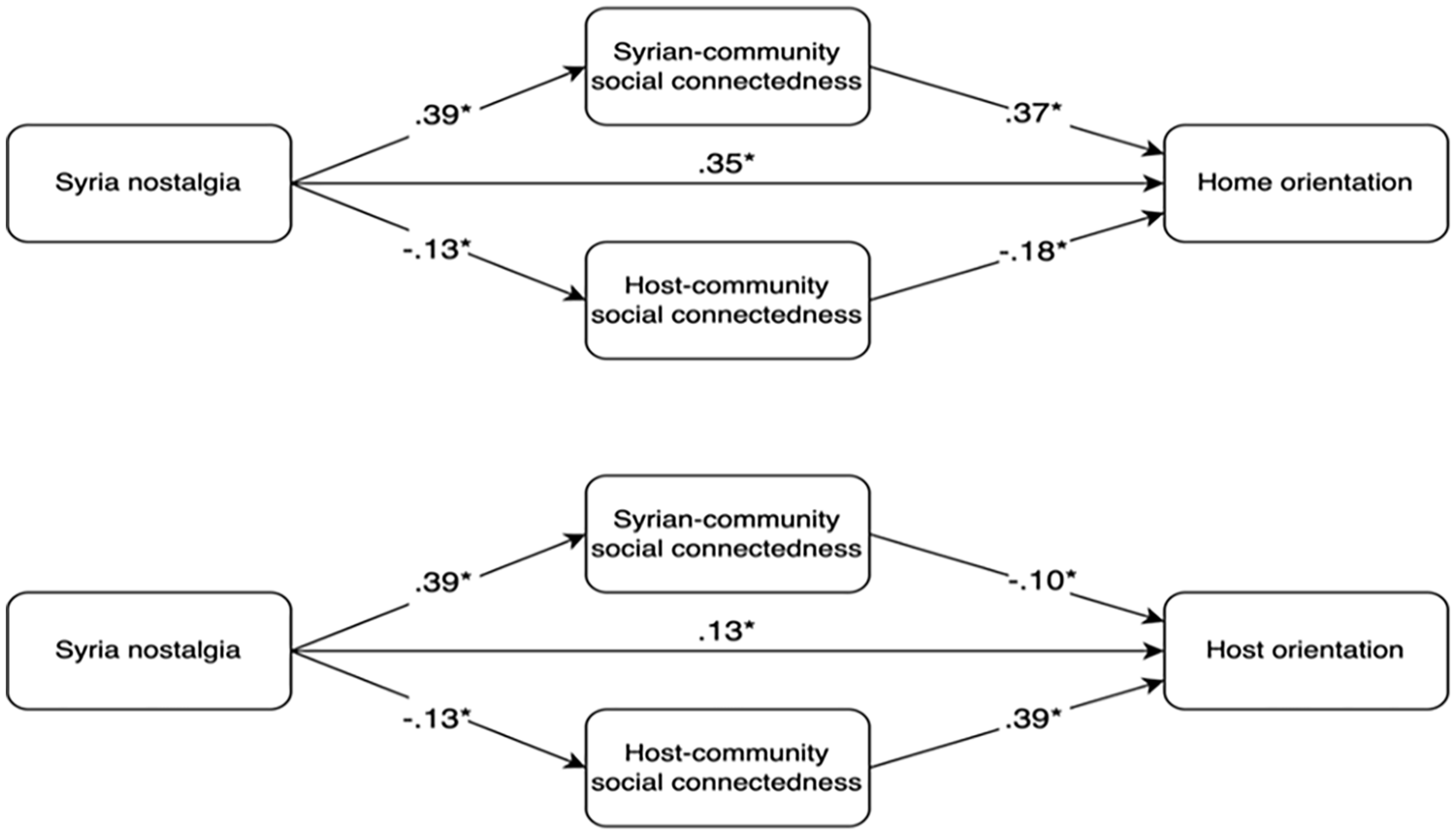
Direct and Indirect Effects: Standardized Regression Coefficients.
Results supported H1. Syria nostalgia was associated with higher home orientation via stronger Syrian-community connectedness (H1a), ab = .15, 95% CI = [.12, .18]), and via weaker host-community connectedness (H1b), ab = .02, 95% CI = [.01, .04]). The residual direct effect on home orientation was positive.
Results also supported H2. Syria nostalgia was associated with lower host orientation via stronger Syrian-community connectedness (H2a), ab = −.04, 95% CI = [−.07, −.02]), and via weaker host-community connectedness, ab = −.05, 95% CI = [−.08, −.03]). Unexpectedly, the direct effect on host orientation was also positive. 1
Discussion
Nostalgia is relevant to Syrian refugees’ home and host orientations. However, social connectedness, a central correlate of nostalgia, was differentially associated with home and host orientations. Specifically, nostalgia for Syria was indirectly linked to higher home orientation via stronger social connectedness with the Syrian community and via weaker social connectedness with the home-country community. Conversely, nostalgia was indirectly linked to lower host orientation via stronger Syrian-community social connectedness and via weaker host-community social connectedness. Together, the type of social connectedness—whether it pertains to the Syrian community or the host community—matters. That is, as an intervening pathway, social connectedness can contribute to stronger or weaker home and host orientations. The results were unaffected by refugees’ length of stay in the host country (Supplementary Materials).
The findings are generative. Future research may examine whether home and host orientations, as linked to nostalgia and social connectedness, contribute to more effective adaptation—although the literature suggests that host orientation is more strongly associated with adaptive outcomes (Abu-Rayya et al., 2023). Also, future research may specify the mechanisms through which social connectedness is serially linked to home and host orientation—potentially through meaning in life (Sedikides & Wildschut, 2018). Relatedly, the positive direct effects of Syria nostalgia on both home and host orientation suggest the operation of unmeasured intervening mechanisms. This possibility is intriguing in the case of host orientation, where the direct effect was directionally opposite to the negative indirect effects, implying a beneficial countervailing process.
Follow-up work can address limitations of this research. By using the terms direct effect and indirect effect, we adopted the parlance of mediation analysis but did not wish to make causal claims. Indeed, we tested our hypotheses with a cross-sectional design, preventing unambiguous causal inferences. Longitudinal, ecological momentary assessment, or experimental designs can address this issue, while testing social connectedness in general, rather than nostalgia-specific, settings. Future research should also examine a variety of refugee contexts to enhance the generalizability of findings. Overall, the acculturation literature stands to gain from integrating nostalgia and its association (via social connectedness) with both home orientation and host orientation.
Supplemental Material
sj-pdf-1-jcc-10.1177_00220221251347961 – Supplemental material for Nostalgia, Social Connectedness, and Acculturation Orientation Among Syrian Refugees
Supplemental material, sj-pdf-1-jcc-10.1177_00220221251347961 for Nostalgia, Social Connectedness, and Acculturation Orientation Among Syrian Refugees by Constantine Sedikides, Mai Alkhatib, Azzam Amin, Tim Wildschut and Hisham M. Abu-Rayya in Journal of Cross-Cultural Psychology
Footnotes

Declaration of Conflicting Interests
The author(s) declared no potential conflicts of interest with respect to the research, authorship, and/or publication of this article.
Funding
The author(s) received no financial support for the research, authorship, and/or publication of this article.
Ethics Approval Statement
The study was reviewed and approved by the Internal Review Board at Doha Institute for Graduate Studies. All participants provided written informed consent.
Supplemental Material
Supplemental material for this article is available online.
Notes
References
Supplementary Material
Please find the following supplemental material available below.
For Open Access articles published under a Creative Commons License, all supplemental material carries the same license as the article it is associated with.
For non-Open Access articles published, all supplemental material carries a non-exclusive license, and permission requests for re-use of supplemental material or any part of supplemental material shall be sent directly to the copyright owner as specified in the copyright notice associated with the article.
