







Abstract
Perceptions of Asian Indian Americans (AIAs) as model minorities minimize the experiences of racism they face. The authors qualitatively examined racism and related coping among forty-four 1.5- and second-generation AIAs (sixteen 1.5-generation and twenty-eight second-generation; 79.54% women; ages 19–54 years). Grounded theory analysis of focus group interview data revealed three domains: (a) Awareness of and Experiences of Racism; (b) Psychological Impact of Racism; and (c) Cognitive and Behavioral Approaches to Coping with Racism. Findings indicate that early and ongoing exposure to racism contributes to lasting emotional distress, challenges navigating ethnic and racial identity, and use of multiple coping strategies (e.g., avoidance, minimization, seeking support, and confrontation). They also suggest the influence of an internalization of the model minority stereotype and colonial mentality, transmitted from the first generation, on participants’ experiences of and responses to racism. The study’s implications for ethnic and racial identity among AIAs, and future research and intervention are discussed against the backdrop of recent theoretical developments.
As the largest Asian sub-population in the United States (U.S. Census Bureau, 2023), Asian Indian Americans (AIAs) are a highly diverse community with respect to language, heritage region, cultural traditions, religion, and waves and circumstances of migration (John et al., 2024). Given the history and diversity within the group, there is substantial empirical evidence that AIAs in the United States experience discrimination and related violence based on race, ethnicity, religion, gender, skin color, and language (Bajaj et al., 2016; Inman et al., 2015; Misra et al., 2022; Tummala-Narra et al., 2016). Yet, AIAs are often perceived as model minorities, perpetuating the notion that they are all academically and professionally successful and do not face struggles or social barriers (Bajaj et al., 2016; Inman et al., 2015; Misra et al., 2022).
Interestingly, most of the extant literature on AIAs and racism has focused on the experiences of the first generation, with far less attention on the 1.5 and second generations (Tummala-Narra et al., 2024). The first generation includes people who arrive to the United States as adults; the 1.5 generation includes people born outside of the United States who relocated to the United States prior to adolescence (by age 12 years); and the second generation includes children of immigrants (first generation), born and raised in the United States (Inman et al., 2015; Tummala-Narra et al., 2024). Notably, there is a growing population of children of Asian Indian immigrants (1.5 and second generations) in the United States. In fact, between 2010 and 2020, the AIA population has more than doubled, with over half of AIAs below 25 years of age (John, 2024; U.S. Census Bureau, 2023). As such, it is especially important to examine experiences of racism among 1.5- and second-generation AIAs as they are raised in a bicultural context, in contrast to first-generation AIAs who are raised in India (Tummala-Narra et al., 2024). Moreover, both 1.5- and second-generation groups are often exposed to racism in early life (childhood and adolescence) and differentially internalize racism based on their unique social locations (Inman & Tummala-Narra, 2024). The present study used qualitative inquiry to examine experiences of racism, its psychological impacts, and approaches to coping with racism among 1.5- and second-generation AIAs. An in-depth understanding of racism can fill an important gap in understanding racialized experiences and racial identity development across multiple generations of AIAs (Inman et al., 2015; Inman & Tummala-Narra, 2024; Iwamoto et al., 2013). In the following sections, we present recent theory and research concerning race and racism among AIAs which informs the present study.
Theoretical Framework
In examining experiences of and responses to racism, it is important to consider theories of ethnic and racial identity for AIAs. Recently, Inman and Tummala-Narra (2024), drawing on critical race theories (e.g., PCRT, AsianCRT, DesiCRT) and research with AIAs, introduced a conceptual model of ethnic-racial identity across first-, 1.5-, and second-generation AIAs. This model highlights a hybrid identity shaped by navigating pre-migration socialization, the legacy of British colonization in India, the caste system, and post-migration racial categorization in the United States. Each generational group develops a distinct sense of ethnic and racial identity due to these intersecting factors.
Specifically, first-generation AIAs tend to internalize an ethnicized-racial experience reflecting both marginalization (e.g., being seen as a foreigner, speaking with an accent) and privilege (e.g., voluntary migration, being highly educated) in U.S. society. As a result, they often see themselves as both insiders and outsiders, with their perspectives on racism shaped by colonial mentality, the model minority stereotype, and a belief in meritocracy. Inman and Tummala-Narra’s (2024) model also highlights how 1.5-generation AIAs, who have formative experiences in both India and the United States, develop an ethnicized-racial identity distinct from the first generation. Their early exposure to racism in the United States, combined with the internalized aspects of colonial mentality and the model minority stereotype, contributes to a dual sense of belonging in the United States. Second-generation AIAs, while receiving similar messages about heritage culture, colonial mentality, and caste system, tend to develop a heightened awareness of racial difference and racism from an early age. This awareness fosters a sense of minority status and conflicting feelings of belonging, leading to what Inman and Tummala-Narra (2024) describe as “a dual consciousness of experiences of assimilation and exclusion” (p. 1393). Compared to other generational groups, second-generation AIAs are more likely to internalize white cultural norms while simultaneously forming connections with other communities of color and advocating for their rights as Americans, shaping a racialized-ethnic identity.
Notably, Inman and Tummala-Narra (2024) emphasize that racial and ethnic identity are influenced by social factors such as gender, social class, and geographical location, evolving over time in response to sociopolitical climate. This intersectional model of racial and ethnic identity raises important empirical questions about how 1.5- and second-generation AIAs experience and respond to racism. Guided by Inman and Tummala-Narra’s framework, the present study seeks to gain a nuanced theoretical understanding of these experiences and inform culturally relevant interventions for racism-related stress among these AIA generational groups. To contextualize this inquiry, we next present empirical literature on racism, pre-migration context, racism-related stress, and coping responses among AIAs—key themes that have shaped Inman and Tummala-Narra’s (2024) model and the current study.
Racism and Stereotyping Against Asian Indian Americans
Discrimination against people of Asian Indian descent has occurred since the beginning of Indian migration to the United States in the 1700s (Inman & Tummala-Narra, 2014). Early waves of immigrants experienced legalized discrimination and violence, through policies that restricted immigration and the ability to obtain citizenship (Inman & Tummala-Narra, 2014). AIAs have also been targeted for violence, particularly during times of economic and political tensions when they were seen as a threat to the labor force. While white workers in Washington state attacked Indian laborers in the early 1900s, a similar incident occurred 80 years later when the “Dotbusters” attacked South Asians in New Jersey and northern Pennsylvania (Inman et al., 2015; Misra et al., 2022). The term “Dot” in “Dotbusters” referred to a sacred symbol, the bindi, worn by many Hindu women. While the “Dotbuster” attacks targeted AIAs of all religious backgrounds, they were primarily directed against Hindu AIAs. Following the 9/11 terrorist attacks, AIAs, often mistaken for people of other ethnic, religious, or racial backgrounds (e.g., Arab Americans, Muslim Americans), were verbally harassed, racially profiled, physically attacked, and murdered (Ahluwalia & Pellettiere, 2010; Inman et al., 2007; Mukkamala & Suyemoto, 2018). The first hate driven murder post-9/11 was that of a Sikh, AIA man, Balbir Singh Sodhi, in Arizona. These hateful acts increased after the 2016 presidential election of Donald Trump (Tummala-Narra et al., 2024). In effect, a 45% rise in incidents of hate violence and speech against South Asians was documented within the first year of the first Trump administration (Misra et al., 2022).
Research also indicates that AIAs face stereotypes that devalue the Indian culture (e.g., snake charming, being dirty) and portray them as exotic, passive, or as perpetual foreigners, terrorists, and model minorities (Inman et al., 2015; Mukkamala & Suyemoto, 2018; Tummala-Narra et al., 2024). However, public perceptions of AIAs as a model minority and the internalization of this stereotype within AIA communities have served to dismiss the prevalence and impacts of racism on AIAs, promulgating unrealistic expectations of achievement and a reluctance to seek help (Daga & Raval, 2018; Inman et al., 2015; Misra et al., 2022; Mudambi, 2019). For example, in a qualitative study with first-generation AIAs (Inman et al., 2015), participants who identified with the model minority stereotype and exhibited behavioral acculturation (e.g., wearing western dress) were perceived as having social and cultural capital that could protect them and future generations from discrimination. Yet, being targeted with racial slurs and microaggressions, physical violence, racial profiling by law enforcement, bullying in schools, and glass ceilings at work, contributed to a lack of sense of belonging in the United States. In the face of such discrimination, identifying with the model minority stereotype helped sustain hope in the American Dream.
Influence of the Pre-Migration Context
In addition to the internalization of the model minority stereotype, Inman and colleagues (2015) highlight the first generation’s pre-migration context of an exposure to community tensions, the caste system, and cultural messages based on British colonization. Notably, scholars (David & Nadal, 2013; Inman et al., 2015; Nikalje & Çiftci, 2023) have described the influence of past colonization encompassing a colonial mentality on perceptions of, and responses to, discrimination in the post-migration context. For instance, Nikalje and Çiftci’s (2023) study suggests that the negative psychological effects (e.g., depression) of colonial mentality can be internalized and transmitted intergenerationally from first- to second-generation AIAs. Relatedly, Tummala-Narra and colleagues (2024), in a qualitative study examining racial socialization experiences of 1.5- and second-generation AIAs, noted that participants received family messages emphasizing a strong connection with Indian heritage, while simultaneously receiving other messages that fitting into U.S. society was made possible by associating with white privilege. Interestingly, while participants expressed anger and frustration with racism in broader U.S. society and discriminatory attitudes within their ethnic and religious communities, participants both internalized and resisted the oppressive messages, including the model minority stereotype. This internal struggle significantly influenced how they navigated their identities across multiple contexts (Tummala-Narra et al., 2024).
Racism-Related Stress
Among first- and second-generation South Asian Americans, experiences of racial and ethnic discrimination have been linked with significant negative mental health outcomes (e.g., depression, anxiety, sadness, anger, stress, lowered self-esteem, helplessness), even when controlling for educational and economic background (Inman et al., 2015; Joseph et al., 2020; Kaduvettoor-Davidson & Inman, 2013; Nadimpalli et al., 2016; Tummala-Narra et al., 2012; Yoshihama et al., 2012). Research has also indicated that racialized policing, profiling, surveillance, hate speech and violence heighten anxiety and diminish feelings of safety and belonging (Misra et al., 2022). A study of a Gujarati sample in Detroit (Yoshihama et al., 2012) found that participants who had lived in the United States longer—including U.S. born AIAs—reported higher levels of everyday discrimination, which was associated with poorer emotional well-being (e.g., feeling depressed). These findings highlight potential generational differences in racism-related stress among AIAs. Specifically, individuals from the 1.5 and second generations, those who spend their formative years in the United States, may experience earlier exposure to racism and a heightened sense of racial otherness when compared to first-generation AIAs (Inman et al., 2015; Tummala-Narra et al., 2016, 2024).
However, most studies on the effects of racism have either focused solely on first-generation immigrants or aggregated experiences across generational groups, leaving a notable gap in understanding the distinct racism-related stress among 1.5- and second-generation AIAs. Emerging research suggests that exposure to racism among 1.5- and second-generation AIAs is linked to self-concept, racial identity development, and difficulties integrating into U.S. society (Iwamoto et al., 2013; Tummala-Narra et al., 2016). South Asian adolescents in these generational groups may also face intergenerational tensions, particularly when parents—often unaware of their children’s racialized experiences—express discomfort with their full participation in mainstream U.S. culture (Tummala-Narra et al., 2016). These tensions, compounded by cultural differences between home and outside contexts, can contribute to the development of a dual sense of self while experiences of racism remain largely invisible.
The invisibility and the struggle to belong frequently persist in emerging adulthood. For example, 1.5- and second-generation South Asian American college students have reported viewing their racial background as a liability, particularly when navigating feelings of insecurity, isolation, and lack of safety due to cultural and racial marginalization and discrimination (Manejwala & Abu-Ras, 2019; Poolokasingham et al., 2014). Together, these findings underscore the need for further research examining the distinct impacts of racism on the developmental trajectories and psychological well-being of 1.5- and second-generation AIA populations.
Coping With Racism
Prior studies, using qualitative, quantitative, and mixed methods approaches, suggest that AIAs cope with racism through different strategies (e.g., active or cognitive coping; Ahluwalia & Pellettiere, 2010; Daga & Raval, 2018; Inman et al., 2015; Joseph et al., 2020; Manejwala & Abu-Ras, 2019). For instance, active coping is a behavioral strategy that involves taking action against racism or actively seeking resources and support from others, such as family and community (Inman et al., 2007; Tummala-Narra et al., 2011). In contrast, cognitive coping strategies involve efforts to appraise and/or change one’s perception or view of an event or situation (Inman et al., 2015; Inman & Tummala-Narra, 2024).
Socialization concerning race, culture, and caste within India and the United States can influence how AIAs from different generations cope with and respond to racism (Inman & Tummala-Narra, 2024). For instance, Inman and colleagues (2015), in a qualitative study, found that first-generation participants’ approaches to coping with racism were influenced by their pre-migration experiences in India, where they were generally taught to not question authority or make waves about injustice (e.g., caste system), and to not trust foreigners due to colonization. These first-generation participants used cognitive coping strategies, reporting a sense of inevitability of discrimination, comparing discrimination occurring in India and AIA communities with that occurring in broader U.S. society, and placed discrimination in perspective (e.g., giving others the benefit of the doubt), even as they were hurt by discrimination. They also utilized active coping strategies, such as avoidance, overachievement, confrontation, and assimilation. Interestingly, they believed that their children (1.5 and second generation) would face fewer racial barriers in the United States, due to greater acculturation on their parts. It is important to note that the first-generation AIA perspectives concerning how one copes with racism have been found to influence how their children (1.5- and second-generation AIAs) respond to racism. For example, Daga and Raval (2018), in a mixed method study, found that 1.5- and second-generation South Asian Americans (including AIAs), similar to the first generation, used active coping such as relying on family and community support, and cognitive coping strategies that encouraged a non-confrontational approach to racism.
Family and community support, a positive ethnic identity, and connection to religion have all been found to protect against racism-related stress (Ahluwalia & Pellettiere, 2010; Joseph et al., 2020; Manejwala & Abu-Ras, 2019; Nadimpalli et al., 2016; Tummala-Narra et al., 2012, 2016). The connection to family and heritage culture and religion is an essential part of ethnic-racial socialization for first-, 1.5-, and second-generation AIAs (Inman, 2006; Inman & Tummala-Narra, 2024). Ethnic-racial socialization refers to the process in which parents provide messages concerning their heritage culture and race and racism to their children (Daga & Raval, 2018; Patel et al., 2023). Studies concerning ethnic-racial socialization of 1.5- and second-generation South Asian Americans indicate that parents (first generation) tend to focus more on encouraging a connection with cultural heritage and the model minority notion than on preparing children to cope with or address racism. Furthermore, 1.5 and second generations tend not to discuss their racism experiences with parents or seek help in coping with racism largely due to parents’ silence and lack of preparation for racism (Daga & Raval, 2018; Patel et al., 2023; Tummala-Narra et al., 2016, 2024). In fact, in a qualitative study with first-generation AIA parents and their 1.5- and second-generation adolescents, Patel and colleagues (2023) found that parents avoided conversations regarding racism with their children as they believed that such discussions would be harmful, and in response, adolescents avoided sharing their experiences of racism with their parents. In another qualitative study (Tummala-Narra et al., 2024), 1.5- and second-generation participants noted that they were not typically provided with the language to communicate their experiences of racism by their parents, and that racism was discussed only when incidents were identified as serious. Interestingly, a quantitative study by Nadimpalli and colleagues (2016) indicated that an active coping style (e.g., talking about or reporting racism) played a protective role in the relationship between discrimination and anxiety among AIAs born in India.
These findings suggest that confronting racism may be helpful in coping with racism-related stress, even though ethnic-racial socialization for many AIAs involves an avoidance of engaging with racism. Silence concerning racism may be especially detrimental to the 1.5 and second generations as they often encounter racism early in their life and may cope with these experiences in isolation (Tummala-Narra et al., 2011, 2024). In addition, qualitative research with first- and second-generation AIAs (Sharma et al., 2023) indicates that negative experiences of counseling and psychotherapy and the perception of the lack of cultural competence among practitioners are significant barriers to seeking help. While much of the existing quantitative and qualitative research has either focused on the first generation or aggregated AIA samples across first and later generations, the present study aimed to expand understandings of racism-related coping within the 1.5 and second generations. Furthermore, as 1.5 and second generations have overlapping and distinct socialization in different cultural contexts (India and the United States; Inman & Tummala-Narra, 2024), it is important to examine the similarities and differences in how these two generational groups experience and respond to racism in the United States.
Present Study
The following research questions informed the present study:
We used grounded theory methodology (Strauss & Corbin, 1998) to seek an in-depth understanding of racism experiences and related coping, comparing similarities and differences across the 1.5 and second generations, as these questions have been largely unexplored within these AIA subgroups.
Method
Participants
The sample included 44 participants (nine men and 35 women; ages 19–54 years (M = 31.91; SD = 10.30); 16 identified as 1.5 generation and 28 identified as second generation. Among the 1.5 generation, 12 participants came to the United States between ages 6 weeks and 6 years, and four came to the United States between 8 and 10 years. The Indian regions of origin for participants and their parents spanned various areas of India (e.g., Andhra Pradesh, Bengal, Kerala, Rajasthan, Tamil Nadu). Participants’ U.S. residence included the East and West Coasts, and South, Midwest, and Mid-Atlantic regions. Participants grew up in neighborhoods with varying racial compositions: 24 in predominantly white areas and 20 in racially diverse areas. At the time of the focus group interviews, 21 participants lived in predominantly white regions and 23 lived in racially diverse regions.
Twenty-one participants indicated that English is their first language, 19 indicated that an Indian language (e.g., Bengali, Gujarati, Hindi, Malayalam, Tamil, Telugu) as their first language, and four stated that both English and an Indian language were first languages. Forty participants stated that they prefer speaking in English, and four reported that they preferred both English and their first language, which was an Indian language.
Participants’ religious backgrounds included: 29 Hindu, three Christian or Catholic, two Sikh, two agnostic, one Hindu and Zoroastrian, and three grew up as Hindu and later became agnostic/not religious. Four participants did not respond to the question regarding religion. In terms of education, six participants identified as college students, 16 had an undergraduate degree, 16 had a master’s degree, and six held a doctoral level degree. Participants’ occupations included areas such as engineering, business, health care, education, law, arts, and the humanities. In addition, participants reported their income backgrounds as follows: 18 middle-class, 24 upper-middle class, and two upper-class.
Participant Recruitment
Snowball sampling was used to recruit participants in the study. The research team used their professional and personal contacts in Asian Indian American organizations (e.g., student, cultural, and professional). Email invitations, which included the eligibility criteria, were sent to these contacts by the research team. The inclusion criteria were the following: Being at least 18 years old and born in the United States (second generation) or having immigrated to the United States by age 12 (1.5 generation). The research team communicated the details of the study to respondents via email, obtained informed consent, and arranged the semi-structured interview at a time convenient for participants. As one purpose of the study was to learn about similarities and differences in experiences and responses to racism among 1.5- and second- generation AIAs, focus groups were organized based on the participants’ generational status (1.5 and second generations). Participants received a $25 gift card for their time. The authors’ institutional review boards approved this study.
Focus Groups
Twenty focus groups (seven 1.5-generation and 13 second-generation participant groups) were conducted in English via Zoom video-conferencing platform. The interviews ranged from 1.5 to 2 hr in length, and each focus group consisted of two to three participants. Focus group methodology allows for participants to discuss challenging experiences in depth and in ways that may not be captured in individual interviews (Krueger & Casey, 2000). Focus group interviews used alongside grounded theory methodology in prior research examining racism and racial socialization with AIAs has allowed for consciousness-raising and the ability for participants to share their own racialized experiences and learn about others’ experiences (Inman et al., 2015; Tummala-Narra et al., 2024).
Measures
Demographic Form
Participants completed a demographic form that consisted of questions about age, gender, religion, birth country, age at immigration, Indian region of origin, first language, language preference, U.S. region while growing up, current region of residence, the racial composition of geographic area while growing up and area of current residence, education, occupation, and socioeconomic status.
Focus Group Interview
A semi-structured interview was developed for this study, utilizing a full review of the extant literature concerning experiences of racism and related coping among AIAs (Inman et al., 2015; Tummala-Narra et al., 2024). The current study is part of a larger qualitative project (Tummala-Narra et al., 2024) that examined racial socialization and racism among 1.5- and second-generation AIAs. In the present study, we analyzed responses to a subset of questions in the semi-structured interview, particularly concerning experiences of racism and coping. Sample questions included “Were you ever bullied, harassed, or physically threatened or attacked because of your Asian Indian background?” “Can you share an example of when you experienced racism or racial discrimination?” “How did you feel about it?” and “How did you cope with these experiences?” All interviews were recorded and transcribed by the research team.
Research Team
A primary research team, comprised of three Indian American female psychologists across three generations (first, 1.5, and second), arranged and facilitated the focus groups and analyzed the data. Following preliminary data analyses, a fourth member of the research team, a second-generation Taiwanese American female psychologist, serving as the auditor, conducted validity checks. The research team regularly shared their experiences of race, ethnic and racial identity, racism, and related coping throughout the data analytic process, identifying similarities and differences within the team based on our cultural, linguistic, regional, religious, and generational backgrounds, and discussed how these experiences may be similar to or different from those of the participants.
Data Analytic Approach
Due to limited theory explaining discrimination and coping among 1.5 and second-generation Indian Americans, grounded theory analysis (Strauss & Corbin, 1998) was used to analyze the data (Inman et al., 2015; Tummala-Narra et al., 2024; Yeh & Inman, 2007). This data analytic approach involved a series of steps, including open coding, axial coding, and selective coding of responses within each generational group (1.5 and second generation). We examined core themes emerging from the data within each generational group and constantly compared them across each of the focus group interviews within that same generational group (Creswell, 2012). We then compared the themes that emerged from the 1.5-generation focus group interviews with the themes that emerged from the second-generation focus group interviews. This process allowed us to identify similarities and differences within and across the 1.5- and the second-generation focus groups. Potential themes were identified using open coding, where we analyzed words, sentences, and short paragraphs in participants’ responses. Next, in the axial coding step, subsets of themes that captured a particular phenomenon were grouped together as a part of a broader category or domain. For instance, the themes of cognitive coping and active coping based in behavioral adaptations, along with subthemes such as normalization of racist experiences, seeking connection and support, and confronting and dismantling racism, together formed a broader category or domain, “Coping with Racism.” These themes and domains were discussed until consensus was reached and data reached a point of saturation (i.e., no added information was provided through focus group interviews; Inman et al., 2015). For the 1.5 generation, saturation was reached by Focus Group 6 and for the second generation, saturation was reached by Focus Group 10.
Data Trustworthiness
Researchers’ self-reflexivity, credibility and adequacy of data, and data interpretation were used to determine data trustworthiness (Yeh & Inman, 2007). With regard to reflexivity, three of the researchers identify as AIA and are affiliated with AIA communities. To address potential bias related to credibility of data, investigator triangulation (Inman et al., 2015) was implemented. A Taiwanese American researcher, unaffiliated with the AIA community, audited and examined the validity of data collection and analysis at various points in the data analysis. The final coding reflected the auditor’s perspectives and feedback. Researcher bias on data interpretation (Inman et al., 2015) was addressed through regular discussions of our personal reactions to participants’ responses. These discussions were documented and referenced during data collection and analysis (Strauss & Corbin, 1998).
Results
Our study focused on how race-based discrimination was experienced, understood, and coped with by 1.5- and second-generation AIAs. We present the major themes and subthemes emerging from the focus group data, drawing on similarities and differences between the two generational groups’ experiences (see Figure 1). Participants’ words from the interviews are noted in Italic in the following sections which detail the findings.
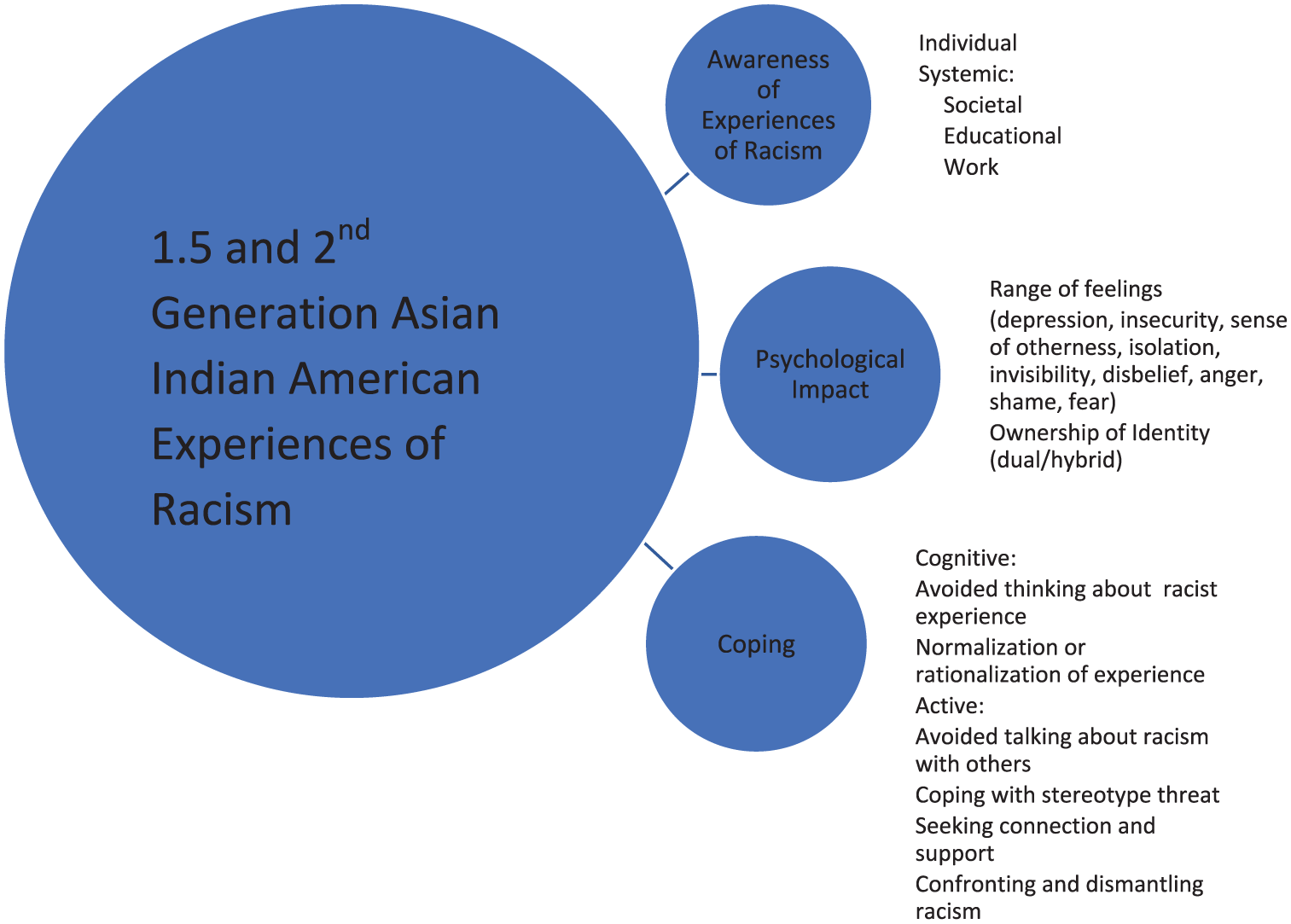
Thematic Map of Themes and Subthemes: 1.5- and Second-Generation AIA Experiences of and Responses to Racism.
Awareness of and Experiences of Racism
Both groups of AIAs were aware of racism throughout their life, but the nature of this awareness varied across time. A majority of the 1.5 generation’s racism experiences heightened as they grew older, “I would say, 20 years, 15 years, I’ve felt more discriminated against . . . people point out that I’m not white.” Conversely, second-generation AIAs were aware of and able to articulate their experiences of racism that occurred at a very young age, “Racism is built into the foundation of the U.S. and it’s taught in school and internalized and indoctrinated and you can’t really avoid it.” The second-generation respondents also noted, “countless episodes of discrimination,” and a shift in the type of racism experienced, “things like that were more overt when I was young, but as I’ve gotten older, it’s not so obvious,” but yet, “it felt more like thousands of microaggressions all the time.”
Both 1.5- and second-generation AIAs discussed two types of racism, individual and systemic. At the It was most scarring to realize that my body was undesirable for anyone at my school . . . my skin tone, my hair, my dark hair on my arms and legs. I just felt very othered, undesirable, unsexual, asexual, and just completely closed off.
Interestingly, both AIA groups spoke to an “exoticism” of the Indian culture through comments and appropriation of cultural activities or symbols (henna, wearing bindis, practicing yoga). Moreover, they highlighted religious markers that heightened their experiences of discrimination. One 1.5-generation AIA noted, “I’ve just heard a lot of awful things that are said . . . like why are they coming into our neighborhood and putting this weird Hindu temple there.” A second-generation AIA spoke to her Sikh culture, “a family friend wears a turban and traditional clothes . . . someone called him ‘Osama.’” Both 1.5- and second-generation AIAs frequently experienced a sense of otherness because of statements such as “you know you need to go back to your own country” or “where are you from?”
Both AIA groups were
At the 9/11 was scary. At the end of the day people don’t know that a Sikh is a Sikh, religion didn’t matter. If you had a certain look, you were suspect. It’s scarier today . . . the way the political rhetoric is going, it does open up vulnerabilities of people who don’t think, see, or differentiate.
Both AIA groups spoke to a greater awareness “with the rise in hate crimes now” against South Asians and even more with profiling while traveling (“I’m definitely hyperconscious in airports with extra security check . . . I don’t think it’s gonna go away in my lifetime”), including in their own neighborhoods as noted by a second-generation AIA, My brother has very Middle Eastern features, he has the beard . . . he gets profiled. Last summer, a police officer came up to him asking him, did he belong in this neighborhood, he had to get out his ID and prove that he’s from this house.
Both generational groups saw profiling as more likely to occur in less diverse areas, when outside of their ethnic enclaves, and in educational and work settings. In
In the
Psychological Impact of Racism
Experiences of racism, exclusion, and discrimination not only caused a
Often, when they experienced racism, both generational groups reported disbelief, it “catches you off guard,” “It was very shocking to me because it was someone in my face saying it so aggressively.” In the face of such discrimination, they felt disempowered (“felt I couldn’t say anything”), exhausted (“just so tiring’”), and “helpless.” Although both generational groups spoke about anger and frustration with their experiences of racism, they suppressed their anger (“sometimes you bite your tongue when you wish you could scream”) either because they did not know what to say (1.5 generation) or they felt protective of their parents (second generation).
Interestingly, the second-generation AIAs’ anger and shame came from being “plac[ed] in a place where I had to think about all of this and cope with it.” They spoke of “lash[ing] out at parents and blam[ing] them for coming to the United States,” of wanting to distance themselves from their parents, “I did not want anyone to know they were my parents.” They spoke about being ashamed (“I didn’t want to say I was Indian”) and self-conscious, and having significant anxiety, “I remember having a panic attack when someone asked me what color I am . . . I just did not want to be different.” They spoke about wanting to fit in, “I hated the skin I was in, I wanted to be white so bad, I wanted to fit in with the crowd, which was all white, and it was miserable,” and “I struggled with belonging in the Indian community.” They also expressed feeling “demeaned by the fact that I was an Indian American interested in Indian things,” and described how their attachment to their AIA identity kept them from fitting in.
The 1.5- and second-generation AIAs were also challenged with
Yet, there seemed to be a shift from discomfort to a greater ownership of one’s identity across their lifespan. Because of the practicality of needing to “get a job, make a living, and participate in society,” the 1.5-generation AIAs felt that there was a need to “balance” staying “connected to your culture and embrace it” but not “raising a flag and putting a stake down or use the bull horn.” Conversely, the second-generation respondents felt stronger from “embrac[ing] my culture . . . feeling more American.” As one second-generation AIA stated, “I’m just as American as anyone else, I was born here, this is my country and I feel like we’re likely to call out instances of racism and say it’s inappropriate, that’s how it works.” Moreover, there seemed to be some compassion for their younger selves, I know the adult me would like to be friends with the high school version of myself because I knew who I was, but I also knew to be accepted I had to try in all these ways that white people don’t have to and it’s wired into me. It’s a little bit of a burden.
Because of these shifts in identity, in more recent years, both generational groups expressed fear due to “this phase in our history . . . I am fearful for our bodies and our safety,” and “just nerve-wracking how people are going to see me is what’s more worrying.” The 1.5-generation respondents specifically spoke of fear for their children in the future, “the political rhetoric in general doesn’t feel very good, it feels uncomfortable to me.” “I have brown kids . . . they’re biracial you know and they’re going to continue to experience that and so that’s probably my biggest fear.”
Coping With Racism
Participants used
For 1.5-generation AIAs, Certain things can make you smell a little stronger than others . . . the cumin, the methi . . . and we did a family thing where we were like listen, it’s not very nice what they did but maybe there’s some truth in what we’re eating and here’s what we can do about it, but it still didn’t feel very good.
The second-generation participants seemed to be resigned to the notion that “no matter how much you try to be like other people . . . there’s only a certain amount of change depending on if the other person wants to [change].” They stated that while they could not ignore racism, “it’s better in the long run to not give too much attention.” Some of this also came from an internalization of the model minority myth, “lot of the stereotypes do fall under Indians being smart or having a hard work ethic.” Another second-generation AIA noted, I think I’ve contributed to it [i.e. model minority]. It’s difficult to argue that the U.S. treats South Asians badly, when in general South Asians are doing well.
Relatedly, both generational groups shared the sentiment that other groups had it worse than AIAs, noticing a hierarchy in oppression, “I do think that there are other races outside of Indians that are treated worse than us,” but still feeling that they were “treated as substandard citizens.” A 1.5-generation AIA stated, “I feel like we have it way easier than Blacks, or Mexicans or the Vietnamese . . .” Participants either minimized their experience, “Black people don’t feel safe when they have to deal with law enforcement . . . I’m dealing with it on a very minor level, in comparison,” or questioned their own behaviors, “I think there are times when we have to kind of just step back and see how much did we push that race card versus what are we doing to perpetuate that.”
Interestingly, second-generation respondents also stated that they “did not take it personally.” Moreover, they rationalized it as being comedic relief, “He didn’t mean it bad. It was funny.”
Both generational groups also engaged in several A coworker took a red sharpie and placed a little red dot on my forehead on my ID. I didn’t know how to react. When you’re at work, you don’t want to be that one person who can’t take a joke. I felt like I couldn’t say anything. I had to laugh at it too, but I was offended by it. I tried to wipe it off, but it wouldn’t come off.
The second-generation AIAs s thought it best to “keep it under the radar” because they did not want to “draw attention to being a minority.” This generational group felt that they did not want their teachers and professors to think that “I could not handle it because I was able to excel in my academics.” They also did not want to make it a “big deal” and “worry their Indian parents,” for fear of hurting or scaring them.
In It was more important to go to McDonald’s even though we didn’t eat meat, and we started eating meat. My initial reaction was there’s something wrong with me. I need to dress like these people, or I need to look like these people. And I remember trying for two years to try to fit in like that.
Being “ashamed of [my] Indian-ness,” participants chose to “remove myself from my community,” “stopped expressing my culture for a good five years,” but also isolated themselves from the dominant community, “I’m not even going to try to go to prom, because none of these boys are going to be interested in me.” Yet, in articulating their choices, the second-generation respondents noted their conflicted coping style, In high school, I realized that my way to succeed was assimilation and proximity to whiteness. I dropped going to the temple, my classical music or classical Bharatanatyam lessons. I only had white friends and I tried to please all these white teachers. I was participating in anti-black racism.
Participants made “these calculations, where race clearly has a strong impact on what you would do and what you wouldn’t do.” As one second-generation AIA noted, “I don’t fill gas in certain areas and physical safety is a concern.” Still another participant started “anglicize[ing] my name so I wouldn’t be questioned about it.”
For second-generation AIAs, 9/11 was extremely salient and much of their coping was seen through this lens, I grew up in what wasn’t a largely Indian community but there was enough of a presence and after it happened, it kind of muted any representation or expression because you didn’t want them to assume that because we weren’t stereotypically American, we were terrorists.
The need to identify as “American” seemed to be salient in their assimilation and coping. The AIAs in this study saw their family and community members change their behaviors to avoid hostility from others, as evident in the following quote: I noticed a lot of the aunties started taking off their hijab. I remember being at school and not talking about the fact that I was Muslim. One of my close family friends who wears a turban, put up an American flag outside his house after 9/11 to show that he wasn’t a terrorist, it’s still up today.
The second-generation AIAs also felt a responsibility for “all Indians everywhere, I had to be a model for them.” This resulted in not wanting to do “anything that was stereotypical,” due to feeling embarrassed. Participants also shared that they changed their accents and stated, “Every time I meet an American, I’m the most upmost, outstanding citizen, speak properly, present myself well.” One participant expressed, I went out of my way to only meet people who didn’t look like me . . . let me prove that that’s not the only thing that I am. It went on until college, where I didn’t date anyone Indian . . . I didn’t do the Indian student association things.
Because of the intra-group conflict within the Indian community, some second-generation AIA respondents sought “friends that were not Indian.” Yet, as they grew older, seeking “friends of color” seemed important to both generational groups. For the second-generation AIAs, “not being around white people has been great for my mental health. I don’t have to justify my race; I don’t have to talk about it.” In addition, many second-generation AIAs valued their connections with their African American and Latinx American friends, as noted in the following: for me interacting and having friends who were African American and Latino helped process discrimination and being open to that and talk about it . . . allowed me to not internalize it.
Another participant shared, I identify as gender and sexually queer and I was just not allowed to explore that. The South Asian community just didn’t understand . . . it was seen as a white thing. It wasn’t until I had a mentor that is transmasculine and black and he just taught me so much.
Most notably for both generational groups, “it seemed necessary to find spaces where you can connect with your Indian identity.” As one 1.5-generation AIA stated, Finding commonalities really solidif[ied] the American Indian bonds, that shared experience of knowing what is the other and what is your community and the weird straddling that you have to do between those things.
For the second generation, Just talking it out and then kind of knowing that you have support, became empowering to be able to do something, to say that it’s a real thing . . . What I noticed is that the older I get, most of my friends became Indian or South Indian.
For these second-generation AIAs, connecting with other AIAs not only instilled pride in themselves (“I think the first time I felt like I could be attractive was through brown men”) and their culture but also helped them “learn more about the culture by surrounding” themselves with it. They felt “more comfortable with Indian people because they somehow understood what I was going through . . . I guess that’s helping shape my identity.”
They felt that they were “not alone, I have a support group and I have people that believe in me and people that feel the same way, so that’s always made it a lot easier,” “they were my strength and people in my community.”
Both generations wanted to use these instances as an “opportunity to educate [others] a little more,” taking pride in their Indian heritage. It was important for the second-generation AIAs to “explain what we stand for and stereotypes that we often deal with, just making people aware.” Interestingly, the second-generation AIAs felt educating themselves helped with understanding racism, “pursuing black studies and sociology as an undergrad and try[ing] to understand the construction of race in America helped shape who I am.”
The importance of allyship, “solidarity and collective action” was high on their minds. They expressed a wish for “forums to discuss and acknowledge that this is an issue in our community,” “to come together and stand as a united force,” and “have a rapport with other minority groups.” They felt that “being aware of our own biases against other groups . . . becoming more open to fighting beyond our own causes is really important for the community.”
Both generational groups felt it was important to not follow the tradition of their parents when they heard them say, “Don’t say anything. Don’t make any waves.” They shared, “we’re not our parents and we can be different than our parents and I think that’s really important now.” The second-generation AIAs expanded on this: It’s very common to lump ourselves in with other people of color and while those experiences are certainly shared, we have our unique experiences as well and we need to talk about what that means and how to dispel stereotypes and rise above it.
The second-generation respondents shared several ways they confronted racism, “we came together and wrote a letter to them,” “complained to the director of the school,” and “I have this memorized script that I go through with people so they pronounce my name.” This generational group felt that the more “quiet we are the more disservice it is to our entire community.” They expressed the need to “talk to our kids, parents, grandparents, relatives, cousins, and friends.” Relatedly, having a presence in “local politics” and “media” was seen as a way for the “community to get together.”
Interestingly, the second-generation AIAs also spoke to some key factors that have impacted the internalization of racism. They felt it was important to “break down the model minority image. We need to have conversations . . . to make it known that we have a place in discrimination against people of color in the U.S. topic.” They felt strongly about “exploring caste and how it plays out with Indian Americans in the U.S. and understanding our privileges within the community too.” They also identified the need to address the “discrimination and negativity within our own group,” calling attention to biases toward other AIAs. At the same time, both generational groups saw a shift within U.S. society over time. Whereas the 1.5 generation saw this in their nieces and nephews “just much more integrated into their school and community life than we ever were,” the second-generation AIAs were encouraged by a shift in society, due to “protests” and access to “resources online.”
I think society has changed- there’s laws to protect people now, this change has allowed me to call people out much more comfortably than I ever would have.
In summary, both generational groups faced racism at individual and systemic levels across their lifespan. Whether they arrived in the United States at a young age (1.5 generation) or were born in the United States (second generation), their awareness of racism persisted across the lifespan. However, the nature of their experiences and awareness differed based on how long they had lived in the United States. The 1.5-generation AIAs developed a heightened awareness as they grew older, whereas the second-generation AIAs were more explicitly able to articulate their childhood experiences and noted shifts in the types of racism they encountered over time. While both generations reported facing discrimination in the form of stereotypes, second-generation AIAs specifically described discrimination based on skin color, highlighting their minority position in the United States. Yet, for both generational groups, not always having a language to speak about these racist events due to a silencing or dismissal within their own families, communities, and the broader U.S. society had a significant impact. The psychological impact of a hybrid identity (Asian Indian American) was influenced by the push and pull of an internalized model minority stereotype and colonial mentality, as well as how they internalized their ethnicity and race.
The 1.5 generation often focused on the practical aspects of staying connected to their culture while minimizing attention to it, whereas the second generation strongly identified as American and emphasized owning that identity. Coping strategies across both groups included a mix of cognitive and active behavioral approaches. These strategies reflected some continuity of their parents’ (first generation) approaches but also included new behaviors aimed at addressing stereotype threat, building connections with others with similar experiences, and actively challenging racism.
Cognitive coping often implied an acceptance of racism, while active coping reflected either assimilationist tendencies or resistance. An important distinction was that second-generation participants were more likely to challenge internalized racism within their own communities and to seek solidarity with other minoritized groups. Thus, while there were shared experiences and coping strategies across the 1.5 and second generations, there were also important differences. Ultimately, the experiences of both generational groups reflect an intersectional ethnic-racial identity shaped by their social location (Inman & Tummala-Narra, 2024).
Discussion
This is the first in-depth qualitative study, to our knowledge, focused on racism and coping, specifically among 1.5- and second-generation AIAs. Our findings underscore early and ongoing exposure to racism, the cumulative negative impacts of exposure to racism on mental health and identity, and multiple strategies used to cope with racism in this community. While there are few studies that have focused on the racial identity formation among AIAs (Ibrahim et al., 1997; Iwamoto et al., 2013), our study calls attention to the complex processes that shape ethnic and racial identity across time, for the 1.5 and second generations. Specifically, the findings suggest that 1.5- and second-generation AIAs experience and respond to racism in shared and distinct ways, based on their respective ethnic-racial socialization (India and the United States for 1.5 generation, and the United States for second generation; Tummala-Narra et al., 2024). While there are some distinctions in ethnic-racial socialization for these two generational groups, they are both raised primarily if not solely within a U.S. bicultural context. In addition, social location factors, such as gender, sociopolitical climate, and physical and religious markers, shape experiences and responses to racism for both generational groups. As such, the present findings support the recent theoretical conceptualization of AIA ethnic and racial identity as multidimensional and intersectional (Inman & Tummala-Narra, 2024). In this section, we elaborate our findings, including similarities and differences between the two generations, and highlight how the findings inform conceptualizations of ethnic and racial identity for these groups.
Early and Ongoing Exposure to Racism
As noted in prior studies (Inman et al., 2015; Misra et al., 2022; Tummala-Narra et al., 2024), our findings highlight the blatant and subtle racism (e.g., profiling by law enforcement, hate crimes, microaggressions) that have heightened since the 9/11 terrorist attacks and again following the presidential election of Donald Trump. Our study underscores the early exposure to racism faced by both 1.5 and second generations in the United States, in contrast with their first-generation counterparts (Inman et al., 2015). While the second generation spoke about very early exposure to racism, both generational groups recalled numerous racist incidents that they and their family, friends, and other AIAs experienced across the lifespan. Unfortunately, participants did not have the language to articulate the racist incidents that they experienced at school (bullying, teasing, social exclusion), due to their ethnic-racial socialization at home where racism was either avoided or minimized and due to the lack of attention to racism against AIAs in the broader U.S. society. They neither shared these incidents with their parents, nor received adequate help from adults at school, leaving them isolated with their racism-related stress. These findings call attention to K-12 schools as a primary location of racism, where change is sorely needed to support AIAs (Bajaj et al., 2016; Tummala-Narra et al., 2016).
Most often, racism faced by participants was based on racial (e.g., dark skin tone), religious (e.g., terrorist), and/or cultural (e.g., exotic, smelly, dirty, eating curry) stereotypes (Tummala-Narra et al., 2024). Experiences of exoticization and cultural appropriation (e.g., non-Asian Indians wearing bindis and henna) were additional sources of stress and frustration, reminiscent of British colonization (David & Nadal, 2013; Nikalje & Çiftci, 2023). Participants also faced intersectional discrimination (Joseph et al., 2020; Mukkamala & Suyemoto, 2018; Tummala-Narra et al., 2011). For example, assumptions about getting an arranged marriage, reported by our female participants, reflected gendered racism (Essed, 1991). In addition, being misidentified with other racial and ethnic groups and experiences of othering created racial/ethnic ambiguity and a greater vulnerability to discrimination for both generational groups, regardless of religious background. At the same time, similar to prior research (Nadimpalli et al., 2016), it was the second-generation participants who connected physical markers such as darker skin tone, religious symbols (e.g., turban, hijab, bindi), and Indian clothing with more frequent racism and lack of acceptance (e.g., being perceived as less desirable). In the current study, AIAs from different religious backgrounds noted that these physical markers placed one at heightened risk for being targeted by racism.
The hypervisibility that 1.5- and second-generation participants experienced through bullying, profiling, harassment, and violence, stood alongside a sense of invisibility, reflective of their complex, ambiguous position in the U.S. racial hierarchy (Bhatia, 2007; Inman & Tummala-Narra, 2024; Modi, 2023). This complex racial positioning was further evident in educational and workplace settings (Misra et al., 2022). Whereas the 1.5 generation shared concerns about disadvantages that AIA students face in the college admissions process and discrimination against AIA faculty, the second generation shared concerns about the lack of attention to Asian Indian American history in school and university curricula and social exclusion in college. Both generational groups discussed workplace challenges due to discrimination. The discrimination and exclusion at school and work left our participants feeling largely invisible and isolated. Importantly, these findings contrast with the first generation’s expectations that their children would experience less racism and secure more acceptance in U.S. society (Inman et al., 2015). This discrepancy suggests intergenerational gaps in expectations and experiences of racism and related stress, and unique trajectories of racial and ethnic identity development within different generational groups (Inman & Tummala-Narra, 2024).
The Lasting Impacts of Racism on Mental Health and Identity
Contrary to the model minority stereotype which assumes that AIAs lead only privileged lives, our findings indicate that AIAs repeatedly face racism with profound psychological impacts (e.g., depression, anxiety, sadness, lack of belonging, shame, helplessness, isolation; John et al., 2024; Mudambi, 2019; Patel et al., 2023). Notably, 1.5-generation participants expressed a fear for their children’s safety in the current sociopolitical climate, highlighting concerns regarding racism for later generations of AIAs. One striking finding is how participants internalized rejection based on race, skin color, culture, and religion, feeling as though something was wrong with them or that they disliked themselves, rather than locating racism as a pathology within broader society. During some racist incidents, participants felt they had to suppress their anger due to either a loss for words or a sense of protectiveness of their family members.
Sadly, some of our second-generation participants blamed or distanced themselves from their parents due to feeling ashamed and self-conscious about being Asian Indian. Similar to previous research, our study suggests that an internalized colonial mentality and systemic racism in the United States can result in a devaluing of oneself and one’s heritage culture (David & Nadal, 2013; Inman et al., 2015; Nikalje & Çiftci, 2023; Tummala-Narra et al., 2024). This can lead to emotional distress and a lack of belonging (David & Nadal, 2013; Nikalje & Çiftci, 2023), reflective of post-colonization stress (Comas-Diaz et al., 2024). These findings reflect Inman and Tummala-Narra’s (2024) conceptualization of AIAs’ ethnic and racial identity development. Specifically, the pre-migration legacy of British colonization seemed to be transmitted intergenerationally through ethnic-racial socialization, interacting with racism experiences in the United States. As Inman and Tummala-Narra (2024, p. 1388) note, “the resultant ethnicized or racialized identities are often framed through a predominantly White supremacy lens.”
It is clear that, in the present study, the emotional impacts of racism were related to participants’ ethnic and racial identity. Both generational groups described the emotional stress that accompanied a sense of duality and hybridity (Inman & Tummala-Narra, 2024; Tummala-Narra et al., 2016, 2024). Participants spoke about feeling numb and isolated because of having a “double life” in a bicultural context, managing cultural expectations within and outside their homes as well as stereotypes and racism in dominant society. Importantly, race and culture were intertwined as they negotiated their identity. Both generational groups questioned how Indian they were when they were with family or their Indian community, and how American they were when they were with non-Indians. Yet, each generational group’s experience of racism had differential impacts on ethnic and racial identity. As indicated in Inman and Tummala-Narra’s (2024) conceptual model, 1.5-generation AIAs’ experiences of racism seem to shape an ethnicized-racial identity where parental messages of maintaining ethnic and religious identity within a racialized society contributed to a dual sense of belonging and compartmentalization. For second-generation AIAs, while also experiencing conflicts concerning belonging in a bicultural context, racism seems to shape a racialized-ethnic identity, where a minoritized racial status was more salient when compared with the 1.5 generation.
In addition, for both generational groups, ethnic and racial identities shifted across time in unique ways. Our 1.5-generation participants wanted to maintain a connection and identification with their Indian culture and U.S. dominant culture, while our second-generation participants claimed their identities as American, embracing their Indian heritage and a U.S. minority identity. Prior studies have indicated that the awareness of minority status among AIAs heightens racism-related stress, particularly among the second generation (Inman et al., 2015; Tummala-Narra et al., 2011, 2024). In the present study, both 1.5 and second generations named the emotional burden of trying to fit into U.S. society while coping with racism and stereotypes. For both groups, racism-related stress brought to the foreground their minority status, although the second generation was inclined to identify more fully as American when compared with the 1.5 generation who seemed ambivalent about primarily identifying as American. These findings suggest that the 1.5 and second generations have distinct pathways of ethnic and racial identity development (ethnicized-racial identity and racialized-ethnic identity, respectively; Inman & Tummala-Narra, 2024). They also call attention to the multidimensional and intersectional nature of ethnic and racial identity experiences for AIAs and possibly other immigrant communities who grapple with the interaction of pre-migration histories (e.g., colonization), acculturation, and racism experiences in the United States.
Our findings highlight the complex, bicultural experiences of 1.5 and second generations and how race and ethnicity intersect, each becoming more salient depending on the context (Grosfoguel, 2004). Sellers and colleagues (1997) have described the importance of assessing the salience and centrality of race in the development of Black racial identity. In particular, they proposed that individuals differ regarding the extent to which race is a relevant component of self-concept in a given time and context (salience of racial identity), and the extent to which race is a central part of self-concept (centrality of racial identity; Sellers et al., 1997). In the present study, while both 1.5 and second generations had early and ongoing exposure to racism in the United States, the findings suggest that differences in exposure to and identification with Indian cultural and/or religious heritage can influence the salience of race vs. ethnicity in the development of ethnic and racial identity for AIAs across different generations.
Role of Model Minority Stereotype and Colonial Mentality in Addressing Racism
Given the range and complexity of emotional impacts of racism and ethnic and racial identity that develops amid navigating multiple cultural contexts and racism, it is not surprising that participants used various strategies to cope with racism and related stress. They weighed which approach to coping may be most effective based on the context of racist incidents, life circumstances, and developmental periods (e.g., adolescence vs. adulthood; Iwamoto et al., 2013). Their decision-making on addressing racism were guided by ethnic-racial socialization messages, including an internalization of the model minority stereotype and colonial mentality. Consistent with prior studies, the influence of pre-migration context and the first generation’s perspectives on race and racism was evident, as participants internalized messages from their parents about ignoring or forgetting racist incidents and not complaining or speaking out, as racism is to be expected in the United States (Daga & Raval, 2018; Inman et al., 2015; Tummala-Narra et al., 2024). They used various cognitive coping strategies. For example, in rationalizing racist incidents, both generational groups tended to blame themselves and questioned their own behaviors, such as how they dressed or what they ate (Indian food), at times feeling as though little benefit would come from trying to fit in or change others’ behaviors. Further, both groups tended to minimize their own experiences of racism, as they perceived these experiences to be less severe and less important than those faced by other racial and ethnic minority groups (e.g., Black, Mexican, Vietnamese Americans). Such attempts to rationalize racism suggests an internalization of the model minority stereotype, rendering their discrimination experiences invisible (John, 2024; Misra et al., 2022; Mudambi, 2019).
At the same time, avoiding discussions about racism and normalizing and rationalizing racism, strategies similar to those used by their parents (first generation), did not protect participants from feeling distressed or isolated (Inman et al., 2015; Patel et al., 2023; Tummala-Narra et al., 2024). Our findings call attention to how similar strategies used by different generational groups may have distinct meanings regarding racial identity. For example, research indicates that when first-generation AIAs use avoidance, normalization, or rationalization, these strategies reflect a sense of resignation to the notion that racism is a necessary sacrifice to survive in the United States (Inman et al., 2015). While our 1.5- and second-generation participants seemed to use similar strategies, they did so based on their perceptions of their racial position in relation to other racial minority groups in the United States, implicating unique racial identity trajectories for each of these generational groups (Inman & Tummala-Narra, 2024).
In particular, both generational groups, at times, chose to avoid talking about racist incidents due to concerns about negative responses from others. The 1.5-generation AIAs pointed out the problem of others not acknowledging the racist incident or the impact of racism, being unsure whether the discrimination was due to race or ethnicity and not wanting to create waves in interactions with others. The second-generation AIAs avoided talking about racism to minimize attention to their minority status and to manage both other people’s impressions of them and their parents’ anxiety or fear related to racism. In effect, these responses to racism reflected ethnic-racial socialization messages of staying under the radar and being less visible to others as protective measures when coping with racism (Tummala-Narra et al., 2024).
Notably, both sets of AIAs also engaged in impression management as another way to secure safety. The second generation emphasized 9/11 as a turning point for how AIAs changed their behaviors to avoid hostility, profiling, harassment, and violence (e.g., removing hijab and turban; Inman et al., 2007). Both generational groups spoke to active coping strategies, such as assimilation, specifically changing behaviors (e.g., started eating meat, anglicized their names) to fit in and succeed, even though these efforts left them feeling isolated. Further, the internalization of the model minority stereotype and colonial mentality (Inman et al., 2015; Nikalje & Çiftci, 2023; Mudambi, 2019; Tummala-Narra et al., 2024) was evident as some second-generation participants felt embarrassed to be Indian and a pressure to be model citizens. They also avoided friendships and romantic relationships with AIAs to thwart racism and secure acceptance in mainstream U.S. society. These coping strategies may reflect a response to what Modi (2023, p. 4) described as “inconsistent racialization” and “racial ambiguity,” where AIAs navigate both a sense of acceptance and hostility in dominant U.S. society.
For both generational groups, other types of active coping strategies such as engaging with communities, where they connected with their Asian Indian identity and shared commonalities (including racism experiences), provided a sense of security and support and feelings of pride in their Asian Indian identity (Inman et al., 2015; Tummala-Narra et al., 2016). These findings are consistent with prior research indicating that a stronger connection with heritage culture and community can be protective against the negative effects of discrimination (Inman et al., 2015; Joseph et al., 2020; Nadimpalli et al., 2016; Tummala-Narra et al., 2016). Whereas first-generation AIAs may view talking about racism as potentially interfering with securing success and belonging (Inman et al., 2015), our participants felt that such discussions were critical for their sense of connection and belonging both in Asian Indian and dominant U.S. contexts. Although both 1.5- and second-generation participants found friendships with AIAs and other racial minorities helpful, our second-generation participants, in particular, found friendships with non-white friends helpful in processing their experiences of racism as well as topics such as gender and sexuality, which were stigmatized in their AIA communities. Notably, several second-generation participants found therapy helpful; this is promising, considering previous research indicating stigma and challenges accessing culturally informed services (Sharma et al., 2023).
Finally, both generational groups challenged their parents’ approach to coping with racism (e.g., not making waves), breaking the intergenerational transmission of silence concerning racism (Daga & Raval, 2018; Tummala-Narra et al., 2024). Over time, they became better equipped to confront racism, due to growing awareness, access to language to articulate their experiences, and policies that protect them. Despite the burden placed on them to serve as cultural experts or representatives (Poolokasingham et al., 2014), participants expressed the importance of speaking up, educating others about their Asian Indian identity, and developing allyship and collective action. In addition, second-generation participants underscored the need for more spaces within AIA communities where racism can be discussed and addressed collectively.
Scholars have previously suggested that 1.5- and second-generation AIAs may be ambivalent about the model minority stereotype. While this stereotype can be associated with cultural pride, it can damage one’s sense of self-worth due to immense pressure to meet achievement expectations (Daga & Raval, 2018; Patel et al., 2023; Tummala-Narra et al., 2024). In our study, even though both sets of participants seemed to internalize the model minority stereotype, the second generation wanted to dismantle this stereotype (Tummala-Narra et al., 2024). Contrary to their first-generation parents’ tendency to avoid discussions about racism, they expressed a desire to talk with their families (e.g., children, parents) and friends about racism, to locate racism as a societal problem rather than a reflection of internal or cultural deficit, process their experiences, and prepare for addressing racism (Daga & Raval, 2018; Patel et al., 2023; Tummala-Narra et al., 2011, 2024). Compared to our 1.5-generation participants, the second generation also challenged the colonial mentality by highlighting the importance of exploring biases and intersectional marginalization within AIA communities (e.g., casteism, colorism). Questioning messages from their first-generation parents contributed to shifts in conceptualizations of race and racism, suggesting the dynamic nature of the participants’ ethnic and racial identity across the lifespan. The nuanced differences between the 1.5 and second generations with regard to addressing racism appeared to reflect their ethnic-racial socialization and their experience of being a minority in a bicultural context, highlighting their unique ethnic and racial identity trajectories (Inman & Tummala-Narra, 2024; Tummala-Narra et al., 2024). Such differences contributed to how each generational group secure a sense of belonging within AIA communities and broader U.S. society.
Limitations and Directions for Future Research and Intervention
We interviewed primarily highly educated, middle- and upper-middle class, Hindu, and female participants, and hence, the study may not capture the experiences of racism and coping among AIAs from other sociocultural, religious, and economic backgrounds. We faced difficulty in recruitment, despite efforts to invite 1.5- and second-generation AIAs from different U.S. regions to participate in the study. Hesitation in speaking about racism experiences may have limited recruitment. Further, the focus group interviews were conducted via video teleconference to include participants from multiple geographic locations; however, this format may have affected participants’ responses differently than if the interviews were conducted in-person. Although participants shared valuable information regarding intersectional discrimination, we did not include more specific questions regarding intersectionality, such as how skin tone, gender, caste, or religious background may have shaped their experiences of racism and coping. Moreover, although we made the transcripts available to participants for their comments or corrections, none of the participants availed of this opportunity.
Despite these limitations, our findings have significant implications for research and intervention. Our study provides critical information for better understanding the development of racial identity among AIAs across generations, recognizing the inextricable connection between race and culture in racial identity development, the fluid, hybrid, and multidimensional nature of racial identity, and the similarities and differences in how racism is experienced and responded to within each generational group. As our participants spoke to multiple factors (e.g., skin tone, religion, gender, sexual orientation) that interacted with racism, future research can examine experiences of intersectional discrimination occurring within and outside of AIA communities (Mukkamala & Suyemoto, 2018; Sandil et al., 2015). For instance, future studies can explore the role of skin tone and specifically the interaction between racism in the United States and colorism within AIA communities to better understand the potential impact of skin color bias in ethnic and racial identity development. As the present sample consisted of primarily Hindu AIAs, future research can examine how physical markers associated with specific religious communities (e.g., Muslims, Sikhs) relate to racism experiences and with ethnic and racial identity development. Considering the intergenerational transmission of pre-migration messages noted in the present study, it would be important to specifically investigate the role of caste and casteism in ethnic and racial identity development.
With respect to clinical practice, our findings suggest that clinicians should inquire about memories of racism (e.g., bullying, violence, stereotyping, social exclusion) across the lifespan. It is possible that clients have coped with racism and racism-related stress in isolation and/or minimized these experiences, and as such, recognizing and validating racism in psychotherapy can be especially helpful. It is also essential for clinicians to help clients identify and develop social connections outside of therapy, where they can share their experiences of racism and explore coping strategies. In addition, clinicians can inquire about clients’ bicultural context and the experience of dual identity and recognize the nuanced differences between the ethnic and racial identities of 1.5- and second-generation AIAs (Inman & Tummala-Narra, 2024). For example, second-generation clients may be more apt to primarily identify with their U.S. racial minority status while staying connected with their Asian Indian heritage, whereas 1.5-generation clients may identify with both their Asian Indian heritage and U.S. racial minority status.
We support strength-based perspectives (Inman & Tummala-Narra, 2024; Tummala-Narra et al., 2024) regarding clinicians’ understandings of how 1.5- and second-generation clients approach and cope with racism, bearing in mind that clients navigate racism in accordance with their life circumstances, sociopolitical climate, and developmental periods. Coping strategies should be understood with a consideration of the emotional impacts of racism and real threats to safety that AIAs endure, and the unique ethnic and racial identity development of AIAs within each generational group. It is also essential that clinicians recognize the diversity within AIA communities (e.g., gender, religion, caste, skin tone) to assess how specific social location factors influence experiences of racism, ethnic and racial identity, and responses to racism. It is important to refrain from pathologizing colonial mentality and the internalization of the model minority stereotype, as these experiences not only reflect racialized demands in dominant U.S. society, but pose challenging dilemmas related to physical and psychological safety. Therefore, exploring the complex feelings that clients have toward their racial position in the United States, socialization regarding racism, its impacts, and related coping would be helpful.
Both 1.5- and second-generation AIAs in the present study expressed a desire for spaces where they can openly discuss and foster awareness of their racism experiences and work toward addressing racism. Our findings suggest that intergenerational dialogues within AIA communities would be critical for working toward greater understanding of racism experiences across different generations. Creating in-person and online spaces for AIAs to share their experiences of racism and collectively develop strategies to address racism occurring within their neighborhoods and educational and workplace settings is an important step to collective healing and advocacy.
In addition, community-based interventions, such as psychoeducation and dialogues within schools, colleges, and cultural, religious, and social organizations can facilitate social awareness and action (Bajaj et al., 2016; Tummala-Narra et al., 2016, 2024). In particular, the findings highlight a critical need for school-based interventions to develop awareness regarding racist bullying and teasing directed against AIA children and adolescents, in addition to recognizing the diverse experiences of AIAs based on factors such as immigrant generation, gender, and religion. Such awareness is essential for teachers, school counselors, guidance counselors, and other school personnel. Therefore, schools can implement training for staff and support groups for students to help them navigate stereotypes and racism (Tummala-Narra et al., 2016). College counseling centers and student services can also benefit from this training. Finally, engaging AIAs perspectives in broader racial discourse through modifying training curricula to include racialized experiences of AIAs, and advocacy in media and social media are necessary initiatives for making racism experiences of the 1.5 and second generations visible within and beyond psychology.
Footnotes
Declaration of Conflicting Interests
The authors declared no potential conflicts of interest with respect to the research, authorship, and/or publication of this article.
Funding
The authors disclosed receipt of the following financial support for the research, authorship, and/or publication of this article: The study was supported by the Lynch School of Education and Human Development at Boston College.
