







Abstract
In psychological science, researchers have long explored how individuals interact with their cultural context. Although it is commonly accepted that cultural factors shape individuals, the extent of this influence has not been clearly established. Some argue that culture profoundly shapes the human psyche, while others suggest a more limited cultural influence. This paper synthesizes these perspectives and reframes the inquiry from ‘To what extent is an individual’s life cultural?’ to “Which life domains are cultural?” To address this empirically, we sourced data from 147,260 participants residing in 88 different countries, who reported on 243 variables across, representing a wide range of different life domains. We analyzed 1,328 parameters derived from Intraclass Correlation Coefficients and Within-and-Between Analysis I, which quantify the proportion of variance in phenomena explained by differences at four levels of grouping: country, cultural zones, regions, and residential areas. We found that domains such as religious values, sexuality, social capital, and beliefs about out-groups vary significantly across cultures, whereas economic values, children’s qualities, perceptions of science and technology, and organizational affiliation show less variation. We situate these findings within models explaining societal constructs based on chronology, complexity, and evolutionary obligations.
Social scientists are united in their curiosity about the relationship between individuals and their social context, yet they disagree on the extent of social context’s influence on shaping people’s minds and lives. This debate is especially pronounced regarding culture’s impact. Some researchers argue that culture has a minimal effect (e.g., only 2%; Gerhart & Fang, 2005), while others contend that culture is one of the most dominant forces, explaining up to 36% of variance in certain aspects of life (Akaliyski et al., 2021; Heine & Lehman, 2004). In this study, we contribute to this discourse by examining whether culture’s influence varies across different domains of life. We explored this possibility empirically, with an intention to progress the discourse from “How much of human life is shaped by culture?” to “Which life domains are shaped by culture?”
Between Cultural Differences and Similarities
Typical cross-cultural studies focus on country-level correlates of cultural differences (Hofstede, 1984; Krys et al., 2019) or how cultural characteristics explain differences in human behavior (e.g., cultural variations in selfhood help understand cognitive functioning; Uskul et al., 2023; Vignoles et al., 2016). However, the question of how much the human psyche is shaped by contextual factors is not always central to research on cross-cultural differences (Stankov, 2015). Here, we place this inquiry at the center.
While understanding cultural differences is important, some researchers argue that exploring what might be universal to humankind is equally essential (Manstead & Fischer, 2002). However, in practice, cultural psychology has predominantly focused on differences, often at the expense of similarities. This emphasis has resulted in findings on cultural differences being more likely to be published than cultural universals (Yan & Poortinga, 2017). In addition, many researchers frequently explicitly select variables based on their potential to highlight differences rather than similarities (Fiedler, 2011). This tendency is understandable, as identifying cultural differences helps uncover potential limitations in the generalizations psychology aims to formulate (Norenzayan & Heine, 2005). However, such a focus risks creating an exaggerated impression that people across the globe are less similar than they actually are. Differences and universals are both integral to advancing the understanding of the human psyche. Furthermore, some evidence indicates that observed differences are less supported by data than proposed similarities (Brouwers et al., 2004).
It may be the case that a predominant focus on differences has enhanced the polarization between universalism and relativism in the social sciences, rather than treating them as points along a continuum (Fontaine & Breugelmans, 2021). Fortunately, growing voices highlight the importance of systematizing knowledge about both similarities and differences (Norenzayan & Heine, 2005). Such systematization supports the development of a global, universal psychology that incorporates diverse indigenous perspectives, including Western viewpoints, while respecting the varied ecologies, social practices, beliefs, and languages of the people involved (Berry, 2013; see also Morris, 2014).
Previous Empirical Investigations
Some prior studies have explicitly addressed the question of universals versus cultural characteristics (Saucier et al., 2015; Stankov, 2011, 2015; Stankov & Lee, 2014, 2016; Stankov & Saucier, 2015) For example, Saucier and collaborators (2015) examined data collected online across 30 countries from over 8,000 participants, mostly college students, using items drawn from selected measures of nearly 50 variables. They found out that the largest differences were not in the phenomena most frequently studied in cross-cultural psychology (e.g., values, social axioms, cultural tightness), but in religiosity, regularity-norm behaviors, family roles and living arrangements, and ethnocentrism. Materialism, Machiavellianism, and moral codes demonstrated moderate-magnitude cultural differences. Other studies revealed that social norms and social attitudes exhibited greater intercultural variability compared to measures of personality and values (Stankov, 2011, 2015; Stankov & Lee, 2014; Stankov & Saucier, 2015). In yet other studies, religion (e.g., Fischer & Schwartz, 2011; Georgas et al., 2004), conservatism/moral attitudes (Hanel et al., 2019), and family values (Stankov & Lee, 2016; cf. Krys et al., 2019, 2023) consistently emerged as the factor with high cross-cultural variance. These studies provide a basis to further investigate the universality versus intercultural variability of psychological phenomena using a larger dataset covering more variables, and collected across a larger array of different cultural regions.
Furthermore, values emphasizing tolerance and self-expression have diverged globally, particularly between high-income Western countries and the rest of the world. Despite these global divergences, regional convergence of values has been observed, indicating that while global values may be diverging, they are converging within certain geographic proximities. This global divergence and regional convergence add another layer of complexity when considering the patterns of cultural change observed in these studies (Jackson & Medvedev, 2024).
There currently exists a small amount of evidence demonstrating the universality of psychological phenomena. Norenzayan and Heine (2005) suggest that this limited interest in universals within psychology may stem from the “implicit assumption that its [psychology’s] objects of investigation were de facto universals” (p. 764). Nonetheless, research into cultural universals is evident in mainstream psychology, although similar to studies on differences, it remains largely fragmented across sub-topics. For example, Buss (1989, 2016) and Buss and Schmitt (2017) have examined universals in sex differences in attraction, while Ekman (1992, 2014) and Ekman and Friesen (1971) have focused on universals in facial expressions and emotions.
From Fragmentation to Integration
One of the key challenges in understanding what is cultural versus universal lies in the fragmentation of research across different domains of psychology. Fields such as the psychology of religion, family psychology, and gender studies, for instance, are often studied in isolation, which can hinder empirical discovery, theoretical integration, and the comparison of findings across these areas (Saucier et al., 2015). Moreover, psychologists from various subfields—such as cognition, personality, and social behavior—may interpret observed cultural differences in divergent ways. For example, in cognition, unexpected cultural differences are more frequently viewed as measurement artifacts, whereas social psychology is more inclined to consider them as meaningful information (Van de Vijver & Leung, 2000).
In the current study, we address this challenge by integrating multiple and diverse psychological and social phenomena within a single investigation. Specifically, we examine over 200 variables describing a wide range of life domains including human behavior, preferences, and attitudes from the entire scope of the World Values Survey (WVS). This comprehensive approach enhances our ability to derive generalizable conclusions not feasible in prior smaller-scale studies (Goodwin et al., 2020). Importantly, we seek to advance the field by investigating not only variables central to cross-cultural psychological research but also those that extend beyond the popular constructs typically emphasized in psychological studies (see also Stankov & Saucier, 2015). Such a broad integration of topics may uncover constructs that are either culturally variable or universal, yet have been overlooked in the field (Taras et al., 2009).
Which Findings From Student Samples Are Generalizable?
One of the most significant limitations in some of the previous research is that generalizations about similarities and differences are often based on studies that predominantly rely on student samples (Saucier et al., 2015; Stankov, 2011, 2015; Stankov & Lee, 2016; Stankov & Saucier, 2015). University students worldwide likely share common views and behaviors, as university environments often foster similar mindsets. Students are typically unusually independent, self-expressive, affluent, secular, low-context, and analytic in their thinking (e.g., Fiske, 1998; Vignoles et al., 2016), which distinguishes them not only from non-students of similar age but also, perhaps more significantly, from their broader societies. It may be the case that students from different cultures may be more similar to one another than to their compatriots within the same country (Hanel & Vione, 2016). Consequently, research based on more representative samples is needed to validate and extend the findings of existing studies on cultural differences and similarities. This significant limitation is addressed in the current paper by using data from the WVS, as well as in other studies that utilize these data to varying extents (e.g., Fischer & Schwartz, 2011; Hanel et al., 2019).
While recognizing the importance of moving beyond student samples (Ludwig et al., 2023), we posit that findings on cultural differences observed in student samples should also be the case when tested in more representative samples. If students across cultures are more similar to one another than general populations are, then differences documented among students are likely to persist in broader samples. However, the generalizability of cultural similarities drawn from student samples is less certain. On the one hand, if the analyzed domain reflects characteristics typical of the global student mindset (e.g., relatively looser attitudes toward sexuality), findings on similarities might not generalize to the broader population. On the other hand, if the domain is not specific to the student mindset (e.g., endorsement of family values [Krys et al., 2023, 2019) and is identified in the literature as a cultural universal, it may also emerge as a universal in our study, potentially even more strongly.
Beyond “Methodological Nationalism”
In addition, some researchers claim that treating countries as distinct cultural units is not very informative (some even label it ‘methodological nationalism’; see Wimmer & Glick Schiller, 2002). Some suggest that analyses at different units—smaller regions, villages—are required to confirm or challenge the conclusions drawn from country-level analyses (Tung & Verbeke, 2010). Through this perspective, countries are seen as artificial constructs with limited predictive power, suggesting that national culture may not be a meaningful unit of analysis.
While we agree that countries are cultural constructs (i.e., there are reasons to deem them artificial), we disagree with the view that the meaning of countries as units of analysis is overstated—divisions created by contemporary national borders significantly affect people’s lives and mindsets (e.g., consider North and South Korea or towns like Nogales, divided by the US-Mexican border). Nevertheless, acknowledging merit in the “methodological nationalism” argument and aiming to advance the discussion beyond it, we address the unit of analysis issue in our study by conducting analyses on cultural differences and similarities at four levels: cultural zones, countries, regions, and towns.
Previous Theories on Cultural Universals
There is currently a need to deepen our understanding of cultural differences and universals. How should cultural universals be defined? Addressing this fundamental question is crucial for advancing our understanding of what is inherently cultural and what is universal.
Norenzayan and Heine (2005) propose a framework for understanding psychological universals, categorizing them into four hierarchical levels: accessibility universals, functional universals, existential universals, and nonuniversals. Accessibility universals represent psychological processes that are equally accessible and used similarly across all cultures. Functional universals are shared across cultures but may vary in their accessibility or degree of impact. Existential universals exist universally but are employed differently depending on cultural contexts. Finally, nonuniversals represent cultural-specific tools or practices that do not exist across all cultures. The key distinction between accessibility and functional universals lies in their degree of universality: while both are present across cultures, accessibility universals remain equally available and functionally identical, whereas functional universals may exhibit more cultural differences in strength, prevalence, or the specific ways they manifest.
In the current paper, we focused on the two highest levels of universals defined by Norenzayan and Heine (2005), accessibility and functional universals. Specifically, we examine behaviors, attitudes, and preferences that exist, are utilized, and are accessible across all cultures. Building on Norenzayan and Heine’s framework, we extend their approach by introducing a spectrum for analyzing these phenomena. We compared how strongly a behavior, attitude, or preference is shaped by cultural context to how strongly a behavior, attitude, or preference remains unaffected by them. We used a statistical approach to compare cultural-level variance to individual-level variance.
The Present Study
In this study, we investigate which aspects of life are more culturally varied and which aspects of life are more culturally universal. While some previous research has addressed this important question, our approach utilizes a relatively more holistic approach and addresses some gaps in prior research.
First, we conduct analyses on representative samples, whereas prior research relied predominantly on student samples (Henrich et al., 2010). Second, we integrate various life domains into a single study, in contrast to earlier fragmented studies that mostly analyzed only single or limited domains (cf. Saucier et al., 2015). Third, we conduct analyses across four different units of group analysis—cultural zones, countries, regions, and towns—whereas prior studies often focused solely on the country level (cf. Akaliyski et al., 2021). Fourth, we examine both cultural differences and universals, conceptualizing them as a continuum, while earlier studies typically prioritized cultural differences (Fontaine & Breugelmans, 2021). Moreover, the number of countries included in our analyses exceeds that of most comparable studies (Brouwers et al., 2004; Cohen, 2009). Finally, as the WVS (like many other studies) overrepresents Western cultures, we strive to avoid Western-centrism by comparing findings from the full dataset with those from a dataset that limits the overrepresentation of Western countries in our sample (see also Berry, 2015). It is important to note, however, that the selection of questions may be biased due to the fact that the WVS was designed by psychologists and other social scientists, likely favoring certain questions that psychologists are accustomed to asking.
To achieve these aims, we leveraged a large representative global dataset from the latest 7th wave of the World Values Survey (https://www.worldvaluessurvey.org/WVSDocumentationWV7.jsp), where responses were collected across 243 variables (Haerpfer et al., 2022). We analyzed two versions of the dataset: a standard WVS version and an extended version that incorporated data from the European Values Study (EVS), which provides an oversample of Western countries (and limits the number of variables from 243 in WVS to 139 in EVS). The datasets included n=147,220 participants across 88 countries in the extended version and n=87,882 participants across 59 countries in the standard version. We categorized variables into thematic groups representative of particular life domains. We then compared how much variance in each life domain is explained by a country-level of analysis across all variables. This approach provided the opportunity to identify what sorts of life domain are more culturally varied than others.
Method
We used two complimentary statistical techniques to quantity how much life domains vary according to culture Intraclass Correlation Coefficient (ICC) and Within-and-Between-Analysis I (WABA). WABA and ICC are statistical methods utilized to analyze data variability across different units of analysis or measurement, with WABA decomposing variance into within-group and between-group components, while ICC assesses the proportion of total variance attributable to differences between groups. In total, we calculated and systematically compared 1,328 parameters of ICC and WABA. For the WVS dataset, ICCs were computed for 243 variables, while WABA was conducted for 217 variables (excluding binary variables). For the extended WVS+EVS dataset, ICCs were calculated for 139 variables at the country level, without repeating the WABA analysis.
Intraclass Correlation Coefficient
The ICC is a statistical measure that quantifies the degree to which variance in data can be attributed to the clustering structure of individuals within a larger population (Bliese, 2000). The ICC represents the ratio of between-group variance to the total variance, where the between-group variance captures differences between clusters, and the within-group variance measures the variability within each cluster (Fisher, 1925). This formula can be expressed as ICC=Var(b,/(Var[+Var, b]), where Var(b) and Var(w) are the between- and within-group variance components, respectively.
ICC values range from 0 to 1 and are commonly expressed as a percentage and reflect the extent to which variation in an item can be attributed to the clustering structure of individuals within a larger population (clustering unit). For example, an ICC value of 0.21 for an item with a grouping variable of ’country’ indicates that 21% of the responses to that item can be explained by the respondents’ country. Building on previous practices in the field (e.g., Ng et al., 2016; Peugh, 2010) and based on the assumption that ICCs can be interpreted similarly to the proportion of variance explained in analysis of variance (ANOVA), we followed eta-squared–like guidelines to estimate effect sizes. Specifically, ICC values above 15%, between 10% and 15%, and between 5% and 10% are interpreted here as indicating a high, moderate, or small clustering effect, respectively. If an ICC falls between 3% and 5%, its interpretation may be more ambiguous, and values below 3% suggest very little clustering. However, different studies may apply different thresholds, and interpretations can vary depending on context. For example, Bliese (2000) suggests that ICC values should ideally be greater than zero, with values around .20, indicating strong suitability for group-level analysis (Herman et al., 2008).
We calculated ICCs using the “lmer” function, a two-sided linear formula object describing both the fixed-effects and random-effects parts of the model, from the “lme4” (Linear Mixed-Effects Models using Eigen and S4) (Bates et al., 2015) R package (R Core Team, 2000).
Within-and-Between-Analysis I
We also used a WABA method to determine whether each variable differs primarily between groups, within groups, or both between and within groups (Dansereau et al., 1984). WABA I involves testing for both statistical significance (F-test) and practical significance (E-test). The key advantage of WABA is its incorporation of a practical test that is independent of the sample size. The E-test in WABA consists of dividing the between-group correlation by the within-group correlation, resulting in a tangent value. The tangent value serves as a practical measure. When the angle between the within-group score vector and the between-group score vector is 90°, the tangent equals 1. This indicates that the vector for the raw scores is equidistant from the within-group and between-group vectors. This geometric property is significant for understanding the distribution of scores. We applied the conventional 30-degree criterion to determine the primary source of variability in the data based on the obtained E-test values. Specifically, an E value greater than 1.73 indicates that the variance is largely attributable to between-country differences, while an E value less than 0.58 indicates that individual differences account for the majority of the variance. E values falling within the range of 0.58 to 1.73 indicate that both country and individual differences contribute to the measured variance (Dansereau et al., 1984; Soo Shin & Shin, 2016). We calculated these values using the “WABA” R package (O’Connor & O’Connor, 2019).
Testing Robustness of Findings for Four Types of Grouping Variables
Country is not the only possible proxy for culture; in statistical terms, other meaningful grouping variables are also possible. To test the robustness of our findings across different units of aggregation, we calculated ICC values for all variables from the WVS before conducting our main analyses. We did this for four grouping levels: cultural zones (adapted and modified from Welzel, 2013), countries, regions, and residential areas (cities, towns, or villages).
Grouping Variables into Life Domains
To examine the generalizability of our findings, we examined how much culture matters when all variables were grouped according to two different criteria. First, we utilized the categories within the WVS database. In addition, we categorized all variables based on criteria developed through census analysis by a panel of trained judges. All key statistics were calculated separately for each item and then aggregated as an average for each category to provide a clear overview of the patterns observed across different thematic sections.
The WVS Categorization
The WVS questionnaire was originally organized by the scale’s creators into 14 thematic sections, covering social values, attitudes, and stereotypes, societal well-being, social capital, trust and organizational membership, economic values, corruption, migration, post-materialist index, science and technology, religious values, security, ethical values and norms, political interest and political participation, political culture and political regimes, and demography. We calculated the ICC value for each item and then calculated basic statistics for each category (i.e., groups of items). To limit the error that may arise from the variability or inconsistency in individual item measurements, we rely on the average values for the categories rather than individual items.
Categorization by Independent Judges
To ensure the robustness of our findings for specific domains, we conducted additional analyses using an alternative set of seven domains, which are frequently analyzed in research studies: economy, science and technology, migration, corruption, gender, sexuality, and religion. In addition, we sought to examine whether the classifications made by laypeople would differ from those proposed by experts.
We asked a set of independent judges (recruited via www.prolific.com) to assign items to each domain and excluded several items from the WVS dataset to ensure the validity of our analyses. We removed items that lacked comparability across countries, did not measure psychological variables, or did not meet the methodological requirements for our analyses. Specifically, we removed items related to demographics and post-materialism, as well as those specifically dependent on the respondent’s country or region, with nominal scale answers, about knowledge or the state, or concerning trust in international organizations.
The remaining items were transformed into sentence infinitives, and we included attention checks for quality control (5% of questions). In addition, we randomly selected 5% of repeated questions to assess the reliability of our judges. Each participant completed a training session involving a similar categorization with example responses. The quality of judgment performance was assessed through a series of steps to ensure the accuracy and consistency of their assignments. First, the accuracy of attention check assignments was verified, revealing that only four judges made a single mistake, which did not lead to disqualification. Next, the consistency of responses was examined by comparing answers to repeated questions for each judge. Following this, inter-judge agreement was calculated as the percentage of matching responses between pairs of judges. The initial agreement improved after excluding judges with the lowest consistency, but further removals did not lead to substantial changes. To further assess inter-rater reliability, Fleiss’ kappa was calculated, confirming that the assignments were not random (Fleiss, 1971). Finally, items were assigned to categories based on a minimum agreement threshold of 60%, ensuring that only items with the highest number of consistent responses were included.
Items were then presented in randomized blocks of 15 questions. The final sample consisted of 20 adult participants, with equal representation of men and women, from English-speaking countries including the United States, Canada, the United Kingdom, and Australia. All participants were native English speakers and had completed at least an undergraduate college degree. The average age of the participants was 34 years, with a standard deviation of 11 years, and ages ranging from 23 to 69 years. Additional details are provided as Supplementary Information.
Results
Testing for Robustness
To comprehensively test the robustness of our findings, we conducted comparisons across several dimensions: (1) four different levels of grouping variables, residential areas (Nareas = 3,524), regions (Nregions = 791), countries, and cultural zones (Nzones = 7). Detailed data on countries, regions, and residential areas can be found in the WVS documentation., (2) two datasets—a smaller dataset with limited overrepresentation of Western cultures (Ncountries= 59, Nparticipants = 87,882) and a larger dataset expanded by the inclusion of the European Values Study (Ncountries=88, Nparticipants=147,260), (3) two different statistical procedures, and (4) two different categorizations of variables/life domains (WVS vs. competent judges).
We found that the pattern of results remained consistent regardless of the statistical procedure (ICC vs. WABA; r = .98), the method of categorizing variables (original WVS vs. judges; see Figure 1), or the unit of grouping (residential areas, regions, countries, or cultural zones; r > .92). However, the overlap between findings from the Westernized dataset and the dataset with a limited number of Western cultures was strong but not exact (regular WVS vs. extended dataset; r = .60; detailed results are presented in Table S1 in SI). Consequently, unless explicitly stated otherwise, the findings reported below are based on the limited dataset, as it reduces the strong Western bias inherent in the broader dataset.
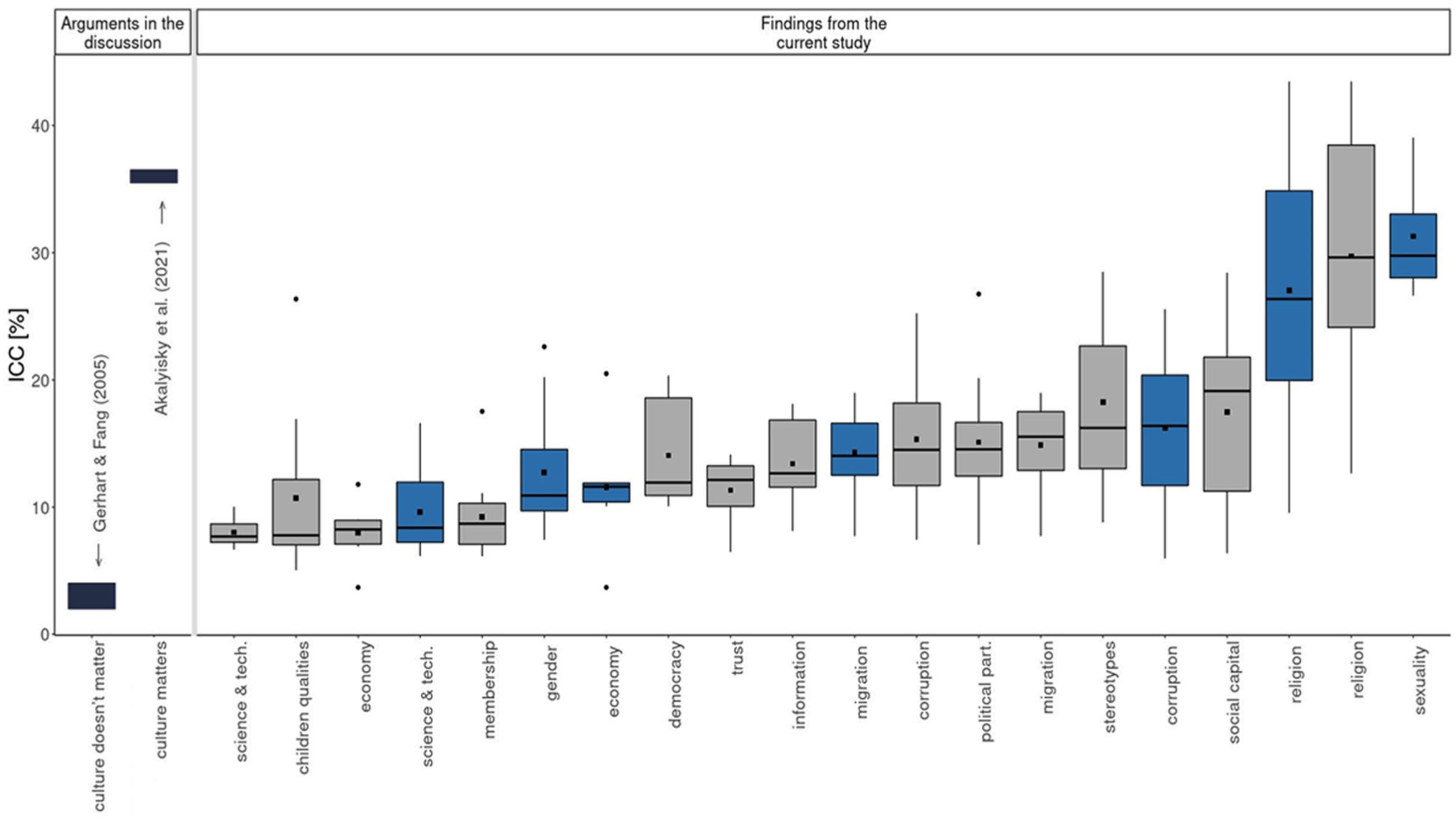
Life Domains Exhibit Varying Intercultural Variability.
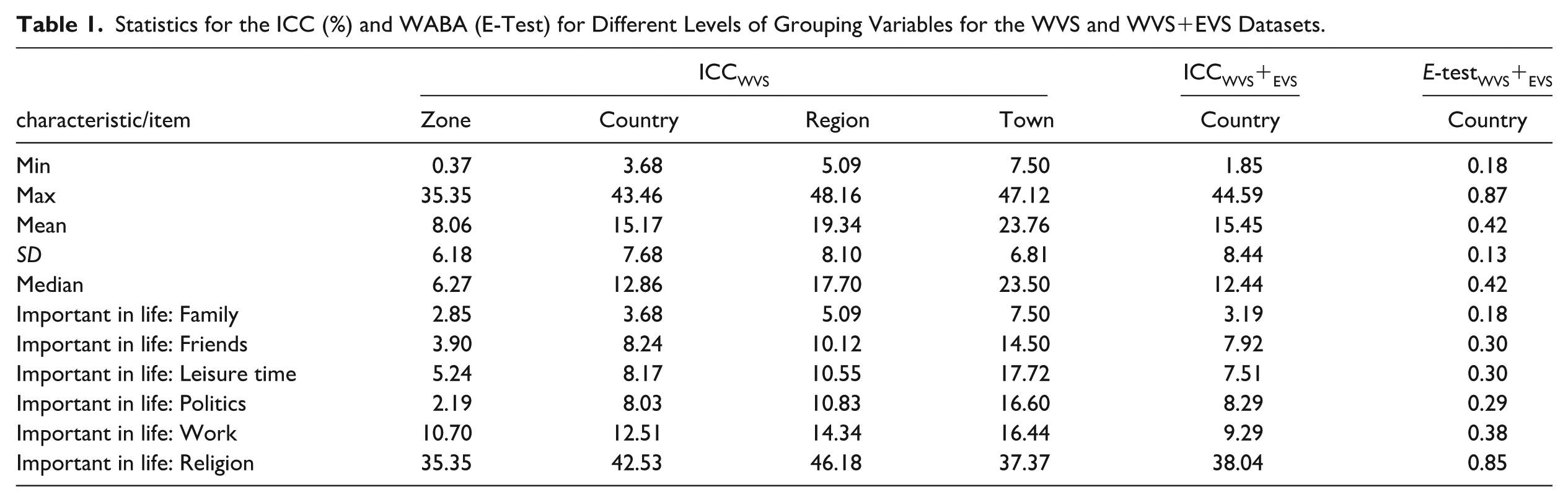
Table 1 displays the results of the ICC and WABA analysis for four different levels of grouping variables using the standard WVS dataset and joint WVS and EVS dataset (WVS+EVS) for all considered items, as well as for a sample of six items related to the importance of various aspects of human life. In the main text, we focus on countries, the most common grouping variable, and for the WVS dataset, to analyze the widest range of topics and avoid overrepresentation of European cultures.
Statistics for the ICC (%) and WABA (E-Test) for Different Levels of Grouping Variables for the WVS and WVS+EVS Datasets.
Findings for Life Domains
We found that across two different statistical procedures (ICC and WABA), several life domains tended to be more varied according to culture than others. Religious values, sexuality, social capital, and beliefs about out-group life domains were highly varied according to cultural context, while economic values, children’s qualities, perception of science & technology, and organizational affiliation life domains did not tend to vary according to cultural context.
The statistics (ICC values) for items grouped by categories from the WVS and by the division made by trained judges, calculated at the country level, are presented in Tables 2 and 3, respectively. Since the data are slightly skewed (skewness = 1.27, kurtosis = 1.83), Tables 2 and 3 report the median ICC values for the remaining grouping variables: cultural zones, regions, and towns (residential areas). For categories from the WVS, four domains stand out—economic values, children’s qualities, perception of science and technology, and organizational affiliation—with an average ICC value of less than 10%. For trust, the variance explained by countries is moderate (11%). For the remaining compact domains, the influence of culture is higher than the average for all variables from the WVS, with ICC values greater than 15%. Social capital, religious values, stereotypes, and beliefs about other groups (neighbors) are issues for which people’s opinions are particularly dependent on the country of residence. In the case of the migration and corruption categories, individual items distort the average.
Statistics for the ICC Values (%) for Categories From the WVS.
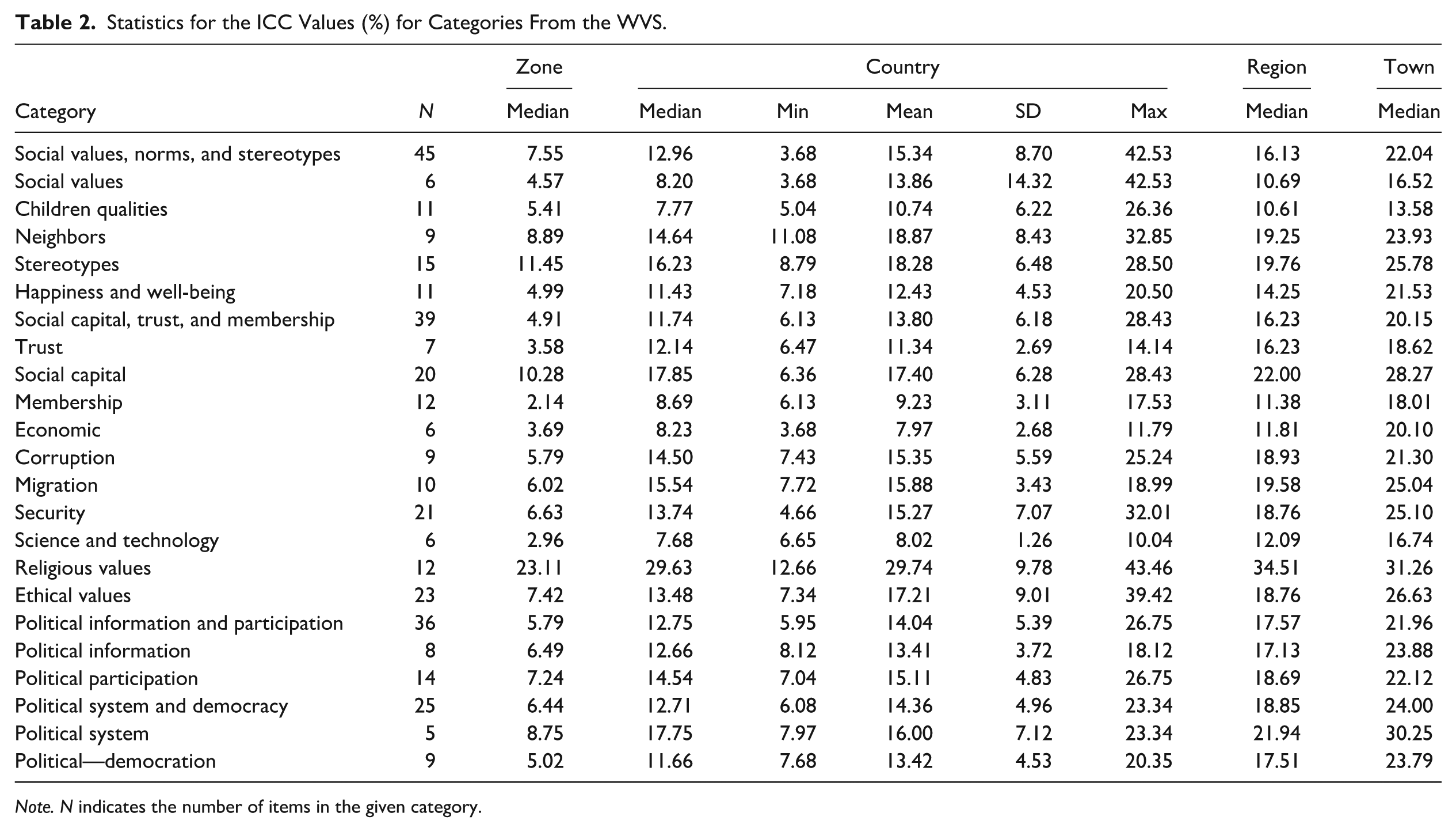
Note. N indicates the number of items in the given category.
Statistics for the ICC Values for Selected Life Domains.
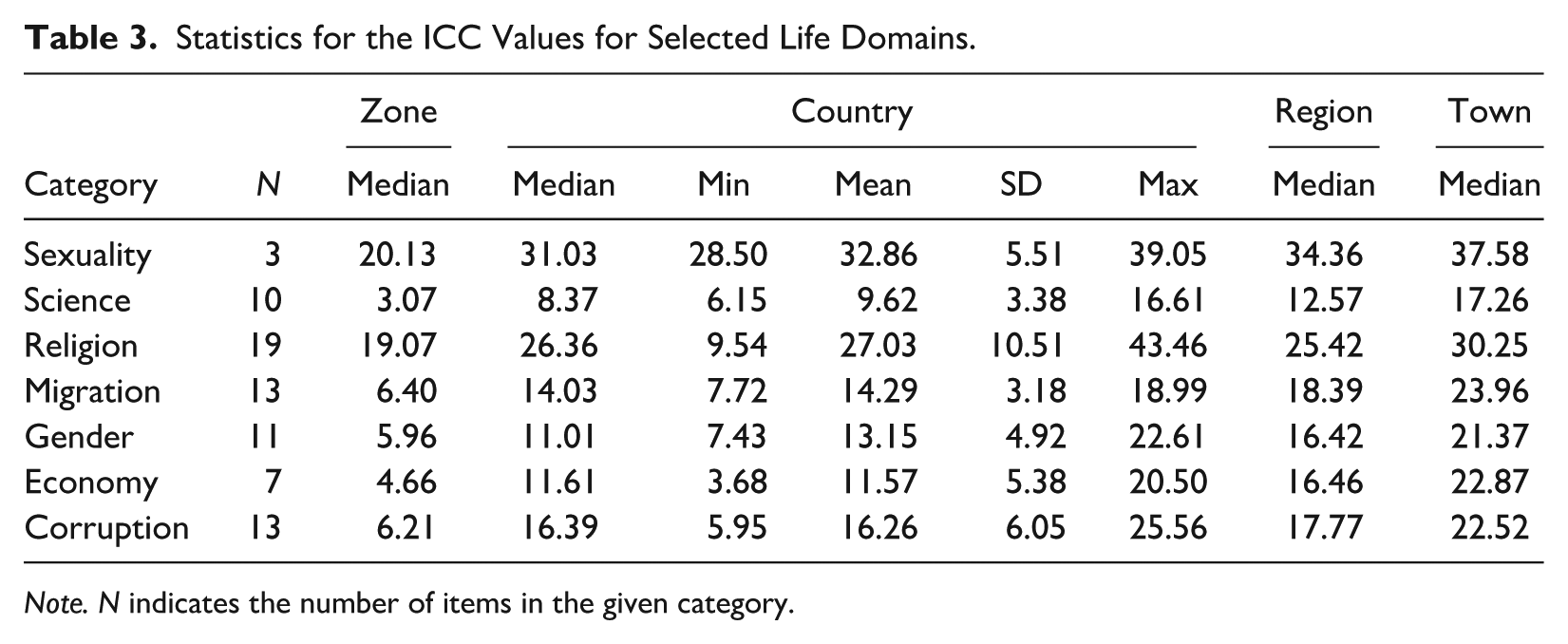
Note. N indicates the number of items in the given category.
For categories common to both categorizations, the results for life domains created by competent judges were consistent with the categorization based on the WVS. Again, the perception of science and technology (9%) shows low cross-cultural variability, similar to economic values (13%). Categories related to corruption and attitudes toward migration (both 17%) have ICC values higher than the average for the entire dataset, placing them within the range of moderate ICC values. Religion exhibited very high variance according to cultural factors (26%), with an even higher value observed only for sexuality (31%). For better insight, the results are visualized in Figure 1.
The results of these analyses reveal that cultural influences vary across different life domains. Domains related to religious values, sexuality, social capital, and beliefs about out-groups are particularly dependent on the culture. On the other hand, domains related to economic values, children’s qualities, perception of science & technology, and organizational affiliation show low cultural variability. Interestingly, family and religion—two topics traditionally associated with socially conservative political perspectives displayed extremely low and high ICC values, respectively. The importance of family seems to remain pan-culturally universal, and the importance of religion seems to be relatively highly shaped by culture.
Discussion
These findings advance the understanding of what is culturally specific and what is pan-culturally universal for humankind. Using representative samples collected in an integrated study with a unified methodology, analyzing four distinct group units, and limiting Western bias in our analyses, we demonstrate that culture significantly shapes views on sexuality and religion (Fischer & Schwartz, 2011; Georgas et al., 2004). In contrast, perspectives on science, the economy, preferred qualities in children, and the importance of family tend to be relatively invariant across cultures. Our findings remained relatively consistent across different methods including the use of different units of grouping (residential areas, regions, countries, or cultural zones).
While most studies focus on specific psychological variables such as tightness-looseness or emancipative values, we aim to complement existing knowledge on the spectrum of cross-cultural diversity by classifying a range of phenomena that are not always at the center of researchers’ attention (ref). For example, it is well established that perceptions of corruption vary substantially across cultures (Hooker, 2009); we highlight the magnitude of these differences and compare them with those observed in other life domains.
These results are largely consistent with other studies based on student samples (Stankov & Lee, 2016) and representative samples (e.g., Fischer & Schwartz, 2011; Hanel et al., 2019; Saucier et al., 2015). Nevertheless, further research including different groups for the same variables would be necessary to confirm the absence of differences.
In particular, previous research has documented the greatest cross-cultural variability in phenomena related to religiosity—ranging from about 25% (e.g., conservatism in Stankov, 2011; devout in Fischer & Schwartz, 2011) to approximately 40% (Saucier et al., 2015; Stankov & Lee, 2016). These findings are consistent with other studies indicating that religion constitutes a critical dimension within the ecocultural framework (Georgas et al., 2004). Results for the sexuality domain are also consistent with previous literature. Hanel et al., (2019) demonstrated that perception of moral attitudes toward personal and sexual issues varies significantly across territories. Notably, the greatest cross-group differences were observed in the moral dimension of purity (Graham et al., 2011). At the other end of the cross-cultural variability spectrum are phenomena such as children’s qualities and social values, which can be treated as indicators of values important in a given society. The low ICC values obtained seem to support claims about the limited role of culture in determining values (Fischer & Schwartz, 2011; Stankov, 2011).
Our findings contribute to an ongoing discourse dealing with how much of human life is shaped by culture to which domains of life are cultural and which are relatively universal. The latter perspective produces yet another question: why are certain life domains similar across cultures, while others are highly culturally specific? We propose three potential hypotheses that emerged post hoc from our data analyses: the chronology thesis, the complexity thesis, and the evolutionary flexibility thesis. Each hypothesis provides valuable insights and helps explain part of the phenomenon, but none appears to be superior to the others.
It is also possible that different mechanisms are needed to explain variability across different life domains, and instead of searching for a single universal explanation, the focus should be on hypotheses that are more specific to each domain. Both approaches together can provide a more precise understanding of the phenomenon and contribute to the refinement of future theoretical frameworks by accounting for the distinct factors shaping each domain. Further research in this direction is essential.
Chronology
One reason why certain aspects of life vary more across cultures than others may be the chronological emergence of specific life domains. That is, if a given domain emerged earlier in human history, it may show greater cultural variation because communities had more time to diverge in this area. For instance, religiosity, while deeply ingrained across many cultures, manifests in markedly different ways worldwide. Religiosity often reflects enduring historical trends that persist despite rapid modernization and economic development (Inglehart & Baker, 2000). Similarly, a factor inseparably linked with the history of humanity is migration. Moreover, researchers believe that migration is one of the earliest factors shaping humankind (Boyd & Richerson, 2009; McNeill, 1984), making it highly significant from the perspective of the chronology hypothesis. In contrast, domains that emerged more recently in human history, such as views on science and technology, may reflect relatively modern phenomena and therefore show greater similarity across cultural contexts.
The chronology hypothesis helps explain certain life domains but not others in this study. The high cultural diversity of religiosity and the relatively high similarity of views on science and technology, the economy, and democracy align with this hypothesis. However, it fails to account for the pronounced differences in attitudes toward sexuality, corruption, and social capital, or the high similarity in preferred qualities in children and views on gender issues.
Complexity
The level of complexity may also explain why certain aspects of life vary more across cultures than others (Roes & Raymond, 2003). The more factors that shape a given domain or attitudes toward it, the more culturally diversified it could be. For instance, Fincher and Thornhill (2008) documented that number of religions in a given country is determined by multiple factors including population size, land area, pathogen prevalence and disease richness; other authors document that early development of religion was associated with geography (Park, 2005), sex ratio (Schenker, 2002), population density (Gelfand et al., 2011), availability of resources, for example, water (Shaw, 2012), rice/wheat agriculture (Talhelm, 2020) or (evolutionary) biology (Sweek, 2002). In contrast, perspectives on science are largely based on variation in financial and social capital (Fountain, 1998). Thus, the reason why religiosity is more culturally diversified than science may be that religion is shaped by more factors than science.
In our findings, apart from high cultural variation in religiosity, the complexity hypothesis could help explain relatively high cultural variation in sexuality, and social capital. Religions frequently attempt to regulate attitudes toward sexuality, so if religiosity is the outcome of multiple factors, then attitudes toward sexuality will also be an outcome of multiple factors. Social capital’s complexity arises from the fact that it comprises multiple interconnected dimensions (e.g., generalized trust, institutional trust, interpersonal trust, social norms, and social networks) that are influenced by both individual factors, such as personal relationships, and social factors, like social trust (Bjørnskov, 2006; Durlauf, 2002; Van Oorschot & Arts, 2005). The complexity hypothesis, however, does not adequately explain the relatively high cultural diversity in perception of corruption, or high similarity for child qualities.
Evolutionary Flexibility
It may also be the case that the evolutionary flexibility of a life domain explains the degree of cultural variation. For example, evolutionary flexibility in caring for offspring is universally low—children cannot survive without family or a caregiver—so the valuation of family may be culturally universal (Sear, 2016). However, evolution does not impose a universal structure for the family. As a result, cultures may differ in the specific roles of family members (e.g., gender roles) (Buss & Schmitt, 2017). Similarly, attitudes toward sexuality—where evolution does not impose a specific ideal—are culturally variable, as evidenced by our analyses. On the other hand, if the WVS had included a question about the general intention to have a fulfilling sexual life—a basic evolutionary mechanism necessary for reproduction—it is likely that such a question would have garnered universal endorsement across cultures, since evolution leaves little room for flexibility in the mechanisms of egg fertilization. Thus, the widespread endorsement of child qualities could also perhaps be explained by the hypothesis of low evolutionary flexibility. Every child needs to reach a similar set of developmental milestones to reach adulthood (e.g., Erikson, 1950).
Limitations and Further Questions
Differences within geographical groups—such as cultural zones, countries, regions within countries, and towns—are often much greater than the aggregated differences between geographical groups (Silver & Dowley, 2000). While acknowledging this fact, we do not claim that cultural differences are inherently more or less important than differences based on other categories. We particularly emphasized country-level differences because countries remain the most influential units of aggregation in the social sciences and the primary actors in policy-making today, and three other group units turned out to produce substantially the same pattern of findings (see Table 1).
Our study is limited in several ways. For example, the data used in this study (WVS) is not representative of certain cultural regions and may include potential response patterns or biases (Goodwin et al., 2020). In addition, a limitation is that we only analyze a single wave of the data (a single point in time), which restricts our ability to capture changes over time. Moreover, there is the potential bias of the WVS due to its design by psychologists, which may favor certain questions that psychologists are accustomed to asking.
Our study is also limited in that the independent judges we recruited to evaluate the categories were all from Anglo-Saxon countries and had higher education levels, which may introduce bias. However, the taxonomy of life domains taken from the WVS and analyzed in our paper partially addresses this concern. In addition, inconsistencies, as evidenced by high standard deviations within some of the studied life domains, underscore the need for more fine-tuned categorizations of life domains in future research. It is also important to note that, even for the life domains with the highest ICCs in our analyses, between-culture variation never exceeded within-culture variation (i.e., no ICC exceeded 50). This suggests that, while culture appears to have a substantial impact in several domains, there remains considerable room for other non-cultural factors to explain the variables of interest—potentially exerting even stronger effects (see also Maney, 2016).
Furthermore, while our study examines life domains broadly, and not address their antecedents, forms, or consequences. For instance, some domains identified as universal might exhibit significant cultural variation in their antecedents, while culturally diverse domains may have universal consequences. Finally, an unresolved philosophical question persists: does the absence of differences necessarily indicate universality, and to what extent do observed differences limit or reshape our understanding of similarity?
Finally, we are unable to make any definitive conclusions regarding whether cultural norms are the cause of differences between cultural groups. Our findings only show that differences in psychological traits exist between populations, which may arise from various sources, including cultural norms. While cultural norms are likely to contribute to these differences, cross-national patterns of variability require a more in-depth examination to precisely determine why these differences emerge.
Conclusion
We anticipate that the findings presented here will help shift the discourse from “How much of human life is cultural?” to “Which life domains are cultural?” This paper also raises an important further question: “Why are certain life domains cultural, while others are more universal?” Answering these questions requires further theoretical and empirical investigation. The three hypotheses proposed here—chronology, complexity, and evolutionary flexibility—are preliminary, and additional targeted studies are essential to advance this line of inquiry. Finally, this work serves as a reminder that, despite cultural differences, there exists a substantial common ground that unites humanity across cultures.
Supplemental Material
sj-doc-1-jcc-10.1177_00220221251387688 – Supplemental material for Progressing Discourse From “How Much a Human’s Life is Cultural?” to “Which Life Domains Are Cultural?”
Supplemental material, sj-doc-1-jcc-10.1177_00220221251387688 for Progressing Discourse From “How Much a Human’s Life is Cultural?” to “Which Life Domains Are Cultural?” by Ewa Palikot, Brian W. Haas and Kuba Kryś in Journal of Cross-Cultural Psychology
Footnotes
Declaration of Conflicting Interests
The authors declared no potential conflicts of interest with respect to the research, authorship, and/or publication of this article.
Funding
The authors disclosed receipt of the following financial support for the research, authorship, and/or publication of this article: This work was supported by the Norway Grants 2014–2021 operated by the National Science Centre (Poland) under Project Contract No. 2019/34/H/HS6/00597 (GRIEG).

Supplemental Material
Supplemental material for this article is available online.
References
Supplementary Material
Please find the following supplemental material available below.
For Open Access articles published under a Creative Commons License, all supplemental material carries the same license as the article it is associated with.
For non-Open Access articles published, all supplemental material carries a non-exclusive license, and permission requests for re-use of supplemental material or any part of supplemental material shall be sent directly to the copyright owner as specified in the copyright notice associated with the article.
