






Abstract
Global migration has increased ethnic and cultural diversification at the local community level, creating novel, culturally diverse everyday contexts and reshaping understandings of groups with different cultural backgrounds. This study investigates the perceptions that young people from various cultural backgrounds have of each other. We employed a structural approach to social representations utilizing the word associations method. Participants included 42 adolescents ages 13 to 19 from the Savo region in Finland of Finnish, Middle Eastern, or Ukrainian backgrounds. The data consisted of 577 word associations related to these three cultural groups. Qualitative content analysis and descriptive statistics were used to examine the contents, evaluations, structures, and potential dynamics of social representations of these groups. Five structural elements were identified—cultural stereotypes, appearance of people, characteristics of people, characteristics of culture, and social connections—which were divided into four structural zones of social representations. While the structures of “Finnish” and “Ukrainian” indicated potential transformation in social representations, the structure of “Middle Eastern” showed stability. Ingroup favoritism was found in all three participant groups based on the evaluations of associations. The findings are discussed in relation to the sociopolitical context of Finnish society.
Keywords
Introduction
Migration is a global phenomenon that brings both opportunities and challenges to societies. Research shows that mixing immigrant and non-immigrant populations in a neighborhood can improve relations between different ethnic and cultural groups (Schmid et al., 2012), but it can also cause feelings of threat and anxiety, leading to problematic relationships (Laurence et al., 2018; Stevenson & Sagherian-Dickey, 2016). Interactions between individuals from various ethnic and cultural backgrounds are crucial during adolescence as young people expand their social circles to include more peers (Karataş et al., 2023). Numerous factors, including parental and peer norms (Jasinskaja-Lahti et al., 2011), residential segregation (Schlueter, 2011), socioeconomic backgrounds, and language skills (Beißert et al., 2019; Kivijärvi, 2013), shape adolescents’ readiness to engage in interethnic interactions. Additionally, their perceptions of and attitudes toward different ethnic groups are significantly influenced by their interactions with peers from diverse ethnic and cultural backgrounds (Elias et al., 2021; Karataş et al., 2023; Lötjönen et al., 2025; Pettigrew, 1998). These interactions can occur at school (Bohman & Miklikowska, 2020) and during leisure time (Kim, 2012). However, previous research conducted at educational settings suggests that young people often form connections with peers of their own ethnic group, and the connections between ethnic majorities and minorities tend to be fragile (Kao & Joyner, 2004; Mouw & Entwisle, 2006), which also applies to leisure time (T. Reynolds, 2007). Studies conducted in Finland, the context of this research, have had similar findings (e.g., Kivijärvi, 2013; Kivijärvi & Harinen, 2009).
In his article “An Essay on Social Representations and Ethnic Minorities,” Moscovici (2011) explored how social representations shape the perception and treatment of ethnic minorities. Moscovici argued that these representations are not merely passive reflections of reality but actively construct and reinforce social norms, stereotypes, and power dynamics. He emphasized the role of communication and social interactions in the formation and dissemination of these representations, highlighting their impact on both the majority and minority groups.
In fact, prior research on social representations of ethnic and cultural groups has often focused on minority groups (e.g., Pivetti et al., 2017; terWal, 1996). Augoustinos et al. (2015) analyzed how refugees are portrayed through social representations in public discourse and media, arguing that refugees are often depicted in essentialized and racialized ways, which reinforces stereotypes and marginalizes these groups. Another common feature of prior research is the emphasis on exploring the connection between social representations and identity, such as immigrant identities (Deaux & Wiley, 2007), identity and acculturation among mixed-heritage individuals (Howarth et al., 2013), the construction of refugee and asylum-seeker identities (Moloney, 2007), and the cultural identity of bicultural young adults (Ogoro et al., 2022).
Andreouli and Chryssochoou (2015) examined how national identity is constructed and understood within culturally diverse societies. They argued that social representations of national identity are influenced by interactions between different cultural groups and the broader societal context. They highlighted the dynamic nature of national identity, showing how it can be inclusive or exclusive depending on the prevailing social representations and the power relations between groups. Andreouli and Chryssochoou (2015) emphasized the need for research that seeks to understand these representations in order to foster social cohesion and address challenges related to multiculturalism and integration. This is crucial since ethnic, national, and cultural identities are constructed in intergroup relations where perceptions of other groups play a significant role (see Tajfel, 1982).
This study aims to address the aforementioned research gap by examining how adolescents with Finnish, Middle Eastern, and Ukrainian 1 backgrounds living in Eastern Finland perceive Finnish, Middle Eastern, and Ukrainian people and how these perceptions reflect intergroup dynamics. We use social representations theory as our theoretical framework as it focuses on the contents, forms, and functions of people’s everyday understandings constructed through social interactions (Moscovici, 1984, 2008). Specifically, we adopt a structural approach to social representations, utilizing a word associations test combined with both qualitative and quantitative analyses. Our research is guided by three key questions: (1) What kinds of social representations of Finnish, Middle Eastern, and Ukrainian people are constructed by the terms young people use in a word association test? (2) How are these social representations structured by the frequency and order of evocation of the associated terms? (3) What dynamics of social representations are suggested by the analysis of the content and structure of these representations?
Our research makes empirical and methodological contributions. Empirically, it explores young people’s perceptions of different cultural backgrounds in Finland. Methodologically, our study enhances the word association method by combining qualitative and quantitative analyses to examine the contents, structures, and dynamics of social representations.
Structural Approach to Social Representations
Everyday interactions shape people’s understanding of and behavior toward diverse groups, influencing their coexistence (Breakwell, 1993; Moscovici, 2011; Prost et al., 2023). This study examines the formation and content of such understandings among Finnish, Middle Eastern, and Ukrainian adolescents using social representations theory. Developed by Moscovici (1984), this theory explores how people construct, share, and use common-sense knowledge in their everyday lives. According to Moscovici (1973), social representations are shared “systems of values, ideas and practices” (p. xiii) that help people navigate daily life and communicate with each other. Social representations are socially constructed, modified, challenged, and opposed through social interactions (Moscovici, 1984, 2008). Therefore, they are dynamic and constantly undergoing reconstruction (Marková, 2003; Moscovici, 1984, 1988). People also construct social representations of diverse groups of people. These social representations shape not only how we think about these groups but also how we behave toward them (Breakwell, 1993; Prost et al., 2023). Consequently, social representations can influence intergroup relations, either facilitating or challenging them. Additionally, people form beliefs about how other groups view them, known as meta-representations. These meta-representations impact intergroup interactions by shaping preconceived notions about how groups are perceived (Elcheroth et al., 2011; Obradović & Draper, 2022).
Although social representations are socially constructed, they are not uniformly shared. Different groups can develop divergent representations of the same phenomena to serve their interests (Moscovici, 1984, 2008). Additionally, social representations are dynamic and constantly reconstructed (Moscovici, 1984, 2008). Moscovici (1984) emphasized that their dynamic nature is particularly evident during crises and upheavals, making it useful to study them in the context of change. Global migration significantly affects and reshapes societies, communities, and individual lives. We understand global migration and its repercussions at the local community level as increased ethnic and cultural diversification, a context of change characterized by intensified reconstruction of social representations. Therefore, we are interested in examining the contents of social representations as well as potential signs of their renegotiation and dynamics. To achieve this, we conducted both content and structural analyses based on word associations.
The structural approach to social representations, developed by Jean-Claude Abric, expands on Moscovici’s foundational work. Abric (1993, 2001) combined the concepts of the central core and peripheral elements within the structure of social representations. According to Abric (2001), social representations consist “of a body of information, beliefs, opinions, and attitudes about a given object” (p. 43). The central core theory posits that these elements are hierarchically organized into a central core and a peripheral system (Moliner & Abric, 2015). The central core, which imparts meaning to the representation, contains foundational and consensual elements of collective memory and the group’s normative system, making it stable and resistant to change (Abric, 1993). It performs generative and organizational functions, regulating the integration of other elements. Changes in the central core transform the entire representation. Representations with the same content can differ if organized around different central cores, highlighting the qualitative importance of the central core over its quantitative aspects (Abric, 2001).
The peripheral system consists of diverse and flexible elements that adapt social representation to concrete situations. These peripheral elements, organized around the central core, serve three functions: concretization, adaptation, and defense. Concretization refers to the process of anchoring a social representation in concrete reality, making it easier to understand and communicate. Adaptation is enabled by the flexible nature of peripheral elements, allowing the representation to adjust to changing contexts and incorporate new information, thus supporting its evolution over time. Defense is also managed by peripheral elements, which act as a buffer by absorbing new or potentially conflicting information, thereby protecting the stability of the central core of the representation (Abric, 2001; Moliner & Abric, 2015). Peripheral elements also enable individual variations based on personal experiences, accommodating significant differences with the consensual central system (Abric, 1993).
Building on Abric’s (1993), 2001) foundational work on the conceptual division between the central core and peripheral elements, more nuanced approaches to conceptualizing the structure of social representations have been developed within the methodological context of the word association test (i.e., free association technique; see Dany et al., 2014). These contributions clarify how different peripheral elements interact with and influence the overall structure of social representations and provide methods and tools for analysis. Most relevant for our purposes is the concept of potential change zones (Vergès, 1994; see also Dany et al., 2014).
Potential change zones are areas of potential destabilization and transformation of social representations (Vergès, 2005) that are particularly prone to change through social interactions. Abric (2001) relied on Vergès’ (1992) proposal of the crossing technique, which is based on the salience and evocation of associated items, as a means of defining and dividing structural elements: Such a crossing technique allows us to determine the “zone of central core” which comprises those elements of high frequency that are given the top ranking. The other zones, compromising either words with high frequency and lower rankings or words given first rankings but appearing with lower frequency, correspond then to the peripheral elements. (Abric, 2001, p. 46)
Thus, Abric (2001) differentiated between the central core and two peripheral elements. However, he did not discuss the zone formed by the words with low frequency and lower rankings. In this article, we follow the structural division of social representations presented by Vergès (1994) and Dany et al. (2014) comprising four structural zones determined by the following frequency and order of appearance: the core zone (high frequency and top ranking), two potential change zones (either low frequency and top ranking or high frequency and low ranking), and the periphery (low frequency and low ranking). This structure, consisting of four zones, is compatible with the rank-frequency method we utilize in our analysis (see Dany et al., 2014; Vergès, 1994). This finer-grained division of social representations into four structural zones by Dany et al. (2014) is important for the purposes of our study, as it—and especially the two potential change zones—enables the examination of the dynamics of potential change in social representations.
Word Association Test and Rank-Frequency Method in Examining Structure of Social Representations
In word association tests, it is common to ask for three to five responses without specifying the nature of the associated words (Dany et al., 2014). The method’s advantage is its potential to elicit spontaneous responses (Moloney et al., 2005). It uncovers the contents of social representations by prompting individuals to share the words or expressions that come to mind regarding the subject (Piermattéo et al., 2018). Participants often find it pleasant and motivating, even with abstract and complex topics (Sakki et al., 2014). Given our interest in understanding young people’s perceptions of people of different cultural backgrounds, we found this method suitable for data collection. A limitation of the method is that words are polysemous, and lists of individual words do not allow for in-depth interpretation of social representations (Piermattéo et al., 2018; Sakki et al., 2014).
The word association test is commonly used to investigate the structure of social representations based on the assumption that core elements are frequently mentioned and quickly evoked (Dany et al., 2014). This linkage between the central core theory and the word association test underpins our methodological choices. The method involves two rank indicators: frequency (how often an item is mentioned) and appearance ranking (the order in which items are listed; Dany et al., 2014). Frequency reflects a collective dimension, indicating quantitative centrality (Moliner, 1994), while appearance ranking reflects the qualitative dimension, aligning with individual cognitive availability, suggesting that more cognitively available elements are mentioned first (Dany et al., 2014). Combining these indicators helps identify the most salient elements of a social representation, mapping both quantitative and qualitative properties (Dany et al., 2014).
Thus, this rank–frequency method combines the frequency of items and their appearance ranking based on the notion that core elements are mentioned most frequently and early in the word association list (Abric, 2001; Vergès, 1992). Previous research shows significant variation in methodologies for defining structural positions of social representation elements, which can lead to subjective interpretations (see Dany et al., 2014). To address this criticism, and following Moscovici’s (1988) encouragement of methodological creativity, we propose an application of the rank–frequency method that utilizes both qualitative and quantitative approaches—qualitative content analysis and calculating the rank–frequency ratio—illustrated with scatter plots. This method offers a simplified technique for establishing cut-off points for structural zones and defining positions of structural elements. Additionally, it provides a clear visual presentation of the structure of social representations.
Context of the Study
Global crises, including those in Afghanistan, Syria, and Ukraine, have increased the number of refugees, including in Finland. Most immigrants in Finland live in the Helsinki Metropolitan area (Sjöblom-Immala, 2016). This study focuses on the Northern Savo region in Eastern Finland, where immigrant numbers and cultural diversity are lower. By the end of 2023, Northern Savo had 11,342 residents with an immigrant background, with a significant increase due to the war in Ukraine. Ukrainians are now the second largest immigrant group in the region after Russians, followed by Middle Easterners (Statistic Finland, 2023).
Immigration has received significant media attention in Finland, shaping public understanding of immigrants and refugees. During the 2015 “refugee crisis,” Middle Eastern refugees were often portrayed as cultural threats (Martikainen & Sakki, 2021), while Ukrainian refugees are generally depicted as fellow Europeans needing help (Martikainen & Sakki, 2023). Although, many Finns see migration as a major challenge attitudes toward European immigrants are generally more positive than toward those from outside Europe (Koikkalainen et al., 2021), influencing perceptions of ethnic groups in Finland. However, when considering intergroup relations, it is not enough to focus solely on Finnish people’s perceptions of those with immigrant backgrounds. It is equally important to study the perceptions of Finns held by people with immigrant backgrounds as well as the perceptions different immigrant groups have of each other. This study aims to provide insight into the perceptions of Finnish, Middle Eastern, and Ukrainian adolescents regarding people from these groups.
Our study participants came from three cultural backgrounds: recent arrivals from the Middle East and Ukraine and native Finns. Until recently, these groups’ perceptions of each other were often shaped by mediated sources like education and media rather than direct interaction. This lack of direct contact may have led to the formation of stereotypes (Fiske & Neuberg, 1990) which may still influence how young people interact with each other. However, it is reasonable to assume that young people’s views are evolving due to increased contact, making it interesting to study whether the content and structure of social representations related to these three cultural groups exhibit signs of dynamism and change.
Methods
Participants and Data Collection
This study is based on qualitative data collected between spring and autumn 2023. A total of 42 adolescents, ages 13–19, from the Northern Savo region in Eastern Finland, with Finnish, Ukrainian, or Middle Eastern backgrounds, participated in the study. Ukrainian participants had lived in Finland for less than a year, while those from the Middle East had been in Finland for a few years. Participation in the study was voluntary, and participants were informed that they could withdraw at any time without providing a reason. Informed consent was obtained from all participants, and for those under the age of 15, consent was also required from their parents or caregivers.
Participants were recruited from schools through visits by researchers, who informed students about the research project and participation opportunities. Similar recruitment efforts were carried out at a multicultural community center. In both settings, posters and leaflets were used to raise awareness of the project among young people and their parents. Notably, for Middle Eastern and Ukrainian participants, snowball sampling through mothers or other close contacts proved to be an effective recruitment method.
The data were collected using a word association test with the associative technique of multiple-response free association (Flament & Rouquette, 2003), which allows participants to generate several words without restrictions on the nature of the words (e.g., grammatical). Participants were asked to list the first five words that came to mind from the stimulus words “Finnish,” “Middle Eastern,” and “Ukrainian” and to indicate whether these associations were positive, negative, or neutral.
The participants were instructed to write down words in the order they came to mind. The test was conducted by researchers of the project, including the authors of this article, as a part of the data collection workshops in which the young people participated. Data were collected during three workshops held in different locations to facilitate the participation of all who had expressed their interest in participating: one in a university classroom, one in a classroom at the participants’ school, and one in a home environment. In the university and school workshops, participants were seated individually at desks and completed the word association test using paper and pencils. Each stimulus word was projected onto the wall and shown one at a time, with participants given 1.5 min to produce five associations per stimulus word. In the home setting, the stimulus words were presented on A4-sized paper, but the procedure remained the same. In both the classroom and home environments, all participants completed the test simultaneously. Apart from the researchers, no other individuals were present during the test. We chose not to separate participants based on their cultural backgrounds, as we believed this would unnecessarily emphasize their differences. The researchers clarified that the stimulus words referred to people from these cultural backgrounds. Participants wrote the words in their native languages, and the responses were later translated into English. The full study protocol was as follows: Upon arrival, participants were seated in a way that allowed them to work without distractions. They were then given instructions explaining that they would be presented with three stimulus words. For each stimulus word, they were asked to write down five words or expressions that came to mind, in the order they were evoked. Additionally, they were instructed to mark each association as positive, negative, or neutral. Researchers ensured that all participants understood the procedure and confirmed their willingness to participate. Each stimulus word was both displayed and read aloud by the researcher.
Our final data included 577 associations: 251 from Finnish participants (n = 18), 141 from Middle Eastern participants (n = 10), and 185 from Ukrainian participants (n = 14).
Data Analysis
Our analysis combined qualitative and quantitative methods. While quantitative methods like correspondence and cluster analysis are commonly used to study the structure of social representations from word associations (see, e.g., Doise et al., 1993; Moloney et al., 2005; Sarrica, 2007), the first phase of our analysis was based on data-driven qualitative content analysis (Schreier, 2014) following Mäkiniemi et al. (2011). We conducted distinct content analyses for each of the stimulus words (“Finnish,” “Middle Eastern,” and “Ukrainian”). In each of these three analyses, we initially categorized the associated words based on their content. Subsequently, we further categorized them by participant group (Finnish, Middle Eastern, and Ukrainian adolescents) to identify potential differences within content categories among the three participant groups. We first grouped associated words with similar content into subcategories, then combined subcategories with related content into main categories, with each main category representing one structural element to be used in the final phase of the structural analysis. To address subjectivity in interpretation, we used researcher triangulation as recommended by Danermark et al. (2013) and Piermattéo et al. (2018). The first author categorized the data, and then the first and second authors discussed and critically examined the categorization multiple times, refining it until consensus was reached. However, without participants’ clarifying accounts, our interpretations may not fully capture their intended meanings.
After categorizing the data, we focused on analyzing participants’ evaluations of their associations as positive, negative, or neutral. We calculated frequencies and percentages of these evaluations for all three stimulus words across all participant groups. This allowed us to examine how participants from the three different cultural backgrounds evaluated the associations. Furthermore, this enabled us to study which stimulus words were perceived most negatively, positively, and neutrally and whether there were differences in how participants from different backgrounds evaluated associations related to people of other cultural backgrounds.
In the third phase, we identified the positions of main categories as either the core zone, potential change zones, or periphery using the application of the rank–frequency method. Thus, we conducted a structural analysis to examine how the main categories (i.e., structural elements) were positioned within the structure of social representations and whether the structure exhibited signs of dynamism identified in the content analysis. More specifically, our aim was to determine whether some structural elements were located within the potential change zone, which would suggest the possibility of transformation and renegotiation in social representations.
We began this third phase of analysis by calculating word frequencies within each main category across the three groups. As already mentioned, each main category represented one structural element. For each main category, we then determined appearance rankings based on the mean values of the order in which the words appeared in the list. Since participants were asked to produce five words in the order they came to their mind, the mean values could vary between 1 and 5. The lower the appearance ranking, the higher the words appeared on average in the word lists. We used frequencies and mean appearance rankings of the main categories to define cut-off points for the core zone, potential change zones, and periphery. Scatter dot charts 2 were used to indicate the rank–frequency ratio of each main category—the relationship between the two sets of values (frequency and appearance rank)—and thus the position of structural elements in the social representation.
Reference lines were drawn on both the X (means of appearance ranks) and Y (frequencies) axes according to the mean values, resulting in a 2 × 2 scatter dot chart, where main categories with high frequencies and low appearance rankings formed the core zone, those with low frequencies and high appearance rankings formed the periphery, and the remaining categories fell into two potential change zones with either low frequencies and low appearance rankings or high frequencies and high appearance rankings (Figure 1).
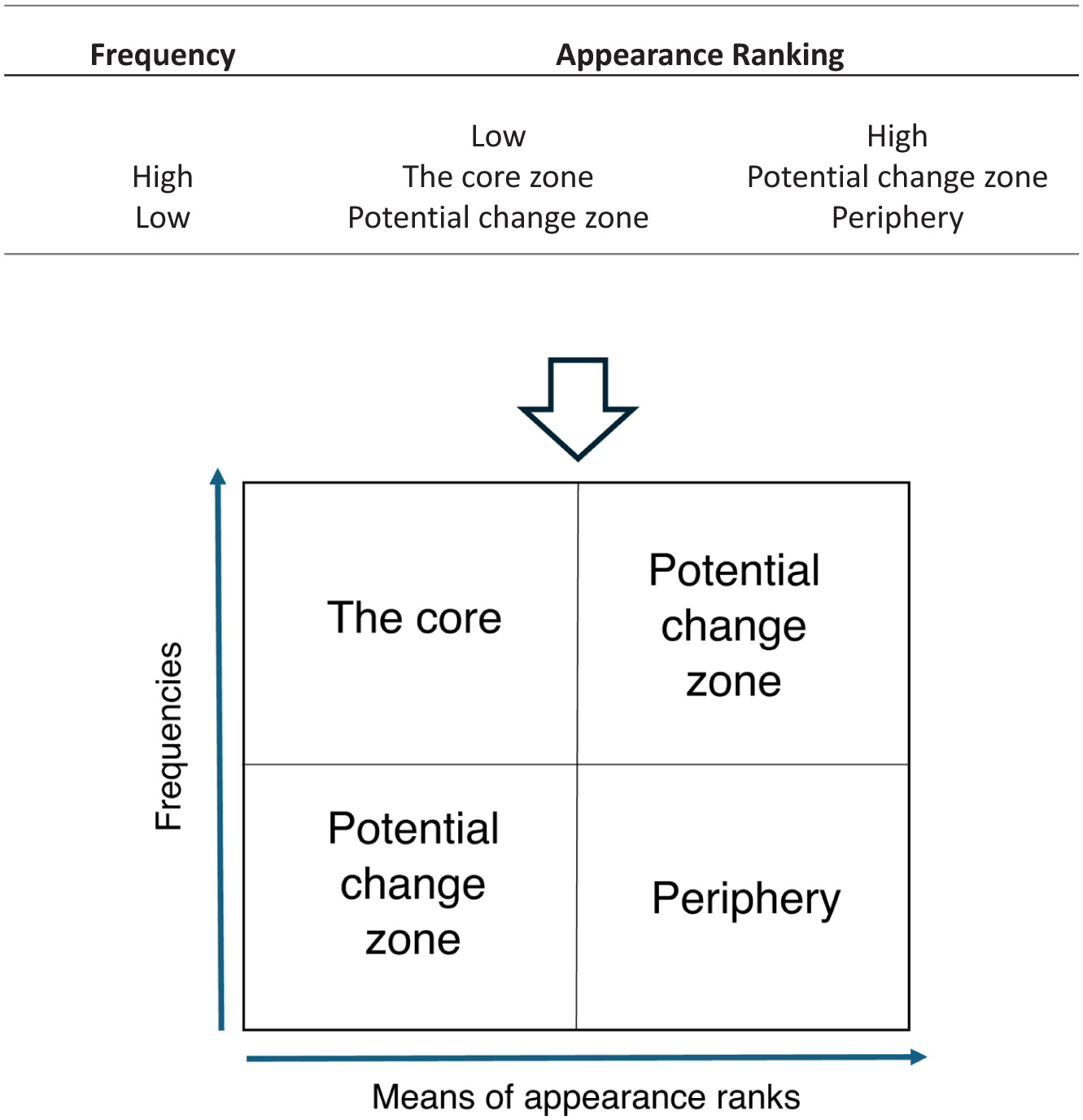
Four structural zones formed by word associations with the rank-frequency method, as defined by Vergès (1994) and presented by Dany et al. (2014), and the rationale used in this article to define cut-off points of structural elements of social representations.
Findings
Contents of the Main Categories of Social Representations of “Finnish,” “Middle Eastern,” and “Ukrainian”
A total of 577 associations were produced in response to the three stimulus words: 201 associations with “Finnish,” 187 with “Middle Eastern,” and 189 with “Ukrainian.” For the stimulus word “Finnish,” Finnish participants produced 89 associations (avg. 4.9), Middle Eastern participants produced 45 (avg. 4.5), and Ukrainian participants produced 67 (avg. 4.8). For the stimulus word “Middle Eastern,” Finnish participants produced 78 associations (avg. 4.3), Middle Eastern participants produced 49 (avg. 4.9), and Ukrainian participants produced 60 (avg. 4.3). Finally, for the stimulus word “Ukrainian,” Finnish participants produced 84 associations (avg. 4.7), Middle Eastern participants produced 47 (avg. 4.7), and Ukrainian participants produced 58 (avg. 4.1).
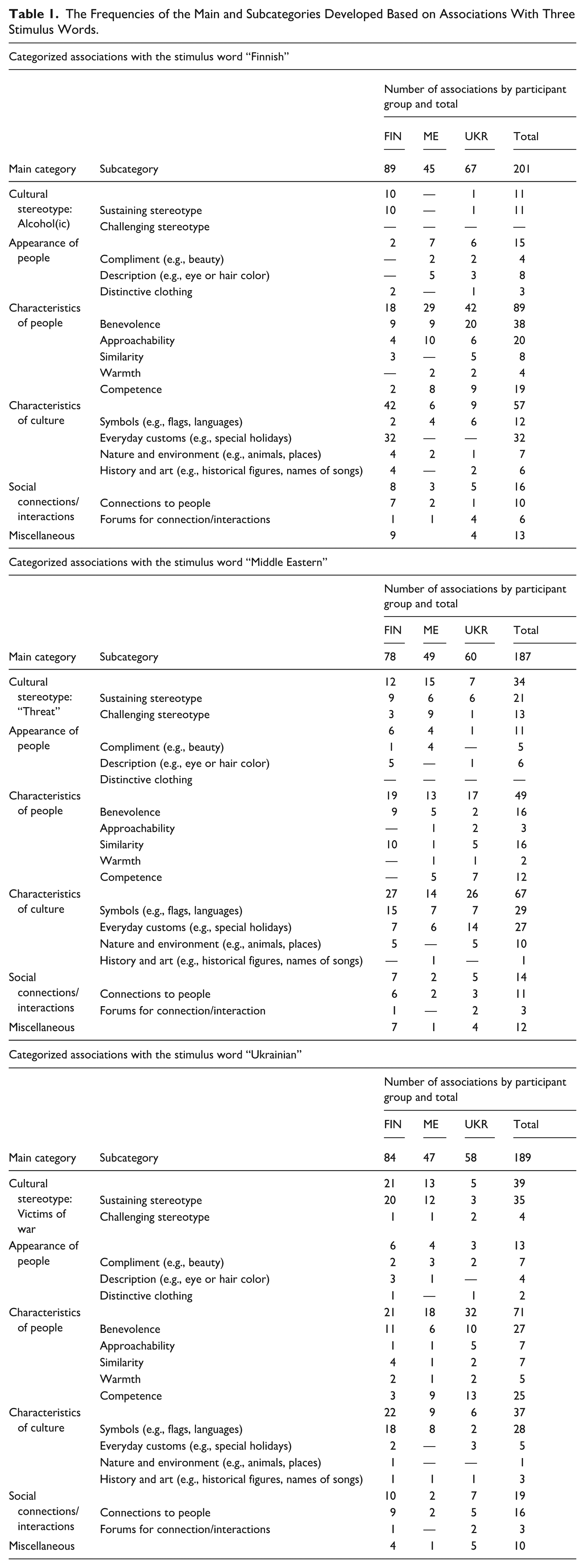
In our content analysis, we noticed that the contents of the associated words exhibited notable similarities across the data, and therefore, the same main and subcategories could be formed in all three content analysis conducted on stimulus words. We produced five main categories (i.e., structural elements): (1) cultural stereotypes, (2) appearance of people, (3) characteristics of people, (4) characteristics of culture, and (5) social connections/interactions (Table 1).
The Frequencies of the Main and Subcategories Developed Based on Associations With Three Stimulus Words.
Cultural Stereotypes
Several participants’ word association lists included words and expressions that referred to conceptions and beliefs about Finnish, Middle Eastern, and Ukrainian people that can be understood as stereotypes in terms of socially constructed simplifying conceptions (Stangor, 2015) widely spread and commonly known in the current social, political, and cultural contexts of Finland and Europe. Participants expressed these stereotypes directly by naming them without further explanation, which we interpreted as sustaining stereotypes. However, participants also referred to stereotypes by indirectly implying an awareness of the stereotype but challenging it.
There were differences in how adolescents from Finland, the Middle East, and Ukraine perceived these cultural stereotypes. The stereotype of “Finnish” was constructed around alcohol, aligning with the widespread stereotype that Finns consume a lot of alcohol (Tigerstedt & Törrönen, 2007). This stereotype was primarily mentioned only by Finnish participants, except for one Ukrainian participant, and may be understood as an internalized ingroup stereotype. The cultural stereotype of “Middle Eastern” was constructed around the concept of threat, resonating with common media and political discourse portraying Middle Eastern (especially male) refugees as a threat to Western societies (Holzberg et al., 2018; Martikainen & Sakki, 2021). In our data, associations such as threat, fear, radicalism, and stranger sustained this stereotype and were produced by Finnish and Ukrainian participants. However, some associations challenged the stereotype, such as without harm, wrongly understood community, hurt, and misunderstood, mostly produced by Middle Eastern participants. This suggests an awareness of the stereotype and a desire to defend their ingroup (K. J. Reynolds & Turner, 2001). These Middle Eastern participants’ responses may stem from meta-representations (Elcheroth et al., 2011) about their own cultural group, creating a need to challenge the prevailing stereotypical perceptions within the community. Additionally, some Finnish participants associated “Middle Eastern” with words like citizen of Finland, compassion, and human, challenging the stereotype of Middle Eastern people as threatening. This can be seen as a statement against the discrimination faced by people from the Middle East in Finnish society (Castaneda, 2024).
With the stimulus word “Ukrainian,” the cultural stereotype of war victims emerged, reinforced by associations such as affected by war, conflict affected, death, escape, and war. This stereotype is also prevalent in current lay and media discourse in Finland and Europe (Martikainen & Sakki, 2023; Mayaleh et al., 2025). It was produced only by participants with Finnish or Middle Eastern backgrounds (i.e., outgroups). Ukrainian participants, however, did not associate “Ukrainian” with victimhood but seemed to take an active stance against this position, as evident in the main category of characteristics of people presented later. Despite the absence of words referring to victimhood, Ukrainian participants were likely aware of this stereotype because it is widespread in Finnish society (Martikainen & Sakki, 2023). The absence of references to victimhood may reflect their wish to distance their ingroup from the passive position of war victims and strive for a more active social identity. The ways both Middle Eastern and Ukrainian adolescents negotiated and challenged the cultural stereotypes associated with their groups suggest dynamics and renegotiations in social representations.
Appearance of People
The second structural element dealt with people’s appearance. Even though this was the least frequent main category, associations to appearance were produced for all three stimulus words. Appearance associations were often produced either at the beginning or end of the word list, which might indicate that associations related to appearance were concrete and therefore easier to start or end with. We divided these associations into three sub-categories: compliments, descriptions, and distinctive clothing. While compliments praised the appearance (e.g., beautiful) and descriptions neutrally mentioned appearance features (e.g., dark hair, brown eyes, blond hair, blue eyes), there were mentions of distinctive clothing typical for that group of people (e.g., furry cap for “Finnish” and vyshyvanka for “Ukrainian”).
Characteristics of People
Except for the stimulus word “Middle Eastern,” the main category of characteristics of people was the largest main category. This main category could be divided into five sub-categories: benevolence (e.g., friendly, hospitality, kind, goodwill), level of approachability (e.g., talkative, quiet at first, isolated, reserved), similarity (e.g., different, similar, normal, unknown, familiar people), warmth (e.g., cold, positive, family lover, warm), and competence (e.g., smart, strong, innovative). However, different groups of participants presented the sub-categories in different ways.
Participants with a Ukrainian background produced several associations expressing the benevolence of the “Finnish,” which may convey gratitude toward Finnish people for taking in Ukrainian refugees. On the other hand, associated words referred to the competence of the “Ukrainian” (e.g., clever, positive, strong). These associations may reflect a desire to reinforce the social identity of Ukrainians as competent and to distance themselves from the social identity as refugees and war victims. This response may stem from an awareness of the stereotypical meta-representation (Elcheroth et al., 2011) of Ukrainian refugees as war victims, creating a need to challenge these perceptions and construct a more positive social identity for the ingroup (K. J. Reynolds & Turner, 2001). Word associations produced by Ukrainian adolescents suggested that social representation is subject to renegotiation.
The associations produced by the Middle Eastern adolescents about “Finnish” and those produced by Finnish adolescents about “Middle Eastern” interestingly overlapped in sub-categories of approachability and similarity. Middle Eastern participants frequently associated “Finnish” with reservedness (e.g., isolated, not open, reserved), while Finnish participants emphasized differences with “Middle Eastern” (e.g., unknown, different, confusing). These associations suggest a sense of detachment between the two groups, reflecting potentially problematic relationships and challenges to everyday encounters. Given the nature of our data, which consist of word associations, it is challenging to determine the reference point from which participants generated their responses—whether from their own individual perspective or from that of their ingroup. For instance, when considering perceived differences, it remains unclear whether participants viewed these differences in relation to themselves as individuals or in comparison to their cultural group. Nonetheless, such perceptions are likely to have significant implications for intergroup relations.
Characteristics of Culture
Although the assignment was to produce associations about groups of people, many associations concerned cultural characteristics related to these groups. Country-specific elements of nature, such as winter, camel, sun, and birch, as well as associations with the environment, history, and culture (e.g., Cossacks, Snellman, and Cha cha cha), were produced for all groups of people. Associations in this structural element mostly referred to cultural and nation-specific identifiers and symbols, such as language and flag colors, and were the most abundant among associations for “Ukrainian” and “Middle Eastern.” Finnish participants associated “Finnish” with culture-specific everyday customs, such as national holidays. Ukrainian participants, in particular, associated “Middle Eastern” with the Muslim religion (e.g., Islam, hijab, 3 arafatka). While adolescents associated the stimulus words “Finnish” and “Middle Eastern” more with cultural characteristics than people’s characteristics, the stimulus word “Ukrainian” was more often associated with people’s characteristics.
Social Connections and Interactions
Finally, we formed the fifth main category of social connections and interactions. Although associations with social connection and interaction were not abundant, they nevertheless formed a distinct content category. In this structural element, associations expressed interaction with other people (e.g., friends, people, person, and acquaintance) or different forums of interaction (e.g., parties, skateboarding, school). Hence, contact with people from different cultural backgrounds formed a layer of social representations of Finnish, Middle Eastern, and Ukrainian groups of people.
Miscellaneous
Additionally, a miscellaneous category was created. These associations could not be logically classified into the aforementioned categories, nor did they form a coherent category of their own. For example, some words appeared to be names of places or people, but their meanings were unclear to us (e.g., close ones, places of home country, etc.). Some associations included words or letter combinations whose meanings we could not understand or verify (e.g., a-a-a-a, ABC, so-man). Furthermore, some words did not fit into the established categories and were too few in number to justify the creation of a separate category (e.g., dog, service, sentence).
Evaluations of Word Associations: Positive, Negative, or Neutral
The second phase of the analysis focused on evaluations of the associations. We asked young people to estimate whether they perceived the associations they produced for the three cultural groups as positive, negative, or neutral. All participants belonged to one of the groups they produced associations for, with the other two groups being culturally different. Therefore, we use the concepts of “ingroup” and “outgroup” in presenting the findings. Table 2 summarizes how adolescents evaluated their associations for all three groups. Evaluations are presented as frequencies and percentages to facilitate comparisons. In some cases, evaluations were mixed, with participants using more than one symbol (+, −, or 0), and in other cases, evaluations were missing altogether. Ingroup evaluations are highlighted with bolded text.
Percentages and Frequencies of Evaluations of Associations With Groups Presented by Three Participant Groups.
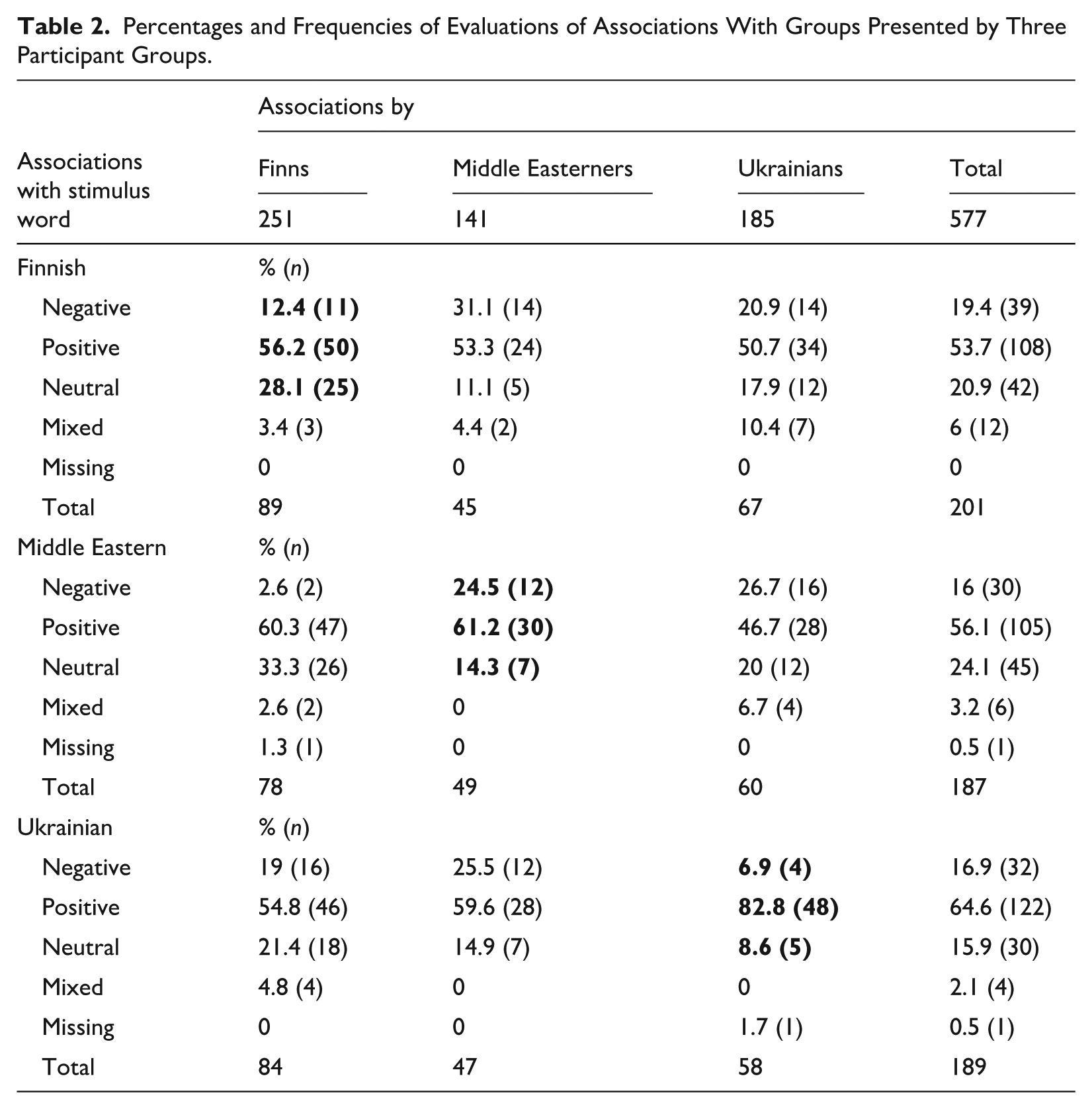
Overall, social representations of all cultural groups were positive, as adolescents from all three cultural backgrounds produced more positive than negative or neutral associations. In fact, more than half of the associations for every stimulus word were positive, except for the stimulus word “Middle Eastern,” which participants with a Ukrainian background perceived less positively (46.7%). Distributions of negative evaluations were more diverse. The lowest number of negative associations was produced by participants with a Finnish background for “Middle Eastern” (2.6%), while the highest was by participants with a Middle Eastern background for “Finnish” (31.1%). Between these two groups, the difference in perceptions varied the most, as Finnish participants seemed to have a more positive image of Middle Eastern people than Middle Eastern participants did of Finnish people.
The content varied between negative, positive, and neutral associations regarding ingroups or outgroups. Finnish participants’ negative associations with their ingroup typically involved cultural stereotypes related to alcohol, with words such as alcohol, alcoholic, and drunk being produced. Positive ingroup content was most abundant among cultural characteristics, especially words related to everyday cultural customs, such as sauna, cottage, and Midsummer. Neutral evaluations were scattered evenly across all main categories. For Middle Eastern participants, negative evaluations of their ingroup mainly related to cultural stereotypes, with words such as asylum seeker, stereotyped, and misunderstood. Positive ingroup associations were most often related to personal or cultural characteristics, such as hard working, culturally rich, and diverse. Neutrally evaluated words for the ingroup were scarce and divided into main categories of cultural characteristics and cultural stereotypes, with words such as immigrants and Arabs. Finally, among Ukrainian participants, words with negative evaluations of their ingroup were rare and not centered on any specific main category, with sadness being one example. In contrast, positively evaluated words for the ingroup were abundant and typically related to personal characteristics, with words such as clever, positive, and strong.
Ingroup favoritism was evident in the associations produced by participants from all three backgrounds. Each group evaluated the stimulus word referring to their ingroup more positively than other groups did. This was most pronounced for “Ukrainian,” as Ukrainian adolescents evaluated their own cultural group much more positively and less negatively than Finnish and Middle Eastern adolescents evaluated their own groups. This strong positive association with the ingroup might be due to a threatened identity as refugees and their effort to construct a more positive group distinctiveness for the ingroup (Tajfel, 1982). All groups of participants evaluated the stimulus word “Finnish” equally positively.
However, outgroup bias in negative evaluations was not as clear as ingroup favoritism in positive evaluations. Middle Eastern and Ukrainian participants’ word associations demonstrated outgroup bias, as they included more negative associations about other groups than their own. For instance, Middle Eastern participants typically associated negative evaluations of “Finnish” with personal characteristics such as cold, isolated, and reserved, while their negative evaluations of “Ukrainian” were almost solely based on cultural stereotypes, with words like war, conflict affected, and death. Similarly, Ukrainian participants produced negative associations for “Finnish” typically related to personal or cultural characteristics, using words such as shy, different world understanding, and other language, whereas their negative evaluations of “Middle Eastern” were typically based on cultural stereotypes or cultural characteristics, with words like radicalism, threat, and hijab.
Nevertheless, Finnish participants produced the fewest negative associations about “Middle Eastern” (only two participants), which may be a manifestation of political correctness. Middle Eastern immigrants are often portrayed negatively in media (Martikainen & Sakki, 2021) and face racism in Finnish society (Castaneda, 2024). Finnish adolescents might be aware of this and cautious about expressing negative associations to avoid being seen as racist (see Sue, 2013). The number of neutral associations produced by Finnish participants about “Middle Eastern” supports this idea, as a third of all their associations were neutral and did not take either a positive or negative stance. The content of these neutral associations supports this interpretation, as several of them were quite general expressions such as person, sea, and normal. Words that could be seen as either negative or positive, such as confusing and stranger, were also evaluated as neutral. This generality also characterized Finnish participants’ neutrally evaluated associations toward “Ukrainian,” reflected in words such as person, culture, and Cyrillic alphabets. The neutral associations toward “Middle Eastern” and “Ukrainian” may reflect unfamiliarity with these cultures. Nevertheless, we suggest this might also be due to political correctness, as the majority group often refrained from taking a positive or negative stance on minority groups.
Finally, many of the negatively evaluated associations about “Middle Eastern” and “Ukrainian” were not negative perceptions of the groups per se but rather statements of moral support or moral defense against these perceptions. These associations fell under the main category of cultural stereotype (see Table 1). For the stimulus word “Ukrainian,” this became evident through word associations like war affected and miserable from war, which can be seen as expressions of moral support for a group facing severe aggression due to the war in Ukraine. This moral support was expressed by Finnish and Middle Eastern participants (i.e., outgroups). In contrast, moral defense related to Middle Eastern people, visible in word associations like people suffering from stereotypes and misunderstood, was expressed only by the Middle Eastern participants themselves (i.e., ingroup). This suggests that Middle Eastern adolescents were aware of the negative stereotypes their ingroup faces and wished to distance themselves from them. This can be understood as a function of meta-representations (Elcheroth et al., 2011) that may shape intergroup relations.
Interestingly, Ukrainian adolescents did not associate their own cultural group with words referring to war and victimhood. Despite media and public discourse emphasizing the victimhood of Ukrainian people (Martikainen & Sakki, 2023; Zawadzka-Paluektau, 2022), the absence of such associations may reflect a desire to distance themselves from this stereotypical war-related victimized social identity. The lack of moral support or defense in associations related to “Finnish” might reflect the majority–minority dynamics between these three groups and positions of power between host and immigrant groups. The data were collected in Finland, where Finns are considered the majority cultural group, while Middle Easterners and Ukrainians represent cultural minorities. Both minority groups arrived in Finland primarily as a result of fleeing war or political upheaval. Among minority group members, this may shape lay perceptions of the majority group, suggesting that the majority’s advantaged position in society makes moral support seem unnecessary or undeserved, as they are not perceived to experience similar hardships or victimhood that would typically elicit such support. Only Middle Eastern participants actively defended themselves against stereotypes toward their ingroup, while Ukrainian participants did not, suggesting that as immigrants, Middle Eastern individuals likely encounter more prejudices in Finnish society compared to their Ukrainian counterparts.
Structures of Social Representations of “Finnish,” “Middle Eastern,” and “Ukrainian”
The content analysis of word associations (e.g., meta-representations and references to intergroup dynamics) indicated that young people negotiate the social representations of different groups in relation to their current context and prevailing conceptions, suggesting that these representations are undergoing vivid reconstructions. Therefore, we aimed to examine whether this renegotiation and dynamism were reflected in the structure of social representation. In this phase, we did not examine each participant groups’ perceptions separately but focused on the social representations of “Finnish,” “Middle Eastern,” and “Ukrainian” as constructed through word associations from all participant groups. Although participants came from different cultural backgrounds and had lived in Finland for varying lengths of time, they all resided in the Northern Savo region, attended local schools, and participated in the same research project (which, by the date of data collection, had included four prior meetings where participants had met each other). Thus, we believed there were conditions for shared knowledge. Additionally, we thought that living in the same context, which is experiencing changes in cultural diversity, would lead young people to construct their understanding not only of other cultural groups but also of their own.
In this third phase of analysis, we focused on analyzing the structure of social representations. Through content analysis, we noticed that the contents of associations across three distinct cultural groups exhibited notable similarities, and the same main categories could be constructed for all three groups. Hence, these main categories served as structural elements for social representations of all groups, whose positions were examined within the four-field structural matrix of social representations: the core zone, two potential change zones, and the periphery. The same structural elements facilitated more accessible comparisons of the findings.
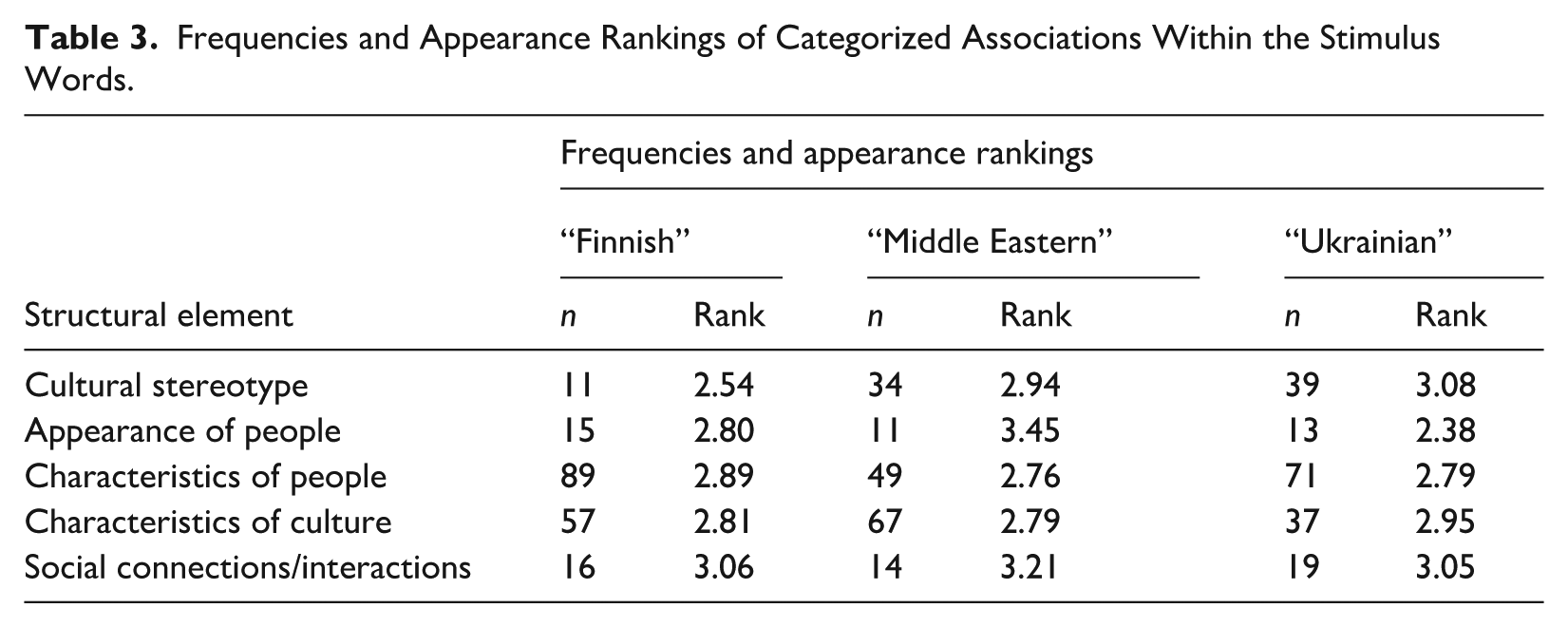
First, we present the frequencies and appearance rankings of the five structural elements (i.e., main categories) presented above. Then, we elaborate on and discuss the structural composition of the social representations of “Finnish,” “Middle Eastern,” and “Ukrainian.” Table 3 shows the frequencies and appearance rankings of all structural elements (main content categories).
Frequencies and Appearance Rankings of Categorized Associations Within the Stimulus Words.
Cut-off points of the structural elements and their structural composition within the zones of social representations for all stimulus words are presented in Figure 2.
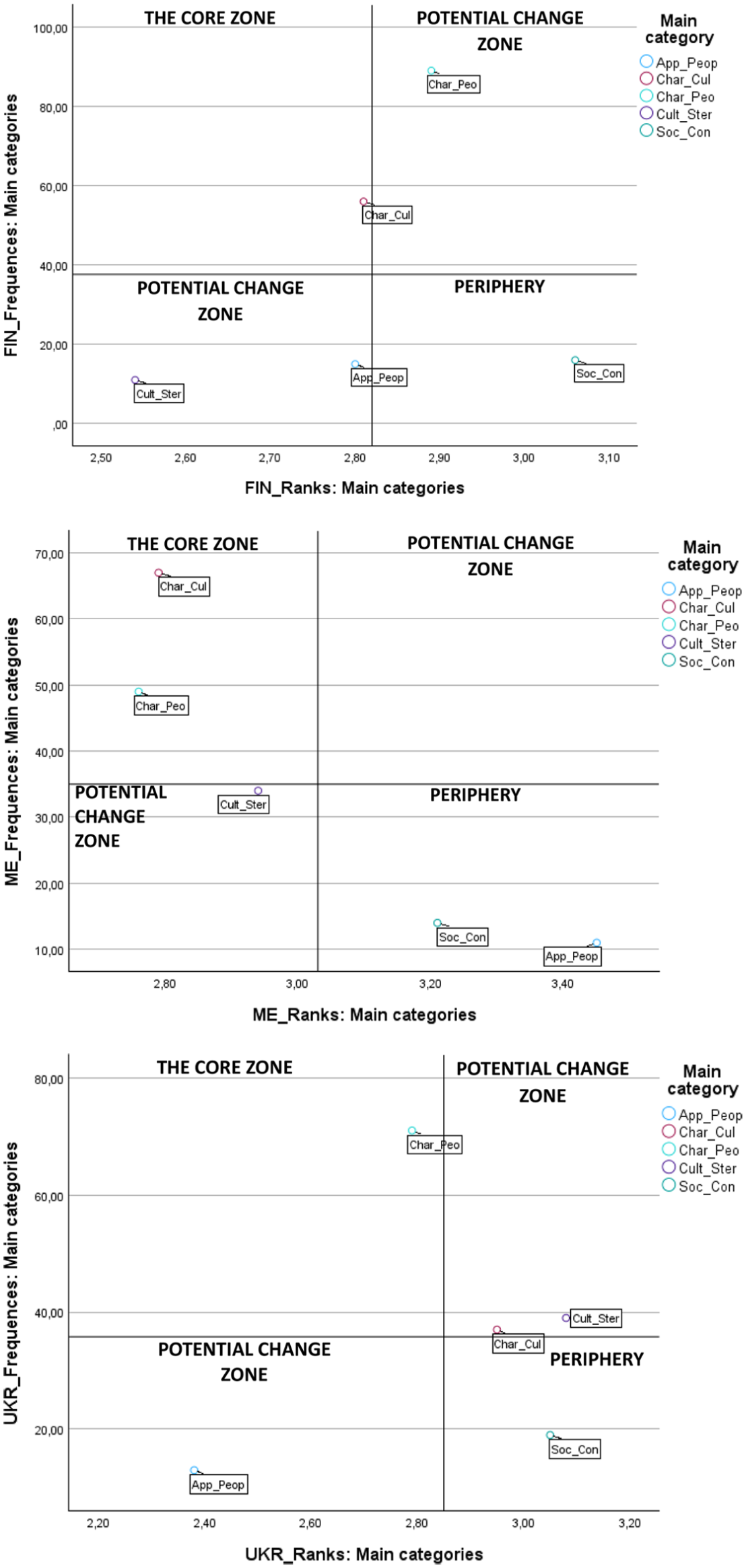
Structural composition of social representations of “Finnish” (FIN), “Middle Eastern” (ME), and “Ukrainian” (UKR).
Analysis of both frequencies and appearance rankings reveals that in the social representation of “Finnish,” the core zone is formed by the main category of cultural characteristics. In contrast, the potential change zones include the main categories of cultural stereotypes, appearance of people, and characteristics of people, while the main category of social connections/interactions is located in the periphery. For “Middle Eastern,” the structure of the social representation is quite different. The core zone consists of the main categories of characteristics of people and characteristics of culture, the potential contact zone includes the main category of cultural stereotypes, and the periphery includes the main categories of social connections/interactions and appearance of people. For “Ukrainian,” the core zone is based on the main category of characteristics of people; the potential change zones include the main categories of appearance of people, characteristics of culture, and cultural stereotypes; and the periphery consists of the main category of social connections/interactions.
In the social representations of “Finnish” and “Ukrainian,” the potential change zone main categories were emphasized, with three structural elements positioned in the potential change zones for both groups. This finding suggests that perceptions of Finnish and Ukrainian adolescents are not stable but are in the process of change. The core zone of these social representations is occupied by only one main category. In contrast, the structure of the social representation of “Middle Eastern” seems to be more stable, with two main categories forming the core zone and the periphery and only one situated in the potential change zone. Because only one main category is included in the potential change zone, it appears that both Finnish and Ukrainian participants have quite established perceptions of Middle Eastern people.
In the social representations of “Finnish” and “Ukrainian,” the dynamics among the three different groups of participants appear different on the basis of the four-zone structural differentiation. Middle Eastern adolescents may have more established perceptions on Finns, as they had lived in Finland for a longer period. Ukrainians, on the other hand, are more recent arrivals, and their perceptions of Finnish people are still forming. Additionally, social representations of Ukrainian people among both Finnish and Middle Eastern adolescents are in the process of taking shape, as the war in Ukraine has brought this group of people more actively into their awareness and enabled personal contact with Ukrainians who moved to Finland. The changing social context and the resulting changes at societal, interpersonal, and intergroup levels seem to dynamize the social representations and their structure.
In sum, the structural analysis revealed that social representations regarding “Finnish” and “Ukrainian” are undergoing vivid reconstruction, as three out of five main categories are situated in the potential change zone, a zone particularly connected to potential changes in social representation. Social representations of “Middle Eastern” appear more static, even though one main category is also situated in the potential change zone. In the social representations of all groups, the main category of cultural stereotypes is located in the potential change zone. This finding resonates with the results from the content analysis of word associations, suggesting that stereotypes and the meta-representations stemming from them are being negotiated and challenged.
Discussion
This article has explored the contents and structure of social representations among Finnish, Middle Eastern, and Ukrainian adolescents regarding the same three groups of people. Based on word associations related to all three groups of people, we produced five main categories through content analysis: (1) cultural stereotypes, (2) people’s appearance, (3) people’s characteristics, (4) cultural characteristics, and (5) social connections/interactions. Participating adolescents were asked to evaluate their word associations as positive, negative, or neutral. More than half of the associations for every stimulus word were positive, except for the stimulus word “Middle Eastern,” which participants with a Ukrainian background perceived less positively (46.7%).
Analysis of the contents and evaluations of the word association indicated patterns where negative or undesired meta-representations stemming from stereotypes were renegotiated and challenged, also reflecting intergroup dynamics. For instance, we interpreted Middle Eastern adolescents’ word associations for their own cultural group, such as without harm, wrongly understood community, and misunderstood, as reflections of the meta-representation (Elcheroth et al., 2011) stemming from stereotypical media discourse of Middle Eastern refugees as a threat to European wellbeing (Martikainen & Sakki, 2023). Finnish participants’ word associations for “Middle Eastern,” such as citizen of Finland, compassion, and human, in turn, also seemed to express awareness of the stereotypical conceptions and discrimination people from the Middle East experience in Finland (Castaneda, 2024) and exhibited an empathetic stance to this group of people. For the stimulus word “Ukrainian,” the cultural stereotype of war victims (e.g., Martikainen & Sakki, 2023; Mayaleh et al., 2025) emerged, constructed by associations such as affected by war, conflict affected, death, escape, and war. Both the absence of words referring to war victims in Ukrainian participants’ word associations and the simultaneous presence of words referring to competence (such as clever, positive, and strong) may reflect awareness of the meta-representations (Elcheroth et al., 2011) stemming from stereotypical conceptions as well as a desire to construct a more positive group distinctiveness for the ingroup (Tajfel, 1982).
The five main categories served as the structural elements for examining the structure of social representations. Based on composition of frequency and appearance rank, we grouped similar elements into one of the structural zones. Ultimately, these structural zones collectively constructed a structure of social representation. Using the four-zone model by Dany et al. (2014) comprising the core zone, two zones of potential change, and the periphery, our analysis showed that in the social representations of “Finnish” and “Ukrainian,” three main categories were situated in the potential change zone, suggesting dynamism and transformation. In contrast, the social representation of “Middle Eastern” appeared more stable, with one main category in the potential change zone and two main categories each in the core zone and periphery. We identified commonalities in the structure of all three groups’ social representations. Firstly, the core included the main categories of characteristics of culture and/or characteristics of people, while the periphery included the main category of social connections/interactions. Secondly, the main category of cultural stereotypes was identified as a potential change element in all three social representations. Based on its structural position, cultural stereotypes appear to be a dynamic element indicating change (Dany et al., 2014; Vergès, 2005).
The nature of everyday knowledge, as represented by the main categories in the core zone and in the potential change zone, differed. Characteristics of people and culture appeared to represent more experience-based knowledge, such as personality traits, which could be seen as constructed based on participants’ experience of cross-cultural interaction in their everyday lives. In contrast, cultural stereotypes in the potential change zone represented more prototype or generalization-based information about the group. Stereotypical associations between different cultural groups—particularly between Finns and immigrant groups—can be easily prompted, as stereotypical content is present in everyday discourse in Finnish society. This is especially true regarding immigrant groups from Middle Eastern and African countries because such content is often reinforced through media and political rhetoric that promotes populist narratives of Finnish cultural superiority (Martikainen & Sakki, 2023; Pettersson & Sakki, 2020). In our interpretation, the word associations both sustained and challenged these stereotypes, particularly those directed at Middle Eastern populations. This pattern was observed across all participant groups: Middle Eastern participants primarily challenged these stereotypes, while the other groups tended to sustain them, Finns slightly more so than Ukrainians.
Overall, Finnish participants tended to produce more associations related to cultural stereotypes about other groups than about their own, whereas Middle Eastern and Ukrainian participants more often described characteristics of people belonging to the majority group. Cultural stereotypes can be dehumanizing, as they reduce individuals to generalized traits. In contrast, references to personal characteristics are inherently more humanizing—particularly when they convey appreciation or respect—as they acknowledge individual uniqueness (Rodríguez-Pérez et al., 2021). From this perspective, Finns produced slightly more dehumanizing associations about minority groups, while minority groups produced more humanizing associations about Finns. However, it is important to note that these cultural stereotypes toward immigrant groups were not predominantly negative (i.e., expressing negative attitudes or prejudices), nor were the characteristics attributed to the majority group exclusively positive (i.e., complimentary in nature).
The relationship between characteristics of people and/or culture in the core zone and cultural stereotypes in the potential change zone is also interesting, particularly in terms of the words Middle Eastern and Ukrainian participants associated with Finnish people. Ukrainian participants characterized Finnish people as shy, different world understanding, and other language, while Middle Eastern participants used words such as cold, isolated, not open, and reserved to portray Finns. When combining this tendency of Finns toward social reticence suggested by Middle Eastern and Ukrainian participants with the partially stereotypical perceptions held by Finnish participants about people from the Middle East and Ukraine, the resulting interplay of host and immigrant group perspectives may pose challenges to communication in intergroup interactions.
Some participants mentioned school in their word associations, and these mentions were placed in the main category of social connections/interactions in the content analysis. The structural analysis revealed that this main category was placed in the periphery, indicating its less significant role in social representations. Previous studies have provided evidence that classroom diversity plays a crucial role in promoting positive interethnic relations and friendships (Bohman & Miklikowska, 2020; Stark et al., 2015). In Finland, the context of this study, inclusiveness in terms of classroom ethnic diversity is appreciated (Rissanen, 2019) provided pupils have sufficient language skills, as teaching is mainly in Finnish or Swedish. However, pupils with insufficient Finnish language proficiency mostly attend instruction in separate classrooms, which prepares them for basic education (Sinkkonen & Kyttälä, 2014). Although learning the language is crucial for social inclusion, this “segregating” educational arrangement may also complicate interactions with peers coming from different cultural backgrounds. In fact, Kivijärvi’s (2013) study conducted among ethnic minority youth found that strong interethnic ties among youth in Finland are quite rare. Although we cannot make any interpretations about the role of the school based on our data, it is crucial to be aware that institutional arrangements and practices may also contribute to the nature of adolescents’ social representations regarding different cultural groups.
Implications
Despite municipal efforts to promote residential integration and reduce segregation, certain neighborhoods remain predominantly inhabited by immigrant populations. As a results, Middle Eastern and Ukrainian participants in our study were likely to encounter other minority immigrant groups more frequently than their Finnish counterparts. In educational settings, immigrant students in Finland are often placed in separate classes due to language proficiency considerations. While this approach may be practical, it inadvertently fosters increased interaction among immigrant students and reduced engagement with native peers. Such separation can contribute to the formation of minority identities and asymmetrical intergroup relations, as limited everyday contact between immigrant and native populations may lead to the development of stereotypes rooted in insufficient cultural understanding (Fiske & Neuberg, 1990). Notably, most Ukrainian and Middle Eastern participants had no prior personal contact with each other before the study, underscoring that physical proximity alone does not ensure intercultural interaction or integration.
Inclusive educational policies are therefore essential. Integrating immigrant students with host-country peers, despite initial academic challenges, can facilitate daily interaction within a supportive environment where teachers play a key role in guiding intercultural encounters. Practical strategies developed by educational professionals are crucial for creating inclusive learning environments that also support teachers in managing the complexities of intercultural education. Research that illuminates how different cultural groups perceive one another is vital. Our findings suggest that young people rarely engage with individuals from different cultural backgrounds, resulting in limited knowledge and hesitancy to initiate contact. Minority groups often perceive Finns as reserved and difficult to approach. These findings support the integration of shared classrooms to promote intercultural learning.
In the current socio-political climate, marked by the rising popularity of populist parties, it is increasingly important for young people to have real-life encounters with cultural diversity. Rebelo et al. (2025) argued that populist movements frequently portray minorities as threats, thereby legitimizing exclusionary policies and reinforcing harmful stereotypes that serve their political agendas. Some participants in our study viewed Middle Eastern people as threatening, exemplifying this dynamic. Expanding opportunities or intercultural interaction among youth can help foster independent, evidence-based perspectives and counteract populist narratives. Understanding and addressing the challenges of intercultural encounters requires critical attention to the lay perceptions that shape how cultural groups perceive one another, as they profoundly influence attitudes, behaviors, and the potential for meaningful relations.
Limitations and Future Directions
One limitation of the study relates to the participant groups and the stimulus words. When studying social representations of groups among specific groups of people, identifying group boundaries is challenging (Lo Monaco et al., 2016). Potter and Litton (1985) noted that individuals may not identify with the group researchers categorize them into. In our study, the stimulus word “Middle Eastern” and the group of participants categorized as Middle Easterners are broader and more problematic than “Finnish” and “Ukrainian,” as “Middle Eastern” encompasses several cultural identities and countries. However, given the Finnish context of migration, where Middle Easterners and Ukrainians are among the major immigrant groups, and Middle Easterners are often categorized as one group in official documents, media, and everyday perceptions, we chose to use this concept. Similarly, “Finnish” and “Ukrainian” are not unambiguous either. The study design, asking participants to reflect on a group based on their ethnicity alone, may overlook intersectional diversity and promote stereotypical thinking. However, examining ethnicity and its functions is relevant given the current public discourse.
The application of the word association method and the structural approach presented some challenges. Both methods have been implemented with highly variable practices, making it difficult to find clear guidelines in previous research. Additionally, many studies have not transparently explained how associated words were clustered for structural analysis or how cut-off points were determined. These varying applications make comparing study findings challenging (see Lo Monaco et al., 2016). In this study, we carefully articulated our choices, the basis for combining content analysis with structural analysis, and the principles underlying our analysis. We hope these clarifications elucidate the logic of our research and analysis and assist future scholars interested in the word association method as part of social representations research.
Another limitation of our study relates to the word association method, specifically the qualitative analysis of associated words. Like prior scholars (e.g., Piermattéo et al., 2018; Sakki et al., 2014), we acknowledge that forming content categories based on word lists alone, without participants’ clarifying accounts, is challenging. However, we believe that reading word lists produced by a single participant for individual stimulus words in relation to each other, as well as reading word lists produced by different participants in relation to each other, helps create an interpretative environment that makes content analysis possible. Nevertheless, we are aware that the interpretation may not always be strictly loyal to participants’ intentions. Therefore, we have tried to be moderate in our interpretations, justify them based on prior research, and construct a close link between content analysis and structural analysis to examine potential dynamics in social representations, the main focus of our study.
Finally, we examined the structure of social representations not just based on individual associated words but on main content categories constructed via qualitative content analysis. This approach organizes and systematizes word association data, enabling comparison between different social representations. As Lo Monaco et al. (2016) highlighted, the grouping of associations based on semantic proximity is often performed in various ways but typically not described in detail within articles. This omission leaves readers uncertain about the procedures involved in this critical phase of grouping, which precedes the structural construction. Therefore, we utilized qualitative content analysis for this critical phase. We are aware that our method reduces semantic plurality, common in most grouping methods, but it offers a systematic examination of the contents of associations, helping to identify patterns within and between social representations. Furthermore, it enables comparisons across different social representations, helping to identify similarities and differences in their structures. Despite the limitations, we believe that combining the word association test with the analysis of the content and structure of social representations offers a valuable method for studying the dynamics of social representations. This approach, when used in a longitudinal study design, enables a more concrete examination of changes in social representations. Additionally, when studying the social representations of groups, integrating social representations and social identity approaches provides a more comprehensive analysis of intergroup dynamics.
Footnotes
Acknowledgements
We wish to thank Mari Puttonen, Helena Rovamo, and Tapani Utunen for their valuable contribution to the data collection.

Ethical Considerations
The research was reviewed and approved by The Research Ethics Committee of the University of Eastern Finland (statement date: 12/2023).
Consent to Participate
Written informed consent to participate in this study was provided by the participants or their legal guardian.
Author Contributions
Katja Lötjönen: Conceptualization; formal analysis; investigation; methodology; visualization; writing—original draft; writing—review & editing. Jari Martikainen: Conceptualization; formal analysis; funding acquisition; investigation; project administration; supervision; writing—review & editing. Hadi Farahani: Investigating; writing—review & editing.
Funding
The authors disclosed receipt of the following financial support for the research, authorship, and/or publication of this article: The research has been funded by Koneen Säätiö (202208017).
Declaration of Conflicting Interests
The authors declared no potential conflicts of interest with respect to the research, authorship, and/or publication of this article.
Data Availability Statement
The data are not publicly available.