






Abstract
Stress-induced changes imparted in a ‘dentin-bonded-crown’ material during sintering, annealing, pre-cementation surface modification, and resin coating have been visualized by profilometry. The hypothesis tested was that operative techniques modify the stressing pattern throughout the material thickness. We polished the upper surfaces of 10 ceramic discs to remove surface imperfections before using a contact profilometer (40-nm resolution) to measure the ‘flatness’. Discs were re-profiled after annealing and after alumina particle air-abrasion and resin-coating of the ‘fit’ surface. Polished surfaces were convex, with a mean deflection of 8.4 ± 1.5 μm. Mean deflection was significantly reduced (P = 0.029) following alumina particle air-abrasion and increased (P < 0.001) on resin-coating. Polishing induced a tensile stress state, resulting in surface convexity. Alumina particle air-abrasion reduced the relative tensile stress state of the contralateral polished surface. Resin-polymerization generated compression within the resin-ceramic ‘hybrid layer’ and tension in the polished surface and is likely to contribute to the strengthening of ceramics by resin-based cements.
INTRODUCTION
Adhesive cementation of feldspathic ceramic (Addison et al., 2008) and glass-ceramic (Pagniano et al., 2005) dental restorations increases ceramic flexural strength and can enhance resistance to fracture in service (Malament and Socransky, 1999). As a consequence, the ‘dentin-bonded-crown’ technique has been developed and involves the use of aesthetic ceramic substrates to which a reliable ceramic-resin bond can be achieved (Burke and Watts, 1994). The clinical success of the dentin-bonded crown is attributed to a synergism achieved between the ceramic and tooth substrate, mediated through the resin-based cement (McLean, 1988). To provide clinical guidance and to optimize the ceramic reinforcement by the resin-based cement, investigators have studied the underlying strengthening mechanisms (Fleming et al., 2006; Addison et al., 2007a, 2008). The traditionally proposed theories—ceramic crack healing by the resin-based cement (Marquis, 1992) or the induction of crack-closure stresses secondary to polymerization shrinkage (Nathanson, 1994)—have been tested and have not fully explained the observed behavior (Addison et al., 2007a). Most recently, ceramic reinforcement following resin-cementation has been demonstrated to be insensitive to the critical surface defect size (Fleming et al., 2006), but sensitive to macroscopic surface roughness and resin-cement elasticity (Addison et al., 2007a). As a consequence, strengthening has been attributed to a resin-ceramic ‘hybrid layer’ of cement-infiltrated defects, and under loading, stressing of the system becomes sensitive to the characteristics of the ‘hybrid layer’ (Addison et al., 2008).
The concept of a ‘hybrid layer’ conveniently and simplistically relates the patterns of observations of the resin-cemented ceramic substrates under an applied flexural stress. However, it is conceivable that the creation of a ‘hybrid layer’ may also affect the global residual stress state across the ceramic. The strength of dental ceramic restorations is not dependent solely on the ceramic composition, microstructure, surface, and bulk defect populations, but also on the nature of the residual stress fields induced during processing or post-fabrication surface modification. The manufacturing procedures for dentin-bonded-crown restorations introduce stresses that can affect longevity when placed clinically. Stresses can be introduced during sintering (McLean and Hughes, 1965), pressing (Denry and Holloway, 2004b), machining (Denry et al., 1999), post-processing annealing heat treatments (Denry and Holloway, 2004a), or following pre-cementation surface modifications (Addison et al., 2007b).
Destructive testing methodologies have been used as a performance indicator for assessing the strengthening of dentin-bonded-crown materials; however, the ‘true’ stress state within the ceramic body is often masked in the bi-axial flexure strength (BFS) results. Large sample groups (n = 60) enhance dissemination of the strengthening information (Addison et al., 2007a). However, when global stressing patterns are modified, testing methodologies that concentrate the maximum applied stress to a small volume may obscure the true effect. Using a well-characterized dental ceramic suitable for the manufacture of dentin-bonded crowns, the authors have previously demonstrated, using BFS testing, that annealing, pre-cementation surface modification, and adhesive cementation influence ceramic strength, but the observations were related to characteristics of the surface defect population (Addison et al., 2007a, 2008).
The authors modified a simplistic profilometer deflection test that was previously used to visualize stress-induced deformation of resin-based composites (Feilzer et al., 1990) and dental ceramics (Isgró et al., 2005). The improved methodology utilizes high-resolution profilometry for visualization of stress-induced changes in surface convexity imparted by pre- cementation and cementation operative techniques. The hypothesis tested was that pre-cementation and cementation operative techniques can induce a significant modification of the stressing patterns throughout the thickness of a dentin-bonded-crown material.
MATERIALS & METHODS
An optimum (Fleming et al., 2000) powder/liquid at slurry consistency [0.6 g of Vitadur Alpha dentin porcelain powder and 0.16 mL Vita Modeling Fluid (Lots 7411 and 14209R, respectively)] was condensed under ultrasonic vibration (CeramoSonicTA II, Shofu, Kyoto, Japan) into a perspex mould. Disc-shaped specimens were fired, according to the manufacturers’ recommendations, in a vacuum furnace (Vita Vacumat 40, Vita Zahnfabrik, Bad Säckingen, Germany), then air-cooled and stored in a desiccator.
One surface of each disc (13 ± 0.01 mm diameter) was wet-polished at 100 rpm and a load of 7 N for standard intervals with increasing grades (P340, 600, 800, 1200, and 2500) of silicon carbide abrasive papers on an Alpha and Beta Grinder-Polisher (Buehler, Lake Bluff, IL, USA) to a final thickness (measured with a Digimatic Micrometer; Mitutoyo Corp., Tokyo, Japan) of 0.58 ± 0.03 mm. We used a contact diamond stylus profilometer (Talysurf CLI 2000, Taylor-Hobson Precision, Leicester, UK) with a 90° conisphere stylus tip of 2 μm radius to perform measurement traces across a 10-mm2 area (10 mm length and 1 mm width) coincident with the center of the polished specimen surface. We made 251 traces with a 4-μm step-size (y-direction) at a stylus velocity of 1 mm/sec, recording datapoints every 10 μm (x-direction), with a 40-nm resolution (z-direction). Each disc (n = 10) was labeled, and the chosen area was marked to ensure consistency of the subsequent repeat measurements.
Following profilometric evaluation, the discs were annealed at 610°C—above the transformation temperature (603°C), but below the softening point (695°C) of the material (Denry et al., 1999; Isgró et al., 2005). Discs were placed with the polished surface in contact with the silicon nitride refractory tray and heated from 200 to 610°C in air at 20°C/min, then held at 610°C for 40 min before being cooled to 60°C at 2.9°C/min. The discs were aligned, and the polished (upper) surfaces were profiled for quantification of maximum deflection.
The ‘as-fired’ (lower) surfaces of the discs were alumina particle air-abraded with 50-μm particles delivered in an air stream perpendicular to the specimen surface at a pressure of 2 bar from a 10-mm distance for 10 sec, by means of an ECO Dry Oxide System (Dentalfarm, Torino, Italy), and the thickness was determined. The polished (upper) surfaces of the discs were then profiled for quantification of the mean deflection. A 0.035-g quantity of Rely-XTM Veneer Cement (Lot No. 6CW, shade A3, 3M ESPE, St. Paul, MN, USA) was applied to the alumina particle air-abraded surfaces of the discs and covered with Mylar. A glass slide was gently pressed onto the disc until the resin spread to the edges. The resin was light-irradiated (Optilux 501, SDS Kerr, Danbury, CT, USA) for 20 sec at 740 mW cm−2, with a 13-mm tip-diameter from a distance of 0 mm. The polished (upper) surfaces of the discs were profiled for quantification of the mean deflection immediately after being coated with cement (0 hr) and following 24, 48, and 168 hrs of dry storage.
Statistical Analysis
The mean deflection of the polished (upper) surface was compared with deflection measurements following annealing and annealing/alumina particle air-abrasion, by a one-way analysis of variance (ANOVA) and post hoc Tukey tests (P < 0.05). A univariate general linear model (P < 0.05) examined the impact of cement coating and time on the mean deflection of the annealed alumina particle air-abraded specimens (SPSS version 16, Chicago, IL, USA).
RESULTS
Following fabrication and polishing of the discs, the polished (upper) surfaces were determined by profilometry to be convex, with an associated mean deflection of 8.4 ± 1.5 μm (Fig. 1, Table). Annealing of the polished specimens resulted in no significant (P = 0.73) alteration of the mean deflection (Fig. 2, Table). However, following annealing and alumina particle air-abrasion, the mean deflection was significantly reduced to 5.6 ± 2.6 μm (P = 0.029), with no significant reduction in specimen thickness (Fig. 2). A univariate general linear model (where the factors identified were no cement against cement coating and increasing time) demonstrated a significant impact of resin-cement coating on the increase in mean deflection (P < 0.001). In contrast, increasing time following resin-cement coating was determined to have no significant impact on mean deflection for the time-scale investigated.
DISCUSSION
The processing routes routinely utilized in the manufacture of dental ceramic restorations result in the introduction of residual stress states across the thickness of the ceramic restoration (McLean and Hughes, 1965). Residual stresses can be thermally induced following cooling from the ceramic sintering or pressing temperature, or can be induced by machining as a consequence of the heating and/or plastic deformation of the ceramic surface during form-grinding (Rekow and Thompson, 2005). Following fabrication, the residual stress state may be modified by pre-cementation treatments (Addison et al., 2007b) or by cementation (Rosenstiel et al., 1993). We adopted an improved version of a profilometric deflection test (Feilzer et al., 1990; Isgró et al., 2005) to visualize the impact of clinically relevant residual stress states and applied stresses on the surface geometry of nominally identical sintered ceramic discs. Rather than relying on a single profilometric trace, as previously described (Feilzer et al., 1990; Isgró et al., 2005), we characterized the three-dimensional ‘flatness’ and subsequent deviations from the baseline ‘flatness’ of a highly polished surface of ceramic discs, manufactured to a high geometric tolerance, containing defects of an amplitude of < 4 μm (Fleming et al., 2006).
The baseline profilometric evaluation of the ceramic discs following sintering and subsequent polishing of the upper surface revealed a convex profile with a mean deflection of 8.4 ± 1.5 μm. The observed deviation from an expected ‘flatness’ suggests that the upper surface of the ceramic disc was in a tensile stress state relative to the lower ‘fit’ surface. The glass-ceramic material used in the study will exhibit viscoelastic behavior both on cooling from the processing temperature and from the transformation range during annealing. As a result, residual stress states are set in the ceramic body, with the pattern of stressing sensitive to the cooling rate. However, in this study, during cooling, the ‘fit’ surface of the ceramic came into contact with the silicon nitride refractory tray and cooled at an equivalent or slower rate compared with that of the upper surface. As a result, a compressive stress state would be expected to be induced in the upper surface relative to the ‘fit’ surface. Previously, the authors have demonstrated, using BFS testing on the same ceramic substrate, that the polishing regime used results in a strength reduction (75.4 ± 1.8 MPa) when compared with the ‘as-fired’ condition (94.4 ± 9.9 MPa) (Addison et al., 2008). The BFS reduction could not be fully accounted for by Griffith’s theorem (Griffith, 1921) relating the strength to the size of the critical surface defect, since polishing was demonstrated to decrease surface flaw amplitude significantly (Fleming et al., 2006). It is proposed that the polishing process induces a tensile stress state across the surface, which, in combination with the residual stress state set by cooling after ceramic processing, accounts for the observed surface convexity. Annealing above the transformation temperature and below the softening temperature would be expected to reduce the residual thermal stress state markedly across the specimen, in accordance with conventional wisdom (Denry et al., 1999). However, in the current investigation, the reduction in the mean deflection was not significant (P = 0.73), suggesting that the annealing regime used was not completely effective in the removal of the residual stress state.
Alumina particle air-abrasion of the ‘fit’ surface of the ceramic specimens resulted in a significantly decreased mean deflection and corresponding surface convexity when compared with those of the baseline polished (upper) ceramic surface. It has been suggested that the deviation from ‘flatness’ of the polished (upper) surface is maintained by the surface being in a relative tensile stress state compared with the ‘fit’ surface. Alumina particle air-abrasion of the ‘fit’ surface of dental ceramic restorations is commonly used to increase the surface area for bonding and the potential for macro-mechanical retention of the dental cement (Wolf et al., 1993). Alumina particle air-abrasion has previously been demonstrated to modify the ceramic surface defect population (Addison et al., 2007b) and cause surface and subsurface deformation (Zhang et al., 2004). As a result, stress relief secondary to crack growth or tensile stress induction at the ‘fit’ ceramic surface accounts for a concomitant reduction in the relative tensile stress state of the contralateral surface.
Resin-cement coating significantly increased the mean deflection of the polished (upper) surface when compared with the uncoated alumina particle air-abraded specimens. The polymerization of methacrylate-based cements is associated with volumetric shrinkage (Rosenstiel et al., 1993). Polymerization results in shrinkage stress, and the magnitude is determined by the degree and rate of shrinkage, the elastic modulus, and the constraint of the polymerizing cement bulk (Ferracane, 2008). In the current investigation, the majority of the polymerizing cement was unconstrained, and therefore it is unlikely that significant stresses were generated. However, on cement coating of the ceramic discs, the surface is infiltrated by the resin-based cement, and during polymerization, shrinkage is constrained within the ‘hybrid’ layer (Addison et al., 2007a), resulting in a compressive stress state. Consequently, reciprocal tensile stressing of the polished (upper) ceramic surface occurs, thereby increasing convexity. These observations demonstrate, for the first time, the validity of the theory (Rosenstiel et al., 1993) relating the polymerization shrinkage of resin-based cements to a beneficial compressive stress state across the ceramic defect integral. However, it is unlikely that the induction of a compressive stress state by the resin-based cement accounts completely for the improved clinical performance of adhesively cemented dental ceramics or fully explains the strengthening mechanism. Previously, the investigators observed significant reinforcement of dental ceramic substrates following coating with thin (< 20 μm) films of unfilled methacrylate-based resins (Addison et al., 2007c), which generate minimum shrinkage stresses. The reported findings are not entirely consistent with Rosenstiel’s resin-strengthening mechanism (Rosenstiel et al., 1993) and imply that the magnitude of ceramic reinforcement is a function of multiple factors. Since no significant alteration of the mean deflection was observed in the repeated measurements following resin-cement coating over the 168-hour time-frame investigated, the stress state at the ‘fit’ ceramic surface remained unaltered, suggesting that no or little stress relaxation occurred. However, the samples were stored dry, and the observations are likely to be modified in water, due to hydroscopic expansion or matrix plasticization of the resin-based cement.
In conclusion, the hypothesis tested, that pre-cementation and cementation operative techniques can induce a significant modification of the stressing patterns throughout the thickness of a dentin-bonded-crown material, was confirmed with the novel deflection test methodology used. The deflection test proved to be a reliable method which enabled the stresses induced in dentin-bonded-crown materials to be visualized, and offers a further tool to ceramicists’ as a non-destructive test complementary to BFS testing.
The Mean of the Maximum Deflection Values (μm) and Associated Standard Deviations for the Vitadur Alpha Ceramic Discs (n = 10) Measured at (A) Baseline after Polishing, (B) after Annealing, (C) after Annealing and Alumina Particle Air-abrasion, and after Resin-Cement Coating at (D) 0 hr, (E) 24 hrs, (F) 48 hrs, and (G) 168 hrs
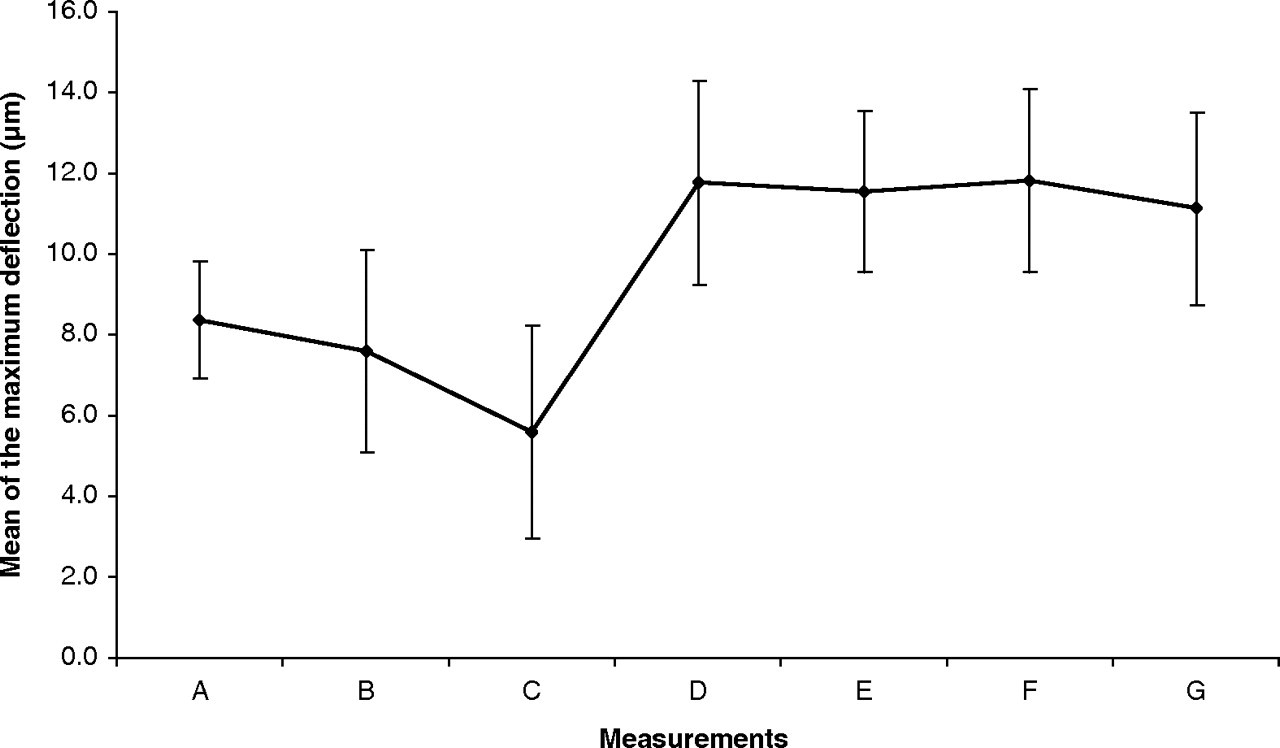
The mean of the maximum deflection values (μm) and associated standard deviations for the Vitadur Alpha ceramic discs (n = 10) measured at
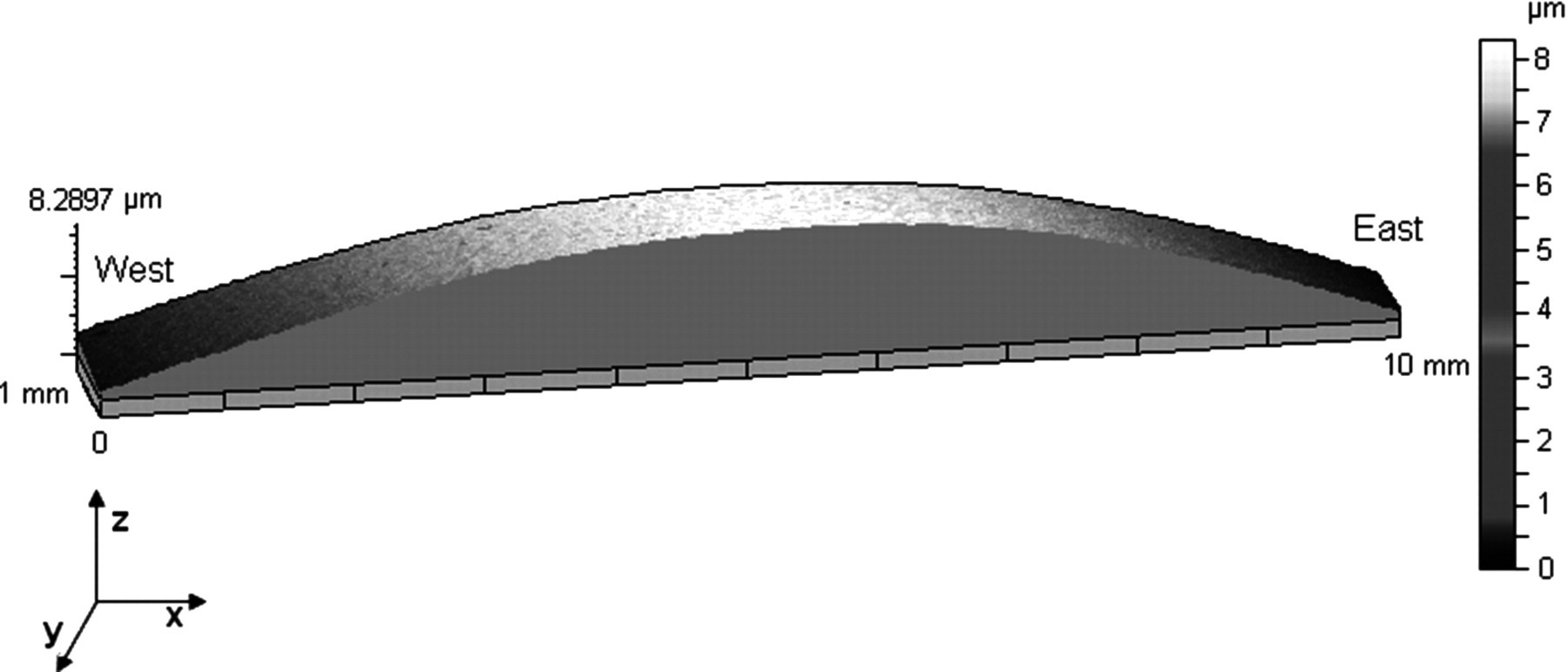
A three-dimensional profilometric representation of the 10-mm2 section, coincident with the center of the ceramic disc, composed of 251 traces with a 4-μm step-size (y-direction). The mean of the maximum deflection value for groups of 10 specimens was recorded.
Footnotes
Acknowledgements
This work was funded by and carried out at Dublin Dental School and Hospital.