







Abstract
Color information from different color-measuring systems varies during color matching in maxillofacial prosthetics. We studied the hypothesis that a non-contact measuring system and 4 contact color-measuring instruments perform comparably in accuracy and precision on measurements of pigmented maxillofacial elastomer specimens having human skin colors. Measurement comparisons in accuracy on opaque standard color patches were made in Phase I. In Phase II, the system with the best accuracy was used as the reference instrument, and comparisons in accuracy and precision on elastomer specimens were made. The CIEDE2000 color difference formula was used. Repeated-measures ANOVA with Tukey testing and linear regression analysis for CIELAB and color differences among the instruments were performed. The contact measuring systems perform differently in accuracy, possibly due to edge loss and other factors, but performed comparably in precision with the non-contact measuring instrument. This non-contact system is recommended for color measurement of maxillofacial prosthetic materials.
Keywords
Introduction
Increasing numbers of maxillofacial patients with cancer, trauma, or congenital diseases are requesting more comprehensive and high-quality prosthetic services. An aesthetic and comfortable maxillofacial prosthesis relieves many concerns of the patient and may improve quality of life (Wiens and Wiens, 2000). Color matching to human skin during maxillofacial prosthesis fabrication is often a significant challenge for professionals. Collecting accurate skin color information is an important step (Seelaus and Troppmann, 2000). Many techniques have been utilized in attempts to achieve an accurate skin appearance match. Compared with a chairside visual trial-and-error method (Ma et al., 1988; Seelaus and Troppmann, 2000) and facial skin shade guides (Over et al., 1998), instrumental colorimetric or photometric techniques have been noted to provide more consistent, reliable, and quantitative assessment of an object’s color under controlled conditions (Johnston and Kao, 1989; Paul et al., 2002).
Contact measuring instruments, including most colorimeters and spectrophotometers, have been commonly used in maxillofacial prosthetic measurement (Koran et al., 1981; Seelaus and Troppmann, 2000; Kiat-Amnuay et al., 2006). Edge loss has been found during contact measuring on translucent materials and was related to aperture size and beam size of the contact reflectance measurement system (Johnston et al., 1996). Non-contact color-measuring systems have the potential to provide more accurate color information of translucent objects by eliminating edge loss (Bolt et al., 1994). A spectroradiometer measuring system has been evaluated on aspects of accuracy and repeatability and was considered to be valid and reliable on the spectral reflectance measurements of craniofacial structures (Wee et al., 2006; Gozalo-Diaz et al., 2007). This system was also utilized on research of color matching in dentistry (Douglas et al., 2007; Paravina et al., 2007; Kim et al., 2008). More critical information is still needed regarding comparisons of measuring systems within skin color space for a measuring system to be established as a valid and reliable method for shade replication in craniofacial prosthetic rehabilitation.
For analysis of a measuring instrument, measurement uncertainty consisting of accuracy and precision must be evaluated. Accuracy may be assessed by comparing a test instrument with a reference instrument which is considered to be correct, and precision may be assessed by measuring repeatability or reproducibility (Berns, 2000; ASTM E284). Accuracy and precision of different color-measuring instruments on dental porcelain specimens were evaluated according to CIELAB color difference metrics (Seghi et al., 1989). Moreover, the CIEDE2000 color-difference (ΔE00) formula has recently been approved by CIE as a modification of the CIELAB formula and outperformed other color difference formulas (CIE Technical Report, 2001; Luo et al., 2001).
This study consisted of two phases. Phase I was to investigate the accuracy of measuring instruments with a series of opaque standard color patches. The practical hypothesis was that one system would be found to be superior in accuracy for use in Phase II. Phase II was to compare accuracy and precision performance of the measuring systems on translucent pigmented maxillofacial elastomer specimens having colors within human skin color space. The null hypotheses are that the tested color-measuring systems show no significant difference in accuracy compared to the established reference instrument, and that the tested measuring systems perform equally well in accuracy and precision on maxillofacial elastomer specimens.
Materials & Methods
Five measuring instruments were utilized, and each instrument was calibrated with its own calibration tile according to the manufacturer’s instructions prior to each measurement session. The non-contact measuring system consisted of a PR705 spectroradiometer (Photo Research Inc, Chatsworth, CA, USA) and fiber optic light cable (Model 70050; Newport Stratford Inc., Stratford, CT, USA) connected to a xenon arc lamp (300W; Newport Stratford Inc.). The spectroradiometer and the cable were positioned on an optical table (Mecom Inc., Rising Sun, OH, USA) to provide a 45°/0° configuration. For all measurements, light intensity was obtained from 380 to 780 nm with a 2-nm interval with Spectrawin software (v 2.0; Photo Research Inc.), and spectral reflectance values were calculated. The distance from the lens to the specimen surface was 80 mm, and the measuring diameter was 1 mm. We used the Perkin-Elmer Lambda 35 UV/Vis Spectrophotometer (LD35), with an integrating sphere, a diffuse reflectance spectrophotometer with a 0°/diffuse configuration and an 8-mm-diameter measuring aperture. The 2 tristimulus colorimeters used were the Minolta Chroma Meter CR200 with 8-mm-diameter aperture and a diffuse/0° geometry, and Minolta CR221 with 3-mm-diameter aperture that uses a 45° ring/0° geometry (Minolta Corp., Ramsey, NJ, USA). The ShadeEye NCC Chroma Meter (Shofu Dental Corp., San Marcos, CA, USA), a contact tristimulus colorimeter with a proprietary measuring geometry, was used in Analyze Mode.
A Mini ColorChecker® chart with 24 opaque color patches (GretagMacbeth, New Windsor, NY, USA) was obtained along with a reflectance spectrum for each color patch obtained by the manufacturer using a 45°/0° GretagMacbeth Spectrolino/Spectroscan Spectrophotometer. From the PR705 and the LD35 measurements and the provided ColorChecker reflectance spectra, CIELAB values for D65 illumination using the Standard CIE (2°) observer were obtained.
Twenty-four thick pigmented MFE specimens approximately 23 mm in diameter and differing in translucency were made with A-2000, a platinum silicone elastomer (Factor II Inc., Lakeside, AZ, USA) mixed with 5 pigments, i.e., tan, black, red, yellow (Functional Intrinsic Skin Color, Factor II Inc., Lakeside, AZ, USA) and titanium dioxide powder (J.T. Baker Co., Phillipsburg, NJ, USA). The surface of each specimen was formed to be approximately uniform matte, but these specimens varied in translucency, as described previously (Hu et al., 2009).
The color of each color patch or elastomer specimen was measured 3 times by each instrument studied. For these repeated measurements, the patch or specimen was re-positioned and then measured in an arbitrary order. The 3 measurement sessions by each instrument were conducted within about a two-hour period.
Color differences due to inaccuracy and imprecision of the instrumental measures were evaluated by a method previously described (Seghi et al., 1989), except that the CIEDE2000 color difference formula (ΔE00) was utilized (CIE Technical Report, 2001; Luo et al., 2001). For instrument accuracy, comparison of measurements obtained by the test instrument with corresponding ones obtained on the reference instrument were made in two ways: (1) Absolute accuracy (AccLab) was calculated by the average ΔE00 value calculated from the CIELAB values for each specimen obtained by the reference and each test instrument, and (2) relative accuracy (AccDE) was calculated as the average absolute difference between the 2 ΔE00 values of each possible pair of specimens (ΔE00_P) obtained by the reference and test instruments. For instrument precision, repeatability was applied, which was defined as the closeness of agreement for a defined measurement procedure. Repeatability measures for each instrument were also made in two ways: (1) Absolute repeatability (RepLab) was calculated as the average ΔE00 value between the CIELAB color coordinates on 1 specimen from each individual measurement and the average of the 3 individual measurements obtained by that instrument; and (2) relative repeatability (RepDE) was calculated as the average absolute difference between the 2 ΔE00_P from each individual measurement and the average of the individual measurements obtained by the test instrument.
In Phase I for measurements of the opaque color patches, the values of AccLab and AccDE were calculated based on the L*, a*, and b* values from the manufacturer-supplied reflectance spectra as the reference, and then an analysis of these accuracies identified the system to be used as the reference instrument for the Phase II measurements of translucent elastomer specimens.
Repeated-measures ANOVA with Tukey testing (SAS 9.1) (α = 0.05) was conducted for comparisons of AccLab and AccDE of all 5 instruments in Phase I and for comparisons of values for AccLab, AccDE, RepLab, and RepDE of the test instruments in Phase II.
The means of CIE L*, a*, and b* and ΔE00_P for the 5 instruments were also compared by repeated-measures ANOVA with subsequent Tukey testing. Linear regression analyses (SAS 9.1) (α = 0.05) were also performed in Phase II for the 4 parameters (CIE L*, a*, and b* and ΔE00_P) of each test instrument relative to the reference. The null hypotheses for these regression analyses were that the slope = 1 and intercept = zero for each test instrument.
Results
Mean and standard deviation (SD) of accuracy and repeatability of the measuring instruments tested on measurements of 24 opaque ColorChecker® Patches (Phase I) and maxillofacial specimens (Phase II) are provided in Table 1. In Phase I, the values of AccLab and AccDE for the PR705 system were significantly lower than those for the other 4 test instruments (p < 0.05). Accordingly, calculations of AccLab and AccDE, RepLab and RepDE presented in Phase II were based on the PR705 as the reference instrument. Results for the comparisons between each possible pair of the instruments tested are also presented (Table 1). The AccLab and AccDE means of all 4 test instruments relative to the reference PR705 were significantly different from zero (p < 0.05).
Mean (Standard Deviation) of Accuracy and Repeatability of the Measuring Instruments Tested on Measurements of ColorChecker® Opaque Patches (Phase I) and Maxillofacial Elastomer Specimens (Phase II)
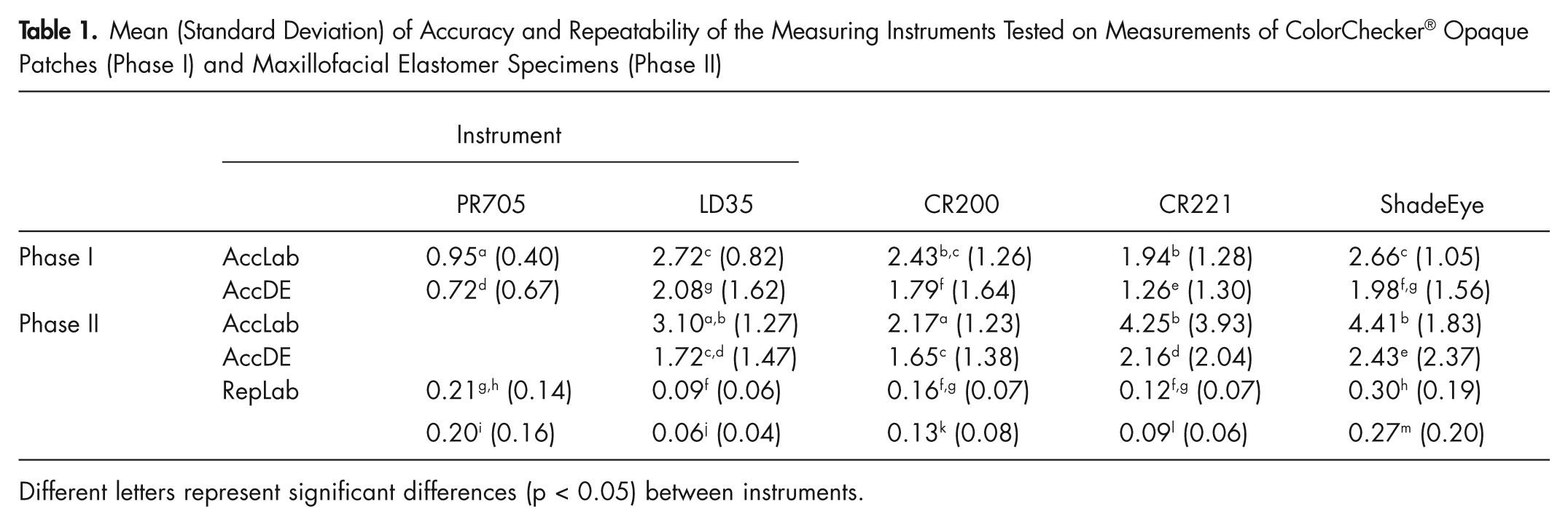
Different letters represent significant differences (p < 0.05) between instruments.
The CIELAB values of 24 pigmented MFE specimens obtained by all 5 instruments and the calculated ΔE00 values of 276 possible pairs are summarized (Table 2).
Summary of CIELAB Values of the Maxillofacial Elastomer Specimens Measured and ΔE00 Values of Each Possible Pair for All Five Instruments
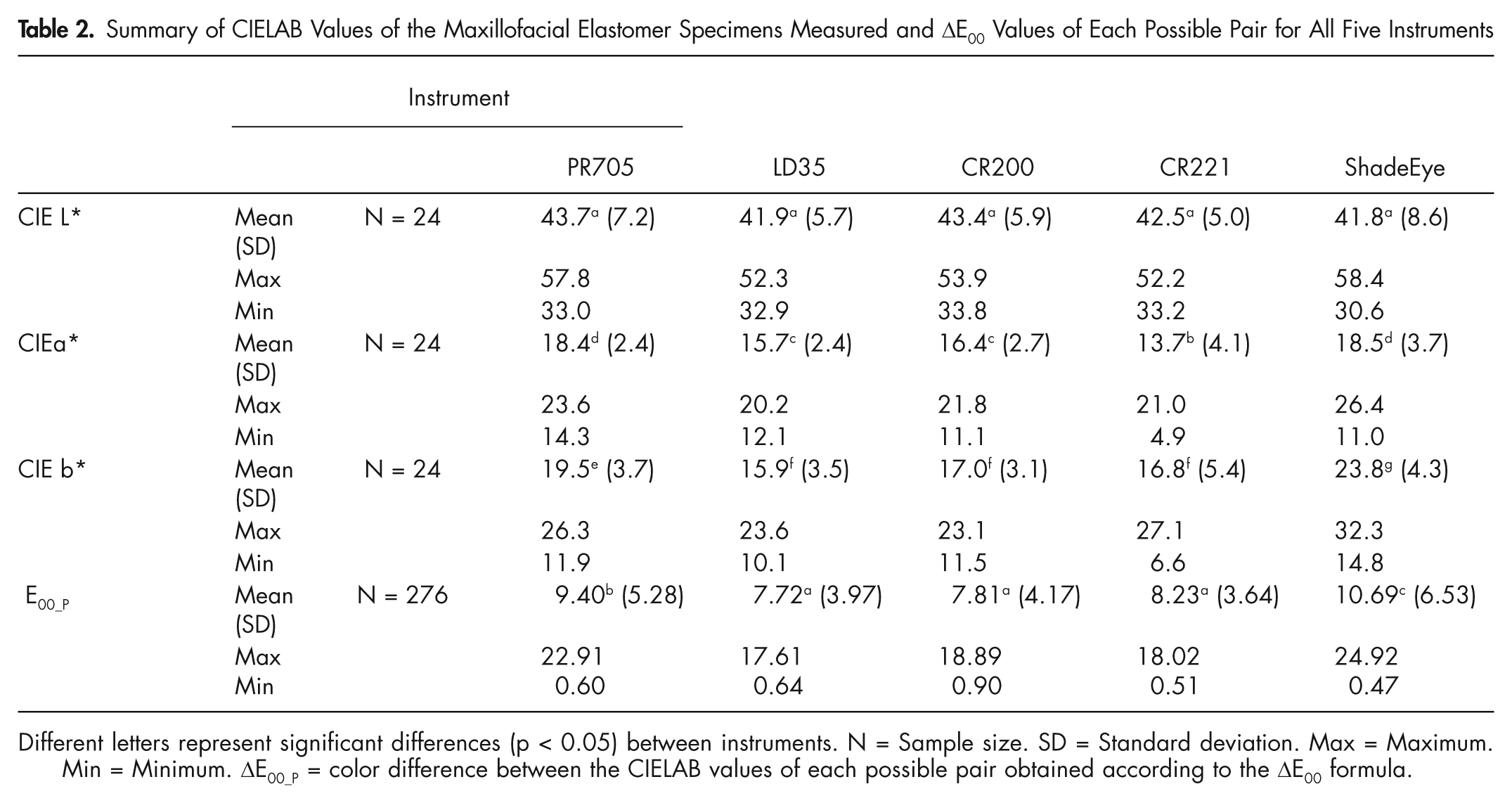
Different letters represent significant differences (p < 0.05) between instruments. N = Sample size. SD = Standard deviation. Max = Maximum. Min = Minimum. ΔE00_P = color difference between the CIELAB values of each possible pair obtained according to the ΔE00 formula.
Linear regression analysis results between each test instrument and the reference PR705 include estimates of the correlation coefficient (r), slope, and intercept for the 3 CIELAB values of elastomer specimens and calculated ΔE00_P values. These results are provided for CIE a* (Fig. 1), which are similar to the regressions for CIE b*, and for ΔE00_P (Fig. 2), which is somewhat similar to the regressions for CIE L*. The correlation coefficients for the CIELAB values and ΔE00_P on LD35 and CR200 are greater than 0.92 except for r = 0.85 for CIE a* for CR200. The correlation coefficients of CIE L* and ΔE00_P on CR221 and ShadeEye are close to 0.90, whereas the correlation coefficient of CIE a* on ShadeEye is 0.67. The estimates of slope and intercept of both CIE L* and ΔE00_P on LD35, CR200, and CR221 are significantly different from 1 and 0, respectively (p < 0.05), but those of CIE a* and b* are not statistically significant.
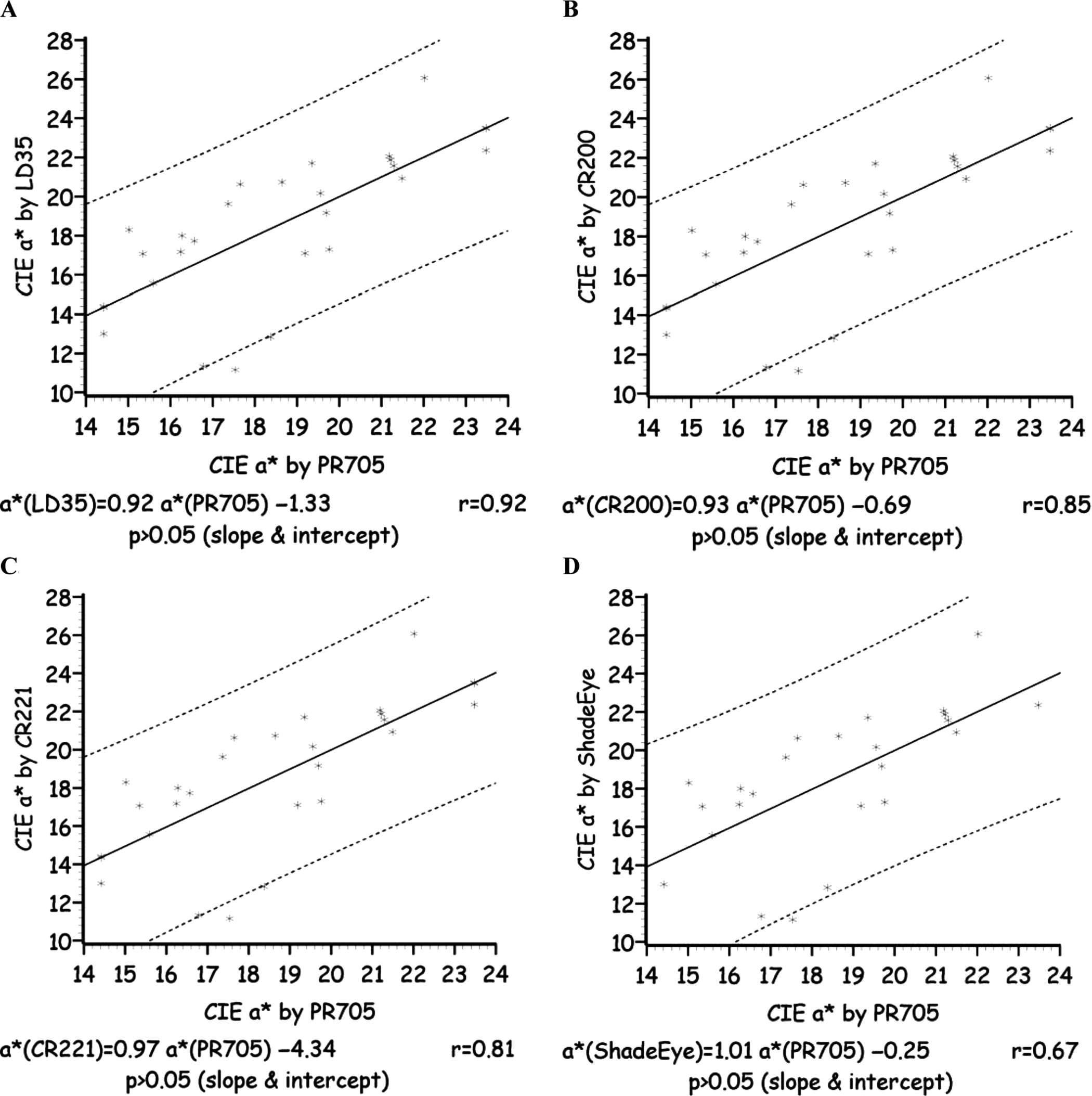
Regression results for 24 CIE a* values of the elastomer specimens between each test and the reference instrument PR705. The solid line presents the regression line, and the dotted lines represent the 95% confidence limits for an individual measurement. The test instruments are
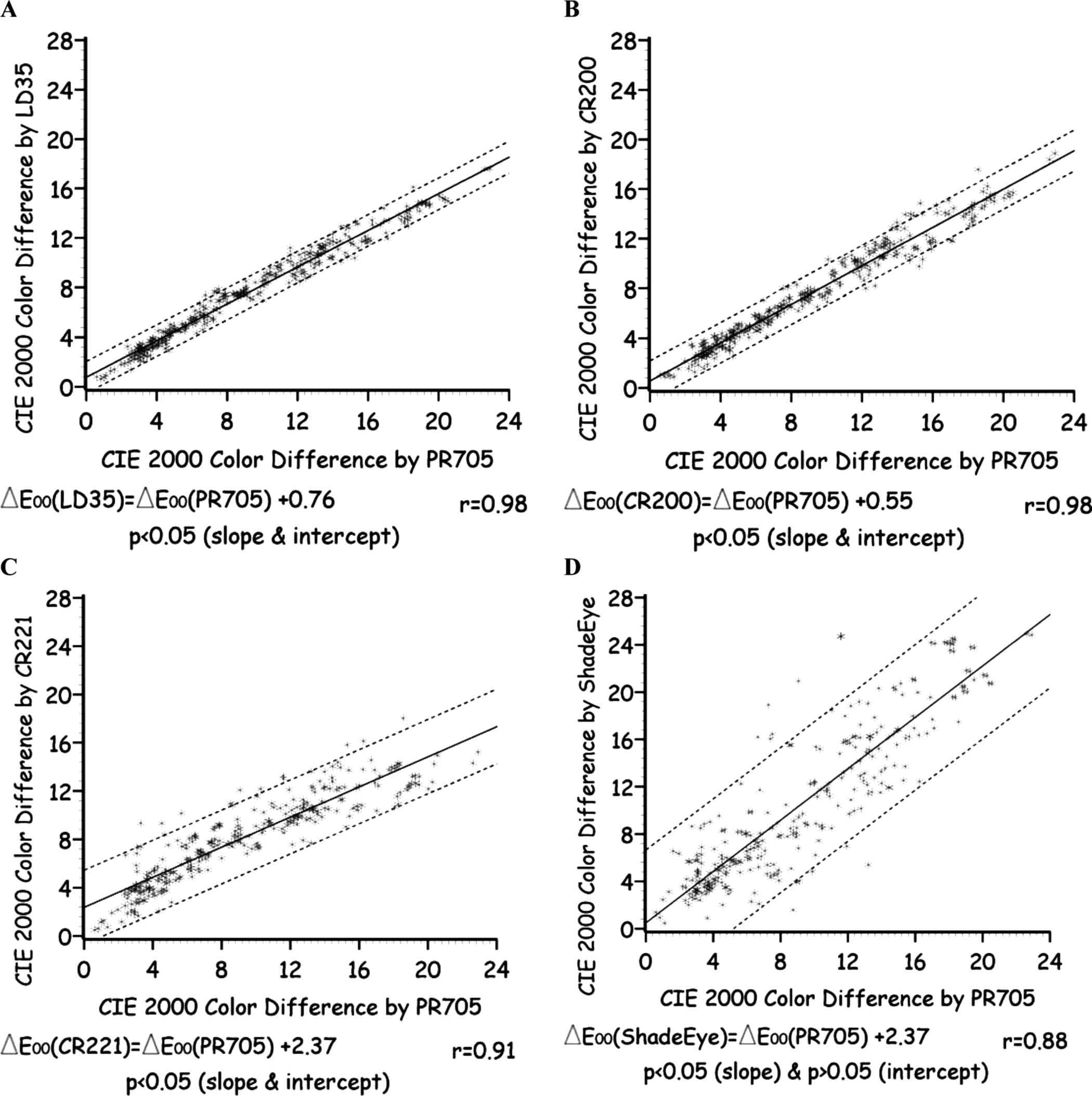
Regression results for 276 ΔE00_P values of elastomer specimen pairs between each test and the reference instrument PR705. The solid line presents the regression line, and the dotted lines represent the 95% confidence limits for an individual measurement. The test instruments are
Discussion
According to the definitions mentioned above, the lower the values of AccLab and AccDE, or RepLab and RepDE, the higher accuracy or repeatibility the instrument demonstrates, respectively. In Phase I, where we investigated the accuracy of the 5 instruments on the 24 opaque patches (Table 1), the AccLab and AccDE for the PR705 system showed the best accuracy among the instruments tested over a wide range of possible colors, and this accuracy was very acceptable in terms of values reported (Douglas et al., 2007; Lindsey and Wee, 2007; Paravina et al., 2009) for perceptibility and visual acceptability limits in dentistry.
In Phase II, the CIELAB ranges of the pigmented MFE specimens fell into human skin color space (Gozalo-Diaz et al., 2007). Lower a* values on the a* or red-green axis and b* values on the b* or yellow-blue axis were obtained by 3 contact-measuring instruments (LD35, CR200, and CR221) compared with the non-contact system. Edge loss caused by small-window contact measurement on translucent materials (Bolt et al., 1994) might be an important source causing these lower a* and b* values. The regression results of CIE a* and b* provide further evidence on instrumental measuring errors which might be derived from the wavelength-dependent edge loss. These discrepancies may contribute to the differences in ΔE00_P as well.
The non-contacting measuring system performed differently in terms of accuracy compared with the contact measuring systems, indicating, again, measuring differences which might be due to various edge losses caused by various aperture sizes. For the degree of instrument repeatability, the RepLab and RepDE values for all the instruments tested were less than 0.30. The RepLab and RepDE of the PR705 were 0.21 (± 0.14) and 0.20 (± 0.16). The RepLab value of PR705 was not statistically different from those of CR200 and CR221, which were not significantly different from that of LD35. The PR705 system was still comparable with the other instruments tested, to a certain extent, in terms of repeatability.
Instrument-measuring geometry on color measurements is another important consideration in the assessment of color-measuring instrument performance. Goniophotometric properties of the sample surface of the material involving optical measurement of the object surface as a function of illumination and observation angles could significantly affect color measurement (Seghi, 1990; Berns, 2000). The surfaces of the specimens with approximately uniform matte could minimize measurement differences because of optical directional sensitivity. However, different instrument-measuring geometries of the instruments studied still contribute, to a certain degree, to the differences of the CIELAB values and ΔE00 calculated from the measurements. The similar schematic patterns of regression plots and correlation coefficients associated with these regressions provide further insight into differences in measurements of color by different devices when specimens vary in translucency, since it can be expected that more edge-loss would occur for more translucent materials.
Measurement differences between the instruments tested might also be derived from sources other than edge loss and measuring geometry, such as the use of different standards during calibration, approximations of color parameters using filters as used in the CR200 and CR221 devices, unknown proprietary processes, etc.
In addition, the comparisons of the overall performance of the ShadeEye system suggest that certain corrections in ShadeEye for edge loss may be approximated (Seghi, 2004), although the ShadeEye is not specifically designed for the elastomer specimens tested, which might cause measurement discrepancies compared with other measuring instruments.
Within the limitations of this study, the non-contacting measuring system performs differently in accuracy but comparable in precision when compared with contact color-measuring instruments. This system is recommended for color measurements of esthetic maxillofacial prostheses. Improvements in this system may still be needed, due to its time-consumption, its potential sensitivity to surface features of the object, and its lack of portability. Furthermore, future investigation of the degree of accuracy relative to an absolute translucent standard may provide more evidence for further applications of non-contact measuring systems.
Footnotes
Acknowledgements
The assistance in specimen preparation and measurements by Amber Huang, Andy B. Gilbert, and Maria C. Molcut is gratefully acknowledged.
This study was supported by The Ohio State University College of Dentistry. This research is part of the dissertation research of Xingxue Hu, presented in partial fulfillment of the requirements for the degree Doctor of Philosophy in the Graduate School of The Ohio State University.