






Abstract
Indirect composites have been undergoing an impressive evolution over the last few years. Specifically, recent developments in computer-aided design–computer-aided manufacturing (CAD-CAM) blocks have been associated with new polymerization modes, innovative microstructures, and different compositions. All these recent breakthroughs have introduced important gaps among the properties of the different materials. This critical state-of-the-art review analyzes the strengths and weaknesses of the different varieties of CAD-CAM composite materials, especially as compared with direct and artisanal indirect composites. Indeed, new polymerization modes used for CAD-CAM blocks—especially high temperature (HT) and, most of all, high temperature–high pressure (HT-HP)—are shown to significantly increase the degree of conversion in comparison with light-cured composites. Industrial processes also allow for the augmentation of the filler content and for the realization of more homogeneous structures with fewer flaws. In addition, due to their increased degree of conversion and their different monomer composition, some CAD-CAM blocks are more advantageous in terms of toxicity and monomer release. Finally, materials with a polymer-infiltrated ceramic network (PICN) microstructure exhibit higher flexural strength and a more favorable elasticity modulus than materials with a dispersed filler microstructure. Consequently, some high-performance composite CAD-CAM blocks—particularly experimental PICNs—can now rival glass-ceramics, such as lithium-disilicate glass-ceramics, for use as bonded partial restorations and crowns on natural teeth and implants. Being able to be manufactured in very low thicknesses, they offer the possibility of developing innovative minimally invasive treatment strategies, such as “no prep” treatment of worn dentition. Current issues are related to the study of bonding and wear properties of the different varieties of CAD-CAM composites. There is also a crucial need to conduct clinical studies. Last, manufacturers should provide more complete information regarding their product polymerization process, microstructure, and composition, which significantly influence CAD-CAM material properties.
Keywords
Introduction
Nowadays, dental composites represent a wide and complex variety of materials with an increasing range of properties and indications. The latest developments of computer-aided design–computer-aided manufacturing (CAD-CAM) blocks are especially associated with new polymerization modes, innovative microstructures, and different compositions. All these changes have introduced important gaps among the different classes of indirect composites (ICs) in terms of mechanical properties, chemical stability, biological properties, bonding properties, and long-term performance probability, notably in comparison with ceramic materials (Coldea et al. 2013; Nguyen et al. 2014; Phan et al. 2014; Awada and Nathanson 2015; Swain et al. 2015). These recent and rapid breakthroughs are sometimes associated with confusion about the specific characteristics of emerging materials, which is augmented by incomplete or misleading information delivered by companies. Currently, some materials are listed either as ceramic-like or in composite materials, under a large variety of names, such as resin nanoceramics, hybrid ceramics, resin-matrix ceramics, double-network materials, ceramic-based interpenetrating-phase composites, or polymer-infiltrated ceramic network (PICN; Denry and Kelly 2014; Gracis et al. 2015). Consequently, the aim of this work is to critically review the global evolution of ICs to understand their respective properties and the contribution of new materials to treatment strategies improvement.
Classification of Current ICs
The most important characteristics differentiating and influencing the main properties of current ICs are related to 1) the type of manufacturing process (artisanal vs. industrial CAD-CAM blocks), 2) the microstructure (with dispersed fillers vs. PICN), 3) the mode of polymerization (light, high temperature [HT], or high temperature–high pressure [HT-HP]), 4) the resin matrix composition, and 5) the filler size and volume content. The table introduces a classification that takes into account those considerations and includes most current ICs. Note that information delivered by companies on their websites is often misleading or incomplete, particularly regarding the mode of polymerization and the composition.
Artisanal
Artisanal ICs are handmade buildups like direct composites. Their composition and structure are also identical, but they are incrementally photopolymerized extraorally, which avoids the negative effect of polymerization shrinkage stress on residual tooth structure or cavity margins (Ferracane and Hilton 2015). Many factors can affect the polymerization efficiency of light-activated resin composites—such as the light-curing unit, the curing parameters (irradiation time and mode, irradiance, radiant exposure), the temperature, the material composition (photoinitiator, monomers, fillers, shading pigments), its viscosity, and its optical properties (Leprince et al. 2013). Consequently, the degree of conversion is limited and operator dependent, and reported in vitro values for light-activated composites, either direct or indirect, vary from approximately 40% to 75%, depending on the different parameters (Ferracane and Condon 1992; Imazato et al. 2001; Ribeiro et al. 2012; Calheiros et al. 2014). Moreover, as the irradiance varies from the surface to the depth, the polymerization is inhomogeneous, which generates internal stress within the material (Nguyen et al. 2012). These disadvantages have a negative impact on mechanical properties and the release of free monomers (Ferracane 1994; Ferracane et al. 1997; Chen et al. 2005; Lin-Gibson et al. 2009; Van Landuyt et al. 2011; Nguyen et al. 2012; Gupta et al. 2012).
The current generation of artisanal ICs is mainly composed of microhybrid materials. For some products, specific curing units were developed that allow the complementary application of temperature (>100 °C). Postcure heating was shown to improve degree of conversion (Ferracane and Condon 1992) and flexural strength (Sedda et al. 2010) and to reduce the unreacted monomers remaining in light-cured composites (Bagis and Rueggeberg 2000). The hypotheses are that temperature can increase 1) volatilization of unreacted monomers and 2) double-bond conversion, mobility of monomers, and polymer chains, promoting cross-linking (Ferracane and Condon 1992; Bagis and Rueggeberg 2000). Yet, the diffusion of free monomers—and, hence, their reactivity after a photopolymerization process—is limited due to the augmentation of the viscosity (Leprince et al. 2013), which could explain that the degree of conversion increase is also limited. Indeed, Ferracane and Condon (1992) showed that a postcure at 120 °C can increase, depending on the composite material, the degree of conversion from 3% to 18%—with the highest value being, in the bulk of the material, 75% for a 10-min treatment and 78% for a 3-h treatment. However, the temperature can promote a chemopolymerization process if the material contains BPO (benzoyl peroxide). Nowadays, the range of available artisanal ICs is decreasing in favor of the development of CAD-CAM blocks.
CAD-CAM Blocks
CAD-CAM processes have recently revolutionized the world of ICs, introducing high-performance materials that are industrially produced and secondarily milled. Industrial processes used to produce CAD-CAM blocks increase material homogeneity, decrease the presence of flaws and pores, and increase their reliability, in comparison with hand-built materials (Giordano 2006). They also allow for the augmentation of the filler volume content: this is not possible with direct composites, which need to be sufficiently plastic for the restoration buildup. Recent CAD-CAM blocks do not contain any bisphenol A–glycidyl methacrylate (Bis-GMA), and they are no longer photopolymerized—with high-performance industrial polymerization processes involving HT (>100°C) and sometimes HP (>150 MPa) having been developed (Sadoun 2011; Nguyen et al. 2012). The composite class of CAD-CAM blocks should be divided into 2 subclasses, depending on their microstructure: with dispersed fillers and PICN materials.
With dispersed fillers
Paradigm MZ100 (3M ESPE, St. Paul, MN, USA) was the first marketed CAD-CAM block in the years preceding 2010. It contains 85 wt% of zirconia-silica fillers in a Bis-GMA and triethylene glycol dimethacrylate (TEGDMA) matrix: its composition is similar to Z100 direct composite from the same company. Paradigm MZ100 block is simply photopolymerized and is considered to be like a Z100 block, without any original properties (Nguyen et al. 2013). Then, 3M introduced its “nanoceramic”‘ called Lava Ultimate. Lava Ultimate has a 79 wt% of zirconia-silica nanofillers (in the form of dispersed or aggregated particles) and constitutes a nanofill composite, with the same kind of fillers as direct composites. The real improvements lie in the matrix, which is here composed of urethane dimethacrylate (UDMA) and is totally heat rather than photopolymerized. UDMA has a higher concentration of double bonds than Bis-GMA: it was shown to reach a higher degree of conversion and cross-linking and to exhibit a higher polymerization reactivity with light curing (Sideridou et al. 2002). Light-cured UDMA also exhibits a lower water sorption and solubility than Bis-GMA (Sideridou and Karabela 2011), which can prevent alteration of material properties and water-soluble color pigment absorption. Unlike Bis-GMA, UDMA does not necessarily require the addition of TEGDMA as a diluent to lower the viscosity. In fact, TEGDMA has a higher concentration of double bonds, and when mixed with Bis-GMA, it increases the degree of conversion and cross-linking (Sideridou et al. 2002), but it induces more polymerization shrinkage (Goncalves et al. 2011).
Recently, GC (GC Corporation, Tokyo, Japan) and Shofu (Shofu Inc., Kyoto, Japan,) marketed Cerasmart and Shofu Block HC, respectively, as part of the “hybrid ceramic” group of materials. “Hybrid ceramic” is a confusing commercial name that does not refer to material science notions and does not reflect the real properties of materials. In reality, even if the composition or the filler size is not exactly the same, these new composite blocks are all dispersed filler materials with a UDMA-based matrix, which is HT polymerized (see Table), and can be considered as part of the same family from a mechanical point of view when compared with ceramic and PICN CAD-CAM blocks (Awada and Nathanson 2015).
Classification of Indirect Composites Based on Their Manufacturing Process, Microstructure, and Polymerization Mode.
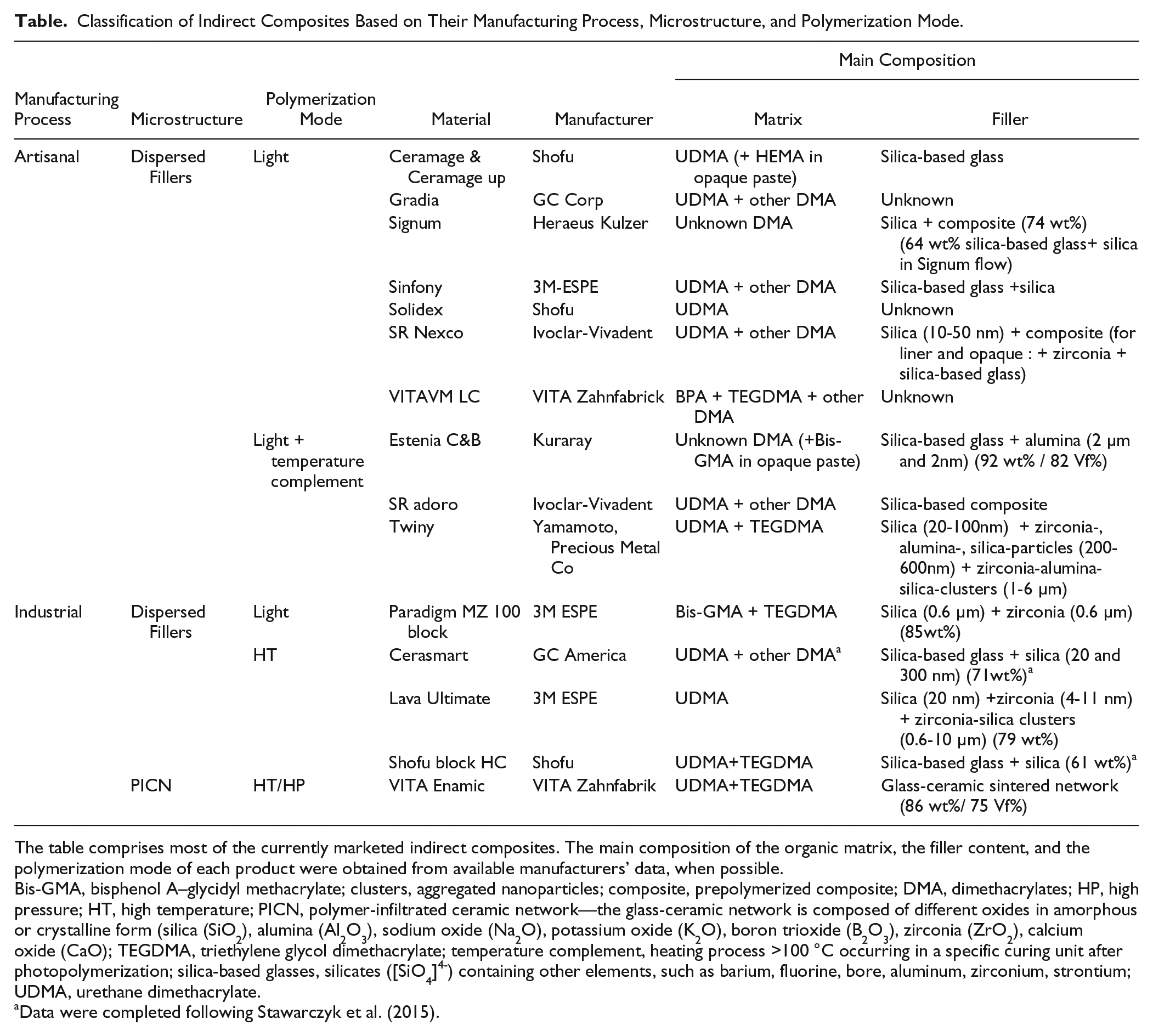
The table comprises most of the currently marketed indirect composites. The main composition of the organic matrix, the filler content, and the polymerization mode of each product were obtained from available manufacturers’ data, when possible.
Bis-GMA, bisphenol A–glycidyl methacrylate; clusters, aggregated nanoparticles; composite, prepolymerized composite; DMA, dimethacrylates; HP, high pressure; HT, high temperature; PICN, polymer-infiltrated ceramic network—the glass-ceramic network is composed of different oxides in amorphous or crystalline form (silica (SiO2), alumina (Al2O3), sodium oxide (Na2O), potassium oxide (K2O), boron trioxide (B2O3), zirconia (ZrO2), calcium oxide (CaO); TEGDMA, triethylene glycol dimethacrylate; temperature complement, heating process >100 °C occurring in a specific curing unit after photopolymerization; silica-based glasses, silicates ([SiO4]4-) containing other elements, such as barium, fluorine, bore, aluminum, zirconium, strontium; UDMA, urethane dimethacrylate.
Data were completed following Stawarczyk et al. (2015).
PICN materials
Inspired by glass-infiltrated ceramics marketed by Vita in the 1980s (In Ceram System; Vita Zahnfabrik, Bad Säckingen, Germany), R. Giordano patented, in 1997, the idea of replacing glass with a polymer to obtain a PICN. Thus, this material is the result of the infiltration of a presintered glass-ceramic scaffold with a monomer, which is secondarily polymerized. PICNs differ significantly from composite materials with dispersed fillers classically incorporated by mixing. Indeed, the ceramic network constitutes a 3-dimensional scaffold of interconnected (in contrast to dispersed) particles: it forms a real skeleton, which is able to distribute stresses more effectively in all directions and to promote resistance to breakdown phenomena (Swain et al. 2015; Fig. 1). Time was needed for Vita to put the first PICN, called Enamic, on the market in 2012. This was related to the difficult management of the polymerization shrinkage stress effects on the ceramic network (Swain et al. 2015). This problem was solved through M.J. Sadoun’s patent, which introduced a new polymerization process using HT and HP (>150 MPa; Sadoun 2011; Nguyen et al. 2012). Indeed, HT increases the chains’ mobility and then polymerization, which decreases with pressure, while HP compensates for shrinkage and reduces the number and size of defects (Nguyen et al. 2012). In the Enamic material, the ceramic network material is infiltrated with a UDMA and TEGDMA mixture. The volume fraction of ceramic is high, which is why Vita was the first to introduce the confusing commercial name “hybrid ceramic” to describe its material. PICNs are also often called double-network materials, ceramic-based interpenetrating phase materials, or interpenetrating-phase ceramic-resin composites.

Schematic illustration of the microstructure of a composite with dispersed fillers incorporated by mixing versus a polymer-infiltrated ceramic network (PICN) material. In the latter, the ceramic network (white color) constitutes a 3-dimensional scaffold of sintered ceramic particles, which form a real skeleton.
Ongoing research on experimental PICNs shows impressive and promising results in terms of mechanical and biological properties of this class of materials under development (Nguyen et al. 2013; Nguyen et al. 2014)—notably, when the ceramic network is performed by slip casting and uses HT-HP (180 °C, 300 MPa; Nguyen et al. 2014) and when the polymer matrix is composed of only pure UDMA, without TEGDMA and initiator (Nguyen et al. 2013). Those results are described in the next section.
Impact of Recent Advances on Material Properties
Mechanical Properties
Degree of conversion and polymerization mode influence
Many mechanical properties of dental composites are significantly influenced by the degree of conversion and, consequently, the polymerization mode (Ferracane et al. 1997; Chen et al. 2005; Lin-Gibson et al. 2009; Nguyen et al. 2012). Wear resistance (Ferracane et al. 1997), hardness (Chen et al. 2005), and then elasticity modulus (Lin-Gibson et al. 2009) were shown to increase with the degree of conversion. By polymerizing both commercial direct composites and artisanal ICs under HT (180 °C)–HP (250 MPa), Nguyen et al. (2012) showed a significant increase in their mechanical properties in comparison with the photopolymerized samples. They attributed their results to a higher degree of cross-linking, a more homogeneous polymerization, and a reduction in the number and size of defects. Indeed, Phan et al. (2015) recently studied the polymerization of pure UDMA with an initiator (BPO 0.5%) and showed that HT (90 °C, 4 h) generated an 89% degree of conversion, while the combination of HT-HP (200 MPa) was able to increase the degree of conversion to 95%. Note that the monomer nature also influences the degree of cross-linking: UDMA was shown to ensure a higher degree of conversion and cross-linking than Bis-GMA, with light curing (Sideridou et al. 2002).
Filler content influence
But the polymerization mode is not the only parameter improving mechanical behavior. The type, size, and volume fraction (Vf%) of the filler particles as their bond to the resin matrix are often pointed out as important influencing factors on mechanical properties. Increasing the filler content increases tensile and compressive strength, hardness, and elasticity modulus (Li et al. 1985; Chung 1990; Lin-Gibson et al. 2009). Wear resistance, which is a multiparametric property, was also shown to be affected by the filler content (Li et al. 1985; Condon and Ferracane 1997) and by particle size, geometry, and distribution (Turssi et al. 2005), with high filler content and small particles being more advantageous, as confirmed by the results of a recent clinical study (Cetin and Unlu 2012). Nguyen et al. (2013) analyzed HT-HP experimental composites with dispersed fillers and confirmed that mechanical properties increased with filler content. However, above 60 Vf%, the flexural strength tended to decrease, perhaps due to the difficulty encountered with filler incorporation by mixing, which engendered the presence of porosities. Industrial processes used for CAD-CAM blocks allow for the augmentation of the filler content in comparison with artisanal ICs, particularly PICNs, which do not encounter the mixing problem. Yet it is important to note that most manufacturers express the filler content in weight (wt%) instead of volume (Vf%), which does not enable comparisons among the different products (see Table). Indeed, weight is more related to the filler composition—with some fillers, such as zirconia, being significantly heavier than others.
Microstructure influence
Figure 2 gives the flexural strength of commercial and experimental CAD-CAM composite materials, with different microstructures (dispersed fillers and PICNs) and manufacturing processes, in comparison with IPS e.max CAD (Ivoclar Vivadent, Schaan, Liechtenstein), the most resistant glass-ceramic material. Interestingly, experimental HT (180°C)–HP (300 MPa) PICN made by slip casting and infiltration of a sintered glass-ceramic network (73.8 Vf%) with UDMA (without initiator) showed a flexural strength around 288 MPa, while the same HT-HP components manufactured by filler mixing (65 Vf%) showed a flexural strength of only around 122 MPa (Nguyen et al. 2014). The addition of initiator was shown to increase the PICN flexural strength up to 300 MPa, which is a value close to the most resistant glass-ceramics, such as lithium-disilicate glass-ceramic IPS e.max CAD (Ruse and Sadoun 2014). Enamic, which is the currently marketed PICN, gave results inferior to experimental slip-casted PICN (Ruse and Sadoun 2014; Nguyen et al. 2014). Indeed, if the ceramic network volume is similar (73.5 Vf% for experimental PICN vs. 75 Vf% for Enamic), there are important differences between the 2 materials: the nature of monomers (UDMA vs. UDMA and TEGDMA), the HT-HP process (180°–300 MPa vs. undetailed HT-HP), and, finally, the ceramic network manufacturing process (slip casted or pressed). Those considerations highlight the complex relationship between manufacturing process parameters and material performance.

Flexural strength (3-point bending test) of commercial and experimental computer-aided design–computer-aided manufacturing materials with different microstructures. Data are from Ruse and Sadoun (2014) for Enamic, Lava Ultimate, and IPS e.max CAD materials and from Nguyen et al. (2014) for Paradigm and experimental materials. CAD, computer-aided design; HP, high pressure; HT, high temperature; PICN, polymer-infiltrated ceramic network; UDMA, urethane dimethacrylate.
Regarding the elasticity modulus, Enamic (elasticity modulus = 30 GPa, hardness = 2.5 GPa) was shown to exhibit intermediate properties between dentin and enamel, while other CAD-CAM blocks with dispersed fillers are under the dentin values (Ruse and Sadoun 2014). In fact, the ideal restorative material should mimic the specific mechanical properties of enamel and dentin as much as possible. Petrini et al. (2013) proposed a concept of a biomimetic composite material, with different layers of alumina lamellae infiltrated with epoxy resin, reproducing the anisotropy of the tooth tissues. New developments should focus on these considerations.
Toxicity and Monomer Release
The main current issue concerning dental composites from a biological point of view is the release (or elution) of components due to incomplete polymerization and, later, due to degradation (Ferracane 1994; Van Landuyt et al. 2011; Gupta et al. 2012). In 1996, Olea et al. raised the issue of the presence of bisphenol A (BPA), a well-known endocrine disruptor, in dental materials. Indeed, dental composites may release not only BPA but also low weight monomers such as HEMA and TEGDMA, high weight monomers such as Bis-GMA and UDMA, and additives such as free radicals and photoinitiator molecules (Van Landuyt et al. 2011; Kingman et al. 2012; Leprince et al. 2013). All monomers are reported to induce adverse effects, such as bacterial colonization on the composite surface, pulp damage, disturbance of odontoblasts and dental stem cells, dermatologic and allergic reactions, and cytotoxic and genotoxic effects (Bakopoulou et al. 2009; Bakopoulou et al. 2011; Krifka et al. 2013; Leprince et al. 2013). Some photoinitiator molecules may also exhibit significant cytotoxicity (Bakopoulou et al. 2009). Most studies have not proven that BPA was directly released from Bis-GMA-based restorations (Bakopoulou et al. 2009). In fact, BPA was often reported as a degradation product of Bis-DMA, a component of sealants for pits and fissures. Salivary enzymes, such as esterases, are able to degrade the Bis-DMA ester bonds but not the Bis-GMA ether bonds, which encounter the liberation of BPA. However, the evaluation of BPA release from dental composites is highly complicated, since there are many other sources of BPA contamination.
Regarding these biological interactions, recent CAD-CAM blocks are superior to direct and artisanal ICs since they imply 1) a significant increase in the degree of conversion (Lin-Gibson et al. 2009; Gupta et al. 2012), 2) the use of less toxic monomers and the absence of photoinitiators (Gupta et al. 2012; Krifka et al. 2013), and 3) a better resistance to degradation and then to toxic components release (Van Landuyt et al. 2011). Indeed, the degree of conversion was shown to influence cell response (Lin-Gibson et al. 2009), and a recent review highlighted the importance of polymerization of resin materials in regard to their toxicity (Gupta et al. 2012). A short time ago, HT-HP polymerized UDMA was shown to exhibit dramatically reduced monomer release in comparison with light- or thermocured UDMA, which could probably be due to a higher degree of conversion and a higher degree of homogeneity (Phan et al. 2014). Moreover, UDMA—which is used as an alternative to Bis-GMA in modern CAD-CAM blocks—is not synthetized from BPA. In fact, Bis-GMA was shown to exhibit the highest in vitro cytotoxicity on human gingival and pulp fibroblasts, greater than UDMA (Gupta et al. 2012). Finally, Nguyen et al. (2013) developed experimental PICNs without TEGDMA and initiator (BPO), while TEGDMA is reputed to have many cytotoxic and genotoxic effects, such as the inhibition of specific odontoblast functions (Krifka et al. 2013). Those effects are promoted by TEGDMA’s small molecule size, which increases diffusion processes.
Bonding Properties
Increasing surface roughness (i.e., micromechanical interlocking) is more important than chemical conditioning with a silane (i.e., an agent coupling inorganic fillers with organic resin cement) to improve bonding properties of ICs (Spitznagel et al. 2014). Currently, for most ICs, there is a consensus in the literature about the use of air abrasion (50-μm alumina particles) or silica-coating systems (Co-Jet and Rocatec systems; 3M ESPE, Seefeld, Germany) to roughen the material surface to increase surface energy and micromechanical interlocking (Spitznagel et al. 2014). The hydrofluoric acid-etching procedure induces lower bond strength values for most composites, while postsandblasting silane pretreatment is generally recommended to further increase bond strength (Spitznagel et al. 2014). Yet in the particular case of Enamic PICN material, the manufacturer recommends a 5% hydrofluoric acid etching for 60 s as an alternative to air abrasion. Indeed, with PICNs, the etching procedure induces the total dissolution of the ceramic phase and the creation of an interesting “honeycomb” structure formed by the remaining resin network, offering a very high potential for micromechanical interlocking (Fig. 3). In fact, Enamic was shown to give higher bond strength to resin cement than Lava Ultimate (Elsaka 2014). Recently, 3M has removed crowns from the indication list of Lava Ultimate material because of the occurrence of debonding failures, which still need to be explained. This phenomenon was notably reported with crowns bonded on zirconia implant abutments and was attributed to the elastic deformation of the restoration during chewing (Schepke et al. 2015). Bonding properties of new CAD-CAM blocks, dispersed fillers, and PICNs need to be investigated, as there is a lack of data in the literature about their behavior, notably in comparison with ceramic materials. Indeed, their specific microstructure and their high degree of conversion—which can decrease the possibility of additional chemical bonding between free monomers and resin cement—can significantly affect their performance and thus constitutes a current issue, particularly in regard to their indications as adhesive restorations.

Scanning electron microscope observation (1000× magnification) of experimental slip-casted polymer-infiltrated ceramic network after polishing and etching with hydrofluoric acid for 1 min. Etching leads to glass-ceramic network dissolution and creation of a specific interesting “honeycomb” structure formed by the remaining resin network, which promote bonding.
Clinical Considerations
Currently, there is still no universal or ideal material in restorative dentistry, and the material choice varies with the clinical situation. This choice should promote current treatment strategies, which aim to conserve and preserve remaining tooth tissues and structures (Lynch et al. 2014). A critical issue lies in the lack of clinical evidence regarding the comparison of the various existing materials and techniques, particularly for extensive cavities (Fron Chabouis et al. 2013; Grivas et al. 2014). Concerning the objective of minimal intervention approaches and given clinical background, direct composites are reported as the material of choice for the restoration of class I and II cavities in posterior teeth (Lynch et al. 2014), especially when indirect techniques would imply further loss of tooth tissue to adapt the cavity design. Artisanal ICs in general were shown to exhibit good clinical results and similar annual failure rates to direct composites in posterior class I and II cavities (Manhart et al. 2004; Grivas et al. 2014; Opdam et al. 2014) and for the restoration of maxillary premolars with 1 missing cusp (Fennis et al. 2014). A recent systematic review (Fron Chabouis et al. 2013) found limited evidence that ceramics perform better than artisanal ICs for inlays in the short term.
In general, indirect techniques are advised for subgingival margins, extensive cavities (including those where multiple cusps require replacement), and altered/abnormal enamel and dentine (Lynch et al. 2014). Those techniques allow 1) the use of a material with better mechanical properties, such as resistance to fracture, which is one of the first causes of failure of direct composites, particularly with larger restorations (Opdam et al. 2014); 2) the reduction of the effect of polymerization shrinkage stresses (Ferracane and Condon 1992); and 3) the achievement of better occlusal anatomy and proximal contact points. The emergence of CAD-CAM composite blocks has generated the apparition of new materials, which possess, in vitro, better mechanical properties than artisanal ICs and also significant advantages in comparison with glass-ceramics. In fact, CAD-CAM composites show an elasticity modulus closer to dentin than ceramics and the property of absorbing masticatory forces (Coldea et al. 2013), which can be particularly valuable for crowns on implants (Rohr et al. 2015). Composites are also considered more adapted to CAD-CAM processes because 1) they are not as brittle; 2) they exhibit a higher damage tolerance, a lower tendency to marginal chipping, and smoother milled margins (Tsitrou et al. 2007; Awada and Nathanson 2015; Coldea et al. 2015); and 3) they are able to be milled to a reduced thickness (0.2 to 0.5 mm; VITA Zahnfabrik). Furthermore, CAD-CAM composites exhibit a better machinability than ceramics in terms of milling time and bur lifetime (Lebon et al. 2015; Fig. 4). The resulting lower cost, added to the absence of any firing procedure for ceramic staining or crystallization (required for lithium-disilicate glass-ceramic restorations), makes those materials very attractive. Additionally, they are easier to mill and to repair in case of failure (no need for hydrofluoric acid use; Zaghloul et al. 2014).

Scanning electron microscope observation of the margins of an IPS eMax CAD (45× magnification) versus an experimental slip-casted polymer-infiltrated ceramic network (PICN) crown (100× magnification), milled with the same CAD-CAM system (Kavo Artica, Biberach, Germany) and on the basis of the same design. The margin edge of the glass-ceramic crown exhibits chipping (arrows), while the margin of the PICN crown is smoother and intact, even at higher magnification.
Among CAD-CAM composites, PICN materials—with their specific microstructure and polymerization mode—constitute an innovative and promising class of materials (Albero et al. 2015; Swain et al. 2015). Particularly, as seen previously, experimental PICNs exhibit additional benefits in terms of 1) mechanical properties—namely, comparable flexural strength and toughness to high-performance glass-ceramics (Coldea et al. 2013; Nguyen et al. 2014), Vickers hardness between enamel and dentin and then reduced antagonistic wear (Swain et al. 2015), elasticity modulus between enamel and dentin (i.e., around 30 GPa, with elasticity modulus of dentin being around 15 to 20 GPa and with enamel around 50 to 100 GPa, while CAD-CAM dispersed filler composites show an elasticity modulus lower than dentin and CAD-CAM ceramics, similar or higher than enamel; Coldea et al. 2013; Awada and Nathanson 2015; Swain et al. 2015)—and 2) low toxicity and monomer release (Phan et al. 2014). Yet the recent advances with CAD-CAM composites described throughout this review through in vitro studies cannot be related to any relevant clinical data and consequently cannot support any evidence-based recommendations in clinical practice for the moment.
Future perspectives include the clinical study of CAD-CAM composites used as crowns on implants and natural teeth and as adhesive restorations, particularly very thin and noninvasive restorations, such as table tops and palatal veneers for “no prep” worn cases (Fig. 5; Schlichting et al. 2011), as illustrated with the pilot clinical case in the Appendix Figure. Current issues are also related to the study of CAD-CAM composites in terms of wear resistance and aging, which still require in vitro and clinical studies. Indeed, Swain et al. (2015) recently reported that PICN crowns (Enamic) perform better in chewing simulation than lithium-disilicate glass-ceramic (emaxCAD) crowns in terms of resistance to crack initiation and growth but exhibit more wear. Yet Mormann et al. (2013) showed, also in vitro, that PICN self-wear and antagonistic enamel wear did not significantly differ from enamel and lithium-disilicate glass-ceramics. However, even if their polishing aptitude is similar, the loss of surface gloss with toothbrushing was higher with PICNs than with glass-ceramics. Wear also constitutes an issue for the stability of stains, which are light-cured composites thinly layered on the surface to improve the esthetics. In fact, when a high level of aesthetics is required (e.g., with veneers), ceramics remain the material of choice. Finally, properties concerning soft tissue behavior around implants also need to be evaluated to use them as transgingival implant components and prostheses.

Table top (0.2 mm thick) for a “no prep” clinical case of a worn dentition restored with minimally invasive bonded partial restorations. The restoration was milled in Enamic (polymer-infiltrated ceramic network) with the Cerec MCXL machine (Sirona, Salzburg, Austria).
Conclusions and Perspectives
Nowadays, indirect dental composites represent a large-scale class of materials characterized by various manufacturing processes, microstructures, polymerization modes, and compositions, implying important variations in material properties. The apparition of composite CAD-CAM blocks has most particularly generated new generations of materials, which could now rival CAD-CAM ceramics for bonded partial restorations and crowns on natural teeth or implants, while artisanal ICs are tending to disappear. Two subclasses of CAD-CAM blocks must be distinguished: those with dispersed fillers and PICNs. Recent in vitro research outcomes, especially with experimental PICNs, have introduced interesting perspectives in terms of mechanical and toxicity properties as milling ability in comparison with high-performance glass-ceramic materials. These innovative materials could be particularly apt for development of minimally invasive treatment strategies, such as “no prep” treatment of worn dentition with very thin restorations. But there is now a crucial need to conduct clinical studies about the different varieties of CAD-CAM composites to validate in vitro results before establishing clinical recommendations. Current issues are also related to the study of their bonding, wear, and cytocompatibility properties. We are still at the dawn of composite CAD-CAM block evolution and its rapid and competitive market development. Even if complicated due to incomplete information delivered by companies, practitioners should remain aware of each product’s specific properties and indications to promote success and new treatment strategies.
Author Contributions
A.K. Mainjot, contributed to conception, design, data acquisition, analysis and interpretation, drafted the manuscript; N.M. Dupont, J.C. Oudkerk, T.Y. Dewael, contributed to data acquisition and analysis, drafted the manuscript; M.J. Sadoun, contributed to conception and design, critically revised the manuscript. All authors gave final approval and agree to be accountable for all aspects of the work.
Footnotes

The authors received no financial support for this work.
M.J. Sadoun has a patent: Composite ceramic block. US patent 8,507,578 B2. The remaining authors declare no potential conflicts of interest with respect to the authorship and/or publication of this article.
References
Supplementary Material
Please find the following supplemental material available below.
For Open Access articles published under a Creative Commons License, all supplemental material carries the same license as the article it is associated with.
For non-Open Access articles published, all supplemental material carries a non-exclusive license, and permission requests for re-use of supplemental material or any part of supplemental material shall be sent directly to the copyright owner as specified in the copyright notice associated with the article.
