







Abstract
Seeking to fill a substantial gap in analytical infrastructure, this article lays out a summary of a newly developed framework for systematically assessing the harms of criminal activities and presents findings from an initial application to cocaine trafficking in Belgium. The application is based on a substantial data collection, which included an analysis of records in the Organized Crime Database of the Belgian Federal Police, 52 criminal proceedings, and interviews with 18 experts, and 12 convicted traffickers. First, we construct a business model for cocaine trafficking in Belgium to characterize the key operational phases and “accompanying” and “enabled” activities. On this basis, we identify the possible harms associated with cocaine trafficking and related activities, evaluate the severity and incidence of those harms, prioritize the harms, and establish their causality. The application demonstrates the merits of the approach and the conceptual and technical challenges confronting it.
Introduction
“Harm,” viewed as a criterion for formulating and evaluating policy, is garnering increasing attention across wide-ranging policy communities (Sparrow, 2008), each with its own perspective, but none wholly unique. Seeking to fill a substantial gap in analytical infrastructure, this article lays out a summary of a newly developed framework for assessing the harms of criminal activities and presents findings from an initial application to cocaine trafficking in Belgium. 1
The confluence of two complementary policy phenomena has led us to develop the framework and apply it to the illicit drug trade. First, national and regional law-enforcement agencies in Europe and elsewhere are turning to harm as a basis for prioritizing and targeting criminal activities. The United Kingdom Serious and Organised Crime Agency (SOCA, 2008) offers the clearest example: “The overarching aim of the [Organised Crime] Control Strategy is to achieve a tangible and lasting reduction in the harm caused to the UK by organised crime.” 2 Second, calls for alternative approaches to supply-oriented drug policy, including approaches based on the general principles of harm reduction (e.g., Caulkins & Reuter, 1997, 2009; Greenfield & Paoli, 2012b; MacCoun & Reuter, 2001; UK Drug Policy Commission, 2009), are arising from concern for the evident deficiencies of current approaches and their near-exclusive focus on supply reduction (e.g., Friesendorf, 2007; Global Commission on Drug Policy, 2011; Paoli, Greenfield, & Reuter, 2009). In particular, the absence of success in reducing the supply of drugs has fed calls to tackle, instead, the harms associated with the production and trafficking of illegal drugs, such as corruption, violence, public nuisance, and environmental pollution.
In this article, we attempt to fill a substantial analytical gap, by providing these and other communities of interest with tools to more effectively develop and implement harm-based policies. Traditionally, crime has been considered a harm in its own right with very few attempts to differentiate the consequences of crime across criminal activities. Despite rising concern for victims of crime in the general public and government policy (e.g., Spalek, 2006), neither criminology nor the adjacent social sciences have made a serious effort to systematically evaluate or compare the harms associated with different crimes as distinct from the perceived seriousness or costs of crime. Moreover, the supply-oriented drug policy community, though gathering steam, has yet to move much beyond theoretical constructs and anecdotal applications of harm-based approaches. Thus, the increased prominence of harm in both policy communities suggests a need for more rigorous—evidence-based, systematic, and tested—analytical tools to further the approach.
This article accompanies two related articles (Greenfield & Paoli, 2012a; Paoli & Greenfield, 2012), in which we discuss the growing interest in harm, explore various conceptual and technical challenges that arise in contemplating harm-based approaches to policy, and develop an analytical harm assessment framework to address them. In this article, we delve into the first empirical application of that framework, an assessment of the possible harms associated with cocaine trafficking (hereafter “cocaine trafficking”) in Belgium, 3 including its “accompanying” activities (i.e., money laundering, corruption, 4 and the use or threat of violence) and its most directly “enabled” activity (i.e., retail dealing). Although cocaine use is at least partially enabled by trafficking, in that demand cannot exist without supply, an assessment of the harms associated with use is beyond our scope. As our analysis relies exclusively on Belgian sources and data, we confine our analysis to harms that accrue in Belgium.
“The Harm Assessment Framework” section summarizes the harm assessment framework. “Research Design and Data Collection” section describes our research design and data collection. “The Business Model of Cocaine Trafficking in Belgium” and “Assessing the Harms of Cocaine Trafficking in Belgium” sections walk through the application of the framework to cocaine trafficking in Belgium. The final section provides “Concluding Remarks.”
The Harm Assessment Framework
Our framework builds on literatures that concern drug-related harms, criminal harms, and national security (for examples of each, see MacCoun & Reuter, 2001; von Hirsch & Jareborg, 1991; and Greenfield & Camm, 2005, respectively). It consists of a set of tools and a multistep process with which to apply them: Specifically, it draws together a model of the criminal activity, which we refer to as a “business model,” a taxonomy of the types and bearers of harms, scales for evaluating the severity and incidence of harms, and a matrix for prioritizing harms (Figure 1). The business model depicts the typical modus operandi of a criminal activity and provides an evidentiary base for identifying possible harms, evaluating their severity and incidence, prioritizing them, and establishing their causality. We begin this section with an overview of three tools that support the assessment process, namely, the taxonomy, scales, and matrix.
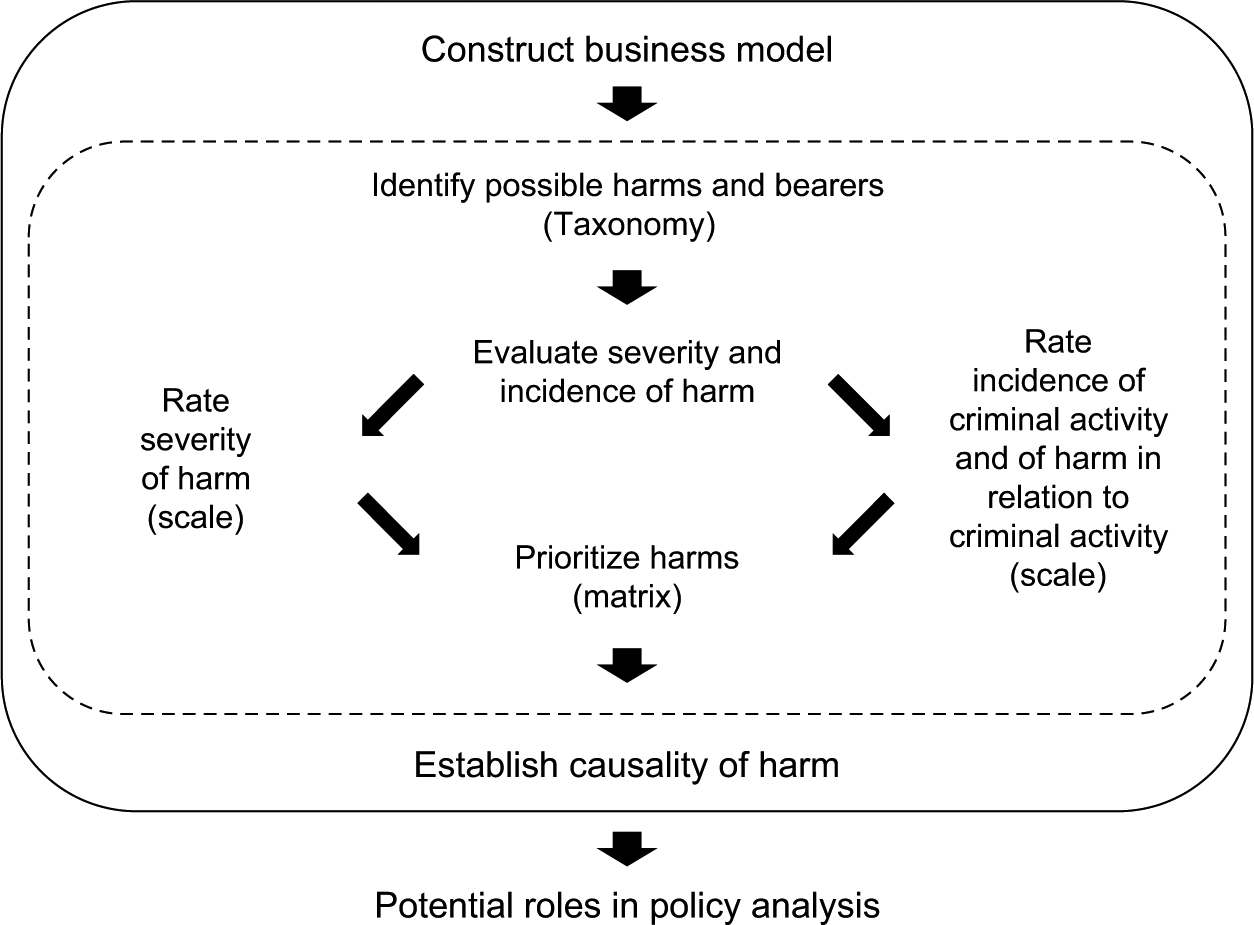
Harm assessment process.
Taxonomy of Possible Harms
Our taxonomy distinguishes among different bearers and different types of harms (Table 1). We specify four classes of bearers: individuals, private-sector entities, including businesses and nongovernmental organizations (NGOs), government entities, and the environment, both physical and social. By allocating harms to their ultimate—or near ultimate—bearers, we avoid using systemic categories, such as harms to the community or to the economy. Building on von Hirsch and Jareborg’s (1991) delineation of harms that accrue to individuals, we specify the different types of harms in relation to the “interest dimensions” of each class of bearer.
Bearers and Types of Harms.
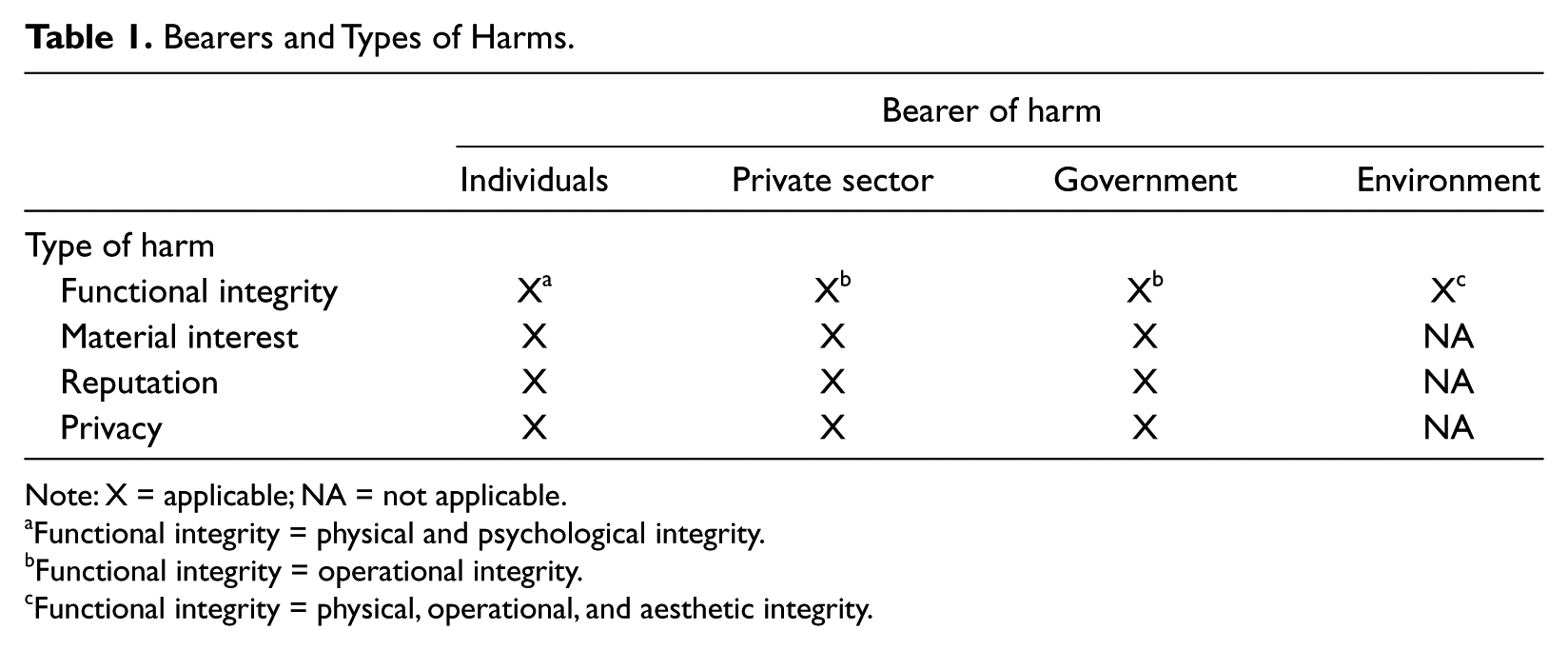
Note: X = applicable; NA = not applicable.
Functional integrity = physical and psychological integrity.
Functional integrity = operational integrity.
Functional integrity = physical, operational, and aesthetic integrity.
In our specification, harms to individuals stem from intrusions on a particular dimension of human interest, be it functional, material, reputational, or a matter of privacy. 5 Violations of functional integrity may result in physical and psychological losses, bounded by death and by momentary pain, discomfort, or anxiety. Violations of psychological integrity, including affronts to human dignity, may occur along with physical injuries or separately. Material interests can run the gamut from the most basic means of subsistence to the amenities of modest comfort and luxury. Damages to reputation arise from actions or events affecting others’ view of the individual. They might involve instances of mistreatment or exploitation, as in cases of human trafficking, or stem from instances of physical assault, verbal harassment, or mere association. A violation of privacy, such as an unauthorized entry or the control of personal documents, might occur in a case of burglary or identity theft.
We approach harms to private-sector entities, government entities, and the environment analogously. A business, NGO, or government entity would suffer an operational loss rather than a physical or psychological loss; a business or NGO might lose value, possibly concurrent with other damages, and a government entity might lose tax revenue; a business, NGO, or government body might suffer a loss of “privacy” if sensitive data leak. Damage to a business, NGO, or government’s reputation might occur under a variety of circumstances, for example, those involving an employee, official, or representative’s participation in a criminal activity. Arguably, such entities experience some reputational loss whenever rule or lawbreaking leaves the impression that they are weak or poorly governed; thus, they may also suffer reputational losses if traffickers exploit them, even without the corrupt, knowing involvement of their personnel. For the environment, we limit the analysis to functional integrity, consisting of physical, operational, and aesthetic integrity. Damages to the physical environment might stem from air, water, and soil pollution; noise and light pollution; the inaccessibility of open spaces; and the obstruction or destruction of landscapes; concerns about the social environment could include public nuisance, social fragmentation, and community disassociation. Drug dealing might, for example, create a persistent public nuisance, resulting in the de facto appropriation of public spaces.
Whereas other classification systems include “the community” as an independent bearer (e.g., Newcombe, 1992; SOCA, 2010), we try to allocate communal harms to their ultimate bearers, including the individuals, businesses, NGOs, and government agencies that compose a community. Similarly, we allocate harms to “the economy” to the actors and entities that compose the economy. In some instance, we acknowledge that we have only identified the “near-ultimate” bearers of harms. For example, many or most harms borne by the government, private-sector entities, and the environment, are borne ultimately by individuals, such as, taxpayers, shareholders, employees, and residents.
Our taxonomy excludes law-enforcement costs. If these were added, the criminal activities that are already most heavily prioritized by law-enforcement agencies—as reflected in the agencies’ funding—would likely appear to be more harmful than others that have been less heavily prioritized, thereby creating a vicious cycle (see also Dorn & van de Bunt, 2010). Along similar lines, we also exclude harms deriving from the generic fear of crime and costs incurred by private entities or individuals to protect themselves from crime. Regarding the former, fear of crime is only partially a direct response to criminal events, themselves, but it is also a reflection of media reporting (i.e., construction) of criminal events and the growing fluidity and resulting insecurity of contemporary late-modern society (e.g., Bauman, 2000). We recognize that individuals’ psychological suffering is conditioned on what society thinks and values; however, our aim, is to assess the direct harms associated with a specific primary activity and its accompanying activities taking that societal context as given. For that reason, a particular criminal activity might elicit different amounts of harm in different social settings. 6 Regarding the costs of protection, individuals, and in most cases businesses and NGOs, do not assess the threat of each criminal activity separately, making it impossible to identify, let alone estimate, the costs of efforts to prevent each particular activity. Moreover, prevention costs are not solely a function of the inherent “toxicity” of crime itself, but are also a function of the perceptions of individuals and entities. Finally, prevention costs are often bundled together with general compliance and technological systems and it would be very difficult to disentangle them empirically from the costs of these other activities (Levi & Burrows, 2008). 7 We do, however, consider remediation and replacement costs, such as, the costs of health care borne by individuals or government entities for treating injuries accruing from a criminal activity and the costs of repairing or substituting assets damaged or stolen by criminals.
Two Scales and a Matrix
We use two ordinal scales to evaluate the severity and incidence of each harm and then combine the scales in a matrix to prioritize the harms. Our approach to severity draws from von Hirsch and Jareborg (1991) and the national security literature, specifically, Greenfield and Camm (2005); our approach to incidence and our matrix draw only from the latter.
We evaluate severity using a scale with five broad categories, ranging from catastrophic to marginal (Table 2). For individuals, we standardize harms in terms of an average victim; for other bearers, we specify the level of analysis (e.g., for businesses and NGOs, we might differentiate between small- and medium-scale entities and large-scale entities). We assign ratings on the basis of benchmarks that are common to each type of bearer.
Benchmarks for Severity Ratings.
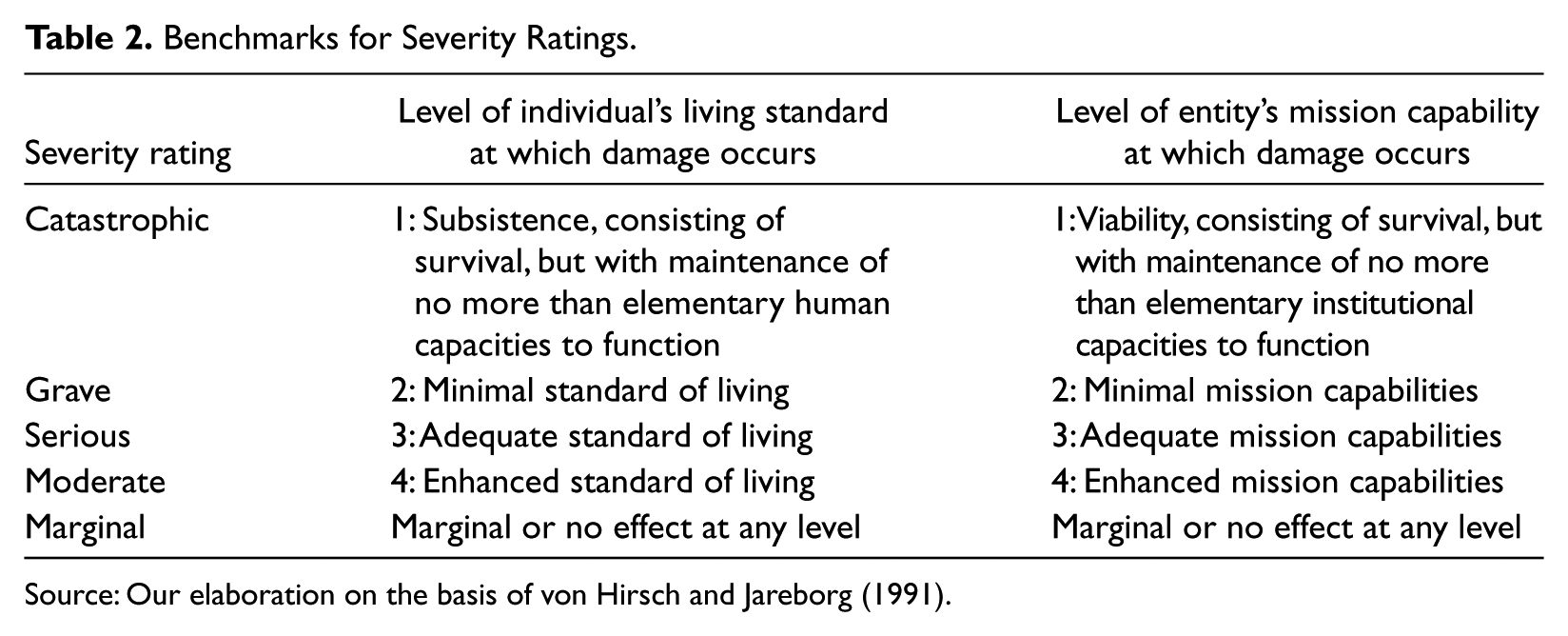
Source: Our elaboration on the basis of von Hirsch and Jareborg (1991).
For individual victims, the common benchmark is the standard of living, which von Hirsch and Jareborg (1991, p. 10), citing Sen (1987), conceptualize not as the “actual life quality or goal achievement” but, rather, as the “means or capabilities for achieving a certain quality of life.” The first four categories of severity—catastrophic, grave, serious, and moderate—correspond to intrusions at each of four living-standard levels, in rank order; the fifth category—marginal—pertains to crime that does not encroach substantially at any level. On this basis, death would result in a catastrophic harm, whereas momentary pain, discomfort, or anxiety would only imply a marginal harm.
We apply the same scale to harms to other bearers, but use a different benchmark, akin to a standard-of-living, for private-sector and government entities. Much as von Hirsch and Jareborg (1991, p. 10) focus on the individual’s “living standard” as the means or capabilities for achieving a certain quality of life, we focus on an entity’s ability to fulfill its “mission,” defined as the entity’s raison d’être. An entity suffers harm if it is less able to fulfill its mission.
For incidence, we also use a scale with five broad categories, in this case, ranging from always to rarely. If a type of harm is not relevant to a specific criminal activity, we label it “not applicable.”
Our matrix jointly rates the severity and incidence of harms (Table 3). Taken together, these ratings can provide an initial basis for prioritizing harms, whereas a severity or incidence rating, alone, cannot. For example, a grave harm might seem to merit more attention than a moderate harm, but if the grave harm rarely occurs and the moderate harm always occurs, the moderate harm may merit more attention. We treat these prioritizations as “initial”; to rank harms more definitively, one would need to weigh the costs of implementing measures to address them.
Matrix for Prioritizing Harms.
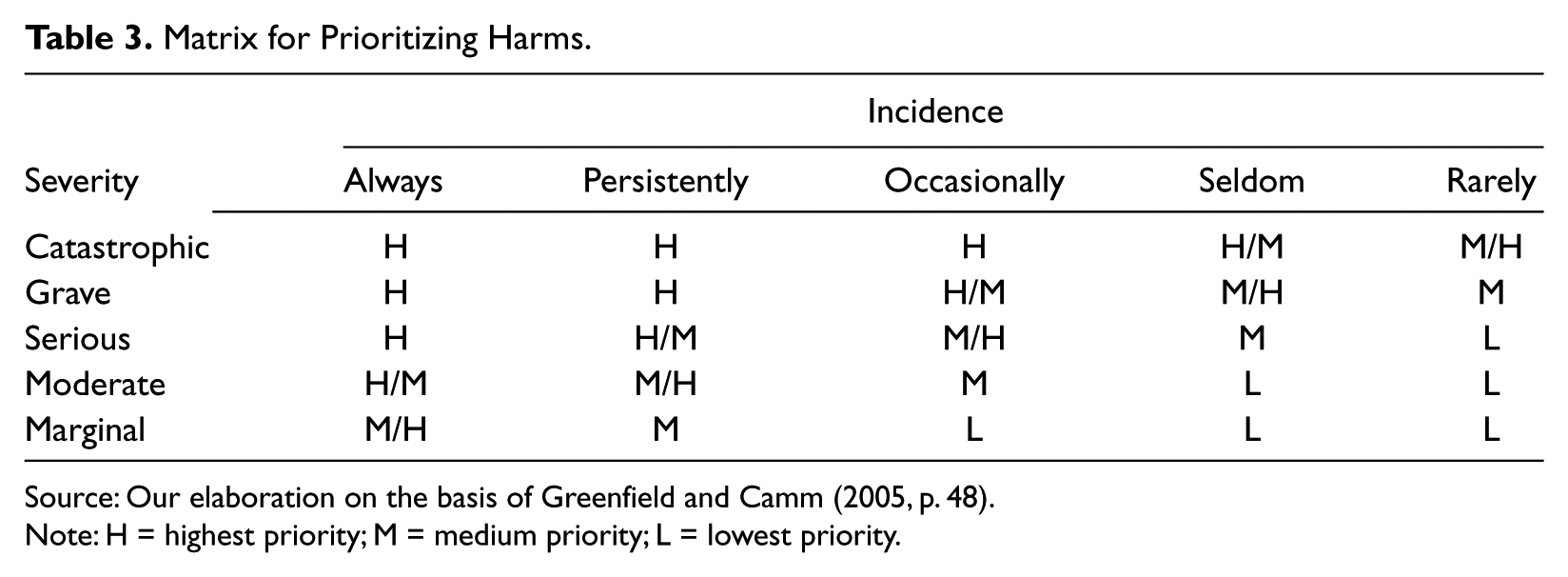
Source: Our elaboration on the basis of Greenfield and Camm (2005, p. 48).
Note: H = highest priority; M = medium priority; L = lowest priority.
As our rating scales suggest, we do not insist on quantifying all harms. When available, we use quantitative data to inform our evaluation, but our framework does not fundamentally require quantification. This flexibility buys us the freedom of using alternative means of analysis and formally incorporating qualitative insights. Following von Hirsch and Jareborg (1991) and the national security community, we accept expert judgment as valid, but we recommend triangulating such opinion with observations from other sources.
Another advantage of our approach is that it allows comparisons of a broad range of harms among individuals and, to a lesser extent, within the classes of private-sector entities, government entities, and the environment, even if harms remain largely incommensurable across classes of bearers. Different types of harms to individuals can be held to a common standard, that is, the “standard of living,” as can different types of harms to a private-sector or government entity vis-à-vis its “mission,” enabling comparisons within classes, but damages to an individual’s standard of living and an entity’s mission capability are not readily comparable. 8 In the final stages of our analysis, we can tally the numbers of highest, medium, and lowest priority harms for each criminal activity, and make general inferences from the distribution, but we cannot aggregate them is such a way as to say whether a set of 10 low-priority functional harms, 5 medium-priority material harms, and 1 high-priority reputational harm is better or worse than a set of 12, 4, and 2.
Nevertheless, our approach offers the benefit of making use of all available information, be it quantitative or qualitative, and, lacking need for large data sets or elaborate statistical methods, the potential advantage of speed. It demands rigorous thinking, but, absent an extensive data collection, one can still exploit the facts on-the-ground to conduct a rapid, yet systematic assessment.
The Harm Assessment Process
The harm assessment process consists of a series of steps that involves data collection, sorting, and analysis (Figure 1). We identify the possible harms associated with criminal activities, evaluate their severity and incidence, prioritize them, and establish their causality. This requires substantial knowledge of the activities. We begin by constructing a business model, defined loosely as the modus operandi for the criminal activity. The business model provides essential building blocks of information. We use it to characterize the key operational phases of the activity and, for complex crimes, describe the functions and modes of accompanying and enabled activities.
Having constructed the business model, we:
Identify the possible harms associated with criminal activities, such as cocaine trafficking, and the bearers of those harms; this step involves sorting harms by primary, accompanying, and enabled activities and classifying harms according to type and bearer with the taxonomy. 9
Evaluate the severity and incidence of harms; this step involves rating the severity and overall incidence of each harm with the ordinal scales. The overall incidence accounts for the incidence of each harm in relation to the criminal activity (the “within-activity” incidence) and the incidence of the criminal activity itself. A criminal activity might always produce serious harm, but if the activity is very rare, it might not merit concern.
Prioritize harms, using the matrix.
We also attempt to establish the causes of harms. Although we have not developed a specific tool for this step, we proceed in two stages. First, we assess the “distance” between the harms and the primary activity. The harms of enabled activities, for example, constitute “remote harms” (Ryberg, 2004, p. 64-65) because they are not just spatially–temporally distant but are mediated by the choices of other actors along the supply chain. Second, we examine the extent to which the harms associated with a criminal activity arise from the policy environment, including the prohibition of the activity and related regulations and enforcement practices. We carry out this assessment on the basis of counterfactual reasoning, a common test of the validity of claims of causation in the social sciences and in historical studies (Calhoun, 2002): We consider what might have happened had the policy not been in place—in this case, for example, had cocaine trafficking not been prohibited. The purpose of this exercise is to assess the extent to which harms are intrinsic to an activity or an artifact of policy and, thus, to identify arenas in which policy makers might have substantial leverage to effect change.
Research Design and Data Collection
Our assessment of the harms associated with cocaine trafficking in Belgium is based on an extensive data collection and analysis. The majority of our primary sources originate from the Belgian criminal justice system. First, we analyzed the data files for all of the 81 criminal proceedings pertaining to cocaine trafficking that were opened by the Belgian Prosecutor’s Offices in Belgium from 2006 to 2008 and included in the organized crime database of the Belgian Federal Police. To be recorded in that database, a case must meet the criteria of the official Belgian definition of organized crime, which is drawn from the German BKA’s (Federal Police Office) and is very broad (see BKA, Bundeskriminalamt, 2009). The database includes virtually all major cases of wholesale cocaine trafficking investigated by the Belgian police but provides only very basic, standardized information about each case. On the basis of a questionnaire that includes several questions about attempted or effective use of violence and corruption, the central police headquarters collects information from the field officers directly responsible for the investigations. As with all police data, there is a problem of “dark number,” as the data concern only the cases known to the police, who, in turn, primarily aim to collect evidence to back the main charge—that is, cocaine trafficking—rather than to substantiate associated activities. Presenting a further limitation, the data in the database are not systematically updated after the initial recording.
Second, we examined a set of 52 criminal proceedings that were opened by the same Belgian Prosecutor’s Offices between 2003 and 2009. 10 This source covers some of the same ground as the organized crime database, 39 of the 52 cases appear in both sources, but it spans more years, includes some cases that did not involve organized crime entities, and contains substantially more information about each case, including those that overlap. This source, which provides the texts of full case reports and case summaries, the latter ranging from 4 to 100 pages in length, was a key source of information for the business model.
We have tended to treat the two sources—the organized crime database and the set of 52 criminal proceedings—separately because they are dissimilar in nature. We refer to the 81 data files as “the (organized crime) database” and to the 52 proceedings analyzed as “our sample” of cases.
Third, we interviewed 18 criminal justice experts—6 police officers, 3 customs officers, 1 public prosecutor, 3 police analysts, 4 money laundering specialists, and 1 prison doctor. Fourth, we interviewed 12 inmates in Belgian prisons who had direct experience in cocaine trafficking. 11 Fifth, we reviewed government reports (e.g., the extensive biannual reports on organized crime; Dienst voor het Strafrechtelijk Beleid, 2008) and statistics (e.g., FGP-Airport, 2010), media articles, and the scientific literature. Although we limited our collection of primary data to Belgian sources, we also considered academic and policy analyses undertaken in nearby countries, such as the Netherlands and United Kingdom. In those instances, we extrapolated from the results and, if necessary, made adjustments for Belgian circumstances. Given our reliance on Belgian sources and data, we do not assess the harms accruing to bearers in other countries.
We emphasize that our assessment of the harms has been strictly evidence based. In our framework, we admit other experts’ judgment but not our own. Thus, we cannot be accused of codifying our prior opinions as fact; however, this stance may lead us to underreport some harms.
The Business Model of Cocaine Trafficking in Belgium
In building our business model (Figure 2), we identified two key phases of Belgian cocaine trafficking (import and wholesale distribution or export), three accompanying activities (money laundering, use or threat of violence, and corruption), and two enabled activities (retail dealing and use).
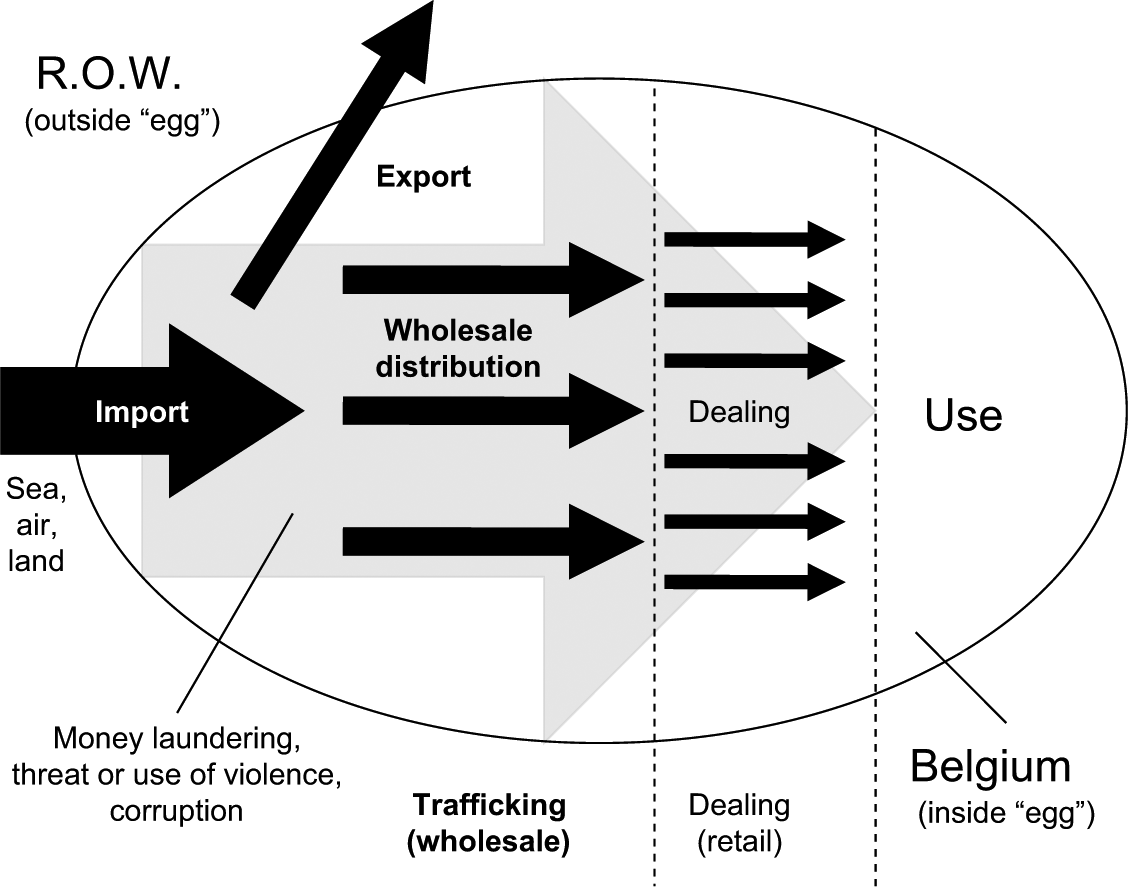
The business model.
For the import phase, we distinguish among sea, air, and land routes because they accrue harms differently. We describe these phases and activities below, considering the relevance of violence and corruption to each. Although we have identified drug use as an enabled activity, we do not assess the harms associated with use in this article; such an assessment would be necessary for an analysis of alternative policy options, but it is beyond our scope.
Import
According to law-enforcement sources, cocaine primarily enters Belgium via two entry points: the port of Antwerp (hereafter “Antwerp port”), which is the second largest port in Europe and the seventh largest in the world (Port of Antwerp, 2010) and the country’s two international airports, particularly Brussels International Airport (hereafter “Brussels airport”). Cocaine is also smuggled into Belgium via land, largely from the Netherlands. The Antwerp port’s dominance in Europe’s sea trade has helped to make Belgium a key transit point for cocaine. The 2006 International Narcotics Control Strategy Report of the U.S. Department of State (2006, p. 143) hypothesizes that 20 tons of cocaine may enter the port each year, adding that “the actual number is believed to be considerably higher.” Belgian officers were generally more cautious in pinning down a number (Int-CJ-3 and -8) but some of them (e.g., Frans, 2010) believed the U.S. estimate to be too low. The U.S. Department of State (2010) also reports—but the basis remains unclear—that about 25% of the cocaine moving from South America through Europe eventually transits Belgium. If correct, that would amount to at least 30 tons annually, calculated on the basis of United Nations Office on Drugs and Crime (UNODC; 2010b) consumption estimates for Europe and without accounting for seizures. 12 On a much smaller scale, Brussels airport accounts for the lion’s share of cocaine smuggled by air. It has good connections with most large Latin American and Caribbean countries and several African countries (e.g., Benin, Congo, Ghana, Sierra Leone, and Togo) that now serve as cocaine transshipment points. From 2005 to 2008, Antwerp port and Brussels airport accounted for 50% to 87% of the cocaine seized in wholesale amounts 13 in Belgium (Table 4).
Number of Large-Scale Cocaine Seizures and Amounts Seized in Belgium and Specifically at Antwerp Port and Brussels Airport (2005-2008). a
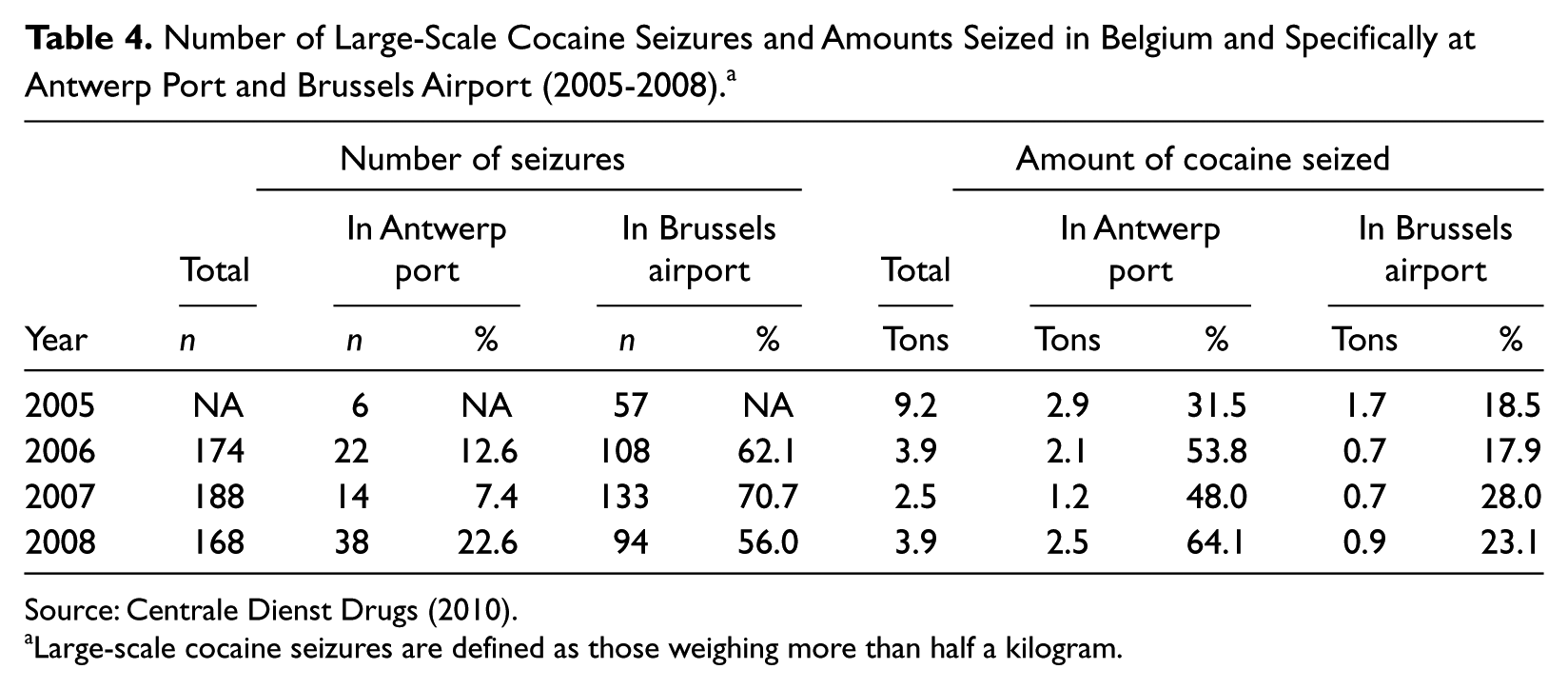
Source: Centrale Dienst Drugs (2010).
Large-scale cocaine seizures are defined as those weighing more than half a kilogram.
A comparison of seizure figures, transit estimates, and estimates of the aggregate annual consumption of cocaine in Belgium suggests that substantially more cocaine enters Belgium than is consumed there. Sewage water analyses (Van Nuijs et al., 2009) suggest an aggregate annual Belgian consumption figure of about 1.75 tons. Using an alternative method of calculation, based on UNODC data, we have come up with an estimate of 2.5 tons. 14 Large-scale seizures alone, ranging from a low of 2.5 tons to a high of 9.2 tons from 2005 to 2008 (Table 4), might be on par with or exceed the estimated consumption, even after adjusting for differences in the purity of cocaine in the measures. In other words, transshipment dominates.
Sea route
An overview of traffic at Antwerp port suggests the ease of smuggling cocaine through this (and similar) entry points and the challenges of interdiction. Advertising 160 km of quayside available for loading and unloading and 5.3 million square meters of warehousing, the port handles upwards of 150 million tons of freight in a year, witnesses tens of thousands of port calls, and describes itself as the “supermarket of Europe,” with trade flowing from the major cocaine-producing countries and their neighbors (Port of Antwerp, 2010).
Cocaine shipments via Antwerp port range from a few kilograms to several tons. The largest seizure on record in Belgium weighed 3 tons and was found in a banana container in 2002 (Belang van Limburg, 2002; Int-CJ-8). Four years later, Dutch authorities intercepted 4.6 tons of cocaine in Rotterdam that were bound for Antwerp (De Volkskrant, 2005). All sources, including three traffickers (Int-Of-2, -6, -7), indicated that cocaine shipments are frequently or most often hidden in containers.
Out of our sample of 52 proceedings, 40 were initiated by the Antwerp prosecutor’s office between 2003 and 2009. In at least 15 of these 40 criminal proceedings, dock- and other port workers were involved in retrieving cocaine from either a ship or a container (Case-LS-1, -2, -7, -11, -12, -13, -16, -17, -18, -20, -21, -22, -26, -27, -29; see also U.S. Department of State, 2010). The informant (Int-Of-7) with direct experience smuggling cocaine via the port reported that dock- and other port workers sometimes facilitated operations.
In most instances, we found that port workers were bribed. Their payoffs varied from €1,000 to €30,000 per operation, depending on their tasks (Case-LS-16 and -21). On some occasions, such as Case-Full-5, dockworkers may enter a ship, pick up one or more bags, and deliver them to a vehicle or drive them to a safe house. Alternatively, they might ensure that the right container stands on a predetermined spot or provide information about its location (Int-Of-7). At other times, dockworkers have delivered discharge documents to traffickers, informing them exactly when and where a ship would arrive (e.g., Case-LS-16).
Container technicians, and especially those who repair and maintain refrigerated containers, have also been involved in cocaine extractions. Refrigerated containers, having compartments for electronics and cooling equipment, are often used to transport fruits and other perishable goods that are shipped from cocaine-producing countries in Latin America. Technicians typically have free access to those compartments and can remove bags or packages at will. In nine of the Antwerp cases, smugglers used such refrigerated containers to hide the cocaine (in Case-LS-10, -19, -25, and Case-Full-8, only cocaine was retrieved; Case-LS-2, -7, -16, -21, and -29 also showed the involvement of container technicians). Two of our interviewees (Int-Of-6 and 7) also confirmed this practice.
Six Antwerp cases provided evidence of sailors or other ship staff’s, such as mess employees, involvement in smuggling (Case-LS-2 and -20; Case-SS-8 -9, -13, and Case-Full-8). These individuals delivered bags with cocaine to a person either waiting on the docks or entering the ship.
Whereas a few low-level ship- or port workers might be corrupt, the evidence suggests that the managers and owners of shipping and logistics businesses are usually unaware of misuse. We did not, for example, find evidence of a ship owners’ or captains’ complicity in either our sample or the database. Likewise, it appears that the containers used for shipping cocaine are usually rented from legitimate logistics companies that have no knowledge of the illegal activities. Manufacturing and service companies are only exceptionally drawn into investigations; when they are, they also seem to lack awareness of misuse. The managers or owners of three such companies played a knowing role in smuggling operations in 3 of the 40 Antwerp cases, but the companies were just front companies, without additional purpose (Case-LS-3, -9, and -24). The informant with direct experience in this business (Int-Of-7) stressed that smugglers tend to prefer hiding cocaine in the cargo of large legitimate manufacturing businesses that have a good reputation, carry out high-frequency shipments, and are completely unaware of being “hitch-hiked.”
We found only modest evidence of the threat or explicit use of violence in the import of cocaine via Antwerp port. Of the 40 Antwerp cases, 6 (Case-LS-1, -2, -17, -21, -30, -31) provided evidence that some traffickers had threatened their accomplices. In Case-LS-3, the Turkish individual who had organized the shipment was compelled to stay with the Colombian and Ghanese owners of the cocaine, while the 600 kg were loaded off the ship. In 6 cases (Case-LS-1, -2, -7, -14, -18, -26), partially overlapping with those documenting the threat of violence, small firearms (handguns) were found during searches or arrests. (The presence of firearms, even if suggestive, does not provide evidence of explicit use of violence.) Traffickers also emphasized the nonviolent nature of high-level cocaine smuggling, especially via sea: They all noted that the larger are the shipments, the less violent is the business (Int-Of-2, -3, -4, -5, -6, -7, -9, and -11). Two of them described violence as occurring “hardly ever” or “very rarely” during import (Int-Of-2 and -5).
We found no evidence of the threat or use of violence against government officials in either our sample or the database—a story confirmed by all of our interviewees. As a law-enforcement officer indicated (Int-CJ-3), the Belgian police hardly ever use firearms to arrest traffickers.
Corruption of Belgian government officials along the sea route appears to be at most a minor concern. An interviewee described a 2009 investigation (Int-CJ-8 with telephone updates in July 2011), in which a customs officer’s partner was accused of cocaine trafficking. The officer was cleared of facilitation and retained; the trial against the officer’s partner is still pending. In the course of a 2010 operation, the Belgian police also arrested a member of the Royal Marechaussee, a Dutch military police force, who had taken part in a smuggling operation at Antwerp port (Mos, 2010). 15
Air route
According to police statistics (FGP-Airport, 2010; Table 5), most cocaine smuggled via air reaches Brussels airport from Western Africa or Latin America. The statistics also show a sharp decline in the number of cocaine couriers arrested, from 164 in 2006 to 39 in 2009. We are unaware of any reduction in detection efforts and none of our interviewees could explain the decline definitively.
Cocaine Couriers and Body-Packers Arrested at Brussels Airport and Main Departure Airports (2006-2009).
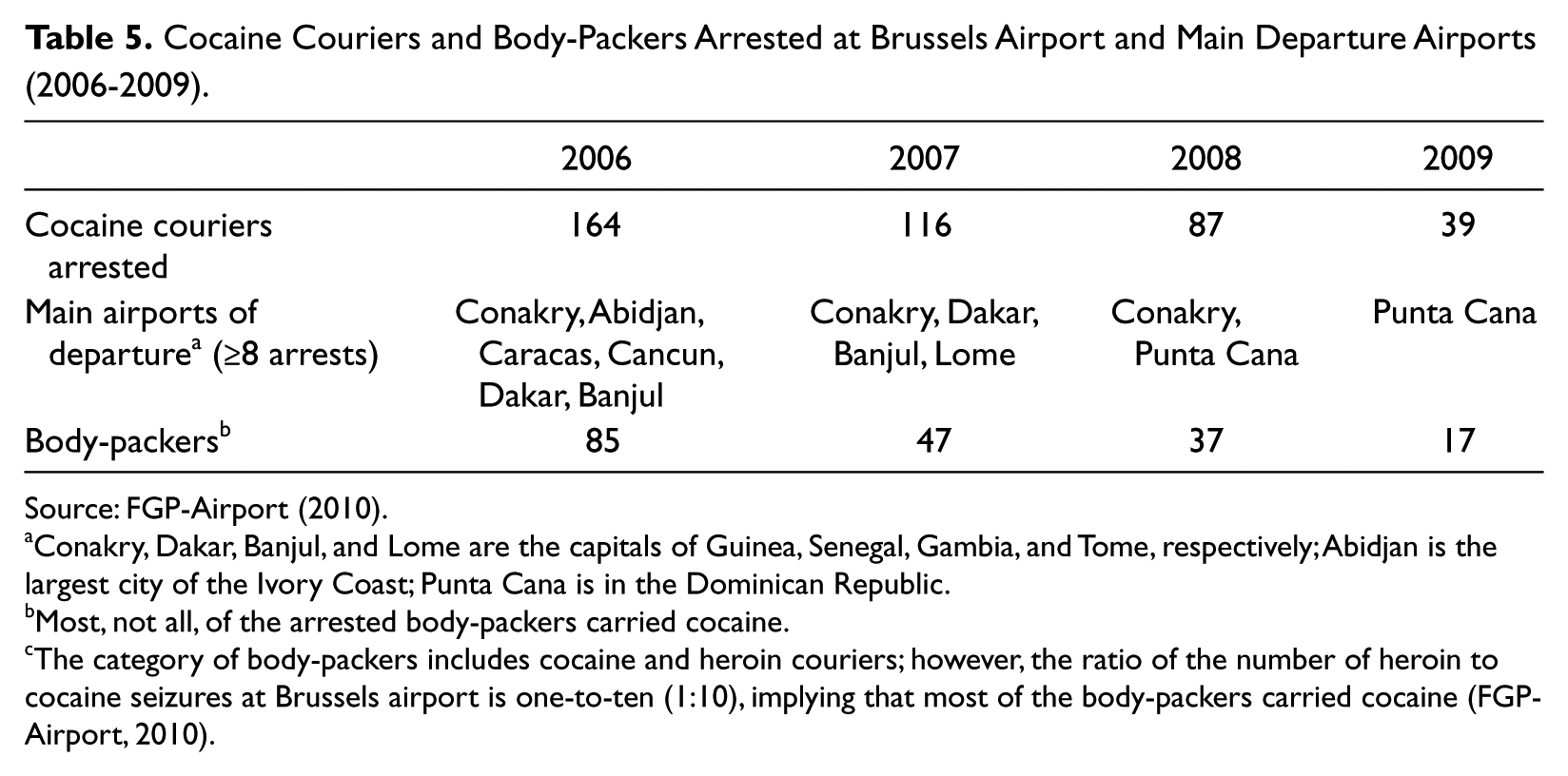
Source: FGP-Airport (2010) .
Conakry, Dakar, Banjul, and Lome are the capitals of Guinea, Senegal, Gambia, and Tome, respectively; Abidjan is the largest city of the Ivory Coast; Punta Cana is in the Dominican Republic.
Most, not all, of the arrested body-packers carried cocaine.
The category of body-packers includes cocaine and heroin couriers; however, the ratio of the number of heroin to cocaine seizures at Brussels airport is one-to-ten (1:10), implying that most of the body-packers carried cocaine (FGP-Airport, 2010).
The Belgian Federal Police (FGP-Airport, 2010) do not keep detailed statistics on smuggling techniques via air for each type of illicit drug, but three techniques seem to be more common than others. First, the drug may be hidden inside luggage. Second, couriers may hide small cocaine packets—or “balls”—in their bodies, either by swallowing them or inserting them in their rectum or vagina (the so-called “body-packers”). Third, couriers may hide cocaine or other drugs on their body, either under their clothes or inside their shoes. Although a few kilograms can be hidden in luggage—as demonstrated by the seizure of about 5 kg of cocaine in the luggage of couriers coming from Congo, Cameroon, and Togo (e.g., Case-Full-4 and -6)—body-packers and other couriers are not ordinarily able to carry more than 1 or 2 kg on each trip, as one of our informants, himself a body-packer, confirmed (Int-Of-10).
Of the three techniques, body-packing is the most dangerous, but lethal accidents have become much rarer as traffickers began vacuum packing cocaine balls. In the past decade, two body-packers have died on the flight to, or upon arrival at, Brussels airport, when some of the balls they were carrying in their bodies exploded (Int-CJ-4; see also Zaitch, 2002).
If cocaine is hidden in luggage, our evidence suggests that it is usually retrieved by its official owner, the courier, who brings the luggage out of the airport and consigns it to a trafficker, typically without involving the cooperation of airport personnel. In 2007 and 2008, though, in two partially overlapping investigations, 13 employees of the main baggage handling company at Brussels airport were arrested because they were suspected of participating in a number of cocaine smuggling operations; in the first case, the luggage came from several African countries and in the second case, from the Dominican Republic (Dernière Heure, 2007; De Standaard, 2007; Int-CJ-1 and -11; Case-Full-2 and -3). The baggage handlers extracted marked suitcases that contained cocaine from airplanes and delivered the suitcases to a contact person waiting in a car at the airport parking deck. They received up to €10,000 per operation (Dernière Heure, 2007; Int-CJ-9).
Other smuggling options include hiding cocaine in air cargo or leaving the cocaine on a plane and having it picked up by cleaners or catering personnel. Both of these techniques are reported infrequently by the Brussels airport authorities. In the period 2006-2009, the Belgian Federal Police identified seven instances of cocaine transportation by air cargo (FGP-Airport, 2010). In one proceeding (Case-Full-1), a cocaine trafficker approached a few employees of one of the world’s leading logistics companies—based in Brussels airport—and asked whether they wanted to extract packages from the secured logistical network that allows the company to skip border controls at entry points. The logistics employees were promised €10,000 to €50,000 per week. They refused the offer and informed their supervisor. Ultimately the trafficker was arrested (Int-CJ-1 and -9; Case-Full-1). Logistics companies may also be misused, albeit more passively, by people who try to send packages with cocaine from cocaine-producing or transit countries. This occurred in Case-LS-4, in which a group of Dutch individuals asked their contact(s) on the island of Curacao in the Caribbean to send packages containing about 600 g of cocaine to addressees in Antwerp.
Cocaine is also smuggled into Belgium with private planes. One of our interviewees (Int-Of-6) carried out such a transport operation from Ghana to France. Law-enforcement data suggest that this method is not very common; however, it might be underreported. The small airports that private planes typically use may have fewer security checks than large airports.
In none of these instances was there any evidence that senior staff of airport or other logistic companies were aware of—let alone had accepted or participated in—the misuse of their companies or facilities by traffickers.
Even more so than when smuggling by sea, the evidence on violence, be it threat or use, is scant. It seems plausible that workers (couriers and bribed airport employees) involved in smuggling operations may be threatened to ensure their compliance; however, we have found no evidence of any threats in our sources, including our interview with a body-packer (Int-Of-10). This interviewee added, speaking from personal experience, that traffickers often select couriers with financial problems that make them more dependent. Only in Case-Full-2 did a driver in charge of transporting bags of cocaine from the airport to a warehouse report being “ripped”; that is, robbed of drugs at a gunpoint. However, the police officer in charge of the investigation doubts the reliability of this account (Int-CJ-9).
Much as it is in the sea route, the corruption of government officials appears to be quite limited in this context. Only two law-enforcement officers have ever been suspected of facilitating cocaine smuggling via air (Case-Full-2 and -3). The suspects, a police officer and a police trainee, were closely related by ethnic and friendship ties to a group of traffickers, but it is yet unclear whether the small intelligence tips the police officer delivered concerned cocaine trafficking (Int-CJ-1 and -9). Although the criminal case is still pending, both suspects have been fired.
Land route
The third possible import route is land, including roads and railways. Much less information is available on land transit than on sea or air, as there are a large number of entry points and Belgian land borders are not patrolled.
The bulk of cocaine smuggled by land, in either small or large lots, arrives from the Netherlands. We found a consensus on this point among the experts (Int-CJ-3, -7, -10), our sample of criminal cases (e.g., Case-Full-7), and Belgian and U.S. official reports (e.g., Federale Politie België, 2008; U.S. Department of State, 2007). Several of the traffickers we interviewed also used to buy (large quantities of) cocaine in the Netherlands (Int-Of-3, -4, -5, and -9). Cocaine also arrives by land from other countries. In Case-LS-16, for example, several multi-kilogram lots of cocaine were smuggled into Paris by air couriers and then smuggled by car to Antwerp. In Case-SS-10, a private yacht was used to transport 1,200 kg of cocaine from Venezuela to Spain. Later, the cocaine was distributed by land; 300 kg arrived in Antwerp (see also Naesen & Demeyer, 2005). These other routes may be underassessed in official analyses because Belgium’s land borders are effectively open.
Transports from and to the Netherlands and other European countries are sometimes carried out with rented cars or vans and apparently without the knowledge of the rental companies. We found evidence of this practice in two cases (Case-LS-1 and -5) and two interviews (Int-Of-3 and -11), but found no corresponding evidence of material or other harms.
We did not find any specific information on the threat or use of violence and corruption in smuggling cocaine via land.
Export and Wholesale Distribution
Although Belgian authorities have limited information on export and wholesale distribution, there is no doubt that the cocaine imported into Belgium oftentimes continues its journey to the Netherlands. According to an Antwerp police officer (Int-CJ-3), the overwhelming majority of the cocaine (95%) entering Antwerp port is bound for the Netherlands. Whereas it was not possible to verify this estimate, Dutch authorities admit (Korps Landelijke Politiediensten [KLPD], 2005) that the Netherlands has become a hub in the European illegal drug market. In eight cases in our sample (Case-LS-1, -2, -9, and 20; Case-Full-1, -2, and -3; and Case-SS-2), we found evidence that the cocaine seized was intended for transshipment to clients in Amsterdam or, less frequently, in other parts of the Netherlands. As both criminal justice experts (Int-CJ-2, -3, -10) and traffickers (Int-Of-2, -3, -4, -5, -6, -7, and -9) explained, the wholesale load is often exported to the Netherlands, unpacked and cut, and then part of it reenters Belgium for domestic use, whereas the rest is shipped to other countries.
According to both law-enforcement officers and traffickers (Int-CJ-3; Int-Of-8), Antwerp seems to be the center of wholesale distribution in Belgium because of its port and its proximity to the Netherlands. Lots to be distributed in Belgium are, depending on their size, brought to warehouses or private premises, where they are split, cut, and repackaged for further distribution. After these operations, the cocaine packages initially imported by airport couriers may be sold to retail dealers. Two or three more transactions may be necessary before the larger loads imported by sea or land route reach the retail market (Int-CJ-10).
None of our sources documents corruption of either businesses or government agencies in export or wholesale distribution, but the threat or use of violence seems to be more common in this phase than during import. We found evidence of repeated “rip-deals” at the wholesale and middle-market levels: After a few successful exchanges, a trafficker orders a lot of cocaine larger than usual and then robs his supplier at gunpoint. Case-LS-31 involved an especially serious swindle. A Belgian citizen who mediated the sale of 4 kg of cocaine was taken hostage by the buyers, threatened with a gun, and assaulted. The traffickers and dealers we interviewed concurred that rip-deals are the most likely way to encounter the threat of violence and, more rarely, use of violence in the cocaine business (Int-Of-3, -5, -6, -7, -8, -9, -11). One interviewee (Int-Of-9) also admitted to carrying out rip-deals. Except for such swindles, traffickers and law-enforcement officers (e.g., Int-CJ-8) agreed that the level of violence in the Belgian cocaine market is low.
In general terms, the organized crime database, which unfortunately does not report data by phase, confirms the interviewees’ perceptions: Among the 81 cocaine trafficking cases represented in that database, we found evidence of only 1 kidnapping/hostage taking (the same episode that was reported in Case-LS-31) and 6 assaults of any kind (Table 6). 16
Violent Incidents Recorded in the Cocaine Trafficking Proceedings Listed in the Organized Crime Database of the Belgian Federal Police (2006-2008).
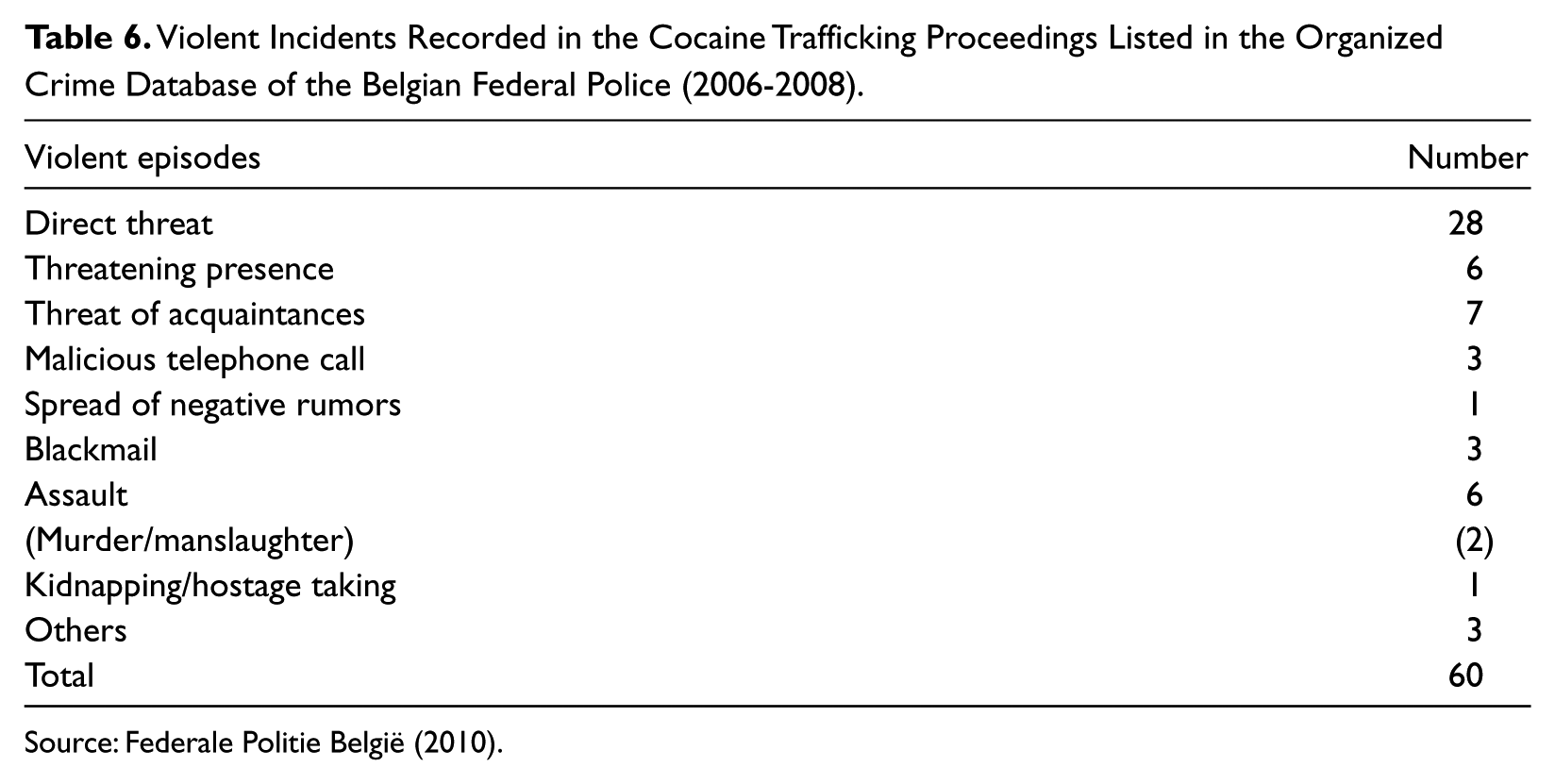
Source: Federale Politie België (2010).
Money Laundering
There are no official estimates of the revenues of cocaine trafficking in Belgium and, hence, of the sums available for laundering. From 2007 to 2009, the Belgian Financial Intelligence Processing Unit (Cel voor Financiële Informatieverwerking [CFI], 2009) received reports of illegal transactions related to drug trafficking for overall amounts ranging from €12 million in 2009 to €37 million in 2008. The CFI does not provide data for each type of illicit drug separately. For cocaine alone, the real figures could be higher. A UNODC report (2005) enables some scoping of the Belgian retail market: The agency estimates that consumers in Western and Central Europe used 107.4 tons of cocaine in 2003, valued at US$17,328 million at retail. Rough estimates of annual Belgian consumption, 1.75 tons (Van Nuijs et al., 2009) and 2.5 ton (our estimate, based on UNODC data, see “Import” section), suggest that Belgium could have accounted for about 2% of that market. On that basis, if average retail prices in Belgium were not very different from those elsewhere in Europe, Belgium’s retail stake could have amounted to almost $350 million. 17
A considerable fraction of trafficking revenues—possibly the majority of import revenues—appears to flow to other countries. Over 60% of the 660 cocaine traffickers recorded in the organized crime database for the years 2006 through 2008 were born outside of Belgium, mainly in the Netherlands (8.3%), Turkey (6.7%), Morocco (4.2%), and Ghana (3.2%) and, presumably, they repatriate some of their illegal revenues to their respective countries of origin (Federale Politie België, 2010). Belgian offenders also hold part of their ill-gotten earnings outside Belgium to avoid detection, as some of them admitted in interviews (Int-Of-6 and -7). Several criminal proceedings also offered evidence of these practices. In four investigations (Case-SS-1, -4, and -8; Case-LS-8), cocaine trafficking profits were moved via banks and money transfer companies to Afghanistan and Turkey, Brazil, Costa Rica and Brazil, and Nauru, respectively. In Case-LS-6, the profits flowed through an underground banking scheme in real estate projects in Dubai.
Our evidence indicates that the money kept in Belgium is used mostly to buy real estate or is spent on luxury goods and lifestyles (e.g., Case-Full-2, Case-SS-4, Case-LS-7, and -20, Int-Of-9). Surprisingly, considerable sums are also kept in cash and hidden at home (e.g., Case-LS-20) and, in one case, under the suspect’s bed (Case-Full-2). We found no evidence that traffickers have been able to infiltrate or affect any sector of Belgium’s legitimate economy, even locally. (We note that the value of the retail cocaine market probably amounts to only about a 10th of a percent of Belgium’s overall economic activity. 18 ) One trafficker (Int-Of-7) laundered his profits, which were up to €100,000 per operation, through his secondhand car company. In another episode (reported by the press), one of the biggest Belgium-based traffickers known—who, however, dealt primarily with hashish and heroin—bought a beauty salon in Antwerp for his ex-wife and invested part of his profits in a tourist resort in Thailand (Van der Aa, 2009).
These investment patterns also reflect the small scale of many cocaine trafficking enterprises based in Belgium. Contrary to the U.S. State Department’s assertion (2010, p. 143) that “the flow of cocaine to Belgium is mainly controlled by Colombian organizations with representative[s; sic!] residing in Africa and Europe,” our analysis of Belgian primary sources suggests otherwise. Colombians are just one of the nationalities involved in wholesale trafficking and are ranked as the seventh largest group (with Albania and the Philippines) in the list of cocaine traffickers registered in the organized crime database in the period 2006-2008. Nor did Colombians play a major role in the proceedings in our sample. Case-LS-7, one of the few relevant cases, described a Colombian arriving in Antwerp to take control of a container of cocaine parked in the port. Some Colombian trafficking organizations might own the drugs, but the Belgian police have difficulty establishing ownership, not least because many large shipments are destined for the Netherlands. There is no doubt, however, that small and ephemeral trafficking enterprises are also at work, often composed of Belgian and Dutch nationals (e.g., Case-LS-1, -8, and -9; for similar findings regarding trafficking in the Netherlands, see Van Duyne & Levi, 2005).
Retail Dealing
Belgium-based wholesalers only partially supply the Belgian retail market. Retail dealers and users often go to the Netherlands to buy cocaine (Int-Of-3, -4, and -9). If cocaine is bought by retail dealers in Belgium, it happens most frequently in Antwerp, which has become a national hub for Belgium.
As in other countries, there are two separate retail drug markets in Belgium: Cocaine products (and other illegal drugs) are sold on the street and in private settings. The street market is dominated by ethnic minorities and, specifically, recent migrants who often are not legal residents or lack job permits. In Brussels and Antwerp (Int-CJ-11 and -12), much as in Frankfurt and Milan (Paoli, 2000), these are predominantly North and Southern Africans. The undocumented migrants are especially vulnerable and, according to the accounts of some policemen, a few of them are mistreated and obliged to sell drugs by their employers, while their families in their home countries are threatened. In Charleroi, two undocumented migrants reportedly asked for help from the police (Int-CJ-10). Although they are less visible, native-born Belgian addicts also continue to function as street sellers.
In other urban contexts, street dealing and the presence of addicts cause public nuisance, principally in disadvantaged neighborhoods; however, this seems to be atypical in Belgian cities. Open drug scenes are not tolerated. In Brussels, no neighborhoods are traditionally associated with drug sales (Decorte et al., 2004, p. 12). Decorte et al. (2004) carried out a detailed study on drug-related nuisance throughout the country; in a survey of 3,700 individuals “less than 1% of the nuisance reported was regarded as drug-related ” (p. 157; our translation)—an assessment largely confirmed by Decorte et al.’s ethnographic fieldwork in Antwerp and Charleroi and our interviews (Int-CJ-10, -11, and -12).
As in other European cities, cocaine is also sold in closed-scene settings, typically by indigenous people or by second- or third-generation immigrants (Paoli & Reuter, 2008). An extended study of cocaine use in Antwerp provides little evidence of criminal professionalization among closed-scene retail dealers: Users report most often acquiring cocaine from friends or a single, regular dealer (38% and 35%, respectively, of the 111 users interviewed). The majority of those buying cocaine from a dealer visited him or her at home (38%) or arranged a home delivery by telephone (18%). Only 9% bought cocaine on the street (Decorte, 2000; see also Cohen & Sas, 1993).
All of our sources indicate that neither open nor closed-scene dealing requires the corruption of government agencies or legitimate businesses. In closed-scene dealing, some cafés and discos are misused by dealers to sell cocaine, without evidence of the managers or owners’ complicity. In street dealing, flats are sometimes rented to hide and “cut” the cocaine, usually by the dealer supplying and/or supervising the street workers (Int-CJ-10 and -11).
Violence also seems to be used sparingly, particularly in the closed-scene settings where cocaine exchanges are embedded in a relationship of trust. Swindles do happen in the open-scene retail market and among street dealers and their cocaine suppliers, but they do not often involve violence. According to police officers working in Brussels and Antwerp (Int-CJ-10, -11, and -12), police hardly ever find guns in the possession of street dealers and their cocaine suppliers.
Assessing the Harms of Cocaine Trafficking in Belgium
On the basis of this business model of cocaine trafficking in Belgium, we have implemented the remaining steps of the harm assessment process. As noted previously, our assessment excludes harms incurred outside of Belgium and those associated with cocaine use in Belgium.
Identifying Harms and Bearers
First, we identify the possible harms and potential bearers for each phase of the primary activity (i.e., cocaine trafficking), its accompanying activities (i.e., money laundering, corruption, and the use or threat of violence), and retail dealing. The results of this exercise are shown in Table 7. That a harm is listed in Table 7 does not imply that it occurs to any great extent, but that it is relevant or plausible, given what we have learned about those activities from our business model.
Possible Harms and Bearers in Different Phases of Cocaine Trafficking, Its Accompanying Activities, and Dealing.
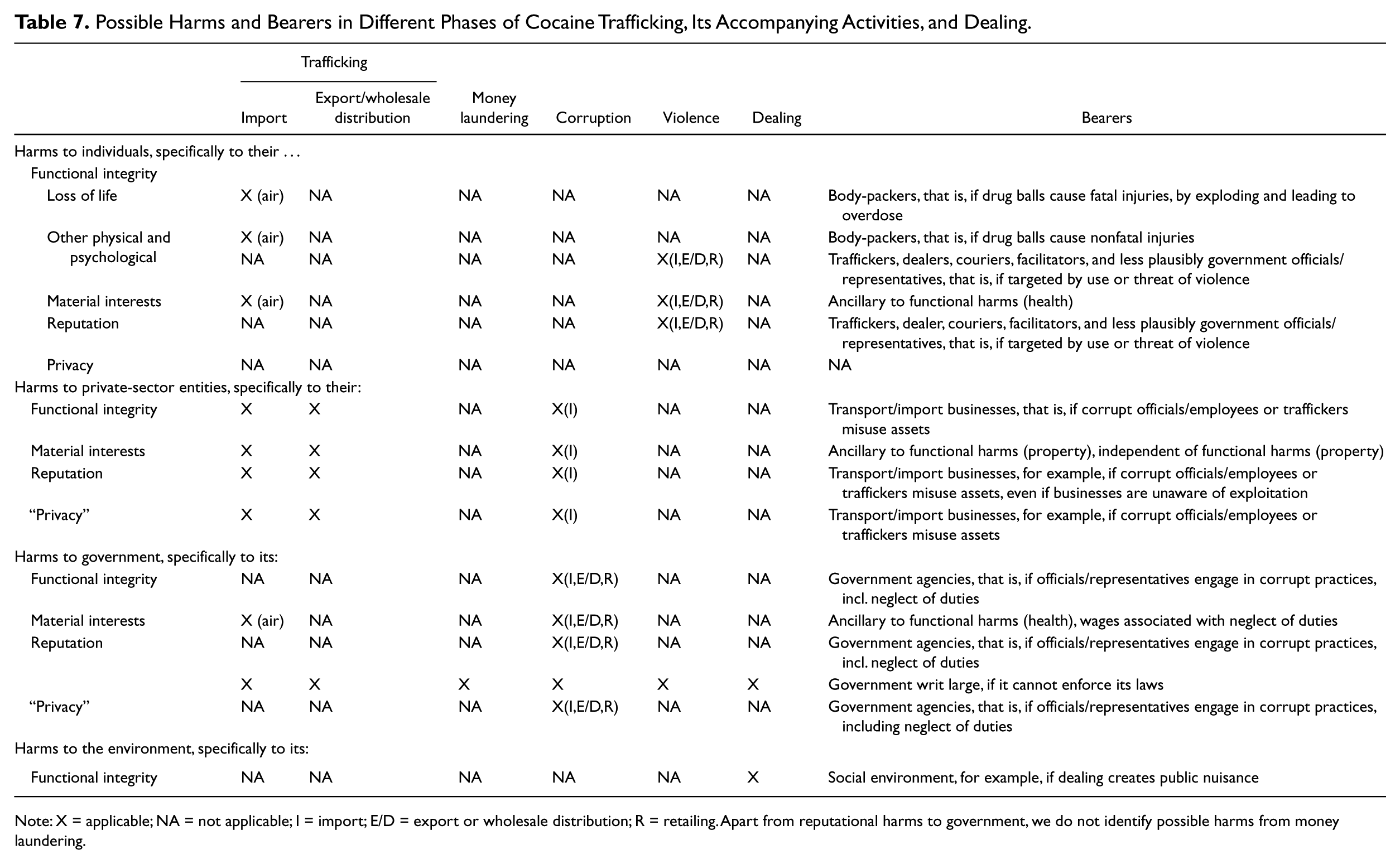
Note: X = applicable; NA = not applicable; I = import; E/D = export or wholesale distribution; R = retailing. Apart from reputational harms to government, we do not identify possible harms from money laundering.
Here, we highlight just a few examples. Across all phases of cocaine trafficking and in retail dealing, traffickers, dealers, couriers, facilitators and, much less plausibly, government officials, or representatives could suffer harm to their physical or psychological integrity if they encounter violence. Body-packers may suffer physical and psychological losses from overdoses. Moreover, the government may suffer reputational harm if it appears unable to enforce its laws, whether pertaining to trafficking, retail dealing, or money laundering. Finally, retail dealing may affect the functional integrity of the social environment if it creates a public nuisance or otherwise disrupts neighborhoods.
On the basis of the business model, we have also excluded some types of harms. For example, we found nothing in the business model to suggest the relevance or plausibility of harms to NGOs or the physical environment (the cocaine found in sewage water might, at least speculatively, enter and affect the environment, but it derives from drug use, not trafficking) and, thus, we regard them as not applicable (NA) for Belgium. In addition, we also excluded harms to manufacturing and service businesses, because those few that were found to be involved in cocaine trafficking were front companies, established only for illicit purposes. Similarly, we found nothing in any of our sources to suggest harms from money laundering, apart from those to the Belgian government’s reputation.
Evaluating Severity and Incidence
Whereas we identified possible harms on the basis of relevance or plausibility, in this evaluation, we confine ourselves to evidence of realization as we find it in the sample of proceedings, organized crime database, academic and grey literatures, and interviews. Lacking credible evidence of a specific “harming” event, we do not include the related harms. As such, a harm that we deemed possible on the basis of the business model might not materialize in our analysis with a rating.
We begin by evaluating the incidence of the primary activity, that is, cocaine trafficking. Recalling the U.S. Department of State (2010) report of Belgian throughput (25% of the cocaine moving from South America through Europe, potentially amounting to at least 30 tons annually) and given the variability of shipment quantities (ranging from grams to tons) and the frequency of seizures, we describe trafficking as a “persistent” activity. Working with the 30-ton figure and the average seizure amount for all points of entry, that is, 19 kg per seizure (calculated using the data in Table 4 from 2006 to 2008), we estimate that smuggling incidents occur at an average rate of just more than 4 per day. If, instead, we separately distinguish between small- and large-scale smuggling operations, defining small and large scale on the basis of the average seizure amounts at Brussels airport and Antwerp port, respectively, that is, 7 and 78 kg at each location, we find that small-scale operations occur about 3.5 times each day and that large-scale operations occur more than 5 times each week.
Next, we evaluate the severity and “within-activity” 19 incidence of the harms of each primary, accompanying, and enabled activity, with the noted exception of drug use. If the harm is tied to an accompanying or enabled activity, we define that activity in sufficiently specific terms to establish a one-to-one correspondence between that activity and the harm. In effect, we create subcategories of activities for corruption, violence, and so on, such as threats, petty assaults, assaults, kidnappings, and deaths. Typically, our evaluations of the within-activity incidence of each harm stand as our evaluations of the overall incidence. In concept, we should “multiply” the within-activity incidence by the incidence of the activity, itself, to arrive at the overall incidence. However, in most instances, multiplying the within-activity incidence by “persistently” does not result in a readily discernable difference between the overall incidence and the within-activity incidence. We note one exception below, in a case of reputational harms. Table 8 provides a synthesis of our assessment of the harms associated with cocaine trafficking, money laundering, corruption, violence, and retail dealing.
Evaluation of Harms.
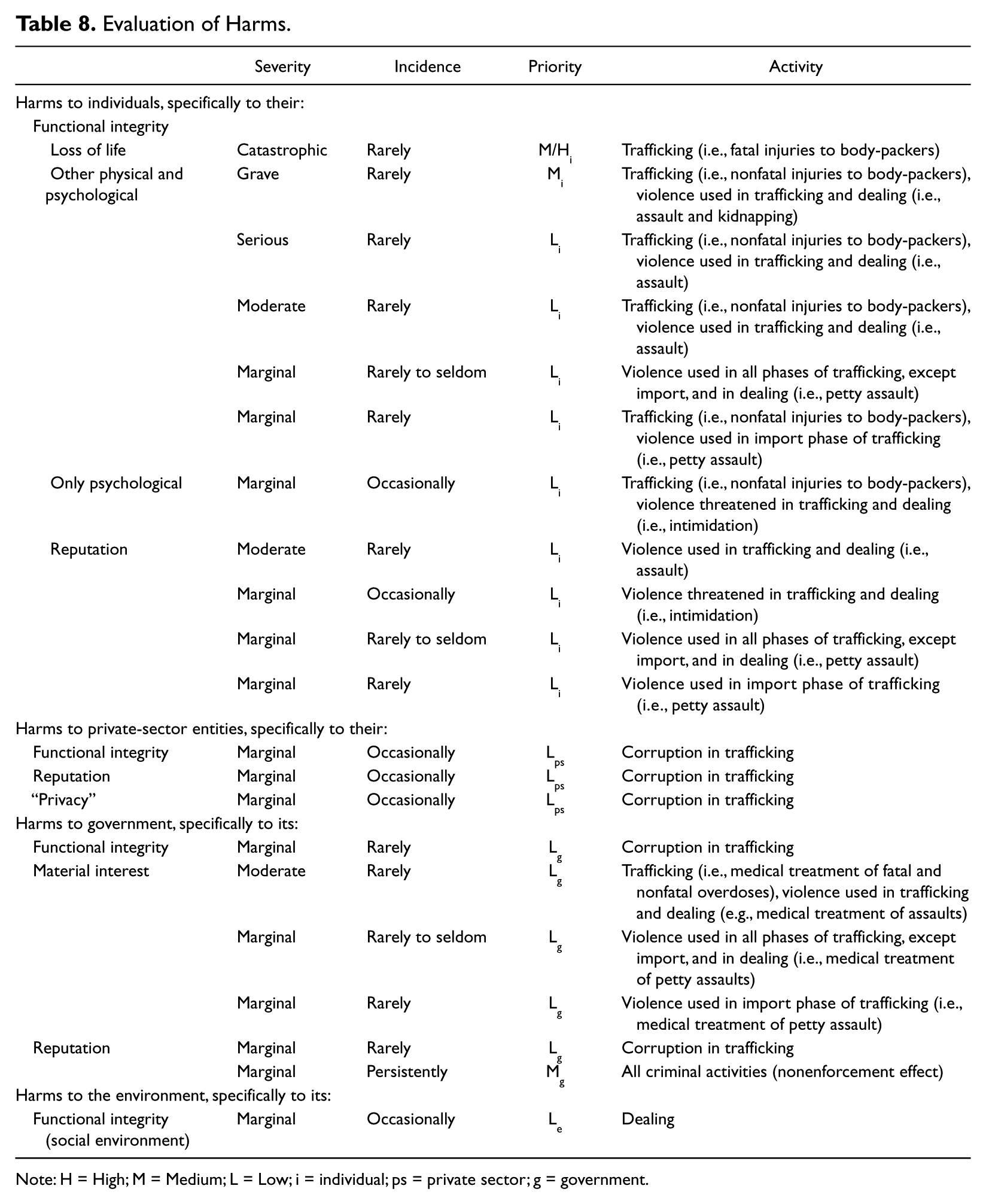
Note: H = High; M = Medium; L = Low; i = individual; ps = private sector; g = government.
Harms to individuals
We find that cocaine trafficking, its accompanying activities, and retail dealing, together, yield moderate to catastrophic harms to individuals in Belgium, but only rarely, and yield marginal harms, rarely to occasionally.
Body-packing, a particular form of trafficking, presents harms to individuals’ physical and psychological integrity, including their dignity, ranging from marginal to catastrophic and is the only activity that yields a catastrophic functional harm—that is, death. According to our sources, deaths occur exclusively during or immediately subsequent to air transit, both of which we describe as occurring “in Belgium” for the purposes of this analysis. We assess the incidence of this harm as rare, given that “only” two body-packers have died on the flight to, or upon arrival at, Brussels airport since 2000 (Int-CJ-4).
Our assessment is consistent with several contemporary studies carried out in other countries (the United Kingdom and Italy), which find that cocaine body-packers rarely incur lethal or very serious complications. In a study conducted at Heathrow airport (1996-1999), 7 of 180 identified body-packers needed surgical interventions and none died (Bulstrode, Banks, & Shrotria, 2002). In Italy, 161 body-packers arrested at Milan airport (1999-2000) were observed in the nearby emergency room: 15 complained of colicky pain, 10 recovered with food deprivation and medical treatment, and 5 required surgery (Pidoto et al., 2002). Given the lack of Belgian statistics, we rely on these studies to conclude that body-packing may yield additional marginal to grave functional harms, also rarely.
As discussed previously, we found little evidence to suggest that the use of violence would result in more-than-marginal functional harms. Case-LS-31 was the only case in our sample that provided evidence of explicit use of violence: This incident, involving a hostage taking during a wholesale transaction, had grave implications. According to criminal justice officers and traffickers, assaults seem to happen “hardly ever” during import (Int-Of-2 and -5) and “very rarely” at the wholesale and retail levels (e.g., Int-CJ-8 and Int-Of-9). The organized crime database of the Federal Police appears to confirm the nonviolent nature of the Belgian market, listing only six assaults in addition to the hostage taking (Table 6). Lacking information on the types of assaults and not being able to allocate these six assaults by phase of operations, we triangulate the data with evidence from other sources and conclude that the use of violence yields moderate to grave harms to individuals’ physical and psychological integrity, including dignity, albeit rarely. As none of our sources provides evidence of cocaine-trafficking-related murders or manslaughter, we do not regard the use of violence as an activity that leads to catastrophic functional harm.
The use of violence could also result in marginal functional harms, but we have even less evidence to work with in making this assessment. To start, we assume that “petty assaults” are more likely than other, more serious forms of assault to result in marginal harms. On that basis, we note that all our sources, including traffickers (Int-Of-2, -3, -4, -5, -6, -7, -9, and -11), suggest that petty assaults occur at most rarely—and possibly never—during import, but the story is less clear further down the supply chain. The database provides evidence of six assaults, petty or otherwise, and our sample does not specifically mention any petty assaults. However, law-enforcement agencies may underreport minimally intrusive assaults, as two law-enforcement officers admitted (Int-CJ-7 and -8), either because the agencies lack awareness of minor episodes or because they do not record all of them. Petty assaults are also rarely reported by offenders, who, however, repeatedly mention rip-deals (Int-Of-3, -5, -6, -7, -8, -9, -11). These swindles are generally carried out with malice or threats, but sometimes involve physical violence. Lacking the grounding to offer a singular evaluation, we regard these marginal harms to individuals’ physical integrity as occurring rarely to seldom further down the supply chain.
Both criminal justice sources and traffickers report that threats—and thus marginal harms to individuals’ psychological integrity, including dignity, absent a physical component—occur at least occasionally. Threats and rip-deals are only mentioned four times in our sample (Case-LS-2 and -31) but 45 incidents of threats and blackmail are reported in the database, and rip-deals occur repeatedly according to offenders (Int-Of-3, -5, -6, -7, -8, -9, -11).
These findings are consistent with observations on drug markets in other developed nations: The use, if not threat, of violence tends to be limited. According to Pearson and Hobbs (2001, p. 42), “violence and killings attract police attention and leave traces, as well as attracting retaliation. Violence is therefore strictly ‘bad for business’” (see also Dorn, Levi, & King, 2005; Reuter & Haaga, 1989).
If used at all, violence is directed primarily against other traffickers, including rivals. Perpetrators were the victims of 50 of the 60 violent episodes reported in the database. Of the 10 other victims (1 police officer, 1 magistrate, 4 informants, 6 private persons/business representatives, 1 politician, and 1 other), 9 were only threatened. Only the employee of a legitimate business was assaulted (for a similar picture, see also Int-Of-2, -3, -4, -5, -6, -7, -9, and -11).
The threat or use of violence associated with cocaine trafficking in Belgium also affects individuals’ reputations. The incidence of such intrusions varies by type of assault, from rarely to occasionally. Given the long-term perspective of the living-standard approach (von Hirsch & Jareborg, 1991), we find that the effect of an assault on one’s reputation is marginal to moderate.
Harms to private-sector entities
Our sources indicate that private-sector corruption occasionally yields marginal harms to businesses’ operational integrity, and reputation.
Employees of shipping and logistics businesses were found to participate in cocaine smuggling through Antwerp port in 19 of the 40 of the criminal proceedings initiated by the Antwerp prosecutor’s office (15 cases of port workers, including container technicians and 4 ship staff members: Case-LS-1, -2, -7, -11, -12, -13, -16, -17, -18, -20, -21, -22, -26, -27, -29; Case-SS-8 -9, -13, and Case-Full-8). 20 Some offenders and criminal justice officers (Int-Of-7 and Int-CJ-7 and 9) confirmed the repeated involvement of port workers. We found less evidence of corruption at Brussels airport. Two cases (Case-Full-2 and -3) document import facilitation by employees of baggage handling companies. 21 All these episodes touch upon the businesses’ operational integrity, reputation, and privacy. Given the not insubstantial share of cases involving corruption and the confirming perspectives of some offenders and officers, we regard the incidence of harms to these three interest dimensions as occasional; however, because the cases involved only low-ranking employees, we consider the harms to be marginal.
Although we attribute occasional, marginal harms to the foregoing episodes, the misuse of a business’ facilities or assets need not imply harm per se. As already noted, these same businesses and some other transportation and manufacturing companies are also misused episodically by traffickers who exploit facilities or assets (e.g., containers or rental cars) to smuggle and hide cocaine without the businesses’ authorization or awareness and without any degree of publicity or genuine intrusion. Absent public knowledge, that misuse cannot have a reputational effect; absent a genuine intrusion, it cannot have an operational effect. If, as we observe, traffickers transport cocaine by ship or airplane or in a container or rental car without any access to the businesses’ private records, proprietary information, and so on, or the cocaine circulates in the public areas of sea and airports along with other cargo and luggage, then the traffickers misuse the means of transportation and facilities that are intended for use by legitimate customers, but without violating privacy.
We did not find any evidence of harms to private-sector entities’ material interests.
Harms to government
Only three law-enforcement officers, one a trainee, have ever been suspected of facilitating cocaine trafficking in Belgium. The investigations are ongoing, but the evidence clearly indicates that the officers’ and trainee’s roles have been, at most, very minor and yielded only the slightest damage to the operational integrity, material interests, privacy, and reputation of the Belgian police or customs. According to the experts interviewed in Antwerp and Brussels, no other cases of cocaine-related corruption have ever come to the fore—foreign sources (U.S. Department of State, 2010) and traffickers (Int-Of-7 and -9) concur. Thus, we regard the harms of corruption to the Belgian government’s operational integrity and reputation as rare and marginal.
More generally, we argue that the reputation of any government suffers at least slightly, whenever it appears unable to enforce one of its laws, such as a law prohibiting cocaine trafficking or corruption. This harm might be marginal, but it always occurs when lawbreaking leaves the impression that a government lacks authority. Given that cocaine trafficking through Belgium occurs persistently—and with some notoriety—it seems reasonable to assert that it creates such an impression for the Belgian government. However, because cocaine trafficking occurs just persistently and not always, the overall incidence of this harm to the Belgian government is not “always,” but just “persistently.”
Finally, we believe that, given the public provision of emergency medical care in Belgium, the government would likely bear the immediate material burden of treating trafficking-related overdose and assault cases. (Eventually, however, the government must pass this cost on to Belgian taxpayers.) Not having undertaken an analysis of the costs of specific medical services, we can only speculate that the damages would range from marginal, for petty assaults, to moderate, for serious beatings and overdoses. Tracking the incidence of the underlying assaults and overdose episodes, we conclude that the government would incur marginal costs rarely during import and seldom to occasionally in all other phases of trafficking and dealing; it would incur moderate costs only rarely.
Harms to the environment
Retail dealing may generate harm to the social environment, but only marginally and occasionally. Open drug scenes are not tolerated in Belgian cities and most socially integrated users—the large majority of all users—buy their cocaine in closed-scene settings (e.g., Int-CJ-10). Even street dealing is largely inconspicuous. Dealers have no interest in attracting law-enforcement attention. As discussed previously, Decorte et al. (2004) indicates that drug-related nuisance is uncommon in Belgium and is associated primarily with the presence of addicts, not their suppliers. We find no evidence of harm to the physical environment from cocaine trafficking, its accompanying activities, or retail dealing.
Prioritize Harms
Next, we turn to prioritization. As shown in Table 8, few of the harms associated with cocaine trafficking in Belgium rank more than “low.” Within the category of the harms to individuals, we rank the catastrophic loss of life generated by body-packing as a medium–high priority because it happens rarely. We consider the grave but rare harms to individuals’ physical and psychological integrity arising from serious assaults as medium priorities. Among the harms to other bearers, only the Belgian government’s general reputational harm warrants a medium priority—Although we regard the harm as marginal, it happens persistently.
Our rankings enable prioritization, but only up to a point. Although our approach facilitates the systematic assessment of wide-ranging harms, it does not, as noted previously, fully enable the aggregation of harms within a particular class of bearers or allow direct comparisons of analogous harms across classes of bearers. For example, we cannot rule on whether medium-high-priority functional harms to individuals, as occur in body-packing, merit more or less concern than medium-high-priority functional harms to private-sector or government entities. Moreover, lacking information about the relative costs of addressing harms, we cannot, even within classes, offer definitive ranks. Nevertheless, we can still examine the broad sweep of ratings and draw preliminary conclusions from their distribution: In this way, we find that the harms of cocaine trafficking notably involve, but are not limited to, the individuals who are, themselves, traffickers.
Finally, we note again that we treat the overall incidence of all but the government’s general reputational harm as roughly equivalent to the within-activity incidence. Strictly speaking, each harm should be viewed as occurring somewhat less frequently because the primary activity, that is, cocaine trafficking, occurs “persistently,” not “always.” The difference should not affect the harms’ relative rankings, except perhaps in relation to the discounted reputational effect, but it might affect prioritizations vis-à-vis other criminal activities.
Establishing Causality
The final step of the assessment process consists of establishing the causality of harms: We assess the distance between harms and the primary activity and the extent to which the harms arise from the policy environment. First, only the rare and marginal harms accruing from retail dealing are remote. All of the other harms are directly associated with cocaine trafficking and its accompanying activities, as they transpire in Belgium. Second, most or all of the harms associated with cocaine trafficking, with its accompanying activities, and with retail dealing appear to derive—once subjected to counterfactual reasoning—from the legal status of cocaine and from law-enforcement practices around that status. There would be little or no body-packing and less corruption and violence if cocaine could be legally imported into, traded in, and exported from Belgium. (We cannot rule out such practices because, even in a “legal” regime, illegal markets would likely develop outside what might be imagined as a highly regulated system.) Similar conclusions have been reached in other countries. MacCoun and Reuter (2001, pp. 105-112) conclude that “tough enforcement is responsible for much of the observed damage” associated with trafficking in the United States.
The establishment of causality for use-related harms requires further consideration. Although we did not assess these harms, two points merit mention. First, the harms of drug use are remote and, thus, it is a normative step to decide whether and to what extent they should be considered a consequence of drug trafficking. Second, there is no doubt that some use-related harms arise from the inherent properties of the drug. (For a brief review of the health consequences of cocaine use, see European Monitoring Center for Drugs and Drug Addiction [EMCDDA], 2007.) However, here too, policy, including modes of enforcement, and other economic, social, and cultural factors feature prominently. For example, a policy of prohibition—and all it might entail—will affect the price and quality of cocaine, which, in turn, can affect consumption and its effects. Some users shift from snorting to injecting to increase their satisfaction from expensive, diluted drugs (e.g., Decorte, 2000).
Having linked most or all of the harms of cocaine trafficking, per se, to the policy environment, we must, however, caution against overinterpretation. Without carefully assessing the harms associated with cocaine use and establishing their causes, which we have not done in our analysis, it is impossible to say whether the balance of the harms resulting from cocaine, itself, and those produced by the policy—legal status, regulations, and enforcement practices—is positive or negative (see also MacCoun & Reuter, 2001). On the contrary, realizing that a policy gives rise to harm may provide policy makers with an opportunity. In New York, for example, changes in local police enforcement practices have led to a radical decline in drug-related killings, even if drug consumption, and presumably dealing, remained stable (Zimring, 2012).
Concluding Remarks
In this article, we have applied the harm assessment framework to cocaine trafficking in Belgium. The application demonstrates the merits of the approach and the conceptual and technical challenges confronting it (see Greenfield & Paoli, 2012a; Paoli & Greenfield, 2012). It suggests the larger potential of our framework to provide evidence-based, systematic assessments of a broad range of crime-related harms to individuals, private sectors, and governmental entities, and the environment, including harms that cannot be quantified easily. In harvesting both quantitative and qualitative information, it leaves no credible evidence on the table nor does it unintentionally assign greater weight to quantifiable harms than to others. In such way, it seems capable of answering the need of the crime control and drug policy communities for rigorous tools to evaluate the harms of crime and drug-related activities as a complement to the dominant cost-of-crime approaches.
This first application of the harm assessment framework also indicates that the framework can yield policy-relevant results. The harms of drug trafficking are often taken for granted and their abatement—if not outright combat—has been established as a leading priority by several national and international law-enforcement agencies (e.g., Federale Politie België, 2006; SOCA, 2010). However, our assessment of harms in the Belgian context indicates that, absent an evaluation of use-related harms, cocaine trafficking generates a small set of notable harms to the country’s individuals, institutions, and environment. The analysis also suggests that most or all of the harms arise from the legal status of cocaine and from regulations and law-enforcement practices around that status. However, as already noted, without an overall assessment of all harms, including those generated by cocaine use, we cannot calculate—and do not speculate on—a final balance. Nevertheless, even without an overall assessment, the current application indicates the value of the framework as an evidence-based, systematic tool to focus policy-making attention and resources on actual instead of perceived harms.
The harm framework is not intended, though, to provide policy makers with a recipe for optimal resource allocations. Policy makers must weigh at least some findings for themselves. A striking result of the current application, for example, is that nearly all harms to individuals arising from cocaine trafficking in Belgium affect traffickers, dealers, or their facilitators. Should these harms be factored into the allocation of resources and, if yes, should they be weighed differently than those affecting law-abiding citizens? One might argue against inclusion, for example, on the basis of free will, and for limiting the analysis to the harms born by parties who are not directly—and willingly—involved in the criminal act. However, as might be true in some instances of body-packing, the lines between perpetrator and victim are not always clear. Moreover, many crime and drug control policies are intended to reduce harms to the physical integrity of all participants in a criminal activity, regardless of their role (e.g., Council of the European Union, 2004, 2005). Whatever the answer, this decision cannot be made on the basis of scientific rules and methods alone.
In other instances, incommensurability implies that policy makers will need to decide how to prioritize the harms that accrue to different classes of bearers, for example, the harms to individuals, businesses, and the government that result from violence. Our model enables comparisons, if not tallies, of like and disparate harms within classes of bearers—the standard of living and analogous benchmarks make this possible—but not across. Given the impossibility of comparing the full range of harms to individuals and institutions, let alone the environment, no purely scientific procedure can establish whether, for example, violence in one domain produces harms of greater priority than violence in any other. Nevertheless, we regard it as a further merit of the framework that it clarifies which steps can be carried out on the basis of scientific rules and methods alone and which cannot.
In contemplating future research, we note the static nature of our approach, which produces a snapshot of the harms associated with a particular criminal activity at a given time, and the potential value of incorporating the dynamics of criminal markets, societal perceptions, and the policies that surround and help shape them. In broad terms, the harms of the current era depend, in part, on events and actions taken in the past; similarly, the harms of the future will depend, in part, on events and actions taken in the present. To illustrate, our analysis of the harms of cocaine trafficking in Belgium ignores any new threats—and associated harms—that might arise from that trafficking. Whether engagement in cocaine trafficking in Belgium in the current era would generate the capacities necessary to engage more productively in that or other criminal activities in the future is a question worth pursuing. Case in point, the domination of Dutch groups in the global ecstasy market has been attributed primarily to the speed with which traditional amphetamine producers and hashish traffickers were able to latche on to ecstasy (Blickman, 2004). Looking to our future, we hope to identify ways to more explicitly address such dynamics in extensions of our framework.
Footnotes
Declaration of Conflicting Interests
The authors declared no potential conflicts of interest with respect to the research, authorship, and/or publication of this article.
Funding
The authors declared receipt of the following financial support for the research, authorship, and/or publication of this article: This paper derives from a larger project on organized crime in Belgium, titled “Danger: Appraising the Dangerousness of Organised Crime,” and funded by the Belgian Federal Science Policy Office for a three-year period.