







Abstract
Psychedelics are psychoactive substances that alter ordinary states of consciousness. The U.S. criminalized ingestion of these drugs approximately 60 years ago and use remains punishable by law. Prior to this time, the substances were differentially declared spiritual sacraments, medicines, and/or party drugs. (Auto)Ethnographies and other research often indicate psychedelic-induced experiences as remarkably personal, necessitating subjective interpretation. Empirical studies exploring patterns across psychedelic encounters are rare, but among the few that exist, users tend to be identified as either pursuing psycho-spiritual enlightenment or self-indulgent amusement. The present paper utilizes narratives collected through 37 in-depth interviews with adults from diverse social backgrounds who report a history of psychedelic consumption in non-clinical settings. The data suggest a potential 4-part categorization based on five factors: named forms of psychedelic substances used, reported frequency of psychedelic ingestions, stated reasons for consumption and desistance, self-imposed rules surrounding use, and descriptions of drug effects and experiences.
Keywords
Introduction
Most scholars agree that drug use has occurred since at least the beginning of human civilization (e.g., Crocq, 2007; Guerra-Doce, 2014; Samorini, 2019; Siegal & Inciardi, 2012). This history has provoked social scientists to investigate why individuals may use substances and to what consequence. Extant research indicates that ingestion is related to a variety of factors, including identity formation or exploration, a desire for comradery, thrill-seeking, ambition, physical and emotional pain relief, existential contemplation, and spiritual awakening (e.g., Adler, 1993; Becker, 1953; Dollar & Hendrix, 2018; Douglas, 1977; Fadiman, 2011; Karavalaki & Shumaker, 2016; Kotarba, 1977; Miller, Miller, & Claxton, 2019; Novak, Herman-Stahl, Flannery, & Zimmerm, 2009; Webb, Copes, & Hendricks, 2019; Williams, 2009).
Drug use is regularly contested in public, political, academic, and clinical realms. Legislatures, scholars, civilians, and users often rely on typologies or groupings to construct meaning around a wide array of drug-related behaviors and experiences. Some persons, including those associated with drug legalization efforts, voice support for an unqualified right to make individual decisions about ingestion; others advocate for a more regulated harm reduction approach, thus highlighting a cautious acceptability of use. Still others centralize attention on problematic dependence and addiction, often pointing out associations between substance use and harmful health outcomes, including cardiovascular or digestive disease, mental illness, malnutrition, and drug-related injuries or fatalities. These varying arguments have given rise to comparisons of why and to what effect people use drugs, which has prompted “types of users,” types of drugs,” and “types of drug use” categorizations.
Psychedelics are psychoactive substances that alter ordinary states of consciousness. These drugs have a complicated history in the U.S. Having been used in healing ceremonies for centuries, they were more widely introduced into Western society during the 1950s and initially considered potentially powerful medicines before they were swiftly criminalized about 60 years ago. Investigations conducted across these periods convey psychedelic-induced states as extraordinarily personal and thus best understood subjectively (e.g., Fadiman, 2011; Langlitz, 2013; Masters & Houston, 1966; Strassman, 2001). Reflecting this standpoint, popular social media platforms (e.g., Redditt and Erowid) devote large amounts of virtual space to those who wish to share information about their own encounters. According to Erowid’s Experience Vault, nearly 40,000 reports on psychoactive substances have been reviewed, edited, and published, with most submissions describing hallucinogen intakes.
Given psychedelics’ complex social history and widespread claims about its subjective experiential nature, might stories about psychedelic use evade group-based classifications? Could this explain the relative lack of categorizations in psychedelic research? The present paper confronts these questions by offering a potential 4-part categorization based on 37 in-depth interviews with adults from diverse social backgrounds who report a varied history of psychedelic consumption. The proposed classification system is based on patterns in five factors consistently but differentially voiced across the interviews: the named forms of psychedelic substances used, reported frequencies of psychedelic ingestions, stated reasons for consumption, self-imposed rules for use, and descriptions of the drug effects and drug-induced experiences. Before presenting these findings, I provide a brief description of psychedelic substances and their use history, review relevant literature on types of drug use and drug users, and give information about the research design used herein.
Psychedelics
Psychedelics, sometimes more broadly known as hallucinogens, are a class of psychotropic substances known to influence mood, cognition, and behavior. 1 A variety of natural resources, such as psilocybin mushrooms and peyote cactus, contain psychedelic properties and have been ingested in spiritual settings and religious ceremonies for centuries.
In 1938, while trying to create a synthetic stimulant, Sandoz Laboratories chemist, Albert Hofman, unexpectedly created the chemical now known as lysergic acid diethylamide (LSD). For the next 20 years, experimental medical researchers in the West investigated LSD and other psychedelics - then named psychotomimetics - to examine their psychoactive effects. The drugs eventually became accessible to civilians outside of clinical and religious contexts, and by the late 1960s, U.S. lawmakers began criminalizing the possession and use of psychedelics. To the disappointment of many psychedelic scientists, in 1970 the Controlled Substances Act officially deemed drugs like psilocybin mushrooms, mescaline, and LSD as highly addictive and unsuitable for any medical use. Criminalization halted nearly all institutionally supported research on these compounds.
In the last several years, funding from federal and organizational entities has been making a comeback, perhaps predictably when apprehensions about opioid marketing, prescribing, and misuse began to rise (Dollar, 2021). Contemporary medicalized examinations on psychedelics receive relatively widespread coverage in conventional media outlets for their investigations of bio-psychological effects on first-time psychedelic users and those suffering from anxiety, depression, and narcotic addiction (e.g., Carroll, 2017; Miller, 2016; Oaklander, 2018). Studies frequently conclude positive effects (see Carhart-Harris, et al., 2016; Gasser, Kirchner & Passie, 2014; Griffiths, Richards, McCann, & Jesse, 2006; Grob et al., 2011; Moreno, Wiegand, Taitano, & Delgado, 2006). For instance, Ross et al. (2016) found significant improvements in depression, anxiety, and fear of death among patients with life-threatening cancer, and Bogenschutz et al., (2015) reported reductions in alcohol dependency following psilocybin-assisted therapy.
This research is, without a doubt, valuable, but it is important to remember that most of the psychedelic consumption in the U.S. occurs in social, not medical, settings. It is estimated that more than 30 million U.S. residents have used hallucinogens (Krebs & Johansen, 2013) and the National Survey of Drug Use and Health, the leading source of illegal substance use, noted that the prevalence of LSD consumption increased more than 200% between 2002 and 2018 (Killion et al., 2021; Yockey, Vidourek, & King, 2020). In the face of widespread mass media attention about their benefits and some U.S. states opting to legally regulate and decriminalize certain forms of psychedelic consumption, use may increase in forthcoming years.
Classifying Drug Use and Drug Users
Classification systems, like typologies and taxonomies, order patterns of things by detecting similarities across units. 2 Sociology, as a discipline, has long relied on types of behavior, types of places, and types of people categories to help make sense of how multiple entities might share certain relevant qualities. Durkheim’s (Durkheim, 1951) typologies of suicide, and Merton’s (Merton, 1938) classifications of deviant behavior are oft-cited examples, but researchers studying drug (mis)use also identify patterned differences to compare drug users and/or drug use behaviors. Indeed, various “types of use” and “types of user” classifications have been developed in an attempt to understand patterns of illicit drug consumption.
Popular rhetoric often contrasts broad categories, like recreational or exploratory use against problematic use. Scientists, trying to more accurately describe differences across groups of users, have offered other comparisons. Generating classifications of drug-using behavior is often done using statistical techniques, such as discriminative modeling or latent class analysis, which allows researchers to inductively create groups or classes. These studies tend to examine samples of system-involved persons, college students, or those completing national surveys (e.g., Dash, Martin, Agrawal, Lynskey, & Slutske, 2020; Green et al., 2011; Kuramoto, Bohnert, & Latkin, 2011; Patra, Fischer, Maksimowska, & Rehm, 2009; Salas-Wright, Hodges, Hai, Alsolami, & Vaughn, 2021; Watkins, 2016). Although instructive in detecting drug use behaviors among subsets of a population, quantitative studies are not well-equipped to discover some of the more dynamic, social aspects of drug use, such as the language or rhetoric used to describe and recount drug-related experiences. Qualitative research designs are better suited to collect such information. To this point, patterned differences in reported decisions to use drugs are discovered in interview-based research, even when researchers do not intend to find them.
Dabney and Hollinger’s (2002) interviews with “recovering drug-addicted pharmacists” exposed two distinct pathways of initial drug use, one labeled “recreational abusers” to describe those who ingested pharmaceuticals to experience desired ecstatic effects, and the other labeled “therapeutic self-medicators,” who began using pharmaceuticals for curative reasons. Even as Dabney and Hollinger (2002, p.210) accentuate that serious, long-term use results in a single “criminal career” outcome, interviewees outlined important differences in patterns of initial use and the meaning assigned to the drugs used.
Also relying on an interview-based design, Chassid-Segin, Gueta and Ronel (2020) identified 4 groups based on patterns among 29 persons characterized as functional drug users. The authors name these groups Better coping users, Socially connected users, Ambivalent users, and Recovering users, which represent variations in perceptions of consumption and stated levels of functioning. “Better coping users” implied daily use of drugs and spoke of their drug use in strictly positive terms (i.e., drugs assisted them with daily activities). “Socially connected users” framed their drug use as assisting in stress relief and social bond formation despite its acknowledged negative effects. “Ambivalent users” voiced more conflicted feelings about their use, evident in stated concerns about their lack of control and desire to desist, and “Recovering users,” marked by their entry into recovery, spoke of the ability to function in daily life for long periods of time despite their dependency.
Classifications in the Psychedelic Literature
As mentioned above, there is a tendency to articulate psychedelic-induced experiences as highly personal and subjective, which can lead to an omission of systematic analysis across accounts. What is more, direct user reports, such as those posted on Reddit and Erowid, center on single experiences and post-ingestion effects, so information about underlying reasons of use, consumption frequency, and thick description about social settings and ingesting processes remain unknowable. Despite the shortage of methodical considerations, some studies have documented patterned variations among psychedelic users.
In his 1968 ethnography, Yablonsky discussed the differences between Heads and Hippies, noting that the former use psychedelic substances “just for kicks” rather than the mystical or political reasons associated with the latter. Stating further divergences among Hippies, he compared True Hippies, who use psychedelics as sacred ritual, with Plastic Hippies (also called dope fiends), who were said to use drugs, including psychedelics, as “energizers.” Yablonsky implied that his observational data of drug consumption showed remarkable similarities among his sample. He seemed, however, to pinpoint differences through open-ended conversations where people had an opportunity to speak freely about use motives and differential engagement with certain social circles. In this way, Yablonsky’s work underscores the importance of in-depth interview data to identify prospective categorical distinctions, especially when investigating activities that are done with the stated intention to elicit countercultural and/or personally meaningful interactions. Like Dabney and Hollinger’s (2002) interviews with pharmacists, Yablonsky (1968) concluded a dichotomous distinction among users. Other studies of psychedelic users do the same, almost always to contrast one group, who is said to assign sacred meaning to their use, to a second group, said to use for more hedonistic reasons.
Based largely on data collected in the Haight-Ashbury area, Davis and Munoz’s (1968) conclusions conflicted in name with Yablonsky’s even though a two-part typology remained intact. Referring to Heads as persons who prefer psychedelic hallucinogens for contemplation and mind-expansion purposes and Freaks as those who prefer drugs for body stimulation, Davis and Munoz’s (1968: 163) classification system highlighted observed differences in the kinds of drugs used, motivations for use, and lifestyle, which they describe as “cultural elements well beyond the immediate realm of drug use.”
Contemporary studies continue to imply an either-or categorization even when innovative research designs are employed. Acknowledging the need for a systematic analysis of online user reports, Rolando and Beccaria (2019) evaluated 60 submissions posted on Italian drug-related forums. When discussing the ingestion of substances to learn, self-claimed Psychonauts distinguished themselves from so-called Junkies. Like the classification systems reviewed above, the former is said to be focused on spiritual or psychic development – or as one submitter called it “cutting edge psycho-navigation,” and the latter is characterized as searching for a pleasurable experience. Across these studies, the use and application of in-out grouping operate as a boundary maintenance tactic. The observational data reported by Rolando and Beccaria’s (2019), for instance, denote a sort of moral hierarchy of use, which serves to distance one “type of user” from another.
To be clear, much of the rhetoric surrounding psychedelic encounters prizes individualized experience, but a few studies on psychedelic use in social settings suggest that group-based patterns may exist. Among these, a few commonalities are notable. First, a classification system is invoked to describe two opposing types of psychedelic users. The two groups are compared by noting that one focuses on transpersonal development and the other on pursuing personally gratifying experiences. In addition, analyses tend to rely on rather homogenous groups (see Johntad, 2020 for a similar observation). Persons studied congregate in a relatively localized place, whether physically (in a neighborhood) or virtually (on a forum). The sample designs consequently restrict attention to those who likely consider illicit drug use as a large part of their social and personal identity. In the present study, I widen the scope by examining persons from a range of geographical locations, diverse family backgrounds, and with varied socio-demographic and politicized identifiers. This more inclusive sample provides a more realistic portrait of the range of persons who have consumed psychedelics, which possibly explains the different categories proposed herein.
Research Design and Sample
Method, Data Collection, and Analysis
Open ended interviews are useful when trying to obtain information about sensitive and/or unlawful topics (e.g., DeVault, 1999). Because this project asks people to share detailed information about their use of psychedelic drugs – a behavior that is currently punishable under federal law – I utilize in-depth interviews as the method of data collection. When conducted well, interviews produce rich and detailed narratives. Social scientists have previously recognized narratives, sometimes referred to as stories, as delivering substantial information about societal beliefs and one’s perceived relation to them (e.g., Bourdieu, 1999; Copes, 2016; Lamont, Small, & Harding, 2010). Stories about illicit activities may offer especially interesting information and interpretations about the self and its experiences. Advocates of narrative criminology certainly call attention to narratives’ ability to portray, construct, and reconstruct significant perceptions and actions of the teller (Presser & Sandberg, 2015; see also Riessman, 2007; Presser, 2008).
Persons were eligible for participation if they were English-speaking adults who reported using psychedelic substances at least once in their life in a non-medicalized setting. Recruitment for participants began through contacting a few personal friends who met the criteria and who had no independent relationship with one another. From there, I relied on snowball sampling, a common technique used to access hidden or hard-to-reach populations (Walter & Biernacki, 1989).
Interviews were audio-recorded and took place in-person or on the telephone depending on participant’s choice, a decision largely determined by geographic location and/or COVID-related physical distancing restrictions. Pursuant to university IRB requirements, following verbal consent, respondents were asked to list all hallucinogenic substances they had consumed. If the respondent was unsure of the substance(s) used, I shared a list of common psychedelics that participants could reference. After a basic tally of the substances used, the interview participants were asked to self-identify their age, sex, gender, race, ethnicity, sexual orientation, and religious affiliation.
Participants were next asked to describe their first consumption of a psychedelic. They were encouraged to be as detailed as possible, describing the form, location, time period, and situational aspects of this experience. If more than one psychedelic consumption was had, the interviewee was subsequently asked to describe other experiences “in whatever way made sense” to them. To minimize recall bias, I employed several techniques of probing to obtain the most comprehensive history as possible. Regardless of the number of times used, participants consistently recounted the time period, location, persons surrounding them (if any), other contextual and situational circumstances, drug effects, and consumption-related consequences at length.
After extensive communication about their psychedelic use history, participants were asked to “describe themselves.” This open-ended prompt resulted in narrations about their former and current familial circumstances, relationship history and status, educational and employment background, social and political affiliations, and perceptions about themselves and their cultural surroundings. Questions about the interviewees’ generalized opinions on drug use, legal punishments, and their interest in social activities, including religious, spiritual, and recreational engagement, closed the interview.
Interview times ranged from 48 min to 4 hr and 23 min, with the average being about one and a half hours.
After transcribing the audio-recorded interviews, I conducted a manual thematic narrative analysis (e.g., Lieblich, Tuval-Mashiach, & Zilber, 1998). Specifically, I reviewed the transcriptions multiple times to identify patterns of convergence and divergence across the narratives. Although prior research guided my attention in the earliest transcript reviews (i.e., peer influence, set and setting), I relied largely on an inductive thematic approach to examine the content of the complete narrative. By design, the interviews produced abundant information; thus, unexpected themes surfaced. These included but were not limited to the ways in which respondents referred to particular psychedelic substances, depictions of desistance practices, and descriptions of how interview participants self-regulated their consumption. Further analysis on repeated ideas and topics revealed how apparent themes coalesced to portray a novel categorization of psychedelic user narratives; the present paper proposes these types.
I relied on elements of Lincoln and Guba’s (1985) evaluative criteria to establish trustworthiness of the research presented herein. Congruent with common standards of practice in qualitative designs (e.g., Patton, 1990), I, the researcher-author, conducted prolonged engagement, negative case analysis, external audits with research assistants, and peer debriefing
Interviewee Characteristics
The present paper takes the interview, as a cohesive story, as the unit of analysis, which means that the unit of observation is distinct from the unit of analysis. Acknowledging the relatedness and hierarchy of analytic units, information about the interviewees is shared below.
The sample includes 37 interviews of persons aged 18–71. All interview participants identified as men or male (19) or women or female (18). Sexual identities were described as heterosexual, bisexual, gay, lesbian, pansexual, and asexual. Six nationalities were represented in the sample, but all reported being current residents of the U.S. Most of the interviews were completed by persons identifying as white or Caucasian; five identified as Hispanic or Latin American, two identified as Black or African American, and two identified as mixed race. Religious affiliation included Jewish, Christian, Buddhist, Taoist, Hellenistic, pagan, and none (e.g., atheist, agnostic, and spiritual but non-religious were all cited).
Participants identified their socio-economic status in several ways. Nearly all respondents had a high school diploma or equivalency and the majority had at least some college education. Work status and occupation varied greatly. Some respondents were unemployed or retired, but most were currently employed. Among those currently employed, some considered themselves underemployed, but many reported being fully employed and spoke about their relative satisfaction with their work life. The type of work differed across interviewees, with some employed in the service industry, others participating in skilled trade work, and still others working in highly specialized professions requiring advanced degrees.
Many expressed their class status as having changed within their lifetime. In these cases, instances of upward and downward economic mobility were both apparent. 3
The number of times psychedelics were used ranged from 1 to well over 100 times. Psilocybin was the most common form of psychedelic used, but LSD was a close second. Other psychedelics, including mescaline, DMT, salvia, and manufactured experimental chemicals, were consumed less frequently among the interview participants. Although not the primary focus of this study, participants reported using other substances, including other psychoactive drugs like marijuana, alcohol, nicotine, caffeine and opiates, dissociative anesthetics such as nitrous oxide and ketamine, and stimulants like MDMA and cocaine. While specific drug use histories varied widely across participants, all persons interviewed had used marijuana, alcohol, and caffeine more than once.
Findings
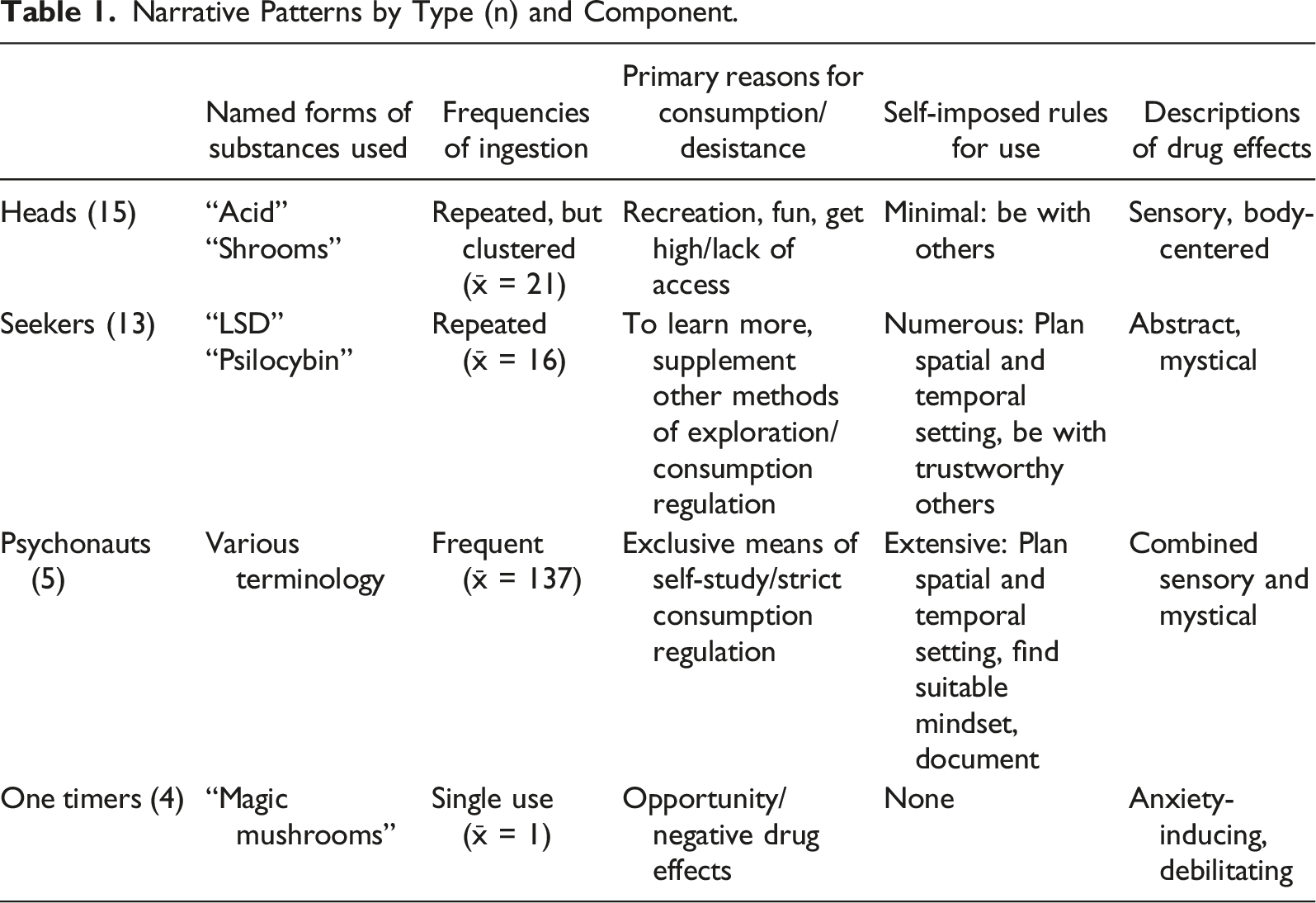
Narrative Patterns by Type (n) and Component.
Head Narratives
Fifteen interview transcripts are classified as a Head narrative. This group shared somewhat frequent consumption of “acid” and “shrooms” for the primary reason of social recreation. The narratives indicated repeated use, with an average of 21 ingestions. The interview data among this group reveal that consumption was motivated by a desire to “have fun,” “be with friends” “party” or “get high.” Among the narratives in this group, precautions surrounding psychedelic use were considered needless, and statements of any rules went largely unexpressed. Importantly, Head narratives described psychedelic use as similar to other drug use, that is, something done for pleasure. The narratives, in fact, implied that the ingestion of illicit drugs should be associated with a renunciation of rules, so creating guidelines around intake competes with this principle. Despite this argument, Head narratives clearly pointed out that psychedelics, like other drugs, are meant to be used alongside friends because it is in that context that enjoyment has its greatest potential. In this way, Head rhetoric echoed publicized statements by many Erowid users (Bohling, 2017) as well as popular 1960s advocate of psychedelics, Ken Kesey, who supported recreational use of psychoactive drugs.
Manufacturing fun with friends through drug use is evident in a couple of different ways. One is seen in Head narratives’ overarching theme that “acid” and “shrooms” are effective party tools because they encourage unusual social encounters. Representing this idea is a comment from one interview participant who said that mushroom ingestion gives him “the best party” because it made him “trust the group he’s with completely,” which enabled him to “really relax.” Another interview participant stated, “I started using it recreationally, partying with my friends. I was never wanting to do it by myself. What’s the point in that? [laughs]”
The centrality of fun is also apparent in stories that emphasize why certain psychedelics are used and others are avoided. As a matter of illustration, one interview included the following remark: I had done it [LSD] over a hundred times. I guess there are people who can just do acid all the time, but I’m not one of those people. So, after a certain amount of time, and I’m really not sure how long it was, I got to the place where it wasn’t really fun anymore. I just knew it wasn’t fun. That’s when I transitioned into mushrooms.
The only difference that Head narratives collectively acknowledged between psychedelics and other forms of substances was access. Shared recollections revealed a clustering of psychedelic ingestion, meaning that it was commonly reported that several intakes would occur in a relatively short periods of time. In explaining this, the narratives specified difficulty in regularly obtaining these substances through their drug distribution networks. The following statements illustrate how this group explained noticeable gaps in their psychedelic consumption: I dropped off a lot of psychedelics because if you don’t know somebody, it’s sorta hard to find. It’s one of the harder classes of drugs to find. We're not doing psychedelics anymore because I don't know where to find them, but we're still drinking and partying and having a good time.
These statements epitomize a general pattern among Head narratives -- a lack of predictable access to psychedelics is the primary reason for desistance.
In describing psychedelic’s effects and the consequences of psychedelic ingestion, interviews spotlighted sensory changes. Descriptions nearly exclusively communicate how the body felt following ingestion. Many interviews in this group talked about stomach upset or digestive issues, and all told of “hallucinations,” a word used to describe a range of audial and visual distortions. Several interviews presented details about how objects that should be stable would become “moveable” or “wavy,” how “colors appeared brighter,” and how “music sounded different.” Asking follow-up questions to provoke more discussion into these memories rarely, if ever, produced expressions that went beyond somatic descriptions. For instance, after one participant described her experiences with psychedelics as having “a lot of visual stuff,” a slight pause in conversation coupled with probing requests resulted in her adding, Things were moving. This stuff [gestures to items on the table] would be, like, all over the place. It was very visual. And just that. It was visual and fun. It just stimulated you. Lights were brighter, things moved that didn’t normally move. I don’t know. I guess, just a fun time.
Seeker Narratives
Thirteen interview transcripts are categorized as a Seeker narrative. The Seeker and Head narratives were similar in their frequency of use, although this group’s average was slightly lower at a reported 16 lifetime ingestions. The stated forms of psychedelics used as told in Seeker narratives, however, contrasted with Head narratives in interesting ways. First, those in the Seeker group divulged consumption of a greater variety of psychedelic substances, including mescaline and DMT, substances used in indigenous religious and healing ceremonies. Second, the language used to identify the same substances were distinct across the groups. As indicated above, Head narratives selected the words “shrooms” and “acid” to designate the drugs consumed; Seekers narratives referenced the substances as “psilocybin” and “LSD.” This difference in linguistic selection signifies potentially diverging perceptions and identities surrounding the meaning of psychedelic-related activities. Accordingly, it hints at a distinct type of storytelling and experience.
Discrepancies across Head and Seeker narratives are also apparent in other ways. Regarding the stated reasons for use, Seeker narratives emphasized the progressive influence of psychedelics. The ingestion of psychedelic substances was framed as one way to fulfill a desire to understand, know, or experience “more.” It's more of a spiritual thing because I felt like I could get in touch with the world better. And I could get more creativity and things like that. My psychedelic use -- it's a quest for meaning and understanding. Most people who experiment with drugs are looking for some sort of understanding, more understanding. It kind of opened my eyes afterwards. I'm not quite sure about what exactly, but to more. It's one of those things that you know you're a bit different afterwards. There’s a different meaning. It opened my mind a bit, and this is always my reasons for trying psychedelics. It is always wanting to -- I guess I would say I always want to learn something more about either myself or know more about the world or maybe just those around me.
The above excerpts demonstrate ideas voiced among all Seeker narratives. In discussing use motives, there is an insistence that psychedelics provide a meaningful opportunity to attain “more” – more creativity, more understanding, more learning, more knowledge. Such phrasing denotes an underlying sense of lack or longing, and psychedelic consumption was mounted as one way to transcend or quell feelings of deficiency or absence.
Unlike Heads, Seeker narratives described psychedelics as a unique type of drug to be used for unique purposes. It was in these discussions that self-imposed rules for consumption became evident. Interviews in this group contained discussions of planning psychedelic intake, citing the need to arrange when, where, and with whom the substances could be consumed. Stories consistently pointed out the need to feel safe and secure, so consideration of time allotment, physical surroundings, and available, nearby persons were essential. One interview participant with a history of using various forms of psychedelics mentioned a preference “to be outdoors when tripping” before adding that it was a requirement “to be in a place that is safe and with people who have integrity.” Another conveyed, “I have to be in the right mindset. And I have to be around people I trust.” All narratives in this group relayed that special attention was made to have a day or two away from work or school, no impending responsibilities to caretake family members, and/or not be around anyone who might disrupt their experience or “trigger a bad trip.” Such discussions not only echo what psychedelic science has argued for decades: that (mind)set and setting are crucial components of a positive psychedelic encounter (e.g., Griffiths et al., 2006; Leary, Litwin, & Metzner, 1963); they account for desistance within this group.
After inquiring further about why making plans for use was important, interviews signaled preparation’s function to establish confidence, or as one person put it, “It gives me a willingness to explore and let go. That requires trust.” This line of reasoning implies that trust is not to be assumed; it must be actively constructed. Perhaps relatedly, Seeker narratives communicated psychedelic-induced altered states of consciousness as a particularly vulnerable state, which is why guides are sometimes used. The times I did these things, I never did it without a sober person in the room. That was one of my stipulations. That was something that had been a part of my research. I was not the person who was going to go for an unsafe situation. Not having a sober person in the room, I find dangerous because they are very real and very serious experiences for some people. You need someone who is distant enough from the experience to keep you safe and to be able to interpret them.
Seeker narratives rarely employed body-based descriptions when recalling psychedelic encounters, opting instead to apply more abstract, sentimental interpretations of psychedelic effects and experiences. Terms like “beautiful,” “insightful,” or “spiritual” were often voiced. One interview in this group applied each of these words. It was a really beautiful experience, very spiritual for me. That whole experience was stepping into profoundness. It was really cool. Insightful. It was a neat experience.
A final distinction in this group as compared to others is the mention of being involved in additional, non-drug-related spiritual activities. Although the type of activity varied (e.g., religious studies, hiking, meditation, yoga, art creation, political engagement), all interviews depicted participation in events that could be described as transpersonal. What is more, these adventures, whether drug-induced or not, were rhetorically linked. The following excerpt exemplifies this element of Seeker narratives: Somehow, I found activism after the drugs, but it was all looking for meaning if I can put it that way…When I went to [location] and got politicized, I started to recognize the different forces in our society…That colored my life more than anything. It gave me a skeleton to put everything else on. Before that I was kind of confused, and drugs was maybe helping me, trying to make sense out of everything and experience life and gather information, so that's been an ongoing thing. My yoga training is the same. It may be related somehow. It’s all a spiritual pursuit.
Psychonaut Narratives
The term psychonaut is commonly used to identify attentive users of psychedelic substances. Junger (1970) coined the phrase to describe persons who engage in intentional spiritual or intrapersonal explorations. Ott (2011) equated psychonauts more clearly with entheogenic consumption, and Pestana, Beccaria and Petrilli (2020) applied it to persons who openly share information about their psychedelic use. In the present paper, I utilize the word to identify the group of stories that report frequent use of various psychedelic substances and the exclusive reliance on hallucinogens as the tool of choice for psycho-spiritual exploration. As described below, the storylines also differ in their narrations of psychedelic effects.
Five interview transcripts are included in this group. The Psychonaut narratives reported a high frequency of psychedelic use as compared to other groups. The average number of classic psychedelic experiences with psilocybin mushrooms, LSD, mescaline, and DMT was 137, although frequent experimentation with a wide variety of other hallucinogenic substances, such as ketamine, ecstasy, and 2C chemicals, were also reported.
While the other groups proposed here are partially marked by their consistent terminology to describe the psychedelics ingested, the vocabulary used to speak of consumed substances among Psychonaut narratives showed remarkable variation. In some instances, interview transcripts referred to an “experience with LSD” but would later narrate “an acid encounter.” In this way, there is no concise way to compare this group’s linguistic choice to describe substances.
The stated reasons for use among this group share much in common with Seekers. Both types reported the primary reason for psychedelic ingestion was to modify one’s usual state of being for the purposes of exploring the mind, or “unearthing” as one worded it. Differences in use motives became noticeable though when discussing some of the underlying factors related to consumption. Psychonaut narratives presented psychedelics, especially naturally occurring ones like psilocybin and mescaline, as entities with their own inherent existence. In speaking about hallucinogens, one narrative relayed, “They have a great purpose in our life. Through them, we get access to deeper insights.” Citing them as “things not to be merely used,” this group conveyed a need to “respect the medicine,” which is done through consumption.
In contrast to Seekers, Psychonaut narratives identified psychoactive substances as their only means of self-directed inquiry, and self-study was the objective. As mentioned in the above section, Seekers spoke about employing various methods of analysis. Such an assortment of practices was absent in Psychonaut narratives as was any real interest in other-than-self inquiries. Firm in psychedelics’ purpose to self-examine, Psychonaut narratives showed no need to do anything but psychedelic-induced discovery. The following statement from one interview illustrates this point: “I can’t meditate or go to therapy or church. Nothing like that. Psychedelics is my activity.” Showing a similar sentiment, another narrative asserted: “I've had what I think is a meditative experience while doing mushrooms, but I've never even meditated.”
Importantly, the stories among this group revealed a central interest in investigating one’s self, although sometimes there was mention that psychedelics were used to search for meaning and understanding surrounding certain dyadic relationships. This trend pointed out another unique element of this group. Psychonaut narratives did not signify using psychedelics for fun like Heads, but they also did not verbalize any interest in developing transcendent insights like Seekers. Instead, Psychonaut narratives stressed the primary motive of self-assessment, without mention of one’s connections to generalized others, macro-social arrangements, or cosmic relations.
Psychonaut narratives disclosed the most extensive rules surrounding ingestion. “Knowing the source” (i.e., having a relationship with a dealer or broker, which may include the earth’s soil or substrate), being in the right mindset to clearly receive answers to specific questions, remaining in the same setting for the duration of the experience, and having a guide or “trip sitter” to document the experience so that it could be later reviewed as a part of one’s analysis all figured prominently among this group’s stories. Accounts mentioned little flexibility on changing plans once a psychedelic encounter was arranged or initiated. If a scheduled guide canceled or work or family plans changed, ingestion was said to be postponed. Any desistance among this group can thus be attributed to the extensive rules not fitting within day-to-day routine. The degree of planning conveyed in these narratives is reminiscent of Riley, Morey, & Griffin (2008) findings regarding ketamine users who discussed their planned drug use while employing neo-liberal discourse about responsible citizenship, including harmonizing individual choice to consume with the need for self-controlled drug use.
Psychonaut interviews contained lengthy, detailed, and complex discussions about trip experiences, which included commentaries about drug effects and their interpretations. Rather than relying on strictly somatic statements as Heads or more abstract statements like Seekers, Psychonauts narratives combined the two. Describing a first psychedelic experiences, one interview included the following remembrance: I remember the ways in which the world presented itself… Sure, the colors were more vibrant and eventually there was more movement to everything and there’s all of that. But…that’s all kind of beside the point. It’s that lack of separation between self and other…That, really, I feel like is the actual profound part.
One-Timer Narratives
This group encompasses 4 narratives that report a single use of a psychedelic substance, so only one form of psychedelic was ever consumed, almost always identified as “magic mushrooms.” Ingestion seemed largely opportunistic as it was detailed as being initiated by a friend or romantic partner who had instant access to the drug. The interviews almost always involved a story of how that person “wanted to trip with” them. Given the opportunity-oriented storyline, the narratives indicated no planning prior to consumption. One-Timer narratives recounted ingesting the drug without preparation or knowledge about its expected effects. There were virtually no rules surrounding ingestion. The interviews collectively mentioned a desire to not be left alone while under the drug’s effects, although they also revealed not sharing this wish with others, so time alone did occur. Reflecting extant research concluding that persons using psychoactive drugs are more likely to report “bad trips” if they are unprepared or disinterested in consumption (e.g., Becker, 1967; Leary et al., 1963), this group emphasized anxiety-inducing effects of the drug, which explained decisions not to use again. Trip experiences were generally described in negative terms, citing them as “suffocating” and “debilitating”. Stories, on the whole, spoke at length about not liking the “out of control feeling” associated with the drug, which explained desistance. The below excerpt represents the general expressions of this group. It was a one-time thing for me. I actually stopped associating with those people after that…It was awful…There was only one person there who I really knew, but it was awful for me because when I did it, I lost a 12-hr period of my life…I don't want to be out of control like that…It was awful because I didn't get high or liberated or have a great night with people at a party…I didn't get scared or laugh. I didn't have anything like that. I was just gone…It did make it clear that I wasn’t interested in ever doing that again.
Conclusion and Discussion
Publicized stories of psychedelic experiences regularly pronounce them as extremely personal, thus bound to individualized interpretation, which can diminish the search for parallels across experiences. A few systematic studies of psychedelic use and users have sought to convey group-based differences in use patterns. In those rare instances, authors rely on a restricted location and commonly conclude a dichotomous “type of user” classification system that compares those who use for so-called recreational reasons with those who use for more spiritual pursuits (e.g. Davis & Munoz, 1968; Rolando & Beccaria, 2019; Yablonsky, 1968).
The present paper veers from the existing research in numerous ways. First, I propose a 4-part categorization of psychedelic drug use narratives. Contradicting prior publications that represent psychedelic experiences as completely individualized experiences or psychedelic users as having one of only two types of motivation, the present paper recognizes patterned yet nuanced heterogeneity across user reports. Examining data collected across 37 in-depth interviews of persons who describe their histories of consuming psychedelic substances in non-clinical settings, I uncover group-based differences based on five factors: the named forms of psychedelic substances used, the reported frequency of psychedelic ingestion, detailed reasons for consumption and desistance, discussions of self-imposed rules surrounding consumption, and descriptions of drug effects and drug-related experiences.
One group, which I classify as Head narratives, can be identified by their relatively frequent but clustered use of “shrooms” and “acid” for the sake of having fun with other people. Head interviews also shared a rather strict focus on somatic-centered descriptions of psychedelic drug effects and their experiences. Another category, which I name Seeker narratives, revealed different patterns. Even though these groups were somewhat similar in their range of consumptions and some forms of use, Seeker narratives utilized less colloquial language to identify the substances ingested. The two groups also differed in their reported intentions. Minimizing the importance of partying and sociability, Seeker narratives described psychedelics as tools for psychological and spiritual development. Perhaps relatedly, these interviews highlighted the need for self-imposed rules to heighten feelings of safety and security when under the influence of psychoactive substances. In communicating about drug effects and trip experiences, Seeker narratives used abstract, and sometimes lyrical, language rather than body-based descriptions. The third group, Psychonaut narratives, share some commonalities with Seeker narrative’s reasons for use, but the two groups diverge in important ways. For one, unlike the Seeker classification, Psychonaut narratives expressed exclusive reliance on psychoactive substances to advance their self-development; second, the latter provided much more detail about their self-imposed guidelines surrounding use, and finally, combining elements observed in Head and Seeker groups, Psychonaut narratives reported drug effects and trip experiences by recounting memorable bodily (dis)comforts alongside imaginative phrasing and mystical interpretations. The last group I identify, One-Timer narratives, are notable in their reported single use of “magic mushrooms,” the absence of preparation and rule adherence regarding consumption, and their disproportionate negative descriptions of drug effects and its consequences. Hence, while the first three groups emphasized the benefits of their psychedelic use, this last group highlighted the perceived disadvantages.
Another difference between the present work and prior studies is my inclusive sampling frame. Not only do I interview persons who report a wide range of use frequency, the participants also reside in areas throughout the U.S. and have varied social, religious, and political backgrounds and affiliations. This sampling technique plausibly accounts for the increased heterogeneity reported herein and serves as a reminder that sampling frames are best when they represent all possible aspects of the population of interest, which in this case is adults with a history of psychedelic use in non-clinical (i.e., social) settings. As mentioned earlier in the paper, such an expanded point of view is especially important given the popularity and increasing prevalence of hallucinogen use in the U.S. and the limited depictions of psychedelic use and users in publicized reports.
Finally, rather than relying on a “type of user” classification, I propose a “kind of narrative” one. This deviation is meant to underline differences in the overall information shared by storytellers, not differences in the storytellers themselves. Although interview participants communicated vast amounts of information about themselves throughout the interviews, I am uncomfortable, for methodological and humanistic reasons, sorting people into discrete categories. While such classifications may be analytically useful, they fall short of fully explaining direct, first-hand life experiences and the meanings applied to them, especially given the plasticity of human identities and statuses (e.g., Stryker, 2000). This said, I acknowledge that relying on categorization of any kind, including those to explain patterned narrations of human experience, may be questionable. This disjuncture is evident in psychedelic studies when Yablonsky (1968) mentions that True Hippies admit to regularly using drugs, including psychedelics, for non-sacramental reasons despite the argument that doing so was strictly part of the Head repertoire. Murkiness across types is similarly implied in other psychedelic studies (e.g., Davis & Munoz, 1968; Rolando & Beccaria, 2019). The same may be said about the present study. When speaking of some memories of psychedelic use, Seeker and Psychonaut narratives depict consumption as a pleasure-seeking adventure, a marker reserved here for Head interviews. Still, differences became apparent by utilizing an inductive, thematic narrative analysis to examine psychedelic-related stories as a whole. Seeker and Psychonaut interviews, for example, designated ingestion for pleasure-seeking only at specific times of use -- their earliest. Discussions of “partying” and fun use motives were minimized or dismissed as short-sighted as the totality of drug experiences were told. These narratives suggest, then, that changes occurred as experiences accumulated (see Rolando & Beccaria, 2019 for a similar argument about the trajectory of some drug users but see Griffiths, et al., 2006 and Strassman, 2001 for contrary findings).
As should be clear, the present paper concludes a wider array of psychedelic use than previous literature has suggested, which broadens our knowledge of users’ perceptions, beliefs, and motivations. Indeed, by bringing attention to user narratives often overlooked in existing psychedelic studies, this paper may help to dispel myths of psychedelic use. When myths become dispelled, the realities of substance use become visible. Sensationalized cultural stories and epithets that tout psychedelic use as either extraordinarily damaging or solely advantageous, or psychedelic users as either seeking a good time or spiritual enlightenment remain short-sighted. Indeed, the data presented herein complicate such binary classifications. Evidence demonstrating heterogeneity of psychedelic use, however, does not have to discount similarities across user histories. Convergence and divergence can co-exist. Taking such a non-dualist approach encourages a rich, nuanced appreciation of life and the activities that are included within it, which can heighten sympathetic understandings. As a result, individual drug use can become appropriately situated in socio-historical context.
Prior work investigating other forms of drug consumption argues for diversified conceptions of use, linking it to political, economic, clinical, and public health treatment (e.g., Askew, 2016; Becker, 1963; Brookfield, Selvey, Maher & Fitzgerald, 2022; Young, 1971). Like the present work, these studies show that variability in storylines does not preclude the existence of patterns -- patterns in perceptions, patterns in beliefs, patterns in interpretations, patterns in actions, and patterns in stories told about these things.
Though discrete identifiers have historically been employed to our political and psychic detriment given their capacity to cage in and exclude from, we would be amiss to reject the benefits of detecting knowable patterns. Fortunately, we can make use of categories to show their social import even as we criticize them for their prospective reductiveness (e.g., (Dollar, 2017) Dollar, 2021). In all matters, particularly those with an intricate history like the use of mind-altering substances, it would be wise to balance an awareness of shared experience alongside recognitions of heterogeneity.
Footnotes
Acknowledgments
The author wishes to thank the interview participants for their honesty and openness. This work would not be possible without their willingness to fully participate. I also thank Kristen Bethune and Derek Clark for their research assistance.
Declaration of Conflicting Interests
The author(s) declared no potential conflicts of interest with respect to the research, authorship, and/or publication of this article.
Funding
The author(s) received no financial support for the research, authorship, and/or publication of this article.
