






Abstract
Substance use among South African university students unfolds within persistent socio-economic inequality and substance-related harm. Drawing on 40 qualitative interviews with current and former students in Durban, this study examines how substance use is initiated, sustained, and intensified during higher education, guided by the social ecological model. Trajectories were shaped by financial strain, academic pressure, emotional distress, peer networks, and prior community exposure. Substances reported included alcohol, cannabis, nyaope, and methamphetamine, with trajectories differing by substance type. Early normalisation intersected with campus environments to facilitate escalation; for some, use shifted from experimentation to dependency where psychosocial support was limited, with avoidance of withdrawal symptoms becoming central to continued use. Data were collected between September 2020 and July 2021, during the COVID-19 pandemic, amplifying existing vulnerabilities. The study frames substance use as a structurally shaped social problem, with implications for multi-level, gender-responsive, substance-specific interventions.
Keywords
Introduction
Substance use remains a major public health concern in South Africa, with sustained demand for treatment services reported across all provinces. National surveillance data from the South African Community Epidemiology Network on Drug Use (SACENDU) show that alcohol continues to account for the largest proportion of treatment admissions, followed by cannabis, heroin-related substances such as nyaope (a low-cost street drug mixture containing heroin), and methamphetamine (Dada et al., 2024). These patterns indicate that substance-related harms are widespread and persistent, reflecting broader social and economic conditions rather than isolated individual behaviour.
Young people constitute a significant proportion of those affected by substance use. The transition from adolescence to young adulthood is a period marked by increased independence, identity formation, and exposure to new social environments, all of which may increase vulnerability to substance use (Arnett, 2005; Stone et al., 2012). University students occupy a distinct position within this life stage. Entry into higher education often coincides with reduced parental supervision, greater autonomy, and new peer networks, while academic demands and uncertainty about future employment may intensify psychological stress. In South Africa, many students enter university from socio-economically disadvantaged households and continue to experience financial strain, family responsibilities, and emotional stress throughout their studies (Statistics South Africa, 2023).
Existing research on substance use among university students in South Africa has focused on prevalence, individual risk behaviours, or campus-level factors (Letsie, 2020; Mathoma, 2022; Mokwena & Setshego, 2021). While these studies provide valuable insight into patterns of use, they often frame student substance use as situational or recreational, linked primarily to peer influence or lifestyle choices (Schulenberg & Maggs, 2002). National surveillance systems offer important information on substances used and treatment entry, but provide limited insight into how substance use develops over time or how broader socio-economic conditions shape students’ pathways into and through substance use (Dada et al., 2024). As a result, the processes through which substance use is initiated, sustained, and intensified during higher education remain poorly understood.
The COVID-19 pandemic introduced additional disruptions to the university environment that are highly relevant to understanding substance use among students. Campus closures, the shift to online learning, increased social isolation, financial insecurity, and heightened anxiety created conditions in which substance use vulnerabilities may have been amplified (Meda et al., 2021; Prowse et al., 2021). In South Africa, where many students already face precarious socio-economic circumstances, pandemic-related disruptions to bursaries, accommodation, and campus-based support services compounded existing stressors. The data for this study were collected between September 2020 and July 2021, a period spanning active COVID-19 restrictions in South Africa, and findings must therefore be interpreted within this context.
Comparative evidence suggests that substance use among university students in South Africa is consistent with, and in some respects more pronounced than, patterns observed in other low- and middle-income countries (LMICs). Studies from sub-Saharan Africa report alcohol use prevalence among university students ranging from 30% to over 60%, with cannabis use prevalent in several contexts (Adelekan et al., 1992; Peltzer & Pengpid, 2019; Blows & Isaacs, 2022). In high-income countries, heavy episodic drinking and cannabis use remain the dominant substances among students, but the structural drivers of use, including poverty and institutional inadequacy, are less pronounced (Davoren et al., 2016). South Africa’s combination of high substance availability, structural inequality, and limited psychosocial support infrastructure positions its student population as particularly vulnerable.
Understanding substance use among university students, therefore, requires attention to the interaction between individual experiences and wider social environments. The social ecological model offers a useful framework for examining substance use as shaped by influences operating across multiple levels, including individual, interpersonal, community, and structural contexts (Bronfenbrenner, 1979; McLeroy et al., 1988). Substance use is not the outcome of isolated decisions but a dynamic process that evolves in response to changing social relationships, environmental exposure, and structural constraints.
This study addresses these gaps by conceptualising substance use among university students as a trajectory rather than a discrete or short-term behaviour. Drawing on qualitative interviews with current and former university students in Durban, KwaZulu-Natal, and guided by the social ecological model, the study examines how substance use is initiated, sustained, and intensified over time. By situating students’ lived experiences within broader national substance use trends and socio-economic conditions, the study advances existing research by foregrounding the cumulative and structural dimensions of student substance use in South Africa.
Literature Review
Substance Use During the Transition to Young Adulthood
Substance use among young adults remains a major public health concern globally, with late adolescence and early adulthood identified as a period of heightened vulnerability to initiation and escalation of alcohol and drug use (Stone et al., 2012; UNODC, 2023). This stage is associated with increased independence, identity exploration, and exposure to new social environments, alongside reduced parental monitoring and changing social expectations (Arnett, 2005). These transitions may increase susceptibility to substance use, particularly in contexts characterised by social and economic uncertainty.
University students represent a distinct subgroup within this age range. International research indicates that student substance use is often shaped by a combination of academic pressure, social norms, and peer networks, with alcohol and other substances frequently embedded within student social life (Davoren et al., 2016; Schulenberg & Maggs, 2002). Substance use among students has been associated with adverse academic outcomes, including reduced academic performance, absenteeism, and increased risk of dropout, as well as mental health challenges such as anxiety and depression (McLellan, 2017).
In South Africa, research on student substance use has focused on prevalence and individual risk behaviours, with limited attention to how substance use develops over time or how broader socio-economic conditions shape students’ experiences. Surveillance data document patterns of treatment demand but provide little insight into the processes through which students initiate, sustain, or escalate substance use during higher education. As a result, the interaction between academic pressure, financial strain, peer networks, and structural inequality remains underexplored.
Socio-Economic Inequality and Student Vulnerability
A substantial body of research demonstrates that substance use is linked to socio-economic conditions. Poverty, financial strain, unemployment, and economic insecurity have been associated with psychological distress and limited access to coping resources, increasing reliance on substances as a means of managing stress and adversity (Galea et al., 2004; Lund et al., 2010). These conditions may also shape living environments characterised by high substance availability and social norms that normalise use.
In South Africa, socio-economic vulnerability among university students is well documented. According to Statistics South Africa (2023), youth unemployment stands at over 60% among those aged 15 to 24, and a significant proportion of university students experience food insecurity and housing instability during their studies. The National Student Financial Aid Scheme (NSFAS) supports a large portion of students from low-income households, yet funding gaps and administrative delays mean that financial stress remains pervasive. These material conditions create a context in which substance use may function as a coping mechanism for persistent economic hardship (Letsie, 2020).
Family context plays a central role in shaping substance use trajectories. Exposure to family instability, parental absence, conflict, or substance use within the household has been associated with earlier initiation and sustained use among young people (Brook et al., 2001). For many university students from disadvantaged backgrounds, financial and emotional pressures persist during their studies, including food insecurity, housing instability, and obligations to support family members. These stressors may intensify academic pressure and contribute to substance use as a coping response (Letsie, 2020; Mathoma, 2022). In low- and middle-income settings, limited access to mental health and psychosocial support services further constrains students’ ability to manage stress without resorting to substance use (Lund et al., 2010). Substance use is often shaped by cumulative disadvantage rather than short-term experimentation.
Community Environments and Structural Exposure
Substance use in South Africa must be understood within the context of persistent structural inequality. Legacies of apartheid-era spatial planning, ongoing poverty, and high youth unemployment continue to shape young people’s exposure to risk and access to support (Statistics South Africa, 2023). Many urban and peri-urban communities are characterised by limited economic opportunities, high population density, and uneven access to health and social services, conditions that may increase both substance availability and vulnerability to use.
Community-level factors, including neighbourhood disadvantage and proximity to drug markets, have been shown to increase the likelihood of substance use among young people (Boardman et al., 2001). In South Africa, substances such as cannabis, heroin-related drugs, and methamphetamine are often embedded within local economies, reducing barriers to access and normalising use within everyday social environments (Mokwena & Setshego, 2021). While national surveillance systems document treatment admissions, they provide limited insight into how these structural and community-level conditions shape substance use pathways among university students.
Gender is an important moderating factor in substance use within community environments. Research in South Africa consistently shows that men report higher rates of substance use initiation and heavier patterns of use, while women are more likely to use substances in response to emotional distress or interpersonal trauma (Dada et al., 2024; Mokwena & Setshego, 2021). However, women’s substance use is often more heavily stigmatised, which may reduce disclosure and help-seeking. These gendered dynamics shape both trajectories and access to support in ways that community-level analyses must account for.
Substance-Specific Trajectories
The social ecology of substance use differs across substance types, and conflating these differences risks obscuring important variation in trajectories. Alcohol remains the most widely used substance among South African university students, with use often embedded in social and recreational contexts and reinforced by cultural norms that normalise drinking (Dada et al., 2024). Cannabis use is prevalent and frequently framed as low risk, particularly in township communities where it is widely available and socially accepted. Nyaope, a low-cost mixture typically containing heroin, is associated with rapid escalation to dependency and is concentrated in economically marginalised communities, where structural factors heavily shape its use (Mokwena & Setshego, 2021). Methamphetamine use, while less prevalent, is associated with intense dependency profiles and significant academic and social disruption. These differences in availability, cost, social acceptability, and dependence profiles suggest that students’ substance use trajectories are likely to vary by substance type, and interventions should be calibrated accordingly.
Conceptualising Substance Use Trajectories
The social ecological model provides a useful framework for understanding substance use as shaped by interacting influences across multiple levels, including individual, interpersonal, community, and societal factors (Bronfenbrenner, 1979; McLeroy et al., 1988). Substance use trajectories are not the result of isolated decisions but emerge through ongoing interactions between personal stressors, social relationships, environmental exposure, and structural conditions.
At the individual level, substance use may be linked to stress, trauma, and mental health challenges. Interpersonal relationships, particularly peer networks and family dynamics, shape access, norms, and initiation. Community environments influence exposure and perceived acceptability, while societal-level factors such as inequality, unemployment, and policy context structure risk and access to support (Navarro, 2016). Applying a social ecological framework enables a more integrated understanding of how substance use develops and intensifies over time.
Despite the relevance of this framework, few qualitative studies in South Africa have applied a social ecological approach to examine substance use trajectories among university students. Existing research often isolates individual or campus-level factors, overlooking the broader socio-economic processes that shape student experiences. Addressing this gap is essential for developing interventions that respond to the realities of substance use within higher education and beyond.
While existing studies document patterns and correlates of substance use among university students, they often adopt cross-sectional or prevalence-based approaches that overlook how substance use unfolds over time (Dada et al., 2024; Letsie, 2020; Mathoma, 2022). Few studies apply a social ecological framework to examine how individual stress, peer relationships, community exposure, and structural inequality interact to shape substance use trajectories during higher education (Galea et al., 2004; Mokwena & Setshego, 2021). This study responds to this gap by offering a qualitative, trajectory-based analysis of student substance use situated within broader national and socio-economic contexts.
Methods
Study Design and Setting
This study employed a qualitative research design to examine substance use trajectories among university students within their social and economic contexts. A qualitative approach was appropriate for exploring how substance use is initiated, sustained, and intensified over time, and for capturing processes not visible in surveillance or prevalence-based data. The design enabled in-depth exploration of students’ lived experiences and the conditions shaping their substance use during higher education.
The study was conducted in Durban, an urban centre in KwaZulu-Natal, South Africa. The city is characterised by pronounced socio-economic inequality, high youth unemployment, and uneven access to mental health and psychosocial services. Many students attending public universities in this setting enter higher education from poor households and continue to experience financial strain during their studies. Conducting the study in this context allowed examination of how broader social and economic conditions intersect with university life to shape substance use trajectories.
Participants and Sampling
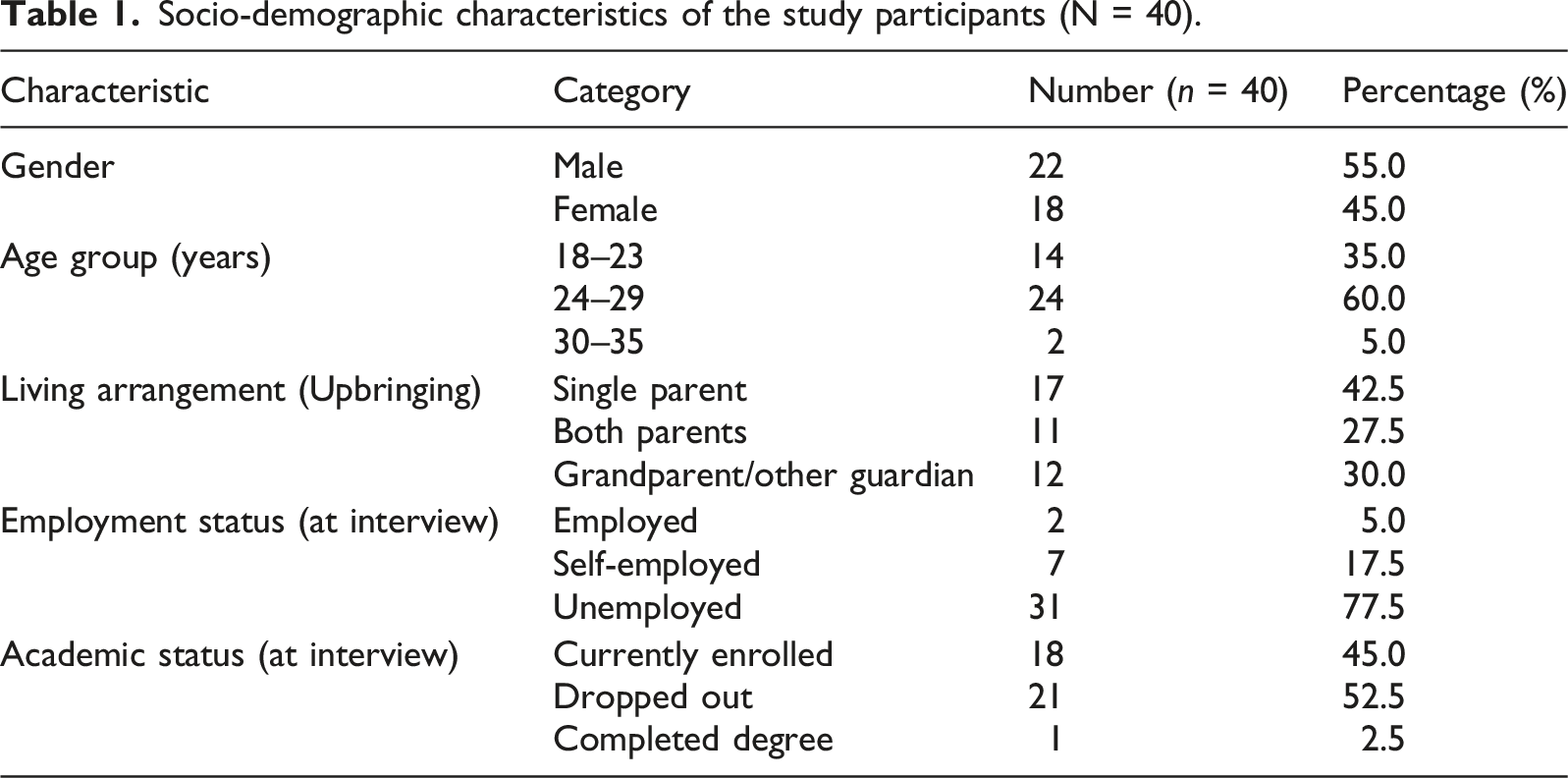
A total of 40 participants were recruited using purposive sampling. Of these, 18 were currently enrolled students at the time of the interviews, 21 had discontinued their studies, and one had completed a degree. Eligible participants were current or former university students who reported substance use during their time in higher education. This group was considered well-positioned to provide detailed experiences of substance use initiation, escalation, and attempts to reduce or stop use. Initial recruitment occurred through university networks, peer referrals, and student social circles. Snowball sampling was subsequently used to reach additional participants, a strategy that facilitated access to individuals who may be reluctant to disclose substance use due to stigma. Participants were drawn from diverse socio-economic backgrounds and resided in urban and peri-urban areas within and around Durban. The sample included both male and female students, as well as individuals whose studies had been interrupted, in some cases in relation to substance use.
Socio-demographic characteristics of the study participants (N = 40).
Data Collection
Data was collected through semi-structured, in-depth interviews conducted between September 2020 and July 2021. Interviews lasted between 45 and 75 minutes and were conducted either face-to-face or via secure online platforms, depending on participant preference and COVID-19 public health restrictions at the time. All interviews were conducted by the first author, who has extensive experience in qualitative research on sensitive public health topics.
An interview guide ensured consistency while allowing flexibility to explore emerging issues. Topics included socio-economic background, family context, academic experiences, peer networks, community exposure, substance use initiation, patterns of use, and attempts to reduce or stop use. Participants were encouraged to reflect on how their substance use developed over time. With consent, interviews were audio-recorded and transcribed verbatim.
Data Analysis
Data was analysed using Braun and Clarke (2006) six-phase thematic analysis. Transcripts were read repeatedly to ensure familiarity with the data. Initial coding was conducted manually using an iterative approach. Early transcripts were coded line-by-line to generate an initial set of codes, which were refined and reorganised as analysis progressed.
Codes were grouped into broader themes capturing patterns across participants’ experiences. Attention was paid to variation in substance use trajectories, including differences in initiation, escalation, and dependency. Analytical decisions were documented throughout the process to maintain transparency. To enhance rigour, emerging interpretations were discussed regularly within the research team. Reflexive notes were maintained to consider how researchers’ positions and assumptions may have shaped interpretation.
Reflexivity
The interviews were conducted by the first author, a young African woman with experience conducting qualitative research on sensitive topics. Given the nature of the study, reflexive awareness was maintained throughout data collection and analysis. The researcher remained attentive to how her social position, age, and educational background could influence participant interactions and the interpretation of narratives. Regular discussions were held with the co-author to review coding decisions and ensure analytic consistency.
It is important to acknowledge that the study adopts a normative stance in framing substance use as a social problem rooted in structural conditions rather than individual failing. This framing shaped the design of the interview guide, the questions posed to participants, and the analytical perspective applied to the data. While this perspective is consistent with a growing body of public health and social science literature, it may have influenced which themes were amplified during analysis. Efforts were made to remain open to alternative framings, including participants’ own accounts of personal responsibility and choice, and these are reflected where relevant in the findings.
Results
This study sought to understand substance use trajectories among university students by drawing on interviews with 40 current and former students in Durban, South Africa. A thematic analysis revealed the complex and evolving ways in which substance use developed over time within students’ social and economic contexts. The sample included students at different stages of their substance use trajectories, including those experimenting with substances, those whose use had intensified during their studies, and those experiencing dependency that disrupted academic progression. In terms of substances, the majority of participants (approximately 30 of 40) reported alcohol as a psychoactive substance as an early or concurrent substance, cannabis was the most commonly reported substance used during university (reported by approximately 28 participants), nyaope was reported by approximately 12 participants and was most strongly associated with dependency trajectories, and methamphetamine was reported by approximately 8 participants, largely among those in more advanced stages of dependency. Several participants (approximately 10) reported poly-substance use. While students shared common experiences of financial strain, academic pressure, and exposure to substance use within social environments, their trajectories differed according to peer networks, community contexts, and access to psychosocial support.
Across interviews, students described identifiable shifts in their substance use over time. For many, trajectories began with early exposure or experimentation, often within peer or community contexts. Continued use was reinforced through social belonging and stress-related coping. For some students, patterns intensified, particularly when financial strain and limited psychosocial support constrained alternatives. In advanced stages, motivations shifted further, with substance use driven less by social factors and more by the avoidance of withdrawal symptoms. Although trajectories varied, this progression from experimentation to intensified and, in some cases, dependent use was a recurring pattern across the data.
Individual-Level Influences: Coping With Stress and Emotional Strain
At the individual level, substance use was described as a response to psychological distress, academic pressure, and emotional hardship. Many reported initiating or increasing substance use during periods of intense stress, including examination periods, financial difficulty, or personal crises. Substances were used to manage anxiety, regulate mood, or sustain daily functioning. One participant explained: I ended up smoking before every activity. It became my way of coping with everything. (P8, Male)
For some students, substance use followed experiences of emotional loss or relationship breakdowns. In these experiences, substances were used to manage emotional pain and provide temporary relief from distress. I was going through a painful break-up. Someone presented drugs to me, and I tried them to escape from the pain. (P37, Female)
Although substances initially appeared to offer relief, students reported that continued use often worsened academic difficulties, disrupted sleep, and reduced motivation. These effects contributed to cycles in which stress and substance use reinforced one another over time.
Interpersonal Influences: Peer Networks and Social Belonging
Peer relationships played a central role in shaping substance use initiation and continuation. Many reported being introduced to substances through friends, with use framed as part of social integration and belonging. Declining participation was often associated with fear of exclusion or social isolation. As one participant noted: I started smoking cigarettes, and it was highly motivated by my peers. I was the only one who was not smoking amongst them. (P15, Female)
Peer influence extended beyond initiation to escalation, as social networks facilitated access to additional substances and normalised frequent use. Students described seeking out peers who shared similar substance use practices, particularly after entering university. When I got to varsity, I looked for friends who were already smoking. The same friends later introduced me to cocaine. (P20, Male)
In some cases, trust within peer relationships reduced awareness of risk. Students described situations in which substances were introduced without their knowledge, highlighting how interpersonal dynamics could undermine individual control over substance use trajectories.
Community-Level Influences: Exposure and Normalisation
Community environments strongly shaped students’ exposure to substances and their perceptions of risk. Students who grew up in townships or peri-urban areas described early and routine exposure to substance use within their neighbourhoods, where substances were widely available and commonly used. One participant explained: In the townships, most of them sell cigarettes and weed. We would get easily exposed to it and buy it. (P11, Male)
For these students, substance use at university represented a continuation of familiar social practices rather than a new behaviour. Community exposure shaped knowledge of access points and consumption practices, lowering barriers to experimentation once students entered higher education. These experiences highlight how substance use trajectories often predate university entry and are shaped by environments beyond campus settings.
Gender emerged as a salient factor within community-level experiences. Men more frequently described substance use as embedded in socialisation and masculine identity within their communities, while women more often described using substances in response to emotional distress or as a means of coping with interpersonal difficulties, including experiences of gender-based violence. Women also expressed greater concern about stigma associated with substance use, which shaped their patterns of disclosure and help-seeking. These gendered differences in substance use experiences and social context are important for understanding how trajectories differ across the sample.
Structural Influences: Financial Strain and Institutional Conditions
Students described how poverty, financial insecurity, and institutional conditions shaped substance use patterns. Many students reported ongoing economic hardship during their studies, including food insecurity, unstable accommodation, and pressure to support family members. These challenges intersect with academic demands, increasing vulnerability to substance use as a coping response. Several students highlighted the role of financial cycles in structuring substance use. Periods following the receipt of bursaries or allowances were often associated with increased consumption. When the money comes in, that is when everything happens. After that, you are just trying to survive. (P6, Male)
The university environment also contributed to increased access and opportunity for substance use. Greater independence, limited supervision, and proximity to urban drug markets facilitated experimentation and sustained use. Rather than creating new risks, these conditions intensified existing vulnerabilities.
The COVID-19 pandemic further shaped structural conditions during the study period. Several participants described how the shift to remote learning removed the social routines and supervision structures of campus life, creating extended periods of unstructured time at home. For some, this coincided with increased substance use. Campus closures also disrupted access to libraries, recreational facilities, and peer support networks, while delays in bursary disbursements compounded financial pressures. Lockdown restrictions in South Africa during 2020 included alcohol and cigarette sale bans, which some participants described as temporarily reducing use but also prompting alternative acquisition strategies. The interplay between pandemic-related disruptions and pre-existing socio-economic vulnerability created conditions in which substance use vulnerabilities were amplified rather than diminished.
Unintended Initiation and Escalation Into Dependency
A key finding was the unintended exposure to potent substances, often through cannabis that had been laced without students’ knowledge. These experiences frequently occurred within trusted peer contexts and were associated with rapid escalation and loss of control. One participant described: My friend used to lace my cannabis with whoonga. Unfortunately, it was too late for me. I was already hooked. (P12, Female)
Students reported experiencing cravings and withdrawal symptoms without initially understanding their cause. In these cases, substance use trajectories shifted abruptly from experimentation to dependency, highlighting how agency could be compromised within social environments.
Dependency and Avoidance of Withdrawal
For students who developed dependency, motivations for substance use changed over time. Use was no longer driven by social interaction or stress relief, but by the need to avoid withdrawal symptoms and maintain basic functioning. As one participant explained: There is nothing that motivates me. I had to smoke because of the side effects. I would get sick if I did not. (P10, Male)
Students described physical and psychological symptoms, including anxiety, headaches, insomnia, and nausea, when attempting to abstain. At this stage, substance use became central to daily routines, and efforts to reduce or stop use were often unsuccessful without external support.
Protective Factors and Pathways Toward Desistance
Not all students followed a trajectory of escalation. A minority of participants described experimenting with substances but not progressing to sustained or dependent use. Several factors moderated trajectories in these cases. Strong family connectedness and accountability to family members were frequently cited as deterrents to escalation. Engagement in structured activities such as sport, religious communities, or academic mentorship programmes also appeared to provide alternative coping resources and social belonging that reduced reliance on substances. A small number of participants described deliberate decisions to reduce use following recognition of the impact on their academic performance or health. I realised my marks were dropping badly. That is when I decided I needed to stop. (P35, Male)
These accounts of desistance or non-escalation point to the importance of protective factors that are absent from dominant narratives of student substance use. They also suggest that trajectories are not inevitably progressive and that targeted support at early stages may interrupt escalation pathways. None of the participants who had developed dependency reported accessing formal university-based support services, though two had previously engaged with community-based treatment programmes. This gap between need and access to formal services is itself a significant structural finding.
Discussion
This study demonstrates that substance use among university students is not a short-term or situational behaviour, but a process shaped by cumulative exposure to socio-economic vulnerability and constrained coping options (Bronfenbrenner, 1979; Lund et al., 2010; McLeroy et al., 1988). A central analytical contribution of this study lies in clarifying how substance use shifts over time. Early use was frequently described as socially embedded or linked to coping with academic and emotional stress. Continued exposure within peer networks and community environments facilitated escalation. For some students, repeated use intersected with financial strain and limited access to support, leading to intensified consumption. At more advanced stages, motivations shifted again, with substance use driven primarily by the need to avoid withdrawal symptoms. This transition from socially motivated experimentation to constrained dependency highlights how trajectories evolve rather than remain static.
Guided by the social ecological model, the findings show that substance use trajectories emerge through interacting influences at the individual, interpersonal, community, and structural levels (McLeroy et al., 1988). Rather than reflecting isolated choice or experimentation, students’ substance use developed over time in response to persistent stress, social environments, and limited access to psychosocial support (Stone et al., 2012).
The findings provide qualitative depth to national substance use patterns documented in national treatment surveillance data such as SACENDU (Dada et al., 2024). Substances commonly reported in national treatment admissions, including alcohol, cannabis, heroin, and methamphetamine, also featured prominently in students’ experiences (Dada et al., 2024). The alignment between students’ experiences and national treatment patterns suggests that student substance use is not an isolated campus phenomenon but reflects broader population-level substance use dynamics shaped by the same social and economic conditions (Mokwena & Setshego, 2021). This challenges dominant assumptions that substance use among university students is exceptional, recreational, or confined to higher education settings (Schulenberg & Maggs, 2002).
The differential trajectories observed across substance types warrant acknowledgement. Alcohol use was often socially normalised and embedded in recreational contexts, with escalation less frequently described. Cannabis was widely used and perceived as low risk, particularly by participants from township communities where it was readily available. Nyaope and methamphetamine were associated with more rapid and severe trajectories, often involving unintended exposure and swift progression to dependency. These substance-specific patterns suggest that a single intervention model is unlikely to address the full range of trajectories represented in this sample. Disaggregated approaches that account for substance-specific dependency profiles and availability contexts are needed.
At the individual level, substance use was linked to psychological distress, academic pressure, and emotional strain. Students described using substances to manage anxiety, emotional pain, and the demands of academic life. While such associations are well documented in the literature on emerging adulthood, this study highlights how limited access to mental health and psychosocial support narrows available coping strategies, increasing reliance on substances over time (Arnett, 2005; Lund et al., 2010; Stone et al., 2012). Substance use functioned less as a discretionary choice and more as a response within constrained circumstances shaped by financial insecurity and institutional pressure (Galea et al., 2004).
Interpersonal relationships, particularly peer networks, played a central role in shaping substance use initiation and escalation. Peer contexts facilitated access to substances and normalised frequent use as a form of social belonging, consistent with international research on peer influence during young adulthood (Davoren et al., 2016). However, the findings extend this literature by showing how trust within peer relationships can undermine agency, particularly in cases of unintended exposure to potent substances. These experiences complicate narratives that frame escalation as fully voluntary and draw attention to coercion, deception, and unequal power within social networks (Brook et al., 2001).
Community environments further shaped substance use trajectories. Students who grew up in townships or peri-urban areas described early and routine exposure to substance use within their neighbourhoods, where availability was high, and use was normalised (Boardman et al., 2001; Mokwena & Setshego, 2021). These findings indicate that substance use trajectories often predate university entry, with higher education settings intensifying existing patterns rather than initiating new behaviours. This emphasises the limitations of interventions that focus solely on campus-based risk factors while neglecting the broader environments students inhabit (McLeroy et al., 1988).
Gender differences in trajectories were evident across community and interpersonal levels. Men were more likely to describe substance use as socially embedded and identity-affirming within their communities, while women more frequently reported using substances in response to emotional distress or trauma. The greater stigma attached to female substance use shapes patterns of disclosure, help-seeking, and trajectory in ways that gender-neutral interventions are unlikely to address. These findings align with broader literature on gendered substance use in South Africa and highlight the need for gender-responsive approaches to prevention and support (Dada et al., 2024).
Structural conditions emerged as powerful drivers of sustained substance use. Poverty, financial insecurity, and institutional arrangements such as bursary and allowance disbursement cycles structured patterns of consumption and vulnerability (Statistics South Africa, 2023). These findings demonstrate how substance use is embedded within material conditions and financial aid cycles rather than driven solely by individual behaviour (Galea et al., 2004). For many students, substance use represented an adaptive response to persistent economic strain rather than a temporary coping mechanism (Lund et al., 2010).
The COVID-19 pandemic added a further layer of structural disruption to students’ experiences. The pandemic created conditions of intensified stress and social isolation for young people. Several participants described increased use during lockdown periods, with limited access to campus-based support compounding vulnerability. While the pandemic context may have amplified trajectories that would otherwise have been less pronounced, it also provides important insight into how acute structural disruptions intersect with chronic socio-economic vulnerability to accelerate substance use pathways.
A key theoretical contribution of this study lies in conceptualising substance use as a trajectory marked by shifting motivations over time. Early substance use was often socially motivated or linked to stress relief, while later stages were characterised by dependency and the avoidance of withdrawal symptoms. This shift reflects a movement from agency to constraint, where continued use is shaped less by choice than by embodied dependence and structural vulnerability (McLellan, 2017). Recognising this transition is critical for understanding why awareness-based or behavioural interventions may be insufficient for students experiencing advanced stages of substance use (McLellan, 2017).
The stigma associated with substance use warrants explicit discussion as both a structural and interpersonal factor shaping trajectories. In the methods, snowball sampling was justified in part by students’ reluctance to disclose substance use due to stigma. However, stigma also functioned as a finding in its own right: students, particularly women, described concealing their substance use from family members, university staff, and peers for fear of judgment. This stigma deterred help-seeking and delayed access to support, even among those who recognised they had developed dependency. Addressing stigma within university environments is therefore not only an ethical concern but a practical prerequisite for effective intervention.
The findings have important implications for substance use prevention and intervention within higher education. Approaches that focus exclusively on individual behaviour change or peer education are unlikely to address the structural drivers identified in this study (McLeroy et al., 1988). Multi-level responses are required, including confidential and accessible psychosocial support services, integration of substance use care within student health services, and stronger linkages between universities and community-based treatment programmes (Lund et al., 2010). Addressing financial insecurity and academic pressure may also play a preventative role by reducing reliance on substances as a coping strategy (Statistics South Africa, 2023).
Situating student substance use within national drug trends highlights the need for alignment between higher education responses and broader substance use policies (Dada et al., 2024). Universities should be understood as part of wider social and economic systems rather than isolated sites of risk. Coordinated responses across institutional, community, and policy levels are therefore essential for reducing vulnerability and supporting healthier transitions through higher education (UNODC, 2023).
Implications for Policy and Practice
The findings of this study carry several practical implications for universities, policymakers, and public health practitioners. First, universities should invest in accessible, confidential, and non-stigmatising psychosocial support services that are equipped to address both mental health and substance use concerns. Current campus-based services are often inadequate in reach and capacity relative to student need. Second, financial aid systems, including NSFAS administration, should be streamlined to reduce the periods of financial anxiety that precede bursary disbursements, which this study identifies as trigger points for increased substance use. Third, given the pre-university roots of many students’ trajectories, early intervention programmes targeting secondary school students in high-risk communities are essential complements to campus-based approaches. Fourth, gender-responsive programming is needed that addresses the distinct ways in which male and female students’ substance use develops, is sustained, and is disclosed. Finally, substance-specific treatment pathways should be developed within or linked to universities, recognising that the clinical and social demands of nyaope or methamphetamine dependency differ from those of alcohol or cannabis use. Policy frameworks governing student welfare should mandate substance use screening as part of standard student health services and establish clear referral pathways to community-based treatment.
Limitations
Several limitations should be considered. First, the study was conducted at a single public university in KwaZulu-Natal, which may limit transferability to other institutional settings with different student demographics and support structures. Second, the findings are based on self-reported experiences of substance use and academic experiences. Given the sensitivity of the topic, some students may have underreported or selectively framed aspects of their experiences despite assurances of confidentiality. Furthermore, substance use and dependency were assessed through participant self-reporting without clinical verification, toxicological screening, or diagnostic assessment. As a result, descriptions of dependency and withdrawal may reflect subjective experience rather than clinically defined conditions and should be interpreted accordingly.
Third, the use of snowball sampling, while appropriate for accessing a hidden and stigmatised population, may have introduced sampling bias. Participants were recruited through interconnected social networks, which may have resulted in over-representation of certain substance use norms, peer group dynamics, or community contexts. Perspectives from students whose substance use was more isolated, less severe, or embedded in different social networks may be underrepresented in the sample.
Fourth, the cross-sectional design captures students’ reflections at one point in time and does not allow for longitudinal tracking of substance use trajectories. While students described progression from experimentation to intensified use, the study cannot establish temporal causality. Future longitudinal research would strengthen the understanding of how trajectories unfold over extended periods.
Fifth, data were collected during the COVID-19 pandemic. The disruptions to university life, increased social isolation, and heightened financial precarity during this period may have amplified substance use vulnerabilities in ways that are not representative of pre- or post-pandemic student experiences. Trajectories described in this study should therefore be interpreted with this context in mind, and future research should examine whether and how pandemic conditions modified patterns of initiation, escalation, and help-seeking among students.
Sixth, while the study captures variation across trajectories, the data do not allow for systematic disaggregation by substance type. Participants reported using a range of substances, and while substance-specific patterns were identified in the data, the sample size and design do not support meaningful comparative analysis across substance types. Future research using a larger sample or substance-specific sampling strategies would enable more nuanced analysis of how trajectories differ by substance. Seventh, the study did not examine whether any participants were referred to, or accessed, formal support services during or after the study period. This information would have added important context regarding the gap between need and access to care that is implied but not fully documented here. Despite these limitations, the study provides in-depth insight into how substance use develops within intersecting social and structural conditions in higher education.
Conclusion
This study demonstrates that substance use among university students unfolds over time through identifiable stages shaped by intersecting social and structural pressures. What often begins as experimentation within peer contexts or as a response to academic and emotional stress may intensify through continued exposure, financial strain, and limited access to psychosocial support. For some students, motivations shift from social participation or coping to the avoidance of withdrawal symptoms, marking a transition from discretionary use to constrained dependency. Conceptualising substance use as a trajectory clarifies how patterns of escalation develop and why intervention strategies focused solely on awareness or discipline are insufficient.
Situating these trajectories within broader socio-economic inequality and national substance use patterns highlights that student substance use reflects structural vulnerability rather than isolated campus behaviour. Addressing it, therefore, requires coordinated institutional and policy responses that engage with the social and economic conditions shaping students’ lives. The findings also point to the importance of protective factors and desistance pathways that are underexplored in existing research. Understanding what enables some students to interrupt escalation trajectories is as important as understanding what drives them, and this should form a priority for future qualitative and longitudinal inquiry in South African higher education contexts.
Footnotes

Ethical Considerations
Ethical approval for this study was obtained from the relevant university Human and Social Sciences Research Ethics Committee. All participants provided informed consent before participation. Confidentiality and anonymity were maintained throughout the research process through the use of pseudonyms and secure handling of interview transcripts. Participation was voluntary, and participants were informed that they could withdraw from the study at any time without consequence. Participants did not receive financial compensation for participation. Given that interviews covered sensitive topics including substance dependency, academic failure, and personal trauma, the researcher remained attentive to signs of emotional distress throughout data collection. Where participants became visibly distressed, interviews were paused, and participants were reminded of their right to withdraw. Participants who expressed distress during interviews were provided with referral information for campus-based counselling services and community-based support organisations.
Author Contributions
BM: Conceptualisation, data curation, methodology. TS: Conceptualisation, data curation, formal analysis, methodology, writing – original draft, writing – review and editing. PM: Conceptualisation, supervision, data curation, formal analysis, methodology, writing – original draft, writing – review and editing. All authors were involved in the drafting of the manuscript and contributed significantly to the final version of the article. All authors read and approved the final manuscript. Regarding data collection specifically, the first author conducted all interviews. The co-author (PM) contributed to the design of the interview guide, provided oversight of the analytical process, and reviewed emerging interpretations throughout the study.
Funding
The authors received no financial support for the research, authorship, and/or publication of this article.
Declaration of Conflicting Interests
The authors declared no potential conflicts of interest with respect to the research, authorship, and/or publication of this article.