







Abstract
This qualitative study explored the experiences, and specifically the challenges, of white elementary student teachers in an urban setting. One of the most interesting findings from this study involved the varied levels of engagement with the school curriculum. Although every Urban Student Teacher (UST) embraced the curriculum, data showed multiple levels of involvement defined as critiquing, tinkering, and creating. While challenging, USTs who created units of study found ownership of the curriculum satisfying. The aim, then, is for teacher educators to encourage student teachers to embrace challenges that come with teaching and view them as a way to learn.
Keywords
Introduction
The majority of the teaching force in the United States is Anglo-American, monolingual, and middle-class women, as opposed to the nation’s student population (Derman-Sparks & Edwards, 2020; Gollnick & Chinn, 2017; T. Howard, 2010; National Center for Education Statistics, 2020). The student population continues to grow in diversity, and in some states, students of color have become the majority (Gollnick & Chinn, 2017; National Center for Education Statistics, 2019). These margins of race, culture, language, and social status continue to widen. Current data show within race alone, Hispanic 1 students have increased from 16% to 26% between 2000 and 2015 in K-12 public school settings (National Center for Education Statistics, 2019). Students who identify as Asian or Pacific Islander have increased from 4% to 5%. White students have decreased from 61% to 49%, and Black students have decreased from 17% to 15%. The teaching force percentages follow a similar trend during the same time frame: White teachers decreasing from 84% to 80%, Black teachers decreasing from 8% to 7%, and Hispanic teachers increasing from 6% to 9% (National Center for Education Statistics, 2020). While the current trends seem to move in a similar direction, the gap with race alone shows that only 20% of teachers are Black, Indigenous, and People of Color (BIPOC) (National Center for Education Statistics, 2020).
As the student population trends upward with diversity, students of color educated in an “overwhelming presence of whiteness” (Sleeter, 2001, p. 101) remains a concern with such differing demographics. Rich with diversity, urban schools show that, “Students of color are in the majority in most of the nation’s largest school districts, with only one in four students being white across the 100 largest districts” (as cited in Gollnick & Chinn, 2017). The schools in this study would be classified as “Urban Intensive” (Milner, 2012) since the school district in this study was located within one of the largest metropolitan cities in the United States. According to Milner (2012), “Urban intensive speaks to the size and density of a particular locale; the broader environments, outside of school factors such as housing, poverty, and transportation are directly connected to what happens inside of the school” (p. 559). As a whole, these large urban school districts display rich diversity; however, they continue to be hyper-segregated with largely Black or Hispanic student populations (Love, 2019). Every educator needs to be mindful of the curriculum they present to students, regardless of their race or culture (Jackson & Knight-Manuel, 2019). As mentioned previously, this particular study included participants who mirrored the majority of the white, middle-class, monolingual teaching population. This demographic stands in sharp contrast with the typical urban school. Given these expanding racial and cultural gaps, investigating pre-service teachers’ perspectives and experiences in diverse urban settings and how they engage with curriculum must be a priority to improve urban teacher education.
Review of Literature
This study set out to explore how USTs engaged with curriculum and instruction in elementary classrooms. I employed a theoretical framework of Culturally Relevant Pedagogy (CRP) (Ladson-Billings, 1994, 1995) to examine how USTs reflected upon their curricular engagement and the extent to which the enactment of this engagement resulted in culturally responsive teaching. Many of the challenges of negotiating curriculum fall under the larger umbrella of anti-biased education (Derman-Sparks & Edwards, 2020), multicultural education (Cochran-Smith, 2004; Gollnick & Chinn, 2017; G. R. Howard, 1999; T. Howard, 2010), and CRP (Ladson-Billings, 1994, 1995, 2001, 2014). While different, these approaches share a deep recognition of the role of identity in the education of children. They also recognize that the curriculum is not neutral and tends to affirm, elevate, and normalize the experiences of the dominant group (Apple, 1992). Teachers unable to implement an anti-biased, multicultural, culturally relevant curriculum are unlikely to become successful in teaching children, particularly those from historically marginalized backgrounds.
An anti-biased education contributes to the healthy growth of young children, encouraging them to explore their identities and where they find themselves in relation to others in the world (Derman-Sparks & Ramsey, 2011). Identity, diversity, justice, and activism are the four goals in the anti-biased approach (Derman-Sparks & Edwards, 2020). These goals are written separately for the teacher as well as the student. It is encouraged that teachers embody these goals to reflect on their own identities, biases, and to think about how they interact with students, families, colleagues, and community members. The authors encourage educators to remain steadfast and embrace the anti-biased approach as a lifelong journey.
Multicultural education celebrates diversity in schooling. This approach is best known for learning about “similarities and differences as we struggle to provide equity for all people” (Gollnick & Chinn, 2013, p. 351). According to Gollnick and Chinn (2013), “All teaching should be multicultural and all classrooms should be models of democracy, equity, and social justice” (p. 351). To fulfill this goal, Gollnick and Chinn (2013) provide six requirements for educators must include and believe in. It is important to remember that multicultural education is needed not only in schools with diversity but within schools of a seemingly monocultural environment. Whether or not school children identify with a similar culture, they can still find differences among themselves. It is equally important for elementary students to recognize the many cultures beyond their own environment as well. Scholars exercise caution with multicultural education, as it could easily lead to a “tourist approach” (Pelo, 2008) and represent a stagnant moment in time with culture (Ladson-Billings, 2014). Avoiding multicultural education in isolation can help avoid such pitfalls. Cochran-Smith (2004) and T. Howard (2010) acknowledge the downfalls of multicultural education but both have provided support for the approach. Cochran-Smith (2004) created a multicultural framework specifically for teacher education and T. Howard (2010) addressed the concerns by adding, “critical multicultural education as a school reform movement is a promising path for ensuring educational equity for all students” (p. 50).
Scholars have suggested that it is extremely important for teachers to learn how to develop a CRP; meaning, teachers of “other people’s children” (Delpit, 1995) must learn to teach in culturally relevant (Ladson-Billings, 1994, 1995, 2001, 2014) and sensitive ways. Ladson-Billings (1994) lists three criteria for CRP:
(a) Students must experience academic success; (b) students must develop and/or maintain cultural competence; and (c) students must develop a critical consciousness through which they challenge the status quo of the current social order. (p. 160)
Ladson-Billings (2014) agreed with Paris (2012) and further developed her theory by addressing the fluidity of culture. Ladson-Billings (2014) added that her theory should reflect “Culturally Sustaining Pedagogy” where the “pedagogy shifts, changes, adapts, recycles, and recreates instructional spaces to ensure that consistently marginalized students are repositioned into a place of normativity—that is, that they become subjects in the instructional process, not mere objects” (p. 76). Culturally relevant teachers critically examine all aspects of the educational space, “deconstructing” and “reconstructing” it to ensure it is inclusive (Ladson-Billings, 2008). These teachers intentionally design their classroom décor, books, and curriculum to “reflect and reveal most accurately both a multicultural world and the student” in the likes of “windows and mirrors” (Style, 1996, p. 1). In addition, culturally relevant teachers draw upon their students’ “funds of knowledge” and validate the knowledge that students bring to the classroom (Gonzalez et al., 1995; T. Howard, 2010; Ladson-Billings, 1994; Medina & del Rocio Costa, 2010; Moll et al., 1992). All of the above must happen within an environment in which “students have a sense of identity safety when they believe that their social identity is an asset, rather than a barrier to success in the classroom, and that they are welcomed, supported, and valued whatever their background” (Steele & Cohn-Vargas, 2013, p. 5).
Culturally Relevant Teaching (CRT) stimulates students’ self-worth and their building of knowledge (Ladson-Billings, 1995). Acknowledgment and inclusion of their culture add to elementary students’ feeling valued, and being informed contributes to their learning and understanding of themselves and others. According to Ladson-Billings (1994), “Students are less likely to fail in school settings where they feel positive about both their own culture and the majority culture” (p. 11). There is more likely to be resistance when students feel threatened with “cultural genocide” by conforming to school (Valenzuela, 2005, p. 93). Rather, CRT demonstrates to students that the teacher values the students’ cultures and aids in building stronger relationships between the two, as well as providing a scaffold for learning. This outlook goes beyond the teacher’s outward actions but also relies heavily upon the teacher’s inner thinking. Ladson-Billings (2008) claims, “Of course teachers think about their students. But how they think about their students is a central concern of successful teaching” (p. 164). Ladson-Billings (2008) continues: Culturally relevant teachers envision their students as being filled with possibilities. . . This perspective moves the teachers from a position of sympathy (“you poor dear”) to one of informed empathy. This informed empathy requires the teacher to feel with the students rather than feel for them. Feeling with the students builds a sense of solidarity between the teacher and the students but does not excuse students from working hard in pursuit of excellence. (p. 165)
It is a goal then, for preservice teachers to hold an ideal of what it means to be a socially just and culturally relevant teacher (Ladson-Billings, 2008).
Culturally relevant teachers also view themselves as advocates. Many scholars studying teacher education for social justice believe that activism should be a contributing factor to the field (Cochran-Smith, 2004; G. R. Howard, 1999; Ladson-Billings, 2014). G. R. Howard (1999) argues: Transformative action is the highest goal of multicultural education. Every act of teaching is a political act. . . Each choice we make regarding educational structure, process, content, curriculum, or pedagogy has implications for equity and social justice. (p. 78)
This calls for teachers to be mindful of what they do and say in the classroom and beyond. In addition, G. R. Howard (1999) stated, “We can contribute to the demise of dominance by speaking out against racism when we see it reflected in the words and behaviors of our students, colleagues, neighbors, and families” (p. 80). Scholars advise teachers to not speak for their students but to help students find their own voice. When students are involved in their learning, they have a “sense of ownership of their knowledge—a sense that it is empowering and liberating” (Ladson-Billings, 1994, p. 77). Furthering this idea, Cochran-Smith (2004) commended teachers in “helping students name and deal with individual instances of prejudice as well as structural and institutional inequities by making these issues ‘discussable’ in school” (p. 77). Teachers must then act as agents of change and be able to not only recognize but respond to negative actions or hurtful inactions within any given classroom.
There are many components and layers to being and becoming a culturally relevant teacher. Teachers must explore their identities and address biases while they help their elementary students discover their own identities and further their cultural competence. Culturally relevant teachers must believe in students and hold high expectations where students achieve success. These educators must develop their critical consciousness where they challenge the status quo for students to view with a critical eye. Examining the perspectives of USTs held toward the curriculum and how they engaged with the curriculum would give great insight into how teacher education programs preparing student teachers through culturally immersive programs.
Methodology
Contextualizing the Study
This article reports findings from a larger study that explores the struggles and challenges of White, Urban Student Teachers (USTs) during their placement in an urban school. The participants in this study were undergraduate teacher education majors enrolled in the Urban Student Teaching Program (USTP). The USTP is a nonselective program that enlists “student teachers who are committed to urban education, to social justice, and to increasing student achievement and closing the achievement gap” (original website for USTP). The USTP allows for a unique opportunity for student teachers to not only teach in urban schools but to also live within the same school neighborhood within a large Midwestern city. The intention is to prepare USTs through a year-long preparatory program at the university, and then provide continued support as they teach and live in an urban setting, providing a full, culturally immersive experience.
Nine student teachers participated in the USTP and of those, five participants elected to participate in the study. The five participants all identified as White, female, and in their early twenties. All of the participants were prepared through the USTP and placed in a diverse urban neighborhood for a fully immersive experience. During the time of this study, more than 40 languages were spoken throughout the community. It was not uncommon to see several different written languages visually displayed on various signs for storefronts in a single city block. Typical languages included Spanish, Korean, Arabic, Swedish, and English. The five participants were placed at three different elementary schools. Three of the student teachers lived in one apartment within walking distance to their elementary schools, and the other two participants lived in another apartment building within two blocks of their elementary school.
While the schools were all located within the same neighborhood, each school catered to a specialty (Table 1). Newton Elementary School (all school names are pseudonyms) provided gifted education. Most of the student population was bused to the school, and most of the students identified as Asian American or White. Less than 2% of the students were English Learners (ELs), and less than 7% of the school population identified as low income. Gifford Elementary School offered Arabic as the foreign language and served a large student population from Middle Eastern backgrounds, although the largest racial group identified as Hispanic. ELs comprised over 25% of the school, and over 73% of the students identified as low-income. Washburn Elementary School was a fine and performing arts school. Over 80% of the students were Hispanic. More than 30% of the students were ELs, and 83% of the students identified as low-income.
Elementary School Specialties, Student Demographics, and UST Placements.
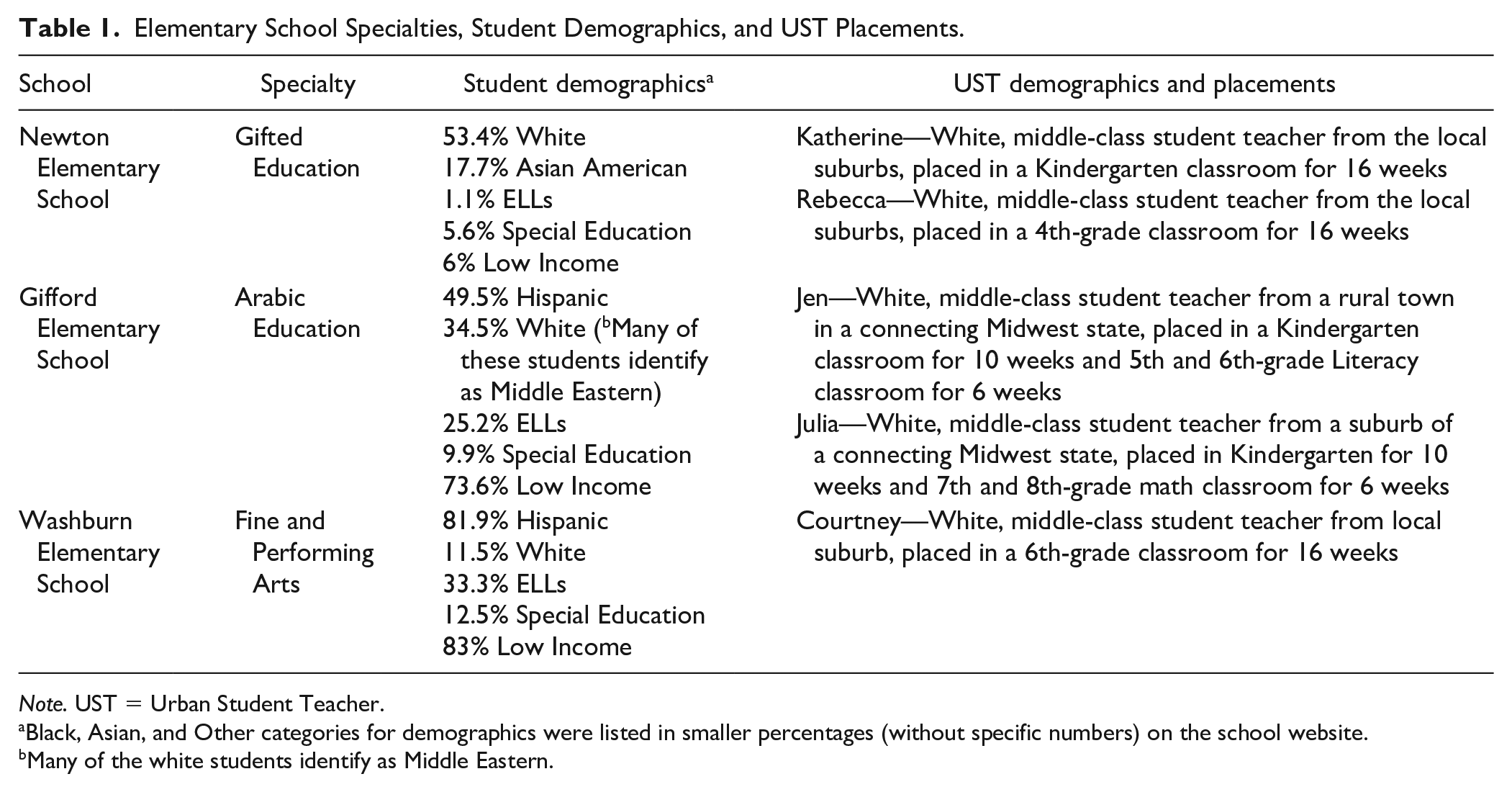
Note. UST = Urban Student Teacher.
Black, Asian, and Other categories for demographics were listed in smaller percentages (without specific numbers) on the school website.
Many of the white students identify as Middle Eastern.
Data Collection and Analysis
The similar context provided the setting for the small, interpretive collective case study. Individual stories were highlighted throughout the research. While the USTs lived and taught within a similar context, they each brought their individual personalities and experiences to share. An analytical portrayal was used to illustrate what happened to the participants during the study. Patterns emerged through a constant case comparison and thematic analysis. Attention was also given to the anomalies. The analyses examined the USTs’ intended lesson plans, implementation, and what failed. Overall, the study investigated the challenges and struggles these USTs faced in becoming successful urban teachers. Findings emerged regarding varying levels of engagement with the curriculum.
Data were collected during the 2011 to 2012 academic year. Data for this study consisted of interviews, observations, serendipitous experiences, and document reviews. Five participants were each interviewed at five different points during their student teaching semester. Interviews lasted approximately 22 min to 2 hr in duration and were audio-recorded and later transcribed. The first interviews were conducted before their placements began, and the last was conducted after student teaching was completed. The remaining three interviews occurred onsite at the beginning, middle, and end of the 16-week placement following scheduled observations. Each participant was observed teaching in their classrooms three times during the semester. The interviews served as a means to gather each participant’s insight, outlook, and reflection of their experience. Questions from the interviews pertained to the experiences of the USTs within both the community and classroom.
Serendipitous experiences included any information I gained while visiting onsite. Informal visits with the participants and other people in their environment provided valuable insight into their attitudes, beliefs, and/or actions. I attended group meetings where all of the USTs gathered and local community meetings. This information was taken into account in addition to what the participants would share with me.
In addition to the 16-week student teaching placement, the USTP requires year-long preparatory coursework, as well as continued coursework during the 16-week student teaching placement. All documents, such as preparatory and student teaching assignments, were reviewed from the year and a half program involvement.
Due to the purpose of this study, which was not intended to evaluate the USTs, I did not collect or review any evaluations or letters of recommendation. I considered collecting such documents, but decided against it, as I wanted my participants to trust in me that I was not there to evaluate their performance. I wanted to reinforce my goal to capture personal stories, which happened through their eyes, ears, and minds.
Findings
Throughout the preparation phase of the USTP, the USTs learned how beneficial culturally relevant lessons were for all students, and in particular, students in urban schools (Cochran-Smith, 2004; Ladson-Billings, 2001). The USTs read books such as Gregory Michie’s (2009) Holler if You Hear Me: The Education of a Teacher and His Students to gain a glimpse into what it might look like to teach culturally relevant lessons to students in urban settings. During their preparatory coursework, the USTs reported they could envision ways of connecting their future students with curriculum and finding ways to make learning meaningful. They were required to create two culturally relevant lessons, one of which needed to connect with a children’s book of their choice. While onsite, the USTs were observed teaching curriculum they had created, as well as curriculum that was required.
Curriculum
Many politicians, despite not being educators, believe they know what is best for education policy, and with this entitlement comes the repercussion of mandated curriculum (Apple, 1992). These external constraints bully teachers into teaching prescriptive, or “teacher proof” (Ladson-Billings, 1994, p. 80) curriculum that is applied as a one size fits all approach. Instead, the USTP, as well as most schools of education, promote the thought of autonomy with teaching. As teachers are prepared with heavy doses of content knowledge and teaching methodologies for pedagogical approaches, they combine this variety of knowledge to perform the ultimate task of what Schulman (1987) referred to as pedagogical content knowledge (PCK). Teachers are not only prepared with PCK at the university level, but they are also encouraged to understand their students, their backgrounds, their community, and culture to create authentic, meaningful, and CRT.
Thus, upon entering the field, the USTs were faced with a curricular contradiction. On the one hand, to be accommodating in their new positions, they needed to embrace the required curriculum within their school setting. On the other hand, they were expected to put their training into practice and meet the demands of their program by adapting curriculum to be relevant and engaging to their students. In what follows, I detail how the UST’s navigated the existing curriculum. Findings show that the USTs differed significantly in their use of personal power, autonomy, and use of the mandated curriculum, resulting in different levels of embracing, critiquing, tinkering (Tyack & Cuban, 1995), and creating curriculum.
Embracing curriculum
The lowest hierarchal level involving personal use of curriculum dealt with the concept of embracing without critiquing. Entering the field as a beginning teacher holds many responsibilities that make for an overwhelming process (Britzman, 2003; Bullough, 1989). Student teachers and beginning teachers often rely upon the prescriptive basals and teaching lessons to survive. Whether with fidelity or as a guide; nearly three-fourths of teachers use basal readers (Dewitz & Jones, 2013). Creating curriculum is an investigative and timely process. Developing curriculum, especially carefully planned units, is practiced throughout the teacher education program. Once in the field, however, student teachers often rely on their cooperating teachers (CTs) to guide them with curriculum. It is a lot easier to take curriculum that has already been organized, and this way the student teacher feels compliant by following the CT’s original plan. Ultimately, student teachers can only control so much of their environment. They are at the mercy of their CTs and their CTs may even feel the constraints of the school or district. There are, however, several drawbacks to accepting curriculum at face value. The curriculum could be outdated, lack meaningful content, be racially or culturally insensitive, or most importantly, it might be racist (Jones, 2020; Kohl, 1992). It is one of the many roles a teacher holds: to be critical of curriculum that is provided for the students.
For some duration of the semester, every UST followed their CT’s guidance and implemented the readily available curriculum. The USTs remarked that they felt obligated to follow through with the curriculum their host teachers provided. Of all of the participants, Courtney (all names are pseudonyms) most willingly accepted the curriculum her CT had in place. Courtney was less confident controlling the curriculum than the other participants, and she was more on a survival path to teaching. Intimidated by 6th-grade curriculum, Courtney confessed: One of my biggest challenges has been becoming familiar with the curriculum. Since I am in a sixth-grade classroom the material is much more advanced than what I am used to teaching. I feel as if I must relearn science concepts before I can teach them. Not only is this time-consuming, but I am not always confident with my teaching. I worry that I may not be able to answer students’ questions or that it is obvious that I am not comfortable in the classroom. (Assignment, September 2011)
Courtney continued to rely on the support of her CT during her 16 weeks in the classroom: The greatest professional disappointment I had in the past two weeks was during a science lesson. I was teaching students how to make energy waves in science class and it was extremely confusing and difficult for my students. I tried my best to break it down step-by-step so they would understand; I even provided examples. It got to the point where my CT needed to step in and I felt like I failed at teaching the lesson. It was a disappointment because I feel like I failed at teaching the lesson and also that I failed at helping my students to understand the lesson. (Assignment, November 2011)
Courtney shared how grateful she was to have Mr. Z there to support her and that she could observe him in the moment and learn from his style of teaching. Mr. Z took classes at a local museum in the city and implemented much of the curriculum from his program. Courtney also taught social studies and reading. She embraced the curriculum although she had envisioned it differently: I was picturing more writers’ workshops and literacy circles and I didn’t have any of that. . . I was just given the textbook and told, “these are the lessons you’re going to teach” kind of experience. . . I didn’t get to do a lot of my own activities, but I still enjoyed it and learned a lot. (Courtney, Interview, November 2011)
She alluded to the future when considering creating her own curriculum: I was pretty much stuck with the books and materials my teacher wanted me to use. . . I didn’t necessarily feel restricted, because it was kind of nice to know what to teach. But I am excited to get into my own classroom and have the freedom to do what I want to do. (Courtney, Interview, December 2011)
Courtney remained comfortable and confident not straying from the curriculum or pushing it toward a more inclusive manner. She wanted to do what was required, have her students succeed, and survive student teaching. Implementing her CT’s curriculum gave her the confidence she needed to teach.
Katherine followed through with using the reading and math textbooks provided by her school. She wanted to keep her students on the same path that they would have been on, had she not been there. She also found planning new curriculum to be time-consuming. In fact, Katherine laughed at how the teacher education program instilled values on creating meaningful units instead of relying on basic basals for curriculum: I feel like you don’t know anything until you student teach. I had great experiences in my field placements prior to student teaching. Looking back at those methods classes and learning, “Oh no, don’t ever use a basal!” Like, yeah right! Just wait until you teach! You can enhance them, but you’re going to use them! You have all of these ideas, but you’re going to use them! As long as you bring in your own things and enhance it. (Katherine, Interview, November 2011)
Katherine’s description of her experience with curriculum seemed to be fairly typical of what student teachers and the USTs in this study experienced. While she recognized the importance of enhancing the basals with supplemental materials, she wholeheartedly admitted to falling back on the basals as the primary resource for beginning teachers.
As previously mentioned with Courtney’s example of teaching about waves, just because a student teacher is handed a curriculum, it does not mean it will be easy to execute. Learning to teach is a complicated process that takes time. It takes a safe environment with a skilled CT to support student teachers as they continue to practice the art of teaching. However, accepting a curriculum at face value and not thinking about how to make it culturally relevant to the students in your classroom can lead to a more challenging lesson. It also takes preparation of studying the content, using multiple resources, and anticipating misconceptions.
Critiquing curriculum
The second level of the spectrum gave insight and indicated a baseline level of critiquing the curriculum, despite the prerequisite of embracing the curriculum. Jen and Julia were vocal in their critique and openly complained about the phonics instruction that Julia’s CT implemented in her classroom. Jen’s CT used a holistic approach, which aligned more closely to the value of instruction Jen and Julia had been exposed to in their reading methods class at the university. Gifford Elementary was in the process of transitioning with their curriculum, eliminating basals, and bringing a more holistic approach to teaching within their school, a change Jen and Julia praised. They shared that the new principal came to the school with a few of her former teachers who believed in CRT and used chapter books that the students could connect with instead of basals. Julia commented how her CT was retiring in 1 year, and although she used a strict curriculum for phonics, her reading scores still showed strong results. For these reasons, Julia remarked that her CT was “left alone” by the school principal (Interview, October 2011). It was easier for Jen and Julia to critique the retiring teacher since Jen’s CT was one of the teachers brought into the school by the principal. He also utilized guiding reading groups, which Jen and Julia were excited to see implemented after learning about the strategy in their methods classes. Courtney, Katherine, and Rebecca never openly criticized their CTs’ curricula. This may have been due to limited data. They either did not think negatively about the curriculum or if they did, they did not openly express this concern.
Jen took pride in how her CT even taught their kindergarten students to think critically about what they read: We explicitly teach the kids to find their resources and to make sure they’re correct. We say, “If you’re using a resource, you need to know the resource is right.” For example, Eric Carle’s (1994), The Very Hungry Caterpillar is wrong because caterpillars hatch from chrysalises, not cocoons. We explicitly taught them that they cannot always trust everything we read. He’s all about resources and questioning, and I’m so glad I was able to see that in a Kindergarten classroom. (Interview, October 2011)
Jen acknowledged that learning and teaching to think critically was something she learned at the university, but she was unaware of how such young learners could achieve this level of thinking. By thinking critically about curriculum and teaching her young students to think critically, Jen recognized she was able to reinforce high expectations and increase student engagement. Thinking critically, holding high expectations, and increasing student engagement all contribute to culturally responsive teaching, thus this level of engagement is not one to be looked upon as less than. In fact, it is a necessary stepping stone for the next two levels of engagement, if the curriculum is to be meaningful and culturally relevant.
Tinkering with curriculum
The third level of the spectrum illuminated the concept of tinkering with the curriculum. As mentioned previously, Katherine expressed that although she relied heavily upon her basals, she believed that it was critical to add supplemental materials to the basic curriculum. Thoughtfully adapting curriculum takes being critical to the next step: doing something about it. Tyack and Cuban (1995) recognized even this next step is not a simple task, especially when teachers are given new, mandated curriculum due to reform efforts: Teachers need help in adapting or developing new instructional practices. Some changes are very hard to make alone. Developing and locally adapting a challenging new curriculum and mode of teaching, for example, is an extraordinarily difficult tasks (sic) that requires collaboration. (p. 138)
Collaborating with others takes additional time and effort, with dependence on other educators to be equally interested in adapting curriculum. For example, Jen’s CT and several other teachers were brought to the school by the principal so that they could share the same vision for creating a more meaningful and inclusive curriculum.
Although Tyack and Cuban (1995) recommended collaboration, the data from this study indicate that student teachers are motivated to adapt curriculum when they are encouraged and given the freedom to do so. In many ways, the adaptation of curriculum was easier to observe than critiquing, because even though the USTs used, and possibly agreed with the curriculum handed to them, they were eager to add their own twist to the curriculum to feel like they had more autonomy. It gave them a sense of purpose and a feeling of becoming a teacher. That ownership was enthusiastically shared by four of the participants, with Courtney as the exception. When asked to share a professional success at the beginning of her placement, Julia shared her experience of delivering a new curriculum after studying it for a few weeks: Beginning the phonemic awareness instruction this week was very satisfying because I was the one teaching new learning behaviors and routines. Also, by the end of this week I truly feel I am implementing an effective program. Finally, another reason this was so exhilarating is because I used my judgment to add and exclude some of the directions in the curriculum to fit the students’ needs and make it more interactive. These decisions were a great success, as I was better able to gauge students’ understanding and keep them engaged. Through this experience I learned how beneficial good curriculum is, but significantly, how important it is to modify any materials to appropriately fit your teaching style and the needs of your students. (Assignment, September 2011)
Furthering the need to tinker with curriculum to fit the needs of her students, Julia wrote, When I am introducing letters or reading stories the material is relevant to their lives within their urban community. If something seems like it may be out of their schema, I address it by asking if any students can define it or I explain in terms they can understand. (Assignment, October 2011)
As mentioned previously, Courtney relied heavily upon the curriculum with little room for developing activities to support the required texts. However, Courtney disclosed visions of how she would have done things differently: Throughout my student teaching experience, I have come across a few things I would like to further develop. The first thing I wish to improve would be differentiating the way in which I teach material, specifically in social studies . . . I found it difficult to work too much outside of the textbook because my teacher wanted me to teach to the textbook. In my own classroom I would find various activities. For example, in our Egyptian unit I would find artifacts, videos and other activities for students to do. I felt at times the students were bored, and I personally find Ancient Egypt interesting, so I wish I could have done more with it. (Assignment, November 2011)
These words came at the conclusion of her experience, showing how Courtney never grew comfortable with adapting curriculum and making it her own. She did, however, have a strong and trusting relationship with her CT. From what I observed in the field, it appeared that he would have supported her in enhancing the curriculum and I wonder if her vision fell on her lack of effort. As mentioned previously, adapting curriculum takes time and effort.
Data revealed the other participants were eager to share the many ways they contributed to the curriculum in their classroom. This “tinkering” of the curriculum gave them satisfaction in making their lessons more relatable to their students, as well as exciting to teach. Rebecca developed visually and intellectually stimulating PowerPoints that impressed her CT. Julia simply took what could have been boring math problems and tweaked them to contain topics that related to her students to gain their interest in math. For example, one math problem used trees as the subject. Julia changed the topic to the local sports teams, in hopes it would better capture her students’ attention and interest.
Tinkering with curriculum proved to be a more realistic way of providing the USTs with more ownership of their teaching responsibilities. It was more time-friendly than creating new curriculum for all of the subjects, not to mention needing to create curriculum that would need to be approved prior to teaching. Due to time restraints, it made more sense for the student teachers to adapt the curriculum to intellectually and culturally engage their students in the learning environment.
Creating curriculum
Ultimately, some participants displayed their ability, autonomy, and desire to create curriculum. When teachers take control of the learning environment, and especially the curriculum, they can be labeled as what Brubaker (1993) called “teachers as decision-makers.” This autonomy provides the avenue for teachers to explore their learning community and create ways of making their lessons more culturally relevant (Ladson-Billings, 2001). The USTs had been encouraged throughout their years of taking classes within the school of education at the university to create meaningful, authentic, and intellectually engaging lessons in their future classrooms. It was evident that these USTs understood the complexity of this idea. An example of this comprehension is demonstrated in the graphic where Julia created a diagram of how she views curriculum, instruction, and the student (Julia, Written Assignment, October 2011) (Figure 1). It is clear that she believes bringing a student’s background knowledge and culture are essential to their educational, emotional, and mental growth, and must be included to create meaningful curriculum and instruction. Understanding and implementing, however, are two different actions. Creating meaningful and relevant curriculum is the most challenging and time-consuming out of the four levels discussed in this section.
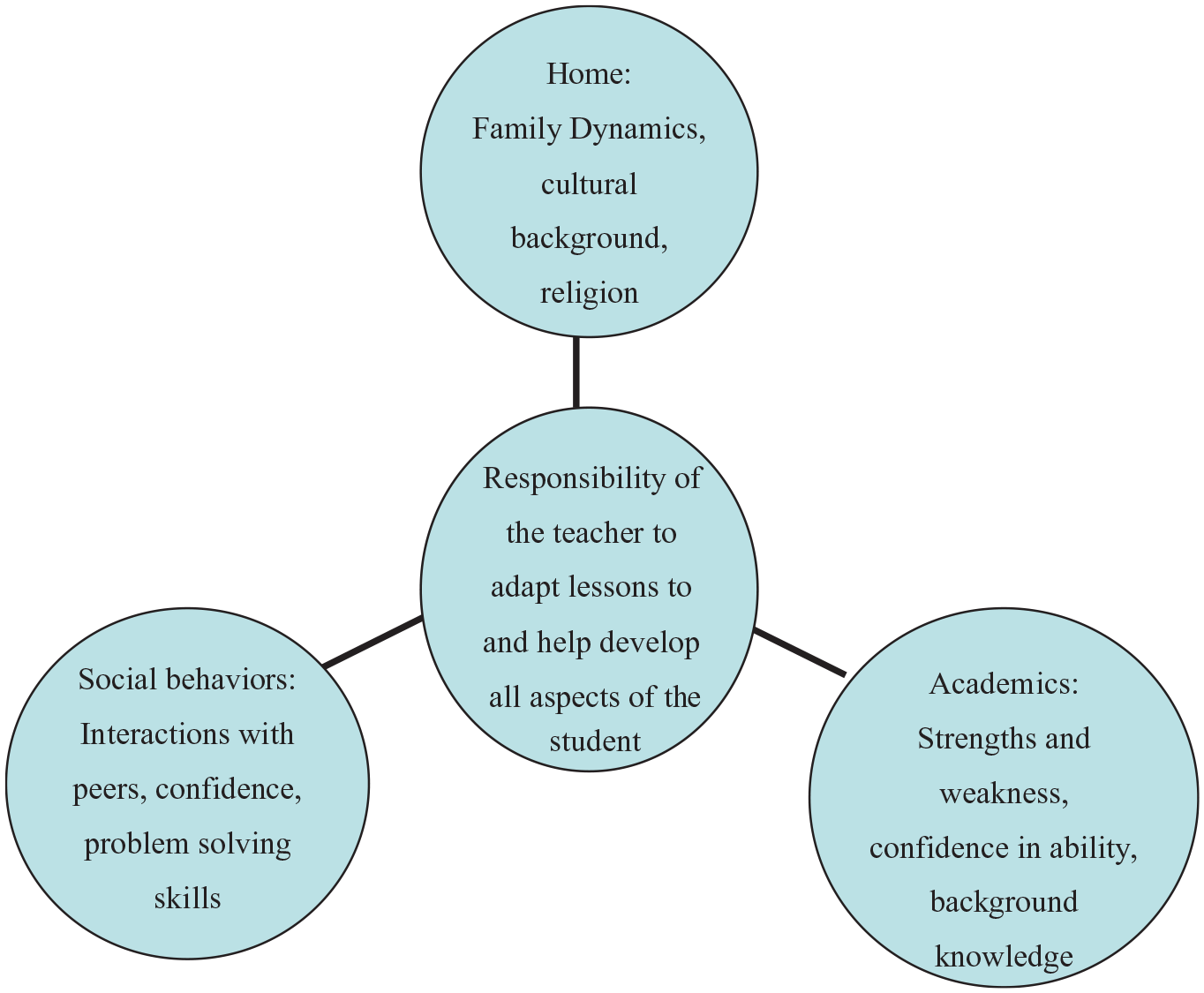
Julia’s diagram of curriculum, instruction, and the student. (Julia, Written Assignment, October 2011).
Although it would prove to be more demanding, Rebecca, Katherine, and Jen also showed evidence of creating curriculum by developing their own units of study throughout their student teaching placements. Rebecca created a poetry unit for her fourth-grade class which included multiple perspectives from her students. Three Asian American students wrote poems that referenced tsunamis, which most likely stemmed from a connection to the recent tsunami that occurred on March 11, 2011 in Japan (Observation, October 2011). During another visit, students were sharing their writing after choosing from several prompts as options that allowed them to write about meaningful objects, experiences, or personal preferences. One student, in particular, displayed pictures of herself and her cousins wearing traditional Native American Indian regalia after they participated in a ceremonial dance in New Mexico. The dance involved dancing for rain for a good crop. She shared how she practiced for four nights and performed at the Viste “Feast Day.” She added, “I like to dance and it’s part of my culture” (Observation, November 2011). The data show the students in Rebecca’s classroom felt encouraged to speak and share about their cultures. When prompted about lesson planning, Rebecca commented, “I think of all of the different ways I can incorporate technology, pictures, stories, and personal experiences to help each individual student” (Assignment, October 2011).
Katherine saw the diversity of families within her classroom and made sure it was valued by creating a family unit for her kindergarteners that addressed the diversity of families, challenging the traditional family construct. Katherine was specific about the diversity, stating, “Some children have two mothers, divorced and remarried parents, and students who were adopted” (Assignment, September 2011). Kathrine continued the family and identity theme in her classroom: Our students will be turning in a long-term assignment and presenting next week. Each student has to write a few sentences about their life and up bringing. They can also talk about the history of their name. This assignment was created to show how each student is special in their own way. This will also help demonstrate to my students how families and individuals are different. (Assignment, October 2011)
Katherine took into account the diversity of her students and created lessons that valued diversity, yet she also created lessons that needed a more critical eye. Katherine used Judy Schachner’s (2003), Skippyjon Jones as her first read aloud to the class (Assignment, August 2011). The CT and principal observed her read aloud and praised Katherine (Assignment, August 2011). No critique was ever mentioned about the stereotypes portrayed through the text. It is possible to adapt and create curriculum without being critical, and therefore, the opportunity to implement CRT is lost. In addition, and more importantly, without critique creating curriculum can become prejudice or racist.
Katherine also developed numerous self-created lesson plans for her kindergarteners in the subjects of social studies, science, and communication skills. Katherine expressed pride when writing about her ability to integrate subject matter, “I am good at integrating various subjects into one lesson. In music I teach my students songs related to reading, social studies, and science. The songs are a great way to get students to remember facts, how to spell words, vowels, and so much more” (Assignment, October 2011). Katherine also valued the voices of her students. When writing about her students, Katherine commented, “I am learning so much from my students while they are learning from me. We have created a positive classroom community where we all feel comfortable to share our thoughts and ideas” (Assignment, October 2011).
Jen made intentional efforts to make her lessons culturally relevant for her students. While teaching kindergarten, Jen shared her plans for a poetry study: I want to find a poem that is written in English by someone who speaks Arabic. The students receive Arabic instruction for 30 minutes every week but have not been excited about the class the past two weeks. I am hoping that with more exposure to people who speak Arabic they might become more excited about the class and language. (Assignment, September 2011)
Jen related her curriculum to her students’ lives. After a few weeks on-site, Jen critically observed that most of the books read to the kindergarteners had not been human characters. She chose to read Ezra Keats’ (1998) book, Whistle for Willie, and after a discussion that involved text-to-text connections, Jen concluded, “We all have a lot to learn as kindergarteners” (Observation and Interview, October 2011).
When asked about a recent success midway through the semester, Jen was encouraged by her CT and students after receiving their feedback on lessons she created: I have more responsibilities and I have now transitioned into the “main” classroom teacher. The lessons I have been planning have been received well by the class and my CT and I feel like I am comfortably transitioning into the role. (Assignment, October 2011)
It is important to note that both of Jen’s CTs pulled rich children’s literature to teach holistically. Due to this environment, it made it easier and possibly set the expectation that Jen would do the same. However, it takes a motivated and knowledgeable student teacher to accomplish such a high level of engagement with the curriculum. Jen also made a point of sharing that her CT threaded culturally relevant lessons throughout the curriculum: My teacher doesn’t teach diversity in isolation. For example, “Now we’re going to read a book about Muslims.” Instead, he teaches as we come across things like, “Why do you think this author’s name sounds funny? Maybe they would think your name sounds funny.” He opens their eyes because it’s in their community and they’re exposed to it already, so we don’t need to be explicit. . .Instead, talking about what makes students special, like specific things about each student and it’s made a big difference with the kids because they notice specific things about their classmates that make them special. They’re noticing things about each other that make them different from their peers that make them special. So, let’s not conform to be one person, but appreciate our differences. (Interview, October 2011)
Jen was thrilled to be in a placement where she was able to practice what she had learned as best practices from the university.
Jen continued to create culturally relevant lessons when she used Mildred Taylor’s (2001) Roll of Thunder, Hear My Cry to teach racial issues in her fifth-grade reading class. Addressing this topic was an interest to her students because her class was very diverse in terms of race, ethnicity, culture, and religion. Jen encouraged her students to discuss how the characters’ experiences in the book related to their own lives or others in the world. Some of her students had difficulty understanding the white and black racial divide but could relate tensions between different groups of people from their native countries. Jen also used the curriculum to encourage her students to critically think about their local schooling system: My students are reading novels that address segregated schools. This coming week I am reading them a children’s book about Ruby Bridges. Then we are going to discuss inequality. The students will lead the discussion. I will provide deep thinking questions about inequalities today in hopes that they will identify inequalities in their school system now and what implications these inequalities have for them and students at other schools. (Assignment, November 2011)
Jen used a variety of guided group discussions and activities to spark thoughtful and provoking conversations. Jen expressed great pride in her students and enjoyed sharing their work, especially assignments that projected their voices through assignments such as the paper Twitter accounts and I Am poems, in which students wrote through the perspectives of different characters in the book. Jen expressed gratitude for being supported by her CT that valued CRT and gave Jen autotomy with her units: My CT welcomes all of my ideas, like the [paper] Twitter account I wanted to include with our novel reading groups. I’ve been able to design the entire unit. . . I’ll share my ideas and she’ll teach my idea to the first class and model how to do it with proper scaffolding that I wouldn’t have thought of as a novice teacher. So it’s good that I get to observe her and then do it myself, and they’re still my ideas for the actual lesson. (Interview, November 2011)
Jen’s teaching philosophy aligned with both of her CTs and she was able to put theory to practice with strong modeling, encouragement, and support. It is without a doubt that this environment allowed her to practice creating culturally relevant curriculum.
Julia realized her students should have some power in the curriculum. Concluding her experience, Julia wrote the following in her final reflection: The students themselves have also given me new knowledge to take with me, as I look to begin my career. The kindergarteners, 7th graders, and 8th graders have all shown me the power and importance of handing the lesson over to them. As we have discussed on professional development days at Gifford, my students have illustrated their maximized learning is when the ratio of student activity to my instruction is as large as it can be. When my lessons are tailored this way, my students show they can create the knowledge, given the appropriate amount of support. (Assignment, Fall 2011)
The data suggest that to create curriculum—and in particular, culturally relevant curriculum—student teachers must have a strong placement as a foundation. Their CT must hold a similar philosophy and encourage the UST to have the freedom to create curriculum. If these essential components are in place, then the UST must have the motivation to put theory into practice. Jen and Julia shared the same sentiment about their host school, Jen explicitly shared, “At Gifford, I am not only learning about how to teach, but I am learning about places all over the world. I think that all people, especially teachers should be lifelong learners. Schools like Gifford have an atmosphere about them that present learning, growth, and challenges before the curriculum is even explored” (Assignment, September 2011).
To create culturally relevant lessons, USTs must also understand and care for the students in their classroom (T. Howard, 2010; Ladson-Billings, 1994; Valenzuela, 2005). Every UST shared strong feelings for their students and displayed varying levels of care (Fife-Demski, 2016). USTs also believed in their students and held high expectations. Jen shared, “My 5th and 6th-grade students have been rising to the challenge of the rigorous assignments I have been giving them” (Assignment, November 2011) and continued, “I had high expectations for my students. My students surpassed the standards I set for them and taught themselves that if they put their mind to something they could not only succeed but enlighten others” (Assignment, November 2011). Rebecca commented, “The children respect me as their teacher, but also accept me as their friend. They really are phenomenal children who are so bright and I love them to death!” (Assignment, October 2011). While Courtney did not show an attempt to strongly critique, adapt, or create the curriculum she was provided, she held strong bonds with her students. There was a reciprocal level of caring that was observed during visits and shared during interviews and document reviews (Fife-Demski, 2016). While the sixth-grade curriculum intimidated her, the occasional behaviors and attitudes of adolescents did not. Courtney was patient and available to her students. They had meaningful conversations about life and looked forward to every day with her students and CT. Her CT also had strong relationships with the elementary students.
While Courtney did not create or adapt her curriculum, the other USTs in some form tinkered and/or created new curriculum to better stimulate their students’ learning. The USTs, for the most part, willingly accepted the curriculum, however, they felt more accomplished and proud of their teaching the more they tinkered with the curriculum and created their own lessons.
Implications
While every UST embraced the curriculum, data showed various levels of engagement through critiquing, tinkering, and/or creating. Whether it was a lack of communicating their critiques, not wanting to step on the toes of their CTs, or not critically examining the curriculum at all, the USTs did not always question what they were instructed to do with their curriculum. It is important to remember the complicated situation in which the student teacher exists. While these USTs are learning how to create such a constructive learning environment, they, themselves, are learning and growing a great deal as well. Britzman (2003) observed that not only are these student teachers in a, “delicate position. . . Margina
lly situated in two worlds, the student teacher as part student and part teacher, has the dual struggle of educating others while being educated” (p. 36). The transformation from student to teacher is complex (Britzman, 2003; Bullough, 1989; Goodman, 1987), and involves a great deal of trials and tribulations. The data from this study show these areas of interest are critical components to thoroughly cover with preservice teachers before they arrive onsite for student teaching. Questioning these aspects of education that directly impact students determines whether or not the educator reinforces the status quo and social reproduction, or creates avenues for authentic learning and social growth.
Why is adding a culturally immersive experience in addition to a classroom experience so important for student teaching? The data suggest there are several reasons for this, one of which is to more fully develop the individual growth of young adults. Research has suggested that most teachers seek positions in schools most familiar to their own schooling history (Haberman, 1996). Many beginning teachers have not had opportunities to expand their horizons and to grow as individuals, yet they are expected to enter classrooms, expanding the minds and experiences of their students. Culturally immersive programs contribute to the development of future teachers and their students (Stachowski & Maha, 1998; Zeichner & Hoeft, 1996). Experiences such as these can offer opportunities to better understand people and cultures different from one’s own to widen one’s perspectives and to gain an appreciation for multiple perspectives. Teachers come into contact with students from a multitude of backgrounds. If teachers have had experiences that have broadened their perspectives and opportunities to work and communicate with people from different backgrounds of their own, they are more likely to be successful in applying these new skills to future settings. Furthermore, and perhaps most importantly, these teachers are then better prepared to teach urban students. They gather background information and cultural resources to blend this knowledge into the school curriculum. Students learn best when their teachers can relate and teach authentic, meaningful, intellectually engaging, and culturally relevant lessons (Brown, 2002; Cochran-Smith, 2004; Delpit, 1995; Gay, 2010; Ladson-Billings, 1994, 2001, 2014; Noddings, 1992; Sleeter, 1996).
Teacher education does not always adapt itself to different communities. Knowles and Cole (1996) warn, “[The] lack of attention to the community within which the school is situated and the role of the school within the community does little to help preservice teachers understand and appreciate the contextual and cultural makeup of the students” (p. 657). Urban schools must be one of the most critical locations for teachers to understand the local community and students. Regardless of the locale, Mason (1999, Spring) has stated, “To teach well, then, we must know our students well” (p. 38). To exclude the community during student teaching and not to emphasize its importance in coursework, is to ignore much of research in teacher education. The students’ in our K-12 schools depend on this necessary component for their future teachers to understand. Not to mention these skills also assist future teachers with the tools to better communicate, collaborate, and understand their future students, students’ families, team members, administrators, and society, as a whole.
Crossing cultural borders is an essential goal for all USTs, especially the White, middle-class, monolingual women from non-urban areas. The data from this study, in tandem with previous data (Fife-Demski, 2016), have unequivocally supported the need for complete immersion in settings, especially within urban contexts. USTs must immerse themselves within the local community culture and bring their common knowledge into the schools if they are to be the best urban teachers possible. As the K-12 student population continues to increase in diversity, the majority of teachers’ identities in our nation still fall under the umbrella of White, middle-class, monolingual women. Students are more likely to be successful when their teachers cannot only relate but also provide culturally relevant instruction. Research has shown that urban schools have a higher teacher attrition rate, and teachers within low-income, high minority, and low achieving schools typically leave for higher income, lower minority, and higher-achieving schools in suburban areas (Ingersoll & Merrill, 2010). There is a clear disconnect that must be examined in order for all students to receive the quality instruction they so greatly need and deserve, and for non-urban teachers to be more likely to stay in urban schools.
Through programs such as the USTP, preservice teachers with nonurban backgrounds can better prepare themselves for the challenges faced within urban schools. They receive an education that pushes them to question the stereotypes held prior to onsite arrival, so that they may unlearn these negative perspectives. By holding onto negative perspectives and carrying them into their future classrooms, they could potentially harm students through various ways, such as deficit thinking (Valencia, 1997), and even contribute to social reproduction of the status quo (Friere, 1987; Giroux, 1983; Morrell, 2004; Rasheed, 2007). Even educators with good intentions can do harm by “perpetuating curriculum violence” by not being critical of the curriculum (Jones, 2020, p. 50). Simply being unaware of how teachers can project their “unstated norms, values, and believes” within the “hidden curriculum” can greatly affect students from accessing the curriculum (Giroux, 1988, p. 23). These negative thoughts could also prevent them from making advancements in immersing themselves in the local urban culture. Through the proper teacher education courses and support during an immersive learning experience, teachers may have the tools they need to adapt to our dynamic education system, especially that of a system found in urban areas. The educational support, reflective practices, and community involvement may also play critical roles in teacher attrition in urban schools. Not only will teacher attrition more likely improve, but with consistent, quality teachers, urban students will be more likely to succeed. The achievement gap has only widened through the years, and it is critical, now more than ever, to work toward closing this gap. Low-income and high minority, urban students deserve the quality education that high-income students typically receive.
Conclusion
Although every UST embraced the curriculum, data showed there were multiple levels of involvement labeled as critiquing, tinkering, and creating. While challenging, USTs who created units of study, found their ownership of the curriculum satisfying. Intentional placements with CTs that practiced CRT and encouraged the freedom for USTs to tinker and create led to a more successful implementation of putting theory to practice. Another theme that emerged from the data was recognizing that no matter how comprehensive the preparation of the education program is, learning to teach is still challenging, and a program cannot prepare student teachers for every obstacle they will face in the field. This study provides evidence that learning to become a good teacher takes initiative, time, and practice. The aim becomes, then, for the student teacher to embrace such challenges. Instead of trying to avoid these struggles, teacher educators should encourage student teachers to embrace the challenges that come with teaching and view them as a way to learn. Perhaps the greatest gain is the lesson learned through overcoming struggles.
Footnotes
Declaration of Conflicting Interests
The author declared no potential conflicts of interest with respect to the research, authorship, and/or publication of this article.
Funding
The author received no financial support for the research, authorship, and/or publication of this article.
