







Abstract
Forty-four states have recently taken formal policy steps to limit how teachers can teach about so-called “divisive issues.” This paper examines teachers’ perceptions of what they need to be prepared to teach in states where “divisive issues” legislation exists. Teacher interview data where restrictive legislation exists were used to explore what inservice teachers need to teach within the constraints of states’ divisive issues legislation, and what teacher preparation programs should focus on when preparing new teachers to do the same. Analysis revealed, among other things, that all feel they need clear guidance from their district, and better training.
“It's getting to be open season on teachers right now.” -David
This paper seeks to provide a foundation for the research that needs to be done on the impact of divisive issues legislation. At the time of this writing, there is work exploring the effects of the laws, but to our knowledge there is nothing published about the implications for teacher preparation. This piece is intended as a jumping off point for the research community to look more closely at this emerging issue.
On September 1, 2020, Chris Rufo, a fellow at the Discovery Research Institute, appeared on “Tucker Carlson Tonight” on Fox News. During this interview, Rufo called for President Trump to end the widespread practice of indoctrinating federal government employees with Critical Race Theory (Dorman, 2020). Rufo said, “what I have discovered is that critical race theory has become, in essence, the default ideology of the federal bureaucracy and is now being weaponized against the American people” (Dorman, 2020, para 2). Shortly after Rufo’s television appearance, on September 22, 2020, President Trump signed the Executive Order on Combating Race and Sex Stereotyping (Exec. Order No. 13,950, 3 C.F.R. 60683, 2020) (note: this Executive Order was repealed by President Biden on January 20, 2021). This Executive Order became a blueprint for states to use when crafting their own divisive issue laws (Legal Defense Fund, 2023). However, this simple television appearance set in motion an unprecedented shift in the culture wars, shoving the K-12 classroom into the spotlight as the primary battleground (Bissell, 2023).
Between January 2021 and June 2023, 44 states have introduced, passed, or taken other formal policy steps to limit how teachers can teach about racism, sexism, and so-called “divisive issues” (Schwartz, 2023b). The resulting limits placed on teachers have played out in a variety of ways, including this one, in a rural district in one midwestern state: a preservice teacher (PST) began teaching a lesson on the Gay Liberation Movement as a component of the Civil Rights Movement. This particular content was documented in the state’s social studies standards-based curriculum, so the PST felt secure in teaching the lesson. Fifteen minutes into the class, the mentor teacher had an email from an angry parent who said the lesson was a violation of the district’s current anti-divisive issues policy because it brought in content around gender and identity. Another PST in a different district was teaching similar content, but was actually removed by the school for teaching it (Reich, 2023). Scenes like this are becoming increasingly common throughout the country, as teachers and preservice teachers alike lack clear guidance on what they can and cannot teach in the classroom under these new laws.
As of June 2023, eleven states have passed formal legislation banning the teaching of so-called divisive concepts; eight states have Executive Orders or State Board of Education Resolutions that place limits on teachers raising certain topics; eleven states have proposed bills that are currently moving through legislatures; and fifteen states have had legislation introduced but not passed (Schwartz, 2023b). Proponents of the bills argue that educators are indoctrinating students with lessons on race that make students feel uncomfortable or shamed in class (Schwartz, 2023a). Some of the legislation seeks to allow parents the opportunity to screen what children will learn (Meckler, 2022; Wexler, 2022) and restricts the content that can be taught in classrooms regarding racism, sexism, identity, human sexuality, and issues of systemic inequality (Greene, 2022; Schwartz, 2023a, 2023b).
These pieces of legislation have prompted a significant increase in media coverage surrounding the new laws’ meaning and impact. Most of this coverage has focused on parents, legislators, and school board members’ thoughts and their perceived need for this legislation. Often sidelined in this discourse are the perspectives of teachers themselves. What do they perceive the impacts of these legislative efforts to be? And how do they intend to respond to the restrictions they impose? It is vital to understand the ways in which teachers believe the laws will impact their classroom. As teacher educators, we also have a strong desire to better learn what we should be doing as we prepare preservice teachers to teach within the constraints of our respective states’ laws.
This phenomenological study explores teachers’ perceptions of what teachers need in order to be prepared to teach in states where anti-divisive issues legislation has been passed. In particular, we wanted to explore the knowledge, skills, and dispositions that teachers anticipated they will need and what teacher preparation programs will need to do to prepare teachers to teach in this new environment. We drew upon data from individual interviews of teachers in states where restrictive anti-divisive issues legislation is now in place were used to explore answers to the following research questions: (1) What do inservice teachers need in order to be prepared to teach within the constraints of states’ divisive issues legislation? and (2) What do these same teachers believe teacher preparation programs should focus on when preparing new teachers to do the same?
Literature Review
Expectations of Teachers
Research has shown over the years that teachers are the most critical element of the classroom when it comes to determining students’ academic success in both the short and long term (Chetty et al., 2014; Rivkin et al., 2005; Rockoff, 2004). Research has consistently shown a clear relationship between students’ learning and the quality of their teachers, and a weak teacher can actually have a deleterious impact on learners (Chetty et al., 2014; Darling-Hammond, 2000; Hattie, 2003). In short, the common denominator in school improvement and student success is the teacher (Stronge et al., 2011).
Alongside growing research and literature which shows teachers are the most important variable in student growth and achievement, there are increasing requirements for their roles in and beyond the classroom. The knowledge base expected of teachers, or “the body of understanding, knowledge, skills, and dispositions that a teacher needs to perform effectively in a given teaching situation” (Wilson et al., 1987), has continually increased, making their job more and more complex. Both teachers in the field and those entering the profession need to be equipped to navigate these increasing expectations.
Knowledge
Teachers need a strong understanding of content, children they teach, and pedagogical content knowledge. Shulman (1986) described knowledge specific to teachers to include “the most powerful analogies, illustrations, examples, explanations, and demonstrations – in a word, the ways of representing and formulating the subject that makes it comprehensible to others” (p. 9). Recent works have explored teacher knowledge in relation to the teacher’s role to actually “transform” subject matter to make it accessible for students (Scheiner, 2022). More recently, teachers also need to have knowledge of the legislation that has been passed that restricts what they can teach (Gross, 2022). Teachers have to know the ins and outs of these bills so that they don’t live in fear of being fired (Meckler & Natanson, 2022).
Skills
The pedagogical and organizational skills teachers need to effectively manage and organize a classroom include establishing routines, monitoring student behavior, using time efficiently and effectively, ensuring availability of necessary materials for student use, organizing a physical space that affords high-leverage teaching practices, and using space well (Stronge et al., 2011). To better manage the complexities of teaching and caring for the whole child, especially post-pandemic, many teachers turn to the skills foregrounded by social-emotional learning (SEL), or “the process of acquiring the competencies to recognize and manage emotions, develop caring and concern for others, establish positive relationships, make responsible decisions, and handle challenging situations effectively” (Weissberg et al., 2015).
Others have pushed for teachers to learn how to be culturally responsive to each of their students’ needs and ways of seeing the world. Gay (2002) defines culturally responsive pedagogy as “using the cultural characteristics, experiences, and perspectives of ethnically diverse students as conduits for teaching them more effectively” (p. 106). Culturally responsive teaching, and the skills associated with it, has been found to lead to higher test scores (Cherfas et al., 2021; Ladson-Billings, 1995), a positive impact on student mental health (Jones & Lee, 2022), and a sense of belonging for students (Prins et al., 2019). In our current anti-divisive issues law climate, some teachers are finding that bans limiting certain resources and books create a roadblock to their becoming more culturally responsive (Najarro, 2022).
Teachers also need to have pedagogical skills that assist them in teaching within the constraints of the anti-divisive issues laws (Kim, 2021). This is especially true when navigating content that may be seen as controversial, such as race (Waxman, 2022), or using pedagogical methods such as discussion and questioning (Belsha et al., 2021).
Dispositions
Dispositions include “the necessary values, commitments, and professional ethics that influence teacher behaviors” (Burden & Byrd, 2013, p. 4). The Council for the Accreditation of Educator Preparation defines dispositions as “the habits of professional action and moral commitments that underlie an educator’s performance” (CAEP, n.d Para 5). They have been found to be important predictors of teacher effectiveness (Johnson et al., 2011). Collaboration, respect, reverence for teaching and learning, reflection, flexibility, and responsibility are all examples of professional dispositions that are found in the literature surrounding the professional traits that one must possess to be a successful teacher (Henninger & Ensign, 2020; Rike & Sharp, 2008; Strom et al., 2019). Yet, dispositions are also not simply cognitive tools to be acquired—they must be practiced (Gresalfi, 2009; Thomas & Brown, 2007). Teachers’ dispositions also assist in building their resiliency to teach in challenging environments, such as those that may now exist in certain states today (Usher, 2019). A teachers’ strong sense of professional identity is a result of their experiences but is also important in understanding teachers’ dispositions. A recent study found that negative media discourses and cultural context can impact teacher identity (Cabalin & Andrada, 2023), which may include media coverage around divisive issues legislation.
Effect of Increasing Expectations on Teachers
Many teachers feel unable to meet these growing expectations across their professional responsibilities, which impacts them and their work. Some researchers have defined teacher stress in terms of the “degree of mismatch between the demands made upon an individual and the individual’s ability to cope with those demands” (Kyriacou, 2001, p. 28). High levels of chronic stress can lead to occupational burnout, characterized by emotional exhaustion, depersonalization, and a low sense of accomplishment in one’s work (Maslach et al., 2001). Stress is among the primary reasons that teachers become dissatisfied and leave their positions (Darling Hammond, 2001) and has been linked to decreased job satisfaction, poor instructional practices, and poor student outcomes (Schwarzer & Hallum, 2008).
Teacher Preparation Programs are Responsive to the Field
Teacher preparation programs have a long history of responding to contemporary conditions in the field, including addressing teacher shortages in key areas (Berry & Shields, 2017; Hunter-Boykin, 1992; Newhouse, 1981; Wilkin & Nwoke, 2011). Programmatic changes have been made in relation to student demographics, specifically preparing preservice teachers to work with diverse students in STEM (Greene-Clemons, 2016), students with disabilities (Wooldridge et al., 2015), and to work with indigenous students (Castagno, 2012). As digital technologies have infused K-12 and higher education classrooms alike, programs have considered how they need to adapt to support the digital practices of their preservice teachers (Foulger et al., 2019). Pedagogical shifts have also aimed to improve the skills of preservice teachers working with K-12 students, for example, emphasizing socio-emotional learning and culturally responsive teaching (e.g., Donahue-Keegan et al., 2019; Sobel et al., 2011).
In addition to preparing teachers for conditions in the field, TPPs (teacher preparation programs) have long prepared preservice teachers to approach controversial issues (Hess, 2002; Oulton et al., 2004; Pace, 2019). Topics have ranged from how to approach teaching about climate crisis (Alvey, 2020; Ashmann et al., 2017; Beach, 2023); gender, sex, and sexuality (Ludwig & Summer, 2023; Vavrus, 2009); and race (Buchanan, 2015; Falter & Kerkhoff, 2018). While teacher educators and TPPs alike wrestle with their contemporary moment, there is clear attention to preparing preservice teachers for navigating complicated and controversial issues in their future classrooms.
As key stakeholders in the education field, TPPs often engage in state level conversations around education. They have helped create new curricular standards (Barr et al., 2014) and engaged with conversations around legislation that will impact their future teachers (Worthy et al., 2018). TPPs are also impacted by federal policies (Gillespie et al., 2020) and respond to current political climates (Andrews et al., 2017). Recognizing that education has always had multiple stakeholders, TPPs must find ways to orient themselves to the new landscapes constructed by state legislatures.
Methods
Study Design
In order to explore teacher perceptions of what inservice and preservice teachers need to be prepared within the constraints of the divisive issues legislation, we conducted a phenomenological study (Moustakas, 1994). According to Creswell and Poth (2017), phenomenological studies allow researchers to explore the perceptions and insights of individuals who shared the same experience. Utilizing phenomenology best enabled the researchers to determine the point of view of the teachers with regards to their firsthand experiences with the enacted legislation, since all study participants are from states where divisive issues legislation has been implemented (Gallagher, 2012).
Participants
As a precursor to this paper, we surveyed K-12 educators working in the United States from October 26-November 27, 2021. This current study is part of that larger project, and we report the results of the survey elsewhere (Author, 2023). For the survey, we recruited teacher participants through email lists, social media, and through our individual networks. We ended up with 573 practicing US K-12 teacher participants. After completing an initial quantitative analysis on the survey data, we wanted to do a follow-up study and triangulate survey findings that would allow us to probe further on individual teachers’ survey responses. The survey itself was not used for this paper; it was used to recruit participants for the follow-up study reported on here, and provided us with the demographic data and context of the participants.
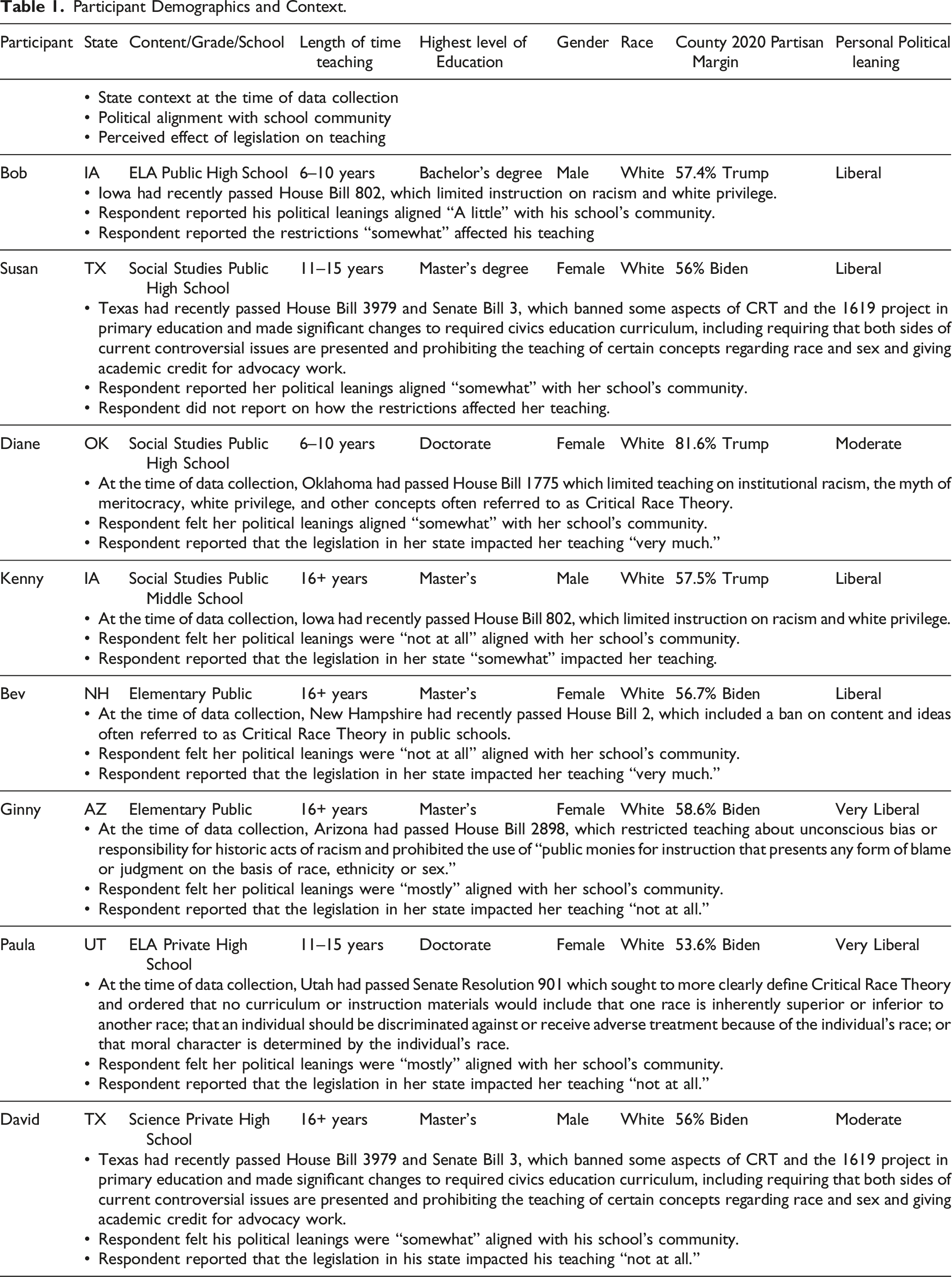
In April 2022, we began to reach out to survey respondents to participate in interviews. From the sample of survey respondents, we filtered out all participants who (1) lived in states that had at that point passed restrictive legislation (which at the time was only eight states) (2) indicated they were willing to participate in an interview. This resulted in a potential sample of 27 participants. We then contacted all of those participants and requested a one-hour interview. Of the participants we contacted, ten agreed to participate in an interview and we were able to successfully schedule interviews with eight participants.
Participant Demographics and Context.
Data Collection and Analysis
One member of our team conducted interviews over Zoom with eight practicing classroom teachers in states where divisive issues restriction legislation had been passed. An interview protocol [Appendix A] asked them to expand on their specific survey answers. Each interview lasted approximately 1 hour. Since our data collection occurred in the initial stage of the passage of these bills, the interviews focused on these teachers’ early experiences with the new regulations, rather than the long term impacts of these bills. This included the support provided by their district and administration and the anticipated impacts on their professional work.
We recorded the interviews, transcribed them, and analyzed the data. One researcher did a first round of deductive analysis through exploratory coding, using the research questions to assist in chunking data. The second cycle of coding utilized inductive analysis, where two researchers coded all data together to support intercoder agreement, using a descriptive coding process (Saldaña, 2021). We then worked together to collapse descriptive codes during a third cycle of focused coding. We created a codebook that allowed our research team to define each code, provide an exemplar quote from the participants, and quantify the number of times we used each code and by which participant. We created a second table based on the initial codebook that enabled our research team to visualize the codes by participant in order to get a better sense of which ones we were spending more of their time discussing (Saldaña, 2021).
Positionality and Reflexivity of the Contributing Authors
Our group of contributing authors are all teacher educators who are deeply invested in the future of teachers, schools, and the profession of teaching. Four of the five authors have classroom experience ranging from 3 to 10 years in middle or high schools. We hold central to these convictions that all teachers are stewards of the profession of teaching that deserve the respect and autonomy afforded other professions, such as medicine or law. We also believe that highly qualified teachers and administrators should be the primary agents in deciding and adhering to the parameters of teaching and the classroom. These educators have the necessary expertise, experience, and pedagogical knowledge to best attend to enduring issues of schools and classrooms that impact all children in ways often hidden from those not in the profession.
Findings
What Teachers Say They Need
In our coding process, we identified eight different themes from our participants on what inservice teachers said they needed to respond to divisive issues legislation.
Legal Guidance
Participants identified a pressing need for more legal guidance from district and school-level administrative personnel. Teachers cited the need for guidance in the form of clear information about what the legal challenges and interpretations are. For example, Kenny, a politically liberal male social studies teacher in Iowa, expressed a desire for clearer legal guidance. He noted that “I think somebody, a legal expert, should essentially summarize exactly what would get a teacher in trouble, so that they know what they can’t do, and exactly where the line is.” Similarly, Ginny, a politically very liberal female elementary teacher in Arizona, observed, “we’re going to need to have that reinforced to know if our district will support us when someone takes up something that we are doing and says that it violates the law.” Ginny also expressed a need for guidance surrounding content. She said that teachers are wary about bringing in original content right now, so “we need printed information instead of finding things online and just using very limited topics and very specific things that can be discussed.” She continued, indicating, “we’re going to need information from the district, not just to know what we can and can’t do, but also to know what our district will and won’t support.” Teachers expressed need for guidance on what the consequences are if they make the wrong content or pedagogical choices. As Susan, a politically liberal female social studies high teacher in Texas, noted, “if the district has advised you one way and you’re doing something that’s way off the chart against what the district guidance is…you could be exposed and you could risk your career.”
Pedagogical Guidance
Participants also expressed a need for guidance about specific pedagogical strategies that they needed to successfully navigate teaching within the legislation. Bob, a male politically liberal ELA teacher who also teaches in Iowa, said that teachers need to “know how to start conversations with kids.” Similarly, Paula, a female very liberal Reading and Language Arts teacher in Utah, observed that “teachers would need to just develop some dialogue skills…find ways to have conversations that still meet that expectation while still reaching the goals that they have.” Alongside that is the need to develop skills surrounding teaching these “divisive concepts.” Teachers also mentioned knowing how to support individual student needs. As Bev, a politically very liberal female teacher in New Hampshire, observed “how you adapt to, and how you deal with, and how you relate to students…it’s the piece about allowing kids to be their own thinkers and things like that. That has to be learned by some teachers. And some people are natural at it, but most people have to learn how to not talk and let them think.” Teachers are clearly looking for “how to” practices to navigate their classrooms in uncertain times.
School and District Support
Participants noted needing some kind of infrastructure or safety net—in the form of a person or group of people—so that they can proceed with the business of teaching in a challenging environment. Kenny noted that they think it would be helpful “if teachers could even have a person that they could say to, ‘Here, I’d like you to look at this and make sure it’s okay.’ And then they would know that the district is going to support them if any parent or kid wants to say, ‘Hey, you can’t do that.’” David, a politically moderate male science teacher in Texas, echoed this need, as he wanted to be able to continue to bring in outside resources as he came across them, but also wanted to make sure there was a process in place to vet them to ensure the district supports them being used in the classroom. He said, “I have no difficulty bringing these things in and going, ‘Hey, I ran across this article the other day, it kind of ties into this. Let’s talk about it because it’s cool and it’s new’. I would not feel comfortable doing that in a public school environment right now, so I would need support of my admin in order to do this.” Teachers need to know they have proactive administrators who will learn the laws and will support them as needed.
Understand Individual Teaching Context
Participants shared that teachers needed to be aware of their roles and responsibilities as a teacher generally, but also in the context of their individual ecosystem (community, district, etc.). This awareness can come in many forms. Bev thought it was necessary that “any new teacher definitely has to have that understanding that if you really want to impact children, it’s not going to happen necessarily through the curriculum.” Additionally, teachers need to be aware of the legislation, and what actual constraints are placed on them. Bob noted that teachers need to have an awareness of “what’s appropriate to talk about or not talk about.”
However, participants also mentioned that they felt teachers needed to find ways to “toe the party line,” meaning that teachers need to teach within the constraints of legislation and policy to avoid getting into trouble. David indicated first and foremost that teachers need to “just keep your head down.” Similarly, Kenny said that teachers need to “stay on topic, you cannot, you know, go with the flow anywhere,” since the legislation takes away teachers’ autonomy. Additionally, he said that teachers need to “take whatever the district guidelines are, and you, you have to adhere to those as closely as possible, right. You’re not bringing in anything, particularly new and different. You’re not going out and teaching anything that’s- that’s, you know, any more controversial than it has to be.”
Support for Advocacy
Participants expressed a need to have more support for their work as advocates such as explaining the rationale behind pedagogical choices. Diane said, “I think more than anything, we need more teachers….who are advocates. Not necessarily activists, though that can work, too. But definitely advocates for well-rounded education.” She circled back to this idea later when discussing advocacy for content, and that there is a need to “be able to explain and be advocates…for our subject matter. To be able to put things in language that people can understand.” However, she also noted that teachers require support in how to do this kind of work, “if we have more of those conversations with people in our local school districts, and we train teachers how to do those things and how to think about things in those ways, I think then you have more people who can go to state legislators to fight for us.”
Participants also promoted advocacy with parents, administrators, and the community, to help them better understand the work of classroom life and the curricular choices. Diane noted, “I need to be able to go and if parents have a problem, say, ‘This is my rationale for what I’m doing.’ And walk them through it. If the school board has questions, to walk them through what I’m doing.” Teachers need to feel that they are safe to have these conversations, and that they will be heard. Paula took a similar perspective on advocacy, but expressed a desire for teachers to have space for dialogue with those who disagree. They feel that teachers “need to be able to say, ‘We hear what this law is saying and what your concerns are. Here’s our concerns. Can we listen to each other and find a way to talk about these things that we can both live with?’”
Dispositions
The remaining three codes reflected the mindset of where teachers were and what they felt they needed to effectively teach in their respective states, all of which connect to personal dispositions.
Resilience
Bev mentioned the topic of resilience multiple times in describing how teachers have to work flexibly within, and rebound in the face of, challenges and setbacks associated with the legislation. She said that teachers need “tough skin. They have to be the type of person that is confident in themselves, but also has boundaries.” She came back to this idea later in the interview and said that teachers need to be hard workers, but that they also need to be committed to the profession, no matter how hard it gets. And that we need teachers that “are not going to complain about all the time it takes to actually educate these kids because it’s going to get worse because now we have to watch ourselves in what we prepare and what we do. So it will take longer to prepare something that’s going to fit the parameters of what’s expected or what’s allowed.”
Knowledge about the Concepts in the Legislation
Kenny called for more knowledge about what concepts are included in the legislation as well as a deeper understanding of those concepts themselves. For knowledge surrounding the actual legislation, he said teachers need “to see the legislation...I think teachers need to know exactly what they… I mean, I think if you’re going to have something like this, you should be incredibly clear on what you can teach.” He came back to this again later in the interview and said that teachers need to know the actual concepts that are being banned in some of the bills. David also said “I think we need more education about what these concepts are, so that teachers can feel comfortable…before they can make a decision about what resources they’re going to use that deal with those kinds of concepts, they should probably have a better understanding of those concepts, like white privilege and racism, than most of us probably naturally do.”
Trust Yourself
Bob felt that it was important that teachers trust themselves. He advised that teachers “keep doing what you’re doing. What you’re doing is fine. What you’ve been doing is fine because if it wasn’t, you would’ve been fired already for indoctrinating children. You would’ve been fired already for sharing your political beliefs like crazy, which this is what this bill alleges that we do, daily.” He came back to this later and said that “it’s a made up thing that they want you to worry about, but you don’t need to worry about. Because if you’ve been teaching for even two years or a year, you’re doing a great job. You’re still teaching.”
What Teachers Say Preservice Teachers Need
Through the coding process, we identified six themes on what participants thought TPPs should focus on when preparing news teachers to teach within the constraints of the laws
Prepare PSTs for the Reality of the Teaching Profession
Participants reported that TPPs need to support PSTs by teaching about the realities of the teaching profession and the current state of education. As Diane noted, “you have to be real about the state of education right now in the United States. Especially in more conservative states. And where all of this is coming from. And being able to say, ‘This is going to happen probably to all of us. At some point, someone’s going to ask a question and we have to be prepared to be able to give people a coherent, concise, easy to understand rationale for why it is we’re doing the things we do.’” Additionally, she observed that TTPs need to be honest with PSTs about what they’re getting themselves into, “I think we need to be honest with people who are thinking about teaching and saying, ‘Look, it’s not enough to just go teach the subject and grade your papers and go home. Because what you’re trying to teach is being attacked in all of these ways.’”
Similarly, participants reported that TPPs should instruct PSTs about the politicization of the teaching profession. Susan noted the importance of “helping new teachers prepare for the politics of it all,” and “preparing teachers for the idea that there may be times when politics is going to invade your classroom…and just especially at a public school, you’re very much still going to see local government and you’re going to see politics from time to time in what you do because that’s just the nature of how we do public education in this country.” Teachers described the need for PSTs to understand that teaching is more political now than ever before, but that it might not always be this way since the pendulum is constantly swinging. Ginny felt that TPPs should potentially focus on “teaching historically the way that things have changed and moved and to get people to start without thinking, ‘Oh my gosh, this is the rest of my career that it's going to be like this.’ So I would think in teacher training, you would need to let them know just because this legislation is this year doesn’t mean that 20 years from now, you’re going to be dealing with this.”
Explicit Instruction on both Content and How to Avoid Risk
Participants suggested that TPPs instruct PSTs in pedagogical moves that allow them to address learning aims without putting them at risk. Diane noted that TPPs now need to “[talk] through the ways to try to combat all of this.” Prior to the legislation being passed, methods professors may have been less likely to bring in content around state laws and their impact on teaching, but now they almost have to in these states. Susan noted that PSTs also need to be taught, “how to deal with those times when that may be awkward, and it may be in conflict with, you know, you may be in conflict or feel like you’re in conflict with some aspect of your community.” Bob brought up the need for TPPs to now make room to discuss whether or not teachers should disclose their political leanings, and the “professional boundary” that PSTs need to navigate in relation to their community and school contexts.
Participants also shared their desire for explicit guidance around the content they can/cannot teach. For example, Bob noted two different times that PSTs need clear and explicit instruction around the kind of content that will or will not put them at risk under the laws. He also noted the importance of TPPs talking with their PSTs about “what’s appropriate to talk about with your students.” They circle back to this point later by citing the need for “future teachers [should] know some ethics about what to talk with about [with] kids get them involved with community.”
Greater Focus on Content Knowledge
Participants also observed having stronger content knowledge would allow them to better navigate the new political climate. Kenny noted three different times the need for TPPs to spend more time focusing on PSTs content knowledge, citing how it would be useful for PSTs to learn about “stuff that would help [them] know what they need to teach history better.” This is especially true when it comes to gaining more content knowledge about second-order disciplinary concepts. They noted the need to “teach [PSTs] how to teach it in a way that is… It’s hard for me to teach black American history without it kind of… Pointing out, it’s not just a story of oppression and victimization. So, you can’t just teach about slavery, and the segregation, and Jim Crow and that stuff. And it’s just hard to find resources, and it’s hard to know the stories that do go beyond just the Jim Crow stuff.” So TPPs should focus on deepening PSTs critical content knowledge. Additionally, Bob observed that PSTs should “be getting tons of training in inclusivity. And especially if you’re going to teach US history, you should learn about things like structural racism, so that you both understand it in dealing with your student population, but also so that you can teach history better.”
Pedagogical Knowledge
Participants also mentioned pedagogical knowledge, in particular developing high-leverage practices that support knowledge of appropriate teacher moves. Kenny reported that PSTs need to learn, “stuff that would help preservice teachers know what they need to teach history better would be useful.” They noted that TPPs should focus on how to teach the content to make sure that students’ needs are being met, and that “preservice teachers should be getting tons of training [in inclusivity]...you should learn about things like structural racism, so that you both understand it on a, in dealing with your student population, but also so that you can teach history better.” One response of note came from Susan who felt strongly that PSTs should learn “how to teach issues that may be viewed as controversial. Given the current political climate, this is an incredibly important skill that TPPs really should be focusing on amidst the culture wars.
This also translates to a need for pedagogical knowledge that comes from time in the field. Bev noted that “I think what they need more of is actually getting into a classroom and working with a seasoned teacher. I think they need way more of that than they do books in a classroom…you’re in a classroom right away and you’re going to learn through that process.” The need for TPPs to ensure ample time in a classroom during their preparation will hopefully support PSTs pedagogical knowledge when it comes to navigating the choppy waters caused by the legislation.
Dispositional Mindsets
The remaining two codes reflect the mindsets that teachers thought PSTs needed in order to effectively teach in their respective states.
Teach Defensively and Stay Focused
David noted the need to make teaching decisions according to minimal-risk strategies. He felt that TPPs should help PSTs “understand what you’re in for,” and part of that is learning how to teach defensively, “in much the same way doctors often practice medicine defensively.” Part of that defensive training comes with teaching them to “practice your craft in such a way that you don’t make waves, right now, you know.” This idea that teachers need to learn to be on the defense is supported by the need to stay focused on what they should be doing. Bob asserted that PSTs need to “focus on what your curriculum is focused on, what the State requirements are going to be…and if that’s not something that you feel like you’re capable of doing, go find yourself something with less stress and better pay.”
Working with the Community
Bob observed that the work of teaching should include stakeholder interaction and outreach, including parents and the larger community. He noted the need for PSTs to learn how to get more involved in their community, and the importance of that. He said, “I think teaching student teachers how to get involved in their community would be really important too, because I don’t know how to do that.” Their rationale for why this is important to learn how to do is that community involvement can help bridge the gap and build trust. Diane echoed this when she said, “I think community’s the biggest thing to reestablish trust in our schools.” A second part of that is teaching PSTs “how to communicate with parents, how to get your parents involved in the classroom in a more meaningful way.” Bob also felt this was important because this involvement with both parents and the community allows for them to build trust. He said, “going to school board meetings and hearing what’s going on, teaching future teachers to be involved with their community and their parents, in a way that builds trust.”
Discussion
This study sought to explore answers to the following research questions: (1) What do inservice teachers need in order to be prepared to teach within the constraints of states’ divisive issues legislation? and (2) What do these same teachers believe teacher preparation programs should focus on when preparing new teachers to do the same? We begin this section by highlighting what we view as important points about our data and findings. We then situate our findings within the broader field.
Based on our findings, it is clear that there is a strong need for inservice teacher support. Participants emphasized the need for guidance, both in terms of what explicitly to teach (and not teach) as well as how to navigate an uncertain political environment. Likewise, participants expressed a need to be better prepared and supported about knowledge and awareness of the legislation in order to advocate for their profession.
With that said, teaching and learning remain highly context-dependent activities and the eight teachers we interviewed offered different perspectives in their responses. This variation may be due to the newness of the legislation, as well as how school, district, and state contexts influenced the lenses through which they view their professional situations. It seems possible, too, that respondents’ personal worldviews were implicated in their responses. For instance, one participant repeatedly expressed the importance of “toeing the party line,” while another highlighted the need to ignore the background noise and trust oneself and one’s abilities as a teacher.
The present study suggests that content has taken on a substantively different texture in light of divisive issues legislation. The teachers we interviewed discussed a need for content knowledge, not in the usual sense of being fluent with the knowledge base and ways of knowing associated with their fields, but rather in the sense of knowing which content was likely to be viewed as controversial. This is the difference, for example, between knowing about the Gay Rights Movement, on the one hand, and knowing not to teach about the Stonewall Riots, on the other. Murkier still, one can be knowledgeable about the Civil Rights Movement but not know which content is likely to generate controversy. For example, which of Dr Martin Luther King’s speeches or writings are “acceptable” for inclusion?
At the time of the study, participants had not yet experienced any direct effects of the legislation on their teaching. However, we expect two sets of conceptual skills that have been directly tied to student success are likely to be impacted. First, culturally responsive pedagogy has both been empirically tied to students’ mental health (Jones & Lee, 2022), academic achievement (Cherfas et al., 2021), and sense of belonging (Prins et al., 2019). Second, the skills that facilitate social-emotional learning and students’ sense of safety and belonging in their classroom includes seeing oneself in the curriculum.
While most teacher dispositions are unlikely targets of the legislative efforts we have discussed, we are concerned about how they are impacted in professional practice. In a context in which teachers are expected to constrain the curriculum or even follow district-provided resources, the need for collaboration is greatly diminished. In such a context, we see an environment in which one’s reverence for the work of teaching and learning is made unwelcome. Additionally, we see little need for teacher reflection or flexibility when their curricular autonomy is constrained by these laws.
Implications for Practice
One major implication of the findings of this study is the findings around stress. Many teachers already feel stress resulting from a mismatch between their perceived ability (or desire) to meet the apparently ever-increasing demands on their time and expertise (Kyriacou, 2001). Stress remains a major contributing factor to 44% of teachers exiting the profession within five years (Ingersoll et al., 2018) and leads to burnout, characterized by emotional exhaustion, depersonalization, and a low sense of accomplishment in one’s work which in turn manifest in poor pedagogical practice and consequent poor student performance (Kyriacou, 2001). Our participants’ responses conveyed a sense of emotional exhaustion, depersonalization, and a low sense of accomplishment in a challenging teaching environment. This has far-reaching implications, with more teachers leaving the profession as these laws continue to be enacted and enforced throughout the country.
What, then, are the implications on Teacher Preparation Programs (TPPs) going forward? It is important to note that teacher educators do not themselves have guidance on how best to prepare teachers to work within the constraints of these laws and possess little if any influence over the settings into which their graduates enter to begin their teaching careers. However, there are some things they can do. Our respondents clearly indicated a need for guidance from their schools, districts, and states. TPPs might be able to work with preservice teachers in close reading of their respective state’s legislative language. Drawing on their relationships with partner districts, they might present case studies of stances and policies that districts are taking, invite in panels of practicing educators, and bring in administrators from local schools to provide guidance. TPPs can also focus concrete effort on teachers’ desires to better understand what makes some content more or less contested than other content, though this will vary by context, as well as on identifying and practicing high-leverage pedagogical strategies that apply to a variety of content choices.
Limitations and Future Research
Our study was limited in a number of ways. First, the survey we fielded was a convenience sample and did not fully reflect the national demographics of U.S. teachers. Eighty percent of the original survey respondents were white, and only five percent identified as conservative. Second, our interviews were conducted in April 2022 when only eight states had passed restrictive legislation. As a result, at the time, only a small proportion of teachers nationally were eligible for the study.
These limitations should be taken into account for researchers planning future studies. First, researchers should work to draw more representative samples of teachers from the 18 states where restrictions currently exist. Additionally, researchers work to include a greater representation of teachers of color, as well as more conservative teachers. Broadening the sample to include more diversity will allow researchers an opportunity to more fully understand what all teachers need in the face of this legislation.
Conclusion
Amid the introduction and passing of so-called “divisive issues” legislation, this study explored teachers’ perceptions of what inservice and preservice teachers need in order to teach in response to legislation designed to constrain teachers’ curricular decisions and limit discussion of socially contested issues. In our analysis of transcripts from eight interviews, we found teachers felt insecure in an environment devoid of clear guidance around the legislation and how districts and schools will support teachers in responding to the same. Respondents also said they needed additional content and pedagogical training and expertise, as well as advocacy skills to stem the tide of public sentiment around these issues. Although we recognize the limitations with this dataset, it is important foundational work that we hope others will build upon to amplify teacher voice around these restrictive laws.
Footnotes
Author’s Note
This paper includes the authors’ personal opinions and are not necessarily reflective of the opinions of the institutions where the authors are employed.
Declaration of Conflicting Interests
The author(s) declared no potential conflicts of interest with respect to the research, authorship, and/or publication of this article.
Funding
The author(s) received no financial support for the research, authorship, and/or publication of this article.
