






Abstract
We examined the predictive role of intrinsic motivation, self-control, social support from classmates, and parental life satisfaction on adolescents’ well-being during online and face-to-face education. We used multi-informant data gathered from both adolescents and their parents. Social support from classmates, intrinsic motivation, and self-control were positively associated with well-being both in online and face-to-face education. The link between parental life satisfaction and adolescent well-being was significant during online education but not during the face-to-face education. The results were discussed within the context of instructional formats focusing on the predictive roles of individual and social factors on adolescents’ well-being.
Keywords
Introduction
Well-being, influenced by a range of social, economic, and environmental conditions, can serve as an indicator of positive mental health (World Health Organization, 2023). Subjective well-being with its three dimensions (positive affect, negative affect, and life satisfaction) pertains to an individual’s assessment of their own life and the conclusion they draw based on this assessment (Diener et al., 1985). Acute stressors, such as pandemics, can lead to mental health problems like depression and anxiety among young people possibly due to the reduced in-person communication resulting from school closures and transition to online education (Allé & Berntsen, 2021; Hafstad et al., 2021; Lakhan et al., 2020; Varga et al., 2021). Pandemic and associated online education have impacted adolescents in numerous other ways beyond their well-being. For example, the economic changes brought about by the pandemic led to the loss of employment for numerous parents, potentially affecting their children’s well-being indirectly (Montenovo et al., 2022). Transitions to online education influenced their motivation and self-control (Eberle & Hobrecht, 2021; Gilbert et al., 2023; Holzer et al., 2021; Yun et al., 2020).
The risk-resilience model (Masten, 2001; Zimmerman et al., 2013) suggests that risk factors can lead to negative outcomes, while protective factors can promote positive consequences, especially in the context of risk. Some adolescents might have protective factors that made them less prone to impacts of the transition to online education. Among these factors, peers play a critical role in the psychosocial functioning (Van Harmelen et al., 2017). Similarly parental characteristics, particularly parents’ life satisfaction, can significantly impact adolescents’ self-efficacy and life satisfaction due to the increased time spent with parents during online education (DeGraff et al., 2016). Thus, we will investigate how the characteristics of people around the adolescents (parents and classmates) and adolescents’ personal traits (motivation and self-control) predict well-being during online and face-to-face education periods. The identification of the predictive role of these variables might provide insight for effective interventions and policies for adolescents’ well-being.
Intrinsic Motivation
Self-determination Theory (SDT) proposed that the fulfillment of the three basic psychological needs which are autonomy (self-initiation and self-regulation of one’s own behavior), relatedness (meaningful relationships and sense of belonging to a social group), and competence (a sense of mastery over the environment) are necessary preconditions for an individual’s development of intrinsic motivation (Deci & Ryan, 2008; Ryan et al., 1996). We have known that intrinsic motivation has declined during the pandemic depending on the satisfaction of these basic psychological needs in school environment (Audet et al., 2021). Intrinsic motivation thrives in settings characterized by a sense of security and interpersonal connection (Akgül, 2023; Atalan Ergin, 2023; Ryan & Deci, 2000). Thus, the uncertainty of pandemic was likely to reduce the intrinsic motivation. Intrinsic motivation is also sensitive to developmental changes during adolescence, with a decline from age 11 to 16 (Gnambs & Hanfstingl, 2016). Hence, it becomes crucial to study the motivation of adolescents.
Intrinsic motivation is closely related to well-being as proposed in the SDT (Deci & Ryan, 2008). For example, university students with high intrinsic motivation had greater subjective well-being, positive affect, and better adjustment at the university life (Bailey & Phillips, 2016; Petersen et al., 2009). The studies during the pandemic have also supported this relationship. For example, intrinsic motivation was negatively associated with mental health problems (Holzer et al., 2021; Yun et al., 2020). Additionally, a multicultural study found that it was positively related to engagement and persistence, and negatively related to procrastination (Holzer et al., 2021). Despite these findings, few studies have focused on the differential protective role of intrinsic motivation in promoting adolescents’ well-being during online and face-to-face education. Therefore, we hypothesized that adolescents with higher levels of intrinsic motivation will have greater well-being during online education.
Self-Control Among Adolescents
Self-control is defined as “ability to override or change one’s inner responses, as well as to interrupt undesired behavioral tendencies and refrain from acting on them” (Tangney et al., 2004). Self-control encompasses both behavioral and cognitive control as well as lower level of impulsivity (Hamilton et al., 2014; Lopez et al., 2019; Uzun et al., 2020). Emotional self-control is positively associated with well-being while behavioral self-control is associated with less internalizing symptoms (Wills et al., 2016). Research has highlighted the protective role of self-control on negative mental health (Li et al., 2020; Lindner et al., 2022). It has positive associations with academic emotions like enjoyment, hope, and pride, whereas negative associations with emotions like anger, anxiety, shame, hopelessness, and boredom (King & Gaerlan, 2014). Overall, it promotes better mental health by increasing stress tolerance, and facilitating goal-directed behavior (Kokkoris & Stavrova, 2021; Schnell & Krampe, 2020).
Negative life events impact self-control (Duckworth et al., 2013). During the online education, students had to be active in their own learning (such as doing their homework and attending online courses) (Eberle & Hobrecht, 2021). Students with high levels of internal motivation had more adaptive motivational profiles (Gilbert et al., 2023). On the other hand, students with poor self-control experienced more academic stress (Murdhiono et al., 2022). Based on these results, self-control might be more essential for students during online education when there is a lot of distractors at home environment. Thus, we hypothesized that adolescents with higher levels of self-control will have greater well-being during online education.
Self-control is not only related to well-being but also to social support, which is especially important during the changing dynamics of social relations during pandemic (Akgül, 2023; Atalan Ergin, 2023). Social support is suggested to be necessary to charge the resources for self-control especially during the stressful situations and distressed individuals with lower social support might have difficulty in coping or regulating themselves effectively during stress-inducing situations (Pilcher & Bryant, 2016). Drawing on the association between social support and self-control, the changing peer dynamics during online and face-to-face education might provide a good opportunity to see to their impact on well-being of adolescents.
The Social Support From Classmate
Self-determination Theory also emphasizes the significance of relatedness needs for mental health (Deci & Ryan, 2008; Ryan et al., 1996). Social support from classmates, sustained even within the context of online education, can play a protective role for adolescents’ well-being as peers holds a special importance during adolescence compared to previous life stages (Santrock, 2023). It can enhance adaptive outcomes by protecting them from a negative affect and boosting a positive affect (Rueger et al., 2016). The favorable impact of social support from classmates on adolescent mental health has been well-established (Schüürmann & Goagoses, 2022). Moreover, perceiving oneself as an important part of the class and being accepted by peers and teachers, schools can fulfill the relatedness needs of students, as proposed in Self-determination Theory (Deci & Ryan, 2008).
However, during online education, the limited amount of time spent with classmates might lead to restricted social support from peers (Akgül, 2023). Youth reported that they experienced moderate levels of isolation during online education, which included feeling disconnected from their friends, missing them, and feeling lonely (Rodman et al., 2022). Additionally, reduced time spent with classmates is linked to loneliness (Ellis et al., 2020), longing for classmates (Rupnik Vec et al., 2020), and negative mental health (Elmer et al., 2020). Liu et al. (2021) found that social support from classmates has a positive association with mental health. Besides, there was a negative correlation between social support from classmates and worry (Li et al., 2021). Therefore, we proposed that social support from classmates positively predicts adolescents’ well-being; this role is stronger during face-to-face education compared to online education.
Parental Life Satisfaction
Given the significant body of research on the transmission of negative emotions and mental health problems from parents to children, parents are important actors in their children’s lives especially during the closure of schools due to pandemic (Akgül & Atalan Ergin, 2021; Powdthavee & Vignoles, 2008). Studies have indicated that parents can transmit not only negative emotions but also positive emotions such as subjective well-being to their children (Nagy et al., 2022). For example, parental life satisfaction is strongly linked to the life satisfaction of adolescents (Augustijn, 2022; DeGraff et al., 2016).
Life satisfaction, or the cognitive side of well-being and judgmental process (Diener et al., 1985), has been possibly affected from pandemic. For example, in a population-based survey, more than a quarter of the adult participants (31.16%) reported that the pandemic had adversely affected their quality of life which is a key component of life satisfaction (Geprägs et al., 2022). Using 25 waves of panel data, Headey et al. (2014) reported that correlations between parent and child life satisfaction ranged from .31 to .42, depending on the gender of the child and parent. Thus, we posit that parental life satisfaction could play a critical role in promoting adolescents’ well-being, particularly during online education when parents and children spend more time together (Akgül, 2023; Atalan Ergin, 2023).
Current Research
Although some previous studies have examined protective factors for adolescents from the impacts of traumatic life events, most of them have focused on either adolescents or their parents (Li et al., 2020; Liu & Wang, 2021). Only a limited number of studies have looked at both adolescent- and parent-related protective factors using multi-informant data (Donker et al., 2021; Zhou et al., 2022). Given the changing dynamics of relationships due to the pandemic, parents have become a more significant predictor in adolescents’ lives, and the predictive influence of both peers and parents may vary depending on shifts in adolescents’ well-being (Audet et al., 2021; Schnell & Krampe, 2020).
The aim of the present study is to test the predictive role of self-control, intrinsic motivation, social support from classmates, and parental life satisfaction for the adolescents’ well-being during online education (Model 1) and face-to-face education (Model 2). We also tested whether self-control, motivation, social support from classmates, and parental life satisfaction, which predict adolescents’ well-being during the online period, continue to have a predictive role after transitioning to face-to-face education (Model 3). These models would help in understanding the differential predictive role of these variables on adolescents’ well-being during online and face-to-face education, and to determine whether their predictive effects during online education continue after transitioning to face-to-face education in line with these aims, our research questions are as follows: 1) What are the correlations between self-control, intrinsic motivation, social support from classmates, and parental life satisfaction and adolescents’ well-being in online and face-to-face education settings? 2) Do levels of self-control, intrinsic motivation, social support from classmates, parental life satisfaction, and adolescents’ well-being significantly differ between students in online and face-to-face education settings? 3) To what extent do self-control, intrinsic motivation, social support from classmates, and parental life satisfaction predict adolescents’ well-being during online education? 4) To what extent do self-control, intrinsic motivation, social support from classmates, and parental life satisfaction predict adolescents’ well-being during face-to-face education? 5) To what extent do the effects of self-control, intrinsic motivation, social support from classmates, and parental life satisfaction on adolescents’ well-being during online education continue to predict well-being after transitioning to face-to-face education?
Method
Study Design
This is a comparative cross-sectional design to examine the relationships between student and parent variables and adolescent well-being across two different educational contexts: online and face-to-face education. We collected data at two time points: first, during a period of online education implemented in response to the COVID-19 pandemic, and second, after students had returned to in-person, face-to-face education. The same set of measures was administered at both time points, allowing for a comparison of the associations between key variables across these two learning environments. The design does not constitute a longitudinal study, as the analyses focused on contextual differences rather than changes over time within individuals.
Procedure
Before data collection, ethical approval was obtained from Cappadocia University (E-64577500-050.99-19200). Additionally, school administrators, parents, and students were informed about the aim of the study. All participants and parents were informed about confidentiality and voluntary nature of participation.
Data were collected online from a secondary school which is located in the suburb of Ankara which is characterized by a predominantly low socioeconomic status (SES) population, with many families experiencing limited access to stable Internet and digital devices. Importantly, the local school system experienced extended disruptions due to the pandemic. Schools were closed from March 2020 to September 2021 during which time instruction was delivered remotely. However, due to limited access to technology and digital infrastructure, many students were unable to fully engage in online learning.
The study had two different waves with 14 months interval (November 2020 and February 2022). In the first wave, the students were in online education due to the COVID-19 pandemic while in the second wave they started face-to-face education. In-person instruction resumed approximately 5 months before Wave 2 data collection began. This return period allowed for students to readjust to school routines, reestablish social connections, and recover from potential academic or emotional setbacks related to the pandemic. Data were collected through an online questionnaire with two sections for parents and children. The questionnaire was publicized through WhatsApp groups of classes in both time 1 and time 2 by the primary researcher. No incentives were offered for participation. Parents volunteering to for the second wave were requested to provide their e-mail addresses during the initial data collection. These addresses were subsequently used to match data from time 1 and time 2.
Sample
The sampling method was convenience sampling. In the first wave (online education period), the total sample consisted of 470 participants. However, after collecting the second wave of data, Wave 1 and Wave 2 data were matched. Following the matching, the number of participants in the first wave was also determined to be 250; 125 adolescents (ngirl = 75, 60%; nboy = 50, 40%; Mage = 10.71, sd = .94) and their parents (nmother = 100, 80.00%; nfather = 25, 20.00%). Students who were in 8th grade at the time of the first data collection and had graduated by the time of the face-to-face data collection, along with their parents, were excluded from the analyses, totaling 222 individuals (ngirl = 58, 52%; nboy = 53, 47%), and their parents (nmother = 91, 82.00%; nfather = 20, 18.00%). Among the parents surveyed, 78 (70.3%) reported being unemployed, while 25 (22.5%) indicated that they were employed, and 4 (3.6%) mentioned working from home. Another 4 parents (3.6%) stated that they had been employed prior to the COVID-19 outbreak but lost their jobs during the pandemic. Additionally, nearly half of the parents (N = 61, 55.0%) reported experiencing economic difficulties.
In the second wave of data collection, the total sample consisted of 250 participants; 125 adolescents (ngirl = 75, 60%; nboy = 50, 40%; Mage = 11.81, sd = .90) and their parents (nmother = 100, 80.00%; nfather = 25, 20.00%).
Thus, the final sample consisted of these 250 adolescents and their parents. Adolescents were in the sixth grade (n = 43, 34.4%), the seventh grade (n = 45, 36%), and the eighth grade (n = 37, 29.6%). Most of the participants had Internet access at home (n = 100, 80%) and enough digital tools to take online education (n = 97, 77.6%). Parents stated that their offspring regularly attended online education (n = 97, 77.6%). A total of 45 (36.0%) parents reported that they were not working, while 34 parents (27.2%) indicated that they were employed, and 27 (21.6%) parents were working from home. Additionally, 12 (9.6%) parents stated that they had been working before the onset of COVID-19 but were laid off during the pandemic, and 7 (5.6%) parents stated that they had been working before the onset of COVID-19 but resigned during this period. Almost half of parents stated that they have economic problems (N = 61, 48.8%).
Data Collection Tools
Information Form
Parents reported on their demographic information, including working status, having Internet access at home, availability of digital tools to connect online lessons, and attendance to online lessons. Adolescents reported their age and gender.
Adolescent Subjective Well Being Scale
The scale aims to assess level of subjective well-being in adolescents. It was developed by Eryilmaz (2009) in Turkish culture. The scale has 15 items, and four subscales were called “satisfaction with family relationships,” “satisfaction with significant other relationships,” “life satisfaction,” and “positive feelings.” Sample item includes “My family loves me.” Each item is rated in a 5-point Likert scale. Higher points refer to higher level of subjective well-being. Cronbach Alpha Coefficients were .84 in T1 and .89 in T2.
Brief Self-Control Scale
The scale used in the current study aims to measure the level of self-control and was adopted from the Self-Control Scale developed by Tangney et al. (2004) and adapted to Turkish culture by Nebioglu et al. (2012) to measure adolescents’ self-control. The scale has thirteen items, and two subscales called impulsiveness and self-discipline. Sample items include “I am good at resisting temptation.” Each item is rated on a 5-point Likert scale. Higher points reflect higher levels of self-control. Cronbach Alpha Coefficients were .71 in T1 and .73 in T2.
Social Support From Classmates
It was measured with eight items following the assessment of Oppedal and Røysamb (2007) and Ystgaard (1997). Sample items include “The students in class give me advice when I need it.” Each item is rated on a 4-point Likert scale. Higher points reflect a higher level of social support from classmates. Cronbach Alpha Coefficients were .90 in T1 and .91 in T2.
Motivation in Education
The scale aims to assess the level of intrinsic and extrinsic motivation. It was developed by Vallerand et al. (1989) and adopted to Turkish culture by Kara (2008). The Turkish form has 12 items and four subscales called identified extrinsic motivation, introjected extrinsic motivation, intrinsic motivation, and motivation. Sample items include “I am happy when I do my homework given at school.” Each item is rated in a 5-point Likert scale. Higher points reflect a higher level of motivation in education. We used only intrinsic motivation subscale in the current study. Cronbach Alpha Coefficients were .68 in T1 and .73 in T2.
Satisfaction With Life Scale
The scale aims to assess global life satisfaction and was used to measure parental life satisfaction in the current study. It was developed by Diener et al. (1985) and adopted to Turkish culture by Dağlı and Baysal (2016). The scale has five items. Sample items include “In most ways my life is close to my ideal.” Each item is rated on a 5-point Likert scale. Higher points reflect a higher level of life satisfaction. Cronbach Alpha Coefficient was .88 in the Turkish form. In the current study, Cronbach Alpha Coefficients were .86 in T1 and .85 in T2.
Data Analysis
The data were analyzed with SPSS version 25. We first examined correlations between variables to test first research question (What are the correlations between self-control, intrinsic motivation, social support from classmates, and parental life satisfaction and adolescents’ well-being in online and face-to-face education settings?). Then paired sample’s t-test analyses was conducted to examine second research question (Do levels of self-control, intrinsic motivation, social support from classmates, parental life satisfaction, and adolescents’ well-being significantly differ between students in online and face-to-face education settings?). To examine the associations between adolescent and parent-related variables and well-being, we estimated three hierarchical regression analysis in which we regressed self-control, social support from classmate, intrinsic motivation, and parental life satisfaction on adolescent well-being during online education (Model 1, third research question, To what extent do self-control, intrinsic motivation, social support from classmates, and parental life satisfaction predict adolescents’ well-being during online education?), and during face-to-face education (Model 2, fourth research question, To what extent do self-control, intrinsic motivation, social support from classmates, and parental life satisfaction predict adolescents’ well-being during face-to-face education?). Self-control, intrinsic motivation, social support from classmates, and parental life satisfaction may have changed for adolescents during the pandemic. For example, reduced time spent together might have altered peer relationships, while the extended time spent with parents could have increased conflicts. These changes could continue to predict adolescents’ well-being even after the transition to face-to-face education. Therefore, we tested whether the effects of predictor variables continue after transitioning to face-to-face education (Model 3, fifth research question, to what extent do the effects of self-control, intrinsic motivation, social support from classmates, and parental life satisfaction on adolescents’ well-being during online education continue to predict well-being after transitioning to face-to-face education?) where we regressed adolescent and parental variables during online education on adolescent well-being during face-to-face education.
Before the regression analysis, the distributions of variables were examined for the assumptions of regression analysis. There were no missing values. The multicollinearity assumptions were met as shown by the medium correlations between variables, Tolerance (.962), Variance Inflation Factor (1.040), and Condition Index (21.432). Residual and scatter plots indicated that assumptions of linearity and normality were met (Tabachnick & Fidell, 2001).
Results
Descriptive Statistics
Correlations Between Variables, Means, and Standard Deviations.

Note. N = 125. Correlation coefficients from wave 1 are the below diagonal; those from wave 2 are above the diagonal. Means and standard deviations from wave 1 presents in line; those from wave 2 presents in column.
*p < .05, **p < .01.
Correlations Between Variables at T1 and T2.
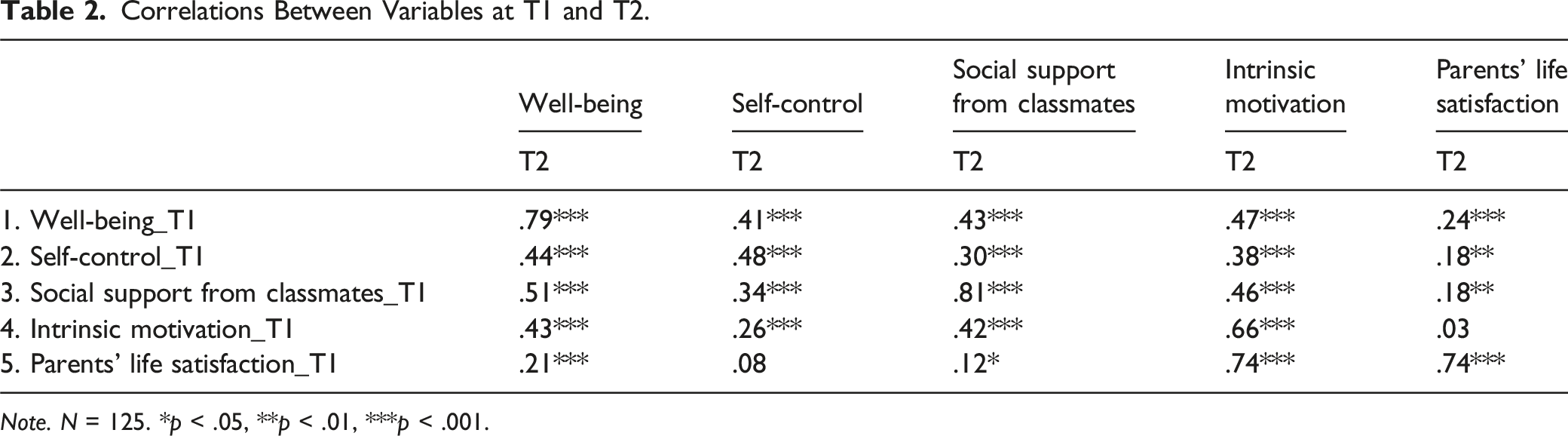
Note. N = 125. *p < .05, **p < .01, ***p < .001.
Multiple Hierarchical Regression Analyses
We first tested the predictive role of self-control, social support from classmates, intrinsic motivation, and parental life satisfaction on wellbeing during online education (Model 1). Social support from classmates, self-control, and intrinsic motivation were entered into the model in the first step. Social support from classmates (β = .34, SE = .04, p < .001), self-control (β = .34, SE = .04, p < .001), and intrinsic motivation (β = .12, SE = .17, p < .001) significantly and positively predicted well-being. Parental life satisfaction (β = .12, SE = .05, p < .05) entered in the second step and significantly predicted adolescents’ well-being in online education.
Secondly, we tested the same model during face-to-face education (Model 2). In the first step, social support from classmates (β = .29, SE = .06, p < .001), self-control (β = .30, SE = .06, p < .001), and intrinsic motivation (β = .28, SE = .24, p < .001) significantly and positively predicted well-being. In the second step, parental life satisfaction (β = .09, SE = .08, p > .05) did not significantly predict adolescent’s well-being which was different from online education.
Predictor Role of Variables Adolescents’ Well-Being During Online Education, Face-to-Face Education, and Stability Over Time.

Note. N = 250 for each model. *p < .05, **p < .01, ****p < .001.
Discussion
In this study, we aimed to explore how intrinsic motivation, self-control, social support from classmates, and parental life satisfaction predict adolescents’ well-being during online and face-to-face education periods, and how the predictive roles of these factors on adolescent well-being are moderated after the transition to face-to-face education. Our findings suggest that social support from classmates, as well as adolescents' intrinsic motivation and self-control, are positively associated with their well-being both during online and face-to-face education. Furthermore, some of these factors have a positive predictive role on adolescents’ well-being over time. Notably, we did not find a significant relationship between parental life satisfaction and adolescents' well-being during face-to-face education, as we predicted. Moreover, intrinsic motivation predicted adolescent’s well-being both online and face-to-face education and explained greater variance during the face-to-face education.
Firstly, these findings can be interpreted within the risk and resilience model framework (Masten, 2001; Zimmerman et al., 2013). The risk factors for students, the disruption in the face-to-face education, and associated difficulties of online education were found to be mitigated by the protective factors such as peer support, intrinsic motivation, and self-regulation. These protective factors were related with adolescents’ well-being during both online and face-to-face education. The temporal stability of associations between adolescents’ intrinsic motivation, self-control, and adolescents’ well-being suggested that protective factors could foster resilience over time despite the risk factors. Predictably, distal protective variables like parental life satisfaction might be less influential than proximal peer related or self-regulatory factors. Thus, the findings suggested that context of the protective factors seemed to be important in the risk and resilience approach.
Both during online education and face-to-face education, adolescents’ well-being is positively related to their self-control and intrinsic motivation. Students reported that online lessons were stressful and negatively affected their mental health and social life (Chakraborty et al., 2021). However, adolescents with higher levels of self-control and intrinsic motivation had higher levels of well-being. Research found that self-control and motivation to self-educate were perceived as opportunities by students during online education (Bakhov et al., 2021; Zou et al., 2021). Self-control might give adolescents a chance by promoting stress tolerance during transition to online lessons and educational goal-directed behaviors (Kokkoris & Stavrova, 2021; Schnell & Krampe, 2020). Additionally, adolescents with higher levels of intrinsic motivation have a positive attitude toward school a higher level of achievement and academic engagement (Holzer et al., 2021; Karimi & Sotoodeh, 2020; Usán et al., 2019). Also, they are more likely to have higher levels of well-being (Arslan, 2021; Bryce et al., 2020). Another variable that predicted adolescents’ well-being during online and face-to-face education was social support from classmates. The significance of classmates was also recognized in the model testing the stability over time suggesting that its effects might be rather stable than instantaneous.
These findings could potentially reflect either context-specific effects or, alternatively, indicate that these constructs such as self-control, intrinsic motivation, and social support from peers exhibit relative stability over time despite the challenges of a global pandemic. However, due to the lack of pre-pandemic data, caution is needed in drawing conclusions about whether these constructs have changed or remained stable.
Our study highlights the importance of support from peers for adolescents in line with Self-determination Theory which emphasizes the need for relatedness for well-being (Ryan & Deci, 2000). During online education adolescents were only able to meet their classmates on online platforms which limited their social ties (Akgül, 2023; Atalan Ergin, 2023). Restricted social relationships were associated with negative mental health (Ellis et al., 2020; Elmer et al., 2020; Rupnik Vec et al., 2020) while high social support from classmates was associated with positive mental health (Li et al., 2021; Liu et al., 2021).
One might think that adolescents in the present study might have kept online contact with their friends. However, it is also reported that frequent contact with friends (either offline or online) did not seem to promote protective effect of friends on internalizing problems during online education (Bernasco et al., 2021). Recent research conducted both during and after the pandemic has highlighted the importance of classmates in adolescents’ mental health (Ellis et al., 2020; Elmer et al., 2020; Li et al., 2021; Liu et al., 2021; Rupnik Vec et al., 2020). It seems that schools might foster adolescents’ well-being by maintaining social support from classmates even during online education, but the mechanism might be still vague.
There is currently no research available on examining both peers and family factors on adolescents’ well-being during COVID-19. Research during COVID-19, when education moved onto online platforms, consistently found that parents’ mental health problems are related to adolescents’ mental health (Akgül & Atalan Ergin, 2021; Nagy et al., 2022). Additionally, parental life satisfaction has been associated with adolescents’ well-being both before and during COVID-19 (Augustijn, 2022; Headey et al., 2014). Our findings partially supported previous findings on the importance of parents’ life satisfaction for adolescent well-being during online education.
On the other hand, there seems to be a difference between online and face-to-face education in terms of the impact of parental life satisfaction on adolescents’ well-being emerged. Parent life satisfaction did not predict adolescents’ well-being during face-to-face education while it was related to adolescents’ well-being during the pandemic despite the heightened parental stress or involvement during the pandemic. It is known that the closure of schools and curfews led to an increase in the time adolescents spent at home with family members (Akgül, 2023; Atalan Ergin, 2023). Additionally, spending more time with parents may have caused adolescents to be more exposed to their parents’ emotions, which might also have affected their well-being during the pandemic. Of course, this increased time spent together results from being at home due to online instruction, rather than from the pandemic itself. However, adolescence period is characterized by spending less time with family members and more time with friends (Collins & Laursen, 2004). After schools’ reopening, adolescents met with their friends and peer relationships might have occupied greater place in adolescents’ life. Therefore, the importance of parental life satisfaction may have diminished compared to its critical role during the pandemic.
When time spent with parents decreased with the shift to face-to-face education, the role of parental life satisfaction disappeared. On the other hand, the importance of social support from classmates did not change even though the decreased time spent with peers during online education (Akgül, 2023; Atalan Ergin, 2023). This could be an important finding revealing that classmates can exert an influence in various settings, whether they be online or in-person. Conversely, when parents are not present in the adolescent’s physical environment, their influence on the adolescent may easily diminish. Therefore, it is crucial for parents to allocate more time to spend with their offspring to foster stronger bonds.
Limitations
Although this study provides insight into the social and individual factors predicting adolescents’ well-being during online and face-to-face education, there are several limitations that should be noted. First, we focused solely on social support from classmates, the role of intimate relationships or other sources of support were not included in the present study. We thought that due to the restrictions, the structure of classmate relationships may have changed in online education. Second, while we examined parental life satisfaction as a protective factor, other parental variables (e.g., parental well-being or happiness) which were not investigated in this study may also impact adolescents' mental health. It should be kept in mind that a confounding factor like the larger economical context of pandemic might have influence both parental life satisfaction and adolescent well-being.
Since we did not have measures of well-being or predictor variables prior to the onset of online education, it is difficult to determine whether the observed differences are specific to face-to-face or online learning contexts. Furthermore, we could not account for pre-existing differences in well-being or predictor variables that may have influenced the observed relationships. The moderate internal consistency reliability of intrinsic motivation and self-control scales was another limitation. A final limitation is that the time of year varied for the data collection time points, which might impact students’ enjoyment of school or joy of learning.
Despite these limitations, repeated measure nature of our study was particularly valuable for understanding the impact of two distinct instructional modes on students. While an independent group design could potentially answer similar questions, it would not offer the same depth of insight into within-person changes and the dynamic nature of the relationship between instructional modes and well-being. Although moderation analysis could have been applied in this study, we chose not to focus on it because our primary aim was to examine the direct predictive roles of the variables rather than their interaction effects. Since the data were collected from two different sources (parents and children) across two waves and the sample size was quite limited, we preferred to avoid adding complexity to the model and instead concentrated on assessing the direct predictive roles of the variables.
Future Recommendations
Our findings underscored the significance of social support from classmates in shaping adolescents’ well-being. Therefore, face-to-face education is crucial by considering the priority of social support from classmates, particularly aftermath of traumatic events. Keeping schools open seems to be essential for the adolescents not only due to the academic concerns but also mental well-being of them. COVID-19, a milestone for education, initiated a shift from face-to-face to online education in cases of emergency situations. However, policy makers should bear in mind that online education brings about some side effects for mental health due to the changing social dynamics.
Increased parent life satisfaction emerged as an important variable impacting well-being of adolescents during online education. Future studies could also explore the relationship between other parent related variables on adolescents’ mental health. Given the impact of parental life satisfaction, adolescents might benefit from good parental role models. It is also evident in the present study that parents can benefit spending more time with adolescents.
Current study showed the buffering role of self-control and intrinsic motivation in promoting adolescents’ well-being during both online and face-to-face education. Moreover, individual factors play a crucial role in adolescents’ well-being, and educational policies should prioritize strategies aimed at improving self-regulation skills. Especially, self-control is a critical indicator of well-being and can be used for intervention purposes to promote well-being directly and indirectly facilitating sources of social support.
However, the question whether how to enhance the self-control among adolescents especially during the online education still remains to be answered. Furthermore, acknowledging the role of social support from classmates, addressing groups rather than individual adolescents could be beneficial. As we conclude our exploration into the individual and social factors impacting well-being of adolescents during online and face-to-face education, the results revealed in this study underscored the social functions of schools.
Conclusion
Education might have differences when it is delivered online and face-to-face. We investigated whether self-control and motivation as individual predictors, and parental life satisfaction and social support from classmate as social predictors, have different effects on adolescent well-being depending on the mode of educational content delivery. It seems that while the importance of parental life satisfaction disappears during online education, self-control, motivation, and social support from peers maintain their significance in both context with the influence spanning over time.
Footnotes

Funding
The author(s) received no financial support for the research, authorship, and/or publication of this article.
Declaration of Conflicting Interests
The author(s) declared no potential conflicts of interest with respect to the research, authorship, and/or publication of this article.