







Abstract
Political polarization has long disrupted the educational landscape, with recent events of 2020+ fueling intensified discussions over controversial subject matter in schools. Drawing on sensemaking theory and professional responsibility literature, we analyze 23 U.S. veteran teacher interviews to explore how they made sense of, and in turn enacted, their professional responsibilities entering the summer of 2022. Our findings reveal that these veteran teachers emphasize fostering students’ critical thinking and socioemotional growth while navigating complex relationships with families and school communities. By centering the voices of veteran educators, this study offers valuable insights and strategies for both experienced and novice teachers navigating a politically tumultuous environment.
“It’s very hard to teach when the world is blowing up, and the kids want to talk about it.” – Ms Davidson, a teacher of 30 years.
Entering the summer of 2022, teachers like Ms Davidson were emerging from a tumultuous academic year marked by heightened polarization in U.S. education policy (Kogan, 2022) and an increase in the politicization of educational content (Woo et al., 2022). This climate, driven by deliberate and strategic efforts from conservative organizations and state legislators, sought to restrict diversity, equity, and inclusion initiatives in schools (Harris & Alter, 2022). Pollock and colleagues (2022a) refer to these efforts as the “2020+ Conflict Campaign” (p. 5), which has led to a proliferation of bills, both passed and proposed, that aim to limit or discourage classroom discussions on race, gender, and sexuality (Sachs, 2022). Often framed as protecting parental rights (e.g., Kao, 2023), these trends pose significant threats to teachers’ autonomy by restricting the topics and materials they are allowed to bring into their classrooms (Jayakumar & Kohli, 2023). For teachers who feel a sense of obligation to acknowledge the lived experiences of their students, these restrictions ultimately impede their agency to fulfill their professional responsibility.
At its core, a teacher’s professional responsibility is about doing what they believe is right based on who they feel responsible to, and what they feel responsible for. This responsibility includes a sense of ethics and values, which matters because the situations described above often send mixed messages to teachers about what their job should be. In response to this ambiguity around what constitutes teachers' responsibility, we follow Baggett and colleagues (2020) in asserting that teachers’ professional responsibility should include enacting justice and equity, addressing sociopolitical issues, and challenging oppressive systems. While this responsibility applies to all teachers, veteran educators, who have developed their professional identities and sense of accountability through years of experience, offer a unique perspective on how sociopolitical shifts and resulting disruptions are reshaping their sense of responsibility.
Building on this understanding of teachers’ shifting responsibilities, this study explores how veteran teachers make sense of their professional responsibilities in the current sociopolitical climate and how they coordinate their future actions in response. Specifically, we ask: - How do veteran teachers make sense of their professional responsibility as educators while navigating the disruptions caused by the 2020+ Conflict Campaign? - How do they coordinate their teaching practices in response to their evolving sensemaking of these broader professional responsibilities?
In pursuing these questions, we hope to inform future efforts to support teachers as they define and enact their responsibilities in an educational landscape increasingly shaped by political conflict.
Literature Review
Schools, as organizations, often function as sites of debate about teachers’ professional responsibilities toward students and society. At the heart of these debates is whether teachers should address content that directly impacts their students yet is deemed controversial outside the classroom, highlighting the challenges to navigate professional responsibilities amid wider societal tensions. As Hess (2009) described, topics that may seem settled outside of schools can quickly become contentious, sparking broader societal debates. As a result, now more than ever, teachers face uncertainties in deciding which topics to address and how to approach them, as they navigate this shifting sociopolitical landscape. In previous research, teachers were seen to reaffirm their equity-related commitments, driven by a desire to “uphold American democracy now and for the future” (Jewett Smith, 2020, p. 14), when confronted with politically charged discourse. This impulse to uphold core values raises important questions about how professional responsibility shapes teachers’ understandings and corresponding responses to these shifts. Accordingly, the following sections will explore how teachers, in general, make sense of their professional responsibility, followed by a closer look at how veteran teachers, with their accumulated experience, redefine and apply their sense of professional responsibility.
Teachers’ Sense of Professional Responsibility
Although research on professional responsibility remains limited (Lauermann, 2014; Matteucci et al., 2017), much of the existing research builds on Lenk’s (1992) model, which defined professional responsibility as being accountable for specific actions, outcomes, or tasks within a given professional role. Lenk’s model suggested that professional responsibility was guided by the expectations set by those to whom an individual was accountable and was subject to evaluation by an overseeing authority. By breaking down professional responsibility as accountability to external authorities, adherence to established standards, and evaluation by overseeing bodies, Lenk (1992) offered a framework to examine not only how individuals perceive and interpret their responsibilities but also how they act upon them in the context of professional norms, ethical considerations, and accountability structures. When this framework is applied to teachers, their sense of professional responsibility is shaped by who they perceive themselves to be responsible to within larger systemic structures, whether that’s their students, their school, or society as a whole (Harpster, 2020).
In turn, teachers’ sense of professional responsibility is informed by their “sense of internal obligation and commitment to produce or prevent designated outcomes” (Lauermann & Karabenick, 2011, p. 127). The question of what teaching and learning outcomes teachers are responsible for—whether it’s promoting critical thinking, fostering an inclusive classroom environment, or adhering to specific content guidelines—becomes increasingly complex in light of shifting policies and public expectations. This complexity deepens when considering calls for teachers’ professional responsibility to take the form of a “critical responsibility,” one that compels them to “take up sociopolitical and cultural contexts and events in our classrooms that have real, material consequences in the lives of our students” (Baggett et al., 2020, p. 157).
As such in this present study, we conceptualize a teacher’s sense of professional responsibility as their definition and enactment of what it means to act ethically within their professional teaching roles, influenced by their sensemaking of for what and to whom they should be held accountable. This understanding recognizes that a teacher’s professional responsibility is continually made sense of in relation to shifts in their personal, institutional, and broader sociopolitical environment.
Veteran Teachers’ Refined Sense of Professional Responsibility
The literature on teachers’ professional responsibility has tended to report findings with relatively little focus on specific years of work experience (Lauermann, 2014). Yet, veteran teachers’ years in the field afford them unique knowledge and perspectives that can be drawn upon when navigating rhetoric that attempts to change the nature of their job (Goodson & Hargreaves, 1996; Goodson, 2003; Lowe et al., 2019). While the field does not have a consistent definition for what constitutes veteran teachers, we follow others (e.g. Chiong et al., 2017) in defining them as having at least 10 years of experience, as this marks their reaching an “expert” level on Berliner’s (1994) scale of pedagogical expertise.
Though not specifically focused on professional responsibility, researchers have explored how veteran teachers have responded to changes within the educational landscape. For instance, veteran teachers have been found to grapple with a significant tension between their deeply held beliefs about “good teaching” and the increasing demands of standardized measures of accountability and decreased autonomy for innovation (Santoro, 2018). Despite these pressures, many maintained a strong commitment to their pedagogical values and persisted in supporting students’ development in various ways (Day & Gu, 2009). In research that has focused more explicitly on teachers’ engagement with sociopolitical tensions, Pollock and Colleagues (2023) documented that veteran teachers expressed a willingness to engage with the topics arising from the 2020+ Conflict Campaign, despite the issues these topics might provoke. Within these navigations, veteran teachers can draw on their developed capacity to reflect on their careers (Carrillo & Flores, 2018), which ultimately influences their sensemaking during policy shifts, as they have a longer knowledge base to draw upon when making sense of environmental shifts.
Veteran teachers’ accumulated years of navigating policy shifts, pedagogical changes, and evolving student needs provide a rich foundation for the sensemaking they undertake during new periods of change. Their sensemaking matters because they can set the tone for the culture and norms of their school and community, especially as novice teachers are influenced by their mentors in how they approach their teaching (Beck et al., 2020). As such, we need to know how veteran teachers make sense of their professional responsibility in response to the most recent shifts in our educational landscape.
Theoretical Framework
Leading up to the summer of 2022, teachers were navigating the aftermath of COVID-19, rising anti-Asian hate crimes (Gover et al., 2020), changing mask mandates (Malkus & Audet, 2022), polarized elections (Fasching et al., 2024), the January 6th insurrection (Davis & Wilson, 2023), ongoing racial injustice before and after George Floyd’s murder (Grace et al., 2022), and numerous school shootings (Education Week, 2021). Meanwhile, social media amplified these issues for students, exposing them to politically charged rhetoric and ultimately bringing these events into the classroom. In this disruptive climate, schools experienced significant disruption, prompting teachers to grapple with the central sensemaking questions: “what is going on, and what should we do next?” (Maitlis & Christianson, 2014, p. 70).
Sensemaking involves the process through which individuals integrate new information into their existing frameworks to guide their coordination of future actions (Weick, 1995; Weick et al., 2005). As Maitlis and Christianson (2014) note, sensemaking occurs when a gap arises between expectations and reality, prompting individuals to interpret their situation and determine appropriate responses. The process is multifaceted and nonlinear, with interwoven stages that continuously evolve as individuals respond to their environments (Turner et al., 2023), involving ongoing evaluation and adjustment of understandings (Kudesia, 2017). As a reflective process, individuals draw on past experiences to interpret new challenges and anticipate potential responses (Weick, 1995), considering their personal identity, the context in which they are situated, and their role within a changing environment (Gioia et al., 2000). Sensemaking also has a normative dimension, as individuals seek to achieve a preferred impact amid complexity and change (Turner et al., 2023). Consequently, it reflects an iterative relationship between individuals and their context, shaped by the particular moment in which they are interpreting events (Dervin, 2015).
For teachers, sensemaking functions as a filter to help them both navigate shifting sociopolitical contexts and continuously reevaluate their professional roles and responsibilities. Specifically, teachers make sense of their roles and responsibilities through a “personal interpretative framework,” shaped by their beliefs about education and perceptions of what their work entails (Kelchtermans, 2009, p. 260). At the core of this framework is their task perception, which encompasses how they normatively understand their professional duties. This task perception reflects “deeply held beliefs about what constitutes good education” (Vanassche & Kelchtermans, 2014, p. 118) and reveals the underlying, value-based choices that guide their practice. Additionally, social dynamics within schools shape teachers’ sensemaking processes, leading them to construct meaning not only within their immediate environment but also in relation to broader professional and organizational contexts (Coburn, 2004). As such, sensemaking theory has been valuable in examining how teachers navigate conflicting ideas and adapt to changes in their environments (Allen & Penuel, 2015; Lowell et al., 2024).
While there has been research exploring the 2020+ Conflict Campaign on educators in general (e.g., Pollock, Rogers, et al., 2022), there is a need to focus specifically on how veteran teachers make sense of these disruptions and coordinate their future actions to align with their professional responsibilities amidst ongoing polarization. Therefore, this study situates its analysis within the broader discourse on teacher sensemaking, focusing on how veteran educators define their professional responsibilities in response to the 2020+ Conflict Campaign and how they adjust their practices to fulfill these responsibilities.
Method
We approached this study as experienced educators with diverse backgrounds, including experience as teachers and administrators. Drawing from our experiences in various educational settings (public, private, and international), we all entered into the same doctoral program with a common interest in the challenges and opportunities that teachers face amidst shifting political pressures. As such, we had a shared interest in understanding the complexities of teaching in today’s context and the ways in which educators understood their work in this developing landscape.
In response, we conducted semi-structured interviews with teachers across the United States to facilitate participants’ reflections on past experiences and anticipation of future implications, both central to sensemaking (Taylor & Van Every, 2000; Weick et al., 2005). As the team initially reviewed the data, we found ourselves being particularly drawn to veteran teachers and the ways in which they were talking about their professional responsibility amidst the 2020+ Conflict Campaign. As such, from within the larger data corpus, we specifically focused on veteran teachers to delve into their sensemaking within the contemporary sociopolitical discourse landscape.
Data Collection
Participant Background Information (Self-Identified)
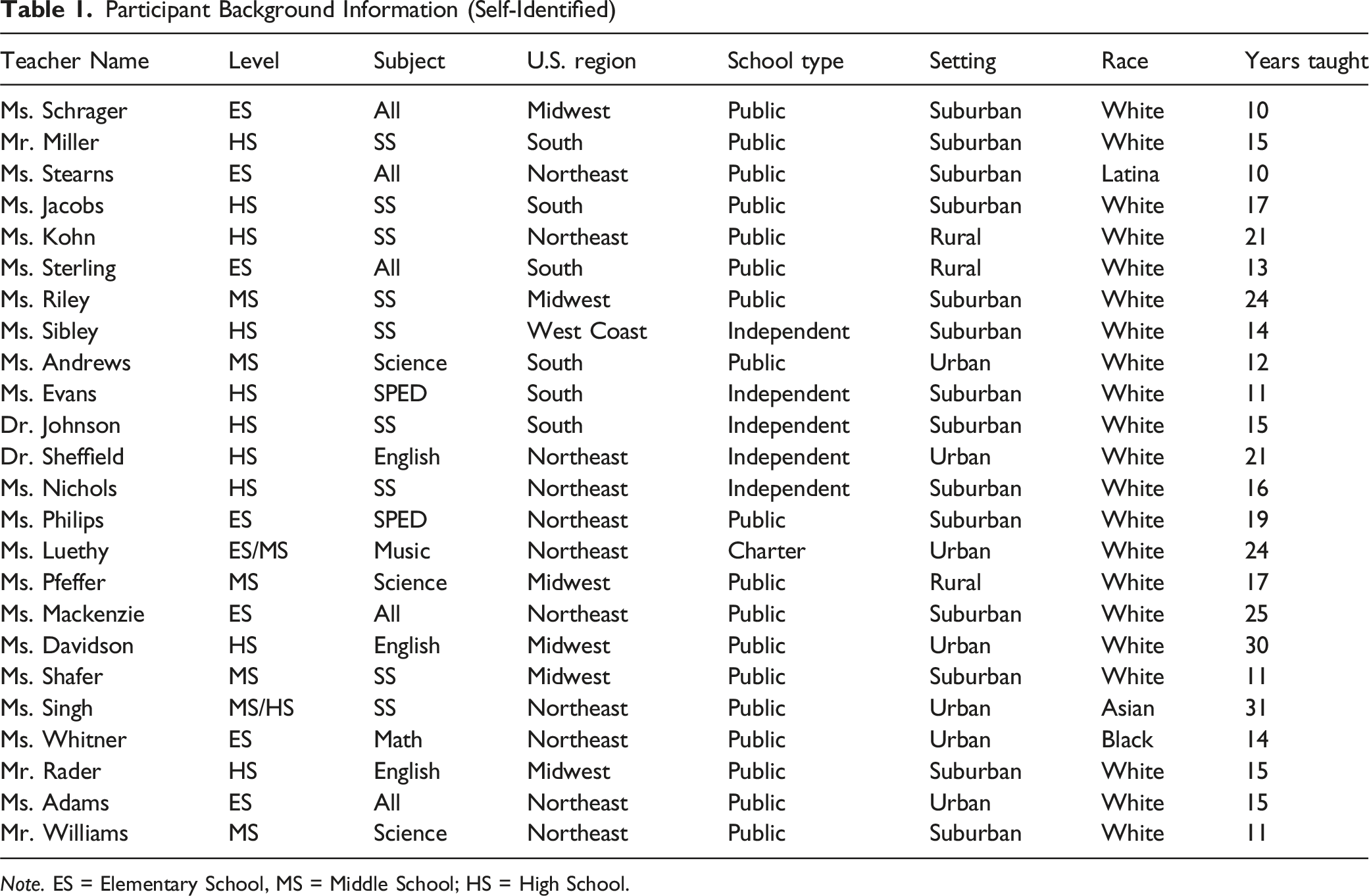
Note. ES = Elementary School, MS = Middle School; HS = High School.
They were recruited via social media posts and outreach to our professional networks. Participants were asked to complete a brief demographic questionnaire and submit contact information so that a team member could schedule an interview. There were 55 responses to the questionnaire. After follow-up with participants, 43 semi-structured interviews were conducted over Zoom. The interview protocol was designed and revised collaboratively to understand how teachers interpret the current political climate, as captured in questions such as “How would you characterize the political moment as it pertains to education?” It also explored how controversies and educational policies impact teachers’ pedagogy through questions such as “Have the controversies changed what or how you teach? The protocol further investigated how personal and professional experiences shaped teachers’ sensemaking with prompts including “Do your personal politics or identity influence your role as a teacher?” Finally, to understand how this sensemaking has evolved over time, the interview included reflective questions such as “How have any of your responses here changed over time?” This interview protocol was used consistently for all interviews, each of which lasted 45–60 minutes. These interviews were audio-recorded and transcribed via Rev.com, followed by checks for accuracy. Of these participants, 24 had more than 10 years of experience, becoming the focus of this paper’s analysis.
Data Analysis
Employing thematic analysis following Braun and Clarke’s (2022) approach, the first three authors conducted multiple rounds of coding to identify key themes around how the veteran teachers were making sense of the 2020+ Conflict Campaign’s impacts on the teaching profession and teachers’ professional responsibilities, as well as how these understandings shaped their actions within their local environments. Initially, the three lead authors independently open-coded three transcripts, identifying preliminary patterns of veteran teachers’ sensemaking. These patterns were collaboratively analyzed, leading to the development of an initial codebook.
Subsequently, the initial codebook was applied to two additional transcripts for validation. The codebook’s application was discussed in group meetings, and themes and codes were further defined and adjusted based on collective agreement. Themes shared a core idea and meaning to “capture a wide range of data that are united by, and evidence, a shared idea” (Braun & Clarke, 2022, p. 71). This process resulted in an updated codebook (see Appendix 1), which was then tested for interrater reliability. The 22 sub-codes identified in the analysis were compiled into six themes, each representing a key factor shaping the teachers’ sensemaking process. Achieving 85% agreement among the first three authors, the remaining transcripts were evenly divided up and independently coded. Once this final round of coding was completed, the research team moved into the last phase of theme development. We examined patterns across all coded segments, considered how sub-codes clustered together, and refined the thematic structure to ensure that each theme conveyed a coherent and analytically meaningful idea. This iterative process produced the themes that organize the Findings section that follows.
Findings
The veteran teachers we interviewed perceived the divisive rhetoric of the 2020+ Conflict Campaign as an upheaval to teachers’ professional responsibility. We highlight below how this disruption prompted teachers to make sense of their professional responsibilities, particularly to support students’ intellectual and social-emotional growth, and how they navigated community and institutional resistance. We conclude by showing how their extensive experience undergirded their interview responses, emphasizing the significance of their identities as veteran teachers on their sensemaking.
The 2020+ Conflict Campaign: a Disruption Prompting Sensemaking of Professional Responsibility
The 2020+ Conflict Campaign represents deliberate obstacles to both the content teachers can bring into the classroom and their interactions with students. This was caused, in part, by a feeling of unprecedented accountability to others. For example, Ms Singh described the expansion of people to whom she felt accountable: “I don’t remember anything quite like this where there’s interference from politicians and lay people into educational spaces in a way that I’ve never seen before.” She saw this as interrupting what she can do in the classroom, particularly in ways that silenced her ability to do what she believed she should. She stated, “This is a very chilling moment in all of my 30-plus years of teaching.”
Ultimately, we found that teachers’ understanding of their profession’s responsibility to students was challenged by the polarizing nature of the external sociopolitical climate, which increasingly impacted students’ everyday experiences. Ms Sterling described how the impact seen on students influenced her shifting sense of professional responsibility to speak out: I think that I used to not have these types of discussions with my students because you were told ‘Don’t have this type of conversation.’ But as the economy has changed, diversity in classrooms have changed….The racism with Black Lives Matter, with the women’s movements that’s happening. A lot of those things now, I feel I have to speak up and educate them on some of it.
Her comments illustrate how teachers were redefining their professional responsibility. Ms Adams, an elementary teacher, also reflected on how the 2016 election influenced her shifting sense of how she should respond to political events outside her classroom: Kids came into school the next day crying...some felt that this unkind person was leading the country...I agreed with that sentiment...it felt more personal than political…I don’t think I felt the pressure to be impartial the way I would have in a previous presidency.
Rather than viewing the election as just another political event, she recognized it as a moment requiring her to explicitly respond in the classroom, which was a different stance than years past as her young students’ were being exposed to a tumultuous sociopolitical climate.
This sentiment was common across teachers, from various grade levels, who described how students’ increased exposure to acrimonious rhetoric and contentious political issues shifted their sense of professional responsibility. They felt a growing obligation to create classroom spaces where students could process the difficult sociopolitical realities they were encountering. Their sense of responsibility felt especially urgent when students’ lived identities were directly implicated in the issues being discussed. As Ms Sibley, a secondary teacher, explained: [W]hen you come into a government class, if a student says something like, well, I support Trump’s build a wall policy, I’ll immediately have students crying over that, right? They might be undocumented. I mean, it’s a visceral, visceral reaction. Meanwhile, I have students who are actually funding Trump’s campaign to help build that wall.
Her comment highlighted the unprecedented emotional intensity of classroom discourse during this period, as students navigated issues that touched on who they were, how they were seen, and what was at stake for their communities.
Professional Responsibility for Critically Discerning Reliable Information
In particular, teachers felt that they had a professional responsibility to guide students in navigating information consumption within the transforming digital landscape. Specifically, they believed that teachers needed to lead students in discerning credible information from misinformation. Ms Davidson underscored this responsibility, noting how misinformation on social media platforms has influenced her understanding of teachers’ roles in supporting students’ media literacy: ...help them, sort of guide them to reliable sources and help try to get, you know, the fluff out of what they’re hearing, what they’re seeing on their Instagram feeds because that’s where they get their news.
Ms Davidson viewed it as her responsibility to provide this intellectual guidance, in response to students’ reliance on social media as news outlets. Ms Kohn further emphasized the impact of social media on students’ information consumption habits because it had expanded their frame of reference beyond traditional sources: They know so much more about what’s going on because of social media. So their frame of reference isn’t just what is on the TV in their living rooms at dinner time, or what their parents or grandparents tell them. They have this whole other world of information to pull from…
Ms Kohn’s views highlighted the necessity of shifting pedagogy in response to how students’ information sources had changed compared to the past. Teachers like Ms Davidson and Ms Kohn expressed an evolving aspect of professional responsibility to help students navigate the new media consumption, acknowledging the profound shifts in how information is accessed and understood in the digital age.
Given the prevalence of contentious rhetoric in the digital age, teachers felt responsible not only to support students in navigating media outlets but also to provide the critical thinking skills necessary to address this rhetoric. Ms Shafer captured this sentiment: “My job is to give them the tools to think critically about it...I want to teach them thinking processes so they can make sense of–there’s a lot of really hard issues happening in the world.” Mr Miller echoes this approach, emphasizing …We want our students to be critical thinkers…If they get some kind of media on their phone all of a sudden pop up, they’re not going to be like, ‘oh my God, that’s true.’ No, they’re going to evaluate the source. They’re going to check to verify, to make sure, and they’re going to also check themselves and hoping that they’re not being misled and being manipulated. And that skill, that social studies, historian, historical thinking skill is really hitting on all of the content…
Ms Shafer’s and Mr Miller’s reflections demonstrated how teachers made sense of their shifting professional responsibility, not just as conveyors of knowledge but as facilitators of students’ critical thinking with regard to engagement with media. Rather than viewing media literacy as an ancillary skill, these teachers interpreted it as central to their role in preparing students to navigate complex social and political landscapes in the digital age in which they are growing up.
Professional Responsibility for Fostering Inclusive Dialogue
Teachers also described a sense of responsibility toward students’ social-emotional growth, which had shifted to include the balance between engaging in conversations about controversial topics and protecting those most directly impacted by the topic.
This shift was particularly evident in Ms Sibley’s reflection on the need to establish new ground rules for her classroom. She spoke about the emerging need to discuss with students how to relate to one another and create a safe, respectful space. “Whereas I didn’t used to have to do so much of that ground rules in the beginning, and now it’s a very big part of the course. How do you actually talk to people?” The increased focus on establishing respectful dialogue reflects teachers’ heightened awareness of the need to protect students in a climate of contentious rhetoric. Ms Jacobs also underscored this responsibility, noting: I think there is a lot that students do want to unpack about race, but I think there’s also, I’m balancing that with the heightened awareness that sometimes addressing these issues can create trauma for students. And so how do you balance those two, acknowledging that our country has these issues leading thoughtful discussion that’s open to all perspectives about how we should move forward from them, but also recognizing that these conversations can be traumatic.
These reflections capture the complexity of fostering open discussions while being sensitive to students’ emotional well-being.
Similarly, Ms Riley underscored teachers’ responsibility to support those who may face discrimination or marginalization within and outside these conversations. She explained her commitment to creating an inclusive environment: “I have a safe space poster and a safe space sticker on my lanyard so kids know that I’m an ally of the LGBTQ community...” Ms Riley’s use of visible symbols, such as the safe space sticker, demonstrated her sense of professional responsibility to signal that every student is socially accepted and emotionally protected within the classroom. Her approach highlighted the importance of both acknowledging and actively supporting students’ diverse identities in a way that fosters a safe and inclusive learning environment. In so doing, Ms Riley illustrates the sensemaking undergone by many teachers as they established classroom norms that prioritized inclusivity in response to the identities and experiences students bring with them.
Enacting Professional Responsibility in the Face of the 2020+ Conflict Campaign
Teachers’ efforts to fulfill their responsibility to guide students’ consumption of information and engagement in controversial topics often intertwined with their awareness that communities might hold differing views on the content of these discussions. Recognizing this, teachers frequently mentioned the potential for pushback, especially in light of the nationwide 2020+ Conflict Campaign. In response, veteran teachers strategically aligned their practices with their evolving sense of professional responsibility while navigating the expectations of their institutional contexts and local communities.
A Shared Strategy: “Sell What I’m Teaching”
This section presents five illustrative examples showing how veteran teachers strategically introduced materials to facilitate conversations around potentially controversial topics, carefully “selling” or framing these choices in attempts to minimize pushback within their contexts.
Dr Sheffield shared how she made the decision to replace traditionally taught texts with those that are frequently challenged or banned. She strategically communicated this decision to families, explaining, “I feel like I just try to be more strategic about how I like…sell what I’m teaching, or how I, like, frame what I’m teaching.” Her use of terms like “sells” and “frames” highlighted her intentional approach to fulfilling her professional responsibility in a setting where these texts might be considered controversial. She further characterized this as her “own quiet rebellion:” I definitely, in my own kind of quiet way, tried to swap out some texts for texts that are being banned. But I have tried to be savvy about the way that I framed those choices, so I’m not just kind of coming out and announcing that this is like an active, you know, rebellion, but just kind of quietly, like normalizing these texts being part of the curriculum.
Ms Kohn, who had over 21 years of experience, previously faced pushback for teaching such texts, but continued to include them by creatively leveraging technology. “I have sometimes just taken chapters or excerpts and made them into Google Docs, PDFs. If the cover isn’t on the book or if it doesn’t say learning for justice across the top, people leave you alone.” By making this strategic modification, she maintained her professional responsibility to teach critical content while avoiding potential conflict. Her actions illustrated the ways in which teachers navigated both a sense of professional responsibility to engage students in the content but in a way that responded to possible pushback.
Ms Williams illustrated how she and her science teacher colleagues engaged in an active process of sensemaking as they carefully negotiated the language they use when communicating with parents about controversial topics such as climate change. She explained: With our blast emails, we avoid some of the language about teaching climate change and sort of frame it in a different way where we’re teaching about interesting weather and trying to explain droughts and floods in places and sort of avoid some of those buzzwords when we’re communicating to the parents kind of on a whole.
Ms Sibley struggled with the inclusion of institutionally banned topics that addressed current partisan events encountered by students through the media. As such, in her interview, she discussed the complexities of discussing controversial topics in her particular school, noting, “We are a progressive Catholic school on LGBT issues for sure. It is a lot more complicated with abortion, for example.” Reflecting on the Supreme Court’s overturning of Roe v. Wade that summer, Ms Sibley stated: “I can’t come in my classroom and say, ‘Oh, I’m really sad that Roe was overturned,’ for example. I could never say that. Or ‘I support abortion being legal.’ I could never say that, so I use terminology like reproductive justice or penumbras.” Rather than avoiding the topic altogether, she addressed the decision by employing terms strategically: “reproductive justice,” which framed abortion as part of broader human rights and equity concerns, and “penumbras,” or implied rights, which allowed her to anchor the discussion in constitutional law. Both terms created space for student dialogue without requiring her to disclose her own position.
Strategic navigation was also evident in the account of Ms Pfeffer, a middle school science teacher in a rural Midwestern public school, also strategically navigated her context, where her political views often differed from those of the families she served. She described reframing controversial conversations to emphasize scientific evidence and empathy in the classroom. For example, when students raised questions about gender identity during a genetics unit, she redirected the conversation toward disciplinary clarity while acknowledging the broader societal discourse: “We’re going to say sex, not gender, because gender is how you identify and sex is biologically what you were assigned… That is not the point of this conversation.” When appropriate, she helped students consider how their comments might land outside their rural community: “You’re probably offending some people right now… you’re going to experience life outside of [town].” In doing so, Ms Pfeffer made sense of her professional responsibility to both uphold scientific accuracy and support students’ social-emotional growth by fostering empathy and awareness of diverse perspectives. Collectively, teachers’ approaches did not reflect avoidance, but rather a form of strategic professionalism, one grounded in their desire to foster student learning while sustaining their own ability to teach in politically charged landscapes.
Looking at the Outliers: “I’ve Never Been Constrained”
While most teachers interviewed reported facing various forms of pushback from their communities and institutions, a fortunate few claimed to have never encountered any resistance from their school districts or schools. For example, Ms Nichols claimed that “the two places that I’ve taught have not had state standards, even the public school. So I’ve never been constrained. And I will say that it puts me in a different place than many of my colleagues around the country right now.” Additionally, Ms Schrager reflected on how she felt “pretty protected by my district and administration,” but this did not always translate to her living her sense of professional responsibility when remotely teaching. As she said, “Yet, during COVID-remote learning, with parents around a lot, I sometimes found myself censoring what I said.” These accounts highlight that teachers’ enactment of professional responsibility—and the degree of strategic navigation required to do so—can be strongly shaped by situational factors.
The Role of Experience in Making Sense of Professional Responsibility
Across interviews, veteran teachers talked about the ways in which their years of experience influenced their sensemaking around the current sociopolitical moment’s impact on their professional responsibility, and the ways that they acted in response. For instance, Mr Rader acknowledged that he might have conformed to censoring himself as a new teacher, focusing primarily on instruction and delivery; his current approach has evolved: I think early on in my career, I would say that I felt that my role was more about instruction and delivery, whereas today, I really feel invested and concerned with the individual student and what their particular needs are, whether those are based around race, gender, identity, sexuality, or anything else. I think so much of what drives individuals today is what they consider to be their own personal identity, and I try, my biggest concern is allowing them and encouraging them the freedom to be that.
In response to the changing sociopolitical climate, his professional responsibility to foster inclusive spaces drove him to take necessary steps, even if they countered his school’s prevailing approach.
This perception that they could live out their professional responsibility, even with the disruptions, was due to their layered protections that came with being experienced in the field. For example, Dr Sheffield navigated her role with a unique sense of autonomy, stating, “I do have a Ph.D. at a school where not that many people have PhDs, and I have found that that gives me a certain degree of freedom that people give me the benefit of the doubt.” This acknowledgment highlighted the ways in which credentials shaped her perceptions of “freedom” to fulfill her professional responsibilities. Beyond academic degrees, veteran teachers also emphasized how their reputations served as additional layers of protection. For example, Dr Johnson remarked, “When you’re a new teacher, you’re always worried [but] after you know years in the classroom you’ve earned the trust and respect of your school and your administration.” For these teachers, their veteran status offered a shield against uncertainty and scrutiny, granting them a sense of security and authority within their professional roles.
Additionally, veteran teachers noted a growing sense of comfort in their identity and practices. Ms Nichols shared this perspective: “I also think as now a veteran teacher, I’m more comfortable in my own skin and knowing where I can push kids into uncomfortable spaces to think about and dive into sources and grapple with these things, I am more comfortable having the hard conversations with students than I was as a younger teacher…” Her reflection underscored the confidence that comes with experience, illustrating how her comfort in herself now as a teacher allowed her to more effectively facilitate difficult conversations and challenge students to engage deeply with divisive issues.
Veteran teachers had a strong sense that not engaging with these topics undermined the democratic principles at the core of their professional responsibility, which was to foster critical, inclusive dialogue that honors and values the perspectives of all students. While they felt committed to this stance, they worried that there was a “chilling effect” on less experienced teachers. For instance, when Ms Jacobs made sense of how she navigated community pushback, she stated, “I think for teachers that maybe haven’t been in the profession as long, it could have a chilling effect on what topics they bring up if they get pushback from parents like that.”
Despite many of the veteran teachers we interviewed feeling confident in their ability to navigate pushback, our study also revealed that veteran teachers require support to sustain their work, as these ongoing disruptions have emotional and psychological impacts. Ms Whitner reflected this sentiment, stating: “It just seems that when you’re a veteran teacher, the support is very low. You’re expected to just deal with it. You’re expected to just handle it, [because you have] done it before.” She emphasized the lack of support that veteran teachers experience, due to an assumption that their years of experience are enough support. This tension is echoed by Ms Stearns, an elementary teacher who left the classroom after the 2021–2022 school year for an education-related position outside of the classroom due to lack of institutional support. She found that even with formal district statements in support of inclusion, the pushback she received and the lack of meaningful follow-through left her feeling exposed and isolated. Together, these accounts point to a clear conclusion: experience alone cannot shield teachers from burnout or backlash in the current climate. Veteran teachers may have more tools and confidence to navigate complexity, but they still need ongoing institutional support to sustain their efforts to uphold professional responsibility in polarized times.
Discussion
Drawing on sensemaking theory (Weick, 1995) and perspectives of professional responsibility (Lauermann & Karabenick, 2013), our study examined how veteran teachers in the United States made sense of, and in turn enacted, their professional responsibilities amid the sociopolitical turmoil leading up to the summer of 2020. This period posed significant challenges for all K-12 educators (Baggett et al., 2020; Dunn et al., 2019), leading them to feel a sense of urgency around upholding democratic values (Jewett Smith, 2020). However, veteran teachers occupied a distinct positionality within this moment. Unlike early-career teachers, who have only known the current climate, veteran teachers brought a perspective shaped by prior eras of schooling (Day & Gu, 2009; Kelchtermans, 2009). Building on this, our analysis illustrates how veteran teachers experienced the 2020+ Conflict Campaign as a disruptive yet crystallizing moment, one that prompted them to engage in sensemaking.
Following other research (Jayakumar & Kohli, 2023), veteran teachers in our interviews described facing a rise of consequences for addressing controversial topics (e.g., racism). Many of their accounts echoed politically charged dynamics, which “did away with the guise of educator neutrality by politicizing all forms of educator action and inaction, forcing every educator into some kind of inevitable response” (Jewett Smith, 2020, p. 7). As described in our findings, one teacher recounted the time leading up to the summer of 2022 as feeling more personal than previous periods, while another noted a newfound urgency to talk about potentially controversial topics in ways she had not before. Teachers also reported mounting accountability pressures from multiple parties (e.g., families, community members, and administration) with often conflicting expectations.
Despite these challenges, veteran teachers’ remained committed to a shared sense of professional responsibility: to help students navigate misinformation and political polarization, and to foster open dialogue across their diverse students. This enduring stance aligns with prior research showing that veteran teachers maintain strong motivation to support students despite external challenges (Day & Gu, 2009). Through our analysis, we have come to understand that their ability to stay committed is shaped by their accumulated knowledge and insights gained through navigating past educational reforms, institutional shifts, and sociopolitical tensions throughout their careers. This memory of their professional experiences shaped their view of the present as an urgent disruption, ultimately prompting them to be even more committed to enacting their shifting professional responsibility.
While almost all of the veteran teachers strategically enacted their professional responsibility, their particular actions evolved in response to their localized environment, illustrating how sensemaking is always situated within specific times and places (Dervin, 2015; Turner et al., 2023). Specifically, they intentionally coordinated their instructional approaches to fulfill their professional responsibility within the supports and constraints of their school setting. To do so, they engaged in what one teacher described as a “quiet rebellion” through strategic communication and curriculum modification. In this process, veteran teachers enacted what others have termed creative insubordination (Gutiérrez, 2016) and the act or leveraging backup (Pollock et al., 2022b). Through such coordination, veteran teachers were not merely reacting to constraints but rather were actively shaping their responses in ways that aligned with their developing sense of professional obligation. Tracing these coordinated responses reveals not only how teachers interpreted a shifting sociopolitical landscape but also how they felt responsible to do so in a way that responded to their local community.
Limitations
While this study advances our understanding of how veteran teachers navigate complex sociopolitical contexts to enact their professional responsibilities, there are limitations to consider. Participants were recruited primarily through social media and professional networks without compensation being offered, which may have led to self-selection bias toward individuals with similar viewpoints or those who were strongly invested in the topic. The sample also lacked demographic diversity across race, gender, and other identity markers, limiting the ability to account for how these factors might shape teachers’ experiences and perspectives. Furthermore, this study did not examine differences across grade levels or across subject areas, which may offer meaningful variation in how professional responsibilities are understood and enacted. These limitations suggest important directions for future research. Despite these constraints, by exploring their sensemaking and subsequent enactment of professional responsibilities, this study highlights the resilience and adaptability of veteran educators. Recognizing and supporting this work is essential to equip teachers to meet contemporary challenges while fulfilling their sense of professional responsibility.
Implications
Veteran teachers’ experiences provide critical insights into how educators are upholding, and thus can uphold, their professional responsibilities, especially those with a sense of critical responsibility that must be lived out differently in light of shifting sociopolitical pressures. At the same time, our study highlights that experience does not entirely shield educators from the stresses and disruptions within contemporary schooling. As such, there is an ongoing need to provide professional support to teachers at all stages of their careers, including veteran teachers. Following Santoro (2018), who described the unique demoralization veteran teachers face when navigating a tension between past and current teaching conditions, we found that years of experience can serve as both a valuable resource and a source of tension when veteran teachers are expected to handle challenges independently. In response to this sense of isolation, we emphasize the importance of sustained, context-specific support designed to meet veteran teachers’ unique needs. Thus, building on this study’s findings, we suggest several ways to strengthen professional learning opportunities.
First, veteran teachers’ accumulated time in education enabled them to recognize the present as distinctly urgent; yet, it did not lead them to abandon their enduring sense of professional responsibility. As (Beck et al., 2020) reminded us, “veteran teachers who have persisted in teaching have a wealth of expertise that can provide insight into the elements of teacher preparation that may help new teachers to remain—and thrive—in teaching” (p. 4). In turn, we recommend supporting newer teachers in developing this kind of resilience, wherein one can acknowledge disruption while remaining rooted in their sense of obligation. To develop this resilience, we point to the ways in which teachers’ professional responsibility was developed enough to remain strong, yet flexible enough to shift in response to students’ needs. Such a commitment to one’s professional responsibility will not eliminate the structural challenges they face, but it can help them navigate those challenges with greater clarity, resilience, and foresight. As such, teacher education efforts can and should learn from these educators who have developed tools for sustaining themselves and, at times, subverting the persistent efforts to constrain critical conversations in schools.
Next, our findings illustrate the importance of supporting teachers at all career stages in navigating political and community contexts. Veteran teachers were able to enact their professional responsibility not because they were immune to political pressures, but because they used intentional strategies, such as adjusting their language and drawing on community trust, to manage professional risks while staying true to their ethical commitments. These actions were more than merely compliance or resistance. They reflected what Gutiérrez (2016) calls creative insubordination: a practice that blends ethical conviction with contextual awareness. Through this balancing act, veteran teachers demonstrated a nuanced understanding of context-aware strategies that upheld their professional responsibility amid a polarized educational landscape. This insight underscores a key implication for supporting educators today: professional development and policy efforts must prepare teachers to navigate not just instructional content but also the social and political dynamics that shape their work.
Finally, our findings highlight the urgent need to invest in veteran teachers’ relational and mentoring capacities. Over time, these educators cultivated deep, trust-based relationships with students, administrators, families, and community members. These connections served as a foundation for their strategic action as they had built the necessary credibility to be entrusted by the community and developed a deep understanding of the context to know how to present potentially divisive topics. As such, their embeddedness in the school community allowed them to respond in ways that addressed their student needs, even if this meant they were taking informed instructional risks. In addition to these community ties, veteran teachers were frequently informal mentors as they drew on their accumulated wisdom to support the growth of novice educators (Feiman-Nemser, 2001; Lowe et al., 2019). These dual roles, as both connectors and mentors, position them as key contributors to building collective capacity in schools. Supporting and formalizing these roles through policy and professional learning structures can help cultivate a culture of resilience, collaboration, and thoughtful leadership within schools.
These takeaways are especially critical at a time when the teaching profession is not only politicized but actively targeted by legislative restrictions, public scrutiny, and organized efforts to control curricular content creating a highly volatile and restrictive educational landscape. Many of the teachers in our study explicitly contrasted today’s climate with earlier moments in their careers, noting how much more intense, personal, and ideologically charged the current conditions have become. Supporting these teachers is essential not only to sustain their well-being but also to preserve their vital roles as mentors, leaders, and sensemakers within school communities.
Conclusion
We began this article with Ms Davidson’s observation: “It’s very hard to teach when the world is blowing up, and the kids want to talk about it.” Her words encapsulated how teachers made sense of a world shifting in unprecedented ways during a time when political turmoil deeply affected their classrooms and the students to whom they felt accountable. Those challenges have only intensified in the years since 2022 with an expansion of policies targeting schools, restrictions on what can be taught, and public efforts to monitor and punish educators (Flowers & McKay, 2025). These conditions only increase the risks associated with upholding professional responsibility, particularly for teachers committed to justice-oriented or inclusive instruction.
Yet, as this study illustrates, teachers can live out their professional responsibility, even amidst such disruption, not through defiance alone but through careful negotiation of risk and responsiveness. While veteran teachers’ core sense of responsibility remained steady, how they enacted that responsibility shifted depending on context. In other words, in response to the 2020+ Conflict Campaign, they did not change for what and whom they felt responsible; rather, drawing on their understanding of the local context, they carefully framed content, avoided potentially controversial language, and chose their words deliberately to maintain trust and reduce conflict. We offer this as a way forward in the most recent onslaught of disruptions that prompt sensemaking of professional responsibility.
Facing a national climate of intensified federal oversight, teachers’ sensemaking must contend with more than just local community dynamics or veiled threats of consequences. For instance, it is now illegal to require all students to engage with content centering the lived experiences of LGBTQ+ individuals (Mahmoud v. Taylor, 2025), effectively forcing teachers to enforce an injustice by denying students access to essential knowledge and perspectives (Wargo & Giunco, in press). As such, this ruling sends a chilling message to educators: that inclusive pedagogies, even those aligned with state standards or district policies, may be overridden by claims of religious freedom. Consequently, the strategies illuminated in this study, grounded in relational trust and contextual awareness, remain deeply and urgently relevant. In a time when teaching is increasingly politicized and legally fraught, the stance the veteran educators in our study modeled offers essential guidance for sustaining critical professional responsibility, even within contested and uncertain terrain.
Footnotes

Funding
The authors received no financial support for the research, authorship, and/or publication of this article.
Declaration of Conflicting Interests
The authors declared no potential conflicts of interest with respect to the research, authorship, and/or publication of this article.
Appendix
Teacher Sensemaking Codes and Definitions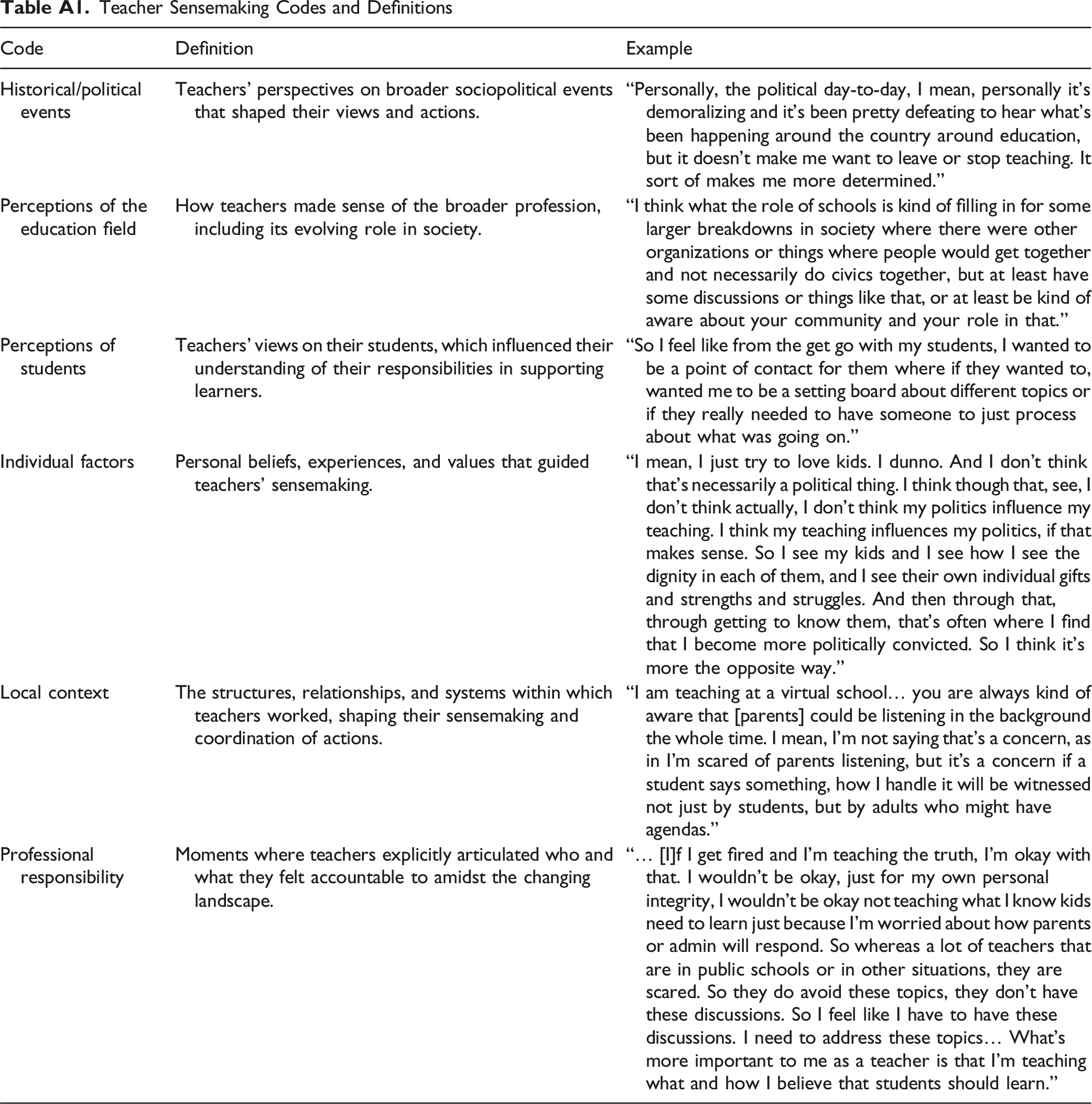
Code
Definition
Example
Historical/political events
Teachers’ perspectives on broader sociopolitical events that shaped their views and actions.
“Personally, the political day-to-day, I mean, personally it's demoralizing and it's been pretty defeating to hear what's been happening around the country around education, but it doesn't make me want to leave or stop teaching. It sort of makes me more determined.”
Perceptions of the education field
How teachers made sense of the broader profession, including its evolving role in society.
“I think what the role of schools is kind of filling in for some larger breakdowns in society where there were other organizations or things where people would get together and not necessarily do civics together, but at least have some discussions or things like that, or at least be kind of aware about your community and your role in that.”
Perceptions of students
Teachers’ views on their students, which influenced their understanding of their responsibilities in supporting learners.
“So I feel like from the get go with my students, I wanted to be a point of contact for them where if they wanted to, wanted me to be a setting board about different topics or if they really needed to have someone to just process about what was going on.”
Individual factors
Personal beliefs, experiences, and values that guided teachers’ sensemaking.
“I mean, I just try to love kids. I dunno. And I don't think that's necessarily a political thing. I think though that, see, I don't think actually, I don't think my politics influence my teaching. I think my teaching influences my politics, if that makes sense. So I see my kids and I see how I see the dignity in each of them, and I see their own individual gifts and strengths and struggles. And then through that, through getting to know them, that's often where I find that I become more politically convicted. So I think it's more the opposite way.”
Local context
The structures, relationships, and systems within which teachers worked, shaping their sensemaking and coordination of actions.
“I am teaching at a virtual school… you are always kind of aware that [parents] could be listening in the background the whole time. I mean, I'm not saying that's a concern, as in I'm scared of parents listening, but it's a concern if a student says something, how I handle it will be witnessed not just by students, but by adults who might have agendas.”
Professional responsibility
Moments where teachers explicitly articulated who and what they felt accountable to amidst the changing landscape.
“… [I]f I get fired and I'm teaching the truth, I'm okay with that. I wouldn't be okay, just for my own personal integrity, I wouldn't be okay not teaching what I know kids need to learn just because I'm worried about how parents or admin will respond. So whereas a lot of teachers that are in public schools or in other situations, they are scared. So they do avoid these topics, they don't have these discussions. So I feel like I have to have these discussions. I need to address these topics… What's more important to me as a teacher is that I'm teaching what and how I believe that students should learn.”