






Abstract
This study examined barriers and enablers of academic freedom in Ethiopian public higher education institutions using a qualitative design based on interviews and document analysis across three universities. Findings indicate that academic freedom is constrained by political interference, limited institutional autonomy, funding dependence, ethnic polarization, hierarchical academic cultures, and patronage-based administration, prompting academics to adopt strategies such as self-censorship, negotiated compliance, and selective collaboration. Despite these challenges, enabling conditions include policy reforms, growing governmental commitment to autonomy, an expanding research culture, and international collaboration. The study underscores the need for stronger legal protections, transparent governance, and greater autonomy, contributing Global South perspectives to academic freedom scholarship and informing policy and practice.
Academic freedom is widely recognized as a cornerstone of higher education systems and democratic knowledge production, as it enables critical inquiry, innovation, and meaningful public engagement (Altbach, 2001). It is closely linked to institutional quality and global competitiveness (UNESCO, 1997), whereas its erosion is associated with intellectual conformity, reduced research productivity, weakened institutional autonomy, and limited contributions to national development (Garry, 2023). At its core, academic freedom signifies the right of scholars to teach, conduct research, share their publications, and engage in public discourse without facing undue restrictions (Tight, 2018; Åkerlind & Kayrooz, 2003). This principle is firmly embedded in major international human rights and higher education frameworks, including the Universal Declaration of Human Rights (1948), the International Covenant on Civil and Political Rights (1966), and the UNESCO Recommendation concerning the Status of Higher-Education Teaching Personnel (1997), all of which emphasize freedom of expression, inquiry, and knowledge dissemination as essential to democratic and intellectually vibrant societies.
In line with these global norms, many countries have incorporated academic freedom and its principles into their legal and policy frameworks. In Ethiopia, freedom of expression is constitutionally protected under Article 29 (Federal Democratic Republic of Ethiopia [FDRE], 1995), while academic freedom is formally acknowledged in the Education and Training Policy (1994) and subsequent Higher Education Proclamations (Nos. 351/2003, 650/2009, and 1152/2019) as a key pillar of institutional autonomy and higher education development (Aboye & Metcalfe, 2021; Federal Democratic Republic of Ethiopia, 2019). Despite these normative and legal commitments, academic freedom is increasingly constrained globally by political interference, shrinking civic space, market pressures, and authoritarian governance (Altbach, 2007; Marginson, 2014). These pressures are particularly pronounced in the Global South, where limited institutional autonomy, politicized state–university relations, and resource constraints further restrict academic practice (Scholars at Risk Network, 2022; Teferra & Altbach, 2004). Ethiopia reflects many of these broader dynamics: rapid expansion of the higher education sector has not been matched by equivalent advances in institutional autonomy, governance capacity, or academic quality, with continued state oversight and securitized campus environments significantly shaping academic life (Assefa, 2008; Human Rights Watch, 2024).
In Ethiopia, the higher education system has been characterized by strong state involvement in governance, staffing, curriculum oversight, and institutional accountability, reflecting a historically centralized approach to public sector administration (Semela, 2007; Tamrat & Teferra, 2018). Although successive reforms have sought to enhance university autonomy, institutions have continued to operate within tightly regulated administrative and political frameworks, particularly in relation to academic staffing, research prioritization, and campus governance (Assefa, 2008; Semela, 2007; Tamrat & Teferra, 2018). Moreover, periods of political transition and heightened national security concerns have, at times, further shaped the boundaries of academic discourse and the operational space of universities (Aalen, 2002; Scholars at Risk Network, 2022). As a result, despite formal policy commitments, the realization of academic freedom in Ethiopian higher education remains uneven, contested, and highly context-dependent across institutions (Aboye & Metcalfe, 2021; Degefa, 2015).
Although academic freedom has attracted increasing scholarly attention, empirical studies on how it is experienced within Ethiopian higher education institutions (HEIs) remain limited. Existing literature has largely emphasized structural and policy dimensions, often overlooking the lived experiences, coping strategies, and agency of academics in everyday practice (Altbach, 2007; Scholars at Risk Network, 2022). This leaves a critical gap in understanding how academic freedom is negotiated within the complex interplay of institutional and political realities. This study addresses this important gap by examining how academics in Ethiopian public universities understand and experience academic freedom within a dynamic political and institutional landscape, thereby providing contextually grounded insights that contribute to the broader scholarship on academic freedom. In doing so, it foregrounds context-specific experiences from the Global South, where dominant global narratives often fail to fully capture localized constraints and negotiated academic practices (Adu & Odame, 2023). To achieve this purpose, the study is guided by the following research questions: • How do academic staff and administrators perceive and experience academic freedom in Ethiopian higher education institutions? • How do gender and discipline shape academics’ experiences of academic freedom in Ethiopian HEIs? • What structural, institutional, and socio-cultural factors constrain academic freedom in Ethiopian HEIs? • What enabling conditions or opportunities exist to strengthen academic freedom in Ethiopian HEIs?
Overall, by navigating the terrains of academic freedom within Ethiopian higher education institutions, the study offers valuable insights from a Global South perspective on how academic freedom is experienced and constrained. These insights are relevant to both local stakeholders and the broader international academic community. The study also contributes to ongoing scholarly debates on academic freedom in Ethiopia and comparable contexts, while also offering empirical evidence to inform policy discussions and support reforms aimed at strengthening academic autonomy and scholarly agency in Ethiopian higher education.
Literature Review
Theoretical Framework
Academic freedom refers to the right of academics to teach, conduct research, publish findings, and participate in academic governance without undue interference (Degefa, 2015; Åkerlind & Kayrooz, 2003). It is widely recognized as a cornerstone of knowledge production, critical inquiry, and intellectual exchange (Altbach, 2007). Contemporary scholarship links academic freedom closely to institutional autonomy, emphasizing universities’ capacity to govern academic affairs independently of external political or administrative control (Bongaerts, 2022; UNESCO, 1997). To examine academic freedom in Ethiopian higher education, this study draws on an integrated framework combining Clark’s (1983) Triangle of Coordination, Institutional Theory (Scott, 2013), and the distinction between institutional autonomy and individual academic freedom (Berdahl, 1990; Marginson, 2014).
Clark’s model highlights the interaction among the state, academic profession, and institutional governance in shaping higher education systems. This perspective is particularly salient in Ethiopia, where government control over governance structures, financial resources, and leadership appointments continues to influence institutional autonomy and academic decision-making (Hao, 2025; Woldegiorgis & Doevenspeck, 2013). For example, the strong regulatory role of the state in areas such as curriculum approval, staffing, and institutional leadership appointment illustrates how state coordination can directly or indirectly constrain institutional independence and academic decision-making (Hao, 2025). Institutional Theory further deepens this analysis by explaining how formal regulations, professional norms, and shared beliefs shape academic behavior and organizational practices (Scott, 2013). In Ethiopia, such institutional pressures may encourage cautious research behavior, self-censorship, and adherence to prevailing norms and expectations (Ashcroft, 2004; Assefa, 2008).
Complementing these perspectives, the individual agency framework highlights the relationship between institutional autonomy and individual academic freedom, providing insight into how macro-level governance arrangements shape the day-to-day experiences of academics (Bourdieu, 2001). While institutional autonomy concerns the independence of universities, individual academic freedom is expressed through teaching, research, publication, and scholarly engagement (Altbach, 2001; Marginson, 2014). Together, these perspectives provide a comprehensive framework for understanding the interplay of governance arrangements, institutional norms, and individual agency in shaping academic freedom within Ethiopian higher education and beyond.
Conceptual Framework of the Study
The conceptual framework of this study positions academic freedom as a multidimensional construct shaped by the interaction of institutional, political, and socio-cultural factors within Ethiopian higher education institutions. Drawing on Altbach’s (2001) conceptualization of academic freedom, the framework conceptualizes academic freedom as encompassing the freedoms to teach, conduct research, publish, and express scholarly opinions without undue interference. Clark’s (1983) Triangle of Coordination model highlights the influence of the state, the academic profession, and the market on university governance and autonomy. Scott’s (2013) Institutional Theory explains how formal rules, organizational structures, and societal norms shape academic practices and behaviors. Figure 1 illustrates the integrated conceptual framework, showing how system-level forces, institutional structures, and individual agency shape academic freedom in Ethiopian higher education institutions. Conceptual Framework of Academic Freedom in Ethiopian Higher Education Institutions. Note. Adapted from Altbach’s (2001) conceptualization of academic freedom, Clark’s (1983) Triangle of Coordination model, Scott’s (2013) Institutional Theory, and the UNESCO Recommendation concerning the Status of Higher-Education Teaching Personnel (UNESCO, 1997)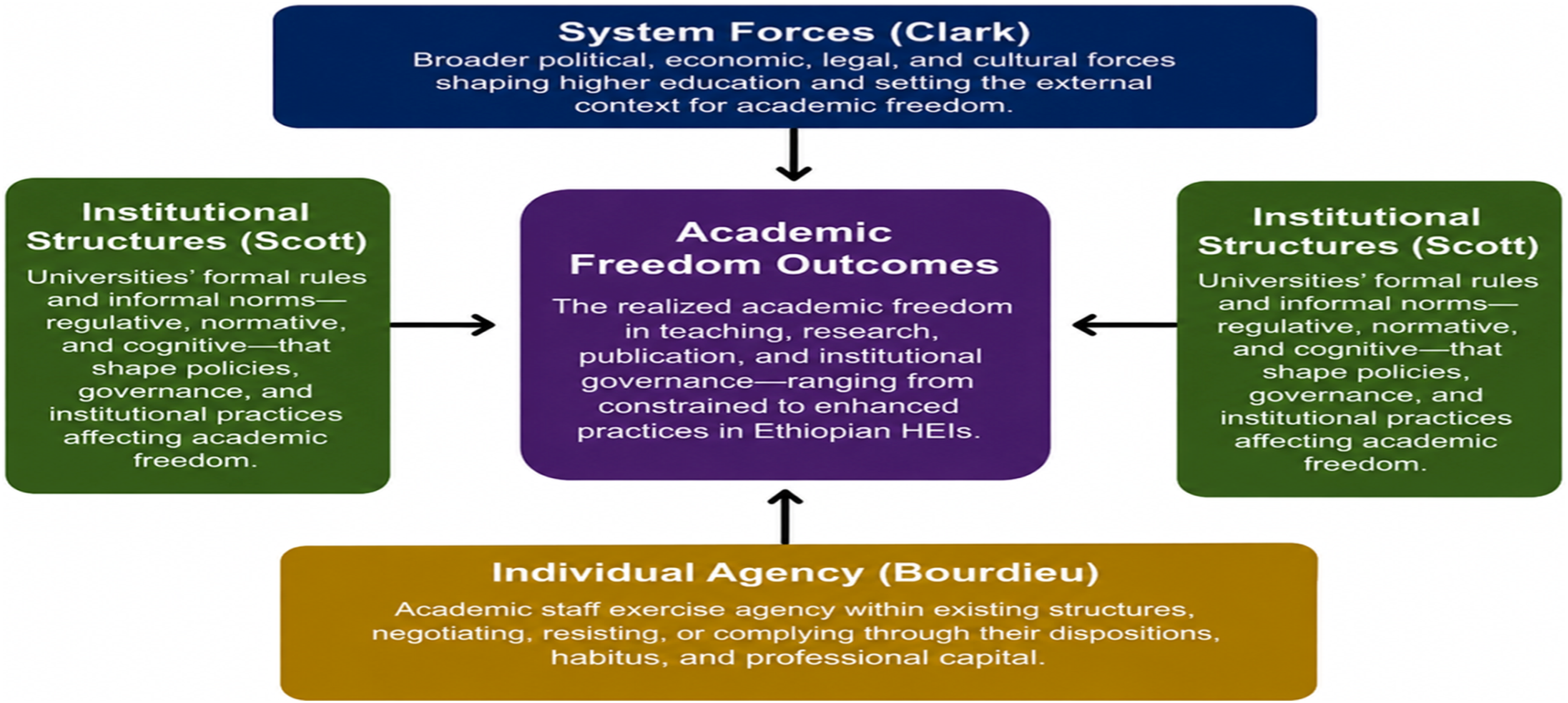
Furthermore, the UNESCO (1997) Recommendation provides the normative foundation for academic freedom and institutional autonomy. Together, these perspectives illustrate how academic freedom is enabled or constrained by governance structures, institutional autonomy, disciplinary cultures, gender and power relations, and broader socio-political contexts, ultimately influencing the capacity of universities to fulfill their teaching, research, and public engagement missions.
Global Context
Academic freedom remains unevenly protected across the world and is frequently constrained by political interference, censorship, surveillance, and institutional control (Altbach, 2007; Garry, 2023). Evidence from Europe, Asia, the Middle East, and Türkiye demonstrates that scholars may face intimidation, dismissal, or harassment for engaging with politically sensitive issues (Altbach, 2001; Karran et al., 2017). For example, following the 2016 coup attempt in Türkiye, numerous academics were dismissed for signing a peace petition, while in Japan, scholars have faced harassment for addressing contested historical issues (Scholars at Risk Network, 2022). Similarly, Professor Mohammad S. Dajani faced threats after organizing a student visit to Auschwitz, illustrating the risks associated with engaging in controversial academic activities (Scholars at Risk Network, 2022). In Burma, prolonged university closures have been used to suppress student activism and critical discourse, underscoring the vulnerability of higher education institutions under authoritarian regimes (Scholars at Risk Network, 2022).
Across Africa, academic freedom faces similar challenges. Scholars and students frequently encounter intimidation, violence, and repression from state security forces, non-state actors, and extremist groups (Appiagyei-Atua et al., 2016; Mamdani, 2018). For instance, between September 2021 and August 2022, Scholars at Risk documented 391 attacks on higher education communities across 65 countries, including Egypt, Algeria, South Africa, Nigeria, the Democratic Republic of the Congo, and Ethiopia (Scholars at Risk Network, 2022). Most of these violations were perpetrated by state security forces, armed groups, and other external actors (Adu & Odame, 2023; Human Rights Watch, 2024). As a whole, these examples demonstrate the persistent challenges confronting academic freedom globally and the continuing need for stronger protections for scholars and institutions (Zeleza, 2024).
National Context
In the Ethiopian context, existing studies suggest that the evolution of academic freedom has been significantly shaped by successive political regimes and their respective governance approaches to higher education (Assefa, 2008; Wagaw, 1990). During the Imperial Era (1930s–1974), the expansion of higher education institutions was closely aligned with state-building priorities, with limited space for dissenting academic voices (Wagaw, 1990). These constraints became more intensified under the Derg (1974–1991), when universities were nationalized and subjected to strict ideological control, censorship, and political purges that severely curtailed critical inquiry (Balsvik, 2007; Woldegiorgis & Doevenspeck, 2013). Although the EPRDF government (1991–2018) initially introduced reforms aimed at expanding access and modernization, studies show that strong state control over curricula, research, and campus governance persisted—particularly after 2005—resulting in surveillance, self-censorship, and constrained institutional autonomy (Assefa, 2008; Scholars at Risk Network, 2022).
Since 2018, political liberalization under Prime Minister Abiy Ahmed has expanded discursive space in some areas, yet weak institutional autonomy, excessive dependence on government budget, and ethnic polarization continue to undermine academic freedom and institutional autonomy (Aalen, 2002; Human Rights Watch, 2024). Recent assessments paint a complex picture where a rising interest in socially impactful research exists alongside persistent government oversight, self-censorship, and limited institutional independence (Ashcroft, 2004; Tamrat & Teferra, 2018). Emerging civil society advocacy and comparative African analyses highlight potential paths for reform but underscore the need for systemic protections to strengthen academic freedom and support Ethiopia’s participation in global knowledge production (Teferra & Altbach, 2004). This historical and contemporary context frames the significance of examining how academic freedom is perceived, constrained, and negotiated within Ethiopian higher education today.
Method
Research Design
This study employed a qualitative phenomenological design to investigate how academic freedom is understood, experienced, constrained, and negotiated within Ethiopian higher education institutions. Phenomenology was selected because academic freedom is a socially constructed and politically embedded phenomenon shaped by institutional cultures and power relations—dimensions not easily captured through quantitative approaches (Degefa, 2015; Åkerlind & Kayrooz, 2003). Grounded in an interpretivist paradigm, which prioritizes participants’ subjective meanings and lived experiences (Creswell & Poth, 2018), the study foregrounded the perspectives of academic staff and institutional leaders to generate nuanced insights into the complex challenges and opportunities surrounding academic freedom in Ethiopia.
Study Context
The study was conducted in three purposively selected public universities—Addis Ababa University (AAU), Hawassa University (HU), and Arba Minch University (AMU)—to capture institutional diversity within Ethiopia’s higher education system. AAU, established in 1950, represents Ethiopia’s oldest and flagship institution with strong national visibility and political relevance. With its long-standing history in the higher education arena, this institution provides important insights into how academic freedom is negotiated within a mature and politically prominent university context (Ashcroft, 2004; Teferra & Altbach, 2004). In contrast, Hawassa University, founded in 2000 reflects relatively new and regionally situated universities operating in ethnically diverse environments and undergoing rapid institutional development (Semela, 2007). Furthermore, Arba Minch University exemplifies institutions located in peripheral regions that face distinct governance, resource, and contextual constraints (Kohoutek et al., 2017). Overall, these sites provide variation in institutional age, geographic location, and political context, enabling a more comprehensive examination of how academic freedom is experienced across different settings.
Researcher Positionality
As a faculty member at one of the three institutions included in this study, I acknowledge that my professional experiences within Ethiopian higher education may have influenced various stages of the research process. My interest in academic freedom emerged from my engagement in teaching, research, academic leadership, and scholarly discussions on the role of universities in fostering intellectual inquiry, critical thinking, and institutional autonomy. While my familiarity with the Ethiopian higher education context facilitated a deeper understanding of participants’ experiences and the institutional realities shaping academic freedom, I remained mindful of the potential influence of my assumptions and professional perspectives on data analysis and interpretation (Berger, 2015). To mitigate this risk, I adopted a reflexive approach throughout the research process by critically examining my assumptions, maintaining analytic notes, and grounding interpretations in participants’ accounts. Findings and conclusions were developed inductively and supported by direct quotations from participants (Creswell & Poth, 2018).
Given my affiliation with Hawassa University, careful attention was paid to participant recruitment and potential power dynamics. Although some participants were professionally known to me, none were recruited based on personal relationships. Participants were selected through purposive sampling using predefined inclusion criteria, and participation was entirely voluntary. Furthermore, the inclusion of participants from Addis Ababa University, Hawassa University, and Arba Minch University provided diverse institutional perspectives and reduced the likelihood that the findings would reflect the culture or experiences of a single institution. Throughout the study, I remained committed to representing participants’ perspectives accurately and transparently during data collection, analysis, and reporting, while acknowledging the complex and contested nature of academic freedom. In sum, throughout the study, I sought to represent participants’ perspectives accurately and transparently, recognizing the complex nature of academic freedom. By engaging in ongoing reflexivity and adhering to established qualitative research procedures, I enhanced the credibility, dependability, and integrity of the study (Lincoln & Guba, 1985).
Participant Recruitment and Selection Procedures
The study employed purposive sampling to recruit information-rich participants with direct experience of teaching, research, governance, and policy implementation in Ethiopian public universities (Patton, 2015). Participants were drawn from academic staff and university administrators whose positions offered firsthand insight into the practice, regulation, and governance of academic freedom (Creswell & Poth, 2018). Three public universities—Addis Ababa University, Hawassa University, and Arba Minch University—were purposively selected to capture variation in institutional history, mission, and organizational context. Addis Ababa University represented the country’s oldest and most research-intensive institution, while Hawassa University and Arba Minch University provided perspectives from universities established during the expansion of the public higher education sector. This selection enabled a comparative understanding of academic freedom across different institutional settings.
Participants were required to have at least 5 years of service at their current institution and to be actively engaged in teaching, research, academic leadership, or university administration. To ensure diverse perspectives, participant selection also considered institutional role, discipline, gender, and years of professional experience. The recruitment process involved identifying potential participants through publicly available university directories, faculty profiles, and institutional leadership structures. Initial invitations describing the purpose of the study, participation requirements, and ethical safeguards were sent via email and official communication channels. Individuals who expressed willingness to participate were contacted to arrange interview schedules and provide informed consent. Additional participants were selected iteratively to ensure representation across academic ranks, leadership positions, disciplinary fields, and gender groups.
Distribution of Study Participants across Universities

aNote. M = Male; F = Female.
Data Collection
In-Depth Interviews
Primary data were collected through semi-structured, in-depth interviews, enabling participants to share their experiences while allowing the researcher to explore emerging issues. This method is effective for exploring complex and sensitive topics like academic freedom, providing both structure and flexibility for in-depth insights (Creswell & Poth, 2018). An interview guide was developed based on academic freedom literature (Altbach, 2001; Assefa, 2008; UNESCO recommendations, 1997) and the Ethiopian higher education policy context. Each interview was conducted in person in English and lasted between 45 to 90 minutes. With informed consent, all interviews were recorded and transcribed verbatim for analysis (Patton, 2015). Participants were invited to share their perceptions and experiences related to academic freedom in Ethiopian HEIs.
Some of the questions included in the interview guide were: What does academic freedom mean to you? How do institutional or political factors influence its practice at your university? Have you ever experienced direct or indirect censorship in your teaching, research, or public engagement? If so, can you describe this experience? How does your gender or discipline affect your experience of academic freedom? What existing institutional or policy conditions support academic freedom in your university? This exploration sheds light on how academic freedom is experienced, constrained, and negotiated in Ethiopian HEIs, broadening our understanding by foregrounding perspectives from the Global South.
Document Analysis
To complement interview data, document analysis was conducted to contextualize institutional practices within Ethiopia’s policy and governance framework. National-level documents reviewed included the Ethiopian Constitution (1995), the Education and Training Policy (1994), the Higher Education Proclamation No. 1152/2019, and the Universities Autonomy Proclamation No. 1294/2023, all of which address institutional autonomy, governance, research, and academic freedom. At the institutional level, documents such as Senate legislation, strategic plans, faculty bylaws, research policies, publication and promotion guidelines, administrative circulars, quality assurance reports, and performance reports were reviewed across the three universities. Variations in document types reflected differences in institutional maturity, administrative capacity, and policy development. Documents were obtained from university websites and administrative offices and analyzed using Bowen’s (2009) document analysis approach involving selection, coding, and thematic interpretation, supported by NVivo. The analysis enabled triangulation of findings and provided insight into the relationship between formal policy provisions and everyday academic practice (Creswell & Poth, 2018).
Data Analysis
Data analysis proceeded through an iterative, multi-stage qualitative process integrating interview transcripts and contextual documents. Interview data were first transcribed verbatim and reviewed for accuracy. Consistent with thematic analysis procedures outlined by Creswell and Poth (2018), the analysis began with repeated reading of the interview transcripts to gain familiarity, followed by open coding to identify meaningful segments related to academic freedom, autonomy, political influence, and institutional governance. Codes were then compared within and across cases to identify patterns, which were progressively clustered into categories and refined into higher-order themes. An inductive–deductive coding strategy was employed: inductive coding allowed themes to emerge from participants’ accounts, while deductive coding drew on the study’s conceptual framework to explore constructs such as the state–university relationship, institutional autonomy, and academic agency (Saldaña, 2021).
Documentary data were analyzed concurrently to contextualize and corroborate interview findings. Using Bowen’s (2009) qualitative document analysis procedures, relevant policies, proclamations, statutes, and governance guidelines were systematically selected, coded, and thematically synthesized. Documents were coded using the evolving codebook derived from interview data, allowing cross-source comparison on governance, research regulation, institutional autonomy, and state oversight, and revealing gaps between formal guarantees and lived practice. The researcher’s insider status as an academic at one of the study sites made it easier to gain access and understand the context, but also required sustained reflexivity. Analytic journaling and critical self-reflection were employed to mitigate bias and ensure methodological rigor (Patton, 2015).
To enhance trustworthiness, triangulation was conducted across methods, data sources, and theory. Methodological triangulation involved comparing themes emerging from interviews with patterns identified in policy and institutional documents to validate or challenge participant accounts (Creswell & Poth, 2018). Data source triangulation contrasted perspectives across academic ranks and institutions to capture positional differences in experiences (Bowen, 2009). Theoretical triangulation used the integrated conceptual framework to interpret patterns at structural, institutional, and individual levels. Finally, analytic memos, codebook revisions, and member checking were applied to enhance analytic rigor, while emergent interpretations were checked against the full data set to ensure credibility and consistency (Patton, 2015). Member checking was conducted with a subset of participants to verify the accuracy and credibility of emerging interpretations. Selected anonymized excerpts were shared with participants via email, allowing them to confirm meanings, clarify intent, or correct misinterpretations. Inputs from the participants helped refine themes and ensured that findings authentically reflected participants’ lived experiences rather than researcher assumptions (Creswell & Poth, 2018). This systematic process strengthened credibility and interpretive accuracy, enabling the study to move beyond descriptive accounts toward an integrated explanation of how academic freedom is negotiated and constrained in Ethiopian higher education.
Findings
The findings are organized into five interrelated themes: (1) Perceptions and Experiences of Academic Freedom among Academic Staff and Administrators in Ethiopian HEIs; (2) Gender, Power, and Academic Freedom; (3) Disciplinary Differences and Academic Freedom; (4) Key Structural and Institutional Barriers to Academic Freedom in Ethiopian HEIs; and (5) Enabling Conditions and Future Directions for Strengthening Academic Freedom. These themes illuminate how academic freedom is understood, experienced, constrained, and supported within the Ethiopian higher education context.
Perceptions and Experiences of Academic Freedom Among Academic Staff and Administrators in Ethiopian HEIs
The findings reveal that academic freedom in Ethiopian higher education institutions is generally understood by academic staff as the ability to teach, conduct research, publish, and express ideas without undue interference. This understanding is primarily framed in terms of professional autonomy in core academic activities and the protection of intellectual expression within the university space. Participants associated academic freedom with the freedom to pursue research interests, deliver disciplinary content in teaching, and engage in scholarly debate without external restriction. However, this conception is consistently shaped by the broader political and institutional context, particularly state influence over leadership, funding, and governance. As a result, academic freedom is not viewed solely as an individual right but as a condition that depends on institutional and political environments that either enable or constrain its practice.
The findings further show that academic freedom is commonly understood and experienced as relative rather than absolute. Many academics described it as operating “within limits,” particularly in relation to politically sensitive topics, ethnic considerations, and administrative expectations. This perceived boundedness contributes to widespread self-censorship, as academics adjust their research and teaching choices in anticipation of potential consequences. As one participant explained, “You are free to speak, but you also know where the boundaries are; you adjust your work accordingly” (Senior Lecturer, AAU-P11). Similarly, another faculty member observed, “In principle, we are free to teach and research what we want, but in reality, there are unseen boundaries. You always think twice before selecting sensitive topics, particularly those related to politics and ethnicity” (Associate Professor, AAU-P06). These accounts reflect an implicit understanding of academic freedom as conditional and cautiously exercised within perceived risks.
In addition, only a limited number of participants explicitly referenced the ethical and professional responsibilities associated with academic freedom, such as accuracy, integrity, and distinguishing evidence-based knowledge from personal belief. Where mentioned, these responsibilities were framed as general academic norms rather than integral dimensions of academic freedom itself. At the same time, university administrators acknowledged the importance of academic freedom but tended to situate it within institutional mandates, accountability structures, and national development priorities. As one dean stated, “Academic freedom is important, but it must align with institutional goals and national development priorities; it is not absolute” (Dean, AAU-P09). Likewise, a vice president noted, “We encourage academic staff to be creative, but we also have a responsibility to ensure that teaching and research are consistent with the university’s mission” (Vice President, AMU-P11).
In sum, the findings suggest a divergence in perspectives between academic staff and administrators. While academic staff members emphasize constraint, self-censorship, and political sensitivity in their lived experiences, administrators stress alignment, responsibility, and institutional oversight. This tension reflects a broader governance context in which academic freedom is formally recognized but unevenly realized in practice, resulting in a conception of academic freedom as constrained autonomy rather than an absolute academic right.
Gender, Power, and Academic Freedom
The findings indicate that gender, embedded within broader structures of power and privilege, significantly shapes how academic freedom is experienced in Ethiopian HEIs. While both male and female participants reported constraints on academic freedom, women academics often described additional, layered barriers linked to gendered expectations, institutional hierarchies, and informal power dynamics within their workplaces. Female participants highlighted that their ability to freely express critical views, particularly on sensitive institutional or political issues, was often self-regulated due to fear of reputational consequences, marginalization, or being labeled as “difficult.”
In contrast, male participants—especially those in senior positions—tended to report relatively greater confidence in expressing dissenting views, suggesting that positional authority and gender intersect to shape voice and visibility. One female academic explained, “Even when you have something important to say, you think twice. Not because it is wrong, but because of how it will be received as a woman” (Lecturer, AMU-P04). Similarly, another participant observed, “Male colleagues can challenge decisions openly. For us, it is more complicated, we have to be careful and strategic” (Senior Lecturer, HU-P15). These accounts indicate that academic freedom is not experienced as a neutral or uniformly accessible right, but rather as socially mediated, where gender norms and institutional cultures influence who can speak, how, and with what consequences. Women’s underrepresentation in leadership positions further compounds this dynamic, limiting their influence in shaping academic and institutional agendas.
Disciplinary Differences and Academic Freedom
The study also reveals important variations in how academic freedom is experienced across disciplines. Academics in the social sciences and humanities reported facing more direct constraints, particularly when engaging with politically sensitive topics, governance issues, or critical social analysis. Their work was often perceived as more “visible” and potentially contentious, leading to heightened scrutiny. In contrast, participants from natural sciences and engineering generally described fewer direct restrictions in their teaching and research activities. However, their experiences of academic freedom were shaped by other constraints, such as limited research funding, resource dependency, and institutional priorities, rather than overt ideological control. A senior social science academic remarked, “In our field, what we teach and research can easily be seen as political. So you are always aware of the boundaries” (Senior Lecturer, HU-P02). Meanwhile, a natural science participant noted: “We don’t usually face problems in what we say in class, but our freedom is limited by resources and research support” (Assistant Professor, AAU-P03).
These findings suggest that academic freedom is discipline-sensitive, with social scientists experiencing more content-based and ideological constraints, while those in hard sciences encounter more structural and material limitations. Importantly, this does not imply that one group enjoys full freedom; rather, the nature of constraints differs across fields. Overall, the findings underscore that academic freedom in Ethiopian higher education is not uniformly experienced, but is mediated by gendered power relations and disciplinary contexts. These dynamics shape not only the extent of freedom academics perceive but also the strategies they adopt—ranging from open engagement to cautious self-censorship—in navigating institutional environments.
Key Structural and Institutional Barriers to Academic Freedom in Ethiopian HEIs
Key Structural and Institutional Barriers to Academic Freedom in Ethiopian HEIs: Illustrative Participant Quotes
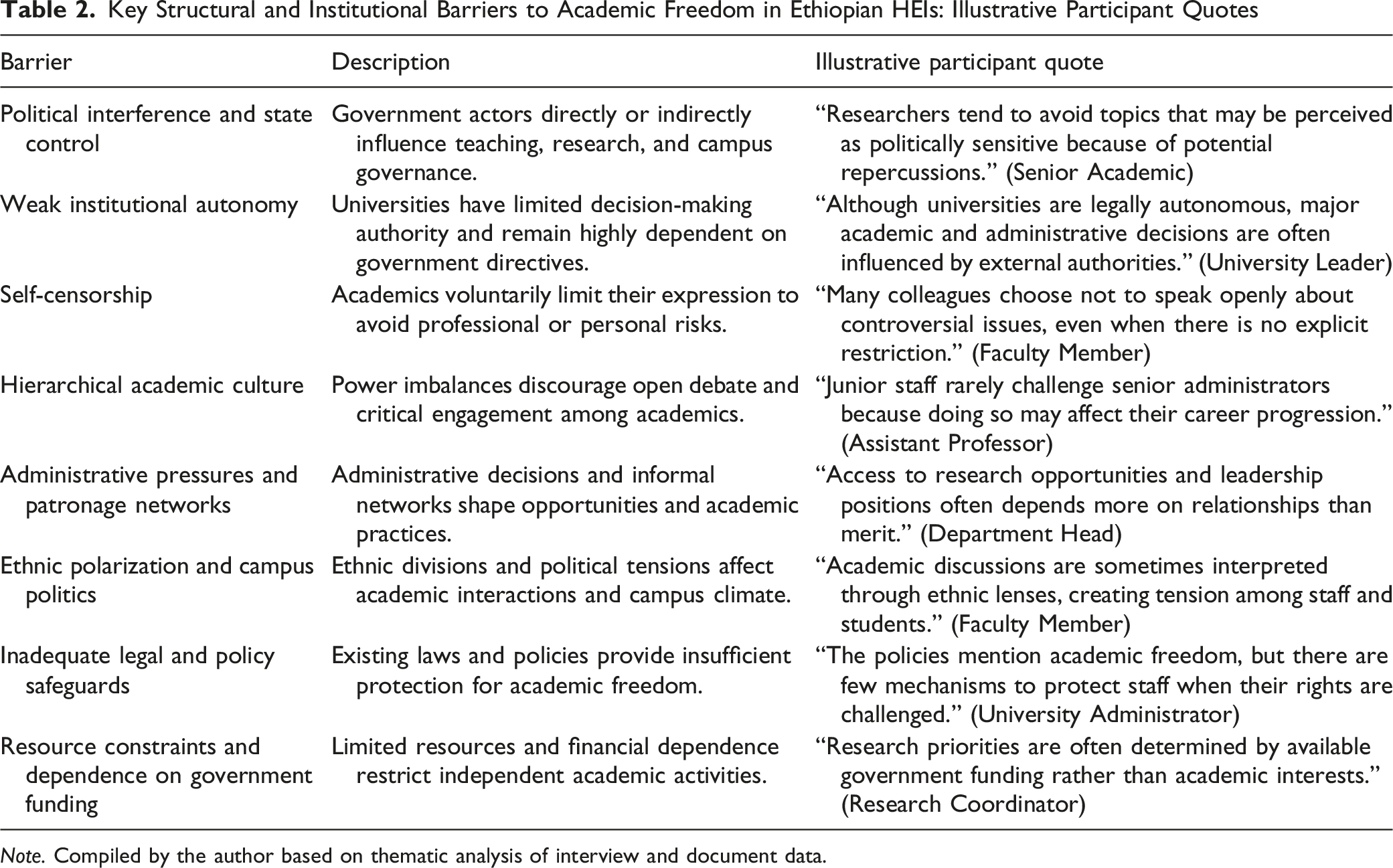
Note. Compiled by the author based on thematic analysis of interview and document data.
Political Interference and State Control
Participants consistently identified excessive state influence over university affairs as one of the most significant challenges to the exercise of academic freedom. Although academic freedom is formally recognized in legal and policy frameworks, participants reported that state influence frequently shapes leadership appointments, institutional priorities, and academic decision-making, thereby limiting institutional autonomy. As one academic staff member observed, “Universities are expected to be autonomous, but major decisions are often influenced by external political interests” (Professor, HU-12).
Participants portrayed Ethiopian higher education as operating within a highly centralized political environment that shapes teaching, research, and public discourse. This context encourages self-censorship, particularly on politically sensitive issues, as academics fear potential repercussions. One participant emphasized, “There are topics you avoid because they are politically sensitive; even if nobody tells you directly, you just know the consequences” (Associate Professor, AAU-P06). Similarly, another respondent noted, “We’ve seen colleagues face repercussions for research that contradicts popular political opinion. This creates a chilling effect” (Senior Lecturer, HU-P02). An academic leader echoed this concern, stating that “Despite policies advocating for academic freedom, the actual practice is often constrained by the political climate” (Department Head, AMU-P22). Overall, political pressures constrain both scholarly inquiry and open debate, creating a gap between the formal guarantees of academic freedom and its practical realization.
Further complicating this dynamic, growing dependence on state funding and political appointments restricts academic freedom. A research director explained, “Universities depend on the government for funding and appointments. So, academic freedom becomes limited because leaders are accountable upwards, not to the academic community” (Research Director, HU-P08). This vertical accountability erodes institutional independence and prioritizes adherence to state interests over scholarly inquiry. The pervasive political dominance impacts daily academic practices, limiting critical engagement and stifling intellectual diversity, particularly in sensitive areas such as governance and human rights. Participants expressed skepticism about the existence of genuine institutional autonomy amid ongoing political interference in leadership appointments and internal affairs. A vice president remarked, “Academic freedom is not only individual; it also means the university should have autonomy to manage its affairs without government intervention” (Vice President HU-P12). However, participants highlighted challenges, including government oversight, legal ambiguities, and politicization within university leadership, which undermine the ability to uphold academic freedom.
Legal and policy uncertainties further exacerbate the situation. Many participants noted the absence of clear frameworks to define and protect academic freedom, leaving academics vulnerable to arbitrary restrictions. One Senior lecturer pointed out, “Sometimes university laws are vague, and policies conflict with national regulations, making it hard to understand our rights” (Lecturer, AAU-P05). Surveillance and public scrutiny, particularly regarding ethnicity, further restrict open debate within universities, especially in the social sciences. A senior academic stated, “Sometimes you are not afraid of the government; you are afraid of how your colleagues or students from different ethnic backgrounds will interpret what you say” (Associate Professor, HU-P10). This pressure shapes both research agendas and classroom discussions, where avoiding politically sensitive topics has become the norm.
To navigate these pressures, academics often rely on informal peer networks, strategic topic selection, and open dialogue with administrators. One academic explained, “We frequently discuss sensitive topics with trusted colleagues first to ensure we approach these areas carefully” (Associate Professor, AMU-P19). An academic leader also emphasized the role of communication in problem-solving and maintaining academic space, saying, “Effective communication is not just a tool for problem-solving; it’s the foundation that nurtures a thriving academic environment” (Dean, AAU-P09). Overall, these accounts illustrate how political and state-level constraints—such as funding dependency, ideological boundaries, and a climate of scrutiny—profoundly shape academic behavior in Ethiopian HEIs. Consequently, advancing academic freedom necessitates strong institutional autonomy, clear legal protections, and safeguards against undue political interference.
Limited Institutional Autonomy
Participants consistently identified limited institutional autonomy as a major barrier to academic freedom in Ethiopian public HEIs. Despite constitutional and legislative provisions recognizing institutional autonomy and academic freedom, respondents reported that government influence over governance, funding, leadership appointments, and academic decision-making continues to constrain universities’ independence. As one senior academic observed, “We are told that universities are autonomous, but major decisions—such as budgeting, leader appointments, and academic program approvals—are still determined by political authorities” (Associate Professor, AAU-P01). Another participant added, “When the ministry influences who becomes president or vice president, you know autonomy is more symbolic than real” (Senior Lecturer, HU-P02).
Document analysis similarly revealed a gap between formal policy commitments and institutional practice. Participants noted that key decisions often remain subject to ministerial oversight, limiting universities’ ability to govern their affairs independently. This perceived lack of autonomy was also linked to restrictions on scholarly inquiry and academic expression. As one academic explained, “On paper, academic freedom is guaranteed, but in practice, appointments and initiatives are influenced by who is politically trusted, not who is academically qualified” (Assistant Professor, AAU-P03). While university leaders acknowledged these challenges, they tended to portray autonomy as an evolving process shaped by regulatory requirements and ongoing governance reforms. A vice president remarked, “Even though we aim for institutional independence, we still function within a national framework where certain decisions need to align with government regulations” (Vice President, HU-P12). A dean further commented, “Autonomy is a work in progress; the law provides for it, but implementation takes time as institutions and the state adapt to shared expectations” (Dean, AMU-P14). Despite differences in emphasis, both academic staff and administrators agreed that existing levels of autonomy remain insufficient for the full realization of academic freedom.
Self-Censorship Among Academics
The study also revealed a widespread culture of self-censorship among academics, driven by fear of political reprisal or reputational damage. Faculty members often steer clear of diving into research or classroom conversations that could be seen as controversial, especially topics like national politics, university governance, and ethnicity. This cautious approach has created an environment where academic exploration and open discussions are significantly stifled. One senior lecturer described, “We censor ourselves more than anyone else does; you don’t want to risk your career by speaking out” (Senior Lecturer, AMU-P21). Another added, “Even in classrooms, we have to be careful. Students may report you if they think you’re saying something politically charged” (Senior Lecturer, HU-P15). Such accounts illustrate how fear, rather than formal restriction, often governs academic behavior, undermining the foundational principles of scholarly freedom. This phenomenon is indicative of deeper systemic anxieties rooted in unclear boundaries and the unpredictable consequences of dissent.
Dependence on Government Funding
Participants frequently cited excessive reliance on government funding as a significant barrier to academic freedom across all participating universities. Chronic underfunding of research activities and limited resources affect every aspect of academic life, from research to infrastructure. Many academics struggle to conduct independent, rigorous research due to these limitations. An early-career researcher noted, “We’re told to publish and innovate, but there’s no funding, no access to journals, and sometimes even no internet. How can you be academically free under such conditions?” (Lecturer, HU-P17). Another academic stated, “Most of our research is self-financed. Without institutional support, how can we compete globally or even regionally?” (Assistant Professor, AMU-P24). The Ethiopian higher education landscape heavily relies on government funding, leading to vulnerabilities for academic freedom. This dependence allows the Ministry of Education and other political bodies to exert control over universities.
Research agendas are often influenced by government priorities, where funding favors topics aligned with state interests. A senior researcher shared, “If your proposal mirrors government policy or aligns with national priorities, it usually gets the green light without much delay. But once you start addressing issues like governance, ethnicity, or political history, securing funding becomes nearly impossible” (Senior Researcher, AAU-P18). Moreover, the lack of diverse funding sources limits academic pluralism, forcing scholars to either conform to politically favored topics or risk exclusion. A young female academic bluntly remarked, “You either play by the rules, or you’re left behind; if your research doesn’t align with the national agenda, it essentially doesn’t exist” (Lecturer, AMU-P04). In summary, excessive reliance on government funding has created a constrained academic environment in Ethiopian public universities, allowing the state to influence research directions and suppressing academic freedom. To contribute effectively to national development, universities must diversify their funding structures and strengthen protections for scholarly independence.
Ethnic Polarization and Campus Politics
Ethnic polarization also identified as a significant barrier to academic freedom and institutional cohesion in Ethiopian higher education. In a context where politics and identity are deeply entwined, the ethnicization of academic spaces undermines merit-based decision-making and fosters distrust among faculty and students. Participants reported that open discussion and critical exchange—core elements of academic freedom—are often compromised as comments are interpreted through ethnic identities rather than intellectual merit. A senior lecturer observed, “When you criticize the administration or government, people first ask which ethnic group you belong to; that alone can silence freedom of speech and open discussion on campus” (Senior Lecturer, HU-P02).
These tensions are linked to broader national political dynamics, with ethnicity serving as a dominant organizing principle in representation and public discourse. As an associate professor remarked, “Universities are not islands; whatever is happening politically will reflect on campus, including ethnic divisions” (Associate Professor, HU-P10). Ethnic affiliations often influence hiring, leadership selection, and promotion practices, undermining fairness and meritocracy. A lecturer summarized, “Even appointments and promotions are often influenced by ethnic affiliations, creating distrust among faculty and students” (Senior Lecturer, AMU-P21). The cumulative effect of these dynamics is a fragmented academic community where ethnic considerations overshadow scholarly collaboration and shared institutional goals. Participants emphasized that the erosion of trust and collegiality, alongside the politicization of identity, significantly weakens the foundation of academic freedom. Rather than serving as neutral spaces for critical inquiry, universities risk reproducing and amplifying societal divisions. Consequently, ethnic polarization presents not only a socio-political challenge but also a structural impediment to academic freedom and the integrity of the higher education mission in Ethiopia.
Hierarchical Academic Cultures
A hierarchical academic culture emerged as a major barrier to academic freedom in Ethiopian HEIs. Participants described rigid top-down structures that discourage open intellectual exchange and limit junior faculty influence. A junior lecturer noted, “In our universities, hierarchy is everything; as a junior academic, you really think twice before challenging your seniors, even in academic discussions” (Lecturer, AMU-P04). Such dynamics make early-career academics reluctant to challenge senior colleagues, stifling critical dialogue and innovation. Decisions are largely directive with minimal consultation, reflecting a diminished faculty role in curriculum, research, and governance. As one senior lecturer remarked, “The majority of the decisions come from the top. We are expected to implement, not question” (Senior Lecturer, AAU-P05). These norms cultivate silence, as questioning authority can appear disrespectful or politically risky. Leaders acknowledged this context but framed it as culturally embedded rather than intentionally repressive. A dean explained, “We come from a system where authority is respected; changing this mindset isn’t something that happens overnight” (Dean, HU-P16). While this perspective normalizes hierarchical practices, faculty emphasized their harmful effects on participation and governance. Overall, these norms generate unspoken constraints that stifle open discussion and weaken academic freedom.
Patronage-Related Administrative Pressures
Participants identified patronage-related administrative pressures as a significant barrier to academic freedom. These pressures were described as non-merit-based demands, political directives, and informal obligations imposed on university leaders and academic staff by influential actors involved in their appointment or career advancement. Participants indicated that such practices prioritize political loyalty and personal affiliations over professional competence and institutional rules, thereby undermining merit-based governance and academic independence. Nearly three-quarters of the respondents perceived that leadership appointments are often influenced by political considerations or ethnic affiliations rather than merit and academic qualifications, fostering governance arrangements that privilege compliance over critical inquiry and independent academic engagement. As one department head observed, “Political loyalty and ethnicity matter more than competence in promotion and appointment decisions; independent thinkers are often sidelined” (Department Head, HU-P13).
Participants further noted that decision-making processes frequently lack transparency and provide limited opportunities for meaningful faculty participation. Echoing this concern, a senior lecturer noted that even university presidents may hesitate to speak freely, as hierarchical chains of command often suppress openness and discourage candid feedback (Senior Lecturer, AAU-P23). These findings suggest that patronage-driven administrative systems constrain academic autonomy by incentivizing conformity and marginalizing dissenting perspectives. A university leader acknowledged the challenges associated with navigating political expectations, stating, “Leadership roles come with political demands; sometimes you have to balance academic values with directives from above” (Vice President, AMU-P11). Consequently, participants perceived patronage networks as fostering a culture of upward accountability to political actors rather than accountability to academic standards, thereby weakening institutional integrity and limiting the conditions necessary for the effective exercise of academic freedom.
Enabling Conditions and Opportunities for Advancing Academic Freedom in Ethiopian HEIs
Despite the challenges identified, the study revealed several enabling conditions that support the advancement of academic freedom in Ethiopian HEIs, including ongoing policy reforms, a growing research culture, expanding international collaborations, and professional and generational shifts.
Ongoing Policy and Institutional Reforms
Recent higher education policy and institutional reforms were identified as important enabling conditions for strengthening academic freedom in Ethiopian HEIs. Participants emphasized that ongoing autonomy and governance reforms are gradually promoting more decentralized institutional decision-making, although the extent of implementation differs across institutions. As one participant observed, “The new reforms at least recognize autonomy, even if practice has not fully caught up yet” (Senior Lecturer, AAU-P14). In addition, document analysis of the Higher Education Proclamation No. 1152/2019 and Universities Autonomy Proclamation No. 1294/2023 confirms formal recognition of academic freedom and institutional autonomy, creating a policy basis for independent teaching, research, and governance.
Despite these legal and policy provisions, participants emphasized that their practical impact is still emerging and, in many cases, remains largely symbolic. However, they viewed these reforms as important “windows of opportunity” for enhancing institutional self-governance, including curriculum development and academic decision-making. As one dean noted, “The new policies have encouraged us to take more initiative in our academic pursuits, creating a culture where faculty members feel their voices matter” (Dean, HU-P16). A senior lecturer reported, “With greater autonomy, academics are better able to pursue research that aligns with their professional interests and expertise without unnecessary bureaucratic constraints” (Senior Lecturer, AAU-P23). Participants also indicated that although autonomy is still constrained by oversight mechanisms and resource dependence, ongoing reforms have contributed to a gradual shift toward more participatory governance and reduced administrative interference.
Expanding Research Culture
The findings revealed a growing emphasis on research productivity and scholarly engagement across Ethiopian HEIs, which participants associated with increasing academic openness and inquiry. This expanding research culture was perceived as encouraging academics to pursue more independent investigations and engage in knowledge production aligned with disciplinary standards. One participant stated, “Compared to before, there is now more encouragement to publish and conduct research, which motivates academics to be more active” (Assistant Professor, AMU-P09). Such developments were seen as gradually strengthening institutional commitment to evidence-based scholarship and intellectual autonomy.
Participants further noted that this shift toward research-oriented practice is increasingly reflected in institutional expectations, including promotion criteria, staff evaluation systems, and academic workload structures that place greater value on publication and research output. While implementation varies across institutions, many respondents viewed these changes as reinforcing a culture of inquiry and enhancing academic visibility. As one senior lecturer explained, “Research is now taken more seriously in promotion decisions, so staff are more engaged in producing work that meets academic standards” (Senior Lecturer, AAU-P11). Overall, this emerging research culture was perceived as a positive enabling condition that supports gradual movement toward greater academic independence and scholarly professionalism.
International Research Collaborations
Participants highlighted international collaborations as a significant enabling condition that enhances academic freedom through exposure to global academic norms, methodologies, and scholarly networks. These partnerships were reported to improve research quality, broaden academic perspectives, and reinforce professional confidence among academic staff. As one respondent explained, “Working with international partners helps us understand how academic freedom is practiced elsewhere and strengthens our own confidence in research” (Associate Professor, HU-P20). Such collaborations were perceived as creating external academic spaces that support intellectual independence and reduce isolation from global scholarly communities.
Participants further emphasized that international partnerships also contribute to strengthening institutional capacity through joint research projects, academic exchange programs, and access to external funding opportunities. These engagements were seen as particularly valuable in supporting early-career academics and enhancing methodological rigor in research practice. As one participant emphasized, “International collaborations provide opportunities to learn new advanced research skills and strengthen our confidence to engage with topics that might be challenging to pursue within local contexts” (Assistant Professor, AAU-P10). Overall, international collaborations were viewed as an important enabling factor that not only enhances research quality but also indirectly supports the practice of academic freedom by expanding intellectual horizons and professional autonomy.
Professional and Generational Shifts in Academic Culture
The study found that ongoing professional development, generational change, and increasing digital engagement are gradually reshaping academic culture in ways that support greater openness, collaboration, and critical inquiry. Participants noted that younger academics and internationally trained scholars tend to be more research-oriented, debate-friendly, and willing to question established ideas compared to earlier cohorts. As one participant observed, “Younger staff are more open to discussion and less afraid to question ideas, which is changing the academic environment slowly” (Lecturer, AAU-P21). Similarly, another senior academic remarked, “The younger generation is more research-minded and less afraid of debate. They bring new ways of thinking into the university” (Associate Professor, AMU-P19). These generational shifts were seen as contributing to a more dynamic academic environment that increasingly values inquiry, evidence-based dialogue, and scholarly independence.
Participants further highlighted the growing role of digital academic tools and platforms in facilitating scholarly exchange and mitigating institutional resource constraints. Online databases, virtual seminars, and academic networking platforms were reported to expand access to knowledge, enable interdisciplinary engagement, and sustain academic activity beyond physical university settings. As one assistant professor explained, “Online platforms and webinars provide access to debates and knowledge that may not be available locally. They help us remain academically active despite limited resources” (Assistant Professor, HU-P15). Overall, these intertwined professional, generational, and technological shifts were perceived as fostering a more open and connected academic culture, gradually strengthening the conditions for intellectual engagement and academic freedom in Ethiopian higher education institutions.
Discussion
The findings of this study reveal a complex and at times contradictory landscape of academic freedom in Ethiopian public universities. While constitutional and policy frameworks formally guarantee academic freedom (e.g., Higher Education Proclamation No. 1152/2019; University Autonomy Proclamation No. 1294/2023) (FDRE, 2023), participants view these provisions as largely symbolic, with a persistent gap between policy and practice. This reflects broader patterns in authoritarian and semi-authoritarian contexts, where formal commitments coexist with practical restrictions through both direct and indirect mechanisms (Altbach, 2001; Giroux, 2015). Viewed through Clark’s coordination model and Scott’s institutional theory, the findings highlight ongoing tensions among state control, institutional governance, and academic agency, consistent with comparative higher education scholarship (Marginson, 2014; Nayyar, 2007).
A central finding is the pervasive influence of political control and state oversight on academic work in Ethiopian public universities, largely mediated through financial dependency and centralized governance structures. As the primary funder of higher education, the state shapes research priorities, staffing, and institutional policy, privileging government-aligned agendas and discouraging politically sensitive inquiry (Balsvik, 2007; Teferra & Altbach, 2004). This aligns with Mamdani’s (2018) critique of intellectual dependency in African universities and broader political economy analyses of higher education (Altbach & de Wit, 2018; Luescher, 2016). From an institutional perspective, these dynamics reflect coercive, normative, and cognitive pressures that reinforce compliance and self-censorship (Scott, 2013), contributing to what Fataar (2025) describes as the “silencing of the university.” Closely linked to these structural constraints are limitations in institutional autonomy. Despite formal policy commitments, centralized control over leadership appointments, budgeting, and academic decision-making results in what Vaira (2010) terms “nominal autonomy.” This gap between policy and practice reflects broader governance challenges in African higher education systems (Adu & Odame, 2023; Appiagyei-Atua et al., 2016).
Institutional variation further shapes experiences of academic freedom across Ethiopian universities. Addis Ababa University’s long-established academic traditions and research prominence are accompanied by greater political scrutiny, while Hawassa University reflects the challenges of rapid expansion, centralized governance, and resource constraints (Semela, 2007; Tamrat & Teferra, 2018). Arba Minch University illustrates how regionally oriented institutional missions can limit opportunities for critical inquiry (Marginson, 2014). These differences underscore the uneven nature of academic freedom and highlight its dependence on institutional context and structure (Clark, 1983; Marginson, 2014).
Beyond structural constraints, the findings demonstrate that academic freedom is unevenly experienced across gender and disciplinary lines. Gender operates as a structural and relational dimension shaping voice, legitimacy, and authority within academia (Bourdieu, 2001; Connell, 2009). Women academics reported additional constraints, including gendered expectations, exclusion from decision-making spaces, and heightened professional scrutiny. These findings align with feminist scholarship highlighting the reproduction of gendered hierarchies in academia (Acker, 1990; Morley, 2013). Disciplinary differences further shape experiences: academics in social sciences and humanities reported greater constraints due to engagement with politically sensitive topics (Altbach, 2001; Zeleza, 2024), while those in natural sciences and engineering faced fewer ideological restrictions but greater resource constraints (Becher & Trowler, 2001; Clark, 1983). These patterns confirm that academic freedom is uneven across disciplines and shaped by epistemological positioning within the university system (Neumann, 2001).
Another key contribution of this study is its identification of ethnic polarization as a significant constraint on academic freedom in Ethiopian higher education. Participants reported that ethnic affiliations often influence governance processes, professional interactions, and decision-making, creating fragmented academic environments where academic merit may be overshadowed by identity-based considerations. These dynamics are rooted in Ethiopia’s ethno-federal system, which has made ethnicity a central feature of political and administrative organization (Aalen, 2002; Assefa, 2008). While originally intended to address historical inequalities, the system has also fostered identity-based politics within universities, contributing to what Mamdani (2018) describes as “political tribalization.” As a result, universities often mirror broader societal tensions, with ethnic identity shaping governance practices, collegial relations, and academic culture (Aboye & Metcalfe, 2021). These conditions, reinforced by hierarchical governance systems and patronage networks that prioritize loyalty over merit, erode meritocratic principles, limit academic freedom, and weaken institutional autonomy (Tamrat & Teferra, 2018). Extending previous research on ethnicity in African higher education (Aalen, 2002; Teferra & Altbach, 2004), this study demonstrates how ethnic identity influences academic discourse, perceptions of scholarly intent, and the integrity of merit-based evaluation systems.
Despite these constraints, the study identifies several enabling factors that may foster greater academic openness and intellectual engagement. Recent legal reforms and institutional restructuring provide a normative foundation for strengthening autonomy, although their effectiveness depends on implementation and insulation from political interference (Ashcroft, 2004; Luescher, 2016). International collaborations and expanding graduate programs also enhance scholarly exchange and global integration (Altbach, 2007; Karran et al., 2017). In addition, generational shifts within academia may gradually reshape norms toward greater acceptance of critical inquiry (Altbach & de Wit, 2018). Overall, the findings underscore that academic freedom in Ethiopian higher education is socially constructed and politically embedded, shaped by intersecting forces of state control, institutional governance, gender dynamics, disciplinary cultures, and ethno-political contexts. Strengthening academic freedom therefore requires moving beyond formal legal guarantees toward substantive institutional autonomy, inclusive governance, and context-sensitive reform.
Limitations and Future Research Directions
This study provides in-depth insights into academic freedom in Ethiopian higher education; however, its findings should be interpreted in light of certain limitations. The focus on three public universities may limit the transferability of findings to private institutions or other higher education contexts. Given the sensitivity of the topic, participants may also have been cautious in discussing their experiences. Additionally, the researcher’s insider positionality, while facilitating access and contextual understanding, may have influenced data interpretation despite efforts to maintain reflexivity. Future research could extend the analysis to private universities, adopt comparative or longitudinal designs, and utilize quantitative or mixed-methods approaches to examine broader patterns and enhance the generalizability of findings.
Implications for Policy and Practice
The findings suggest the need to move from the formal recognition of academic freedom to its effective realization in Ethiopian higher education. At the policy level, this requires addressing structural constraints such as excessive state control, financial dependency, and centralized governance. Institutional autonomy should therefore be strengthened beyond legal provisions by introducing safeguards against political interference in leadership appointments, research priorities, and academic decision-making (UNESCO, 1997). This should be complemented by transparent, merit-based governance systems and independent oversight mechanisms to enhance accountability while protecting scholarly independence (Altbach, 2001; Luescher, 2016). In addition, diversifying university funding sources is essential to reduce reliance on state funding and the resulting pressures that foster conformity and self-censorship (Mamdani, 2018). Policy attention is also needed to address socio-political dynamics, including ethnic polarization and gender inequality, which shape how academic freedom is experienced in practice. Higher education governance frameworks should therefore incorporate equity-oriented measures that promote inclusive representation and institutional trust while safeguarding academic integrity. This includes addressing identity-based dynamics that influence participation and authority within academic spaces, as well as removing gendered barriers that limit voice and agency (Connell, 2009; Morley, 2013).
At the institutional level, universities should cultivate environments that enable both the protection and responsible exercise of academic freedom. This entails strengthening collegial governance, ensuring transparency in leadership and decision-making, and implementing merit-based recruitment and promotion systems (Deem, 1998; Marginson, 2014). Institutions should also establish clear protection mechanisms for academic staff, including confidential reporting systems and access to legal or professional support in cases of censorship or retaliation (Karran et al., 2017). Given the prevalence of self-censorship, fostering a culture of open dialogue and critical inquiry is essential, supported by sustained professional development on academic freedom, research ethics, and scholarly integrity (Marginson, 2014). Strengthening international partnerships and scholarly networks can enhance institutional resilience while promoting adherence to internationally recognized principles of academic freedom (Altbach & de Wit, 2018).
Conclusion
The study concludes that academic freedom in Ethiopian higher education institutions is widely valued but unevenly understood and inconsistently experienced across academic staff and administrators. While participants broadly associate academic freedom with the ability to teach, research, publish, and express ideas without undue interference, its practical realization is constrained by institutional controls, political sensitivities, and managerial oversight. Participants’ perspectives differed by role: academic staff tend to emphasize limitations, self-censorship, and restricted autonomy in teaching and research, whereas administrators stressed the importance of balancing individual academic rights with institutional mandates and national priorities. These contrasting interpretations reflect a continuing tension between the aspiration for academic freedom and the institutional mechanisms that shape its exercise in practice. Overall, this study contributes a Global South perspective on academic freedom, demonstrating that its realization depends not only on legal protections but also on governance structures, state–university relations, and identity dynamics. The findings highlight the need for coordinated, evidence-based reforms that align policy, institutional practices, and socio-political realities to strengthen academic freedom in practice.
Footnotes

Ethical Considerations
This research was approved by the Ethics Review Committee (Ref No: COE-REC/035/2025) and was conducted in accordance with the institution’s ethical guidelines. Informed consent was secured from all participants, ensuring that they were fully aware of the study’s purpose and their rights.
Funding
The author received no financial support for the research, authorship, and/or publication of this article.
Declaration of conflicting interests
The author declared no potential conflicts of interest with respect to the research, authorship, and/or publication of this article.