






Abstract
This study explored resilience pathways among rural Zimbabwean students whose development and coping are shaped by socio-ecological risks such as isolation, cultural context, and colonial legacies. Guided by the Social Ecology of Resilience Theory (SERT), data were generated from 15 students (aged 13–18) in Forms 1–4 using interviews and reflective journals. Thematic analysis revealed internalised limitations, resilience through support systems and personal strengths, a need for self-regulation and guidance, and community collaboration. The findings highlight the importance of strength-based interventions and school–community partnerships to promote adaptive coping, holistic development, and improved mental health care in rural contexts.
Introduction
Rural communities in Africa, particularly Zimbabwe, face interconnected structural, economic, cultural, and psychosocial challenges that affect students’ access to and transition into higher education (Ndofirepi & Maringe, 2020). Chidakwa (2025c) states that rural students often encounter vulnerabilities that shape perceptions of both rurality and higher education achievement. Rurality is characterised by geographic isolation, limited infrastructure, economic marginalisation, and restricted access to quality educational services (Chidakwa & Hlalele, 2022; Mhongera & Lombard, 2020). These conditions create structural disadvantages, cultural isolation, and limited academic exposure, reducing students’ readiness for and participation in higher education. Consequently, higher education access, participation, and completion are often constrained by intersecting vulnerabilities that limit educational achievement and social mobility (Masten & Motti-Stefanidi, 2020). Key barriers include poor-quality secondary schooling, financial hardship, long distances to institutions, language marginalisation, emotional stress, and inadequate academic support (McGee & Lin, 2017). Katunga and Lombard (2016) further note that these challenges affect students psychologically, socially, culturally, and emotionally, influencing their preparedness and confidence to enter higher education. These factors shape rural students’ capacity to demonstrate resilience and pursue higher education opportunities, highlighting resilience as a critical process in educational transition pathways (Dube et al., 2020; Makhalemele & Botha, 2021).
Similar patterns are evident across Africa and beyond. In Ghana, structural and socioeconomic barriers influence educational aspirations and access to higher education (Abotsi et al., 2018; Anlimachie & Avoada, 2020), while in Zambia, limited resources and opportunities constrain rural students’ educational pathways (Masaiti et al., 2020). Comparable challenges have also been reported in Kazakhstan (Amankulova, 2018) and the United States (Koricich et al., 2018), suggesting that barriers to higher education among rural students reflect a broader global trend. This study therefore examines resilience within the transition to higher education, focussing on how collaborative support systems enable or constrain access to tertiary institutions. Addressing these challenges requires context-sensitive strategies involving families, schools, policymakers, and community leaders (Chidakwa & Hlalele, 2022; Masten & Motti-Stefanidi, 2020). Such efforts should address structural barriers while strengthening resilience-enabling systems that support rural students’ entry into and success in higher education.
Despite these challenges, the resilience of rural students in transitioning to higher education remains an important yet underexplored area. Resilience is a dynamic process through which individuals draw on internal and external resources to overcome adversity and achieve positive educational outcomes (Masten & Motti-Stefanidi, 2020). For rural students, resilience extends beyond individual determination to include family support, community networks, and culturally sustaining practices that shape aspirations, preparedness, and access to higher education (Chidakwa, 2025a; Chidakwa & Khanare, 2024). Asset-based perspectives view rural communities as sources of strength, where Ubuntu values and indigenous problem-solving practices (locally generated knowledge passed through generations) help students navigate structural barriers (Lunga, 2020). In rural Zimbabwe, resilience is therefore embedded within family, peer, school, and community systems that support students’ transition to tertiary education. However, research has focused largely on resilience among rural students aiming to get in higher education, with less attention to the protective factors that enable students to access it in the first place (McGee & Lin, 2017; Theron & Van Rensburg, 2018). Resilience is increasingly understood not as an innate trait, but as a process fostered by supportive ecosystems that facilitate educational transitions. Collaborative interventions, including peer mentorship and community-led initiatives, have strengthened resilience in comparable Global South contexts (Chidakwa, 2025c; Mhongera & Lombard, 2020). This study addresses this gap by examining how resilience is nurtured among rural students and how it shapes their opportunities, decisions, and capacity to transition from secondary to higher education.
Despite Zimbabwe’s constitutional commitment to education and supportive policies such as the Education Amendment Act (2020), NDS1 (2021–2025), and ESSP (2021–2025), rural students remain significantly less likely to access higher education (Ndofirepi & Maringe, 2020; Nenji & Ndofirepi, 2020). These disparities emphasise the need to understand how resilience shapes students’ educational decisions, access, and participation. Although rural students demonstrate considerable resilience (Chidakwa, 2025c, 2025b), their transition to higher education is often constrained by systemic barriers, including geographic and economic exclusion, under-resourced schools, high tertiary education costs, cultural marginalisation, limited career guidance, and challenges such as food insecurity, caregiving responsibilities, and orphanhood (McGee & Lin, 2017; Ndofirepi & Maringe, 2020). These factors create a resilience gap in which even highly motivated rural students face compounded challenges not typically experienced by their urban peers. Addressing these inequalities requires moving beyond individualistic notions of grit toward exosystemic responses. Masten and Motti-Stefanidi (2020) argue that resilience develops within interconnected systems involving families, schools, and policymakers. Practical strategies include community-education partnerships such as digital learning hubs and satellite campuses, asset-based pedagogies that integrate indigenous knowledge, and peer mentorship networks linking rural-origin university students with secondary learners to support successful transitions into higher education (Dube et al., 2020; Nenji & Ndofirepi, 2020; Nthabiseng et al., 2024; Theron et al., 2022).
The above conditions create a resilience gap where even highly motivated students face layered challenges not typically experienced by urban peers. While structural barriers are well documented, less is known about how rural students construct resilience during the transition to higher education within interacting ecological systems. Limited attention has been given to the interplay between agency, community support, and policy environments in rural contexts (Chidakwa, 2025a, 2025c). In addition, research often focuses on post-entry university resilience, with insufficient emphasis on pre-university transitions and the role of indigenous knowledge in shaping access pathways (Bird & Fuller-Thomson, 2024; Wang et al., 2025). These gaps justify a context-specific study of resilience during the transition to higher education in rural Zimbabwe.
This study is guided by the question: How do vulnerable rural students in Zimbabwe experience the challenges and supports that shape their resilience during the transition to higher education? The study aims to: (i) reframe rural education from a deficit-based to an asset-based perspective by highlighting students’ strengths and potential; (ii) identify resilience risks affecting access to higher education and explore systemic support mechanisms; and (iii) examine community strengths and resources that sustain resilience during educational transitions. The study aligns with decolonial approaches that prioritise local knowledge systems (Chidakwa & Khanare, 2024; Nketsia & Opoku, 2024) by emphasising rural students’ voices and co-designing solutions with stakeholders. Thus, equitable access to higher education requires recognising rural students as capable agents whose resilience is strengthened through community support.
Literature Review
Vulnerability in rural Zimbabwean education is shaped by interconnected historical, structural, and cultural factors. Colonial dispossession disrupted land ownership and community systems, contributing to persistent inequalities reflected in under-resourced schools, poor infrastructure, and limited support networks (Chidakwa, 2025a, 2025b; Chidakwa & Hlalele, 2022). Exclusion is further reinforced when education systems marginalise indigenous knowledge and community-based epistemologies (Dube et al., 2020). However, viewing rural students solely through a deficit lens overlooks important strengths. An asset-based perspective highlights the role of community networks, cultural practices, and indigenous knowledge as valuable resources that support adaptation and development (Hay, 2021; Hay & Joubert, 2021). A balanced understanding therefore requires recognising both structural constraints and community strengths, avoiding narratives that either overstate vulnerability or romanticise resilience.
When it comes to higher education attainment specifically, barriers are layered in ways that economic indicators alone cannot fully capture. Patriarchal norms and labour migration disrupt caregiving arrangements, often leaving students, particularly girls, without stable family support structures that schooling depends on (Motsa & Morojele, 2017; Mpofu et al., 2013). The COVID-19 pandemic intensified these vulnerabilities through increased caregiver loss and household economic strain (Mugwanda & Tagutanazvo, 2021). As Kristo (2021) notes, academic success is embedded within these social arrangements rather than separate from them. Despite this complexity, policy responses have typically treated rural disadvantage as uniform, overlooking its intersecting and context-specific dimensions (Malindi & Koen, 2021). While Zimbabwe’s ESSP (2021–2025) and Heritage-Based Curriculum, alongside SDG 4, emphasise equity and inclusion, the gap between policy intent and rural lived realities remains significant (Nketsia & Opoku, 2024; Robeyns, 2017).
Resilience, then, becomes a contested concept. It is not reducible to individual grit or perseverance but is produced through relationships, cultural memory, and community practices (Robertson et al., 2021; Chidakwa & Khanare, 2024). Mhongera and Lombard (2020) argue that resilience initiatives that overlook local epistemologies (knowledge) risk reproducing the very deficit thinking they seek to address. Ndlovu (2023) further emphasises the importance of genuine student agency in narrating lived experiences, rather than positioning learners as passive recipients of externally designed interventions. This suggests that compensatory approaches, while useful, are insufficient on their own. More sustainable responses are those that build on existing community strengths rather than replacing them, an approach that is both contextually respectful and more likely to endure (Theron & Van Rensburg, 2018).
The Social Ecology of Resilience Theory (SERT): An Evolving Theory
Resilience has evolved from being viewed as an individual trait enabling children to ‘beat the odds’ (Rutter, 2012) to a dynamic process embedded within ecological systems (Hemson, 2019). Grounded in Bronfenbrenner’s ecological systems theory and Lewin’s field theory [B = f (P, E)], SERT highlights the interaction between individuals and their environments (Ramage & Shipp, 2020; Tudge et al., 2022). Bronfenbrenner describes development as shaped by nested systems: the microsystem (family, school, peers), mesosystem (interactions between these contexts), exosystem (indirect influences such as policies), macrosystem (cultural and socioeconomic conditions), and chronosystem (changes over time) (Theron & Van Rensburg, 2018; Tudge et al., 2022). From this view, resilience emerges when individuals access supportive resources across these systems. Ungar (2011) further emphasises that resilience depends not only on individual strengths but also on the availability of supportive environments such as families, schools, and communities, making it culturally and contextually grounded.
The current study adopts this evolving SERT to understand how vulnerable students navigate adversity and persist in educational pathways. Resilience is reconceptualised as a social-ecological process rather than an individual trait, emerging through dynamic and culturally grounded interactions between individuals and their environments (Ungar, 2011; Zimmerman, 2013). It develops through relationships with parents, teachers, peers, mentors, and community members that provide emotional support, guidance, and role modelling (Malindi, 2021; Mavhura, 2017; Naderpajouh et al., 2023). In education, supportive teacher–student relationships and positive peer networks strengthen motivation, confidence, and persistence despite socioeconomic hardship, fostering adaptive coping and positive development. SERT also shows that resilience is shaped by multiple ecological systems operating at different levels of social life (Chidakwa, 2020; Chidakwa & Hlalele, 2022). Immediate contexts such as families, peers, and schools influence daily experiences and provide direct support, while broader structures such as education policies, economic conditions, and cultural values shape available opportunities (McAllister & Wright, 2019). These interconnected layers highlight resilience as the product of complex interactions between personal experiences and wider social systems.
Another key principle is that resilience is culturally and contextually defined. Theron and Van Rensburg (2018) show that resilience behaviour varies across societies because coping strategies are shaped by local beliefs, traditions, and expectations. In many contexts, resilience is expressed through collective responsibility, strong family ties, spirituality, and communal support systems (Malindi, 2018, 2021). Recognising these grounded expressions helps avoid imposing universal or Western-centred interpretations of coping and adaptation, and supports more contextually relevant approaches. In Zimbabwe, indigenous knowledge systems are embedded within kinship networks, extended family structures, communal child-rearing practices, and culturally specific belief systems among groups such as the Shona and Ndebele (Chidakwa, 2025a; Mpofu et al., 2013). Ndlovu (2023) notes that these systems shape resilience through collective caregiving, respect for elders, spiritual guidance, and community accountability. These practices influence how students experience support and navigate their educational pathways, including transitions into higher education.
SERT conceptualises resilience as a socially embedded and culturally mediated process through which individuals adapt to adversity using personal agency, community support, atypical pathways (such as informal mentorship, peer learning, and distance learning), and structural opportunities (such as scholarships, inclusive education policies, and government support programmes) (Ungar, 2011). It requires decentring the individual when examining resilience and focussing instead on the broader social ecology. In this study, indigenous knowledge systems are integrated across multiple levels: the intrapersonal level (belief systems and identity), the meso-level (family, kinship, and community support), and the macro-level (cultural norms, traditions, and values shaping educational aspirations and resilience pathways) (Chidakwa, 2025b; Marongedza et al., 2022). This integration strengthens understanding of rural students’ transition to higher education by linking cultural context, social systems, and agency, ensuring resilience is interpreted in locally grounded rather than externally imposed terms.
In rural education, SERT highlights how structural conditions and access to resources shape resilience outcomes (Hemson, 2019; Rutter, 2012). Rather than focussing only on overcoming poverty and infrastructure gaps, it draws attention to strengths within rural social systems, indigenous knowledge, and local aspirations (Dube et al., 2020; Hay, 2021; Hay & Joubert, 2021). However, poverty, inequality, limited resources, and social exclusion can still constrain opportunities for resilience development. Strengthening resilience therefore requires both individual empowerment and the improvement of social systems that enable access to education, mentorship, and community support (Mhongera & Lombard, 2020; Motsa & Morojele, 2017). This positions resilience as dependent on personal agency and enabling structures. SERT aligns with Zimbabwe’s education policies (ESSP 2021–2025, Vision 2030, HBC) and global SDGs 4 and 10 by emphasising equity, inclusion, and indigenous knowledge. It thus shifts focus from deficit-based to strength-based approaches, supporting participatory, culturally grounded, and ecologically sensitive interventions for rural students’ transition to higher education.
Method
This study adopted a qualitative approach using phenomenology as a methodology within an interpretivist paradigm to explore how rural Zimbabwean students experience resilience during their transition to higher education. The design assumes that reality is socially constructed and best understood through participants’ subjective meanings and lived experiences (Englander & Morley, 2023). Phenomenology was used to capture the essence of this shared experience by focussing on how students perceive, construct, and enact resilience in context (Creswell & Poth, 2024). A qualitative approach guided the collection of rich descriptive data, likely through interviews, allowing participants to express their experiences in their own terms. The design therefore enabled an in-depth understanding of resilience as shaped by intrapersonal, relational, and contextual influences in rural educational transitions.
Participants
The sample comprised 15 rural student participants (RSP1–RSP15), aged 13–18 years, drawn purposively from Forms 1–4 (Grade 8–11 in South Africa). Criterion-based sampling was used, with inclusion based on (1) enrolment in a rural secondary school, (2) adolescence (13–18 years), (3) socioeconomic vulnerability such as orphanhood or caregiving responsibilities, and (4) willingness to discuss educational experiences. The age range reflected adolescence as a key stage for identity formation, resilience development, and educational aspiration. Including both boys and girls ensured diverse perspectives, with many participants experiencing orphanhood and caregiving responsibilities that shaped their resilience. This sampling strategy aligned with the study’s focus on marginalised populations (Chidakwa & Hlalele, 2022; UNESCO, 2020). To address power imbalances, a participatory approach positioned participants as active contributors rather than passive respondents (Lokot et al., 2023), aligning with decolonial critiques of extractive research and supporting more equitable knowledge production (Creswell & Poth, 2024).
Instruments and Data Collection
The interview protocol was developed iteratively through literature review (Englander & Morley, 2023; Ungar, 2011), alignment with the conceptual framework, and consultation with local educators to ensure cultural relevance. Interviews were audio-recorded with informed assent and school approval, with assurances of confidentiality and restricted research use. Reflective journals were also used over 2 weeks to capture deeper, day-to-day reflections not easily accessed through interviews (Creswell & Poth, 2024). Students completed three entries, guided by simple prompts on challenges and sources of strength or hope. Journals were later discussed with participants for clarification. This triangulated approach strengthened credibility by providing corroborating evidence through independent verification of interviews and participant-generated reflections within a participatory, culturally responsive framework.
Data Analysis and Procedures
Data analysis followed Braun and Clarke’s (2022) six-phase thematic analysis framework, offering a structured yet flexible approach to identifying patterns across interviews and journals. In phase 1 (familiarisation), all interviews were transcribed, and journal entries repeatedly read to develop a holistic understanding of participants’ experiences (Englander & Morley, 2023; Tisdell et al., 2025; Ungar, 2011). Phase 2 (coding) involved inductive, line-by-line coding to capture elements such as emotional expression, hardship, coping strategies, and social support systems. Phase 3 (theme development) grouped related codes into preliminary themes reflecting resilience experiences among rural students. In phase 4 (reviewing themes), themes were refined through iterative comparison to ensure coherence and distinctiveness. Phase 5 (defining themes) clarified each theme’s central meaning in relation to resilience under conditions of poverty and exclusion (Tisdell et al., 2025; Ungar, 2011). Phase 6 (writing up) involved presenting themes with supporting excerpts, guided by reflexive interpretation. Interview and journal data were analysed together to support triangulation, with journals often providing deeper elaboration of interview insights. For example, brief references to school stress in interviews were expanded in journals through accounts of balancing academic and household responsibilities. This strengthened interpretation of coping and resilience (Lokot et al., 2023). Trustworthiness was further enhanced through peer debriefing and informal member checking during school visits, ensuring findings remained grounded in participants’ lived realities.
Ethical Considerations, Reflexivity, and Trustworthiness
Ethical clearance was obtained, and ethical principles were upheld through informed consent from participants and guardians, voluntary participation, the right to withdraw, and confidentiality ensured via anonymisation and secure data storage (Creswell & Poth, 2024). Sensitive issues were handled carefully, with opportunities for debriefing and referral to support services where needed (Tisdell et al., 2025). Trustworthiness was ensured through credibility, dependability, conformability, and transferability, supported by a transparent thematic analysis process (Braun & Clarke, 2022). Credibility was strengthened through prolonged engagement, verbatim quotations, and peer debriefing. Dependability and conformability were ensured through an audit trail of coding and theme development, while transferability was supported by rich contextual descriptions. Reflexivity was maintained through a researcher journal documenting assumptions and biases (Englander & Morley, 2023), alongside participant and community validation to keep interpretations grounded in lived experiences and aligned with participatory and decolonial principles.
Findings
The diagram maps the findings of all four preliminary themes onto the adapted SERT framework. Themes 1 and 4 are positioned at the macro-level, while Themes 2 and 3 are located at the meso-level. All four themes influence the intrapersonal level before converging on equitable access to higher education. This interaction across levels presents resilience as a socially negotiated rather than purely individual process (Figure 1). Preliminary themes identified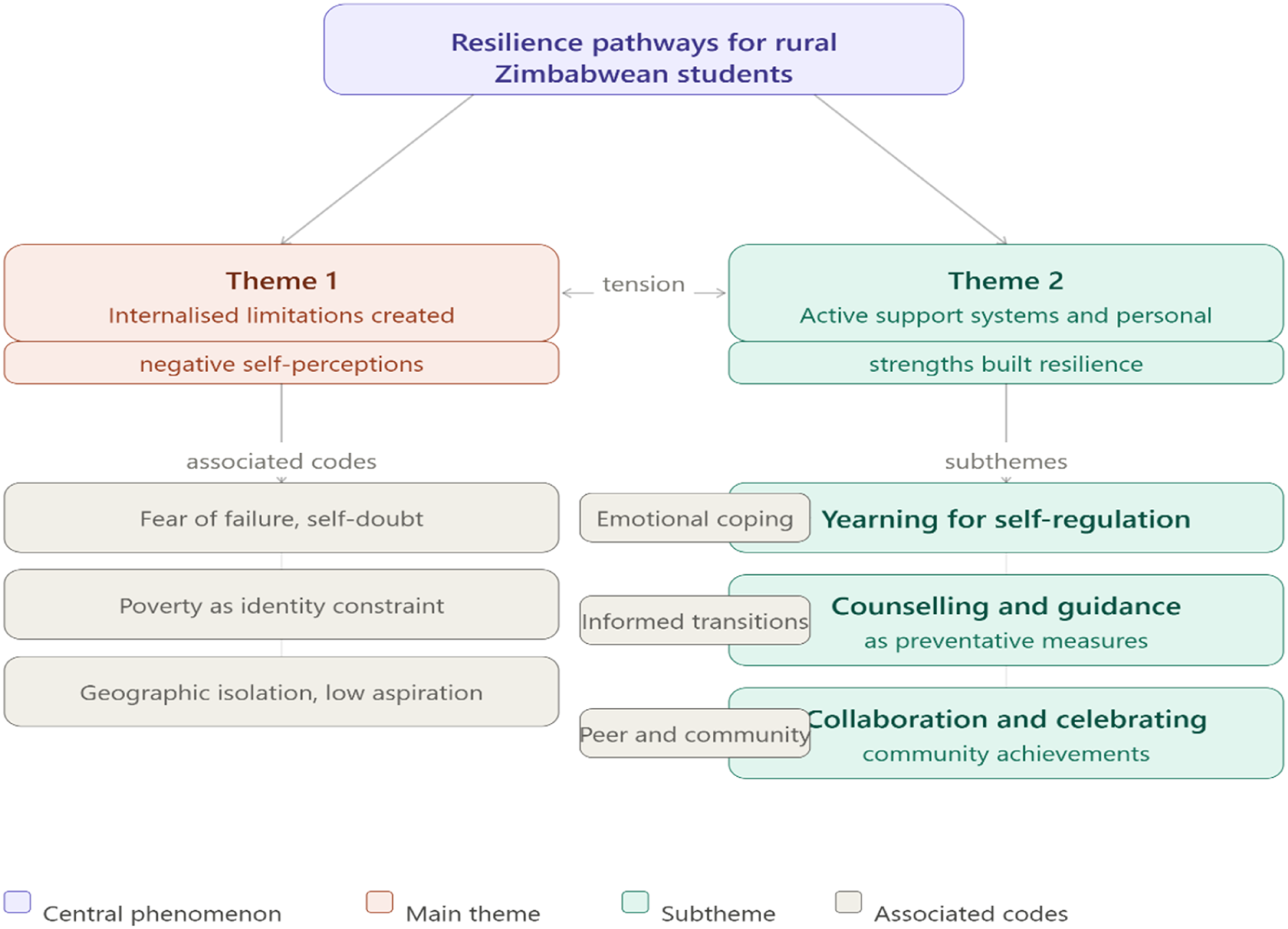
This study explored resilience pathways among rural Zimbabwean students in their transition to higher education, focussing on how cultural beliefs and socioeconomic hardships shape adaptive coping in line with the research question. The thematic map above is organised around five key relationships linking resilience pathways, themes, sub-themes, and code clusters. At the centre is resilience pathways among rural Zimbabwean students, branching into two themes: Internalised limitations and active support systems and personal strengths. A bidirectional arrow illustrates the ongoing tension between these themes, showing that limitations and supports coexist throughout students’ resilience journeys. Internalised limitations comprise three code clusters: fear of failure and self-doubt, poverty as an identity constraint, and geographic isolation and low aspiration. Active support systems and personal strengths includes three sub-themes: yearning for self-regulation, counselling and guidance, and collaboration and celebrating community achievements, each linked to its associated code cluster. The next subsection presents and discusses the key findings.
Internalised Limitations Created Negative Self-Perceptions
At the intrapersonal level of the adapted SERT, internalised limitations emerged as a major barrier shaping rural students’ perceived ability to transition into higher education. Many participants held deeply embedded beliefs that success is unattainable due to socioeconomic background and cultural upbringing, which in turn influenced their aspirations and educational decisions. These intergenerational narratives often reinforced expectations of failure. One participant stated, ‘Where I come from, people say that if your family has never succeeded, you will also fail. It’s in the blood’ (RSP3), illustrating how such beliefs weaken motivation and self-confidence and constrain agency in pursuing higher education. These findings highlight an important gap in conventional SERT applications, which typically underemphasise intrapersonal dimensions, despite their centrality in shaping access to higher education. At the macro-level, spiritual and traditional beliefs further reinforced these limitations. For example, one participant noted, ‘Sometimes I dream of being successful, but elders tell us that dreams are warnings, not encouragements’ (RSP7), while another stated, ‘If your elders did not go far in life, you should not expect to go further’ (RSP5). At the meso-level, such beliefs are transmitted through family and community interactions, shaping educational trajectories during the transition phase and limiting students’ ability to envision futures beyond their immediate contexts, thereby constraining access to higher education.
Additionally, societal conditioning at the intrapersonal level of the adapted SERT framework fosters passivity in shaping personal futures, particularly during the transition to higher education. One participant noted, ‘Even if I try, I feel like my life is already written for me’ (RSP2), reflecting reduced self-determination and weakened pursuit of higher education opportunities. Another added, ‘No matter how much effort I put in, people say I cannot change my fate’ (RSP11), showing how discouragement at the meso-level through family and community interactions reinforces this mind-set. At the macro-level, such fatalistic beliefs are embedded in broader cultural narratives, constraining aspirations, limiting motivation, and reducing students’ agency to access and succeed in higher education.
Active Support Systems and Personal Strengths-Built Resilience
Findings show that personal determination and self-belief are critical enabling factors in students’ transition to higher education. Strengthening resilience among rural learners requires supportive systems, positive role models, and community-driven initiatives that shape aspirations and readiness for higher education. Role models from similar backgrounds are particularly influential, with one student noting, ‘When I see an older student from my village who made it, I start to think maybe I can also do it’ (RSP2), showing how lived success challenges fatalistic beliefs and strengthens confidence. At the meso-level, relationships with teachers, peers, and mentors provide key support during transition. Encouragement from teachers helps reshape self-perception, as reflected in the statement, ‘My teacher always tells me that I am intelligent… now I try harder’ (RSP9). Such affirmation strengthens self-efficacy, motivation, and preparedness, enabling students to move beyond psychological constraints and pursue higher education opportunities.
Besides mentorship, peer exposure within the microsystem (Bronfenbrenner’s ecological model) emerged as a strong influence on students’ development. One participant noted, ‘Some of my friends now think differently after going to the city. They say life can change if we work hard’ (RSP14), showing how broadened perspectives foster ambition and higher education aspirations. At the macro-level, community support systems and collective cultural practices also strengthen resilience by providing resources that enable educational progression. Personal determination further reinforced these influences, as reflected in statements such as, ‘If I wait for someone to save me, I will stay in the same place forever. I must make a move myself’ (RSP8) and ‘My family’s struggles are not my destiny. I will work hard and make a difference’ (RSP3). These accounts highlight how self-motivation, combined with supportive ecological systems, helps students challenge intergenerational disadvantage and pursue higher education as a pathway to social mobility.
Mentorship and community encouragement are crucial in bridging the gap between aspiration and achievement. One participant noted, ‘Sometimes, all we need is someone to say, “I believe in you,” and it gives us the strength to keep going’ (RSP9). Alumni who share their experiences also provide tangible pathways, reinforcing the belief that success, including access to higher education, is attainable. Collective action further strengthens resilience, as illustrated by the statement, ‘When the community comes together to help students, we all benefit’ (RSP1), showing the value of shared responsibility in supporting transitions to tertiary education. Participants also highlighted inclusive school practices. One student explained, ‘Our teachers try to involve everyone in class discussions and encourage us not to feel left behind’ (RSP5), indicating how participation builds confidence and readiness for higher education. Generally, role models, teacher support, exposure to broader experiences, mentorship, and community action help students overcome internalised limitations and strengthen resilience. Although this transition is gradual and complex, resilience can be nurtured through aligning aspirations with resources, respecting student agency, providing guidance, fostering collaboration, and recognising community success, all of which support equitable access to higher education. (1) Yearning for Self-Regulation
Findings show that a key element in fostering resilience is aligning students’ aspirations with available support systems and resources, particularly in relation to academic pathways and higher education decisions. Many rural students reported feeling excluded from decisions about subject choices and career planning, which affected their motivation and readiness for higher education. One participant noted, ‘Although we can make our own decisions, parents, teachers, and influential individuals need to engage us on subject choices at school…’ (RSP6), highlighting the importance of mentorship and guidance that is both structured and responsive to student aspirations. When students feel heard, their confidence and resilience increase. Conversely, ignoring their interests can lead to disengagement, as reflected in the statement, ‘If our interests are considered… we might even decide to drop out of school’ (RSP2). These accounts highlight the need for participatory decision-making that supports student agency and strengthens transition pathways into higher education. At the meso-level, interactions between students, families, teachers, and community stakeholders shape agency during this transition. Participants further emphasised the need for recognition and inclusion, with one stating, ‘If they value us, they will support our participation in decision-making processes’ (RSP10), linking empowerment directly to resilience and higher education aspirations. Another suggested ‘… community forum where learners can voice concerns and ideas’ (RSP8), reinforcing the role of inclusive spaces in strengthening engagement, community resilience, and access to higher education opportunities. (2) Counselling and Guidance as Preventative Measures
Counselling and guidance were frequently identified as essential in helping students navigate challenges and make informed decisions about their academic trajectories and access to higher education. Participants noted that structured mentoring supports both emotional resilience and decision-making. One stated, ‘Of course, counselling and coaching enable us to accept the circumstances in which we live’ (RSP4), reflecting its role at the intrapersonal level in strengthening coping and self-understanding. However, gaps in provision were also highlighted, with one participant noting, ‘Guidance and counselling… is not used here’ (RSP2), pointing to missed opportunities in rural schools. Others linked counselling directly to educational planning: ‘If we had proper guidance, it would help us choose the right subjects and know what to do after school’ (RSP7), showing its influence on higher education pathways. Teachers were also seen as important sources of informal guidance, with one participant stating, ‘Teachers try to guide all of us about opportunities…’ (RSP6). At the macro-level, limited counselling provision reflects broader systemic inequalities that constrain equitable access to higher education. Strengthening counselling services in rural schools is therefore critical for enhancing resilience, improving informed decision-making, and supporting successful transitions into higher education. (3) Collaboration and Celebrating Community Achievements
At the meso- and macro-levels of the adapted SERT framework, collaboration, and the celebration of community achievements emerged as key factors of strengthening resilience and supporting rural students’ transition into higher education. Participants emphasised that resilience is built through collective effort within community systems. One noted, ‘In a rural community, a culture of collaboration and teamwork should be built’ (RSP6), reflecting resilience as a relational and shared process that shapes educational aspirations. Celebrating both small and large achievements was also seen as motivating students and reinforcing the possibility of accessing higher education. As one participant stated, ‘Success or failure should belong to the community, not just an individual’ (RSP1), highlighting the role of collective identity in shaping motivation. Another added, ‘When others succeed, and we celebrate them, it makes us want to go further, even to university’ (RSP8), showing how community recognition strengthens aspiration toward higher education pathways.
Furthermore, students highlighted inclusive practices such as equitable encouragement and shared access to opportunities at the meso-level through schools and community interactions. One participant noted, ‘In our school, everyone is encouraged to take part and aim higher, no matter where they come from’ (RSP3), suggesting that inclusive environments strengthen participation, confidence, and readiness for higher education. From a Bronfenbrenner perspective, these findings show how meso-level collaborative practices and macro-level cultural values interact to shape resilience as a socially embedded process influencing higher education trajectories. The findings point to the importance of student empowerment, participatory decision-making, and community collaboration in transforming limitations into resilience and strengthening equitable access to higher education.
Discussion
The findings suggest that internalised limitations significantly shape rural students’ self-perceptions, reinforcing intergenerational narratives of failure and constrained aspiration. Consistent with Mhongera and Lombard (2020), participants’ accounts reflect how inherited beliefs about family history and destiny can sustain cycles of self-doubt. Theron et al. (2022) similarly argue that culturally embedded belief systems may restrict educational ambition, a pattern strongly supported in this study. Student voices powerfully highlight this point; as one participant explained, ‘People in my community always say school is for those with money, not for us’ (RSP12). These dynamics align with Zimbabwe’s ESSP (2021–2025), which recognises that rural students face sociocultural and psychological barriers that undermine equitable participation (MOPSE, 2021; UNESCO, 2020). The study further extends existing literature by foregrounding the spiritual dimension of educational fatalism (Luecke, 2025), particularly how interpretations of dreams and ancestral destiny can be read as limiting rather than enabling. This highlights the intersection between indigenous cosmologies and educational aspiration, where beliefs may both support identity and, at times, constrain perceived agency. Within the HBC context, this tension emphasises the need for culturally responsive pedagogies that affirm indigenous knowledge while critically engaging belief systems that may unintentionally limit student agency. Such approaches can help students reinterpret cultural narratives in ways that strengthen aspiration, agency, and resilience.
Drawing on resilience theory, Van Breda and Theron (2018) argue that deterministic mind-sets are not fixed and can be reshaped through intentional, context-sensitive interventions. The coexistence of resignation and latent agency in students’ narratives reflects this potential for transformation. This transformative potential was evident in participants’ reflections; one student noted, ‘There are days I feel there is no point trying, but I keep going because without trying, nothing will change for me or my family’ (RSP10). These findings also align with national development priorities in Vision 2030 and the NDS1, which position education as central to human capital development, inclusion, and sustainable growth (MOPSE, 2021; UNESCO, 2020). Both frameworks emphasise psychosocial support, empowerment, and community participation as key drivers of progress (Marongedza et al., 2022; Masaiti et al., 2020). While the analysis confirms existing theories of cultural replica (Luecke, 2025), it adds empirical insight into how spiritual interpretations can intensify educational fatalism in rural contexts. The findings therefore highlight the need for culturally grounded resilience interventions (Mavhura, 2017; Mawila & Munongi, 2025) that address psychological, spiritual, and structural dimensions of limitation.
Furthermore, the study indicates that social support systems and community influences are central to fostering resilience among vulnerable rural students in Zimbabwe. Participants reported that exposure to successful peers from similar backgrounds and consistent teacher encouragement strengthened self-belief and academic effort, supporting Van Breda and Theron’s (2018) socio-ecological model of resilience. These findings align with Malindi and Koen (2021), who argue that relatable role models counter fatalistic assumptions about rural disadvantage by enhancing self-efficacy. In addition, students’ reflections suggest that limited spatial mobility, such as visits to urban centres, can broaden aspirations, extending previous research by highlighting experiential exposure as a catalyst for mind-set shifts (Hay, 2021; Malindi & Hay, 2023; Musiello et al., 2024). While supporting Mhongera and Lombard’s (2020) emphasis on community-based interventions, the findings also complicate earlier scepticism about rural students’ capacity for change without structural reform, revealing a dynamic interaction between agency and collective support. Students’ narratives reflect both personal determination and reliance on communal scaffolding, reinforcing resilience as a relational rather than purely individual process (Makhalemele et al., 2021). One participant captured this interdependence particularly well, stating ‘When life became difficult at home, my aunt reminded me why I started. Without her, I would have left school long ago’ (RSP6). These insights align with Zimbabwe’s ESSP (2021–2025), Vision 2030, and NDS1 priorities on inclusive education and human capital development (MOPSE, 2021; UNESCO, 2020). The study thus highlights peer influence, mentorship, and experiential exposure as important but often underexplored mechanisms supporting rural resilience.
The findings further indicate that fostering resilience among rural students requires deliberate alignment between student aspirations and available support systems. Participants emphasised the importance of guided decision-making, consistent with Chidakwa and Hlalele (2022), who argue that mentorship should bridge ambition and feasible pathways, and Ungar’s (2011) view that participatory processes strengthen self-efficacy. These insights align with Zimbabwe’s ESSP (2021–2025), which prioritises strengthened guidance and counselling services alongside increased student participation in academic and career planning (MOPSE, 2021; UNESCO, 2020). However, the study also reveals gaps between policy intent and school-level implementation, particularly the inconsistent availability of guidance and counselling in rural schools. Students reported ‘limited guidance and exclusion from decision-making’ and noted that they learnt about bursary opportunities ‘only by chance’ (RSP13). One participant noted that ‘students know what support is missing but are rarely consulted’ (RSP4). This disconnect mirrors Theron et al. (2022), who highlight weak institutional coordination as a barrier to resilience-building. Participants’ emphasis on collaboration extends Van Breda and Theron’s (2018) notion of social cohesion by foregrounding grassroots participation as a key resource for resilience, aligning with national frameworks on shared responsibility for learner wellbeing. The study advances resilience scholarship by showing that resilience emerges through the interaction of individual agency (Malindi, 2018, 2021), collective action (Makhalemele et al., 2021), and systemic support, reinforcing the need for integrated, context-responsive interventions in rural Zimbabwe. It also highlights community ownership as essential for sustaining long-term change, while centring rural students’ voices as critical to understanding both policy intentions and implementation gaps.
Implications
The findings have important implications for theory, policy, and practice, especially in how resilience is conceptualised, supported, and institutionalised in rural Zimbabwean education.
Theoretical Implications
This study extends SERT by highlighting underexplored dimensions, including intrapersonal and spiritual forms of educational fatalism and the role of indigenous cosmologies in shaping student agency. It reframes adaptive capacity as culturally mediated and socially embedded rather than individually determined, strengthening resilience scholarship in postcolonial contexts by integrating transformative learning theory with SERT. The findings further show that resilience emerges through the interaction of personal agency, community practices, and structural conditions. In refining Ungar’s (2011) model, the study positions spiritual beliefs, intergenerational narratives, and communal recognition as ecological influences across intrapersonal, mesosystemic, and macrostructural levels.
Policy Implications
At policy level, the study highlights a gap between Zimbabwe’s progressive frameworks – including ESSP (2021–2025), Vision 2030, and the Heritage-Based Curriculum – and their limited translation into rural school realities. A key concern is the absence or inconsistency of counselling and guidance services, despite their importance in policy and learner wellbeing. This suggests an implementation gap that undermines the practical value of otherwise well-formulated policies. Policymakers should prioritise adequately resourced, culturally responsive psychosocial support in rural schools, supported by trained personnel and accountability structures to ensure alignment with policy commitments. More broadly, the findings call for a shift in equity-oriented policy away from uniform views of rural disadvantage toward differentiated approaches that recognise intersecting constraints such as cultural marginalisation, geographic isolation, gendered roles, and economic hardship.
Practical Implications
For the schools, the findings highlight practical ways to strengthen learner support. Teacher development programmes should equip educators to recognise and respond to learners’ internalised constraints through strengths-based mentoring, guidance, and culturally responsive pastoral care. Rural schools could introduce structured resilience initiatives such as clubs, peer mentorship networks linking rural-origin university students with secondary learners, storytelling spaces, and family engagement programmes that build on existing community strengths. Inclusive classroom practices that involve students in discussion and decision-making can strengthen confidence and post-school readiness. To be effective, they should be embedded in formal school improvement frameworks to ensure consistency, sustainability, and accountability.
At other institutional level, the implementation and monitoring of school-based guidance and counselling services require significant strengthening through targeted training, adequate resourcing, and improved coordination among education authorities, schools, and community stakeholders. Without such deliberate systemic support, even well-intentioned policy commitments are unlikely to achieve meaningful or sustained impact on rural students’ transitions into higher education.
At the community level, collaboration with traditional leaders, faith-based organisations, and caregivers can help reshape narratives of failure and fatalism to strengthen agency and aspiration. Recognising and celebrating local educational successes, especially students progressing into higher education, can strengthen collective identity and broaden young people’s sense of possibility. In the same vein, strengthening kinship networks and local leadership structures can sustain relational support that helps rural learners imagine and pursue futures beyond their immediate environments. Such community-embedded strategies may be more durable than externally imposed interventions because they draw on existing social and cultural resources.
Limitations of the Study
While the study provides valuable insights into resilience among rural students, several limitations warrant consideration. First, reliance on self-reported data reflects participants’ personal perceptions and lived experiences, which may emphasise individual meanings and interpretations of resilience. Second, the study was conducted in selected rural schools within a specific region, limiting the transferability of findings to other rural contexts where cultural norms, resources, and institutional arrangements may differ. Third, consistent with qualitative inquiry, the study does not seek statistical generalisation but rather offers analytical insights into a specific case (Yin, 2018). Finally, the cross-sectional design captures experiences at a single point in time and does not account for shifts in policy or community dynamics.
Directions for Future Research
Future studies could deepen understanding of rural resilience by exploring how spiritual belief systems, such as dream interpretations and ancestral guidance, interact with formal schooling processes over time. Additionally, longitudinal designs would help clarify how internalised limitations evolve across key educational transitions, particularly from primary to secondary school. More so, comparative research across different rural provinces could also identify variations in cultural narratives and support structures, helping to establish which resilience mechanisms are locally specific and which are more broadly applicable. Above all, participatory and arts-based methodologies should continue to be advanced to ensure that students’ voices remain central, while further research could examine how community leaders, educators, and caregivers co-construct or challenge; fatalistic beliefs within everyday interactions. Finally, there is scope for investigating how policy frameworks, such as the ESSP (2021–2025) and the recently introduced HBC Philosophy, translate into tangible changes in student motivation and community engagement on the ground.
Positionality and Reflexivity
As researchers with personal and professional connections to rural Zimbabwe and South Africa, we occupied a dynamic insider–outsider position throughout the study. Our familiarity with rural schooling built trust, rapport, and culturally responsive data generation. At the same time, proximity risked interpreting experiences through our assumptions. We engaged in ongoing reflexive practice to examine how our positionality shaped data collection, interpretation, and representation. Our engagement was driven by scholarly and ethical commitments to challenge deficit views of rural youth and recognise them as knowledgeable social actors whose lived experiences constitute valuable knowledge.
Several strategies enhanced trustworthiness, including a reflexivity journal documenting assumptions, emotions, and interpretive decisions throughout data engagement. Initial coding was inductive to avoid constraining participant meanings, supported by peer debriefing and informal member checking to strengthen interpretive validity and alignment with participants’ lived realities. Awareness of shifting positionality, as insider and institutional authority, informed efforts to minimise hierarchy during data generation. Although these measures cannot eliminate researcher influence, they represent a transparent attempt to keep analysis grounded in participants’ accounts.
Conclusion
In conclusion, the findings highlight the dynamic interplay between individual agency and systemic influences in rural education, highlighting the limitations of traditional resilience frameworks. Rural students negotiate personal aspirations alongside collective community wisdom, developing adaptive strategies that are culturally and contextually grounded. Behaviours often viewed as limitations may instead reflect sophisticated responses to structural constraints. The study contributes theoretically by integrating transformative learning and resilience theories, positioning adaptive capacity as socially embedded rather than purely individual. It extends the resilience discourse by showing that effective interventions must recognise both personal agency and community support systems, while foregrounding rural students’ voices. Resilience-building efforts should strengthen rather than replace indigenous knowledge and local support mechanisms, fostering collaboration between schools and communities. Such approaches offer sustainable, context-relevant pathways for educational policy and practice in rural Zimbabwe.
Footnotes
Acknowledgement
We extend our gratitude to research assistants and the participants themselves who played a big role in assisting to gather data used in this study. Your cooperation in making this research possible is greatly appreciated.

Ethical Considerations
The study was ethically approved by the University of Johannesburg (SEM 2-2023-157) and Ulster University (Grant AH/T008075/1), with strict adherence to informed consent, confidentiality, and the protection of vulnerable participants.
Author contributions
The authors prepared the original manuscript preparation. The authors also read and approved the published on the final version of the article.
Funding
The authors disclosed receipt of the following financial support for the research, authorship, and/or publication of this article: The author declares that this study received financial support from Political Economy of Education Research Network (PEER) funding, which was allocated by the Arts and Humanities Research Council, Grant Reference AH/T008075/1.
Declaration of conflicting interests
The authors declared no potential conflicts of interest with respect to the research, authorship, and/or publication of this article.