







Abstract
Sociological research focuses on how poverty, family, and neighborhood dynamics shape children’s problems, but knowledge about how school is related to children’s mental health is underdeveloped, despite its central presence in children’s lives. Using a social structure and personality-stress contagion perspective, the authors use a nationally representative sample of first graders (N = 10,700) to assess how the classroom learning environment affects children’s emotional and behavior problems. Children in more negative environments—such as classrooms with fewer material resources and whose teachers receive less respect from colleagues—have more learning, externalizing, interpersonal, and internalizing problems. Moreover, children in classrooms with low academic standards, excessive administrative paperwork, rowdy behavior, and low skill level of peers have more problems across one or more outcomes. Some school effects vary across race and ethnicity.
Although sociologists examine neighborhood and family linkages to children’s behavioral and emotional problems, the school context potentially influencing mental health has been relatively ignored by researchers. Children spend nearly as much time in educational institutions as adults do in workplaces, which are the focus of a great deal of stress research (Tausig 1999). Classrooms can be taxing places for young children as they face new and often difficult demands. Surrounded by many others who may be distracting, and sometimes in schools with noxious environments, children must engage in work that has become increasingly rigorous in recent years (Alexander et al. 1988; Perry and Weinstein 1998; Rimm-Kaufman, Pianta, and Cox 2000). Moreover, schools are not only an important context for understanding children’s strains, they act as an early biographical context that may have lasting implications for behavioral and emotional health over the life course (Dufur, Parcel, and McKune 2008; Parcel and Dufur 2001; Wheaton 1999).
School systems are a key aspect of social stratification, described graphically by author Jonathan Kozol (1991) as constituting “savage inequalities.” There are two ways to understand how children’s socioeconomic status (SES) and race connect to school environments in influencing mental health. First, schools may be a mechanism by which children’s status is linked to problem behaviors. Children attending lower quality schools characterized by insufficient resources or low teacher morale—often lower SES or minority children (Alexander, Entwisle, and Thompson 1987)—may be more likely to act out, have trouble with peers, or feel anxious than children who enjoy better school conditions—typically higher SES and white children. Another important possibility to examine is whether lower quality learning environments create more difficulties for those already in disadvantaged positions. In other words, harsh classroom environments may exacerbate the mental health disadvantages that poor and minority children experience as a result of their socioeconomic or racial status.
In sum, this study is important for three reasons. First, just as work contexts are important for adults’ health, the school context is significant to understanding children’s emotional and behavioral problems. Second, because school quality is intimately linked with the SES and racial status of students, we assess how school environments may be implicated in the worse mental health of lower SES and minority children. Finally, examining young children may inform policy directed at preventing trajectories of problem behaviors. Using a nationally representative sample of first graders, we assess the following questions: How is the school environment linked to first graders’ emotional and behavioral health? Do negative features affect poor or minority children differently than they do middle-class or white children?
Theory And Evidence
The Sociology of Children’s Mental Health
The study of children’s mental health has largely focused on the role of poverty and family structure in contributing to both internalizing and externalizing problems (Aneshensel and Sucoff 1996; McLeod and Nonnemaker 2000; McLeod and Shanahan 1996). Poverty increases the likelihood that parents, especially mothers, are depressed, impose harsh discipline, and do not respond emotionally to children’s needs, thus making children act out or feel anxious and depressed. Poor and minority children are also more likely to live in disorganized, crime-ridden neighborhoods lacking in quality resources such as libraries and parks. In all, children are more prone to depression and acting out when they are surrounded by others who are poor or having troubles (Levanthal and Brooks-Gunn 2000; McLeod and Nonnemaker 2000).
Despite the significant role schools play in children’s lives, sociological work on the influence of school environments on children’s mental health is relatively scarce. And yet the entry into formal schooling represents a critical period for several reasons: It marks the government mandate to enter educational institutions; transitions into elementary school can be especially complex (Corsaro, Molinary, and Rosier 2002); and, importantly, the experiences of educational inequalities early in school have long-term effects on children’s achievement (Entwisle, Alexander, and Olson 1997, 2005). Children who have difficulties in the critical first grade year face much greater troubles in fourth grade, for example (Entwisle et al. 1997). Thus, understanding classroom features as potential strains is an important direction for researchers interested in children’s problem behaviors.
A Social Structural and Personality Approach: Classroom Environments and Stress Crossover to Children’s Emotional Well-Being
A social structural and personality approach articulates how particular proximal contexts within the social structure influence individuals’ psychological functioning (House 1981; McLeod and Lively 2003). It is a powerful perspective because it allows researchers to both specify features of the proximal context critical to a child’s experience and to articulate, through “natural links” to other theories (McLeod and Lively 2003:87) such as stress contagion or crossover from one individual to others (Wethington 2000), the process by which the context may be influential. Below, we discuss how features of the first grade classroom environment can cross over to children’s emotional experiences.
Classroom learning environments contain “abstract resources” encompassing the qualities of the physical space and the other people with whom children inhabit that space (Grubb 2009). Children’s classrooms are emotion-filled places characterized by “close and intense” interactions between teachers and students (Hargreaves 2000:819). Indeed, Alexander et al. (1987) eloquently argued that young children’s interactions with teachers are the main aspect of the school experience. This “supervisor” and the classroom dynamics she 1 builds are critical for children’s day-to-day stressors in the same way superiors create work environments for adults that are more or less stressful (Kelloway et al. 2005). If frustrated, overworked, or disrespected teachers offer little patience or kindness in their interactions with students, stress may transfer to students. For example, teachers who are not viewed as supportive to middle school students create more disruptive behavior among them (Ryan and Patrick 2001).
Through what process do features of the classroom learning environment create distress in individual children? Just as stress in the family context may be shared from one member to others (Milkie 2010; Wethington 2000), and problems at work with supervisors, low morale, and noxious or poor facilities create distress for adults ( Kelloway et al. 2005; Tausig 1999), so too can deleterious school conditions create distress for children through this crossover process. Teachers’ anxiety and frustration with their schools’ climate spills over to interactions with children in the same way that mothers under financial duress treat children harshly, creating distress in offspring. Stress contagion in this way occurs through “passive exposure” of a group to one individual’s stress (Wethington 2000:234). This is particularly likely for individuals who share a “linked fate,” such as members of a household or classroom (Wethington 2000:234). Below, we discuss six aspects of the classroom learning environment, including features of the classroom, teacher, and peer network, that link to children’s well-being through stress crossover.
First, material resources are an important feature of classroom environments in two ways. Dilapidated rooms and a dearth of materials may threaten a school’s ability to provide complex learning opportunities, constraining positive classroom interactions. Indeed, a school’s negative physical appearance is associated with lower learning motivation, stifled creativity, and more problem behaviors among children (Kumar, O’Malley, and Johnston 2008). Moreover, disrepair represents a symbolic devaluing of children who occupy those spaces. The physical state of classrooms and the resources available to students signifies the value placed on learning as well as how much the community values the children (Kozol 1991). Although the usefulness of educational resources or expenditures for student achievement is debated (Braddock and Eitle 2004; Hanushek 1997; Hochschild 2003), the effects on children’s mental health and problem behaviors may be substantial.
Second, the respect that a teacher perceives is an important component of the classroom environment. Elementary teachers’ jobs are notoriously challenging, requiring dedication, flexibility, and creativity in advancing diverse children academically as they face myriad daily demands. When teachers do not feel respected by their colleagues, this may fundamentally shape their work life, and thus that of students. Feeling disrespected or underappreciated is no doubt highly frustrating, likely coloring teachers’ interactions with their students, as well as affecting their willingness to motivate children and work toward overcoming disadvantages (Hoy and Woolfolk 1993).
Third, the increasing bureaucratization of schools can be an important component of children’s classroom experience. The No Child Left Behind Act (NCLB) has increased the amount of assessment and paperwork required in U.S. public school classrooms, overloading teachers (Kozol 2005; Linn, Baker, and Betebenner 2002; Sunderman et al. 2004). Being pulled away from their young students to tackle paperwork is likely difficult for teachers, as well as for their students.
Fourth, teachers’ feelings that schools’ academic standards are too low may affect their everyday interactions with children. Some teachers note that instructional techniques encouraging social development, such as collaborative writing and “buddy reading,” no longer suit school curricula (Barksdale-Ladd and Thomas 2000). This obstruction may make teachers and students miserable in the same way that boring or repetitive tasks alienate workers in factories and offices. With more challenging instruction, students, including those with difficult home lives, are more engaged (Yair 2000). Teachers’ lack of control over curriculum may create a climate with less stimulation and cognitive development, and with disengaged, frustrated students.
Finally, peer features of the classroom learning environment are important. Student discipline problems can impair the learning environment by introducing a stressful tone, diminishing teacher satisfaction (Liu and Meyer 2005), and upsetting fellow students, regardless of their involvement in the problem interactions. Moreover, the academic skill level of a classroom may be important in how it affects children’s interactions with one another. Classrooms with greater proportions of children with low skill levels may be wearisome because classroom time becomes dedicated to “catching up” academically. Teachers who feel pressure from administrators to advance student achievement despite significant obstacles tend to be more controlling and less able to foster “autonomy supportive” environments (Pelletier, Seguin-Levesque, and Legault 2002); this is associated with decreased motivation (Pelletier et al. 2002) and perhaps with mental health.
In sum, the classroom experience can be stressful for children, with some features impinging directly on behavior and emotion, and others working indirectly through stress “crossing over” from teachers’ experiences; some features may work in both ways. Although we discuss features of the classroom influencing individual children, we acknowledge other possible causal pathways. For example, not only may classroom environments affect children’s problems, but an individual child’s problem may create worse classroom environments, such as conflicts among staff members or peers who fight more. This may also be a mutually reinforcing, bidirectional process. We return to questions of causality in the discussion section.
Children’s Status, School Strains, and Mental Health
As argued above, a negative learning environment should be associated with more emotional and behavioral problems. Assessing the school environment in combination with children’s status can help untangle two ways in which children’s status may be linked with mental health. First, poor learning environments may be part of the mechanism by which poverty or minority status works to produce worse mental health. Poor or minority children are more likely to attend disadvantaged schools (Braddock and Eitle 2004; Crosnoe 2005; Hochschild 2003). Impoverished schools are often crumbling and marked by staff instability, whereas wealthier schools have better equipment, more stable infrastructure, and attract experienced administrators and teachers (Diamond, Randolph, and Spillane 2004; Grubb 2009; Hochschild 2003). In sum, children from disadvantaged backgrounds may have worse mental health because they experience harsher, more noxious conditions in school compared with children occupying more advantaged statuses.
A second possibility is that school strains may exacerbate effects for already disadvantaged groups. Regarding children’s academic achievement, school conditions rather than family background contribute to racial gaps in learning, whereas family background better explains SES gaps in achievement (Condron 2009). In terms of race, we expect that the learning environment may differentially affect children’s mental health, given that poor or minority children may experience “double jeopardy” through an exacerbation of stressors in school when combined with other disadvantages. Using ECLS-K data, Crosnoe (2005) found that Mexican immigrant children suffer a double disadvantage, whereby their internalizing problems on average are greater in schools with high minority representation, compared with white students. Downey, Broh, and von Hippel (2004), also using ECLS-K data, found that schools exacerbate black-white inequality in achievement. In terms of SES, Downey et al. found that school environments are helpful: Disadvantaged children attending disadvantaged schools make gains in test scores over the school year, reducing SES gaps in achievement. However, poor school conditions may be more relevant to mental health than to achievement (Crosnoe 2005). Thus, economically and racially disadvantaged students may experience more distress than more privileged students when faced with disadvantaged environments.
Summary
Considering the enormous amount of time young children spend in school, their lack of ability to opt out of noxious classroom environments, and the potentially long-term consequences of early negative contexts on mental health, research on school conditions and mental health is underdeveloped. A focus on classroom features that may link to children’s problems can expand our understanding of children’s mental health processes. We propose two hypotheses:
Hypothesis 1: Among first graders, negative features of classroom learning environments are associated with more emotional and behavioral problems.
Hypothesis 2: Negative features of classroom learning environments affect poor and minority children more negatively than they do middle-class and white children.
Methods
Sample
The data are from the ECLS-K, First Grade Data File, provided by the National Center for Education Statistics. The ECLS-K used a multistage probability design to sample of over 20,000 kindergarteners in approximately 1,200 public and private schools in 1999 (National Center for Education Statistics 2002). Administrators targeted approximately 24 kindergarteners within each public school or primary sampling unit’s cluster of schools and approximately 12 kindergarteners within each private school (National Center for Education Statistics 2002); our analyses indicate that approximately 4 children per classroom, on average, were surveyed.
The first grade interviews with parents and teachers were collected in spring 2000 during personal and telephone computer-assisted interviews. Evaluation during the second half of the school year provides a more accurate measure of the effects of classroom-related strains over the course of the school year. Because of attrition, the sample decreases from 19,967 in kindergarten to 16,373 by first grade, and we exclude 604 children with a special education teacher in kindergarten (a proxy for previous learning or behavioral difficulties) from the analysis. Weighted survey completion rates in first grade vary by the respondent, with 84.5 percent of parents and 78.0 percent of teachers reporting (National Center for Education Statistics 2002). Although individually these rates are as expected, limiting the sample to those with complete data reduced the effective sample size from 16,373 to between 10,699 and 10,821. Analyses of missing data show that the children remaining in the sample are disproportionately white, higher SES, and more likely to attend private school compared with children missing from the analyses. Given that the more disadvantaged children in potentially poor learning environments are disproportionately missing from the sample, we believe our estimates to be biased toward more conservative findings.
Dependent Variables
Teachers evaluated a child’s learning, externalizing, interpersonal, and internalizing problems using Gresham and Elliott’s (1990) Social Skills Rating System. For each of the dependent variables, higher scores indicate more problems, on a scale ranging from 1 (“never”) to 4 (“very often”). Learning problems measures difficulties with attentiveness, task persistence, and flexibility. Externalizing problems is the frequency with which the child argues, fights, disturbs ongoing activities, and acts impulsively. Interpersonal problems are indicated by difficulties in forming friendships, dealing with other children, expressing feelings, and showing sensitivity. Internalizing problems measures the presence of anxiety, loneliness, low self-esteem, and sadness in the child. Alpha values for the scales ranged from .75 to .92.
Explanatory Variables
Features of the classroom learning environment are measured by six variables. A lack of classroom resources (including textbooks, trade books, workbooks, Basal readers, manipulatives, audio and video equipment, videotapes, computer equipment, computer software, paper and pencils, a photocopier, art materials, musical instruments, music recordings, materials for students of limited English proficiency, materials for children with disabilities, heating and air conditioning, classroom space, and child-sized furniture) is a 19-item scale ranging from 0 to 3 where 0 = “always adequate” or “don’t use this resource,” 1 = “sometimes not adequate,” 2 = “often not adequate,” and 3 = “never adequate.” Lack of respect from colleagues refers to teachers’ perceptions of low respect and acceptance from colleagues on a 5-point scale ranging from 1 (“strongly disagree”) to 5 (“strongly agree”). Low standards at the school is teachers’ assessment of low academic standards at the school, with responses ranging from 1 (“strongly disagree”) to 5 (“strongly agree”). Interference from paperwork and interference from problem behavior are measured as agreement on a 5-point scale ranging from 1 (“strongly disagree”) to 5 (“strongly agree”) to the following statements: “Routine administrative duties and paperwork interfere with my job of teaching” and “The level of child misbehavior (for example, noise, horseplay, or fighting in the halls or cafeteria) in this school interferes with my teaching.” Below-grade-level reading refers to the number of classroom children below grade level in their reading skills.
Child Characteristics and Control Variables
Child’s social status characteristics
Child gender is a binary measure for boy (boy = 1, girl = 0). Child race is coded into five mutually exclusive dummy variables: (1) white, (2) black or African American, (3) Asian, (4) Hispanic or Latino, and (5) “other” races, which includes individuals of two or more races, American Indians, native Hawaiian, other Pacific Islander, or native Alaskan. SES is a composite variable, standardized on the basis of z scores, and includes mother’s and father’s education and occupation and the log of household income (National Center for Education Statistics 2002).
Control variables
Foreign-born parent indicates whether the child’s mother or father was born outside the United States (yes = 1, otherwise = 0). Family structure is measured as two biological or adoptive parents in the household (yes = 1, otherwise = 0). Maternal full-time employment is a binary variable indicating when the mother works for pay more than 35 hours per week (yes = 1, otherwise = 0). Hours of nonparental care is the number of hours per week that children receive care from nonparent others each week. Moves refers to the number of places the child has lived for four months or more since birth. Other controls include geographic region and urbanicity. Geographic location is coded as a series of four dummy variables for Midwest, West, Southeast, and Northeast. Northeast is the omitted category. Urbanicity is coded from 1 to 3, where 1 indicates small town and rural locations and 3 represents large and midsize cities.
Teacher and school control characteristics include teacher’s race, teacher’s education level, teacher’s years of experience, class size, and a binary measure indicating whether the school is private (yes = 1, otherwise = 0). We include teacher’s race because research suggests that racial identity affects student-teacher interactions (Alexander et al. 1987; Downey and Pribesh 2004). Teaching experience is important because less experience is associated with worse learning outcomes for students (Crosnoe 2005). Table 1 presents descriptive statistics for the variables in the analysis.
Weighted Sample Characteristics
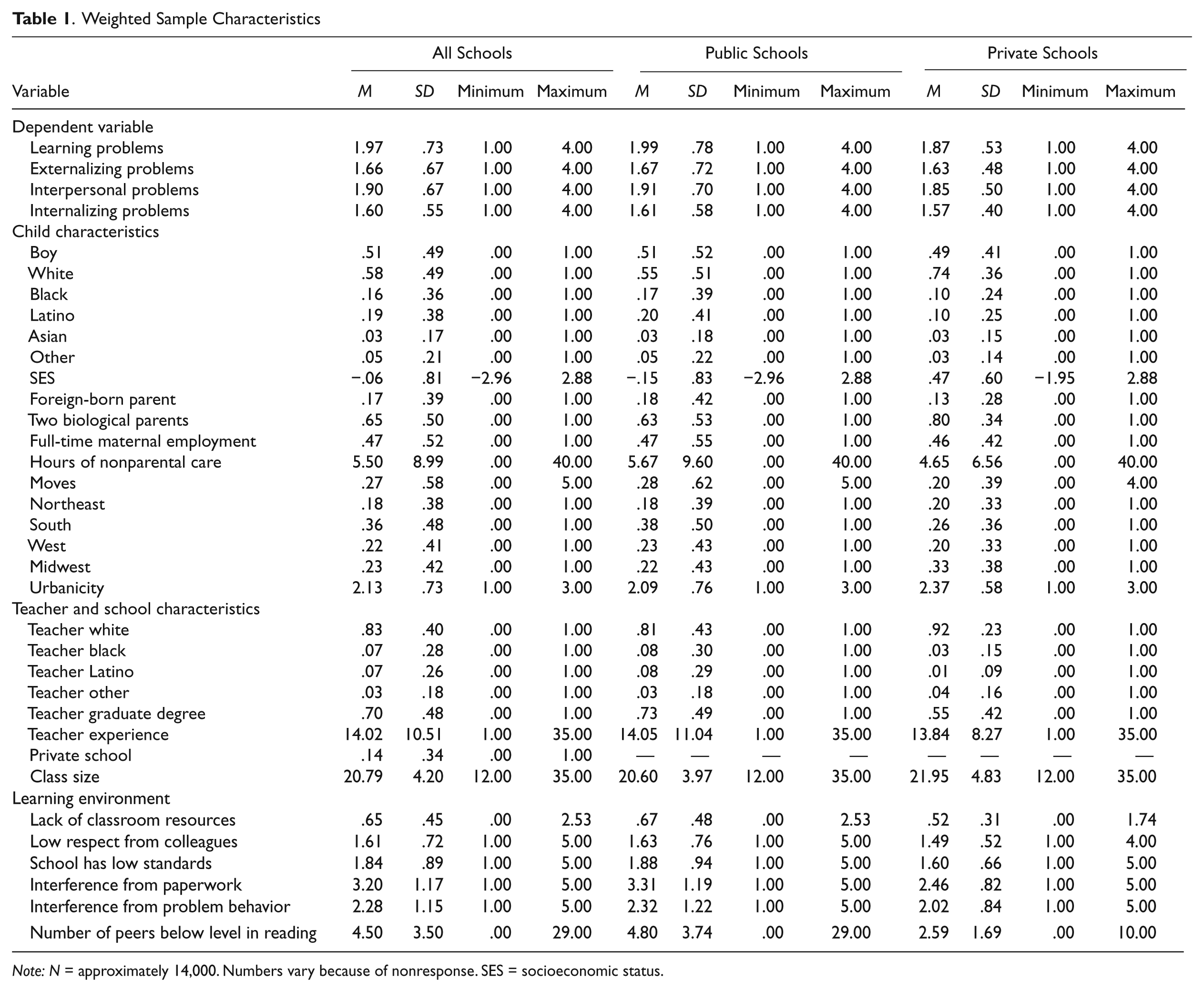
Note: N = approximately 14,000. Numbers vary because of nonresponse. SES = socioeconomic status.
Analytic Plan
Multilevel models for each of the four dependent variables are conducted in stepwise fashion as follows: model 1 introduces child and family characteristics and controls, model 2 includes teacher and school control characteristics and learning environment characteristics, and model 3 adds interaction effects. We tested interaction effects between each explanatory learning environment variable and race and each with SES. For SES and learning environment interactions, only those that are statistically significant are included in the interest of parsimony; for racial and ethnic group comparisons, because white is the omitted category, all other groups are included in the models even when only one group shows significant differences from whites. Moreover, because we are interested in the exacerbation of problems for disadvantaged minorities, we do not present or discuss some significant interaction effects between Asians and whites and “other” races and whites. These results are available upon request. Theoretically, Asians are not typically considered in the position of double disadvantage like Hispanics and blacks, and they generally exhibit fewer problems than white children. For children in the “other” racial category, it is difficult to interpret differences meaningfully, given the diverse cultures represented by this label.
For multivariate analyses, standard errors are adjusted to account for the clustering of children within particular schools and the multistage sampling design. Fitting a simple ordinary least squares regression model results in inaccurate standard errors and increased likelihood of incorrectly rejecting the null hypothesis. As a result, we fit a multilevel model using the PROC MIXED function in SAS, which performs similarly to hierarchical linear modeling software (Singer 1998). In a two-level model, children (level 1) are nested in classrooms (level 2). We find similar coefficients using the sampling stratum variable and the cluster identification variable provided with the data set, which uses the Taylor expansion method to limit the underestimation of standard errors. Variables in the model are grand mean centered, because this can decrease the influence of outliers and multicollinearity in the model (Bickel 2007; Kreft, de Leeuw, and Aiken 1995).
Results
Learning Problems
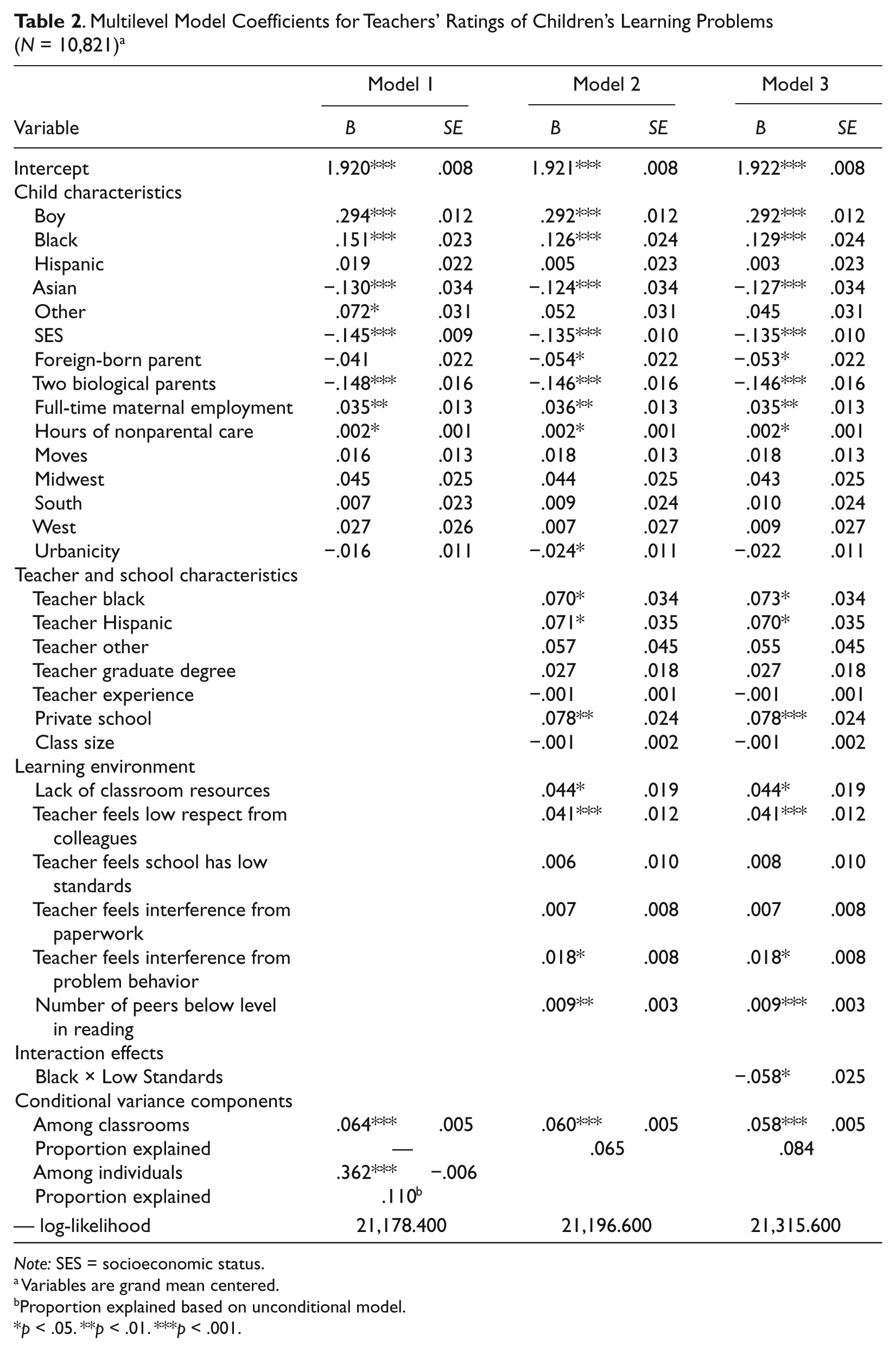
Table 2 shows coefficients from multilevel models for children’s learning problems. Model 1 introduces child and family characteristics and shows that boys have more problems than girls. Black children have more problems, and Asians fewer, compared with white children. SES is negatively and significantly associated with learning problems; for each unit increase in SES, learning problems decrease by .15 points. Model 2 shows that children with black or Hispanic teachers have more learning problems compared with those with white teachers.
Multilevel Model Coefficients for Teachers’ Ratings of Children’s Learning Problems (N = 10,821) a
Note: SES = socioeconomic status.
Variables are grand mean centered.
Proportion explained based on unconditional model.
p < .05. **p < .01. ***p < .001.
The learning environment also affects children’s learning problems. A dearth of materials is associated with children’s learning problems, with a one-unit change in classroom resources (i.e., greater dearth on the scale of adequate books, paper, or other materials) equal to a .04 increase in a child’s learning problems. A lack of respect among teachers and more interference to teaching from problem behavior in the school are also associated with more learning difficulties for first graders. Children in classrooms with more students below grade level in reading have more learning problems. The introduction of the classroom features does not significantly alter the coefficients for child’s race or SES.
The introduction of interaction terms in model 3 shows that classroom conditions have similar relationships with learning problems regardless of the child’s SES. There is a race-by-standards interaction effect, with lower academic standards associated with more learning problems for white students compared with black students; however, the size of the effect is relatively small.
The baseline intraclass correlation coefficient (ICC) for learning problems is .15, meaning that 15 percent of the total variance in learning problems is explained by between-classroom differences and 85 percent by student-level differences. Compared with the unconditional model, the introduction of child characteristics explains approximately 11 percent of explainable between-student variance in children’s learning problems. Classroom characteristics (in models 2 and 3) account for 8 percent of the explainable variance among teachers’ classrooms.
Externalizing Problems
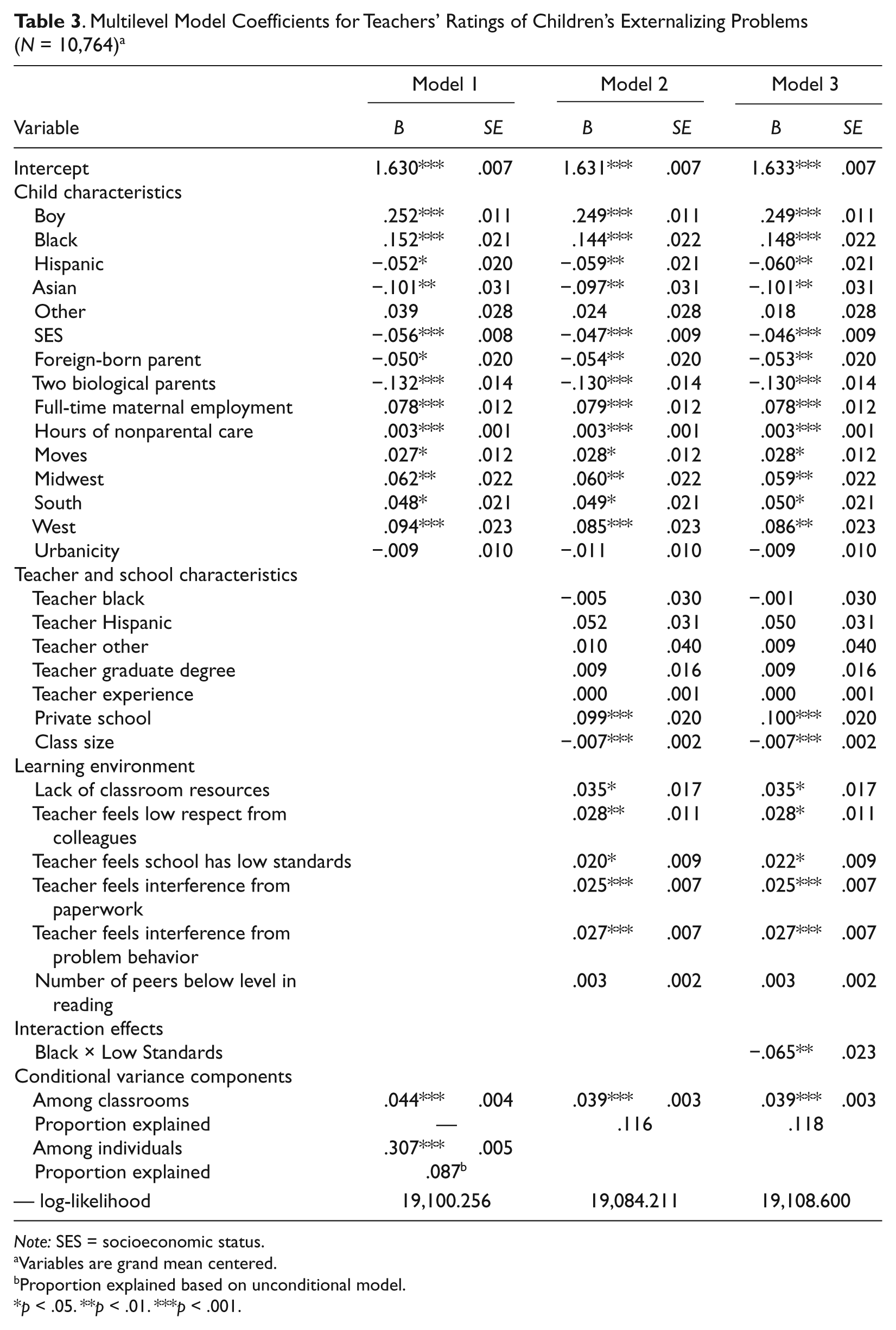
Table 3 shows mixed models for children’s externalizing problems. Boys, black children, and lower SES children have more externalizing problems than do girls, white children, and higher SES children. Latino and Asian children exhibit fewer externalizing problems compared with white children. Again, the introduction of school context variables in model 2 changes these individual social status coefficients very little. Among the learning environment variables, the lack of material resources is associated with more externalizing problems. A lack of respect and low academic standards are also associated with more externalizing problems. A child in a classroom with high levels of interference to the teacher from paperwork and problem behavior in the school has more externalizing problems.
Multilevel Model Coefficients for Teachers’ Ratings of Children’s Externalizing Problems (N = 10,764) a
Note: SES = socioeconomic status.
Variables are grand mean centered.
Proportion explained based on unconditional model.
p < .05. **p < .01. ***p < .001.
Model 3 introduces interaction effects. Black students in schools with low academic standards have fewer externalizing problems, on average, compared with white students in schools with low academic standards. Separate group analyses (not shown) suggest that low academic standards are positively and significantly associated with white students’ externalizing problems, while for black students, low standards are not significantly associated with externalizing problems. Again, there are no statistically significant interactions between SES and the learning environment.
The baseline ICC for externalizing problems is .13, which indicates that 13 percent of the variance in externalizing problems is explained by differences among classrooms. Compared with the unconditional model, student-level characteristics in model 1 account for approximately 9 percent of explainable student-level variance. Classroom characteristics and interaction effects account for 12 percent of the explainable variance among classrooms.
Interpersonal Problems
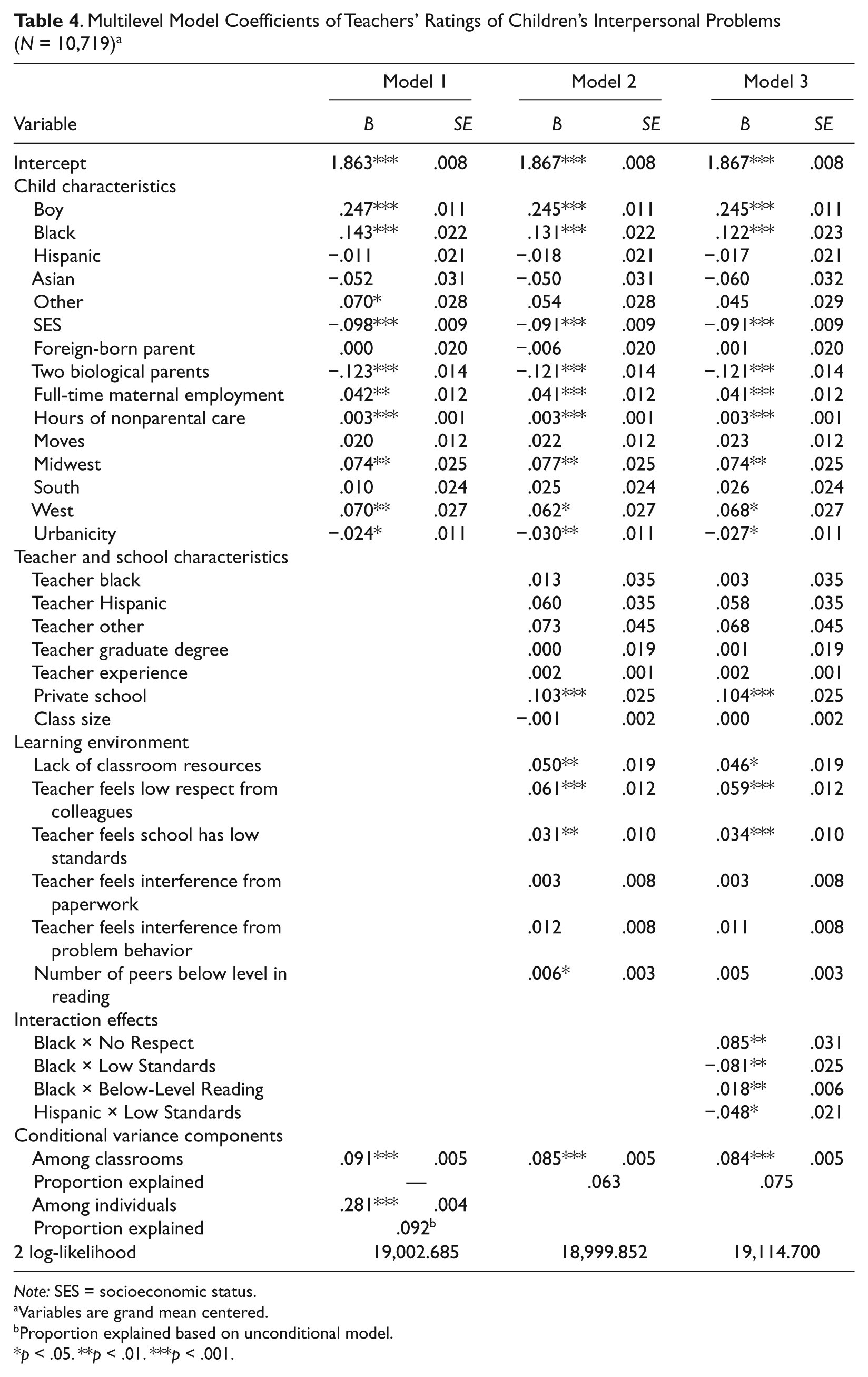
Table 4 presents mixed model coefficients for children’s interpersonal problems. Model 1 shows that boys, black children, and children of “other” races have more interpersonal problems compared with girls and to white children. Additionally, children in higher SES households have fewer interpersonal problems.
Multilevel Model Coefficients of Teachers’ Ratings of Children’s Interpersonal Problems (N = 10,719) a
Note: SES = socioeconomic status.
Variables are grand mean centered.
Proportion explained based on unconditional model.
p < .05. **p < .01. ***p < .001.
In model 2, the introduction of learning environment characteristics results in only slight reductions in the coefficients for child’s race and SES. Fewer material resources are significantly associated with more interpersonal problems. Teachers’ perceptions of a lack of respect and of low academic standards at the school are related to more interpersonal problems for children. For each one-unit decrease in felt respect from colleagues, there is a .06 increase in interpersonal problems. More children below grade level in reading in the classroom result in more problems.
The introduction of interaction effects in model 3 shows different effects of the learning environment across race and ethnicity but not social class. Black children appear particularly responsive to a larger number of below-grade-level students in the class and to teachers’ perceiving a lack of respect from colleagues, resulting in worse interpersonal problems compared with white children in similar circumstances, as illustrated in Figures 1 and 2. A higher number of peers below grade level in reading is positively and significantly associated with interpersonal problems for black children, but this has no significant effects on white children (Figure 1). Similarly, a lack of respect is positively and significantly associated with interpersonal problems for both groups, but the coefficient is twice as large for black children (Figure 2). The reverse is true for disadvantaged minority children compared with whites in classrooms with teachers who perceive that the school has low standards: Blacks and Hispanics have fewer interpersonal problems compared with white children in similar classrooms.
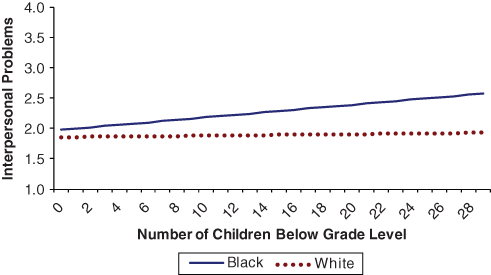
Predicted Effect of Number of Children Below Grade Level in the Classroom on Interpersonal Problems, by Race
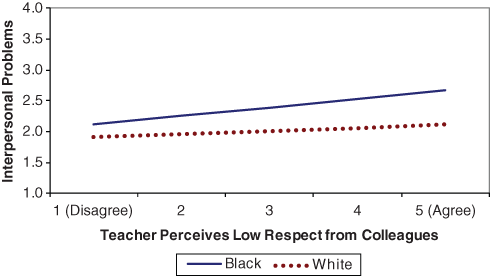
Predicted Effect of Low Respect from Colleagues on Interpersonal Problems, by Race
The ICC for interpersonal problems is .24. Compared with the unconditional model, student-level characteristics account for approximately 9 percent of the explainable student-level variance. Classroom characteristics account for 8 percent of the explainable variance among classrooms.
Internalizing Problems
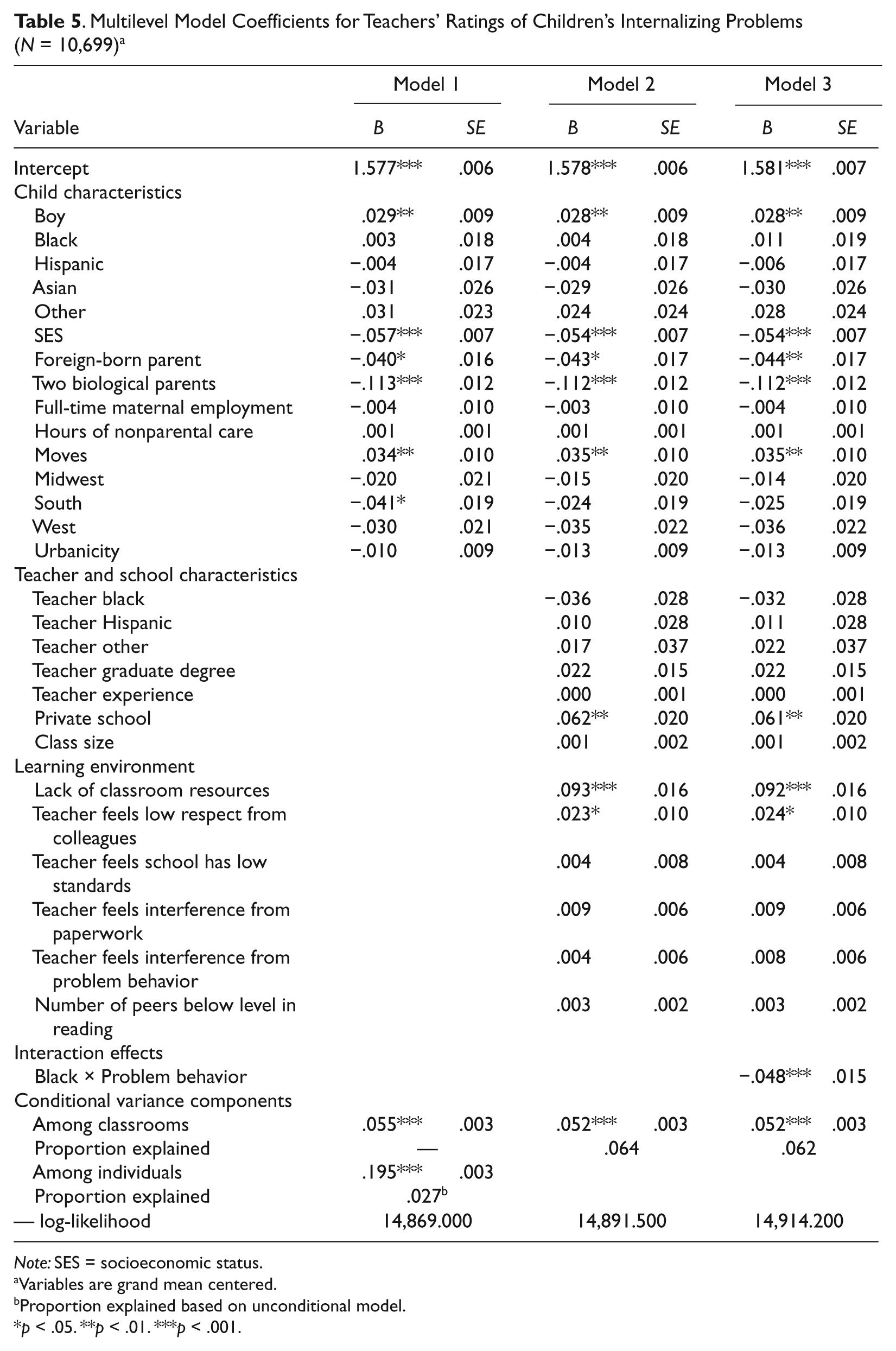
Table 5 shows results from mixed models for children’s internalizing behaviors. Boys and low-SES children have more internalizing problems, but there are no race differences (see model 1). In model 2, children in classrooms that lack material resources have more internalizing problems; additionally, the size of the effect of a dearth of material resources is twice as large for children’s internalizing problems as the other three measures of children’s mental health. Children in learning environments characterized by greater staff respect also experience fewer problems.
Multilevel Model Coefficients for Teachers’ Ratings of Children’s Internalizing Problems (N = 10,699) a
Note: SES = socioeconomic status.
Variables are grand mean centered.
Proportion explained based on unconditional model.
p < .05. **p < .01. ***p < .001.
Model 3 introduces interaction terms across social status and classroom characteristics, with no significant differences by SES. Interference from problem behavior has differential associations with mental health across race and ethnicity for internalizing behaviors. Black children in schools with problem behavior interference show fewer internalizing problems compared with white students in similar classrooms. Separate group analyses (not shown) indicate that problem behaviors are positively and significantly associated with internalizing problems for white children but not significantly associated with internalizing problems for black children.
The ICC is .23, indicating that approximately 23 percent of the variance in internalizing problems is among classrooms. Student-level characteristics account for approximately 3 percent of explainable student-level variance, compared with the unconditional model. Classroom effects account for approximately 6 percent of explainable variance among classrooms. Across all four outcomes, the ICC ranges from .13 to .24, indicating the amount of variation occurring between classrooms rather than within them. This suggests that there is a significant level of cross-classroom variation in children’s mental health ratings and that classroom features have an important bearing on mental health outcomes, especially for interpersonal and internalizing problems.
Discussion
Children spend a substantial amount of time in school, a key social institution in their lives analogous to the workplace in adults’ lives and one from which they cannot opt out. Although links between workplace strains and adults’ mental health have received a great deal of attention from sociologists, the stressors that children face in school have been relatively neglected in sociological research. In this article, we find that for several components of the learning environment, worse conditions are associated with more emotional and behavioral problems in children. Moreover, the ways these conditions affect black versus white children is complex.
Our study identifies the ways in which classroom learning environments matter for children’s problems. A central finding is that a lack of material resources in the classroom is strongly connected to a child’s mental health. Being in a classroom with key ingredients central to young children’s schooling—ranging from basic resources such as paper and pencils and heat to child-friendly furnishings and computers—is associated with all four measures of emotional well-being. This may occur because teachers become more harsh or frustrated when they cannot teach properly because of a lack of resources. It may also be, as Kozol (2005) argued, that dilapidated surroundings and insufficient materials symbolically devalue children in those spaces:
The insult to aesthetics, the affront to cleanliness and harmony and sweetness, are continuing realities … for children who must go each morning into morbid-looking buildings. … Do kids who go to schools like these enjoy the days they spend in them? You do not find the answers to these questions in reports about achievement levels, scientific methods of accountability, or structural revisions in the modes of governance. (p. 163)
The finding that children experiencing disadvantaged classroom environments also experience poorer mental health underscores Kozol’s (2005) argument that we must acknowledge children’s voices about poor facilities and learning materials.
A learning environment that reduces a teacher’s ability to provide enriching experiences is associated with children’s problems. Specifically, having a teacher who does not feel respected by her colleagues is connected to all four measures of children’s mental health. Low morale may spill over in the form of a dejected teacher who becomes less invested in or unable to create a positive environment for children. For instance, teachers who lack supportive relationships may not have the freedom to seek advice from colleagues, becoming less invested in classroom activities (Dornbusch, Glasgow, and Lin 1996). Grubb (2009) emphasized that these complex and abstract resources, built into the relationships among staff, are central to creating engaging environments for children and thus are critical for children’s outcomes.
Additional aspects of the learning environment relate to at least one type of problem examined in this study. Teaching interference due to excessive administrative paperwork is connected to externalizing problems. Perhaps children know they can misbehave if the teacher is not available, whether she is attending administrative meetings and replaced by a substitute or whether she is absent authoritatively even while present physically as she takes care of administrative tasks required for the school. The increased attention to test scores and monitoring as a result of NCLB may place heavy administrative demands on teachers. In response to questions about NCLB, teachers cite inadequate resources to accomplish goals, negative effects on teacher morale, and attention diverted from more important issues (Sunderman et al. 2004), which takes the joy from the learning environment.
Children in classrooms where teachers report that problem behavior in the school interferes with their teaching also have more externalizing problems, net of their own characteristics and other school factors. Problem behavior is a major source of teacher dissatisfaction, turnover, and lowered expectations (Liu and Meyer 2005). Moreover, discipline problems in the school likely take teachers away from teaching to deal with disciplinary action, and they could lead to teacher exhaustion, making it more difficult to regulate children’s behavior within the classroom.
Similarly, teachers who feel that the school’s learning standards are too low may be less able to maintain positive engagement with students (Barksdale-Ladd and Thomas 2000; Yair 2000), and they may believe they lack the ability to improve children’s lives (Hoy and Woolfolk 1993). Low academic standards and classrooms with many underperforming children may reduce creative and complex interactions that engage children, much like substantively complex work engages and enlivens adult workers. Children in classrooms where teachers report low standards exhibit more externalizing and interpersonal problems. Too many children performing below grade level academically is related to an individual child’s learning problems. It may be that these children require extra attention that is not easy to provide and thus take teacher time and energy away from more social- or emotion-oriented skill development. Teachers with high numbers of below-grade-level children may not adequately challenge all students, thus losing students’ attention and concentration (Yair 2000).
This study has limitations linked to sorting out how aspects of negative learning environments are associated with children’s well-being. First, the rating of the child is from the teacher’s (vs. parent’s, mental health professional’s, or child’s) perspective and is multilayered. Teachers’ assessments consist of some objective aspects of the child’s actions and feelings. But these assessments contain subjective comparative referents, that is, the child is assessed within his or her peer contexts, or against ideals that may vary on the basis of teachers’ characteristics (Alexander et al. 1987). It is worth noting that consistently across the four dependent variables, children in private schools are rated higher on problems, net of other characteristics, compared with those in public schools. This finding is intriguing. Although it is beyond the scope of this article, it is possible that children in private schools are considered “select” and thus there are higher standards for “proper” emotions and behavior, making children less able to meet that bar. Even though we are not able to tease apart the extent to which classroom experiences affect a child’s “actual” negative behavioral or emotional health versus a teacher’s perception of a child as problematic, both are likely to be relevant for the child’s current and future school experiences. Teachers’ ratings of children are critically important for their reputation in the school and among future teachers, as well as to parents and medical professionals.
In terms of causality, caution is in order. Although we posit that a child’s classroom and school context affect his or her mental health, it is possible that a child’s problems influence a teacher to state that a classroom has inadequate material resources, that more children are below grade level in reading, or that excessive administrative paperwork interferes with teaching. Longitudinal analyses (not shown) using a lagged dependent variable with a control for the child’s kindergarten rating of mental health did not show a significant effect of the kindergarten rating on the first grade rating, nor did including kindergarten ratings significantly alter the results of the models presented here. Because the classroom environment and teacher change with each year, it is difficult to separate long-term effects of the first-grade year from variation in classroom environments and teachers occurring across time as the child progresses through elementary school. Future research could explore how children’s mental health changes over the course of elementary school in relation to changes in the learning environment.
How do children’s SES and racial status matter in relation to negative learning environments and mental health? Although poor and minority students experience worse classroom conditions, on average, compared with their wealthier, white counterparts, school conditions do little to explain the worse mental health of low-SES children. This is consistent with research suggesting that most socioeconomic differences in children’s school academic outcomes are a result of family background rather than school context (Condron 2009). We examined interaction effects to test our second hypothesis, that lower SES and disadvantaged minorities (blacks and Hispanics) would experience exacerbated disadvantages within more negative environments. This hypothesis did not receive a great deal of support. Lower SES children do not experience exacerbated disadvantage under any of the negative learning climate conditions, compared with higher SES children. For blacks, however, two aspects of the learning environment more strongly relate to interpersonal problems than they do for whites: a teacher’s feeling a lack of respect from colleagues and having more peers with low skill levels in their classroom. This finding to some degree parallels Condron’s (2009) work on academic achievement, also using ECLS-K data, that showed that the school environment partially explains the black-white gap in test scores. And yet our study also showed that low academic standards are linked to worse learning and interpersonal problems and that interference to teaching from problem behavior in the school is linked to worse internalizing problems for white children compared with black children. The complexities of the racial differences found here deserve future research attention; specifically, qualitative work is in order to assess how and why certain aspects of the learning environment may be especially disadvantageous to different racial groups.
In all, many aspects of the learning environment are connected to first graders’ mental health, independent of children’s own status. In particular, two conditions seem especially important: (1) a lack of material resources and (2) a teacher feeling lack of respect from colleagues. These two features affect multiple facets of children’s emotions and behaviors, whereas other aspects of the classroom may be less powerful in their reach into children’s well-being. Policies at the federal, state, and local levels can alleviate resource-poor classrooms by providing adequate goods and supplies that allow teachers to create a positive learning environment and that allow children to thrive without duress. School systems can also invest in training and retaining high-quality staff members so that teachers can work collaboratively with talented others. With adequate resources and revered teachers, classrooms can foster children’s emotional health. For scholars who care about children’s mental health, this study makes clear that, in assessing a child’s experiences, examining the classroom context is important. Schooling is linked to children’s emotional and behavioral health in multilayered ways, and assessing the influences of educational institutions on children’s mental health is worth a great deal of further consideration.
Footnotes
Acknowledgements
We thank Jane McLeod and Blair Wheaton for comments.
The authors disclosed receipt of the following financial support for the research and/or authorship of this article: This work was supported by National Institutes of Health grant HD051689-01 A2.
1.
We refer to teachers with feminine pronouns because the vast majority of teachers surveyed were women. In the first grade Early Childhood Longitudinal Study, Kindergarten Class of 1998–1999 (ECLS-K) data, teacher gender is a suppressed variable because of the lack of variation. In kindergarten, 98 percent of teachers were women.