






Abstract
Despite the importance of employment for shaping mental health over the life course, little is known about how the mental health benefits of employment change as individuals age through their prime employment and child-rearing years. This study examines the National Longitudinal Survey of Youth, 1979 Cohort (N = 8,931), following respondents from their late 20s to mid-50s. Results suggest that among women, the aging of children is especially salient for shaping the mental health consequences of employment. Young children diminish the protective effect of mothers’ full- and part-time employment, but the salubrious effects of paid work increase as children get older. The benefit of employment for men’s mental health also changes over time, but it is the aging of men themselves rather than their children that alters the magnitude of full-time employment’s protective effect. Findings suggest the contribution of employment to life course mental health remains tethered to traditional gender roles.
Employment is a key social role that promotes mental health, reducing depression for men and women (Aneshensel, Frerichs, and Clark 1981; Dooley, Prause, and Ham-Rowbottom 2000; Moen, Dempster-McClain, and Williams 1992; Pavalko and Smith 1999). Mental health improves up to midlife, in part because of the increased prevalence of employment, especially among men (Clarke et al. 2011; Mirowsky 1996; Mirowsky and Ross 1992). Yet we know relatively little about how the effects of employment on mental health change as men and women age. This study examines how the effects of employment on depression change along two temporal dimensions of the life course: the aging of individuals and the aging of their children.
Paid work may become increasingly beneficial to mental health as people age toward midlife. The demands–resource model posits that employee well-being improves when job resources exceed job demands (Arnold and Evangelia 2007; Schieman, Milkie, and Glavin 2009). Job resources, such as earnings and workplace autonomy, improve during the first half of adulthood, while unfavorable work conditions and job insecurity decline (Kalleberg and Loscocco 1983; Schieman et al. 2009). Thus, the salubrious effects of employment likely increase with age.
For parents, the accrual of mental health rewards from employment may be complicated by the demands of child-rearing. The role strain perspective posits that too many role demands reduce well-being (Goode 1960; Marks 1977). Young children are especially demanding of time and energy, and may limit parents’ health benefits from employment. But as children grow older, their care becomes less time intensive and more flexible, increasing the compatibility of paid work and child-rearing. As a result, the mental health benefits of employment may increase through two processes: increased job rewards as individuals age and decreased child-rearing demands as children get older.
Gender may determine whether the aging of individuals or their children is most salient for shaping the mental health consequences of employment. With age, men accrue greater labor market experience and extrinsic job rewards than women (Padavic and Reskin 2002). In contrast, child-rearing is especially tied to role strain for women. Young children reduce women’s feelings of role balance (Milkie and Peltola 1999), and the interference of work into family time is more detrimental to women’s mental health than men’s (Glavin, Schieman, and Reid 2011). Thus, the aging of children seems especially important for shaping the health effects of women’s employment.
This study follows the National Longitudinal Survey of Youth, 1979 Cohort (NLSY79), from their late 20s to early 50s, examining how individuals’ age and the presence and age of children shape the association between employment and depression. Research on mental health and the timing of work and family roles has tended to focus on role transitions, exploring the timing of first birth (Bulanda and Lippmann 2012; Kalil and Kunz 2002; Mirowsky and Ross 2002), employment entrances (Clarke and Wheaton 2005), and employment exits near retirement (Falba, Sindelar, and Gallo 2009). Few, if any, studies focus on age variation in the consequences of employment during middle adulthood, when the majority of initial transitions into work and parenting roles have already occurred but when the rewards and demands of these roles continue to evolve. Doing so reveals that age and stage of child-rearing shape the mental health consequences of employment in gender-specific ways and highlights the extent to which the determinants of mental health over the life course remain gendered.
Background
Employment and Mental Health over the Life Course
Mental health tends to be best during middle adulthood, a trend to which employment and marriage contribute. During early adulthood, transitions into employment and marriage reduce depression. In the early 60s and beyond, depression rises as retirement, divorce, and widowhood become more common and as health and financial concerns increase (Clarke et al. 2011; Clarke and Wheaton 2005; Mirowsky and Ross 1992; Schieman, Gundy, and Taylor 2001; Yang 2007). Though better health selects people into employment (Dooley et al. 2000; Ross and Mirowsky 1995), research accounting for selection processes indicates employment has a causal effect in promoting physical and mental well-being (Hibbard and Pope 1991; Pavalko and Smith 1999; Ross and Mirowsky 1995).
Gendered employment pathways also shape mental health. Child-rearing reduces women’s paid labor (Damaske and Frech 2016) and increases men’s (Lundberg and Rose 2002), widening the gender gap in depression during early and middle adulthood. Using data from the late 1980s, Mirowsky (1996) found that women’s lower likelihood of full-time employment during middle adulthood explains 19% of this widening and that women’s greater difficulty in arranging childcare and likelihood of being a homemaker explain an additional 15% (Mirowsky 1996). Yet despite rising women’s employment during the twentieth century, the widening of the gender gap in mental health as men and women age has increased for recent cohorts (Yang and Lee 2009).
Identifying when and for whom employment provides the greatest protection against depression is important for understanding employment’s contribution to mental health. Past research controlled for gender differences in employment rates by age but did not examine if employment’s effect changes as people get older (Clarke et al. 2011; Mirowsky 1996). In his seminal work, Mirowsky (1996) noted that half of the growth in the gender gap in depression with age was unexplained and that the gender disparity was surprising given preceding decades’ rise in women’s employment. Yet employment rates capture only one dimension of how the gendered life course affects paid labor. Below, I describe why and how the salubrious effect of employment for mental health is expected to vary by the ages of individuals and their children as they age to midlife and why these processes may vary by gender.
Employment and Individuals’ Own Age
Changes in job conditions and rewards suggest the mental health benefits of having a job increase as individuals age through early and middle adulthood. Both extrinsic and intrinsic rewards from employment increase as people get older, promoting job satisfaction (Kalleberg and Loscocco 1983). With age, employment also becomes more central as a source of social interaction (McDonald and Mair 2010). Other aspects of employment linked to good health also improve with age, such as job status and occupational mobility (Liljegren and Ekberg 2008; Zimmerman, Christakis, and Vander Stoep 2004). The first hypothesis addresses the expected age variation in the mental health benefits of employment.
Some job rewards increase for men more than women, suggesting a gender disparity in the accrual of mental health rewards from employment. Women accumulate fewer years of labor market experience over the life course and receive a lesser wage boost for each additional year of employment (Munasinghe, Reif, and Henriques 2008), suggesting that age is less closely tied to job resources for women. Additionally, the rewards of occupational advancement may be more beneficial for men. For example, the demands–resource model posits that job control facilitates well-being (Arnold and Evangelia 2007). Though workplace authority improves men’s well-being, it is associated with worse mental health for women (Pudrovska and Karraker 2014). Accordingly, I expect the following:
Employment and Child-rearing Demands
Scholars have previously investigated if family roles alter the health benefits of employment, particularly for women. In accordance with the role strain perspective, some studies find the protective effect of employment is reduced for married women (Waldron, Weiss, and Hughes 1998) and mothers (Ross and Mirowsky 1988; Schnittker 2007). Others find no differences (for a review, see Klumb and Lampert 2004). Preferences and social norms also matter. Employment is more beneficial for women who prefer to work for pay (Ross, Mirowsky, and Huber 1983; Usdansky et al. 2012), and continuous employment was more important for the self-esteem of baby boomer women relative to their predecessors (Carr 2002).
Temporal variation in the demands of child-rearing suggests that children’s age shapes the mental health consequences of employment. Parenting and employment are both time-intensive social roles, reducing time available for sleep, leisure, and self-care (Bianchi, Robinson, and Milkie 2006). The time-intense care demands of young children may explain why parents of young children are especially likely to report role overload and work–family conflict (Allen and Finkelstein 2014; Higgins, Duxbury, and Lee 1994). Indeed, difficulty arranging childcare, rather than children per se, shapes depression among employed wives (Ross and Mirowsky 1988). Yet as children get older, their direct care needs decline, suggesting the benefit of employment increases as total role demands fall. Thus, employment may become more beneficial as parents age in part due of the reduced child-rearing demands of older children.
Though individuals’ own age is often considered the timetable of the life course (Elder 1975), child-rearing stage may also be an important temporal dimension for understanding life course variations in employment outcomes, especially for those whose own age is less salient for shaping the mental health returns of paid work. The fourth hypothesis posits how the age of children directly varies employment’s mental health benefits.
Children’s age may shape the compatibility of employment and child-rearing for women more than for men. Idealized mothering norms encourage women to maximize time directly caring for young children (Hays 1996). In contrast, breadwinning remains a central responsibility of fatherhood (Townsend 2002). These norms may explain why feelings of time shortages with children and the spillover of employment responsibilities into home life reduce well-being for mothers but not fathers (Glavin et al. 2011; Nomaguchi, Milkie, and Bianchi 2005). Thus, I expect the following gender difference:
Data and Method
Sample
The study used the 1992-to-2012 waves of the NLSY79. The NLSY79 includes four time points with mental health measures: the 1992 and 1994 surveys and the age 40 and age 50 health modules, for which data were collected during 1998 to 2006 and 2008 to 2012. The cohort ranged in age from 27 to 56 during these four mental health observations. The NLSY79 does not contain mental health measures during respondents’ early 20s, precluding a focus on initial transitions into parenthood and stable employment. Instead, the data allowed for analysis of middle adulthood, drawing attention away from life course transitions to emphasize the force of individuals’ age and the age of their youngest child in varying employment’s effects. Prior NLSY79 research suggests early parenthood transitions and employment pathways beginning in early adulthood affect midlife health (Frech and Damaske 2012). Thus, the prior selection of healthier respondents into employment and delayed parenting during early adulthood could bias findings for ages 27 to 56. The NLSY79’s repeated mental health measures allowed for analyses of changes in well-being via fixed-effect models, which reduced concerns that findings reflected earlier life course processes.
Attrition is a potential source of bias for aging and health research. Because this study focused on the interactive effects of employment and age rather than the direct effect of aging, attrition is most concerning if depression reduces response rates unevenly by employment status. The NLSY79 has relatively strong retention (89% in 1994 and 75.9% in 2010). Additionally, attrition only modestly affected survey means for characteristics associated with mental health and employment, including education, marital and parental statuses, and poverty (Aughinbaugh 2004). The unavailability of age 50 health module data for the youngest cohort members reduces the number of observations at the fourth time point.
Key Measures
Depression was measured using a seven-item scale derived from the Center for Epidemiological Studies Depression Scale (CES-D; Radloff 1977). Ranging from 0 to 21, the scale captures the occurrence and frequency of seven depressive symptoms. The score was logged to address skew (CES-D score + 1). When coefficients (β) are small, eβ ≈ 1+ β, making β*100 the approximate percentage change in the original CES-D for each one-unit change in independent variables in log-linear models.
Employment was measured according to whether individuals are employed full- (over 30 hours per week) or part-time (1–30 hours per week). These were measured separately to reflect the greater time challenges of combining child-rearing with full-time employment.
Age and age-squared estimate age’s curvilinear relationship to mental health. Age was centered at 27, the age of the youngest respondents at the first observation. Children’s age was measured by the age of the youngest child at home to reflect the intense time demands of young children. Dummy variables captured having a youngest child under 6, ages 6 to 12, and ages 13 to 18. Respondents without children 18 or younger constituted the referent category. 1
All multivariate analyses controlled for basic sociodemographic covariates, including being married, logged family income, highest grade of education, and being black or Latino. Models also controlled for health limitations to employment. Table 1 presents the means of covariates by gender, which were weighted using the NLSY’s custom survey weights for all sampled years (Zagorsky N.d.).
Weighted Sample Means by Timing of CES-D Score Collection, National Longitudinal Survey of Youth, 1979 Cohort (N = 31,571).
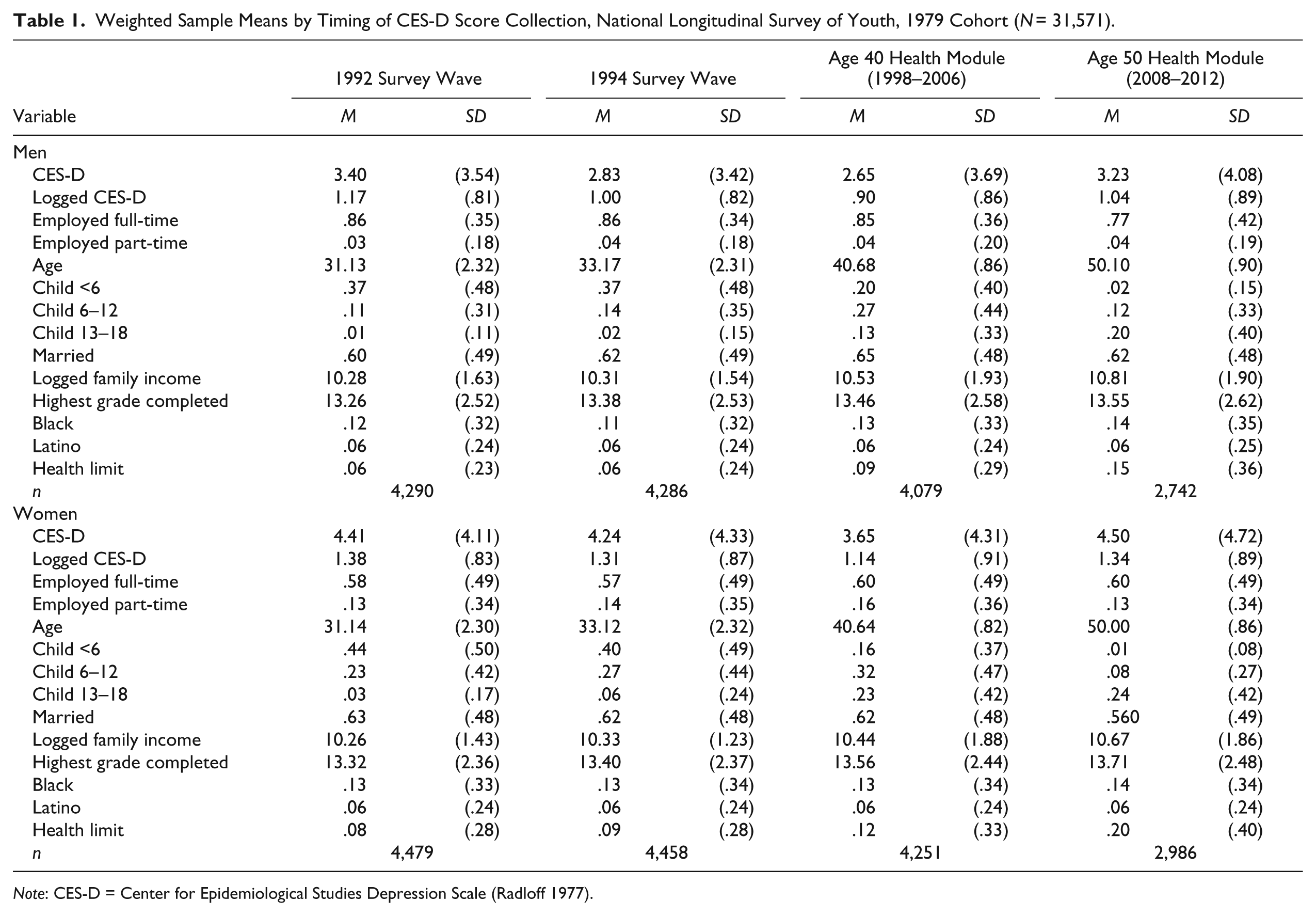
Note: CES-D = Center for Epidemiological Studies Depression Scale (Radloff 1977).
Analytic Strategy
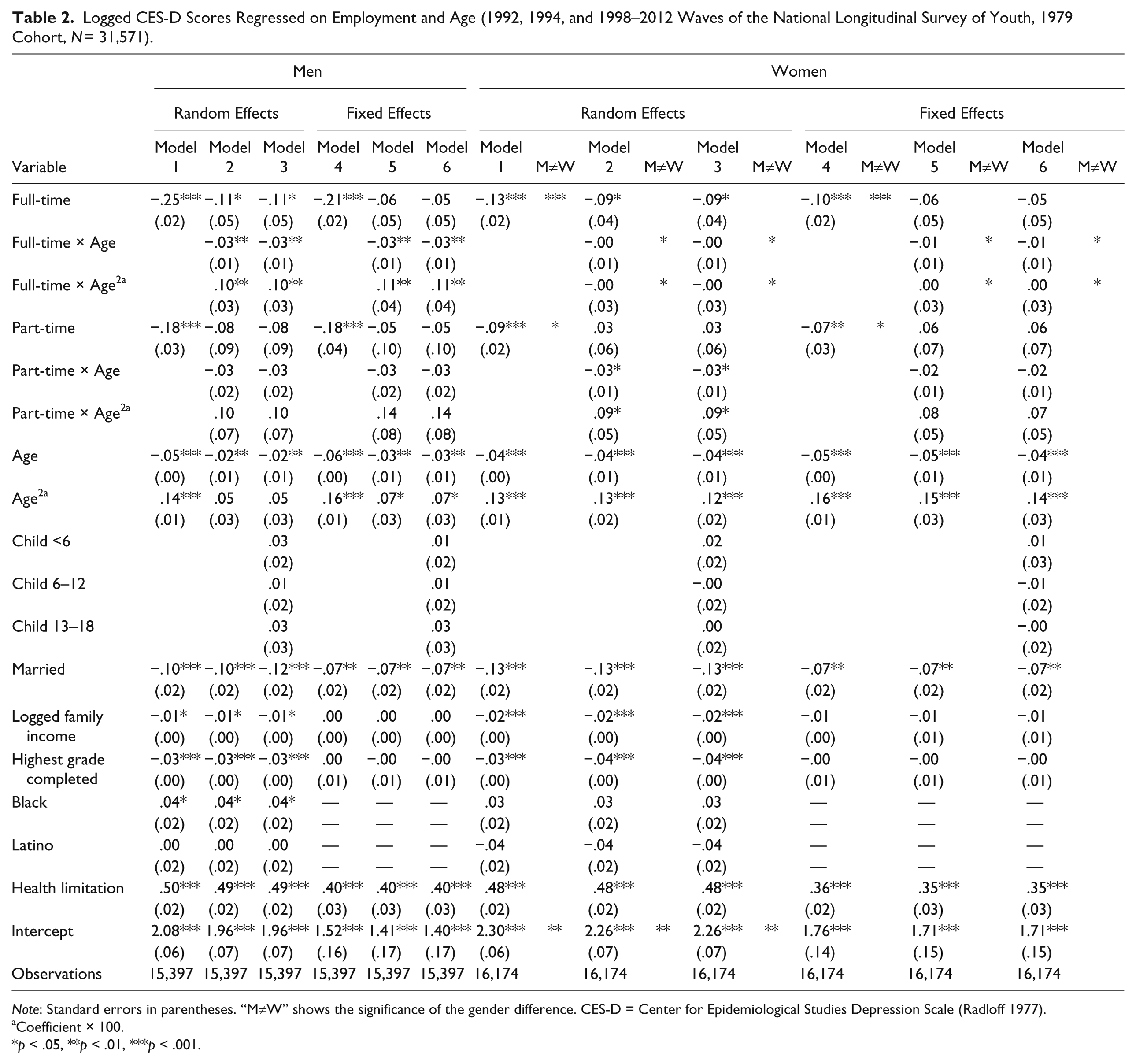
The first portion of the study examined changes in the effects of employment on mental health as individuals age. In separate regressions for men and women, I first regressed CES-D scores on age and employment (Table 2, Model 1). Model 2 tests Hypothesis 1, adding interaction terms for age and employment. The significance of the gender differences specified by Hypothesis 2 are noted alongside results for women. These significance levels were obtained by estimating Models 1 through 3 on a pooled sample of men and women, adding an interaction term for each covariate and gender, and three-way interactions to test gender differences in the interactive effects of age and employment. 2 Model 3 adds controls for children to test Hypothesis 3, if children contribute to the increased benefit of employment as individuals age.
Logged CES-D Scores Regressed on Employment and Age (1992, 1994, and 1998–2012 Waves of the National Longitudinal Survey of Youth, 1979 Cohort, N = 31,571).
Note: Standard errors in parentheses. “M≠W” shows the significance of the gender difference. CES-D = Center for Epidemiological Studies Depression Scale (Radloff 1977).
Coefficient × 100.
p < .05, **p < .01, ***p < .001.
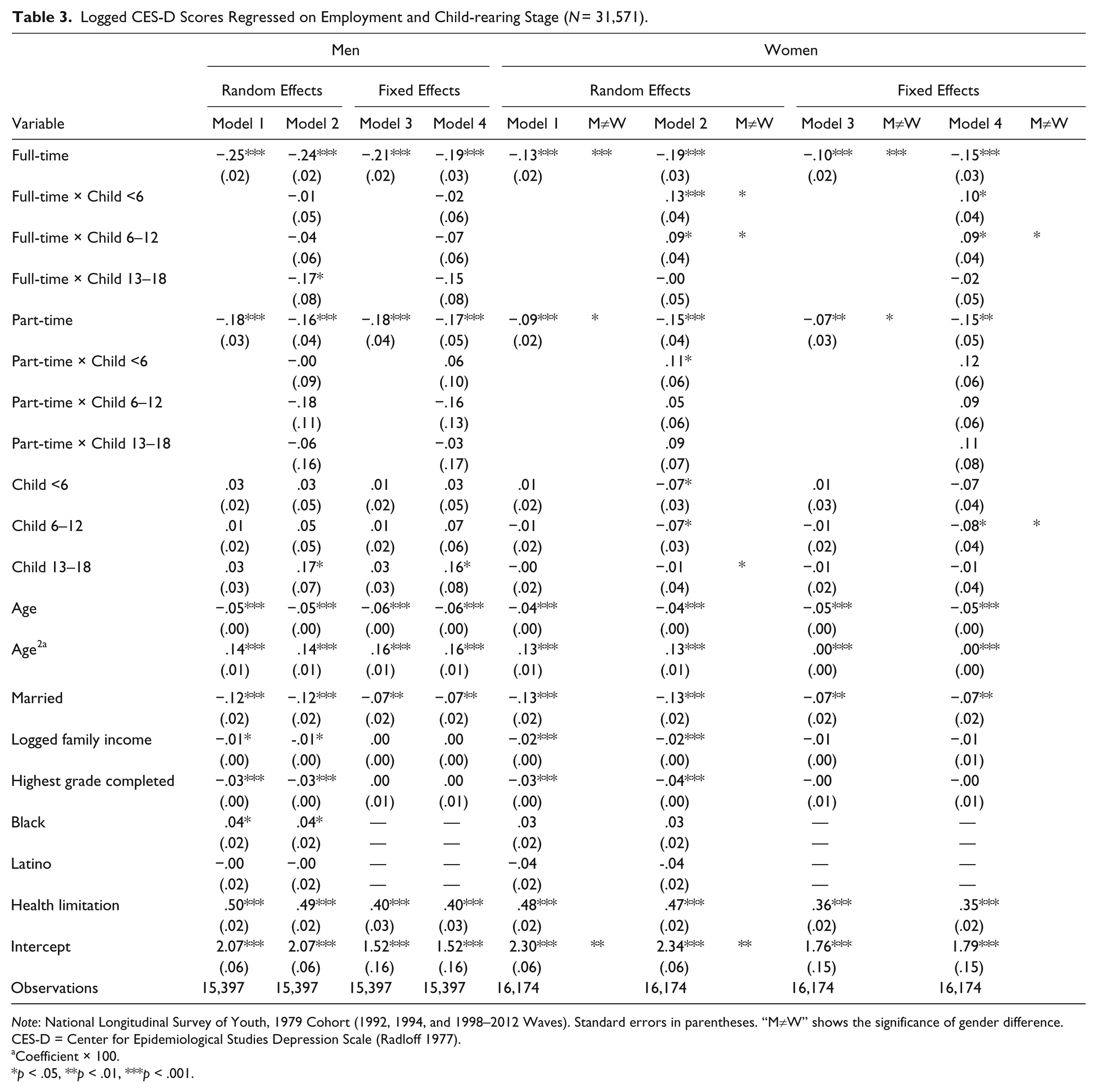
The second set of models directly examined how the mental health consequences of combining employment and child-rearing varies by children’s age. In Table 3, Model 1 first regresses CES-D scores on employment and children’s age. Model 2 tests Hypothesis 4 by adding interaction terms for employment status and children’s age. The significance of gender differences (Hypothesis 5) are noted alongside coefficients for women. 3 Given the lack of precise sample weights for the age 40 and age 50 health modules, I followed recommendations to include sociodemographic covariates in the models rather than weighting regressions (U.S. Bureau of Labor Statistics N.d.; Winship and Radbill 1994). 4
Logged CES-D Scores Regressed on Employment and Child-rearing Stage (N = 31,571).
Note: National Longitudinal Survey of Youth, 1979 Cohort (1992, 1994, and 1998–2012 Waves). Standard errors in parentheses. “M≠W” shows the significance of gender difference. CES-D = Center for Epidemiological Studies Depression Scale (Radloff 1977).
Coefficient × 100.
p < .05, **p < .01, ***p < .001.
All models were estimated using both random and fixed effects given their different capabilities to capitalize on the strengths of panel data. Fixed-effects models estimate the association of changes in the independent variables with changes in the dependent variable within multiple observations of individuals over time and were implemented in Stata using the xtreg…, fe command (StataCorp 2015). The models eliminate all person-specific unobservable characteristics that are stable over time (Wooldridge 2009). Doing so strengthened causal inference by eliminating individuals’ time-stable characteristics as a source of bias (Halaby 2004). In contrast, random-effects models assume that person-specific unobservable characteristics are not associated with the dependent and independent variables and allow the intercepts to vary. Random effects were estimated via generalized least squares with Stata’s xtreg…, re command (StataCorp 2015). The models estimate a matrix-weighted average of the association of covariates with the dependent variable for multiple observations between and within individuals, controlling for the correlation in the error terms of repeat observations of individuals (Wooldridge 2009).
A limitation of fixed-effects models is that they estimate effects only when dependent and explanatory variables change over time. Estimates of change diverge somewhat from the study’s hypotheses, which focus on the effects of employment generally rather than changes between employment states. Thus, I discuss the findings and support for hypotheses from random-effects estimates first and then discuss whether fixed-effects estimates further support the hypotheses. Because all respondents age between observation periods, fixed-effects estimates for the interactions of employment with age capture the association of changes in CES-D scores with age and employment even for respondents with stable employment. Fixed-effects estimates for the interactions of employment with children’s age groups capture the association of changes in CES-D scores with changes in either or both employment status and child-rearing stage.
Covariate data were missing for 2% or fewer observations, except family income, which was missing 17.2%. Missing data were imputed using Stata’s mi impute chained command. The imputation model included all analysis covariates. To better predict family income, respondents’ and their spouses’ earnings, respondents’ number of weeks employed and average weekly work hours during the past year, and family income from the previous NLSY survey wave were also included in the imputation model. Following recommendations from White, Royston, and Wood (2011), the imputation model included interaction terms, and missing dependent-variable data were imputed but dropped from regressions. Results from 20 imputed data sets were combined using mi estimate in Stata. Because other measures of model fit (i.e., Akaike information criterion, Bayesian information criterion) cannot be combined using Rubin’s rules (White et al. 2011), I discuss whether Wald tests indicate that interaction terms improved model fit.
Results
Effects of Employment by Age
In Table 2, Models 1 through 3 show random-effects estimates assessing the variation in employment benefits by individuals’ age. When estimated for men of all ages (Model 1), full-time employment is associated with .25-lower logged CES-D scores, roughly 25% lower on the original CES-D scale. Men’s part-time work is associated with .18-lower logged CES-D scores. Full- and part-time employment are less protective for women, associated with .13- and .09-lower logged CES-D scores. When those of all employment statuses are pooled, mental health has a curvilinear association with age and is best for men age 45 and women age 44.
Model 2 adds interaction terms for age and employment, testing Hypotheses 1. These interactions shift the full-time employment coefficient for men (–.11) to reflecting the effect of full-time employment for the youngest men in the sample, age 27. Full-time employment reduces CES-D scores by roughly 11% for these young men. The full-time and age interaction (–.03) improved model fit and indicates that the association of full-time employment with good mental health becomes stronger as men approach midlife, supporting Hypothesis 1. Full-time employment is progressively less protective for older men, as the positive Full-time × Age 2 coefficient (.001) indicates. Full-time employment is most protective for men at age 43, when full-time work is associated with .34-lower logged CES-D scores. The interactions between part-time employment and age for men are not significant and did not improve model fit. Finally, the age coefficient (–.02) captures the association of age and CES-D scores for men without jobs, who have better mental health at older ages.
Results for women differ. The interactions of full-time employment and age are not significant, providing no evidence that the protective effect of full-time employment increases with women’s age (Hypothesis 1). Moreover, the interaction coefficient for full-time and age is significantly smaller for women than men, supporting Hypothesis 2. 5 For women, none of the employment and age interactions improved model fit. Nevertheless, results for part-time employment provide some support for Hypothesis 1, as the interactions of women’s part-time employment with age (–.03) and age-squared (.0009) are significant. The age and age-squared coefficients (–.04 and .0013) reflect age’s curvilinear association with mental health for women without jobs, who have the best mental health in their early 40s.
Model 3 tests Hypothesis 3 by controlling for the presence and age of children. These controls do not change the employment and age interactions between Models 2 and 3, and did not improve model fit for either gender. The findings do not indicate the aging of children contributes to changes in the mental health effect of employment with age.
Models 4 through 6 present fixed-effects estimates. Model 4 results indicate that moving into full- and part-time employment reduces logged CES-D scores by .21 and .18 for men and by .10 and .07 for women. Model 5 tests Hypotheses 1 and 2. For men, the fixed-effects estimate for the interaction of full-time employment and age (–.03) matches the random-effects coefficient and indicates that the benefit of moving into full-time work increases as men get older. This increase is significantly larger for men than for women, for whom the interaction effect is not significant. These findings further support Hypotheses 1 and 2. The interaction of part-time employment and age are marginally significant (p values < .08) for both genders. Notably, rounding accentuates the differences in the random- and fixed-effects Part-time × Age coefficients for women. In Model 6, controls for children do not alter the interactions between age and full-time employment. These results align with random-effects estimates and do not support Hypothesis 3.
Figures 1 and 2 show predicted logged CES-D scores by employment and age from Model 3, holding other covariates at their means. At age 27, the difference in logged CES-D scores between jobless men and men employed full-time is small. This difference widens as men approach their early 40s. Among women, the difference in mental health for those without jobs or employed full-time is similar across the 20-year age span. Differences in CES-D scores for women working part-time compared to jobless women are more variable. Part-time employment is most protective against depression for women at age 42, when it is associated with .14-lower logged CES-D scores relative to not having a job.
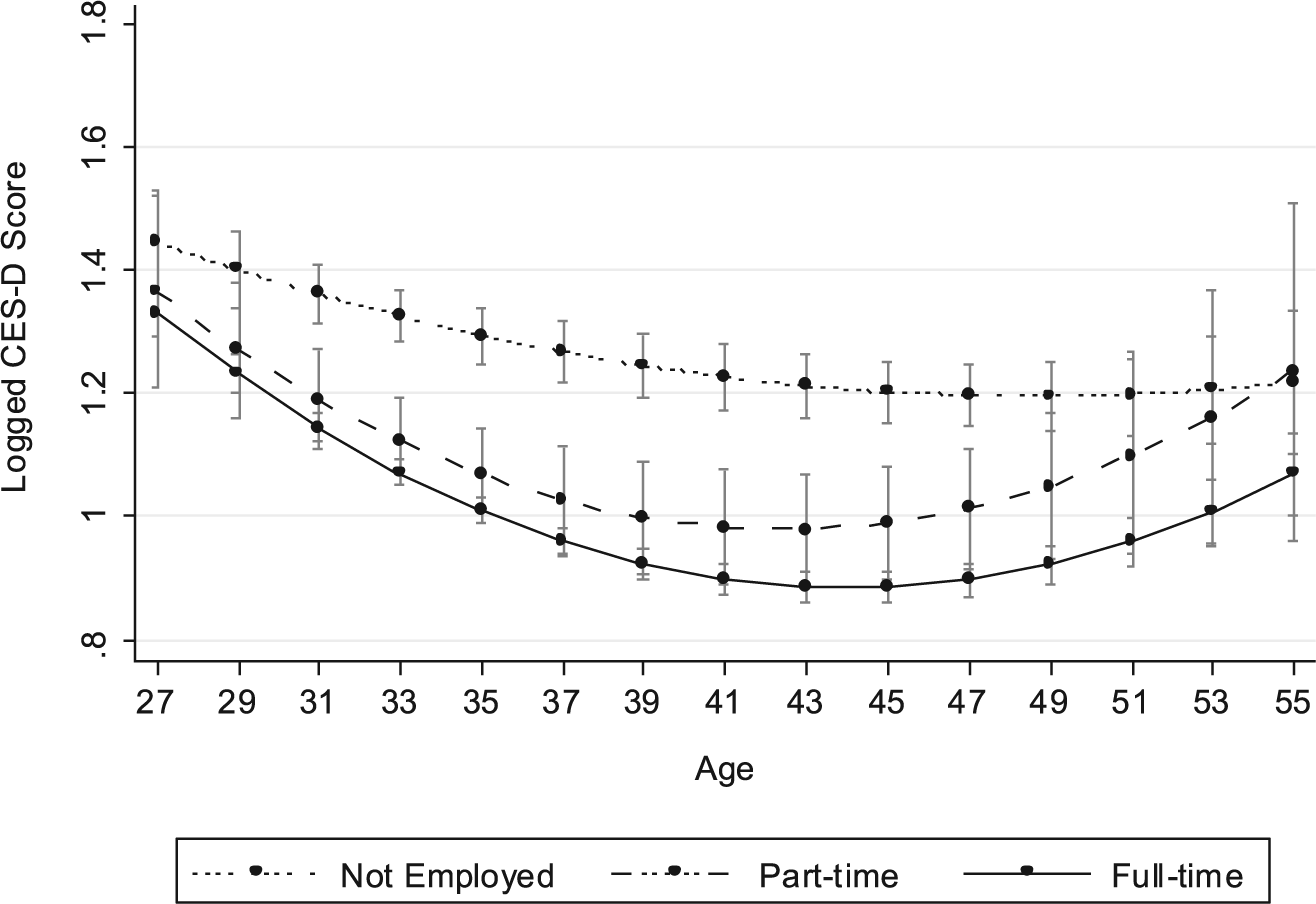
Men’s Logged CES-D Scores by Employment and Age.
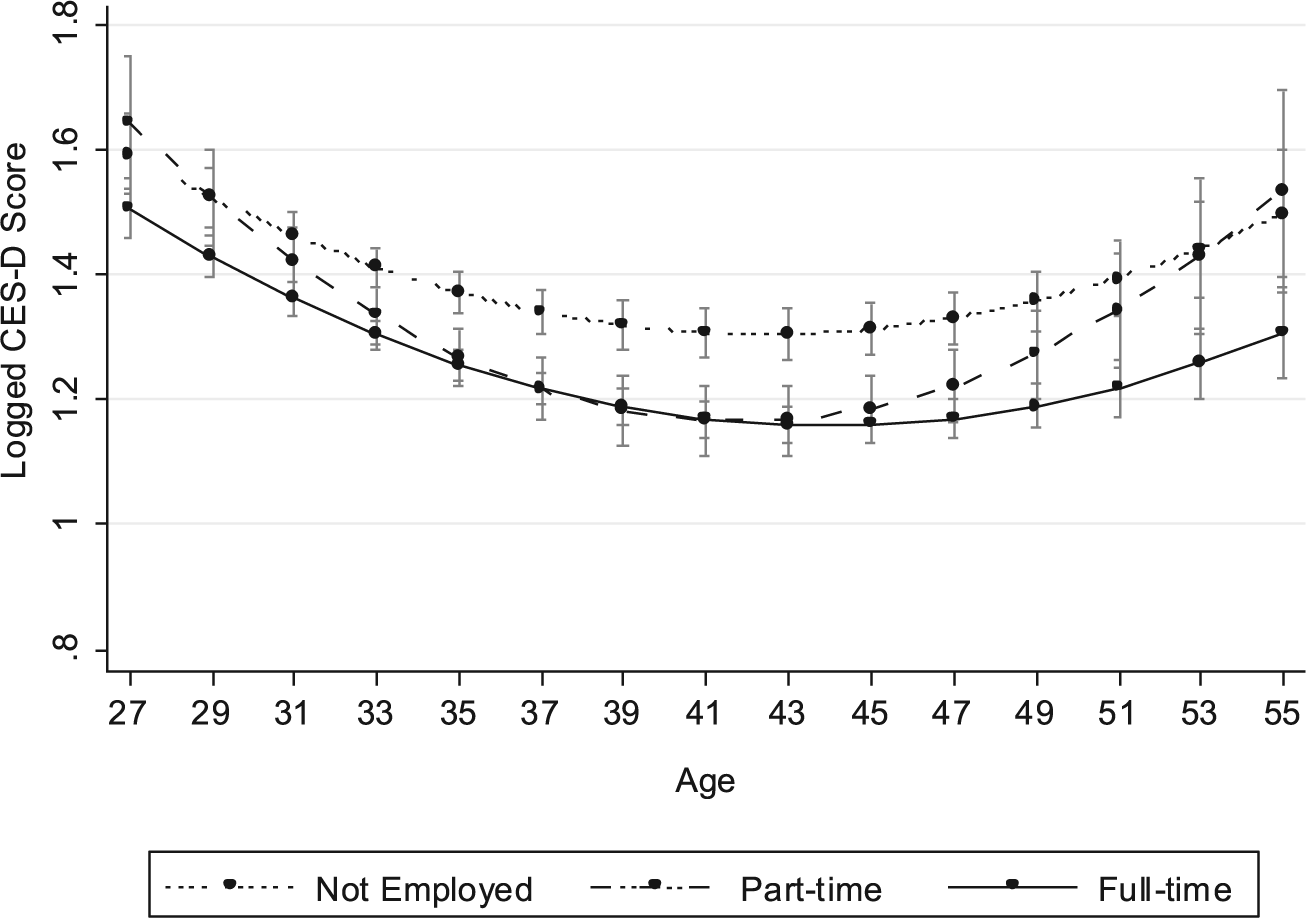
Women’s Logged CES-D Scores by Employment and Age.
Effect of Employment by Child-rearing Stage
The models in Table 3 test Hypotheses 4 and 5, addressing how the effects of combining employment and child-rearing vary as children age. Models 1 and 2 present random-effects estimates. Model 1 results largely mirror those from Table 2. Model 2 tests Hypothesis 4 by adding interaction terms for employment and the age of respondents’ youngest child. The addition shifts the coefficients for full- and part-time employment to reflect the associations of employment and CES-D scores for the referent group, men or women without children. Among childless men, full- and part-time employment is associated with a reduction of .24 and .16 in logged CES-D scores. For men, the interactions for employment and younger children are not significant and did not improve model fit, providing no support for Hypothesis 4. The interaction term for working full-time and having a teenage child is significant. This negative effect, however, indicates full-time employment is associated with improved mental health for fathers of teenagers more than for childless men.
Hypothesis 4 is supported by results for women. Among childless women, the referent group, full-time employment is associated with a roughly 19%-lower originally scaled CES-D score. This protective effect is reduced by young children, as the Full-time × Child <6 coefficient (.13) indicates. For mothers of children under 6, full-time employment is associated with a roughly 6%-lower originally scaled CES-D score, calculated by adding the full-time coefficient to the interaction term (–.19 + .13 = –.06). School-age children also reduce the protective effect of full-time employment. Full-time employment reduces originally scaled CES-D scores by roughly 10% for mothers of children ages 6 to 12 (.19 + .09 = –.10). The interaction terms for being employed full-time and having a teenage child are not significant among women and did not improve model fit, suggesting teenage children do not dampen the mental health benefits of women’s full-time employment. Similar patterns are evident for part-time employment. Among women without children, working part-time is associated with a reduction of .15 in logged CES-D scores. Children under 6 diminish this protective effect by .11, making the estimated effect of part-time employment on logged CES-D scores only –.04 for mothers of the youngest children (–.15 + .11 = –.04). The interaction terms for part-time employment and older children are nonsignificant and did not improve model fit.
Findings for full-time employment support the gender difference posited by Hypothesis 5. The interactions between full-time employment and children under 6 and ages 6–12 are significantly larger for women, indicating young children reduce the beneficial effect of full-time work for women more than for men. 6 Findings on part-time employment provide less support for Hypothesis 5, as tests did not detect gender differences in the effects of combining part-time employment with the care of young children.
Finally, results from Models 1 and 2 suggest child-rearing’s effect on mental health is conditional upon employment status and the age of respondents’ youngest child. In Model 1, children were not significantly linked to mental health when respondents of all employment statuses are pooled. In Model 2, the children coefficients capture effects for those without jobs. Among these men, teenage children are associated with roughly 17%-higher CES-D scores (coefficient = .17). Among mothers without jobs, children under 12 lower CES-D scores by roughly 7% (coefficient = .07).
Models 3 and 4 present fixed-effects estimates. In Model 3, there is no indication that changes in child-rearing stage are associated with changes in mental health for either gender. In Model 4, interaction terms are significant only for women and, like random-effects estimates, support Hypotheses 4. Among childless women, moving into full-time employment lowers logged CES-D scores by .15. This protective effect is smaller for mothers of children under 6 and ages 6 to 12. The coefficient Part-time × Child <6 is not significant but is comparable in size to the random-effects estimate. The coefficient Full-time × Child 6–12 is significantly larger for women than men, further supporting Hypothesis 5. The gender difference in the interaction of full-time employment and having a child under 6 is marginally significant (p value < .08).
Figures 3 and 4 show the predicted logged CES-D scores by employment and child-rearing stage from Table 3, Model 2, holding other covariates at their means. 7 For men, full- and part-time employment boosts mental health. There are no significant differences by child-rearing status among men employed full- or part-time. Instead, differences occur among jobless men, for whom teenage children are associated with worse mental health. For all women, full-time employment is associated with better mental health relative to not having a job. Mothers of children under 6, however, have the smallest gap in CES-D scores between those with and without jobs, and employment benefits them significantly less than it does mothers of teenagers or childless women. Notably, the diminishment of the mental health benefits of full-time employment for mothers of very young children is due to worse mental health among employed mothers and better mental health among those not working for pay. Women employed part-time tend to have higher scores than women working full-time and lower scores than jobless women. There is not a linear trend, however, linking CES-D scores to children’s age among women working part-time.
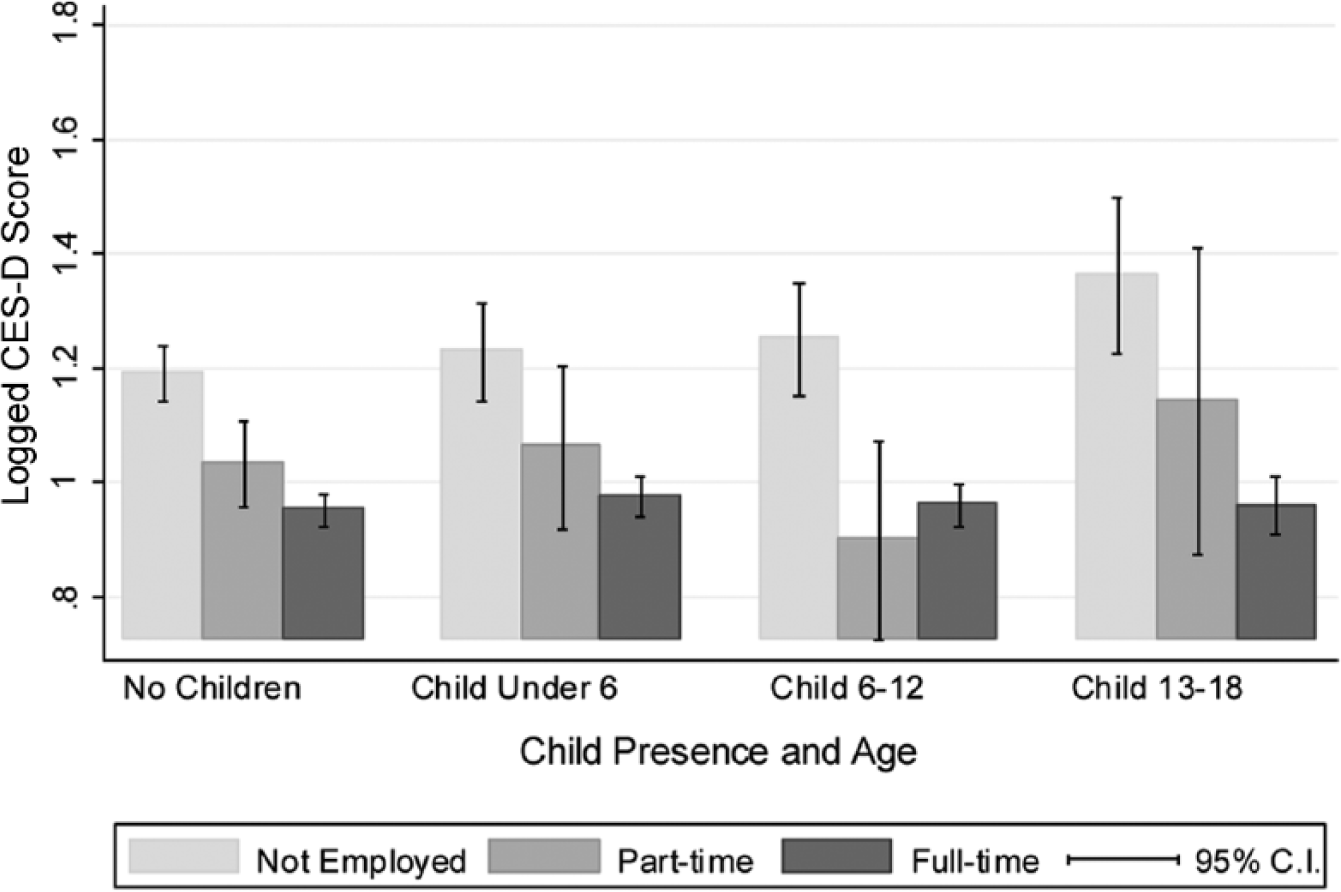
Men’s Logged CES-D Scores by Employment and Child-rearing Stage.
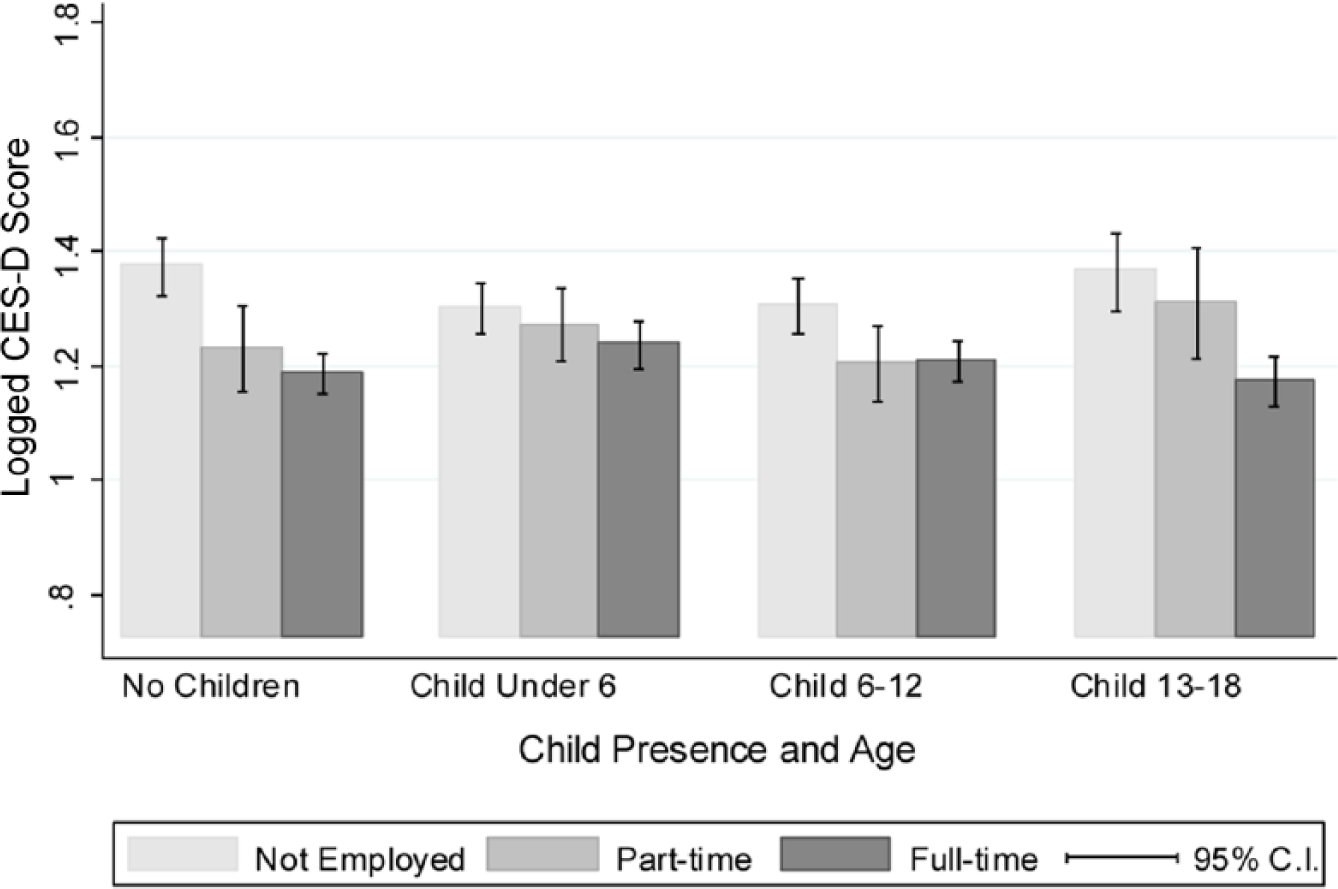
Women’s Logged CES-D Scores by Employment and Child-rearing Stage.
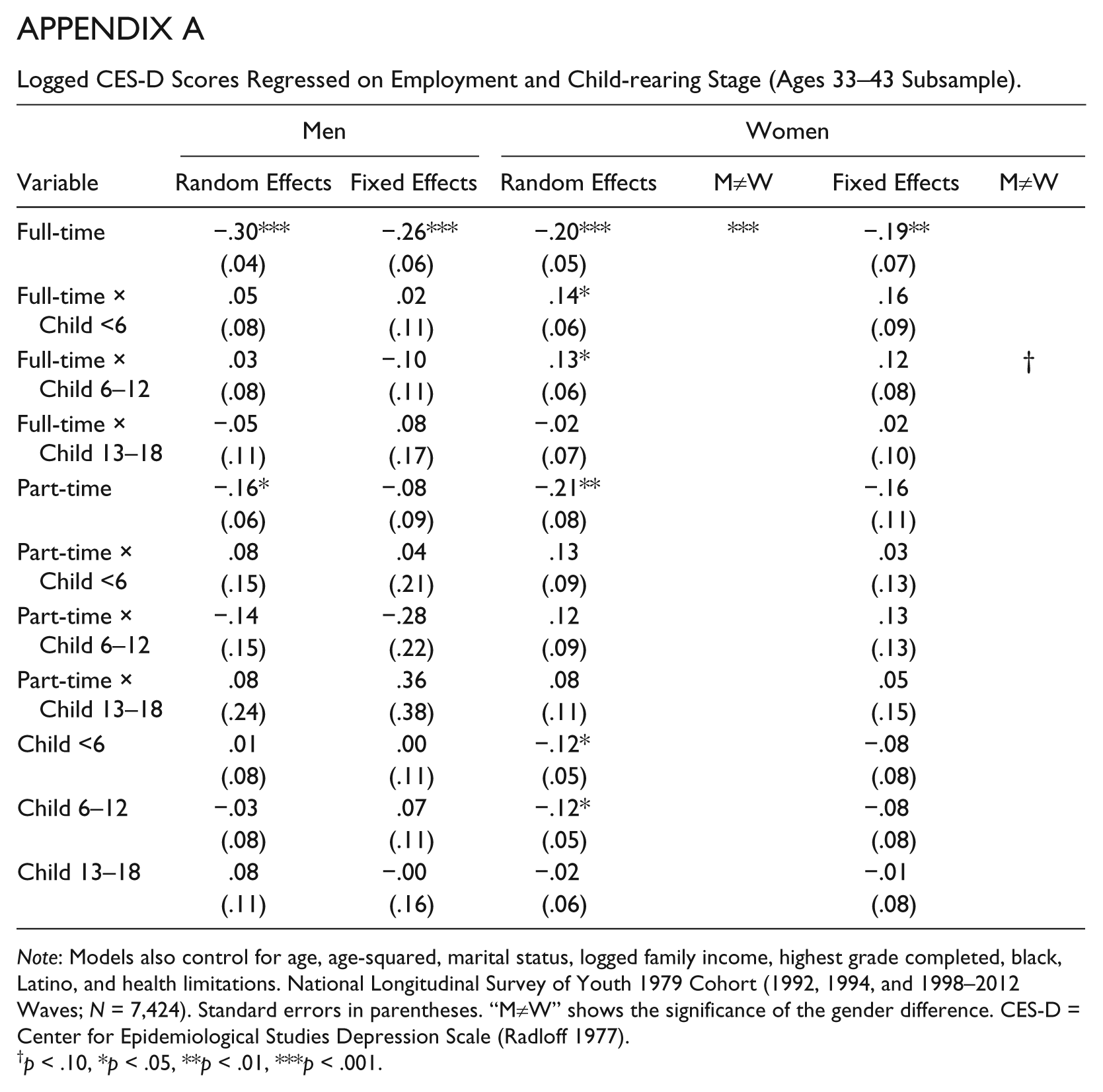
To further disentangle the aging of children and parents, I estimated Models 2 and 4 from Table 3 on a subsample of individuals ages 33 to 43. These lower and upper age bounds match the mean ages of parents with a youngest child under 6 and those with a youngest child age 13 to 18. These estimates are presented in Appendix A. Among men, the random-effects estimate for Full-time × Child 13–18 was not significant, suggesting the Table 3 estimate was at least partially driven by men’s own age. Among women, the random-effects estimates for the interactions of full-time employment and children under 6 and ages 6 to 12 were positive and significant, further supporting Hypothesis 4. The random-effects estimate for Part-time × Child <6 and fixed-effects estimates for all interactions of children with full-time work were not significant, but coefficients were comparable in size to estimates for the full sample. Finally, the significance of the gender differences dropped out in the age-restricted subsample, suggesting that men’s increased benefit of employment as they themselves age contributes to gender differences in the effects of employment for parents of young children.
Discussion
In laying out a life course perspective, Elder (1975:175) described, “Marriage and motherhood would be key elements of this model in the lives of girls, with economic independence and stable employment assuming priority in the normative life course of boys.” Since then, convergence in employment pathways by gender (Brückner and Mayer 2005) suggested employment had become more central in the life courses of women. Yet this study suggests that parenthood remains central to women’s life course because the mental health benefit of employment accrues along gendered timetables. Though men’s mental health gains from full-time employment increase as they themselves age, women’s gains increase as children grow older.
The Interactive Effects of Employment and Child-rearing
Young children substantially reduce the benefit of employment for women’s mental health. Full-time employment reduces childless women’s CES-D scores by almost 20%. Yet random- and fixed-effects estimates indicated that children under 6 cut this benefit by two thirds, and children ages 6 to 12 reduced the benefit by half. Random-effects models estimated young children also cut the benefit of part-time work, but fixed-effects estimates were not significant. This lack of significance in fixed-effects estimates may be due to the loss of statistical power as a result of estimating effects only for respondents with changes between waves.
Mothers of young children employed full-time have worse mental health than childless full-time workers and employed mothers of teenagers. These findings support a role strain perspective and build upon studies that examine the consequences of combining work and family roles but that less often examine differences by children’s age (Plaisier, Beekman, et al. 2008; Reskin and Coverman 1985; Thoits 1986; Voydanoff and Donnelly 1989; (for an exception finding no differences by children’s age, see Plaisier, de Bruijn, et al. 2008).
Differences in how young and teenage children alter the benefit of employment suggest the mental health consequences of parenting change within middle adulthood. Previous work examining the timing of parenthood on health has tended to focus on role transitions or has differentiated the demands of active parenting from the benefit of adult children for seniors’ well-being (Umberson, Pudrovska, and Reczek 2010). The age of children also shapes children’s effect on women without jobs. Younger children bolster mental health for jobless mothers, possibly because child-rearing provides a salient source of identity when children’s care needs are great and when there are strong social pressures for mothers to directly care for children (Hays 1996). As children age, motherhood may become a less viable substitute for the identity provided by employment.
The mental benefit of employment for fathers is not reduced by young children. This may reflect men’s lesser time spent caring for children (Bianchi et al. 2006) and the ideological compatibility of employment and fatherhood (Townsend 2002). Presented results differ from Schnittker’s (2007) finding that children under six reduce the benefit of employment for fathers’ self-rated health. If the benefit of employment for men’s self-rated health increases with age, past findings that young children reduce fathers’ health benefits from employment may partially confound the effects of children and men’s own age. Alternatively, work–family strains may diminish men’s self-rated health more than mental well-being.
The Rising Benefits of Employment as Individuals Age
Results from random- and fixed-effects models indicated the protective effect of full-time employment increases as men age from their late 20s to early 40s. At 27, the protective effect of full-time employment is roughly equivalent to 13% of the overall standard deviation in men’s logged CES-D scores. By 43, the effect’s magnitude triples. Previous work on the midlife mental health advantage emphasized transitions into employment during early adulthood (Clarke et al. 2011; Mirowsky 1996; Mirowsky and Ross 1992). This study suggests that employment makes a larger contribution to men’s midlife mental health than previously discussed. Though men’s employment rates change little between the late 20s and early 40s, their mental health continues to improve—in part because the benefit of full-time employment increases.
Among women, the mental health benefits of full-time employment do not increase with age, an important finding given that the majority of employed women work full-time in the United States. Moreover, the age interaction with full-time employment is significantly larger for men. The finding that gender differences in the effect of employment emerge over the life course clarifies old debates on whether employment is more beneficial for men than for women (Reskin and Coverman 1985). At age 27, and among those not caring for children, gender did not differentiate the mental health benefits of employment. Gender differences accrued as men and women aged and passed through stages of child-rearing. These findings suggest employment contributes more to the gender gap in depression at midlife than indicated by previous research controlling for employment rates (Mirowsky 1996) and imply that increases in women’s employment would have a limited effect on reducing gender disparities in mental health at midlife unless women’s rewards from full-time employment also grew.
Results from random-effects estimates provided some evidence that women reap increased mental health benefits from part-time employment as they age toward midlife. Fixed-effects estimates for part-time interactions were not significant, possibly due to low statistical power as only 13% to 16% of sampled women worked part-time. The interactions of part-time employment and age did not improve model fit for women, however, further highlighting the limited importance of women’s own aging. Results also highlight the limited benefits of part-time employment for resolving work–family conflicts to improve mental health: across age and child-rearing stages, the mental health of women working part-time is the same or worse than full-time workers’.
Though the time-intensive care demands of young children generated the hypothesis that the aging of children would increase the mental health returns of employment as individuals’ aged, findings did not support this expectation. Among men, the lack of change in age and employment interactions with the addition of controls for children aligns with the finding that young children do not diminish men’s benefit from employment. Among women, the lack of change in coefficients is more curious but seems rooted in the overall lack of change in women’s health gains from full-time work as they themselves age. Supplemental analyses did not indicate that childless women accrued increased returns to full-time employment with age. Though the aging of children enhances the benefits of employment for mothers, this increase may be too small to influence interactions between age and full-time employment at the aggregate.
Because research has identified cohort effects within the NSLY79 (Frisco et al. 2012), I explored the possible confounding of age and cohort effects by sampling just the younger half of the cohort, who contribute the observations of ages 27 to 31. Random-effects estimates of the interactions for age and full-time employment were almost identical for men. 8 Among women, the interaction of part-time employment and age was not significant, but the effects of part-time employment for the younger and older halves of the NLSY79 were only marginally different (p < .1). Though inconclusive with respect to disentangling cohort and age effects, the sensitivity of the interaction for women’s part-time employment and age casts further doubt on Hypothesis 1 for women.
Limitations
One limitation of this study is that it does not fully account for the gendered family processes that shape selection into employment. Fixed-effects models control for all stable characteristics, but there may still be time-varying, unobserved factors that shape mental health and employment. Qualitative research suggests work–family conflict generates mental distress and encourages mothers to leave employment (Hochschild 1989; Stone 2007). Accordingly, mothers who remain employed may have work and family conditions that mitigate work–family conflict, promoting well-being. Netting out these selection processes may yield larger estimates of the dampening effect young children have on employment’s benefits.
The selection of healthier individuals into employment is also concerning, especially if the magnitude of a selection effect varies by age. All estimates controlled for health limitations to employment, and fixed-effects models controlled for time-stable propensities for depression and employment. Nevertheless, these approaches may insufficiently control for instances where worsening mental health encourages people to leave employment. To investigate this concern, I excluded observations where individuals had recently left employment, and I estimated random-effects models for cases with a stable employment status across two adjacent time periods. Despite the smaller sample, the size and significance of interactions for employment and individuals’ age remained comparable. It seems that if poor mental health encouraged employment exits, the process unfolded similarly over the sampled age span.
Though the NLSY79 data provided four mental health observations from ages 27 to 56, the data precluded analysis of mental health during early adulthood. The general alignment of fixed- and random-effects estimates suggested that support for hypotheses were not driven by early-adulthood employment and parenting pathways that likely contributed to respondents’ mental health by ages 27 and older. Nevertheless, young children may diminish the mental health gains from employment for young parents even more so than for parents examined in this study, particularly if young parents’ limited job resources make combining child-rearing and employment especially challenging. Limited job resources, however, may also give young parents fewer employment-based mental health rewards to lose in the event children reduce employment. Similar logic suggests that employment is less beneficial during the early 20s than at age 27. Further research on the mental health benefits of employment during early adulthood, when the onset of mental health conditions and initial transitions into parenthood and employment often occur, is needed to provide a fuller understanding of mental health, employment, and the gendered life course.
Finally, future work might also explore why the benefits of employment diminish during the second half of adulthood. Presented results indicated that overall, mental health worsens after the late 40s. Yet other work reports that additional controls for health conditions, a sense of control, and widowhood reduce the uptick in CES-D scores (Clarke et al. 2011; Schieman et al. 2001; Yang 2007). Though CES-D scores for men without jobs remain low after the early 40s, the mental health of men employed full-time worsens. This timing coincides with the leveling of extrinsic job rewards and a stagnation in job satisfaction (Kalleberg and Loscocco 1983), so declining job resources might drive employment’s diminished benefits at later ages. Rising demands stemming from the highest work statuses may also contribute (Schieman et al. 2009).
Conclusion
This study examined how the effects of employment change as individuals and their children age. Results suggest young children reduce the protective effect of full- and part-time employment for women, but the salubrious effects of employment increase as children grow older. In contrast, young children do not diminish the mental health benefits of employment for men. Instead, the benefits of full-time employment increase as men themselves age toward midlife. Though part-time employment is more beneficial for women in their early 40s than for younger women, women’s gains from full-time employment do not increase as they approach midlife. The findings suggest the timing of work and family roles within the life course shapes mental health in ways not captured by the timing of role transitions and illustrate the fruitfulness of greater attention to the meaning of time within the life course (George 2014).
As Moen and Chermack (2005:104) describe, “Women’s lives are typically contingent lives, shaped around the experiences of others: their husbands, children, and parents.” Individuals’ age has been described as the timetable for employment careers (Lawrence 1984) and the life course generally (Elder 1975). Because men’s mental health gains from employment are relatively unresponsive to child-rearing, overlooking role combinations has minimal consequence for our understanding of employment and men’s mental health. Yet because the aging of children strongly influences women’s mental health rewards from employment, the combination and timing of work and family roles is essential for understanding women’s life course mental health.
Footnotes
Appendix A
Logged CES-D Scores Regressed on Employment and Child-rearing Stage (Ages 33–43 Subsample).
| Men |
Women |
|||||
|---|---|---|---|---|---|---|
| Variable | Random Effects | Fixed Effects | Random Effects | M≠W | Fixed Effects | M≠W |
| Full-time | −.30*** | −.26*** | −.20*** | *** | −.19** | |
| (.04) | (.06) | (.05) | (.07) | |||
| Full-time × Child <6 | .05 | .02 | .14* | .16 | ||
| (.08) | (.11) | (.06) | (.09) | |||
| Full-time × Child 6–12 | .03 | −.10 | .13* | .12 | † | |
| (.08) | (.11) | (.06) | (.08) | |||
| Full-time × Child 13–18 | −.05 | .08 | −.02 | .02 | ||
| (.11) | (.17) | (.07) | (.10) | |||
| Part-time | −.16* | −.08 | −.21** | −.16 | ||
| (.06) | (.09) | (.08) | (.11) | |||
| Part-time × Child <6 | .08 | .04 | .13 | .03 | ||
| (.15) | (.21) | (.09) | (.13) | |||
| Part-time × Child 6–12 | −.14 | −.28 | .12 | .13 | ||
| (.15) | (.22) | (.09) | (.13) | |||
| Part-time × Child 13–18 | .08 | .36 | .08 | .05 | ||
| (.24) | (.38) | (.11) | (.15) | |||
| Child <6 | .01 | .00 | −.12* | −.08 | ||
| (.08) | (.11) | (.05) | (.08) | |||
| Child 6–12 | −.03 | .07 | −.12* | −.08 | ||
| (.08) | (.11) | (.05) | (.08) | |||
| Child 13–18 | .08 | −.00 | −.02 | −.01 | ||
| (.11) | (.16) | (.06) | (.08) | |||
Note: Models also control for age, age-squared, marital status, logged family income, highest grade completed, black, Latino, and health limitations. National Longitudinal Survey of Youth 1979 Cohort (1992, 1994, and 1998–2012 Waves; N = 7,424). Standard errors in parentheses. “M≠W” shows the significance of the gender difference. CES-D = Center for Epidemiological Studies Depression Scale (Radloff 1977).
p < .10, *p < .05, **p < .01, ***p < .001.
Acknowledgements
I am grateful for Becky Pettit’s guidance in the development of this research and for comments from Stewart Tolnay, David Takeuchi, Julie Brines, and Blair Wheaton on previous drafts.
Supplemental Material
The appendices are available in the online version of the article.
Funding
The author(s) disclosed receipt of the following financial support for the research, authorship, and/or publication of this article: Partial support for this research came from a Shanahan Endowment Fellowship and a Eunice Kennedy Shriver National Institute of Child Health and Human Development training grant, T32 HD007543, and a Eunice Kennedy Shriver National Institute of Child Health and Human Development research infrastructure grant, R24 HD042828, to the Center for Studies in Demography and Ecology at the University of Washington.
Notes
Author Biography
References
Supplementary Material
Please find the following supplemental material available below.
For Open Access articles published under a Creative Commons License, all supplemental material carries the same license as the article it is associated with.
For non-Open Access articles published, all supplemental material carries a non-exclusive license, and permission requests for re-use of supplemental material or any part of supplemental material shall be sent directly to the copyright owner as specified in the copyright notice associated with the article.
