







Abstract
This study extends health disparities research by examining racial differences in the relationships between multigenerational attainments and mortality risk among “Silent Generation” women. An emerging literature suggests that the socioeconomic attainments of adjacent generations, one’s parents and adult children, provide an array of life-extending resources in old age. Prior research, however, has demonstrated neither how multigenerational resources are implicated in women’s longevity nor how racial disparities faced by Silent Generation women may differentially structure the relationships between socioeconomic attainments and mortality. With data from the National Longitudinal Survey of Mature Women, the analysis provided evidence of a three-generation model in which parent occupation, family wealth, and adult child education were independently associated with women’s mortality. Although we found evidence of racial differences in the associations between parental, personal, and spousal education and mortality risk, the education of adult children was a robust predictor of survival for black and white women.
Education is a well-established correlate of longevity across genders and races (Hummer and Lariscy 2011), but its association with white women’s mortality grew substantially larger during the latter twentieth and early twenty-first centuries (see Montez and Zajacova 2014). This finding has garnered the attention of social scientists, and recent studies have identified a number of social and behavioral mechanisms that help explain the widening education gap in white women’s mortality (Ho and Fenelon 2015; Montez and Zajacova 2013). Although this line of research has provided important insights into our understanding of health disparities among women, it has yet to examine whether the survival of older cohorts of white and black women is related to the attainments of multiple familial generations.
The majority of research on U.S. mortality disparities focuses on individual characteristics, but an emerging literature suggests that survival is also linked to adjacent generations—one’s parents and adult children (Friedman and Mare 2014; Pudrovska 2014; Torssander 2013). Although this literature offers evidence of a multigenerational structure in mortality among older adults, it has neither empirically tested this structure in its entirety nor considered the implications of race in the transfer of health advantages across multiple generational lines. Thus, in this study we ask:
Research Question 1: Are parent, personal, and adult child attainments independently related to women’s chances of survival in later adulthood?
Research Question 2: Does race differentially shape any observed relationship between multigenerational attainments and women’s mortality risk?
To address these questions, we examine data from the National Longitudinal Survey of Mature Women (NLS-MW), a nationally representative sample of women aged 30 to 44 in 1967. This birth cohort of women were followed for over three decades and provided information on the socioeconomic attainments of multiple generations within their families. Distinguishing between birth cohort (or simply cohort) and familial generation (or simply generation) is key to understanding both our conceptual framework and analytical approach. In line with life course scholarship, we define cohort as those who are born in broadly similar historical periods, whereas generation refers to one’s position in the line of descent within a family (Alwin and McCammon 2003; Elder and George 2016). Each generation is by definition in a different cohort, meaning that every generation is exposed to unique historical contexts and attainment structures. Thus, we begin by developing a conceptual model of multigenerational attainments and mortality, and to operationalize this model, we then review several historical events and cultural and demographic trends throughout the twentieth century that structured attainment opportunities among Silent Generation women, their parents, and their adult children.
Background
Multigenerational Models of Attainment and Health
Recent scholarship in stratification and demography argues for a non-Markovian process of inheritance in which the socioeconomic attainments of one generation directly influence the life chances of two or more subsequent generations (Mare 2011, 2014). In contrast, earlier work generally supported a Markovian pattern in which grandparents’ (G1) socioeconomic attainment only indirectly influenced grandchildren’s (G3) attainment through parents’ (G2) characteristics (Warren and Hauser 1997). A non-Markovian pattern, however, suggests that a mix of formal and informal social institutions directly link the attainment of G1 to the life chances of both G2 and G3 (Mare 2011). A similar model is being considered in studies on health disparities (Huang et al. 2015; Lê-Scherban et al. 2014), and like scholarship on status attainment, this research emphasizes the benefits of G1 attainments for the health of subsequent generations. For later adulthood and old age, however, an integration of recent studies on parent and adult child attainments and mortality risk in older populations suggests an alternative multigenerational structure might exist.
Adjacent Generations and Mortality in Later Adulthood
An emerging body of research suggests that mortality in later adulthood and old age is related not only to personal attainments (G2) but also to the attainments of one’s parents (G1) and adult children (G3), what we refer to as adjacent generations (Wolfe et al. 2018), specifically, research within the “long arm” and “social foreground” perspectives. Research on the long arm of childhood conditions argues that parent attainments are linked to mortality in later life by way of a complex mixture of biological and social mechanisms (Hayward and Gorman 2004; Pudrovska 2014). From a biological standpoint, socioeconomic deprivation early in life may permanently damage physiological functioning, leading to a greater risk of developing chronic diseases later in life (see Almond and Currie 2011). Furthermore, an early deficit of socioeconomic resources can also be the catalyst for a lifetime of socioeconomic difficulties and social adversities that incrementally increase the risk of mortality over time through an accumulation of environmental exposures and stress (Pudrovska and Anikputa 2014).
The social foreground perspective, a more recent development in demographic research, emphasizes the health-related resources that high-attaining children provide their elderly parents (Friedman and Mare 2014; Torssander 2013; Zimmer, Hanson, and Smith 2016). Adult children with greater socioeconomic resources may be able to provide more direct care, both physical and financial, to support their parents’ health. In addition, more educated children may encourage healthier lifestyles and influence their parents’ health behaviors more than less educated children. Friedman and Mare (2014), for example, find evidence that parents’ smoking and physical activity help explain the association they find between parent mortality and the educational attainments of their adult children.
Rather than view these as competing perspectives, we regard the long arm and social foreground perspectives as incomplete explanations of a larger multigenerational process. Regardless of the specific mechanisms, when taken together, these perspectives suggest relaxing the temporal assumption of prior multigenerational models to allow for the possible influence of adjacent generations, G1 and G3. However, prior research has neither examined the degree to which G1, G2, and G3 attainments independently contribute to G2 longevity among older women nor considered the implications of race. Thus, a key contribution of this paper is that it considers the full multigenerational structure of mortality disparities among older women and incorporates the complexities of race.
Education and Opportunity in Midcentury America
Studies often—but not always (e.g., Duncan et al. 2002)—observe that education has a stronger association with mortality than other common indicators of socioeconomic status (SES) like occupation and income (Miech et al. 2011). The most common explanations of the robust education-mortality association involve the effects of education on occupational and economic attainments and human capital development. Those with more schooling are more likely to gain employment at higher-earning occupations and accumulate more wealth than their low-attaining counterparts (Mirowsky and Ross 2003). Through occupational and economic attainments, schooling is often exchanged for health advantages like, for example, health insurance, healthier and more expensive diets, and gym memberships. With respect to more direct effects, human capital theories argue that educational attainment instills cognitive (e.g., skill improvement) and noncognitive (e.g., conscientiousness and a sense of mastery) resources that help reduce stress and its physical impact on the body and improve health maintenance routines and adherence to treatment regimens when illness occurs (Pampel, Krueger, and Denney 2010).
Educational attainment seems fundamentally linked to survival, but depending on its availability and economic and human capital returns, the strength of education’s relationship with mortality can vary considerably across genders, races, and birth cohorts (Masters, Hummer, and Powers 2012; Miech et al. 2011; Shuey and Willson 2008). Most Silent Generation women established their work and family lives well before the feminist and civil rights movements, meaning that they had far fewer educational and labor market opportunities than their male counterparts and more recent cohorts of women (Goldin 2006). Throughout the 1950s, when a large portion of this birth cohort of women were in their late teens and early 20s, women’s college graduation rates were at historically low levels (Jacobs 1996), and the traditional gender attitudes during the formative years of the Silent Generation often limited women to their role in the family (see Cotter, Hermsen, and Vanneman 2011). Furthermore, although the rates of women’s labor force participation doubled in the latter half of the century (Bureau of Labor Statistics 2016), Silent Generation women still had to rely heavily on spousal attainments to provide key economic resources due to gendered inequalities in the labor market (Goldin 2006). Thus, the education of Silent Generation women often had little influence on their occupational and economic attainments, making their quality of life and in turn their health dependent on spousal attainments (Brown, Hummer, and Hayward 2014; Jacobs 1996).
Jim Crow and the Great Migration
For Silent Generation black women, institutionalized racism all but completely removed opportunities for status attainment. Most Silent Generation black women lived in the South and came of age before the end of Jim Crow. Jim Crow refers to a range of laws that legalized racial discrimination in Southern states following the end of slavery in the late 1800s (Woodward 2002). The enforcement of Jim Crow has been hypothesized to adversely impact health through multiple social mechanisms, including exposure to social and economic deprivation, exogenous hazards like environmental pollutants and dangerous neighborhoods, and social adversity like discrimination and related stressors.
The details of Jim Crow laws varied across states and over time, but they always aimed to restrict the rights of black communities while preserving the preferential treatment of white Southerners with respect to public services, especially those related to socioeconomic attainment. The public schools available to black communities in the Jim Crow South lacked the quality of those provided to white communities. Segregated schools had shorter academic years, lower pupil expenditures, and larger class sizes (Margo 1990). As a result, black populations had low rates of literacy, school attendance, and educational attainment in general. While the chances of attending college were low for this cohort of black women, receiving more than the barest public education was highly unlikely for their parents. A large portion of their parents worked on farms in rural areas and received little to no formal education. In 1900 and 1910, for example, the illiteracy rate for black men in the South was 50% and 40%, respectively. As a point of comparison, white men had illiteracy rates of only 12% in 1900 and 9% in 1910.
From 1910 to 1970, mounting racial tension and a lack of economic opportunities led to approximately 6 million black men and women leaving the South for major urban areas in the Midwest and Northeast of the United States (Tolnay 2003). These cities generally provided more educational opportunities (Margo 1990; Tolnay 2003; Walters and James 1992) and greater access to the labor market than urban areas in the Jim Crow South (Black et al. 2015; Card and Krueger 1992). However, the black families that moved outside the South still lived in highly segregated, poorly maintained, and crime-filled neighborhoods, and the health inequalities linked to areas of concentrated poverty in cities like Chicago and New York have been noted since the earliest research on urban life in the United States (Faris and Dunham 1939; Hollingshead and Redlich 1958). Thus, even though more educational and occupational opportunities existed outside of the South, these opportunities may have been undercut by the biological damage caused by growing up in impoverished urban areas in the 1920s and 1930s.
Growing Racial Equality and the Widening Education Gap in Mortality
The black men and women of the Silent Generation were critical to the Civil Rights Act of 1964; for example, Martin Luther King, Jr., Coretta Scott King, and Malcom X were all members of the Silent Generation, but they did not benefit as much as their children did from the subsequent gains in attainment opportunities. During the latter half of the twentieth century, black communities generally experienced rising wages, an increase in the availability and quality of education, and greater economic returns from education. From 1960 to 1980, for example, the wage differences between black and white men fell from 40% to 25%, and Card and Krueger (1992) estimated that 20% of this narrowing is related to improvements in the relative quality of black schools. Likewise, Couch and Daly (2002) found that the equalization of educational opportunities facilitated a continued convergence of black and white wages in the 1990s. Thus, although never on par with their white counterparts, reduced racial inequalities in education from the 1960s onward provided the children of Silent Generation women with more opportunities to become upwardly mobile than previous cohorts of black Americans.
Although growing racial equalities suggest that black and white women may receive similar returns for their children’s education, research on the widening education gap in mortality suggests that the association between adult child education and mortality may be larger for white women. Among cohorts of white men and women, the educational differences in mortality risk have grown sharply for cohorts born in the latter half of the twentieth century (Montez and Zajacova 2014). For black men and women, however, educational differences have remained relatively stable across cohorts. If a similar pattern is occurring with respect to the education of adult children and their mothers’ health, then the association between adult child education and white women’s mortality risk may be larger than the association for black women.
On the other hand, given the importance of network ties in black communities, the increased opportunities available for their children may be an especially important resource for black women. Hogan, Hao, and Parish (1990), for example, found that many black mothers received at least one-half of their income from individuals other than their husbands, and O’Brien (2012) found that middle-income black men and women are more likely to provide informal financial assistance than their white counterparts. Thus, adult child educational attainments may provide black women with a larger proportion of their socioeconomic resources and, as a result, benefit their survival more than the survival of white women.
Wealth and Family Structure
Thus far, our discussion has assumed that the educational attainments of parents and adult children provide Silent Generation women with health-related resources that they would not otherwise have in later life. It is possible, however, that any observed relationships between multigenerational attainments and mortality are the result of underlying social and psychological traits that shape both longevity and family-level resources. Although adjusting for every possible confounder is impossible, prior research suggests that wealth and family structure are key determinants of health that could also create spurious associations between multigenerational attainments and mortality.
Indicators of economic attainment offer direct assessments of one’s ability to purchase resources like private health insurance, expensive medications and treatments, and living spaces without toxins or carcinogens. Like education, long-term measures of economic attainment provide an approximation of personal traits like intellectual abilities and noncognitive skills like discipline that help amass wealth and protect health (Hällsten and Pfeffer 2017). With respect to multigenerational attainments, wealth often includes the financial and material successes of previous generations and increases the chances of educational and occupational attainments of future generations (Mare 2011). Furthermore, wealth captures the accumulated impact of racial inequalities in economic opportunities over the course of multiple familial generations (Oliver and Shapiro 1995). Even by the late 1980s and early 1990s, for example, the median net worth of black families was less than 10% of what white families reported, and the majority of black families had no wealth or were in debt.
Family structure might also explain associations between multigenerational attainments and mortality. On one hand, marriage can provide a source of emotional, social, and economic support that improves physical and mental health (Carr and Springer 2010). On the other hand, marital dissolution through divorce and widowhood appears to damage health and longevity through its negative impact on families’ emotional and economic well-being. Furthermore, divorce, which occurs at a higher rate among black men and women (Sweeney and Phillips 2004), may also reduce children’s educational attainment (Bernardi and Radl 2014).
Data and Methods
The analysis used mortality information from the National Longitudinal Survey of Mature Women (NLS-MW). The NLS-MW began in 1967 with a nationally representative sample of 5,083 noninstitutionalized women between the ages of 30 and 44. Information was available from 20 follow-up interviews that occurred between 1968 and 2003. The mortality information we used came from data collection through the Demographic Survey Division of the U.S. Census Bureau and the National Center on Health Statistics, which has a complete database of all death records provided directly by the state agencies and contains social security numbers, first and last names, birth date, sex, and race. Thus, the NLS-MW data have highly accurate mortality data.
The final analysis sample was limited to 2,432 white and 917 black respondents (N = 3,349) who had adult children (25 or older) in the 1977, 1986, 1999, or 2003 waves. The 1977 wave (10 years past baseline) was the first year the NLS collected information on the educational attainment of adult children. We therefore began with the 1977 sample (N = 3,907) and updated adult child education using the 1986, 1997, and 2003 waves. Respondents who did not have a child reach the age of 25 by the final wave were dropped from the analysis (N = 556), leaving a sample size of 3,351. In supplemental analyses, we found no evidence of racial differences in the odds of having a child who reached the age of 25 (95% confidence interval [CI] = .80, 1.19). Two additional cases were dropped because their age of death was younger or equal to their age in 1977. This left the final sample of 3,349 women. All data preparation and analyses were conducted using Stata 15.1 (StataCorp 2017), and the code to replicate the analysis is maintained at a publicly available website to facilitate extensions to this study (https://osf.io/ts3kp/).
Missing data were addressed using multiple imputation with chained equations as implemented in Stata’s MI suite of commands to construct 20 complete data sets. Overall rates of missing data were low, with most variables having either no missing data or missing for less than 1% of respondents. The primary exceptions were parents’ education and occupation, which were missing for 16.9% and 8.8% of respondents, respectively. Diagnostic tests indicated that the imputed values for these measures tended toward lower levels of education and occupation scores than in the original distributions, but ultimately the imputed values did not substantially shift distributions (Eddings and Marchenko 2012).
Variables
Mortality
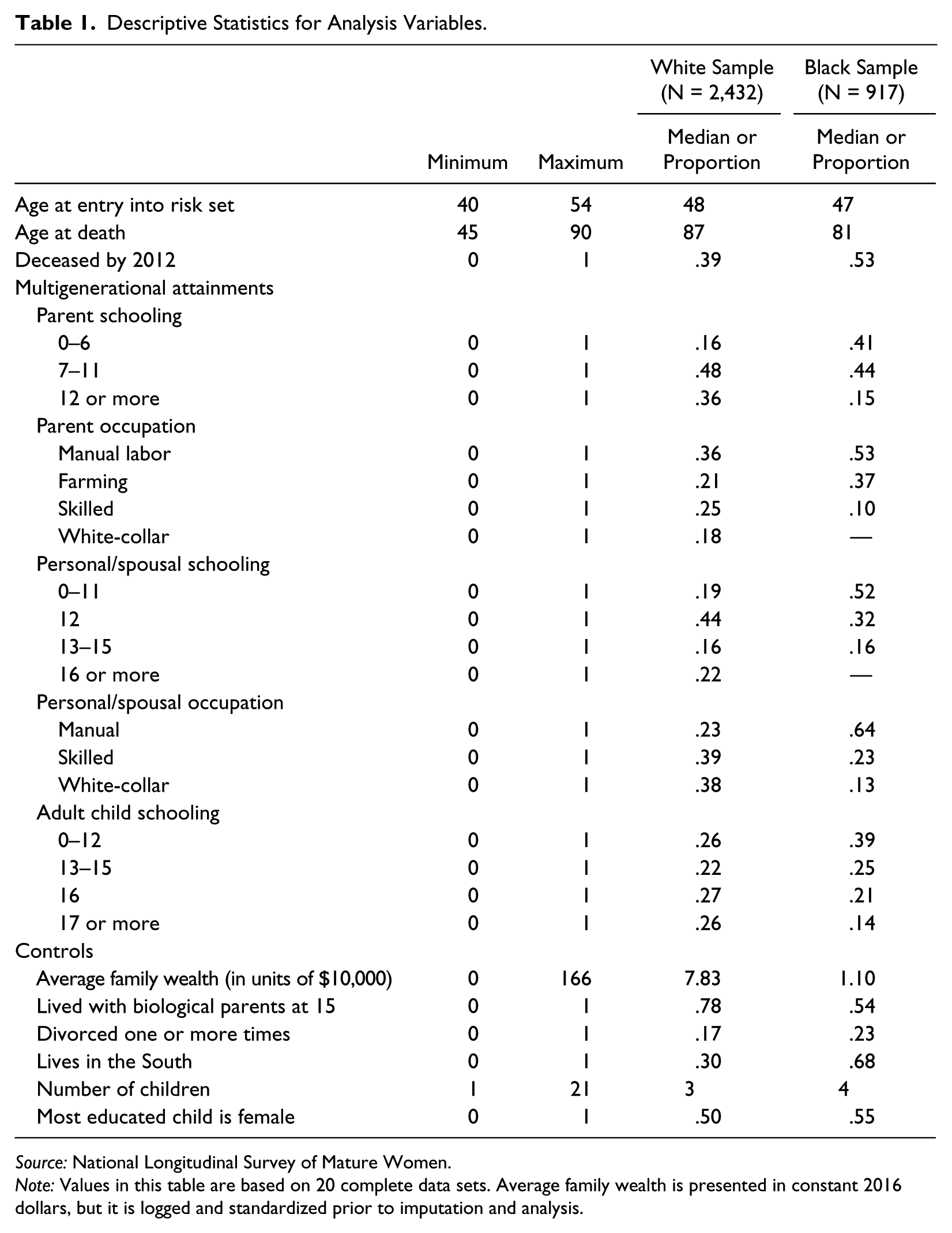
Respondents’ age at entry into the risk set ranged from 40 to 54 (see Table 1) with a median age of approximately 48 for the white sample and 47 for the black sample. By 2012, 43% of the sample was deceased, with an estimated median age of death of 85 years old. This varied by race, though. A much larger proportion of the black sample was deceased by 2012, .53 compared to .39 for the white sample, and the estimated median age of death among whites was 87 and only 81 for the black sample.
Descriptive Statistics for Analysis Variables.
Source: National Longitudinal Survey of Mature Women.
Note: Values in this table are based on 20 complete data sets. Average family wealth is presented in constant 2016 dollars, but it is logged and standardized prior to imputation and analysis.
Because each generation usually included multiple members—mother/father, respondent/spouse, and two or more children—we combined attainment information in meaningful ways to create variables that broadly characterize the attainment of each generation. Because spousal attainment was critical to the quality of life for this cohort of women and their mothers (see our prior discussion of the inequality of attainment opportunities in the mid-twentieth century), we used the head of household attainment when respondents were adolescents, typically their father, to create parent attainment, and we used the highest level of education and occupation among respondents and their spouses to create personal/spousal attainment. For adult children, we used the attainment of the highest educated child, an approach used in prior examinations of the social foreground (Torssander 2014). Other measures of children’s attainment, the proportion of children with a certain educational level or the education of the firstborn, for example, have previously been compared and found to yield similar results (Torssander 2013). To check the sensitivity of results, supplemental analyses considered several other operationalizations of multigenerational attainments, including models that separated spouse and respondent attainment (see Appendix available in the online version of the article). These alternative operationalizations supported the same conclusions that are presented here.
Educational attainment
Educational attainment was operationalized as a three- or four-category variable created from meaningful educational thresholds within the historical context of each generation. Parents’ educational attainment was operationalized as (1) 0 to 6 years, (2) 7 to 11 years, and (3) 12 or more years. For both white and black women, far fewer of their parents completed high school and went to college than did future generations (see Table 1). This was not surprising given that their parents grew up when public education was just beginning to spread across the United States. As education became more important for success in the U.S. labor market, the average years of schooling increased. However, the rise in educational attainment disproportionally favored white women and men. To reflect this trend, personal/spousal education was measured as (1) 0 to 11 years, (2) 12 years, (3) 13 to 15 years, and (4) 16 or more years for white women. For black women, personal/spousal education was measured as (1) 0 to 11 years, (2) 12 years, and (3) 13 or more years. We did not include a fourth category for black women because only 64 black women or their spouses in our final sample attained 16 or more years of education. Cohorts following the Silent Generation experienced an even greater expansion of education. Thus, adult children’s attainment was measured as (1) 0 to 12 years, (2) 13 to 15 years, (3) 16 years, and (4) 17 or more years. Models that included adult attainment also control for respondents’ total number of children, gender of respondents’ most educated child, and year information was collected about adult children (1977, 1986, 1999, or 2003).
Occupational attainment
Due to the limited opportunities for educational attainment among the parents of the NLS-MW women and the women themselves, occupation was also used as an additional indicator of socioeconomic status. Parents’ occupational attainment were measured as categories that included manual (private household, service, operators, transportation, or laborers), farming (farmers and farm managers), skilled (technical and related support, sales, administrative support, protective services, or the military), and white-collar (managerial or professional occupations). The same set of occupations was created for respondents with the exception of farming, which only a small number of respondents reported. Unfortunately, the NLS-MW did not collect information on the occupations of women’s adult children.
Wealth
The final model included a measure of average family wealth, which was constructed by taking the average of women’s wealth from the 1967, 1971, 1972, 1977, 1982, 1987, 1989, 1995, 1997, 1999, and 2001 surveys for respondents 65 and younger in the given year. To create total net assets, the NLS takes the sum of women’s housing, savings, bond, Individual Retirement Account (IRA), insurance, and business assets and then subtracts mortgages, loans, and other debts (excluding automobile wealth). A small number of respondents (N = 265) had a negative average, which was recoded to 0. Before imputation, respondents’ wealth was converted to 2016 dollars, logged, and standardized, and outliers were moved closer to the center mass of the distribution (within three standard deviations of the mean). In supplemental analyses, we also considered variation in average wealth, average family income, variation in family income, and a measure of wealth that adjusted for married couples. Results led to the same conclusions we present here (see Table A7 in the Appendix in the online version of the article).
Sociodemographic controls
Every model in the analysis controls for a number of important factors related to multigenerational attainments and mortality (see Table 1). First, family structure at age 15 was defined as living with both biological parents or living in some other family structure. Second, marital history was measured as an indicator of whether respondents ever experienced a divorce. Marital status was measured as a simple binary because a majority of the NLS-MW remained married throughout the survey and virtually none of the sample remained unmarried (N = 4 for the white sample and N = 43 for black sample). Finally, models control for whether the respondents lived in the South.
Methods
For the next step in the analysis, we used a modeling and postestimation strategy that was meant to identify the associations between each generation’s attainment and mortality and the degree to which those associations were robust to the inclusion of other generations’ attainments and controls. First, we began with a descriptive analysis of how socioeconomic attainments vary across generation and race. Next, we estimated a series of Gompertz hazards models that examine the associations between parent, personal/spousal, and adult children’s attainments and mortality separately before fitting a model that included the attainments of all three generations and a final model that adjusted for family wealth (see Section 6 for a more detailed discussion of our methods and Table A8 for comparisons with semi-parametric Cox models, available in the Appendix in the online version of the article).
The analysis was stratified by race, but we also fit auxiliary models on the full sample that included interaction terms between race and each measure of attainment to test racial differences (see Tables A1 and A2 in the Appendix in the online version of the article). To consider the relative importance of adjacent generations in the overall multigenerational structure of G2 mortality by race, we also predicted median ages of death using different values of parent and adult child attainments with Stata’s margin command (StataCorp 2017). Standard errors and confidence intervals for the median ages of death were calculated using the delta method. Statistical tests for the attenuation of coefficients across models were conducted using Stata’s suest command.
Results
Figure 1 illustrates baseline predicted survival curves by race, educational attainment, and generation. The first two panels show respondent curves by parental educational attainment. Although differences are relatively small, each curve for white women is discernable and suggests an improvement in mortality risk with each increase in educational category. For black women, however, the survival curves related to their parents’ education are nearly overlapping. In the middle row of Figure 1, the survival curves related to personal/spousal education are more distinct for white women, whereas the curves for black women are nearly identical for the 0 to 11 years of schooling category and the 12 years of schooling category, with a moderate increase in survival for the 13 or more years of schooling category. In contrast to parent and personal/spousal attainments, the education of women’s adult children shows a similar relationship to black and white women’s survival, with the smallest difference occurring between the 13 to 15 and 16 years of schooling categories and the largest difference occurring between the 0 to 12 and the 17 or more years of schooling categories.
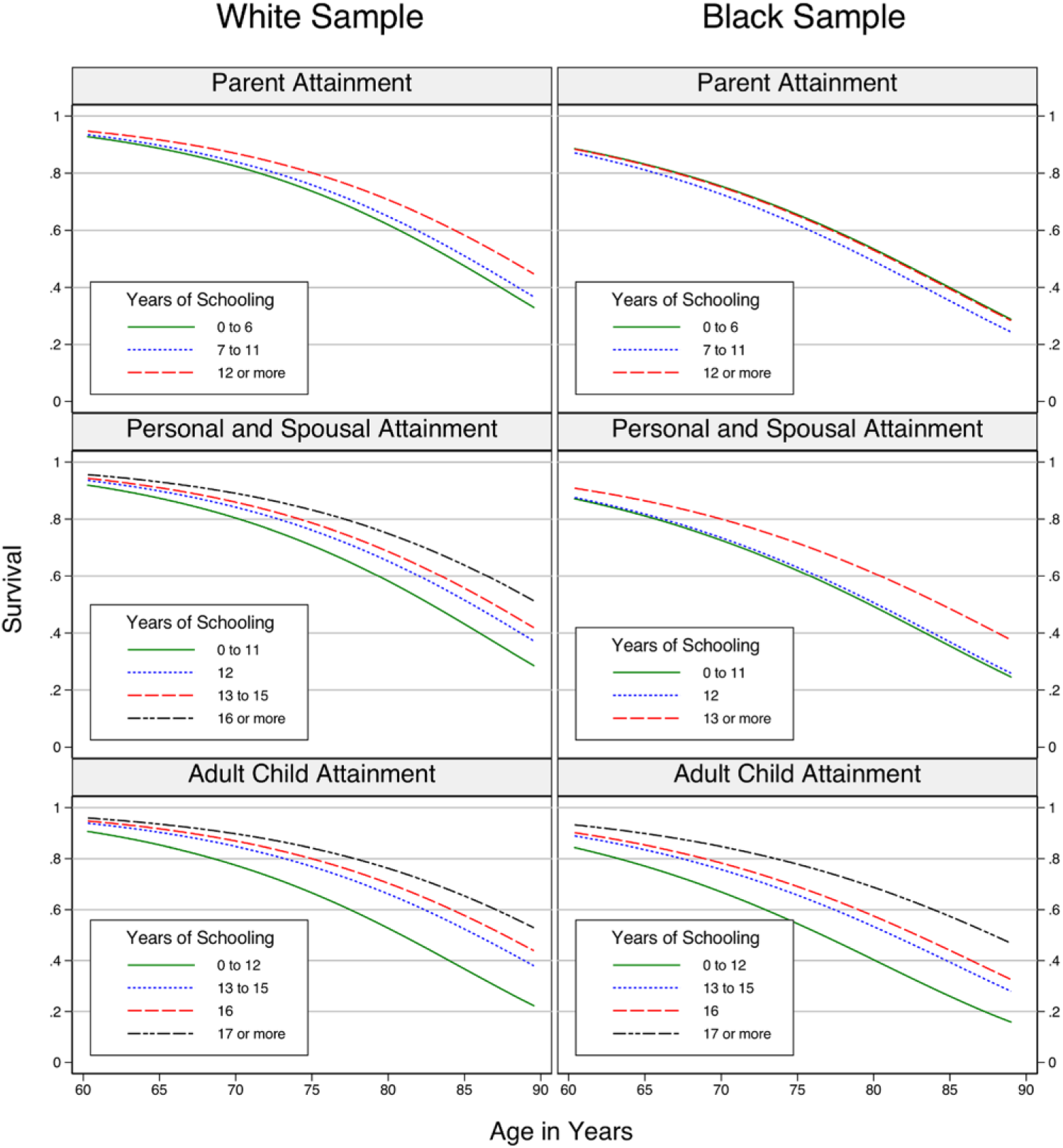
Baseline Predicted Survival Curves by Race, Familial Generation, and Educational Attainment.
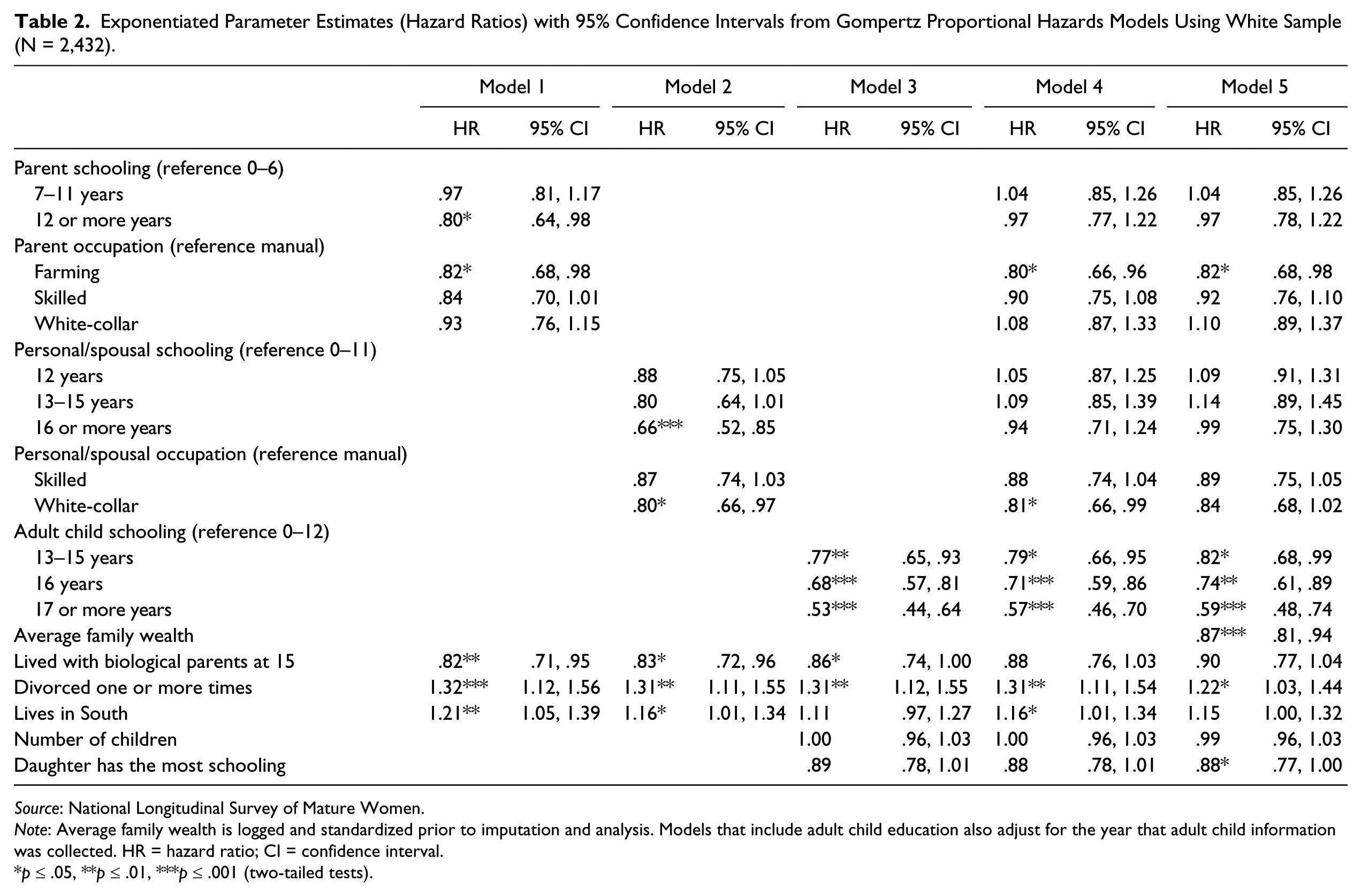
Table 2 presents results from Gompertz hazards models for white women. The attainments of all three generations were initially associated with white women’s mortality risk. In Model 1, we found that having parents with 12 or more years of education and parents who were farmers were associated with a 20% and 18% reduction (95% CIs = .64, .98 and .68, .98, respectively) in the hazard of mortality, respectively. In Model 2, 16 or more years of schooling and white-collar occupations were associated with a 34% and 20% reduction (95% CIs = .52, .85 and .66, .97, respectively) in the hazard of mortality, respectively. In Model 3, we observed roughly the same association with adult child schooling, and the hazard of mortality increased from a 23% reduction to a 47% reduction (95% CIs = .65, .93 and .44, .64, respectively) across higher levels of schooling. The associations between G1 and G2 educational attainments and G2 mortality risk were reduced to nonsignificance in Models 4 and 5. Each of the changes observed in the coefficients for parent and personal/spousal education from their baseline associations in Models 1 and 2, respectively, to Models 4 and 5 in Table 2 were significant at the .05 level or lower (see the Appendix in the online version of the article for model comparisons). However, even after controlling for wealth and the attainments of all three generations in Model 5, adult child education was related to a significantly lower mortality risk among older women, ranging from a 18% reduction (95% CI = .68, .99) for 13 to 15 years of schooling to a 41% reduction (95% CI = .48, .74) for 17 or more years of schooling.
Exponentiated Parameter Estimates (Hazard Ratios) with 95% Confidence Intervals from Gompertz Proportional Hazards Models Using White Sample (N = 2,432).
Source: National Longitudinal Survey of Mature Women.
Note: Average family wealth is logged and standardized prior to imputation and analysis. Models that include adult child education also adjust for the year that adult child information was collected. HR = hazard ratio; CI = confidence interval.
p ≤ .05, **p ≤ .01, ***p ≤ .001 (two-tailed tests).
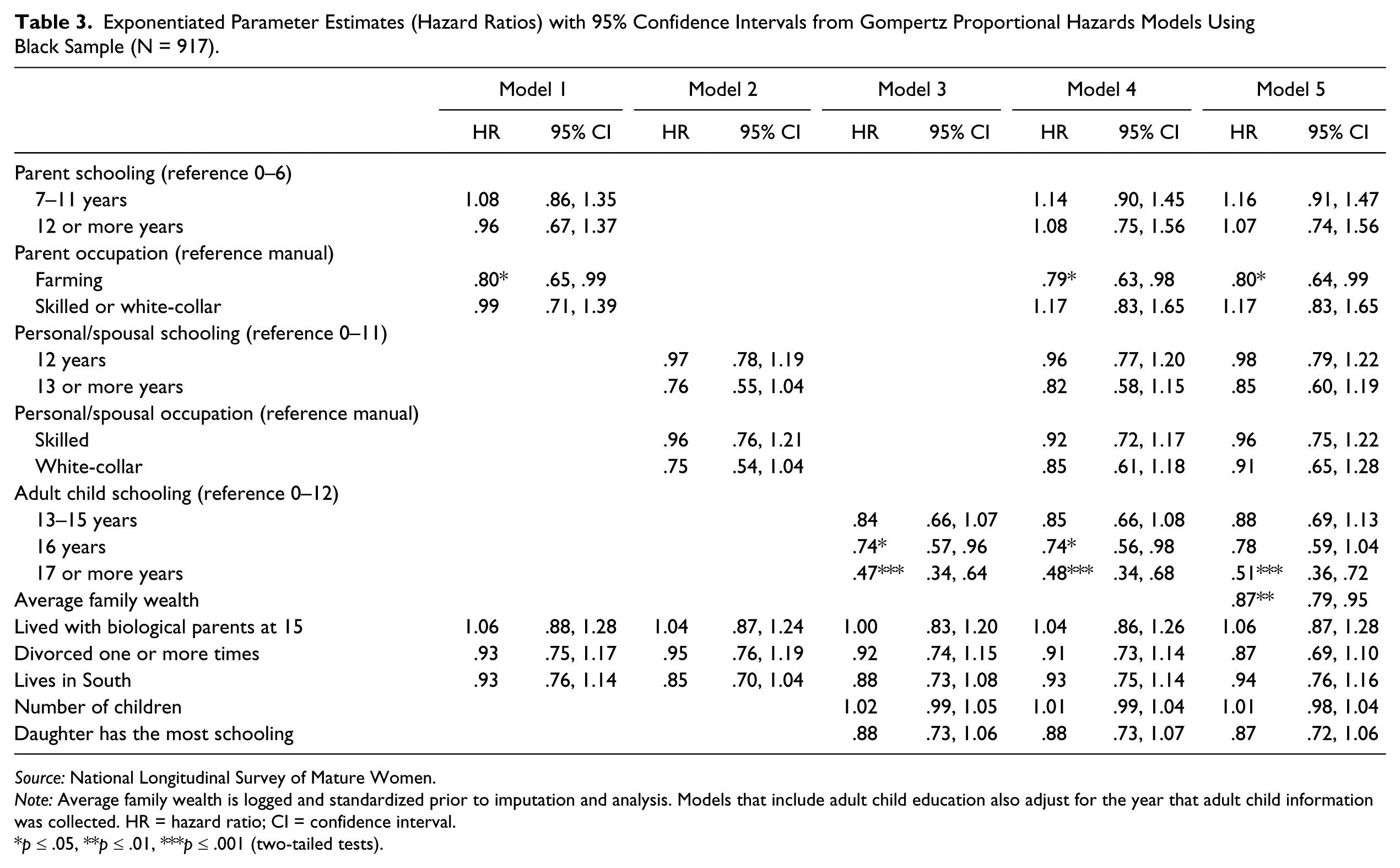
Table 3 presents results for black women. Like the white sample, black women’s survival provided support for a multigenerational process in which aspects of G1, G2, and G3 socioeconomic attainments were independently associated with G2 mortality risk. In Model 1, we observed a similar association for parent farming as with white women—having parents who were farmers was associated with a 20% reduction (95% CI = .65, .99) in the hazard of mortality. Similarly, in Model 3, having more education adult children was associated with a 26% and 53% reduction (95% CIs = .57, .96 and .34, .64, respectively) in the hazard of mortality for 16 years of schooling and 17 or more years of school, respectively.
Exponentiated Parameter Estimates (Hazard Ratios) with 95% Confidence Intervals from Gompertz Proportional Hazards Models Using Black Sample (N = 917).
Source: National Longitudinal Survey of Mature Women.
Note: Average family wealth is logged and standardized prior to imputation and analysis. Models that include adult child education also adjust for the year that adult child information was collected. HR = hazard ratio; CI = confidence interval.
p ≤ .05, **p ≤ .01, ***p ≤ .001 (two-tailed tests).
In contrast to white women, parent and personal/spousal educational attainments were not significantly associated with black women’s mortality in any model. With respect to G3 attainment, however, we found a robust relationship between education and black women’s mortality. In analyses not shown, we tested racial differences in the relationships between multigenerational attainments and mortality with interactions between race and education (see the Appendix in the online version of the article). Overall, those results supported the conclusion that parent, personal, and spousal educational attainments provided a greater advantage for the survival of white women. With respect to adult children, however, this trend was not observed. That is, the association between adult child educational attainment and mortality did not significantly differ between black and white women.
In Figure 2, we provide an illustration of the substantive effect sizes of the associations between adjacent generations and survival by comparing the predicted median ages of death for white and black women by category of parent occupation and adult child education. These predictions were calculated using coefficients from a reduced Gompertz hazard model with interactions between race and parent occupation, adult child education, family wealth, and sociodemographic controls (the information used to create Figure 2 is available in Tables A4 and A5 in the Appendix in the online version of the article). The dashed lines in the figure represent the unadjusted medians for the white and black samples at 87 and 81, respectively. For parents’ attainment, the largest inequalities in women’s survival occurred among the children of skilled and manual workers (approximately 8 and 4 years, respectively), whereas the children of farmers had the smallest racial differences in median age of death at 3 years (95% CI = .74, 5.8). In terms of adult children’s education, the smallest racial inequality in survival was among the mothers of high achievers, a difference of only 3.6 years (95% CI = −.15, 7.35) between white and black women who had children with 17 or more years of schooling.
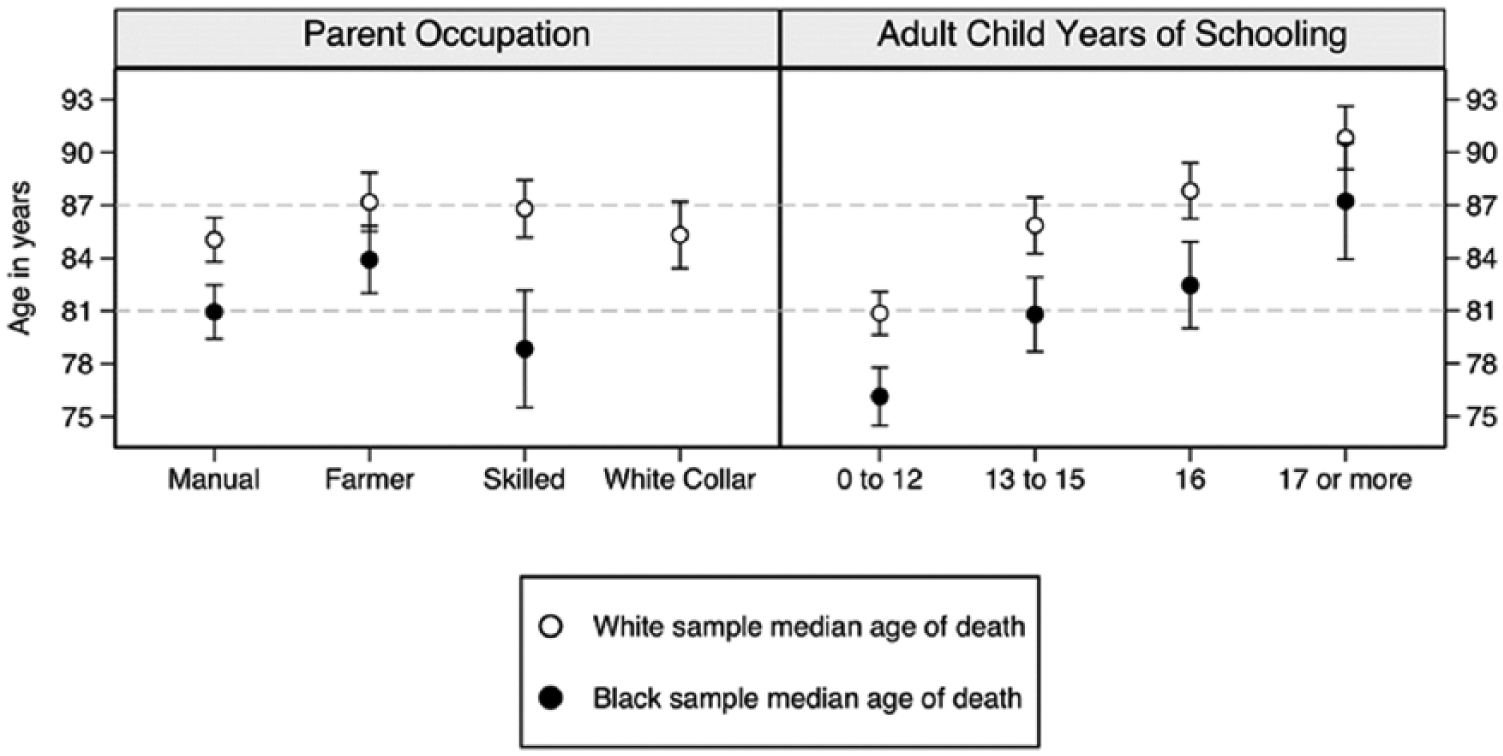
The Estimated Median Age of Death by Race and the Attainments of Adjacent Generations.
Discussion
An emerging literature suggests that the socioeconomic attainments of parents and adult children may provide an array of life-extending resources in old age. However, research has neither tested whether this multigenerational structure exists in mortality disparities for women nor considered the impact of race. Using data from the NLS-MW, we find evidence of (1) a multigenerational model in which aspects of G1, G2, and G3 attainments are independently linked to G2 survival among both black and white Silent Generation women and (2) racial differences in the associations between G1 and G2, but not G3, educational attainments and G2 mortality. Results from the analysis were broadly consistent with prior research and move the literature forward in several ways. Below, we discuss our key findings, notable limitations of the data and analysis, and broader implications of the current study for future research.
Key Findings
First, the analysis found evidence of a three-generation model in which parent, personal/spousal, and adult child attainments were linked to the survival of Silent Generation women. Results from Gompertz proportional hazards models suggested that having parents who were farmers, accumulating greater wealth, and having high-attaining adult children all independently reduced mortality risk among older women regardless of race. Even after adjusting for wealth and sociodemographic controls, our final model predicts that those with higher multigenerational attainments will live significantly longer, suggesting that the flexible resources linked to the attainments of adjacent generations are potentially quite consequential. Thus, consistent with the long arm and social foreground perspectives, our results support relaxing the unidirectional nature of prior multigenerational models to identify the full extent of health disparities among older populations of women.
Second, with respect to the long arm perspective, results support prior studies that have found living on farms or in rural areas reduces one’s mortality hazard in adulthood (Warner and Hayward 2006). The NLS-MW participants were born between 1923 and 1937, which means these women were born immediately prior to or during the Great Depression. Farming in this period was common, and while they did not avoid the financial repercussions of the Great Depression, farmers were in a much better position to grow food for their families when malnutrition was believed to be widespread among children (Watkins 2000). Growing up on farms may have also reduced women’s exposure to pervasive air and water pollution in urban areas prior to federal policies like the Air Pollution Control Act of 1955, and even though the biological pathways remain unclear, recent studies still find that farming communities have lower rates of a number of health issues, especially respiratory problems (Stein et al. 2016).
Third, with respect to the social foreground perspective, we find that the schooling of adult children had a robust association with both white and black women’s mortality. This result provides further evidence that the socioeconomic attainments of adult children are related to life expectancy (Friedman and Mare 2014; Torssander 2013, 2014; Zimmer et al. 2016). The social foreground’s inversion of the more commonly studied intergenerational transmission processes represents an important shift in thinking for researchers, especially as the United States experiences a dramatic increase in the population of older adults in the coming years (Ortman, Velkoff, and Hogan 2014).
Fourth, we found racial differences in the associations between parent and personal/spousal educational attainments and mortality but not in the association between adult child education and mortality. In models that considered generations separately, parent and personal/spousal education had significantly larger associations with the survival of white women compared to black women, which is consistent with prior research (Kelley-Moore and Huang 2017; Shuey and Willson 2008). However, our work went a step further by examining adult children’s education, which was an equally robust predictor of black and white women’s survival. Thus, the education of their children may supply Silent Generation black women with health-related resources that their own education, in addition to the educational attainments of their parents and spouses, did not provide.
Related, even though the children of Silent Generation black women had greater access to attainment structures than their mothers, substantial racial inequalities in educational and labor market outcomes still existed. In our sample, for example, the most educated child of 39% of black women had 12 or fewer years of schooling, compared to only 26% of white women. Furthermore, the estimated median age of life for black women who had children with 12 or fewer years of education was younger than all other estimates, including black women’s unadjusted median age of death. Thus, the black women who had the weakest familial safety nets with respect to socioeconomic attainment were also those who died at the youngest ages.
Limitations
Our study is unique in its ability to examine the effects of multigenerational attainments on women’s mortality, but our findings are limited in ways that provide future opportunities for research. First, the NLS-MW does not contain information on the economic attainment of parents or the economic or occupational attainments of adult children. While having parents who farmed was related to a reduction in mortality hazard, parents’ long-term economic circumstances would have likely provided a better indicator of women’s childhood conditions. For example, using family income in addition to occupational and educational information, Pudrovska (2014) found a robust association between parent SES and mortality. However, this association did attenuate as the population aged. Thus, the relatively weak association between parents’ attainment and women’s mortality may be the result of an insufficient measure of economic circumstances or the diminishing effect of childhood SES as the population ages.
Second, this study finds a robust relationship between adult child schooling and mortality, but it does not examine intervening mechanisms or address all potential confounders. Torssander (2013) addressed some of the potential concerns regarding a causal interpretation by using family fixed effects models, which reduce the influence of unobserved family characteristics, and we controlled for family wealth and family structure throughout one’s life course. Nevertheless, unobserved variation may still account for this association, and elucidating the causal mechanisms and addressing endogeneity within families are important next steps for research. For example, adult children’s education might be capturing the association between survival and mother’s unobserved human capital or family characteristics that neither parental nor personal/spousal attainments fully capture. Likewise, parents who value education and/or seek to help their children become upwardly mobile are often the product of similar family expectations and circumstances. In other words, which children—and grandchildren—attain more is not random (Song and Mare 2017). Unobserved characteristics of women and families like this may also be related to women’s health, and although this point does not necessarily contradict the social foreground hypothesis, it does suggest that future research should clarify the dynamic interplay between generational attainments, family and parent characteristics, and health.
Implications for Scholarship and Future Research
Despite these limitations, our findings have important implications for scholarship and future research in several areas. First, given the shifting impact of gender, race, and education on life chances across the twentieth century, health disparities scholarship comparing cohorts should consider multiple sources of status. For women in the Silent Generation and black women in particular, many of the flexible resources related to health were inaccessible by way of personal attainment due to the systematic lack of opportunity to achieve academically or exchange academic achievement for economic returns in the labor market (Goldin 2006; Jacobs 1996). Thus, to identify the full extent of health disparities among populations with few opportunities for personal attainment, future research should continue examining the relationship between family attainment and health.
Second, our findings also have implications for research examining social relationships and health in later life. Close relationships and strong social networks among older adults are related to health and longevity (Cornwell and Waite 2009; Umberson 2017), but functional decline and the accompanying increase in household disorder, including general household disrepair, clutter, lack of cleanliness, odor, and noise, in the dwellings of older adults are related to a reduction in network size, number of friends, social support, and social interactions (Cornwell 2016; Schafer 2018). Older adults are also more likely to lose close relationships through death, especially black women, which can be emotionally devastating and socially isolating (Umberson 2017). This area of research suggests that visits to help elderly family members with small tasks like cleaning around the house and transportation to social activities could help reduce their social isolation and improve the health of elderly populations. However, because the United States is currently undergoing a dramatic increase in the population of older adults (Ortman et al. 2014) and more recent cohorts of women are generally providing fewer hours of informal carework (Pavalko and Wolfe 2016), social isolation and its consequences are likely to grow among elderly populations, especially among disadvantaged groups with less stable social networks (Cornwell 2015). Thus, to better detect vulnerable populations, future research in this area should consider incorporating the socioeconomic attainments of kin networks into models of aging, social isolation, and health.
Third, our findings suggest that future studies of SES and health across the life course might benefit from additional information on the socioeconomic resources of family members when studying older populations. Personal attainments may be poor indicators of material and social circumstances in later life when people begin to rely more heavily on assistance from family. During this period of the life course, the weakening of the SES-health association that studies often observe (e.g., Brown et al. 2016) may in part reflect a decoupling of personal attainments from material circumstances as exogenous factors begin to have an increased impact on quality of life and health due to the economic and physical vulnerability of older populations. Thus, measures of socioeconomic resources that include multigenerational attainments might be necessary to fully identify socioeconomic inequalities in older populations.
Finally, our findings have implications for future research on racial inequalities in asset accumulation and health. Broadly speaking, the association between adult children’s education and women’s survival we found in the analysis was similar for black and white women, but the current study did not elaborate on racial inequalities in the lives of black children and what that might mean for their parents’ health. High-attaining children generally come from similarly high-attaining parents (Torche 2011), but unlike their white counterparts, high-attaining black children often provide financial assistance to family and friends due to the disadvantaged nature of their networks (O’Brien 2012)—what Portes (1998) calls “negative social capital.” Successful white children are frequently embedded in advantaged networks that rarely need financial or instrumental support until much later in life, which frees future generations to accumulate personal assets, like purchasing a home or building an investment portfolio, as soon as they enter the labor market. For successful black children, however, giving financial assistance to their networks, while beneficial for family and friends, is yet another obstacle in gaining financial stability and wealth and avoiding debt (Conley 1999; Killewald, Pfeffer, and Schachner 2017; Oliver and Shapiro 1995). When considered with our results, this suggests that institutional racism in a focal generation’s attainment directly affects their health and mortality in adulthood (Phelan and Link 2015; Williams 2012) and then indirectly in old age as the upstream effect of racism constrains the ability of high-attaining black children to accumulate wealth and in turn reduces the overall resources available to elderly black populations. Thus, social policies aimed at improving educational opportunities for black youth and asset accumulation among young black adults could offer potential, though indirect, paths to reducing racial inequalities in survival among elderly populations.
Supplemental Material
DS_10.1177_0022146518784596 – Supplemental material for Multigenerational Attainments, Race, and Mortality Risk among Silent Generation Women
Supplemental material, DS_10.1177_0022146518784596 for Multigenerational Attainments, Race, and Mortality Risk among Silent Generation Women by Joseph D. Wolfe, Shawn Bauldry, Melissa A. Hardy and Eliza K. Pavalko in Journal of Health and Social Behavior
Footnotes
Acknowledgements
The authors are grateful to the anonymous JHSB reviewers and the editor, Dr. Richard Carpiano, for providing invaluable feedback during the revision process.
Supplemental Material
The Appendix is available in the online version of the article.
Authors’ Note
Previous versions of this paper were presented at the annual meetings for the American Sociological Association, International Sociological Association, and in the departments of Sociology and Human Development and Family Studies at Purdue University.
Author Biographies
References
Supplementary Material
Please find the following supplemental material available below.
For Open Access articles published under a Creative Commons License, all supplemental material carries the same license as the article it is associated with.
For non-Open Access articles published, all supplemental material carries a non-exclusive license, and permission requests for re-use of supplemental material or any part of supplemental material shall be sent directly to the copyright owner as specified in the copyright notice associated with the article.
