







Abstract

RESEARCH PROBLEM & DATA
Do state laws granting undocumented immigrants access to driver’s licenses improve birth outcomes among Mexican and Central American immigrants?
State-level immigration legislation has been on the rise for two decades. Whereas some state policies aim to drive out immigrants by enhancing immigration enforcement and restricting immigrants’ access to services and benefits, others aim to support immigrant integration by expanding protections from deportation and increasing access to key resources. One such resource is driver’s licenses. Nineteen states and the District of Columbia have enacted laws expanding access to driver’s licenses to undocumented immigrants, most recently Minnesota in 2023. Research shows restrictive policies can negatively affect the health and well-being of immigrants and their children. It is unknown if and how supportive state-level immigration policies, such as those expanding access to driver’s licenses, impact health.
We examined the birth records of more than 4 million singleton births born to Mexican and Central American immigrants between 2008 and 2021 who lived in a state that adopted a driver’s license policy during the study period. We use multivariable log binomial and linear models to estimate the association between state laws granting undocumented immigrants access to driver’s licenses and perinatal health. In addition, as a control measure, we replicated the analysis for U.S.-born, non-Hispanic White pregnant people living in the same states.
KEY FINDINGS
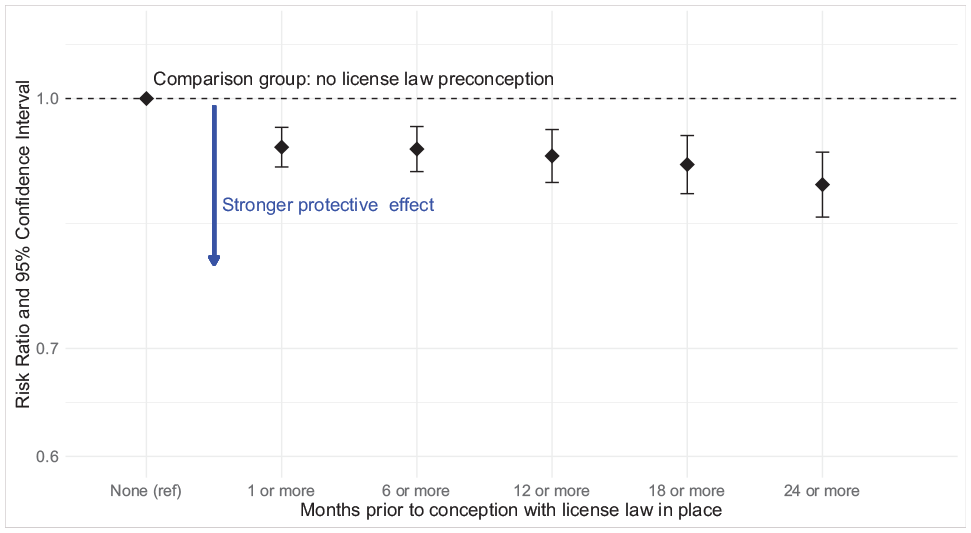
For Mexican and Central American immigrants, implementation of a license law is associated with fewer low birth weight births and higher mean birth weight—critical measures of early development (see Figure 1).
The association between license laws and birth weight was stronger the longer the law was in effect (see Figure 1).
License law implementation was not associated with birth weight for U.S.-born non-Hispanic White pregnant people, a group for whom no effect from the law was expected.
Protective Association between Preconception Exposure to Driver’s License Laws and Low Birth Weight Births to Mexian and Central American Immigrants, 2008–2020.
Note: Adjusted for fixed effects for state, year (continuous and quadratic), parity (binary), birthing person’s age (continuous and quadratic), country of origin, rurality (county-level, binary), unemployment rate (state), % of Latine individuals who are noncitizens (state), % of foreign-born Mexicans and Central Americans who are noncitizens (state), % of adults without a high school diploma (state), and Immigration Climate Index (state).
POLICY IMPLICATIONS
Findings from this study show the potential for an individual state policy to positively shape the lives of immigrants and their families amid a largely restrictive federal immigration climate. The laws included in this study were implemented between 2013 and 2020—a period characterized by increasingly negative discourse around immigration nationally and an increasingly restrictive federal immigration enforcement climate under President Trump. Within this context, we find that extending the legal right to drive to undocumented immigrants is associated with health benefits for the children of Mexican and Central American immigrants. These laws likely influence birth outcomes by lessening deportation fears and subsequent chronic stress, a key risk factor for low birth weight, and increasing immigrants’ access to financial resources, including better paying jobs and more weekly work hours. State policies that facilitate immigrants’ integration into U.S. society may buffer against a restrictive federal immigration climate.