







Abstract
This study offers alternative interpretations of war-related distress embedded within the social and political context of the Vietnam War. Subjective interpretations from aging Vietnam veterans were analyzed using interpretative phenomenological analysis. A central theme—Moral authenticity: Overcoming the betrayal and shame of war—overarched five subordinate themes. Four subordinate themes encapsulated layers of war-related betrayal associated with shame. Shame was likely to be described as either (a) internal/sense of personal failure, with no acts of rage; or (b) external/reckless or threatening acts of others, engendering rage. A fifth theme, reparation with self, reflected humility, gratitude, and empathy, currently undefined domains of the growth construct.
Keywords
Introduction
The Vietnam War profoundly affected many of those who served. Distress associated with the Vietnam War led to the introduction of the diagnosis of posttraumatic stress disorder (PTSD; American Psychiatric Association, 1980), a diagnosis that is based on a medical paradigm that indirectly provided a context for empathic societal acceptance of the once ostracized Vietnam veteran. In addition, the language of disorder created a shared understanding across professional disciplines (Creamer, Burgess, & Pattison, 1992; Horowitz, 1986; Janoff-Bulman, 1989, 1992; Rachman, 1980), allowing for communication between the legal, political, and psychiatric realms. While helpful in providing recognition of the psychological distress experienced by Veterans, the medical label of PTSD individualized their experiences. As such, almost 40 years on there is a wealth of research on PTSD but relatively little on the social psychology of how individual reactions interact, positively and negatively, with the social context.
The literature that does address the wider social and political context shows that: first, the intensity and escalating antiwar movement in a number of affected societies led many serving individuals to believe that the war was morally wrong (Doka, 2002; Harvey, 2002); and second, confronted by an atmosphere of defeat on homecoming, many found the antiwar marches and protests personally invalidating and antagonistic (Fleming, 1985; Goodwin, 1987; Shay, 2002). As a consequence, many returnees questioned their own moral integrity during war (e.g., DePrince & Freyd, 2002; Joireman, 2004; Kauffmann, 2002; Wilson & Droždek, 2006) leading to feelings of alienation, loneliness, and abandonment (e.g., Doka, 2002; Fiala, 2008; Harvey, 2002; Kauffmann, 2002; Shay, 1994).
The sense of betrayal was sometimes too much to admit leading to the individual internalizing feelings of guilt and shame (Wilson & Droždek, 2006). Seen from the traditional diagnostic perspective, such feelings of shame and guilt become target symptoms for treatment. But from a social psychological perspective, shame and guilt can be understood differently as emotional states that serve to promote individual moral integrity and social justice by motivating avoidance of unethical behavior in future situations or through the reparation of wrongs (e.g., Tangney, Wagner, Fletcher, & Gramzow, 1992; Wilson & Droždek, 2006).
It is within the above context that we were interested in the subjective individual lived experiences over decades of veterans from contentious wars, particularly complex feelings of betrayal, guilt, and shame. In particular, we were interested in whether those complex feelings of distress could be redefined positively over time despite lack of societal support for reintegration. Current growth literature suggests that posttraumatic growth is dependent on positive social support (Joseph & Linley, 2005; Ryff, 1989; Tedeschi & Calhoun, 1995). However, more recently some studies suggest that growth may be possible despite social rejection and alienation through a narrative of self-redefinition (McCormack, Hagger, & Joseph, 2011; McCormack & Joseph, 2013).
Drawing on a phenomenological epistemological position, our aim was to explore how Vietnam veterans, exposed to war, and antagonism and blame on their return from war, have redefined their experiences over time. We sought to broaden our understanding of the experience of veterans in relation to the wider societal and political contexts of their lives. Using interpretative phenomenological analysis (IPA; Smith, 1996), we were concerned with the importance of alternative subjective positions and different ways of making sense of the world. From a critical realist position, IPA seeks to describe the way in which the world is socially constructed, interpreted, and understood. As such it provides a platform for phenomenological exploration of a complex subject area through a process of understanding and interpretation and critical reflection of a real world where unobservable realities exist (Blaikie, 1991). This seems an important line of enquiry. Vietnam veterans are now among the older members of society. While the diagnosis of PTSD was a reaction to the early experiences of Veterans in the aftermath of the war, we are now almost 40 years on. Many have carried the diagnosis of PTSD throughout their lives, at times finding it helpful, and at other times unhelpful, but throughout these intervening years it has been the PTSD narrative that has framed their experiences. Forty years on we think it necessary to listen again to the voices of the Veterans themselves.
Method
Participant Recruitment
Ethical clearance was obtained from the university ethics review panel prior to data collection. The participants of the study were sourced through mail-outs and notice boards of social groups within the Vietnam veteran community of a major city.
Participants were informed of the study’s aims and that they could withdraw at any time and request their interviews be destroyed. Following consent, the semistructured interviews were conducted in either the veteran’s home or a place of their choosing. Each lasted approximately 2 to 3 hours, resulting in approximately 25 hours of data. Data were collected using a digital voice recorder.
Participants
Nine participants, all male, aged between 62 and 69 years had spent more than 12 months in Vietnam during the war. All had been involved in active service. Four remained in their first marriage, four were in long-term second marriages or stable relationships, and one was divorced and lived alone. Apart from the veteran living alone, all had adult children. All had received a psychiatric diagnosis of PTSD. All had varying levels of remuneration in the form of pensions for their disabilities and diagnoses. All had sought and received psychological and psychiatric assistance in the last 10 years including combat-specific trauma counseling. Participant names have been changed to safeguard confidentiality.
Interpretative Phenomenological Analysis
IPA is concerned with homogeneity, that is, participants with similar demographic and experiential background. As Vietnam veterans, these veterans complied with the purposive sampling strategy of IPA (Smith, 1996) whereby the topic being investigated holds relevance and personal significance for the participants. IPA is intent on prioritizing rich, idiographic accounts through semistructured interviews. It provides a set of flexible guidelines, adaptable to research aims (Smith, 1996; Smith & Osborn, 2003, 2008; Smith, Osborn, & Flowers, 1999). The aim of IPA is to disentangle an individual’s thoughts (cognition), words (story), and actions (behavior). It addresses the science of experience, that is, the relationship between that which exists outside our minds (objectivity) and the thoughts and ideas individuals have about reality (subjectivity). As such, the researcher seeks to describe rather than explain. IPA is a method for seeking participant’s perceptions and understandings of experiences that are (a) complex, (b) poorly understood, or (c) previously unexplored (Smith, 1996; Smith & Osborn, 2008), yet have either created a critical crossroad or significantly affected individual lives. Therefore, it explores phenomenological uniqueness of the individual within his or her social context (Smith, 1996; Smith & Osborn, 2003, 2008; Smith et al., 1999).
Interviews
Prior to conducting the interviews, the questions were trialed on colleagues for openness and to highlight and eliminate possible interviewer biases and preconceptions. A “funneling” technique (Smith & Osborn, 2008) that elicits general views of an experience and guides respondents to articulate more specific concerns was used. When participants addressed targeted issues early in the interview, this approach allowed flexibility for adapting the interview to follow the participants’ lead. As the experiential experts on the subject under investigation, the duration of each interview was dictated by the extent to which each participant shared.
The interviews were treated as one set of data. The step-by-step stages of the analytic process are provided in Table 1.
Stages of Interpretative Phenomenological Analytic Process.
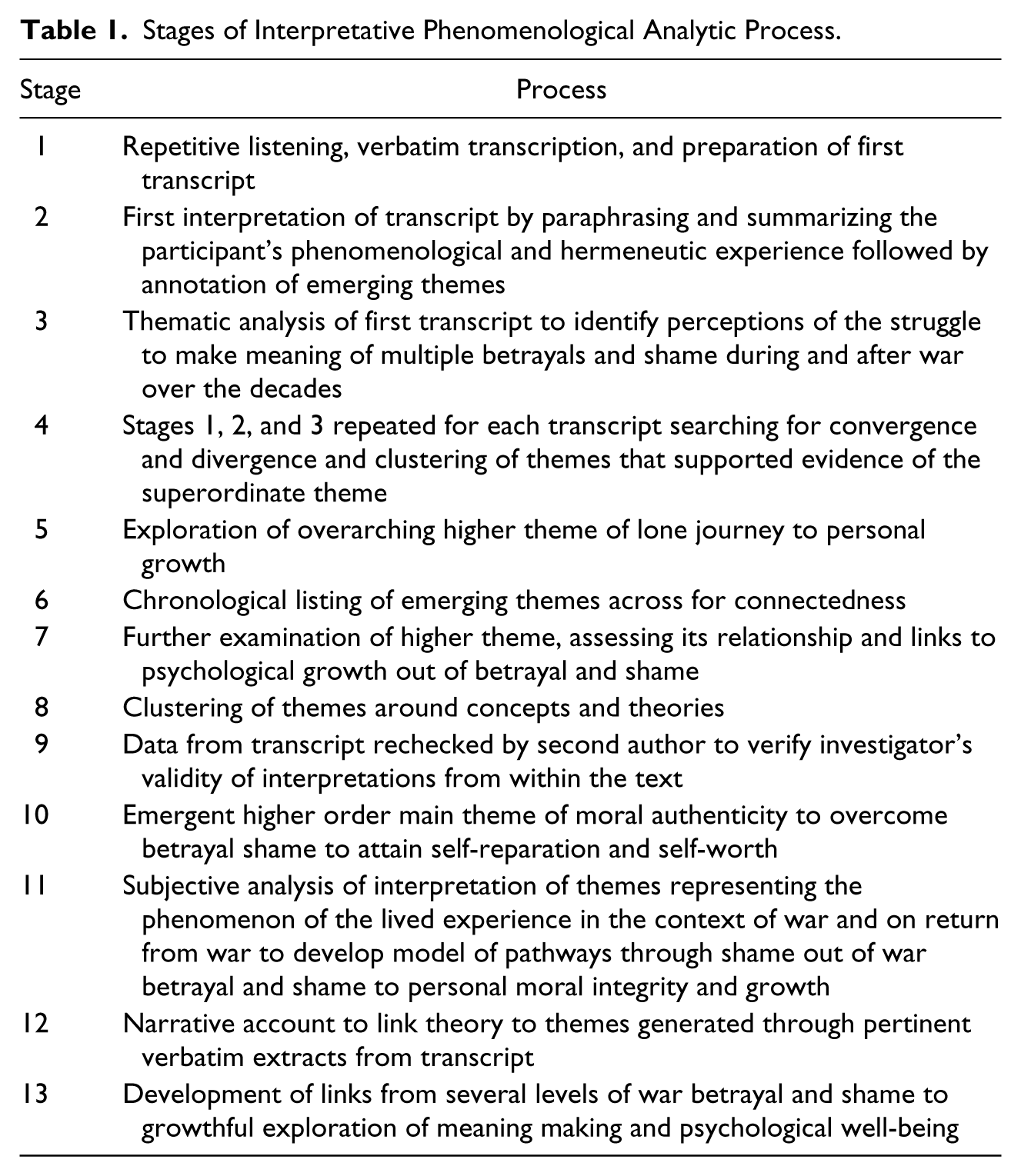
Using IPA to define themes requires a close interaction between reader and script to reduce biases and preconceptions and guards against attempts to shift interpretation out of the participants’ personal/social world into the researcher’s world. Ultimately, there is a merging between the interpretative activity of the researchers and the participants’ narration of their experiences. The researchers’ understanding and interpretations are reworked and refined until a sense of finality is reached regarding the superordinate and subordinate themes. Themes and supportive transcript excerpts are then embedded in a coherent narrative account of the participants’ experiences of the phenomenon under investigation (Elliott, Fischer, & Rennie, 1999).
Validity
Unlike nomothetic research, the authors did not aim to produce evidence of cause and effect or produce a satisfactory interrater reliability score. Rather, the audit aimed to provide the reader with one account of the data that systematically achieved internal coherence and presentation of evidence. As such a detailed audit trail was produced (Smith & Osborn, 2008). The first author, trained in IPA, conducted the interviews and transcribed each verbatim (for notations, see the appendix). The second author conducted an independent audit of the transcripts. Quality control occurred through the independent audit of themes in which the narration was checked for authenticity and thematic representation (for more details on this approach, see Smith, 1996). This was followed by critical reflection and robust discussion between authors to ensure evidence for the themes supported interpretation of the data. Extract notations were logged and a table of higher order themes and subthemes was developed. This process was repeated for each transcript until connections between themes began to emerge across cases.
Results
Following is a narrative descriptive analysis of this study and its thematic outcomes.
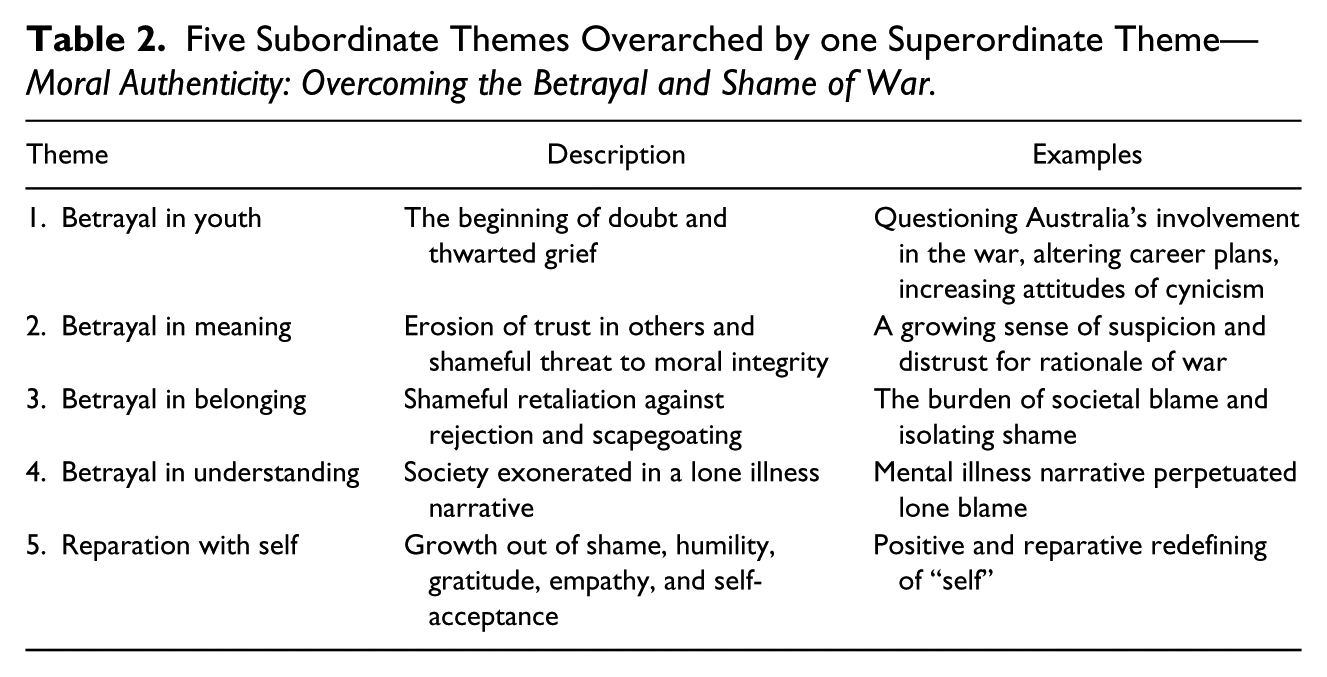
One superordinate theme—Moral authenticity: Overcoming the betrayal and shame of war—emerged overarching five subordinate themes. This superordinate theme encapsulated the veterans’ struggle over decades to pursue reparative self-evaluation and moral integrity. Four of the subordinate themes described the multiple layers of war-related betrayal. A fifth defined domains of psychological growth that contributed to positive change over time (see Table 2). The quotations provide rich evidence from within the data and were not selected on prevalence within the data.
Five Subordinate Themes Overarched by one Superordinate Theme—Moral Authenticity: Overcoming the Betrayal and Shame of War.
Theme 1: Betrayal in Youth: The Beginning of Doubt and Thwarted Grief
In this section, we draw attention to the confusion often felt by Vietnam veterans regarding their involvement in that war and the sequelae of doubt and thwarted grief as a consequence of their experiences.
Doubt
The reality of war altered the dreams and plans of these young lives and left Nick with a legacy of doubt and suspicion: I didn’t really understand what had happened in Vietnam to get us there in the first place. . . . I don’t think many did. We were just sent there—“off you go boys.”
Similarly, Andrew acknowledged feelings of cynicism fueled by increasing doubt that his safety was prioritized to his military caretakers: I remember feeling—why are we helping these people when all they do is turn their back on us and try and shoot us at night-time?
Thwarted Grief
During the war, their doubt was compounded by a need to suppress feelings of mourning and bereavement following catastrophic loss as staying alive became the priority over grieving the dead: We didn’t shed any tears when people died in Vietnam . . . you were totally focused on not getting killed. Watching where you stepped—watching where—everything you did was one second at a time . . . and when they start putting them in body bags . . . you think, this is for real.
For Andrew, thwarted grief complicated mourning. Intermittent and permanent loss of young colleagues, visual cues to prioritize fear and self-preservation, constant changes within the team, all created an atmosphere that disallowed a rite of passage for meaningful mourning. Over the decades thwarted grief found its voice intrusively and unpredictably: A soldier is supposed to feel . . . react only for the group you’re with and that goes out the window when the first body bag . . . and you already know who is in the bag and the reason he is in it because I have been on the radio during the contact with the enemy. Do I feel anger? The answer is yes, very much so. Not much I could have done then. Did I cry then? Yes underneath, but over the years lots.
Yet it was the lifelong sensory legacy of war grief that weighs heavily on Keith. The horror of war is etched in clear images that remain with him as a burdensome co-traveler for life: . . . they’re screaming and in pain and legs missing and ar—bowels sticking out and eyes gone . . . cause it’s life and death, it never leaves you, it’s vivid in your mind all the time . . . you leave it—leave it in the background and get on with your life the best you can but ah—but ah—it’s always there.
Without time or opportunity to articulate and share emotional responses to the horrors of war, sensory memories became indelible images instead of modified narratives through the collective memory. The intrusiveness of trapped sensory memories and thwarted grief remained impossible for Sean to remove in the decades after Vietnam: You can’t deal with daily death . . . you can’t deal with it . . . you never get used to it . . . you can shovel bodies into bags and ship them off on a helicopter, you can dig a grave for—for the dead and bury em—um—but you can’t—can’t erase it from you mind.
Even when the participants felt supported and valued by their military leaders, the unpredictability of death brought grief of interrupted journeys of togetherness and severed inclusive narratives: We grew that close—that’s probably what hurt me the most about the death and destruction—plenty of ours cut to pieces and when you don’t see them anymore and you’ve trained with them, and been through this, then someone comes in and replaces them and—and they are—so that—that—that hurt the most.
Theme 2: Betrayal in Meaning: Erosion of Trust in Others and Threat to Moral Integrity
In this theme, the overwhelming nature of death and associated losses is seen to erode the young veterans’ trust in their military caretakers and create doubt about personal moral integrity. Participants described a growing sense of frustration and suspicion of the rationale for being in Vietnam—were they being betrayed, were they complicit in that betrayal, thereby betraying their colleagues? Moral integrity was called into question, and feelings of shame emerged. They remember shame being expressed in one of two ways: (a) externalized and rageful (e.g., shame related to association with others’ negligent, corrupt, or dishonest actions); and (b) internalized and self-blaming (e.g., sense of personal moral failure).
Externalized Shame
Rageful responses triggered by association with another’s dishonorable actions can be viewed as externalized shame. Noel described a rageful berserk state following three acts of perceived injustice by his senior officer: First incident: We went out on a patrol by ourselves with a handful of Vietnamese, completely by ourselves out there, and we saw enemy not too far away, and he wanted to start shooting at them, and you know—you know, there was about 6 of us—you know he was such a dickhead! Second incident: There was an incident where he made me drive him back . . . right on curfew time, and I said “we can’t go back, you’re drunk.” . . . He ordered me to drive him back and I had to dismantle a road block to get the . . . to keep driving on the road, and when I dismantled the road block, a trip flare went off . . . and we got shot at by the bloody south Vietnamese soldiers.
Making sense of quite out of control rage, Noel illustrates the force of an external challenge to his moral integrity. Rage moved quickly toward an end point of physical threat when he perceived a senior officer acting inhumanely: Third incident: . . . so by the time we got this Vietnamese wounded soldier off one helicopter and waiting for another, I’m already sort of starting to get a bit of head—I’m getting a head of steam up cause this bloke’s such an idiot. . . . Of course the guy died and it ended up that I lost it completely—I just—just went crazy and pulled my rifle on him and threatened to blow his head off . . . quite out of control, because—because of all this (previous) stuff . . . we could have done better.
The target of rage and violence in response to seeming acts of injustice did not always occur immediately or toward the perceived betrayer: Frank: . . . the actions of an inexperienced officer put the rest of the patrol in serious danger during the course of the patrol. The anger was palpable to say the least when the boys got back to camp. What has made the situation worse over the years . . . was that the officer concerned falsified the reports of the events that took place and caused a number of (disability) claims to be denied as the traumatic incident . . . was at odds with the “official report.” Many of the claimants were shattered to find an officer had lied to cover his own shortcomings. There was at least one attempted suicide—thankfully unsuccessful.
Internalized Shame
The meaning of one’s own survival was often questioned. Deep seated shame was often associated with that survival: . . . in my dark times I cry a lot. Maybe it’s the survival guilt coming out. Shame is the other thing that rings strong with me even to this day . . . one in particular I have not discussed with anyone which touches me deeply but that, I take to the grave.
Similarly, internalized dialogues that had no opportunity for verbal expression maintained fragmented and shameful memories, often fuelling honor in death and shameful self-blame in living: Sean: I thought I was a failure there because I went out and got drunk and got beaten up by the White Mice (South Vietnamese police) . . . and while I was in hospital, 9 of my own mates got killed. . . . I’d have been with them . . . so I’d have probably been one of the KIO’s (killed in action). . . . How do you get your head around it. I don’t know. . . . I had a vendetta to fulfill—definitely anger ar—probably towards myself you know. . . . Shame is the question I ask myself lots of times over and over . . .
Forty years after his combat experience, Warren still grieved the circumstances that left him with feeling shamed: I did have and still have a feeling of humiliation in the sense that being a Vietnam soldier was a sense of failure and a waste of my young life. . . . I now feel as I grow older that my Vietnam service was unimportant.
Theme 3: Betrayal in Belonging: Shameful Rejection and Scapegoating
The burden of societal blame and humiliation was an extension to the legacy of the Vietnam War carried by veterans after the war:
Rejection
These participants spoke of being overwhelmed with societal betrayals, including hostile treatment and marginalization on homecoming: “You know, they didn’t even want us back here. . . . I couldn’t pick up where I left off. . . . I just didn’t fit in . . . I felt alienated from them.” Even families rejected them on return: “My family did not want to know.”
Scapegoating and Retaliation
Being scapegoated for unpopular military and political decisions contributed to feelings of alienation and a growing sense of isolation in their social communities: People around me just wouldn’t talk about Vietnam because OK it was a war we lost . . . so the Vietnam veterans . . . got the blame for that.
Feeling judged over wartime events outside their control explosive and retaliatory rage can be seen as a way of rejecting being scapegoated: I just belted seven bells out of this bloke. . . . I felt sorry for the bugger in some respects but unfortunately he made the decision to have a crack at me so bad luck. . . . I will not be afraid to have a go.
Unsurprisingly, societal ill-will on return unleashed a “pressure cooker” of moral rage, war grief, and sense of betrayal: It was just all too hard to stay composed—seemed to be that my emotions were always close to the surface and it didn’t take too much to trigger me off.
For decades after the war, Barry’s perception of his ongoing retaliation against perceived injustices was one of personal handicap. His blame of “self” mirrored society’s blame of the veteran: “I’ve just about gone off the deep end for the thousandth time (be)cause I do fly off the handle—it’s a handicap.”
Theme 4: Betrayal in Understanding: Shame and Misunderstanding in a Lone Therapeutic Narrative
This theme portrays interpretations of continuing betrayal that were perpetuated through an individualist mental illness paradigm: “They thought you were mad. You were on your way to the mad house.”
Narrative of Misunderstanding
An internal struggle persisted between a willingness to accept a lone narrative of mental disorder and therefore blame, and feelings of isolation and rage through societal rejection. Although the granting of the psychiatric diagnosis of PTSD for war-related mental distress was the badge that granted a war pension and societal recognition, Barry still continued to perceive himself as the problematic referential point of blame in need of change: “Trying to get other people to understand—yeah, I’m trying to change.” Similarly, this lone mental illness narrative added to the perception that he was to blame for the negative effects of his war trauma on others: “If I would’ve opened up a little bit more and thought a little bit more, actually those problems might have resolved themselves a little more easily and not caused problems for anyone else.”
Shameful Diagnosis
Mental health categories became entwined within their narratives of self judgment and shame: “When I was diagnosed with posttraumatic stress disorder . . . I felt guilt that I—that I had posttraumatic stress” and “It seems to have a stigma of we’re nuts or lepers.” A betrayal in understanding was articulated as “mental pain” as they struggled to understand a complex set of social events following war: “There’s no two ways about it and it’s hard to describe the mental pain you feel . . . but you do.”
Theme 5: Reparation With Self and Posttraumatic Growth
Within this theme, a positive and reparative redefining of the self followed decades of shameful betrayal. Despite the persistence of negative consequences of the war—ongoing “lack of trust” of society, learning to “put up with the scars,” retreating into alcohol “to console myself,” or to “try and integrate with people and civilian life,” and a deep sense of betrayal through “being controlled by what happened in Vietnam for the rest of my life”—these veterans also interpreted the distress of war as building and enhancing strengths and capacities that would facilitate overcoming adversity in the future.
Reflecting on positives, each participant relayed a story of his former young self that was able to resource strengths and abilities when confronted with war-related adversity. These can be seen as reparative as long-held negative views of “self” took on new meaning: “You were basically thrown in the deep end and made to think, made command decisions . . . and we used to do things that took initiative.” Over time, they came to perceptions and narratives of “self” that shifted from self-devaluing to self-valuing: If I was to draw any positives from Vietnam, I know I’d be a stronger person. . . . I can confront tragedy in front of me . . . emotionally I’ll be strong enough to cope with it. . . . I can confront the demons . . . and I don’t mind shedding a few tears.
Embracing distress, Sean no longer sought to avoid the emotional challenges that had once left him feeling vulnerable and fragile. He recognized a growing willingness to embrace painful memories as part of a self-reparative process irrespective of societal evaluation, “In one sense I try to resurrect emotionally by digging through my past to try and resurrect it . . . it might take me time, but I can—I can confront it.”
Without gratitude by society to provide nurturing reintegration following war, over time Frank was able to begin the process of valuing himself and define what was important in his life. Similarly, he began to observe personal gains in wisdom and autonomy. His private and lone journey of personal reparation became an ongoing search for meaning: I suppose that as you strive to be a better human being, recognition from anyone in relation to oneself becomes less and less important as you realize how much other people do that causes you or what you do to become less important in your own eyes.
Engaging in an iterative process with “self,” moral questioning was viewed as a strength, and emotional pain and grief were conceptualized as experiences that gave rise to growthful domains such as empathic concern for others: “I feel grief for people. Anybody, anybody that has a tragedy in their life you know—I can feel their pain.”
The humility of honest self-evaluation through psychological pain seemed to motivate reparative and positive change for Sean: I went pretty close to the edge . . . that was a good turning point in my life I think and a period of time just talking through whatever . . . if I keep that attitude—if I want to honestly change and something comes up and it doesn’t go right, I can change.
Once shameful, personal involvement was redefined through a humble commitment to honor oneself no more highly than was justifiable. Gratitude emerged from self-acceptance and self-reparation allowing Warren to accept with humility his role in the war. He acknowledged wisdom that grew out of pain: The word humility comes to mind, only that I am older now and wiser, or wiser after the events. I am thankful for what I have and for what I have had . . . yes, humility is a big word for me . . . after all I only did the best job I could under the circumstances.
Noel now recognized that authenticity was more important than what others thought of him. This freed him to remain open to self-driven change. Psychological pain was now seen as uniquely instrumental in facilitating honest self-appraisal thereby bringing a heightened sense of value to his relationships with others and his relationship with himself: . . . to concentrate on the things that are important and not get too wound up with things that are not important . . . because I used to be one that took everything on board with very debilitating effects. I almost killed myself. . . . I’ve had the view of late that if I’m alright, people that matter to me are alright around me.
Discussion
A burgeoning body of research has begun to recognize the importance of using qualitative methods to explore the lived experiences of individuals with traumatic, painful, and chronic life distress (e.g., McCormack et al., 2011; Shinebourne & Smith, 2009; Smith & Osborn, 2008). By focusing on idiographic understandings rather than nomothetic explanations, phenomenological interpretations offer subjective interpretations of distress that are often not fully captured by quantitative approaches.
However, although qualitative methodologies such as IPA complement and illuminate quantitative studies given their meaning-focused approach and detailed construction of subjective-felt experiences, several limitations are of note. First, it is challenging for researchers to be completely cognizant of their biases and presuppositions. Thus, efforts must be made to increase awareness of mindsets that favor and seek out explanations that are consistent with theoretical orientation and training experiences. As such, researchers must be explicit about their philosophical position and conduct a preliminary self-investigation to expose unconscious biases and presuppositions and continue such investigations throughout the research process. Without careful exploration of personal biases and preconceptions and a clear understanding of the phenomenological/qualitative philosophy underlying these positions, there is a risk of compromising the quality of the analyses and/or reverting to traditional patterns (e.g., focusing on generalization rather than individual understanding, utilizing positivist terminology, being influenced by explanations that promote an illness ideology). Second, the subjective world of the participant may inadvertently be neglected in favor of the subjective world of the researcher. Thus, the double hermeneutic approach of IPA necessitates that the researcher strives to remain neutral and reflexive.
Although efforts were made in the present study for researchers to address these concerns, we are aware that while we sought to understand Veterans experiences from their frame of reference, our analysis does reflect to some extent our own frame of reference and in particular the positive psychological conception of posttraumatic growth. Likewise, we cannot rule out the influence of the dominant discourse around PTSD in how this must inevitably influence both our and our participant’s narratives.
Accepting that there are these inevitable limitations of the approach, our analysis offers new ways of conceptualizing the experiences of Veterans that may be useful to clinicians. We found that forms of posttraumatic distress, particularly shame and guilt, seen phenomenologically, can be formulated as ways of coping within the social and political context that facilitated meaning and purpose following the associated grief and betrayal. This provides an alternative narrative to the one of permanent and debilitating mental ill health provided by the medical label of PTSD. By taking the view that behaviors associated with shame and guilt may be either internalized or externalized responses to thwarted grief and others’ betrayal within a social and political framework, support for the individual can embrace complexity of meaning rather than simply psychopathology. This alternate discourse of interpretation is something to be encouraged in the therapeutic environment where individuals can bring hermeneutic and growthful possibilities to traumatic, painful, and chronic life events over a lifetime trajectory when the focus of individual disability is removed.
Specifically, our findings revealed an interplay of factors unique to each participant that produced convergent themes of betrayal over time (see Table 2) as well as different pathways to self-reparation and posttraumatic growth (see Figure 1). In summary, veterans were disenfranchised by a variety of betrayals (e.g., “They didn’t even want us back”) and experiences of grief (e.g., “You can’t deal with daily death . . . you can’t deal with it . . . you never get used to it . . .”) on their return home. Shame was a common response to both betrayal and grief. Externalized shame often occurred via self-association with others’ negligent, corrupt, or dishonest actions, eliciting blame toward others and rage reactions. Internalized shame often manifested itself as consequential self-blaming (e.g., “thoughts about doing harm to myself . . . increasingly as time went on”), eliciting more restrained responses such as self-doubt. Humility facilitated increased empathy, and gratitude arose from experiences of shame and associated coping responses. Wisdom was recognized as emerging from psychological pain. Importantly, this process involved making meaning of feelings of marginalization and stigmatization by society through the creation of a narrative. Fortunately, despite evoking painful distress, shame appeared to be a powerful tool in increasing humility, which, in turn, facilitated self-reparation. Prior research demonstrating that humility can encourage self-compassion, promote greater resilience, enhance wisdom, and facilitate personal growth through acknowledgement of limitations and vulnerabilities (Andre, 2002) is supported by the findings in the present study. These veterans talked of engaging with their distress (e.g., “I try to resurrect emotionally by digging through my past . . . I can confront it”) to make meaning of their war experiences and give purpose to their futures. As they mused on their experiential interpretations, a detailed picture of the subjective “self” shifted from a past “self” struggling with shame and isolation, to a more empathic, humble, and grateful “self” in the present.
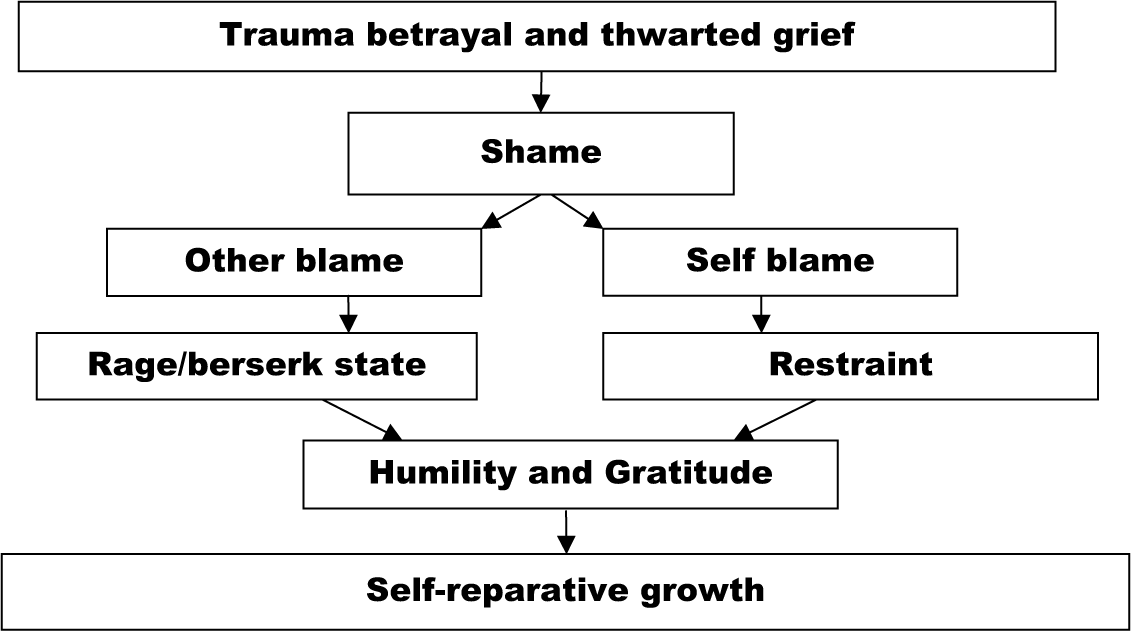
Possible pathways through betrayal/shame to self-reparative growth.
In addition, prior investigations cite development of humility as a key component of posttraumatic growth related to personal development (Hefferon, Grealy, & Mutrie, 2009; McCormack et al., 2011). Understanding the development of humility following traumatic experiences and exploring its utility in decreasing possible negative consequences of trauma is an important direction for future research and therapeutic intervention.
Another unexpected finding was the theme of veterans’ recognition of gratitude. Recent research has demonstrated that the receipt of gratitude can mitigate negative consequences and posttraumatic stress responses after war (Burnell, Coleman, & Hunt, 2006; Hautamäki & Coleman, 2001). In addition, gratitude may promote motivation, daily self-regard, and the pursuit of constructive, satisfying, and rewarding social activities, leading to personal growth (Kashdan, Uswatte, & Julian, 2006; Wood, Joseph, & Maltby, 2009).
Implications
These findings demonstrate that veterans struggling with war-related betrayal, grief, guilt, and shame have a capacity to grow personally as a result of their experiences. As such, therapists need to be aware of the possibility of transformative growth following war trauma. Simply shifting the therapeutic mindset to this possibility would seem an important advance. It may also be that exploring the themes of humility and gratitude in therapeutic work may be a useful clinical tool, but we would urge caution that our findings suggest that there are different pathways of growth from betrayal, grief, and shame. As such therapeutic conceptualization would likely vary depending on the ways in which individuals experience (e.g., internalize vs. externalize) or cope with (e.g., rage vs. restraint) shame.
For example, prior research indicating the ways in which shame can be beneficial (e.g., Wilson & Droždek, 2006) suggests that attempts to banish shame may not be ideal (Elshtain, 1995) and that helping individuals to understand their shame and manage it more effectively may be preferable.
As such, our findings advocate a strengths-based framework for thinking about shame and associated coping responses. For instance, therapists can help clients achieve greater self-compassion when reflecting on feelings of betrayal and shame and reflect on prior responses and behaviors they have used to cope with such feelings. In other words, therapists can facilitate clients’ understanding that certain behaviors may have been employed in the past as a way of helping them cope and survive given their traumatic circumstances. That is, such responses likely served important functions at some point even if they are currently distressing and are no longer helpful or effective. In addition, therapists can remind clients of the possibility of growth out of traumatic experience, fostering hope that change and healing can occur.
In conclusion, our findings highlight the veterans’ attempts to bring meaning to societal isolation and emotional responses to war distress. Despite current theory indicating support as necessary for psychological growth following trauma, over time, and despite antagonistic and nonvalidating support from their social environment, these veterans found a lone pathway for psychological growth through personal humility, gratitude, and empathy. For clinicians, these narratives demonstrate that no matter how explanatory medical paradigms may be for explaining the responses to war, if used to legitimize an individual narrative devoid of the social and political context for emotional pain, psychological distress and government compensation following war, cumulative betrayal trauma, and rageful shame is likely.
Footnotes
Appendix
Acknowledgements
We thank Professor Martin Hagger.
Declaration of Conflicting Interests
The author(s) declared no potential conflicts of interest with respect to the research, authorship, and/or publication of this article.
Funding
The author(s) received no financial support for the research, authorship, and/or publication of this article.