







Abstract
This article addresses and amplifies the symbolism of the archetypal image of the fish, particularly as it appears in Chinese culture, and is informed by C.G. Jung’s psychology. It examines how what Jung called the transcendent function is implied in the deep wisdom of the archetypal image from Chinese folklore, “A fish leaping over the dragon gate” (魚躍龍門). The archetypal image of the fish-shaped Yin-Yang symbol, representing the Tai Chi of Chinese Taoism, is used to demonstrate how the Tao can represent and parallel a special form of the personality development or individuation process that typically takes place in Jungian analysis. Finally, a brief clinical case study is used to explore and discuss the Chinese cultural perspective on the archetypal fish image and its symbolic representation of the so-called “feminine” pathway of individuation.
Keywords
Fish and the Archetypal Symbolism of Fish
Fish are the oldest vertebrates on Earth, living in nearly every body of water. According to archeological discoveries, the earliest fossils of fish date back to approximately 400 million years ago. The emergence of fish represents a qualitative leap from the evolution of primitive invertebrates into vertebrates (Zhang, Yuan, & Li, 2001). There are countless kinds of fish. Fish possess superior reproductive capacity. According to ichthyologists, scientists who study fish, there are over 33,000 species of fish currently recorded in the world and still counting.
The vast majority of fish belong to poikilothermic or cold-blooded animals. They depend on fins to move about, and they depend on gills to breathe (Shao & Chen, 2016). The sense of smell and sense of touch of fish is very good, whereas their sense of sight is not (Shao & Chen, 2016). The majority of fish reproduce by spawning, a process in which the female and male fish release eggs and sperm externally, and each time the eggs number in the hundreds of thousands. By virtue of their strategically superior reproductive capability, they survive their numerous natural enemies. Parental care given by fish is very limited or fundamentally nonexistent. Only a small number of fish give birth to baby fish referred to as fry or fingerlings. Some extraordinary fish can and do physically change sex, and therefore are said, “to have both sexes in one body,” that is, they are literally androgynous (Shao & Chen, 2016, pp. 40-42): they embody both the masculine and feminine in one being, and, in this sense, symbolize wholeness and balance.
Fish are integrally related to the élan vital, Life-Force, or what Jung, in consequential distinction to Freud’s far more limited definition, called libido. Whales, for example, the warm-blooded, largest, and most impressive sea-dwelling “fish,” are an exception to the rule, actually being enormous mammals, embodying immeasurable energy, power, and vitality, archetypally representing, as Jungian analyst Edward Edinger (1975/1995) writes, “the primitive, undifferentiated energies of nature” (pp. 76-77). And according to Melville (via Captain Ahab) in Moby-Dick, the great white whale “represents the transcendental reality behind the appearance of things. And such transcendental reality is another name for God” (Edinger, 1975/1995, pp. 77-78). Hence, the archaic association between fish and religion.
From ancient times, fish have been one of the totems worshiped in fertility cults, and can be said to sometimes symbolize what Jung and Taoism refer to as the feminine principle, which, in contrast to the masculine principle, can be described as a more unconscious, emotional, caring, instinctual, fertile, diffuse, earthy, organic, irrational, receptive, rhythmic, natural, nonjudgmental, soft, sensual, subjective, passive, poetic attitude toward, and way of being in life. This probably has to do with fact that the shape of a fish closely resembles that of the human vulva or external female genitalia. What’s more, the belly of a fish is hollow—like the female vagina or womb—which shares the same function as that of a container, famously exemplified in the Old Testament story of Jonah and the great fish. Indeed, fish are often associated with the moon, mothers, goddesses, and birthing (Tan, 2001). The ancient Hani people of the Yunnan Province of China even have legends and creation myths related to fish (Z. X. Li, 1991).
Fish are, in Western culture and depth psychology, traditionally also seen specifically as a symbol of the “unconscious.” Speaking from the perspective of Jung’s Analytical Psychology, fish inhabit the unfathomable depths, and represent the far-off, slippery, elusive, not-easily-touched contents of the unconscious—an aggregate of immense potential life energy. However, without the aid of helpful tools, techniques, and methods, people cannot clearly see the fish living and swimming below the water’s surface, and it is extremely difficult to catch fish bare-handed, with no line, hook, spear, or net. Hence, the value and importance of Jungian analysis, Analytical Psychology, and depth psychology in general, which provide a helpful method for plumbing and discerning the shadowy depths of the unconscious.
As noted above, fish can symbolize the Life-Force, including its myriad possibilities and undifferentiated energy, representing a kind of relatively vague, enigmatic, and mysterious psychological content, the nature, development, and direction of which is yet unrevealed; it is the obscure psychic content concealed beneath the surface of consciousness (von Franz, 1996). Jung (1951/1959) considered fish (and snakes) to be commonly employed animal imagery for representing some event that has startled and stimulated part of the unconscious, or as a theme of intrapsychic compensation, especially when specifically describing an individual having had a similar numinous mental event and experience such as this. At the Bollingen Tower, Jung built on the shore of beautiful Lake Zurich in Switzerland, preserved to the present day, there is a piece of a stone carving he created by hand of a snake swallowing a fish (Figure 1). This stone carving records an event Jung personally experienced in his life. It occurred in 1933, by the shore of his Bollingen retreat. One day, Jung found a snake that had evidently choked to death in the act of trying to swallow a whole live fish. Both creatures were dead. According to Jungian analyst Joseph Cambray (2009), Jung saw this as synchronistic, that is, as a meaningful rather than random coincidence, since he was working and writing at that time on the relationship of Christianity (symbolized by the Fish) and Alchemy (symbolized by the Snake). For Jung, this external event synchronistically paralleled his own views on how these two traditional systems’ inability to integrate and assimilate (i.e., swallow and digest) their different perspectives ultimately proved fatal to each, leaving them both devitalized or “dead” (p. 10).
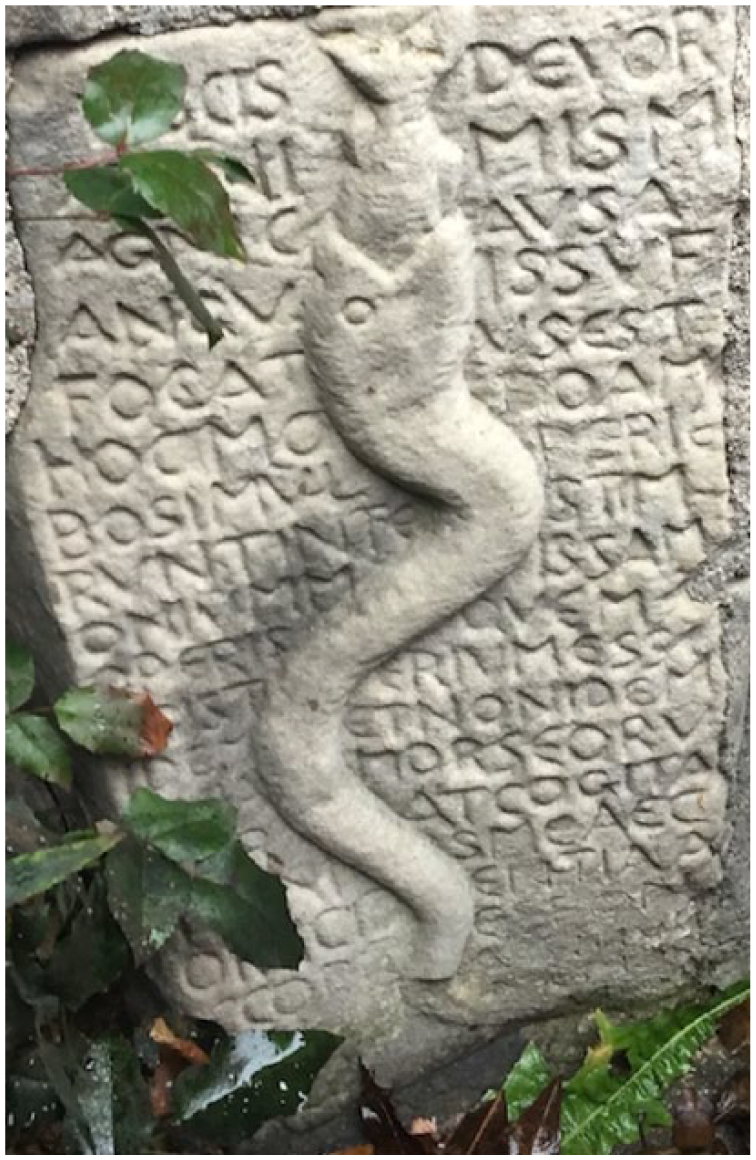
Jung’s carving of a snake swallowing a fish, taken by the author (Shi) at the Bollingen Tower, Bollingen, Switzerland, November, 2016.
Indeed, in cultures all over the world, fish have a great deal to do with religions and spirituality. For instance, “The Egyptian priests were forbidden to eat fish, for fishes were held to be as unclean as Typhon’s sea” (Jung, 1951/1959, p. 121). In contrast, Christian culture regards fish as a kind of a sacrificial offering. Fish and loaves symbolize the Eucharist, and Jesus is regarded as the first incarnation of the age of Pisces, one of the three zodiac signs ruled by the element of water (Biedermann, 1994, p. 98). For Jung, the Self, as differentiated from the ego, refers to the entirety and authentic center of the person, and can be experienced as wholeness, “a profound mystery, a secret resource, or a manifestation of the God within” (Stevens, 2001, p. 61).
Both Christ and the fish are archetypal symbols of the Self. Christ draws the projection of the fish symbol out of nature, unburdening nature and concentrating it upon himself. The fish also plays a prominent role in astrology since it is the zodiacal sign that governs the first two thousand years of the Christian era. (von Franz, 1996, p. 154)
In India, too, the fish is connected with the savior symbol: The God Manu transformed himself into a fish and saved the holy books from the flood (von Franz, 1996).
Within the traditional culture of China, the fish is a special symbol of good luck, plenty, and perfect happiness. In the Chinese era of land cultivation and fishing, fish were the most important food for humans to support their livelihood. Fish were also a symbol of wealth. Therefore, within the human soul or what Jung called the collective unconscious, fish have a symbolic significance of harvest, sustenance, and abundance. In the pronunciation of Chinese characters, the sound of the character for “fish” 「魚」is the same as the sound of the character for “surplus” 「餘」. On the Spring Festival Eve in China, a playful picture with a chubby baby holding a fish will be hung on the wall in every family home (Figure 2), symbolizing “abundant surplus year after year.” The ancient Chinese folk custom of giving fish as a token of congratulations and good luck on holidays is retained to the present day. Legend has it that Kong Li (孔鯉), the son of Confucius, who also went by the name BoYu (伯魚), was thus named because Duke Zhao of Lu (魯昭公) gave Confucius a carp as a gift of congratulation at the time of his son’s birth. In addition, the image of fish swimming freely and without restraint is symbolic of a harmonious, happy, and perfect marriage (Bruce-Mitford 2014, p. 68).
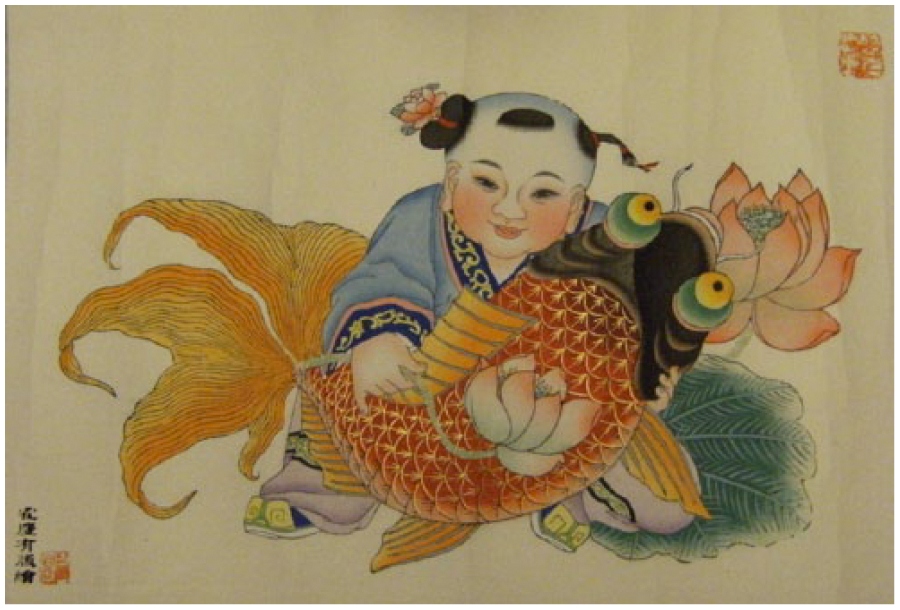
Traditional Chinese Folk New Year painting, abundant surplus year after year.
On the other hand, fish can also be symbolic of greed or avarice—the negative or destructive characteristic of the feminine principle to engulf, to swallow up, or devour, and so on. For instance, in the Chinese legendary novel Journey to the West (Wu, 1955), the Fish Monster, not unlike the great fish in the biblical story of Jonah, swallows Tang Seng, who was on pilgrimage to bring back the Buddhist scriptures from India. The Fish Monster lurks at the murky bottom of the Tongtian River. Guanyin turned the monster into a small fish, and forcefully dragged it up with a bamboo basket, at which point Guanyin rescued Tang Seng. The story symbolically represents the ego being swallowed up by the dark and negative aspect of the feminine hidden in the unconscious or shadow (symbolized by the dark and muddy depths of the water). It is at last only possible to transform this negative aspect of the feminine through heroically bringing it up from the depths into consciousness (symbolized by Guanyin using a bamboo basket to drag Tang Seng from the river).
The Transcendent Function Within the Transformation of the Image of the Fish
The “transcendent function,” one of the core concepts of Jung’s psychology, “mediates OPPOSITES. Expressing itself by way of the SYMBOL, it facilitates a transition from one psychological attitude or condition to another” (Samuels, Shorter, & Plaut, 1997/2012, p. 150). It refers to the psyche’s innate capacity to transcend, transform, and thereby, reconcile the seeming irreconcilability of polar opposites. Jung (1917/1966) states that the “psychological ‘transcendent function’ arises from the union of conscious and unconscious contents” (p. 69).
In ancient Chinese cosmology, the sea was considered connected to the heavens and the earth, and therefore, within the fantastic legends of mythology, fish could actually transform the opposite polarities of life and death. In the book, Classic of Mountains and Sea, Classic of the Great Wilderness: West, it is recorded: Zhuanxu was, within the remote legends of Chinese antiquity, one of the five emperors. When he died, his soul left his body. At that particular moment, wind came from the north and water gushed out like a bubbling spring. Zhuanxu’s soul entered the body of a fish. Zhuanxu and the fish integrate into a new creature, that was half human and half fish, named fish-woman. (Fang, 2011, p. 326)
In a painting of the Han Dynasty unearthed from a tomb of the Eastern Han Dynasty (Figure 3), there is a figure with three fish pulling a cart toward the left; a deceased person is sitting peacefully behind it, floating like a celestial being in folklore. The fish here symbolizes the ability to transcend life and death, leading the soul toward another world or form of existence.
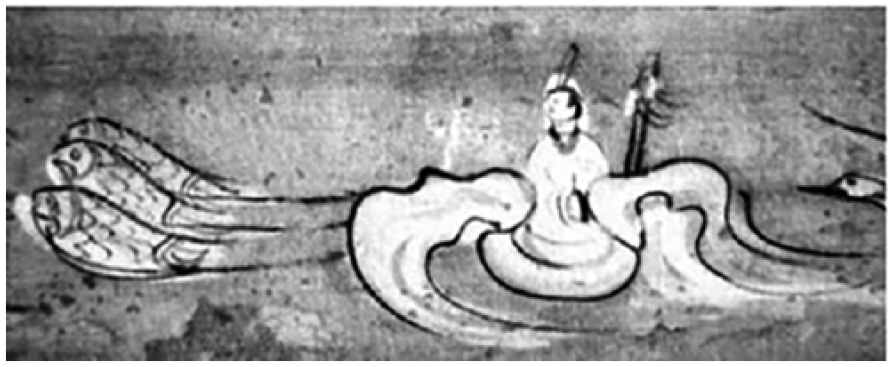
The East Han Dynasty, fish pulling a cart, unearthed from a tomb dating.
From Zidanku, Changsha, Hunan Province in China, a silk painting of a solemn dragon (Figure 4) was unearthed from a tomb dating back to the Warring States Period, depicting the deceased riding on a dragon up to heaven. The deceased can be seen standing gracefully on a dragon boat. In the lower left-hand side, there is a fish similarly moving forward in a leisurely manner. In this painting, the fish serves, not unlike the figure of Virgil for Dante in the Inferno, as a guide through the darkness (the Yin), after which the dragon takes over as the guide into the light (the Yang). The fish and the dragon together seem to guide the spirit of the deceased person through the journey of transformation. The Yin has to do with the qualities of darkness, unknowing, substrata, passivity, irrationality, unconsciousness, and so forth. Yang (the masculine) and Yin (the feminine) exist as polar yet integrally and inextricably related opposites.
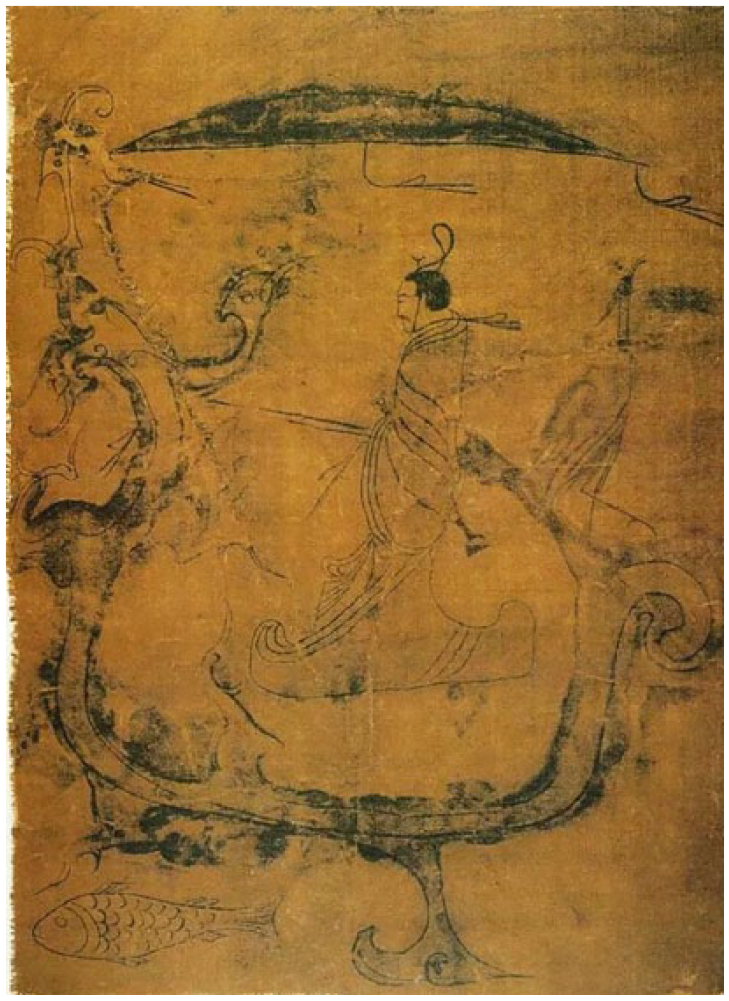
Solemn Silk Tomb painting of a person and a dragon.
The two are mutually instructive, mutually dependent, mutually in opposition, and mutually transformative.
In Buddhist culture, there is also a trace of the fish and dragon. Fish are considered one of “The Eight Treasures of Buddhism,” symbolizing freedom, emancipation, rebirth, and eternal life. In Buddhist temple architecture, it is relatively common to see a kind of intertwined fish and dragon creature called a Makara, above the door of the pagoda. There was a gilded gold and silver Makara dating from the Song Dynasty unearthed from a place called Tiger Shaped Mountain in the village of Layaotun (拉要屯), near Nandan County, Guanxi Province, China. (Figure 5) The shape depicts an image of a strange creature resembling something between a fish and dragon.
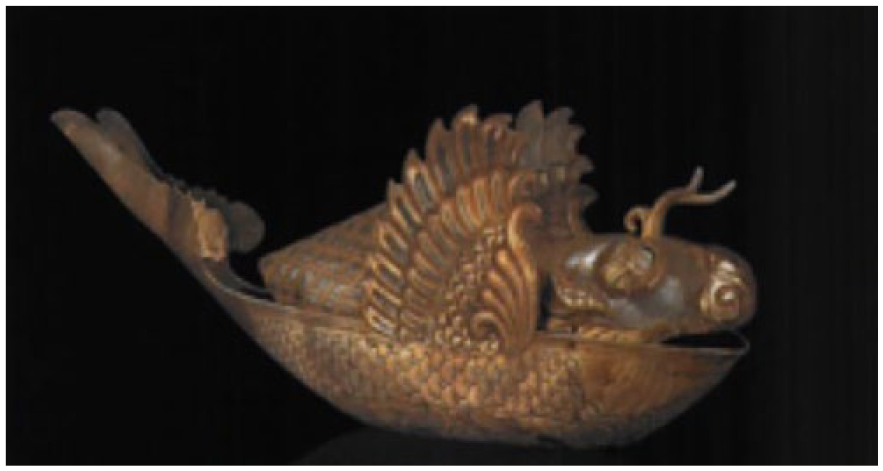
Gilded Gold and Silver Makara of the Song Dynasty, unearthed in Nandan County, Guangxi Province (circa
A fish transforming into a dragon symbolizes a kind of transcendent psychological development. Within Chinese culture, both fish and dragons live in water. In Jungian psychology, water tends to be a symbol of the unconscious, whereas fish symbolize human subconscious awareness. Limited (and protected) by the properties of water, for the most part fish are determined to exist on the level of the unconscious, symbolizing the passive, the restricted, the underlying, unseen, stealthy, and the imperceptible, and so on, power of the Yin (the feminine aspect of reality). Traditionally, Chinese dragons usually live at the bottom of the sea in a crystal palace. They are in charge of and possession of the treasures at the bottom of the sea. They can fly up to the heavens at will when needed. Not only can they transcend the restrictions of water and land to move into other spaces but also controlling the form of the water, they can move freely among the clouds and cause it to rain. The Chinese traditionally speak of themselves as descending from dragons. What dragons symbolize in Chinese culture is different from that of the West. They represent a much higher level of psychospiritual development, a more mature character. Therefore, “the fish jumps over the dragon gate” image is in a ritual sense a fish being transformed into a dragon, and has become a common symbol in China of important psychological growth, development, transition, or individuation, as Jung called this process.
Within the mythology of Chinese folk legends, the story of “A Fish Leaps Over the Dragon’s Gate” (Figure 6) vividly depicts this process. As the legend has it, each March, there are countless yellow carp, which swim from the rivers and seas to this sacred place of the dragon gate. As soon as the carp leaps successfully over the dragon’s gate, there will be clouds and rain to follow, and fire from heaven will also come to burn its tail. Once the tail is burned off, the fish will then fully change into a dragon which can soar up into the sky (Y. Li, 1938). The tail typically connotes in humans the primitive, vestigial, and incomplete evolutionary element, symbolizing the shadowy part which is, by definition, difficult to be aware of (it can be hard to see one’s own “tail”). The tail sometimes represents a fragile, latent, inappropriate, underdeveloped, shameful, repressed, or residual part of the personality. Archetypally, fire is related to destruction, purification, creation, and rebirth. When the carp’s tail is burned, it symbolizes the old useless part of the persona or original self-identity (fish) or the inappropriate and no longer necessary part, being burned away, jettisoned, and destroyed. Meanwhile, the process of burning away the tail represents the often painful and traumatic transformation of life, and the resulting rebirth of new life (dragon).
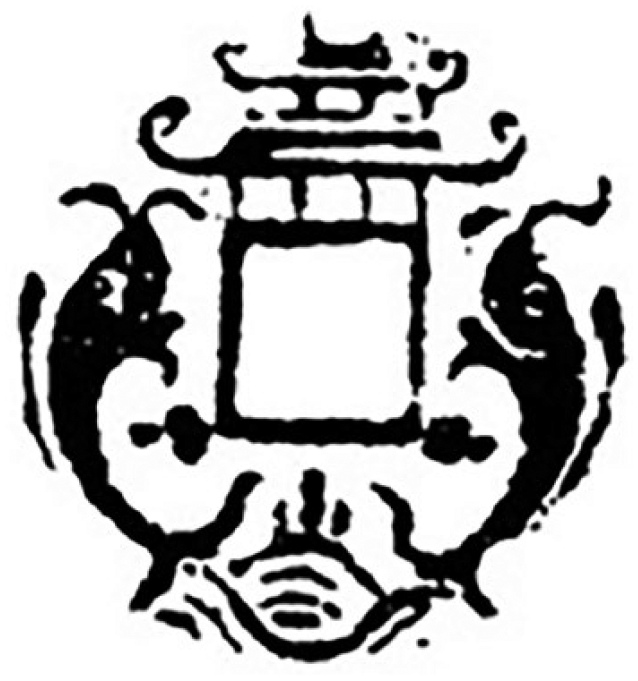
Chinese folk block printing, “A Fish Leaps over the Dragon’s Gate.”
In ancient China, a common metaphor for the imperial examination for higher prestige was “a carp leaps over the dragon’s gate.” To pass the Emperor’s examination to enter into one’s official career meant to break from the status and persona of a student from a humble family, and enter into the Emperor’s imperial management system. The profound and pervasive influence which this symbolic significance has had on Chinese society and culture can be found, even more so today than previously, in the standardized university entrance examination system, as well as the civil servant examination system of modern-day China.
In the mythological story of “A Carp Leaps Over the Dragon’s Gate,” the dragon’s gate symbolizes a sacred threshold, a pathway of entry from one space into another. The fish that passes over the gate changes the space, circumstance, and environment of its former life condition and consciousness. It actualizes a total transformation from the world of a fish to the world of a dragon. It is a deep transcendent transformation. There are three key elements in this process of transformation: awareness, courage, and trust. First of all, the fish must have the capacity to be aware: to know that there is another world other than the world of water. Awareness is the function of consciousness. A fish in water is aware of the existence of the sky, and therefore is able to “open it is container of consciousness” so to speak, to elevate the function of its ego consciousness. Second, it must be able to embrace going against the current and have courage to be fearless before danger and difficulty. Only then can the fish dare to leap to become a dragon, breaking through the confines and limitations of fate, history, and character, to seize the opportunity of transformation, to attain power and wisdom. Third, the fish must believe in the talent and potential within itself and take action to put them into practice, which is the key to attaining transcendence and transformation.
Psychologically speaking, the metamorphosis from fish to dragon, from being under water to being in the sky, is the transformation and the raising up of unconsciousness to consciousness. It is also the transformation from the physical level (in the water) to the spiritual level (in the sky). It is a transition from the material to the ethereal. The fish is a real creature in the objective world, but the Chinese dragon is a mysterious and changeable animal in legend. It has many different aspects of real animals (fish, snake, horse, deer, etc.), but also a number of imaginary features. Despite the fact that the Chinese dragon has some of the traits of the fish, it has the ability to change. From the standpoint of individual personal development, it represents the integration of different aspects of the personality, such as what Jung referred to as the “shadow” or the “persona,” the “anima” or the “animus. It embodies, in effect, the process of individuation.
The Fish-Shaped Yin-Yang Images of the Tai Chi and the Process of Individuation
If “The Fish Leaps Over the Dragon’s Gate” is a symbolic interpretation of the development and transcendence of personality, then the fish-shaped Yin-Yang images of the Tai Chi embody the philosophical thought in Taoism, vividly conveying an archetypal symbol of the Self, with the rich, abundant implications contained in the process of individuation described by Jung.
The fish shaped Yin-Yang images of the Tai Chi symbol (also referred to as the Yin-Yang diagram) condenses the essences of Chinese Taoist thought. As apparent in Figure 7, there are two fish-like shapes, one black and one white, linked together head to tail. The outer line forms a circle, the inner line forms a curved “S” shape that runs through the center, forming the double helix (dual spiral) structure of the fish-shaped Yin-Yang images of the Tai Chi.
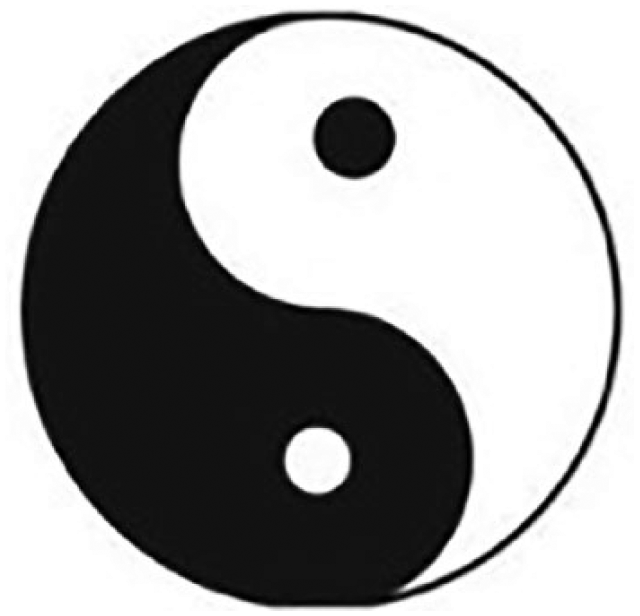
The fish-shaped Yin-Yang images of the Tai Chi.
The opening words of Explanations of the Tai Chi Diagram《太極圖說》written by Zhou Dunyi in the Song Dynasty are “Wu Chi and Tai Chi” 「無極而太極」which can be translated as “the infinite and the ultimate,” expressing the earliest thinking of Chinese philosophy. Wu Chi, “the infinite,” refers to the undifferentiated state of the universe before it was formed. The ancients believed that prior to heaven and earth being differentiated, the universe was a chaotic mass, what Jung might call a massa confusa. There was no polarity, no sexual differentiation, and no heterogeneous distinction. Developing from this infinite state, celestial bodies initially formed. Once there were celestial bodies, there became what is called Tai Chi or “the ultimate.” The Tai Chi is the force that propels polar opposition. Tai Chi further differentiated into polarities, bringing into being the Yin and Yang. The law of movement and transformation between Yin and Yang became known as the Tao「道」.
The relationship between Wu Chi, Tai Chi, and the polarities of Yin and Yang can be expressed by the Yin-Yang diagram, consisting of two fish-shaped images (Figure 7): The large circle of the outer ring symbolizes Wu Chi, the infinite. From within it comes forth the Tai Chi, the ultimate, (having form and differentiation). The white fish has within it a black dot, symbolizing that within the Yang there is always Yin. The black fish has within it a white dot, symbolizing that within the Yin there is always Yang. Yin and Yang are reciprocally rooted in one another; that is, they are totally interdependent. There is a trade-off, so to speak, wherein when one diminishes the other increases, symbolizing a mutual transformation of oppositional matter.
The two fish-shape of the Tai Chi has become a symbolic diagram not only uniquely representative of Chinese culture but is also one of the most important and well-known archetypes (or archetypal images) in the history of human civilization. In my view, the fish-shaped Yin-Yang images of the Tai Chi represent perfectly what Jung described as spiritual wholeness and balance, and can serve as a symbol of what he called the Self. The “Self” is one of the central concepts of Jung’s analytical psychology: “From ancient times, Eastern man had used the word ‘the Self’ to express, in a broader sense, the center of the personality” (Jung, 1917/1966, pp. 28-30). “Psychologically speaking, the Self is the unified body of consciousness and subconsciousness. It represents the completeness of one’s spirit” (Jung, 1938/1969, p. 57). “Consciousness and unconsciousness mutually compensate one another to form a complete soul; this is none other than the Self” (Jung, 1917/1966, pp. 28-30).
The circular shape formed by the two fish-shaped Yin-Yang figures of the Tai Chi is an archetypal image of wholeness or completeness. From the perspective of analytical psychology, Wu Chi is similar to the state of the collective unconscious; it is inherently existent, yet imperceptible to the individual. Speaking from this perspective, the appearance of the Tai Chi (the “great circle”) means the beginning of the differentiation from the inchoate and chaotic state. Within the circle is the realm of opposition. It is big with nothing beyond it, yet small with nothing within it. It is the liminal boundary between the intangible and tangible worlds. When we view the fish-shaped Yin-Yang images of the Tai Chi as a whole, the black and white portions symbolize all things within the world of opposites, categorized as either Yin or Yang. The black color represents the unconscious (Yin), while the white color represents consciousness (Yang), The two compensate each other; together they bring about life, and cause it to grow; they are at once in opposition and yet unified, together forming a balanced whole, elegantly expressing an image of the coexistence and interplay of consciousness and unconsciousness, symbolizing spiritual wholeness and unity.
Let us now focus on the mysterious “S” shaped line in the middle of the fish-shaped Yin-Yang image of the Tai Chi. The “S” shaped line or boundary that separates the diagram into the two polarities of Yin and Yang shows the mutually dependent yet oppositional relationship of the Yin and the Yang, while at the same time also suggests that in the midst of Yin and Yang there are the possibilities of growth and decline, life and death, as well as of transformation. In Chinese culture, the snake-like “S” shaped curved line symbolically has to do with change. Among the oracle inscriptions on bones or tortoise shells of the Shang Dynasty in China, some 3,000 years ago, the character for “dragon” was written as , having a surprising resemblance to the letter “S.” It also seems to coincide with what I described previously as the transcendent function, which the image of the dragon symbolizes. In the Phoenician and Hebrew languages, “S” originally had to do with “teeth” and “the sun.” In Greek, the corresponding letter has to do with circumflexion, having the extended meaning of “boundary” or “woman,” and so on. The Arabic numeral “3” is also associated with the letter “S,” and “S” is the initial letter in the English words “shadow,” “snake,” and “sun.” Perhaps even more significantly, “S” is the first letter of the English words “self” and “Self.” These same or similar common points across different ancient cultures are precise examples of Jung’s conception of archetypes of the collective unconscious. “S” vividly represents the precondition of the world of opposites, as well as the power and potentiality of transformation within it. It represents the regulation of the opposites. It represents striking a dynamic balance. It represents the mediating effect that is required to reach or activate the transcendent function. “S” is located in the center of the circle, which symbolizes both the separation and interconnection. It not only distinguishes the two different characteristics of Yin-Yang in chaos but also links the opposite (black–white, Yin-Yang) into a whole (big circle). The shape of S is an archetypal image of similarity and opposition, openness and change, which intuitively expresses the dynamic relative balance, as well as the trend and possibility of mutual transformation.
The fish-shaped Yin-Yang symbol of the Tai Chi, and the “S” shaped curved line that cuts the circle into two separate but related halves, symbolically expresses the transformation and unification of differing, especially oppositional, psychological energies, neatly depicting the process of individuation and of the transcendent function of dynamic existence. It is precisely the mediation of what Jung termed the transcendent function that facilitates the integration of personality and attainment of higher consciousness. The mutual embrace of the two fish-shaped parts of the Yin-Yang symbol of the Tai Chi, the integration of motion and stillness, mutually moving to form the myriad things in the universe; herein lies the unceasing mystery of the birthing and formation of the universe, and the secrets of spiritual development along the pathway of individuation.
Finding the Fish Image in Clinical Practice
Rose is a married Chinese woman with an 8-year-old child. She works as a civil servant, and her husband is a successful businessman. She is of medium build, with a round face, but her eyes are rather lifeless and dim. Her long, dark hair falls over her shoulders, and she is dressed in fine and expensive Western style clothes. When Rose was 35 years old, she sought therapy due to her suicidal depression. She said, I’m the kind of person who looks good from outside, because I have good living and working conditions. But only I know that I am very sad, and my mood is low. I feel that everything is meaningless. When I am alone, I often want to jump off the platform of a tall building.
At this moment, she closed her eyes and began to weep silently. The psychotherapist (Shi) leaned in and asked her softly, “How long did this last?” She sighed, “More than 6 months.”
Through talking with her, I gradually learned that nothing unusual or traumatic had happened in Rose’s outer life in the past 6 months. She could still go to work, but she was not as passionate and hardworking as she used to be. She suddenly began to feel that everything was losing its meaning, including her work, family life became boring, and she felt maternally inadequate with her child. However, 3 months before the initial consultation, she started to suffer from serious insomnia, tossing and turning every night and having difficulty falling asleep. After waking up at 3 or 4 o’clock in the morning, she could no longer fall back asleep, and often kept her eyes open until dawn. Her insomnia seemed symptomatic of her suffering and misery. Her husband took good care of her, providing a secure and comfortable life, but Rose could not understand why she was unable to enjoy it. Instead, she was often in a deep state of depression, which only reinforced Rose’s remorse.
Shortly after we started once-weekly analysis, she had a dream in which the images were simple but very vivid: A large carp, golden red in color, lay flat against a black backdrop. A fish net hung loosely over its body. Most impressive was the golden sheen on the surface of the fish. In the next scene, there was an old lady sitting at the foot of a bed looking at me as I was sound asleep.
In our therapeutic work together, I asked her to adjust her breath, relax, and try to return to the dream. She closed her eyes and approached the fish in the dream in her imagination, a method Jung developed and called “active imagination.” She found more details: The carp was 2-feet long. The entire body was golden in color. Its physique was beautiful. There was a bright sheen about it. The fish was not in water. It was not exhibiting the typical posture fish use when swimming, moving about, or resting. It was reclining. It seemed quite peaceful, but it was dragging its tail about. It seemed to be in low spirits; faint and weak. It led one to feel pity and sorry for it. Rose even reached forth her hand to touch it. The fish’s body was sticky and somewhat cold. It had lost the smooth glossy feeling that it had in the water. A net woven of coarse cotton string hung loosely over the fish’s body. The string had absorbed water and was dripping wet. At present, it seemed as if the still moist cotton net was the only thing providing some minimal measure of life-sustaining water for the poor fish. The old lady in the dream, who was sitting quietly at the foot of the bed watching Rose sleep and dream, indicating a state of unconsciousness, presents a maternal image of companionship and protection. This mysterious yet comforting figure reminded Rose of her childhood. When as a little girl she was sleeping, her grandma would in reality sit beside her bed and sew, quietly watching over Rose. So the grandmotherly old lady in Rose’s dream can be seen as both a positive archetypal image of the mature feminine mode of being, and a symbol of the observing Self, as well as representing Rose’s positive transference relationship to the analyst, which, as in all forms of psychotherapy, was crucial to her individuation process.
Rose, in outer and inner reality, was at that time in the midst of an existential crisis, what Jung might have called a “midlife crisis.” On the one hand, she was deeply attracted to the mystery of the spiritual world. She wanted to study psychology in order to find the meaning of her life. On the other hand, she identified with the Chinese traditional concept of feminine gender identity, in which “women should not exceed their bounds, rather stay at home to be good wives and good mothers.” The thought of giving up a stable career to pursue her dreams left her full of conflict and contradiction. Rose, at that time, was not yet conscious of the restriction this way of thinking had upon her. Nor was she aware of just how much vigor and vitality she was lacking at that time! It was not until the fish in the dream, that is, the unconscious, told her in this way: Having no water, a fish will not be able to swim away; but at the same time, having no water, a fish will lose its freedom, eventually, even its life. A “fish out of water” or trapped in a confining wet net is completely out of its element, suffocating, and destined to die.
Through our analytic work together, she gained some insight into her current state. Rose became conscious of the fact that the fish in the dream was none other than herself entering her midlife crisis. Although she still managed to maintain the superficial outward appearance of a beautiful, healthy, golden-red luster, it was slowly fading, and had come at the loss of her freedom, even the vitality and passion of life itself. She was now merely surviving, not really living, off the little residual water from the cotton strings of the net that caught and bound her. She found herself inwardly all dried up, as it were (much like a cut rose without a vase full of fresh water!), out of her element, at the end of her resources, stuck, and with no real sense of purpose in life.
Until one day when Rose had the following dream: There were many small boats huddled together, anchored at a river crossing, but there wasn’t even one boat moving in the direction I wanted to go. At that time, a middle-aged man pointed to the water below. I noticed there rising up from the water a boat shaped like a fish with a dragon’s head. I knew in my heart that this boat could take me to where I wanted to go. This fish shaped boat with a dragon’s head began heading toward the south under the starlight of a dark night.
The boat in Rose’s dream gave her much to work with. It was a fish-shaped boat with a dragon’s head. It could move under water. It could also move on the surface of the water. Even though it was at night, the place it was headed toward was unusually clear. This boat which floated up from underneath the water seems to indicate the process of the emergence and manifestation of some sort of unconscious material. This process of emergence came to fruition by means of what Jung referred to as her animus, that is, the masculine energy (e.g., aggressive, rational, linear, penetrating, forceful, etc.) within her. Raising this mysterious submerged boat required sustained heroic effort. Subsequent to having this dream, Rose’s exterior life manifested a transformation like that of “a fish leaping over the dragon’s gate.” That is, she obediently and bravely listened to the soulful call within her; quit her safe job, and headed south to attend systematic studies in psychology, opening up a more conscious and fulfilling life, and passionately pursuing and exploring her previously unknown self.
Coincidentally, 1 day after she had this dream, Rose received a package sent to her by her niece who was traveling in Japan. To her surprise, she found inside a pair of mythological fish-dragon creatures called Makara! (Figure 8). This kind of deeply impressive experience of what Jung referred to as synchronicity gave Rose an even more sincere and strong belief that she had found a new world, direction, or “pathway” in life more suitable and spiritually sustaining for her. Today, Rose, has become a trained psychological counselor, using her hard-won wisdom to help others on their own unique journeys toward individuation.
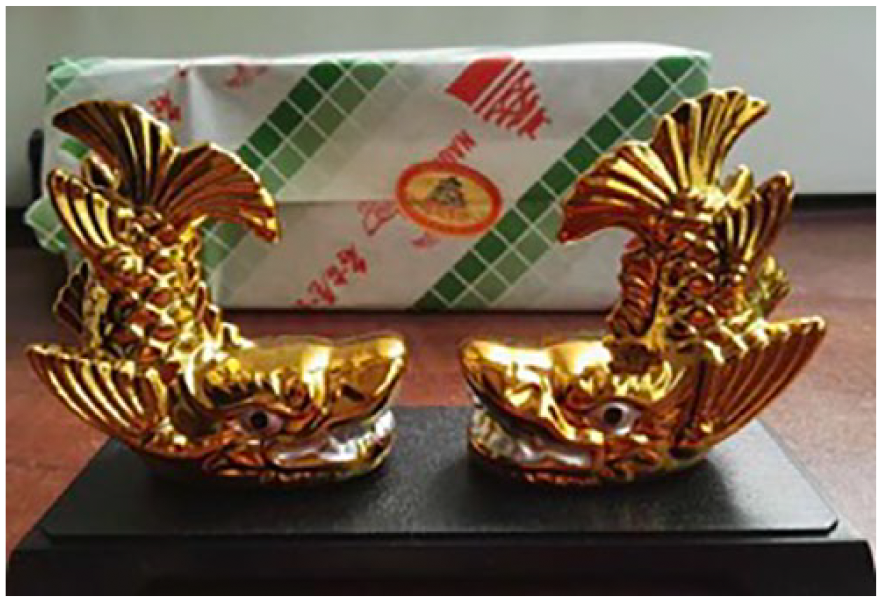
A gift from Tokyo, Japan, a Makara Fish.
Indeed, during the course of her 3-year-long therapy, Rose dreamed of several different images of the fish, which seemed to be a metaphor for Rose herself, who entering into middle-age, was and still is in the process of spiritual transformation. The fish is also a metaphor for the regular pattern of the process of individuation. Rose’s story is not only her personal story; rather, it is one that has collectively occurred and continues to happen in the lives of many contemporary women in China. It is even something we all personally encounter in the process of individuation; that is, to let go of or sacrifice, like the carp losing its tail, the persona we previously powerfully identified with, to confront, accept, and integrate our shadow, and connect the ego with the Self, thereby reaching wholeness of the person. As the Jungian analyst Anthony Stevens (2001) writes, In the first half of life it is essential to develop a strong and effective ego of one is to deal competently with the tasks of this stage-separating off from the parents, establishing oneself in a job or profession, marrying, providing a home for one’s family, etc. Only in the second half of life does it become possible for the ego to recognize its subordinate status in relation to the Self—an indispensable stage in the progress of individuation. (p. 63)
In conclusion, “The Self” is a central concept in the theory and practice of Jungian analysis. It is the ultimate goal of development in the process of individuation. From the perspective of Chinese culture, the fish is a salient image of transformation—the spontaneous arising of what Jung termed the transcendent function. The two entwined fish-shaped image of the Yin-Yang symbol of the Tai Chi represents the fundamental philosophical thinking in Taoism, which is a treasure of Chinese culture and, at the same time, a precious spiritual gift for the world.
Footnotes
Declaration of Conflicting Interests
The author(s) declared no potential conflicts of interest with respect to the research, authorship, and/or publication of this article.
Funding
The author(s) received no financial support for the research, authorship, and/or publication of this article.
