







Abstract
This article studies the impact of Kitchen God beliefs and worship on Chinese mentality and behavior, both consciously and unconsciously. At the conscious level, the evolution of the Kitchen God beliefs has gone through four stages; Nature God, Animal God, Half-animal/Half human God, and finally Human God. The evolution of the Kitchen God in China displays the features of a couple, aging and secularization. The experience of “returning to the sacred origin” can be obtained through Kitchen God worship by burning an old paper image of the Kitchen God and pasting of a new one of him beside the kitchen stove year after year during the Kitchen God festival. The secret to continuity of life lies in repetition. The image of the Kitchen God as an important graphic symbol is formed by a constellation of images; good pot and evil pot, two dragons playing with a bead, rooster and dog, the psychological archetypes as yin and yang, unity of opposites, transformation and integration. This ritual serves as a bridge between Chinese people and their “ancestors,” “the other realm” (nirvana), and “the Self.” On an unconscious level, the psychological significance of Kitchen God beliefs is analyzed through “the family hexagram.” The collective unconscious for the Chinese can be revealed by a continuous pattern of concentric circles structure, that is, “heaven and earth—the Kitchen God—ancestors—parents—offspring.” Through a clinical case using Sandplay Therapy, this article will show that Kitchen God imagery unconsciously shows the constellation of “family.” Family is the place of belonging and home for Chinese people, helping the client return to his inner source and gain strength through acceptance and transformation. The implication of Kitchen God beliefs for today’s Chinese society is to return to the most primitive “Tao,” which presents a possible cure for many kinds of psychological problems we are facing. It suggests that researchers pay attention to the psychological phenomenon of clients’ using the Kitchen God image to express their cultural feelings toward family in psychological practice.
Keywords
Introduction
Kitchen stoves, originally made of stones and clay, are the worktops where Chinese cook, with an upper part hollowed out where pots are placed and a lower part where firewood is placed to make a fire. Commonly worshipped by the Chinese, the Kitchen God is one of the three most renowned secular gods and has been worshipped in diverse forms since prehistoric times. Its status and influence even surpass that of the Land God and City God. Folk beliefs about the Kitchen God have a far-reaching impact on the life of Chinese people. Due to the diversity of Chinese culture, customs and legends of Kitchen God beliefs vary according to ethnic and regional groups, easily seen from the appellations given to the Kitchen God. As can be found in The Kitchen God Sutra and the collection in Chinese Kitchen Culture Museum, the Kitchen God has over 80 names in history, such as deity of the kitchen, deity of the eastern kitchen, Bodhisattva, or Mother of fire. It is the deity which has the largest number of names and figures in Chinese culture. This article explores the impact of the kitchen god image on the collective cultural mindset and behavior of Chinese people by studying Kitchen God beliefs and worship.
Daily customs and religious beliefs give expression to the essential aspects of Chinese culture. As collective folk beliefs, Kitchen God lore has been passed down through generations and continues to have a major impact on people’s thoughts, words and deeds, productivity and everyday life. Kitchen God beliefs and worship rituals reflect the culture, intrinsic order, and collective unconsciousness accumulated throughout social changes. C. G. Jung holds that (Jung, 1999) the collective unconscious is a part of the psyche made up essentially of archetypes, identical in all of mankind, constituting a common psychic substrate of a supra-personal nature present in each and every one of us. The contents of the collective unconscious have never been conscious, and therefore have not been acquired individually, but owe their existence exclusively to heredity. Jung called the contents of the collective unconscious “archetypes,” invisible and intangible but a real “deep structure” with great power (Ye, 2011, p. 96). The shift in Kitchen God beliefs from the ancient Natural God to later folklore figures reflects the material and spiritual culture of different historical stages in China. In this sense, Kitchen God beliefs carry the shared emotional experiences or psychic phenomenon accumulated by the Chinese for a long time. Jung said that the primordial images or archetypes can be represented by figures that constantly reappeared in the course of history. The elements of the human mind and destiny are preserved in each image, and the vestiges or vicissitudes of ancestral history are permeated in the same way. These archetypes, existing as a priori psychic structures, quietly manipulate, limit, and generate varieties of mythical fantasies and “primordial images” like a powerful frame. This article attempts to explore the influence of Kitchen God beliefs on the psychology and behavior of Chinese people from the perspective of the cultural unconscious through analysis of Kitchen God images, beliefs, worship, and customs, pictures, etc.).
The Research at a Conscious Level: Origin and Figure Evolution of Kitchen God Worship and Kitchen God Worship
Origin and Figure Evolution of Kitchen God Worship
Fire is a primal element in Kitchen God beliefs. As one of the world’s ancient civilizations, China has a rich and varied “fire culture.” Each of the 56 ethnic groups within China has its own rituals and traditions related to fire, the vitality of which is so enormous that we can still find the legacy of “living” customs such as the fire sacrifice ceremony of the Manchu, the sacred fire altar of the Miao, and the Torch Festival of the Yi in contemporary Chinese social life. The Han people are the largest population sub group in China. According to the sixth national census in 2010, the Han subgroup accounted for 91.51% of China’s total population. For this reason, this article focuses on the impact of the Kitchen God on the Han people through their evolution and sacrifice. The Kitchen God has been worshipped by Chinese ancestors since prehistoric times ranging from primitive sun worship, Fire God worship, worship of the feminine in matriarchal clans, to totem animal worship, and ancestor worship in patriarchal clans. Kitchen God beliefs have undergone continuous evolution and development. As Wilhelm Wundt (2008) mentioned in Elements of Folk Psychology: Outlines of a Psychological History of the Development of Mankind, “any psychological phenomenon must rely on certain social and historical conditions, and social development has its own regularity” (pp. 34-35).
The earliest “kitchen stoves” can be traced back to piles of burning wood or coals that primitive people used to get warm, repel animals, and make food. When the location of fire making moved from unfixed to fixed locations, from outdoor to indoor, the first stoves in a real sense were created. There is no known oracle character for the word “stove,” but its Chinese character is a combination of two pictograms; 火 (fire) and 土 (earth), the original meaning referring to a structure made of bricks or stones for cooking and boiling water. In terms of etymology, the original Chinese character for stove contained the pictogram 穴 (a hole).  The oracle character for hole was used to mean stove, a hole in which to make fire. The original symbolism of the stove developed with the emergence of the Fire God. Kitchen God worship originated from the primitive worship of the sun and fire. With social development and historical changes, Kitchen God beliefs and worship gradually infiltrated social awareness and moral views. Ritual activities with respect to certain gods changed from the Fire God to the Kitchen God to the Ancestral God. Symbolically the tenor shifted from the God guarding the clan to the God guarding the family. Kitchen God worship and beliefs have gradually assumed different cultural and psychological connotations in tandem with social and historical development, mainly related to the following five primitive types of worship.
Sun Worship
Man comes from nature. The human psyche originates from nature and is influenced by it. As an archetype, nature is universal. The archetype of nature has been rooted in the human psyche as a force deep in the collective unconscious. The Kitchen God, as one of the most popular in China, had its earliest origins in sun worship, which is a mainstream viewpoint of researchers who trace the origins of Kitchen God beliefs and worship (Zhan & Zhang, 1994). China is one of the five birthplaces of sun worship in the world. From the Neolithic Age to the Xia and Shang Dynasties, sun worship is one of the main Chinese primitive beliefs. A Comparative Study of Different Schools of Learning by Wang Chong of the Eastern Han Dynasty has a chapter entitled “Treatise on the Sun,” which emphasizes, “the sun is the essence of fire.” Many Chinese fire myths regard the origin of fire as the sun, and the fire in the earthly world is the messenger sent by the sun.
Fire God Worship
Fire God worship is a part of nature worship. When first encountering fire, primitive peoples were in awe of it and believed it was spiritual in origin, having a will of its own and great power. It took them a long time to learn how to handle and tend fire. In the beginning they regarded it as supernatural, thus believing fire was a god. There is an old statement that the Kitchen God evolved from the Fire God. In the period of using natural fire, the ancients often had the misfortune of extinguishing the fire, a great disaster for a clan or tribe. Therefore, a clan or tribal leader who searched for and protected the fire was regarded as a hero. This became the most primitive prototype of the Fire God. In a chapter of “A Compendious Essay” in Huainanzi of Western Han Dynasty, it is recorded “Emperor Yan (legendary emperor Shen Nong) was the first to make fire, so that he has been worshiped as the God of the Kitchen Stove after death.” Gao You further annotated that “Emperor Yan reigns over the world by virtue of fire and enjoyed sacrifice as a Kitchen God after his death.” Learning how to start, tend, manage and use fire generated the practice of religious customs concerned with admiration and worship of fire. The cultural phenomenon of fire worship is of great significance in researching the evolution of the Kitchen God imagery. Kitchen God worship did not emerge until fire was moved indoors and into the kitchen stove.
Animal Worship
Totem animal worship is another shared belief in early human society. Primitives both revered and feared animals, even taking as totem animals for their clan those that threatened their lives. Worshiping an animal image as a Kitchen God is a reflection of this cultural trend. For instance, in archaeological discoveries and myths and legends, it is found that frogs and stoves are inextricably linked. The story of frogs teaching people how to make fire is still popular among the northern peoples who believe in Shamanism. It is said that frog proposed to humans, “there are rocks on the mountain, birch trees have fire.” In bronze characters, the character for stove is  composed of
  (a cave or hole) and
  (like a cricket with many feet). However, many scholars believe that the image of Kitchen God in the Han nationality is an animal (Liu, 2003; Zhan & Zhang, 1994); for example, Ding Shan, a religious scientist, and Yuan Ke, a mythologist, regarded the Kitchen God as a common animal around the stove, a cicada. They believed the fabled Kitchen God in later generations, whatever it is called “Chan” or “Dan,” evolved from the name of Qiong Chan, with a literal meaning of “poor cicada,” the son of legendary emperor Zhuan Xu. The true essence of Qiong Chan is cockroach, a common cicada-like insect found on the stove (Yuan, 1982).
Worship of the Feminine
In matriarchal societies, women enjoyed a dominant position because of their fertility and irreplaceable role in childbearing. This, kitchen fires were kept by the most prestigious women in the clan and it was believed that Kitchen Gods were female figures. From Chinese characters, we can discover the cultural views on women in matriarchal society and the general condition of primitive women. For example, the character 姓 (surname) has a structural component of the female, indicating that a surname originates from the female. In Explanation of Script and Elucidation of Characters (Shuowen Jiezi) by Xu Shen, it shows that a person’s surname is a sign of kinship, which was initially determined by the female surname. Therefore, the characters for the surnames of some of the earliest tribal chiefs mostly take the word 女 (female) as their radical, a main structural component of a Chinese character. For example, Emperor Yan’s family name Jiang (姜) and Yellow Emperor’s Ji (姬) and Zhu Rong’s (妨). all have 女 (female) as their radical. In Symbolism of Transformation, C. G. Jung (2011, p. 663) quoted from the famous Chinese sage Zhuangzi from his chapter titled “Understanding Life,” “around stoves, there are tufts of hair.” He quotes also from the Chinese official, Sima Biao stating, “the Kitchen God has her hair in a bun, looks like a beautiful woman in red.” In The Book of Rites (Li Chi), it is recorded, “Firewood is burned where named Ao; food contained in the basin and wine in the bottle are sacrificed to the senior woman.” These quotations illustrate the feminine nature of Kitchen Gods and Fire Gods in Chinese legends.
Ancestral (Male) Worship
Most of the Kitchen God images involving male ancestor worship are characterized as “half man and half beast.” It is recorded in the third-century text Records of Emperors and Kings that Emperor Yan has “the head of a bull and the body of a man.” In the chapter “Classic of Regions Beyond the Seas: South (Haiwainanjing)” in Guideways through Mountains and Seas (Shanhaijing), it states, “the deity of the southern regions, Zhu Rong has an animal body with a human face, riding two dragons.” Images of Kitchen Gods gradually upgrade from animal gods to human gods. Kitchen stoves played an essential role in ancient people’s work and life. Initially, the stove was mainly used for preserving fire, so it was a symbol of the residence of the Fire God. However, with economic and social development, families emerged in agricultural society and a patriarchal social structure was formed. Each household had their own kitchen stove and Kitchen Gods began to appear, becoming like a patron saint for the family. Kitchen stoves shifted from being symbols of “the head of a clan” to “the head of a family,” eventually becoming symbols of ancestral Gods (Zhan & Zhang, 1994). “Kitchen God” is interpreted in The Dictionary of Taoism by Li Shuhuan (1979, p. 500) as “In Taoism, each household has its Kitchen God with their surnames worshipped, for the ancestors in each family have such strong moral principles that they can inspect the good and evil of their descendants.” Kitchen Gods have gradually evolved from omnipotent Gods in charge of everything, to the secular god, whose only function is to send a messenger to the Jade Emperor (the Supreme Deity of Taoism), thus becoming a secular God closer to people’s lives.
Archaeological findings show that the earliest Chinese kitchen god sacrificial activities can be traced back to the Longshan culture of the Neolithic era over 4000 years ago when the painted stove picture was taken as the focus of worship by the ancient Chinese (Ren, 1999). Before that, no images of Kitchen Gods had yet been shown. It is recorded that the earliest sacrificial activities in Han peoples began in the Zhou Dynasty (1046-256 BC), 2600 years ago (Liao, 2003; Shen, 2005; Wang, 2000; Xu, 2006), recorded in The Book of Rites (Li Chi) in the chapter entitled Sacrificial Rites (Huang & Lin, 2016). The Rites of Zhou of the Zhou Dynasty has the earliest written record of Kitchen Gods, where Zhu Rong was regarded as a kitchen god. A review of the literature shows that Kitchen Gods have gone through three stages; primitive Kitchen God, Taoist God, and secular God. Records of primitive Kitchen Gods are found in documents of the pre-Qin period, extant or quoted in Han Dynasty (202BC-220AD) with three categories: Fire and Sun God worship related to nature worship (God of Light); frog associated with animal/totem worship (Huang & Lin, 2016; Yang, 1991), rooster or cockroach (Liu, 2003); and an old woman in charge of cooking (Liao, 2003). Among them, the personified Nature God is related to ancestor worship (Zhang, 1994), while the old woman has to do with feminine worship. The records of Taoist Kitchen Gods come from the Taoist scriptures after the Eastern Han Dynasty (25-220AD). They are all human figures, mainly including “the Mother of Fire in Kunlun Mountains and the Deity of Kitchen in the household” (Huang, 2006). The secular Kitchen God was first recorded during the Western Jin Dynasty (266-316AD; such as in Records of the Three Kingdoms) and was mainly in human form (Chen, 1988). In each place, local characteristics were integrated to form a rich and colorful folklore, thereby, Kitchen Gods were not only fully personified but also socialized (Ren, 1999). The most popular images of Kitchen Gods in modern times were of a dark-skinned feudal official with a long beard in imperial uniform, an amiable old man (Xu, 2006), or an elderly couple.
From the evolution of Chinese Kitchen God beliefs, it can be seen that the evolution follows four stages of religious development proposed by Wilhelm Wundt: the period of devil and witchcraft worship, the period of totem worship, the period of god worship, and the period of world religion. According to Wundt (2008), overlooking the influence of culture is a chief defect of modern psychology. He emphasizes that culture and religion cannot be investigated purely by measurement. Chinese folk beliefs are inseparable from sociopolitical and economic systems. Folk beliefs shed light on people’s thoughts and values, on which the formation of Kitchen God legends and the inheritance of its customs are based. However, the evolution of Kitchen Gods in China has its distinctive features, which are characterized by couples, aging and secularization (Zhan & Zhang, 1994). The first characteristic is in the feature of couples. The Kitchen God is mostly worshipped as a couple. The male Kitchen God has absolute authority, while the Kitchen Goddess is simply an indispensable “accessory” to him to symbolize integrity and happiness of the family. This is a reflection of traditional Chinese feudal family values and the thought of “male priority.” In matriarchal societies, women held the right to keep and use fire, so the original Kitchen gods were women. The second characteristic is aging, determined by different labor divisions between old and young in social life. In ancient China, the young went out to work and it was the old and weak women who cooked and did the housework around the kitchen stove. In addition, if the Kitchen God were to be “the head of a clan” or “the head of a family,” only the senior with more experience could qualify, which is also in line with the traditional Chinese view of a proper order between old and young. The third characteristic is secularization. With the development of society, the sacred Kitchen God has become secularized and civilian. There are many legends about the origin of Kitchen God in folk stories. People shaped the Kitchen God according to their wishes, favorably or derogatorily, and some even shaped the Kitchen God as a rogue gambler.
To sum up, Chinese people’s beliefs in Kitchen God evolve with the improvement of people’s living conditions and social transition. On the surface, man seeks God for protection, but it is man who creates a God and transforms it according to the environment of different eras at a deeper level. The attributes of Gods vary according to changes in the social environment. Traditional Chinese culture is human centered. The most fundamental activity is to live for life. Gods and objects are simply elements for human needs, tools to facilitate human evolution. Therefore, they do not take on the god’s will, since human will is seen as the will of heaven. Complying with the mandate of heaven is basically to follow the will of the people. Another purpose of life is for humans to respect their parents and love their descendants (Zhang, 1978). Worship is the product of imagination which is based on real-world phenomena, but it is beyond sensory perception of the real world (Wundt, 2008). The evolution of the kitchen god image reflects the relationships between the Chinese and nature, society, family, and themselves. It has a connotation beyond the original meaning of perceptual image. This connotation has a certain inheritance, continuity, and sociality. It is hidden in people’s unconscious and becomes a kind of collective identity, forming the close bond of “heaven and earth—the Kitchen God—ancestor—parents—descendants.” The Kitchen God has become a secular God with the lofty virtue of heaven and earth as well as the power of ancestors to protect their descendants. Such deep-rooted unconscious beliefs are also a powerful force in forming Chinese collective culture.
The Kitchen God Worship
The Chinese oracle character for worship is  , consisting of “又” (holding by hand) and “肉” (flesh), which means holding the flesh to offer sacrifices to the ancestors, praying for protection and blessing. The Classic of Filial Piety, states, “sacrifice is a means of dialogue between man and deity.” Sacrifice and praying are manifestations of the ancients’ religious beliefs and worship, attempts to exchange material offerings for help and blessings from the deity. Primitive peoples were ambivalent toward offering sacrifice, depending on and appealing to the gods on the one hand, but showing a sense of helplessness and powerlessness in nature and social life on the other hand. Sacrifice may also reflect the mind, character and unique cultural consciousness of the ethnic group.
As early as the pre-Qin period, Kitchen God worship became one of the important “five sacrifices” of Chinese people (Li, 2012). Kitchen God figures constantly evolved from the Fire God, involving a kind of nature worship. In earliest times, the Kitchen God had only the natural attribute of fire without any specific appearance. Later, such outstanding legendary tribe leaders as Emperor Yan, Yellow Emperor, and Zhu Rong were worshipped as Kitchen Gods by their people. Respectively, their images had different features; an ox head with a human body, the emperor’s appearance, and the face of a beast riding on a dragon. Henceforth, Kitchen Gods began to have specific appearances with a constellation of images, gradually developing into standardized images and sacrificial ceremonies. Offering sacrifices to Kitchen Gods is a custom having widespread influence among Chinese in both the Han and other minorities (See Figure 1). This article discusses the sacrificial ceremony performed by the Han majority. Generally, the Han people hold a ceremony annually on the 23rd or 24th of the twelfth lunar month, with specific procedures as follows. First, they burn incense. Three sticks of incense are lit and inserted into a container on the kitchen stove. Offerings are placed on the stove; a bowl of sugar, rice, water, and straw. Sugar and rice are dedicated to the Kitchen God, while water and straw is dedicated to the Kitchen Gods’ horse, rooster, and dog. Sweets are essential, for it is hoped that a variety of sweets can seal the Kitchen God’s mouth, so that he or she will not say anything bad about the family after ascending to heaven to make a report. Secondly the old “Kitchen god picture” is burned. After sacrifices are made to the Kitchen God, the “Kitchen God picture” will be torn off the wall and burned. Firecrackers will be set off outdoors while the whole family cheers, “Farewell to the Kitchen God to heaven!” The ceremony ends with the sound of firecrackers. Finally, the Kitchen God is welcomed back to the household by pasting a new Kitchen God picture above the stove. The welcoming ceremony is usually held after dinner and cleaning up the kitchen stove on the last day of the lunar year.
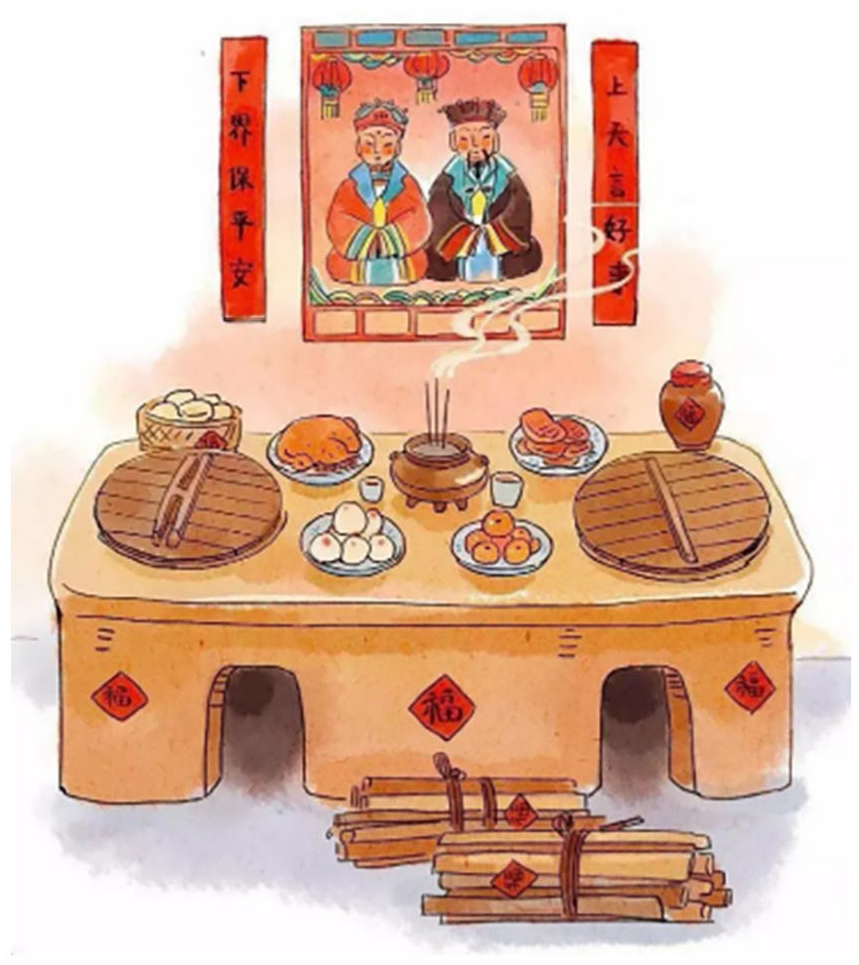
A picture of sacrifices offered to the Kitchen God from Baidu Gallery.
In The Book of Changes, there is a saying “images are created for full expression,” meaning that abstract ideas can be expressed through concrete images. In Aion: researches into the phenomenology of the self, Jung (2014a, p. 209) said, “the nature of the image is the projection of an archetypal pattern of order.” In Kitchen God ceremonies of sacrifice, the kitchen god image is an important graphic symbol, playing a significant role. Kitchen God images show distinctive Chinese characteristics in the course of history (see Figures 2 and 3). A constellation of images has been used to portray Kitchen Gods; good pot and evil pot, two dragons playing with a bead, rooster and dog. These cover such psychological archetypes as yin and yang, unity of opposites, transformation and integration. They are representations of images in the Chinese cultural unconscious, shared symbols handed down through generations which retain enormous vitality in the psyche of modern Chinese.
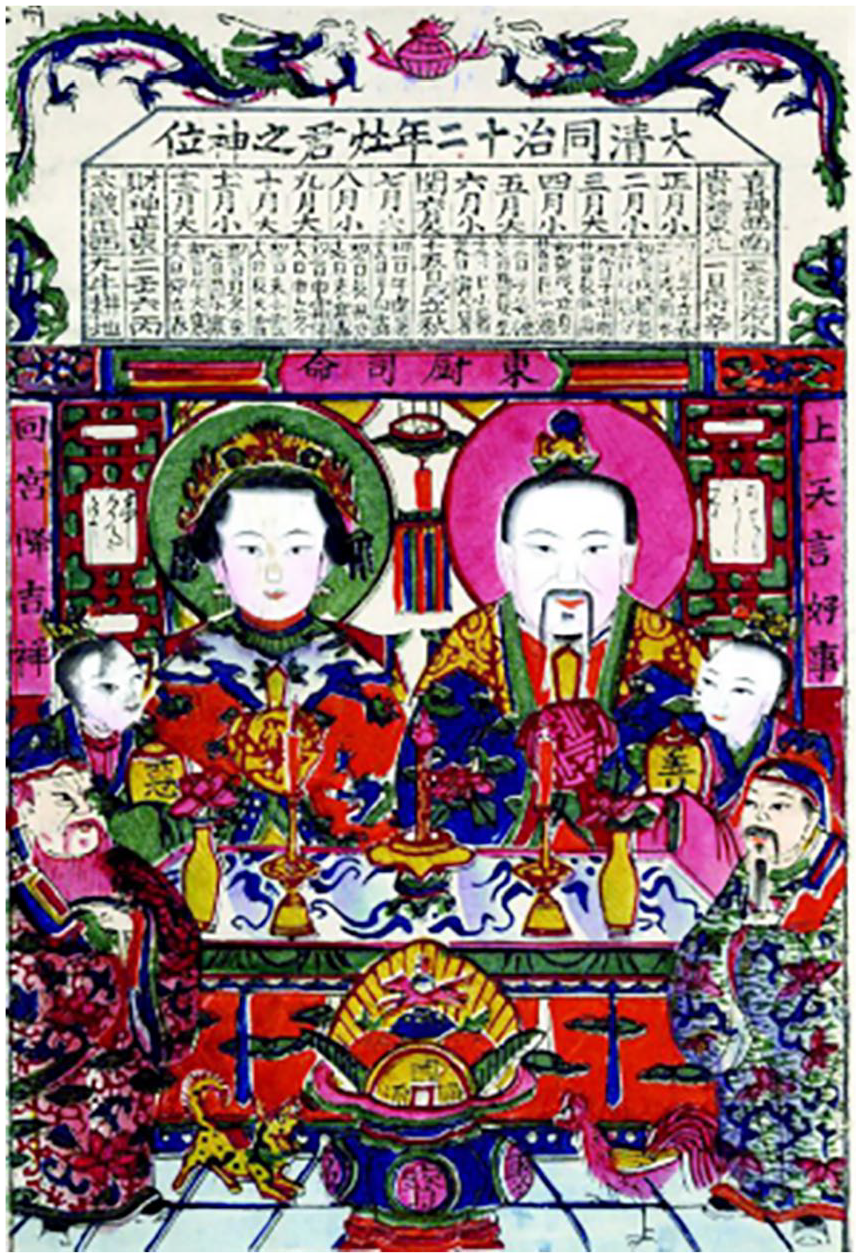
Deity of Eastern Kitchen, deity-image printed on paper for posting or incinerating in folk sacrifice in 1873, the 12th year of Tongzhi reign in Qing Dynasty.
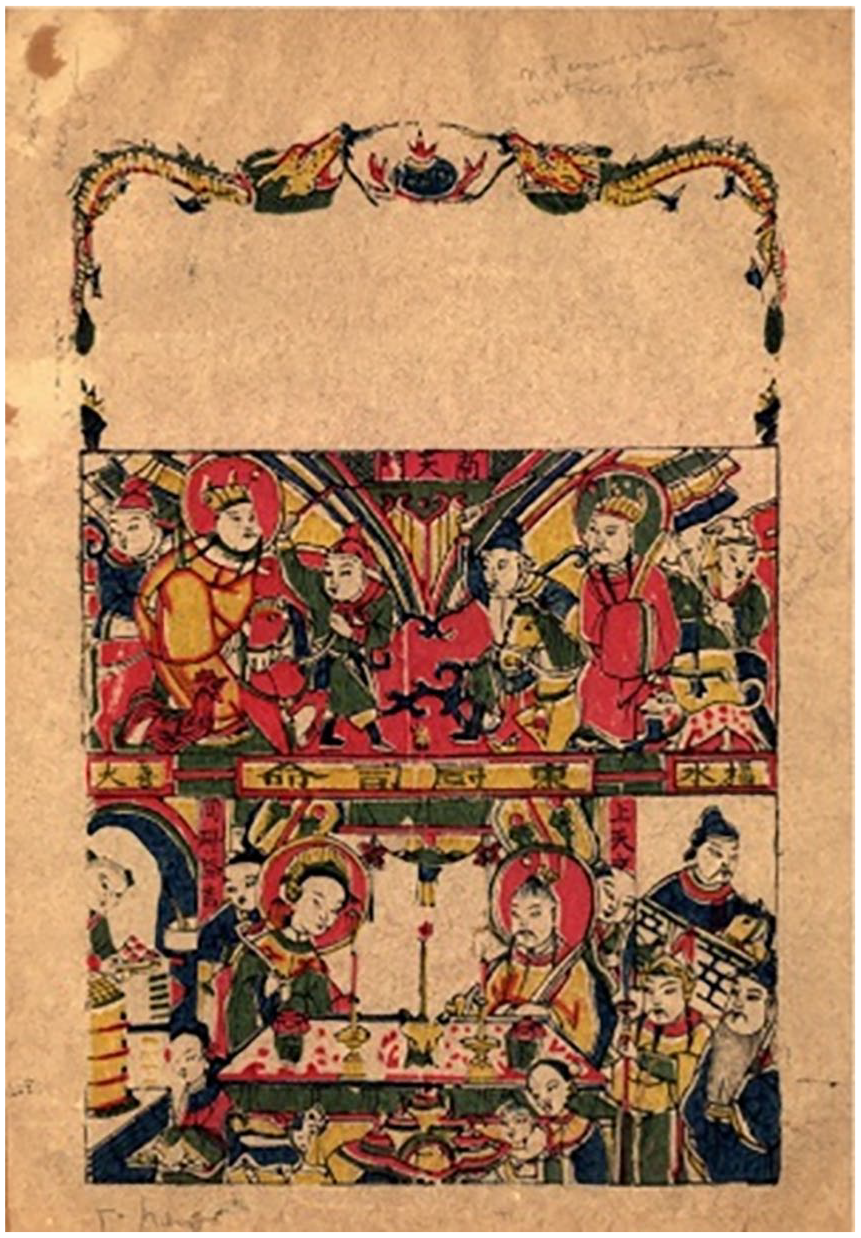
Goodrich, A. S. (1991). Peking paper gods: A look at home worship. Steyler Verlag.
Good Pot and Evil pot
Yin and yang are united in the Tao. The fundamental structure of “Tao” corresponds to the opposites in contradiction in mythological cosmology. Good pot and evil pot are the most typical archetypal images of syzygy, of yin and yang. In the beginning, primitive people discovered two sides of fire, its power to promote life and power to cause death. In Kitchen God pictures, images of good pot and evil pot were adopted to show such polarities. The opposites of good and evil were reconciled by belief in the deity’s ability to reward or punish to achieve integration of the opposites. Each was held in a pot, a container.
Two Dragons Playing With a Bead
This is one of the most popular mythical images in Chinese civilization. The image of the dragon has remained relatively unchanged, while the image of the bead has shown more evolution. The “bead” is often shown as the image of a fireball. Most pictures of Kitchen Gods, show the image of two dragons playing with a fireball. Legend has it that the Chinese dragon is a Water God, who can ascend to heaven and dive into the abyss. The dragon enjoys controlling the weather with the divine power of “calling for wind and rain” and is the medium of communication between heaven and earth. The dragon can discharge fork-shaped lightning from its claws and spray hot fireballs from its mouth, symbolizing his power and ability to control, to ward off ill luck. Therefore, the dragon is an auspicious figure.
Rooster
Rooster is associated with phenomena such as sunrise in the east, light replacing darkness, yang conquering yin, or cold winter changing to spring (Ye, 1992). In fact, the rooster expresses the beginning of both time and space in myth and is the symbol of five virtues in China; civil virtue, martial virtue, bravery, benevolence, and faithfulness. Rooster can drive away evil spirits and is characterized by masculinity, power, and spirituality.
Dog
Dog  in oracle inscription appears like an animal with a slim belly but a long tail. Dogs were the earliest domesticated animals. They symbolize loyalty, courage, and integrity, so have been understood as the most loyal partners for human beings. The Moinba and Luoba minorities still regard the dog as a kitchen god. Hunting dogs accompany these minorities day and night and are their right-hand assistants in hunting for food. Therefore, they regard dogs as totems, household gods, protective gods, and kitchen gods.
The experience of “returning to the sacred origin” can be obtained through Kitchen God worship by burning an old paper image of the Kitchen God and pasting a new one of him beside the stove during the Kitchen God festivals year after year, to produce and strengthen thoughts of self-renewal. The secret of life’s continuity lies in repetition, the most common experience of this being that plants flourish and wither cyclically every year.
For the ancients, what has happened can occur repeatedly through the power of rituals. Flying ashes and dissolving smoke of the old Kitchen god picture represents the good wishes of the people ascending to heaven. It was believed that burning allowed access to “the other realm (nirvana).” Burning rituals were adopted to connect two different spheres. On the one hand, burning expressed mourning for the past and earnest hope for peace and prosperity in the future. Putting up the new Kitchen God picture represents welcoming him or her back and “bringing good luck.” For people, the Kitchen God picture is not only an image, but a symbol of rebirth, a ceremonial death and rebirth through the sacrifice of seeing off the old and welcoming the new. For the Chinese, this symbolic practice of Kitchen God sacrifice is deeply rooted in the mind and spiritual world. As a cultural symbol, “Kitchen God” symbolizes both “creation” and “destruction,” carrying the memory of their past life as well as yearning for a better life. These symbolic images serve as a bridge between the Chinese and their ancestors, “the other realm (nirvana)” and “the Self,” helping them locate themselves in the family, society, and nature. This helps them find their position in the world and to achieve harmony between humans, objects, society, and nature.
The Research at an Unconscious Level: Kitchen God Belief and the Family Hexagram
In the I Ching, the hexagram that intuitively corresponds to the kitchen stove is that of the family or clan. The image of the family is wind above and fire below. In Discussion of the Trigrams (Shuo Kua), the saying goes, “The Gentle is wind; The Clinging is fire,” signifying wind coming forth from fire, the image of the family. From the images, we can see that fire in the form of a kitchen stove is a fundamental symbol for the family. It is the space for Chinese people associated with retention of emotional bonds in the family, spiritual inheritance, and cultural order. In the traditional Chinese practice of geomancy or feng shui the “six internal affairs” and “three essentials of a family” are valued. The “six internal affairs” refer to the gate, steps, hall, bed, kitchen stove, and millstone. The “three essentials of family refer to the gate, master room, and kitchen stove. Both the “six internal affairs” and “three essentials of a family” emphasize the kitchen stove in the home as a source of food and nourishment. As a symbol of the household, the kitchen stove has a certain role in achieving distinction. In ancient China, dividing up family property and creating separate households was also called “separation of stove or separation of kitchen fire,” meaning separate cooking, and no longer eating together, the distinction of being a separate household. People sharing a stove are related by blood. Chinese people often say that they should “keep the family line alive,” to not allow it to extinguish. On the one hand, “incense” refers to sacrifice for worship, but on the other hand its metaphorical connotation is the continuation of offspring (Zhang, 2015). The fire of “Burning Incense Hall” indicates the fire in the kitchen stove, making the stove fire a symbol of fertility, sustaining fertility, reproduction and eternity.
The judgement, referring to the teaching or guidance contained within the hexagram is simple, “The family: the perseverance of woman furthers.” The lower trigram of fire symbolizes yang, while the flames making the heat rise form the upper trigram of wind. The upper trigram of wind is considered yin. The external wind is an effect of the internal fire, so wind and fire benefit one another. Only when they are in their proper positions and perform their duties can good fortune result. It is said in the Commentary on the Decision: The correct place of the woman is within; the correct place of the man is without. That man and woman have their proper places is the greatest concept in nature. Among the members of the family there are strict rulers; these are the parents. . . . When the house is set in order, the world is established in a firm course.
The emphasis here on “correctness” does not mean to respect man and belittle woman, rather, each should be in their proper place. The laws operative within the family household show that, when transferred to outside life, keep the state and the world in order. The influence that goes outward from within the family is represented by the symbol of wind created by fire. The ancient Chinese emphasized the way of getting along with each other as family members, that is, the family order, as extending from family to community, country, and even to the world. In The Orderly Sequence of the Hexagrams, it states, Heaven and earth existing, all (material) things then got their existence. All (material) things having existence, afterwards there came male and female. From the existence of male and female there came afterwards husband and wife. From husband and wife there came father and son. From father and son there came ruler and minister. From ruler and minister there came high and low. When (the distinction of) high and low had existence, afterwards came the arrangements of propriety and righteousness.
Chinese patriarchal social structure is actually an expanded family, which is the so-called “the prince is prince, the minister is minister, the father is father and the son is son.” G. W. F. Hegel pointed out in analyzing the structure of Chinese Society, “on this form of moral union alone rests the Chinese State, and it is objective Family Piety that characterizes it. The Chinese regard themselves as belonging to their family, and at the same time as children of the State.” Liang Qichao (1873-1929) wrote in his Academic History of China of the Last Three Hundred Years, The organization of our Chinese society is based on the family, rather than the individual. It is also true that after the family is regulated, the country will be governed. Although the patriarchal system of Zhou Dynasty (1046-256 BC) was abolished in form, its spirit still exists. (Q. Liang, 2006)
Kitchen God beliefs originated from primitive beliefs. Down through time, they have come to value the harmony of yin and yang and accept the world view of the unity of humans with nature, but also to accept the Confucian moral retribution law to manage and operate. They then reflect the Buddhist world view of “causes and effects of three lives” and “samsara of six times,” overseeing the public behavior with the Taoist ghost and deity systems.
In Folk Religious Scriptures in Ming and Qing Dynasties, the chapter on In Honor of the Kitchen God, says “of all the things in the world, this life is the most valuable. Since human beings should be benevolent, this benevolence actually has its roots. The first is to honor heaven and earth.” In ancient China, heaven was regarded as the Supreme God, and earth was adopted to match heaven to cultivate all things. The sacredness of heaven and earth lie in their infinite possibilities. In essence, in the broadest sense, Kitchen Gods and heaven and earth are worshipped as parents and ancestors. Kitchen God beliefs have extended from heaven and earth, to ancestors, to parents, influencing the institution of the family unit. Kitchen God beliefs not only include the emotions and beliefs inherited from the ancestors and reverence for the spirits, but the honor of the ancestors and retention of the aliveness of the family line.
The Kitchen God beliefs reflect the constructs of the cultural consciousness of traditional Chinese society with such main contents as “ancestor,” “clan,” “loyalty,” and “filial piety.” They also reflect unconscious contents such as “consanguinity,” “paternity,” and “authority of the husband,” which become constraining, but internalized concepts resulting in externalized rituals and codes of ethics.
The Three Cardinal Guides (ruler guides subject, father guides son and husband guides wife) and Five Constant Virtues (benevolence, righteousness, propriety, knowledge, and sincerity) - principle of feudal moral conduct-restrict women in terms of their instinctive inner drive, often causing it to fail to develop. The primitive father archetype emphasizing authority, and despotism evolved into a perceptible and conventional solar conscience. With the rise of this type of patriarchy, solar consciousness became the mainstream ideology in China. Especially in the feudal era, the father archetype symbolized authority, strength, dignity, rationality, order, and boundaries. In the eternal order established by the Emperor, only one command was allowed, especially when the Emperor’s image combined with that of the father, forming a kind of cold and strict father archetype. The mother archetype of lunar consciousness, represented by softness and obedience retreated into the unconscious. Since the era of patriarchy, women have been restricted to the arena of the kitchen stove and the role of cook for the family, gradually losing their power. Until contemporary times, a stereotype about the role of women in the kitchen has dominated.
In contrast, primitive Chinese thought that because human beings grew from women’s bodies, they were the givers and protectors of life. The changing phenomena of all things in heaven and earth being yang or yin, depended on their specific time and position. The law of the universe is that they become masculine or feminine. The law of the universe is that yang and yin are changing and interacting with each other. The most fundamental hexagrams in the I Ching are The Creative (Qian, Hexagram 1) and The Receptive (Kun, Hexagram 2). The Creative symbolizes heaven, yang, and the masculine, while The Receptive symbolizes earth, yin, and the feminine. Ancient Chinese embodied the quality of “yin” and “The Receptive” to form the concept of women’s morality, corresponding to the quality of “yang” and “The Creative” of men. Yin and yang’s interaction implied harmony between heaven and earth, male and female, and thus created all things. Qian and Kun had no hierarchical distinction, one being superior, the other inferior. But as patriarchal solar consciousness developed, extreme attitudes arose distorting the original acceptance of women’s virtue, so that a bias against it continues to exist today.
Parallel to this is the plight of Chinese men’s growth and development which has fallen into a state of incompetence and absence. In a sense, this is a kind of self-sacrifice in order to protect women, to allow them to be seen, to provide opportunities for them to assume a position beyond the traditional role in an attempt to make up for what has been lost. Traditional Chinese culture is based on male supremacy, and yet, almost all social ethics reflect admiration for feminine ethics, seeming to embody the subtle power of the feminine personality. From the evolution of the Kitchen God, we can find the signs of primitive feminine images as well. The origin of the Kitchen God and the Family hexagram implies that female consciousness must focus on returning to its natural state. Only by letting women find their true selves, can they restore the connection to the Self.
A Clinical Case: An Expression of Personal Consciousness and Unconsciousness
The Kitchen God has evolved into a well-known secular God, which is still widespread in China. This fully secular God reflects the contradictions in the world outlook of ordinary Chinese, that is, they can be disrespectful and even ridicule the kitchen god, who is closely related to their lives, but it’s difficult for them to completely free themselves from the Kitchen God concept that binds them. As the symbol of family, the kitchen and Kitchen God still have a profound impact on the deep psychology and behavior of contemporary Chinese.
At the end of this article, a case with Sandplay Therapy (SPT) is employed to illustrate the kitchen god symbolism in contemporary clinical work. As Mark Pearson and Helen Wilson mentioned in their book titled Sandplay & Symbol Work: Emotional Healing & Personal Development With Children, Adolescents and Adults (Pearson & Wilson, 2001, p. 10): “Sandplay therapy may help the client begin to understand themselves more clearly, counselors in supporting clients to gain the skills to understand and deal with their inner life—their feelings, moods, reactions, body sensations, dreams and fantasies, etc.” Jungian SPT is a psychotherapeutic method utilized worldwide. SPT is a psychodynamic method used to effectively treat a variety of mental health conditions in children and adults (Foo et al., 2020; Roesler, 2019). Foo et al. using an A-B single-subject design found that after 18 sessions of SPT significant improvement in symptoms of anxiety as measured by the Hamilton Anxiety Rating Scale and General Anxiety Disorder–7 (Foo et al., 2020). SPT was successfully applied to treat the mental health problems, such as the depression, generalized anxiety disorder (Foo et al., 2017) and other mental health problems (Lee & Kowen, 2016). The professional society of SPT in China is one of the largest in the field of psychotherapy worldwide. The client “express their emotional and psychological state, the problems they encounter and the way they deal with them” throughout Sandplay process (Shen & Gao, 2004). The key point of SPT is to create a free and protected space which can give the unconscious the possibility to express itself, in other words, it offers a container for the nonverbal and symbolic expression of the client’s inner world. Sandplay and symbol work help to create congruence between the inner world and the outer world. In SPT, subjective internal psychological contents of the person are expressed by external objects, which are consciously presented for them to experience and comprehend (Guo et al., 2019).
Therefore, image is the external concrete expression implied in the inner mind. Unconsciousness can be made conscious by presenting as symbolic images (Li & Shen, 2017), thus achieving energy flow and psychic integration. Dora Kalff (2014), the founder of SPT, believes that understanding the images in the sandtray can promote the trusting relationship between counselor and client, which can facilitate the internal healing of the client. In the following case study the client tells his own stories through the external and objective “worlds” he creates using figures, including a kitchen god miniature. Miniatures are the symbolic objects used by clients to express their inner world; they can make the invisible psychological world visible. All possible objects in real life can be expressed in the sand box through sandplay figures. The definition of SPT refers to “the dialogue between consciousness and unconsciousness.” The real healing factor and power is embedded deep in the heart of each human being. The communication and dialogue between conscious and unconscious conducted through SPT is a means to achieve healing, facilitate internal development and obtain meaning.
Mr. Li, a 43-year-old male, has been married for 17 years. After many frustrations and a failed pregnancy, he and his wife conceived a son through artificial insemination. At the time of the therapy, his son was 11 years old. In recent years, his wife received a promotion in her career with a higher salary and better benefits. His wife devoted so much time and energy to her career that Mr. Li had to shift his energies toward rearing their son, hoping that his son could become a successful person. But eventually his son’s declining academic performance incurred his wife’s complaints. In addition, his failures to achieve promotion and losses in stock investments resulted in depression. Mr. Li felt that his wife had so much control over him and that he himself had accomplished nothing. At the beginning of therapy, he was so depressed that he felt his life was meaningless and worthless. He developed physical symptoms such as having pins and needles sensations in his hands and feet and insomnia. He reported having many dreams over the past 4 months.
The first three consultation sessions were spent collecting family and social history information for Mr. Li. He was one of the four children in his family of origin, having an elder brother and two younger sisters. The family lived in the countryside and their parents were farmers. Living on his parents’ meager income, they were thrifty and had a very warm family life. His parents had somewhat of preference for sons and his father told him from childhood that men have to assume the responsibility for raising the family. His mother was less talkative, but she took good care of the whole family and worked hard throughout her life. Mr. Li studied hard since he was a child. Eventually, he went to university, worked and settled down in a big city. He was the pride of his parents and set a good example in the eyes of his family, but now feels he is a loser.
During the sixth session, when the client noticed a miniature cicada on the shelf, he picked it up, commenting that it was a symbol of Kitchen God. He shared that when he was young, his whole family tended to sit around the cooking table, talking while eating. His mother would share many fairy tales with them, and this left him with warm feelings. Then he created a sand picture with the miniature of cicada (see Figure 4).
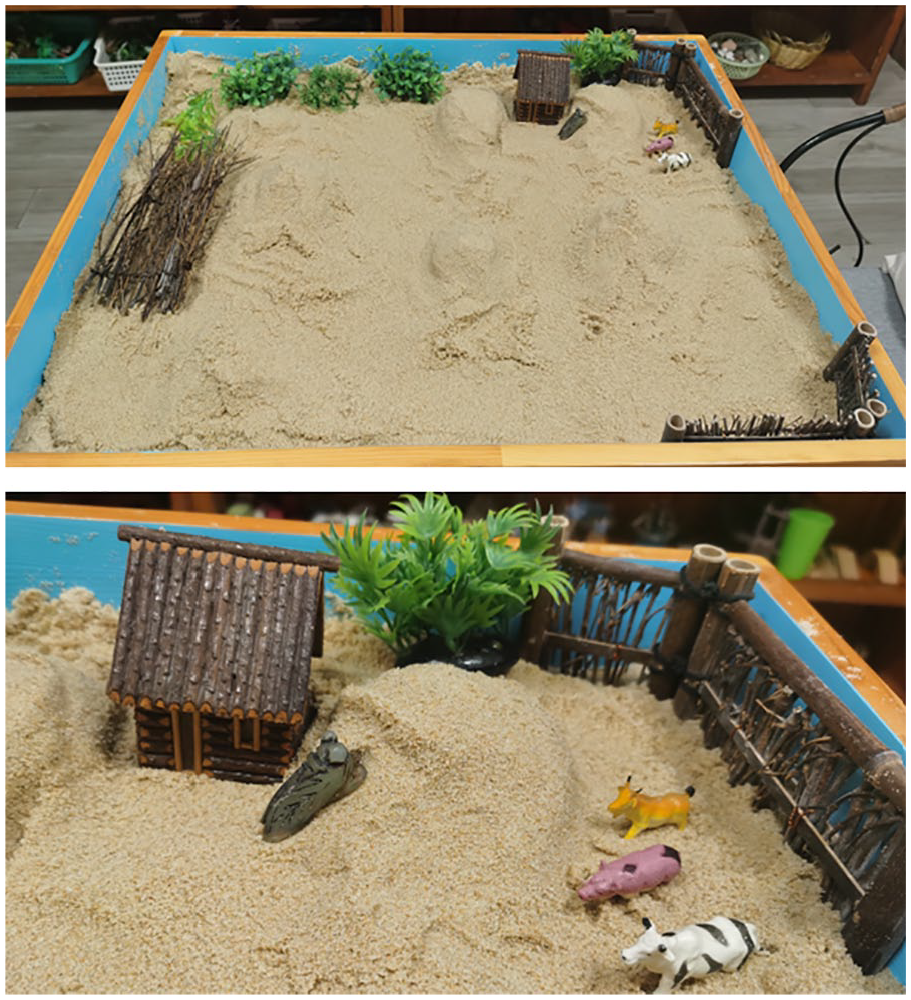
Sand pictures of Mr. Li from Zhuhai, China, a cicada (taken by the author in June, 2019).
Mr. Li shared “This cicada is the Kitchen God. Every year during my childhood, my mother would clean up the kitchen stove, serve varieties of candies and tributes to sacrifice to the Kitchen God, and appreciate his protection for our household. We all liked to be around our mother and the kitchen stove on the day of sacrifice. My mother would cook all kinds of delicious food on the stove for us, especially during the Spring Festival when the whole family sat around the kitchen stove, which I miss very much. But now I’ve settled down with my wife in the big city. Most of the time, the family has no time to dine together. I’ve almost forgotten the sense of ritual. In recent years, my wife has been promoted and often works overtime while I often order takeout for eating. I’ve almost forgotten the wonderful feeling of eating and chatting with family.
After Mr. Li gazed at the Kitchen God and felt it for a while, he said that he has been longing for success in his career so that his wife can stay at home to look after the family, and expressed his desire for a happy and orderly family life. However, he admitted the reality is totally the opposite, which he could hardly accept. He felt that his family was misplaced, and that he has been distracting himself by educating his son, but his fantasy had been shattered by the decline of his son’s academic performance. He could no longer hide behind his child and fulfill himself through his son. Mr. Li shared that cicadas represent the Kitchen God are symbols of transformation and rebirth. Apart from many other realities, his failure to be promoted and his investment losses caused him to be depressed. He said that ancient Chinese writers wrote poems about cicada when they felt hopeless in the pursuit of an official career.
Since the time of Han Dynasty (202BC-220AD), the ancients used the cicada’s transformation to represent rebirth. Reflecting on the Kitchen God cicada, the client could appreciate the depth of his frustration in life, and his depression caused by the difficult realization of how imbalanced his family life and become. At the same time, he could be reminded of the ideal he longed for and the possibility of rebirth contained in the symbol of cicada. Counselling is not meant to change, get rid of, or eliminate a client’s pain. Analytical Psychology focuses on the integration of the fragmented personality with “feeling-tone.” In the process of growth and development, an individual many lose connection to the Self, the sense of wholeness including all parts of the personality, both conscious and unconscious. A counselor’ work is to help facilitate bringing fragmented parts back together. Evidence of fragmented parts of the personality, unconscious to the individual may emerge gradually through images in the sandtray, gradually become conscious and finally achieve unification of unconscious and conscious material.
The symbol of the Kitchen God evoked Mr. Li’s feelings. He shared that his wife was actually very hardworking since she not only worked hard at her job, but was also considerate and caring of him and their son at home. He realized he had been attached to his own thoughts about how their family should be, unconsciously not wanting or allowing his wife to surpass him, which he thought would destroy the natural order of the family. He thought of her tolerance and acceptance of him, how she comforted and encouraged him when he failed to get a promotion. Before, he always felt that her guilt drove her to care about him, but in fact, he had trouble facing his own failure and accepting that his wife’s career was better than his. Mr. Li stated, “I’ve been avoiding the negative and shadowy parts. I can’t accept I’m not good enough. Now I feel much better when I speak it out. It seems I’ve lightened my burden a lot.” Mr. Li had gained a new insight into himself through this process and began to reshape a new, sounder internal sense of himself. This would allow him to revive, grow, and transcend his previous sense of self.
In a later session, Mr. Li shared that he had a dream after he created his sand picture that day. He clearly remembered the words in the dream: “Blue mountains can’t stop water flowing; Eastward the river keeps on going.” He suddenly realized that he had been holding onto a lot of things. Before, he always felt that his wife and the company that did not give him the promotion owed him, so he was not willing to accept his own failure. He realized he could not continue to shirk responsibility in this way. He realized it was not simply getting a promotion and making more money that would make his family happy. He felt he should let those things go, and when he accepted this idea, he and his family seemed to relax at all at once together. Mr. Li’s reflection shows that his pain came from deconstructing and reconstructing the concept of “family,” one of the most important concepts in Chinese civilization. Kitchen God beliefs are based on a view of the stable and traditional family system under the small-scale farmer economy in China. With accelerating modernization, especially after the period of reform and opening up, the economy began to sweep away old beliefs. The concept of “family” was gradually deconstructed. When this happened, it meant that a strong and important energy needed to be reorganized. Deconstruction itself was actually the beginning of reconstruction, and the key lying in understanding the process of construction and how to construct it. Mr. Li’s wishes regarding his wife’s role in the kitchen were not consistent with reality, resulting in psychological imbalance. The return of “divinity” and “transformation” of the kitchen stove represented by “cicada” was a result of his recognition of his wife’s due power. Mr. Li needed to return to the internal source to gain strength from acceptance and transformation, in order to gain vitality from his own psychological dilemma.
Thinking in image is the traditional mode of thinking for the Chinese, which lays a foundation for their general cultural psychology. With this mode, they recognize the world and deduce the relationship between things through images abstracting from viewing and establishing resemblances. Studies have shown that the reported rate of somatization of psychiatric outpatients in China remains high. More than 70% of patients’ chief complaints are somatic symptoms, which are related to the unique “imagery thinking” mode of the Chinese (Lv & Wang, 2012). Imagery is the primary language of the unconscious, and these images need expression (Pearson & Wilson, 2001, p. 25). In the early stage of Mr. Li’s consultation, obvious physical symptoms and emotional distress were reported. There were a total of 32 consultation sessions in his treatment. This article selects the images in the sandtray from one single session to elaborate, but in fact, SPT is more than that. It is a coherent process, and the counselor must be very careful about the interpretation of the image. What really matters is the client’s understanding and association of the image in the sandtray. Mr. Li had many associations to the Kitchen God image, including the growth environment in his early life, his marital relationship and parent-child relationship, and so on. A basic postulate of SPT is that deep in the unconscious there is an autonomous tendency, which, when given the proper conditions, allows the psyche to heal itself. The free and protected space offered in SPT makes Mr. Li’s unconscious materials symbolically expressed by means of images which is of great significance in transcending the specific contents. This space also enables the conscious and unconscious to communicate more effectively and smoothly, so as to achieve the integration of the psyche.
Therefore, through SPT, Mr. Li developed his ability to perceive and reflect on emotions and feelings in his inner world. During his last three sessions, the counselor reviewed his process with him. He expressed that he lived in a city in the eastern part of China where the economy was growing most rapidly. He was surrounded by a new generation of “immigrant” families, many of whom were often overwhelmed by the pressures of work and the economy. After a period of consultation, Mr. Li obviously felt that his physical symptoms were alleviated, and tensions has eased in his relationship with his wife. What he felt most during the consultation process was the restoration of his internal order. Many years away from home often left him feeling rootless, disconnected from his origin. The process of consultation enabled him to relocate himself and his family in the diverse and complicated world, and rediscover his faith in “family.” Although the notion of modern Chinese is constantly changing under the impact of economic and social factors, it is still imperceptibly influenced by many traditional notions, and treats their psychological problems in a mixed way. When the values of the external world attach more importance to secularization and materialization, and we are no longer in awe of the important symbols in culture, it will distance us increasingly from the internal world, and cause individuals to have a stronger sense of meaninglessness and worthlessness. If we lose the connection with traditional culture and ancestors, we will become spiritual “vagrants” and find it difficult to find the way home. Jung once said (Jung, 2014b, p. 57): With the decline of alchemy the symbolical unity of spirit and matter fell apart, with the result that modern man finds himself uprooted and alienated in a de-souled world. Present-day man no longer feels at home in his world and can base his existence neither on the past that is no more nor on the future that is yet to be. It seemed as if it were only through an experience of symbolic reality through SPT that man, seeking his own “existence” and making a philosophy out of it, could find his way back to a world in which he is no longer a stranger.
Discussion and Conclusion
This article unravels the evolution and sacrificial rites of Kitchen God beliefs and finds that the evolution and inheritance of Chinese Kitchen God culture is consistent with gender roles of Chinese people in the country, collective, family, and individual. It analyzes the psychological factors in the collective unconscious behind Kitchen God beliefs through explanation of the “family hexagram.”
The operational mode of Kitchen God sacrifice is like the circle of the eight diagrams of Taiji, with its ending and the starting point interlaced and cyclical. Philip Wheelwright, American philosopher and literary theorist, said, “among the great archetypal symbols, the circle and its most common concrete image—wheel, are perhaps of the most philosophical significance. The divine law that follows the nature points out “the state of being independent and changeless, moving in cycle.” Circles represent the world outlook of ancient Chinese. The unity of opposites which contains such pairs as masculine and feminine, positive and negative, conscious and unconscious, in which human and matter are constantly flowing to achieve wholeness and integration, is what Jung called the process of alchemy. Chinese culture is so different from western culture by virtue of its different dominant values. Chinese culture and values are displayed in a continuous concentric circular structure, that is, “heaven and earth—the Kitchen God—ancestors—parents—descendants.” They are so entirely connected that they have become a kind of collective identity, deeply affecting the collective unconscious of the Chinese.
With the booming development of China’s economy and society, many things, traditional and modern, are intertwined, affecting the minds and daily life of Chinese. The implication of Kitchen God beliefs for today’s Chinese society is to return to the most primitive “Tao,” which presents a possible cure for many kinds of psychological problems we are facing. The way of heaven and the psyche are always intertwined. The way of heaven lies in man and in his heart. When facing the Kitchen God without qualm, one can feel the response from heaven and earth naturally, achieving harmony between the way of heaven and humanity. This oneness of human and nature is the goal of Jung’s concept of individuation in psychological development.
“Archetype” is deeply accumulated in the cultural-psychological structure through human endless and persistent practice. The archetypal image of the Kitchen God carries the shared emotional experience or spiritual phenomenon accumulated by the Chinese. As God of the household, Kitchen Gods are sacred embodiments of “family.” They have independent divine character, overseeing diets, rewarding good and punishing evil. They are closely related to such traditional Chinese views as ancestor worship, carrying on the family line, and maintaining family order. Therefore, the family values embedded in Kitchen God beliefs carry the collective unconsciousness and collective emotion of the Chinese.
“Household” is the most basic economic and social unit. At present, “household” is still a core concept in Chinese society, but one that must be rethought. The primary feature of family is stability, which not only comes from external care, responsibility, and dependence, but from the individual’s internal understanding of themselves and family. Only by returning to the origin and expressing sincerity and integrity from the “heart,” can family members hold each other, hoping to make them steady and sure. In a word, the Kitchen God is the gathering image of “home” and the home of the Chinese.
Kitchen God images are cultural symbols that have accumulated profound collective feelings, but are mainly constructed on the basis of traditional Chinese families (Huang & Lin, 2016). Traditional Chinese society is earthbound human society with more stability and less mobility. Relatively speaking, people then have a stronger sense of order, stability and security. However, with the development of science and technology and the acceleration of modernization, Chinese traditional family structure has been affected. Traditional rituals have gradually simplified or even disappeared, people’s feelings for native land have weakened, and Kitchen God beliefs have also been affected and gradually declined in this process. The problem bequeathed by the Kitchen God image lies in how to understand the value of these ancient myths and rituals left in the cultural tradition. If we lost them without the chance to understand them, then it becomes difficult for human beings to seek the richness and diversity of the inner spiritual world, and they may express their indescribable inner pain and conflicts through “symptoms.” As Su et al. found in their study, with the dramatic changes in Chinese society, several psychological indicators of Chinese adolescents, such as anxiety, have also changed across birth cohorts. The results showed that Chinese adolescents’ scores on the Self-rating Depression Scale increased by at least .76 standard deviations from 1989 to 2018. It is evident that social changes play an important role in predicting changes in depression (Su & Liu, 2020). When we are no longer in awe of the important symbols in the local culture, and the values of the external world are more worldly and materialistic, it causes distance from the inner world, and results in individuals experiencing a stronger sense of meaninglessness and worthlessness.
The main significance of academic research lies in cultural inheritance and enlightenment for the present. As a gathering image of Chinese families, Kitchen Gods symbolize stability and order. “Family” is the habitat of individual soul and spirit. The study of the Kitchen God images can arouse feelings toward family, earth, and native land from deep within the wisdom of the collective unconscious. As Huang has stated, “The core of the contemporary implications of Kitchen God belief is that it allows the reflector to focus on the notion of ‘family’” (Huang & Lin, 2016). From the perspective of globalization, future research can explore the significance of the cultural gene of China and compare these images with those from other countries or regions. Such an example would be the comparative study of the Huo Tang (a kind of stone stove) culture in China’s minority regions. Liang’s research finds that despite the impact and influence of modernism, Huo Tang is still an important spiritual and cultural center for the Naxi minority. The annual Torch Festival still plays an important role in people’s lives. The author Liang in her doctoral dissertation entitled Psychological Analysis of the Image of Naxi Dongba Culture (Liang, 2021) finds that, through the ceremony of the Torch Festival, the Naxi people can maintain a sense of connection and affinity with their ancestors. Future research should be based on these cultural images to discover and explore their connotation and influence on people’s psychological mechanisms.
Footnotes
Declaration of Conflicting Interests
The author(s) declared no potential conflicts of interest with respect to the research, authorship, and/or publication of this article.
Funding
The author(s) received no financial support for the research, authorship, and/or publication of this article.
