







Abstract
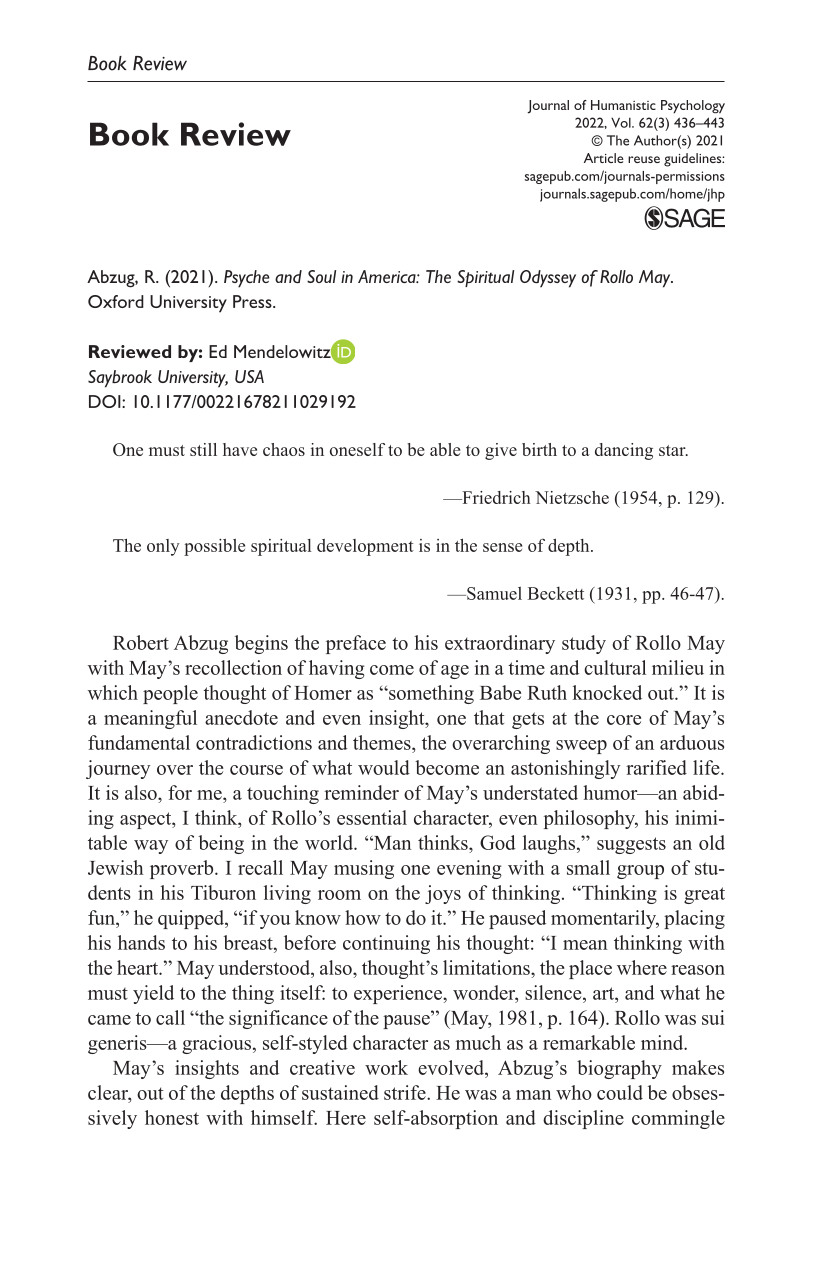
One must still have chaos in oneself to be able to give birth to a dancing star. The only possible spiritual development is in the sense of depth.
Robert Abzug begins the preface to his extraordinary study of Rollo May with May’s recollection of having come of age in a time and cultural milieu in which people thought of Homer as “something Babe Ruth knocked out.” It is a meaningful anecdote and even insight, one that gets at the core of May’s fundamental contradictions and themes, the overarching sweep of an arduous journey over the course of what would become an astonishingly rarified life. It is also, for me, a touching reminder of May’s understated humor—an abiding aspect, I think, of Rollo’s essential character, even philosophy, his inimitable way of being in the world. “Man thinks, God laughs,” suggests an old Jewish proverb. I recall May musing one evening with a small group of students in his Tiburon living room on the joys of thinking. “Thinking is great fun,” he quipped, “if you know how to do it.” He paused momentarily, placing his hands to his breast, before continuing his thought: “I mean thinking with the heart.” May understood, also, thought’s limitations, the place where reason must yield to the thing itself: to experience, wonder, silence, art, and what he came to call “the significance of the pause” (May, 1981, p. 164). Rollo was sui generis—a gracious, self-styled character as much as a remarkable mind.
May’s insights and creative work evolved, Abzug’s biography makes clear, out of the depths of sustained strife. He was a man who could be obsessively honest with himself. Here self-absorption and discipline commingle with a self-transcendence I find virtually nowhere in the current scene. More commonly, one observes overconcern with reputation and notoriety, the production of lesser, oftentimes derivative works, rather than a more thoroughgoing self-inquiry and free-spiritedness that might effect more novel outcomes. May’s oeuvre remains open-ended over time, resisting easy categorization even in its sources. His identification as an existential–humanistic psychotherapist did not preclude an abiding admiration for Freud or Adler or Jung; interests in Heidegger and Sartre and others, too, are to the best of my knowledge, never foresworn. On his deathbed, May advises a graduate student to become familiar with all the important ideas and articulators, mentioning Kierkegaard and Nietzsche in particular. Most of all, it was a lifelong immersion in liberal religion, the literature of depth and humanistic psychology, extensive psychotherapeutic experience on both sides of a metaphorical divide, and, inexorably, the broader humanities no less than his own personal daemons and travails to which May remained obeisantly attentive. Toward the end of life, May consulted a Jungian analyst for his final experience in personal therapy. His spiritual odyssey had no preordained roadmap or destination—why it remains, even now, fascinating to ponder and so edifying to behold. Certainly, there was a sense of mission. It was a hero’s journey in the end, a man intent on embracing an ongoing search for self and way and, inseparably connected with this, ministering to others in so doing.
Abzug’s (2021) opening chapter, “Epitome of America,” begins like this: In late August 1987, after a troubled morning of writing, Rollo May emerged from the tiny work cabin at his summer home in New Hampshire to receive word from the American Psychological Association that it had awarded him a Gold Medal for Lifetime Achievement. At age 78, having been in the public and professional limelight for almost four decades, May was plagued by the fear that he and work would soon be forgotten. “I was deeply moved,” he wrote in his diary the next day. “My colleagues think well of me—I felt like crying.” The honor came at a crucial time, for May was writing what he knew might be his last book, The Cry for Myth. (p. 1)
What is especially compelling throughout Abzug’s book is Rollo’s dogged attention to his own story and destiny no less than what Coltrane (cited in Nisenson, 1993, p. 131), contemplating van Gogh, had called the “creative urge”—the painstaking integration of myriad intrapsychic, earthly, and cosmic elements in this ongoing business of becoming ourselves. What may emerge as a consequence of the artist-type’s generative struggle is a praiseworthy (I do not say “unblemished”) life, one that honors personal past even as it imagines into being that which is authentically one’s own. May was a fundamentally impressive creative thinker—something he came to feel and think about himself over the course of time. “You should write books with questions,” he once told me, “not answers.” And once you have done so, you should not write another for another 2 years so as to avoid repeating what you have already said. The ongoing search for conjoined personal and planetary selves and mythologies, this rather than vanity, is the enduring spirit that informs May’s remarkable life and the poetic arc of his work. It heartrending in this sense to learn of Rollo’s final words to Georgia, his wife, moments before passing peacefully away in the fall of 1994: “Dear, I’m going to paint.”
“From Broadway to the Milky Way,” sings Dylan (1983) on his early 80’s album Infidels; “that’s a lot of territory indeed.” The poet would seem to invoke Nietzsche’s “pathos of distance” separating worldly routine from those more convincingly illumined, even sacred, realms. Also, perhaps, expressed chronologically, a pilgrim’s faltering yet persistent progress toward greater heights.
It is not possible to codify May according to theory or method or a circumscribed body of thought. There is, instead, the place of sustained inquiry, immersion in subconscious and marginalized aspects of experience, and the fruits of such labors when done with especial integrity. “You should learn all the theories,” he told me one evening, “but leave them at the door to your office.” Encounter lies beyond the foreground of theory and didactics. Rollo’s particular brilliance was not wholly of an intellectual bent. Rather, he viewed human personality as “a great unfinished artistic project” (Bilmes, 1980) at which one worked throughout the course of life. The thought of “master” therapists conferring certificates of achievement at the end of a weekend or program would likely have been anathema to him. His statements about therapeutic processes and objectives, though thematically coherent, varied over time. Abzug’s several anecdotes relating the impact on individuals encountering May’s books for the first time are evidence of what, in the world of jazz, has been called “trance-mission” and, in Zen, “direct pointing.” They are exquisitely moving and wholly in concert with the overarching tenor of Abzug’s book. It is, in the end, a beautifully wrought rendering of the life of an astoundingly interesting man.
Abzug’s graceful study of May returns us, it may be hoped, to our own moral and spiritual sensibilities and predicaments, consciences, and yearnings, as we ponder our own journeys vis-a-vis that of such an exemplar. Rollo was not egoless, but by no means was he vain. He wanted others to understand that the man we so much admired was a survivor of innumerable ongoing battles along all the significant planes of existence spanning very nearly the entirety of his life. He sought to inspire integrity and courage in others in their own pursuits of self, world, and awareness. He was that kind of teacher who had little interest in spawning acolytes or copyists even as he came to see himself as a forward-leaning thread in the perennial tapestry. As he aged, he became anxious that those threads might fray and become lost to expedience and reduction, that foundational resonances and sympathies were being lost. In the years since his death, the stakes have only increased even as time appears to wind down. We are still craving guideposts and myths by which we and the planet might be sustained, and even enhanced, in an age of diminishing visibility and light. As a consequence of Abzug’s book, May’s vision, voice, and human, all-too-human example are brilliantly laid out before us at a critical moment in time.
One of the things that gets to me in all of this is the manner in which Abzug’s fine words and, these several ones here in this succinctest of reverberations, are the outcomes of ineffable processes leading to encounters with those “higher types” to which Nietzsche pointed as our most auspicious human representatives and incantations, the bases of our most fruitful reveries and commitments. Reading about the manner in which Abzug’s book was conceived, I am reminded that finding my way to Rollo was similarly uncanny. Here, it was John Vasconcellos, esteemed California assembly member and state senator, a friend of Abzug, who introduced the two men on realizing that his hope that Abzug might write a biography of Carl Rogers would not fly. May never ceased paying homage to an unconscious poised, precariously, between William James and Vienna. I knew immediately on meeting him that I had found the mentor I had been seeking. There is no doubt that he felt heartfelt gratitude for, and openness with, Abzug as relationship and project evolved. Those oftentimes dimly perceived stirrings within each of us and the ineradicable tensions between solitude and encounter, Rollo’s perpetual availability to those mysterious Rankian connections and partings, enchanting, and implacable that inhere right down to the end. “What is there to keep me here?” Opines a character in Beckett’s (in Megged, 1985, p. 1) Endgame; “The dialogue,” is the interlocutor’s matter-of-fact response. Beckett, the literary genius who would have the midlife epiphany that he might make a living out of his own considerable despair.
Sometime in the spring of 1988, shortly after running into Rollo’s daughter, Carolyn, one day in Cambridge, I wrote my old teacher to say hello and share some thoughts. Toward the end of the letter, I wrote: Recently, I have been reading Herman Hesse’s final novel, Magister Ludi, which examines the manner in which the literate one may or may not separate oneself from the world about in order to pursue the life of the mind. There is a moving portrayal of the relationship between the protagonist, Joseph Knecht, and the Music Master, the wise and kindly man who merely by taking an interest in Knecht enhances his life and inspires him toward heights (and depths) he hitherto hadn’t imagined. In any case, Rollo, I thought of you.
So, May passed along an example and way of being more than any theory or nexus of technique. Still, though, he had his themes, themes comprising what the Czech novelist Milan Kundera (1986) might call one’s “existential code.” As I once told an awestruck university student in Nanjing inquiring about the essence of May’s work: “Think of the titles of all those books by which you have been sustained.” Man’s Search for Himself (May, 1953); Symbols in Religion and Literature (May, 1960); Psychology and the Human Dilemma (May, 1967); Dreams and Symbols (May & Caligor, 1968); Love and Will (May, 1969); Power and Innocence (May, 1972); The Courage to Create (May, 1975); The Meaning of Anxiety (May, 1950/1977); Freedom and Destiny (May, 1981); The Discovery of Being (May, 1983); My Quest for Beauty (May, 1985); The Cry for Myth (May, 1991). “These,” I told an admiring Chinese inquisitor, “are Rollo May’s essential themes.” May was a mensch, a serious man for whom the quest is always, in the end, significantly spiritual. In Rollo’s case, it was, insistently, psychological as well; also, thoroughly aesthetic. Abzug does a lovely job in helping us better understand the interweaving tensions and threads in the overall pattern. It is possible that Rollo had implicitly, his own message, posthumously, also to relay.
The fact that Dylan keeps finding his way home and doing his thing. Coltrane’s (cited in Nisenson, 1993, p. 131) invocation of God as muse and creativity as “that great and eternal constant.” The fact that Rollo May’s books continue to blow youthful minds a half-century after having come into being. Life is only justified as an aesthetic experience, Nietzsche somewhere observes. With Abzug’s book, we are afforded an eloquent, exceptionally informed telling of the story of a singularly special and paradoxical man. Such an example and accomplishment becomes, it seems to me, a beacon of light in an arguably darkening world—a narrative and myth by which we, too, might be constructively informed in our own personal quandaries and quests. One of many things that I especially loved about Rollo was the ineradicable tension between the sublimest flights of an uncommonly lofty mind commingling with an exquisitely sensitive soul and that strikingly down-to-earth midwestern core. I find, despite radically discordant life stories, similar tensions between what we might call mind, body, and soul in William James. Both men knew better than to succumb to misguided attempts at pinning things down.
I wrote to Rollo episodically after returning from California to the East Coast. He responded warmly every time. Not wanting to take too much of his energy or time, I wrote less often and more briefly as he aged. After a penultimate note I sent him, his mind returned to a singular memory in his response. He remembered seeing me in the back row at a lecture he had given many years before at the CSPP in Berkeley on, as he put it, “The Paradoxes of Psychotherapy.” “And I knew you knew just what I was getting at,” he recalled with affection. I wrote him one final time some time thereafter, with Rollo going back to that same image and memory in his brief reply, this time with a quite different intuition or reading: “I saw you sitting there with a profound look of puzzlement.” I was momentarily taken back by this altered recollection of things. “Tillich used to say,” Rollo continued, “that our questions are more important than our achievements. I can only second that.” What a gallant way for a revered mentor to take his leave!
Psyche and Soul in America winds down with an anecdote about Abzug’s learning of a Canadian animation producer’s online mention of Man’s Search for Himself, originally published in 1953, as the book she most highly valued. Abzug (2021, p. 338) contacted the producer, Maral Mohammadian, by email to inquire about her notable valuation of a book written almost seventy years before, “worlds away from contemporary assumptions about self and identity.” Mohammadian (in Abzug, 2021, p. 338) wrote back that she had been drawn to the book during a period of “transition and personal reflection.” She noted, further, that she found the book to be “sharp, succinct, but without the tone of pulp philosophy or self-help books.” “Poetic and imaginative,” “inspiring and beautiful”—these were other words the film producer used. “I read it twice (often in tears, if I may be blunt). It transmits a painful kind of belonging . . . It distills certain universal human traits in a poetic way.”
Immediately following this anecdote, Abzug (2021, pp. 338-339) ends his book by encapsulating, perhaps, May’s essential significance and message, the reason why his books would appear to be timeless and so relevant today: His works offer historical breadth to generations in which technological innovation more and more has taken center stage at the expense of millennia of wisdom about the human condition. In a world enamored of data, robotics, and artificial intelligence, May underscores the resources of individuals in shaping their own existences. Love, courage, autonomy, creativity—reading Rollo May’s work today reminds us that these endangered aspirations are as important today to the crafting of a meaningful life as they were during May’s own lifetime and for millennia past.
It is important, I think, that psychologists recognize in Abzug’s book a surpassing accomplishment without indulging a desire to project on it our own narratives or images. Rather, we might simply take it in. (“Watch the movie,” exhorted Abraham Maslow [1972, p. 71] in an undated note alluding to the misplacement of controls.) I am thinking about how much a contradictory soul like Eugene Taylor bequeathed to third force psychology (newcomers to the scene, I realize, will likely have little idea) historically and scholastically, though he was significantly sidelined even before he was gone. (“This is how eager we are to wipe out the present,” quips the narrator of “Building the Great Wall of China,” Kafka’s [2007, p. 122] astonishing fictional reverie on, we may say, metaphysical entropy.) May called Taylor shortly before he died in response to an article Eugene had sent him concerning Eugene’s skeptical sense of how things might go in Rollo’s afterlife. Rollo weighed in emphatically with respect to Eugene’s concerns. “You are going to make a lot of enemies,” May told him, “but you must do it anyway. I cannot help you because I am too old.” Here, as elsewhere, there is no simple story to be told. This is especially so in Rollo’s case, prioritizing, as he did, outsider voices over those doggedly determined to place themselves front and center. Rollo, no doubt, was anxious about his legacy, even as he found increasing peace in his final years in his marriage to Georgia and the natural beauty to be beheld both at Squam Lake and from those majestic panoramic views on Sugarloaf Drive in Tiburon.
Robert Abzug has written a magnificent biography. Rollo would, I have little doubt, have found Abzug’s book to be “marvelous” in its thoughtfulness, warmth, and pervasive integrity—one, I think, many Journal of Humanistic Psychology readers will likely cherish and that every one of us should wish to read. Psyche and Soul in America should be required reading for all those among us who hear the Siren-like call, those evocations of what William James (1902, p. 508), in The Varieties of Religious Experience, had called the “MORE.” Rollo, I am quite sure, would have been honored and also humbled and gotten up the next day and back to work. Certainly, he would have been deeply, deeply moved.
Footnotes

Author Biography