







Abstract
This study explores the relationship between existential anxiety and mental health among Iranian university students, with a specific focus on three dimensions of existential anxiety: death, meaninglessness, and guilt. Drawing on a sample of 256 students aged 18 to 30, the research employed quantitative analyses to assess how these existential components relate to emotional, psychological, and social well-being. The study’s tools included the existential anxiety and the Mental Health Questionnaire. Results revealed a strong negative correlation between existential anxiety and mental health, with meaninglessness emerging as the most significant predictor. Regression analyses confirmed that each subcomponent independently contributed to reduced well-being, with distinct patterns across mental health dimensions. These findings underscore the multidimensional nature of existential anxiety and its place within broader existential moods such as guilt and meaninglessness. By examining these dynamics in a non-Western, non-clinical population, the study extends cross-cultural understanding in humanistic and existential psychology and highlights meaning as a vital determinant of mental health.
Introduction
Life is filled with fundamental uncertainties that compel individuals to confront profound questions about their existence. These uncertainties manifest in inquiries such as whether one will inevitably face death, whether existence holds authentic meaning, or what constitutes true freedom – questions that have occupied human thought for generations; lived realities that shape how individuals relate to themselves, others, and the world. While these questions are universal aspects of the human condition, their contemplation often becomes unsettling, leading to a distinct form of psychological distress known as Existential Anxiety.
Conceptual Overview of Existential Anxiety
Existential psychology has long acknowledged a spectrum of fundamental conditions of existence – often called the existential givens or concerns – including death, meaninglessness, guilt, freedom and responsibility, and isolation. These conditions need not always manifest in the form of anxiety; for example, guilt may be experienced as remorse, and meaninglessness as emptiness or apathy (J. Vos, 2023). In this essence, existential concerns are multifaceted and can be expressed in different affective forms. Within this broader landscape, existential anxiety remains a central phenomenon that frequently accompanies or intertwines with these concerns.
Existential anxiety has been explored across philosophical, psychological, cultural, and clinical contexts. Recent systematic work confirms that existential anxiety is not only a philosophical abstraction but a measurable construct within contemporary psychology. Van Bruggen et al. (2015) reviewed existing instruments and demonstrated that the core dimensions identified by classical existentialists – such as death, meaninglessness, isolation, and guilt – remain central to empirical definitions of existential anxiety. Their findings support the view that existential anxiety is inherently multidimensional, bridging philosophical theory and psychological research.
Tillich (1952) proposed that existential anxiety arises from the awareness of the threat of non-being – the negation of existence itself. He identified three primary forms: anxiety about the inevitability of mortality (Death), anxiety caused by a perceived lack of intrinsic purpose (Meaninglessness), and the fear of moral failure or divine judgment (Condemnation and Guilt). These facets reflect a deep recognition of personal responsibility and the ongoing challenge of living in accordance with one’s authentic self (Weems et al., 2016).
Among these concerns, death holds a particular psychological weight; individuals must confront its unrelenting and often unsettling reality (Alshehri et al., 2024). The notion that “existential anxiety is merely the fear of death” (reflected in Kesebir & Pyszczynski, 2011) speaks to death centrality. According to Heidegger (1927/1962) and Becker (1973), individuals often evade this confrontation through distraction and denial, aimed at mitigating the anxiety associated with the fear of death. Similarly, Terror Management Theory (TMT; Greenberg et al., 1986) posits that awareness of mortality triggers profound existential anxiety, leading individuals to apply unconscious efforts to buffer against death-thought accessibilities.
While death may appear as the ultimate source of existential anxiety, its psychological weight is amplified by what it threatens to erase; meaning. Sartre (1957) argues that death is terrifying not just for its finality but because it casts light on the absurdity of life. In a similar vein, Lifton (1979) suggests that the fear of death arises from the annihilation of meaning – the very structure upon which individuals build their lived narratives. Yalom (1980) further underscores, “if we could live forever, we would still be worried about the meaning.” As even Frankl (1959) proposes that the will to meaning is the primary motivational force in human being. The search for meaning, then, is not optional – it is intrinsic to human flourishing.
Contemporary work by L. Vos (2015) builds on these classical insights in psycho-oncology, showing that confronting existential givens such as death and meaninglessness may evoke distress while also deepening the search for meaning in life. Thus, according to him, existential anxiety simultaneously threatens meaning and stimulates its pursuit (a tension also reflected in Frankl’s (1959) Man’s Search for Meaning). Well-being, in this view, requires the capacity to tolerate the resulting anxiety as an inevitable response to existential givens while continuing to engage in a meaningful living.
Distinct from death and meaninglessness, there stands Guilt and Condemnation, which reflects the ethical weight of existence. Tillich (1952) conceptualizes this form as anxiety over moral failure and the fear of not living up to one’s potential or ethical responsibility. Unlike moral guilt, which is linked to actions and social norms, existential guilt reflects a broader confrontation with freedom and responsibility. As discussed by Yalom (1980), it encompasses the failure to become what one might have been; it arises from the gap between one’s actual life and one’s possibilities. Binswanger (1963) and May (1958) further link this experience to the existential structure of Eigenwelt – relationship with self – wherein one grapple with authenticity, regret, and the pressure of freedom and responsibility.
Existential Anxiety and Mental Health
Cooper (2003) argues that existential concerns are central contributors to psychological distress and mental health decline. The World Health Organization (2004) defines mental health as a state in which individuals can realize their abilities, cope with everyday stressors, work productively, and contribute to their community. Mental health, then, is not merely the absence of illness, but a dynamic state of psychological, emotional, and social well-being. Emotional well-being involves positive affect and life satisfaction; psychological well-being includes autonomy, environmental mastery, personal growth, and purpose; and social well-being reflects societal integration, contribution, and coherence (Keyes et al., 2002).
Understanding how existential anxiety interacts with mental health is vital, especially given its connection to depression, anxiety, and other distress states (Alshehri et al., 2024). Theoretically, existential concerns are often intensified by exposure to trauma or life-threatening experiences (Weems et al., 2016). While existential anxiety may be transient, it has also been associated with enduring psychological symptoms such as depression (Pellens et al., 2022; Van Bruggen et al., 2015), anxiety (Tomaszek & Muchacka-Cymerman, 2020), suicidality (Akbari et al., 2023; Alshehri et al., 2024), and even aggression (Önol & Engin, 2022; Van Tilburg et al., 2019).
Research has also explored the differential impact of existential anxiety’s subcomponents. For example, death anxiety has been shown to profoundly affect individuals with life-altering conditions such as Huntington’s disease (Sokol et al., 2023), advanced cancer (An et al., 2018; Grossman et al., 2018), and various psychiatric disorders (Menzies et al., 2019). When individuals confront death vividly – described as a state of existential terror (Greenberg et al., 1986) – they may develop symptoms of post-traumatic stress disorder, depression, or anxiety (Boelen, 2021; Karima et al., 2023). Even subtle reminders of mortality, such as death-thought accessibility have been linked to elevated psychological distress (Leung et al., 2024; Vail et al., 2019; Zhou et al., 2008).
Additionally, perceived meaninglessness has detrimental effects on well-being and mental health (Van Tongeren & Showalter Van Tongeren, 2021). Studies link meaninglessness to a range of psychological difficulties including depression (Fu et al., 2023), anxiety (Tommasi et al., 2022), and addictive behaviors (Glaw et al., 2017). Similarly, empirical evidence suggests that existential guilt also contributes to psychological distress, particularly in the form of anxiety and internal conflict (Arian et al., 2023), though theoretical definitions of existential guilt and research on this notion are extremely limited. These findings highlight the vital role that a sense of purpose and existential coherence play in fostering resilience and psychological balance.
Demographic factors may also shape how existential anxiety relates to mental health. For instance, Yalom (1980) suggested that existential concerns become particularly salient during major life transitions, such as emerging adulthood and later life. Arnett (2000) described ages 18 to 25 as a period marked by identity exploration and instability, often accompanied by heightened existential questioning. Moreover, Schnell (2009) demonstrated that meaninglessness is positively associated with age; older participants reported higher levels of meaningfulness than younger ones, suggesting that the experience of meaning in life may increase across lifespan.
Gendered socialization has also been proposed to influence how individuals experience and express existential anxiety, with feminist theorists such as de Beauvoir (1949) highlighting women’s heightened existential vulnerability under conditions of social oppression. Education level, meanwhile, has been theorized to influence coping strategies, though research suggests that meaning-making capacity, rather than formal education, is the more crucial factor in psychological resilience (Frankl, 1959; Giannone & Kaplin, 2020). Given these theoretical and empirical insights, it is important to examine whether demographic factors such as age, gender, and education moderate the relationship between existential anxiety and mental health.
Building on this literature, the main purpose of the present study is to evaluate how existential anxiety relates to mental health among Iranian university students, focusing on the dimensions of emotional, psychological, and social well-being.
Current Study and Research Questions
While existential anxiety has been extensively examined in relation to mental health, important gaps remain in the literature. Much of the existing research has focused primarily on death anxiety and meaninglessness, with relatively less attention to existential guilt. In addition, most studies have been conducted with clinical populations, leaving the lived experience of existential concerns among non-clinical groups – such as university students – underexplored. To address these gaps, the present study examines the relationship between existential anxiety and mental health among Iranian university students. Specifically, it explores how the three core dimensions of existential anxiety – Death-Fate, Meaninglessness, and Guilt-Condemnation – relate to emotional, psychological, and social well-being. Accordingly, this study seeks to answer the following research questions:
By addressing these questions, the present study makes two key contributions. First, it extends research on existential anxiety to a non-clinical, non-Western sample of Iranian university students, thereby advancing cross-cultural perspectives in humanistic and existential psychology. Second, it highlights the often-overlooked dimension of existential guilt alongside death and meaninglessness, demonstrating the multidimensional character of existential anxiety and its distinct links with different aspects of mental health.
Methodology
Research Design
This study employed a descriptive-correlational design to examine the relationship between existential anxiety and mental health among Iranian university students. In addition to assessing the overall association (RQ1), the study explored the roles of existential anxiety subcomponents (RQ2), their predictive contributions to mental health (RQ3), and the moderating effects of demographic factors (RQ4). A quantitative survey-based method was selected to assess how existential concerns and psychological well-being manifest and interrelate in the lived experiences of students.
Participants
The target population consisted of all students enrolled at Bu-Ali Sina University in Hamadan, Iran, during the 2023 to 2024 academic year, estimated at approximately 12,000 individuals. A total of 256 participants were recruited through convenience sampling. The final sample included 79 men (30.9%) and 177 women (69.1%). Inclusion criteria required participants to be (a) currently enrolled university students, (b) fluent in Persian, and (c) between the ages of 18 and 30. No exclusion criteria were applied beyond the removal of incomplete responses; notably, no surveys were excluded due to missing data, and all included cases were retained after screening for outliers.
To verify the adequacy of the sample size, a post hoc power analysis was conducted following Cohen’s (2013) guidelines. Based on the observed correlation coefficient (r = −0.67) and a significance level of α = .05, the analysis indicated a power level of 1.0, substantially exceeding the conventional threshold of 0.80 and reflecting a low risk of Type II error.
Instruments
Existential Anxiety Questionnaire
Existential anxiety was assessed using the Existential Anxiety Questionnaire (EAQ) developed by Weems et al. (2004). This 13-item instrument evaluates three key dimensions: Death-Fate, Meaninglessness, and Guilt-Condemnation. Sample items include: “Do you feel nervous about death?” (Death-Fate), “Do you feel that life is meaningless?” (Meaninglessness), and “Do you feel guilty about past actions?” (Guilt-Condemnation). Responses are dichotomous (yes = 1, no = 0), with four items (2, 4, 7, and 9) reverse-scored. Higher total scores reflect greater existential anxiety.
The original version of the scale demonstrated acceptable internal consistency (α = .71) and test–retest reliability (r = 0.72), along with significant correlations with depression and anxiety (Weems et al., 2004). An Iranian adaptation by Etemad et al. (2016) reported lower internal consistency for the subscales (Death-Fate = 0.51, Meaninglessness = 0.41, Guilt-Condemnation = 0.51). However, reliability in the present sample was stronger: internal consistency coefficients were α = .85 for the total scale and .63, .69, and .74 for the Death-Fate, Meaninglessness, and Guilt-Condemnation subscales, respectively – indicating acceptable to good reliability for this population.
In addition, an exploratory factor analysis supported the three-factor structure, and a confirmatory factor analysis (CFA) demonstrated acceptable model fit (χ²/df = 4.16, CFI = 0.82, root mean square error of approximation (RMSEA) = 0.07). These findings indicate that the three subscales represent related but distinct constructs and are better analyzed separately rather than as a single composite scale. Furthermore, independent-samples t-tests were conducted to examine gender differences in the EAQ subscales. No significant differences emerged between men and women on Death-Fate (t (254) = −0.12, p = .73, Cohen’s d = 0.07), Meaninglessness (t (254) = −0.26, p = .79, Cohen’s d = −0.04), or Guilt-Condemnation (t (254) = −0.20, p = .84, Cohen’s d = −0.06), with all effect sizes indicating negligible gender differences.
Mental Health Questionnaire
Mental health was assessed using the 14-item Mental Health Questionnaire developed by Keyes et al. (2008), based on the Mental Health Continuum model. This instrument measures three dimensions of well-being: Emotional, Psychological, and Social. Sample items include: “How often do you feel satisfied with life?” (Emotional), “How often do you feel you have a sense of purpose in life?” (Psychological), and “How often do you feel you are a part of your community?” (Social). Responses are provided on a 6-point Likert scale ranging from never (1) to always (6), with higher scores indicating greater mental health.
The original validation study reported internal consistency coefficients of α = .74 for the overall scale, with subscale reliabilities ranging from .59 to .73 (Keyes et al., 2008). An Iranian validation by Khalili Varnakshi (2015) demonstrated stronger internal consistency (α = .85). In the current sample, reliability was excellent: α = .91 for the total scale, and α = .93, .75, and .82 for the Emotional, Psychological, and Social Well-Being subscales, respectively – indicating strong psychometric performance.
In addition, an exploratory factor analysis suggested a three-factor solution consistent with the theoretical model, and a CFA demonstrated good fit for the three-factor structure (χ²/df = 3.58, CFI = 0.90, RMSEA = 0.06). These results support the use of both the overall score and the three subscales in subsequent analyses. Independent-samples t-tests were also conducted to examine gender differences in mental health dimensions. No significant differences were found between men and women across the emotional, psychological, and social subscales (all ps > .05), and effect sizes (Cohen’s d) indicated only trivial differences.
Procedure
Data were collected via a secure, anonymous online survey distribution through academic social media platforms. The survey included two standardized psychological instruments along with demographic questions (e.g. age, gender, academic level). The survey was designed for clarity and accessibility, requiring approximately 10 min to complete. Participation was entirely voluntary, and no personally identifying information was collected. All completed responses were automatically stored in a secure, password-protected database to ensure data integrity and participant privacy.
Ethics Statement
This study was conducted in accordance with the ethical standards of the 1964 Helsinki Declaration and its later amendments. According to the regulations in place at Bu-Ali Sina University, formal Institutional Review Board approval was not required for anonymous, non-clinical online survey research without collection of identifying information. Prior to participation, all respondents were presented with an informed consent page outlining the purpose of the study, their rights as participants, and assurances of confidentiality and anonymity. Participation was entirely voluntary, and no personal identifying data were collected.
Data Analysis
Statistical analyses were conducted using SPSS 26 (IBM Corp., Armonk, NY, USA). Descriptive statistics – including means, standard deviations (SDs), skewness, and kurtosis – were used to assess distributional assumptions and sample characteristics. All variables were checked for univariate skewness and kurtosis, which fell within acceptable range (±1), indicating no extreme outliers or distributional violations; therefore, no additional trimming or imputation procedures were required. Pearson correlation analyses examined relationships among existential anxiety, mental health, and their respective subcomponents. Multiple regression was used to evaluate the predictive power of existential anxiety dimensions. Furthermore, exploratory analyses were conducted using one-way analysis of variance (ANOVA) and post-hoc Tukey tests to compare mental health scores across existential anxiety tertiles. PROCESS Macro was used to check for moderation effects of gender, age, and education level. Additionally, effect sizes (e.g. η², Cohen’s f²) were reported to quantify the magnitude of effects.
Results
Descriptive Statistics
The study sample consisted of 256 Iranian university students. Among participants, 69.1% identified as women (N = 177), and 30.9% as men (N = 79); 74.2% were undergraduate students (N = 190), and 25.8% were graduate students (N = 66). The age distribution indicated that 50.8% were aged 21 to 25 (N = 130), 30.1% were between 18 and 20 (N = 77), and 19.1% were aged 26 to 30 (N = 49).
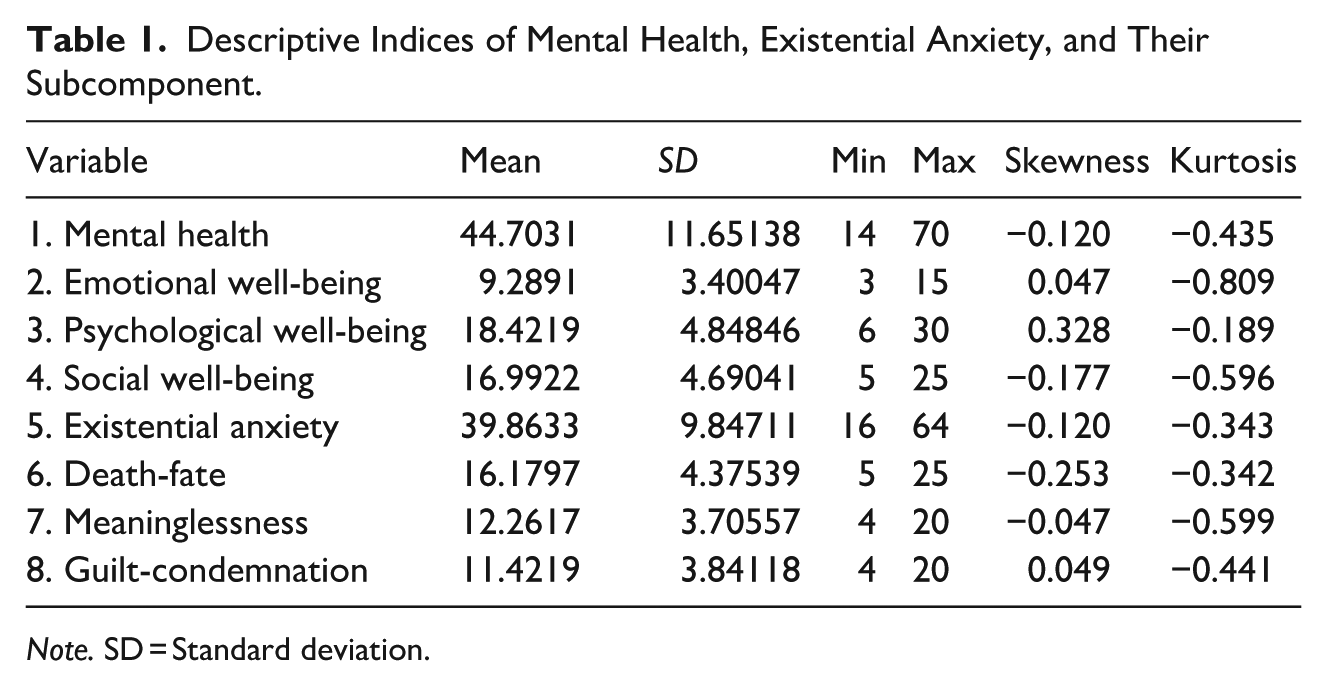
Table 1 presents the descriptive statistics for the main study variables. The average Existential Anxiety score was M = 39.86 (SD = 9.85), and the average Mental Health score was M = 44.70 (SD = 11.65). All variables exhibited skewness and kurtosis values within acceptable ranges (±1), indicating approximate normality and suitability for parametric analyses.
Descriptive Indices of Mental Health, Existential Anxiety, and Their Subcomponent.
Note. SD = Standard deviation.
Research Questions and Findings
RQ1 – Relationship Between Existential Anxiety and Mental Health
To address the first research question, a Pearson correlation analysis was conducted. Results indicated a statistically significant and strong negative correlation between Existential Anxiety and Mental Health (r = −0.670, p < .001). Plus, Existential Anxiety showed a stronger correlation with social well-being (r = −0.626). This suggests that higher levels of existential anxiety are associated with lower levels of mental health among university students, especially at social well-being level.
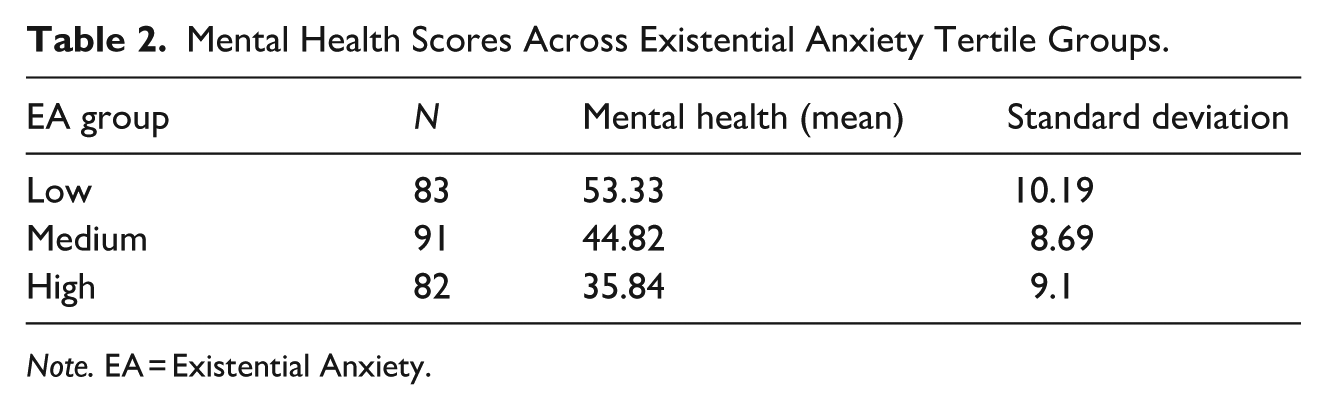
To further contextualize the finding, exploratory analyses were conducted by categorizing participants into low, medium, and high existential anxiety groups using tertile splits (Table 2). A one-way ANOVA revealed a significant difference in mental health scores across these groups, F (2,253) = 72.49, p < .001, with a large effect size (η² = .366). Post-hoc Tukey tests indicated that all group differences were statistically significant (p < .001). Participants in the high EA group reported substantially lower mental health (M = 35.84) compared to the medium (M = 44.82) and low EA groups (M = 53.33).
Mental Health Scores Across Existential Anxiety Tertile Groups.
Note. EA = Existential Anxiety.
RQ2 – Existential Anxiety’s Subcomponents and Mental Health Dimensions
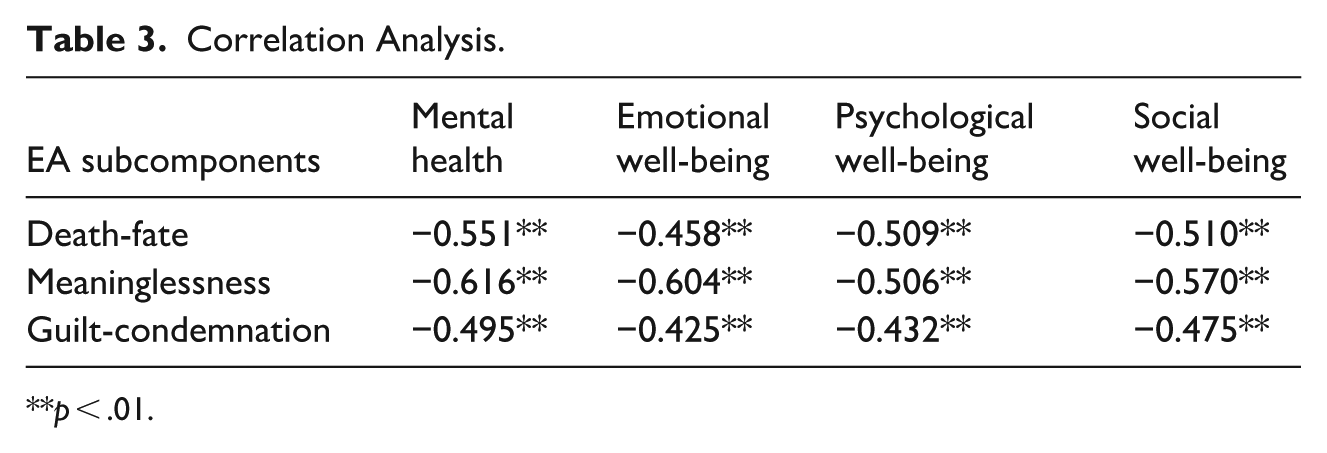
Drawing on Pearson correlation analysis, relationship between Existential Anxiety’s subcomponents and Mental Health dimensions was explored. As shown in Table 3, all three subcomponents of EA were significantly and negatively correlated with mental health and its dimensions. Meaninglessness demonstrated the strongest correlation with mental health (r = −0.616) and across all dimensions, particularly with emotional well-being (r = −0.604).
Correlation Analysis.
p < .01.
Death-Fate demonstrated the second strongest negative correlation with mental health (r = −0.551), with its strongest associations observed for psychological well-being (r = −0.509) and social well-being (r = −0.510). Guilt-Condemnation also exhibited a substantial negative relationship with mental health (r = −0.495), with its strongest correlation emerging for social well-being (r = −0.475). Overall, these findings indicate that higher levels of Existential Anxiety’s subcomponents lead to lower levels of Mental Health dimensions. Most importantly, Guilt-Condemnation and Death-Fate show a stronger correlation to social well-being, while Meaninglessness’s correlation score is stronger with emotional well-being.
RQ3 – Predicting Mental Health from Existential Anxiety’s Subcomponents
A multiple linear regression analysis was conducted to determine the predictive power of the three subcomponents of existential anxiety on mental health. The overall model was statistically significant, F (3, 252) = 70.806, p < .001, and explained 45.7% of the variance in mental health (R² = 0.457, Adjusted R² = 0.451). Multicollinearity diagnostics indicated acceptable levels, with variance inflation factor (VIF) values ranging from 1.37 to 1.81, well below the threshold of concern (VIF < 5).
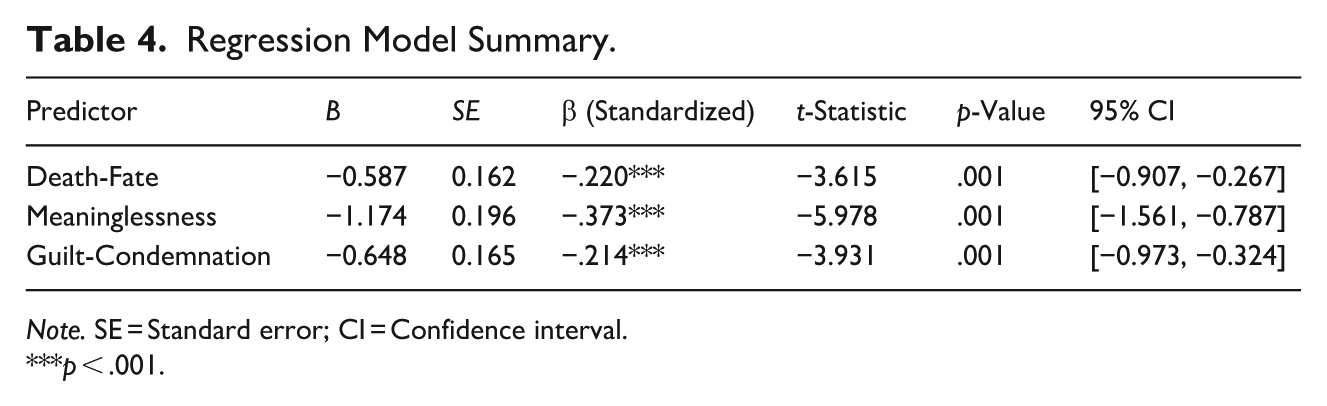
As shown in Table 4, all three subcomponents significantly predicted mental health. Among them, Meaninglessness emerged as the strongest predictor (β = −.373, p < .001), followed by Death-Fate (β = −.220, p < .001) and Guilt-Condemnation (β = −.214, p = .011). These results suggest that each subcomponent uniquely contributes to explaining variance in mental health, with meaninglessness having the most pronounced impact.
Regression Model Summary.
Note. SE = Standard error; CI = Confidence interval.
p < .001.
RQ4 – Moderating Role of Gender, Age, and Education Level
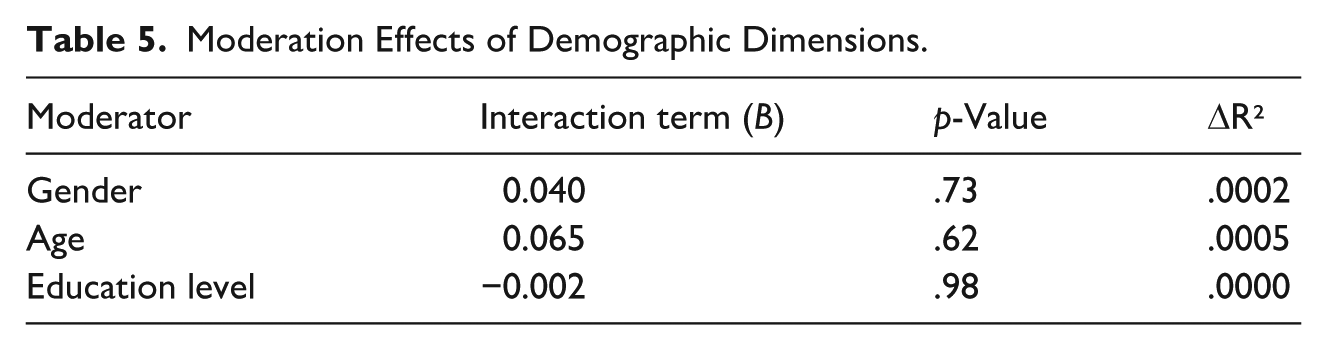
Using PROCESS Macro, a series of moderation analyses were conducted to examine whether gender, age, and education level moderate the relationship between existential anxiety and mental health. All three models were statistically significant (e.g. F (3, 252) = 69.81, p < .001), each examining approximately 45% of the variance in mental health outcomes. However, the inclusion of interaction terms did not meaningfully improve model fit, with R2 change values close to zero across all moderators (e.g. ΔR² = .0002 for gender).
As presented in Table 5, the interaction terms were not statistically significant for gender (B = 0.0401, p = .73), age (B = 0.065, p = .62), and education level (B = −0.002, p = .98), suggesting that none of these demographic variables moderate the relationship between existential anxiety and mental health. In other words, the negative association between existential anxiety and mental health remained consistent, regardless of participants’ gender, age, or education level. This finding suggests that existential anxiety may function as a robust and generalized predictor of diminished mental health.
Moderation Effects of Demographic Dimensions.
In addition to the total-score models, moderation analyses were also conducted separately for each existential anxiety subscale (Death-Fate, Meaninglessness, Guilt-Condemnation) in relation to the three dimensions of mental health (Emotional, Psychological, and Social Well-Being). Across these 27 models, interaction effects of gender, age, and education were generally non-significant (all ps > .10, ΔR² ≤ .03), indicating that the negative associations between existential anxiety and mental health dimensions were largely consistent across demographic groups. The only exception was a significant interaction between gender and guilt-condemnation in predicting social well-being (B = −4.11, SE = 1.51, p = .008, ΔR² = .027), suggesting that the detrimental effect of guilt-condemnation on social well-being was stronger among men than women (full coefficients for all models are available upon request).
Discussion
This study contributes to the growing literature linking existential anxiety to mental health by examining both the overall construct and its subcomponents – Death-Fate, Meaninglessness, and Guilt-Condemnation. The findings reveal a robust negative association between existential anxiety and mental health, with meaninglessness emerging as the most potent predictor. Each subcomponent uniquely contributed to psychological distress, underscoring the multidimensional nature of existential anxiety. Contrary to expectations, demographic factors such as gender, age, and education level did not moderate the relationship between existential anxiety and mental health, and the relationship between their subcomponents.
A significant negative correlation between existential anxiety and mental health is theoretically anticipated. Tillich (1952) argues that when existential anxiety is unacknowledged or repressed, it leads to neurotic anxiety, which distorts reality and impairs psychological well-being. As a result, those who fail to integrate existential concerns into their lives may experience chronic psychological distress, such as anxiety disorders or depression. Similarly, Yalom (1980) asserts that concerns about death, freedom, isolation, and meaninglessness are fundamental to the human condition, but when unresolved, they manifest as clinical symptoms. This shows that existential anxiety is not merely symptomatic but reflects a deeper inner conflict stemming from an individual’s confrontation with life’s ultimate concerns.
Furthermore, empirical research shows that high levels of existential anxiety are linked to a variety of psychological problems. Alshehri et al. (2024) demonstrated that existential anxiety has a strong and positive correlation with depression and is associated with increased psychological distress. Tomaszek and Muchacka-Cymerman (2020), similarly, highlighted the significant correlation between existential anxiety and general anxiety due to experiences of trauma. Moreover, Akbari et al. (2023) in their study found a close relationship between unresolved existential concerns and suicidality. Align with these, Weems et al. (2004, 2016) emphasize that heightened existential concerns are often accompanied by elevated psychological symptoms, especially during life transitions or periods of instability.
Brown et al. (2023) reported that college students often experience existential anxiety during phases of identity exploration and decision-making. Students described feeling unmoored amid newfound autonomy and pressure to construct a meaningful life, identifying meaninglessness, isolation, and responsibility as central emotional burdens. However, those who engaged in adaptive practices – such as cultivating structure, staying present-focused, or drawing on belief systems – reported greater resilience. Giannone and Kaplin (2020) showed that while Critical Existential Thinking (e.g. questioning life’s purpose) correlates with increased anxiety and depression, Personal Meaning Production is associated with lower psychological distress. This, again, suggests that existential anxiety is not inherently pathological; it becomes so when individuals lack the internal resources to encounter it.
These findings align with the current study’s result that meaninglessness is the most correlate with and the strongest predictor of mental health compared to other subcomponents of existential anxiety. Existential theorists have long emphasized the central role of meaning in life. Frankl (1959) asserted that the absence of meaning leads to “existential vacuum” – a psychologically destabilizing state. Yalom (1980) emphasized that even in the absence of death, we would still grapple with meaning. Moreover, Lifton (1979) and Sartre (1957) suggested that death is terrifying not only for its finality but because it renders life’s meaning uncertain. Similarly, foundational empirical research highlights that the presence of meaning in life predicts higher well-being, while search for meaning – especially when unresolved – correlates with higher stress (Steger et al., 2006).
Lie et al. (2022) found that existential anxiety is a significant predictor of suicidal ideation and depression. In their study, individuals experiencing a loss of meaning in life exhibited higher levels of depressive symptoms. Giannone and Kaplin (2020) explored the relationship between spiritual intelligence and mental health, suggesting that a lack of spiritual intelligence, which encompasses meaning-making, is linked to higher instances of addiction. Also, Pellens et al. (2022) found that existential anxiety mediates the relationship between a lack of meaning in life and depressive symptoms. Individuals with lower experiences of meaning reported higher EA, which in turn was linked to more severe depression. Moreover, Tommasi et al. (2022) in their study on doctoral students found that meaningless work is positively associated with anxiety and depression. The lack of meaningful engagement in work tasks contributed to psychological distress. Similarly, Brown et al. (2023) found that students unable to find direction or meaning during challenges reported greater psychological distress.
One of the interesting findings of the study is that Existential Anxiety, Death-Fate, and Guilt-Condemnation are most correlated with Social Well-Being, while Meaninglessness is better correlated to Emotional Well-Being. Although there’s no single unified theory explicitly formulating the relationship between Existential Anxiety and Social Well-Being, theoretical frameworks strongly imply or support this connection. Yalom (1980), for example, argued that much existential distress arises from struggles with Interpersonal Disconnection – the inability to form or sustain meaningful relationships; implying on the coined concept Existential Isolation. Empirically, this concept has been linked to existential anxiety and the fear of death (Costello & Long, 2014; Helm et al., 2018, 2019). Moreover, Anxiety Buffer Disruption Theory (Pyszczynski & Kesebir, 2011) – an extension of TMT – suggests that when anxiety buffers, including self-esteem, close relationships, and cultural worldview, are disrupted and ineffective, individuals become more vulnerable to existential anxiety. These show that interpersonal relationships play a key role in managing distress, and a disruption in them could lead to existential anxiety and its subcomponents.
However, empirical research is mainly focused on the connection between death anxiety and lack of social support (Fairlamb & Courtney, 2024; Huang et al., 2022; Jamal Livani et al., 2020), and there is not much of discussion on existential anxiety and existential guilt. On the contrary, recent studies have consistently demonstrated a strong positive relationship between Meaninglessness and Emotional Well-Being. Steger’s Meaning in Life Framework (2006–2011) shows that high presence of meaning is consistently associated with positive emotions, life satisfaction, and emotional resilience. Sameer et al. (2022) found a strong correlation between life satisfaction and the degree of perceived meaning in life, but little correlation with the pursuit of meaning. Similarly, Wolfram (2023) showed that meaning in life is associated with higher life satisfaction, even when positive and negative effects are controlled. Karataş et al.’s (2021) study also demonstrated that meaning in life is a significant predictor of life satisfaction. Moreover, studies link meaning in life with positive effects such as hope (Edwards et al., 2025) and satisfaction of autonomy, competence, relatedness, and beneficence (Martela et al., 2018) as well.
Frankl (1959) argues that when individuals fail to find meaning, they experience the Existential Vacuum, which manifests as boredom, apathy, depression, and inner emptiness – hallmarks of poor emotional well-being. Indeed, a perceived absence of meaning leads to Noogenic Neurosis, which is an existential form of emotional distress. In line with this, Deci and Ryan’s (2000) Self-Determination Theory discusses that meaning in life is often considered as a byproduct of fulfilling Autonomy, Competence, and Relatedness. When they are unmet, individuals experience lower emotional well-being and higher distress. Moreover, Heine et al. (2006) in their Meaning Maintenance Model discuss that human beings are motivated to maintain coherent and meaningful mental representations of the world. When meaning is disrupted (e.g. by trauma, loss), it triggers affective distress, which people try to reduce by restoring meaning elsewhere. As a result, a threat of meaning induces a negative affective state, often including anxiety, sadness, or disorientation, until meaning is reconstructed.
Another key finding suggests that gender, age, and education level do not moderate the relationship between existential anxiety and mental health. Classical existential theories such as Yalom (1980) and Tillich (1952) conceptualized existential anxiety as Universal but acknowledged that Gendered Socialization may shape how individuals express or suppress anxiety. Aling with this, Feminist Existentialists (de Beauvoir, 1949) argue that women’s existential anxiety is often shaped by social oppression, limited freedom, and the Othering of the female identity, which impacts how women experience existential anxiety and mental health. Similarly, May (1958) notes that the Cultural Repression of Emotion in men may impede authentic living and increase existential distress in them. As a result, gender seems to be a Cultural factor for existential theorists, which may influence the relationship between existential anxiety and mental health.
Similarly, research literature shows inconsistency in gender studies. For example, Robah (2017) found that women scored significantly higher on existential concerns, suggesting a heightened sensitivity to existential threats possibly due to socialization patterns, emotional attunement, and bodily vulnerability. Similarly, Lloyd et al. (2015) showed that young clinical women exhibited higher existential vulnerability, which was associated with depressive symptoms and reduced life engagement. On the contrary, recent studies such as Li et al. (2022) and Giannone and Kaplin (2020) found no significant gender differences, indicating that while gender may moderate existential anxiety, the findings are not yet conclusive across populations.
Although study’s focus was not on specific age groups, finding of non-moderating role of age is in contrast to the theory. Most of the participants of the study (N = 207, 81%) were between age 18 and 25. Arnett (2000) described this phase as “emerging adulthood,” characterized by identity exploration, instability, and heightened self-focus. Yalom (1980) views age as relevant, particularly during Life transitions (e.g. adolescence → adulthood). According to him, vulnerability increases in Emerging Adulthood and Later Life, when existential questions (e.g. “who am I?” or “what legacy do I leave behind?”) become particularly salient. Additionally, Maslow (1968) suggests that different stages of life prioritize different psychological needs (e.g. belonging in adolescence or self-actualization in adulthood). He argues that mental health is enhanced when people successfully meet age-relevant developmental challenges and needs.
Research literature also seems to be aligned with the theory. For example, Brown et al. (2023) identified ages 18 and 25 as a period where existential concerns intensify, especially when individuals face decisions about identity, relationships, and future goals. Robah (2017) further found a U-shaped distribution of death anxiety, peaking in the 20s and again in later life. Lloyd et al. (2015) also documented elevated existential vulnerability in young adult women, reinforcing the idea that this developmental window is uniquely sensitive. However, the study’s finding is suggesting that age doesn’t play a significant role in the relationship between existential anxiety and mental health, which is to say that existential anxiety’s function is unique and doesn’t change in different age groups. This finding is a challenge to existential and humanistic theories, and research literature in this field. However, this must be interpreted with cautious, as it could be as a result of study’s purpose, cultural and individuals’ differences.
Moreover, current study shows that education alone does not appear to moderate the relationship between existential anxiety and mental health, which is aligned with the theory. Yalom (1980) warns that Intellectualization, common in highly educated individuals, can be a defense against confronting deeper existential truth. Frankl (1959) emphasizes meaning-making capacity, not education level, as the key protective factor against existential distress. Similarly, Maslow (1968) states that education can enhance mental health only if it promotes Autonomy, creativity, and self-actualization.
Empirical research is also aligned with the theory and current study’s finding. For instance, Alshehri et al. (2024) reported high levels of existential anxiety in both undergraduate and graduate Saudi students, with no significant differences by education level. Evram and Çakici Eş (2020) found that personal variables such as emotional resilience and self-esteem were more predictive of existential anxiety than education. Giannone and Kaplin (2020) further showed that meaning-making capacities, not academic attainment, protect against existential distress. Thus, while education may shape the context in which existential anxiety arises, it does not inherently guard against it – suggesting that psychological factors are more crucial to mental health outcomes.
Limitations and Future Direction
While this study offers valuable insights into the relationship between existential anxiety and mental health, several limitations should be acknowledged. First, the cross-sectional design restricts the ability to draw causal conclusions about the relationship between existential anxiety and mental health outcomes. Longitudinal studies are needed to determine whether existential concerns precede mental health declines, or whether deteriorating mental well-being increases vulnerability to existential anxiety. Then, the study relied exclusively on self-report measures, which may be subject to introspective limitations, social desirability bias, and response effects. Although the instruments used were psychometrically sound, incorporating mixed methods – such as phenomenological interviews, narrative accounts, observation, or behavioral measures – would provide a more nuanced understanding of the lived experience of existential anxiety.
Furthermore, the composition of the sample was uneven across key demographic groups. Male participants, graduate students, and individuals aged 25 to 30 were underrepresented relative to younger undergraduates and female respondents. As a result, findings related to age, gender, and educational level should be interpreted with caution, as these subgroups may not have been sufficiently powered to reveal the full variability of existential concerns across developmental or identity contexts. Moreover, the sample was drawn from a single institution. Cultural, religious, and academic norms specific to this population may limit the generalizability of findings. Comparative studies across diverse regions, including both collectivist and individualist cultures, could illuminate the sociocultural dynamics that shape the intensity and content of existential anxiety.
Additionally, the study assessed existential anxiety using only three subcomponents -meaninglessness, death-fate, and guilt-condemnation – while other core existential concerns, such as existential isolation and freedom-responsibility, were not included. Furthermore, assessment of each subcomponent relied on a small number of items from the EAQ (Weems et al., 2004) based on Tillich’s (1952) theory. While these items provided focused indicators of the constructs, they may not have captured the full depth of each subcomponent; more comprehensive instruments would be more beneficial for future studies. Besides, this study did not examine the potential role of mediating factors, such as meaning-making skills, spiritual intelligence, resilience, or social support systems. Future research should explore how these variables interact with existential anxiety to either buffer or intensify its psychological effects, particularly among vulnerable student subgroups.
Furthermore, the possible mediation pathways, such as whether the impact of death anxiety on mental health was mediated by meaninglessness and guilt, were not investigated. Examining such mediations in future work would clarify the mechanisms through which existential concerns shape well-being. Lastly, the role of cultural difference was not discussed. While this study draws upon existential theories developed primarily within Western intellectual traditions, the data emerged from a non-Western, Iranian student population. Classical existential frameworks – such as those proposed by Yalom, Frankl, and Tillich – are rooted in values of individual freedom, self-authorship, and autonomous meaning-making. In contrast, Iranian culture tends to emphasize relational identity, familial responsibility, and spiritual transcendence – values often embedded within religious teachings and collective moral expectations (Azadarmaki & Bahar, 2006). These cultural structures inevitably shape the way existential concerns are experienced and expressed. As a result, future research should take into account cultural differences as well.
Conclusion
This study examined the complex relationship between existential anxiety and mental health among university students. Statistical analysis showed that elevated existential anxiety is associated with significantly diminished mental health. Among existential concerns, meaninglessness emerged as the most potent predictor of mental distress, reinforcing long-standing existential and humanistic theories that emphasize the centrality of purpose and coherence to mental health.
Importantly, the lack of moderation by gender, age, and education level suggests that existential anxiety operates as a distinct psychological phenomenon, transcending demographic boundaries. This finding supports classical claims regarding the universality of existential concerns while also challenging assumptions about demographic variation often reported in research literature. Furthermore, the distinct associations between different subcomponents of existential anxiety and dimensions of mental health highlight the need for more differentiated and targeted therapeutic and social interventions.
While these insights deepen our understanding of existential anxiety and its interaction with mental health, the study also underscores several areas for further investigation. For instance, the reliance on limited subcomponents and measurement’s narrowed items calls for more comprehensive instruments that can capture a fuller range of existential experiences including Existential Isolation. In addition, future research should explore how mediating variables such as resilience, meaning-making ability, and social connectedness may buffer the psychological effects of existential anxiety.
In sum, this study contributes to the ongoing effort of reconceptualizing existential psychology within contemporary, multicultural, and developmental frameworks. By centering meaninglessness as the core determinant of mental health (comparing to other existential anxiety subcomponents), it calls for reconsidering this concept as a vital contributor to individuals’ mental well-being, especially for university students. Supporting adults in this era of life requires approaches that do not simply pathologize distress but help individuals meaningfully engage with it. In doing so, we affirm one of humanistic psychology’s central insights that “psychological growth is often born from our most profound existential questions.”
Footnotes
Acknowledgements
We sincerely thank all participants for their invaluable contributions to this study.

Consent to Participate
Written informed consent was obtained from all participants.
Authors Contributions
Mahyar Nikpour Rahmat Abadi was responsible for data collection, data analysis, writing the introduction and discussion, and manuscript preparation; Yoones Rajaei was responsible for cooperation on data collection, writing the method and findings, and cooperation on writing the discussion; Erfan Abdollahi Chirani was responsible for cooperation on data collection and data analysis.
Funding
The authors received no financial support for the research, authorship, and/or publication of this article.
Declaration of Conflicting Interests
The authors declared no potential conflicts of interest with respect to the research, authorship, and/or publication of this article.
Data Availability Statement
The data that support the findings of this study are available from the author upon reasonable request.